

ON THE COVER (May 2026)
August 9th, 2026 · Comments Off on ON THE COVER (May 2026)
Comments Off on ON THE COVER (May 2026)Tags: Annex · On the cover
NEWS: Saxe hosts town hall about congestion (May 2026)
August 9th, 2026 · Comments Off on NEWS: Saxe hosts town hall about congestion (May 2026)
City staff speak about rising concerns related to traversing Toronto
By Damola Omole
University-Rosedale Councillor Dianne Saxe hosted a virtual town hall meeting on the evening of April 16 which brought together city officials on infrastructure and congestion to get to the bottom of the issues that seem to perpetually afflict the roads of Toronto.
Just over 70 people turned out to listen to the discussion and voice their concerns.
“I do understand [congestion] is a frustration for residents and visitors alike. It’s a drain on our economy, and it impacts our environment as well. And if left, to me, it will become something that lowers our quality of life. So it’s very, very important, of course, to manage it.”
Those were the words of Andrew Posluns, the chief congestion officer and executive director at the strategic capital coordination office at the city’s infrastructure services. Posluns delivered a presentation chock-full of key insights into the city’s varying strategies to reduce congestion.
Toronto’s growth, he explained, is both a sign of success and a major contributor to its traffic challenges. With millions living across the Greater Toronto Area and increasing numbers of commuters returning to in-person work, demand on the city’s transportation network continues to rise. At the same time, shifting travel behaviour, including a 17 per cent increase in ride-hailing use, are reshaping how congestion manifests.
Better transit decreases congestion, and investments in transit signal priority, which allows buses and streetcars to move through intersections more efficiently, have led to measurable gains. On the Eglinton Crosstown’s Line 5, for example, riders have seen travel times reduced by up to 20 minutes on a round trip, according to city statistics.
Changes like this form part of a congestion management plan built on what Posluns identified as “five key pillars.” The first focuses on minimizing the disruption caused by construction which is widely seen as one of the biggest contributors to gridlock. A program introduced in 2025 now charges fees for occupying road space, incentivizing contractors to complete work more quickly and coordinate with other projects to avoid overlapping closures.
The second pillar expands traffic management efforts. The city currently deploys about 100 traffic agents to manage flow at busy intersections. This number is expected to grow to 127 by the end of the year. Meanwhile, Toronto is upgrading its aging traffic operations centre by aiming to incorporate real-time data and improve coordination with police when incidents occur.
Improving surface transit is the third pillar.
With road space limited, the city is prioritizing modes of transportation that can efficiently move more people.
Plans are underway to expand transit signal priority to 72 additional intersections, alongside measures such as adjusting parking rules on busy routes to keep buses and streetcars moving.
AI and smart technology play a central role in the fourth pillar. Posluns described how the city is experimenting with “smart signals” that use sensors to adapt to traffic conditions in real time, as well as “intelligent intersections” that integrate data on vehicles, cyclists, and pedestrians to optimize flow. Longer-term ambitions include developing a “digital twin” of Toronto’s transportation network to simulate and plan for congestion scenarios.
The final pillar focuses on shifting travel behaviour. Through public awareness campaigns and partnerships with employers and event organizers, Andrew says the city is encouraging transit use, particularly during major events.
One such event looming large is the upcoming 2026 FIFA World Cup, which is expected to bring hundreds of thousands of visitors to the city. Officials emphasized that it will be a “transit-first” event, with no parking available near venues and increased TTC service to accommodate demand.
At the end of the presentation, Saxe directed the discussion towards that of the more outspoken individuals present at the meeting. Some residents raised broader questions about the roots of congestion. Several pointed to rapid real estate development around areas such as subway lines which are key pressure points.
Many of the attendees drew comparisons between Toronto and New York.
For instance, multiple people brought up New York’s recent congestion pricing program. There is a fee of $9 for cars entering a part of Manhattan on weekdays between 5 a.m. and 9 p.m. The fee is to reduce traffic and pollution.
Discussions as to whether Toronto should adopt this policy have been ongoing for a while; however, one area that may be untapped is a Eurasian model of city planning.
Many of the largest cities with the least amount of traffic exist in Europe (Amsterdam and Zurich) and Asia (Singapore, Uzbekistan, and Tokyo).
Many of these cities share similarities with Toronto such as high parking prices and above average transit systems; however, Toronto lacks many of the factors (like advanced cycling and walking infrastructure, convenient high-density, mixed-use urban planning, and superior road management) that make these cities so efficient such as advanced cycling and walking infrastructure, high-density, mixed-use urban planning, and superior road management.
Based on past critiques, our city has a long way to go in terms of striking mix of modes of transportation.
Underlying many of these discussions is a fundamental tension: how to balance competing demands on limited road space. From bike lanes and pedestrian zones, to parking and transit, each intervention carries trade-offs.
“There are a lot of competing demands on our shared space,” Posluns said. “The [challenge] is getting the balance right.”
Comments Off on NEWS: Saxe hosts town hall about congestion (May 2026)Tags: Annex · News
IF THESE WALLS COULD TALK: Author Katherine Govier lived at 411 Brunswick Ave. (May 2026)
August 9th, 2026 · Comments Off on IF THESE WALLS COULD TALK: Author Katherine Govier lived at 411 Brunswick Ave. (May 2026)
115 years of rich history in these walls

By Mike Mastromatteo
There are doubtless hundreds of stories and anecdotes that arise from stately Brunswick Avenue in the central Annex, but this month we are concentrating on just one place: 411 Brunswick.
This 115-year-old, much-renovated rooming house, has been home to dozens of owners and renters over its lifetime.
By the late 1960s, 411 Brunswick, like many places in the Annex, had been converted into a rooming house, with separate living units on the first, second, and sometimes third floors.
In the early 1970s, the property—and many houses along Brunswick Avenue—contributed to the “literary Annex” lore by housing prominent writers and various creative types. We’ll get to one of those later, but we will now begin with some early history.
The first owner of the house, according to the city directory, was Francis Phillips who had moved in by 1912.
Phillips was identified as a “builder” in the 1901 census and building appeared to be his forte. His name appeared in the Toronto Daily Star a few times in September of 1895 as the purchaser of three parcels of land—numbers 419, 420, and 421 Brunswick Ave.—all of which had to be sold due to arrears with the property taxes.
It’s uncertain if there were houses attached to these properties before the year 1912. A Globe and Mail news item from Nov. 5, 1903 said that “a pretty house wedding [took place] Wednesday, November 4, at the house of Mr. and Mrs. Francis Phillips, when their [third eldest] daughter Emma Dawson was married to James Henry Cox.”
The Phillips family resided on Henry Street in the very early years of the 20th century, but had moved into the Brunswick home by 1912. In any case, Mr. Phillips resided at 411 Brunswick Ave. until 1921. He passed away in October 1921 at age 77. His widow Eleanor survived him for only a short time but passed away in November of 1924, aged 74.
The Phillips’ eldest daughter, Mona Amelia Phillips, resided there until December 1946, when as the Globe and Mail reported, she “entered into rest at her home at 411 Brunswick Ave.”
Sad as it may seem, there were a lot of deaths at the home over the years.
In March 1929, Thomas Herbert Ellenor, husband of the Phillips family’s third eldest daughter Emma, died suddenly of an unspecified cause. The Ellenors suffered another heartbreak a quarter-century earlier. Thomas Herbert Ellenor and his wife Eleanor, had a daughter, Louise Frances, who died Jan. 13, 1904 at age four months.
An assortment of owners and short-term residents occupied the house between 1950 and today. One of the more artistically-inclined was George Gerhardt who occupied one of the apartments in the early 1960s.
A copywriter at Eaton’s by day, Gephardt was an accomplished stage performer with the Eaton’s Operatic Society which put on operettas at the College Street Eaton Auditorium between 1931 and 1965. In the Toronto Daily Star’s February 8, 1963 edition, George Gephardt was mentioned for his portrayal of the Persian travelling peddler Ali Hakim who courts “boy crazy” Ado Annie in the Rodgers and Hammerstein play, Oklahoma.
The creative talents of George Gephardt provide a good segue to the “literary Annex” and the contributions of the house at 411 Brunswick.

One of the more illustrious occupants in the early to mid-1970s is Canadian novelist and short story writer Katherine Govier. The author of the highly acclaimed novel Angel Walk (1996) and the more relevant (for our purposes) short story collection, Fables of Brunswick Avenue (1985), Govier resided for four years at 411 Brunswick Ave. She first lived at 398 and 409 Brunswick before settling into the writer-friendly 411.
In talks with the Gleaner, Govier reflected on her time on Brunswick Avenue, especially at 411.
As a writer, Govier found the aura of the home to be her literary muse. “I wrote most of my first novel, Random Descent (1979), on the back sun porch of 411 Brunswick,” she said.
She also had good things to the say about the area’s impact on Canadian writers eager to make their mark on the literary scene. “I was in my 20s, and I was in a roaring hurry to write things down,” she said. “The Annex and Brunswick Avenue were places where we felt part of a real community. We walked everywhere. We didn’t have cars. Sometimes we rode bikes, but we would be walking up and down to Bloor Street and we would meet and talk about books. It was an early time of Canadian culture rebirth. And we were all hugely energized by this idea of our country—the stories we were going to tell and how we were going to make the world different.”
At one point, Govier invited fellow Canadian writer Joy Kogawa to share the home at 411 Brunswick and to work on her highly acclaimed novel, Obasan (1981).
Chronicling the Canadian government’s internment of Japanese immigrants during the Second World War, the book has become required reading for many English courses on Canadian literature.
Some of Govier’s experiences in the Annex are fictionalized in short stories contained in Fables of Brunswick Avenue. Given the “if these walls could talk” theme for this series, perhaps this passage from the short story A New Start, is most applicable: “Margaret painted her wonderful street as a ghost street, windy, and her row of peaked houses empty at the top with broken gable windows where pigeons went in and out. The main floors were full of blue rooms where people squatted in front of flickering televisions.”
This tableau of life on one of the Annex’s most colourful streets may soon be repeated with Govier’s next collection of short stories, Lights Out on Brunswick Avenue. Stay tuned!
READ MORE:
- IF THESE WALLS COULD TALK: 74 Vermont Ave. is one of the oldest on the block (Apr. 2026)
- IF THESE WALLS COULD TALK: Bathurst Street landmark fading into a prolonged sunset (Mar. 2026)
- IF THESE WALLS COULD TALK: Once upon a time at 27 Follis Ave. (Feb. 2026)
- IF THESE WALLS COULD TALK: So many rich and diverse lives lived in these twin houses (Jan. 2026)
- IF THESE WALLS COULD TALK: Before the Maddy was a pub it was a mansion (Dec. 2025)
- IF THESE WALLS COULD TALK: 351 Palmerston Blvd. (Oct./Nov. 2025)
- HISTORY: If these walls could talk (Sept. 2025)
Comments Off on IF THESE WALLS COULD TALK: Author Katherine Govier lived at 411 Brunswick Ave. (May 2026)Tags: Annex · History
NEWS: ARA hosts AGM (May 2026)
August 9th, 2026 · Comments Off on NEWS: ARA hosts AGM (May 2026)
Bloor Annex BIA’s maintenance worker shares Community Builder Award
By Shaya Rahmani
Annex residents gathered on April 23 for the Annex Residents’ Association (ARA) annual general meeting (AGM) where community concerns and local contributions took center stage. The annual gathering brought together residents, organizers, and local advocates to reflect on the past year and discuss ongoing neighborhood issues.
Chair Rita Bilerman opened the meeting with a call to order, followed by a land acknowledgement, approvals of the agenda, minutes of the 2025 AGM, and financial statements. The evening moved through a series of reports and updates, but a highlight came with the presentation of the Community Builder of the Year Award.
The award, which started in 2017, goes to an Annex resident who makes the neighborhood better, typically through quiet effort that isn’t seen by many others.
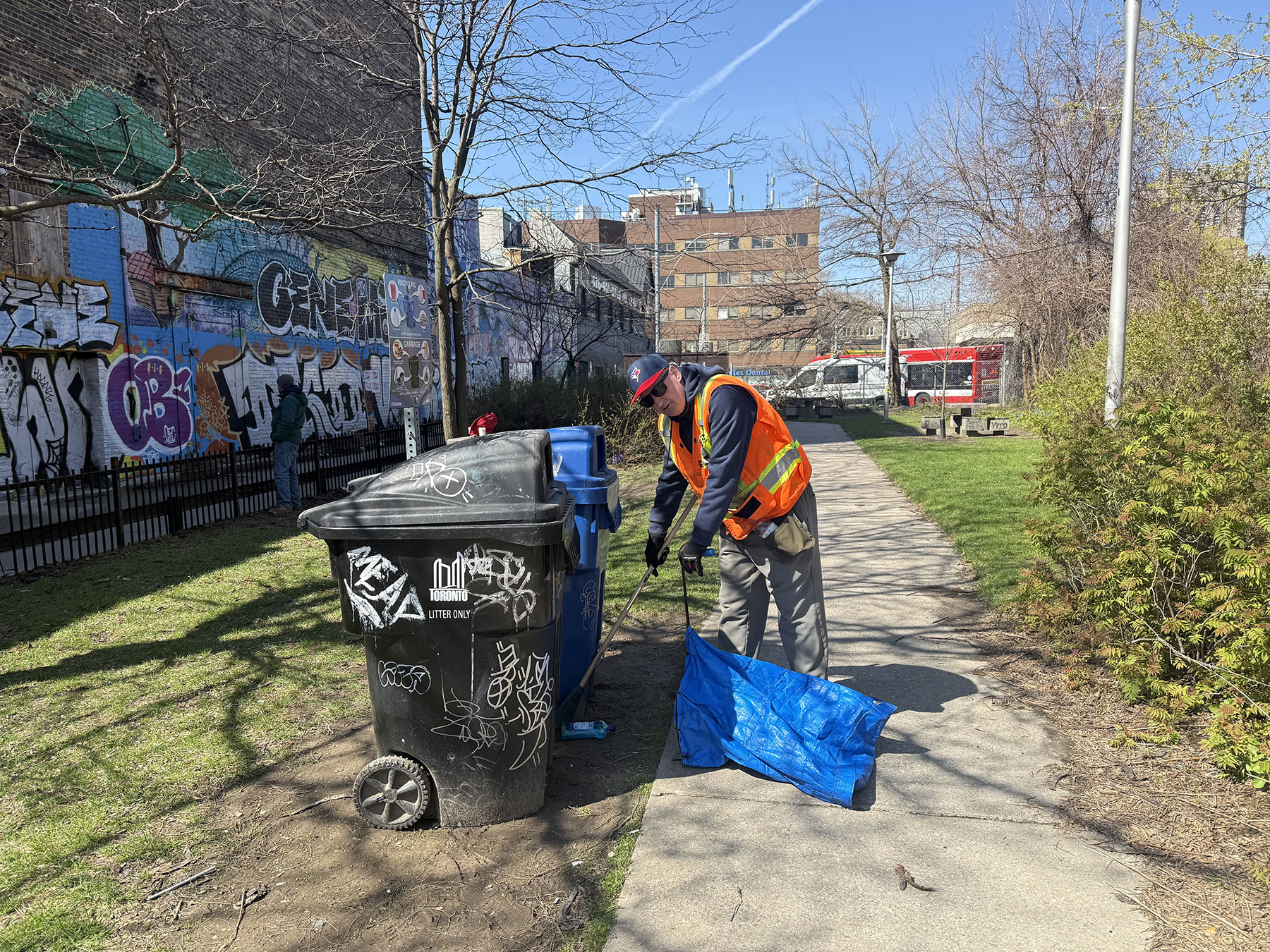
This year, the ARA honored Dan Deffett and Alberto Martin for their efforts in supporting and maintaining the community, especially in cleaning and reviving Seaton Park on Albany Avenue. Deffett, who works for the Bloor Annex Business Improvement Area cleaning and maintaining sidewalks, parkettes, and public spaces between Bathurst Street and Madison Avenue, has become a familiar figure in the neighborhood. Known for his friendly attitude and dedication, he said his work comes naturally.
“I’ve been doing this for about five years off and on and it’s just my own personality,” Deffett said. “I don’t like litter. I don’t like graffiti. So, you know, it’s not work for me.”
Attendees cheered when Deffett took the award, showing their appreciation for the small things that people do every day that often go unnoticed but help make the Annex a better place to live and feel like a community.
Housing and other concerns that affect the whole community were also addressed at the AGM. Lynda Macdonald, the keynote speaker, gave a talk called Collaboration in Development that brought up worries about access and affordability. People were talking about the Rent-Geared-to-Income (RGI) system, its long waiting list, and how it doesn’t do a good job helping people who really need it.
During the question period, residents voiced frustration and concern. One attendee jokingly asked, “What does affordable housing mean?” drawing some laughter, while another raised serious concerns about tenants being priced out through demovictions and renovictions.
Deffett, who said he is also on the RGI waitlist, humorously said, “I will be dead before they get to me.”
Councillor Dianne Saxe did not attend the ARA’s meeting because the meeting fell on the same day as the city council meeting, but a representative delivered remarks on her behalf.
The representative expressed appreciation for the work of the ARA and its role in advocating for the community.
Updates on heritage, parks, trees, and the environment, along with a presentation on a local tree survey and an update about KESKUS Estonian Cultural Centre, rounded out the agenda.
While the meeting covered a wide range of issues, the recognition of community builders underscored the role individuals play in maintaining the Annex’s reputation as a liveable and engaged neighbourhood. The meeting concluded with door prizes and adjournment.
READ MORE:
- CHATTER: Community Builder of the Year: Neil Jain (May 2019)
- NEWS: ARA holds annual meeting (Election Special 2018)
- CHATTER: Larry Sdao receives Community Builder Award (JULY 2017)
- CHATTER: Nominate a community builder (MARCH 2017)
Comments Off on NEWS: ARA hosts AGM (May 2026)Tags: Annex · News
CHATTER: Huron Spring Picnic aims to raise $30,000 amid funding pressures (May 2026)
August 9th, 2026 · Comments Off on CHATTER: Huron Spring Picnic aims to raise $30,000 amid funding pressures (May 2026)
The annual Huron Spring Picnic will take place on June 4 from 4 p.m. to 8 p.m. at Huron Street Junior Public School. The goal is to raise $30,000 through community donations, food sales, and a silent auction.
“It’s important every year,” said Cassandra Harvey, co-chair of the school council and one of the picnic organizers. “But this year…we’ve seen so many budget cuts to the school board. We’re really trying to focus on reaching that goal so we can supplement what is being taken away.”
Funds raised go directly back into the school and support everything from classroom enrichment to basic needs. Harvey said programs funded by past picnics include artists and scientists in the school, a student mural project, and a weekly lunch program that feeds around 20 students twice a week.
“We feed them if their parents can’t afford to,” she said. “All of the money goes right back into the students.”
The event, which serves a school community of roughly 300 to 350 students, also plays a broader role in the neighborhood.
“I would say it feels wholesome and happy,” Harvey said. “There’s not so many community events… and everyone is invited.”
This year’s picnic features returning staples like a student talent show, a bake sale, and a barbecue, alongside new attractions such as a Zumba session for kids and parents. Organizers have also expanded community support, with dozens of local businesses contributing auction items and food donations.
Harvey said the talent show remains a highlight. “It’s really, really fun…everyone looks forward to it.”
Organizers are still seeking vendors, donations, and volunteers, and they encourage community members across the Annex to attend.
For more information about how to participate or donate, contact the Huron Picnic donations team at picnichuron@gmail.com
—Shaya Rahmani, Gleaner News
Comments Off on CHATTER: Huron Spring Picnic aims to raise $30,000 amid funding pressures (May 2026)Tags: Annex · News
LETTERS TO THE EDITOR (May 2026)
August 9th, 2026 · Comments Off on LETTERS TO THE EDITOR (May 2026)
Re “The man who will never be mayor struggles to be premier” (Apr. 2026)
This is a strong editorial but I must make one correction.
You suggest that land should not be removed from the Greenbelt because it doesn’t have “basic infrastructure” such as sewers and drinking water. But the Greenbelt should be protected not because it’s unsuitable for home-building. It should be protected because nature possesses intrinsic worth.
The Humber River valley, for instance, has dignity and beauty—you must visit it this spring!—quite apart from what it can do for humans.
—Gideon Forman
Vermont Avenue
Re “Coffee Two Ways” (Feb. 2026) and “New in Business: Delightfully Turkish” (Sept. 2025), the Gleaner’s Howard Pressburger has a fan:
Kudos for your restaurant reviewer. He’s intelligent. He includes lots of interesting information, and I trust him.
—Maxine Sidran
A long time Gleaner reader
Comments Off on LETTERS TO THE EDITOR (May 2026)Tags: Annex · Letters · Opinion
EDITORIAL CARTOON: How Ford (May 2026)
August 9th, 2026 · Comments Off on EDITORIAL CARTOON: How Ford (May 2026)

SEE MORE EDITORIAL CARTOONS:
- EDITORIAL CARTOON: How Nice-ish (Apr. 2026)
- EDITORIAL CARTOON: How Wonderful (Mar. 2026)
- EDITORIAL CARTOON: How ICE (Feb. 2026)
- EDITORIAL CARTOON: A P.P. easement (Jan. 2026)
- EDITORIAL CARTOON: Con spawn (Dec. 2025)
- EDITORIAL CARTOON: Speed sham (Oct./Nov. 2025)
- EDITORIAL CARTOON: Taking care of business (Sept. 2025)
- EDITORIAL CARTOON: How to buy Canadian (Aug. 2025)
- EDITORIAL CARTOON: Silly vs. Silly (May/June 2025)
- EDITORIAL CARTOON: “Poll toll” (Apr. 2025)
- EDITORIAL CARTOON: The Perils of Pierre Pufferfish (Mar. 2025)
- EDITORIAL CARTOON: Doug out-thugged, needs a hug (Feb. 2025)
- EDITORIAL CARTOON: “A tiny silver lining!” Jan. 2025
- EDITORIAL CARTOON: Today’s flavour: cookie dough (Dec. 2024)
- EDITORIAL CARTOON: Disinformation 101 (Oct./Nov. 2024)
- EDITORIAL CARTOON: Get ready for Eglinton! (Sept. 2024)
- EDITORIAL CARTOON: Staggering Progress! (Summer 2024)
- EDITORIAL CARTOON: How Nice (June 2024)
- EDITORIAL CARTOON: How Nice (May 2024)
- EDITORIAL CARTOON: How Nice: NIMBYism 101 (Apr. 2024)
- EDITORIAL CARTOON: Why can’t they get along??? (Mar. 2024)
- EDITORIAL CARTOON: How to drive in Toronto (Feb. 2024)
- FORUM: Celebrating 20 years of cartoonist Brett Lamb (April 2017)
Comments Off on EDITORIAL CARTOON: How Ford (May 2026)Tags: Annex · Editorial · Opinion
EDITORIAL: Dougy and the jets (May 2026)
August 9th, 2026 · Comments Off on EDITORIAL: Dougy and the jets (May 2026)

The Ontario government is in a debt and deficit crisis, and the cost of living has skyrocketed; yet, the premier thought this would be a great time to buy himself a luxury jet with Ontario taxpayers’ money.
The decision to buy the secondhand Bombardier 650 jet for $28.9 million was recently approved by the flying monkeys who inhabit the Ontario cabinet. The Toronto Star discovered the purchase. It was not announced by the premier, nor did it appear in the recent budget. Merit Stiles, Ontario NDP leader, cleverly coined it the “gravy plane.”
The premier was equally chagrined and defensive. He reversed course within two days of the purchase being discovered. He did not say, “I am sorry. It was the wrong decision.” Instead, he said, “I am sorry, but it was the right decision.” This warrants analysis.
The province is carrying a cumulative debt north of $400 billion, the largest in Canada. The annual cost to service this debt is $16 billion, or 7.1 per cent of the Ontario budget. The 2026-27 budget forecasts an additional deficit of $13.6 billion which will only add to the bleeding. The days of blaming the Liberals or COVID are gone; it’s all on you Mr. Ford. This is just bad management by a government that has got a little too comfortable in power and is seeking some perks.
This purchase happened as Premier Ford was ramming through legislation protecting his and his cabinet’s cell phone records retroactively from freedom-of-information requests (FOIs). The FOI plan was buried as an addendum to the recent budget bill. Doug Ford thinks he is above the law, and he clearly has something to hide.
According to Bombardier, the jet Ford bought requires a runway length of 5640 feet to takeoff when fully loaded. In the same week as the jet buy, the premier introduced legislation to expropriate the Billy Bishop Airport from the city and proposed to allow jets and extend the runway to 5900 feet. Coincidence is unlikely here.
Ford defends the decision in several ways. Ontario is big, “twice the size of Texas” he says, and he needs the plane to get around. Other premiers have jets he said, and Ontario is playing catch-up. He said that when he flies commercial, there have been occasions when other passengers have been verbally abusive. He also told Global News that he fears propeller aircraft.
While it is true Ontario is big, the plane he chose can only land at 19 of Ontario’s 179 airports, including Billy Bishop, should it be extended. Poor research by the premier.
It is actually not the case that other premiers have jets and belong to a club Ford wants to join. According to the CBC, no other provincial or territorial leader has one. They all fly commercial, and half of them sit in economy. Quebec has government jets, but these are air ambulances, a fact Ford has chosen to overlook.
As for passengers being verbally abusive to him at 30,000 feet, maybe stop acting like such an asshole to invite such inappropriate conduct.
It’s not the Ontario taxpayers’ job to help Doug Ford overcome his fear of propeller aircraft. He could try therapy or take the bus or train instead; it would certainly be cheaper that a $30-million jet equipped with leather lazy boys and all the associated costs of flying it.
Ford thinks he is invincible; he is not. The latest polls put him neck to neck in popular support with the leaderless Liberals at 37 per cent. Try governing for all of Ontario for a change, and stop conducting yourself like a monarch.
READ MORE EDITORIALS:
- EDITORIAL: The man who will never be mayor struggles to be premier (Apr. 2026)
- EDITORIAL: Take from the poor and give to the rich (Mar. 2026)
- EDITORIAL: ‘An international relations earthquake’ (Feb. 2026)
- EDITORIAL: Poilievre endorses Trump’s actions; he should never be PM(Jan. 2026)
- EDITORIAL: Toronto has matured; Doug Ford has not (Dec. 2025)
- EDITORIAL: Governing by gut, not facts (Oct./Nov. 2025)
- EDITORIAL: Pierre is in a political pickle (Sept. 2025)
- EDITORIAL: Fact over fiction: Ford’s Bill 212 fails on its merits (Aug. 2025)
- EDITORIAL: No experience necessary managing a school board (July 2025)
- EDITORIAL: Bill 5 recklessly endangers Ontario (May/June 2025)
- EDITORIAL: Thou shalt not park in a bike lane (Apr. 2025)
- EDITORIAL: Bike lane facts Ford knew (Mar. 2025)
- EDITORIAL: Poilievre’s perfect storm (Feb. 2025)
- EDITORIAL: An election designed to distract voters (Jan. 2025)
- EDITORIAL: Bill 212 causes congestion (Dec. 2024)
- EDITORIAL: Fact-checking Ford (Oct./Nov. 2024)
- EDITORIAL: An injection of ignorance (Sept. 2024)
- EDITORIAL: Road safety for some, sometimes (Summer 2024)
- EDITORIAL: Ford’s boozy billion-dollar blunder (June 2024)
- EDITORIAL: Ford needs to step up and lead for once (May 2024)
- EDITORIAL: The Vacant Home Tax: A multi-mayor failure (Apr. 2024)
- EDITORIAL: Ford‘s actions “reflect a juvenile understanding of the role of the judiciary” (Mar. 2024)
- EDITORIAL: The “Get it Done Act” should get Ford out (Feb. 2024)
Comments Off on EDITORIAL: Dougy and the jets (May 2026)Tags: Annex · Editorial · Opinion
FORUM: What a month at city hall (May 2026)
August 9th, 2026 · Comments Off on FORUM: What a month at city hall (May 2026)
From tenant protections to climate action
By Dianne Saxe
As spring arrives in full force, it’s been a busy and productive month at city hall with important progress on tenant protections, climate action, and community-building projects across our neighbourhoods.
At the top of the list is a major update to RentSafeTO, the city’s program for ensuring safe conditions in apartment buildings. Toronto city council has strengthened the system to better protect tenants and focus enforcement efforts on the worst offenders. A new rating system—green, yellow, and red—will launch June 15, giving residents clearer, more transparent information about building conditions. Most buildings are expected to meet satisfactory standards, but the new framework ensures that serious issues are prioritized and addressed more effectively. It’s a meaningful step toward safer, more accountable housing.
April also brought a strong focus on climate action. At city hall, I worked to strengthen Toronto’s Electrification Advantage strategy and advanced the use of bidirectional electric vehicle charging. This technology allows EVs to supply power back to the grid during peak demand, thereby reducing costs, improving resilience, and helping ensure that our city’s clean energy strategy is both ambitious and practical.
I also represented Toronto’s Climate Caucus in Ottawa for Clean Electricity Lobby Days, working alongside labour, environmental, and Indigenous partners to advocate for national support for clean energy. Locally, progress is finally underway to modernize Toronto’s aging streetlight system—more than 80 per cent of our roads do not meet current lighting standards. Switching to LEDs will reduce emissions, lower costs, and improve safety—an overdue upgrade, given that much of our current infrastructure is past its useful life.
Climate action also means rethinking how people move through the city. Toronto’s updated congestion management plan now better recognizes the essential role of public transit, cycling, and walking in keeping the city moving efficiently and sustainably. Encouragingly, we’re already seeing results. Changes to parking regulations on Bathurst Street, for example, have improved northbound bus speeds by about one-third between Bloor and Dupont—proof that prioritizing transit can deliver real benefits.
Humble improvements can make a big difference, too. Following a council motion I brought forward, the TTC has installed 49 new benches across subway stations in Ward 11, making transit more comfortable and accessible for riders.
Looking ahead, there’s exciting news for Ramsden Park. At my request, the city launched a design competition—its first for a recreation centre since 1987—to reimagine the future Ramsden Park Community Recreation Centre. Five teams, led by Canadian architects, have been selected to propose designs that emphasize sustainability, accessibility, and community connection. Residents will have a chance to view and provide feedback on these proposals at a public exhibition this fall.
There has also been important progress on infrastructure coordination. I have been working closely with city and TTC engineers to accelerate construction timelines and reduce disruption for residents and businesses. This work is already delivering results: the reopening of Bay and College ahead of schedule and the significant shortening of planned watermain work on Yonge Street, are clear examples of what better coordination can achieve.
Community advocacy continues to play a vital role in shaping decisions. This month, I was proud to support the AIDS community in ensuring their voices are heard regarding the future of the AIDS memorial in Barbara Hall Park—an important reminder that city-building must always be rooted in respect, inclusion, and dignity.
At the same time, there are challenges. Recent provincial legislation threatens key city assets and priorities, including our waterfront, transit funding, and public spaces. These are issues that will require continued attention and strong advocacy.
Amid all this, there have been moments of celebration. Congratulations to Rosedale United Church and the Royal Conservatory of Music for receiving Heritage Grants to restore their historic buildings. And for those looking ahead to warmer days, there’s some great news too: expanded vending options—including ice cream—are coming to select parks, helping make our public spaces even more vibrant.
Finally, there’s encouraging news on the global stage. Clean, renewable energy continues to grow rapidly, with recent data showing renewables surpassing coal in global electricity generation for the first time in a century. It’s a powerful reminder that progress is possible—and that local action can be a part of a much larger shift.
From housing to climate to community spaces, we’re pushing forward on the goal of making Toronto a city that is more liveable, more sustainable, and more inclusive for everyone.
.Dianne Saxe is city councillor for Ward 11, University-Rosedale.
READ MORE BY DIANNE SAXE:
- FORUM: A report from the road (Apr. 2026)
- FORUM: Funds flowing (Mar. 2026)
- FORUM: A busy beginning to 2026 (Feb. 2026)
- FORUM: Tear up that parking lot and put in housing (Jan. 2026)
- FORUM: Pursuing a green agenda (Dec. 2025)
- FORUM: Twelve active files (Oct./Nov. 2025)
- FORUM: A busy August in Ward 11 (Sept. 2025)
- FORUM: Celebrating greenspaces, easing congestion (Aug. 2025)
- FORUM: Council still at work (July 2025)
- FORUM: Easing congestion into summer (May/June 2025)
- FORUM: Exciting spring initiatives (Apr. 2025)
- FORUM: Tariffs and election dominate (Mar. 2025)
- FORUM: Budget is the news of the month (Feb. 2025)
- FORUM: A busy beginning to 2025 (Jan. 2025)
- FORUM: A busy legislative agenda ahead (Oct./Nov. 2024)
- FORUM: Saxe and the City (Summer 2024)
- FORUM: Tackling road congestion, noise, and safety (June 2024)
- FORUM: Undoing vacant home tax debacle (May 2024)
- FORUM: A busy agenda at city council (Apr. 2024)
- FORUM: University-Rosedale update from the councillor’s chair (Mar. 2024)
- FORUM: Eventful new year at city council (Feb. 2024)
- FORUM: A hectic first year in University-Rosedale (Dec. 2023)
- FORUM: Keeping it green and safe in University-Rosedale (Fall 2023)
- FORUM: Fighting on five fronts (Summer 2023)
- FORUM: Addressing a housing shortage (May/June 2023)
- FORUM: Leveraging a green agenda (April 2023)
- FORUM: Budget passes in a consensus vote (Mar. 2023)
- FORUM: Bike lanes made permanent, more warming centres open (Feb. 2023)
- FORUM: Turbulent time to take a seat (Jan. 2023)
Comments Off on FORUM: What a month at city hall (May 2026)Tags: Annex · Opinion
FORUM: Bringing jets to Billy Bishop is a terrible idea (May 2026)
August 9th, 2026 · Comments Off on FORUM: Bringing jets to Billy Bishop is a terrible idea (May 2026)
Expanding the airport adds a myriad of negative impacts
By Jessica Bell
This week, I attended a town hall on the Conservative government’s threat to expand the Toronto Island Airport and permit larger jets.
More than 200 people packed the gym at the new community centre at Queens Quay East. There was a feeling of deep anger toward the Doug Ford Conservative government for once again messing with Toronto’s waterfront, as well as a feeling of betrayal because the Carney Federal Government is failing to stop it.
I oppose allowing jets at the Toronto Island Airport. Until I attended this meeting, however, I did not fully grasp just how breathtakingly stupid this expansion would be.
Expanding the airport to accommodate jets is not a minor tweak—it is a massive industrial project.
The runway would have to be extended by 336 metres. Approach lighting would need to be installed up to 750 metres beyond the runway in both directions. Wall-like jet blast deflectors would be required to prevent boats from being overturned by engine thrust. Beaches on Toronto Island would be reduced.
Much of what we know has been uncovered by the citizen’s group Waterfront for All through freedom of information requests—a process the Ford government is currently trying to weaken. Even with these disclosures, there is still a great deal we don’t know. What we do know is the expansion will be significant, permanent, and deeply damaging to our quality of life.
The health impacts are real. Toby Heaps, a parent of three who lives near the airport, spoke about his concerns for his children’s health. He has every reason to worry.
An air quality study conducted by the Bathurst Quay Residents’ Association and the University of Toronto found that levels of ultrafine particles near the airport regularly exceed World Health Organization guidelines. These levels spike dramatically during plane takeoffs and landings.
These ultrafine particles—about a thousand times thinner than a human hair—can penetrate deep into the lungs and have been linked to serious health outcomes, including lung cancer.
With the Gardiner Expressway to the north and the gas plant to the east, downtown residents already face significant environmental burdens.
Adding jet traffic into this mix should alarm everyone who lives near the downtown core.
Expect noise you can’t ignore. Every Labour Day weekend, Torontonians collectively grit their teeth while the International Air Show roars overhead. We tolerate it because it lasts a few days.
Now imagine that noise every single day of the year.
Picture sitting on your balcony on a summer evening having dinner with friends, only to have your conversation drowned out by a descending jet every two minutes.
The owner of Billy Bishop Airport loves to talk about “whisper jets.” But anyone who has ever stood at the end of a runway knows there is no such thing as a quiet jet.
John Nishikawa of the Toronto Ornithological Club raised another serious issue: birds.
Just this week, he observed 1,100 tundra swans, each weighing about 20 pounds, flying through the Toronto Spit—immediately east of the airport. There are roughly 170,000 birds in and around Toronto Island.
Bird strikes are a well documented aviation risk, particularly with jet engines. Transport Canada recommends there be no waterfowl refuge within 3.2 kilometres of an airport. What is the plan to keep birds away? Drones? Sound canons? Habitat destruction? We don’t know.
This all leads to a fundamental question: who is the waterfront for?
Years ago, the city made a choice to prioritize people over industry. That’s why 800 hectares at the mouth of the Don River are being redeveloped for housing. It’s why the waterfront has become one of the densest residential neighbourhoods in North America.
Encouraging people to part with their life savings and buy homes here only to strip away everything that makes the waterfront liveable feels like a profound betrayal.
Toronto urbanist Jane Jacobs said that you must win a fight three times. The influential No Jets TO campaign beat back attempts to expand the airport in 2003 and 2015. Now it’s time to win again.
There are many opportunities to push for change. The upcoming Scarborough Southwest byelection, which must be held before September, provides a clear opportunity to send a message to Doug Ford.
Any expansion requires federal approval. Downtown Toronto Liberal MPs must hear—loudly and consistently—from constituents who expect them to quash it.
Influential stakeholders with access to the provincial government should be encouraged to pick up the phone. Major developers, many with Conservative ties, stand to lose real money if the waterfront becomes a less desirable place to live.
The waterfront belongs to the people who live there, work there, and visit—not to big jets. Let’s protect it.
Jessica Bell is the MPP for University-Rosedale and the Shadow Minister for Finance and the Treasury Board for the Official Opposition. You can reach her office at jbell-co@ndp.on.ca or 416-535-7206.
READ MORE BY JESSICA BELL:
- FORUM: Schools struggle under Ford’s supervisor czar (Apr. 2026)
- FORUM: Generation screwed (Mar. 2026)
- FORUM: A lurking health crisis is right in front of us (Feb. 2026)
- FORUM: Our health-care crisis deepens (Jan. 2026)
- FORUM: Doug Ford thumbs his nose at democracy (Dec. 2025)
- FORUM: A troubling track record (Oct./Nov. 2025)
- FORUM: Province late to the party on affordable housing rules (Sept. 2025)
- FORUM: Coping with heat is the new norm (Aug. 2025)
- FORUM: Now more than ever, Ontario needs to buy local (July 2025)
- FORUM: Primary health, environment, education each suffer under Ford (May/June 2025)
- FORUM: Coming up this legislative session (Apr. 2025)
- FORUM: What did the election teach us? (Mar. 2025)
- FORUM: Auditor General exposes government shortfalls (Jan. 2025)
- FORUM: Dangerous road safety bill is a distraction (Dec. 2024)
- FORUM: Bike lanes are a solution to congestion, not the cause (Oct./Nov. 2024)
- FORUM: Government ignores own experts, closes injection sites (Sept. 2024)
- FORUM: The heat is on (Summer 2024)
- FORUM: A view from inside the pink palace (June 2024)
- FORUM: Queen’s Park roundup (May 2024)
Comments Off on FORUM: Bringing jets to Billy Bishop is a terrible idea (May 2026)Tags: Annex · Opinion
FORUM: New heights bring new safety concerns (May 2026)
August 9th, 2026 · Comments Off on FORUM: New heights bring new safety concerns (May 2026)
AEDs should be mandatory in new high-rises

By Gabriel Blanc
In the March edition, the Annex Gleaner offered readers a glimpse of new development potential with increased density and height for buildings near TTC stations. These new permissions give us good reason to think about how new high-rise buildings can be made safer for those who will live there.
My mom had a heart attack on the fifth floor of a high-rise building. She survived, thanks to the skill and dedication of nurses and paramedics who got to her in time. But in the months that followed her recovery, I couldn’t stop thinking about Torontonians who aren’t so lucky. And there are more of them than you might realize.
The increase in high-rise development enabled by MTSAs brings this problem into focus: Torontonians living above the fifth floor have a nearly 50-per-cent lower survival rate for out-of-hospital cardiac arrests than those on lower floors, according to Dr. Ian Drennan at the University of Toronto. The reason is clear: when every second counts, distance is deadly. Most tall residential buildings in this city simply don’t have automated external defibrillators (AEDs) positioned where residents can reach them quickly.
But high-rises do not need to be more dangerous than any other kind of home.
AEDs are portable, easy to use, and proven to save lives. AEDs guide you through every step of using one, making it easy to use for all, regardless of experience. If we were to treat defibrillators like fire extinguishers, every resident could be near a lifesaving device at all times. They should be easily accessible on every floor, potentially by being positioned near the stairwell on every third landing. Manitoba mandates defibrillator access in gyms (where cardiac arrests are, unfortunately, more common). Toronto could take this a step further and extend regulations to gyms in private residences (which are also increasingly common). Doing so would ensure that residents are able to provide medical aid in the event paramedics are unable to reach residents swiftly.
At Toronto city hall, I’ve worked to make that a reality. I helped draft a motion, slated to come before city council in 2027, that would ensure high-rise residents have equal access to emergency medical care. That gives us time to identify or elect real champions for this cause on council.
On cost: I’ve heard the concern that the $2,000 per-unit price tag for AEDs places an unfair burden on building owners. But considering that developers in Toronto pay the city nearly $130,000 per unit in development charges, requiring AED installation in new builds is a modest, reasonable ask. In any case, providing AEDs could fall under the Community Benefits Funding program, much like how bike parking spots are funded.
The Annex is one of Toronto’s great success stories: a genuinely mixed-income neighbourhood where rooming houses, detached homes, missing middle multiplexes, mid-rise apartments, and high-rise towers coexist on the same streets. That diversity of housing is part of what makes our neighbourhood one of Toronto’s most liveable. But that liveability is threatened by such unequal access to emergency medical care.
While the province has taken action on defibrillator access through initiatives like Bill 141, the city has not. A truly inclusive city doesn’t let your postal code or your floor number determine whether you survive a medical emergency. Toronto can be a global leader in public health access with modest policy changes from city hall.
It’s time to expand AED access in high-rise buildings. As we approach the municipal elections this fall be sure to ask the candidates in University-Rosedale if they would support such a positive life-saving initiative.
Gabriel Blanc is the former co-chair of the Young Greens of Ontario, has worked in city hall as a policy advisor to budget chief Shelley Carroll (Don Valley North), and is running for city councillor in University-Rosedale in the upcoming election.
Comments Off on FORUM: New heights bring new safety concerns (May 2026)Tags: Annex · Opinion
FOCUS: The doctor is in (May 2026)
August 9th, 2026 · Comments Off on FOCUS: The doctor is in (May 2026)
Dr. Danielle Martin and the Liberals handily win byelection
By Gleaner News Staff
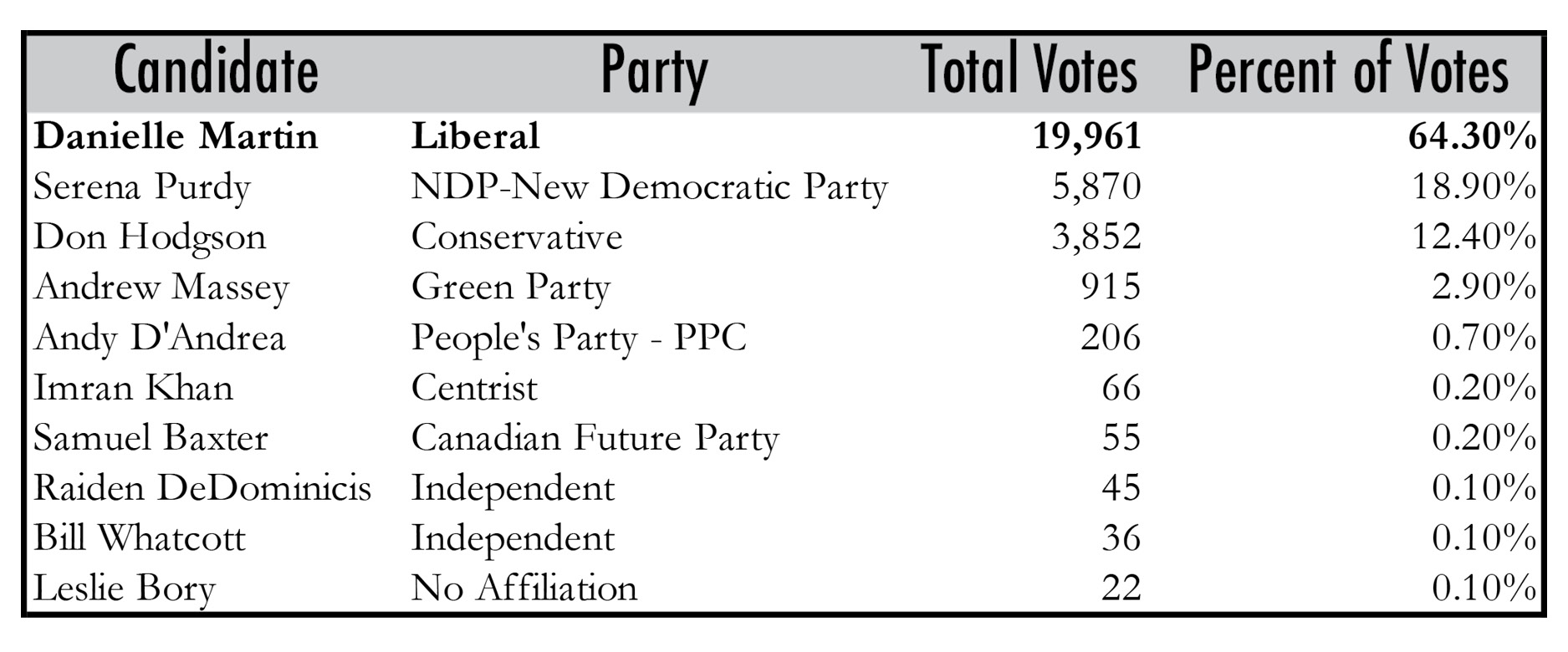
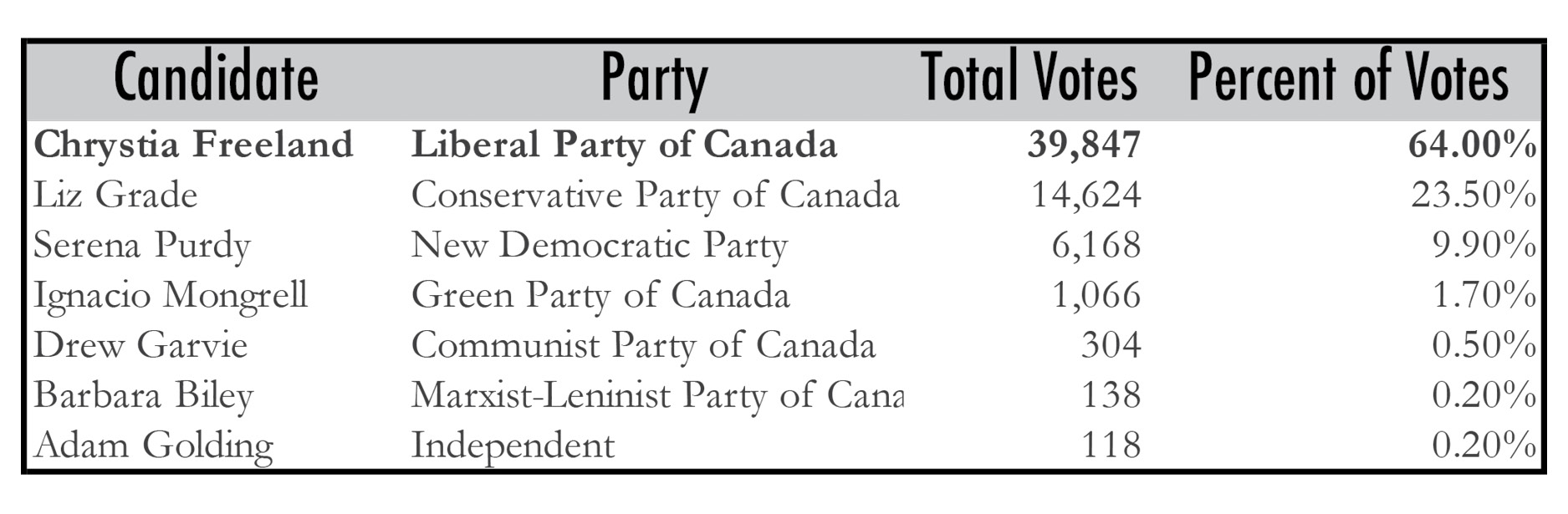
Dr. Danielle Martin almost exactly mirrored Chrystia Freeland’s 2025 win in the April 13 University-Rosedale byelection. First time candidate Martin received 64.3 per cent of the vote compared to Freeland’s 64 per cent during the general election back on April 28, 2025.
Comparatively, the NDP and the Conservatives went in dramatically opposite directions and traded places.
Repeat candidate, Serena Purdy for the NDP, almost doubled her share of the vote from 9.9 per cent in 2025 to 18.9 per cent in the recent byelection.
The Conservatives on the other hand, represented by another rookie candidate, Don Hodgson, went in the exact opposite direction with 12.4 per cent of the vote compared to Liz Grade’s 23.5 per cent in 2025.
The Greens also seemed to in-crease their share at the expense of the Conservatives with Andrew Massey increasing Green support to 2.9 per cent from Ignacio Mongrell’s 1.7 per cent in 2025.
31,115 total votes were cast in the byelection compared to 62,265 in 2025. According to Elections Canada, University-Rosedale has a population of 123,812 with 93,971 electors on the list.
Dr. Danielle Martin’s constituency office is located at 622 College St., Suite 200 and can be reached at 416-928-1451 and danielle.martin@parl.gc.ca.
University-Rosedale 2026 byelection results:
University-Rosedale 2025 general election results:
READ MORE:
- FOCUS: Candidates queried (Apr. 2026)
- CHATTER: Freeland resigns as MP after Ukrainian appointment (Jan. 2026)
- FOCUS: Candidates queried (Apr. 2025)
- CHATTER: Watchdog cites Chinese interference in Freeland campaign(Feb. 2025)
- CHATTER: Protesters disrupt Freeland’s leadership announcement (Jan. 2025)
- NEWS: Freeland wins despite lower turnout (Fall 2021)
- FEDERAL ELECTION 2021: Candidates queried (Aug. 2021)
- NEWS: Freeland re-elected (Nov. 2019)
- FOCUS: Federal election candidates queried (Oct. 2019)
- NEWS: Candidates face-off (Oct. 2019)
- NEWS: Freeland new MP for University-Rosedale (Nov. 2015)
- FOUCS: Where do your LPC, NDP, and GPC candidates stand? (Sept. 2015)
Comments Off on FOCUS: The doctor is in (May 2026)Tags: Annex · News