
115 years of rich history in these walls
By Mike Mastromatteo
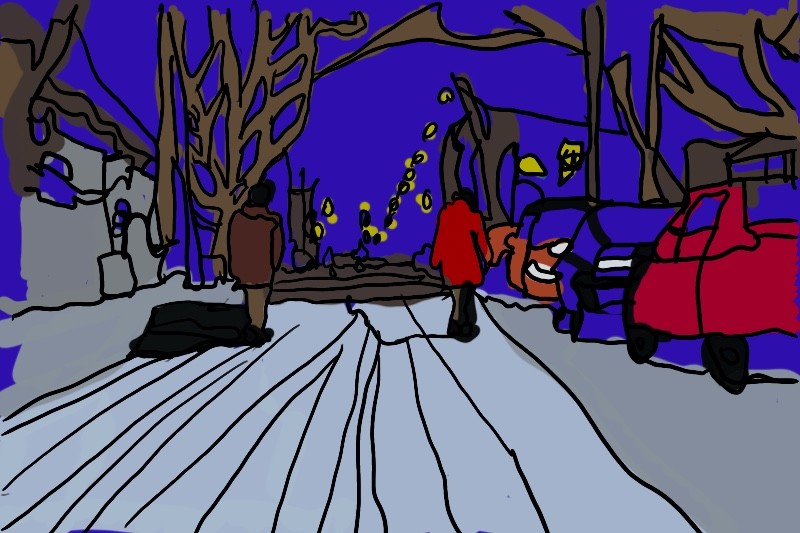
There are doubtless hundreds of stories and anecdotes that arise from stately Brunswick Avenue in the central Annex, but this month we are concentrating on just one place: 411 Brunswick.
This 115-year-old, much-renovated rooming house, has been home to dozens of owners and renters over its lifetime.
By the late 1960s, 411 Brunswick, like many places in the Annex, had been converted into a rooming house, with separate living units on the first, second, and sometimes third floors.
In the early 1970s, the property—and many houses along Brunswick Avenue—contributed to the “literary Annex” lore by housing prominent writers and various creative types. We’ll get to one of those later, but we will now begin with some early history.
The first owner of the house, according to the city directory, was Francis Phillips who had moved in by 1912.
Phillips was identified as a “builder” in the 1901 census and building appeared to be his forte. His name appeared in the Toronto Daily Star a few times in September of 1895 as the purchaser of three parcels of land—numbers 419, 420, and 421 Brunswick Ave.—all of which had to be sold due to arrears with the property taxes.
It’s uncertain if there were houses attached to these properties before the year 1912. A Globe and Mail news item from Nov. 5, 1903 said that “a pretty house wedding [took place] Wednesday, November 4, at the house of Mr. and Mrs. Francis Phillips, when their [third eldest] daughter Emma Dawson was married to James Henry Cox.”
The Phillips family resided on Henry Street in the very early years of the 20th century, but had moved into the Brunswick home by 1912. In any case, Mr. Phillips resided at 411 Brunswick Ave. until 1921. He passed away in October 1921 at age 77. His widow Eleanor survived him for only a short time but passed away in November of 1924, aged 74.
The Phillips’ eldest daughter, Mona Amelia Phillips, resided there until December 1946, when as the Globe and Mail reported, she “entered into rest at her home at 411 Brunswick Ave.”
Sad as it may seem, there were a lot of deaths at the home over the years.
In March 1929, Thomas Herbert Ellenor, husband of the Phillips family’s third eldest daughter Emma, died suddenly of an unspecified cause. The Ellenors suffered another heartbreak a quarter-century earlier. Thomas Herbert Ellenor and his wife Eleanor, had a daughter, Louise Frances, who died Jan. 13, 1904 at age four months.
An assortment of owners and short-term residents occupied the house between 1950 and today. One of the more artistically-inclined was George Gerhardt who occupied one of the apartments in the early 1960s.
A copywriter at Eaton’s by day, Gephardt was an accomplished stage performer with the Eaton’s Operatic Society which put on operettas at the College Street Eaton Auditorium between 1931 and 1965. In the Toronto Daily Star’s February 8, 1963 edition, George Gephardt was mentioned for his portrayal of the Persian travelling peddler Ali Hakim who courts “boy crazy” Ado Annie in the Rodgers and Hammerstein play, Oklahoma.
The creative talents of George Gephardt provide a good segue to the “literary Annex” and the contributions of the house at 411 Brunswick.
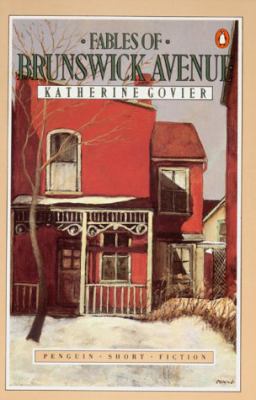
One of the more illustrious occupants in the early to mid-1970s is Canadian novelist and short story writer Katherine Govier. The author of the highly acclaimed novel Angel Walk (1996) and the more relevant (for our purposes) short story collection, Fables of Brunswick Avenue (1985), Govier resided for four years at 411 Brunswick Ave. She first lived at 398 and 409 Brunswick before settling into the writer-friendly 411.
In talks with the Gleaner, Govier reflected on her time on Brunswick Avenue, especially at 411.
As a writer, Govier found the aura of the home to be her literary muse. “I wrote most of my first novel, Random Descent (1979), on the back sun porch of 411 Brunswick,” she said.
She also had good things to the say about the area’s impact on Canadian writers eager to make their mark on the literary scene. “I was in my 20s, and I was in a roaring hurry to write things down,” she said. “The Annex and Brunswick Avenue were places where we felt part of a real community. We walked everywhere. We didn’t have cars. Sometimes we rode bikes, but we would be walking up and down to Bloor Street and we would meet and talk about books. It was an early time of Canadian culture rebirth. And we were all hugely energized by this idea of our country—the stories we were going to tell and how we were going to make the world different.”
At one point, Govier invited fellow Canadian writer Joy Kogawa to share the home at 411 Brunswick and to work on her highly acclaimed novel, Obasan (1981).
Chronicling the Canadian government’s internment of Japanese immigrants during the Second World War, the book has become required reading for many English courses on Canadian literature.
Some of Govier’s experiences in the Annex are fictionalized in short stories contained in Fables of Brunswick Avenue. Given the “if these walls could talk” theme for this series, perhaps this passage from the short story A New Start, is most applicable: “Margaret painted her wonderful street as a ghost street, windy, and her row of peaked houses empty at the top with broken gable windows where pigeons went in and out. The main floors were full of blue rooms where people squatted in front of flickering televisions.”
This tableau of life on one of the Annex’s most colourful streets may soon be repeated with Govier’s next collection of short stories, Lights Out on Brunswick Avenue. Stay tuned!
READ MORE:
- IF THESE WALLS COULD TALK: 74 Vermont Ave. is one of the oldest on the block (Apr. 2026)
- IF THESE WALLS COULD TALK: Bathurst Street landmark fading into a prolonged sunset (Mar. 2026)
- IF THESE WALLS COULD TALK: Once upon a time at 27 Follis Ave. (Feb. 2026)
- IF THESE WALLS COULD TALK: So many rich and diverse lives lived in these twin houses (Jan. 2026)
- IF THESE WALLS COULD TALK: Before the Maddy was a pub it was a mansion (Dec. 2025)
- IF THESE WALLS COULD TALK: 351 Palmerston Blvd. (Oct./Nov. 2025)
- HISTORY: If these walls could talk (Sept. 2025)