
“We played on our see-saw” wrote 10-year-old Grace in 1908
By Mike Mastromatteo
In researching the modest semi-detached home at 711 Spadina Ave., just south of Bloor Street, the reporter came across a sentimental artefact, that in many ways, speaks to the heart of this series called If These Walls Could Talk.
In the early years of the 20th century, the Globe newspaper featured a Playtime for Little People section, in which young people could post letters to the editor and have them published for all to see. On March 21, 1908, the Globe published a letter from Grace Hubbell, then 10 years old and residing at 711 Spadina Ave.
Headlined My Saturday at Home, young Grace wrote the following:
“I have had a very pleasant day. Being Lent, I went to a children’s service, and when it was over I saw my little friend coming out and brought her home, and we played on our see-saw. We played till one o’clock; then mother asked me if I’d like to have my friend to luncheon and I said yes. And we went in, and I telephoned her mother and asked her if she could stay for lunch, and her mother said yes. Then we had lunch, and afterwards went out to play on the see-saw again. About four o’clock we saw an intoxicated man in the lane and we went in the house and looked out of the window and watched him. Then we saw him put up a Japanese parasol. He was smoking, with the parasol over him. He went away, and we didn’t see any more of him.”
The innocence with which Grace describes her Saturday at her home tells a story with more colour and poignancy than could the most sensitive of our “listening walls.”
The Hubbell family moved into the home around 1901. They appear to have enjoyed a genteel lifestyle. Not only did daughters Grace and Helen enjoy summer vacations in the Muskoka region, but both girls attended the prestigious Bishop Strachan School on Lonsdale Road.
The Hubbell family left other faint footprints around the city. In 1906, the father, Lawrence Hubbell, became part of a curious newspaper story after helping two stranded sailors on a schooner anchored in Toronto Bay. The sailors claimed they had been abandoned by their captain and left with little food. Hubbell and a companion reportedly bought provisions for the hungry men after alerting authorities.
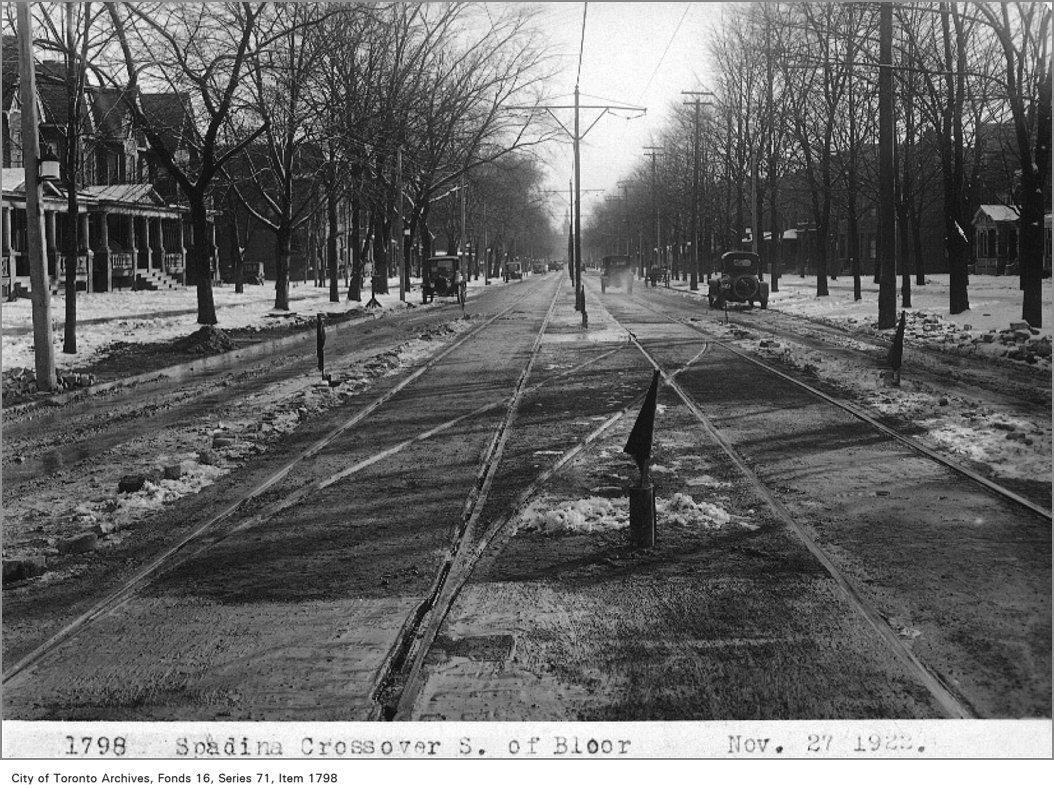
The Hubbells moved in during a period when Spadina Avenue was still one of Toronto’s prestigious residential streets. The neighbourhood was a mixture of comfortable family homes, churches, schools, and institutions. Horse-drawn vehicles shared the roadway with an increasing number of electric streetcars. The city was expanding rapidly, yet much of daily life retained a distinctly Victorian rhythm.
The decades that followed brought a parade of new occupants: secretaries, salesmen, mechanics, roomers, and professionals. The house sheltered Dora, Annie and Lois Bexon in the 1920s, a barber named Jason Tomlinson during the Depression years, and later William Mason, Walter Lesko, Charles Ricketts and many others.
One noteworthy, short-term resident at 711 Spadina Ave. was Gordon Steadman of Marysville, New Brunswick. His experience as a roomer at the house was not without trauma. As the Globe and Mail explained in a story from Jan. 17, 1939, Steadman, a Bible student studying in Toronto that fateful winter, was robbed of $22—money he had earmarked for his tuition at Toronto Bible College. The newspaper also recorded: “Four men approached in a car, three got out and rifled through his pockets, one stayed in the car. The car sped north to Bloor and turned east.”
The neighbourhood changed dramatically throughout the 20th century. Grand houses became boarding houses. Institutions expanded. University buildings pushed outward. The character of Spadina Avenue evolved from an elite residential boulevard to the diverse urban corridor we know today.
Through all those transformations, 711 Spadina endured.
Sometime in the 1960s, 711 Spadina became the property of the University of Toronto. In fact, the house next door—709 Spadina—has been home to the university’s academy of science for many years.
Despite the many lives lived within the confines of this home, Grace Hubbell’s experience is special. Many house histories never get beyond ownership records, census entries, or the occasional newspaper mention of one of the owners or occupants. Grace Hubbell however, changes everything. The moment she writes about her friend, the see-saw, the luncheon, and the man under the Japanese parasol, the house stops being a property; it becomes a place of belonging.
There is still a laneway immediately north of the house, running between Spadina and Huron streets. We cannot know if it’s the place where Grace Hubbell spotted the intoxicated man sheltering beneath a Japanese parasol more than 100 years ago. But it’s near enough to remind us that ordinary moments— the kind a 10-year-old girl might capture in a letter to a newspaper—can become the most poignant memories a house leaves behind.
More than a hundred years later, Grace Hubbell is long gone. The see-saw is gone. The lane has changed. Even the city around the house would be scarcely recognizable to her. Yet because she took the time to write about one unremarkable Saturday, the walls of 711 Spadina can still speak.
And what they tell us is not a story of famous people or historic events; they tell us that once, on a spring afternoon, a ten-year-old girl stood at a window and watched the world go by.
READ MORE:
- IF THESE WALLS COULD TALK: Cast of characters adds spice to Lippincott home’s lore (June 2026)
- IF THESE WALLS COULD TALK: Author Katherine Govier lived at 411 Brunswick Ave. (May 2026)
- IF THESE WALLS COULD TALK: 74 Vermont Ave. is one of the oldest on the block (Apr. 2026)
- IF THESE WALLS COULD TALK: Bathurst Street landmark fading into a prolonged sunset (Mar. 2026)
- IF THESE WALLS COULD TALK: Once upon a time at 27 Follis Ave. (Feb. 2026)
- IF THESE WALLS COULD TALK: So many rich and diverse lives lived in these twin houses (Jan. 2026)
- IF THESE WALLS COULD TALK: Before the Maddy was a pub it was a mansion (Dec. 2025)
- IF THESE WALLS COULD TALK: 351 Palmerston Blvd. (Oct./Nov. 2025)
- HISTORY: If these walls could talk (Sept. 2025)