
$3 a month to stable your horse…in 1907
By Mike Mastromatteo
The house at 217 Lippincott St. isn’t the oldest home in the Annex, but it might be a contender for the most varied in terms of the wide range of tradespeople, professionals, clothing manufacturers, journalists—and the occasional rabbi—who have resided there over the years.
Its mint-green façade—almost certainly not the original colour—casts a hopeful hue on its adjacent abodes. Just east of Bathurst Street, this house belongs to a broader family of downtown Toronto houses built during the city’s late-19th-century expansion west of the old core.
It’s not certain when the home was ready for occupancy. The 1887 municipal directory describes 217 Lippincott as an “unfinished house.”
The first recognized occupant of 217 Lippincott was woodworker William Brownlow (1888) who was employed by the Robert Elder Carriage Works company located near Queen Street West and Spadina.
Brownlow didn’t stay long. In 1897 he moved to Palmerston Boulevard, and the next year took up residence at 207 Brunswick Ave. Between 1890 and 1897, another tradesman, bricklayer John Morton, called the place home.
As the 20th century dawned, and the Victorian era began to fade, veterinary surgeon Robert Kennedy enters our story. Dr. Kennedy lived at 217 Lippincott from 1900 to 1907.
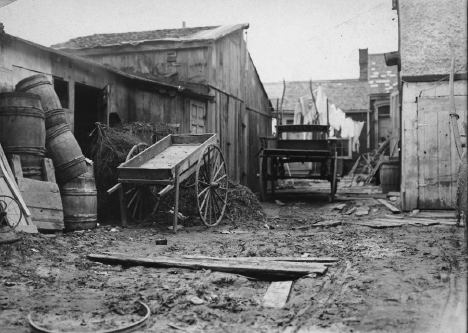
It was convenient for the neighbours that a veterinary surgeon lived close by. Stables and livery operations were still a big part of downtown homes in the early years of the 20th century. In 1907, the Toronto Daily Star ran a classified ad: “Stables to let…warm stable, two stalls and barn, $3 a month.” The ad was posted by someone living at 213 Lippincott, so with our Dr. Kennedy living only two doors away, any ailing equines would be most in luck.
Following the Dr. Kennedy era, 217 Lippincott became the realm of teamster, William Delill, who lived there with wife Edith and a family that grew to include four daughters and three sons.
Delill’s work as a teamster must have inspired his life-long interest in horses. He won several horse show awards over the years. In 1930, for example, he was singled out as second place finisher in the “single harness pony” category at the Ontario Winter Fair.
For the next ten years, 1908-1918, 217 Lippincott was home to George E.T. Brain and his wife Elizabeth. The Brain family included George and Elizabeth, daughters Maud, Jennie, Emma, Jessie, Florence, and son Harry. Brain worked as a foreman with AA Allen and Company, wholesalers of hats, capes and furs.
Sadly, by 1918, Elizabeth Brain was listed in directories as “widow of George.” One can hope that with five daughters and a son, Mrs. Brain was well cared for after her husband’s passing.
Before getting to the next owner/occupant of the property, a quick digression. More than two decades after the classified ad about stables for rent on Lippincott Street., the August 18, 1930 edition of the Toronto Daily Star ran the following item in agate type: “A horse was destroyed early today in a fire which gutted four stables at the rear of 217-219-221 Lippincott St. The fire, of unknown origin, broke out in the two-storey frame stable at 219 Lippincott St. The steady play of water soon had the blaze under control and the fire was extinguished in less than an hour.”
We don’t know where Dr. Kennedy was living in 1930, but we can only imagine his reaction to the news that a horse perished next door to his former home and operating theatre.
For the next 25 years, 1920-1945, the home belonged to “pedlar” Joseph Weiss, who on occasion, rented space to clothing finisher Benjamin Lemberg. There may have been a second Weiss family living in the home over the years. The 1931 census lists machine operator Samuel Weiss living there with wife Lillian and son Ernest.
Marion Weiss, a bookkeeper with Canadian Jewish Publishing, occupied the home in 1953 and was succeeded by Rebecca Katsburg, wife of Rabbi Solomon Katsburg. The rabbi and his wife resided at 217 Lippincott until 1962. By then, his congregation had moved “up the hill,” north on Bathurst Street.
Like many Annex homes in the 1960s, 217 Lippincott began its slow transition to a rooming house. A number of short time renters passed through the property from the early 1960s until 1990. One of the more celebrated was CBC reporter and writer Larry Zolf who lived there from 1990-1992. The host of the innovative CBC program, This Hour Has Seven Days, Zolf was well respected, despite his occasionally confrontational work. One might wonder what sort of atmosphere filled the house during Zolf’s short time there.
Architecturally speaking, 217 Lippincott is slightly worn, but it is a dignified Victorian “survivor,” compressed between neighbours, carrying layers of aesthetic decisions from different eras: Victorian ambition, mid-century neglect, countercultural repainting, contemporary survival. The more imaginative might even say it’s a case of high Victorian brickwork “wearing” the eccentric overcoat of a late-20th-century Annex home.
The stables and back lots are long gone from 217 Lippincott and its neighbouring houses, but with a little imagination, one might hear echoes of whinnying and clip-clop that rang out so many years ago.
READ MORE:
- IF THESE WALLS COULD TALK: Author Katherine Govier lived at 411 Brunswick Ave. (May 2026)
- IF THESE WALLS COULD TALK: 74 Vermont Ave. is one of the oldest on the block (Apr. 2026)
- IF THESE WALLS COULD TALK: Bathurst Street landmark fading into a prolonged sunset (Mar. 2026)
- IF THESE WALLS COULD TALK: Once upon a time at 27 Follis Ave. (Feb. 2026)
- IF THESE WALLS COULD TALK: So many rich and diverse lives lived in these twin houses (Jan. 2026)
- IF THESE WALLS COULD TALK: Before the Maddy was a pub it was a mansion (Dec. 2025)
- IF THESE WALLS COULD TALK: 351 Palmerston Blvd. (Oct./Nov. 2025)
- HISTORY: If these walls could talk (Sept. 2025)