
All As and Bs for this set of reviews
This is the second instalment of our annual look at neighbourhood greenspaces. Each year, the Annex Gleaner visits and evaluates the parks and parkettes across our coverage area using a range of criteria. While there is no single overall winner, letter grades are assigned to reflect the quality of each space based on factors such as upkeep, design, amenities, accessibility, and overall atmosphere.
Previous grades are included for comparison, while the accompanying reviews highlight the unique features and character that make each park distinct.
Compiled and photos by Shaya Rahmani
Huron Street Playground
Address: 496 Huron St.
Time of Visit: 11:53 a.m.
Grade: A (Last year’s grade: A-)
Reason to go: Huron Street Playground is a clean, well-maintained neighborhood greenspace that serves as a modest but lively neighbourhood hub. The enclosed design of the park creates a sense of safety for younger users. In the centre of the park there is rope climbing structure which is surrounded by open space for flexible casual recreation. A fenced-in dog area allows pet owners and families to share the space. Young trees have been planted in the park, and there is a water fountain for pets and families. There is a school nearby, and the chalk drawings and hopscotch patterns indicate that the park is well-used.
Overheard: Children shouting from the adjacent schoolyard, birds chirping in the trees above, and the jumping sounds of kids playing hopscotch in the middle of the park.
Did you know: Chalk drawings like hopscotch are a common feature in many Toronto playgrounds, reflecting how informal play adapts to public space beyond its original design.
Paul Martel Park
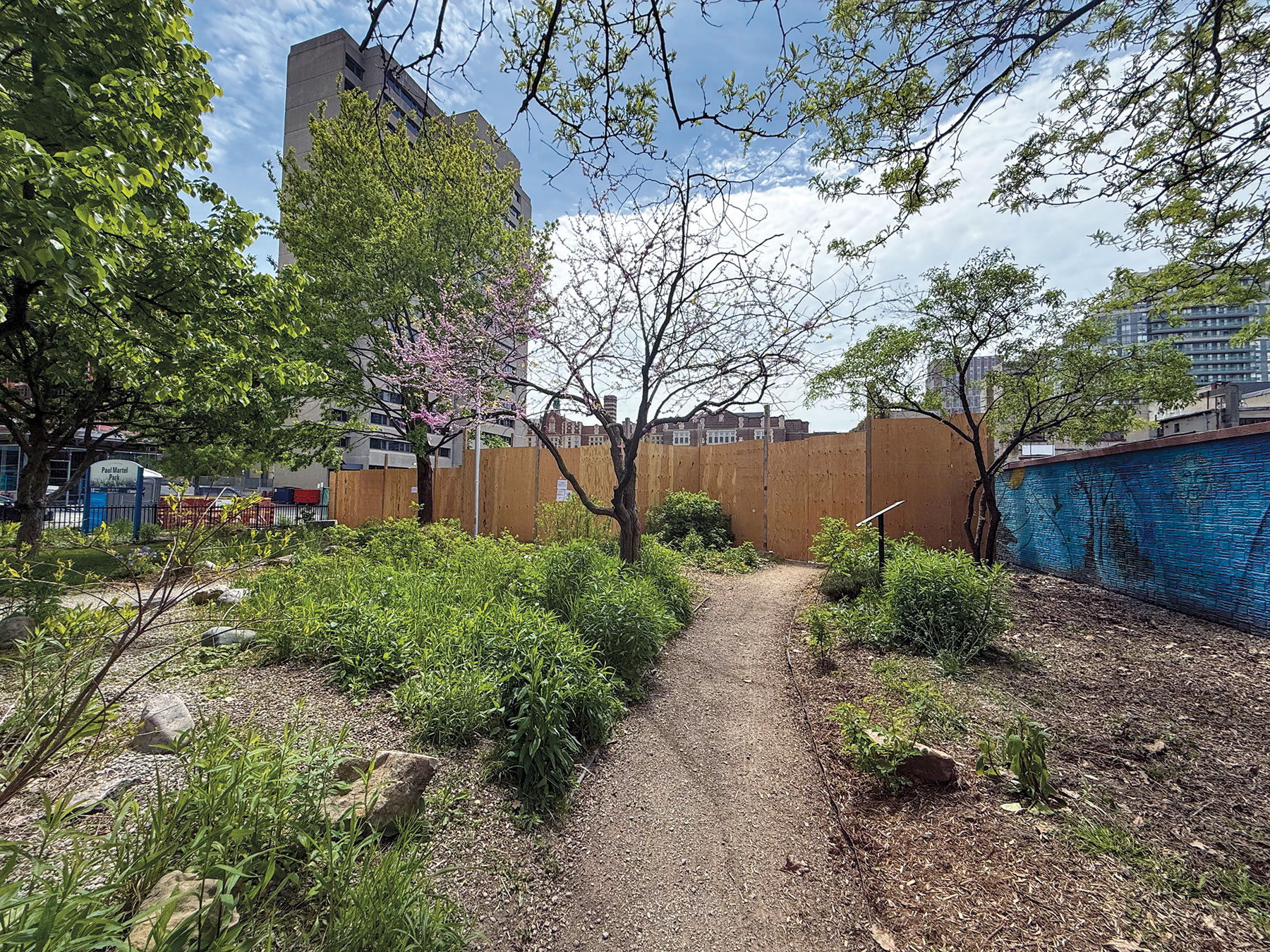
Address: 10 Madison Ave.
Time of Visit: 12:37 p.m.
Grade: B+ (Last year’s grade: A-)
Reason to go: Paul Martel Park is a modest, but visually interesting greenspace near the intersection of Spadina Avenue and Bloor Street. It offers a transitory break in the middle of one of the Annex’s most busy development zones. Even with the intensity of the surrounding construction, the park retains a strong sense of organization and care, with sculpted gravel plantings and well-maintained flower beds. The Indigenous mural provides cultural and visual interest and offsets the otherwise industrial setting. The auditory environment is often defined by the sound of construction such as sawing, metal work, and the constant movement of machinery which undermines the peace associated with local greenspaces. Still, the park is a quick stop for local residents and pedestrians, especially those traveling between residential neighborhoods and the adjacent commercial sector.
Overheard: The constant buzzing of saws, the clanging and thumping of steel construction work, and occasional fragments of conversation from pedestrians passing through the surrounding residential area.
Did you know: The park’s design emphasizes small-scale planting beds, seating areas, and interpretive signage, reflecting a shift toward “micro-park” models in dense urban neighbourhoods.
Taddle Creek Park
Address: 40 Bedford Rd.
Time of Visit: 1:18 p.m.
Grade: A (Last year’s grade: A)
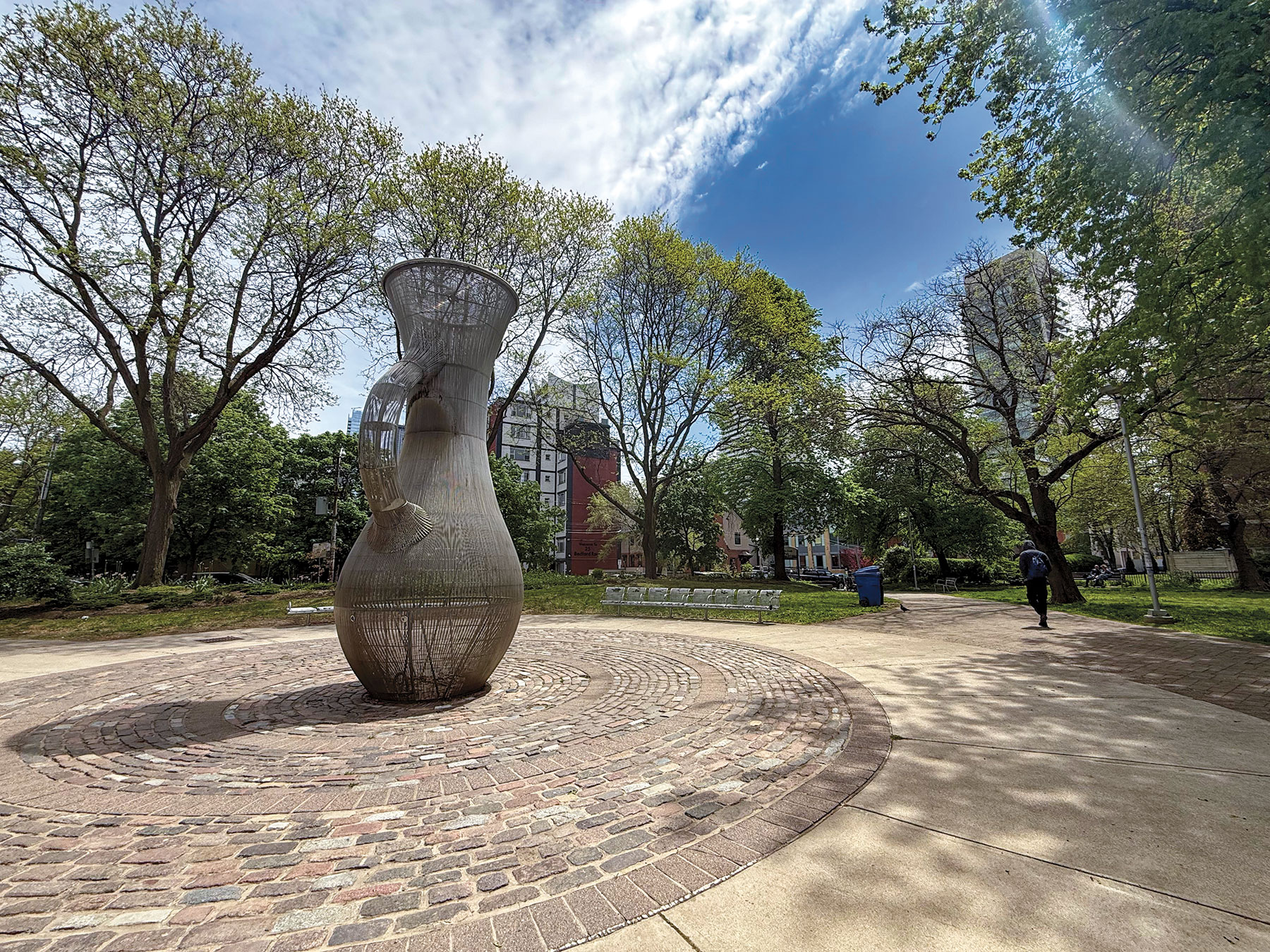
Reason to go: This park is notably clean and carefully landscaped, with well-maintained flower beds that provide seasonal colour and structure throughout the space. At its centre stands a large sculptural vase which functions as a visual focal point and gives the park a distinct identity that sets it apart from more utilitarian neighbourhood greenspaces. A prominent mature tree anchors the park’s layout, offering substantial shade and reinforcing a sense of permanence. The park includes a playground area, a water fountain and many benches dedicated “in loving memory” to community members which introduces a strong commemorative and reflective dimension to the space. The park has a sense of quiet continuity; visitors are more likely to encounter stillness, reflection, or slow movement rather than high activity. Overall, Taddle Creek Park succeeds as a small but thoughtfully composed greenspace that integrates play, memory, and natural elements into a cohesive neighbourhood setting.
Overheard: The rhythmic tapping of a cane along the paved walkway as someone moves slowly through the park
Did you know: During the park’s 2011 revitalization, construction crews unexpectedly uncovered parts of old house foundations beneath the site.
Bloor-Bedford Parkette
Address: 245 Bloor St W.
Time of Visit: 2:06 p.m.
Grade: B (Last year’s grade: B+)
Reason to go: Bloor–Bedford Parkette is a modest but well-used pocket of respite located in one of the busiest areas of the Annex. As the park is on Bloor Street and surrounded by University of Toronto buildings, it is heavily used by students and surrounding workers. The parkette provides a respite from the intensity of its surroundings. Maintenance is generally satisfactory, however cigarette litter can be seen on the borders of benches and walks, indicating the park’s heavy use.
Overheard: The angry flow of traffic from Bloor street and snippets of student conversations.
Did you know: The parkette is located at the edge of the University of Toronto’s St. George campus, placing it within one of the most pedestrian-dense academic zones in Canada.
Philosopher’s Walk
Address: 78 Queen’s Park Crescent
Time of Visit: 2:48 p.m.
Grade: A+ (Last year’s grade: A+)
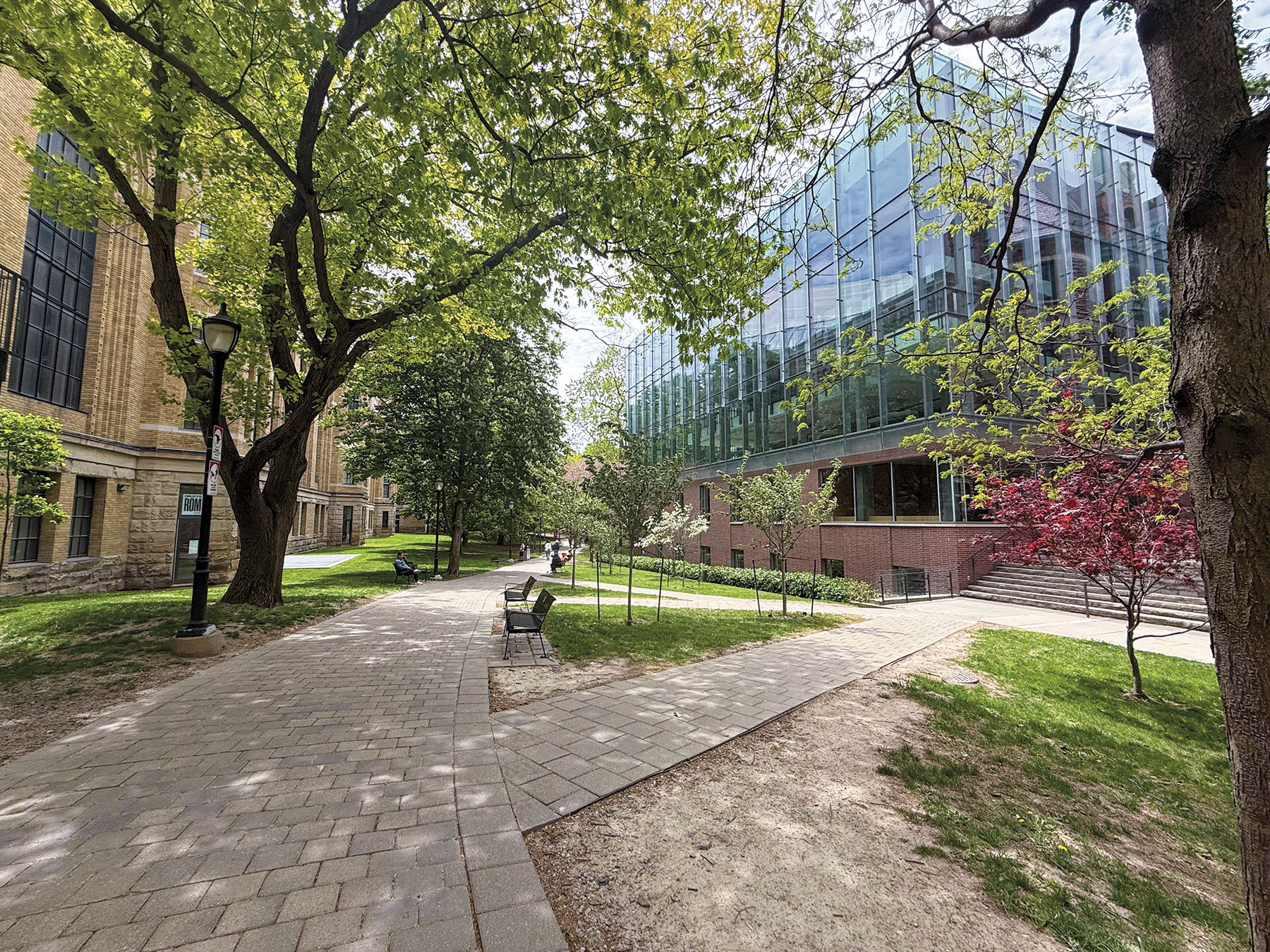
Reason to go: Philosopher’s Walk is one of the most visually and acoustically distinctive pedestrian corridors in the Annex, offering a rare combination of natural landscape and institutional atmosphere within the core of the University of Toronto. Maintained to a high standard, the walkway is defined by a mature tree cover that creates one continuous canopy overhead. This produces a shaded, immersive environment that feels removed from the surrounding urban density. The walk also functions as an active connective space, regularly used by students, faculty, and visitors moving between campus buildings and nearby cultural institutions. Its proximity to the Royal Conservatory of Music contributes a unique auditory backdrop, with music often spilling into the open air. This includes violin performances that blend into the ambient sounds of foot traffic and conversation, giving the space an almost cinematic quality. Despite its central location, the walkway maintains a strong sense of calm, making it both a practical route and a contemplative space within the university landscape.
Overheard: The sound of violins drifting from an open window at the Royal Conservatory, mixed with student conversations.
Did you know: Philosopher’s Walk is especially known for its seasonal changes, including spring blossoms, dense summer canopy cover, and vivid fall foliage from mature hardwood trees.
Queen’s Park (north and south)
Address: 11 Wellesley St. W.
Time of Visit: 4:00 p.m.
Grade: A (Last year’s grade A+ and A)
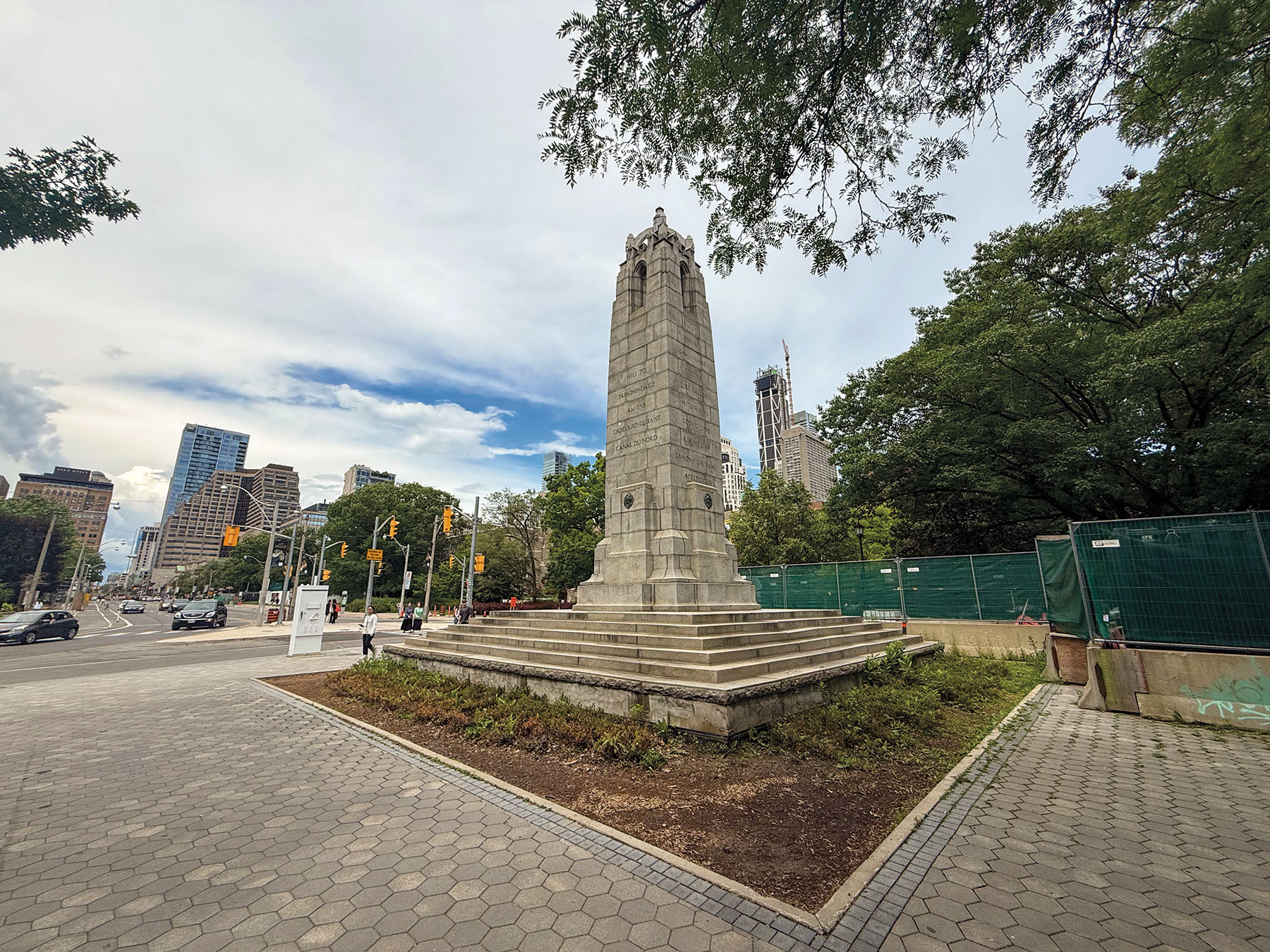
Reason to go: Queen’s Park North is a large, open greenspace that prioritizes natural landscape over programmed recreation. It offers expansive lawns, mature trees, and dense shade that create a calm, campus-adjacent atmosphere in the heart of the city. Despite ongoing construction in certain sections, the park maintains a strong sense of order and refinement, with wide stretches of grass that encourage informal gatherings, reading, or quiet rest. The space feels closely tied to the surrounding University of Toronto environment, with much of its activity shaped by students and nearby institutional life rather than traditional park programming. Statues and historical markers are integrated into the landscape, reinforcing a sense of continuity between the park’s present use and its civic past. The overall experience is one of openness and stillness, where movement is slow and the landscape itself becomes the primary feature.
Queen’s Park South, by contrast, is more formally structured and institutionally framed. Wrapping around the Ontario Legislative Building, it reinforces the site’s civic and political significance. The landscaping is highly intentional, with carefully maintained hedges, manicured flowerbeds, and symmetrical design elements that emphasize order and formality. A veterans’ memorial adds a reflective dimension to the space, while the surrounding architecture blends seamlessly into the greenery. The park functions not only as a public space, but also as a symbolic civic environment, where governance, memory, and public life intersect within a carefully curated landscape.
Overheard: On the north side, students debating assignment grading schemes and completion-based assessments; on the south side, the measured footsteps and radio chatter of peace officers conducting perimeter patrols.
Did you know: Queen’s Park is one of Toronto’s earliest examples of a civic green space designed to visually frame an important government building using open lawns and curved pathways to emphasize the Ontario Legislative Building as a focal point.
READ MORE:
- GRADING OUR GREENSPACE: Annual audit of Annex amenities (June 2026)
- GRADING OUR GREENSPACE: How do our parks rate? (Sept. 2025)
- GRADING OUR GREENSPACE: How do our parks measure up? (Aug. 2025)
- GRADING OUR GREENSPACE: Grading the green (July 2025)
- GRADING OUR GREENSPACE: Annex parks’ report card (Dec. 2024)
- GRADING OUR GREENSPACE: Annex parks report card (Oct./Nov. 2024)
- GRADING OUR GREENSPACE: A report card on our parks – part 2(Sept. 2024)
- GRADING OUR GREENSPACE: A report card on our parks (Summer 2024)
- FOCUS: Grading our greenspace (Feb. 2024)
- FOCUS: Grading our Greenspace (Dec. 2023)
- FOCUS: Grading our greenspace (Fall 2023)
- GRADING OUR GREENSPACE: Third and final instalment (Oct. 2022)
- GRADING OUR GREENSPACE: Appraising Annex parks (Sept. 2022)
- GRADING OUR GREENSPACE (Aug. 2022)
- NEWS: New mural celebrates Indigenous storytelling (July 2022)
- GRADING OUR GREENSPACE (Fall 2021)
- GRADING OUR GREENSPACE (July 2021)
- LIFE: Bickford Park embraces yoga (June 2021)
- FOCUS: New park imbued with nostalgia (Apr. 2021)
- ON THE COVER: Renewing Martel’s vision (Nov. 2020)
- FOCUS: Park set for eco-restoration (Nov. 2020)
- GRADING OUR GREENSPACE: Grading the green (Aug. 2020)
- FORUM: Making it green (Aug. 2020)
- OBITUARY: Architect leaves indelibe marks (July 2020)
- CHATTER: Sally’s Fright finds a home in Yorkville (July 2020)
- FOCUS: Robert Street Field site of geothermal energy (Mar. 2020)