
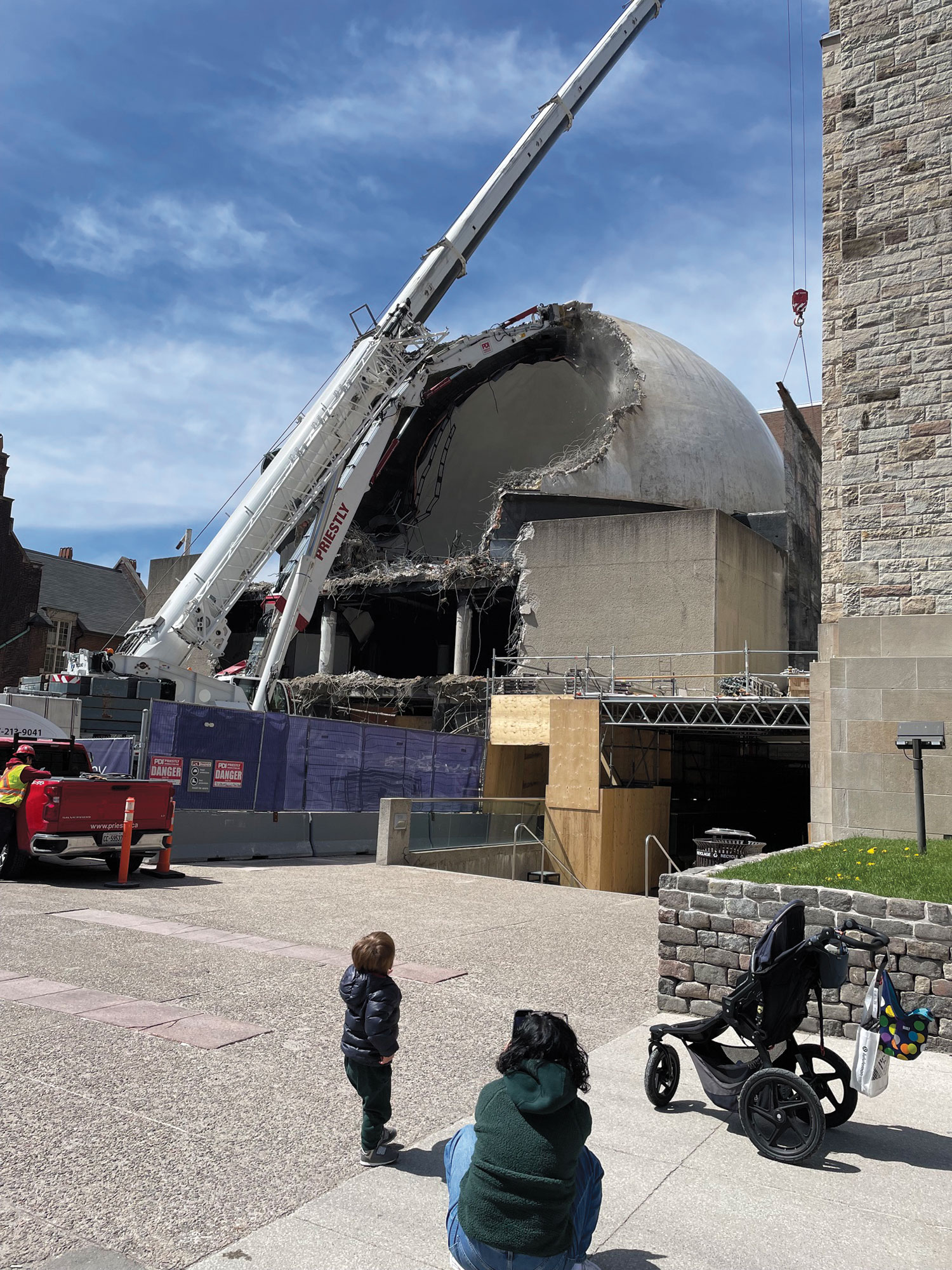
ON THE COVER: Planetarium comes down (June 2026)
August 9th, 2026 · Comments Off on ON THE COVER: Planetarium comes down (June 2026)
Comments Off on ON THE COVER: Planetarium comes down (June 2026)Tags: Annex · News · On the cover
SPORTS: Free seats, scoresheets and athletes (June 2026)
August 9th, 2026 · Comments Off on SPORTS: Free seats, scoresheets and athletes (June 2026)
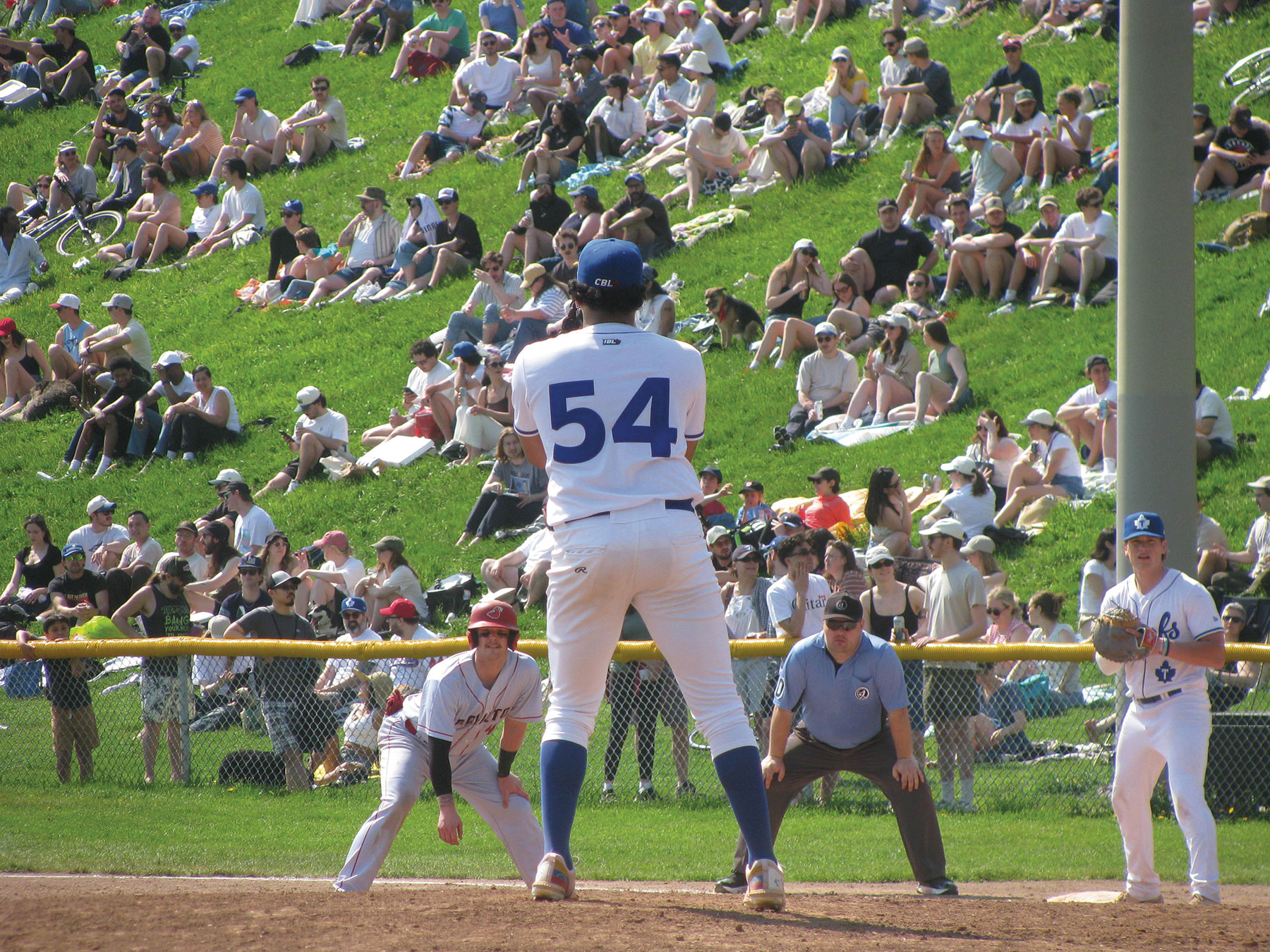
A new season of Maple Leafs baseball launches at Christie Pits
By R.S. Konjek
The world is going to hell, but we still have Maple Leafs baseball.
As the cost of living skyrockets, baseball at Christie Pits remains free for everyone. This is one of the last unspoiled pleasures of our times.
The 2026 season has gotten under way and the Leafs have upped their game. They are part of the newly christened Canadian Baseball League, a professional circuit with clubs in nine Ontario cities.
Thousands flocked to the Pits for the Leafs’ season opener. Many more are expected in the months ahead.
Every ballgame is someone’s first ballgame. Taking inspiration from the Gleaner’s annual “Grading Our Greenspaces” park reviews, here follows a kind of gazetteer for newcomers who may find Toronto’s sunken ballpark a curious place. Which corner of Dominico Field is best for you? Let the degree of your fanhood be your guide.
Street Level. Recommended for: The unadventurous.
At the park but barely in the park. Well away from the action, but with a view that takes in everything. Players’ parents will often sit on the lip of the Pits, content to watch without being involved. This is also a favourite roost for less-mobile fans who don’t want to have to climb back up from field level.
The Hillsides. Recommended for: The good-timers.
These are the all-embracing slopes that surround most of the diamond. Find a spot, throw down a blanket and set your cares aside for a few hours. Families, friend groups, and spontaneous communities sprawl across the hillsides. Kids romp, dogs frolic. It’s a summertime idyll.
The Bush. Recommended for: The party animals.
This dense cluster of trees and scrub sits on the east slope of the park. It is home to the Leafs’ famous fan group, The Bushmen. Founded by three hardcore fans over a decade ago, the group has swollen in numbers and is famous for relentlessly cheering the home side and heckling opposing players. Always funny, never vulgar.
The Seats. Recommended for: The diehards.
Three modest tiers of bench seating wrap around the infield. Here you will find the regulars, those fans who know all the players and know their stats, their slumps, and their triumphs. Fan-player intimacy is at its peak here. You are closest to the action and hear every interaction on the diamond.
The Members’ Zone. Recommended for: The status seekers.
Behind the third base fence is the only paid seating in the park. Members get reserved seats, food and drink, and other VIP perks. The pizza is great. Single game passes are also available. It’s an exclusive bubble for people who prefer not to rub elbows with the hoi polloi.
The Fences. Recommended for: The associates.
Two long fences stretch from the infield to the outfield corners. Onlookers drape their arms over these fences, happy to stand the entire game. This is where you will often find the teams’ front office staff observing the game, clusters of photographers, or ex-teammates who stop by to visit and chat.
The Outfield and Beyond. Recommended for: The distant observers.
Furthest from home plate, but still a great view of the entire diamond. A nice vantage point to watch plays unfold with no obstructions. Fans set up blankets, folding chairs, even tents from which to sit and watch. Also, conveniently close to the snack bar and restrooms.
On the diamond, there has been a huge turnover.
Fans arriving at Christie Pits will want to grab one of the free program sheets that are handed out by club staff.
As of this writing, the Leafs have signed 17 new players for the 2026 season. That’s well over half of the 28-player roster.
Among the players who have departed are long-time veterans Greg Carrington, Jordan Castaldo, Marek Deska, Ryan Dos Santos, Connor Lewis, and all three Marra brothers, Adam, Dan and Justin.
Some returning favourites include pitchers Wilgenis Alvarado and Luis Florentino, and outfielders Marcus Knecht and Dennis Dei Baning.
Returning for his fourth season at the helm is field manager Rob Butler, joined by assistant coaches Rich Butler and Brian Sewell.
The Leafs go from being one of the league’s oldest teams to one of the youngest. The newcomers bring plenty of youth and energy. This summer, fans can start getting attached to the next generation of Maple Leaf stars.
As well as Yasiel Puig.
Yes, that Yasiel Puig. In late April, social media erupted over a Toronto Star report that the Leafs had signed the ex-MLB All-Star to the Canadian Baseball League’s largest-ever contract. The report turned out to be true.
In the Leafs’ season opener, Puig made his Toronto debut in style. Before an estimated crowd of 4,000, he hit a pair of home runs to lead his new club to an 8-6 victory over the Kitchener Panthers.
If Puig sticks around for the entire season, he will continue to be a huge draw. Even if he doesn’t, there is still plenty of baseball to be had as the Leafs pursue their first league championship since 2007.
The regular season continues to the end of August.
More information about the Leafs and their schedule can be found at www.mapleleafsbaseball.com.
READ MORE:
- SPORTS: Maple Leafs moving up to the pros (Feb. 2026)
- NEWS: Maple Leafs wrap up historic season (Sept. 2025)
- SPORTS: From Tokyo to Toronto: Sato’s season of surprises (Aug. 2025)
- SPORTS: Dos Santos finds a home at Christie Pits (July 2025)
- ON THE COVER: Sato’s debut (May/June 2025)
- SPORTS: Sato makes history with perfect debut (May/June 2025)
- ON THE COVER: Pitching history at the Pits (Apr. 2025)
- SPORTS: Leafs make history (Apr. 2025)
- SPORTS: Christie Pits eyed as destination for baseball and more (Sept. 2024)
- SPORTS: Baseball feels the chill at Christie Pits (Summer 2024)
- SPORTS: Maple Leaf Mystique thrills Pits (June 2024)
- SPORTS: A whole new ball game (Apr. 2024)
- SPORTS: Baseball in full bloom at the Pits (Summer 2023)
- NEWS: Leafs fall in the Finals (Oct. 2022)
- SPORTS: Thrilling walkoff advances Leafs (Sept. 2022)
- ON THE COVER: Solazzo slams, salutes hillsides (Aug. 2022)
- SPORTS: Leafs prepare for postseason push (Aug. 2022)
- SPORTS: Baseball Leafs navigate a new era at Christie Pits (July 2022)
- NEWS: Dominico’s vision changed Toronto sports history (Winter 2022)
- SPORTS: IBL Maple Leafs fall one win short of championship (Fall 2021)
Comments Off on SPORTS: Free seats, scoresheets and athletes (June 2026)Tags: Annex · Sports
IF THESE WALLS COULD TALK: Cast of characters adds spice to Lippincott home’s lore (June 2026)
August 9th, 2026 · Comments Off on IF THESE WALLS COULD TALK: Cast of characters adds spice to Lippincott home’s lore (June 2026)
$3 a month to stable your horse…in 1907
By Mike Mastromatteo
The house at 217 Lippincott St. isn’t the oldest home in the Annex, but it might be a contender for the most varied in terms of the wide range of tradespeople, professionals, clothing manufacturers, journalists—and the occasional rabbi—who have resided there over the years.
Its mint-green façade—almost certainly not the original colour—casts a hopeful hue on its adjacent abodes. Just east of Bathurst Street, this house belongs to a broader family of downtown Toronto houses built during the city’s late-19th-century expansion west of the old core.
It’s not certain when the home was ready for occupancy. The 1887 municipal directory describes 217 Lippincott as an “unfinished house.”
The first recognized occupant of 217 Lippincott was woodworker William Brownlow (1888) who was employed by the Robert Elder Carriage Works company located near Queen Street West and Spadina.
Brownlow didn’t stay long. In 1897 he moved to Palmerston Boulevard, and the next year took up residence at 207 Brunswick Ave. Between 1890 and 1897, another tradesman, bricklayer John Morton, called the place home.
As the 20th century dawned, and the Victorian era began to fade, veterinary surgeon Robert Kennedy enters our story. Dr. Kennedy lived at 217 Lippincott from 1900 to 1907.
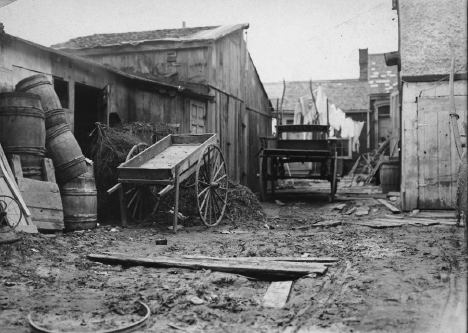
It was convenient for the neighbours that a veterinary surgeon lived close by. Stables and livery operations were still a big part of downtown homes in the early years of the 20th century. In 1907, the Toronto Daily Star ran a classified ad: “Stables to let…warm stable, two stalls and barn, $3 a month.” The ad was posted by someone living at 213 Lippincott, so with our Dr. Kennedy living only two doors away, any ailing equines would be most in luck.
Following the Dr. Kennedy era, 217 Lippincott became the realm of teamster, William Delill, who lived there with wife Edith and a family that grew to include four daughters and three sons.
Delill’s work as a teamster must have inspired his life-long interest in horses. He won several horse show awards over the years. In 1930, for example, he was singled out as second place finisher in the “single harness pony” category at the Ontario Winter Fair.
For the next ten years, 1908-1918, 217 Lippincott was home to George E.T. Brain and his wife Elizabeth. The Brain family included George and Elizabeth, daughters Maud, Jennie, Emma, Jessie, Florence, and son Harry. Brain worked as a foreman with AA Allen and Company, wholesalers of hats, capes and furs.
Sadly, by 1918, Elizabeth Brain was listed in directories as “widow of George.” One can hope that with five daughters and a son, Mrs. Brain was well cared for after her husband’s passing.
Before getting to the next owner/occupant of the property, a quick digression. More than two decades after the classified ad about stables for rent on Lippincott Street., the August 18, 1930 edition of the Toronto Daily Star ran the following item in agate type: “A horse was destroyed early today in a fire which gutted four stables at the rear of 217-219-221 Lippincott St. The fire, of unknown origin, broke out in the two-storey frame stable at 219 Lippincott St. The steady play of water soon had the blaze under control and the fire was extinguished in less than an hour.”
We don’t know where Dr. Kennedy was living in 1930, but we can only imagine his reaction to the news that a horse perished next door to his former home and operating theatre.
For the next 25 years, 1920-1945, the home belonged to “pedlar” Joseph Weiss, who on occasion, rented space to clothing finisher Benjamin Lemberg. There may have been a second Weiss family living in the home over the years. The 1931 census lists machine operator Samuel Weiss living there with wife Lillian and son Ernest.
Marion Weiss, a bookkeeper with Canadian Jewish Publishing, occupied the home in 1953 and was succeeded by Rebecca Katsburg, wife of Rabbi Solomon Katsburg. The rabbi and his wife resided at 217 Lippincott until 1962. By then, his congregation had moved “up the hill,” north on Bathurst Street.
Like many Annex homes in the 1960s, 217 Lippincott began its slow transition to a rooming house. A number of short time renters passed through the property from the early 1960s until 1990. One of the more celebrated was CBC reporter and writer Larry Zolf who lived there from 1990-1992. The host of the innovative CBC program, This Hour Has Seven Days, Zolf was well respected, despite his occasionally confrontational work. One might wonder what sort of atmosphere filled the house during Zolf’s short time there.
Architecturally speaking, 217 Lippincott is slightly worn, but it is a dignified Victorian “survivor,” compressed between neighbours, carrying layers of aesthetic decisions from different eras: Victorian ambition, mid-century neglect, countercultural repainting, contemporary survival. The more imaginative might even say it’s a case of high Victorian brickwork “wearing” the eccentric overcoat of a late-20th-century Annex home.
The stables and back lots are long gone from 217 Lippincott and its neighbouring houses, but with a little imagination, one might hear echoes of whinnying and clip-clop that rang out so many years ago.
READ MORE:
- IF THESE WALLS COULD TALK: Author Katherine Govier lived at 411 Brunswick Ave. (May 2026)
- IF THESE WALLS COULD TALK: 74 Vermont Ave. is one of the oldest on the block (Apr. 2026)
- IF THESE WALLS COULD TALK: Bathurst Street landmark fading into a prolonged sunset (Mar. 2026)
- IF THESE WALLS COULD TALK: Once upon a time at 27 Follis Ave. (Feb. 2026)
- IF THESE WALLS COULD TALK: So many rich and diverse lives lived in these twin houses (Jan. 2026)
- IF THESE WALLS COULD TALK: Before the Maddy was a pub it was a mansion (Dec. 2025)
- IF THESE WALLS COULD TALK: 351 Palmerston Blvd. (Oct./Nov. 2025)
- HISTORY: If these walls could talk (Sept. 2025)
Comments Off on IF THESE WALLS COULD TALK: Cast of characters adds spice to Lippincott home’s lore (June 2026)Tags: Annex · History
NEWS: The Biking Lawyer reaches out to gig economy workers (June 2026)
August 9th, 2026 · Comments Off on NEWS: The Biking Lawyer reaches out to gig economy workers (June 2026)
Education in exchange for free delivery bags
By Shaya Rahmani
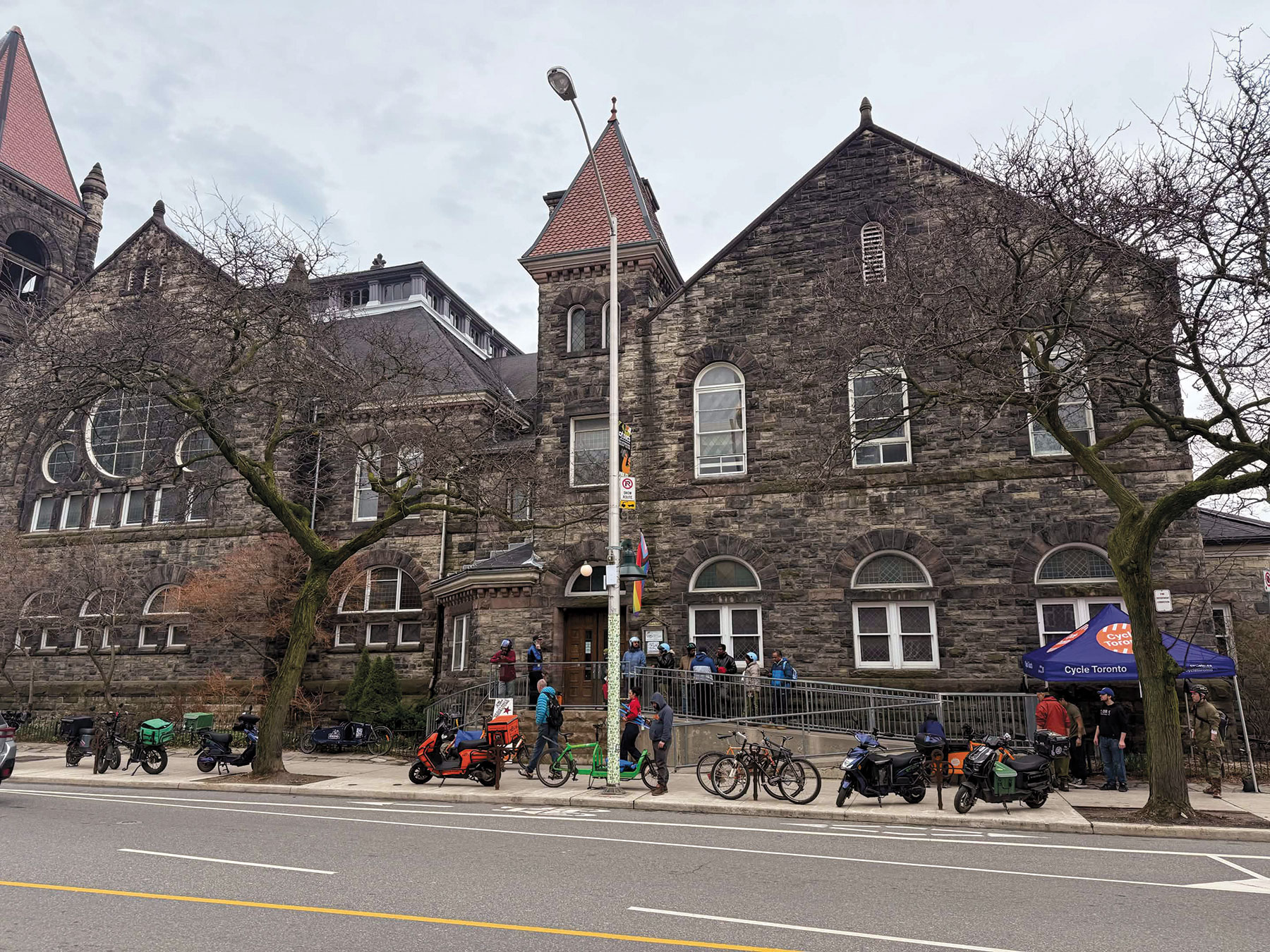
A Toronto initiative aimed at supporting gig economy cyclists saw a strong turnout despite days of heavy rain, as riders gathered for free equipment and safety training.
Organizers, including major injury lawyer David Shellnutt who advocates for cyclists’ legal rights (also known as The Biking Lawyer), partnered with The Bike Brigade, Cycle Toronto, and Rovelo Creative to host the event from April 13 to 15 at Trinity-St. Paul’s United Church at 427 Bloor St. W.
Shellnutt, who founded The Biking Lawyer LLP and has more than a decade of experience in personal injury and human rights law, led parts of the safety discussion. He and other speakers emphasized practical risk reduction, including the importance of staying off sidewalks, riding predictably in traffic, and documenting collisions. They also advised riders on what to do after a crash, including seeking medical attention and recording details for insurance and legal purposes.
The program offered free insulated delivery bags to cyclists who attended a safety session, and the goal was to distribute 500 bags to workers who rely on bicycles for income. The event also aimed to address safety concerns and gaps in support for app-based delivery workers.
Despite poor weather conditions throughout the week, cyclists continued to show up in large numbers, highlighting demand for both equipment and information.
Narada, a bike courier and filmer who attended the event, said turnout exceeded expectations early on. “The Biking Lawyer handed out close to 100 delivery bags on the first day,” said Narada. Beyond the giveaway, organizers focused on education. Attendees participated in cycling safety sessions covering rules of the road and how to handle common interactions while working.
Delivery cyclist Jihnder Kamran said the session made an immediate impact. “I feel more informed and safer delivering from the meeting today.” Kamran said.
The rainy conditions underscored the realities of gig-based delivery work; cyclists often operate in every type of weather without guaranteed protections or support. Organizers said the initiative focused on education over enforcement, as efforts grow to improve conditions for delivery workers across Toronto.
Comments Off on NEWS: The Biking Lawyer reaches out to gig economy workers (June 2026)Tags: Annex · News
CHATTER: Bathurst business owner receives recognition for support of bus lanes (June 2026)
August 9th, 2026 · Comments Off on CHATTER: Bathurst business owner receives recognition for support of bus lanes (June 2026)
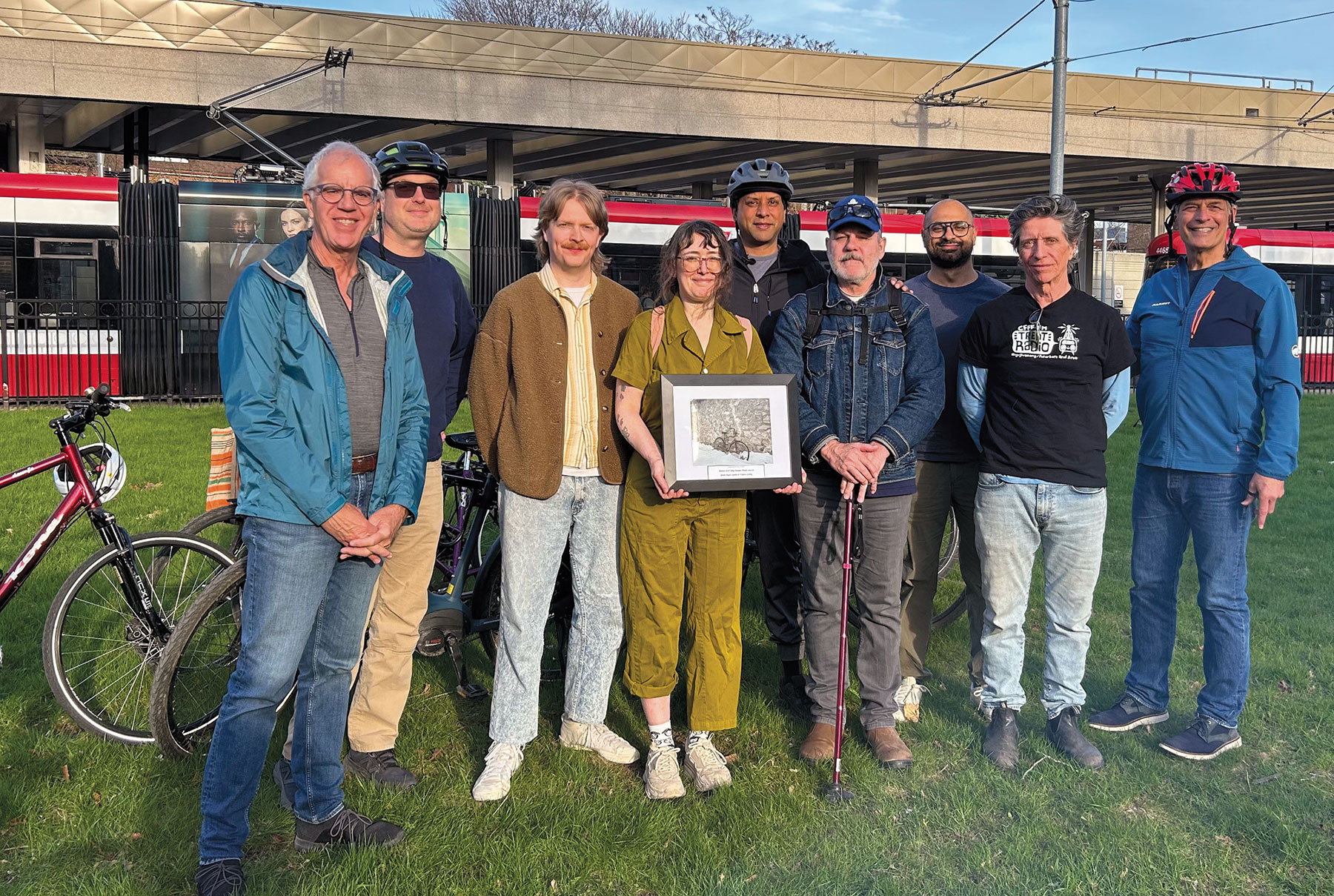
For her dedication to better transit, Ginette Lapalme was awarded the 2026 Business Road Safety Champion Award on April 23 from Albert Koehl and the Toronto Community Bikeways Coalition (TCBC) in front of the Bathurst subway station.
Koehl, who is an environmental lawyer, adjunct professor at the University of Toronto, and founding member of TCBC said that “Ginette stood up and courageously defended the RapidTO busway proposal, and TCBC appreciated the fact that she was willing to stand up for good transportation planning.”
TCBC is a volunteer advocacy group that believes the priorities of municipal transportation should be improved cycling, transit, and walking facilities. They advocate for the reallocation of public road space from motor traffic to cleaner, more efficient transportation options.
Ginette Lapalme, an artist and Bathurst street business owner, decided to speak out in favour of the RapidTO lanes that the city planned to install along Bathurst ahead of the 2026 FIFA World Cup.
The purpose of the RapidTO plan was to enhance bus and streetcar reliability and improve travel times across Toronto through the implementation of transit priority solutions such as reserved lanes and intersection and signal improvements.
One of the more controversial parts of the RapidTO plan was to eliminate parking along Bathurst Street including north of Bloor. Some, however, felt this would have a negative impact on businesses along the street, and most business owners in the area opposed the plan. Ginette stood uniquely in favour of the bus lanes, and she felt that opposition from businesses along Bathurst Street was a form of fearmongering.
We are nearly eight months into RapidTO’s implementation along Bathurst Street, and Ginette stands by her initial sentiments.
“[At the time], I attempted to remind everyone that there are many people in this city, including me, who do not own or drive cars and that it would be important to recognize that faster and more reliable public transit would allow more potential customers to peruse our businesses,” Ginette said.
In addition to helping (as opposed to harming) the businesses along the street, Ginette saw RapidTO as a means of improving safety for cyclists and pedestrians in the area.
“[I also] pointed out that actual pedestrians and cyclists have died and/or been injured due to unsafe streets, and this issue is much more important than an imagined loss of business,” Ginette said.
Ginette’s stance was an unpopular one and drew waves of hate and slander from her fellow business owners.
“Some business owners disagreed with me politely, and others not so politely,” She continued, “A woman I didn’t recognize even barged into my store just to yell and call me names because of my pro-bus poster.”
Ginette also noted multiple other incidents, such as ones involving AI-generated videos depicting resident of Bathurst disagreeing with her, as well as Instagram posts claiming that she was paid by the government to support RapidTO.
Aside from business owners along Bathurst Street, another notable opponent of part of the RapidTO plan was Ward 11 Councillor, Dianne Saxe, who in April of this year, hosted a town hall that sought to address city-wide congestion.
Saxe attempted to foster a compromise between transit advocates and anxious business owners by suggesting the Bloor to Dupont stretch be exempt from the TTC’s RapidTO Bathurst project.
To this day, Albert Koehl remains confused by this decision, as he believed Saxe to be a champion of congestion mitigation and sustainability.
“This would have been great for transportation, great for climate action, and great for affordable transportation. So we were very disappointed that the local councillor, Dianne Saxe, didn’t support the busway,” said Koehl.
Overall, despite the flak she received, Ginette noted that much good came of her advocacy.
“I met a lot of residents. I was connected with the activist group TTCRiders, and they invited me to speak at a press conference, and I felt encouraged to register to speak at city hall for the first time.”
Ultimately, the city scaled back RapidTO Bathurst (thanks in part to the compromise put forth by Saxe). The planned RapidTO bus lanes north of Bloor were cancelled, but the priority streetcar lanes between Nassau Street and Bathurst Station should be completed by late May, just in time for the 2026 FIFA World Cup. The city is expecting around 300,000 visitors to Toronto. Metrolinx is projecting about 44,000 additional riders, and the TTC is preparing for roughly 1.5 million additional transit trips.
—Damola Omole/Gleaner News
READ MORE:
- FORUM: Bathurst Street: Not yet RapidTO (Aug. 2025)
- NEWS: Pushback on Bathurst bus lanes (July 2025)
- LETTERS TO THE EDITOR Empty cars don’t buy things responses (July 2025)
- OPINION: Empty cars don’t buy things—people do (May/June 2025)
- FORUM: Easing congestion into summer (May/June 2025)
- NEWS: Annex honoured for pioneering Bloor bike lanes (May/June 2023)
- FORUM: Changing times and travel modes (October 2018)
- FORUM: A magical new supply of parking spots (Oct. 2017)
- FOCUS: An early advocate for bike lanes (June 2016)
- FORUM: The faster we lower speeds, the more lives we save (Oct. 2015)
Comments Off on CHATTER: Bathurst business owner receives recognition for support of bus lanes (June 2026)Tags: Annex · News
EDITORIAL CARTOON: How open for busy-ness (June 2026)
August 9th, 2026 · Comments Off on EDITORIAL CARTOON: How open for busy-ness (June 2026)
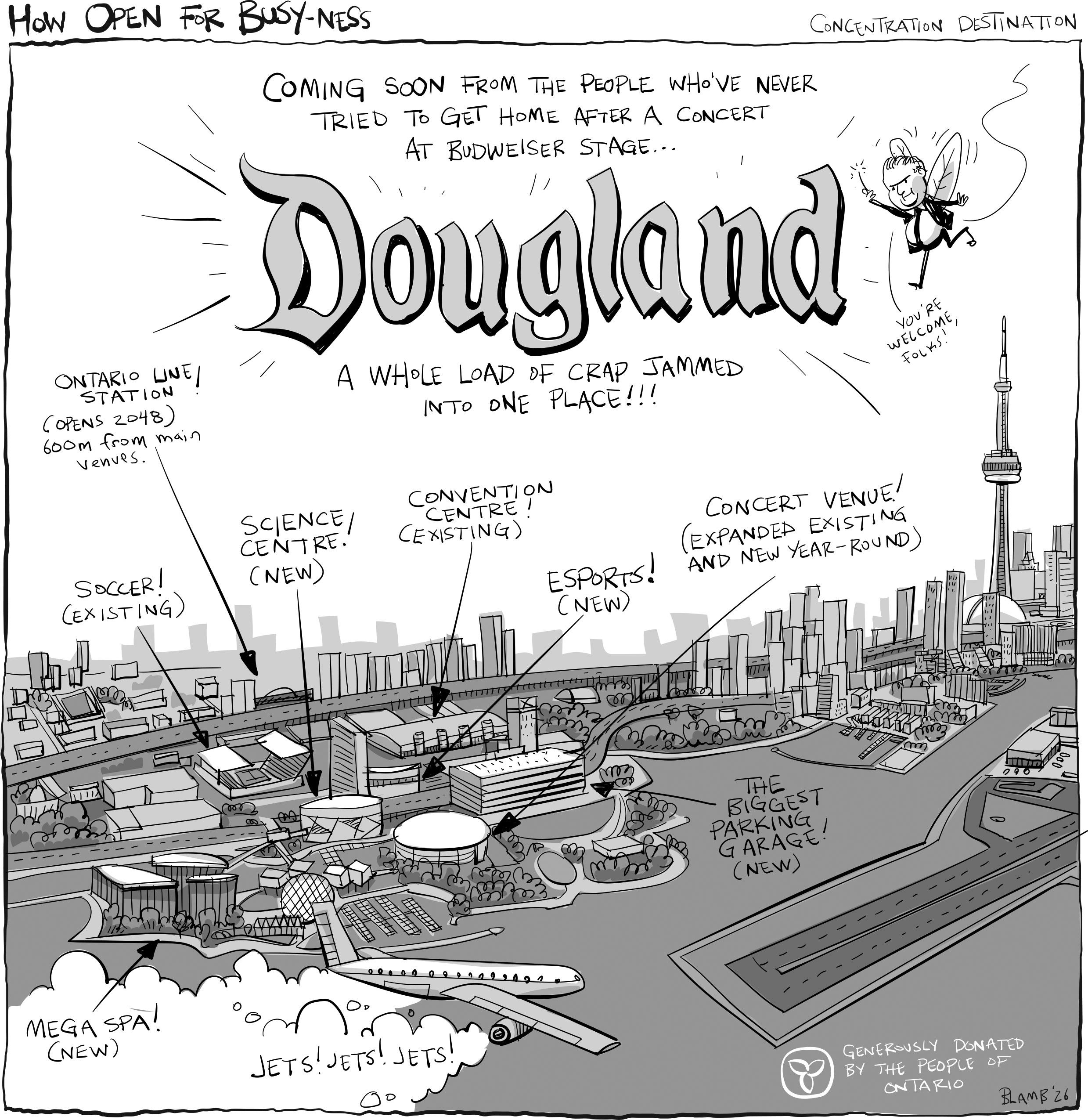
SEE MORE EDITORIAL CARTOONS:
- EDITORIAL CARTOON: How Ford (May 2026)
- EDITORIAL CARTOON: How Nice-ish (Apr. 2026)
- EDITORIAL CARTOON: How Wonderful (Mar. 2026)
- EDITORIAL CARTOON: How ICE (Feb. 2026)
- EDITORIAL CARTOON: A P.P. easement (Jan. 2026)
- EDITORIAL CARTOON: Con spawn (Dec. 2025)
- EDITORIAL CARTOON: Speed sham (Oct./Nov. 2025)
- EDITORIAL CARTOON: Taking care of business (Sept. 2025)
- EDITORIAL CARTOON: How to buy Canadian (Aug. 2025)
- EDITORIAL CARTOON: Silly vs. Silly (May/June 2025)
- EDITORIAL CARTOON: “Poll toll” (Apr. 2025)
- EDITORIAL CARTOON: The Perils of Pierre Pufferfish (Mar. 2025)
- EDITORIAL CARTOON: Doug out-thugged, needs a hug (Feb. 2025)
- EDITORIAL CARTOON: “A tiny silver lining!” Jan. 2025
- EDITORIAL CARTOON: Today’s flavour: cookie dough (Dec. 2024)
- EDITORIAL CARTOON: Disinformation 101 (Oct./Nov. 2024)
- EDITORIAL CARTOON: Get ready for Eglinton! (Sept. 2024)
- EDITORIAL CARTOON: Staggering Progress! (Summer 2024)
- EDITORIAL CARTOON: How Nice (June 2024)
- EDITORIAL CARTOON: How Nice (May 2024)
- EDITORIAL CARTOON: How Nice: NIMBYism 101 (Apr. 2024)
- EDITORIAL CARTOON: Why can’t they get along??? (Mar. 2024)
- EDITORIAL CARTOON: How to drive in Toronto (Feb. 2024)
- FORUM: Celebrating 20 years of cartoonist Brett Lamb (April 2017)
Comments Off on EDITORIAL CARTOON: How open for busy-ness (June 2026)Tags: Annex · Editorial · Opinion
EDITORIAL: Ford’s straw man fallacies (June 2026)
August 9th, 2026 · Comments Off on EDITORIAL: Ford’s straw man fallacies (June 2026)
Doug Ford would like you to think he has the solutions to all the problems you didn’t even know you had.
The premier likes to depict a world full of simple problems, and sometimes made-up ones, for which he has complex solutions which inevitably benefit him and his desperate craving to stay in power and be liked. The root of the strategy is to create the problem, the straw man, and then take it down; it’s a perfect self-fulfilling circle of deceit with power as the main goal.
Ontario taxpayers are on the hook for a series of TV ads currently being broadcast which promote government accomplishments such as building more homes, combatting illicit public drug use, closing encampments, and fighting crime. These “problems” are mostly not true. The province is years behind in building new homes. Public drug use is a result of either addicts being homeless and/or the province purposely closing most safe injection sites creating more public drug use. Encampments are down, and so is crime on just about every metric. But not to worry, Doug has solutions.
To help “solve” the housing crisis Ford’s solution was to try and develop select parcels of the Green Belt, a pristine watershed with no services or public infrastructure to support new suburbs. Of course, that “solution” was preceded by the premier’s developer buddies buying up those specific parcels of land with the foreknowledge that the province was about to lift the development restrictions. The point here is that Ford took a real problem, the housing crisis, and portrayed it as Ontario’s lack of new housing in the Green Belt.
In 2022, the province enacted the Strong Mayors, Building Homes Act. At first, it applied to just Toronto and Ottawa, but it has since expanded to 200 Ontario municipalities. Ford says he is going to appoint regional chairs to which many towns and cities will be subordinate. These chairs will work for the premier and not be elected, and they will also possess these extraordinary powers: The Act allows the mayors, and ostensibly regional chairs, to overrule majority votes of municipal councils and to implement what the legislation vaguely describes as “provincial priorities”, i.e., Doug Ford’s will.
A recent Toronto Star analysis found that of the 4,200 strong mayor decisions issued since the law’s inception, only two per cent were aimed at housing creation. Some mayors have actually used their newfound authority to block housing and densification. Doug Ford portended his desire for one person rule in his 2016 autobiography, Ford Nation: Two Brothers, One Vision, where he wrote of his desire for “One person in charge, with veto power, similar to the strong mayoral systems in New York, Chicago, and L.A.” Never mind the housing never materialized, at least the centralized power did.
The omnibus Justice Act currently in the legislature includes provisions allowing the province to direct police service boards to ensure they adhere to “provincial priorities.” This is an affront to the long-standing principle that the government does not direct the police. The impartiality of law enforcement is critical to a functioning democracy. The potential that a sitting premier could order the arrest of those who disagree with them is too real. Will the premier force the police to arrest drug addicts, vagrants, and that elusive criminal element responsible for fewer crimes? Stay tuned.
On education, the premier has taken over a raft of school boards for dubious reasons. The “problem” at the Toronto Catholic Board was that the board chair bought themselves a computer monitor and a phone charging cord. The solution: takeover the board and install your own unelected leader. Then maybe sell some surplus school lands to someone you may know, while the real estate market is depressed.
In each case, Doug Ford oversimplifies a problem and then makes hasty generalizations as a form of verbal manipulation. He then crafts elaborate, overzealous solutions to the strawman problem that invariably results in a nefarious outcome where he benefits with more power for power’s sake.
READ MORE EDITORIALS:
- EDITORIAL: Dougy and the jets (May 2026)
- EDITORIAL: The “Get it Done Act” should get Ford out (Feb. 2024)
- EDITORIAL: The man who will never be mayor struggles to be premier(Apr. 2026)
- EDITORIAL: Take from the poor and give to the rich (Mar. 2026)
- EDITORIAL: ‘An international relations earthquake’ (Feb. 2026)
- EDITORIAL: Poilievre endorses Trump’s actions; he should never be PM(Jan. 2026)
- EDITORIAL: Toronto has matured; Doug Ford has not (Dec. 2025)
- EDITORIAL: Governing by gut, not facts (Oct./Nov. 2025)
- EDITORIAL: Pierre is in a political pickle (Sept. 2025)
- EDITORIAL: Fact over fiction: Ford’s Bill 212 fails on its merits (Aug. 2025)
- EDITORIAL: No experience necessary managing a school board (July 2025)
- EDITORIAL: Bill 5 recklessly endangers Ontario (May/June 2025)
- EDITORIAL: Thou shalt not park in a bike lane (Apr. 2025)
- EDITORIAL: Bike lane facts Ford knew (Mar. 2025)
- EDITORIAL: Poilievre’s perfect storm (Feb. 2025)
- EDITORIAL: An election designed to distract voters (Jan. 2025)
- EDITORIAL: Bill 212 causes congestion (Dec. 2024)
- EDITORIAL: Fact-checking Ford (Oct./Nov. 2024)
- EDITORIAL: An injection of ignorance (Sept. 2024)
- EDITORIAL: Road safety for some, sometimes (Summer 2024)
- EDITORIAL: Ford’s boozy billion-dollar blunder (June 2024)
- EDITORIAL: Ford needs to step up and lead for once (May 2024)
- EDITORIAL: The Vacant Home Tax: A multi-mayor failure (Apr. 2024)
- EDITORIAL: Ford‘s actions “reflect a juvenile understanding of the role of the judiciary” (Mar. 2024)
Comments Off on EDITORIAL: Ford’s straw man fallacies (June 2026)Tags: Annex · Editorial · Opinion
FORUM: Welcome to summer! (June 2026)
August 9th, 2026 · Comments Off on FORUM: Welcome to summer! (June 2026)
Waterfront under threat with airport expansion plans
By Dianne Saxe
With summer now in full swing, our city finds itself in the midst of important conversations about Toronto’s waterfront, art in public space, and safety on streets. Across University-Rosedale and the city as a whole, there is encouraging momentum on several community priorities, alongside some major decisions that deserve thoughtful public discussion.
Toronto deserves agency in the future of Billy Bishop Airport
The province’s proposal to expand Billy Bishop Airport for larger jet service would have significant implications for Toronto’s waterfront and downtown communities, and many residents are concerned about the long-term impacts.
Concerns raised by residents include increased traffic congestion, additional pollution and aviation emissions, pressure on parkland and housing opportunities, and the potential impact on recreational boating and waterfront access.
Just as importantly, many Torontonians have not been given a meaningful opportunity to shape a decision that could permanently alter a large part of the city’s waterfront. Transformative city-building decisions work best when residents are genuinely consulted, and local voices are part of the process.
For that reason, I pushed for a city-wide referendum as a way to give residents a direct voice on the issue. While council ultimately chose not to proceed with that approach, I continue to believe that Torontonians deserve to be included in conversations about the future of their waterfront. It is my hope that Toronto city council, and indeed all levels of government, will work with residents, community organizations, and the city to ensure the waterfront remains a vibrant and accessible public space for future generations.
Ward 11’s cultural network continues to grow
One of the things that makes University-Rosedale unique is its extraordinary concentration of cultural institutions, independent venues, parks, and community gathering spaces. Supporting that ecosystem remains a key priority.
This month, I was delighted to help fund our second new performance venue: a new home for the beloved Bad Dog Theatre in Mirvish Village. Bad Dog has long been one of Toronto’s most important incubators for comedy and performance talent, and securing a permanent venue strengthens the city’s independent arts community at a time when cultural spaces are under increasing pressure.
It is also encouraging to see Mirvish Village steadily coming back to life after years of disruption and construction. The area’s new tree-lined streetscape is beginning to mature, local businesses are attracting strong community support, and destinations like Pizzeria Badiali have quickly become neighbourhood favourites. Honest Ed’s Park is also on the way and will add another important public gathering place to the community.
Beyond Mirvish Village, several exciting public realm projects are now complete or moving forward.
The new Gallery Park is now open across from the Art Gallery of Ontario. As a key anchor of the Relic Park system, the space honours art, memory, and community through beautifully integrated architectural relics and Indigenous ironwork that are especially striking at night.
The new active leisure park at Ossington and Dupont has also opened, creating another valuable recreation space in a growing neighbourhood.
Community-building extends beyond parks and arts infrastructure. Non-profit groups can now be reimbursed for insurance costs associated with community events involving park ovens, including the popular oven at Christie Pits. Small changes like this can make a meaningful difference in helping grassroots community events thrive.
Progress on motorcycle-like vehicles in bike lanes
I have taken an important step toward addressing unlicensed motorcycle-like vehicles operating on sidewalks and in cycling infrastructure.
These vehicles have become increasingly common in bike lanes and on sidewalks, raising concerns about safety, noise, and the proper use of cycling infrastructure among residents, pedestrians, and cyclists alike.
This month, council adopted my motion supporting provincial requirements to license these vehicles under the Highway Traffic Act. Staff have also been directed to report back in December with bylaw changes that would prohibit them from operating in bike lanes.
If adopted, the new rules would create a clear choice for delivery riders and operators:
• License and insure mopeds or motorcycles and operate them in regular traffic lanes; or
• Use properly speed-limited e-assist bicycles if they wish to continue using cycling infrastructure.
The goal is to create a clearer and safer framework that protects bike lanes while still supporting practical transportation and delivery options.
In other news
The East Waterfront LRT has finally received funding, while Biidaasige Park now features a basketball tree installation and Canoe Landing has become accessible by canoe. Council’s upgraded infrastructure and housing plan for Ookwemin Minising has been carefully designed to accommodate the current island airport—though much of that planning could be undermined by the airport expansion.
As climate change intensifies, extreme heat remains Toronto’s most serious climate-related health risk.
Because the city cannot currently require landlords to provide air conditioning without passing costs directly onto tenants, Toronto is pursuing federal retrofit funding while also expanding direct support programs. This year, the city will install portable air conditioners for 2,400 eligible seniors and new parents—a major increase from 500 units last year.
Toronto is changing rapidly, and the growth our city is experiencing will shape its future. This transformation will work best when the residents of this city have a meaningful voice in the decisions that shape it.
Dianne Saxe is city councillor for Ward 11, University-Rosedale.
READ MORE BY DIANNE SAXE:
- FORUM: What a month at city hall (May 2026)
- FORUM: A report from the road (Apr. 2026)
- FORUM: Funds flowing (Mar. 2026)
- FORUM: A busy beginning to 2026 (Feb. 2026)
- FORUM: Tear up that parking lot and put in housing (Jan. 2026)
- FORUM: Pursuing a green agenda (Dec. 2025)
- FORUM: Twelve active files (Oct./Nov. 2025)
- FORUM: A busy August in Ward 11 (Sept. 2025)
- FORUM: Celebrating greenspaces, easing congestion (Aug. 2025)
- FORUM: Council still at work (July 2025)
- FORUM: Easing congestion into summer (May/June 2025)
- FORUM: Exciting spring initiatives (Apr. 2025)
- FORUM: Tariffs and election dominate (Mar. 2025)
- FORUM: Budget is the news of the month (Feb. 2025)
- FORUM: A busy beginning to 2025 (Jan. 2025)
- FORUM: A busy legislative agenda ahead (Oct./Nov. 2024)
- FORUM: Saxe and the City (Summer 2024)
- FORUM: Tackling road congestion, noise, and safety (June 2024)
- FORUM: Undoing vacant home tax debacle (May 2024)
- FORUM: A busy agenda at city council (Apr. 2024)
- FORUM: University-Rosedale update from the councillor’s chair (Mar. 2024)
- FORUM: Eventful new year at city council (Feb. 2024)
- FORUM: A hectic first year in University-Rosedale (Dec. 2023)
- FORUM: Keeping it green and safe in University-Rosedale (Fall 2023)
- FORUM: Fighting on five fronts (Summer 2023)
- FORUM: Addressing a housing shortage (May/June 2023)
- FORUM: Leveraging a green agenda (April 2023)
- FORUM: Budget passes in a consensus vote (Mar. 2023)
- FORUM: Bike lanes made permanent, more warming centres open (Feb. 2023)
- FORUM: Turbulent time to take a seat (Jan. 2023)
Comments Off on FORUM: Welcome to summer! (June 2026)Tags: Annex · Opinion
FORUM: Ontario’s terrible climate plan should inspire action (June 2026)
August 9th, 2026 · Comments Off on FORUM: Ontario’s terrible climate plan should inspire action (June 2026)
The Ontario government is hiding under a rock
By Jessica Bell
In April, I participated in hearings to assess the Conservative government’s progress in implementing its climate action plan. I left feeling betrayed and undeterred.
This is how bad the Conservatives are failing on the climate file.
We’re not meeting our targets. In her 2025 report, Ontario’s auditor general, Shelley Spence, concluded the government is on track to reduce its emissions by 22 per cent below 2005 levels by 2030, well below the 30 per cent goal.
In committee, officials from the government boasted about this 22 per cent reduction, but they were taking credit for something they didn’t do.
Ontario’s emissions reductions are largely because Ontario closed its coal plants in 2014. Since the Conservatives came to power, emissions reductions have stalled in the building and agriculture sectors and emissions are rising in transportation, electricity, and industry.
The premier has made a career of hating the environment. With his “axe the tax” mantra, he hammered away for years on the misleading message that a carbon tax is why everything is so expensive.
From ending the cap-and-trade program, to cancelling wind energy contracts, to rewriting Ontario’s planning rules to allow carbon-intensive, low-density sprawl, the Conservatives committed to gutting environmental protections.
I’m most alarmed by the Conservative’s move to keep Ontario hooked on gas.
Ontario’s Independent Electricity System Operator (IESO) is favouring gas plant applications over more competitive renewable energy generation, and Enbridge is now allowed to bill existing ratepayers for connecting new homes to gas, even when cheaper options exist.
The plan is sloppy and secretive. The auditor general found the government made gross mistakes in its climate plan, like double counting emissions reductions or including the benefit of the federal carbon tax after it had been repealed.
When questioned about these gross inaccuracies, officials said they’re using best practices, but we can’t verify if that’s true because the government is refusing to release any updates to its original flawed climate plan.
After 2030, we are flying in the dark. Officials in the hearing confirmed the government, after 2030, will have no public targets, plan, or tracking.
Ministry officials defended their abandonment of a climate plan by saying they’re still committed to reducing emissions, but with all the economic uncertainty, they need to remain agile and adaptable.
There is no comprehensive adaptation plan.
Experts have been warning governments to get ready for extended and extreme hot weather, dangerous wildfires that threaten towns and cities, intense rainfall and flooding, threats to Ontario’s farming and food supply, and increased pressure on our emergency responders and hospitals.
Reducing emissions and preparing for a hotter and more extreme climate is the only morally, socially, and economically sound decision because the consequences of ignoring reality is just downright terrible across all the benchmarks that matter: standard of living, mortality, GDP.
The devastating 2025 fire in the Los Angeles area is one example of a natural disaster that could hit Toronto.
The L.A. fire burned for three weeks; entire neighbourhoods were razed, and it cost the economy over $70 billion.
A city and state investigation confirmed that the city wasn’t ready for climate-fuelled extreme wildfire. The winds were so extreme that planes could not fly. The emergency systems were outdated. There weren’t enough fire fighters. A postmortem study is no comfort to the 18,000 people who lost their homes.
An NDP government would fully accept the auditor general’s recommendations to develop, publish, implement and track a sound climate action to reduce our emissions, along with a comprehensive plan to ready our towns, cities, key economic sectors, health-care system, and more.
The solutions are all around us. Sweden, Denmark, Iceland, and Norway, are either carbon-negative or very close. Cities like Paris and New York are executing plans to prepare for extreme heat and extreme flooding.
While Doug ignores the issues, there are lots of things we can do to act on climate: support and improve the city’s NetZero strategy; or support a group doing good work, such as the Toronto Climate Action Network, Environmental Defence, and the Ontario Clean Air Alliance.
Doug Ford is not a monolith. People are devastated by his cuts to hospitals and schools. His obsession with his pet projects. The corruption. His disdain for the environment.
We know there’s a rash of byelections coming up, starting with Scarborough Southwest. He’s vulnerable. His popularity is tanking. It’s time to flex our political muscle. We will be campaigning in these byelections, and I encourage you to do the same.
Jessica Bell is the NDP MPP for University-Rosedale and the shadow minister for finance and the treasury board for the Official Opposition. Contact her at jbell-co@ndp.on.ca or 416 535 7206.
READ MORE BY JESSICA BELL:
- FORUM: Bringing jets to Billy Bishop is a terrible idea (May 2026)
- FORUM: Schools struggle under Ford’s supervisor czar (Apr. 2026)
- FORUM: Generation screwed (Mar. 2026)
- FORUM: A lurking health crisis is right in front of us (Feb. 2026)
- FORUM: Our health-care crisis deepens (Jan. 2026)
- FORUM: Doug Ford thumbs his nose at democracy (Dec. 2025)
- FORUM: A troubling track record (Oct./Nov. 2025)
- FORUM: Province late to the party on affordable housing rules (Sept. 2025)
- FORUM: Coping with heat is the new norm (Aug. 2025)
- FORUM: Now more than ever, Ontario needs to buy local (July 2025)
- FORUM: Primary health, environment, education each suffer under Ford (May/June 2025)
- FORUM: Coming up this legislative session (Apr. 2025)
- FORUM: What did the election teach us? (Mar. 2025)
- FORUM: Auditor General exposes government shortfalls (Jan. 2025)
- FORUM: Dangerous road safety bill is a distraction (Dec. 2024)
- FORUM: Bike lanes are a solution to congestion, not the cause (Oct./Nov. 2024)
- FORUM: Government ignores own experts, closes injection sites (Sept. 2024)
- FORUM: The heat is on (Summer 2024)
- FORUM: A view from inside the pink palace (June 2024)
- FORUM: Queen’s Park roundup (May 2024)
Comments Off on FORUM: Ontario’s terrible climate plan should inspire action (June 2026)Tags: Annex · Opinion
GRADING OUR GREENSPACE: Annual audit of Annex amenities (June 2026)
August 9th, 2026 · Comments Off on GRADING OUR GREENSPACE: Annual audit of Annex amenities (June 2026)
Part 1 of this year’s Grading our Greenspace
This is the first instalment of our annual look at neighbourhood greenspaces. Each year, the Annex Gleaner visits and evaluates the parks and parkettes across our coverage area using a range of criteria. While there is no single overall winner, letter grades are assigned to reflect the quality of each space based on factors such as upkeep, design, amenities, accessibility, and overall atmosphere.
Previous grades are included for comparison, while the accompanying reviews highlight the unique features and character that make each park distinct.
Compiled and photos by Shaya Rahmani
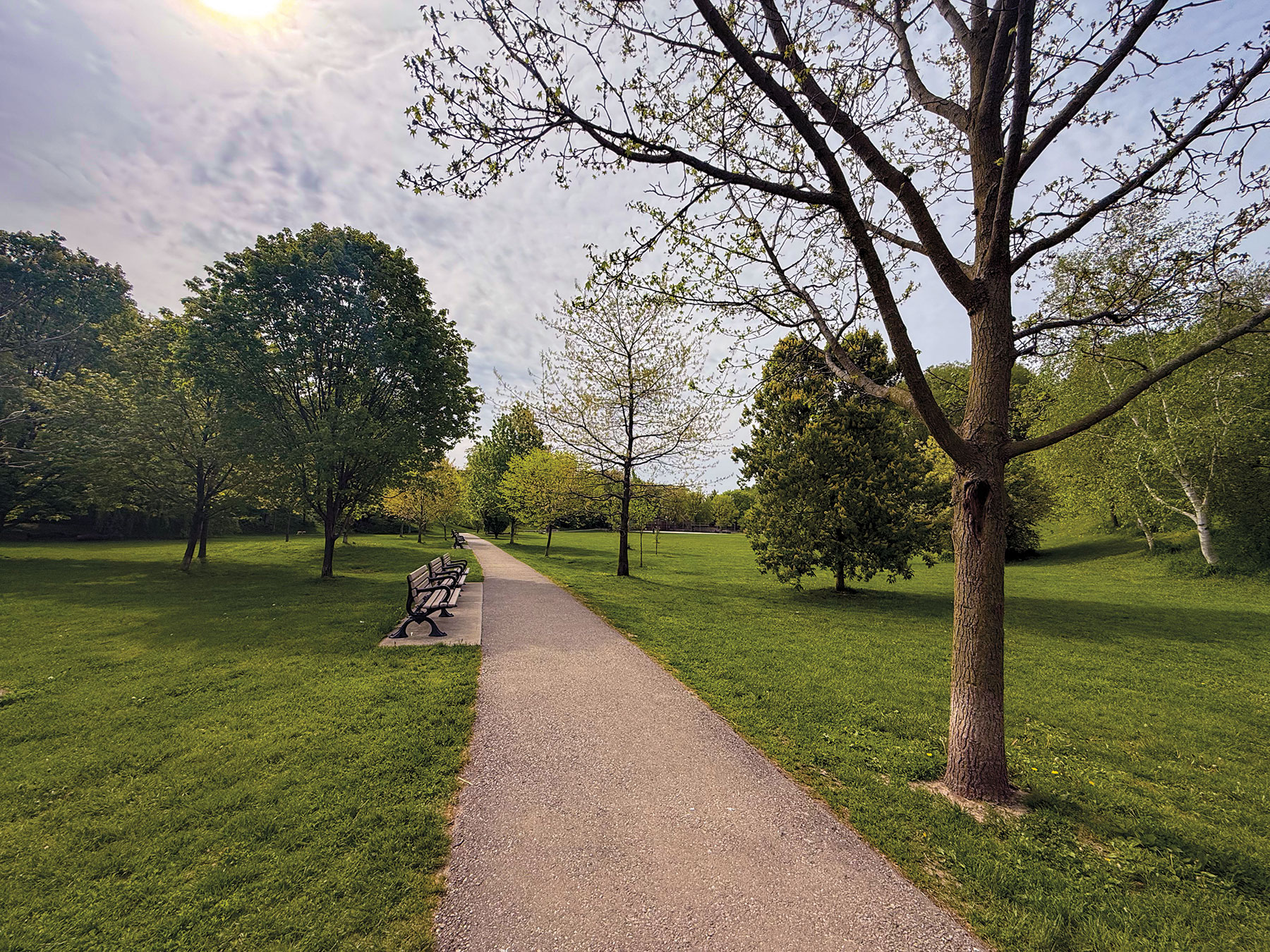
Bickford Park
Address: 468 Grace St.
Time of Visit: 10:36 a.m.
Grade: A (Last Year’s Grade: A)
Reason to go: Bickford Park is a spacious and welcoming greenspace tucked into the neighbourhood of Christie Pits. The park’s rolling hills and wide-open layout create a relaxed atmosphere that feels a bit removed from the surrounding city streets. One of its biggest draws is its appeal for dog owners. There is a fenced-in dog area for pets looking for a more contained space, while a large field also provides plenty of room for off-leash dogs to run around and burn off energy. During the visit, the park felt lively without being overwhelming, with neighbours gathering and chatting as dogs raced through the grass. The park is also well-maintained when it comes to its plant life and shrubbery, giving the area a cared-for and inviting appearance. While the baseball diamond shows some signs of age and could benefit from more attention, it does little to detract from the park’s overall atmosphere. Nearby community resources such as The Bickford Centre and Bob Abate Community Recreation Centre further add to the neighbourhood feel of the area. Whether you are looking for a place to walk your dog, throw a ball around, or simply enjoy some time outdoors, Bickford Park offers plenty of room for activities while maintaining a calm and welcoming character.
Overheard: Dog owners discussing their pets while neighbours chat nearby and dogs barking excitedly as they run through the off-leash areas.
Did you know: A hidden waterway runs beneath the area. The historic Garrison Creek system, one of Toronto’s oldest buried waterways, passes under Bickford Park and nearby areas.
Christie Pits Park
Address: 750 Bloor St. W.
Time of Visit: 11:13 a.m.
Grade: A (Last Year’s Grade: A)
Reason to go: There are still some larger, more active greenspaces in the Annex, such as Christie Pits Park, which offer a range of attractions for people of all ages. In Christie Pits there is a huge children’s playground, open grassy spaces that are perfect for recreational activities, and plenty of picnic tables and benches throughout the grounds. What sets it apart from many other local parks is its vastness which means it can accommodate several activities at the same time without feeling crowded. Whether visitors are seeking a location to exercise, socialize, or just spend time outdoors, Christie Pits accommodates a wide range of activities. The park has a huge baseball field and soccer facilities, plus a skate park that regularly attracts skateboarders and scooter riders performing stunts and testing new skills. The mature trees in the park offer shaded spaces that are a respite on warmer days, while the varying tree cover adds visual character and lends individual sections of the park their unique feel. The only visible problem on our visit was the amount of litter and plastic rubbish strewn around in parts of the open space. Nevertheless, Christie Pits is a vibrant and adaptable park with a little bit of everything for almost everyone.
Overheard: Sounds of skateboard wheels grinding against rails and riders practicing tricks.
Did you know: Before becoming a public park, Christie Pits was once a series of sand and gravel quarries that supplied material used to build some of Toronto’s early roads and buildings.
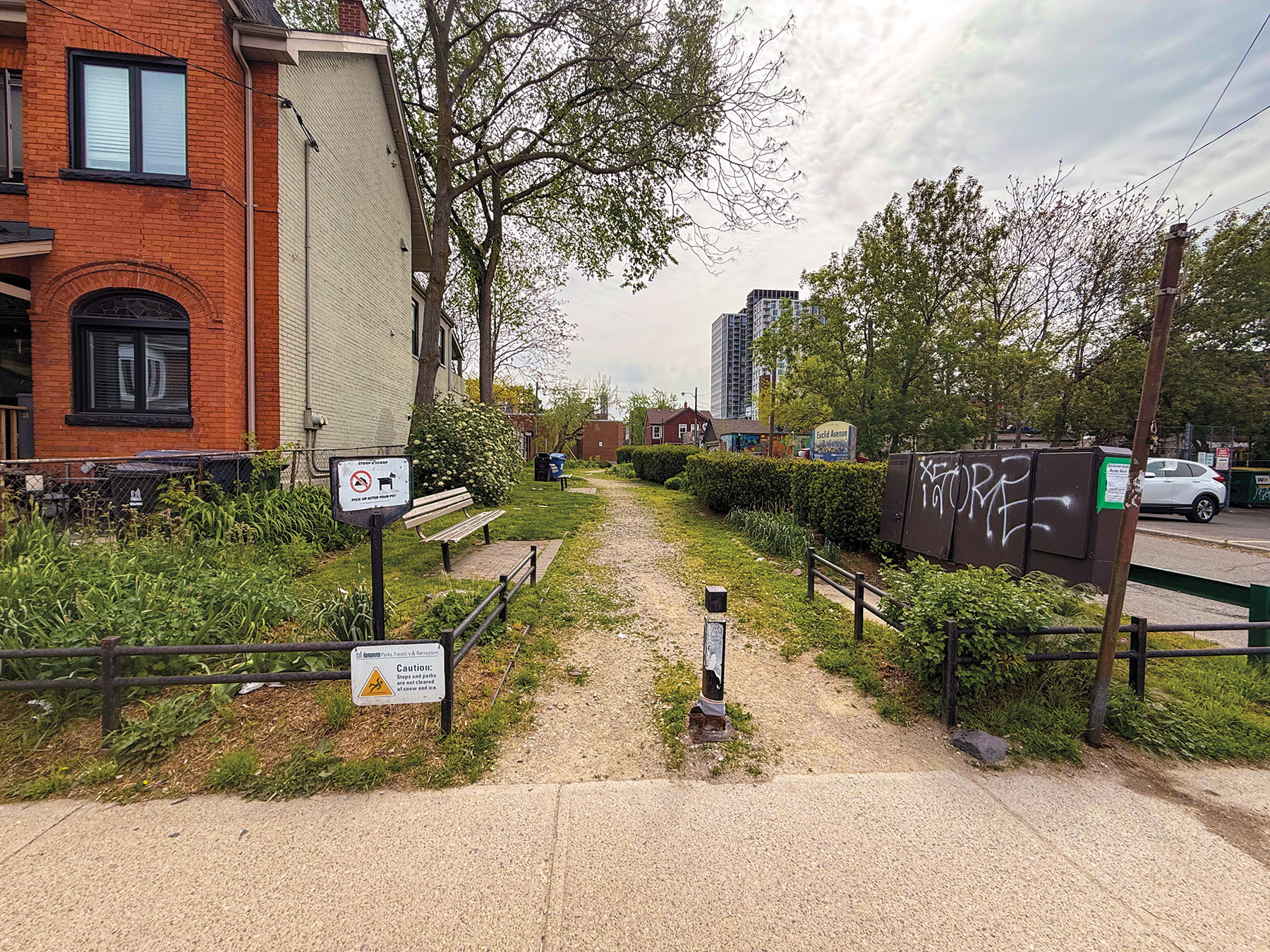
Euclid Avenue Parkette
Address: 711 Euclid Ave.
Time of Visit: 11: 55 a.m.
Grade: F (Last Year’s Grade: F)
Reason to go: Euclid Avenue Parkette is a small parcel of greenspace that works more as a transition strip than as a destination in its own right. The parkette is located on a residential street and is significantly affected by the noise of the adjacent households. This makes it difficult for the area to serve as a place of rest or reflection. The physical layout is sparse, with only the basics, such as a few seats and garbage cans, neither of which adequately offset the absence of mindful design or functional space. The parkette also has litter and an overall air of neglect. There is no shade or substantial greenery. It’s not a place that invites you to linger, but instead to hurry through. Overall, Euclid Avenue Parkette is not very useful as a public greenspace and resembles a converted alley more than a park.
Overheard: Air conditioning and ventilation units doing their best attempt at a symphony.
Did you know: The street name Euclid appears in many North American cities and references the ancient Greek mathematician whose work influenced surveying and mapping systems which helped shape early urban street grids.
Healey Willan Park
Address: 504 Euclid Ave.
Time of Visit: 12: 42 p.m.
Grade: A (Last Year’s Grade: A)
Reason to go: Healey Willan Park is a small, residential greenspace designed primarily for families and young children in the surrounding neighbourhood. The park features a playground and sandbox and it has a lived-in, community feel, often marked by scattered toys that suggest frequent and ongoing use rather than occasional visits. The open grassy areas are unstructured and filled with dandelions, adding a simple, natural character to the park’s otherwise minimal design. While it is not a large or heavily programmed greenspace, its appeal lies in its accessibility and ease of use. The atmosphere is calm and domestic, shaped by the surrounding homes and the steady presence of families.
Overheard: Children calling out while playing in the playground against the steady background sound of birds chirping from the nearby trees.
Did you know: Famous Canadian writer Robertson Davies once joked that one of the only things worth doing in Toronto was listening to the choir led by Healey Willan at St. Mary Magdalene.
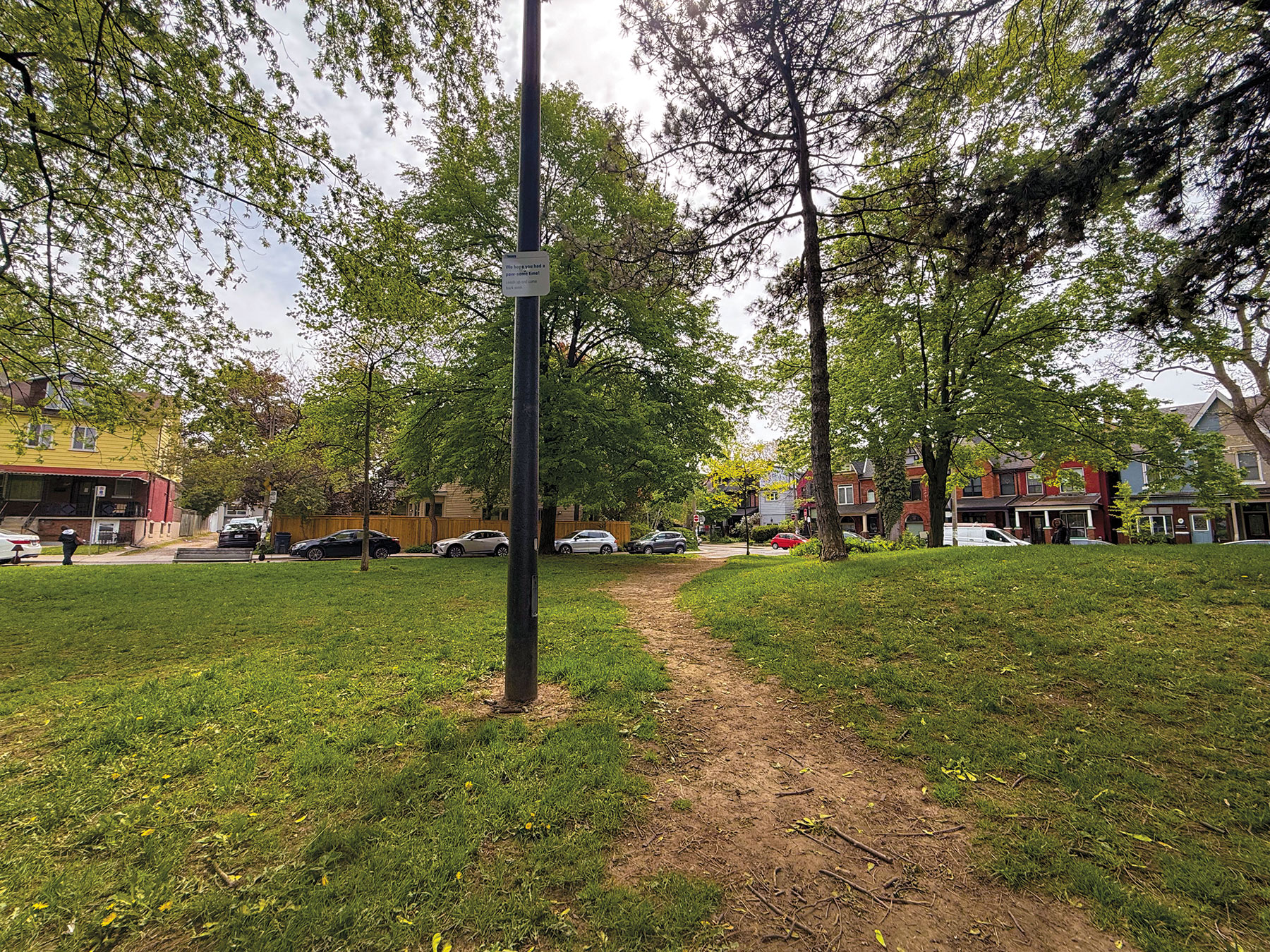
Vermont Square Park
Address: 819 Palmerston Ave.
Time of Visit: 1:30 p.m.
Grade: A- (Last Year’s Grade: A)
Reason to go: Vermont Square Park is a highly functioning, well-organized neighbourhood greenspace that acts as the principal recreational hub for the West Annex community. Even though it is small, the park is always busy and anchored by a large playground. The play structures are enclosed, contributing to a sense of safety. The adjacent open lawns offer additional space for unstructured play and include bocce courts and flexible-use zones. A key feature of the park is its mature tree canopy that offers considerable shade and helps create a noticeably comfortable microclimate during warmer months. Benches and picnic tables are arranged in a basic yet efficient pattern throughout the space. The middle field also seems to have a circular fenced-in part which might be for programming or for an enclosed off-leash dog area, demonstrating a flexible response to community needs. The park is small, but its design clearly favors accessibility, safety, and use by different generations.
Overheard: Children calling out from the playground while caregivers converse from shaded benches.
Did you know: The park is surrounded by a mix of Victorian and early Edwardian homes, many of which reflect the Annex’s distinctive architectural style that emerged during Toronto’s rapid growth between the 1880s and 1910s.
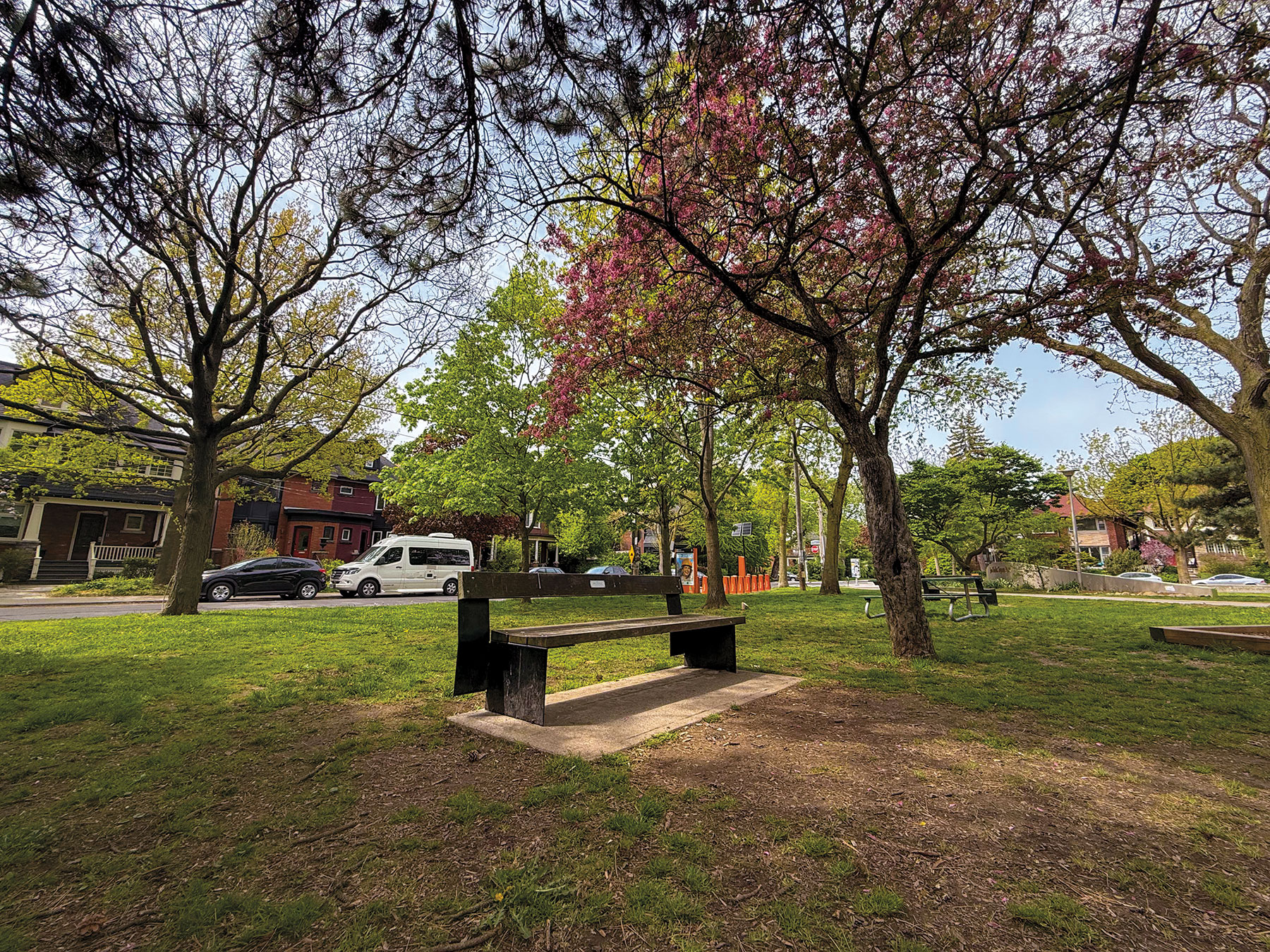
Jean Sibelius Square
Address: 50 Kendal Ave.
Time of Visit: 2:20 p.m.
Grade: A+ (Last Year’s Grade: A+)
Reason to go: Jean Sibelius Square is one of the Annex’s most fully realized and stand out greenspaces, balancing recreation infrastructure, passive green areas and community activities. The park is situated between Kendal and Brunswick avenues with Wells Street to the south and Bernard Avenue to the north. The park’s courtyard-like design provides a cushion from the neighborhood’s ambient street sounds, while being extremely accessible. The idea is that it can be used by a large number of people at one time, from families with small children to fitness-conscious park-goers. A hallmark of the park is its comprehensive recreational activities. The outdoor fitness area is a busy place throughout the day with many stations and pull-up bars. Next to it is a big playground with rope climbing structures, rock-climbing walls, and elevated play pieces to promote more physically active play. The proximity of bicycle rental stations improves accessibility and encourages longer stays in the surrounding green network. Mature trees produce a split canopy effect, with parts of the park in deep shadow and other areas open and sunny. At its cultural heart is a statue of Jean Sibelius, a Finnish composer and the park’s namesake.
Overheard: A father laying out strict rules for an enthusiastic group of children playing hide-and-seek tag and the nearby grunting of a man completing pull-ups on the outdoor fitness equipment.
Did you know: The park contains a memorial to Jean Sibelius that was presented to the City of Toronto by Finnish Canadians in 1959.
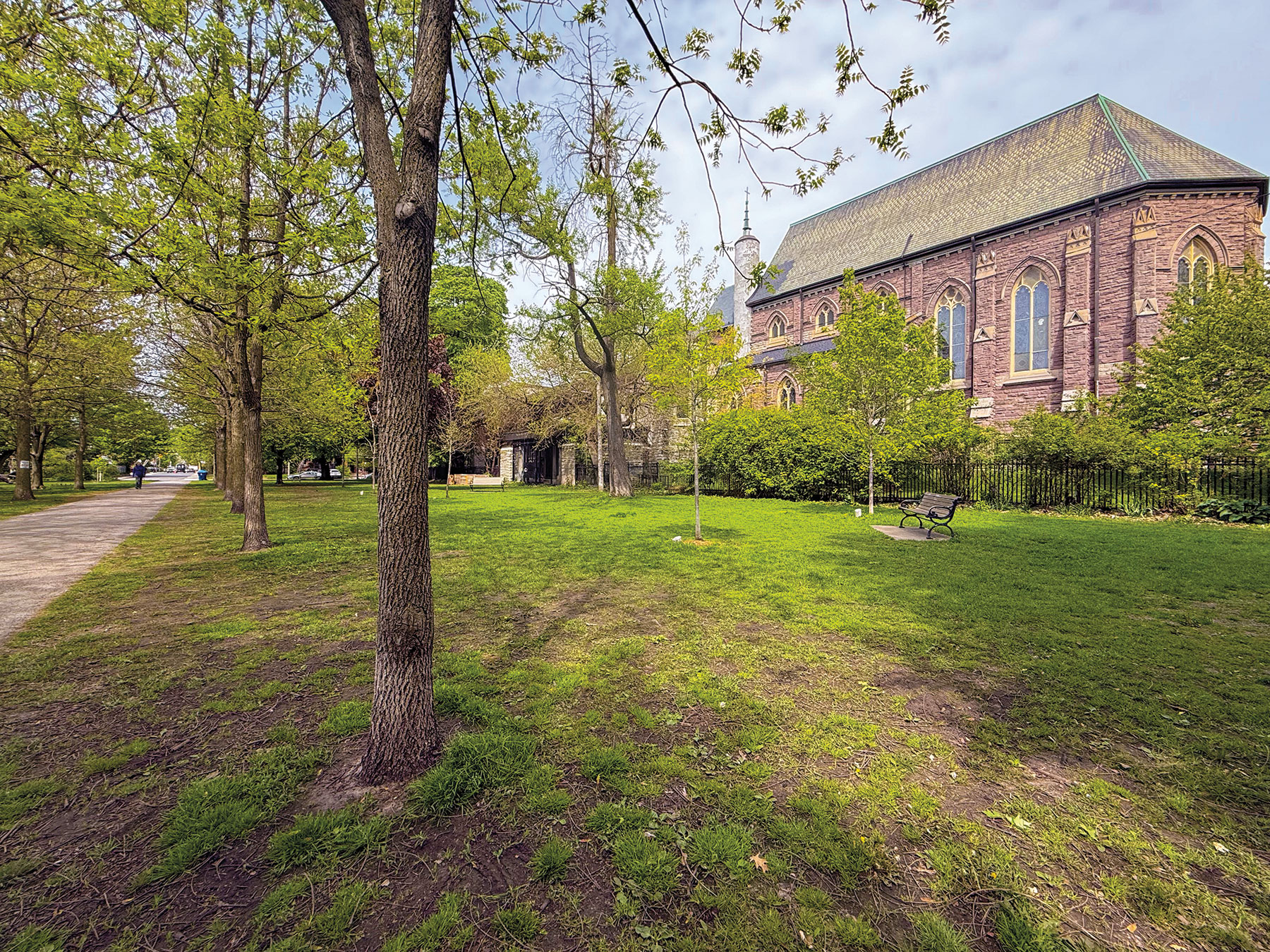
St Alban’s Square
Address: 90 Howland Ave.
Time of Visit: 3:10 p.m.
Grade: A- (Last Year’s Grade: A)
Reason to go: St. Alban’s Square is a modest and softly charming greenspace that offers a moment of tranquility amid the bustling rhythm of the Annex. The most visually striking aspect of the park is the symmetrical arrangement of trees on either side of the main path which directs movement through the area and strengthens the formal, even processional quality of the layout. The vibe of the park is decidedly low-key, driven less by scheduled activity and more by passive use. Seating is evenly spread around the park with benches situated to take advantage of both shade and sightlines along the walks. Mature trees provide a steady overhead canopy, affording relief during warmer months and adding to the park’s general sense of comfort. St. Alban’s Square has limited amenities but is carefully maintained. It is less a destination park and more of a place to relax for a moment, to pass through gently, or to step away from the surrounding noise of the city without quite leaving it behind.
Overheard: Birds chirping overhead in the tree canopy and the occasional footsteps of residents moving along the tree-lined path
Did you know: Like many Toronto parks, St. Alban’s Square is maintained by the city’s parks, forestry and recreation division and is designed for passive recreation, such as walking, sitting, and short stops rather than organized sports or programming.

Robert Street Park
Address: 60 Sussex Ave.
Time of Visit: 4:00 p.m.
Grade: B (Last Year’s Grade: A)
Reason to go: Robert Street Park is close to the Spadina and Bloor intersection and provides a brief pocket of peace in an otherwise highly urbanized area. The park has few amenities, and the focus is the rope climbing towers and open space for play. There are almost equal parts grass and hardscaped materials on the surface of the park. Much of the area is covered in cement and plastic safety flooring. This adds to a more formal, almost institutional aspect, but also guarantees durability and year-round usability. The park has good sightlines which include the CN Tower and colourful murals provide contrast to the otherwise pragmatic design of the playground. In general, Robert Street Park is more of a short, activity-oriented interlude for youngsters than an extensive recreational attraction.
Overheard: A teacher instructing a group of children to line up near the playground equipment, accompanied by the steady sounds of kids climbing off the structures.
Did you know: The park was designed with a strong emphasis on accessibility and barrier-free play structures, including rope-based climbing elements and open circulation paths intended to support a wide range of physical activity.
Matt Cohen Park
Address: 393 Bloor Street W.
Time of Visit: 10: 25 a.m.
Grade: C (Last Year’s Grade: C-)
Reason to go: Matt Cohen Park is a small greenspace located at the corner of Bloor Street West and Spadina Avenue. It is a transitional civic space rather than a regular park, and it is located at one of the busiest corridors in the city. There is little soft landscaping in the park, but there is a clear feeling of purpose due to the incorporation of cultural and informational components such as stone chess tables and interpretative signage outlining aspects of local history and the surrounding neighbourhood environment. The physical configuration of the park is dictated by its location so there is not a lot of grass and more of an emphasis on hardscaped surfaces. Because it is so close to the University of Toronto and community institutions, there is a constant flow of people passing through, making it more of a pass-through park than a destination park.
Overheard: The cooing of pigeons moving across the hard surfaces of the park, interspersed with the steady hum of traffic.
Did you know: Matt Cohen called his longtime Spadina neighbourhood home “the centre of the universe.”
Huron-Washington Parkette
Address: 406 Huron St.
Time of Visit: 11:10 a.m.
Grade: B- (Last Year’s Grade: B)
Reason to go: Huron–Washington Parkette is a modest, transitional greenspace located adjacent to the University of Toronto. It functions primarily as an informal pause point within an academic and pedestrian-heavy environment. Despite its limited size and minimal amenities, the parkette plays a noticeable role in the daily flow of students and faculty moving between campus buildings and surrounding streets. The space consists largely of an open grassy area punctuated by a small number of mature trees. It is frequently used as an outdoor extension of campus activity, with classes occasionally gathering in the space for brief discussions or informal instruction. However, the condition of the site presents some challenges. Litter is visible throughout portions of the grass which detracts from its overall appearance and suggests inconsistent upkeep.
Overheard: A professor teaching an education studies class in the parkette.
Did you know: The name Huron Street is widely believed to reference the Huron (Wendat) people, a Haudenosaunee-speaking Indigenous nation historically located in what is now southern Ontario.
READ MORE:
- GRADING OUR GREENSPACE: How do our parks rate? (Sept. 2025)
- GRADING OUR GREENSPACE: How do our parks measure up? (Aug. 2025)
- GRADING OUR GREENSPACE: Grading the green (July 2025)
- GRADING OUR GREENSPACE: Annex parks’ report card (Dec. 2024)
- GRADING OUR GREENSPACE: Annex parks report card (Oct./Nov. 2024)
- GRADING OUR GREENSPACE: A report card on our parks – part 2(Sept. 2024)
- GRADING OUR GREENSPACE: A report card on our parks (Summer 2024)
- FOCUS: Grading our greenspace (Feb. 2024)
- FOCUS: Grading our Greenspace (Dec. 2023)
- FOCUS: Grading our greenspace (Fall 2023)
- GRADING OUR GREENSPACE: Third and final instalment (Oct. 2022)
- GRADING OUR GREENSPACE: Appraising Annex parks (Sept. 2022)
- GRADING OUR GREENSPACE (Aug. 2022)
- NEWS: New mural celebrates Indigenous storytelling (July 2022)
- GRADING OUR GREENSPACE (Fall 2021)
- GRADING OUR GREENSPACE (July 2021)
- LIFE: Bickford Park embraces yoga (June 2021)
- FOCUS: New park imbued with nostalgia (Apr. 2021)
- ON THE COVER: Renewing Martel’s vision (Nov. 2020)
- FOCUS: Park set for eco-restoration (Nov. 2020)
- GRADING OUR GREENSPACE: Grading the green (Aug. 2020)
- FORUM: Making it green (Aug. 2020)
- OBITUARY: Architect leaves indelibe marks (July 2020)
- CHATTER: Sally’s Fright finds a home in Yorkville (July 2020)
- FOCUS: Robert Street Field site of geothermal energy (Mar. 2020)
Comments Off on GRADING OUR GREENSPACE: Annual audit of Annex amenities (June 2026)Tags: Annex · Life
LIFE: Random chat at the side of a curb (June 2026)
August 9th, 2026 · Comments Off on LIFE: Random chat at the side of a curb (June 2026)
Cycle shop has become something of a local legend
By Howard Pressburger
Finally, there is some good weather, and I’m walking home from the gym, and I run into Aaron Enchin outside his store, Curbside Cycle. We stand in the sunshine, a warm breeze blowing, and have a friendly chat. And Aaron points across the street at the Brunswick House and tells me that’s where his business started.
Back in the early ’90s, Don Watterson, Aaron’s step-father, had a vision, and not the kind that was a result of his participation in the ’60s. It was a realization that there was a void in practical cycling. Most people hadn’t ridden a bicycle since childhood; they may have owned a bicycle, but it was tucked away in the back of the garage or rusting out in the backyard.
Don set up a tent beside the Brunswick House and offered his service as a bike mechanic, trying to get those machines back on the road, not just for recreation, but as a useful mode of transportation.
I’m not sure if it was because of Don’s radical notion of a bicycle as a legal, effective, and environmentally friendly method of commuting, or that he was operating an unlicensed business on a street corner, but after a few run-ins with “the man,” Don moved his business, Curbside Bicycle Repair, into the storefront at 402 Bloor St. A couple of years later he moved the business to its present location at 412 Bloor St., the former home of Weller Publishing.
Fast forward a decade and Curbside Cycle is no longer just doing repairs, but also trying to outfit folks with easy-to-ride bicycles. This isn’t as simple you might think, because at that time, most bicycles in North America were either road bikes (think Tour de France), or trail bikes, designed to be used off-road. Neither of these styles were ideal for Don’s vision to get people commuting with ease, and maybe a little bit of style.
This all changed when Curbside began to import bicycles from Europe. The first brands to arrive were Kronan from Sweden and Pashley from the U.K. These bikes were made for daily errands, family outings, or commuting to work. They are sturdy, comfortable to ride, easy to get on and off, and allow the rider to sit straight up, no longer having to lean forward in an aggressive riding style. Some are step-through, so the rider can wear a suit or skirt or casual clothes, without the worry of getting dirty or tangled up or being uncomfortable. These bikes encapsulated Don’s point of view, that cycling should be just a normal mode of transportation.
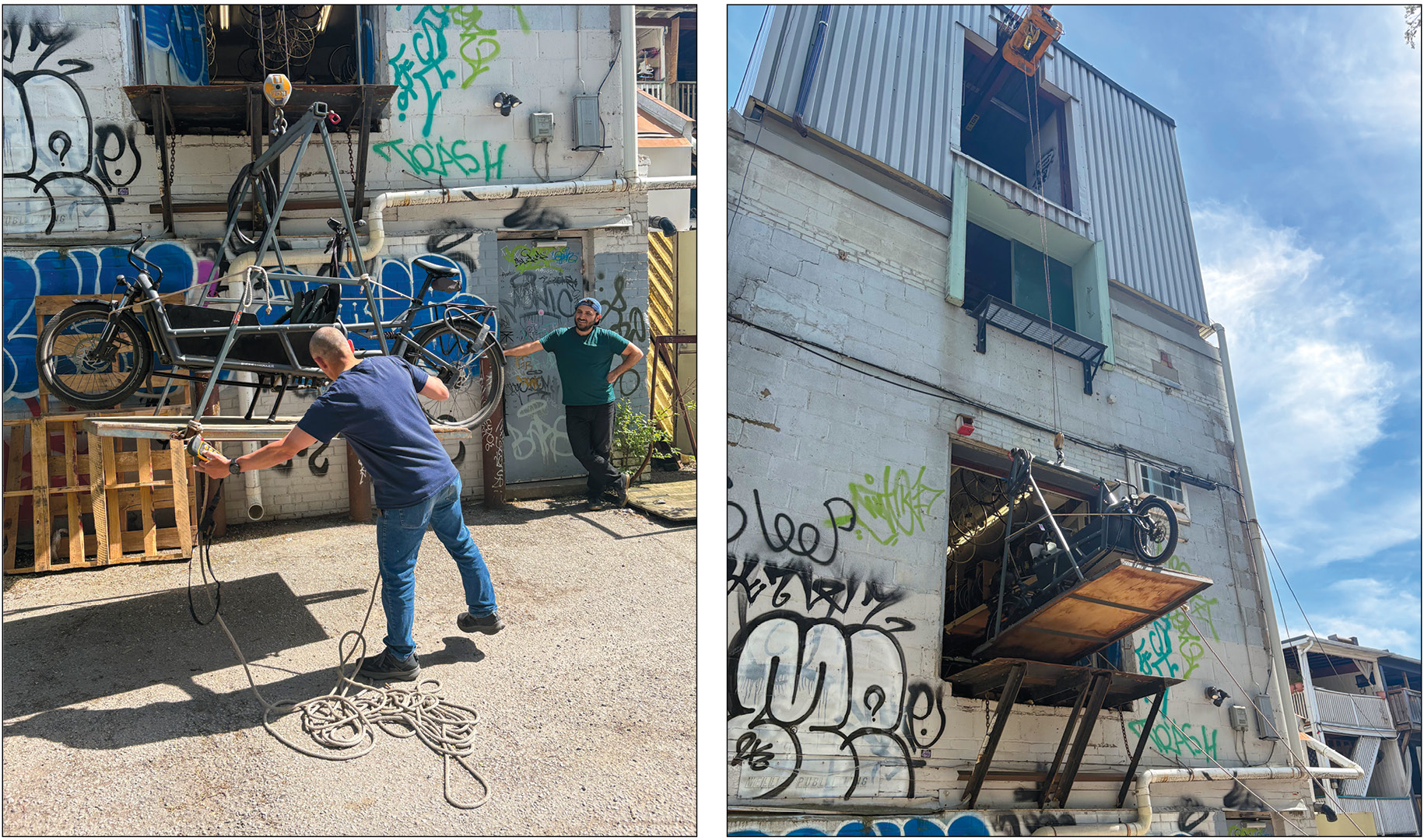
The European bicycle business grew and grew, so much so, that Don and company opened an importing and distribution arm. A venture not without risks, but one that may have meant to be due to their building’s infrastructure left behind by Weller Publishing. The two upper floors had been modified to carry heavy loads like printing presses and tons of paper, and there’s an external lift crane which makes receiving, storing, and shipping dozens and dozens of bikes pretty easy.
Don passed away suddenly in 2017, but before he died, he introduced us to one more innovation: cargo bikes. You might recognize these two-wheelers with their low centre of gravity and large box in front. Adopted early by major courier companies for downtown deliveries, they have now become a viable alternative to owning a car for urban families. With their safe, sleek design, ample room for kids, dogs, and groceries, Aaron has a hard time keeping up with the demand, even with some models having a five-figure price tag.
This year Curbside celebrates its 35th anniversary, and it is still on the leading edge of practical cycling. Aaron modestly refers to Curbside as a family-friendly neighbourhood bike shop, but the scope of their impact is evident. There have been a number of spin-offs lead by former employees including Bikes on Wheels in Kensington Market, Bateman’s, which just recently moved from its location on Bathurst between Bloor and Dupont, and Pedaal on Harbord street, which is a café and bike store all rolled into one.
Curbside is a store that takes its role in the community seriously, but warmly, and with a wry smile.
Before I part ways with Aaron, I ask about his take on the politics associated with cycling in this city. There’s no denying that Don was very involved in getting the Bloor street bike lanes created, and through the years, Curbside has supported various initiatives to get cycling normalized as just another form of transportation. But as Aaron puts it, “Sometimes a bicycle, is just a bicycle,” and I’m good with that.
Howard Pressburger is manager of Wiener’s Home Hardware, the beloved and essential retail institution established in 1922.
READ MORE BY HOWARD PRESSBURGER:
- LIFE: At Knifewear it cuts both ways (May 2026)
- LIFE: A tale of two bookstores (Apr. 2026)
- LIFE: Coffee two ways (Feb. 2026)
- NEW IN BUSINESS: Clothing options on Bloor for the fashion conscious (Dec. 2025)
- NEW IN BUSINESS: Delightfully Turkish (Sept. 2025)
Comments Off on LIFE: Random chat at the side of a curb (June 2026)Tags: Annex · Life · New In Business
FOCUS: How pub chess builds community (June 2026)
August 9th, 2026 · Comments Off on FOCUS: How pub chess builds community (June 2026)
Gender equity representation an ongoing challenge
By Mackenzie Currier
“There’s a wide range of people who come from a wide range of ages, genders, and backgrounds in all sorts of ways. But, I guess everyone likes to chat, (and) everyone’s into chess, and so it creates a common denominator,” shares one player at Pub Chess Toronto.
Every Wednesday, at 7:45 p.m., Pub Chess Toronto hosts a Blitz chess tournament at the Madison Avenue Pub at 14 Madison Ave. Contestants play five (3+2) games against similarly ranked players and are paired with opponents with the same number of losses after each round. For a $15 entry fee, contestants get a drink/food token, potential bragging rights/medal, and a sense of community.
Liza Orlova and Geordie Derraugh founded Pub Chess Toronto 10 years ago with the aim of creating a more casual vibe and growing the chess community. What started with a collection of friends developed into a weekly ritual for 20-30 people, before exploding to over 100 people after COVID. The chess club became renowned, with Grandmasters Magnus Carlsen and Hikaru Nakamura attending. “I don’t really help out anymore, but I’m really happy to just come and play. I come almost every week and just see what it’s grown into,” shared Derraugh.
Chess nights and games happen almost every day of the week in Toronto. For some, the draw of the Madison Avenue event is the drink/food ticket. Some discovered it online or through word of mouth. People come from all over the city, with one guest commuting from North York for the chance to play in person. Neil Goel, the current club organizer, explained that, of the clubs in the city, their group is on an “intermediate scale,” but anyone who knows the pieces more is welcome to join in. They are encouraging beginners and players of all different skill levels to be a part of the club.
Goel has worked hard to create a fun, organic space where people can bond over their shared love of chess. Though he originally joined the club to improve his craft, Goel now focuses more on the club’s social aspect than on the chess side. Though most contestants are kind, Goel reveals that he has had to remove players with ill intent.
Chess is an extremely male-dominated sport, with only 11 per cent of FIDE-rated players being female in 2020. A 2025 study by Li, Glickman, and Chabris found that female underrepresentation can be explained by the greater number of boys who enter chess at the lowest levels. A 2023 study by Arnold et al. shows that bias among parents and mentors of young female players, who believe they are less capable than their male counterparts, also contributes to this divide. This bias is ingrained in the community, with many women experiencing sexism, harassment, and being underestimated.
“In my experience, hostile. I can see why other girls might not want to come,” shares first-time Pub Chess goer Courtney about her experience with the chess community. Being the only girl in her Sudbury chess club, she hoped that Pub Chess Toronto might have a more even split of men and women, but she found there was still an underrepresentation of female players. Goel has worked hard to be someone women can open up to about issues they are experiencing and has tried to encourage more women to join the club with events such as “women play free.”
“You deserve to enjoy your hobby regardless of your skill level. And you deserve to do so safely in a space that feels welcoming to you” shared Goel.
This chess night is a popular choice for newcomers, with the universal language of chess serving as a connector.
For newcomer Elena Kucherenko, chess is more than a weeknight hobby. Her father fostered a passion for the sport, teaching her and enrolling her in a chess club at age 5. The sport is extremely popular in her home country of Ukraine, with the government supporting clubs and education programs.
Eventually, she earned the title of Woman Candidate Master and later became a chess coach. Kucherenko was running a chess club for children in Ukraine before evacuating to Canada during the war. “I was very upset because of the political situation in my country, and that’s why I started to visit the chess club, to be distracted from political views, to enjoy chess.” She now works as a chess coach and enjoys spending time with the friends she’s made at these events.
“It’s putting people who are smart, educated, friendly, and willing to develop themselves for all their lives together. So that’s why I enjoy this community. I support it.” shared Kucherenko.
For those interested, you can learn more through their social media: pubchesstoronto.
READ MORE:
Comments Off on FOCUS: How pub chess builds community (June 2026)Tags: Annex · Life