August 10th, 2026 · Comments Off on ON THE COVER: The host of Maple Leafs Baseball (July 2026)
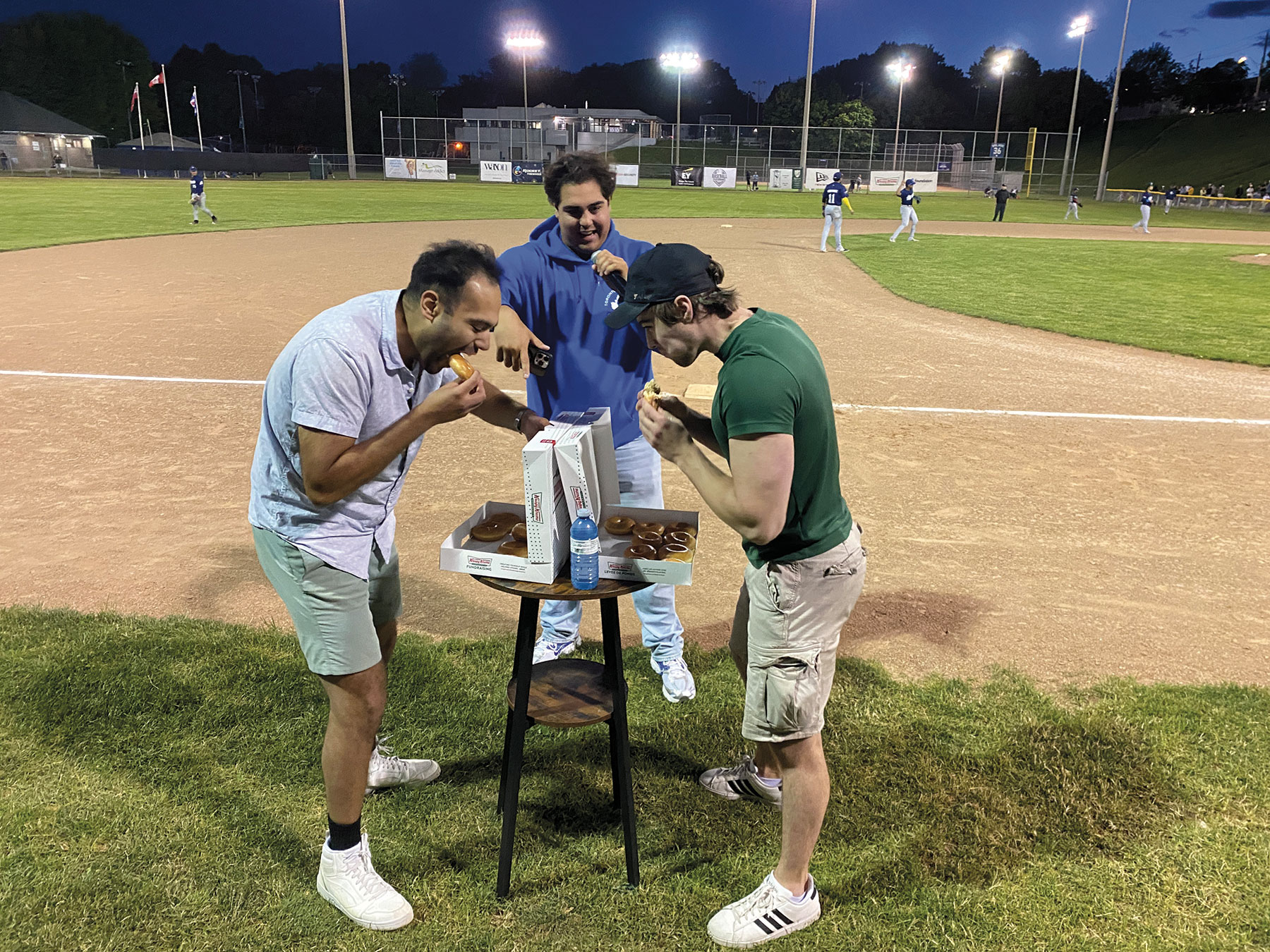
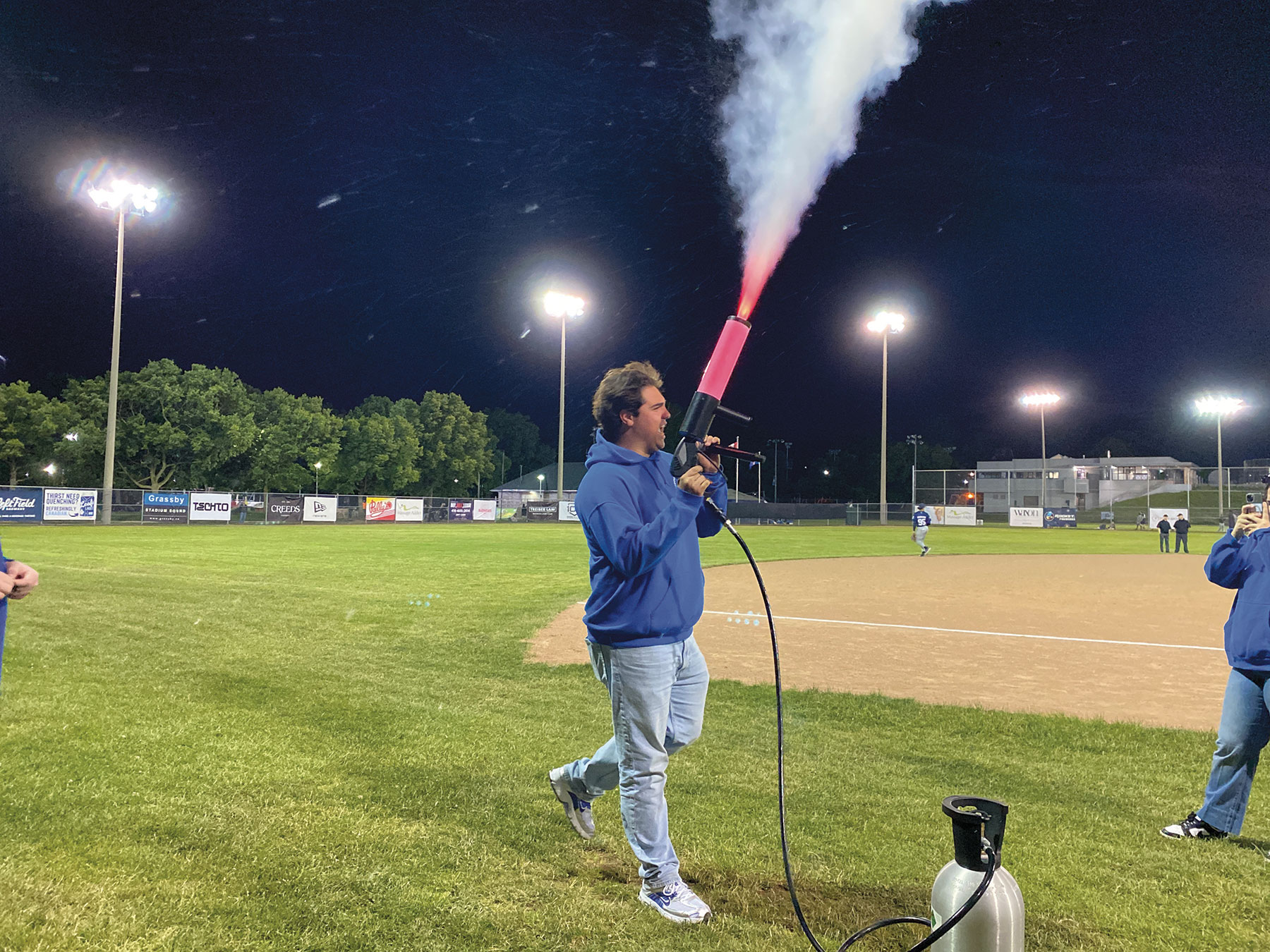
In-park host Michael Roudbari presides over a doughnut-eating contest in between innings at a Maple Leafs baseball game on June 19 at Christie Pits. Please click here for a full profile by R.S. Konjek: SPORTS: Meet the voice of Christie Pits (July 2026). R.S. KONJEK/GLEANER NEWS
August 10th, 2026 · Comments Off on GRADING OUR GREENSPACE: Annual audit of Annex parks continues (July 2026)
All As and Bs for this set of reviews
This is the second instalment of our annual look at neighbourhood greenspaces. Each year, the Annex Gleaner visits and evaluates the parks and parkettes across our coverage area using a range of criteria. While there is no single overall winner, letter grades are assigned to reflect the quality of each space based on factors such as upkeep, design, amenities, accessibility, and overall atmosphere.
Previous grades are included for comparison, while the accompanying reviews highlight the unique features and character that make each park distinct.
Compiled and photos by Shaya Rahmani
Huron Street Playground
Address: 496 Huron St. Time of Visit: 11:53 a.m. Grade: A (Last year’s grade: A-) Reason to go: Huron Street Playground is a clean, well-maintained neighborhood greenspace that serves as a modest but lively neighbourhood hub. The enclosed design of the park creates a sense of safety for younger users. In the centre of the park there is rope climbing structure which is surrounded by open space for flexible casual recreation. A fenced-in dog area allows pet owners and families to share the space. Young trees have been planted in the park, and there is a water fountain for pets and families. There is a school nearby, and the chalk drawings and hopscotch patterns indicate that the park is well-used. Overheard: Children shouting from the adjacent schoolyard, birds chirping in the trees above, and the jumping sounds of kids playing hopscotch in the middle of the park. Did you know: Chalk drawings like hopscotch are a common feature in many Toronto playgrounds, reflecting how informal play adapts to public space beyond its original design.
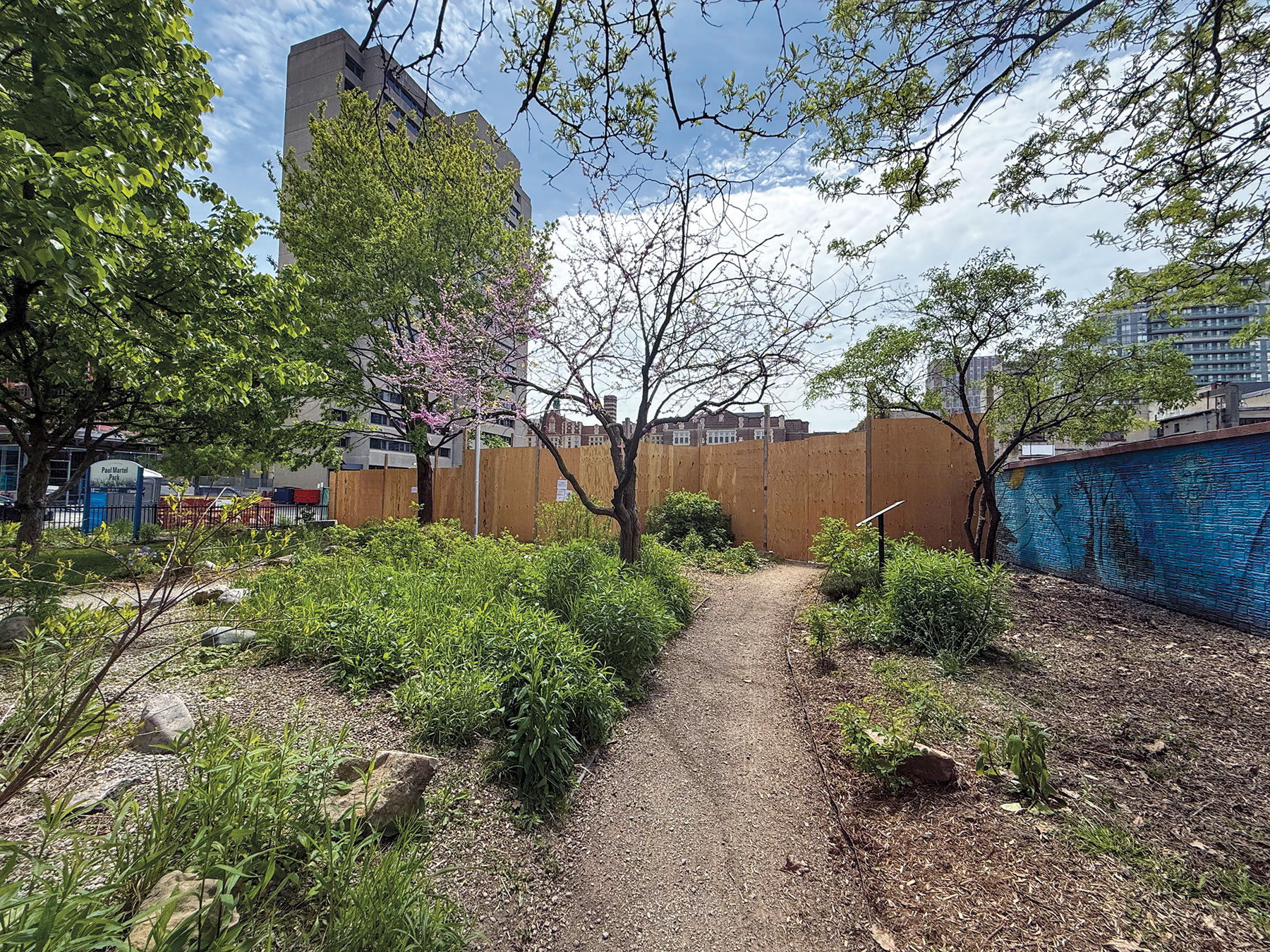
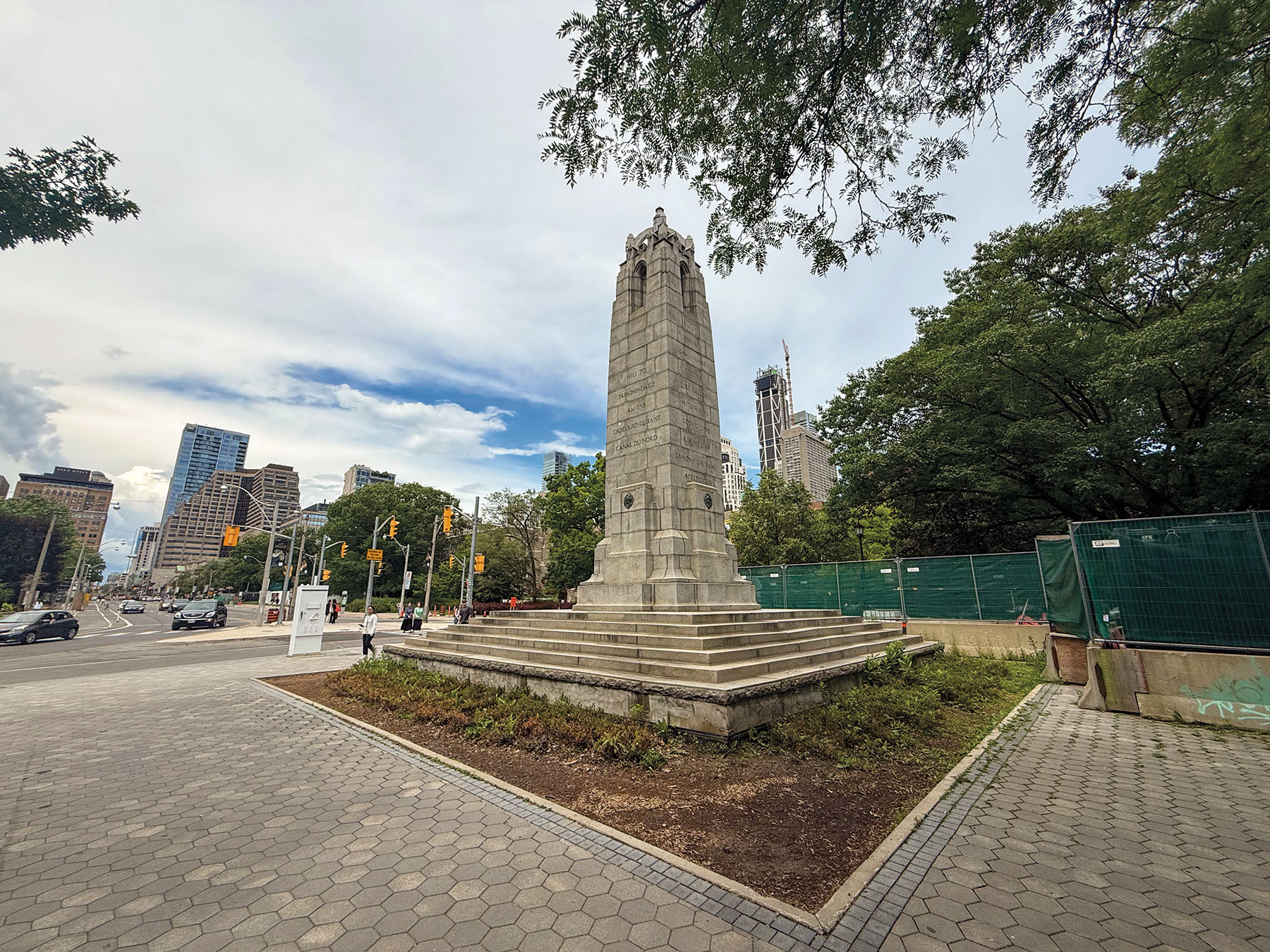
Despite construction sounds, Paul Martel Park is an Indigenous-led oasis.
Paul Martel Park
Address: 10 Madison Ave. Time of Visit: 12:37 p.m. Grade: B+ (Last year’s grade: A-) Reason to go: Paul Martel Park is a modest, but visually interesting greenspace near the intersection of Spadina Avenue and Bloor Street. It offers a transitory break in the middle of one of the Annex’s most busy development zones. Even with the intensity of the surrounding construction, the park retains a strong sense of organization and care, with sculpted gravel plantings and well-maintained flower beds. The Indigenous mural provides cultural and visual interest and offsets the otherwise industrial setting. The auditory environment is often defined by the sound of construction such as sawing, metal work, and the constant movement of machinery which undermines the peace associated with local greenspaces. Still, the park is a quick stop for local residents and pedestrians, especially those traveling between residential neighborhoods and the adjacent commercial sector. Overheard: The constant buzzing of saws, the clanging and thumping of steel construction work, and occasional fragments of conversation from pedestrians passing through the surrounding residential area. Did you know: The park’s design emphasizes small-scale planting beds, seating areas, and interpretive signage, reflecting a shift toward “micro-park” models in dense urban neighbourhoods.
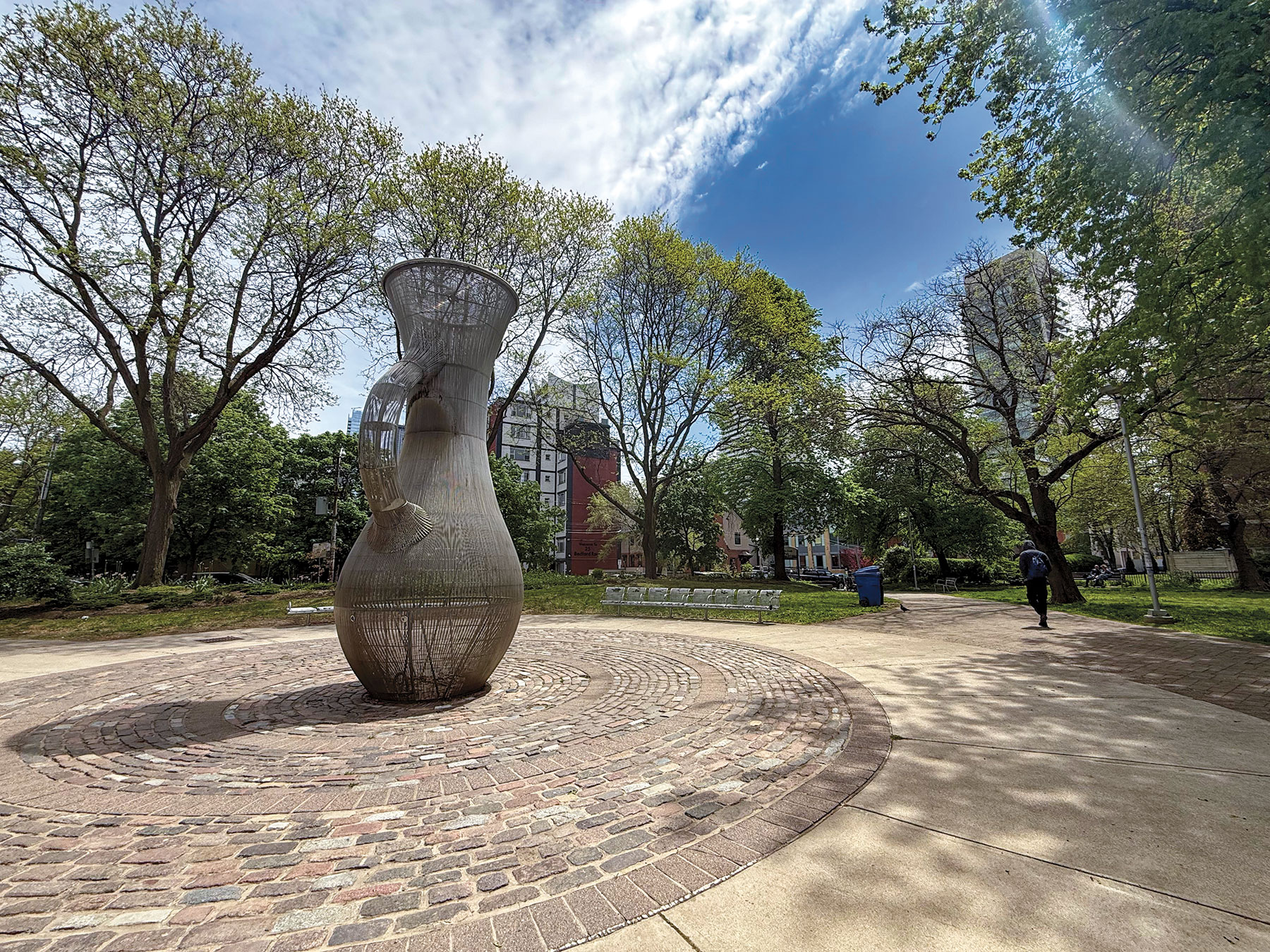
A large sculpted vase is the focal point of the lovely Taddle Creek Park.
Taddle Creek Park
Address: 40 Bedford Rd. Time of Visit: 1:18 p.m. Grade: A (Last year’s grade: A) Reason to go: This park is notably clean and carefully landscaped, with well-maintained flower beds that provide seasonal colour and structure throughout the space. At its centre stands a large sculptural vase which functions as a visual focal point and gives the park a distinct identity that sets it apart from more utilitarian neighbourhood greenspaces. A prominent mature tree anchors the park’s layout, offering substantial shade and reinforcing a sense of permanence. The park includes a playground area, a water fountain and many benches dedicated “in loving memory” to community members which introduces a strong commemorative and reflective dimension to the space. The park has a sense of quiet continuity; visitors are more likely to encounter stillness, reflection, or slow movement rather than high activity. Overall, Taddle Creek Park succeeds as a small but thoughtfully composed greenspace that integrates play, memory, and natural elements into a cohesive neighbourhood setting. Overheard: The rhythmic tapping of a cane along the paved walkway as someone moves slowly through the park Did you know: During the park’s 2011 revitalization, construction crews unexpectedly uncovered parts of old house foundations beneath the site.
Bloor-Bedford Parkette
Address: 245 Bloor St W. Time of Visit: 2:06 p.m. Grade: B (Last year’s grade: B+) Reason to go: Bloor–Bedford Parkette is a modest but well-used pocket of respite located in one of the busiest areas of the Annex. As the park is on Bloor Street and surrounded by University of Toronto buildings, it is heavily used by students and surrounding workers. The parkette provides a respite from the intensity of its surroundings. Maintenance is generally satisfactory, however cigarette litter can be seen on the borders of benches and walks, indicating the park’s heavy use. Overheard: The angry flow of traffic from Bloor street and snippets of student conversations. Did you know: The parkette is located at the edge of the University of Toronto’s St. George campus, placing it within one of the most pedestrian-dense academic zones in Canada.
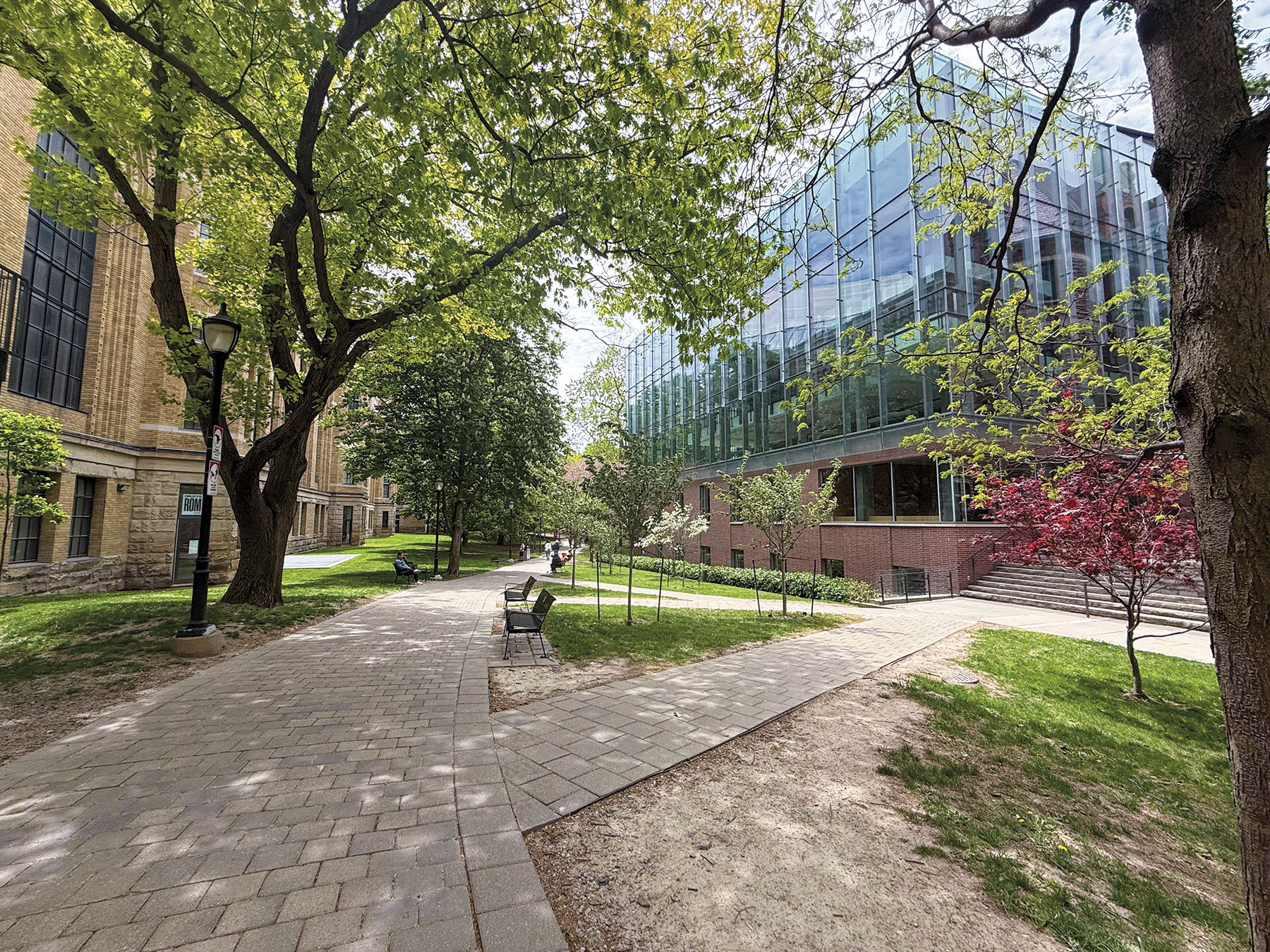
Seeking peace? Want to be enveloped by landscape? Go to Philosopher’s Walk.
Philosopher’s Walk
Address: 78 Queen’s Park Crescent Time of Visit: 2:48 p.m. Grade: A+ (Last year’s grade: A+) Reason to go: Philosopher’s Walk is one of the most visually and acoustically distinctive pedestrian corridors in the Annex, offering a rare combination of natural landscape and institutional atmosphere within the core of the University of Toronto. Maintained to a high standard, the walkway is defined by a mature tree cover that creates one continuous canopy overhead. This produces a shaded, immersive environment that feels removed from the surrounding urban density. The walk also functions as an active connective space, regularly used by students, faculty, and visitors moving between campus buildings and nearby cultural institutions. Its proximity to the Royal Conservatory of Music contributes a unique auditory backdrop, with music often spilling into the open air. This includes violin performances that blend into the ambient sounds of foot traffic and conversation, giving the space an almost cinematic quality. Despite its central location, the walkway maintains a strong sense of calm, making it both a practical route and a contemplative space within the university landscape. Overheard: The sound of violins drifting from an open window at the Royal Conservatory, mixed with student conversations. Did you know: Philosopher’s Walk is especially known for its seasonal changes, including spring blossoms, dense summer canopy cover, and vivid fall foliage from mature hardwood trees.
Queen’s Park features a vast array of tree species.
Queen’s Park (north and south)
Address: 11 Wellesley St. W. Time of Visit: 4:00 p.m. Grade: A (Last year’s grade A+ and A) Reason to go: Queen’s Park North is a large, open greenspace that prioritizes natural landscape over programmed recreation. It offers expansive lawns, mature trees, and dense shade that create a calm, campus-adjacent atmosphere in the heart of the city. Despite ongoing construction in certain sections, the park maintains a strong sense of order and refinement, with wide stretches of grass that encourage informal gatherings, reading, or quiet rest. The space feels closely tied to the surrounding University of Toronto environment, with much of its activity shaped by students and nearby institutional life rather than traditional park programming. Statues and historical markers are integrated into the landscape, reinforcing a sense of continuity between the park’s present use and its civic past. The overall experience is one of openness and stillness, where movement is slow and the landscape itself becomes the primary feature. Queen’s Park South, by contrast, is more formally structured and institutionally framed. Wrapping around the Ontario Legislative Building, it reinforces the site’s civic and political significance. The landscaping is highly intentional, with carefully maintained hedges, manicured flowerbeds, and symmetrical design elements that emphasize order and formality. A veterans’ memorial adds a reflective dimension to the space, while the surrounding architecture blends seamlessly into the greenery. The park functions not only as a public space, but also as a symbolic civic environment, where governance, memory, and public life intersect within a carefully curated landscape. Overheard: On the north side, students debating assignment grading schemes and completion-based assessments; on the south side, the measured footsteps and radio chatter of peace officers conducting perimeter patrols. Did you know: Queen’s Park is one of Toronto’s earliest examples of a civic green space designed to visually frame an important government building using open lawns and curved pathways to emphasize the Ontario Legislative Building as a focal point.
August 10th, 2026 · Comments Off on IF THESE WALLS COULD TALK: A glimpse into the past from 711 Spadina Ave. (July 2026)
“We played on our see-saw” wrote 10-year-old Grace in 1908
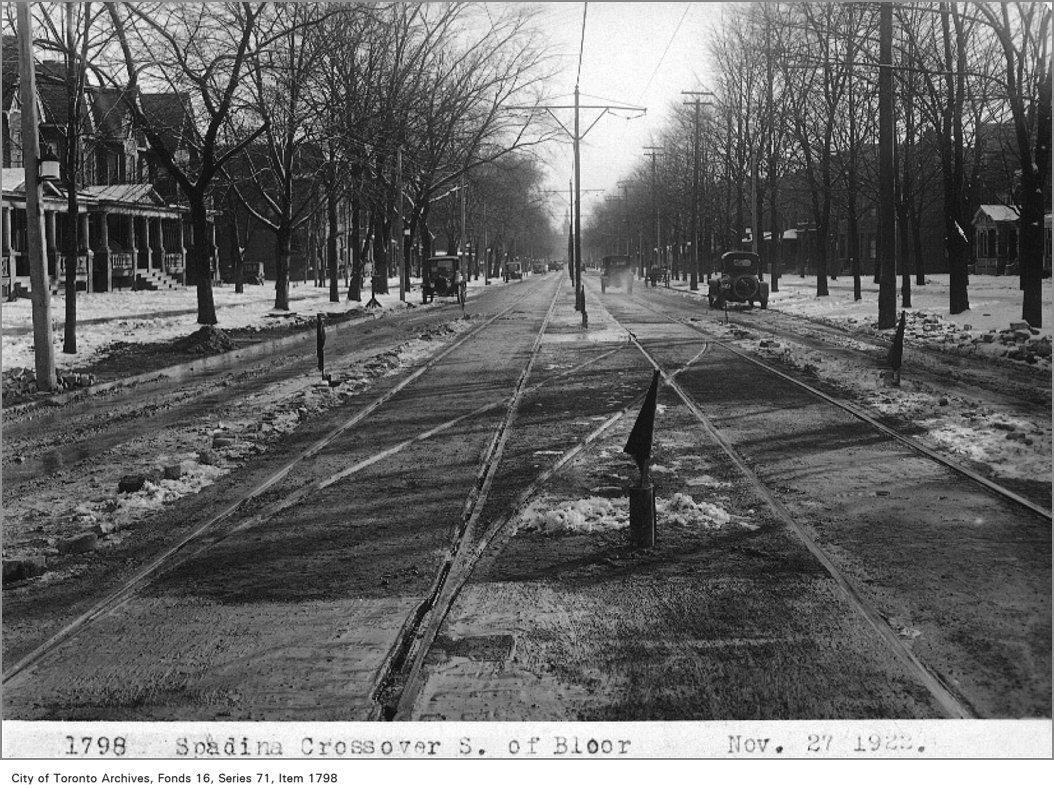
Photo of Spadina Avenue from 1923. COURTESY OF THE CITY OF TORONTO ARCHIVES
By Mike Mastromatteo
In researching the modest semi-detached home at 711 Spadina Ave., just south of Bloor Street, the reporter came across a sentimental artefact, that in many ways, speaks to the heart of this series called If These Walls Could Talk.
In the early years of the 20th century, the Globe newspaper featured a Playtime for Little People section, in which young people could post letters to the editor and have them published for all to see. On March 21, 1908, the Globe published a letter from Grace Hubbell, then 10 years old and residing at 711 Spadina Ave.
Headlined My Saturday at Home, young Grace wrote the following:
“I have had a very pleasant day. Being Lent, I went to a children’s service, and when it was over I saw my little friend coming out and brought her home, and we played on our see-saw. We played till one o’clock; then mother asked me if I’d like to have my friend to luncheon and I said yes. And we went in, and I telephoned her mother and asked her if she could stay for lunch, and her mother said yes. Then we had lunch, and afterwards went out to play on the see-saw again. About four o’clock we saw an intoxicated man in the lane and we went in the house and looked out of the window and watched him. Then we saw him put up a Japanese parasol. He was smoking, with the parasol over him. He went away, and we didn’t see any more of him.”
The innocence with which Grace describes her Saturday at her home tells a story with more colour and poignancy than could the most sensitive of our “listening walls.”
The Hubbell family moved into the home around 1901. They appear to have enjoyed a genteel lifestyle. Not only did daughters Grace and Helen enjoy summer vacations in the Muskoka region, but both girls attended the prestigious Bishop Strachan School on Lonsdale Road.
The Hubbell family left other faint footprints around the city. In 1906, the father, Lawrence Hubbell, became part of a curious newspaper story after helping two stranded sailors on a schooner anchored in Toronto Bay. The sailors claimed they had been abandoned by their captain and left with little food. Hubbell and a companion reportedly bought provisions for the hungry men after alerting authorities.
The Hubbells moved in during a period when Spadina Avenue was still one of Toronto’s prestigious residential streets. The neighbourhood was a mixture of comfortable family homes, churches, schools, and institutions. Horse-drawn vehicles shared the roadway with an increasing number of electric streetcars. The city was expanding rapidly, yet much of daily life retained a distinctly Victorian rhythm.
The decades that followed brought a parade of new occupants: secretaries, salesmen, mechanics, roomers, and professionals. The house sheltered Dora, Annie and Lois Bexon in the 1920s, a barber named Jason Tomlinson during the Depression years, and later William Mason, Walter Lesko, Charles Ricketts and many others.
One noteworthy, short-term resident at 711 Spadina Ave. was Gordon Steadman of Marysville, New Brunswick. His experience as a roomer at the house was not without trauma. As the Globe and Mail explained in a story from Jan. 17, 1939, Steadman, a Bible student studying in Toronto that fateful winter, was robbed of $22—money he had earmarked for his tuition at Toronto Bible College. The newspaper also recorded: “Four men approached in a car, three got out and rifled through his pockets, one stayed in the car. The car sped north to Bloor and turned east.”
The neighbourhood changed dramatically throughout the 20th century. Grand houses became boarding houses. Institutions expanded. University buildings pushed outward. The character of Spadina Avenue evolved from an elite residential boulevard to the diverse urban corridor we know today.
Through all those transformations, 711 Spadina endured.
Sometime in the 1960s, 711 Spadina became the property of the University of Toronto. In fact, the house next door—709 Spadina—has been home to the university’s academy of science for many years.
Despite the many lives lived within the confines of this home, Grace Hubbell’s experience is special. Many house histories never get beyond ownership records, census entries, or the occasional newspaper mention of one of the owners or occupants. Grace Hubbell however, changes everything. The moment she writes about her friend, the see-saw, the luncheon, and the man under the Japanese parasol, the house stops being a property; it becomes a place of belonging.
There is still a laneway immediately north of the house, running between Spadina and Huron streets. We cannot know if it’s the place where Grace Hubbell spotted the intoxicated man sheltering beneath a Japanese parasol more than 100 years ago. But it’s near enough to remind us that ordinary moments— the kind a 10-year-old girl might capture in a letter to a newspaper—can become the most poignant memories a house leaves behind.
More than a hundred years later, Grace Hubbell is long gone. The see-saw is gone. The lane has changed. Even the city around the house would be scarcely recognizable to her. Yet because she took the time to write about one unremarkable Saturday, the walls of 711 Spadina can still speak.
And what they tell us is not a story of famous people or historic events; they tell us that once, on a spring afternoon, a ten-year-old girl stood at a window and watched the world go by.
August 10th, 2026 · Comments Off on NEWS: Foosball fever takes over Annex hotel (July 2026)
Developer of Mirvish Village supports inaugural event
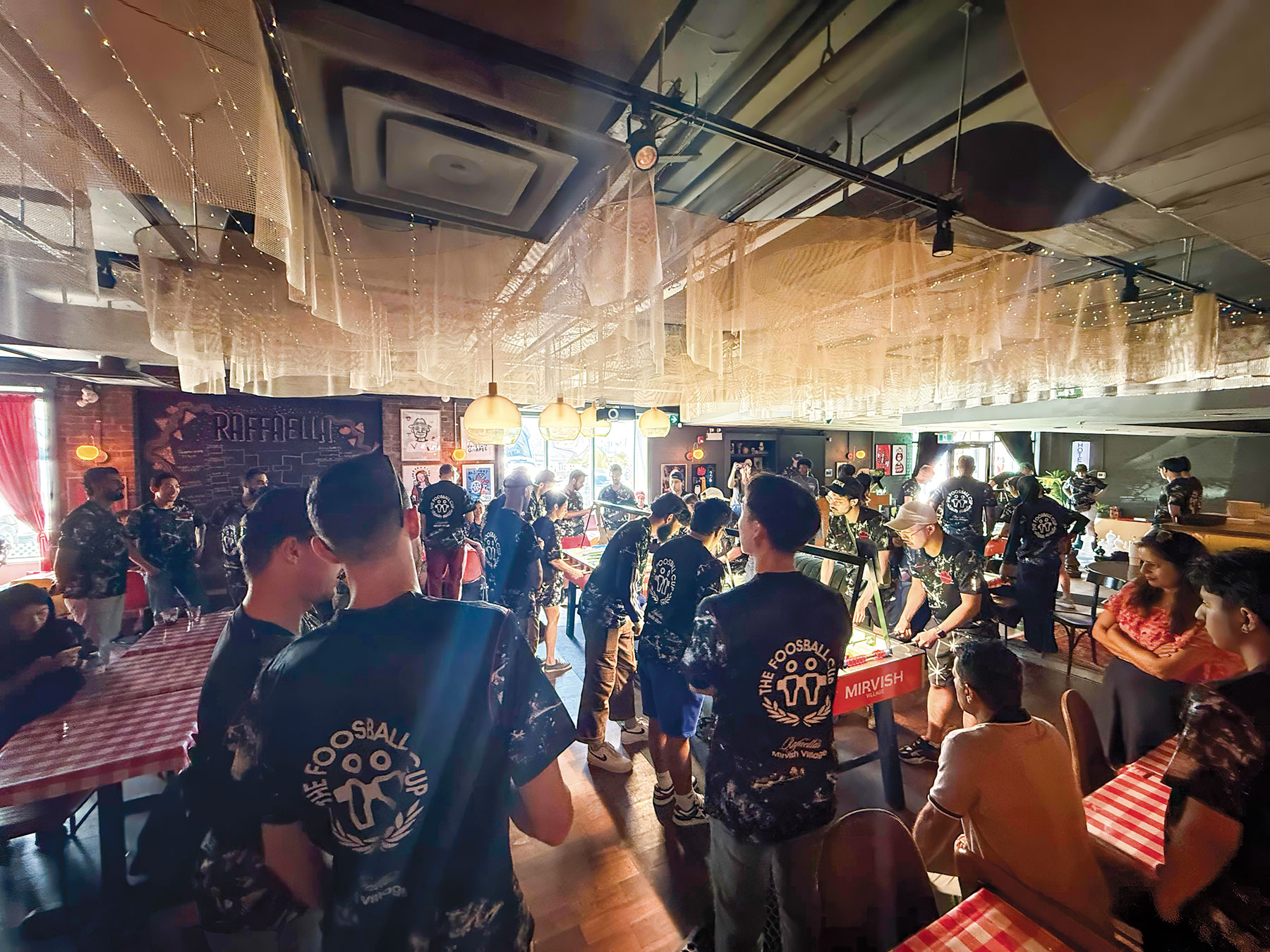
A 32-team foosball tournament transformed Raffaella, inside the Annex Hotel, on Brunswick Avenue. SHAYA RAHMANI/GLEANER NEWS
By Shaya Rahmani
The route to the World Cup came to the Annex on June 21—this time, on a foosball table.
Thirty-two teams packed into Raffaella inside the Annex Hotel for the inaugural Foosball Cup, a community tournament presented by Mirvish Village, the developer at Bathurst and Bloor and organized by Sunday Pace. The winner-take-all competition offered an unusual grand prize: a pair of tickets to a FIFA World Cup Round of 32 match in Toronto and a custom 3D-printed Foosball World Cup trophy.
The event transformed the venue into a lively tournament floor as teams with names such as Portugal, Rush Hour, Shabang FC, and Win-Benyana battled through a single-elimination bracket. Custom jerseys, produced by GTA Jerseys, added to the competitive atmosphere while live music kept the energy high throughout the afternoon.
Tournament organizers emphasized accessibility over elite competition. Players deemed highly experienced or semi-professional were required to partner with a less experienced teammate which created balanced matchups and encouraged broader participation.
The tournament also reflected the evolution of Sunday Pace which began as a run club before expanding into community-focused events. Erfan Noroozi, from Sunday Pace, explained that the organization builds gatherings around existing communities and neighbourhood connections, rather than relying on outside attractions to draw people together. Through partnerships with Mirvish Village and Raffaella, the Foosball Cup became another example of that community-first approach in action.
The tournament drew participants from across the city. Professional-grade tables were supplied by Italian Foosball, whose representatives also helped vet registrations to identify experienced players.
The match rules prohibited spinning the rods and jerking the table which kept the focus on skill and teamwork.
One team took home the prize, but the afternoon seemed less like a competition and more like a community. Between applause, friendly rivalries, and a whole lot of neighbourhood pride, the Foosball Cup transformed a basic table game into a celebration of local connectedness with a World Cup-sized award waiting at the finish line.
Comments Off on NEWS: Foosball fever takes over Annex hotel (July 2026)Tags:Annex · News · New In Business
I missed the meeting held by Saxe but appreciated your reporting on the congestion issue.
I own a car but ride my bike downtown (inhaling who knows what), but at least I make good time.
But it sounds like Toronto is ready for a congestion charge? Some recognition that city infrastructure costs money? We pay to use transit—why are roads “free”?
Many cities have introduced them, and they are now considered part of city life.
Thank you.
Also, I am loving the history of residents articles! [If these walls could talk]
Just a quick note to tell you how much I enjoy your articles by Mike Mastromatteo regarding the rich history of different homes and people who lived in the Annex neighbourhood.
I frequently look up the homes on Google maps, and I love all the detail and effort that you put into retelling the histories of these wonderful families.
I feel so fortunate to live in this neighbourhood as it has all of this rich background, and I’m always inspired by their lives and their accomplishments.
Thank you for bringing their stories to life!
—Anna
Comments Off on LETTERS TO THE EDITOR (July 2026)Tags:Annex · Letters · Opinion
August 10th, 2026 · Comments Off on EDITORIAL: A single road in, a single road out (July 2026)
There are a myriad of reasons why expanding Billy Bishop airport is a terrible idea. Getting 10 million passengers, crew, and staff back and forth from the dead end at the bottom of Bathurst Street may be the most dreaded one.
Premier Ford says that if he gets his way, the tiny island airport will accommodate jets, and the number of annual passengers will rise from the current 1.8 million to nearly five times that number.
Even at the current level, congestion is a huge problem there. Anyone flying out of the island needs to know in advance whether there are construction closures, sporting events, or concerts. Being stuck under the Gardiner in exhaust-filled gridlock is no fun as you watch the cab’s meter climb while the departure time looms.
Not long ago the province enacted Bill 107, the Getting Ontario Moving Act, ostensibly to deal with a very real transportation crisis: traffic congestion. Of course, Ford has used the act mostly to go after bike lanes, but the crisis is real, and everything about the island airport expansion plan will only make traffic congestion and gridlock worse.
What about the current gridlock on Bathurst and the Lakeshore? Once Ford’s European-owned spa and the new science centre have been built at the former Ontario Place, how are an estimated six million patrons supposed to come and go? And don’t forget about the island the premier wants to build for a new convention centre under the new flight path south of the spa; you can’t make this stuff up.
Back to the island airport expansion plan. Currently, the island airport occupies just 85 hectares. Pearson sits on nearly 2000 and is accessible from every compass point due to a myriad of highways and a ring road. There is a whole underground city at Pearson for service vehicles. You can take a TTC bus to Pearson. You can take the UP Express from Union Station in 35 minutes, and it is very civilized. No concert traffic or construction closures will block your path. They could increase capacity at Pearson by adding a new terminal. This is NOT the case for the island; all construction vehicles, service vehicles, and construction crews will need to funnel through the same choke point as the passengers.
The Toronto Port Authority (TPA) says the airport expansion will cost $5 billion. TPA’s net income in 2025 was $16.9 million. The province says it will not be paying for the expansion. So, who will? Doug Ford says the private sector. Why does this sound like Donald Trump’s ballroom? He promised it would be paid for by donations, but it turns out the American taxpayer will be on the hook.
There is a real American connection here too. After Premier Ford annexed the islands, and the airport, and a mainland park, the public then learned that the island terminal is owned by the U.S. investment bank, J.P. Morgan. How does this figure into the scheme? Why is the American bank benefitting while we all suffer from this stupidity. What does Doug get?
The federal government, which holds constitutional authority over airports, has not taken a stand on the province’s plan. Ford’s plan is still at the spitballing stage. There is very little to comment on except what’s written on the back of a napkin. The feds have created a survey, and they have asked Transport Canada to review the idea from a regulatory perspective. It appears that Prime Minister Carney is looking for exit ramps that don’t include a hard “no” to Doug Ford. This at once perplexing and disappointing. No doubt the the 23 Liberal MPs within Toronto’s bounds must feel the same way. Liberal caucus meetings on the subject must be “interesting.”
It’s time for the federal government to show leadership and call out this plan for what it is: very poorly conceived. No Doug, NO.
August 10th, 2026 · Comments Off on FORUM: Queen’s Park North to get major upgrade (July 2026)
Green energy initiatives are finally competitive
By Dianne Saxe
A special note of condolence and thanks to our police, fire, and paramedic services
Our city has suffered a heartbreaking loss this month with the death of Toronto Police Constable Marc Pinizzotto. This moment stands as a painful reminder of the immeasurable debt we owe to our police, as well as Toronto’s paramedics, firefighters and first responders, who give so much to protect our communities every day. We owe them our gratitude and enduring support. The demands placed on police, fire, and paramedic services this summer have been extraordinary. These professionals continue to serve our city with dedication, courage, and compassion, often under the most difficult of circumstances.
Thank you.
Building a stronger and more liveable Toronto
One of the great privileges of serving as your city councillor is seeing years of hard work turn into real results. This month brought several important milestones that will help make University–Rosedale—and Toronto as a whole—more liveable, sustainable, and resilient.
One of the most exciting pieces of news in our ward is that the Queen’s Park North Concept Plan has now been unanimously approved by both the infrastructure and environment committee and city council. Thanks to an unprecedented and extraordinarily generous private donation, twinned with years of collaboration among community members, experts, and city staff, this beloved public space is set for a remarkable renewal.
The revitalization will put the park’s magnificent trees first, helping them recover from years of soil compaction and damage while preserving the heritage features that make Queen’s Park so special. All existing public art will remain, including the beloved Great Oak Bench and the historic fountain. The plan will also create new opportunities for people to enjoy the space, with improved pathways, a restored running track, gardens, storytelling and water features, additional seating, a café, and public washrooms. It will open up the heart of the park by relocating the statue of King Edward VII closer to the legislature while ensuring that the park remains a welcoming and accessible destination for everyone. This is exactly the kind of city-building project I love: one that protects our natural heritage while making public spaces more beautiful, functional, and enjoyable.
Building a liveable city also means protecting the services people rely on every day. Residents will be pleased to know that 311 is becoming easier to use, with improvements already underway and more enhancements planned. While customer service upgrades may not always make headlines, they have a direct impact on people’s daily interactions with city government, and they help residents get answers and assistance more quickly.
I was also pleased to successfully advocate for the return of foam dumbbells in city aquafit classes. Originally removed by staff, many seniors felt their independence and judgment were being discounted. We raised the issue directly with senior parks leadership and brought them back. Seniors deserve opportunities to stay active, build strength, and make informed decisions about their own health and fitness. A great city supports residents of all ages and respects their ability to make choices about their own well-being.
I’m also encouraged by the progress we’re seeing on clean energy. Recent provincial electricity procurements showed that solar, wind, and battery storage can now outcompete gas-fired power on cost alone—a win for affordability, energy security, public health, and the environment. Here in Toronto, years of advocacy are translating into real results, with Toronto Hydro expanding support for electric heating, electric vehicles, and new housing. At the same time, the city has begun removing outdated zoning barriers that make it harder for residents to install heat pumps, EV chargers, insulation, and renewable energy technologies, helping households save money while reducing emissions.
Canada’s FIFA World Cup 2026™ performance has filled our country with pride, showcasing skill, resilience, and putting us on the map as a world-class soccer nation. There are so many opportunities to join in the festivities or join friends and neighbours at a local spot to cheer on your team. I’ll be watching the finals at Café Diplomatico, so come on by and say hello!
Finally, a personal note: Toronto’s municipal election will take place on Oct. 26, and I will be seeking re-election as your city councillor. I am immensely proud of what we have accomplished together, from improving parks and public spaces, to building more affordable housing, advancing climate action, and strengthening community services— this work requires persistence, collaboration, and long-term thinking. There is always more work ahead, but we’re making real progress together towards building a city that is affordable, sustainable, safe, and welcoming for everyone. Thank you for your engagement, your ideas, and your commitment to making University–Rosedale—and Toronto—a better and more liveable place to call home.
Dianne Saxe is city councillor for Ward 11, University-Rosedale.
August 10th, 2026 · Comments Off on FORUM: Queen’s Park roundup (July 2026)
School cuts amount to slash, burn, and pillage
By Jessica Bell
Summer break
The Conservative government has closed the legislature and put us on a record-setting extended summer break until Oct. 27.
The premier didn’t shut down the legislature because he is lazy; he did it because he doesn’t want to be subjected to the daily scrutiny of MPPs and reporters holding his government accountable for their decisions. That’s democracy. Doug Ford doesn’t like it.
Here’s two issues we’re working on this summer.
Secretive school cuts
Since the TDSB was placed under provincial supervision, the school board has been making drastic cuts, mostly centred on schooling for kids who need the most help. Here’s what we know.
Next school year, Orde Street Public School, near College Street and University Avenue will be moving to the Heydon Park Secondary School location on D’Arcy Street. Heydon Park will move to either Vaughan Road Academy or Rockcliffe Middle School, both outside the riding.
I think the TDSB is making these terrible moves because they want to sell off the valuable Orde Street property to generate revenue and close Heydon Park to reduce costs. Despite many kids wanting to attend the special needs school, the TDSB is no longer allowing Heydon Park to accept new students in Grades 9 and 10.
The supervisor eliminated class size caps for Grades 4 to 8 which sets the stage for ultra-large class sizes. Special education class sizes have also been increased.
Diagnostic kindergartens have been closed. The high-needs kids who attend these classes will now move to regular classrooms, and you don’t need a lot of imagination to see how that will affect learning for every single student.
Staffing positions at model schools have been eliminated. These schools are in lower-income areas. Instead of giving kids the extra teaching time to make up for some of the disadvantages they face, schools are allocating resources based on enrolment only.
The TDSB is closing some cafeterias, including the cafeteria at Rosedale School of the Arts, along with most of Toronto’s outdoor education centres, which is where many children get their first experience of overnight camp.
The Conservatives say that these cuts are due to declining enrolment. This is not true. First, the cut in funding is far greater than the modest decline in enrolment. Second, any decline in enrolment must be partly a result of the Conservatives choosing to cut $6 billion in funding from our school system.
Cutting funding in response to declining enrolment puts us on a disastrous race to the bottom when we should be investing in a top-tier public school system.
Ontario is seeing steepest job losses since 2009
Ontario lost 52,900 jobs in the first quarter of 2026, the steepest quarterly job loss since early 2009, excluding the pandemic. Nearly half of those losses were in manufacturing.
University-Rosedale is home to some of Ontario’s biggest employers, including Canada’s largest banks, the Ontario public service, the University of Toronto, and Canada’s largest hospitals. Downtown Toronto has been somewhat insulated from the tariff war.
Even so, for the first time since I’ve been elected, I am regularly meeting people, especially recent graduates, who are telling me they are having difficulty finding a job.
The Conservative government’s strategy has been to give secret loans to big companies, including foreign companies, with no clear conditions attached. Companies like this model, but it doesn’t always help workers or our economy long-term because the investment doesn’t always trickle down. Companies are under no obligation to keep workers employed, increase hiring, or keep factories or businesses in Ontario. They should be.
We are calling for Ontario to more actively manage the economy by investing in public infrastructure and public services to keep and create good jobs here. Ontario should also bring in more robust Buy Ontario, Build Ontario rules so government contracts go to Ontario and Canadians businesses wherever possible. We would be doing our part to bring more Ontario products to Ontario buyers.
Hospitals should be built by Canadian companies, not U.S. ones. It should be easy to identify and buy Ontario fruit and vegetables at the supermarket. More Ontario wood should be used to build needed housing. More Ontario steel should be used for transit lines and buildings.
Over the summer we will continue to get creative to highlight what this government is doing poorly and propose better solutions. Please visit my website at jessicabellmpp.ca for more information about the location and time of upcoming park visits and ice-cream socials we’re hosting to get your feedback and ideas.
Jessica Bell is the NDP MPP for University-Rosedale and the shadow minister for finance and the treasury board for the Official Opposition. Contact her at jbell-co@ndp.on.ca or 416 535 7206.
August 10th, 2026 · Comments Off on LIFE: The farmers’ market is back! (July 2026)
A weekly Annex touchstone
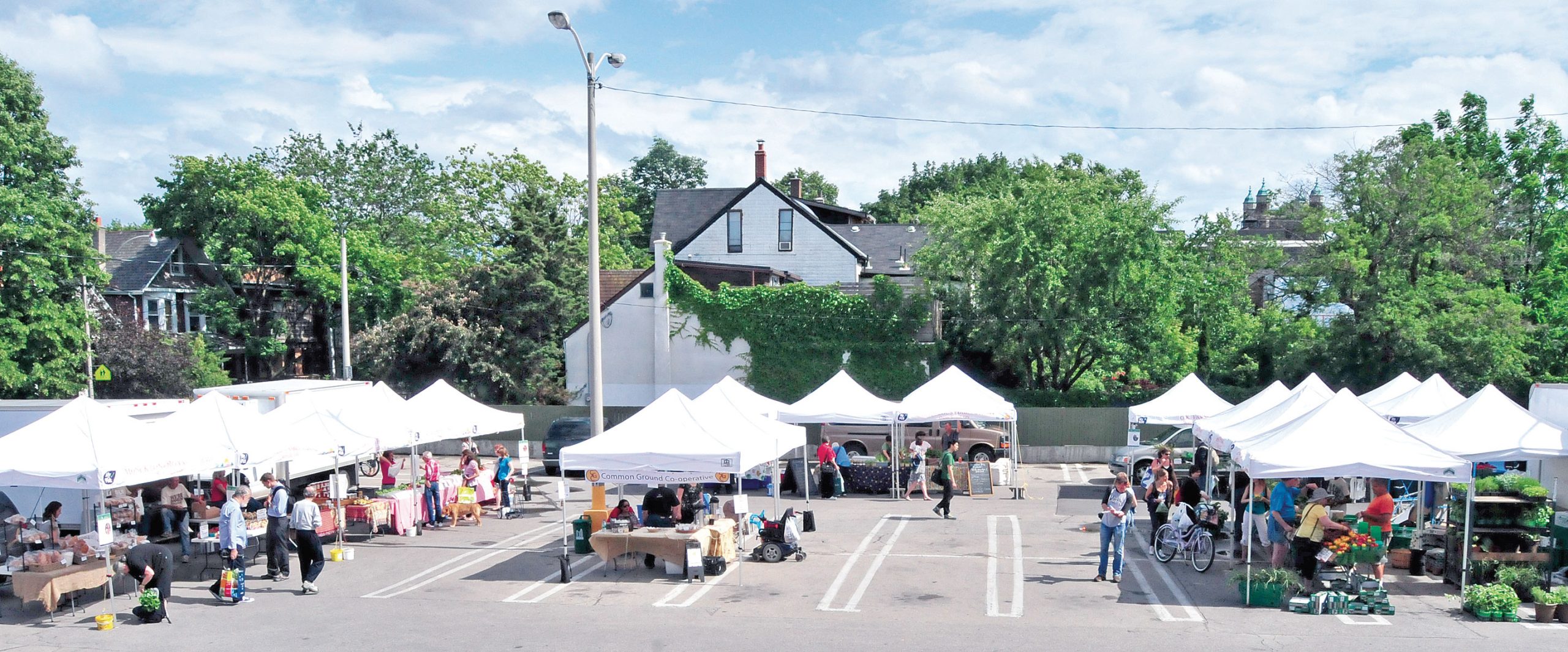
Need garlic scapes? Maybe you didn’t know you needed them. Go to the Bloor Borden Farmers’ Market on Wednesdays from 3 p.m. to 7 p.m. GLEANER NEWS FILE PHOTO
I’m on the edge of retirement and looking for new routines, especially ones that will get me out of bed before noon.
I currently don’t work on Wednesdays, and I usually go to the gym in the morning. Recently however, the gym has been replaced by the dentist.
I’m good with this because I get to lie in the world’s most comfortable chair. Even with my mouth pumped full of Novocain, while my dentist does dental stuff, I’m at one with the chair, so what’s not to like. Going to the gym or the dentist comes with a short walk from my place near Bathurst to Spadina. Sometimes I’ll walk along Bloor or sometimes through the alleyways to the north; other times, I take the parking lot and alleys on the south side.
On June 2, I received an email reminding me that the first farmer’s market of the year would be the next day, coincidentally a Wednesday. I decided to walk through the market site in the hours leading up to it to see how the magic gets made.
Officially named the Bloor-Borden Market, colloquially referred to as the Farmer’s Market, I call it the Vegetable Fair, in tribute to a customer of mine and their curious translation from their native language.
It’s Wednesday, June 3, and for some reason I’ve made my dentist appointment for 9 a.m. I leave my house with time to spare and enter the parking lot off Lippincott street wanting to get the full effect of the transition from urban concrete slab to quaint urban market.
Already the lot is divided in half by a rope and signs letting people know that the market is using the east side.
There is a lone volunteer at this point, and he’s placing some folded canopy tents at various spots in the empty side; they look like giant white lilies about to bloom. I walk through the lot, exit the other side, and proceed through the alleyways to my dentist’s office.
An hour later, I’m on my way back, and by this time, there are a couple more volunteers, and they’re unfolding the tents. There’s one for the musicians (there’s always some live music), one for the volunteer table, and one or two more in the centre, for a few chairs and tables. I make some mental notes, continue home.
A few hours later, I find myself passing by again, this time on the way to pick up a prescription, an adjunct from the morning’s dentistry. By this time, most of the vendors have arrived and are setting up their own tents. The volunteers from before are now relaxing under their own canopy as the setup continues. I take a few reference photos and get the stink eye from someone, so I make myself scarce, as I don’t want to be threatened with a bunch of carrots, accused of stealing some trade secrets. I don’t know, maybe there is fierce competition amongst the market merchants or rival markets; either way, I don’t want to cause a scene.
Finally, it’s 3 p.m., and I head back in earnest. The market is now in full swing; there’s already a line up at the fruit and vegetable vendors. People are milling around the sandwich, empanada, and Mediterranean treat stands.
There are children colouring at the tables under the canopy and dogs being dogs.
The market includes fish, meat and even flowers and low alcohol beer. Since my mouth hurts, I get myself the best popsicle ever, which proves that this small market has something for everyone. All this and more, every Wednesday until October.
Go to bloorborden.com and sign up for the email written by the incomparable Terri Chu who gives you a lot more insight into the market and the specific vendors than I ever could. You can also sign up to volunteer or get a lawn sign.
After nearly 20 years of having a neighbourhood market, I love the weekly ritual. Sometimes I’ll get stuff for a number of meals. Sometimes I just go to mingle and be involved in my community; either way, it’s worth a visit.
And if you are looking for a dentist, I highly recommend Dr. Lawrence Freedman and his team at Bloor Dental Health Centre. Yes, this is a shameless plug, but I’ve been told if I can bring in 25 new patients I’ll get a free root canal, whether I need it or not.
Howard Pressburger is manager of Wiener’s Home Hardware, the beloved and essential retail institution established in 1922.
August 10th, 2026 · Comments Off on SPORTS: Meet the voice of Christie Pits (July 2026)
Win or lose, Michael Roudbari brings the fun to Maple Leafs baseball games
Roudbari fires a smoke gun in between innings at a Maple Leafs baseball game on June 19 at Christie Pits. R.S. KONJEK/GLEANER NEWS
By R.S. Konjek
It is Friday, June 19, and the Toronto Maple Leafs are about to play a ballgame against the Barrie Baycats. Players warm up on the field and fans gather.
A squad of blue-shirted club staffers are at work. Many of them have been here for hours, hanging sponsor banners on the outfield fences, unpacking Leaf-branded merchandise, and getting everything into place, including the smoke gun that is activated when a Leaf hits a home run.
Up in the booth, a couple of staffers provide pre-game music and announcements. At field level, the blue shirts sell merch and raffle tickets.
Ten minutes before the game is to start, their leader’s voice rings out. A pre-recorded intro welcomes everyone and hypes up the crowd.
“Our eyes are on the prize. It’s time to win it all. Are you ready? Let’s go!”
It’s Michael Roudbari, the voice of Christie Pits.
The 23-year-old Aurora native is in his third season as the Leafs’ game presentation manager and in-park host; his roles are many.
For the next three-plus hours, Roudbari will be the energy source that powers the between-innings entertainment at a Maple Leafs baseball game. He will exist in a stream-of-consciousness state playing master of ceremonies, activations manager, social media overseer, fan liaison, leader, motivator, game show host, and troubleshooter.
The troubleshooting begins before first pitch, when the sound system cuts out. Roudbari uses a walkie talkie to communicate with the booth. They conduct a hasty analysis. “Shut it off, then turn it back on,” he suggests. The fix works, and sound returns 30 seconds later.
At the pitcher’s mound, a young woman performs the national anthem. Moments later, she is replaced by starting pitcher Cam Dimidjian, and the game begins.
A new signing, Dimidjian gives up a run to the Baycats, and the Leafs fall behind right away.
For Roudbari, the action on the field is a sidebar to the in-game fun he has plotted out in advance. He landed this job by sending an email to the club, and they took him on. A graduate of Toronto Metropolitan University, he spends his days as an assistant producer for the Daryn & Deepa Morning Show on 99.9 Virgin Radio. Tonight, it’s his job to keep everyone at Christie Pits engaged, no matter the score.
In the bottom of the first, Leafs shortstop Brandon Leroux hits a flyball deep to center field. Roudbari scrambles for the smoke gun, but the ball stays in the park, no home run. Later in the inning, Leroux scores on a hit by Yasiel Puig, and the game is tied 1-1. That will be as good as it gets for the home side tonight.
In the top of the second inning, Barrie takes a 4-1 lead. Roudbari is approached by a fan requesting a birthday shoutout for his significant other. He adds it to his in-game itinerary and radios instructions up to the announcer.
By the bottom of the third inning, Barrie leads 5-2.
It’s time for the “Jackass” movie promo. Roudbari and his team distribute t-shirts, posters, and other paraphernalia to fans. They end up with some left over. He urges his crew to up their energy. “You gotta get into it more,” he says.
The Leafs are not off to a great start this season. They entered the game with a record of 3-10 and have scored the fewest runs of any club in the league.
As night settles in, Roudbari tells his team it’s time to give out the glow sticks.
“Lots of our giveaways are based on the crowd, based on the score, and based on the vibe,” he says. “We always have a scheduled activation, but I do like to switch it up.”
The crew members fan out, and 100 battery-powered multi-coloured light sticks end up in the hands of fans.
Soon, the park is alive with waving lights. “They look so good. I love them. Why don’t we do this every game?” He makes a note to up the number of glow sticks to 250 next time.
The Leafs have kept it close, but a grand slam by Barrie makes it a 9-4 game. Enthusiasm at the park flags.
“Let’s have some fun. It’s too quiet. It’s Friday.” Roudbari recruits a couple of fans for a doughnut-eating contest. They wage a closer battle than that on the diamond. One of them wolfs down five doughnuts in 60 seconds and wins.
“That was amazing. That was the best one yet,” Roudbari says.
Away from the park, he enthuses about his crew. “My game day team are so good at what they each do that it allows me to focus on hosting and having a good time. They’re also just nice people, so going to work is something I cannot complain about. It’s my favourite thing to do!”
It is late in the game and Barrie still leads.
Food and merch sales are closed, and the crew begin dismantling the various tables and tents.
Halfway through the eighth inning, word spreads that the Toronto Marlies have just won the American Hockey League championship. Roudbari marches onto the field to announce the news, finally making use of the smoke gun.
The moment proves a final highlight. The Leafs lose 9-5.
Six hours after they went up, the sponsor banners are taken down. Everything is packed away and stored in the clubhouse.
A few nights from now, Roudbari and his crew will be back to do it all over again.
Despite the Leafs’ record, he loves the job. He sees it as a springboard to hosting radio or TV shows.
“I want to be the next Canadian Ryan Seacrest,” he says.
The Maple Leafs season continues through August.
More information about the Leafs can be found at www.mapleleafsbase ball.com.
August 10th, 2026 · Comments Off on FOCUS: Fly me to the mood (July 2026)
Innovative café leaves Annex orbit too soon
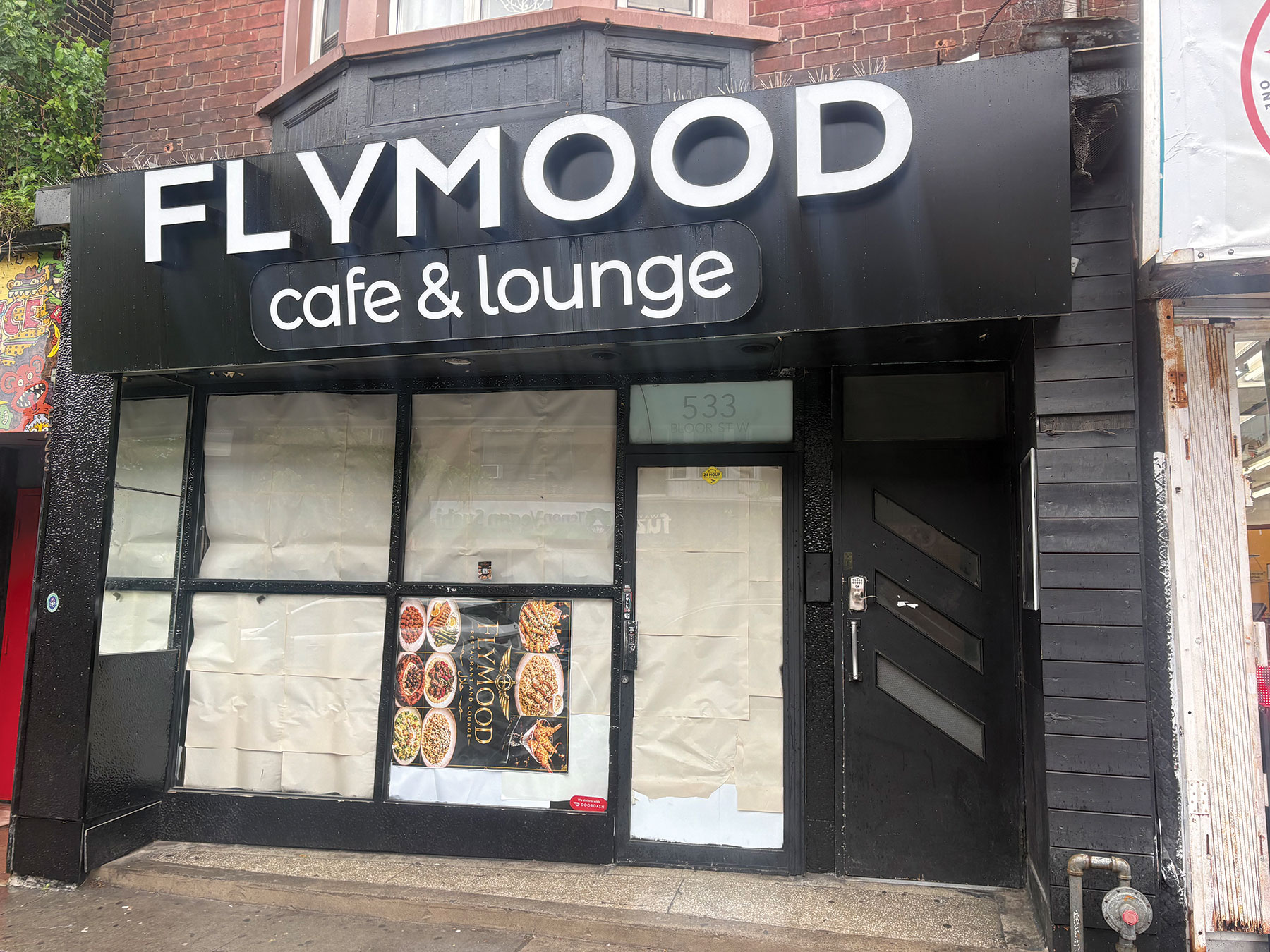
Flymood Café did not fulfill its mission, but it gets points for trying to boldly go. BRIAN BURCHELL/GLEANER NEWS
By Rose Haberer
Our Gleaner writer experienced Flymood Café before it’s abrupt closure.
Previously located at 533 Bloor St. W., FlyMood Cafe & Lounge, which opened in mid-February 2026, captured the essence of a first-class flight and brought it to the ground, allowing guests to experience the fantasy of travel without the inconveniences that so often accompany it. While travel is often overly complicated and expensive, FlyMood offered a local escape, an indulgent dining experience that rebelled against the mediocrity of cabin cuisine.
FlyMood was distinctly cosmopolitan, with offerings that ranged from smashburgers and fries to matcha lattes, Turkish baklava, burrata pasta, and kebabs, allowing guests to explore the world on their plate. Artificial aircraft windows, a convex ceiling, a captain’s uniform hanging in the corner, and other aviation details evoked the feeling of travel without veering into gimmickry. However, the illusion faltered when it came to the service. Basic elements were overlooked, including pre-set cutlery and water filled without request, and the QR code menu was not readily available at the table. Such lapses would be unheard of on a first-class flight to France or the United Arab Emirates.
That said, their Turkish coffee, elegantly presented on a golden plate, arrived with a dense, nutty aroma, as though opulence itself had been distilled into the cup. Alongside it, the Beirut labneh, drizzled with honey and served with fresh, steaming pita, set a high standard for the rest of the meal, compensating for every spartan can of Pringles and bowl of instant ramen consumed 30,000 feet above ground.
The meal began to lose altitude, however, with the truffle fettuccine pasta. Although glazed with a promising creaminess, the overcooked chicken took “airline-inspired” in a turbulent direction. The course redeemed itself with the kebab maghdour, a dish of seasoned minced meat wrapped in flatbread, which was cooked to perfection and plated beautifully with hummus and tomato sauce, offering a flavourful take on a classic.
Dessert at FlyMood did not falter. The menu offered a wide range of options, from a novel teddy bear-shaped chocolate mousse to a pistachio croissant or a rich Dubai chocolate cheesecake. The Karak Chai Tea served as a great palate cleanser.
In a city always in motion, FlyMood offerred a simpler escape, inviting you to slow down and enjoy the experience, and it’s sad to see it has shuttered.
Comments Off on FOCUS: Fly me to the mood (July 2026)Tags:Annex · New In Business