March 9th, 2026 · Comments Off on NEWS: Inside the transformation of the Gardiner Museum (Jan. 2026)
Renovation focuses on connection, access, and Indigeneity
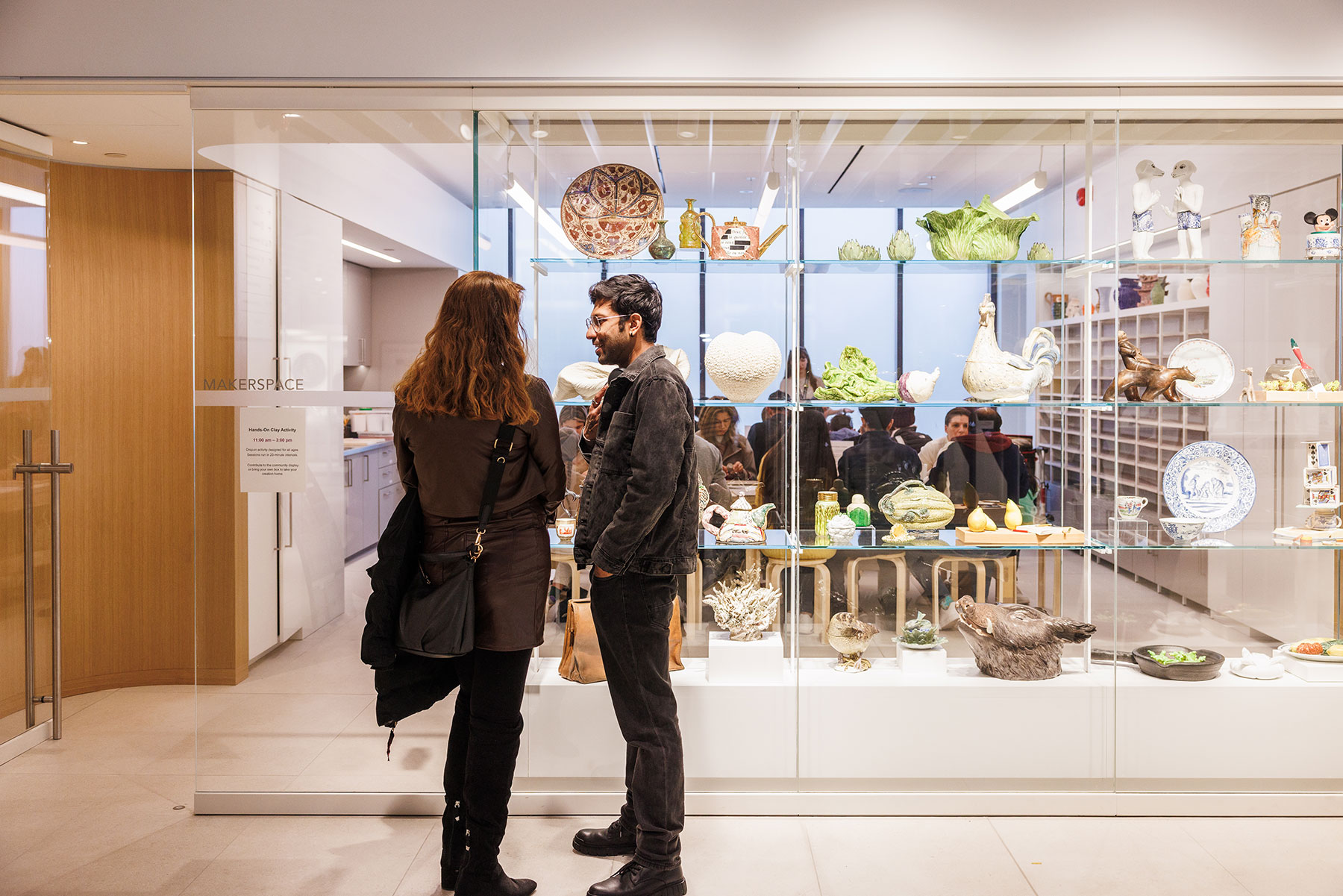
Visitors standing in front of the new Makerspace during the free opening weekend celebration on Nov. 8, 2025. BRITTANY CARMICHAEL/GARDINER MUSEUM
By Mackenzie Currier
The Gardiner Museum, located at 111 Queen’s Park, opened its fully renovated ground floor on Nov. 6. The transformed space includes the Gardiner’s first-ever Indigenous ceramics gallery, new collection galleries, a Makerspace, where visitors can work with clay, and a Community Learning Centre.
The $15.5-million project was made possible by a $9-million contribution from the Radlett Foundation with support from private and public partners, including the Hilary and Galen Weston Foundation, the Lindy Green Family Foundation, and the Government of Canada. Though planning for the renovation began around 2016, the project gained momentum in 2022 following the Radlett Foundation’s generous gift in honour of William B.G. Humphries. The donation expanded the legacy of the late Humphries, a porcelain collector and philanthropist who was passionate about advancing the rights of Indigenous peoples. He envisioned a space that would unite diverse communities through clay and would include accessible education, programming, collections, and exhibitions. This project was built on the pillars of connection, access, and Indigeneity, and the design and curation of the space reflects these values. “This transformation establishes the museum as a dynamic and flexible cultural institution for everybody,” said Sequoia Miller, chief curator and deputy director of the Gardiner Museum.
As part of its commitment to represent and unite diverse communities, the Gardiner established anti-racism, anti-oppression and equity as foundational values. The museum also appointed its first curator of Indigenous ceramics, Franchesca Herbert-Spence, to support its mission to centre Indigenous voices and advance Indigenous self-determination. Herbert-Spence worked with architect Chris Cornelius, a citizen of the Oneida Nation of Wisconsin, when designing the Gardiner’s first gallery of Indigenous ceramics. Prior to Herbert-Spence’s appointment, the Gardiner’s Indigenous Advisory Circle had recommended that the pieces be acquired from artists in the Great Lakes region, with no time period constraints. Following these recommendations, Herbert-Spence commissioned pieces from artists on Manitoulin Island, Six Nations of the Grand River, and Curve Lake. She selected works that reflect the artists’ values and subverted the practice of including only one artist per community by sourcing pieces from multiple artists. She also included archaeological pieces from around these communities.
The gallery is presented in a wooden frame with a transparent copper mesh skin that serves as feathers. Architect Chris Cornelius wanted to create a “vessel that is part of the larger museum experience but also acts as a container to present the Indigenous ceramics within it.” When designing the display, Cornelius emphasized that these pieces are not artifacts of the past, but rather a continuation of Indigenous knowledge. He wanted his work to express something timeless. On the ceiling there is a 24-hour recording of the sky, compressed into 20 minutes, which gives visitors a unique and dynamic experience.
Gabrielle Peacock, executive director and CEO of the Gardiner Museum, asked, “How do we welcome people into the space? How do we connect them to the works in our collection?” Over the past two to three decades, the museum’s audience has shifted to reflect Toronto’s diversity. The Gardiner is also engaging more with younger guests and students and inviting visitors to engage with the medium in a hands-on way. By including art education, the Gardiner has joined a broader cultural shift toward making museums audience-focused rather than object-focused. The hands-on studio enables people to connect with ceramics and gain a greater appreciation for the collections and installations.
In the new William B.G. Humphries galleries visitors will experience ceramics spanning many geographies, cultures, and time periods. The collection encourages visitors to discover connections between pieces and reflect on their own lives as they engage with artifacts from Indigenous Latin America, Europe, and Canada. The Gardiner commissioned Nadia Myre, a contemporary visual artist from Montreal and an Algonquin member of the Kitigan Zibi Anishinaabeg First Nation, to create the installation A Line Through Time. Her pieces use ceramic beads and clay pipes to explore themes of cultural memory and exchange.
In discussing the impact of the renovations, Peacock hopes guests will be “astonished by the scope of ceramics that have been and are continuing to be made” as well as surprised by some elements of the new space. She hopes the renovation inspires people to discover ceramics and to learn more about themselves through cultural traditions.
Visiting hours are from 10:00 a.m. – 6:00 p.m. on Monday, Tuesday, Thursday, and Friday; 10:00 a.m. – 9:00 p.m. on Wednesday; and 10:00 a.m. – 5:00 p.m. on Saturday and Sunday. Ticket prices are $18 for adults, $14 for seniors (65+), and free for youth (18 & under), students, and Indigenous Peoples, with universal free entry on Wednesday evenings after 4 pm.
March 9th, 2026 · Comments Off on CHATTER: Free repair workshops return to Karma Co-op (Jan. 2026)
A satisfied participant in Karma’s fabric mending café. COURTESY KARMA CO-OP
This year, Karma Co-op is again hosting Repair Café workshops. The next one is focused on fabric mending. The co-op is located at the rear of 739 Palmerston Ave. (off Karma Lane).
Bring your clothing in need of mending and leave with both wearable garb and some new sewing skills.
“We aim to provide a mentoring relationship and enable community members to mend and fix items in their own lives and divert things from landfill,” said Andrea Dawber, a Karma Co-op volunteer and event organizer.
All Repair Cafés are open to the public, and they aim to teach people repair skills for clothing, small appliances, electronics, or bicycles. Last year the workshops were so popular that Karma has decided to offer them again this year. The upcoming ones are in February and March.
These free repair events are an extension of Karma Co-op’s mission to sell locally sourced food in bulk, where possible.
The fabric mending workshop is Tuesday, Feb. 10, 2026, 6 p.m. – 7:30 p.m. The small appliances & electronics workshop is Saturday, March 28, 2026, 12 p.m. – 3 p.m.
March 9th, 2026 · Comments Off on CHATTER: Freeland resigns as MP after Ukrainian appointment (Jan. 2026)
Chrystia Freeland, member of Parliament for University-Rosedale, will be leaving her position to assume other roles including an assignment from Ukrainian President Volodymyr Zelensky as an economic adviser.
Prior to her resignation, Conservative critics said the appointment conflicted with her role as a Canadian MP, even though it is unpaid.
Zelensky said Freeland will help his country rebuild after the war and become more resilient in the future. “Chrystia is highly skilled in these matters and has extensive experience in attracting investment and implementing economic transformations,” said Zelensky in a social media post.
In an announcement on Jan. 5, 2026, Freeland said “Ukraine is at the forefront of today’s global fight for democracy, and I welcome this chance to contribute on an unpaid basis…I am grateful to have been your representative [in University-Rosedale].”
Freeland also recently accepted the position of CEO of the Rhodes Trust which administers Rhodes Scholarships to Oxford University. She is relocating to the U.K. to start this position on July 1, 2026.
An accomplished politician, Freeland was elected to Parliament in 2015. She served various cabinet roles including minister of finance and deputy prime minister.
March 9th, 2026 · Comments Off on EDITORIAL: Poilievre endorses Trump’s actions; he should never be PM (Jan. 2026)
“Congratulations to President Trump on successfully arresting narco-terrorist and socialist dictator Nicolas Maduro who should live out his days in prison…Down with socialism. Long live freedom,” read Conservative Party leader Pierre Poilievre’s congratulatory post on X (formerly Twitter) regarding Donald Trump’s recent kidnapping of the Venezuelan President and his wife. Both were brought to New York where they will stand trial for drug trafficking charges and possession of an automatic weapon.
The statement came just hours after the extraordinary move by the United States. The tweet speaks volumes about Poilievre’s suitability to be prime minister. It also came just weeks before his mandatory leadership review at the Conservative Party of Canada. A play to the base perhaps? It’s helpful to be reminded how uniquely unqualified he is to lead Canada; he would literally say anything to stay on as leader of his party. If there were another Freedom Convoy in Ottawa tomorrow, he would be there in a heartbeat in a cowboy hat flipping burgers.
This editorial is not an endorsement of Maduro. Venezuela has long suffered under the illegitimate dictatorship of Maduro, and before him, Hugo Chavez. Aligning himself with drug cartels, Maduro, led a brutally oppressive regime. The Venezuelan people have suffered for decades. But, thanks to Trump, the government is still in place, minus the leader. There has been no purge; the apparatus of corruption and abuse remains.
Calling for adherence to an international rule of law, respect for sovereignty, and multilateralism, Prime Minister Mark Carney reminded Canadians that Canada never supported Maduro’s “illegitimate” regime and called for a “Venezuelan-led transition anchored in the sovereign right of the people to decide their own future.”
Trump holds such niceties in low regard. He is a wannabe strongman with no clear plan. Trump claimed he is now running Venezuela and recently said that the country’s vast oil reserves will be under “indefinite U.S. control.” This was not just a police action. It’s theft; a mafia move expanding turf. Trump also mused recently about taking control of Columbia, Cuba, Mexico, and Greenland. This is the person whose actions Poilievre chooses to praise.
Why did the Conservative leader end his tweet with “Down with socialism, long live freedom”? Was the Maduro regime advocating universal health care, rights to collective bargaining, climate action, school lunch programs, an inclusive tolerant society, bike lanes perhaps? Nope, none of the above. That sounds more like Canada. Is Poilievre, really saying down with Canada? That would be consistent with his brand of Canadian self-loathing that he is naturally predisposed to espouse. Reminds one of the last federal election, when at every opportunity he wanted to tell voters that “Canada is broken.” It is the endless attacks on our own identity that is hard to get behind.
Our prime minister, on the other hand, is more measured. When he was first elected in March 2025, Mark Carney made this statement about Maduro: “One of the first actions taken by Canada’s new government was to impose additional sanctions on Nicolás Maduro’s brutally oppressive and criminal regime—unequivocally condemning his grave breaches of international peace and security, gross and systematic human rights violations, and corruption.”
It’s apparently possible for contradictory positions to both be true; one can oppose Maduro’s leadership and Trump’s actions in the same breath, as both are unacceptable.
Assuming Poilievre receives a healthy endorsement from his party later this month, he should consider ways to make himself more electable beyond his base. At a recent Parliamentary Press Gallery dinner Poilievre told those gathered that a pollster said he could improve his public image by working to engage meaningfully with people’s concerns. Or, he could just get a dog. So, he immediately called the pollster and said “What kind of dog?”
While that’s funny, it’s also probably true. He’s not a leader that a country like Canada would want to call its own.
March 9th, 2026 · Comments Off on FORUM: Tear up that parking lot and put in housing (Jan. 2026)
Climate change advocacy and transit improvements are a focus
By Dianne Saxe
All best wishes for a good new year. So glad to see the days starting to lengthen again. Here are the top three things you should know this month:
Speeding up Transit: The mayor and council have finally joined my campaign to speed up surface transit after the brand new $3.5 billion Finch West Light Rapid Transit line turned out to be slower than the bus. As a TTC board member, I was appalled to learn about this only after the opening and to get confusing and contradictory answers about why. You may have seen me on TV telling our provincial overlords not to open Line 5, Eglinton Crosstown, until it is faster than the Eglinton bus. Toronto has the slowest streetcars in the world, and to fix it, we need to place a greater priority on transit. I have instituted data-driven solutions on Dundas Street that make transit faster, and I’m thrilled these are now being implemented in other wards.
Parking Lots into Housing. As timber walls rise out of the old parking lot at 35 Bellevue, a College Street parking lot four blocks away will now be transformed into badly needed purpose-built student housing. Too many students face multi-hour commutes and/or are crowded into illegal rooming houses. Staff advised that this new building should be open by fall 2029.
Saving Climate Action: Together with citizen activists, I helped rescue the possibility of a mandatory Building Emission Performance Standard (BEPS), the backbone of TransformTO. Instead of the long-promised bylaw, staff were forced to present an old-style “climate plan” with unfunded capital projects and existing green standards that may not survive the year offering “blame Ford and Carney” excuses. Due to public outrage, the mayor eventually allowed a BEPS report for 2027, although there are no guarantees it will lead to action. I also faced a bitter fight trying to ask Toronto Hydro about cost-saving and pollution-reduction measures from the dirty Portland’s gas plant by using storage, renewables, and price incentives that shift expensive peak electrical demand. The provincial agency that should have answered that question, the Independent Electricity System Operator, largely ignored the opportunity. We’ll now get a partial answer in the spring.
In other news:
Six years after Toronto quietly dropped the role of chief resilience officer and abandoned preparing for climate change, the city is ready to start talking about it again. The Climate Change Resilience Workplan is a plan to eventually develop a Climate Change Adaptation Actions Plan, as and when the mayor or other governments are willing to fund it.
As a first step, extreme heat is the top climate breakdown risk to the health and well-being of Torontonians, especially Indigenous peoples, the unhoused, and tenants of buildings without air conditioning (flooding is likely to cause the most infrastructure and financial damage). The city is therefore taking measures to protect tenants from extreme heat in their units, with a Maximum Temperature Bylaw for Rental Units due back to council by July.
The city’s primary sewer contractor was suspended for five years from working for the city after being caught falsifying invoices. This kind of cheating deserves severe consequences.
Council supported my motion condemning Ford’s attack on our conservation authorities, including wasting millions to force a confusing new name and huge new expenses onto the internationally renowned Toronto and Region Conservation Authority.
The city will also support any public interest litigation against Bill 60 which made it easier to evict tenants.
Toronto police data show a large drop in serious crime across the city, including the lowest murder rate we have seen since 1974. However, I am working with the police to address the recent uptick in break-ins in certain parts of our community.
Happy New Year to one and all!
Dianne Saxe is city councillor for Ward 11, University-Rosedale.
March 9th, 2026 · Comments Off on FORUM: Our health-care crisis deepens (Jan. 2026)
The situation only worsens under Doug Ford’s policies
By Jessica Bell
What is happening to health care?
One of the Ontario government’s most important responsibilities is to provide Ontarians with high quality and cost-effective public health care. The Ford government is not effectively delivering on this mandate.
Private health care is proliferating.
There are about 900 privately operated clinics in Ontario. Most of these clinics offer diagnostics, like MRIs and ultrasounds. Now the Conservatives are permitting for-profit companies to perform eye surgery and hip and knee replacements.
The minister has said these for-profit clinics will alleviate the surgery backlog and that “Ontarians will always access the health care they need with their OHIP card, never their credit card.”
This is not true Many patients at these for-profit clinics are being coerced into paying for medically necessary care. This is illegal.
Last November, I listened to Dr. James Deutsch talk about the experience of his now-deceased wife who was charged $7,850 for cataract surgery at a private clinic.
Dr. Deutsch is one of hundreds of people working with the Ontario Health Coalition to file a complaint with the government and demand these clinics reimburse them for costs.
“I believe that they took advantage of her desperate situation and convinced her to opt for a more expensive lens and type of procedure for each eye,” Dr. Deutsch said.
“She was scared to go walking outside. She was not in a position to question. Having the profit incentive and leeway to charge more for a procedure can lead to situations like this, of selling services that are not necessary.”
These clinics are a colossal waste of money because the Conservatives have permitted these for-profit clinics to charge the government much higher rates than hospitals can bill for the same surgery.
As one surgeon described it to the CBC last November: “If I were running that centre, I would be a millionaire. There’s a ton of money to be made.”
It is for more efficient and beneficial for the Ontario government to invest in public health-care delivery and to properly fund our public hospital system.
The family doctor shortage is getting worse.
In December, the auditor general released a sobering report on the state of primary care. She found that two million people in Ontario do not have family doctors or primary care nurses, up from 1.8 million just a year prior.
The auditor general found the government also has no clear plan to connect every Ontarian to a primary care provider by 2029.
The government doesn’t know how many providers are practicing in each region of the province because they don’t properly track it.
The government is not creating enough medical spots for family doctors because they did a poor job of assessing the need and underestimated how many people don’t have a doctor. You can’t fix what you don’t track.
Under the guidance of former federal Health Minister Jane Philpott, the government has issued two rounds of funding to community clinics and family health teams—popular primary care models— to bring in new patients living in areas with acute primary care shortages.
Ontario should increase its investment in primary care, especially nurse practitioner-delivered care and the family health team model.
Physician overbilling is a problem
Most physicians carefully follow OHIP billing rules, and then there are some outliers that don’t.
The auditor general has found there are some doctors who are billing for more than 24 hours a day, 365 days a year. These doctors are billing up to ten times more than other doctors in their speciality.
OHIP billing abuse has been an issue for years, so why aren’t we addressing it?
To maintain trust in our OHIP billing system, it is essential that we rout out abuse. Currently, there are just 8 staff in Ontario monitoring OHIP billing charges of $29 billion a year. One practical solution is to increase the number of staff responsible for auditing and enforcing OHIP billing practices so they can identify and crack down on abuse.
We need a cost-effective and high-quality public health-care system that provides comprehensive cradle to grave health care based on need, not on our ability to pay. That’s the Canadian way.
Jessica Bell is the MPP for University-Rosedale and the Shadow Minister for Finance and the Treasury Board. You can reach her office at jbell-co@ndp.on.ca or 416-535-7206.
December 16th, 2025 · Comments Off on ON THE COVER: A “Beacon” in the winter (Dec. 2025)
This year’s December cover is Beacon by Brian Harvey (Oil on Panel, 36” x 48” x 1.5”).
From the artist: “Beacon is a painting that came about in the aftermath of a heavy snowstorm. As the weather let up and the sky began to clear I headed out to explore the quiet of nearby alleys blanketed in new snow. I am continually drawn to the the play of light that happens in overlooked urban spaces. With this piece, the warm glow of the garage light amidst the cool end of day light drew me in. Winter in the city can be hard to love but it’s one of my favourite seasons to paint.”
Brian Harvey lives and works in Toronto. He has been painting and exhibiting for over a decade, and his work can be found in public and private collections across Canada, the United States, and Europe. His paintings are studies of the commonplace and the typically mundane: the everyday objects, spaces, and urban landscapes that surround him and that are frequently overlooked. He studied at Seneca College, Sheridan College, Toronto School of Art, and the Art Centre at Central Technical School. He recently completed a BFA from OCAD University in Toronto.
December 16th, 2025 · Comments Off on NEWS: Making knives on Bloor Street (Dec. 2025)
A Japanese forger demonstrates a craft with a rich history
Blacksmith Masahi Yamamoto demonstrates knife-making skills at a public event hosted by Knifewear located at 517 Bloor St. W. ROSE HABERER/GLEANER NEWS
By Rose Haberer
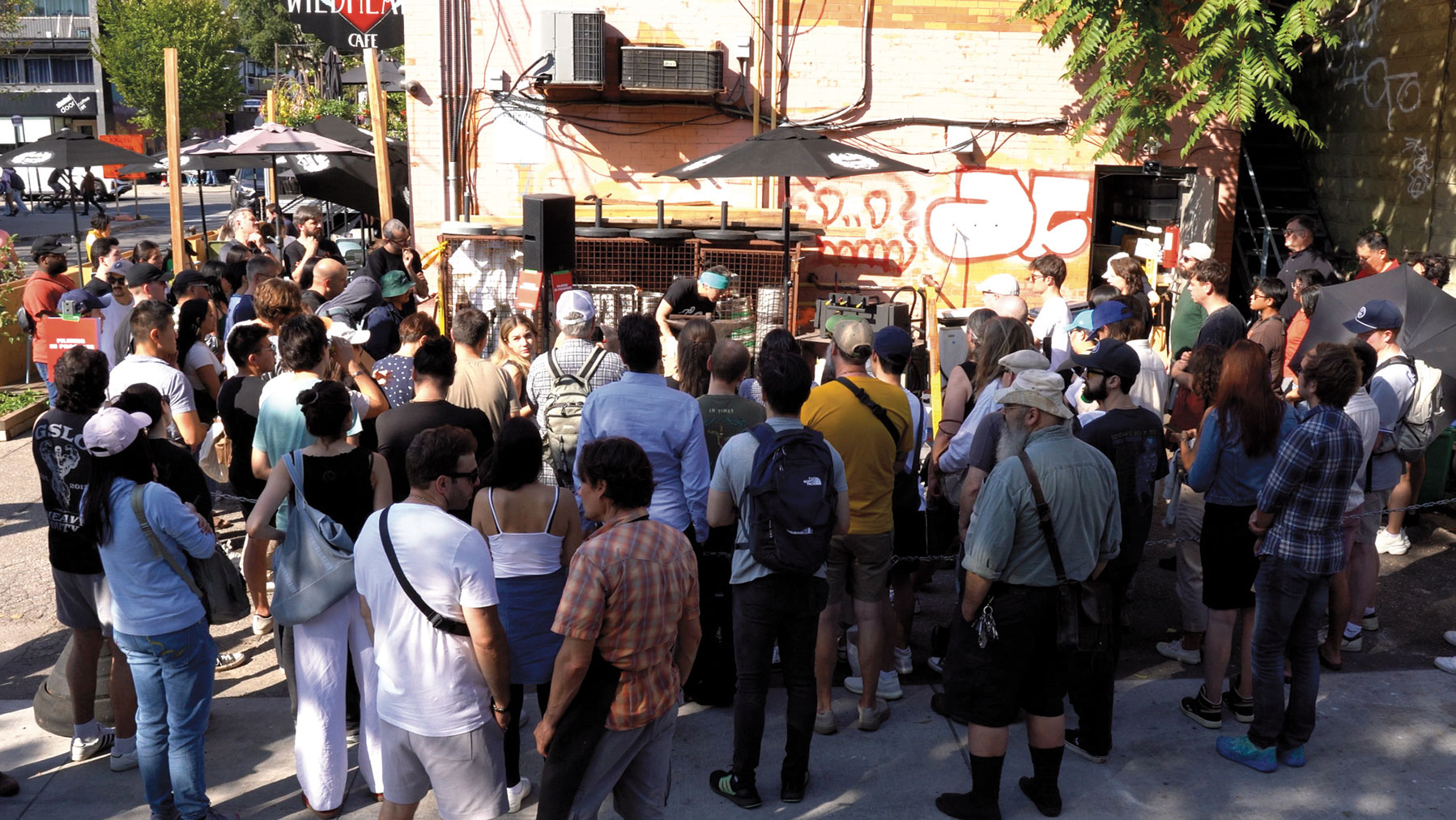
Sparks flew on Oct. 4, when master blacksmith Masashi Yamamoto, one of Japan’s premier knifemakers, performed a live forging demonstration in Toronto’s Annex at Knifewear (517 Bloor St. W.). Knife enthusiasts and curious passersby gathered to witness the spectacle.
Japanese knifemaking carries a rich history which can be traced back to the country’s ancient swordsmithing traditions.
During the Edo period (1603-1868), as the demand for swords declined, blacksmiths redirected their skills towards kitchen knives, applying the same forging and tempering techniques used for samurai swords.
Over time, these knives evolved into highly specialized tools for precise culinary tasks.
The knowledge, techniques, and traditions were passed down through generations, preserving Japan’s renowned standards of craftsmanship.
Yamamoto, renowned for his exceptionally sharp blades and his careful attention to detail, hails from blacksmithing royalty—his family has practiced the craft for 13 generations and they own the esteemed knife company Yoshikane Homano.
A crowd gathered behind Wildhearts Café to watch Yamamoto practice his craft with a forge and anvil. COURTESY KNIFEWEAR
Yamamoto began his training, alongside his brother, under the guidance of his grandfather and uncle, learning the traditional techniques that shaped his family’s legacy. At 36, Yamamoto struck out on his own, beginning his own forge.
With a focus on preserving the time-honoured traditions of Japanese craftsmanship while integrating scientific methods to refine and adapt the process, he opened his workshop in 2013.
A guiding philosophy in Japanese blacksmithing is shokunin kishitsu, the spirit of the master craftsman, which is cultivated through years of disciplined practice and dedication.
“Shokunin kishitsu is the outcome of putting into practice what has been passed down through generations,” said Yamamoto, via a translator, when asked how he interprets this ethos.
Traditions shape the distinctive qualities of Yamamoto’s knives. He explained that Japan’s humid climate leads to rapid food spoilage, compelling early knifemakers to adapt their techniques.
“We make knives so sharp that when they cut ingredients, they won’t go bad as quickly,” He added.
An awareness of the environment and a focus on efficiency are integral to all of his work. He explained that “steel was once a scarce resource in Japan, though very useful,” which led him to carefully consider how to produce knives with minimum waste and maximum efficiency.
What makes Yamamoto’s craftsmanship truly unique is the meticulous tailoring of each knife to its purpose. Even knives made from the same steel are forged differently depending on their use, ensuring optimal performance. Certain parts of his process, such as proprietary heat treatment techniques, remain closely guarded secrets, giving his blades unmatched durability.
It is fitting that Yamamoto’s demonstration was held at Knifewear, a retailer renowned for its high-quality handcrafted products. Since 2022, Knifewear has carried exclusive lines of Yamamoto’s knives, including the Kokuen and Kaijin series.
Kaijin knives use VS1 steel for exceptional hardness and edge retention, while Kokuen knives use SLD steel for a balance of durability and sharpness.
Throughout the event, many bustled into Knifewear hoping to purchase a knife by Yamamoto and to be one of the select few to have their knives engraved by the great blacksmith.
But how does Yamamoto view his knives? As tools or as works of art? For him, the beauty comes from the blade’s functionality.
Shaping the molten hot iron into a blade in the traditional fashion. COURTESY KNIFEWEAR
“If you’re trying to make the knife functional for the users, without thinking about making it beautiful, it will become really beautiful,” he explained.
Referring back to shokunin kishitsu, he explained that his teachers taught him that the spirit of the craftsman is infused in the knife through the maker’s intentions.
Since the knives are handmade, users can feel the presence of a human touch in the final product, which is often absent in machine-made knives.
Though Japan’s blacksmithing history runs deep, younger generations began turning away from the forge.
Yet, amid a surge of international fascination with Japanese knives, many Japanese youth turned to the anvil, reviving a centuries-old art. Knifewear’s brand communications lead, Nathan Gureau, highlighted this during the event:
“When Knifewear opened 20 years ago, the art of blacksmithing was dying out,” Gureau said, addressing the crowd. “It’s because of folks like you that there’s been a massive surge in business for makers like Masashi-san, allowing them to continue their work, and sparking a renewed interest in knifemaking among younger generations in Japan.
Global enthusiasm has breathed new life into the knifemaking craft, allowing it to not only survive, but thrive.
December 16th, 2025 · Comments Off on FOCUS: Residents discuss heritage conservation designation (Dec. 2025)
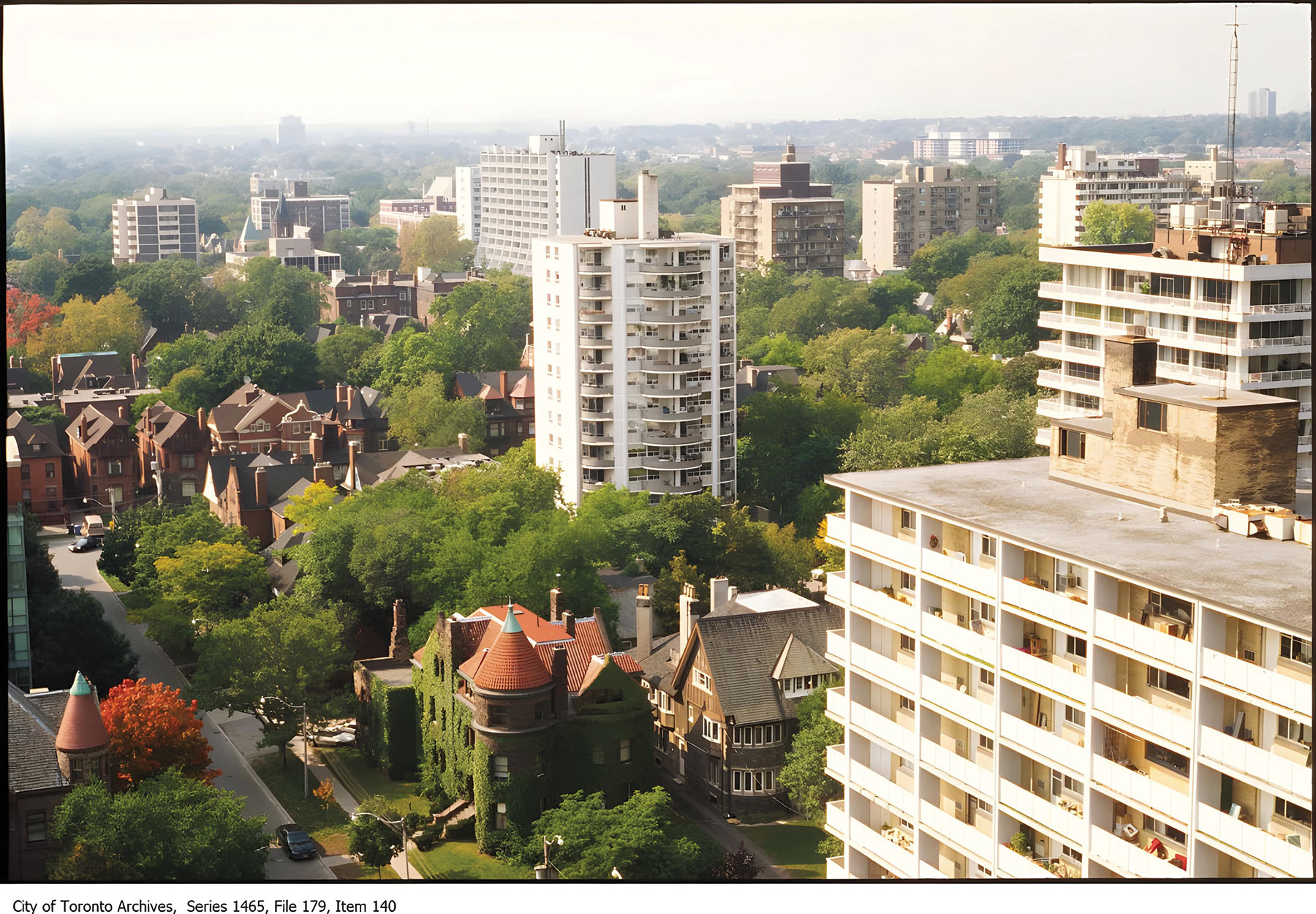
The city is considering applying the HCD designation to the West Annex as part of its Phase II Heritage Conservation District Study.
An aerial view of the West Annex. COURTESY CITY OF TORONTO ARCHIVES, Series 1465, File 179, Item 140
By Damola Omole
On Oct. 21, 2025, City of Toronto planning staff hosted an open house at the Native Canadian Centre of Toronto (NCCT), where individuals from the Annex neighbourhood provided feedback on the city’s new West Annex Phase II Heritage Conservation District (HCD) Study.
Over the course of the three-hour event, various Annex residents popped in and out of the NCCT to learn more about the logistics of the HCD process and to chat with members of the City of Toronto’s planning team.
“We’re particularly interested in stories and understanding what makes places special or unique,” said Tamara Anson-Cartwright, a member of the City of Toronto’s urban design team.
One of architect Uno Prii’s heritage apartment buildings at 44 Walmer Rd. BRIAN BURCHELL/GLEANER NEWS
The traditionally recognized boundaries of the Annex are north to Dupont Street, south to Bloor Street, west to Bathurst Street, and east to Avenue Road. However, the City of Toronto recognizes a broader neighbourhood definition that includes the adjacent Seaton Village and Yorkville areas.
The Phase II study area covers the blocks between Bathurst Street and Bedford Road and between Dupont Street and Bloor Street West. It includes all properties within these boundaries except those already designated under the Madison Avenue HCD, which runs through the Phase II area and encompasses the properties fronting onto Madison Avenue from Dupont to just north of Bloor.
According to the City of Toronto, an HCD designation is a “a planning tool that guides change in neighbourhoods that represent Toronto’s rich social, cultural, and architectural history—places that contribute to the livability and appeal of Toronto as a multicultural, sustainable, and equitable city.”
Factors such as the many students who frequent the West Annex (thanks to its proximity to the University of Toronto and its inherent transitonal population) overall, make the West Annex worthy of an HCD designation, according to Annex resident Christopher Varley.
With this sentiment in mind, Varley is also cognizant of the city’s proclivities for construction and alteration.
“We do have a lot of subway stations, and, of course, I understand there’s a lot of pressure for development because of that,” Varley said.
According to the city, HCDs preserve the historicity of Toronto’s most storied neighbourhoods, while still enabling the city to seek “opportunities for contextually appropriate growth.”
Several sites within the Greater Toronto Area have received the designation, such as the King and Spadina intersection, Queen Street West, and Union Station.
Various parts of the Annex have also received the designation. The East Annex, which was the first large-scale residential neighbourhood to be studied in Toronto as a potential HCD, received the designation in 1994.
More recently, Madison Avenue, known for its collection of 20th residential houses designed by renowned Toronto architects, had its request for the designation approved by the local planning appeal tribunal in 2019.
Annex resident and member of the Annex Residents’ Association, Sara Shaul, believes that the West Annex deserves to be next in line.
“They started with the East Annex, and everyone was going, ‘What about the rest?’ So, we wanted [it] studied the way the east was,” Shaul said.
Shaul doesn’t merely think the West Annex deserves a designation; she thinks it needs one. To her, an HCD label may also help the community retain its character during the sometimes harsh uncertainties of Toronto’s infrastructure development scene.
“We have layers of architectural development that responded to changing needs…and I hope the city maintains pieces of each of those layers,” Shaul said.
While the HCD designation doesn’t spare buildings from all forms of change and renovation, it exists to ensure that changes complement the existing unique built form rather than detract from it.
It also adds extra steps to the renovation process for property owners who may want to alter their own buildings. Certain types of alterations or renovations to a property within an HCD require a heritage permit.
A heritage permit is not required if an alteration or renovation is not visible from the street, or if it only affects the interior of a building.
Various sections of the GTA are consistently bogged down by large construction projects, and so Shaul hopes to see the City of Toronto acknowledge the history and architecture of the Annex so as to preserve its history.
“We must protect what’s of great value,” Shaul said.
While, by law, HCD sites are not immune to construction or alterations, the designation does require any new developments initiated within the area to follow tighter and more careful guidelines.
As stated on the City of Toronto website, “Proposed new construction, alterations, and additions should conserve heritage attributes, contribute to, and be compatible with the district’s character and sense of place.”
A notable example somewhat contrary to this sentiment can be seen through the Eglinton West, or Little Jamaica neighbourhood, which has been greatly impacted by the city’s prolonged LRT construction project.
Many businesses within the area had to shut down or completely overhaul practices as a result of the construction.
Even though the City of Toronto has consistently affirmed the cultural and historic significance of the Little Jamaica neighbourhood, Eglinton West has not been officially designated as an HCD.
The designation would likely not halt the LRT construction altogether; however, it might ensure proper measures are in place to help businesses within the area remain as unscathed as possible.
“We have policies that say no demolition of those amazing [heritage] buildings…but many districts also allow for change to happen that is of a bigger scale,” Anson-Cartwright said.
The process is still in its early stages, and there is no set deadline for when the West Annex can expect its designation to be approved. Other districts, such as Bloor West Village, have been waiting for as long as eight years, so the process can be a lengthy one.
In the meantime, more community engagement is coming, according to Anson-Cartwright. “We’re going to set up a local advisory committee, and we’ll be looking for people to volunteer,” Anson-Cartwright said.
“Most of the focus of the advisory group is with associations that represent the community…that will occur in the next two weeks.”
December 16th, 2025 · Comments Off on CHATTER: A new steward for Seaton Park (Dec. 2025)
RENDERING COURTESY OF DTAH
In May, the Bloor Annex Business Improvement Area (BIA) was approached by Councillor Dianne Saxe and the Annex Residents’ Association to take over the maintenance of Seaton Park at 14 Albany Ave., a long-neglected green space behind Hot Docs’ Cinema, currently operated by city parks.
Since then, the Bloor Annex BIA has been monitoring and cleaning the park daily. The BIA would now like to improve the park to the standards of its other, award-winning parkettes, located at Bloor St. and Howland, Major, Robert and Brunswick. Above is an early rendering of the improved park by DTAH landscape architects.
To accomplish this, the BIA has to expand its footprint to include the park which Councillor Saxe is supporting through a motion that was passed at the City of Toronto’s Economic and Community Development Committee on Dec. 2. The motion goes for final approval at city council on Dec. 16.
—Gleaner News Staff
Comments Off on CHATTER: A new steward for Seaton Park (Dec. 2025)Tags:Annex · News