October 28th, 2016 · Comments Off on FORUM (OCTOBER 2016) We can do better:
Dangerous summer for Toronto pedestrians and cyclists
By Mike Layton
Recent statistics from the Toronto Police Service show a disturbing trend — collisions between vehicles and pedestrians and cyclists are on the rise.
Since June 1 of this year 542 pedestrians and 541 cyclists, a total of 1,083 people, have been hit by drivers (cars) and there may be more, since many go unreported. This is an increase of almost 10 per cent over this time last year. Twelve of these collisions were fatal. This means there are close to 10 collisions daily and someone is killed once every two weeks. Sadly, last year 39 pedestrians and four cyclists were killed in collisions.
[pullquote]We also have a responsibility to build our streets in a way that creates a safer environment for the most vulnerable road users.[/pullquote]
Our city must recognize that some street users are more vulnerable than others and every effort must be made to protect these vulnerable road users. Sometimes these changes impact the convenience of other road users, but we value safer streets, and saving lives, over convenience.
Yes, part of the solution is everyone following the rules of the road. Pedestrians, cyclists, taxis, delivery vehicles, and drivers, we all have rules to follow and when we break them, we put ourselves and others at risk. However, we also have a responsibility to build our streets in a way that creates a safer environment for the most vulnerable road users.
There is a movement and policy around the world called Vision Zero and New York, London, and many other cities are adopting it. Vision Zero demands more action by their city governments to prevent the deaths of vulnerable road users.
Toronto could be doing much more. Earlier this summer, Toronto City Council passed a new Road Safety Plan, but failed to fund it properly. In the Road Safety Plan, we committed to Vision Zero, but we did not act to achieve it.
Council voted against Councillor Wong-Tam’s motion, which I supported, to accelerate the funding for this plan so we could implement it sooner and save more lives. Councillors passed a Road Safety Plan without doing everything we could to implement it; they voted and said they believed in Vision Zero, but didn’t put the resources in place to save more lives sooner.
In June, city council adopted a new Ten Year Cycling Network Plan as a roadmap to improve safety across Toronto. This plan includes 525 kilometres of cycling infrastructure (190 kilometres of which are on quiet streets). Like the Road Safety Plan, the Bike Plan is a good idea on paper that will make Toronto streets safer, but council failed to adequately fund it. City Council voted against my motion to accelerate the funding for the cycling network so that we can save more lives sooner. Instead they supported building the 10-year plan, but doing it in 12 years.
One positive story is a motion that I was able to pass in my role as Toronto and East York Community Council chair. Recognizing that speed kills and that as vehicle speed decreases the risk of a fatality decreases dramatically, last year we voted to reduce the speed limit on all local residential streets in the former City of Toronto and East York boundaries to 30 kilometres per hour. The speed limit changes are being rolled out this year and early next year.
Earlier this month, Sarah Doucette (Ward 13, High Park) introduced a similar motion at the Etobicoke York Community Council to reduce the speed limit on all local residential roads to 30 kilometres per hour in the former cities of Etobicoke and York, but the proposal was defeated by a vote of 9 to 2.
We need to do better as a city. Over 1,083 people hit by drivers in a four-month period is unacceptable and is a clear sign that we need to place safety over convenience and reprioritize our city resources to save more lives sooner. I recognize change on our roads is difficult, but we should have no choice in this matter.
We must protect the lives of vulnerable road users first and invest in building a safer and more sustainable city.
Mike Layton is the city councillor for Ward 19, Trinity-Spadina.
READ MORE:
NEWS: Bikes blessed for another season (June 2016)
LETTER: Keep pushing bike safety (September 2015)
MORE BY MIKE LAYTON:
FORUM: Curious story of Christie Pits pool liner ends in extended hours at Alex Duff (August 2016)
FORUM: A tribute to a friend (June 2016)
FORUM: Large problem, small solution (March 2016)
FORUM: Happy New Year from a new Dad with a new perspective (January 2016)
Tags: Annex · Columns · Opinion
October 28th, 2016 · Comments Off on HISTORY (OCTOBER 2016): Yiddish sign evokes rich history
College Street organization hosts Mandel’s Dreamery installation

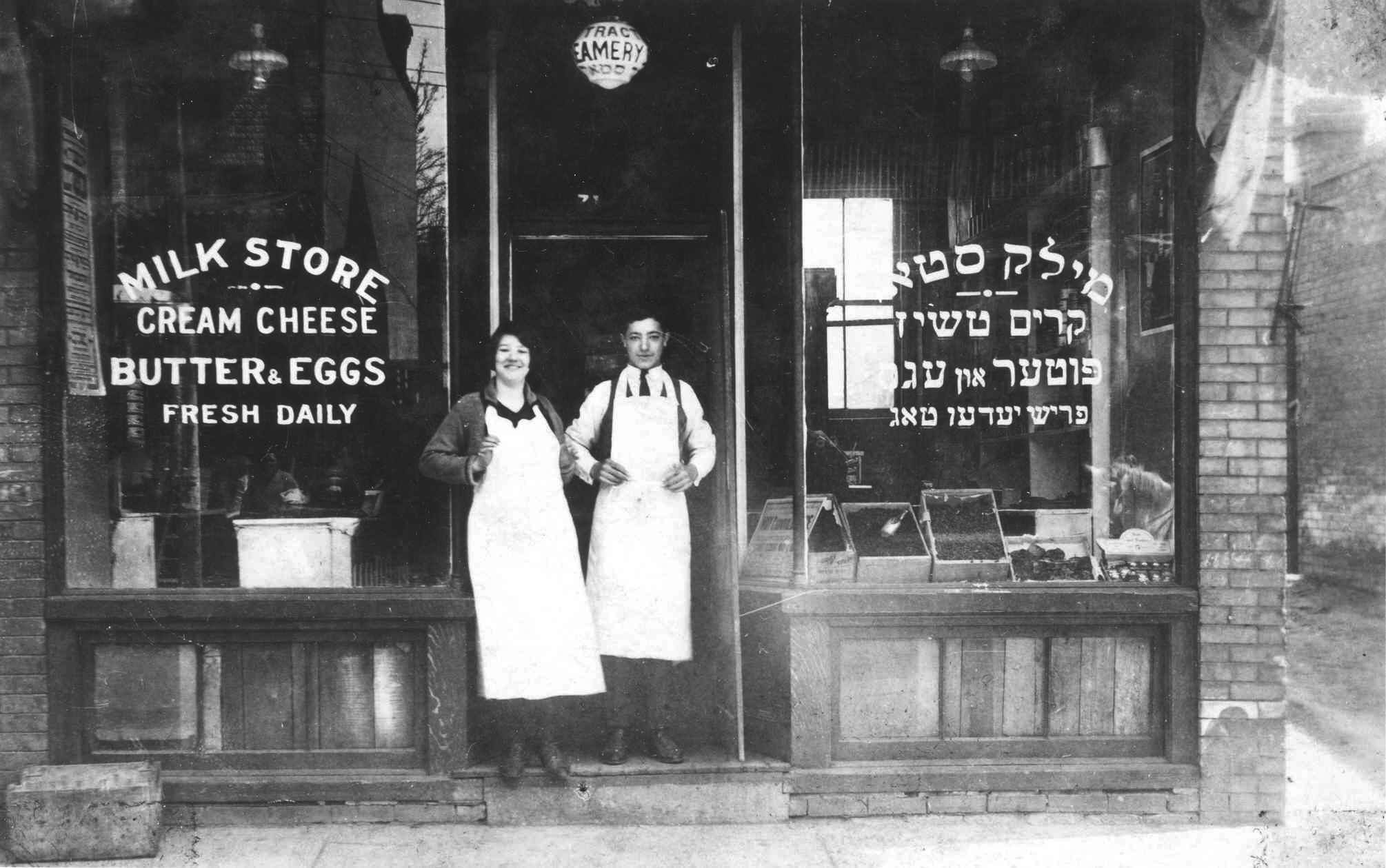
PICTURE COURTESY OF ONTARIO JEWISH ARCHIVES: For Fentster curator Evelyn Tauben, pictures of families standing in front of their storefronts evoke the sense of accomplishment early immigrants felt for building not just a business, but a new life.
By Clarrie Feinstein
When you walk along College Street, you are struck by it immediately. Both out of place, yet oddly at home, it brings the contrast of now and then into sharp relief. And it reminds you of a time when Yiddish was the language of Kensington and the market a predominantly Jewish neighbourhood.
It’s the Mandel’s Creamery sign, which until recently marked 29 Baldwin St., even after the creamery was replaced by a café. It’s now a temporary window installation at 402 College St. thanks to the Ontario Jewish Archives (OJA), which saved the window from destruction after a new business replaced the Italian café that had preserved the heritage sign.
“[Yiddish] was the common language of the European immigrants who had arrived,” said Dara Solomon, OJA director. “Yiddish became symbolic of European Jewery.”
And the sign now has become a symbolic representation of what was a portal to connect Jewish residents to their past and a visual record for all Torontonians to witness.
The sign also marks the transition of a community assimilating into Canadian society as the writing contains a combination of Yiddish and English, often referred to as Yinglish. “This sign marks the moment in history when the residents were beginning to actively become a part of Canadian life,” explained Solomon. “That began with the language.”
This past summer, Evelyn Tauben, curator of Fentster Gallery, breathed new life into the old sign by partnering with Solomon to display Mandel’s sign in the storefront of Makom, a grassroots Jewish organization.
It’s the third installation for Fentster, which takes its name from the Yiddish word for window and is an art collective focused on Jewish themes.
“It’s a real return to our roots,” Tauben said. “It’s a compelling image and a real reminder of the accomplishment these early immigrants felt…you see the families standing outside their storefronts, feeling so proud of their establishments. But they built more than a business, they were building themselves a new life.”
By 1931, 80 per cent of Toronto’s Jewish population of 45,000 lived around Spadina Avenue, establishing businesses, synagogues, and organizations. Today, these Jewish establishments are memories of an earlier era. The installation provides Toronto residents with a glimpse of what College Street used to look like, and a reminder of the delis, kosher restaurants, grocers, and Jewish community centres that occupied the once bustling, Jewish downtown street.
Mandel’s Creamery, which opened in 1915, was one of those businesses. Jewish residents began to leave the area after the Second World War, but Mendel’s Creamery remained until the late 1970s, even as all the other storefronts in the neighbourhood changed.
While the sign has received positive feedback from the Toronto community, it evokes but a memory and can represent only a snapshot of what the area once looked like.
[pullquote]“This sign marks the moment in history when the residents were beginning to actively become a part of Canadian life. That began with the language”—Dara Solomon, OJA director[/pullquote]
Aware of this, the curators have changed the original signage from reading: “Butter, Cheese, Cream, Eggs: Fresh Every Day” to “Butter, Cheese, Cream. Eggs: Only Memories” as kosher foods are no longer “fresh every day” in this part of Toronto. An enlarged 1920s black and white archival photograph of Trachter’s Milk Store, a similar Jewish dairy, forms the visual backdrop.
Not just a connection to the past, however, the sign may also be a connection to the future, as that once vibrant, thriving Jewish community is returning to downtown.
Fentster fronts Makom, the face of a new Toronto Jewish community whose membership is only growing.
“Now we can have a reinterpretation of that signage,” said Makom’s rabbi, Aaron Levy, who celebrates the diversity and multi-denominational nature of the modern Jewish community. “I appreciate seeing it, it grounds me, and tells me that I have a history here.”
The Mandel’s Dreamery will remain installed at Fentster @ Makom, 402 College St. until October 30.
Correction: November 8, 2016
The family name of the of the creamery was misspelled. It is Mandel, not Mendel. The name of the installation was Mandel’s Dreamery.
READ MORE:
PROFILE: Breaking bread with friends (August 2015)
HISTORY: First Narayever marks 100 (February 2015)
HISTORY: Remembering “institution row” (September 2014)
Tags: Annex · History
October 27th, 2016 · Comments Off on HISTORY (OCTOBER 2016): Honouring those who honour history
Local residents recognized at Heritage Toronto Awards
Former Chief of the Mississaugas of the New Credit First Nation and community historian Carolyn King received Heritage Toronto’s Special Achievement Award in recognition of her decades-long efforts to preserve the Mississaugas of New Credit First Nation’s community and to celebrate First Nation heritage at this year’s award ceremony, held in conjunction with the annual Kilbourn lecture on Oct. 17 at the Isabel Bader Theatre. The presentation capped off an evening that celebrated a host of local historians.
Seaton Village’s Ed Janiszewski was among those accepting a community heritage and Members’ Choice award for the Lakeshore Asylum Cemetery Project. Volunteers have identified 1,511 patient names and uncovered 154 grave markers since 2004 in their campaign to restore and commemorate the forgotten Lakeshore Asylum Cemetery. John Lorinc, Michael McClelland, Ellen Scheinberg, and Tatum Taylor took the book award for The Ward: The Life and Loss of Toronto’s First Immigrant Neighbourhood in a category that also included nominees A Meeting of Minds: The Massey College Story by Judith Skelton Grant; Kensington Market: Collective Memory, Public History and Toronto’s Urban Landscape by Na Li; and, The Toronto Carrying Place: Rediscovering Toronto’s Most Ancient Trail by Glenn Turner. Local buildings at 36 Hazelton Avenue, 5 St. Joseph Street, 298 Lonsdale Road, 162 and 427 Bloor St. W., and 113 Walmer Road were also nominated for the William Greer Architectural Conservation and Craftsmanship Award, which recognizes outstanding work commissioned by property owners in conservation of Toronto’s built heritage.
Finally, Gleaner writer and contributing editor Annemarie Brissenden was nominated for a Short Publication Award for “A Haven for Children’s Literature”, an article about the unique history of the Lillian H. Smith branch of the Toronto Public Library that appeared in the September 2015 edition of this newspaper.
—Staff/Gleaner News
READ MORE:
NEWS: HVRA recognized for historical achievements (May 2016)
ON THE COVER: Tracking history in the Annex (April 2016)
ARTS: Capturing the Ward (October 2015)
HISTORY: A haven for children’s literature (September 2015)
NEWS: Preserving a sense of community (March 2015)
Tags: Annex · History
September 16th, 2016 · Comments Off on ON THE COVER (SEPTEMBER 2016): A neighbourhood block party for the global village
![PHOTO BY GEREMY BORDONARO: The Kensington Market Refugee Project, a private group of concerned residents working in partnership with St. Stephen-in-the-Fields, held a neighbourhood block party on Sept. 7 to help raise $50,000 to sponsor a Syrian refugee family and help them settle in Canada. The market, which is home to the city’s first [road mural INSERT LINK], will also come alive with jazz, when the first Kensington Market Jazz Festival launches Sept. 16 to 18.](http://gleanernews.ca/wp-content/uploads/2016/09/AGleanerSept2016Page1WEB-300x200.jpg)
PHOTO BY GEREMY BORDONARO: The Kensington Market Refugee Project, a private group of concerned residents working in partnership with St. Stephen-in-the-Fields, held a neighbourhood block party on Sept. 7 to help raise $50,000 to sponsor a Syrian refugee family and help them settle in Canada. The market, which is home to the city’s first road mural, will also come alive with jazz, when the first Kensington Market Jazz Festival launches Sept. 16 to 18.
READ MORE:
NEWS: Building community over fattoush (June 2016)
NEWS: A warm welcome for new arrivals (January 2016)
EDITORIAL (DECEMBER 2015): Embrace Refugees
NEWS: Groups raise funds for refugees (December 2015)
NEWS: Churches raise funds for refugees (November 2015)
Tags: General
September 16th, 2016 · Comments Off on NEWS (SEPTEMBER 2016): Provincial investment falls short
TDSB repair backlog reflects critical state of infrastructure
By Annemarie Brissenden
With both the federal and provincial governments making significant investments in public infrastructure, the Ministry of Education’s release of information detailing the maintenance backlog in Ontario raises a serious question: are we doing all that we can to maintain our buildings once they are built? The evidence suggests that we are not, and that our penchant for funding new infrastructure while ignoring our existing capital assets is ringing in a very high cost.
Consider that of the nine Ward 10 elementary schools that fall in the Gleaner’s coverage area, six are in critical condition, two are in poor condition, and only one is in even fair condition. All three secondary schools (Central Technical School, Harbord Collegiate Institute, and West End Alternative School) are at the critical level. Many of the elementary school buildings date to the 1950s and 1960s, while both Central Tech and Harbord are over 100 years old.
Reflecting data from 2011 to 2015, a school’s individual FCI is a percentage that is calculated by dividing the total cost of repairs by the cost of rebuilding the school. The higher the FCI, the more repairs the school requires. Schools with an FCI of 65 or greater are considered to be in critical condition.
[pullquote]“Increasingly Ontario parents are noticing the state of disrepair and thinking about the impact on their children”—Krysta Wylie, co-founder, Fix our Schools[/pullquote]
While both the Ministry of Education and the Toronto District School Board (TDSB) stress that such a rating does not mean a school is unsafe for students, it is troubling to wade through the long catalog of repairs, which includes everything from roofing and mechanical work to field restoration, listed starkly in black and white.
“Increasingly Ontario parents are noticing the state of disrepair and thinking about the impact on their children,” said Krista Wylie. She’s a co-founder of Fix our Schools, which was started 25 years ago by TDSB parents whose children all attended old schools with maintenance backlogs.
In June, the province announced it would increase those resources and address the backlog by spending an additional $1.1 billion (on top of a previously announced $1.5 billion) over the next two years on repairing schools throughout Ontario.
In an email, a ministry spokesperson characterized it as a “historic investment” representing “the government’s largest ever investment in school renewal”. It will enable “school boards to repair roofs, update HVAC units, and modernize electrical and plumbing systems”.
“Our government is doing its part to address this issue positively,” said Han Dong (MPP, Trinity-Spadina), whose children attend a local public school. He added that nine schools in his riding, including Harbord and Central Tech, will be getting funds for repairs.
Of the total $2.6 billion announced by the province, though, just under $580 million will be directed to TDSB schools, which collectively have a repair backlog that amounts to $3.6 billion.
“We’re a way off from addressing the backlog,” noted Wylie.
For Ausma Malik (TDSB Ward 10, Trinity-Spadina) it’s a two-fold problem: in addition to receiving adequate resources to make necessary repairs, the board needs “consistent and predictable funding” to maintain its buildings in a state of good repair.
That should amount to $1.4 billion a year, according to the 2015 annual report by the auditor general, who reported that “actual annual funding on a school year basis over the last five years is $150 million a year, increasing to $250 million.”
Wylie believes “the province has done a great job of holding the school board accountable” for budget shortfalls leading to things like a maintenance backlog, even though, in actual fact, it holds all the power.
“The province has relied on ‘right-sizing’ the school system, and painted that as a reason for disrepair,” explained Wylie.
Indeed, Dong points to right-sizing — consolidating and selling schools that are under-capacity and using the proceeds to fund capital repairs, such as in the recently announced merger of the Catholic school board’s St. Raymond and St. Bruno schools — as a way to manage the repair backlog effectively.
“Part of the solution is to look at how we reallocate resources,” said the local MPP. “Schools and day care spaces have to be adjusted given population shift.”
Yet, in a city where green space is at a premium and public schools are as much a hub for recreation as they are for learning, closing schools, even those with low enrolment, is very difficult. Communities push back, supported by councillors who are keen to keep public buildings in public hands. Add this to the unlikely prospect of getting market value for its sites, and it becomes clear why the TDSB often continues to operate schools that are under capacity, even at huge expense.
There’s also the matter of the age of the bulk of its buildings.
While the average age of schools in the province is 38, Toronto’s schools average out at 60 years, with some crumbling in at 100. Such older buildings, the ones that require the most repair and maintenance, have suffered the most from years of chronic underfunding.
As the auditor general’s report highlights, it’s a state of affairs that reflects the province infrastructure pool as a whole. As the second-largest item on Ontario’s statement of financial position, the province’s tangible capital assets are decidedly aging ones. And, so far, little is being done to ensure this portfolio will provide a solid foundation well into the future.
“The government plans to devote two-thirds of its infrastructure spending over the next 10 years to building new assets and one-third to maintaining and renewing existing properties — even though its own analysis indicated it should be the other way around,” wrote the auditor general in her report.
Or as Wylie put it, “it’s more sexy politically for the provincial government to spend money on programs that are way more interesting than a leaky roof.”
READ MORE:
FROM THE ARCHIVES: A look back at one attempt to lease a local school (September 2016)
NEWS: A $9.4-million school with a view (June 2016)
Tags: Annex · News
September 16th, 2016 · Comments Off on FROM THE ARCHIVES (SEPTEMBER 2016): A look back at one attempt to lease a local school
TDSB reverses Essex Junior and Senior Public School decision after community uproar
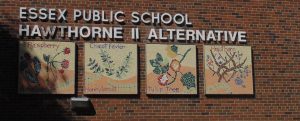
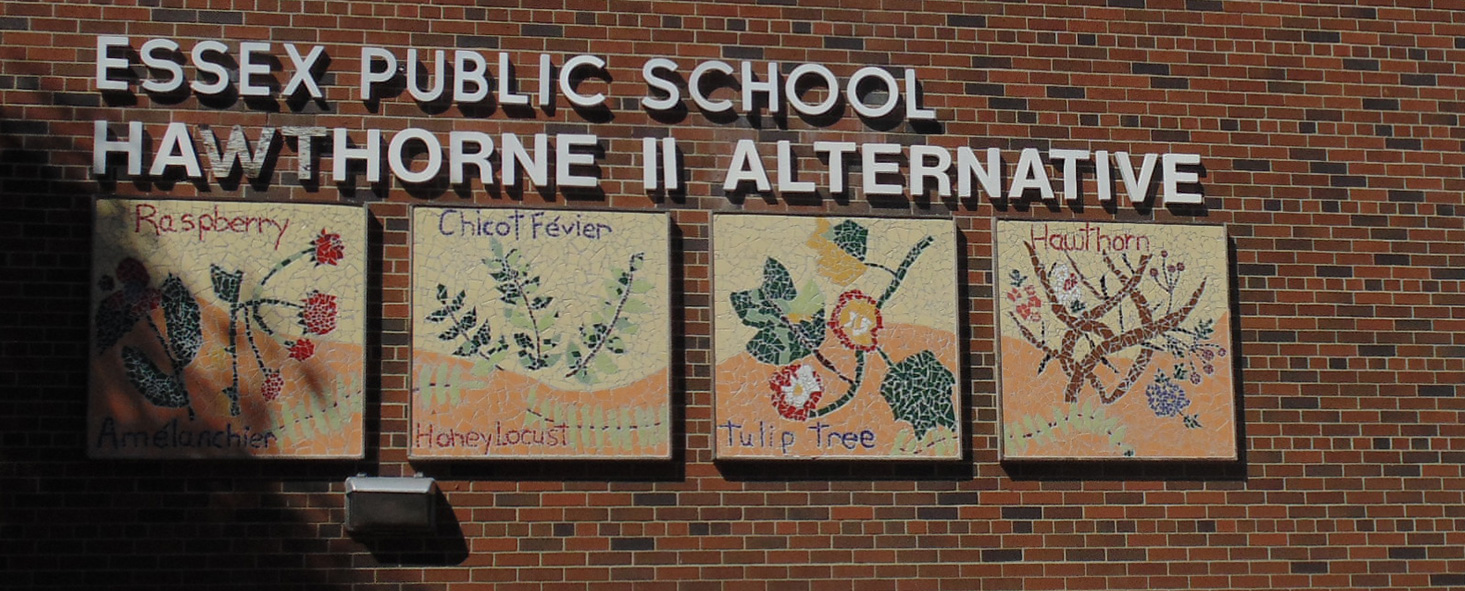
PHOTO BY CLARA FEINSTEIN: The TDSB’s July 2005 attempt to lease Essex Jr. and Sr. Public School (above) backfired in the face of public outcry.
This July 2005 article chronicling the Toronto District School Board’s (TDSB) decision to reverse its plan to lease an empty building at Essex Junior and Senior Public School reflects the challenges faced by municipal school boards that attempt to fund repair and maintenance costs by capitalizing excess space. Today, Essex is in critical condition with an FCI of 87.91.
By Christine Lumley
It only took a month for community members to shout down a TDSB decision to lease an empty building on Essex Junior and Senior Public School property to the Lycée Français de Toronto, a private institution.
The building, linked to the school’s main site by an enclosed bridge and used to house Hawthorne II Bilingual Alternative School Jr., has stood empty since the Conservative provincial government’s funding formula forced Essex and Hawthorne to operate under the same roof.
“It’s good that the neighbourhoods will have much more input in what happens to these buildings now. It will also set new patterns for discussions of public space in other wards,” said local trustee Chris Bolton (Ward 10, Trinity-Spadina) of the decision. He said he plans to chair a committee to examine space issues in the ward and determine how best to make use of the empty buildings.
“I want to be clear it’s not about the Lycée, per se,” said parent Jean Rajotte at a June 1 meeting on the issue, “but it’s sad to lose a public space that has been funded by the public for decades because of money problems. It would be great if we could find a more creative solution.”
Cassie Bell, whose four children attend Hawthorne, said the school had to turn away potential students this past September. She’s worried Hawthorne II will have to move if Essex needs more space in the future.
[pullquote]“It’s sad to lose a public space that has been funded by the public for decades because of money problems”—Jean Rajotte, parent[/pullquote]
But the TDSB has compiled statistics showing the percentage of children aged five to 14 in Ward 10 has dropped 16.2 per cent since 1996. Twenty years ago, Essex had an all-time population high of 1,200 students. Now the two schools combined have 592 students, a decline the board attributes to escalating housing prices.
Indeed, when Hawthorne on Essex supervisor Elif Sommezocak suggested the extra space could be used to expand her currently full daycare centre, Sheila Penny, the TDSB’s executive superintendent for facilities services, replied that the Essex-Hawthorne II site is only 71 per cent utilized and space for the daycare could be found within its walls.
Other ideas for the space include having an artist in residence, leasing it as a constituency office, or using it for the TDSB’s teacher training programs. If the TDSB could not find a use for the space, however, many community members said they would prefer to see the building opened for public use.
It costs the TDSB $116,000 annually to maintain the empty building. If the TDSB leased the building, “the board could use that money to replace eight boilers in eight schools and replace windows in two schools per year,” noted Penny, adding, “with the money spent maintaining the empty building we could have hired two new janitors every year.”
The TDSB has been trying to lease the building for the past five years, as part of its policy to aggressively pursue potential tenants for empty buildings to generate revenue to support capital programs throughout the city. It began talking with the Lycée Français after failing to find a public sector organization for the building.
Penny pointed out that after the mayor’s office identified the neediest areas for the city (the Jane Street, Finch Avenue, south Etobicoke, and Scarborough neighbourhoods), the TDSB began to focus on spending its resources in those areas. Additionally, the study demonstrated the old City of Toronto’s needs are largely met.
“It was also an eye opener for me,” said trustee Patrick Rutledge (Ward 22, Scarborough) after the meeting, “that so many people in the old City of Toronto, where progressive thinking was always pointed to as a source of great pride, were in fact very parochial in their sentiments. People seemed very reluctant to see the system-wide impact of decisions.”
READ MORE
NEWS (SEPTEMBER 2016): Provincial investment falls short
Tags: Annex · History
September 15th, 2016 · Comments Off on NEWS (SEPTEMBER 2016): Trains in the night
Potential disaster averted
By Brian Burchell
Two Canadian Pacific freight trains collided on August 21 sending two locomotives and several rail cars off the tracks just north of Dupont Street near Howland Avenue. The trains were going in opposite directions and one clipped the tail end of the other as it failed to execute a safe pass.
Though 1,100 litres of diesel fuel leaked into the surrounding rail bed, later recovered, no freight or hazardous material was released from the cargo cars. This event is widely seen as a wake-up call by Annex residents long anxious about their proximity to trains carrying hazardous materials right by their doorsteps.
The issue of rail safety has become more urgent since the July 2013 derailment in Lac-Mégantic, Quebec, which killed 47 residents. That train was hauling crude oil in rail cars that just days earlier had passed through the Annex.
The Transportation Safety Board (TSB) has started an investigation into the incident. According to its website the investigative process includes three phases: field (where wreckage is examined and witnesses are interviewed), analysis (where the evidence is examined), and finally formal reporting.
[pullquote]“In 2009, 500 cars of crude oil were shipped compared to 140,000 car loads in 2013.”[/pullquote]
The investigation, said TSB spokesperson Eric Collard, is still at the field phase and it was not possible to predict when it will conclude. However, “if anything comes out of the investigation that is pertinent or urgent we will issue safety notices to the appropriate authorities ahead of the final report”.
This gives little comfort to local city councillor Joe Cressy (Ward 20, Trinity-Spadina), whose ward includes the derailment site. He wants the railway system management regulations overhauled, and alternative routes considered for transporting dangerous goods.
“I hope it is a wake-up call,” said Cressy. “For too long our local communities along the [rail] corridor have been calling for stronger [safety] measures, and while we have a receptive federal government that has taken initial steps they are not substantive or quick enough.”
“We take all rail incidents very seriously and are closely monitoring the situation involving the derailment of CP trains on the North Toronto Subdivision,” wrote Transport Minister Marc Garneau in an email. “We will cooperate fully with the [TSB]’s investigation and will not hesitate to take appropriate action should any regulatory infractions be found.”
University-Rosedale Member of Parliament Chrystia Freeland, whose riding includes the site of the derailment, advised the Gleaner through her constituency office that “my family home where I live with my husband and three children, is right next door to the rail corridor. We can see the tracks from our front window, so this is really personal for me.
“That’s why I am focused on listening to the concerns of constituents right now and I would like to take those concerns back to Ottawa and bring that real personal perspective to the rail safety conversation.”
Henry Wiercinski, vice-chair of the Annex Residents’ Association (ARA) and its spokesperson on rail safety issues, explained that he was not surprised by the derailment. “With railways it’s not a question of ‘if’ but when and where a derailment will happen,” said Wiercinski. “That’s not to say people should be running around in hysterics; these are low-probability high-consequence events.”
The ARA has been instrumental in establishing an organization called Rail Safety First, a coalition of residents’ associations and business improvement areas that advocate for safe, transparent, and accountable rail. It promotes the safer transportation of dangerous goods, more robustly built tanker cars, and the diversion of dangerous cargo away from urban areas.
“Let’s face it,” said Wiercinski, “accidents happen, and the derailment of dangerous goods in a densely populated urban area is far more severe.”
Statistics from the TSB website show that main track derailments across the country are down year-to-date from 58 in 2015 to 34 in 2016, with the year-to-date average over the preceding five years standing at 61. So far in 2016 there have been no occurrences where dangerous goods have been released as a result of a derailment.
Although derailments are decreasing, the amount of crude oil being shipped has increased significantly.
Consider, explained Wiercinski, that in 2009, 500 cars of crude oil were shipped compared to 140,000 car loads in 2013.
He added that there is a big difference between what was being shipped when the rail tracks were first built and what is being shipped now. “Back in the day the rail line carried grain, freight, coal, and beaver pelts and now it carries chlorine, propane, crude oil, and ethanol.
“We can’t just keep whistling past the graveyard and pretend it could not happen here, or think it will happen someplace else; well that’s not okay.”
READ MORE:
EDITORIAL: Train derailment changes the conversation (September 2016)
ON THE COVER: Dupont rail derailment (August 2016)
NEWS: Rail safety focus of town hall (May 2016)
FORUM: Where do your LPC, NDP, and GPC candidates stand? (September 2015)
NEWS: Inaction frustrates residents (May 2015)
NEWS: Risky Rails? (February 2015)
Tags: Annex · News
September 15th, 2016 · Comments Off on NEWS (SEPTEMBER 2016): Help grow the urban forest
Program matches residents with native trees
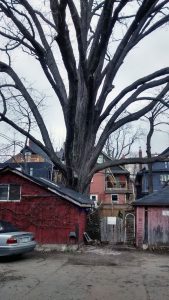
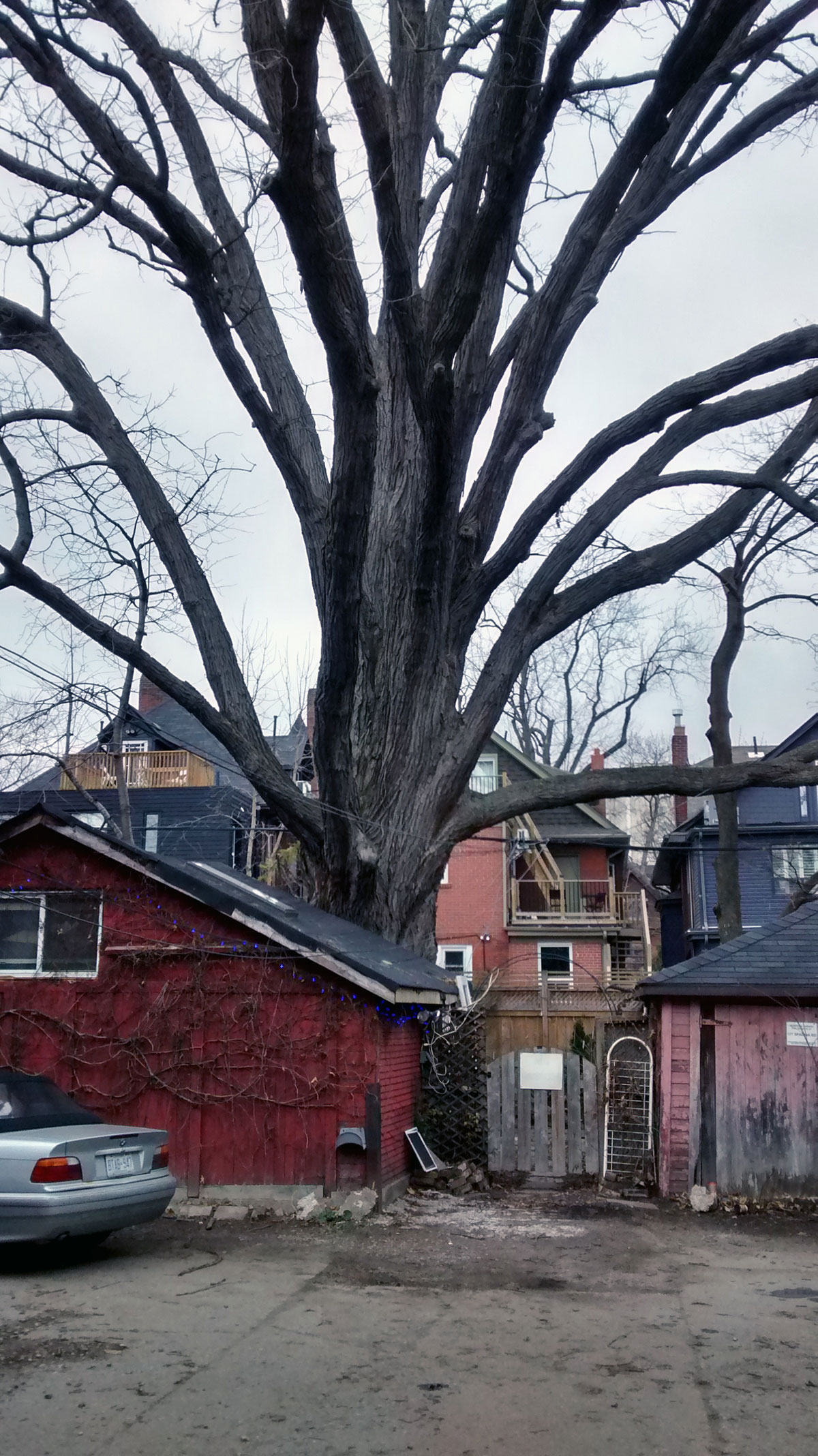
PHOTO COURTESY MICHAEL LOW: This old burr oak tree on Spadina Road reflects Toronto’s aging tree canopy. The Toronto Park and Trees Foundation is working to distribute trees throughout the city so that the urban forest will continue to thrive well into the future.
By Summer Reid
A campaign aimed at increasing the city’s tree canopy from 28 to 40 per cent is coming to the Annex this fall.
Part of the Every Tree Counts campaign, Tree for Me matches residents of Toronto with a native tree suitable for their desired planting area. Under the program 109 trees have been given out since its launching with a successful pilot event in May.
“Our goal is to increase plantings on private land by providing residents with a free, native tree and the resources to ensure it is planted and cared for correctly,” said Margo Mullin, community engagement coordinator of the Toronto Parks and Trees Foundation (TPTF) in an email.
Tree for Me’s community outreach begins this fall, but the organization plans to run events each spring and fall in several communities across the City of Toronto. This year it is targeting the Annex, Parkdale, Rockcliffe-Smythe, Junction, and Riverdale communities. Its goal is to distribute 75 to 100 trees per event, culminating in a total of 400 new ones planted across Toronto in October. It’s also a great opportunity for community associations to educate residents about the importance of preserving and planting trees as well as build capacity for tree planting and care programs.
“As the program grows, we hope to have community groups reach out to us and apply to host their own Tree for Me events,” wrote Mullin, who said that the TPTF is initially working with community associations that already have the capacity to host its tree distribution program.
According to the Annex Residents’ Association (ARA) website, maple trees make up about 30 per cent of the Annex trees. There are approximately 10 different types of maple, though the non-native and invasive Norway maple or Acer platanoides makes up 42 per cent of the canopy. If the Norway, which grows aggressively fast and overcrowds the native trees like the sugar maple, continues to outnumber local trees, there will be no more maple syrup.
It’s one of the many reasons that the TPTF is focused on planting native trees, which are characterized as species that grew in southern Ontario before European settlement. They require less maintenance: since they do not need extra water, they are typically drought resistant, and, since they are acclimatized to the local insect population, they do not need any pesticide spraying.
Native trees, such the sugar maple, also limit the chances of non-native species invading our local ecosystem.
Many trees in Toronto are being damaged by urban development, the expansion of city infrastructure, and the day-to-day activities of Torontonians.
Some threats to our urban forest are over-fertilization, contamination of de-icing salt, drought, not enough sunlight, poor soil quality, damage from lawn equipment, improper pruning, trunk wounds, and severed roots from construction.
“We have to get people to think about maintaining that tree canopy,” said Terri Chu, an ARA member who also writes for The Annex Gleaner. “We have a lot of trees in this neighbourhood and they will be hitting end of life very soon, so we’re going to be getting a lot of bare spots if we don’t start planting now.”
Trees are critical to a neighbourhood’s health. They provide wide-ranging benefits and environmental services such as energy conservation, soil protection, the preservation of wildlife habitat, storm water management, filtration of water and air, and storage of carbon.
Neighbourhood trees also lower household energy consumption by cooling temperatures from 10 to 50 per cent, provide $28.3 million in ecological services every year, and can increase property values by as much as 20 per cent.
Residents who would like to receive a free tree for their property from the TPTF are asked to participate in a 20- to 30-minute tree planting and care workshop before receiving a tree. Every participant will leave with information packages containing more details about the specific tree species and a review of the planting and care techniques taught at the workshop. Tree recipients are encouraged to keep in touch with the TPTF and chronicle how their tree is doing by sharing photos and stories on social media.
Click to register for a free tree. Tree pick-ups have been scheduled for Oct. 5 between 3 to 7 p.m. at the Bloor-Borden Farmers’ Market.
READ MORE:
NEWS: Farmers’ market thriving but under threat due to declining provincial dollars (August 2016)
GRADING OUR GREENSPACE: Meet our parks supervisor (August 2016)
FOCUS: Urban Elms (September 2015)
Tags: Annex · News
September 15th, 2016 · Comments Off on CHATTER (SEPTEMBER 2016): St. Peter’s invites you to Fall Fair fundraising event
By Summer Reid
St. Peter’s Church invites Annex residents to its annual Fall Fair event to support its Winter Welcome Table outreach program. Winter Welcome Table assists the homeless by offering hospitality and a warm evening meal.
The fair, which has grown significantly since it started out as a small community event, features food, great books, chances to win fun prizes, a flea market, and exciting entertainment.
The event will take place on Oct. 1 from 11:00 a.m. to 7:00 p.m. and Oct. 2 from 10:00 a.m. to 8:00 p.m. at St. Peter’s Church (840 Bathurst St.) in the auditorium and on the grounds.
Tags: Annex · News
September 15th, 2016 · Comments Off on CHATTER (SEPTEMBER 2016): Painted streets launch in Kensington
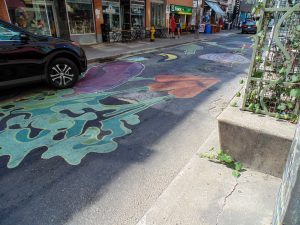
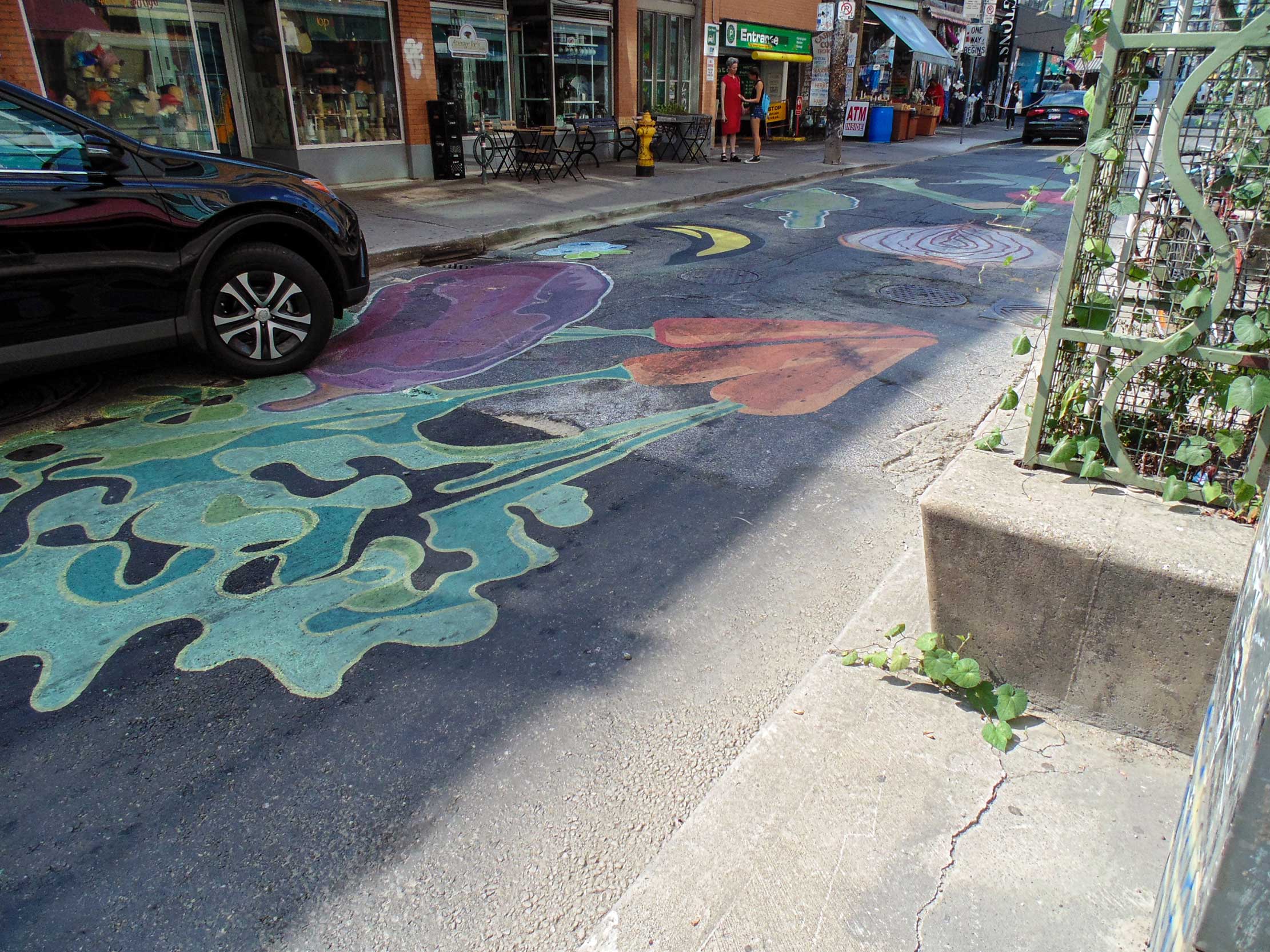
PHOTO BY SUMMER REID/GLEANER NEWS: The city’s first road mural was installed late last month on Baldwin Street in Kensington Market. Part of the StreetARToronto Road Mural program, the mural is the result of a collaboration between artists and the Kensington Market BIA. The mural was painted using latex paint, which is made to withstand weather elements and foot traffic for six to nine months. The City of Toronto launched the pilot project after a proposal to legalize road murals did not pass Toronto City Council. Four additional murals will be installed throughout the city under the project by the end of October.
—Summer Reid/Gleaner News
READ MORE:
ARTS: Bringing art to the people (April 2016)
FORUM: Untapped potential: Animating our local laneways (February 2016) by Joe Cressy
NEWS: Incubating micro-retail: Laneways untapped realm of urban design (December 2015) by Annemarie Brissenden
NEWS: Graffiti artist Erica Balon creates mural on Bloor Street West (July 2015) by Justine Ricketts
ARTS: A new side to graffiti (April 2012) by Jelena Subotic
Tags: Annex · News · Arts
September 15th, 2016 · Comments Off on POLICE BLOTTER (SEPTEMBER 2016): Police investigate College Street and Ossington Avenue sexual assault
By Summer Reid
The Toronto Police Service (TPS) has requested the public’s assistance in investigating a sexual assault that occurred on Sept. 5.
At approximately 3:30 a.m., a man sexually assaulted a woman after entering her home in the College Street and Ossington Avenue area. Last seen walking northbound on Ossington Avenue towards College Street, the man is described as white, unshaven, with short dark hair and wearing a dark shirt and jeans. He is believed to be 5 feet 8 inches to 6 feet tall with a thin build and in his mid- to late-20s. Anyone with information is asked to contact the TPS at 416-808-7474 or Crime Stoppers at 416-222-8477.
Tags: Annex · News
September 15th, 2016 · Comments Off on CHATTER (SEPTEMBER 2016): Two new rezoning applications submitted to city
By Annemarie Brissenden
Applications to rezone an area at Spadina and Sussex avenues as well as 666 Spadina Ave. have been received by City Planning and are available online.
The first application is by the University of Toronto, which seeks to build a student residence on the site. The owners of the apartment building at 666 Spadina Ave. are seeking an amendment, according to the city’s planning website, “to allow the addition of an 11-storey mixed use building with a total of 128 rental residential apartments on the south side of the property and eight stacked townhouses on the north side of the property.
The proposal retains the existing 25-storey apartment building, and parking is proposed within the existing underground parking structure. The site is a heritage property.” The Gleaner will follow up on both applications in a coming issue.
READ MORE:
NEWS: Planning for the future (May 2016)
DEVELOPINGS: Annual review reflects tension between community activism and OMB (March 2016)
NEWS: Residence casts long shadow (February 2015)
Tags: Annex · News