October 28th, 2016 · Comments Off on ARTS (OCTOBER 2016): Interactive installations celebrate Annex icons
Annual Nuit Blanche photo essay returns
Gleaner art director Neiland Brissenden’s annual chronicle of Nuit Blanche returns this month. Previously featured on the newspaper’s Twitter feed, Brissenden’s photo essay highlights installations that interacted with the audience to celebrate some of our neighbourhood’s most loved faces and spaces. —Annemarie Brissenden/Gleaner News

Beloved idols returned to Mirvish Village as the Plywood Collective painted a mural outside Markham House.

Small lit houses, luminous lightboxes, and a disproportionate music box featured in Maison/Home by Claude Miceli and Jean-Christian Knaff inside Markham House.

A tin can phone sculpture connected viewers with the work and each other in the interactive Conversational Partner by Allie Brenner and Laura Snider in the Honest Ed’s parking lot.
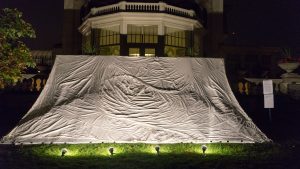
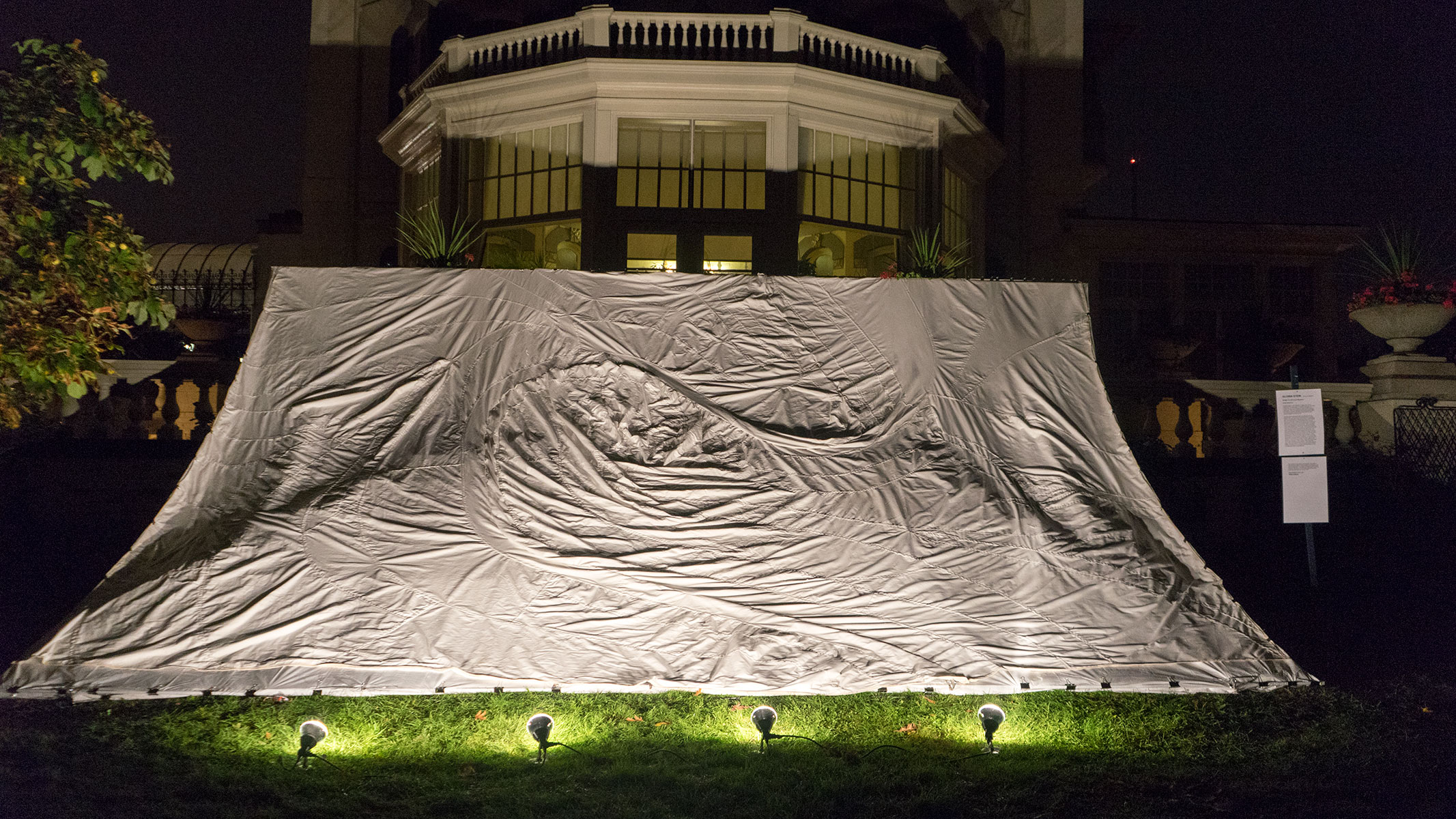
Made of natural cotton by artist Gloria Stein, River: The Shroud of Buczacz, was a 16 foot by 24 foot topographically accurate scale model of the site in Poland where 1500 Jews were murdered during the course of one night in early spring 1943. Stein’s father, then but a small child, managed to survive the massacre, but the poisoned river would feature in the nightmares of the Holocaust that would haunt him for the rest of his life. The shroud both concealed and revealed as it reminded the viewer of the story’s saddest relic, that “many parts of our precious earth are still being poisoned with the blood of innocent victims”.
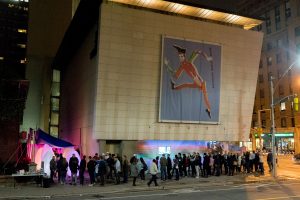
Crowds wait to enter Cushion: An Interactive Media Womb by F_RMLab at the Bata Shoe Museum. The installation replaced the “buzz of the city” with “a space of reflection”, as visitors interacted with “friendly beings” in an “atmosphere created by touch, light, and sound”.
Tags: Annex · Arts
October 28th, 2016 · 1 Comment
City designates Bloor Street a cultural corridor
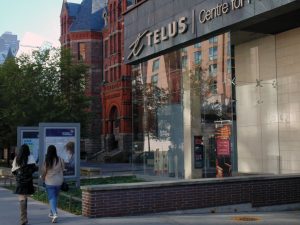
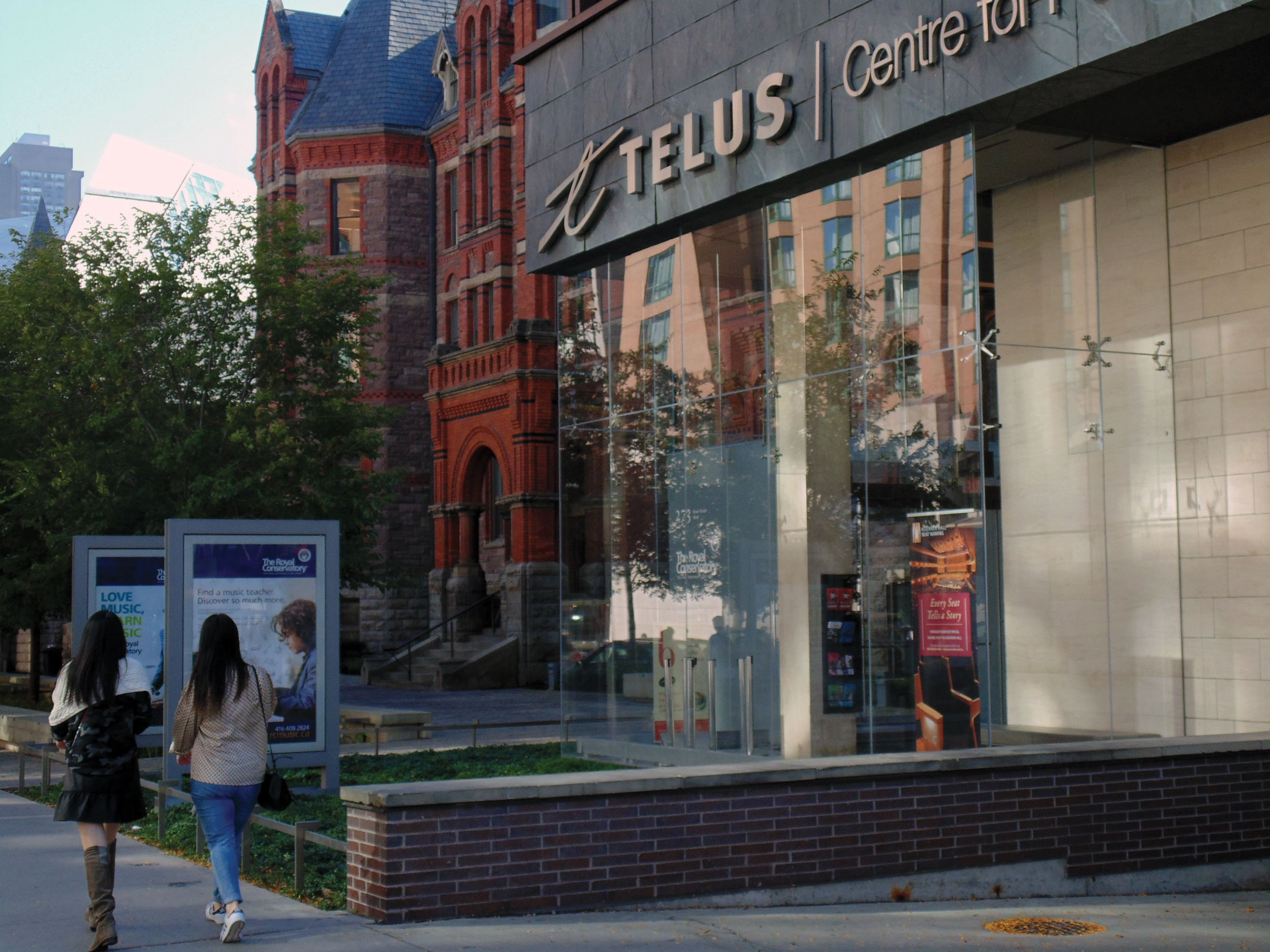
PICTURE BY SUMMER REID/GLEANER NEWS: The province has forgiven a significant portion of its loan to the Royal Conservatory of Music.
By Annemarie Brissenden, Brian Burchell, and Liivi Sandy
Toronto City Council designated the 1.5-kilometre stretch along Bloor Street from Bay to Bathurst streets as a cultural corridor last month, just as the province forgave a significant portion of a loan it had granted to one of the arts organizations that make up the group that had formed to seek the coveted official designation. It’s the first successful application initiated by such a group; past designations have been largely driven by city staff.
Formed nearly three years ago, the Bloor Street Cultural Partnership is a loose informal promotional consortium made up of 19 arts organizations located on and near Bloor Street like the Royal Ontario Museum, the Royal Conservatory of Music (RCM), the Miles Nadal JCC, and the Native Canadian Cultural Centre.
According to Heather Kelly, the founder and director of the partnership, the organizations collectively host three million patrons and generate more than $629.5 million in economic impact annually, as well as employ 5,500 people.
“This designation is a milestone in recognizing that we live in such a culturally rich area,” said Kelly.
Although the corridor designation doesn’t come with any city funding, Norm Kelly (Ward 40, Scarborough-Agincourt), who spoke at the Economic Development and Culture Committee meeting in support of the designation, suggested the corridor not be shy about asking for financial support from the city.
Indeed, the RCM might be the first to come knocking.
Reports surfaced last month that the province had released the music institution from its obligation to repay a portion of its outstanding debt to the province.
“The RCM is an employer, a gathering place, and a place to learn. I’m pleased that we were able to reach an agreement that will ensure the RCM will be able to benefit our musicians and future generations,” said Han Dong (MPP, Trinity-Spadina), who confirmed that a deal had been made but was unable to talk specifics.
The conservatory was one of the first high-profile arts institutions to benefit from a broadening in eligibility for loans from Infrastructure Ontario (IO) in 2007.
“The Royal Conservatory of Music was made an eligible borrower through an Order in Council (OIC), under a section of the Act that allows the government to specify other activities in which IO may engage based on Cabinet approval,” wrote the provincial Auditor General in her 2014 annual report. “The expansion of the Loans Program to the broader-public and not-for-profit sectors has given borrowers who previously may not have had an external credit rating access to affordable financing through the province’s high credit rating and low cost of capital.”
The RCM took out the loan to meet costs related to the construction of the Telus Centre for Performance and Learning. Completed in 2009, the project included a renovation of the historical Ihnatowycz Hall, as well as Mazzoleni Concert Hall and Koerner Hall, which is known for its superb acoustics and regularly hosts international artists at its performance space. Over 500,000 people benefit from the conservatory’s facilities annually, making it an integral part of the province’s and city’s cultural sector.
Neither IO nor the RCM would speak publicly about the details of the agreement, displaying a troubling lack of transparency. It’s particularly surprising given how hard the conservatory has publicly lobbied the province for debt relief, claiming that its loan payments were threatening its ability to provide a full range of programming.
The conservatory had expected to augment the loan with revenue from donations; however, as the Ontario Auditor General wrote in her 2014 report, fundraising has “fallen below expectations”.
Although the RCM would not release copies of its audited statements, mandatory filings with the Canada Revenue Agency put the loan principal at $52 million as of September 2016, and suggest the conservatory paid $4.5 million in 2015 to service its debt.
“Our government understands the importance of Ontario’s culture sector and is proud to provide strategic support to drive cultural innovation, create jobs, and grow our economy,” wrote Katrina Kim, press secretary to Bob Chiarelli (MPP, Ottawa West-Nepean) and the Minister of Infrastructure, in an email.
RCM president Peter Simon is also refusing to talk about the deal and how recent announcements of major donations to the RCM might relate, if at all. On Oct. 5, it announced two donations of more than $5 million, from Michael and Sonja Koerner and James and Louise Temerty. Michael Koerner is the institution’s chancellor, while James Temerty is one of its four directors.
“The culture sector is very important to my riding and to me personally,” said Dong. “[The RCM] is Canada’s largest music and arts education institution. [It] not only benefits the country and the province, but [also] plays a very significant role in Trinity-Spadina.”
—with files from Noelle Defour
READ MORE:
FORUM: Creating growth through the arts (January 2016)
Tags: Annex · News
October 28th, 2016 · Comments Off on NEWS (OCTOBER 2016): MNJCC makes giant splash
New pool is a model for inclusivity and accessibility
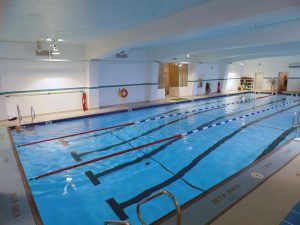
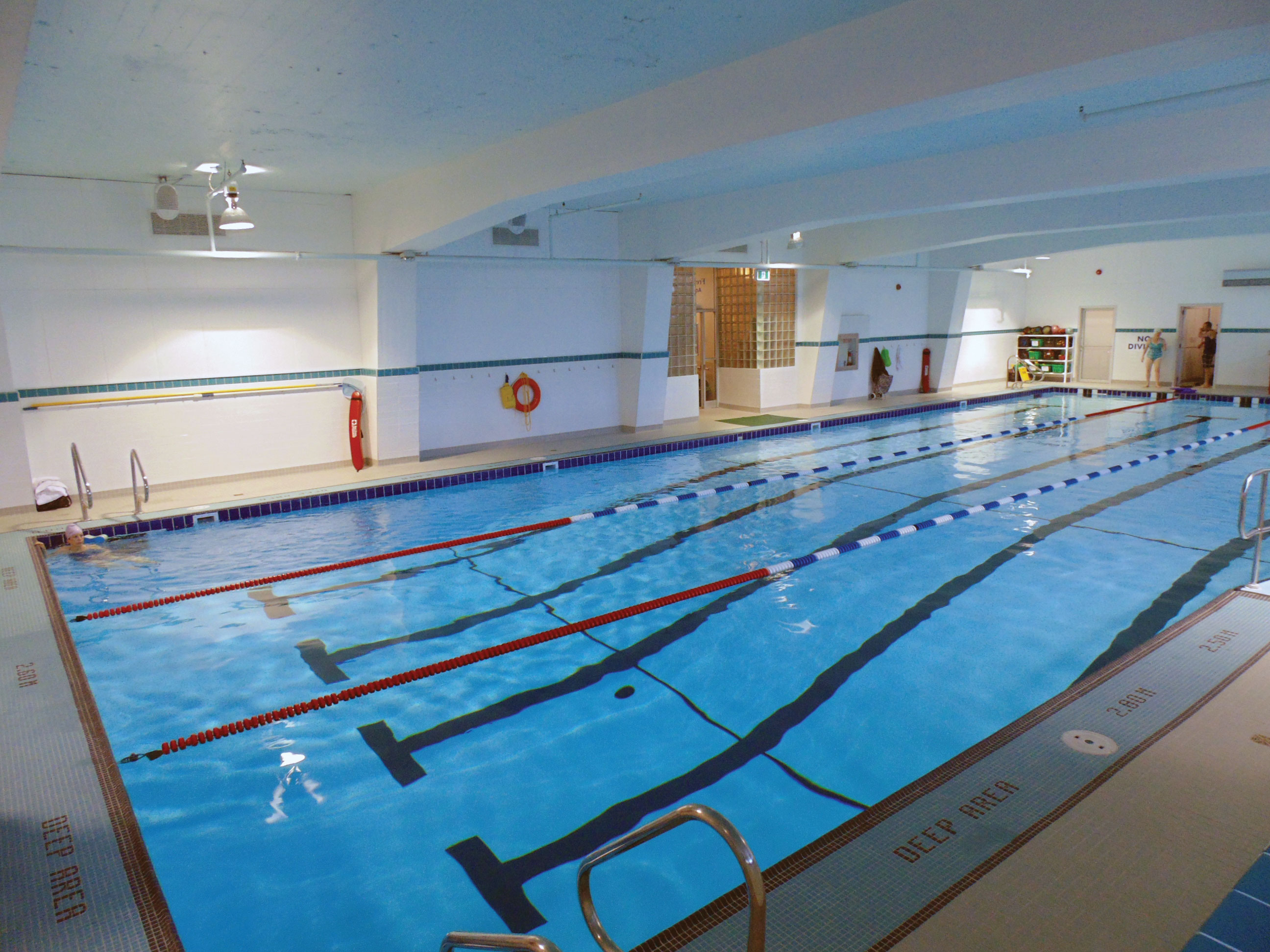
PHOTO BY SUMMER REID/GLEANER NEWS: The MNJCC’s new universally accessible pool (full story on page 1) now features an entrance ramp. The community centre at Bloor Street and Spadina Avenue is now fully compliant with the Accessibility for Ontarians with Disabilities Act, which aims to make the province fully accessible for people with disabilities by 2025.
By Summer Reid
The Miles Nadal Jewish Community Centre (MNJCC) reopened its Freddie Shore Aquatic Centre last month, after an extensive renovation to make the saltwater pool universally accessible.
“This means that everybody, with dignity, can get into [and out of] the pool on their own terms,” said executive director Ellen T. Cole at the pool’s official reopening.
[pullquote]“Pools are an awesome inclusive space if the barriers are removed”—Liviya Mendelsohn, manager, MNJCC[/pullquote]
Adam Purdy, a Paralympic and ParaPan medalist in swimming, explained that making swimming pools universally accessible enables everyone to learn how to swim, a basic skill, no matter their limitation.
“A universal design is very important because it does represent some of the ideas and mindsets of the people who are running those facilities and places,” added the swimmer.
For Liviya Mendelsohn, the MNJCC’s manager of accessibility and inclusion, “pools are about community.
“Pools are about people who share an interest in swimming, getting together, and coming together based on that interest and not on ability. Pools are an awesome inclusive space if the barriers are removed.”
Making the pool universally accessible is but the latest step in the MNJCC’s quest to become fully compliant with the Accessibility for Ontarians with Disabilities Act. Made law in 2005, the aim of the act is to make Ontario fully accessible for people with disabilities by 2025.
“We have set ourselves a standard to be the role model for accessibility and inclusion in the downtown,” said Cole.
Mendelsohn explained that the MNJCC has focused on making its programs accessible, integrated, and financially accessible for anybody facing barriers.
“We have two advisory committees…made up of people with disabilities and [their] allies, and they advise us on our programming,” she said.
“With the right supports, anybody can attend anything.”
Tags: Annex · News
October 28th, 2016 · Comments Off on CHATTER (OCTOBER 2016): Bells ring a perfect offering
PICTURE BY GEREMY BORDONARO/GLEANER NEWS
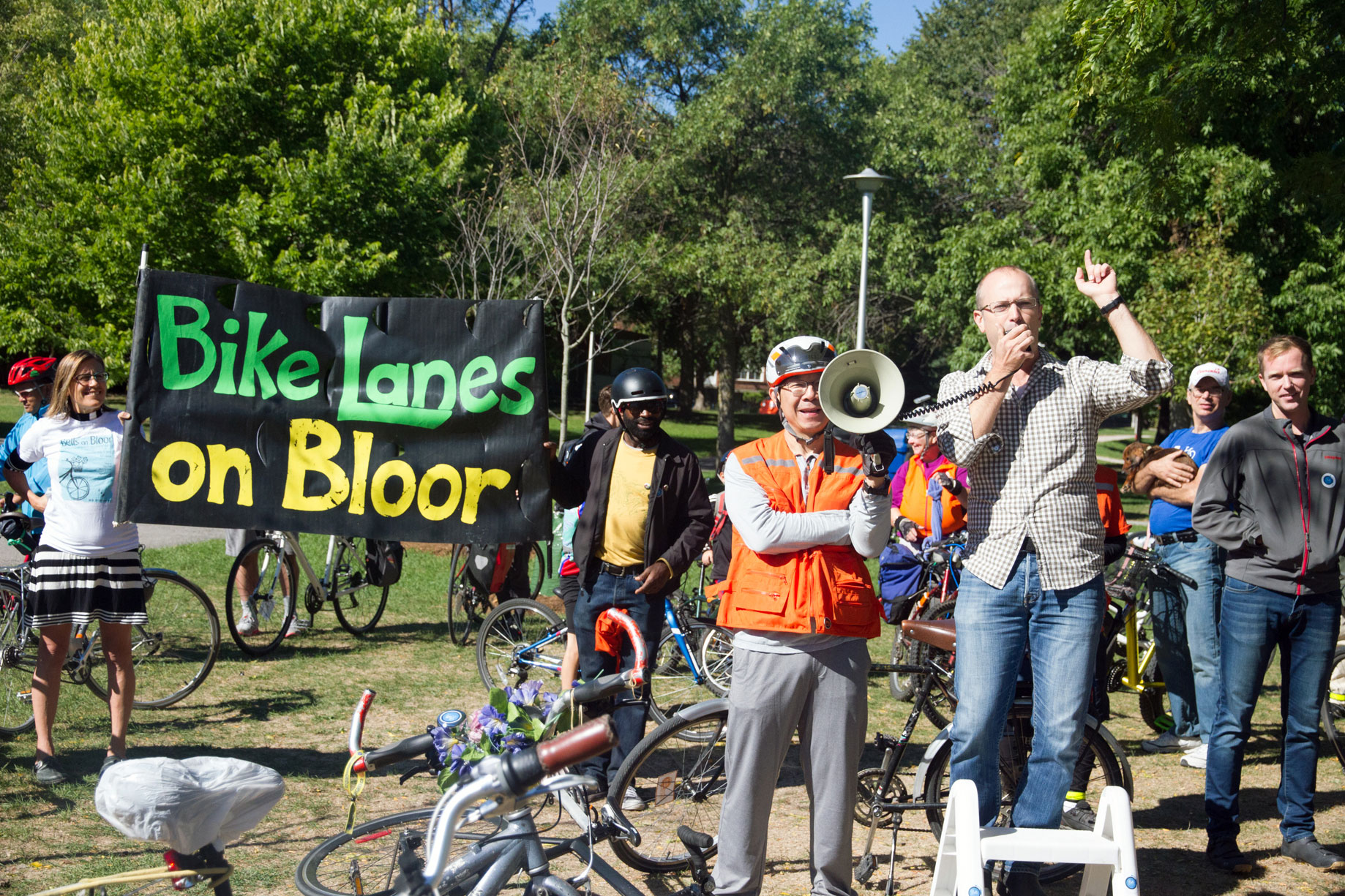
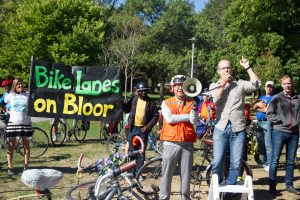
Mike Layton (Ward 19, Trinity-Spadina) was among the speakers at a late September Bells on Bloor event celebrating the installation of bike lanes between Shaw Street and Avenue Road. Organizers characterized the communal ride during which cyclists — including activist Albert Koehl, Joe Cressy (Ward 20, Trinity-Spadina), Gideon Forman from the David Suzuki Foundation, and Jared Kolb from Cycle Toronto — rode a ring around Bloor Street, Sherbourne Street, and Queen’s Park Crescent, as a victory lap. For further information on Bells on Bloor, please visit www.bellsonbloor.org. —Annemarie Brissenden
READ MORE:
CHATTER: Ground-breaking bike lanes launch on Bloor Street (August 2016)
NEWS: Bikes blessed for another season (June 2016)
FOCUS: An early advocate for bike lanes (June 2016)
NEWS: Bike lanes for Bloor Street (May 2016)
The faster we lower speeds, the more lives we save (October 2015)
Early brewer the basis for Bloor Street’s name (May 2015)
Tags: Annex · News
October 28th, 2016 · Comments Off on CHATTER (OCTOBER 2016): HVRA mourns death of Steve Klein
The Harbord Village Residents’ Association (HVRA) mourned the passing of long-time board member Steve Klein, who passed away last month after a struggle with lymphoma. He loved travelling with his family and had a strong relationship with his daughter.
Klein joined the HVRA board in early 2009, bringing new ideas with his quiet but solid presence, continually pushing the association to remain responsible to its members and take on the challenges within the neighbourhood. He donated many volunteer hours to the HVRA, most recently helping to redesign its website, as well as organize the annual pumpkin festival. This popular event is run in conjunction with the Harbord Street BIA and returns to Harbord Street between Spadina Avenue and Borden Street on Nov. 1 from 5:30 to 8:30 p.m.
—Noelle Defour/Gleaner News
READ MORE:
CHATTER: Pumpkin festival (November 2015)
Tags: Annex · News
October 28th, 2016 · Comments Off on CHATTER (OCTOBER 2016): Kensington Hospice a family favourite
The Kensington Hospice recently celebrated its fifth anniversary of providing palliative care in the Annex. One of the seven health services provided by the Kensington Health Centre, the hospice has 10 beds and provides end-of-life care that not only meets the physical, emotional, and spiritual needs of its patients, but also supports a patient’s friends and family.
“All kinds of care, physical care was the largest, but also the care from the nurses were very helpful for her,” said the friend of one patient who preferred to remain anonymous. “The nurses even helped me sometimes; we’d have little conversations and I realized that the little conversations helped me to come to terms with what was going on.”
The non-profit health centre welcomes charitable gifts, with donations being used to improve the facilities, acquire new equipment, as well as fund research and enhancement programs. In addition to the hospice, the health centre provides long-term and community care, a screening clinic, ophthalmology services, and runs the Eye Bank of Ontario.
—Noelle Defour/Gleaner News
Tags: Annex · News
October 28th, 2016 · Comments Off on POLICE BLOTTER (OCTOBER 2016): Brazen Bedford shooting
Just after 3:30 p.m. on Sept. 20, 66-year-old criminal defence lawyer J. Randall Barrs was leaving his office at 23 Bedford Rd. when he was shot multiple times by a man dressed as a construction worker. The alleged shooter, whom the Toronto Police Service has identified as 51-year-old Grayson Delong, was under surveillance by Halton Regional Police following his release on bail due to his suspected connection to a break-in in Peel Region. One plainclothes officer rushed towards Delong, who was attempting to drive away in a car with stolen plates. The officer shot at Delong, who was treated at Sunnybrook Health Sciences Centre for serious injuries before appearing in court, where he agreed to remain in jail pending the outcome of his 15 charges relating to the shooting.
The Special Investigations Unit is investigating the shooting, and Delong is scheduled to appear back in court on Oct. 31.
—Summer Reid/Gleaner News
Tags: Annex · News
October 28th, 2016 · Comments Off on FOCUS (OCTOBER 2016): Marked with granite
Creating a spot to gather

PICTURE COURTESY ROBERT CRAM: A Quebec quarry worker marks granite destined to become part seating, part art installation in four parkettes set to launch on Bloor Street in 2018.
By Geremy Bordonaro
Humans have been moving stones to create monuments since at least prehistoric times, an act that is taking on a very local incarnation, thanks to the Bloor Annex Business Improvement Area, which is installing four parkettes along Bloor Street between Spadina Avenue and Bathurst Street.
Placed at the rights-of-way at Howland Avenue, Brunswick Avenue, Major Street, and Robert Street respectively, the parkettes will provide many user-friendly amenities like a water bottle refilling station and stone seating made of granite sourced from Quebec quarries.
[pullquote]“We’ve been taking stones from places and carrying them to other places to create these communal, interesting spots where people can gather”—Robert Cram, DTAH[/pullquote]
Part art installation, part seating structure, the granite is meant to bring a more human aspect to the landscape, explained Robert Cram of DTAH, the Toronto-based architecture firm responsible for the design of the parkettes.
“This concept was based on something that we, as humans, have been doing for a long time,” Cram said. “We’ve been taking stones from places and carrying them to other places to create these communal, interesting spots where people can gather.”
The granite stones, reclaimed off-cuts, weigh upwards of 10,000 pounds and are 2 to 4 feet tall. Cuts to the rocks for seating are specifically being carved with care by Cram.
“The concept for sculpting the stone came from [Isamu] Noguchi, the Group of Seven, and other people who have done these simple techniques into stone,” said the designer, whose design will give each stone “a beautiful modern look that will complement the history of the layers the stone already has”.
Brian Burchell, chair of the BIA (who also publishes this paper), is spearheading the $1.8-million street revitalization plan that includes the parkettes project, said he believes “they will soften the area, creating spaces that are relaxing and non-commercial; an oasis in a very busy landscape.
“You might think it’s unusual that the chair of the business association is advocating for non-commercial spaces but it’s exactly what we need to make the space more human.”
“From a park point of view, [the goal is] to have an integrated public art landscape, not something plunked down in the site, [but] something that becomes part of the site, [and] something that will work at all different times of the year,” said James Roche, a partner at DTAH, which has worked with other BIAs on similar projects.
“Increasingly, Bloor Street is becoming a destination and we want to make that experience as enjoyable as possible,” said Burchell. “I fully imagine seeing people meeting at these parkettes and them being a place where people can have respite from the completely commercial nature of the street.”
“What’s interesting is the scale of the project,” added Roche. “It’s almost like it’s going to be one of those things where someday someone wakes up and says ‘Wow, this is quite the transformation.’”
In the end, Cram believes that these parkettes will give a sense of connectivity unlike anywhere else in the city.
“When you walk down Bloor [Street], there will be this continual language to it. When you go through, the Annex will have this kind of personal aesthetic that will feed into [its] image.”
Work on the parkettes is expected to begin in 2018.
Read more:
NEWS: Bloor Street goes green (April 2016)
CHATTER: Ground-breaking bike lanes launch on Bloor Street (August 2016)
ON THE COVER: An Annex bee celebration (July 2016)
CHATTER: Family festival celebrates 20 years (July 2016)
NEWS: A permanent home for storytelling (July 2016)
Tags: Annex
October 28th, 2016 · Comments Off on NEWS: What’s next for College Street?
Visioning a future for Little Italy

PICTURE COURTESY DTAH: Astra Burka, who organized the discussion on the future of College Street from Bathurst to Shaw streets, lauded the Bloor Annex BIA (whose chair publishes this newspaper) for its plan to transform “a series of left-over parcels of land into a sequence of vibrant, dynamic, public green spaces”.
By Annemarie Brissenden
Is Little Italy a victim of its own success?
That question was top of mind for those attending a meeting on the future of College Street from Bathurst to Shaw streets at the Royal Theatre last month.
Jane Jacobs loomed large as City of Toronto planner Graig Uens moderated a panel of experts from the city during a discussion that was driven largely by questions from the audience.
“In The Death and Life of Great American Cities, Jane Jacobs asked what makes great neighbourhoods start to decline,” said one speaker. “The answer was its outstanding success. I believe that’s the point that College Street is at.”
For Astra Burka, Little Italy began to change around 1990, when making tomato sauce in laneways, baking bread in the early mornings, and gatherings on Friday nights started to give way to absentee landlords, condominiums, and retail chains.
Deciding it was time to develop a long-term plan, she organized the September meeting, bringing residents and businesses together with the city for the first time.
The architect, filmmaker, and self-described urban thinker for the future of Toronto set the stage for the evening with an overview of some of the challenges of College Street, followed by some opportunities for improvement inspired by models from home and abroad.
[pullquote]“Commercial taxes are not equitable…. Two businesses sitting side-by-side can have widely different assessments”—Djanka Gajdel[/pullquote]
Imagine, Burka asked, if there was a vision that unified the street and included pop-up shops, inviting and visually interesting storefronts, and viewed the street architecture — like planters and bollards — as a canvas for art?
She contrasted this with College Street as it is right now: a visual chaos made up of overhead wires, fenced-in spaces, and trees failing to thrive. Newspaper boxes line patchwork sidewalks with haphazard concrete squares that are punctuated by empty storefronts.
“If we want to have vibrant and exciting neighbourhoods, we have to figure out how to sustain the tapestry of small businesses,” said Djanka Gajdel. “The commercial taxes are not equitable. This is the underlying issue that is affecting all small businesses. Two businesses sitting side-by-side can have widely different assessments.”
Panelist Rebecca Condon, an economic developer officer for the city, agreed that the assessment process, overseen by the Municipal Property Assessment Corporation (a provincial arm’s-length body) is not transparent.
“Commercial tax streams at three times the residential rate,” said Condon, “and the city is trying to reduce that ratio.”
“The answer is in large part political,” added her colleague Randy McLean. The city’s Beautiful Streets manager explained that “the province sets the rules, while the city acts as a collection agency.”
The situation is made worse by the tax breaks that are given to landlords with commercial spaces that have remained vacant for a certain length of time, disincentivizing them from finding new tenants. It also paves the way for huge box stores?(as much a threat to the area’s character as the empty storefronts), the only ones that can afford the commercial taxes.
For many in the audience, pop-up shops would be a good alternative, as well as small owner-operated businesses that would break up the monoculture of cafés and sushi places.
“Cafés might not be the most creative use of corners or arterial space,” said one audience member. “I’d like to see more creative use of space. I don’t want one type of space.”
“Specific types of retail business that can be viable tend to be market specific,” answered Condon, adding that successful pop-ups need “a champion storefront; a landlord prepared to offer short-term low-rent leases that test out the market viability without requiring a lot of resources up front”.
“One of the hardest things we battle is rents and occupancy,” said Lenny Lombardi, chair of the Little Italy College Street Business Improvement Area (BIA). “The most we can do as a BIA is beautify the street as much as possible.”
Antonella Nicaso, a streetscape designer and capital project coordinator for the city’s BIA office, said that BIAs often trigger a neighbourhood’s rejuvenation.
“BIAs provide excellent solutions, local knowledge, and the ability to maintain projects after they are constructed.”
But Lombardi stressed that the BIA’s mandate is to serve its ratepayers, the business community from Shaw to Bathurst streets.
“Our biggest priority is promotion and generating business for merchants,” he said.
As the evening closed, it was clear that a future direction for College Street was beginning to emerge: burying wires, adding artistic elements and seating, recruiting more small owner-operated businesses, and, mostly, rediscovering what makes the neighbourhood its authentic self.
Burka characterized it as a good first start, but she would like more ideas to emerge.
“We all share the space together. Let’s be crazy and do something. We need imagination. We need guts. We have money. We have talent. Let’s go for it.”
READ MORE:
NEWS: Bloor Street goes green (April 2016)
Tags: Annex · News
October 28th, 2016 · Comments Off on NEWS (OCTOBER 2016): Preventing a wall of towers
Spadina Avenue high-rise not a bar for height
By Annemarie Brissenden
A 25-storey, 334-unit apartment building is providing the model for a new mixed-student residence at the northwest corner of Spadina and Sussex avenues, but not in the way local residents’ associations would like.
“It’s effectively the same height as 666 [Spadina Ave.],” said Scott Mabury, vice-president university operations, University of Toronto, of the proposed development, which includes a 23-storey building and a separate 3-storey townhouse complex. The 2.2-hectare site assembles six properties at 698, 700, 702, 704, and 706 Spadina Ave., as well as 54 Sussex Ave.
[pullquote]“Coming in at 11 storeys is pretty respectful”—Sue Dexter, HVRA[/pullquote]
The high-rise includes a four-storey podium that “has been designed to frame both Spadina and Sussex avenues with a height and massing that is generally in keeping with the surrounding built form, and will animate the street with new retail uses” according to a Bousfields Inc. report on the planning rationale for the university.
Yet, Sue Dexter of the Harbord Village Residents’ Association (HVRA) fears that using “666 Spadina [Ave.] as a justification for that kind of height” sets a dangerous precedent that will lead to a wall of towers along the eastern edge of her neighbourhood.
Julie Mathien of the Huron-Sussex Residents’ Organization (HSRO) wrote in an email that it “remains concerned about the height, density, and lack of resident mix in the proposed new development at Spadina and Sussex [avenues].”
Joe Cressy (Ward 20, Trinity-Spadina) agreed.
Noting that he is the third councillor to work this file, Cressy applauded the university’s willingness to start consulting with the community long before it submitted its application to the city, but said, “the application isn’t there yet.
“We still need a more sensitive built form, but the height doesn’t reflect that yet.”
Height is but one of the concerns.
Dexter said she’d like to see a “mix of students that better reflects the community,” and points to 666 Spadina Ave. as a model of what works, explaining that about 60 per cent of that building is students. She would like the proposed residence to include graduate students, as well as faculty with families.
“We have a crying need in the neighbourhood for family housing,” she added.
Cressy also pointed to 666 Spadina Ave. as a model, particularly for how its owners are managing their own application to add an 11-storey mixed use, 128-unit rental apartment building and eight stacked townhouses to the site. The original building — which is included on the City of Toronto’s Inventory of Heritage Properties because it was designed by architect Uno Prii — will remain intact.
“A lot of the stuff we’ve said is important, they are responding to,” said Cressy of the applicant, who like U of T, met with the city before submitting a formal application to rezone the site. “The built form is appropriate and transitions to Robert Street.”
“Coming in at 11 storeys is pretty respectful,” said Dexter, cautioning that the 666 Spadina Ave. proposal needed further study. “By comparison with the university process, 666 is very responsive…. The university talks a lot but they don’t change their process.”
Mabury pointed out that after 2.5 years of public consultation, U of T has adapted the proposed “quite significantly”, reducing the number of students it will house from 800 to 550. It is anticipated that the tower will be made up of 60 per cent first year students and 40 per cent upper years, all commingling on the same floors.
“Nobody has a built a resident with that diverse a population in Canada,” said Mabury. “We are trying to balance what we hear [from the community] with the needs of U of T and its students.”
And what the university needs more than anything are spots for students in first year.
“That’s part of our guarantee; after that students want to move out into the broader marketplace.”
READ MORE:
CHATTER: Two new rezoning applications submitted to city (September 2016)
NEWS: Tall tower before OMB, as city battles back with block study (August 2016)
NEWS: Planning for the future (May 2016)
DEVELOPINGS: Annual review reflects tension between community activism and OMB (March 2016)
Tags: Annex · News
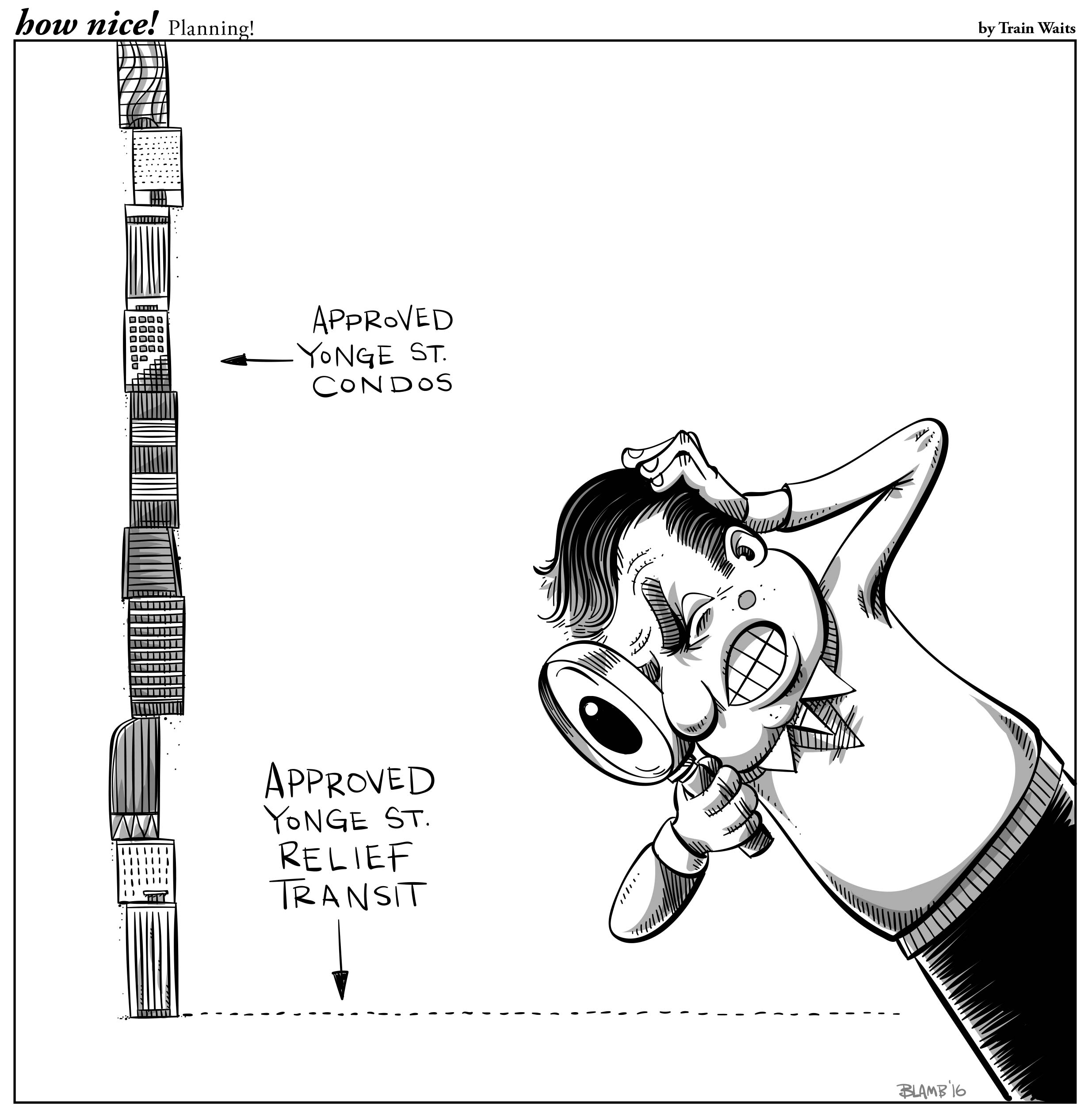
October 28th, 2016 · Comments Off on EDITORIAL CARTOON (OCTOBER 2016): The sincerest form of flattery! by Dow Indepols

MORE how nice!:
A warm carbon blanket! By Hock Estique (September 2016)
A clear path! by Dot Tedline (August 2016)
Planning! by Train Waits (July 2016)
Water, water, everywhere! by W.H. Consin (June 2016)
How to meet your quota! by Otto Mobile (May 2016)
A carpet of green! by Don Mower (April 2016)
Tags: Annex · Editorial · Opinion
October 28th, 2016 · Comments Off on EDITORIAL (OCTOBER 2016): Stealth rate hike may work
Ottawa has enacted mortgage rules that are a bitter pill for new prospective homeowners to swallow, but they are a very clever way to try to cool the nation’s housing market and keep many from sinking under the weight of too much debt.
[pullquote]The federal government has tinkered with the rules around mortgages six times since 2008 and have thus far been unable to get the genie back in the bottle. This latest stress test may do it without causing the bubble to collapse.[/pullquote]
The changes require those making down payments of 20 per cent or less to qualify for a mortgage at a higher standard than the rate that the bank is offering. Ottawa’s new lending regimen requires lenders to apply a stress test to the application to see if they have income to support the mortgage as if it were based on the bank’s posted rate (currently 4.64 per cent). Banks routinely offer mortgages at half their posted rates and until now qualifying for what the bank was actually offering was enough. This change effectively reduces how much one can borrow. Since rising interest rates are the real risk to the housing market the government has found a way to program a “what if they go up?” threshold into lending practices.
The federal government has tinkered with the rules around mortgages six times since 2008 and have thus far been unable to get the genie back in the bottle. This latest stress test may do it without causing the bubble to collapse. Low rates have largely driven this situation, so striking at the source of the problem is wise. This may bring the market down to earth, or at least to point where a Toronto house price can be viewed from terra firma.
Toronto has seen year-over-year gains in the average value for a detached home — currently $1.3 million — increase by 20 per cent in just 12 months. At $1.58 million, the average value in Greater Vancouver is higher, but its market has begun to cool due in some measure to the introduction of a province-wide foreign buyers tax. There is some evidence that the Chinese investors are migrating to Toronto to skirt levies on British Columbia purchases: year-over-year sales (not values but number of properties) fell 26 per cent in Vancouver, but rose 23.1 per cent in Toronto.
The Canada Revenue Agency also has a hand in the federal plan to cool the housing market. The actions of speculators have contributed to the inflation of the housing market bubble without the consequence of needing to pay capital gains taxes on their profit. They achieve this by making a declaration that the house they are “flipping” is their principal residence. To date, that declaration needed only be made to oneself on a form to be kept in one’s own records. Now, according to the announcement, all real estate property transactions must be declared on the annual tax return on Form 3, including those involving principal residences, and failing to do so will void the capital gains tax exemption.
Many of these changes have a direct impact on Canada Mortgage Housing Corporation (CMHC) insured loans. The CMHC loans are for mortgages for houses purchased at a value less than $1 million and with down payments of less than 20 per cent. Arguably this has less and less to do with Toronto prices and is not at all relevant to the Annex, where values are much higher. But one must bear in mind the “trickle-up effect” described by local realtor Louis Adams, “the guy trying to sell his $800,000 property now has a smaller pool of possible purchasers and his chances of buying into [and inflating] the $1 million plus market are thereby diminished”.
Only time will tell if the federal government has got the medicine right for the market this time. Since real estate is the only thing churning the economy at present, it’s important not to kill the patient with the cure.
READ MORE:
EDITORIAL: Train derailment changes the conversation (September 2016)
EDITORIAL: “An egregious breach of trust” (August 2016)
EDITORIAL: Turning the Queen Mary (July 2016)
EDITORIAL: Mayo no, marijuana maybe (June 2016)
EDITORIAL: It just makes census (May 2016)
EDITORIAL: An injection of leadership (April 2016)
Tags: Annex · Editorial