August 1st, 2017 · Comments Off on EDITORIAL (JULY 2017): Thank you Mr. Asti
Every once in a while, someone gets mad as hell and decides not to accept the status quo. It’s a small act of rebellion that can shake things up, bringing sanity and common sense to a situation that has gotten well out of hand.
Take the case of Etobicoke resident Adi Asti. Frustrated by the city’s apparent refusal to install a small staircase along a dangerous incline in Tom Riley Park, Asti appealed to his local councillor. He discovered that people would have to make do with holding onto a rope, as quotes to install the stairs ranged between $65,000 and $150,000. A cash-strapped city, it seems, was not prepared to go down that slope anytime soon.
[pullquote]“The alarming reality of this situation is that the original $65,000 to $150,000 estimate was based on similar projects that the city has already completed.”[/pullquote]
So Asti, engaging the help of a homeless man, decided to take matters into his own hands, building eight steps in just 12 hours at a cost of $550 of his own money. Press outlets promptly lavished him with praise for his resourcefulness. Embarrassed city staff responded quickly, warning Asti to remove the stairs or risk being charged under the municipal code, which prohibits the erection of any unauthorized structures in parks. And Mayor John Tory, supported the staff, warning against copy cat do-gooders, citing liability concerns.
It was an uproar that even attracted the attention of the international press: “Toronto rebukes handyman whose steps save taxpayers $50,000” ran the BBC headline, while CNN noted “City says steps will cost $65,000 – $150,000, man builds them for $550”. It would appear that frustration with bureaucratic nonsense is something that crosses borders.
It didn’t take long for the mayor to change his tune.
He recognized on the one hand that “anything that gets built on city lands must be absolutely safe and has to be able to stand the test of time” (these stairs built by Asti, a retired mechanic, don’t meet that threshold), yet acknowledged that city staff were responsible for generating “outrageous project cost estimates”.
By the end of the week, Tory wisely decided to call Asti and thank him for the well-intentioned effort to make a dangerous situation safer. He also thanked Asti for alerting him to an issue that had not been on his radar. Though Asti’s stairs have now been removed, they will soon be replaced (work has already started) by the city at a cost, according to the mayor’s office, of less than $10,000. The new stairs will have a proper foundation and handholds.
The alarming reality of this situation is that the original $65,000 to $150,000 estimate was based on similar projects that the city has already completed. How much waste are we surrounded by? How much money has gone down the drain? In a statement, Tory said he thanked Asti for “taking a stand”, adding that “his homemade steps sent a message that I know city staff have heard loud and clear…. I’m not happy that these kinds of outrageous project cost estimates are even possible. I’ll be working to identify what changes we can put into place to make sure that doesn’t continue to happen.”
There are thousands of city projects of this magnitude. How many are we overpaying for? Is it a system failure? Are staff incompetent? Is there impropriety in procurement? Is it some lethal combination of all three? This is how “gravy train” theories gain political traction.
It sounds like the mayor may be as mad as hell too. Let’s hope he also stops accepting the status quo. And to Mr. Asti: thank you for doing the right thing.
READ MORE
EDITORIAL: A watershed moment (June 2017)
EDITORIAL: Revoke U of T’s unchecked “licence to build” (May 2017)
EDITORIAL: Westbank’s positive precedent (April 2017)
EDITORIAL: Foreign buyers tax a necessary cliff jump (March 2017)
Tags: Annex · Editorial
August 1st, 2017 · 1 Comment
Take personal actions to work towards reconciliation
By Mike Layton
As festivities wind down from Canada’s 150th birthday, we are granted an important opportunity to look back at where we have been as a nation and chart our course for the nation we want to become.
Many of the Canada 150 celebrations focused on the most recent history of our nation, but missed the opportunity to recognize the inhabitants of Canada prior to colonization and confederation, especially what has happened to Canada’s Indigenous people in the 150 years we are celebrating. We missed a key learning moment in our nation’s history.
[pullquote]“One step that city council can take is the establishment of the Aboriginal Affairs Office.”[/pullquote]
Don’t let Canada 150 pass by without seizing this opportunity to learn about the Indigenous people who lived here in the thousands of years before colonization, and the impact of colonization on the Aboriginal people who live in our city and across our country.
In Toronto, we often isolate ourselves from Indigenous issues. It’s too often assumed that the intergenerational trauma that is the legacy of the residential school system, the lack of safe drinking water, and other pressing issues are only felt on reserves, away from our city.
With more than 60,000 Aboriginal people living in Toronto, the issues are very real and we have unique opportunities to participate in the reconciliation effort. We have a duty to future generations to begin the process of reconciliation, first by learning, and then by taking action.
On June 21 at the annual sunrise ceremony at Nathan Phillips Square, the City of Toronto ceremonially unfurled the flags of the Mississaugas of the New Credit, the Huron Wendat, the Haudenosaunee, the Metis, and the Inuit. A symbolic gesture, but a meaningful one — these flags will remain, permanently.
These flags, along with other ceremonial changes Toronto City Council has made in recent years, show a willingness to change and a desire to learn, but where we have failed is in our commitment to take concrete steps along the road to reconciliation and to fund real action.
One step that city council can take is the establishment of the Aboriginal Affairs Office. The Aboriginal Affairs Advisory Committee, of which I have the honour of serving as co-chair, has repeatedly made this request. An Aboriginal Affairs Office would provide a resource to the Aboriginal community, Aboriginal organizations and city divisions, and would assist in addressing issues facing the Aboriginal community and implementing the reconciliation agenda. City council will vote on this issue in the fall.
As individuals, we can also take personal actions to work towards reconciliation.
Take every opportunity to learn about Canada’s Indigenous communities. Join one of the many Aboriginal organizations across Toronto working on reconciliation events and programs, or attend any one of the many Aboriginal events this summer.
Support Aboriginal businesses large and small, including some of the great new Aboriginal restaurants in Toronto like Nish Dish at Clinton and Bloor streets.
Overcoming the intergenerational trauma that is the result of the residential school system and working toward shared prosperity begins with learning and a shared understanding of our common history, but moves forward with meaningful actions made by each of us individually and together as a society.
Mike Layton is the councillor for Ward 19, Trinity-Spadina.
READ MORE
ARTS: Examining pre-Confederation treaties (May 2017)
NEWS: Reclaiming the Anishinaabe past (April 2017)
LIFE: Indigenous Games coming in July (March 2017)
NEWS: Building a stronger relationship (February 2017)
FOCUS ON EDUCATION: Decolonizing our schools (December 2016)
FOCUS ON EDUCATION: Building a respectful future (November 2016)
HISTORY: Honouring those who honour history (October 2016)
NEWS: U of T committee tasked with responding to Truth and Reconciliation Commission delivers interim report (August 2016)
ON THE COVER: Tracking history in the Annex (April 2016)
READ MORE BY MIKE LAYTON
FORUM: San Francisco a model to follow (April 2017)
FORUM: Tolls, taxes, and Toronto (February 2017)
FORUM: Seeing our neighbourhood through new eyes (December 2016)
Tags: Annex · Columns · Opinion
August 1st, 2017 · Comments Off on FORUM (JULY 2017): Butter tarts, tourtière, and raisin maple donuts
Local politicians celebrate Canada at 150
As the nation celebrated the big 150 this month, we wondered how our local politicians marked our big day. Member of Provincial Parliament Han Dong (Trinity-Spadina), councillors Joe Cressy (Ward 20, Trinity-Spadina) and Mike Layton (Ward 19, Trinity-Spadina), and Toronto Catholic District School Board trustee Catholic School Board Jo-Ann Davis (Ward 9, Spadina-Fort York) shared their Canada Day plans, and some of their favourite Canadian facts, books, and treats!
Compiled by Emilie Jones
How did you spend Canada 150?
Joe Cressy (JC): I went to Alexander Park, as there was a large celebration. I also went to 250 Davenport, also community housing.
Jo-Ann Davis (JD): I actually spent it down in Cape Breton with extended family, who are from the east coast. I spent it mostly outside enjoying the outside, the community, and basically what makes Cape Breton great.
Han Dong (HD): It was great. I spent a few weeks previously knocking on doors, giving out Happy Canada Day signs, and I saw a lot of those in storefronts, which gave me joy. In the morning I went to St. Lawrence Neighbourhood Association parade, invited by Adam Vaughan (MP, Spadina-Fort York). It was lovely; a few residents were in traditional clothing. There was a sense of pride, everyone was really happy, I gave pins to lots of kids, and they loved them. Then I went to Alexander Park, where there was a barbecue, and the community centre helped secure some donations for food. Next I went to Ontario Place, where they had the new oath ceremony for 50 new Canadians.
Mike Layton (ML): As Canada Day is the first long weekend after a busy year of city council meetings, for the past several years I have spent Canada Day sitting dockside at a family friend’s cottage.
What is your favourite Canadian book?
JD: That’s tough. I don’t want to just say the most recent book I read. Probably a Richler, I think The Apprenticeship of Duddy Kravitz. I think because I read it when I was young, it was one of the first books I read that I thought of Canada. Because it is set both inside and outside Montreal, you get the urban setting and the lakes and the trees and everything that Canada is famous for. The environment really reminded me of Canada.
HD: I recently picked up Dave Suzuki’s Letters to my Grandchildren. It is an interesting book, of passing on knowledge and spiritual connection. I haven’t finished it yet, but it is very interesting.
ML: I love stories of Canadian wilderness. An early favourite of mine was Lost in the Barrens by Farley Mowatt.
JC: Can I say my partner’s book? The book I’m reading at the moment is my partner’s novel, Be Ready for the Lightning by Grace O’Connell. CBC called it one of summer’s best books.
What is your favourite fact about the Annex?
HD: I have to go with that we have Hot Docs. I want to use every opportunity to promote them. Having it in our community is so special. They have lots of programs, they have free showings for students, and their films have a large educational value.
ML: For me, growing up in the Annex and later studying and teaching Urban Planning at York University, the fact that Jane Jacobs lived on my street is pretty neat for my inner planning nerd.
JC: I have so many! Probably the one for me is that we stopped the Spadina Expressway that was supposed to be built, that would have really changed the area. So my favourite fact is that we stopped it.
JD: I guess that it has always been a centre, a community, that because of its proximity to the university, it is a place that has been open, and the birthplace of a lot of ideas, a lot of innovation. When I think of the Annex I think of Jane Jacobs, Margaret Atwood…just a place with lots of innovative ideas.
And lastly, what is your favourite Canadian treat?
JD: Butter tarts! That was a much easier question!
ML: Tourtière. A mix of savoury, sweet and a bit gamey, and every family has their own spin. You can go try it at Woodlot on College!
JC: Butter tarts! That’s easy…from the Kawarthas…if I can eat a butter tart in a canoe, I’m in heaven.
HD: Raisin Maple Donuts! I was down in Buffalo once, and I went to Tim Hortons and I asked for one, and they didn’t have any! What do you mean you don’t have any!
Member of Parliament Chrystia Freeland (University-Rosedale) and Toronto District School Board trustee Ausma Malik did not respond to the Gleaner.
READ MORE
FORUM: How our politicians celebrate the holidays (December 2016)
Tags: Annex · Opinion
August 1st, 2017 · Comments Off on (ARTS JULY 2017) Canada 150, camps for kids, and plenty of film
August is alive along the Bloor St. Corridor

PHOTO COURTESY THE ROYAL ONTARIO MUSEUM: Saul Williams of North Caribou Lake First Nation, Weagamo, infuses his first exposure to the homes of non-Indigenous women in the city with humour in White Women and Their Plants, 1978. The painting is part of Anishinaabeg: Art & Power, a Royal Ontario Museum exhibition that explores the life, traditions, and sacred stories of the Anishinaabeg.
By Heather Kelly
Film
Hot Docs Ted Rogers Cinema invites you to step into one of the most eccentric and remarkable spaces in New York hipster history: The Jazz Loft: According to W. Eugene Smith which opens August 4. Then enjoy a spirited look at the life and career of renowned artist Julian Schnabel: A Private Portrait, opening August 11. You can explore the performative aspects of Ronald Reagan’s time in the Oval Office with The Reagan Show starting August 18, celebrate the life and work of controversial photographer Robert Mapplethorpe in the latest in The Great Photographers series, Mapplethorpe: Look at the Pictures on August 20, and discover stories of remarkable individuals such as Patti Smith, Joan Rivers, and Muhammad Ali with Game Changers on screen August 2 to 13. If you’ve been wanting to break out your shoulder pads and big hair, here’s your chance: Like Totally 80s! will feature New Wave legends and the Brat Pack on screen, dirty dancing in the aisles, a videogame tournament, and 80s candy at concessions, at the cinema from August 11 to 17.
Camps for kids
The Royal Conservatory of Music’s many camps for children, teens, and adults continue throughout August at the Royal Conservatory School. In August, the final session features a high-energy, interactive camp for teen and adult voice enthusiasts at any level of experience, with Juno-nominated vocal group Cadence. Students will partake in performances, learn about vocal percussion, instrumental imitation, song arranging, stage presence, circle songs, small group singing, and more, August 21 to 26.
Art exhibitions
Visit the Gallery at the Miles Nadal Jewish Community Centre to enter into a world of empowerment and storytelling with I See: Difference in Perspective, a photography exhibition that explores identity and disability. The Istituto Italiano di Cultura continues to present a solo exhibition of artist Rino Noto’s Wave, where we catch a brief, truncated glimpse of life’s cycles: joy, resilience, purposeful absurdity, on view through September 7. At the Museum of Estonians Abroad/VEMU, the Forest University 50! anniversary exhibition is on display until the middle of September.
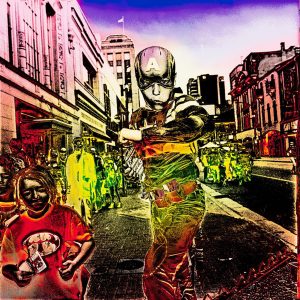
PHOTO COURTESY ISTITUTO ITALIANO DI CULTURA: Rino Noto’s Wave showcases a brief, truncated glimpse of life’s cycles: joy, resilience, and purposeful absurdity.
Museums
During the Royal Ontario Museum’s (ROM) Summer Fridays until September 22, visitors receive discounted admission to explore the museum’s galleries and exhibitions, live music, and a spectacular view of the Toronto skyline in c5 Lounge, 5:30 to 8:30 p.m. Canada’s Table, a delectable tour of regional cuisines prepared by Canada’s top chefs, takes place at the ROM on August 15. Guest chefs include Jamie Kennedy, Ted Corrado, Ned Bell, and more. Continuing exhibitions include Anishinaabeg: Art & Power, The Family Camera, The Evidence Room, and the specially-priced, feature exhibition, Out of the Depths: The Blue Whale Story.
The Gardiner Museum’s Community Arts Space is now in full swing. The month of August brings free programming by Feminist Art Museum, August Fröhls, and artist SoJin Chun in collaboration with The Truth & Dare Project. They’ll be presenting film screenings, exhibitions, workshops, artist talks, and more running until the end of August. All programming is free with registration.
While strolling along the Bloor St. Culture Corridor, take a photo with the Bata Shoe Museum’s (BSM) new window installation. Created by students from Ryerson University, In Full Bloom: Celebrating Canada 150 is an interpretation of the provincial and territorial flowers of Canada using — what else — shoes! Now on display in the Canada 150 x Power exhibition, Toronto-based sneaker designers reflect on what it means to be Canadian. There’s always something for kids to do at the BSM in the summer. This year during Summer Family Fun at the Bata Shoe Museum, kids visiting the museum receive an activity bag that includes a sneaker key chain for decorating, an ISpy game to play in each gallery, and a colourful temporary tattoo. There is also funky footwear to try on, and great opportunities to get a family selfie capturing #BSMfamilyfun.
Heather Kelly is the founder and director of the Bloor St. Culture Corridor. Her column focuses on arts and culture events from the district.
Tags: Annex · Arts
August 1st, 2017 · Comments Off on SPORTS (JULY 2017): The Maple Leaf(s) Forever
A Toronto baseball institution for over a century

PHOTO BY R.S. KONJEK/GLEANER NEWS: Grant Tamane and his Intercounty Baseball League teammates in 2017.
By R.S. Konjek
In some quarters of Toronto, this year’s Canada Day celebrations were a time of spirited debate.
People argued whether a giant rubber ducky on the lakeshore was a whimsical tourism boon or an outrageous financial boondoggle.
Some wondered what a rubber duck had to do with Canada in the first place. As Canadian symbols go, it’s no loon or beaver, and certainly no maple leaf. There’s an icon with staying power.
[pullquote]“The Leafs of the International League are considered one of the best minor league organizations of all time.”[/pullquote]
The leaf, for instance, goes hand in hand with images of Canadian athletes. Here in Toronto, baseball players have been taking the field with a leaf on their uniforms for over a century.
Long before the Blue Jays were hatched in Toronto, baseball in this city was the domain of the Maple Leafs.
Founded in the late 1800s, the city’s first professional ballclub was known simply as the Toronto Baseball Club, or the “Torontos”. The “Maple Leafs” nickname was adopted around the turn of the last century. Not long after that, a small silhouette of a leaf appeared on the left breasts of players’ uniforms. Later on, a “T” for Toronto was laid overtop the foliage to create the iconic “T-Leaf” logo that is still worn to this day.
The original Maple Leafs played in the International League — one level below major league baseball. Over the years, the team’s home park moved around the city. From Sunlight Park near Queen Street East and the Don Valley Parkway, to Hanlan’s Point Stadium on the islands, to Maple Leaf Stadium at the foot of Bathurst Street.
The Leafs of the International League are considered one of the best minor league organizations of all time. They won ten championships and several Hall of Famers spent parts of their careers there — players like Nap Lajoie, Ralph Kiner, and Sparky Anderson all wore the maple leaf. Former Montreal Expos manager Dick Williams’ first managerial job was with the Leafs.
By the 1960s, Maple Leaf Stadium was showing its age. The team also started losing money. They played their final game in the International League in 1967, and then were relocated to Louisville, Kentucky.
Toronto was a baseball black hole for just one year. In 1969, a new Toronto franchise joined the Intercounty Baseball League — an independent league for clubs around southern Ontario. The present day Maple Leafs were born, and they have called Christie Pits their home ever since. Now playing their 49th season, the Leafs of the Intercounty League have won eight championships.
Neither the long history of minor league baseball in Toronto nor the symbolism of the maple leaf are lost on current Toronto players.
“I definitely feel a sense of pride every time I put on the Leafs jersey,” says third-year shortstop Ryan White. “It’s cool to be a part of such a storied franchise.”
Players have discovered that items of clothing that bear the team logo are highly prized in other parts of the world.
“A lot of my friends and players I’ve played with in college in the States love the old school look, and everyone asks me if I can get them a ‘leaf hat’ whenever they know I’m going home for the summer,” White adds.
Players have also come to appreciate that the fans at Christie Pits quickly learn your name once you don the home team’s uniform.
“It’s an amazing feeling to represent Toronto as a part of the Maple Leafs baseball club,” says second-year outfielder Troy Daring. “We have some really loyal fans that truly support the club. I remember my first game back from college this summer, a fan came up to me and welcomed me back by name. I couldn’t believe he remembered who I was.”
The relationships between clubs and symbols, fans and players — they span the decades of our city’s baseball history.
The Leafs of 2017 find themselves in the middle of the pack. As the season rolls on, they have been holding steady at fourth place in the standings, hovering around the .500 mark.
August will be playoff time, and one thing the Leafs have shown in recent seasons is that they are something of a sleeping giant. Last summer, they made it all the way to the championship series before falling short.
Weather permitting, the Leafs play at Christie Pits every Sunday through the rest of July. Games start at 2:00 p.m. The playoffs will begin in August.
READ MORE
SPORTS: Weather permitting (June 2017)
SPORTS: Leafs return with sights on a title (May 2017)
SPORTS: Late summer blues (September 2016)
Tags: Annex · Sports
August 1st, 2017 · Comments Off on GREENINGS (JULY 2017): Taking tolls to the Gardiner and Don Valley Parkway
Toronto shouldn’t have to pay for roads used by non-Torontonians
I love a good history lesson.
The Green Party of Ontario is floating a wonderful petition to implement road tolls on the Don Valley Parkway (DVP) and Gardiner Expressway. I haven’t been shy about being a fan for congestion control purposes. It likely won’t be a revenue windfall as most of these schemes are lucky to generate enough revenue to pay for the capital financing in full, but it will go a long way to reducing emissions and getting people where they need to be.
[pullquote]“Knowing this bit of history made the government’s decision to block tolls seem like a downright asinine one.”[/pullquote]
Having had to sit on the DVP for an hour to get to a family event in Markham recently, I would have gladly paid $5 to reduce the suffering.
While chatting with Tim Grant, chair of the Harbord Village Residents’ Association and the Green candidate for University-Rosedale, I learned a little bit of city history. The costs for the DVP and Gardiner used to be paid for by the province. That cost got downloaded during the Harris days of austerity (as if changing which pocket money comes from makes us richer, but, hey, they balanced their books at the provincial level).
This left the City of Toronto with no choice but to use property taxes to pay for an expensive road used routinely by non-Torontonians.
I had no idea that it wasn’t always paid for by the city. It seems an extreme act of cowardice and a major case of having your cake and eating it too when one level of government says to another “it’s your responsibility to pay for it, but we will prevent you from tolling it in order to do so”.
Knowing this bit of history made the provincial government’s decision to block tolls seem like a downright asinine one. This isn’t about “us” vs. “them”. This is about fairly paying for an asset that’s expensive to maintain and the demand for using it far outstrips the supply.
It’s almost like being forced to take over a fledging business and being told by the former owners “but part of the deal is that you can’t charge for coffee”. If you’ve sold the business, frankly, butt out of the operations.
Beyond the environmental benefits of reducing congestion, there are obvious economic ones too. Consultants trying to get across town to see clients can’t bill for all the time they are sitting on the road. They also can’t work while they are driving. Until we have self-driving cars take over, this is a lot of lost productivity.
Mayor John Tory should seriously consider other options to get congestion under control. He might do well to think about a congestion charge.
Stockholm experimented with such a scheme about a decade ago. If one entered the city between 6:30 a.m. and 6:30 p.m. through one of 18 control points, there was a charge depending on the exact time of day. (Since these were all electronic, there was no slowdown of traffic flow.)
Traffic declined by 22 per cent during the day and emissions inside the city were estimated to have dropped by 14 per cent.
Traffic injuries declined by an estimated 5 to 10 per cent due to the congestion charge.
After a six-month pilot, they held a referendum in which citizens elected to keep the tolls. After it was implemented and both private citizens and businesses saw the benefits to their bottom lines, it became a “no brainer”.
It will not be an easy sell, but we can learn a lot from the experience of other countries. This is what leadership is about.
Tory moved us in the right direction with tolling the Gardiner and DVP, but failing “permission” to do that, we need to start seriously considering other schemes.
As for us environmentalists, we need to recognize people’s concerns. It generally isn’t about a risk they can’t see.
Let’s start emphasizing the very real economic benefits of faster travel times first and use that to win converts. Starting with an environmental argument will get us the exact same thing the last forty years has gotten us. Nowhere.
If you want to support the petition to toll our roads, go to www.tollsfundtransit.ca.
Terri Chu is an engineer committed to practical environmentalism. This column is dedicated to helping the community reduce energy, and help distinguish environmental truths from myths.
READ MORE GREENINGS BY TERRI CHU:
Lessons from Madrid (June 2017)
Thoughts on hitting the 400 benchmark (May 2017)
Solving the food waste problem (April 2017)
Kellie Leitch was right (March 2017)
Tags: Annex · Life · Opinion
June 30th, 2017 · Comments Off on ON OUR COVER (JUNE 2017): Piece by Piece
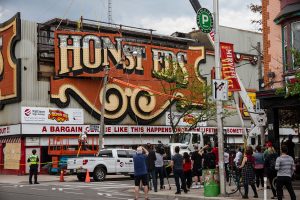
PHOTO BY GEREMY BORDONARO: Part of the iconic Honest Ed’s sign was dismantled on May 23 causing a frenzy of interest from residents and media alike. The sign, which was removed piece by piece throughout the day, will be kept in storage until it can be displayed once more at its new location on the Victoria Street side of the Ed Mirvish Theatre.
Tags: Annex · News
June 30th, 2017 · Comments Off on GRADING OUR GREENSPACE (JUNE 2017): Survey reveals significant upgrades
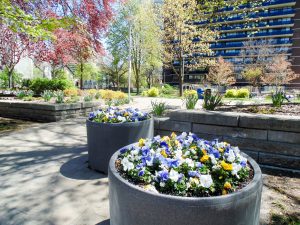
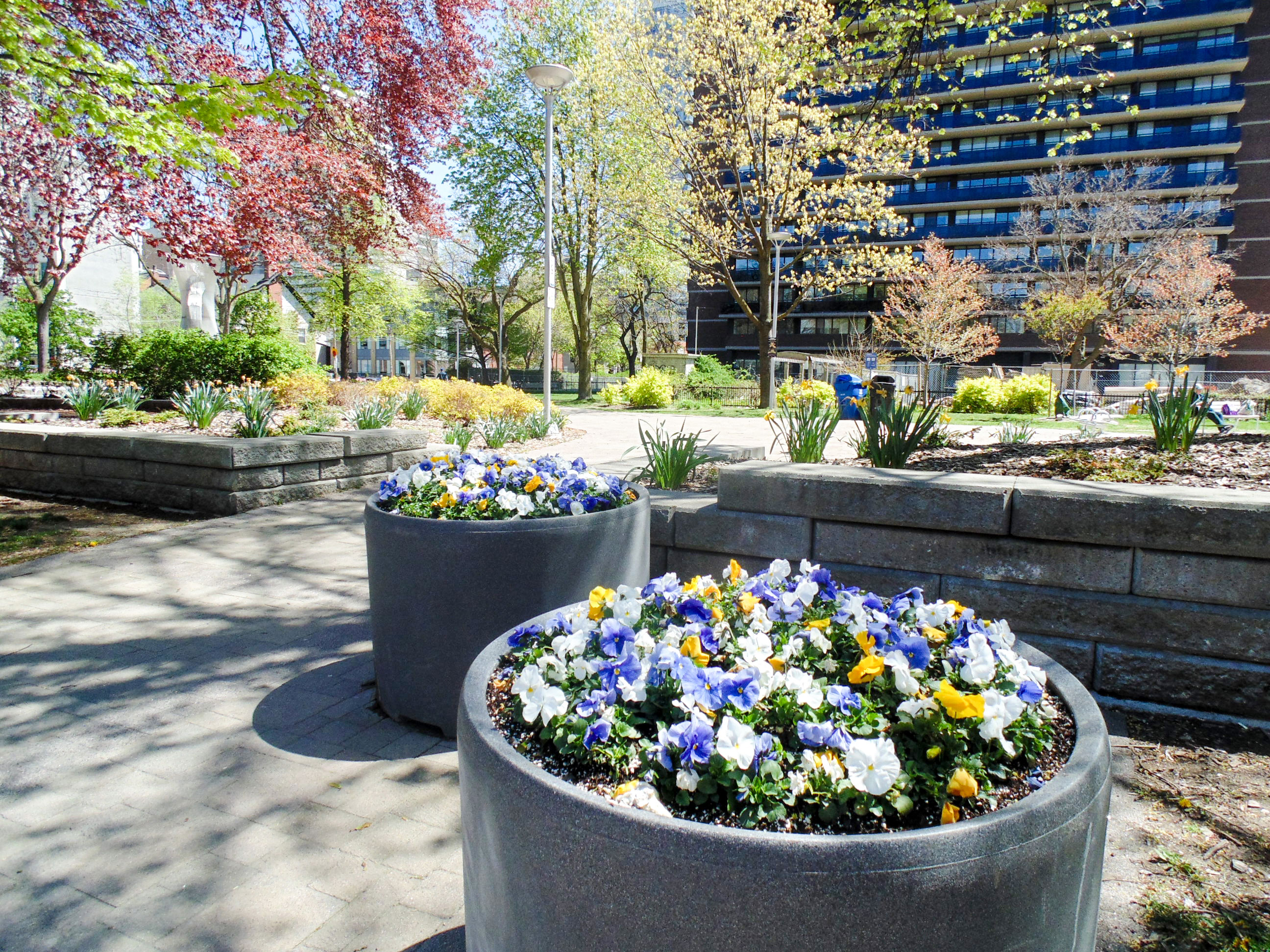
PHOTO BY NATHALIE RODRIGUEZ/GLEANER NEWS: Taddle Creek Park’s planters enhance its natural beauty. Exemplifying the best of community green spaces, the park earned top marks for being a relaxing oasis in the heart of the Annex.
Some parks still suffer from litter and disrepair
Grading our Greenspace returns this month in the first of a three-part series. For this popular feature, we assess many of the parks in and surrounding the Annex considering factors like functionality, safety, cleanliness, seating, and shade. As in past years, our grades are widely varied: after a significant renovation, Christie Pits earned top marks for variety and improved play equipment. Other parks, meanwhile, suffer from lack of maintenance, litter, and general proximity to fast food garbage from Bloor Street West. What’s your favourite local park? Email gleanereditor@gmail.com to let us know, and tell us how we did on our assessments.
Compiled by Geremy Bordonaro and Nathalie Rodriguez
Doctor’s Parkette/College-Brunswick Parkette
15 Brunswick Ave.
Time: 11:30 a.m.
Grade: B (last year: none)
Reason to go: This parkette is barely recognizable from its former self. What was once a dirty and unpleasant patch in the middle of the stretch of College Street between Spadina Avenue and Bathurst Street is now a stylish and clean place to relax during the day. The area has a lovely modern design with ample seating and light postings. Plants and trees are still young and need some time to grow, but show promise. We have our doubts, however, that the park will remain in this condition for much longer, as its past still looms: graffiti has already started to appear around the edges of the seating area.
Overheard: “Hey Mom, check out this sweet jump!”
Did you know: The medical facilities that are close to the park inspired the name.
Euclid Parkette
711 Euclid Ave.
Time: 2:00 p.m.
Grade: D- (last year: D-)
Reason to go: There is no rational reason to come to this park. The only reason this place does not fail is that it does have something resembling seating and trees. The only changes Euclid Parkette has seen have been for the worst: flower and plant life are snuffed out and have long since died, benches are still slowly degrading, and a myriad of interesting types of garbage litter both the path and nearby greenery. The smell is the worst possible part: a scent of all the garbage receptacles of nearby stores mixed with the awful deep-fried smell of the local KFC/Taco Bell. Don’t come here.
Overheard: A nearby parked car blasting Migos’s hit rap anthem “Bad and Boujee”.
Did you know: There is some evidence to speculate that the nearby Korea Town used to be Greek Town.
Christie Pits Park
750 Bloor St. W.
Time: 2:15 p.m.
Grade: A+ (last year: B+)
Reason to go: Last year Christie Pits found itself in the unfortunate position of having an endless amount of construction going on. Now it is back to being an excellent park. The sheer amount of space and things to do, all kept in excellent condition, is frankly staggering. There are beautiful flower beds, many different types of trees, rolling hills, basketball courts, ping pong tables, and a new and improved play-set for children. The key draw of Christie Pits has always been the baseball fields. These baseball fields are excellent and usually full of determined players during the afternoon. Overall Christie Pits has become a great park once again and we look forward to whatever changes await it in the future.
Overheard: “I’m hitting all dingers today!”
Did you know: Officially called Willowvale Park until 1983 when the city just went with the name everyone else uses: Christie Pits.
Seaton Park/Albany Parkette
Albany Avenue, north of Bloor Street West
Time: 2:30 p.m.
Grade: B (last year B)
Reason to go: Albany Parkette is just on the south side of Bathurst Station. The place is filled with graffiti art on walls, garbage bins, checkered tables, signs, and the fence surrounding the space. As for the checkered tables, the seats along them are destroyed, with some missing the wood placed on top of the brick seat. Plant-wise there isn’t much, but there was tons of green aside from the grass being dry. Generally people just stop by the park for about five minutes to take a call or organize their belongings when exiting the subway. It’s a decent area to stop by for a bit although it could use some renovation to create a more comfortable seating place.
Overheard: Screeching from the train coming from the nearby subway grating.
Did you know: The parkette was built in the 1960s, and was constructed after the subway was built.
St. Alban’s Park
Barton Street and Albany Avenue
Time: 3:00 p.m.
Grade: A (last year: none)
Reason to go: St Alban’s is a gorgeous park with a pathway marked by young trees. Once the trees have fully grown it will add a green canopy to the park. There are plenty of seats for when people who choose to sit on benches rather than setting a blanket on the grass, along with plenty of cool shade. There is more than enough room for a dog to run.
Overheard: “Good boy!” said a man belly-rubbing his dog.
Did you know: The Jane’s Walk festival often passes by St Alban’s Park.
Gwendolyn MacEwen Park
Walmer Road and Lowther Avenue
Time: 1:30 p.m.
Grade: B+ (last year: none)
Reason to go: Gwendolyn MacEwen Park is lovely. It’s a gorgeous little space for members in the community to have some alone time. The set up is very basic: six benches and a couple of flowers here and there. The only down side is with certain benches there’s no shade causing the hot sun to strike right into your eyes. Despite the lack of shade, the park’s elegant simplicity makes it a unique beauty.
Overheard: The rustle of the wind blowing through nearby trees.
Did you know: Gwendolyn MacEwen received the Governor General’s Literary Award twice: for The Shadow-maker in 1969 and for Afterworlds in 1987, which was awarded posthumously.
Sally Bird Park
194 Brunswick Ave.
Time: 2:15 p.m.
Grade: B- (last year B)
Reason to go: Sally Bird Park is just a ten-minute walk from Harbord Collegiate Institute, making it a hangout spot for high-schoolers, which has its pros and cons. Pro: students have a place to ramble on about their high-school drama. Con: students taking up most of the space when there’s barely any space to begin with. As a result no one else in the community has the opportunity to use the workout equipment, which just lies there untouched and rusted. No one wants to work out surrounded by teenagers spitting onto the grass. The park is in decent condition, with enough shade for hot summer days, and a water fountain. But there could be more benches as there is only one. Overall the park would be better if it provided access to all with a larger green space.
Overheard: “Yo bro!”
Did you know: Sally Bird Park once contained a playground, but was it renovated by request of the community, which wanted to have workout equipment for those in the area to easily access a free workout structure.
Taddle Creek Park
Bedford Road and Lowther Avenue
Time: 2:00 p.m.
Grade: A+ (Previous year A+)
Reason to go: Taddle Creek Park is busy with people of all ages coming to this location for various reasons. Whether they’re just walking by, going to the playground, having a chat with a friend or just need a place to sit and relax, this is the place. It’s peaceful and contains enough seats to serve all, including metal benches surrounding a fountain sculptured as a pot. The fountain provides a peaceful sound as the water hits the floor and birds chirp in melody, and gorgeous pink tulips surround the area, making it more lively during the spring and summer. Since this park is more populated than others it’s hard to maintain, but so far the well-maintained garbage bins are well used, as evidenced by the lack of litter.
Overheard: A nearby neighbour mowing his lawn mid-afternoon.
Did you know: A river used to flow through the park. It had a variety of names in the past, including Brewery Creek, Little Don River, Goodwin Creek, University Creek, Wolz Creek, but the park is named for the one most commonly used: Taddle Creek.
Ed and Anne Mirvish Parkette
In front of Bathurst subway station
Time: 1:20 p.m.
Grade: D- (last year D+)
Reason to go: This small parkette located in a busy and noisy street could’ve been used as a spot for people to sit down for a bit. But the park has nowhere to sit, only a single bench under a dying tree that is covered in bird droppings, a dirty napkin, and peanut shells. Little effort is made to maintain the plants. The flowers planted off to the side were dry and so was the grass. Until it gets cleaned up, this park will remain a poor legacy to the Mirvishes.
Overheard: Man outside Bathurst Station begging for change.
Did you know: With Honest Ed’s transformation soon coming, the nearby sign on Markham and Bloor streets has been moved to be refurbished and possibly hung at the Ed Mirvish Theatre.
Joseph Burr Tyrrell Park
Brunswick Avenue, north of Bloor Street West
Time: 3:00 p.m.
Grade: C- (last year: none)
Reason to go: Joseph Burr Tyrrell Park, down Dalton Road, is quite small and in need of renovation. The playground has a decent amount of equipment including slides, swings, a rock climber, and a seesaw, all of which are rusted and covered with graffiti. It’s a feature that extends to the fence surrounding the park, a picnic table, and a bench that lies just outside the fence. On the good side people walking by get to view lovely red roses in planters, but of course there’s graffiti on the flower planters to ruin the sight.
Overheard: “I learned middle C all by myself,” said a young girl while on the swings.
Did you know: The sign of the park incorrectly spells Tyrrell as Tyrell. Joseph Burr Tyrrell was a Canadian geologist, cartographer, and mining consultant.
Huron Street Playground
495 Huron St.
Time: 1:15 p.m.
Grade: B+ (last year D+)
Reason to go: Huron Street Playground is a calming, clean park with tons of people biking by. After last year’s renovation it’s now the perfect location to enjoy the outdoors. It has a small playground for children to enjoy with new equipment, including a net climb and swings. The atmosphere is clean, with a pathway going through the park and plenty of benches in fine condition, along with logs placed in various spots for seats. Although the fence surrounding the park is rusted, it is overall a peaceful setting in which to relax and eat lunch or read a book. Not worth travelling a distance to, but great for members in the area that are just a walk away.
Overheard: A family of three singing along to One Direction while walking by the park.
Did you know: Approximately 7 to 8 years ago students at University of Toronto fixed the playground by fundraising and planting.
Huron Washington Parkette
Huron Street and Washington Avenue
Time: 2:30 p.m.
Grade: B- (last year A-)
Reason to go: Just by University of Toronto lies Huron Washington Park, mostly a place for children with benches for parents to watch over them. Other than that there isn’t much else to do, as there are picnic tables, but they are torn apart, cracked, and not very clean. It’s hard to imagine who would enjoy eating there. Plenty of trees provide shade, but there’s very little grass, just some dry soil.
Overheard: “Look at that one!” a middle-aged women said to her husband, pointing to a pigeon.
Did you know: The nearby University of Toronto Schools was intended to be two separate schools when founded by the University of Toronto in 1910.
Correction (June 28, 2017): The print version misspelled Greenspace in the introduction, and stated that Gwendolyn MacEwen received the Governor General’s Literary Award for The Shadow-make, instead of The Shadow-maker.
READ MORE:
GRADING OUR GREENSPACE: Meet our parks supervisor (August 2016)
Part two of our 2016 parks review (July 2016)
PART ONE: Green sanctuaries in the heart of the city (June 2016)
Grading our Greenspace (2015)
Tags: Annex · Life
June 30th, 2017 · Comments Off on NEWS (JUNE 2017): Affordable housing on the agenda
PARA AGM focused on Mirvish Village development
By Geremy Bordonaro
Westbank Projects Corp.’s Mirvish Village development was the focus of the Palmerston Area Residents’ Association (PARA) annual general meeting last month.
“There have been dozens of meetings and literally thousands of hours poured into this so that it could be made better in each and every iteration,” said Roy Sawyer, a Markham Street resident and member of PARA’s Mirvish Village Task Group. “The volunteers who have helped out with this really deserve the highest praise.”
The group’s main goal was to keep residents informed on the project’s progress and represent the neighbourhood’s interests. The work included an unprecedented number of meetings and a huge amount of research by the community volunteers. The sheer amount of input has redefined how the city had to look at how development cycles work.
“We don’t measure development by years,” said Mike Layton (Ward 19, Trinity-Spadina). “But with this one we did just because of the huge amount of community involvement there was throughout the process.”
Layton presented his thoughts on the development and what he and his office were hoping to accomplish in their dealings with Westbank. A large part of his goal was to make sure that the area was still livable for those who are slowly being priced out of living in the Annex.
“One thing we heard, more than anything else, was making sure that our neighbourhood was still affordable. Affordability was a different question thirty or forty years ago or even ten years ago. I bought my first place five years ago and it was much more affordable even then. Looking at that offer to create affordable, or more affordable, housing in our area was seen as one of the top goals of ours.”
Ward 19 is home to a lot of development projects, but Layton was especially concerned about working with the community on the Mirvish Village project.
“We hear the rhetoric down at city hall. ‘Oh they’re just doing it for all that money. People are buying off those city councillors!’” Layton said. “But we want the planning to work and we want the community to work. We want the development to work regardless of what we get out of it in the end.”
Making this development work is particularly important to PARA as the community will certainly feel the impact of more residents and businesses in the neighbourhood.
“At this pace this is probably going to be the biggest change that will happen to our neighbourhood in a century. We need to ask fundamental questions that we don’t normally think much about,” said Paul MacLean, chair of PARA, in his opening statements. “What will these changes mean for our community? What is a good neighbourhood anyways? Questions like these are changed by this Mirvish Village development.”
And questions like these will have to be answered when the development takes place, but for now, in the words of Jonah Letovsky of Westbank, the site is going to see the first stages of development very soon.
“We anticipate being able to start site activity within the next two months. That means the demolition of Honest Ed’s, along Bathurst Street, and the small retail along Markham Street. Headway on the next site activity will likely start in the fall.”
READ MORE:
NEWS: Development dominates discussion (May 2017)
Tags: Annex · News
June 30th, 2017 · Comments Off on NEWS (JUNE 2017): Karma marks 45 years

PHOTO BY EMILIE JONES/GLEANER NEWS: Seaton Village’s Karma Co-op celebrates 45 years on June 24.
Co-op creates community through food
By Emilie Jones
In our fast-paced, busy world, Karma Co-op has managed to stay true to its philosophy of creating a tight-knit community built around sustainable food. Although there have been changes since it was founded 45 years ago, Karma’s ideals continue to revolve around the people: their wants, their needs, and their produce.
As Joe Cressy (Ward 20, Trinity-Spadina) notes, “We started as a community connected to food, then became disconnected, and now we are returning to our roots in recent years.”
This is what Karma prides itself on. Its members see food as more than simply something we eat. While Karma’s focus used to be on selling bulk products to reduce packaging and associated waste, it has progressed to accommodate a variety of different dietary needs including organic, gluten-free, and vegan.
“Karma is a celebration of food,” explains Jennifer Hunter of the Seaton Village Residents’ Association. “[You] go there not only because you care about your own well-being, but other people’s well-being, and the planet’s well-being. Food is purchased responsibly, grown and harvested with respect and acknowledgement to the people who created that food.”
She adds that “Karma has never just been about the food. It brings together people who share similar philosophies and a mindful way of living.”
That philosophy is underscored by its co-operative nature. To be a member of Karma, people must volunteer to work two shifts a month in the store. This leads to a real sense of community, where shoppers and customers are interchangeable.
“l like the idea that everyone knows each other and works with each other,” said Karma employee Alex Molina, “it’s a common theme for employees and members alike.”
Similarly, James Byrne chose to work at Karma because he likes the feeling of community and getting to know members, who in turn help to determine what the store sells and how it works.
Since Karma is much more than a store, the people who shop there are hardly customers. Everyone is equal, and everyone helps one another. Being part of the Karma co-op means having stimulating conversations about the politics and ethics of food consumption, and a variety of other topics. These conversations can happen one-on-one while getting groceries, but also at guest lectures that are open to the wider public. It’s very much at home in the active community of Seaton Village, a hidden location of sorts that is not without some challenges.
“[The location] is both a blessing and a curse,” says manager Talia McGuire. “It is a hidden gem, so people feel like they’ve discovered something awesome, but there is no walk-by traffic.” However, as McGuire notes, gross profit is not what Karma is after.
Nonetheless, Hunter explains that Karma does struggle with “how to stay true to its vision and still be commercially valuable”.
This is why Karma has made some changes in the 45 years since it was founded, such as the different tiers of membership types. Instead of volunteering hours, people can pay a fee to shop at Karma. There are also trial memberships, which allow people to access Karma as a member for one month before deciding if they would like to continue. There is also parental leave, vacation leave, and pay per quarter. In other words, Karma does its best to be flexible and not make members feel permanently obligated.
“In a super crazy, busy world that can be intimidating, where we don’t stop to smell the roses, Karma is a moment where you can take a breath,” says Hunter.
And on June 24 the community will gather to celebrate the co-op’s forty-fifth anniversary. Various co-ops will be in attendance, including Together We’re Bitter, the brewery providing beer for the occasion, and Urbane Cyclist, which will offer free bike tune-ups. Speakers will include Karma’s founding president and Cressy.
Tags: Annex · News
June 30th, 2017 · Comments Off on NEWS (JUNE 2017): Boon or bane?
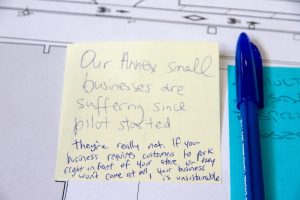
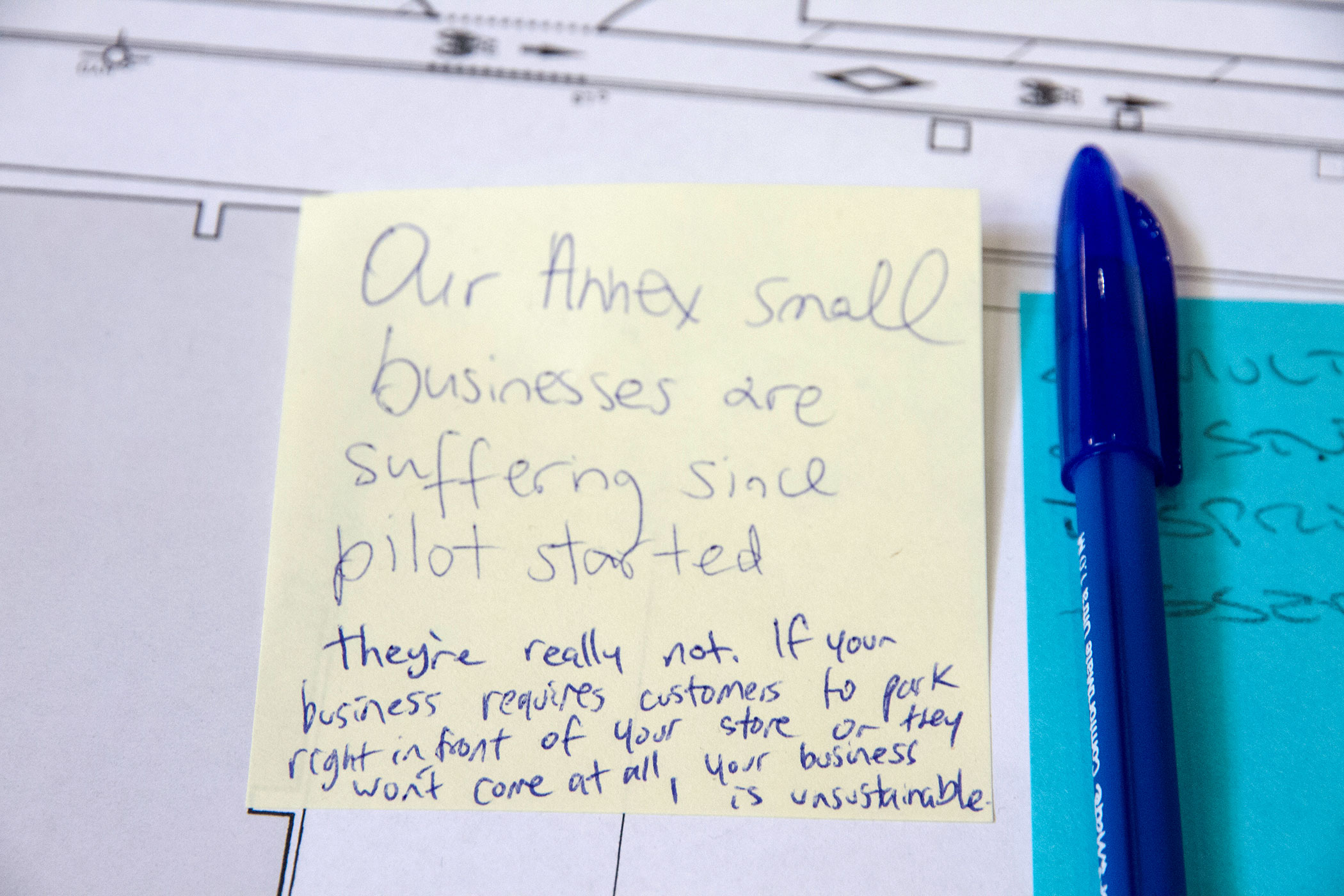
PHOTO BY GEREMY BORDONARO/GLEANER NEWS: Attendees at the third public consultation on the Bloor Street Pilot Bike Lanes annotated a map with comments on the pilot project. The annotations devolved into a war of words, in which one resident found himself battling another over the viability of businesses and bikes.
Economic impact of bike lanes still unclear
By Geremy Bordonaro
When it comes to bike lanes, business owners along Bloor Street West are evenly split: about half support them, and about half don’t. It’s a rift between business owners who think the lanes are a boon and those who think they are a bane.
“The feedback that we’ve got back from business owners so far is split,” said Joe Cressy (Ward 20, Trinity-Spadina). “For some businesses we’ve been told that it’s bringing more customers into the area and in to their shops. For other businesses we’ve heard concerns over issues like delivery and loading. What we are trying to do is understand the concerns and find a way to address them.”
At the heart of the debate is whether or not the bikes have had a positive impact on sales.
[pullquote]“I feel like some of my customers would try to murder me if I said anything against [bike lanes]”—Miranda Black, Theodore 1922[/pullquote]
“What we’ve seen [in other areas] is when bike lanes come in to downtown environments business goes up. It brings more customers in. I hope that’s the case,” Cressy said. “Our economic impact study will tell us whether that’s happening or not. In the meantime we want to improve things to mitigate any impact.”
One of the street’s shop owners who is definitely in favour of the lanes is Brent Robinson from Sweet Pete’s Bike Shop.
“[Our sales are] marginally better. It’s tough to say because we are a very weather-specific business. Even with the bike lanes if it is rainy or cloudy out people aren’t necessarily going to bike to work or going to buy bikes. We’ve not had the best spring on record. We’ve not noticed a huge increase but there is an increase.”
But for other shops, the opposite is true, as in the case of Risque Clothing, which owns two shops on Bloor Street West.
“I have been very busy trying to get my businesses back on their feet due to the very negative effect of the pilot bike lanes,” said Ondina Carvalh, owner of Risque. “My business has declined terribly since the start of the pilot.”
While quite a few business owners say they have been negatively impacted by the bike lanes, many are reluctant to speak out against them for fear of retaliation.
“I feel like some of my customers would try to murder me if I said anything against them,” said Miranda Black, owner and manager of Theodore 1922.
That’s where the Toronto Centre for Active Transportation (TCAT) comes in. An advocacy group that works to make streets more inclusive for walking and cycling, TCAT is conducting an economic study aimed at finding and addressing the concerns of business owners.
A comprehensive survey of consumers and merchant owners along Bloor Street, it will compare statistics from before and after the bike lanes were installed to assess whether there has been any change in the area.
“It’s been mixed. We are getting both support and some concerns expressed,” said Nancy Smith Lea, director of TCAT. “What we’re going to be doing is read each response, and categorize it as being either positive or negative. If there are concerns we note what they are. Once we’ve done that work we’ll release a report that will be openly available.”
Cressy hopes the study will lead to a good outcome for all the parties involved.
“If we were to get the outcome of the economic impact study that showed when you looked at retail trends in the city of Toronto and found that compared to other main streets, Bloor [Street] is doing well, I would say that would be a big win. I believe that bike lanes can be a win-win for business and commuters. I’m hopeful and optimistic that this will be the case.”
READ MORE:
CHATTER: Preliminary data on Bloor Street pilot bike lane released (March 2017)
CHATTER: Ground-breaking bike lanes launch on Bloor Street (August 2016)
NEWS: Bikes blessed for another season (June 2016)
FOCUS: An early advocate for bike lanes (June 2016)
NEWS: Bike lanes for Bloor Street (May 2016)
The faster we lower speeds, the more lives we save (October 2015)
Early brewer the basis for Bloor Street’s name (May 2015)
Tags: Annex · News
June 30th, 2017 · Comments Off on CHATTER (June 2017): Community through song
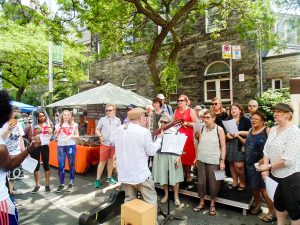
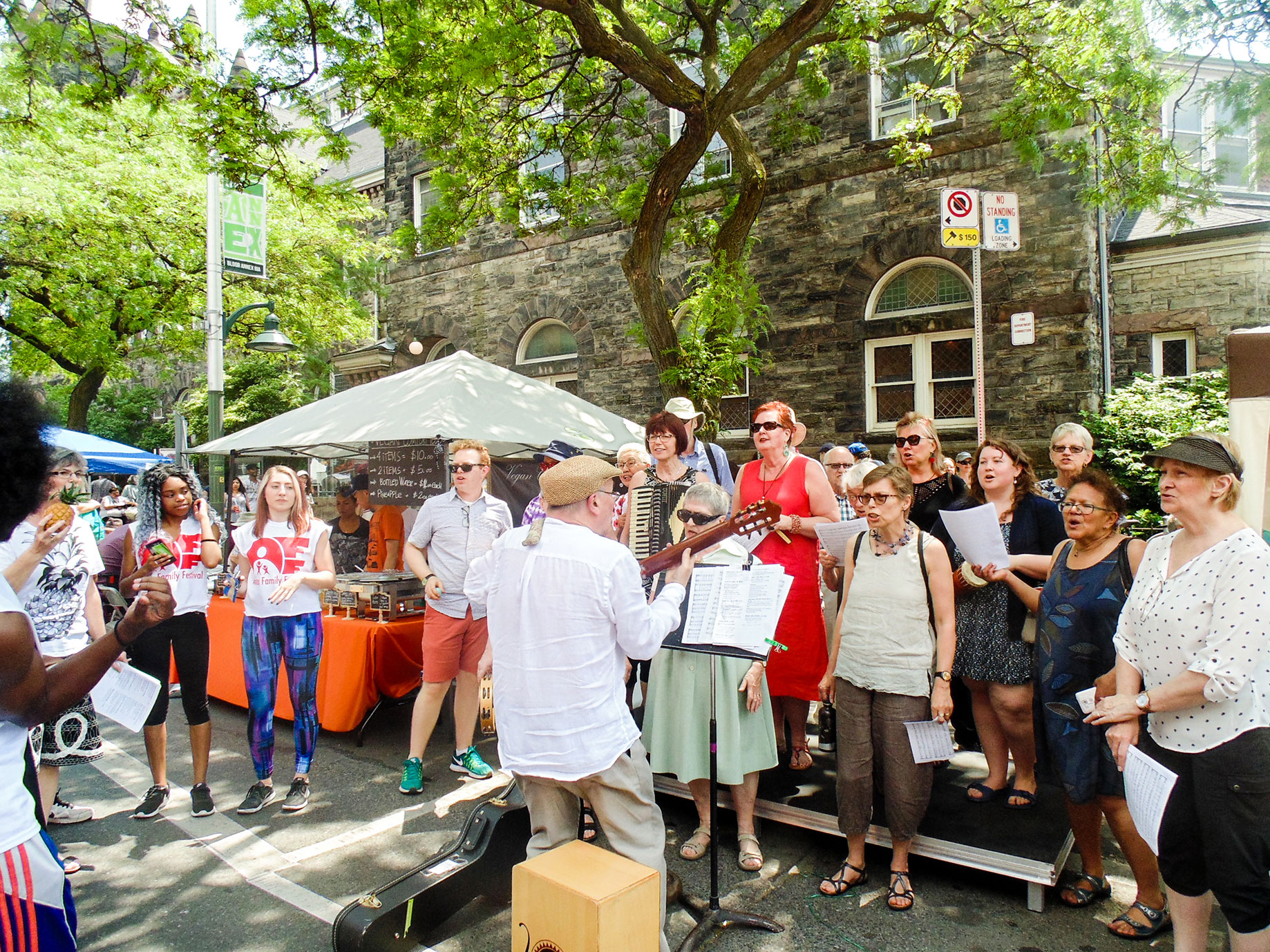
PHOTO BY BRIAN BURCHELL/GLEANER NEWS: Led by Andrew Donaldson, the Trinity-St. Paul’s choir performs on the steps of the Trinity-St. Paul’s United Church during the Annex Family Festival on June 11. Organized by the Miles Nadal JCC and sponsored by the Bloor Annex BIA (whose chair publishes this newspaper), the festival featured 120 craft and unique food vendors, as well as a street parade and children’s village.
Tags: Annex · News