September 29th, 2025 · Comments Off on FORUM: Coping with heat is the new norm (Aug. 2025)
Government needs to lead with solutions, not let people suffer
By Jessica Bell
What can Ontario do to address extreme heat?
We are enduring a summer of record-breaking heat, and it’s going to get worse. The Ontario government’s 2023 assessment of the impact of climate change on our province predicts the number of days above 30 degrees will soar to 60 days a year by the 2080s.
We have two massive tasks ahead of us. We need to continue to pressure the Conservative government to enact a serious plan to get to net-zero and build a sustainable economy, while also taking steps to ensure our survival.
Floods and fires get a lot of attention, but heat is responsible for more illness and deaths than most other extreme weather hazards combined. Here’s five steps the Ontario government should do to protect us from extreme heat.
Protect workers from heat stress
In 2001, a 44-year-old bakery worker named Kim Douglas Warner died at Weston Bakeries in Barrie. Kim had worked a 12-hour shift in 49-degree heat, on a 34-degree day. His temperature reached 42.5 degrees Celsius when he was found unconscious near the ovens.
Workers in schools, factories, mines, and kitchens are vulnerable to heat stress, as are low-wage workers who are active outdoors, such as farm workers, paramedics, delivery and postal workers, garbage workers, and workers in construction.
The Ontario government is consulting on new rules to protect workers from extreme heat, but the rules are weak and one-size-fits-all.
The Ontario Federation of Labour and the NDP are calling for far stronger measures, including a sector-specific approach, paid breaks to cool down, the installation of ventilation and air-conditioning, access to water, protective equipment, and schedule adjustments to avoid the hottest parts of the day.
Establish a maximum temperature standard for rental apartments
It is miserable to live in a boiling apartment during the summer months, and for our most vulnerable residents, it has become deadly. The devastating heat waves in British Columbia in 2021 killed 777 people, and most of the dead were elderly, sick, disabled, and alone in homes without air-conditioning.
To keep tenants safe from dangerous heat waves, the province should establish a maximum temperature bylaw for homes (public health agencies usually land on 26 degrees) and make window air-conditioning a vital service.
After a sustained public pressure campaign, the province passed legislation permitting tenants to install an air-conditioning window unit, however, the legislation isn’t in force. Toronto is studying bringing in a maximum temperature bylaw.
Ontario should upgrade and build climate-resilient infrastructure
Extreme heat puts incredible pressure on infrastructure; roads can buckle, and electricity usage skyrockets, leading to brownouts.
The Association of Municipalities in Ontario (AMO), which is the organization that represents Ontario’s municipalities, calculates that municipalities need up to $290 billion over the next 10 years to accommodate growth, manage climate change, and keep existing infrastructure in good repair, such as roads, water systems, and sewerage pipes. This is a good investment.
Instead of investing in municipalities, Ontario has cut municipal funding and made it harder for municipalities to raise money for infrastructure from development fees.
Improve the quality of existing and new homes.
New homes should be well-made, well-insulated, and energy efficient. These homes are cheaper to cool in summer, they are better able to withstand extreme heat, and they produce less greenhouse gas emissions.
Under the false guise of spurring housing construction, the Conservatives passed a law (Bill 17) which invalidates Toronto and 13 other municipalities’ green building policies. These policies required new buildings to meet higher environmental performance and energy efficiency benchmarks than the provincial standard. Bad move.
New construction alone isn’t enough to lower Canada’s carbon emissions. Ontario has established a fund at homerenovationsavings.ca to provide rebates to homeowners for insulation, heat pumps, better windows and doors, battery storage, and more, but the program will end this December. Ontario does not have a plan to incentivize or mandate the retrofitting of community housing and private-market rental buildings. It should.
Embrace nature
Trees are marvelous at providing shade and cooling homes and neighbourhoods down by as much as six degrees Celsius. The City of Toronto has a policy to protect and expand its tree canopy from 28 per cent coverage to 40 per cent by 2050. The province should help them.
Extreme heat is a serious and escalating challenge, and we will continue to push for solutions that help us protect ourselves while cutting down on climate pollution.
Jessica Bell is the MPP for University-Rosedale and the Shadow Minister for Finance and the Treasury Board. You can reach her office at jbell-co@ndp.on.ca or 416-535-7206.
September 29th, 2025 · Comments Off on FORUM: Bathurst Street: Not yet RapidTO (Aug. 2025)
Council caves and all lose to the precious car
By Albert Koehl
In the run up to the city hall debate about the proposed RapidTO busway on Bathurst Street, everyone played to script, and we all lost.
RapidTO would have created priority transit lanes on Bathurst and Dufferin Streets from the waterfront to the soon-to-be-completed Eglinton Crosstown LRT.
In a city where transit projects are measured in years of delay and billions of dollars in cost overruns, RapidTO offered a quick, inexpensive solution for long-suffering transit riders.
Indeed, there are few fixes in our toolbox that address a similar list of urgent problems: affordability, traffic congestion, and climate change. Even the Toronto Region Board of Trade supported the RapidTO lanes.
For these reasons—and solid public support—the project should have coasted through executive committee and city council. Instead, only the RapidTO lanes south of Bloor were approved.
What happened?
For starters, the media got excited about a loud group of merchants on Bathurst (between Bloor and Dupont Streets) who predicted doom and gloom from the loss of curbside parking. What else is new, except research that contradicts them?
The opponents actually used, until they were caught, fake, AI-generated “concerned residents.” The Toronto Star nonetheless characterised the RapidTO lanes as a “heated and politicized” debate.
Second, local councillor Dianne Saxe championed delay, a beloved approach among politicians who want to avoid making a decision.
Her “compromise” undermined her own pronouncements about the urgency of climate action: “The climate crisis is not a normal political negotiation between different interests, where solutions come from compromise. The climate crisis is a collision between human beings and physics. Physics, like gravity, doesn’t compromise.”
Urban affairs commentator John Lorinc ridiculed Saxe as having “caved spectacularly.”
Third, some merchants, true to an old script, championed parking spots over people.
When a bike lane was proposed on Harbord Street, the local business association said “no bike lanes, period.” That was in the 1990s; today the upgrade of the existing bike lanes got little attention.
More recently, merchants on downtown Yonge predicted “catastrophic consequences” from a pedestrianization initiative. City council ignored them. And, by contrast, the Bloor Annex BIA was among the first to fight back when Premier Doug Ford threatened to remove bike lanes on Bloor.
Ironically (or hypocritically), at their June protest, opponents to the Bathurst busway stood on sidewalk-level parking spots that the merchant had converted to a vibrant, permanent patio. Indeed, the city initiative should have been an opportunity to re-think—and to more rationally use—the extravagant amount of precious urban space that is devoted to parking, instead of to people (and trees, sidewalks, bikeways, and benches).
Finally, TTC riders, environmental groups, and local residents all rallied for the RapidTO busways. An overwhelming majority of the 60+ speakers at the executive committee supported complete busways.
For TTC patrons at bus stops, the recent scorching temperatures are certainly more than the “abstraction” described by opponents. In fact, the Bathurst busway would have delivered thousands of potential new shoppers—people who could hop off the bus and into a business.
A study partly funded by the Bloor Annex BIA showed that over 90 per cent of patrons at local shops arrive on foot, bikes, and transit.
It was left to Mayor Olivia Chow to offer a way forward without embarrassing Councillor Saxe. The mayor should have intervened more forcefully.
Instead, we got a project that will “explore” tried-and-failed options for the stretch north of Bloor to Eglinton, including HOV lanes that have never worked on nearby Bay Street. Councillor Saxe should have chosen her script from neighbouring Councillor Alejandra Bravo, who devoted herself to educating Dufferin residents about the vital importance of RapidTO and identifying feasible options for loading and access.
It’s no longer acceptable, given today’s urgent problems, to allow some groups to carve out exceptions for themselves, while others suffer.
We needed local merchants, the media, and politicians to show leadership. Instead, they simply kicked the can forward.
Albert Koehl is coordinator of Community Bikeways, author of Wheeling Through Toronto, and former vice-chair of the Annex Residents’ Association.
September 29th, 2025 · Comments Off on SPORTS: From Tokyo to Toronto: Sato’s season of surprises (Aug. 2025)
A sit-down with baseball sensation Ayami Sato
A sensation from day one, Ayami Sato is routinely sought out for autographs and photos whenever the Leafs play. CRAIG AIKEN/GLEANER NEWS
By R.S. Konjek
It’s a Friday night in July, an hour before game time at Christie Pits.
Ayami Sato seeks out a shady spot on a bench beside a tree. Speaking through interpreter Yoko Van Veen, she says the heatwave doesn’t bother her, that it’s even more humid in Japan. She only wants to get out of the sunlight while we talk.
Sato has just finished helping her Toronto Maple Leafs teammates at batting practice. As a pitcher, her duty was to retrieve baseballs. As one of the most accomplished female baseball players in the world, the task might have seemed beneath her, but it was not.
Last winter, the Leafs made international headlines when they signed Sato who helped her native country win five women’s world baseball championships. This spring she became not only the first woman to play for Toronto, but the first in Canadian pro baseball history.
A year ago, she never imagined she’d be sitting on this bench, not far from the kids’ splash pad.
“This is a very casual place to play baseball,” she says. “Everybody can just drop by and watch. I feel the players and fans are very close, and they can interact easily.”
Sato was an opening day sensation. Her presence attracted thousands of spectators. She started the game and pitched two perfect innings.
“Every moment here has been precious for me, but when I stood on the mound and made my first pitch, that was the most memorable moment,” she says.
Since opening day, Sato has settled into the bullpen. Like most ballplayers, she’s had her ups and downs over the course of the season.
After some games, Sato has posted long messages on social media, analysing her performance on the mound, being self-critical when necessary, and always looking forward to the next game determined to succeed. Not a common practice among North American athletes, it’s another thing that has made her stand out from her peers.
She routinely praises her teammates online and says she enjoys the collegial atmosphere of the Leafs’ clubhouse, a place filled with postgame music, pizza, and beer—three things that break down barriers in most places.
She appreciates the diversity of Toronto, and the Leafs’ roster reflects that diversity. Being the only Japanese player is not as isolating when her teammates here are Canadian, American, Dominican, Venezuelan and Korean.
“Playing with those guys, it’s very inspiring,” she says. She admits it was a huge leap from living near Tokyo and playing for a women’s team to competing against men in a foreign country. But I just jumped into the environment and tried to do my best to adjust.”
Prior to making the move to Toronto, Sato received messages of support from former Toronto Blue Jays Munenori Kawasaki and Yusei Kikuchi who encouraged her to enjoy her journey.
Support from her country followed her to Canada. Sato says she can pick out voices shouting in Japanese when she is on the mound.
“I hear a lot of supporting voices, and I know they are out there and I’m happy to receive that support,” she says.
In between game days, Sato has spent time visiting girls’ baseball teams, coaching, and speaking to younger players. She has also taken the opportunity to play tourist, visiting Niagara Falls, the CN Tower, Centre Island and Kensington Market.
She is impressed by Toronto’s Japanese food scene, praising Ikkousha Ramen and Taro’s Fish in particular. She is also amused by the creativity of Canadian sushi restaurants. She breaks into a wide smile as she describes how one place put cream cheese on top of salmon, something she’d never seen before.
As for Toronto’s greater food scene: “There are so many temptations when it comes to sweets. I like fried chicken and French fries, and I’d love to try [more] but since I have to perform, I restrict myself.”
She lives close to Christie Pits and has travelled around the city on all modes of transport. Asked to compare Toronto’s subway system to that of Tokyo, she goes politely silent.
“It’s small,” she concedes, “but I can access anywhere easily so I think it’s very convenient. I use it a lot.”
Some of Sato’s teammates begin to emerge from the clubhouse in uniform. First pitch is approaching.
Since arriving in April, Sato has loved her time in Toronto. However, she will return to Japan in September and rejoin her Saitama Seibu Lions women’s team for a big competition in October.
Looking ahead, she has her eyes on the nascent Women’s Pro Baseball League which will be the first of its kind in North America in over 70 years when it begins play in 2026.
For now, the present beckons. It’s time to suit up for this evening’s game. The Maple Leafs are hosting the Guelph Royals as they battle for playoff contention.
Sato is fully committed to doing her part to help the Leafs succeed. Modest to a fault, she doesn’t dwell on her place in Toronto sports history. Having achieved that by spending the summer here, her focus is on the collective goal.
“We play as a team, so every player has to do their best in their positions,” she says. “That’s the beauty of baseball. I have to play my role and focus on what I have to do. I’ve started to figure it out, and by the end of the season I hope I can say I did my best and it was a great season.”
More information and a schedule can be found at www.mapleleafsbaseball.com.
September 5th, 2025 · Comments Off on ON THE COVER Found a penny (July 2025)
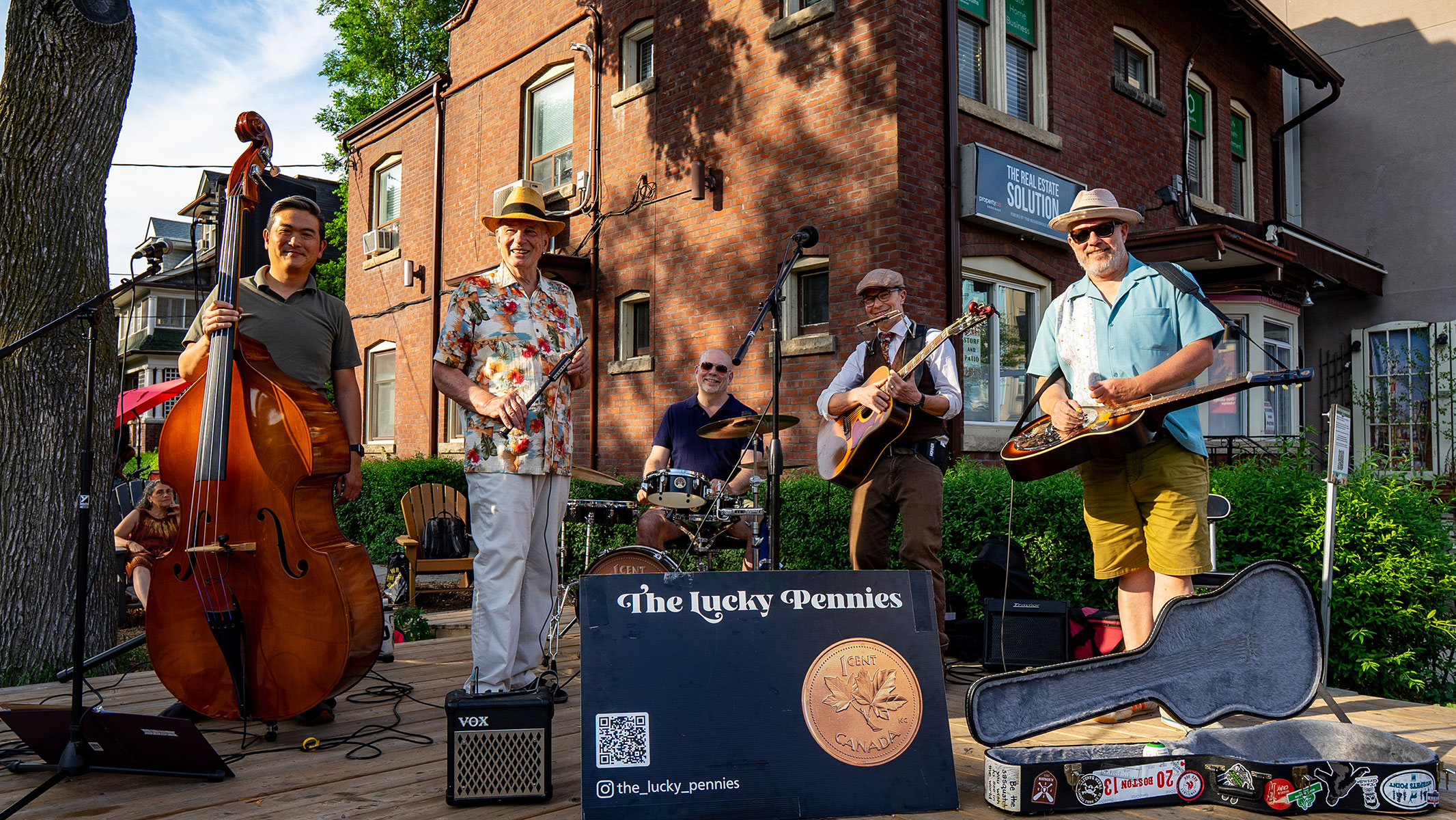
Harbord Village’s Gus Sinclair (2nd from left) joined The Lucky Pennies as they peformed for the Bloor Annex BIA’s Summer Music Series on July 4. Throughout the summer, enjoy free live music at Bloor Street and Brunswick Avenue on Fridays from 6 to 8 p.m., Saturdays from 11 a.m. to 1 p.m., and Sundays from 12 to 2 p.m. NEILAND BRISSENDEN/GLEANER NEWS
Comments Off on ON THE COVER Found a penny (July 2025)Tags:General
Press conference at Kos Café highlights local opposition to RapidTO
By Abigail Harris
On Wednesday June 11, over a hundred residents and small business owners gathered on the patio of Kos Café at Bathurst and Dupont to call on the city to pause the proposed RapidTO transit corridor expansion north of Bloor.
The event was hosted by Protect Bathurst, a grassroots coalition of Toronto residents, local business owners, accessibility advocates, and community leaders who argue that their lifestyles and livelihoods will be negatively impacted by the city’s plan.
The proposed design includes installing priority bus lanes in the north and southbound curb lanes on a 7.5-kilometre stretch of Bathurst from Eglinton Avenue West to Bloor Street West and implementing priority streetcar lanes from Bloor Street West to Lake Shore Boulevard.
All curb-lane access to parking, loading, unloading, deliveries, and service vehicles would be removed, eliminating 138 on-street paid parking spaces, according to the city.
The project’s development was authorized in July 2024 by city council to improve the efficiency and convenience of public transportation ahead of next summer’s FIFA World Cup 26™, but also to provide more reliable bus and streetcar transit in the long term.
Various speakers took the stage, voicing their concerns about what the proposed plan would do to the area’s safety, accessibility, and economic health.
Paul Macchiusi, local resident, owner of Minerva Cannabis, and host of the event, told the audience that the RapidTO plan will improve public transport at the expense of residents and local business owners.
“RapidTO is proposing to change our streets from mixed use neighborhood arteries into 24/7 high speed bus and emergency vehicle corridors,” Macchiusi said. “There will be nowhere for someone to stop and help an aging parent, nowhere for children to get dropped off and go to daycare, nowhere for residents to unload groceries.”
Macchiusi said the city has not taken enough time or the right steps to address perceived issues with the plan and has not participated in larger discussions with the community.
“The RapidTO plan is flawed, and it’s being rushed,” Macchiusi said. “Residents and business owners have repeatedly raised concerns about the safety, traffic divergence, business liability, and basic accessibility, and every time that we have, the answers have been vague, dismissive, or simply absent.”
Michelle Morgan, owner of Annex Art, expressed her concerns about the impact of the priority TTC lanes on her business.
“A large part of my business is children’s programming, including after school art classes, summer camps, workshops, and special events,” Morgan said. “The only access to my storefront is on Bathurst Street, and I fear that I’ll lose a large part of my business to those who rely on parking access to the studio.”
The day before the press conference, Dianne Saxe, city councillor and TTC board member, offered a compromise to the issue, proposing that the installation of the TTC priority lanes between Bathurst Station and Dupont be halted until the next municipal election.
During a Q&A period, Macchisui addressed Saxe’s proposed solution to the complex issue.
“She’s provided us with a compromise, which is a great first step into working into a better plan,” Macchisui said. “Hopefully that will be better than what RapidTO has presented.”
Andrew Greene, chief of staff at Councillor Saxe’s office, was in attendance and addressed concerns from community members after the event.
“Councillor Saxe supports the idea of having a holistic approach and not doing anything rash in the neighborhood,” Greene said. “No one wants to do anything to damage this community. We want to make better transit; we don’t want to destroy communities to do it.”
The comment period for this project has closed. The proposal will be considered by the executive committee on July 16.
To sign up for email updates or to learn more about the project, visit www.toronto.ca, search for RapidTO, and select Bathurst Street under “Projects.”
September 5th, 2025 · Comments Off on NEWS: Harbord Bakery celebrates 80 years (July 2025)
A legacy business marks a milestone
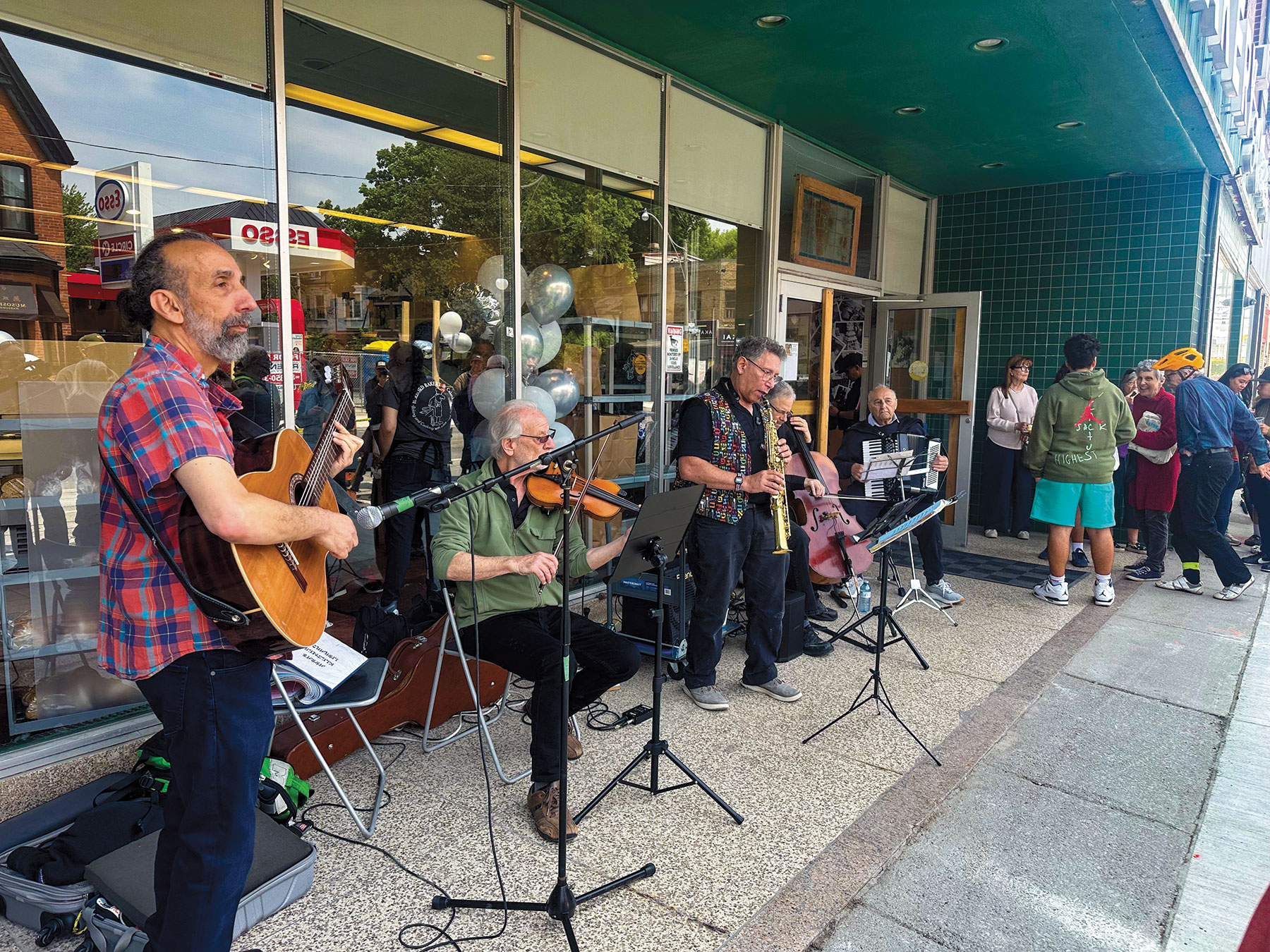
Members of the band Kishke perform at the anniversary celebration. BRIAN BURCHELL/GLEANER NEWS
By Rose Harbener
In 1945, Golda and Albert Kosower fulfilled their dream by purchasing the little bakery next to the fish market at the corner of Major and Harbord.
Harbord Bakery quickly became a hub for the Jewish community. Many brought their own cakes and savoury sabbath meals to bake in the bakery’s brick oven.
Eighty years later, on June 13, 2025, that dream was celebrated with a joyful gathering of the community at the bakery. Visitors were treated to free confections, drinks, music, and dancing to mark the momentous milestone.
The Kosowers immigrated to Toronto from Poland and raised three children while running the bakery.
“I remember they would give free sprinkle cookies to any kid that walked in,” said a celebration-goer in the pastry lineup.
“We’re celebrating that my mom and dad bought Harbord Bakery in 1945,” said Susan Wisniewski, one of the bakery-born children.
“Eighty years is a long time, and it felt like there needed to be a bit of celebration—especially with the world like it is. It’s nice to celebrate with our customers and family at the same time,” she added.
Wisniewski has worked at the bakery since she was a young girl sitting at the counter and helping her mother serve customers. She vividly recalls one of her first memories: learning how to tie up a pastry box.
“A saleswoman, Mrs. Weinstein, taught me how to do it,” she said. “I can do it in my sleep. Very few people tie up boxes now.”
Another aspect that makes the bakery unique is its staff culture. The staff at Harbord Bakery aren’t just the people handing out the famous sprinkle cookies—they are more like family.
“We’re always very close and celebrate lots of things together,” said Wisniewski.
Most of the staff have been at the bakery for at least 25 years.
“My first day here is my favourite memory of it. They’re very nice, and I felt welcome right away,” said a staff member.
The sense of camaraderie and warmth in the bakery originates from the lessons taught by Goldie and Albert Kosower which have been passed down through generations.
Susan and her siblings were raised to connect with customers, not just through transactions, but with kindness, familiarity, and care.
“I have been coming here for 70 years. The first time I went to Harbord Bakery, I was 17. They were the only place open on Sundays that was near us.
I consider it to be a place of not just memory, but also a place of food; wonderful, great food,” said Adrienne Clarkson, former Governor General of Canada and Harbord Bakery regular.
Harbord Bakery has a spirit of belonging that no grocery store can offer. Councillor Dianne Saxe (Ward 11, University-Rosedale), who was in attendance at the celebration, made it clear that if we want local businesses such as Harbord Bakery to continue, they need local support.
“We’re so lucky that after 80 years of difficulties, they are still here and thriving. There’s a real heart here you’re never going to find at a commercial grocery store,” said Saxe.
Part of that heart lives in the recipes themselves. Step into the bakery and the smell of rugelach, challah, and fresh loaves reels you in—their scents unchanged by time.
“These recipes were his. They’re still his,” Wisniewski said, referring to her father.
“You taste the challah, and it’s the same challah. The same taste from years ago when my father first started baking it.”
But how does the time-honoured bakery continue in an ever-changing world? “It is a challenge, but we have wonderful customers, and they are what makes us want to go on,” Wisniewski said.
Comments Off on NEWS: Harbord Bakery celebrates 80 years (July 2025)Tags:General
September 5th, 2025 · Comments Off on GRADING OUR GREENSPACE: Grading the green (July 2025)
The first instalment of our annual report card on area parks
Each year the Annex Gleaner reviews the many parks and parkettes in our coverage area using a variety of criteria. While there is no decisive “winner” of the grading, letter grades are assigned to convey the quality of the parks, considering aspects such as upkeep, design, and amenities. Last year’s grade is provided allowing comparison. The reviews accompanying the assessment also let the reader know what makes each space unique. This is the first instalment of reviews for 2025.
Compiled and photographed by Abigail Harris
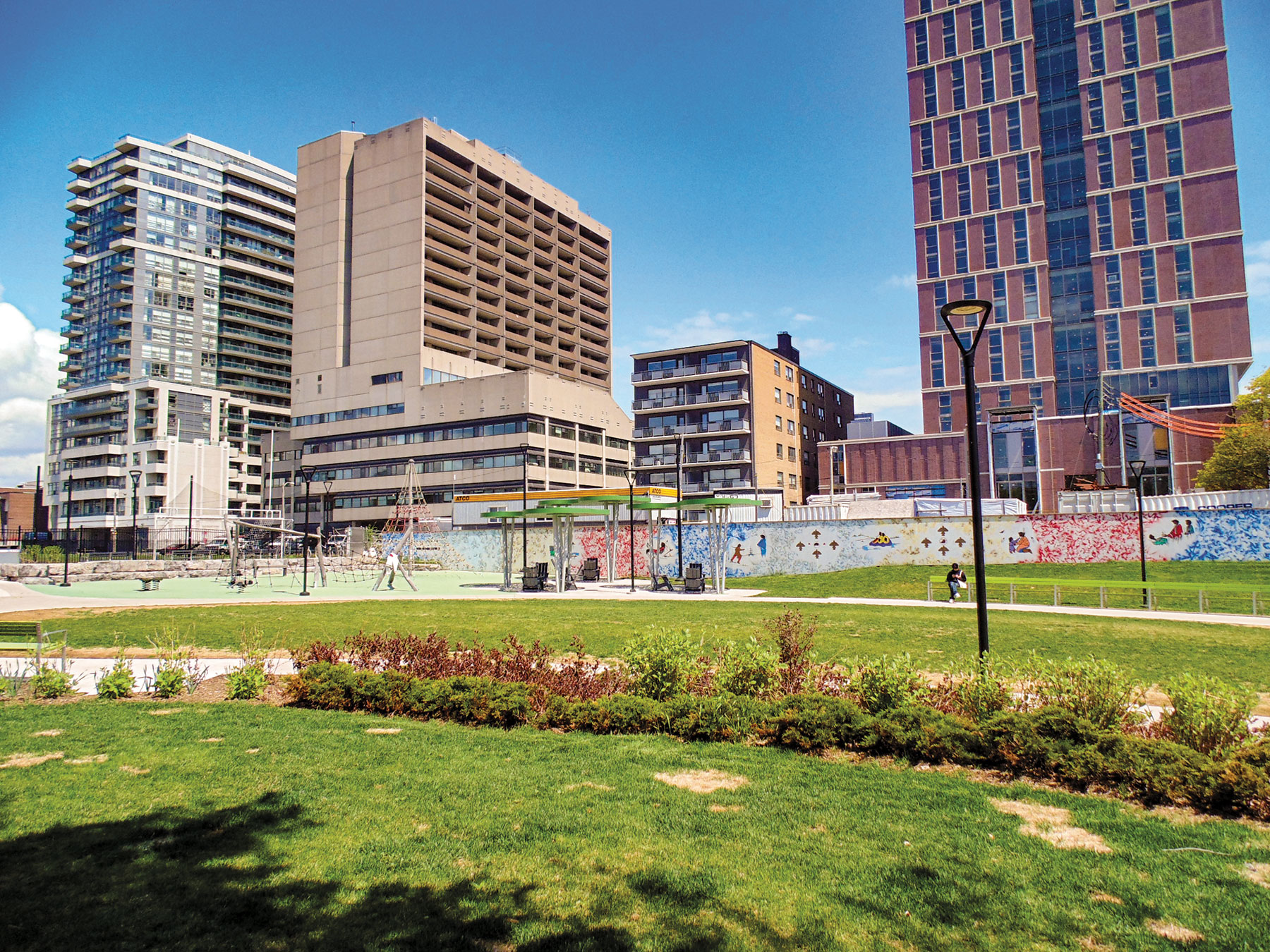
Robert Street Park’s extensive amenities and quiet atmosphere provide a feeling of seclusion.
Robert Street Park 50 Sussex Ave. Time of visit: 1:30 p.m. Grade: A (Last year’s grade: A) Reason to go: While Robert Street Park is located just a stone’s throw from the hectic intersection of Spadina Avenue and Bloor Street, its extensive amenities and quiet atmosphere provide a feeling of seclusion. The park was created as a part of the Robert Street Field Project by the University of Toronto. The project not only built this greenspace but installed a geoexchange system under the soccer field next to it, to reduce greenhouse gas emissions. Muskoka chairs provide comfortable seating, mini pavilions built in the shape of trees supply shade, and long benches surround the perimeter of the greenspace. There is also a rope playground structure for children to play on and a butterfly garden. An Indigenous art piece on the back wall of the park provides a beautiful backdrop to the space. Overall, Robert Street Park is a great place for kids and adults to relax in the city. Overheard: Children playing touch football shout “one steamboat, two steamboat, three steamboat, four steamboat…” Did you know: Geothermal energy uses the natural heating and cooling properties of the earth to regulate temperature in the surrounding buildings connected to the system which is constructed of deep pipes filed with circulating water. In colder months, ground heat is transferred and distributed for heating. In the summer months, this process is reversed, for cooling.
Jesse Ketchum Park 1310 Bay St. Time of visit: 2:50 p.m. Grade: A (Last year’s grade: A+) Reason to go: Jesse Ketchum Park is a small but inviting greenspace at the intersection of Davenport Road and Bay Street. The park features big, draping trees which provide shade during the hot summer months. A few benches and water filling stations make it a pleasant and comfortable refuge from the bustle of the city. It is located next to Jesse Ketchum School where children are often playing on the soccer field or playground. Construction on a high-rise across the street, however, disrupts what could be a quiet, relaxed ambience. All in all, Jesse Ketchum Park is great stop for those looking for a quick escape from the busy city streets. Overheard: The shouts of children playing at the Jesse Ketchum Early Learning & Child Care Centre a few doors over. Did you know: Jesse Ketchum School was established around 1831, three years before the founding of the City of Toronto. The current building at 61 Davenport Road dates back to 1914.
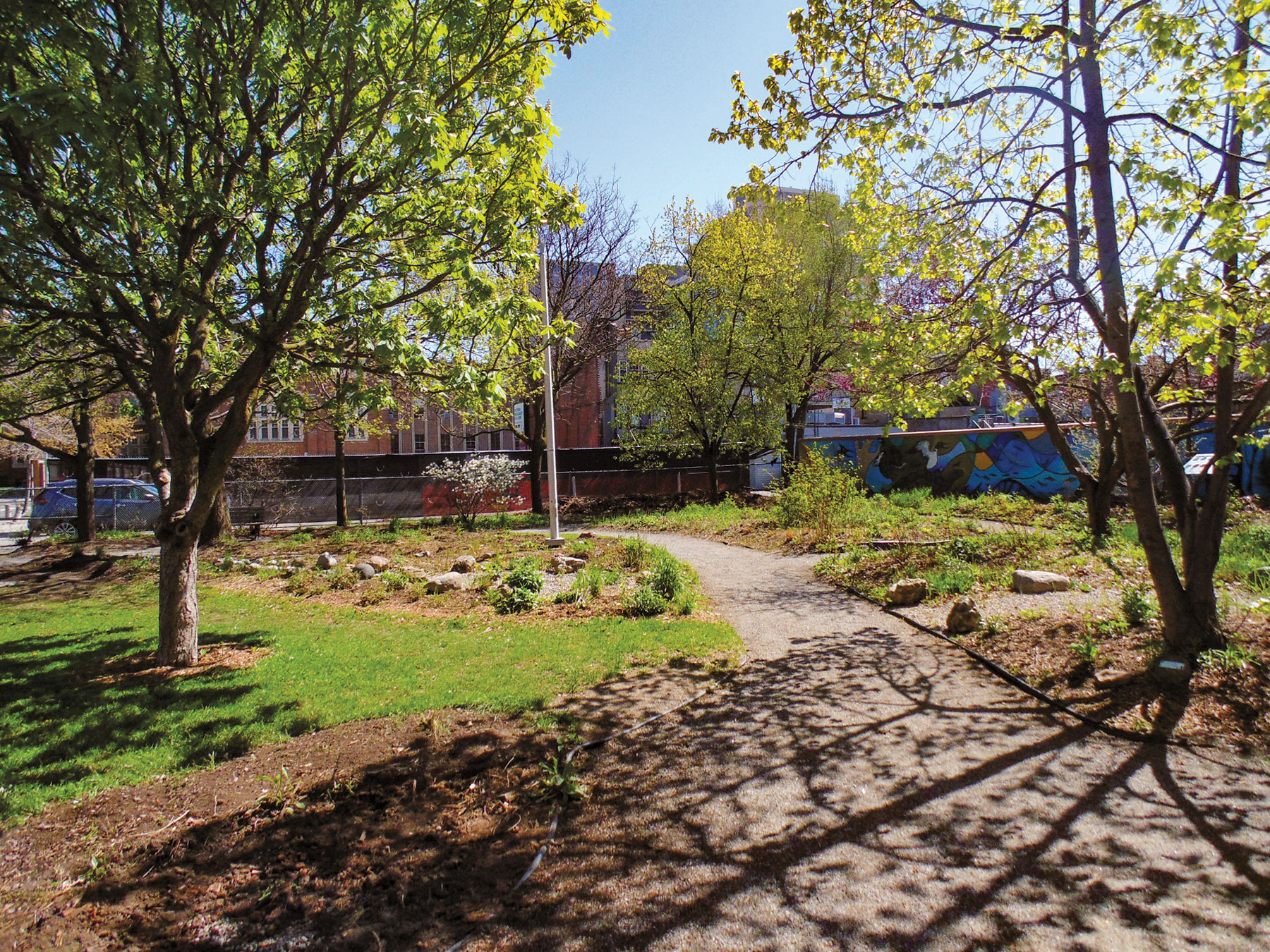
Paul Martel Park has an incredibly beautiful quality to it, with vibrant Muskoka chairs for seating and benches painted the colours of the medicine wheel.
Paul Martel Park 10 Madison Ave. Time of visit: 11:18 a.m. Grade: A- (Last year’s grade: A) Reason to go: This greenspace, located near the intersection of Spadina Avenue and Bloor Street, underwent a significant revitalization in the past few years thanks to a collaboration between Indigenous tradespeople, artists, and Elders known as Aki Wiidookaagewin (Earth Helpers). The revitalization facilitated Indigenous participant horticultural training, as wells as gardening and cultural programming at the park. As a result, this park has an incredibly beautiful quality to it, with vibrant Muskoka chairs for seating and benches painted the colours of the medicine wheel. An Indigenous mural titled Interconnections frames the back wall. The mural depicts the Indigenous creation story and features important figures such as the Muskrat and Thunderbird. Unfortunately, construction across the street on Spadina interrupts the serenity of the space. But overall, Paul Martel is a beautiful park to take a break from the city and admire the artistic talent of the local community. Overheard: A jackhammer from the construction of the new Estonian Cultural Centre across the street. Did you know: In Indigenous culture, thunderbirds are supernatural, bird-like spirits that can create wind, rain, and thunderstorms.
Vermont Square Park 819 Palmerston Ave. Time of visit: 12:15 p.m. Grade: A (Reviewed last in 2022. Grade then: A+) Reason to go: Vermont Square Park is a charming greenspace located near Bathurst Street and Dupont Avenue. This park is a gem within Seaton Village. Despite being located close to Bathurst Street and Dupont Avenue, the park feels very serene and peaceful. The extensive grounds allow for all kinds of park-goers to use the space. There is an off-leash dog area for furry friends and a fenced off playground for little ones with a pirate ship-inspired play structure, swing sets, and a wading pool. The park also features three bocce courts, a European ball game. William H. Bolton Arena is located on the east side of the park, and St. Alban’s Boys and Girls Club, which features an indoor pool, community centre, and daycare, is on the north side. Overheard: Children screech, “Higher!” as their caretakers push them on the swings. Did you know? The Bill Bolton Arena is home to three adult hockey leagues in the summer as well as youth recreational hockey leagues.
Christie Pits Park 750 Bloor St. W. Time of visit: 1:20 p.m. Grade: A+ (Last year’s grade: A+) Reason to go: Christie Pits is beloved by many Toronto residents and is one of the largest and most popular parks in the city. This greenspace is home to amenities that draw in all sorts of members from the surrounding community, including an outdoor pool, three baseball diamonds, basketball courts, outdoor table tennis, picnic sites, skate park, a playground, and a splash pad. It’s conveniently located next to Christie subway station, making it a must-visit destination every summer. Throughout July and August, the Toronto Outdoor Picture Show hosts weekly movie nights. One can always be entertained here in the summer, as various fairs and festivals are always taking place. If you’re a sports fan, the semi-pro baseball team, the Toronto Maple Leafs, play their home games on Dominico Field in Christe Pits. This park has something for everyone and is worth checking out this summer. Overheard: A frustrated dog owner shouts, “Waffles, get over here!” Did you know: The Intercounty Toronto Maple Leafs signed Ayami Sato this season, one of the world’s greatest female baseball players. Sato is the first woman to play in the Intercounty Baseball League and the first in Canadian pro baseball history. (See gleanernews.ca, April 2025).
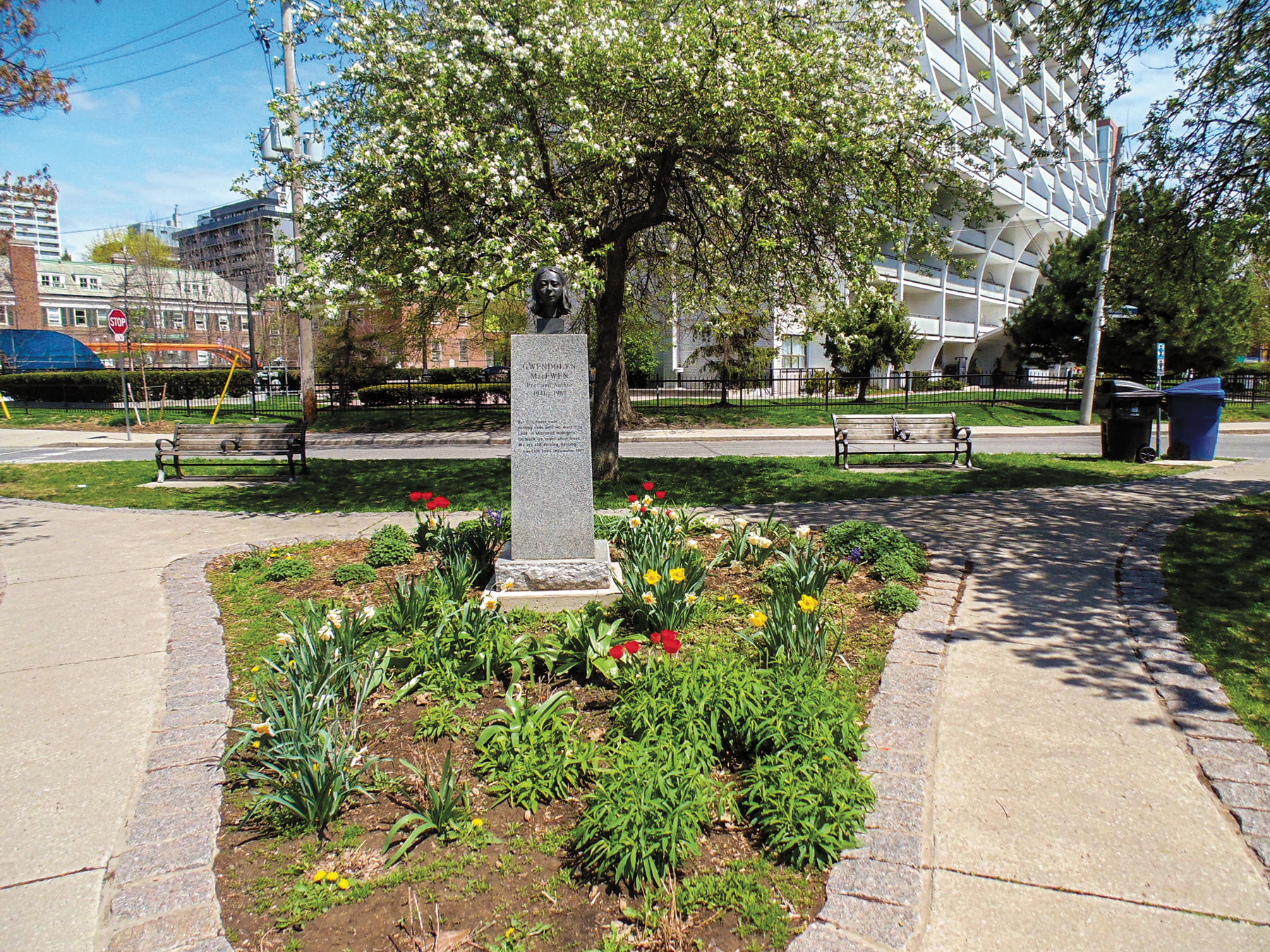
Gwendolyn MacEwen Parkette is a small but charming greenspace.
Gwendolyn MacEwen Parkette 33 Walmer Rd. Time of visit: 12:00 p.m. Grade: B- (Last year’s grade: B-) Reason to go: Gwendolyn MacEwen Parkette is a small but charming greenspace located at Walmer Road and Lowther Avenue. Crab apple trees overhang benches, and yellow and purple flower beds line the pathways. Across the street at Walmer Road Baptist Church there is a beautiful Indigenous mural. The park is in the middle of a roundabout; unfortunately, this means it is a high traffic area with a significant amount of noise. Overheard: The sound of children playing during recess at a school located on Walmer Road. Did you know? Gwendolyn McEwen was a Canadian poet and novelist who began writing and publishing in her teens. She published over 20 books in her lifetime and passed away in 1987 in Toronto.
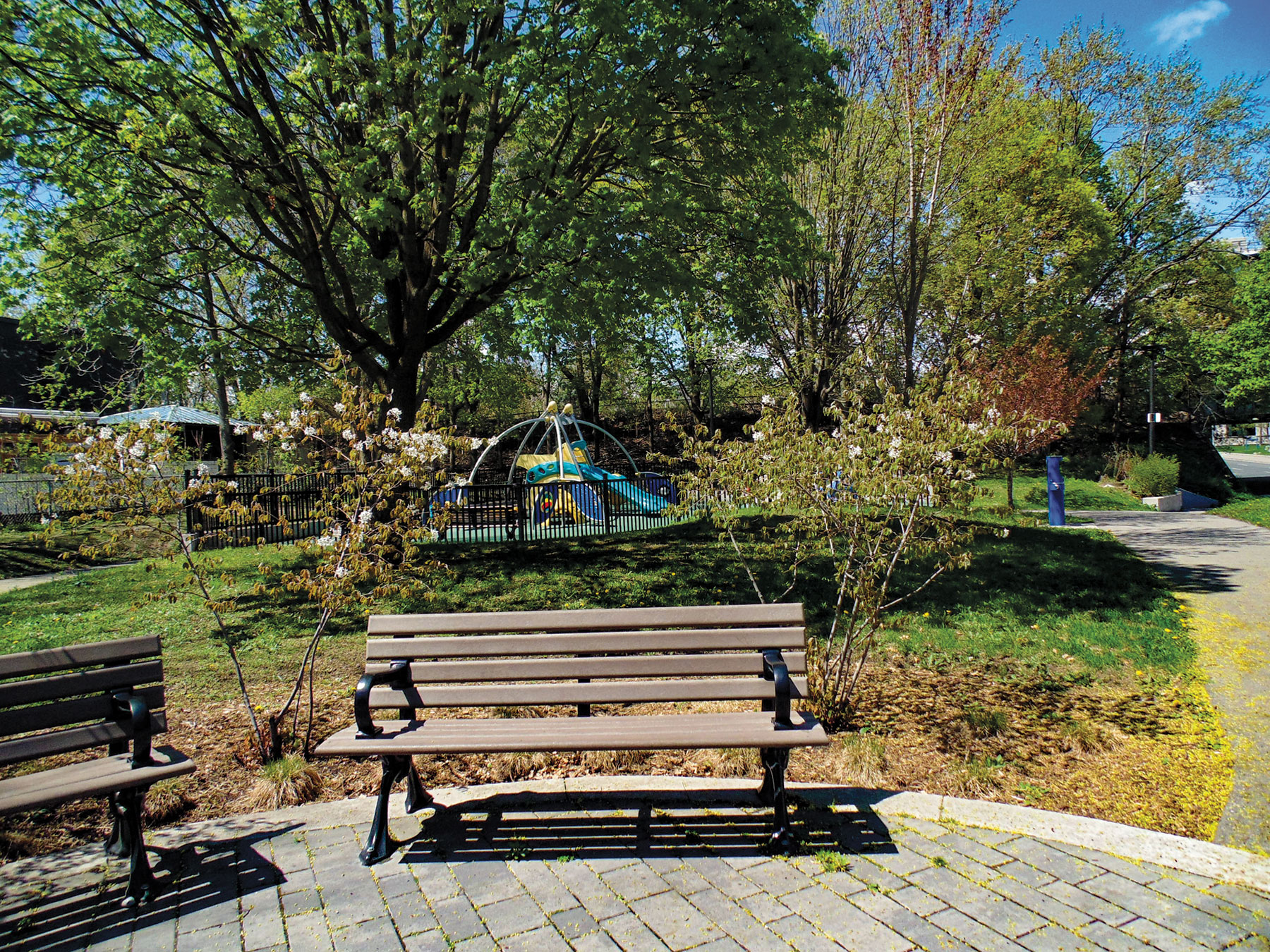
Norway Maples frame Sergeant Ryan Russell Parkette.
Sergeant Ryan Russell Parkette 250 Avenue Rd. Time of visit: 2:32 p.m. Grade: A (Grade last year: B+) Reason to go: Sergeant Ryan Russell Parkette is across from Jay Macpherson Green and is located at Avenue Road and Dupont Street. Norway Maples frame this greenspace and provide ample shade and privacy from the busy city streets. There is an enclosed playground area for children and shaded benches. The noise, given the park’s location at a busy intersection, can be a bit pervasive. Overheard: A bird chirping and cars passing by. Did you know: The Norway Maple is one of the most common trees in Canada and is native to Europe and West Asia. The leaves are bright green in the summer and turn yellow or red in autumn.
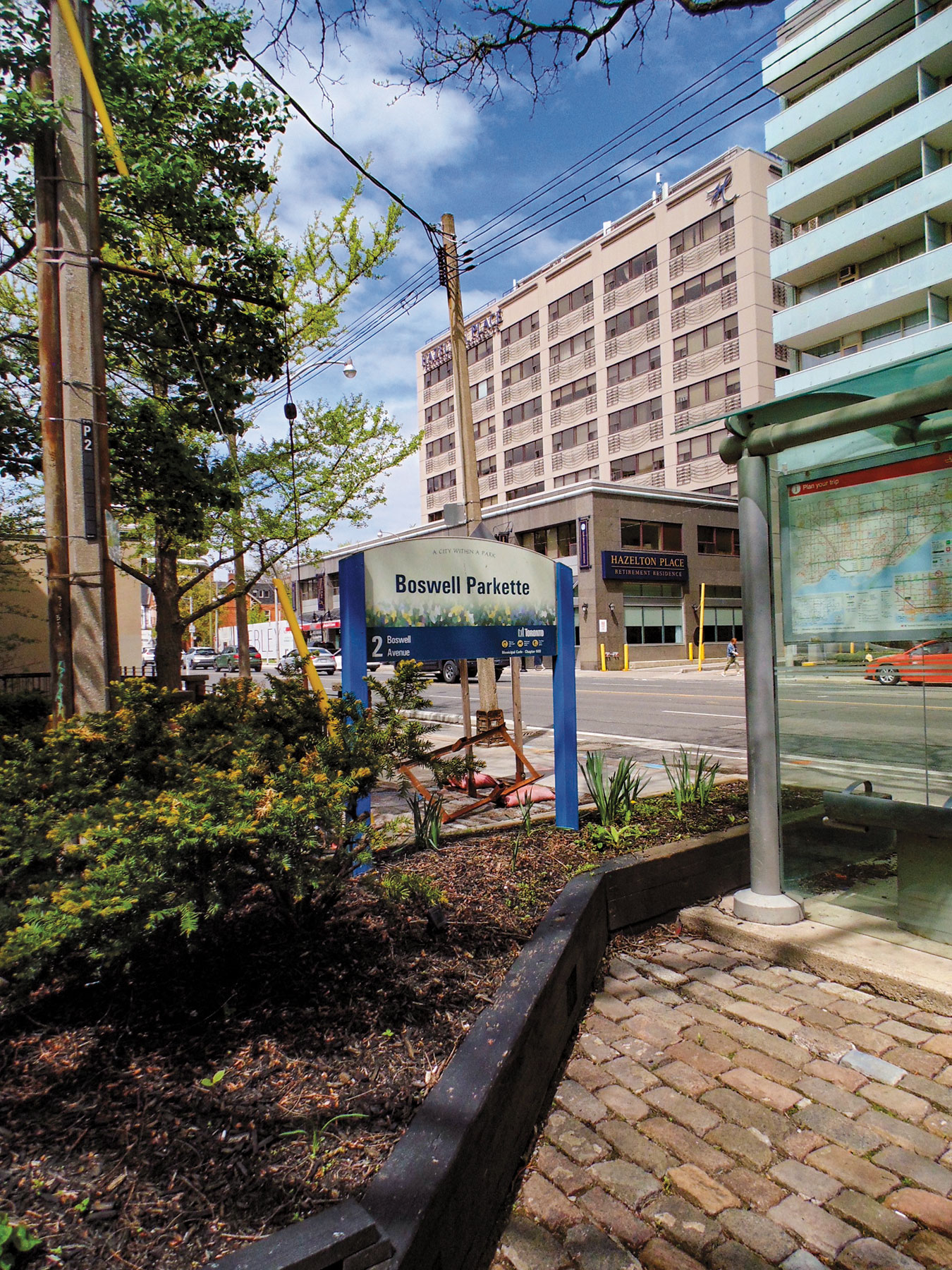
Boswell Parkette provides a brief passageway into the charming residential area west of Avenue Road.
Boswell Parkette 4 Boswell Ave. Time of visit: 1:25 p.m. Grade: B- (Last year’s grade: B) Reason to go: Boswell Parkette is a tiny greenspace located along the hectic stretch of Avenue Road between Davenport and Bloor. The parkette provides a brief passageway into the charming residential area of Boswell Avenue. In the spring the lack of a tree canopy leads to a lack of privacy and shade for park-goers. As a result, not much of the noise from Avenue Road is absorbed, making the space feel quite exposed to the elements. The spot is convenient, however, for passersby who need a breather. Although there is only one bench, the parkette is conveniently located next to the Boswell Avenue bus stop which provides shelter. Despite the traffic noise, Boswell Parkette is still a pleasant place to pass through and make a quick stop if you feel inclined to do so. Overheard: Cars and bikes zipping by. Did you know: Boswell Parkette was named after Toronto’s 24th mayor, Arthur Radcliffe Boswell, who is most remembered for hosting a renowned party in commemoration of Toronto’s 50th anniversary in 1884.
The Doctors’ Parkette 15 Brunswick Ave. Time: 2:32 p.m. Grade: D+ (Last year’s grade: C-) Reasons to go: The Doctors’ Parkette feels like an exercise in hostility—and it’s not just the armrests dividing up the benches. The bushes are overgrown and yellowing, and grass pokes up between the cobblestones that cover nearly the entire parkette. The tree canopy is such that only a third of the benches will ever get shade, and even then, it depends on the time of day. In short, it is nearly impossible to stay and relax here for any substantial period of time. Overheard: Sparrows chirping over College Street traffic. Did you know? It is perfect for when you’re 5-10 minutes early for an appointment at Kensington Health and you feel kind of awkward about bothering the receptionist with your earliness. What other health centre offers that? — By Drew Glennie
Jay Macpherson Green 255 Avenue Rd. Time: 3:35 p.m. Grade: B+ (Last year’s grade: A-) Reasons to go: Nestled at the eastern end of Dupont (and the Annex as a whole) is Jay Macpherson Green, where the tree canopy makes the entire area a shady haven from the summer sun. The green includes a walkway to shorten the pedestrian journey from Avenue Road to Macpherson Avenue with a bench on each side. The park is perhaps not worth a commute from more westerly parts of the Annex, but residents of Yorkville are lucky to have this cozy stopover nearby. The rating for this park is somewhat affected by Sergeant Ryan Russell Parkette across the street which has the same amount of shade and benches but also a play structure. Looks like they’re having fun over there. Overheard: Footsteps on the walking path, both human and canine. Did you know? The Macpherson Avenue Parkette that comes up on Apple Maps when you search Jay Macpherson Green is a totally different place. Don’t ask me how I know. — By Drew Glennie
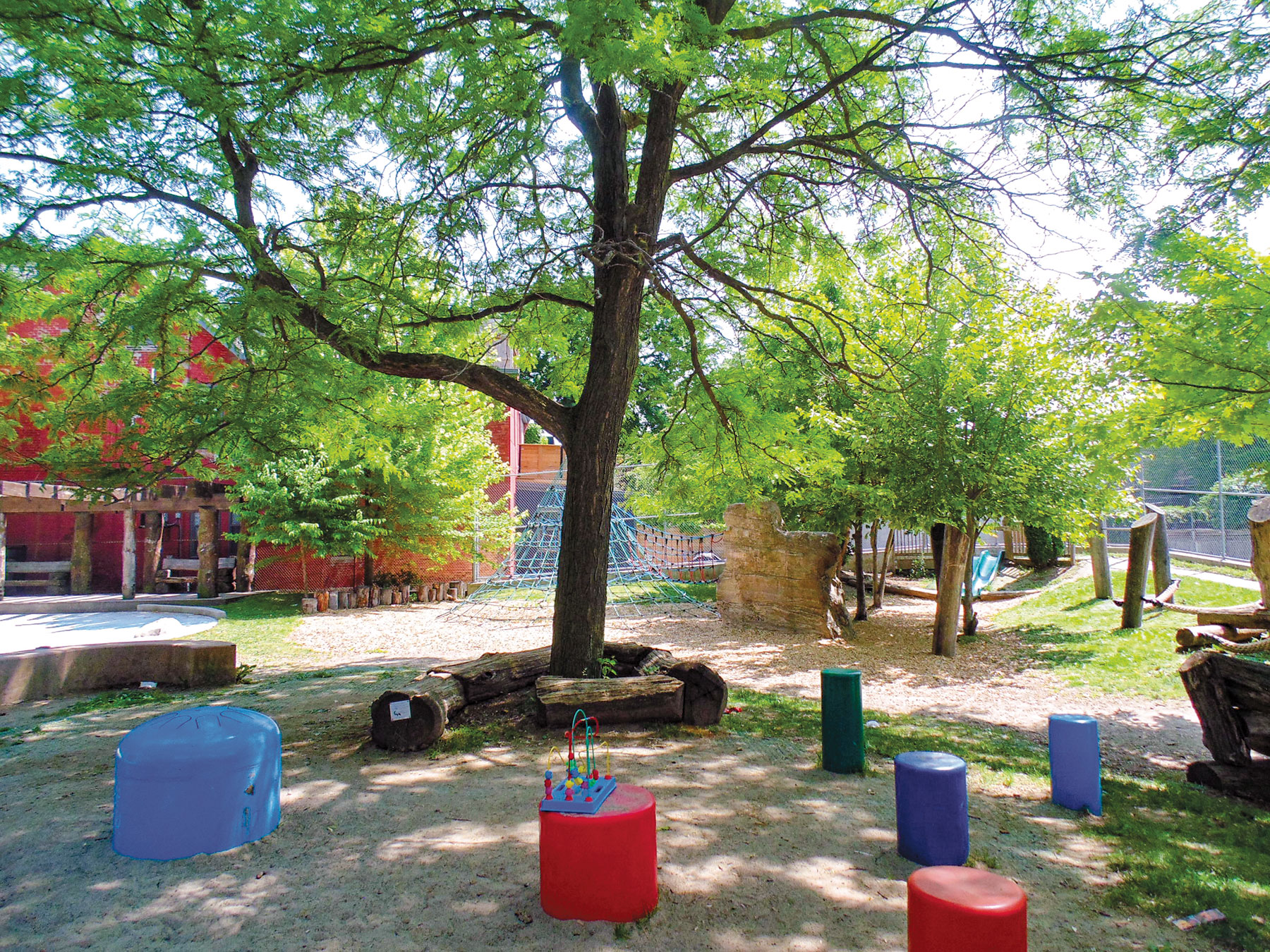
Bring your little ones to enjoy the splash pad, sand pit, rope play structure, and the abundance of toys scattered around Margaret Fairley Park.
Margaret Fairley Park 100 Brunswick Ave. Time: 11:58 a.m. Grade: A (Last year’s grade: A) Reasons to go: Margaret Fairley Park is a charming greenspace located in the heart of Harbord Village. It is named after the renowned Canadian writer and activist Margaret Fairley. Bring your little ones here to enjoy the splash pad, sand pit, rope play structure, and the abundance of toys scattered around. Natural wooden benches and picnic tables add a rustic feel, as if you just happened upon a peaceful clearing in the middle of a forest. The park feels quiet and secluded, making it easy to forget you’re just one block from the construction and chaos of Harbord Street. Overheard: A mother and her child playing together in the sandpit. Did you know? One unique feature of this park is an installation of musical instruments called Thunder Drums. They are percussion instruments that resemble stools for children 18 months to 12 years.
Jean Sibelius Square 50 Kendal Ave. Time: 2:15 p.m. Grade: A+ (Last year’s grade: A+) Reasons to go: Jean Sibelius Square is a beloved destination in the Annex that’s rich with amenities for all age groups. The park has an outdoor fitness gym which parkgoers can use during the warmer months to get a workout in. For little ones, there’s a large playground area with a sandpit, rock-climbing wall, and rope play structure. With plenty of shady trees and picnic tables, Jean Sibelius Square is a great spot to host a gathering. The hustle and bustle of Bloor Street feels far away, and there is a general feeling of peace and quiet in the square. During the winter, the park’s large grassy area turns into an ice rink, making it the perfect place for community members to connect over a game of hockey. Overheard: An exasperated dog walker asks her pack to “Sit, please!” as she struggles to take a photo of all five of them. Did you know? Jean Sibelius was a Finnish composer of the late Romantic period. The park was originally called Kendal Square. It was renamed Jean Sibelius Square in 1959 when Toronto’s Finnish community donated a memorial to Jean Sibelius to the city.
Bloor-Bedford Parkette 245 Bloor Street W. Time: 1:11 p.m. Grade: B+ (Last year’s grade: B) Reason to go: Bloor-Bedford Parkette is a nice shady spot along Bloor Street to stop and sit for a while. With the parkette being right across from the University of Toronto Varsity Centre and steps from the Royal Conservatory, you feel as if you’re right in the middle of all the action of the city. Plus, on clear days, you have a perfect view of the CN Tower in the distance. Unfortunately, it’s easy to get distracted by the noise and construction of the surrounding area. Overheard: Traffic and cyclists buzzing by and a sporting event across the road at Varsity Centre. Did you know? For 32 years, the CN Tower held the record for the world’s tallest freestanding structure.
Matt Cohen Park is an endearing space located at the intersection of Bloor and Spadina.
Matt Cohen Park 393 Bloor St. West Time: 12:05 p.m. Grade: C- (Last year’s grade: C-) Reason to go: Located at the intersection of Bloor and Spadina, Matt Cohen Park is an endearing space positioned right in the city’s core. It features some benches and shady trees but has heavy foot traffic and is more of a quick stop for commuters than a serene destination. Flocks of pigeons seem to love frequenting this park and are not afraid to approach you and ask for food. The park struggles to provide much of an escape from the city given its location and the noise. But what Matt Cohen lacks in lush greenscaping it makes up for in Canadian culture. Parkgoers can stop and read one of the six memorial plaques that detail the life story of esteemed Canadian writer Matt Cohen. Cohen received the Governor General’s Award for his novel Elizabeth and After and has been recognized for his children’s books and short stories. Overheard: Pigeons coo as they fight over a piece of bread while firetruck sirens sound in the distance. Did you know: Matt Cohen published children’s literature under the pseudonym Teddy Jam.
Sally Bird Park is easy to miss if you’re not paying attention.
Sally Bird Park 194 Brunswick Ave. Grade: C+ (Last year’s grade: C+) Time: 11:41 a.m. Reason to go: Sally Bird Park is a quaint greenspace tucked away in Harbord Village. The park is sandwiched between houses on Brunswick Avenue; it can be easy to miss if you’re not paying attention. Its discrete entrance makes it feel like a hidden passage, not so much a park to linger in. There are a few benches, but the park isn’t exactly inviting and functions more like a pleasant way of cutting through to the parallel street Alan Powell Lane. A unique feature of Sally Bird are the three outdoor fitness machines. Although it is small, the park serves its purpose of being a quiet enclave amid busy city streets. Overheard: Dogs panting as they trot through the park alongside their owners. Did you know? This park used to be called Brunswick Parkette, but was renamed in 2004 to honour local resident Sally Bird.
After reading the opinion piece in the latest paper a few days ago, I thought I would give it some time. A week later, the profound disappointment at the tone of the piece still holds sway.
I have been a part of this community since 2009 and in business since 1998 on College Street, where I also got the Gleaner in my mailbox. And I have been gobsmacked at the divisiveness that has surfaced with the proposal from RapidTO.
From my perspective, the polarization of this topic is due mainly to the misrepresentation in the media of the parties involved.
Nowhere in this piece does it mention that the proposal involves dedicated transit lanes 24/7. That means no stopping, no loading, no deliveries, no pickups. That means no access, at any time.
This affects residents, the elderly, the schools, the theatres, the wellness clinics. Because for a good stretch of Bathurst there are no back lanes. There are no alternatives for a lot of addresses.
Referring to the success of the revamped Bloor Street is a clumsy argument. They still have parking and loading zones.
And that is what most of those affected are advocating for: a modified proposal that considers all the needs of the communities involved.
I hope there is a considered response to this.
—Regards, Trish, Owner EWANIKA 1072 Bathurst Street
My name is Paul Macchiusi. I am a Bathurst Street resident and business owner who is writing to express my profound disappointment with the opinion piece published on the front page of your May/June, Vol. 31, No.1 issue, titled “Empty Cars Don’t Buy Things— People Do” by Terri Chu.
As a community advocate who has actively engaged with stakeholders on the RapidTO initiative, I find the article’s misrepresentation of our position, lack of diverse voices, and reckless call to boycott local businesses both divisive and harmful to our equitable, bicycle-friendly and transit-oriented neighbourhood.
Your publication was invited to attend our recent press conference on June 11 at Kos Café, and you did attend. We clearly outlined our stance: We are pro-community, pro-transit, and pro-inclusive planning.
Yet, the Gleaner decided to publish a piece that fails to reflect the opposition to said perspectives, especially given that there were over 100 community members in support of our cause where 6 speakers were showcased and spoke on issues arising from the proposed changes.
Instead, you painted a one-sided narrative that mischaracterizes the entirety of why RapidTO is being opposed and absolutely ignored our concerns about permanent implementation and the need for broader consultation to ensure the plan serves all residents, including those who rely on reliable transit along Bathurst Street.
The author’s claim that transit delays are solely due to “empty cars” and congestion, oversimplifies a complex issue. TTC service reliability has been a documented challenge for years, with internal operational issues playing a significant role in the unreliability of their service.
To attribute delays entirely to street conditions dismisses the lived experiences of residents, and our advocacy seeks to address these systemic issues collaboratively, not to obstruct progress.
Most egregious is the article’s call to boycott businesses that support our position.
This is not a “transit corridor” in the sense of a highway; it is a vibrant neighbourhood where residents and businesses coexist.
Your publication is to support the community it calls home, and instead, published a piece that has a resident calling for a boycott of local establishments—part of the very community your paper claims to serve—and it is irresponsible and undermines the economic and social fabric of our area.
These businesses are not rallying against transit but are advocating for a plan that balances accessibility, equity, and community needs.
The Annex Gleaner has a responsibility to foster dialogue, not division. By amplifying a single perspective without engaging the diverse voices of our community, you have done a disservice to the principles of fair journalism.
I urge you to issue a correction that accurately represents our advocacy and to publish a follow-up piece that includes input from all stakeholders.
We remain open to collaboration and invite you to meet with us to discuss how RapidTO does not benefit our already equitable, transit-friendly neighbourhood.
I look forward to your response and hope the Gleaner will take steps to rebuild trust with our community.
—Sincerely, Paul Macchiusi Bathurst Street Resident, Business Owner and Community Advocate www.protectbathurst.ca
In her recent article, “Empty Cars Don’t Buy Things—People Do,” Terri Chu states that “A luxury Lexus with nobody in it is not entitled to take up the same space as a vehicle that transports dozens of the city’s most hardworking people. The rich are not entitled to public space. This space absolutely needs to be taken back…”
C’mon, a little harsh don’t you think, especially since many of your readers live in some of the most expensive real estate in Canada!
—Elden Freeman, Broker of Record Freeman Real Estate Ltd. 988 Bathurst Street, Toronto
September 5th, 2025 · Comments Off on EDITORIAL: No experience necessary managing a school board (July 2025)
Doug Ford has taken over four major school boards citing “financial mismanagement.” It is really nothing more than a power grab from a premier who would prefer you not look at the fact that it’s his own government whose fiscal house is not in order.
At the end of June, on the last day of school, Education Minister Paul Calandra announced the appointment of supervisors to take over the governance of school board trustees at the Toronto District School Board (TDSB), the Toronto Catholic District School Board, the Ottawa-Carleton District School Board, and the Dufferin-Peel Catholic School Board.
At the TDSB alone, 400,000 Toronto voters elected 22 trustees. These trustees have now lost their jobs, and those who voted for them have lost their representation. The province has stripped the trustees of their responsibilities and their pay (all of $25,000 per year) and forbidden them from speaking to parents or the media. It’s not clear what the province would do if a disgruntled trustee should choose to exercise their right to freedom of speech.
A recent provincial investigation of the TDSB by Pricewaterhouse Coopers revealed no financial wrongdoing. It’s true that the TDSB has a projected deficit of $34.4 million for 2025-26, but they recently reduced that to $2.8 million. Hardly grounds for a hostile takeover. It’s not clear why the province has taken this step on the grounds of “financial mismanagement.”
Meanwhile, in the emperor has no clothes category, the province’s projected deficit has skyrocketed to $14.9 billion. Is it the TDSB or the Province of Ontario that needs to be put under parental supervision?
While it’s true that Ontario school boards are facing financial challenges, their sole source of revenue is the province. Since 2018, the Ford government has cut school board budgets by $6.3 billion. That figure is adjusted for inflation and changes in enrolment. It’s a familiar theme for Ford: bleed it and then step in to “save” it. Who knows what malice the province is planning for school board policy, special education, and the curriculum.
The supervisors themselves are not exactly top-drawer education professionals; in fact, they have no expertise in education whatsoever. In Toronto, both are Conservative insiders who have made donations to the party. Rohit Gupta, Metrolinx consultant and former adviser to Conservative Prime Minister Stephen Harper, is now in charge of the TDSB. No experience managing a school board.
Frank Benedetto now has the reins of the Toronto Catholic District School Board He is connected to the sitting Ontario Environment Minister Todd McCarthy private law firm, where he is the managing partner practcising in personal injury litigation. No experience managing a school board.
A failed 1988 candidate for the Conservative Party of Canada, Robert Plamondon, has taken control of the Ottawa-Carleton District School Board. No experience managing a school board.
See a pattern? Now local school boards are being governed by a group of political insiders.
Aside from the obvious fact that this movie will not end well, perhaps what’s most alarming is the affront to democracy it represents. School boards were the first elected entities in Ontario. Upper Canada enacted the Common School Act in 1816. TDSB has an enrollment of 246,000 students. The policies, curriculum, and scope of services provided by these boards starting this September will make a difference for generations to come.
This intrusion comes from the same premier who cut the size of Toronto’s city council in the middle of a municipal election. This is not about good governance, which Doug Ford knows nothing about; this is about power.
What’s next? A takeover of the City of Toronto? Unlikely, since the city already declined his offer to become mayor.
September 5th, 2025 · Comments Off on FORUM: Council still at work (July 2025)
Moving ahead on city building projects
By Dianne Saxe
Thanks to everyone who cheered and waved at the Pride Parade, enjoyed a Taste of Little Italy, revelled at the Jazz Fest, browsed the Rosedale Arts Fair, cheered for Orphan Annie, waved a flag on Canada Day, and decluttered at our Community Environment Day. I really appreciate your enthusiasm and support and your great questions at the door and at the town hall.
Our June council was dominated by a downtown versus suburb dispute about missing middle housing. To gently increase density and to qualify for federal housing funds, staff proposed allowing low-rise houses in neighbourhoods across the city to be converted into or replaced by buildings with up to six residential units (sixplexes). The existing limit is four. Staff predict that this would mean a gradual introduction of more housing choices. Perhaps one percent of houses will add more units each year.
Multi-unit homes are already common in Ward 11 and are part of what many love about it. In Ward 11, sixplexes will be no taller than one to four-unit homes; our neighbourhoods already have height limits that are higher than the suburbs. Other zoning rules, such as setbacks, will remain unchanged, making many lots too small for sixplexes. After a difficult debate, sixplexes were approved for downtown (Wards 4, 9, 10, 11, 12, 13, 14 and 19) and for Ward 23 (Scarborough North). Other wards can opt in.
Other notable items on the council agenda included:
More paramedics to bring down ambulance delays: Our city recently authorized the recruitment of hundreds more frontline staff and ambulance workers to help address delays and other system-wide issues, subject to provincial funding.
More school meals for hungry kids: We’ve recently expanded school food programs, including a phased implementation of a universal morning meal program in all Toronto school communities by the 2026/2027 school year. We want to use this as a blueprint for a universal lunch program by the year 2030.
Turning money-losing parking lots into housing or parks: The city has been looking at repurposing underperforming city-owned assets like parking lots and other facilities to meet housing and financial goals.
Appointing two great people to the Toronto Hydro Board: A hearty welcome to Lisa DeMarco and Paul Doyle, the newest members of the Toronto Hydro board of directors.
Annual reports on TransformTO (climate action) and Vision Zero (road safety)
Getting strategic about parking: The city has proposed a strategic plan to modernize parking management, aligning parking policy with broader city goals like climate action, housing, and traffic management.
Privacy issues relating to Magna’s robot cars recording faces for private use and profit: Ward 11 residents may notice a new type of vehicle on our roads: self-driving autonomous robots and their chase cars. Despite protests from the city, this pilot project is being run by Magna International and its subsidiary under a secret permit from the Ford government. It raises serious concerns about privacy, safety, and congestion. Residents should know that these vehicles are recording and storing facial data for private profit. Your only recourse is to complain to the Federal Privacy Commissioner at: https://www.priv.gc.ca/en/report-a-concern/. If you and many of your neighbours complain, the privacy commissioner may take appropriate action. Pass it on!
A downtown-east Homelessness Addiction Recovery and Treatment centre: The new centre is aimed at promoting treatment and recovery as part of a wider framework for tackling homelessness.
Better security in GreenP parking lots: A risk-based, multi-layered approach to improving security in parking lots usiusing technology such asCCTV, and a collaboration with Toronto Police and community safety officers.
Reducing salt pollution: The City of Toronto is calling upon the Province of Ontario to act forcefully to reduce road salt pollution from private contractors.
Improving traffic during repairs at King and Church: Accommodating transit during the King and Church intersection closure.
Meanwhile, climate breakdown brought our first miserable heat wave. Our office protested unwarranted pool closures and supported people suffering from extreme heat. Knowing that much more extreme weather is coming, I was delighted to launch Ward 11’s first mini forest on the west edge of Queen’s Park North. Trees provide clean, cool air and water and make our city more liveable. We need many more of them. If there is a young tree near you, please help by watering it deeply in hot weather.
Dianne Saxe is city councillor for Ward 11, University-Rosedale.
September 5th, 2025 · Comments Off on FORUM: Now more than ever, Ontario needs to buy local (July 2025)
Conservative government’s reluctance to lead is frustrating
By Jessica Bell
Donald Trump’s escalating trade war and threats to our economy should be a wake-up call for Ontario’s Conservative government to bring a robust economic plan that puts Ontario and Canada first. Doug Ford didn’t give us that.
People in our community want to do their part and support our country, province, and local businesses, and we need to make it easy for them to do so. But instead of a real strategy, the Conservatives proposed to recognize June 1 as Buy Canada Day.
Every day should be Buy Canada Day, not just one day. Small businesses in our community depend on us keeping our money local. That’s why the Ontario NDP introduced a law to mandate the labelling of Canadian-made products, including food, so that Ontarians can visit their local supermarket and choose to buy Canadian products. This would support local businesses, such as the independent grocery store Fiesta Farms here in University-Rosedale, and it would support local job creation. The Conservatives put politics ahead of patriotism and voted our motion down.
The moment we are in calls for unity of purpose, to take good ideas from all sides of the political spectrum so we can put our province first and invest locally.
What a missed opportunity. According to Bank of Montreal economist Robert Kavcic, even a modest shift in consumer spending toward Canadian goods could add $10 billion in value to the economy alone. Many small businesses in our community, from the Annex, to Summerhill, to Chinatown, would see the benefit of this directly.
This legislative session, Ontario should have flexed its hefty purchasing muscle and made firm commitments to buy, build, and invest in local projects, products, and services.
Ontario is investing $200 billion in infrastructure projects across the province, including hospitals, transit, schools, and childcare spots, all of which we need more of in University-Rosedale. These investments should be allocated to public agencies, and Ontario and Canadian businesses first, not foreign companies. The government should also mandate conditions to maximize these investments, such as requiring projects to use resources from our most trade- impacted sectors, such as steel, aluminum, and lumber.
Ensuring more government dollars go to Canadian and Ontario businesses and workers has huge economic value. Every year, the Ontario government buys $29 billion in goods and services, but only $3 billion goes to Ontario-based businesses. That number should be much higher.
Over the past few months, trade associations, unions, and businesses have been providing examples to the government on how exactly Ontario can support specific workers, public institutions, and business sectors at the local level.
The Ontario Federation of Agriculture recommended Ontario require institutions, like schools (of which we have 33 in University-Rosedale alone), hospitals, and prisons, prioritize buying locally grown food because it would help Ontario farms and strengthen local supply chains.
What the Conservatives have proposed instead is a new $35-million grape program to encourage wine producers to use Ontario-grown grapes. While support for our wine sector is welcome, our entire agricultural sector needs support to withstand the impact of the tariff war, not just the wine sector.
Canada’s largest private sector union, Unifor, joined our call for governments to harness our lumber resources and build affordable housing to fix our national housing crisis. This plan would address housing needs here in our community and should include manufacturing housing in Ontario factories to create jobs, speeding up housing construction, and lowering construction costs.
Unifor also called on Ontario to contract with Canadian companies to build new transit lines and increase the Canadian-content requirements for municipal andprovincial purchases of streetcars, subway cars, and buses, especially electric vehicles—all of which help to power the TTC. This would have a visible impact within University-Rosedale, which has the most subway stations of any Ontario riding. Ontario has transit vehicle manufacturing plants in Thunder Bay and Kingston that are operating below capacity.
In Ontario, the standard requirement is that transit vehicles purchased with provincial funding must have at least 25 per cent Canadian content. The Conservatives relaxed this rule and allowed the massive Ontario Line subway project to be built by a U.S. company who was given the flexibility to meet a lower Canadian-content requirement of 10 per cent. That wasn’t a good move then, and it looks even worse now.
Ontarians want the Ontario government to have their back during this economically challenging time. Strong buy local and build local policies will help keep jobs in our community and province, keep countless small and medium sized businesses in University-Rosedale afloat, and help Ontario’s trade-impacted industries, like our manufacturing sector, weather Trump’s economic storm. What are we waiting for?
Jessica Bell is the MPP for University-Rosedale and the Shadow Minister for Finance and the Treasury Board. You can reach her office at jbell-co@ndp.on.ca or 416-535-7206.
September 5th, 2025 · Comments Off on SPORTS: Dos Santos finds a home at Christie Pits (July 2025)
Team leader racks up runs and chases records for the Maple Leafs
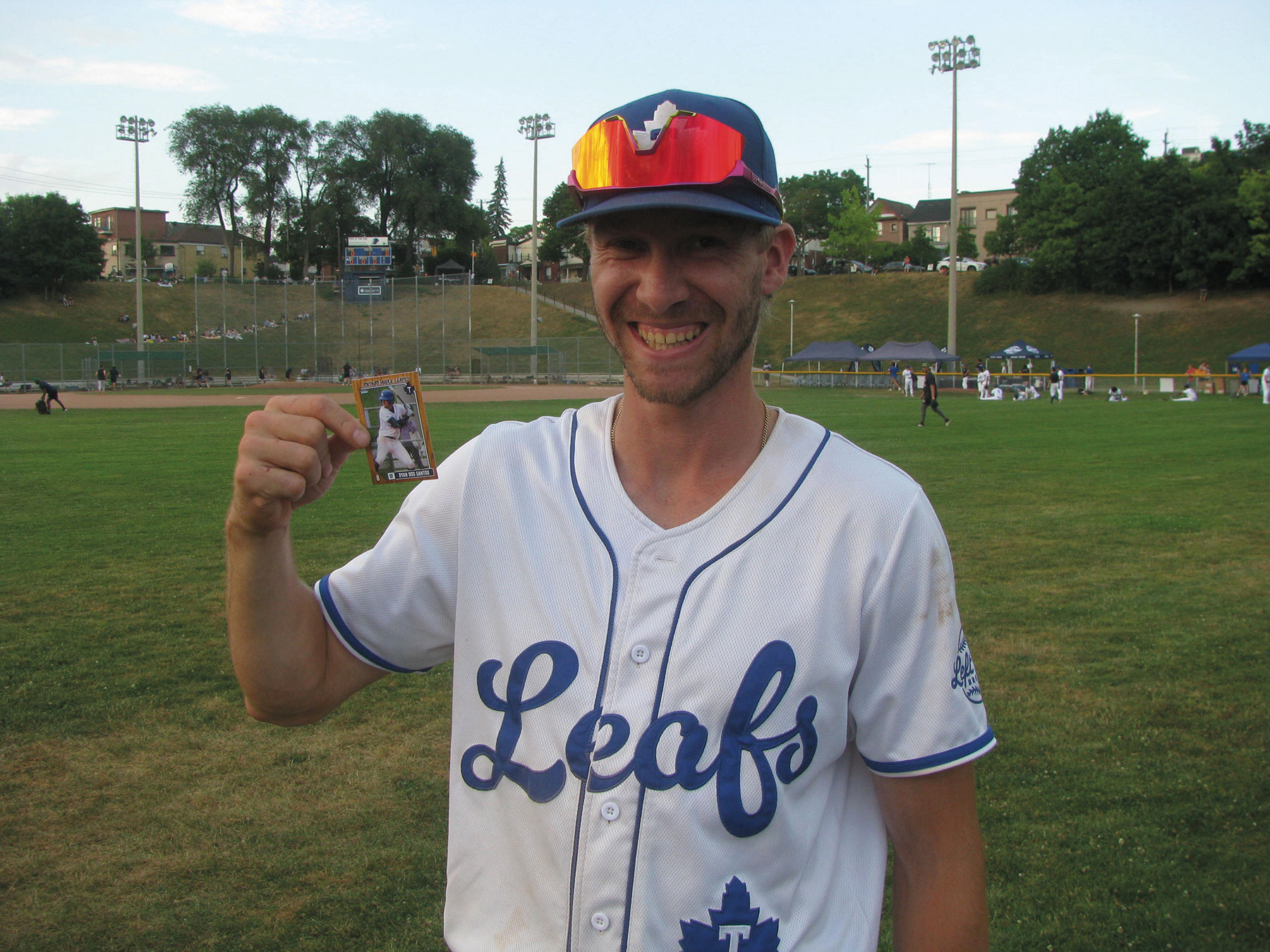
Ryan Dos Santos shows off his own Toronto Maple Leafs baseball card prior to a game at Christie Pits on July 11. For the first time ever, the Leafs have released a complete team set of cards available for purchase at the ballpark.R.S. KONJEK/GLEANER NEWS
By R.S. Konjek
The Toronto Maple Leafs baseball season is in full gallop.
For fans at Christie Pits that means lazy summer nights, home runs, and hot dogs.
The Leafs are putting on a charge for the Intercounty Baseball League championship. Halfway through the season, they hold fifth place in the standings. They are the second-highest scoring team in the league, guaranteeing audiences a show of offensive firepower each time they take the field.
Ryan Dos Santos is one of the horses pulling the blue and white chariot.
The 26-year-old Toronto native is having a career season. At the midway point, he leads the league in walks and is on pace to shatter the single-season record.
Of course, walks are not as sexy as home runs, but once he gets on base, Dos Santos makes the most of it.
He is among the league leaders in stolen bases, and he has scored more runs than any other player so far this year.
“I’m more disciplined away from my pitch,” Dos Santos says.
“Last year I set a career high for myself in walks, so I’m sticking with the same approach of looking for a fastball early. If I don’t get it, [I’m] not chasing a pitcher’s pitch on the outside to just put a ball in play but waiting for my pitch. It’s led to me getting on base a bit more through walks rather than hits, and my goal is to score runs.”
Scoring is definitely sexy.
Dos Santos first joined the Leafs in 2019. At the end of last season, he was selected co-MVP of the team in a players’ vote.
He loves the uniqueness of playing at Christie Pits, where games are free, fans can sit anywhere on the slopes surrounding the diamond, and the place has an aura all its own.
“The fans here are different. The atmosphere is different,” he said. “You have that home field competitive edge on most teams because of how different Christie compares to other stadiums. It’s not a full stadium but it gets loud like a stadium, which is awesome.”
Dos Santos is currently tracking another record, one which simply involves showing up.
Last season, he was the only Leaf to play every single regular season and postseason game. This season, he has not missed a game. If he completes two 42-game regular seasons in a row, he will be the first Leafs player to achieve that record of consistency.
In a league where players have to juggle baseball along with full-time jobs, family commitments, travel, and other facts of life, this consecutive-games-played streak is notable.
“Someone mentioned last year how I played every game,” he said. “Honestly, I like to make myself available for the guys and to the ownership here as well in that they signed me on [and] they’re going to have me for as many games as I can go out there and play. I’m all in good health and happy for that and hope to keep that going.”
Dos Santos expects to keep showing up whenever and wherever the Leafs take the field.
“I don’t plan on missing any games—knock on wood—yeah that’s the goal.”
Normally an outfielder, Dos Santos has also put in playing time at third base and shortstop, whatever it takes to help the team. He also senses a culture change in the team, as the Leafs move away from being a “swing for the fences” type club, with results to show for it.
“Guys are way more bought in for playing for each other, and more quality at bats,” he said. “We’re more of a base hit type team, driving in runs rather than so many fly ball outs, and I think that’s changed the win total.”
Even if the Leafs win an elusive championship this season, Dos Santos sees himself working counts, tearing up the basepaths, and scoring more runs for years to come.
“I think I’ll stick around,” he said. “Only being 26, I’m just entering my prime and understanding of baseball.”
In addition to the action on the field, the Leafs organization continues to roll out promotions and attractions.
In late June, former Toronto Blue Jays manager Cito Gaston made a guest appearance at the Pits. He signed autographs and posed for photos, and the club has confirmed he will make a return appearance later this season.
Fans and collectors now have an opportunity to grab some Leafs baseball cards. For the first time, a complete team set of cards has been released. It includes all the players, coaches, and even the club mascot. The cards are available during home games at Christie Pits and go for $20 a set.
The Leafs’ regular season continues to mid-August, followed by playoffs.