December 21st, 2020 · Comments Off on NEWS: Area long-term care homes and COVID (Dec. 2020)
There have been many outbreaks in long-term care homes across Ontario, including ones within the Gleaner’s distribution area. According to the province, Vermont Square, Kensington Gardens, O’Neill Centre and St. George Care Community have all experienced coronavirus outbreaks but have recovered since.
According to an October 30 statement from MPP Jessica Bell’s office, 62 residents and 47 staff tested positive for the coronavirus at Vermont Square. Executive Director Abiola Awosanya did not respond to the Gleaner’s request for comment by press time. The province shared that there were 11 deaths from COVID-19 in the home.
Vermont Square is now virus-free and is only allowing essential visitors, has increased cleaning and sanitation protocols, implemented bi-weekly testing for staff, and ensured a daily screening of all residents and staff.
Also, according to the province, eight residents of Kensington Gardens died from COVID-19, as reported in the May 2020 edition of the Gleaner. Kensington Gardens is now virus-free and has implemented stronger protocols similar to those at Vermont Square.
According to the province, there are 134 long term care homes in all of Ontario with an active COVID-19 outbreak, as of December 15, 2020. Also according to the province, 2,424 long term care residents in Ontario have died from the coronavirus since the beginning of the pandemic, and 292 locations have resolved their outbreak. Ryerson University’s National Institute on Ageing’s COVID-19 tracker, which includes data from retirement homes, reports much higher numbers, however.
Thankfully, the centres located in the Annex have fully recovered from the virus, and are taking extra precautions to prevent further outbreaks.
December 21st, 2020 · Comments Off on NEWS: Former City Councillor Ila Bossons, dead at 83 (Dec. 2020)
Ila Bossons, former Chair of the Annex Resident’s Association, died December 7 at the age of 83. Bossons served as a Metro and Toronto city councillor from 1988-2000, serving four terms through the turbulent period of Toronto’s amalgamation.
Metro Councillor Bossons represented Midtown, an area that included the Annex, but extended North to Eglinton. She was concerned with enhancing the city’s liveability, and known as a progressive who was independent of the unofficial NDP coalition.
An early advocate of recycling and bike lanes on Bloor Street, Bossons worked with the Toronto Conservation Authority to enhance protection of the city’s ravines. She also campaigned for provincial permission to let the city install cameras to catch people running red-lights.
Ila Bossons voted against Toronto’s 1996 bid to host the Summer Olympics. Again in 2000, she was one of only two councillors who voted against approving Toronto’s bid to host the 2008 Olympics, along with Michael Walker of North Toronto. At the time, bid chair David Crombie called the 54-2 vote a “ringing endorsement,” though Toronto ultimately lost to Beijing. Bossons argued the money would have been better spent on schools, housing and hospitals.
Ila Bossons was born in Germany in 1937. She attended schools in Munich, Madrid, Pittsburgh and New York. She leaves John, her husband of 56 years, her son Miles, and her brother Walter Haeberle. A full obituary will appear in an upcoming issue of the Gleaner.
—Nicole Stoffman/Gleaner News
Comments Off on NEWS: Former City Councillor Ila Bossons, dead at 83 (Dec. 2020)Tags:Annex · News
December 21st, 2020 · Comments Off on EDITORIAL: Ford attacks watershed protectors (Dec. 2020)
As the federal government adopts a bold plan to surpass its 2030 climate plan targets by dramatically hiking carbon taxes, spending billions to help Canadians retrofit homes, and provide massive incentives to carbon heavy industries to change their ways, the Ontario premier appears to be headed in the opposite direction. According to the auditor general’s recent update, this province is not even going to meet its miserly 2030 goal of reducing carbon emissions to 30 per cent below 2005 levels.
In early December, Doug Ford passed legislation to strip the power from local conservation authorities (CAs) who protect water quality and floodplains from the impacts of development. In addition, the provincial government has issued 38 Ministerial Zoning Orders (MZO’s) that override local planning rules, supersede municipal authorities, and allow developments on wetlands, farmland, and previously protected conservation areas.
The changes to the powers of conservation authorities were buried in an omnibus budget bill and come as a surprise to those authorities, but former Tory Cabinet Minister David Crombie saw the writing on the wall. Crombie, who chairs the Greenbelt Council resigned. Six of his colleagues from the council joined him in this move to protest the sneaky amendment of the Conservation Authorities Act. He said “this is not policy or institutional reform, this is high-level bombing and must be resisted.”
Minister of Municipal Affairs and Housing, Steve Clark, quickly tried to change the narrative suggesting the board members had failed “to expand the quality and quantity of the Greenbelt,” but no one is buying the idea that this provincial government is the true champion of the environment.
The bill, which is now law, forces Ontario’s 36 conservation authorities to allow development in environmentally sensitive lands. Though the CAs can attach provisions requiring the developers to enhance the natural environment, those provisions are now appealable to the minister of the environment directly and the minister’s decision on any appeal is full and final.
This fall, Aurora Mayor Tom Mrakas said city staff were shocked to learn that the minister of municipal affairs had issued an MZO for a 10-acre parcel of land in the environmentally sensitive Oak Ridges Moraine. The plan, done with zero consultation with the municipality calls for a new 128-bed long-term care facility and 75 detached homes. “I am not going to sugar coat… it’s not about making affordable housing, these houses are going to sell for a million dollars each,” said Mkrakas adding that the land has water table issues and that’s just one reason it’s not zoned for residential housing. “This is not how you grow communities, this is how you ruin them.”
Outside of the legislation, the government appears to be taking aim at the CAs themselves. Environment Minister Jeff Yurek has issued an edict to all 36 of the province’s CAs to begin to wind down all non-essential programming. This would include education centres like Black Creek Pioneer Village, trails, and SNAPS (sustainable neighbourhood action programs). Since this all comes at budget time, you might think this is about money, it’s not. The CAs are funded by the municipalities. This is a mean-spirited strategy to thwart the efforts of those in roles to protect the environment. Many of the these “non-core” programs fund the core conservation ones.
So while the federal government boldly acts on the urgent need to address climate change, our provincial government is busy de-clawing groups tasked with such things as flood plain protection. Ironically, the conservation authorities’ work is even more important in the extreme weather we experience as a result of climate change. Either Doug Ford does not see the connection or he doesn’t care.
December 21st, 2020 · Comments Off on FORUM: Ford’s fall agenda deeply flawed (Dec. 2020)
Environment, evictions, schools dominate final days of Queen’s Park 2020 Session
By Jessica Bell
Queen’s Park closed for the year on December 8. Here are the legislative highlights from the final few weeks:
The Ford government continued trampling on Ontario’s natural environment. Government Bill 229 stripped the power of local conservation authorities to protect water quality and floodplains from development.
We also learned that Premier Ford has issued 38 Ministerial Zoning Orders to allow developers to override local planning rules as well as municipal opposition in order to start building immediately on farmland, protected conservation areas, and wetlands. We calculate that 19 of these developers are PC party donors.
There are very few Ontarians who support these anti-environment moves. The government’s attack on Ontario’s natural lands is why six members of the Ontario Greenbelt Council, including former PC cabinet minister David Crombie, have resigned from their positions in protest. As Premier, Doug Ford is granted huge formal power, but he must use those powers for the good of the people, not for personal political gain.
The auditor general’s recent annual environmental report also exposed the Ford government’s failure to meet its own miserly climate change goal of reducing emissions by 30% below 2005 levels by 2030. It looks like they didn’t even try. Our collective work to tackle climate change goes beyond any four year term. In the coming weeks, we will be releasing our bold Green New Deal plan. I also urge all of us to work with local residents and groups (Fridays for Future, The Ontario Clean Air Alliance, The Palmerston Residents Association are a few examples) to push for real climate solutions.
Premier Ford said no one will be evicted during a pandemic, but in August the government lifted the eviction ban and now the Landlord Tenant Board is undergoing an eviction blitz. We are hearing disturbing reports of people being evicted without even receiving a notice of their hearing. There is no benefit to society or our economic recovery in evicting people who can’t afford to pay rent because they have lost their job to a pandemic. Ontario needs a well-run Landlord Tenant Board with competent and fair adjudicators, a moratorium on evictions during the pandemic, and rent subsidies so people who have lost their job can pay the rent.
In response to public pressure from so many of us, Doug Ford extended the commercial eviction ban so tenants can’t be evicted for non-payment of rent. The federal government has also eased the eligibility rules to access the Canada Emergency Rent Subsidy Program so tenants can apply directly for financial aid. Previously, businesses could only access this federal rent subsidy program if the landlord signed up.
Sadly, this rent subsidy program is too late for many. The Kensington BIA calculates that over 20 businesses have permanently closed since the pandemic began in Kensington alone. As we campaign for governments to save our main streets, I encourage all of us to shop at local independent stores for items we need. We have launched an ‘I Shop Local’ sign campaign for our area. If you want one for your window or business, please contact us.
Like every parent, I am watching the spread of COVID-19 in our schools very closely. The asymptomatic testing of staff and students at Thorncliffe Park School revealed 26 positive cases, and showed that COVID-19 in our schools is more prevalent than originally thought.
I support the government’s decision to listen to public health and quickly tighten public health screening guidelines for kids in schools. I know how hard is it take time off work to get your child tested for COVID-19, but I also know these measures, and many more, are necessary if we want to keep our schools open and our kids learning.
The money to do more is available. The latest Financial Accountability Office report reveals the Ford government is sitting on $12 billion in unspent COVID-19 funds, most of it transferred from the federal government. Some of these unspent funds must go to investing in smaller safer classes immediately and more expansive testing and contact tracing.
These holidays, I implore you to stay safe and follow all the public health rules as the pandemic’s end appears on the distant horizon. The global rollout of vaccines demonstrates the astonishing ability we have to survive and adapt. Let’s hold tight to our hope, ingenuity, and capacity for change as we tackle the bigger climate crisis to come.
Your support may prevent “ghost” towns on main streets
By Mike Layton
One of the most challenging years in recent memory is almost at an end, and I want to take this time to express my gratitude for the work of so many who saw us through. From our Medical Officer of Health and city staff, to local businesses, community groups and residents, it is clear that the majority of us want to work to overcome this pandemic, together.
As we still have many months of the pandemic ahead of us, it is also important to acknowledge the myriad of ways that pandemic fatigue can show up in our day-to-day lives. The overwhelming feeling of a sudden change is hard on everyone, and it affects people at different times, in different ways.
As I have said before, the pandemic has shown that together we can make transformative change happen quickly
—Mike Layton
However, it doesn’t alter the fact that it remains critical that we follow the advice of Toronto Public Health, and that we get our information from reliable, informed sources.
I continue to have full confidence in Toronto Public Health to learn, adapt, and evolve as new information becomes available to guide our response and keep Toronto residents safe.
One of the most pressing current effects of the pandemic we are facing is the strain on small businesses in our city.
The problem is a national one, with the Canadian Federation of Independent Business estimating earlier this year that 225,000 businesses across Canada are at risk of permanent closure due to COVID-19 measures. These measures are saving lives, so it is important that we continue to create ways that we can adhere to them, while also supporting local business.
I want to express how important it is that we continue to shop locally. Apart from the social andcommunity building benefits, studies have actually proven that locally owned stores generate much greater benefits for the local economy than national chains.
This is because, overall, locally owned businesses generate 70% more local economic impact per square foot than chain stores, with small businesses generating an average of $68 of local economic return for every $100 spent.
Local economies languish not because too little cash comes in, but because shopping at big box stores ensures that most of the money you spend flows out.
Among the many downsides, big box stores regularly bring with them lower pay, net job losses – even though they advertise job gains – from forced local closures, in addition to declining tax revenue. When you choose to buy your next item through curbside pick-up at a local shop, that money will stay in the city and keep our local economy going.
It sounds simple, but these small actions can literally save neighbourhoods from becoming ghost towns, or the even more prevailing, “clone towns” – where every street houses the same big box fast-food and retail options.
I also know that times are tight for many, and for some, the money is just not there. So I wanted to also make clear that another way you can support local business is to share online. Write a review and tell others about a great experience you’ve had at a small business. “Like,” comment and share their work on social media; subscribe to their email list. Often small business owners are just one or two people, so helping to get the word out for them will go a long way.
As I’ve mentioned before, the pandemic has shown that together, we can make transformative change happen quickly. I know that there is more that still must be done, and I remain committed to working with you and my council colleagues to ensure that no resident is being left behind.
As always, my staff and I are here to assist in any way we can. Please don’t hesitate to contact my office by emailing Councillor_Layton@toronto.ca or calling 416-392-4009 to let us know your questions and concerns.
Mike Layton is the councillor for Ward 11 University-Rosedale.
December 21st, 2020 · Comments Off on FOCUS: Ring Music shuttered (Dec. 2020)
A deeper look reveals a storied past
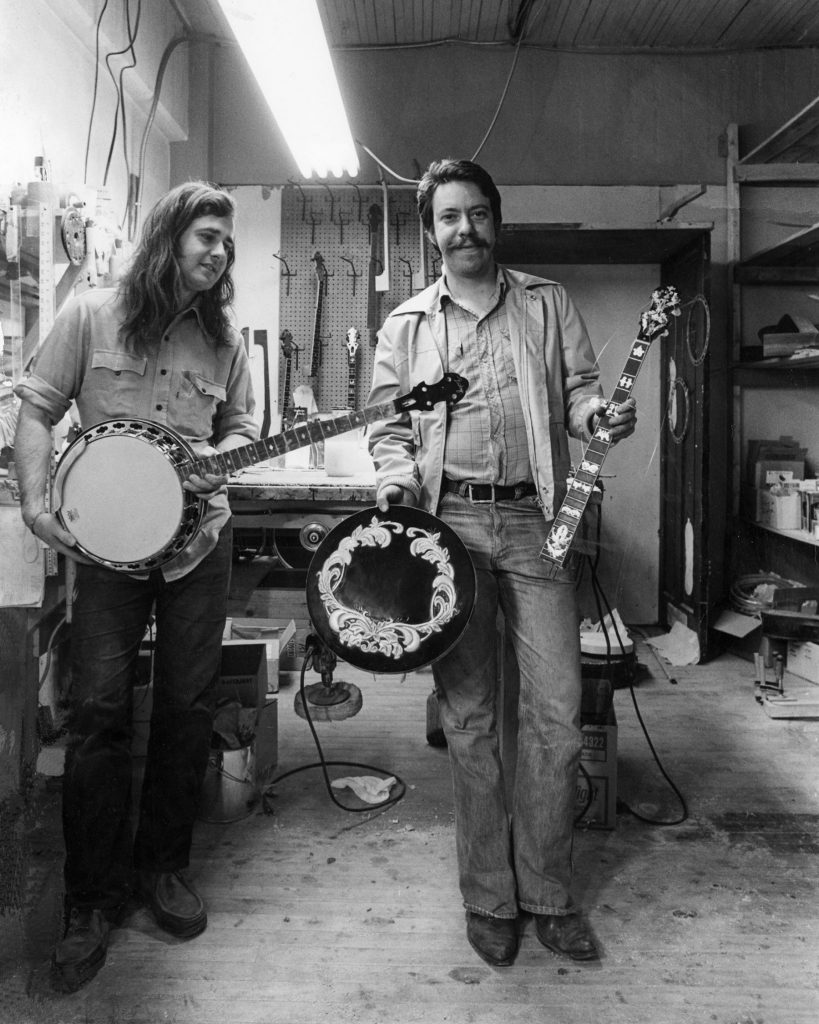
Bruce Dowd (L) and Bill Wager (R), 1974 or 1975. COURTESY MICHAEL MCLUHAN/RING MUSIC
By Nicole Stoffman
Ring Music, the guitar shop at 90 Harbord St., whose customers included Gordon Lightfoot, Bruce Cockburn, and Lenny Breau, has closed after 51 years in business.
Owner John La Roque says he’s “Working away on a new album,” and the now-empty storefront heralds the end of an era. Ring’s closure presents an opportunity to tell its little-known history.
It all started when musician Bill Wager arrived in Toronto from New York in 1969, with a few hundred dollars in his pocket. His new bride insisted he get a real job, so he took a walk down to Queen St. West to ask for work at a printers’ shop, having had experience in that industry.
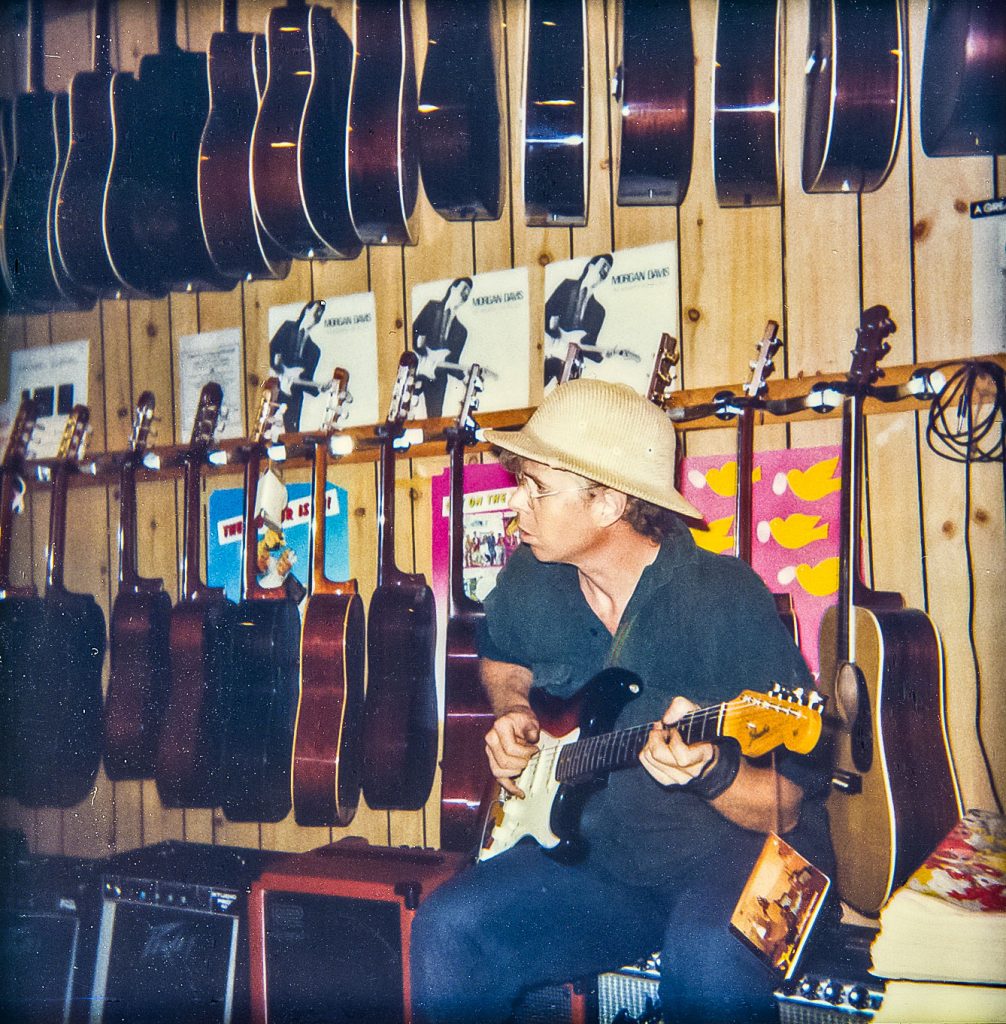
A guitar gets the Bruce Cockburn treatment, 1983. COURTESY MICHAEL MCLUHAN/RING MUSIC
He saw a guitar in the window of a pawn shop and knew he could sell it for twice the price. Wager had learned a great deal about guitars from Dan Armstrong, the inventor of the world’s first clear plastic electric guitar, and owner of a guitar shop on 48th Avenue in New York.
Wager repaired the instrument and put it in the shop window of Ring Music, an audio store (named after the Lord of the Rings) that his friends had just opened at the southeast corner of Harbord and Spadina.
The guitar sold two days later so Wager, “went cruising pawn shops,” to buy more guitars, fix them up, and sell them at twice the price. Soon he was splitting rent with Ring Audio. A short time later he set up Ring Music in the back of the store, where he also did repairs.
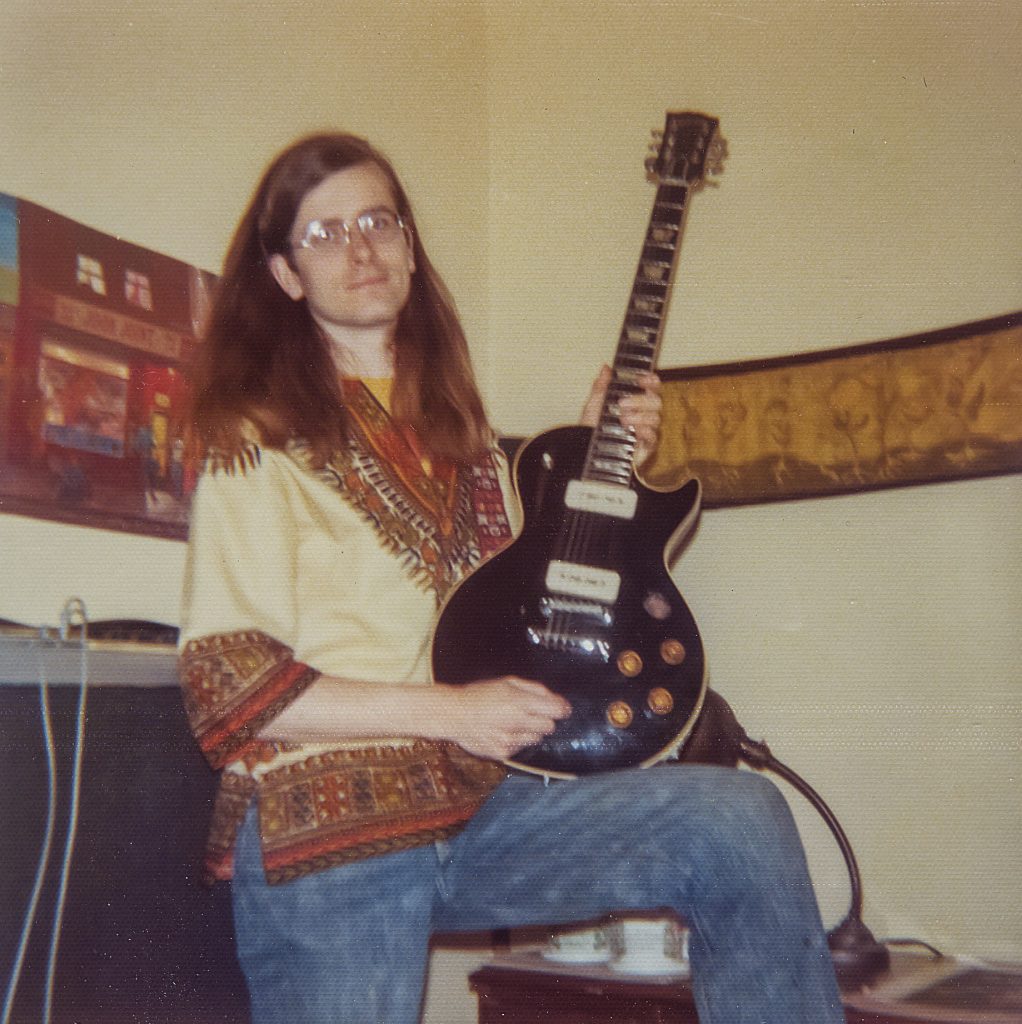
Michael McLuhan, 1973 or 4, with a 1956 Les Paul Guitar, this is a very prized guitar nowadays, worth about 250K. Then it could be had for less than $1,000. COURTESY MICHAEL MCLUHAN/RING MUSIC
“Then weird things started to happen,” Wager told the Gleaner. “One day I see a nylon string classical guitar. It’s not my expertise, but something said, ‘Buy me.’ I bought it and brought it back to the store. I put it in the window. A few days later, this lovely blonde girl walks in and says, ‘Can I try it?’ I said, ‘Sure!’ I’m surprised the guitar didn’t melt, she was so good. She was fantastic. We were all standing there, our jaws on the floor. It turns out it was Liona Boyd.”
When U of T built the Benson Athletic Centre in 1972, Ring Audio moved to Queen St. West and Ring Music moved to 90 Harbord St. The following year, Michael McLuhan, son of Canadian media guru, Marshall McLuhan, joined Ring to apprentice with Bill Wager and luthier Bruce Dowd. Michael was so good with the customers, that within three months, he was running the front of the store, too. “He never threw any customers out of the store like I did,” explained Wager.
Ring music attracted a professional clientele with its reputation for guitar repair. The Bay City Rollers called Ring to repair their instruments when they were in town. In order to avoid being mobbed by girls in the street, the Rollers asked that their instruments be picked up and dropped off at the hotel. Ring Music provided the same type of pick up and delivery service to Gordon Lightfoot, who reciprocated by wearing his Ring Music T-shirt in public, and being interviewed for Ring’s radio ads, as did Ian & Sylvia Tyson.
The store’s humble facade of recent years does not reveal how much of a storied place it is. Bill Wager and his team once inlaid a diamond into Ian Tyson’s fretboard. Bruce Cockburn once coached a young boy from Grimsby how to play his song “Foxglove,” in the store.
“I remember Bruce Cockburn coming in and trying guitars and the way he’d treat the guitar was like his was giving it a chiropractic treatment,” recalled Nathan Hiltz, an employee from the 2000s.
Other notable customers included Lightfoot’s guitar player, Terry Clements, Mick Taylor of the Rolling Stones, Dave Wilcox, Jim Cuddy, Tom Cochrane, and Lenny Breau, considered to be one of the greatest jazz guitarists of all time.
“He was always penniless,” recalled McLuhan of the Canadian Music Hall of Fame inductee. “Which made it a bit of a problem to service him, because we did have to get paid.”
Penniless or not, working musicians were always welcome at Ring Music.
“You wanted to come to us because we could get you happenin’,” said McLuhan, who purchased the store in 1974. “Everything was on a handshake basis.”
They prided themselves on making used instruments, some of which had been in terrible accidents, road-worthy again.
Ring Music was sold again in 1984, this time to John Laroque. McLuhan had hired Laroque in 1982 to learn repair and to look after customers. LaRoque expanded the business into new guitars and a started a music school.
The store was a haven for former employee Nathan Hiltz, who came to Toronto from Halifax in 2000 as an aspiring young jazz musician. New to the Big Smoke, he found his community by simply crossing paths with other players.
“Ring has always been a very welcoming, helpful place, built around very caring people,” said Hiltz. “Toronto becomes a little less nice, a little less cool, a little less comfortable every time a guitar store closes.”
The mystique of Ring Music was rooted in Bill Wager’s own credentials. In New York, he had played on demos in the Brill Building, which famously housed songwriters and music publishers that wrote some of the greatest American popular music. Songwriters would use the demos to shop songs to artists. Wager played on the demo for “You Keep Me Hanging On,” made famous by the Supremes. He also played bass and guitar on occasion for the Cavalcade of Stars, where he recalls backing nine year old Stevie Wonder.
Ring Music also helped create a market for vintage guitars.
“In 1969 there was no vintage market, there were only used instruments,” said McLuhan. Ring became known for servicing electric guitars, including big jazz arch-top guitars from the forties on up. Arch-tops feature an ‘f-hole,’ similar to that of a violin. They are prized by jazz and blues artists alike for their big, complex sound. “We developed this insane reputation as those instruments started to become revered as vintage instruments.”
Ring music also helped to launch the career of world-renowned luthier Linda Manzer, when they bought her first guitars. Based in Toronto, Manzer now makes guitars for the likes of Paul Simon and Pat Methany. Her creations can be seen in the permanent collections of The Canadian Museum of Civilization and the McMichael Art Gallery.
“Ring was the hub of musical and social activity, and it was always exciting to walk in because you never knew who you were going to see playing a guitar or end up in a lively conversation with,” said Manzer.
At Ring Music, it was more important to resurrect guitars, often with homemade parts, than to restore them with original parts. A case in point was a 1942 Vega Deluxe hand-carved in Boston, with a Maple back and spruce top. One day, the Vega Deluxe came into the shop an accident victim, missing the back and neck, and with a crushed brace. After being revived at Ring Music, it was owned by McLuhan, then LaRoque, and eventually Nathan Hiltz, who wasn’t looking for a guitar at the time.
“People now borrow this guitar from me to do recordings,” says Hiltz. “I didn’t have money to buy a lot of guitars, so it was a big deal for me to buy it, but I was guided very, very well.”
Comments Off on FOCUS: Ring Music shuttered (Dec. 2020)Tags:Annex · Arts · Life
Brave entrepreneurs open a restaurant during COVID
Serine Shi amd Nigel Schwartz, seen here in front of their College Street location, have opened a new spot on Bloor Street just west of Spadina Road. The couple have enjoyed much success despite COVID-19 restrictions. MARY AN/GLEANER NEWS
By Mary An
The Daily Dumpling Wonton Co. opened a second location on Bloor Street this October, just as COVID-19’s second wave gathered strength.
“We’ve seen a lot of growth during COVID-19. It seems to be something that people want right now,” says Nigel Schwartz, co-owner of the restaurant.
In the beginning of 2019, Schwartz and his partner Serina Shi, opened their first restaurant on College Street, just east of Ossington Avenue.
The Daily Dumpling Wonton Co. offers freshly made wontons created and prepared by the owners. The dumplings and wontons are filled with different ingredients such as meat or vegetables, but wontons are often round and served with broth.
The Daily Dumpling Wonton Co., offers three different unique sauces to go with their hand-made wontons and numerous side-dishes.
According to Schwartz, the couple started their business with a take-out mind-set. In August 2018, they rented a commercial kitchen space at The Depanneur, where they “did countless rounds of testing recipes.” Two months after nailing the recipe, they started operating as a “virtual kitchen” on UberEats.
Their business plan also included selling their frozen wontons at local grocery stores. Once they opened up their first restaurant, many customers would either take-out or purchase their wontons.
“We weren’t as affected as a sit down or dine-in restaurant in that regard,” Schwartz said. “And we have not experienced a significant drop in our business compared to other restaurants because we have a pretty loyal customer base.”
According to Shi, many people have a special connection to the meals created by the Dumpling Wonton Co.
“The kind of dumpling we serve is specific to Shanghai, where people eat them daily, like a comfort meal,” says Shi.
Shi says she grew up with the scent and taste of wontons, and cooking them has helped her to settle into life away from home.
“When I moved to Canada alone at 16, making wontons became a solo activity that I did to connect back with my family and culture,” she says.
“As a new immigrant to Canada, opening a wonton shop helped me form a strong connection between me and this city, making me feel much more at home in Toronto.”
December 21st, 2020 · Comments Off on FOCUS: Pivoting from the pulpit with new technology (Dec. 2020)
Churches and synagogues ready for on-line services
By Mary An
Nine months into the global pandemic, religious communities have shifted their pulpits onto digital platforms. With Christmas coming, churches seem to be taking the social isolation mandates that limit their ability to connect physically with congregants in stride, while enjoying expanded audiences and in some cases, even surprisingly intimate connections.
In a way, we’re engaging more people because people don’t have to go out of their houses, and they’re coming from far away…So, there’s a blessing
—Rabbi Elyse Goldstein, City Shul
Colin Phillips, Chair of the Board at Trinity St. Paul’s United Church, says having live-streamed and pre-recorded services has helped gain more attention from people in “other places in Canada and the world.” Online streaming has grown audiences for Sunday services to more than 300 people who watch either through social media or the church’s website – although some people seem to be choosing to view the services on other days of the week. This new form of connection also seems to create a new kind of closeness.
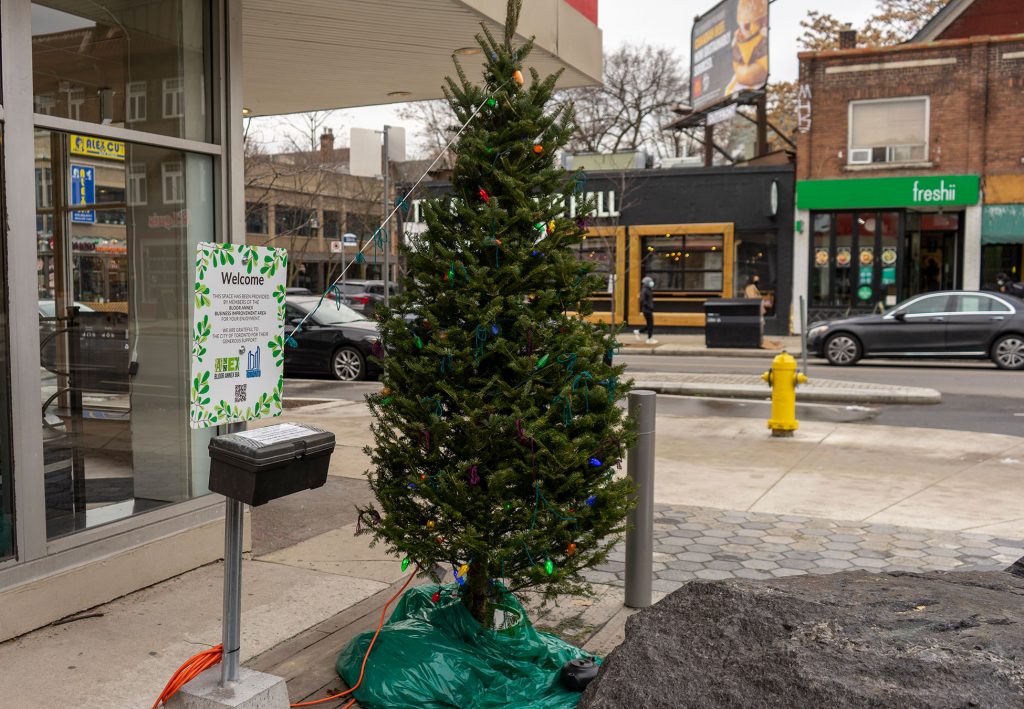
Trinity St. Paul’s United Church has opted for an outdoor wishing tree due the lockdown. The Bloor Annex BIA parkette on Major Street is a perfect spot for this popular pop-up. NEILAND BRISSENDEN/GLEANER NEWS
“The randomness and intimacy of Zoom breakout rooms has made for unlikely connections between congregants who might not otherwise talk,” wrote Phillips said in an email to the Annex Gleaner.
Other religious organizations have shared this experience.
“In a way, we’re engaging more people because people don’t have to go out of their houses, and they’re coming from far away,” says Rabbi Elyse Goldstein from City Shul. “We have people coming to our [online] services from Israel, New York, Boston, and Virginia. So, there’s a blessing.”
The weekly celebration of Sabbath days continue through digital platforms as other occasions do, but with some challenge presented by the meaning of those days.
According to Rabbi Goldstein, on the Sabbath, people are meant to “cease from being involved in the commerce of the world,” by taking a day of rest from technology, work, or shopping.
“It’s very personally hard for me, because I don’t have a day of rest,” says Rabbi Goldstein. “But, my congregants like it. They feel taken care of and that’s what’s really important.”
Other creative ways of connecting were seen in September through the Jewish High Holidays of Rosh Hashanah and Yom Kippur. The synagogue held an outdoor drive-in service at Ontario place, where 135 cars arrived, and celebrations were visible on a big screen.
Trinity St. Paul’s United Church also has their doors open with physical distancing measures in place and a maximum of 10 people allowed at any given time within the sanctuary. Activities that create camaraderie, such as cooking food for one another along with their outreach programs, holiday prayers and traditions, after-choir practice, and hosting pageants, will all continue with social distancing measures in place – or they will take place online.
“The pandemic has been a time to live out the old adage that the church is more than a building,” wrote Phillips.
Comments Off on FOCUS: Pivoting from the pulpit with new technology (Dec. 2020)Tags:Annex · Life
Welcome to December, month ten (give or take, depending on what date you track back to) of life in a global pandemic. Understandably, you might be struggling to conjure holiday feelings this month. Let’s remember, however, that it is “always darkest before the dawn,” and that on December 22, the days start getting longer. So let’s find out what the institutions associated with the Bloor St. Culture Corridor have in store.
Keep traditions alive. You can’t go see live music, but you can support musicians so that they can keep playing music and so that one day, when we’re all allowed to sit shoulder to shoulder once again, there will be people to play for us. So if you are into Christmas traditions, be sure to purchase tickets for A Tafelmusik Christmas. This event brings members of the Tafelmusik choir and orchestra together for the first time in 2020, and will see them perform a joyous chorus and tender chorales from Bach’s Christmas Oratorio paired with a radiant chorus from Charpentier’s Christmas Pastorale. Ticket holders will have access to the concert for 48 hours following the broadcast date on December 12 at 8pm EST.
Enjoy riffs on tradition. Register to enjoy Electric Messiah, a full-length music video that reflects the city of Toronto as it is today with a feast of musical styles ranging from jazz, to soul and hip-hop. Included, of course is a re-imagining of Handel’s Messiah, brought to you free by Soundstreams on December 17. This event is free.
Connect. If you are a senior feeling isolated, the Miles Nadal JCC has set up a program to help you feel less alone. The community centre hosts a bi-weekly seniors support group led by Zoe Levitt, a trained social worker who specializes in working with older people and their families, and who is passionate about helping people work through social, emotional and physical challenges that may be acting as a barrier to the life they want to live.
Learn. Brushing up on your French is easy through the Alliance Francaise. Their Frantastique program sends play-based French lessons to your inbox DAILY regardless of your fluency level.
Give. Want to help keep an important Bloor/Annex cultural institution open? Buy a brick and help A Different Booklist Cultural Centre (ADBCC) move to its new location in the new Westbank Development. With a minimum $100 donation, your name will be engraved in a legacy brick at the ADBCC for all to see.
Get Outside (while staying inside). Enjoy a descriptive audio tour of Royal Ontario Museum’s winning Wildlife Photographer of the Year Competition. This is the 56th year of the competition, and it brings photographs from around the world to the ROM. There are 13 intriguing stops on the tour, the only problem being that before getting too far in – you’ll be so keen to see the photos that you’ll purchase a membership at the ROM.
Plan to shake things up in 2021. A better world is possible. Here’s hoping 2021 allows us out of the house long enough to re-shape it. For endless inspiration on the work that has been done and will continue, for stories of visionaries, daring leaders and joyful change, check out the streaming line-up at Hot Docs. Watch First We Eat, a story about a family in the Yukon that bans all store bought groceries for a whole year; or I am Greta, to get up close and personal with teen climate icon; or Rock & Roll President, the story of how a late night bottle of scotch with Greg Allman brought Jimmy Carter to the Whitehouse.
Creators have not stopped creating, and culture is still worth craving, so don’t stop. Keep seeking ways to engage, wear your masks and stay safe. A new year is coming, let’s make it the one where we kick COVID-19 to the curb.
December 4th, 2020 · Comments Off on ON THE COVER: Renewing Martel’s vision (Nov. 2020)
Paul Richard (left) and Joseph Sagaj, part of a team of Indigenous gardeners, have been working tirelessly to bring Paul Martel Park (located on Madison Avenue, north of Bloor Street) back to its original vision. Click here to read more. BRIAN BURCHELL/GLEANER NEWS
December 4th, 2020 · Comments Off on NEWS: Park set for improvements (Nov. 2020)
Joseph Burr Tyrrell Park named after dinosaur hunter
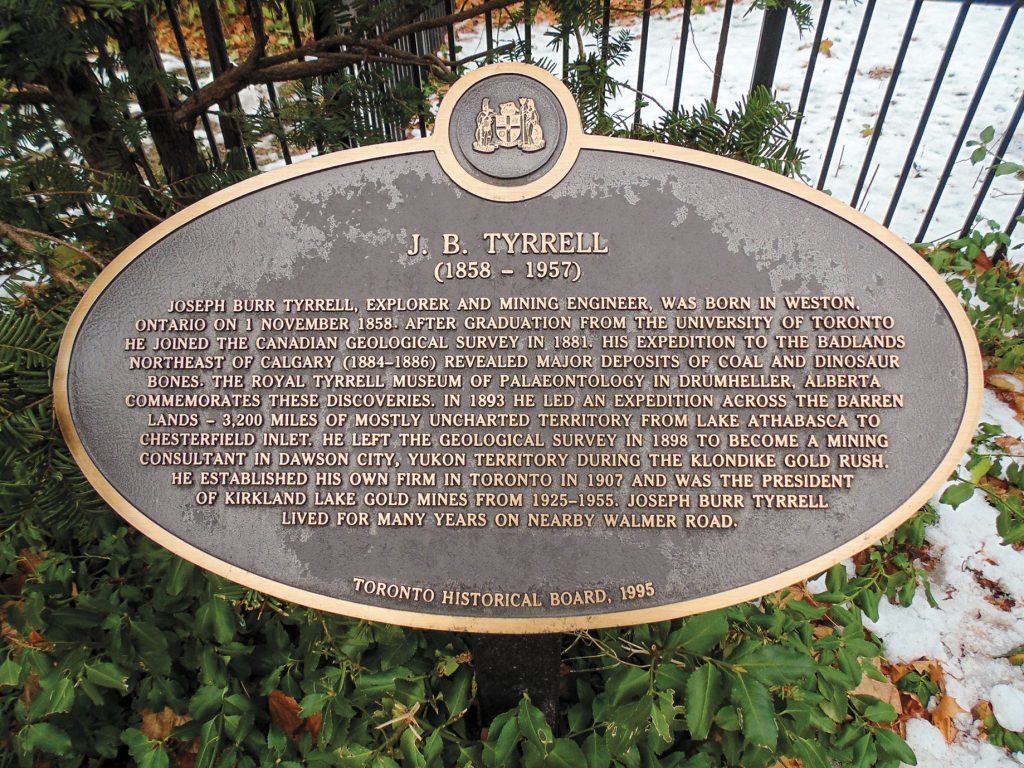
A plaque memorializes the long time Walmer Road resident. BRIAN BURCHELL/GLEANER NEWS
By Tanya Ielyseieva
A plan to redo Joseph Burr Tyrrell Park (Dalton Road and Bloor St. West) is set to be completed by the end of next year, with construction scheduled to begin next summer.
The park is one of the smallest in the Annex and has been in need of renovation for some time.
“I started living a few houses down from the park a decade ago. No children really played in it,” said Gillean Bernier, a community member, and volunteer. “It was a scary place filled with drinkers and homeless at night, and the sand was filled with broken glass. Some of the families I now know even habitually called it “Glass Park” and never let their kids play there. The park has a long history as a place of drugs and drinking. It is not a nice place.”
The community played a large part in the redesign process and worked with the councillor’s office, staff at the Toronto Parks, Forestry and Recreation Division, and The Annex Residents’ Association (ARA) to develop a plan for improvements.
Bernier, who is an architectural designer, adds that a lot of the park’s problems are design-related.
“The original planner intended good things,” she says, “but the dense bushes and gated paved areas are wasted space that do not invite people in.”
Bernier approached Councillor Joe Cressy’s office several years ago to start the redesign process, and says she was pleased at the way Councillor Mike Layton and his director of operations, Marco Bianchi picked up the project.
“We discovered the park had gotten into the city’s list for improvement projects, so we didn’t have to start from scratch,” she says. “Last summer the city planted new trees, and a neighbour donated a bench. It was a great improvement, and everyone was excited for what it could really turn into when a true re-design happened.”
In a letter to the ARA, Bianchi stated that, “there may be disagreements to the proposed direction, but by maintaining as transparent a process as possible these conflicts should be mitigated by the fact that the park is being designed in a way that we hope the vast majority of residents and park users can get behind.”
According to the city, the park is being improved as a state of good repair project and to improve accessibility with new pathways, seating areas, site lines, and a playground.
A design team has developed three preliminary layout options for the park based on an online survey, where residents shared what they wanted to change in Joseph Burr Tyrrell Park.
“The goal was to open the park up visually to the street, reclaim the wasted spaces as part of the park, offer even more seating, shaded from the sun. Everyone agreed that while the play equipment didn’t look fancy, they really were still the best swings and slides in the whole neighbourhood,” said Bianchi of the residents’ offerings. “We would not object to having the playground equipment painted to look fresh. Some members of the community would prefer dogs to be excluded, while others love that the dogs come. I think this will be the strongest point of negotiation for the redesign, but I believe a holistic design for the community will emerge.”
According to the city spokesperson, Forest and Field Landscape Architects have been retained for the design and contract administration of the project. The project budget, including construction, testing, 3rd party inspection, and soft costs (surveyor, consultant, arborist, etc.) is estimated at approximately $350,000.
Who was Joseph Burr Tyrell?
Joseph Burr Tyrrell was a geologist, mining consultant, mapmaker and explorer. He is best known for his discovery of dinosaur bones (Albertosaurus sarcophagus – flesh-eating Alberta lizard) in Alberta’s Badlands, and coal in the vicinity of Drumheller. Tyrrell was born in Weston, Ontario, in 1858, and began working for the Geological Survey of Canada in 1881 after graduating from the University of Toronto. He worked there from 1882-98, and during that time, explored and surveyed the natural history and mineral resources of the country’s remote regions.
Before working on independent assignments, Tyrrell was an assistant to another great figure in Canadian geology, George Mercer Dawson. Working together, the two men made a few important surveys of the Rockies to secure accurate information about coal deposits, and to collect plants, fossils, and other natural history materials.
While he was mapping and studying the geology of the land north of Calgary and east of the Rockies, he discovered the remains of dinosaurs in the Red Deer valley. These remains started the collection of fossil vertebrates currently held by the National Museum in Ottawa.
Tyrrell was a recipient of honorary degrees and distinctions, including The Black Medal of the Royal Geographical Society, The Murchison Medal of the Geological Society of London, and The Flavelle Medal of the Royal Society of Canada.