March 26th, 2021 · Comments Off on FORUM: CaféTO and ActiveTO city programs coming back (Mar. 2021)
Many reasons for optimism for the year ahead
By Mike Layton
The huge success of last year’s ActiveTO and CaféTO projects has shown that Torontonians are eager for safe opportunities to walk and bike around our city, and to patronize local establishments that have struggled over the last year. Locally, residents from across Ward 11 have seen the ways that inspiring actions taken in their neighbourhoods can significantly increase quality of life as we navigate through our recovery period.
The City of Toronto is now in a unique spot to be looking towards redefining our streets away from traditional, and one-sided, use.
More specifically, the ActiveTO program is dedicated road space that facilitates active transportation for essential trips and physical activity, and was a significant component of the Toronto Office of Recovery and Rebuild’s COVID-19 — Impacts and Opportunities Report. It’s become clear that transportation infrastructure will be critical for Toronto’s recovery, and will ensure a pathway to build back better and prioritize investments that support key priorities all through an equity and resilience lens.
ActiveTO is composed of three main programs; Major Road Closures, Quiet Streets and Cycling Network Expansion. Over the past year, this set of programs allowed for the largest expansion of cycling infrastructure in the city’s history and supported thousands of safe cycling and walking trips.
The major road closures were short-term recurring closures (i.e. weekends and holidays) of major roadways adjacent to popular trails to provide more space for walking and cycling, thus enabling physical distancing. The program was deemed a success as thousands of people made use of it with record numbers in May and then levelling off to over 36,000 people during weekends in June, July and August.
As Transportation Services has proposed that the ActiveTO Major Road Closures program continue in 2021 and beyond, one exciting addition to this project that I would like to share is city staff’s recommendation that a Complete Street ActiveTO Pilot be installed on Yonge Street this year. The pilot will not close Yonge Street, but will see the addition of patio spaces, cycling infrastructure, and a separation between pedestrians and the roadway. Parking will still be available and drivers will still be able to travel through the area.
A midtown ActiveTO connection is essential, and it is clear that Yonge will provide the best possible route due to the number of businesses it will help support; the needed safety enhancements it will provide; its location on a subway route; and its low traffic volumes compared to Avenue Road and Mount Pleasant – the other two streets that staff evaluated.
As we continue to navigate the new and difficult circumstances created by the pandemic, I strongly believe that the Yonge Street pilot will go a long way in supporting residents and businesses. The installation of on-street patios, protected bike lanes, parking and delivery areas, and beautification measures will ensure that everyone can safely enjoy Yonge Street this summer.
In the pilot, city staff will be taking best practices learned from successful projects such as “Destination Danforth,” and adapt them to Yonge Street through consultation with businesses and residents, and through ongoing refinements based on data and community feedback. I look forward to being part of that process, and will also share the opportunities for public consultation through my newsletters and website as they become available.
I want to thank residents for contributing their ideas and support towards making our neighbourhoods more conducive to green infrastructure and active living.
As always, please don’t hesitate to get in touch with my office with your questions or concerns at Councillor_Layton@toronto.ca or by calling 416-392-4009.
Mike Layton is the city councillor for Ward 11, University—Rosedale.
March 26th, 2021 · Comments Off on FORUM: Vaccines, development, judicial reform dominate Queen’s Park (Mar. 2021)
Massive power grab by Ford with Omnibus Bill 245
By Jessica Bell
I was sitting near MPP Sol Mamakwa in question period, when Premier Ford accused Ontario’s only Indigenous MPP of jumping the vaccination queue after he flew into a remote community to be vaccinated.
MPP Mamakwa had been invited by First Nations leaders to address vaccine hesitancy among Indigenous people, many of whom have been traumatized by the healthcare system’s systemic neglect of their needs. MPP Mamakwa did not jump the queue.
Doug Ford’s accusation was racist. It was also an attempt to distract from the government’s messy vaccine rollout as it implies that MPP Mamakwa and First Nations people are somehow responsible for others having to wait longer for their vaccine.
Questions and concerns about the vaccine are the top reasons why residents are contacting our office. Residents want to know when they’re eligible for the vaccine, where they can register, who is being prioritized and why. These are critical questions because for some of us, COVID-19 is life threatening.
This is the largest vaccination campaign in Canada’s history. We should expect and accept a few hiccups. The biggest issue Ontario faces is a critical shortage in vaccines, which is not the provincial government’s responsibility.
Now here’s where Ontario could do better: the government factors in vulnerability, risk of exposure and age to determine vaccine priority. Experts have assessed the government’s framework as mostly ethical, but there have been some gaps.
We have been asking the government to take an equity-based approach and move people with disabilities and underlying health conditions further up the queue.
We have been advocating for the government to allocate more vaccines to postal codes that have higher COVID-19 spread, such as Scarborough and Peel.
We also want the government to do a better job of distributing vaccines fairly to accommodate the fact that some regions, like Toronto, have a higher percentage of people eligible for a shot in phase 1, like health care workers. It’s a failure to be fair that led to some public health units to vaccinate people over 80 while some PSWs working in long-term care homes in Toronto were still waiting. These equity issues should be fixed.
Ontario’s vaccine registration system is just plain bad. Every public health unit in Ontario had to set up their own registration system because the Ontario government did not have a working registration system set up in time. They had a year to get this right, and they didn’t.
If you have additional questions or concerns about the vaccine rollout that you believe I should raise with the government then please contact our office.
While vaccines dominate the news, at Queen’s Park, the government is introducing legislation that has nothing to do with health. Here are three bills that we’re debating that you should know about.
Bill 245, the Accelerating Access to Justice Act, further limits the participation of municipalities and residents in land use planning decisions.
Bill 245 merges the Local Planning Appeals Tribunal into a new mega-tribunal called the “Ontario Lands Tribunal.” This new tribunal gives adjudicators the power to dismiss a hearing without listening to the evidence, bans most appeals to tribunals, and limits everyone who is not the lead applicant to just giving written testimony at hearings. Bill 245 also gives the Attorney General more say over the judicial appointment process, politicizing a judge-selection process that is recognized as a global model of fairness and impartiality.
Bill 25, Protecting Ontario Elections Act, doubles the maximum donation Ontarians can give to a political candidate from $1650 to $3300. This is a blatant re-jigging of the rules to help the Conservatives raise more money for the next election. Bringing big money back into politics will mean that everyday people who cannot afford to donate $3300 will have even less influence over the Conservative government.
Finally, Bill 261, the Supporting Broadband and Infrastructure Act gives the Ontario government even more power to use Ministerial Zoning Orders (MZOs) whenever and wherever it wants.
If this law passes, the government will not only be able to use MZOs to override municipal rules and impose its own planning rules, but will be able to exempt itself from key provisions of the Ontario Planning Act. Recently, the government has issued dozens of MZOs on land being developed by developers who have donated to the PC party. This is unethical, and not how planning should proceed at all.
Instead of debating planning laws, I believe we should be approving measures to get us through this crisis. Here are a few ideas: an eviction moratorium, more support for businesses, paid sick days, safer schools, and more funding for public health. That’s what I’m fighting for.
March 26th, 2021 · Comments Off on FOCUS: Community concerned over 225 Brunswick Ave. plan (Mar. 2021)
Former synagogue may turn residential
The one-time synagogue located on Brunswick has been offices since 1972. A developer proposes adding a floor and building seven residential units. Not all neighbours are thrilled with either the density or the change in built-form on the low-rise streetscape. LUCA TATULLI/GLEANER NEWS
By Luca Tatulli
A unique character building with an interesting history graces the corner of Brunswick and Sussex avenues in Harbord Village. In the 1930s, 225 Brunswick was a synagogue for one of Toronto’s oldest Jewish Orthodox congregations, Shomrai Shabbos Congregation. In 1972, the building came to host the Toronto School of Art. Currently, it houses four different tenants including the Annex Designers and Writers Co-op, The Childcare Resource and Research Unit, and a policy research institute.
If Kopas Developments has its way, the two and a half story building will house seven residential apartments and include an additional floor.
The building’s neighbours have voiced differing opinions, including some strong opposition to the plan.
Jeff Kopas, president of Kopas Developments, says his company has been working on the proposed development for the past three years.
“225 Brunswick is a beautiful and unique character building in our community,” his company wrote in a letter to residents dated February 21. “But it is in disrepair and having been built as a synagogue that has always been used as a commercial building it no longer has a legal usage. It makes sense to adapt it for residential usage.”
A number of residents in the community have cited issues with the development’s re-design, size, and number of units. Some residents also see the upgrades as disrespectful to the historical significance of the building and have taken issue with the proposed redesign not fitting into the existing built form of homes on Brunswick Avenue.
“I have no problem with the number of apartments specified in the proposal. I’m not concerned about parking. We need more density in the downtown area. I take issue with the postmodern eruption along the south facing roofline,” said resident Paul Aitken. “It’s in very high contrast with the style of the existing building, an aesthetic that appeals to architects and hipster wannabes but no one else. If the developer were to offer a design more respectful of the existing building and neighbourhood I would be fully supportive, but I hate it.”
Aitken has been a resident of Brunswick Avenue for 25 years and warns about the reaction many long-term residents of the area will have towards this building’s proposed change.
“People distrust change of any kind and will react badly to change that adversely affects them directly,” said Aitken further describing his and the community’s concerns.
Four residential units would be located in the basement and on the first floor while an additional three units would be located on the second and third floors. The upgrades would also see a new metal roofing and siding installed on both left and right sides of the building while retaining the same roofline. The newer roof design stands to be one of the most unique features of the building with its right angle design. The upgrades would incorporate additional balconies connected into the residential units. The proposed development’s height would increase to 12 metres from the current height of 10 metres. The total gross floor area of all additional floors covers 826.46 square metres.
The number of units and size of the proposed development has also caused concerns about waste management.
“If there are seven units in there, you’re going to face challenges with garbage and other household waste. Each household has one green bin, one blue bin, and one grey bin,” says nearby resident Katrina McHugh. “If you multiply that by seven, you’re looking at 21 disposal bins, that’s the size of a single family unit or even two units. That’s a hell of a lot of garbage that’s going to be sitting on the property.”
McHugh has been a resident of the community for 40 years and says that she believes that Kopas Developments did not properly consult her community.
“We’re not renters, we’ve all been here for over 20 years,” says McHugh of the core group opposing this development. “This is our home. The developer says, ‘our community,’ but he doesn’t live here.”
Despite the opposition from some long-term residents, the proposed development has gained some support in the community. Andrea Kristof is an architect and property owner and landlord of 155 Brunswick Ave. In her view the proposed development is a unique fit into the community that respects the historical significance of the building.
She also supports the proposed development due to being significantly smaller than other large scale developments in the Annex.
“This type of adaptive reuse is appropriate. It is a residential neighbourhood and it’s being returned to a residential usage from a commercial usage,” she says. “We need more housing units in the city of Toronto. I’m not sure we need more condos.”
Comments Off on FOCUS: Community concerned over 225 Brunswick Ave. plan (Mar. 2021)Tags:Annex · News
Long term Bloor Street sidewalk dweller is hopeful
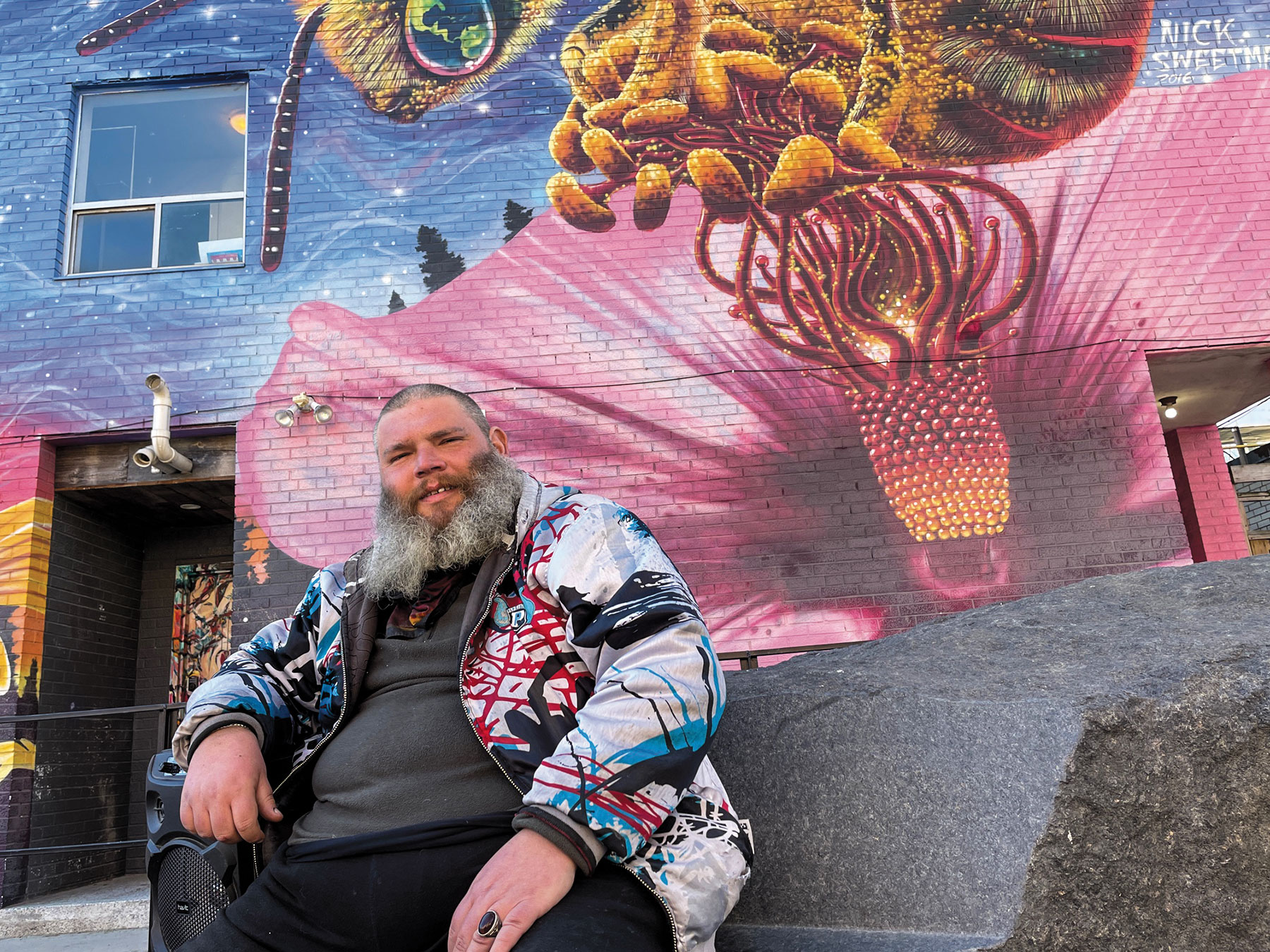
Jeff Reid loves the Annex, but after living homeless on Bloor Street all year, he sees his future self “as a working man with a dog and a life that’s not necessarily in the public eye.” Reid is seeking a bachelor for him and his dog, General. He is experienced in many types of general labour, and would love to get back into trucking. Good reference. Ideas? Contact him at 647-569-3666. NICOLE STOFFMAN/GLEANER NEWS
By Nicole Stoffman
During Bloor Street’s pandemic year, you may have seen increased traffic in the doorways of Hot Docs Cinema, Inti Crafts, or the Annex Billiards Club. Street-involved people have been sleeping in these doorways at night for years, but due to commercial lockdown measures, they’ve become places to camp out all day long. All across Toronto, the pandemic has raised the profile of our city’s homelessness crisis.
If you live in the neighbourhood, you may well recognize Jeff Reid’s face as one of the many people who call these doorways home. You may have also noticed the ad he placed in the back of the Gleaner:
“I am Jeff. I live on Bloor Street, literally. I AM HOMELESS AND WANT TO RENT A ROOM IN THE ANNEX. I can pay up to $650/month. Jeff Reid (647) 569-3666.”
Brian Burchell, the Chair of the Bloor Annex BIA (and publisher of this paper), wrote the ad and gifted it after getting to know Mr. Reid, who he met five years ago when Reid was living on the sidewalk of Mirvish Village. Since the construction for the Westbank development forced Reid east of Bathurst street and onto Bloor St., Burchell has gained a greater understanding of his situation and learned that the 38-year-old wants to find a home.
“My sense was that Jeff just needed a bridge,” said Burchell, “and that he appreciated that his circumstances were not sustainable. At the time he still had his dog, and that was certainly not healthy for the dog to be sleeping on the sidewalk every night. “
Burchell even offered to be a character reference.
“I can speak to some elements of his character that I think bode well for his potential status as a tenant,” said Burchell, who added that when people were breaking windows on Bloor St at 3am, it was Reid who called the police.
For his part, Reid knows that living rough is not how things are supposed to be.
“I’d like to see myself in a nice bachelor with a washroom and a shower,” Reid said. “After which I’d like to see myself as a working man with a dog and a life that’s not necessarily in the public eye.”
His dog, General, a Queensland Heeler, has temporarily escaped the cold and is living with friends, until Reid finds a home.
Reid was born at Mount Sinai Hospital in Toronto, and adopted at the age of two by a family with roots on the East Coast.
Growing up in Ajax, he was, he says, “a very bad kid.” After his adoptive family gave up on him and moved back East, he became street-involved, travelling across the country, and gaining lots of work experience in the process.
“I’ve done roofing, brick and mortar, landscaping, cleaning/janitorial, auto/building maintenance, snow removal, yard work, painting, demolition (loved demo), moving, and line work, “ said Reid. “Ideally I’d like to get back into trucking. I loved trucking.”
Reid is also a humorous and gifted writer, and enjoys reading, gaming and music.
The shelter system is promoted as a way those who are living rough can transition into housing.
In Reid’s experience, however, shelters left him vulnerable to what he calls shelter crime: drug addicts who robbed him at night so they could get a little money for their next hit. In April, he had to leave an apartment provided by “Streets to Homes,” when he was broken into twice.
“A number of measures are in place to ensure the safety of clients,” the City’s Shelter Support and Housing Administration said, in response to inquiries made by the Gleaner, “including providing secure storage for belongings, on-site security at many sites, and requirements for regularly scheduled and frequent rounds by staff during all hours of operation to conduct wellness checks. The new shelter design guidelines recently released by the city also identify a number of best practices that are built into new shelter sites that incorporate a range of measures to provide spaces that enhance safety, including employing Crime Prevention through Environmental Design (CPTED) principles.”
The Gleaner ad generated a lead on an Air B&B, which fell through when Reid’s roommate ran into financial difficulty.
Fortunately, Woodgreen Community Services has since stepped in to connect him with a subsidy that will allow him to apply for market rent bachelor apartments.
“I would urge people to recognize the complexity of the problem of homelessness and to deal with the individual’s behaviour, as opposed to their status as homeless,” adds Burchell. This is a perspective shared by the The Toronto Police Service. The TPS can issue a ticket under the “Trespass to Property,” bylaw, but not if someone is on public space, not causing a disturbance, and not likely to pay the fine. “We usually ask them if they need anything, and try to connect them to services,” said Const. Caroline Dekloet of the TPS.
Now that Reid can afford market rent, he’s hopeful. He’s calling landlords, and getting himself cleaned up and ready for viewings. “The Annex has been super nice to me,” says Reid. “It’s kind of a late start, well restart, for that but I’m confident in my abilities to succeed given the chance.”
March 26th, 2021 · Comments Off on FOCUS: Revitalization of Robert St. Field (Mar. 2021)
Long-awaited renewal of U of T park space for community use
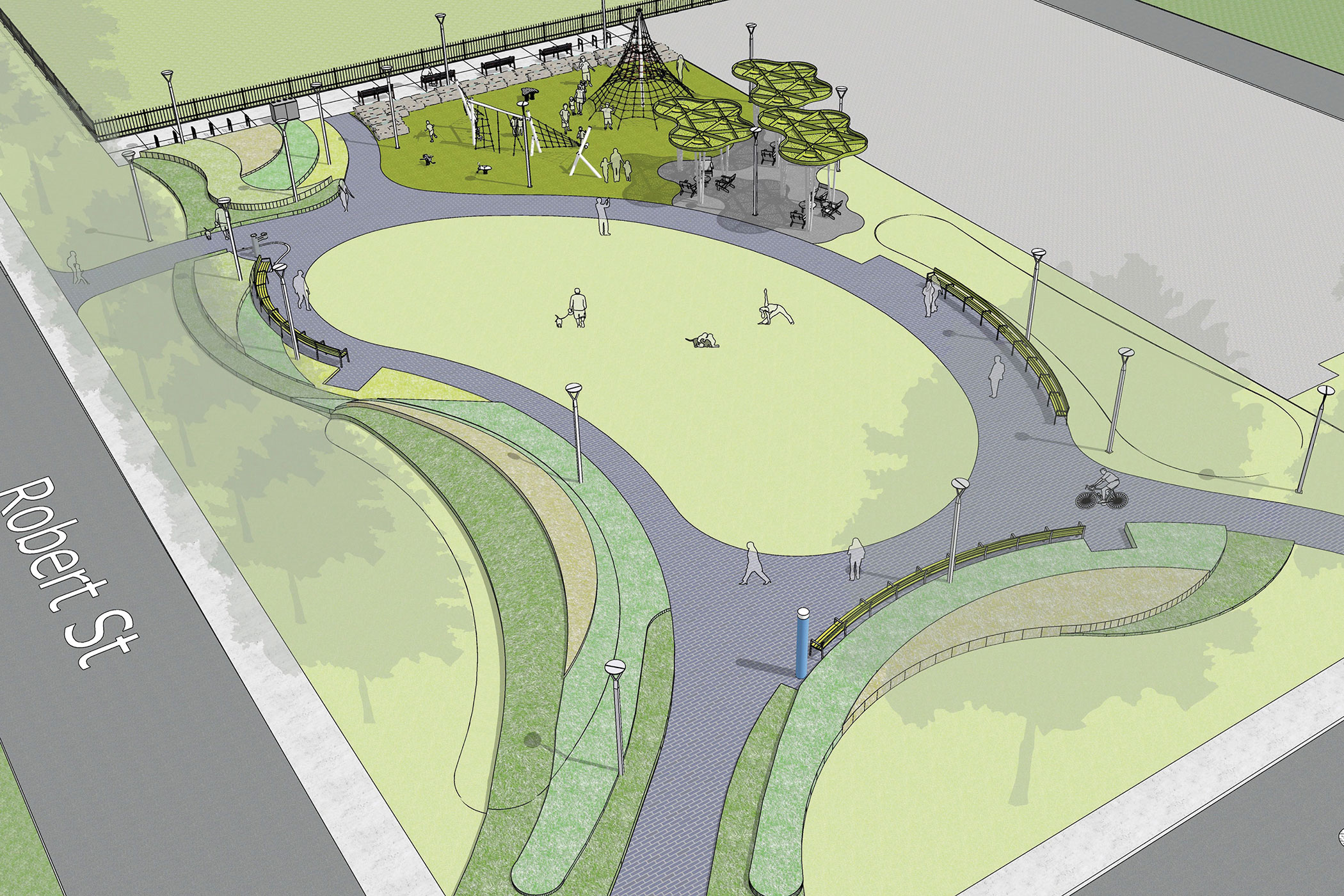
Emerging from its confusing past, Robert Street Field has upgraded the playground and the field is now the largest geothermal project in Canada. COURTESY STUDIO tla OBTAINED FROM THE UNIVERSITY OF TORONTO
By Mary An
Robert Street Field has emerged from the ashes of its past. Located at the intersection of Robert Street and Sussex Avenue, the park, playground, and field are being revitalized by the University of Toronto and designed by Studio TLA.
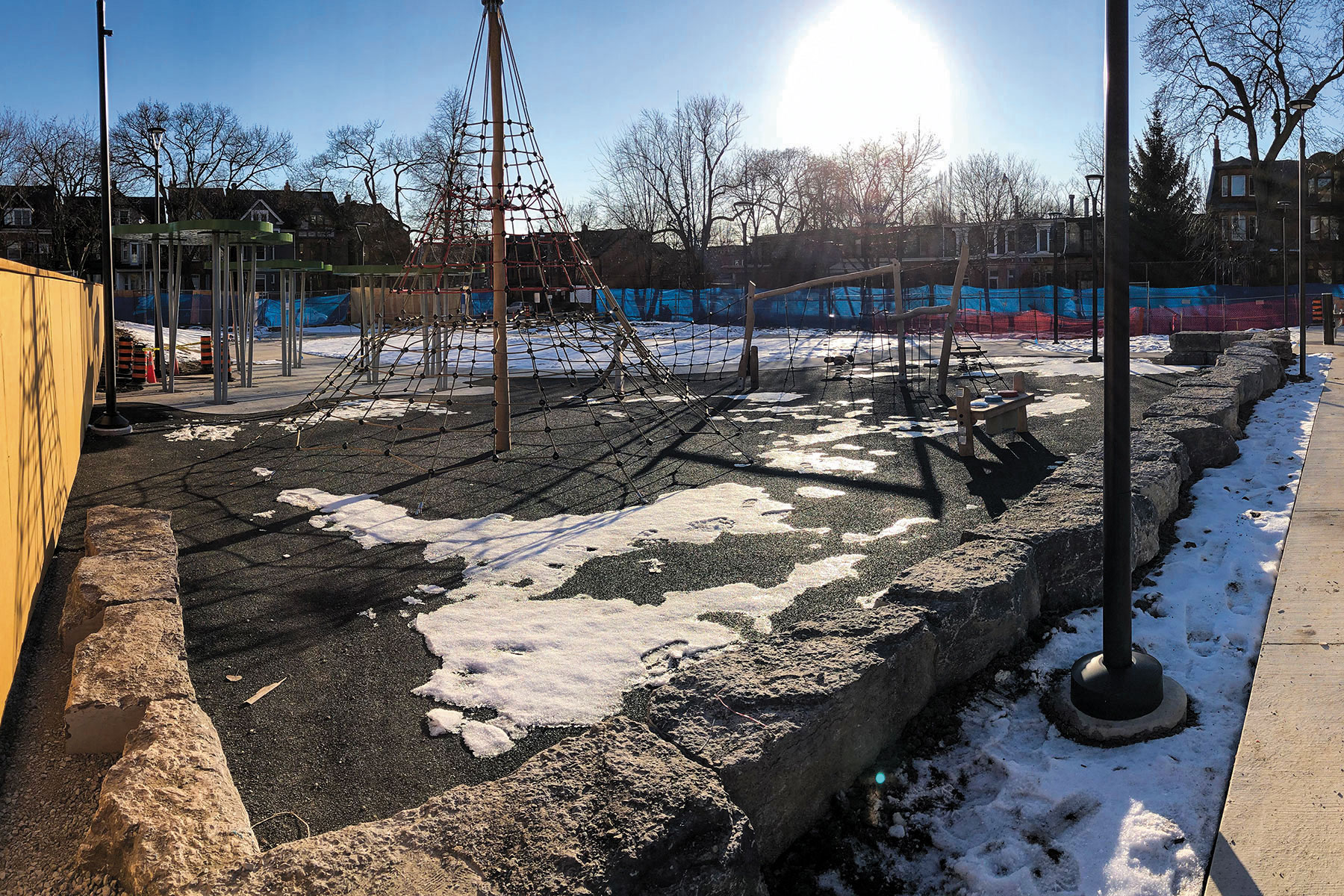
The new playground brings needed greenspace to Harbord Village. Residents can enjoy the year-round greenery and playground as early as June. MARY AN/GLEANER NEWS
“I think overall, the benefits are there, and the park is going to be a nice addition to the community,” Nicholas Provart of the Harbord Village Residents’ Association (HVRA) said in a phone interview with the Annex Gleaner.
The park’s history indicates a very confusing past in terms of ownership and management, which led to the park’s neglect. After tearing down thirty-two houses in the late 1960s, the university created Robert Street Field with a skating rink and tennis courts which was greatly enjoyed by the community. The university came to an agreement with the City of Toronto where the city would pay the cost to maintain the area. In the years following this agreement, the community was disturbed when the ice rink became a storage space for garbage cans, and the tennis courts became a home for landscaping materials.
In 2013, the university proposed that a student residence be built in the area, which was an opportunity to address the community’s needs for the park. Adam Vaughan, councillor of Ward 20 at the time, held a public meeting to identify concerns and input them into a terms of settlement such as; preserving the heritage of the community, ensuring low noise impact, and improving the park and the Robert Street Field.
The plan for a 23-storey student residence at 700 Spadina Ave. is moving forward. The University of Toronto is renovating the park before construction begins.
“The majority of hard landscaping at the site has been completed,” said a spokesperson for the University. “Installation and further landscaping will take place as soon as the weather allows.”
The ice rink and tennis courts will not be revived. According to Provart, the location of the ice rink will be used as a staging area for the construction of the 23-storey building, and will then be converted to “multi-use courts.”
The public park will feature a wide green space with a central lawn, playground equipment, unique shade structures, various seating areas, and bicycle parking spots. There will be seasonal planting and a “mix of deciduous and coniferous plants so that there is year-round greenery,” the university stated in an email.
“It’s a big plus for the community with this green space in the village,” Provart said. “Could they have done more? Yes. Nonetheless, Harbord Village is quite under-serviced in terms of green space, so I think it’s a win.”
Alongside this revitalization of the park, the deepest large geothermal project in the country is being installed underneath the adjacent Robert Street Field. With this geoexchange technology, the university will be able to reduce its greenhouse gas emissions for heating and cooling the new student residence by 90 per cent compared with natural gas.
According to the terms of settlement obtained by the Gleaner, the public will have access to the park and the playing field whenever it is not in use by the university or other organizations. It also states that the University of Toronto will ensure events on the playing field end by 10 p.m.
Understanding the history of Robert Street Field, the university is implementing measures to ensure the field is maintained.
“The University of Toronto will maintain the Robert Street Field including planting the area, maintaining the lawn and beds, removing waste, and repairing relevant systems. There will not be winter snow clearance and maintenance,” A spokesperson from the University of Toronto said.
Residents can expect Robert Street Field to be fully completed by the end of June, 2021.
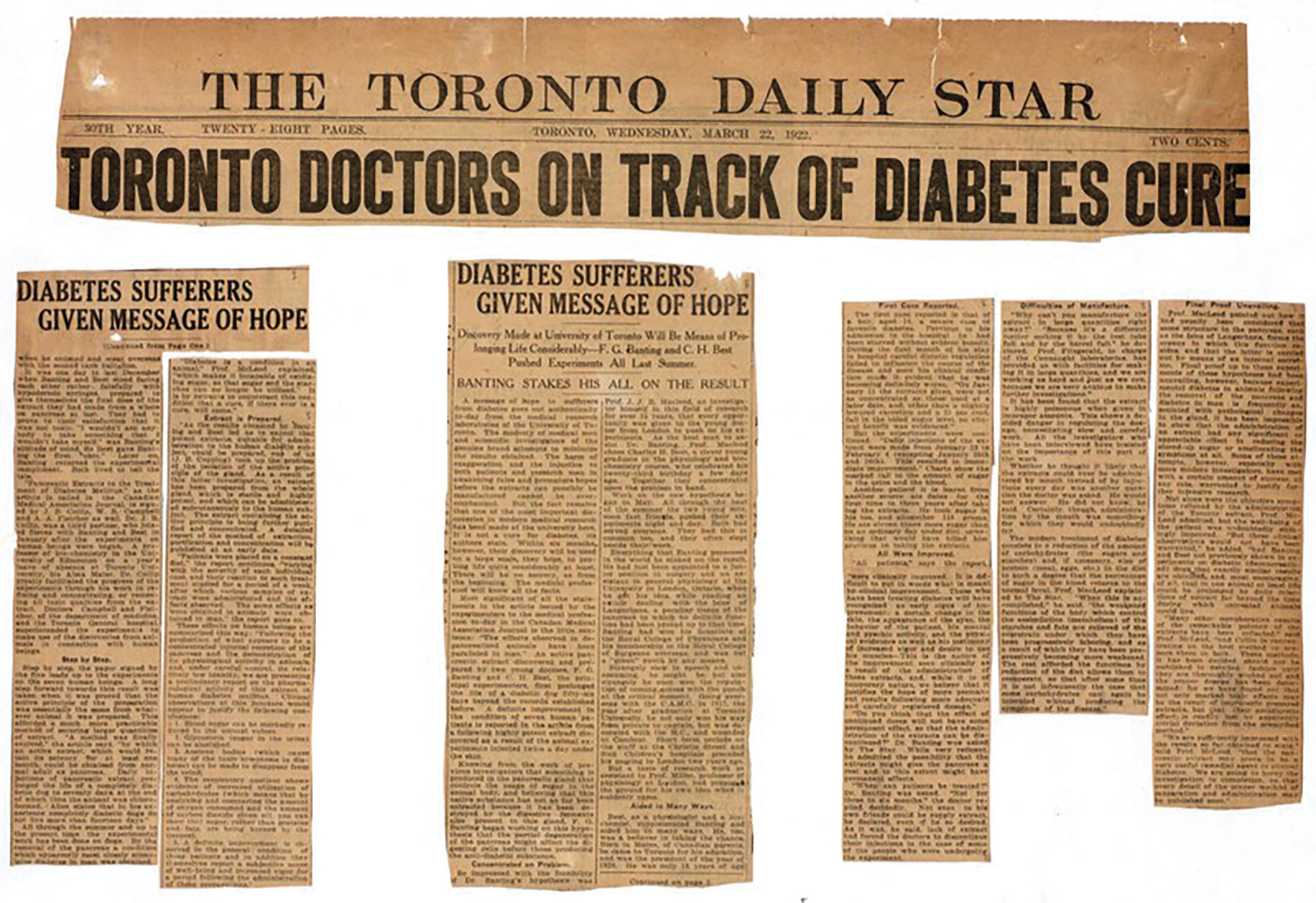
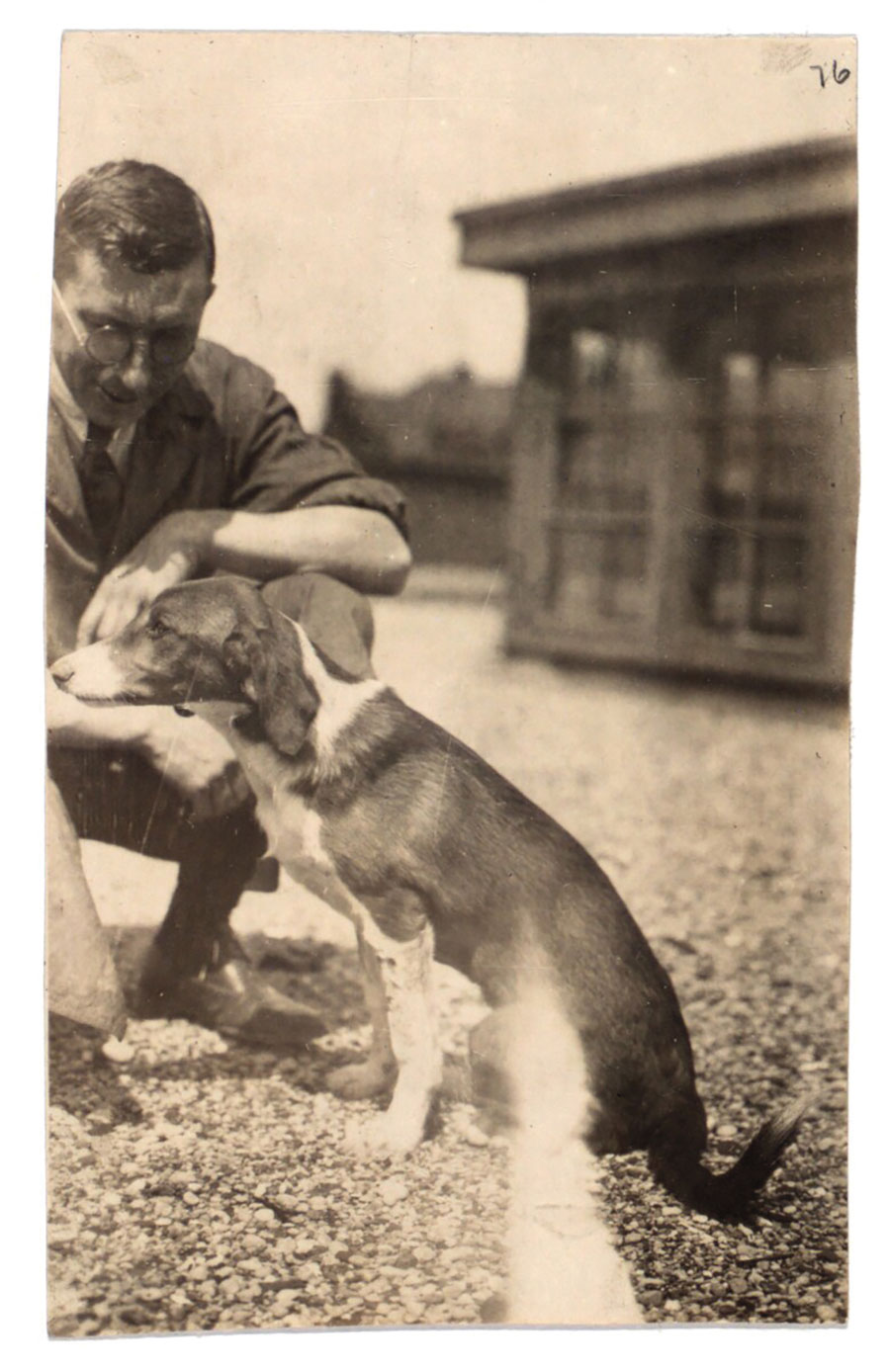
The Toronto research team managed to isolate insulin, free of toxins, in January 1922. As spring approached it was clear they had a major medical breakthrough on their hands. COURTESY THE THOMAS FISHER RARE BOOK LIBRARY
By Meribeth Deen
Every one of us undoubtedly has a notable moment or story that reminds us of the moment when this pandemic “got real.” We are one year in, most of us are waiting for our vaccinations and for life to begin again. While we do, you may as well enjoy the COVID benefit of online exhibitions. The galleries and institutions that make up the Bloor St. Culture Corridor seem to have found their stride in this new world with a continuous flow of digital offerings.
Banting and Best did their first experiment, a pancreatectomy on a dog. When they ran out of dogs to work on, they purchased new ones off the streets of Toronto for between $1-3. COURTESY THE THOMAS FISHER RARE BOOK LIBRARY
To celebrate the 100th anniversary of the discovery of insulin, the Thomas Fisher Rare Book Library offers a deep dive into “one of the most dramatic adventures in the history of medicine” which offered the world a “miracle cure.” Curated by Alexandra Carter and Natalya Rattan, the exhibit relies on The Struggle for Glory, an essay published by the late professor of history, Michael Bliss.
We all know the name of Dr. Fredrick Banting, but did you know his decision to take up the research of the pancreas was made following a coin toss?
In the first section of the exhibition, on “The Discovery of Insulin at the University of Toronto,” you may read the paper that led to the idea that kept Banting up at night and had him asking for laboratory space at U of T in November of 1920.
At that time, it had been 30 years since diabetes had been linked to a problem with the pancreas. As Bliss writes, “therapeutic progress was excruciatingly slow.” One of the only treatments for diabetes that had come to the fore in that time period was a starvation diet, which would prolong life in young diabetics by a year or two.
In the spring of 1921, Banting got the laboratory space he requested, some basic chemical equipment, a dozen dogs and two lab assistants. The assistants decided to split the shifts, and based on yet another coin toss, Charles Best took the summer stint. Flip through Banting’s notebook from those early days of research and do your best to decipher his doctor’s script.
The research was difficult to execute, which did not bode well for the dogs. To “replenish” they purchased dogs off the streets of Toronto for between $1 and $3.
In the summer of 1921, Banting and Best managed to keep “dog 92” alive for 20 days without a pancreas. It was one of many exciting disappointments that summer, and in the coming years they would hold on to the work done that summer as proof of their discovery. However, it would take years – and the work of other researchers – to purify insulin so that it could effectively lower the blood sugar of suffering diabetics, and no gain could seem to be made without an equal dose of drama. But by the autumn of 1922, the stories of “the awe-inspiring impact of insulin were beginning to multiply beautifully.”
A 15 year-old girl named Elizabeth Hughes became a “prize patient.” The girl’s letters to her mother are on display in this exhibit.
By the end of 1923, insulin therapy was available for people across North America and Europe. But that’s not the end of the story – The Struggle for Glory lay ahead.
March 26th, 2021 · Comments Off on GREENINGS: Urban agriculture has many environmental dividends (Mar. 2021)
Reconnecting with our green thumbs is good for us all
By Terri Chu
When most urbanites think of food, they think of restaurants, grocery stores, markets and the incredible diversity of foods available in a place like Toronto. What fewer of us think of is where all that food comes from, how far it has travelled to get to us, and what it takes to produce it. But it’s all worth thinking about, especially before making the devastating choice to pave over farmland in favour of highways and big box stores. It’s also worth considering how much we urbanites can realistically contribute to feeding ourselves.
One statistic I found says that every human eating the “Standard American Diet” requires roughly two football fields per year to produce the necessary amount of food. With this in mind, we need to densify our cities and keep existing farmland intact and in production.
We also need to make use of every available urban space to grow food-bearing plants, as there are numerous ways urban agriculture makes cities healthier and more inviting:
Urban gardens enhance local biodiversity and provide sanctuary for local pollinators and other urban wildlife.
Gardens reduce the urban heat island effect. Cities are known to be several degrees warmer than the surrounding areas both because of waste heat from city life, and because there’s little vegetation that can absorb heat. Any plants we grow in the city will take in that heat and use it for growing, all the while offering us oxygen and humidity in exchange.
Localized agriculture can help us to reduce energy consumption and garbage production. The transportation of food from vast distances is highly energy intensive – and that’s without energy considerations of chemical inputs required in the industrially produced food we import – and it also requires foods to be swathed in packaging. Why not eliminate plastics on food by eliminating the need for it in the first place?
Growing food connects people to nature, and to each other. It also raises awareness about healthy ways of growing food and what healthy eating looks like.
Gardening and growing food requires muscle, and it is a great alternative to hitting the gym.
We’re going to need small-scale localized food production. The agricultural sector is already suffering because of climate change. Smaller farms and food growing operations are more nimble and able to adapt to changing environmental conditions.
There are plenty of global examples of profound impacts made by small-scale urban agriculture. Cuba is famous for the burgeoning of small scale gardens in the face of US sanctions which made industrial farming nearly impossible, alongside a limited ability of the country to import food. By 2008, gardens covering 3.4 percent of all urban land in Cuba produced 90% of all the fruit and vegetables consumed in the country.
One third of Japan’s agricultural land can be found within its cities, and Tokyo produces enough vegetables to feed almost 700,000 people.
Faced with rations during the 1940s, 20 million American households planted gardens and produced between 9 and 10 million tonnes of food during the later years of World War II.
So what should we do here – and now? I would love to see space currently dedicated to cars repurposed into pedestrian, park and garden spaces. We have effectively paved paradise for parking lots, now’s the time to turn those lots green again.
March 26th, 2021 · Comments Off on NEW IN BUSINESS: Opening during a pandemic (Mar. 2021)
Scotty Bons Caribbean cuisine for pick-up or delivery to your doorstep
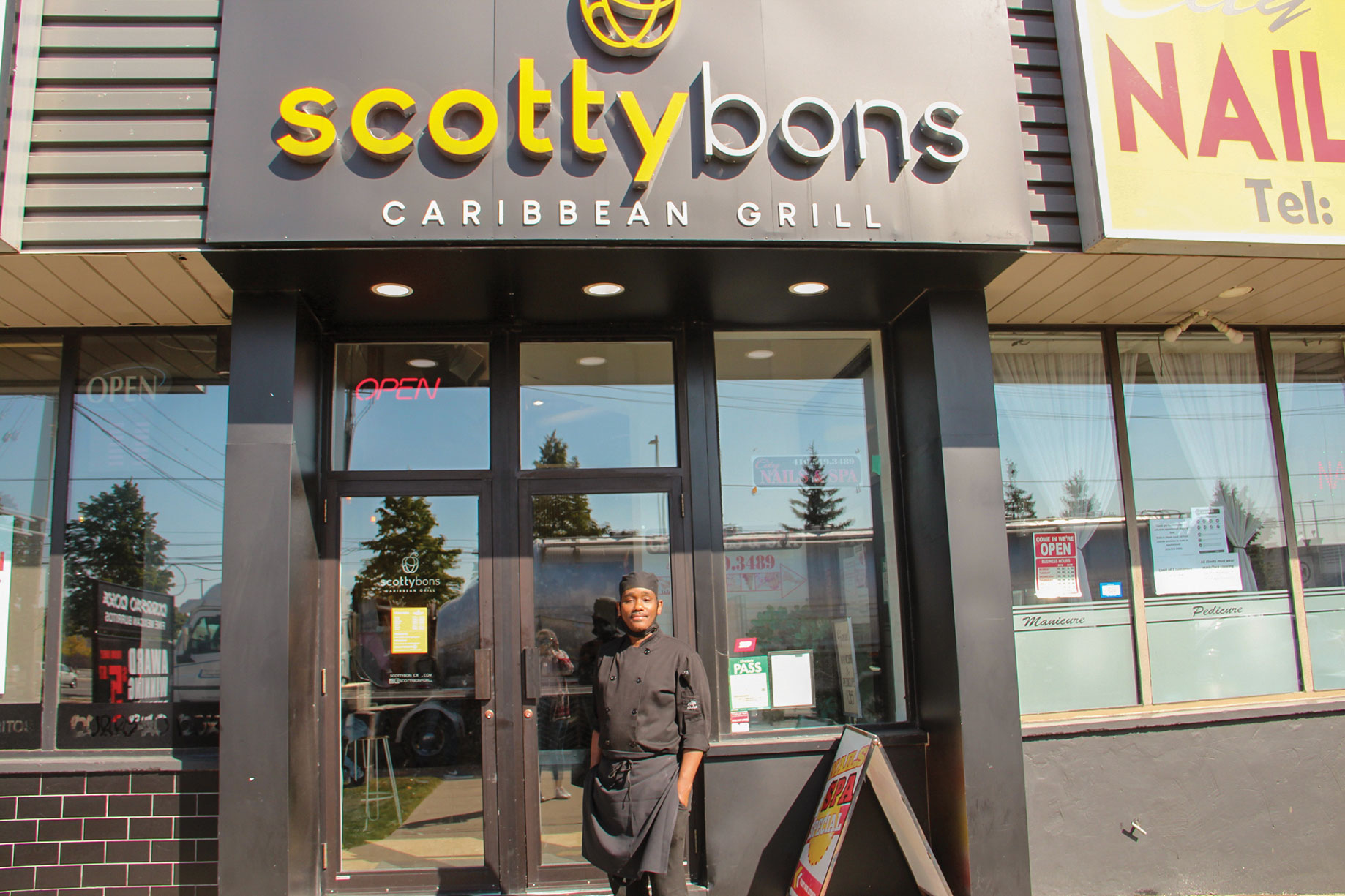
Kendell Garcia and his partners saw the opportunity to open in the Annex as the pandemic created a vacant space on Bloor. TANYA IELYSEIEVA/GLEANER NEWS
By Tanya Ielyseieva
Scotty Bons, short for the famously hot scotch bonnet peppers, is a take on traditional Caribbean cuisine with a western infusion. The new restaurant, located at 402 Bloor St. W. (just west of Brunswick Avenue), serves a halal-certified menu, from roti and sandwiches to fusion bowls.
“I’d be foolish to say that COVID-19 has not affected us, but we’re not going to stop because of that,” says Kendell Garcia, head chef and co-owner of Scotty Bons.
“A lot of my customers have been asking when I come downtown, so the moment and the location seemed right to grab the opportunity and say, ‘Okay, we’re going to Annex.’”
Many businesses within the neighbourhood have been heavily impacted by the pandemic. As Toronto went into full lockdown, restaurants, bars and other food and drink businesses could no longer provide indoor dining service. Outdoor patio dining was shuttered, too.
The potential business risks didn’t stop Garcia from opening a new restaurant in Annex.
“We have been fortunate so far because our main style of business is take out, meaning we are allowed to be open through the pandemic,” says Garcia.
Garcia owns two other Scotty Bons restaurants, one in Scarborough, and one in Brampton. The Brampton location opened during in May, 2020.
March 5th, 2021 · Comments Off on ON THE COVER (Feb. 2021)
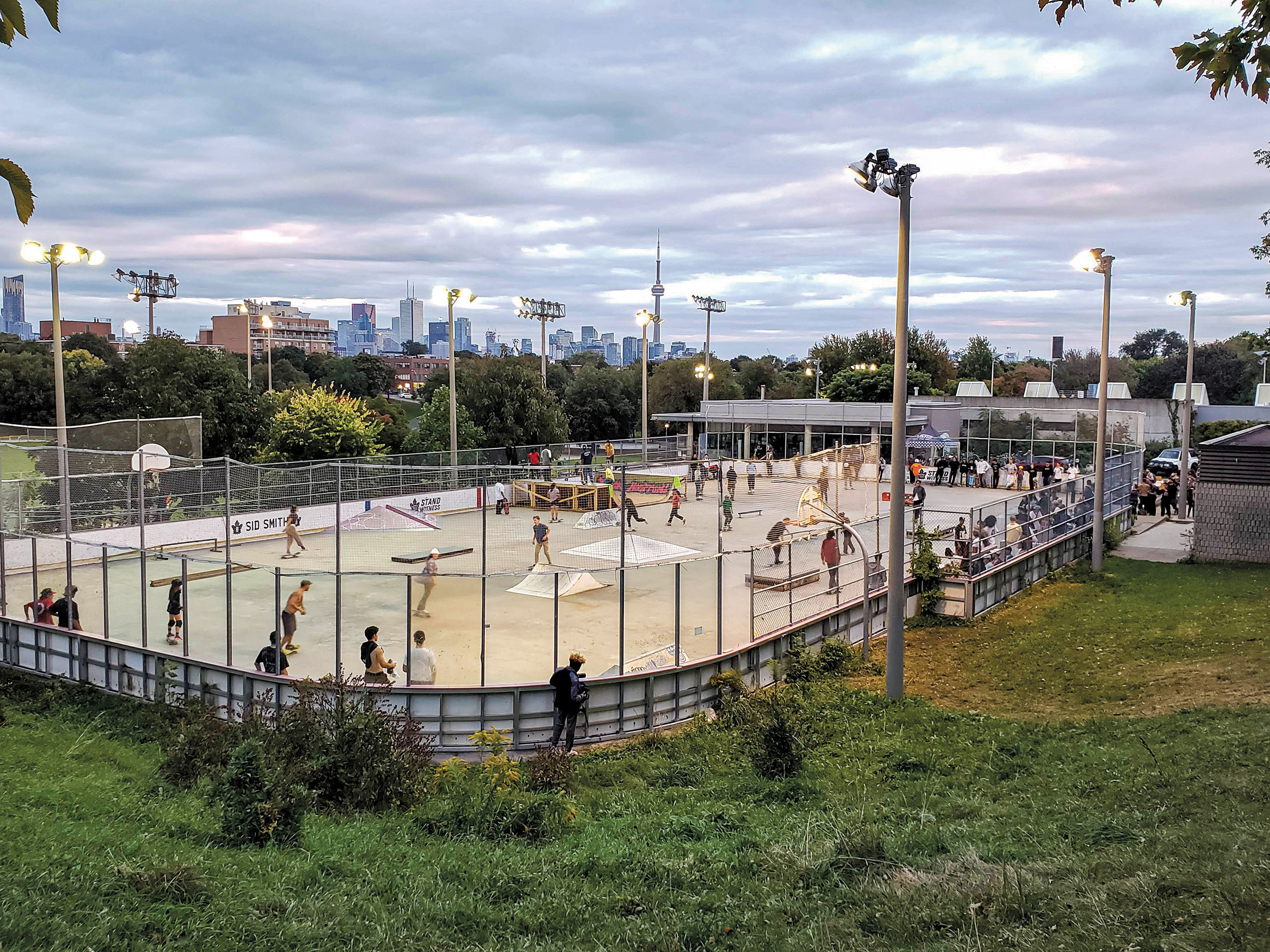
The city is looking for a new permanent skateboarding pad location within Christie Pits, due to the popularity of the seasonal DIY skatepad in Sid Smith rink. See the full story in the next edition. COURTESY MIGS BARTULA, CO-CHAIR OF THE TORONTO SKATEBOARDING COMMITTEE
March 5th, 2021 · Comments Off on NEWS: A threat to the soul of the city? (Feb. 2021)
College/Bathurst development undermines a lively corner
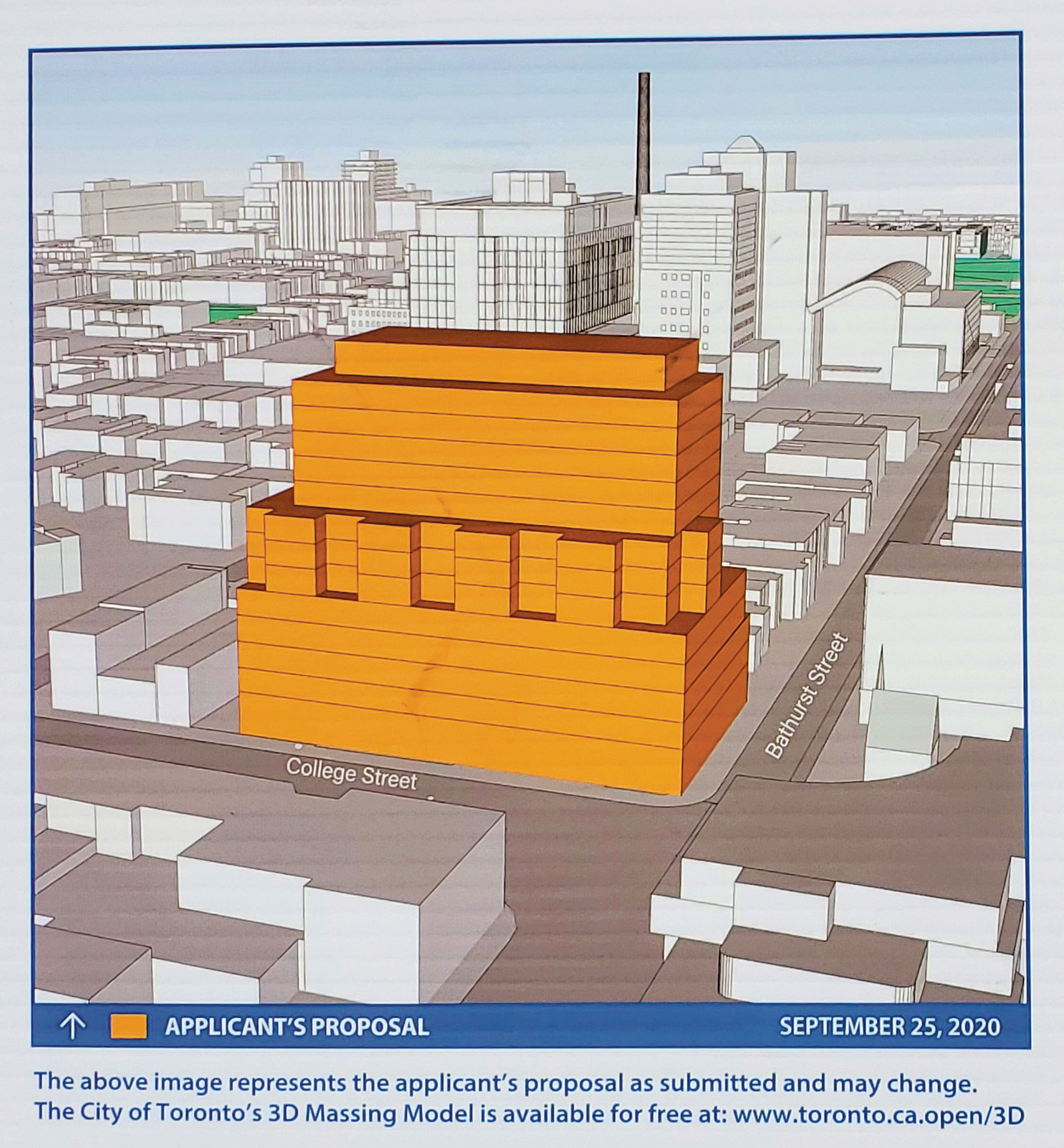
A rendering of the planned development slated to occupy the SE corner of College and Bathurst streets has raised concerns. LUCA TATULLI/GLEANER NEWS
By Luca Tatulli
On January 20, Councillor Mike Layton (Ward 11, University-Rosedale) hosted a tumultuous online consultation for the proposed development at the corner of College and Bathurst streets. While the development has received significant press due to the fact that it will involve the destruction of the building that now houses Sneaky Dee’s, residents at the meeting seemed more concerned about how the new development will change the demographics of the neighbourhood.
“This is valuable time and energy taken away from those with desperate needs,” said Kile Mugwat, a resident of the area. “This is not needed, this is not necessary.”
He added that he opposes the development due to its failure to prioritize the needs of low-income Annex residents, and cited the anonymity of the developer as another point of concern.
“I think any development that isn’t introduced to address community needs specifically shouldn’t go ahead,” said Mugwat indicating his further opposition to the development. “Right now, it should be only about creating housing for the people who need it.”
The applicant for the development is currently unknown and has not come forward. Representatives from the Goldberg Group, the site planners for the project, were present during the meeting on their behalf. The practice of developers’ agents attending consultations in their place is not uncommon.
The Goldberg Group has indicated that the developer would work with the community and has uploaded the project’s 3D modelling and architectural plans to the City of Toronto website.
The proposed development at 431 College St. has been the home of Sneaky Dee’s since 1990. The restaurant has hosted a wide variety of Canadian punk rock and alternative bands. The strip is also home to restaurants Onnki Donburi and Queztal along with RBC Royal Bank. The proposed development would replace the current College and Bathurst strip. It would see a 13-storey multi-purpose building replace the current plaza. The development would have 169 units in total and it would share three ground-level retail spaces. Residential units would be located above the proposed retail units. The proposed development will provide just over 13,009 square metres of living space.
“There’s a real feeling that the city doesn’t care about what we, as residents of this community, want,” said artist Lex Corbett in an interview with the Gleaner following the meeting. “There’s a huge amount of frustration with the idea that people with a lot of money can come in and alter the landscape with little input from the people who live here. I don’t want this development but the developer isn’t doing anything that hasn’t been done countless times across the city. There’s certainly no element of coercion. It is simply people with a lot of money doing what they do: investing in real estate to the detriment of the community.”
Corbett is also the founder of the Stop the Sneaky Dee’s/College Bathurst Development Facebook group. The group is active in opposing the development by attending community consultations and sharing up-to-date information about the development. The group itself does not push for any specific policies, serving instead as a community platform.
Councillor Mike Layton is opposed to the overall development, but says that it is necessary to negotiate with developers to secure affordable housing for residents. Developers currently do not have to commit to building affordable housing and the city does not have the power to mandate affordable housing in new developments.
“If we don’t engage with the developer they will simply appeal and we know from experience, we won’t get as good a result,” said Layton “We cannot legally secure affordable housing without the developer’s agreement.”
A policy framework for the application of inclusionary zoning (IZ) was drafted for the city in September.
The existing provincial rule allows municipalities to obtain affordable housing in new development projects but the lands in question have to be at least within a 500-800 metre radius of a transit stop or station. In Toronto, proposed IZ rules would apply to qualifying areas that have moderate to strong markets for housing. A minimum of 5% of total rental units in these areas would be set aside for affordable housing.
The official plan application for the project was submitted to the city on Sept. 23. The application itself is currently under review with a city council decision on the project pending.
March 5th, 2021 · Comments Off on NEWS: 45 land parcels for Green Line (Feb. 2021)
Long linked greenspace north of the tracks in the works
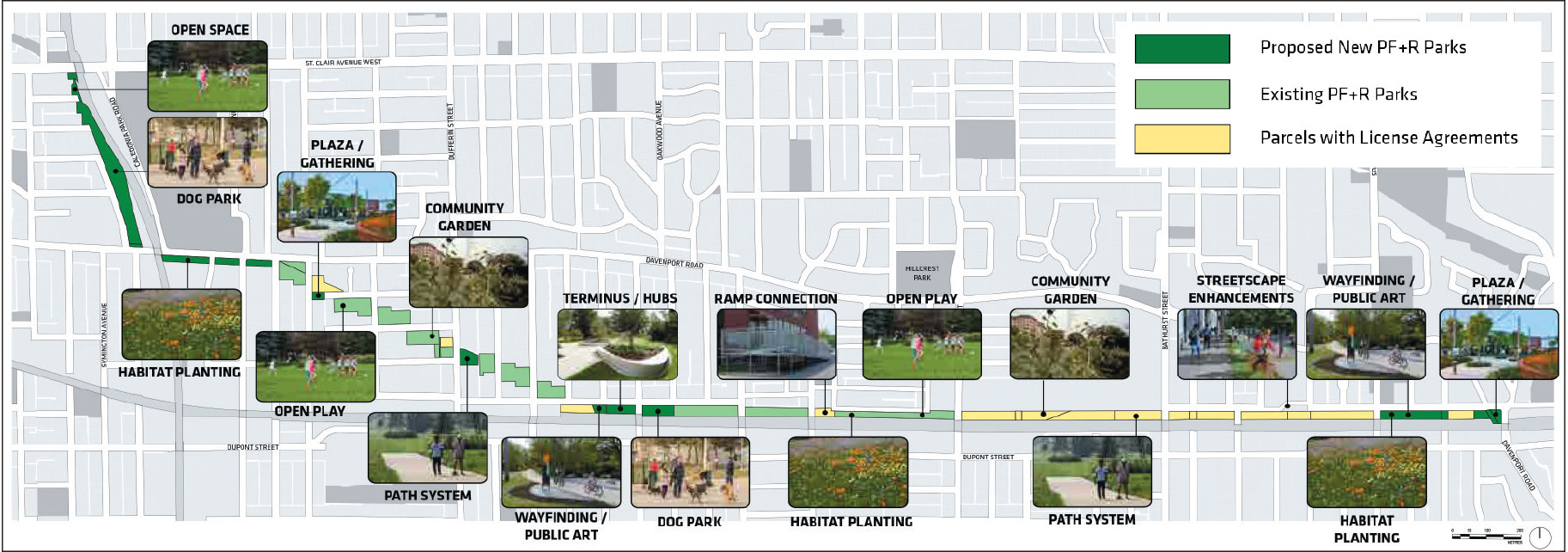
The Green Line, as it is envisioned, will act as a gateway to other, nearby green spaces. COURTESY DTAH
By Mary An
Five kilometres of scattered hydro-electric corridor space just north of Dupont Street is set to become a park called the Green Line. According to the Green Line Implementation Plan on the city’s website, this project will connect green space along the corridor to ensure safety, improve walkability, and connect communities.
“The need for the Green Line is clear, and we need it to work for people from all walks of life,” wrote Evan Castel, co-chair of the Davenport Neighbourhood Association (DNA) in an email to the Gleaner. “Some of these [land parcels] are well-used but aging parks, and others are fenced-off hydro lands that are used only informally by folks who step over fallen fences to walk their dogs.”
The park will be made up of forty-five land parcels in total.
Each new park that will make up the Green Line will have its own public consultation process to determine programming and facilities. Some of the uses desired by the community, such as Dog Off Leash Areas, may not be compatible with the operation of a hydro corridor. COURTESY CITY OF TORONTO’S GREEN LINE IMPLEMENTATION PLAN
Helena Grdadolnik of Workshop Architecture spearheaded the idea in 2012.
Public support for the project grew thanks to partnerships with DNA and Park People, and through events such as community walks, photo exhibits, mural parties, and pollinator gardens. In 2016, the city initiated the Green Line Implementation plan, and Workshop Architecture won the commission for the Green Line Implementation Plan with DTAH and Dillon Consulting. City of Toronto Parks, Forest and Recreation then took the initiative under their wing, and included community input.
The city’s 2019 project plan aims to improve existing land parcels by; licensing new green parcels from both the province and Hydro One, making improvements to the city’s rights-of-way and land adjacent to the parcels, and making road crossings safer for pedestrians. However, the originator of the Green Line idea is sceptical about whether this can actually be accomplished.
“The recent park designs do not meet the original vision because the Green Line is now defined as only the green space under the hydro corridor. This is limited by what Hydro One will grant permission for, rather than integrating it fully with the adjacent street and both sidewalks,” says Grdadolnik. “The street, Geary Avenue, is being rethought by another city department and on a different timeline.”
According to an email from the City of Toronto, after applying to Hydro One for “a secondary use agreement in order to get permission to create parkland,” the city must design the parks to maintain safe clearance around the transmission towers and to ensure that trees planted within the parks follow the height restriction within the wire zone.
By breaking the initiative into 20 smaller projects, the city plans to complete the Green Line within the next 10 years.
As reported by the Gleaner in January, the city has begun the design process for Macpherson Avenue Park, located at Macpherson Avenue and Davenport Road.
It will be the first new park and will act as a gateway to the other green spaces along the Line.
According to the City of Toronto’s website, the construction of this park is expected to begin in 2022.
Along with Macpherson Avenue Park, the city is also moving forward with the Green Line by expanding Geary Avenue Parkette into a full park. Currently the park runs along the south side of Geary Avenue, between Ossington Avenue and Delaware Avenue North.
The city plans to expand the park west along the hydro-electric corridor to Westmoreland Avenue North. They are expected to start construction on this park in 2022 after receiving approvals from the design team and Hydro One. Both parks will include new structures, lots of green space, and place marker designs that speak to the community’s history. The City of Toronto has also released a thorough description about these new additions on their website.
“We hope the Green Line can pull off a balancing act of offering great green space and street design that acknowledges the unique industrial heritage of our rail and industrial lands. We’ve been excited to see these being reinvented as creative employment spaces,” Castel said.
March 5th, 2021 · Comments Off on NEWS: First Black woman appointed superintendent (Feb. 2021)
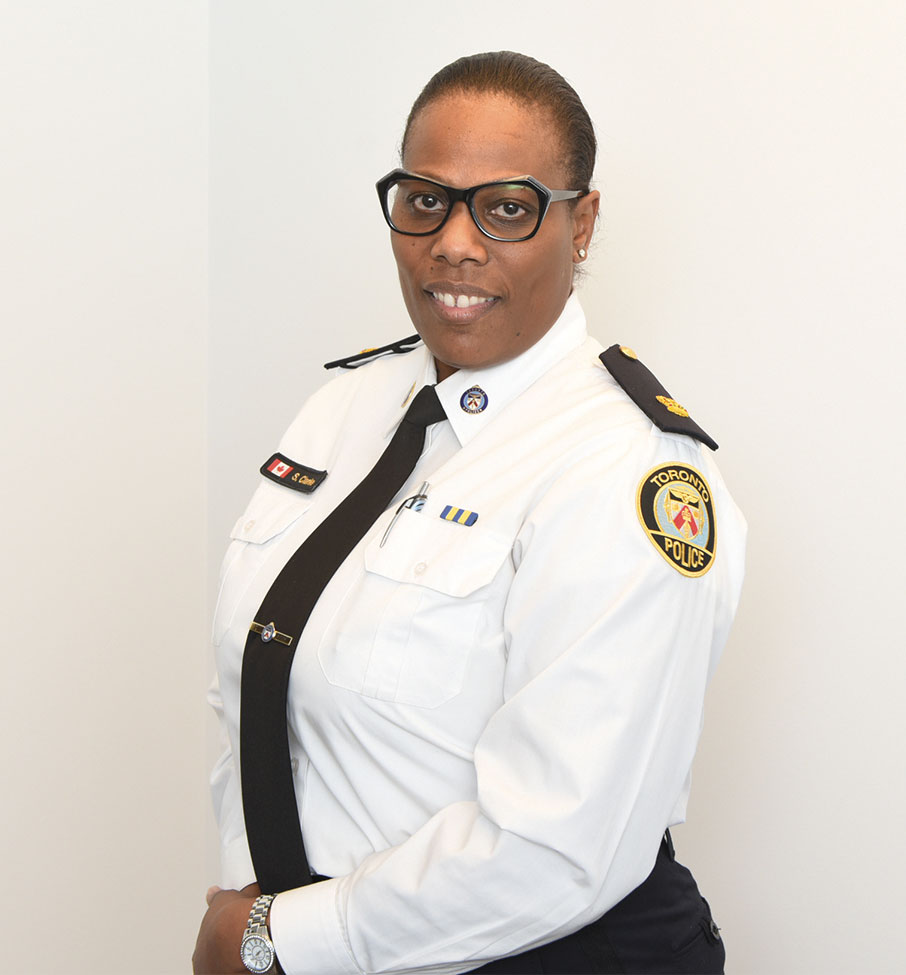
Supt. Stacy Clarke has become the first Black woman to be appointed Superintendent at Toronto Police Service. COURTESY RONALD FANFAIR/TORONTO POLICE SERVICE
Stacy Clarke, the second-in-command at Toronto Police Service (TPS) 14 Division has been appointed superintendent, a rank never before held at TPS by a Black female officer.
With that rank, Supt. Clarke, a 24-year veteran of the force has been assigned the position of Commander of the Community Partnerships and Engagement Unit, which provides and develops programmes and initiatives that positively impact communities and support TPS officers. It is a role which has significant impact for Black communities.
14 Division serves the Annex community west of Spadina and includes a large swath of downtown all the way to the lake.
The mother of a 14-year old daughter and 12-year old son, Clarke has spent her years in policing trying to build partnerships and bridge the gap between TPS and the city’s Black community.
The Jamaican-born Clarke previously served in the Professional Standards Unit and at the Toronto Police College. She was a co-chair of the Police and Community Engagement Review (PACER) for the TPS, promoting a bias-free service. According to the Jamaica Canadian Association, the PACER committee oversaw the implementation of 31 recommendations from the community regarding police interaction.
There is only one other Black female superintendent in Canada, Supt. Isobel Granger with the Ottawa Police Service who was appointed in 2019.
After receiving the news of her appointment from Acting Police Chief James Ramer, Supt. Clarke posted to her Twitter account: “I’ve spent the last few hrs reflecting on the hill I’ve climbed but also on those who have paved the way 4 me. I am humbled & filled with pride. Thank you.”
—Brian Burchell/Gleaner News
Comments Off on NEWS: First Black woman appointed superintendent (Feb. 2021)Tags:Annex · News