December 15th, 2025 · Comments Off on EDITORIAL: Governing by gut, not facts (Oct./Nov. 2025)
As the RCMP criminal investigation surrounding the Greenbelt scandal drags on, Premier Doug Ford is feeling like he just might be untouchable. Emboldened by a combined sense of invincibility and righteousness, Ford is getting sloppy. Most of his initiatives are not evidence-based, and he is unabashed when he says he is governing by gut instinct.
Recently, the auditor general revealed that hundreds of millions of dollars were given to friends and supporters of the party through a jobs training slush fund with no regard for facts or transparency; it’s reminiscent of so many other files handled similarly.
Untold millions are being spent on Highway 413 and the Bradford bypass when expert analysis reveals this will not ease congestion. Only a couple of minutes of commuting time will be saved by those coming and going from the 905 region.
The Ontario Science Centre was shuttered suddenly when facility consultants reported it could be easily fixed.
Select and disconnected parcels of the Greenbelt were declared available for development with no viable plan for the infrastructure needed to support that development. There was also no evidence of a plan outlining how this would solve the housing crisis.
The premier is just about all on his onesie in thinking that building a tunnel under Highway 401 is a good idea; and yet, he is steam rolling ahead.
Ford has just introduced legislation to ban municipalities from using speed cameras because he says, “enough is enough.” Enough of what Doug? Safety in school zones?
He introduced legislation to remove bike lanes on Bloor Street, Yonge Street, and Avenue Road. Removing bike lanes would not ease congestion and would likely increase it, and the safety consequences for all road users would be negative. But that advice disagrees with Ford’s gut apparently.
Now it has been revealed by the province’s auditor general (AG), Shelly Spence, that the Ford government has been doling out $237 million to groups that endorsed the Conservatives in the last election. This was part of the government’s Skills Development Fund. She said there was no transparency in deciding who got the money, but she was able to determine that medium- and low-ranked applications from government supporters were successful.
Of the 20 unions and groups who endorsed the Conservatives in the last election, 17 were successful in securing grant funds; however, the province has refused to release the scoring system used to award the funds making it next to impossible to know if decisions were based on merit or influence.
One firm, Rubicon Strategy, led by Ford’s campaign manager, Kory Teneycke, claims on its website that it “has successfully secured millions in training dollars.” According to The Trillium, Teneycke’s firm has nine clients who received funding in this round. One of those clients is Sal-Dan General Contractors who received $3 million. Sal-Dan’s owner, Salvatore Biasicci, his wife, and his son, donated $50,000 to the party between 2017 and 2025. That’s a pretty good return on investment if party donations were the government’s driving metric.
The AG notes that these decisions are being made by political staff, not civil servants. This is not the case in Alberta or British Columbia. She also found that in at least five cases, political staff provided “inaccurate” explanations as to why they made their decisions which she found “troubling.”
The Ford government is making no effort to justify rewarding their supporters with preferred access to slush funds. The most alarming part is they feel no need to justify their decisions with facts; there is no pretense whatsoever that their decisions are evidence-based. It’s an arrogant and entitled approach to governing that has run its course.
December 15th, 2025 · Comments Off on FORUM: Twelve active files (Oct./Nov. 2025)
Speed cameras and electric Zambonis make for a busy October
By Dianne Saxe
The top three things you should know about in University-Rosedale this month:
Harbord/Hoskin reconstruction is wrapping up after sustained pressure from our office. We’ll have an official opening to celebrate, but it was allowed to drag on far too long and to cause far too much neighbourhood disruption due to lax contracting practices. I have submitted an administrative enquiry and will seek a formal investigation. I’m trying to get benches installed on some of those puzzling concrete pads.
The large Rowanwood water main project will begin again this fall. A few months ago, the excavation had to be paused when a sheet steel obstruction was discovered deep underground. While it is essential to replace the old, undersized water main, the excavations will be disruptive to residents in the Rowanwood area, and they have already cost many well-loved trees. Engineering services has promised not to repeat the mistakes it made on Harbord. We’ll be keeping a close watch.
Doug Ford’s latest—promising to ban speed cameras that help save lives in our school and community safety zones. This again drives home why Toronto needs more financial and legal autonomy. To get it, we’re going to need overwhelming public support before the next provincial election.
In other news:
I’ve cut some more red tape. During the 2024 budget, staff admitted that the bid award panel caused unnecessary cost and delay to city construction projects without any offsetting benefit. I pushed to get rid of the BAP; as of October 1, it’s gone.
After two years of my motions and pestering, we have finally had an education and enforcement blitz aimed at those who ride motorized micromobility vehicles (bikes, scooters, mopeds, etc.). Although overdue, this was a good start, and I am pushing staff to build on it. The infrastructure and environment committee passed my further motions to improve rider education, to try to compel vendors of these devices to give buyers information about rules and risks, and to look at licensing all motorized micromobility devices that operate on our streets.
Navigation apps are causing heavy cut-through traffic and speeding across Ward 11, including in the Castle Frank, Barton, Roxborough, Elm and Euclid areas. We cannot legally prevent non-residents from driving through residential neighbourhoods. Wherever possible, and as requested by communities, we are fighting dangerous speeding with speed cameras, bump outs, planters, crosswalks, and humps. I am open to adding turn restrictions and one-way mazes when communities agree that they want them, although these measures have knock-on effects and local opinion is often divided. In the Euclid area, the city is collecting more data; two rounds of traffic monitoring are scheduled in the next few months. And we will be asking residents if they want a one-way maze.
The parks and recreation department has informed me that the Ramsden Park skating rink should open by January 1, and the basketball court will be restored by spring. The Bill Bolton Arena roof is almost finished, and the dressing room heating system will be replaced in February.
The Markham Street reopening (Lennox to Bloor) has been delayed again, but it might happen in November (hurry up, Westbank!). Do you think it will beat the Eglinton Crosstown?
The Toronto preservation board has refused a Heritage Act application for the large wall that was illegally built on public property at Glen Road and Whitney. Council has already directed that the wall be removed.
We are working with municipal licensing & standards to fine-tune bylaw enforcement for minor breaches by small businesses so that we don’t keep losing well-intentioned small businesses such as the much-loved By the Way Café.
The city is buying 53 electric Zambonis to keep our skating rinks in good order with less noise and pollution. I’m lobbying to get some for Ward 11.
North of Bloor, parking changes this fall will make the Bathurst bus faster and more reliable. In the spring, RapidTO Bathurst streetcar lanes will be installed from Dundas to Bloor.
Dianne Saxe is city councillor for Ward 11, University-Rosedale.
December 15th, 2025 · Comments Off on FORUM: A troubling track record (Oct./Nov. 2025)
Has the auditor general just exposed Ford’s next Greenbelt scandal?
By Jessica Bell
Ontario’s auditor general, Shelley Spence, has a vital job in holding the public service to account. Her office investigates government departments, agencies, and organizations to see if they’re efficiently delivering high quality programs and services.
This week, the auditor general released some damning special reports. I attended the media briefing. Ms. Spence was asked by a reporter if she had a favourite report, and she said “that’s like asking me who is my favourite child” because every report has a story to tell about an issue that affects thousands and sometimes millions of us. Here’s what you need to know about the auditor general’s reports.
The auditor general found the province’s management of its $2.5-billion skills training fund was troubling and not fair or transparent.
The Skills Development Fund gives employers, unions, municipalities, non-profits, and colleges funding to train people looking for work.
The auditor general found that David Piccini, the minister of Labour, Immigration, Training and Skills Development and his political staff were giving contracts worth millions of dollars to companies with close ties to the Conservatives, while rejecting applications from far more qualified applicants. They were playing favourites.
Here’s some troubling examples.
King Animal Hospital received $1.3 million to address workforce shortages. The founders of the hospital and their family have donated over $80,000 to the Conservative party.
The wife of the former Labour minister, Monte McNaughton got $2 million to help dentists sell their businesses to investment firms.
A night club owner with ties to the Ford family got $6 million to hire workers.
If it looks like corruption, it probably is corruption. You can bet that reporters, the NDP, and the auditor general are going to be digging deep into this program to find any corruption.
This is about trust. Ontarians expect the government to deliver efficient programs that help people, not their well-connected friends.
Highly qualified applicants should receive funding from the Skills Development Fund over less qualified applicants. Our public colleges should be properly funded by the province so they can provide affordable education to students who want a practical career. The government’s latest cuts to public colleges, along with a drastic decline in international student enrollment, has led to layoffs and the closure of entire departments and campuses.
The auditor general’s damning report on Ontario’s progress to reduce its greenhouse gas emissions is downright embarrassing and devastating.
The Conservatives will admit that climate change is caused by human activity, but they’ve basically abandoned their duty to do anything about it.
The province will not be meeting its 2030 greenhouse gas emissions targets, and they refuse to even set targets after 2030. They’re not even publishing their plan or their progress on reducing emissions; in fact, that’s why the auditor general wrote this report.
Scientists have been issuing stark apocalyptic warnings for years. Unless governments everywhere do the necessary work of curbing pollution and making societies sustainable, our economy and our standard of living will decline.
The auditor general’s report on Ontario’s affordable childcare program shows the program is in jeopardy and is failing to create enough childcare spaces or hire enough qualified workers to meet its targets.
Affordable childcare is essential to families because an affordable childcare spot means you can go back to work.
It’s one of those government programs that pays off for the government in the long-term because parents who return to the workforce earn income and pay taxes.
The program needs $1.95 billion dollars just to keep operating. Where is that money going to come from? And if the money doesn’t come, what’s going to happen to the program? So far, almost all the funding for Ontario’s childcare program has come from the federal government—we’re talking about 98 per cent.
I was also very concerned to learn that low-income families are now less likely to find an affordable childcare spot because they cannot compete with the increased demand for the limited number of affordable childcare spots available.
Ontario needs to bring in policy fixes so families most in need of affordable childcare can get that childcare spot.
After the reports are released and the reporters file their stories, my job begins.
As a member of the public accounts committee, I work with the auditor general to improve the performance of the departments the auditor general’s investigates.
On average, 43 per cent of the auditor general’s recommendations are implemented. I want to get that number to 80 per cent. I think we can do it.
Jessica Bell is the MPP for University-Rosedale and the Shadow Minister for Finance and the Treasury Board. You can reach her office at jbell-co@ndp.on.ca or 416-535-7206.
December 15th, 2025 · Comments Off on ON THE COVER: Nazi-free since ’33 (Sept. 2025)
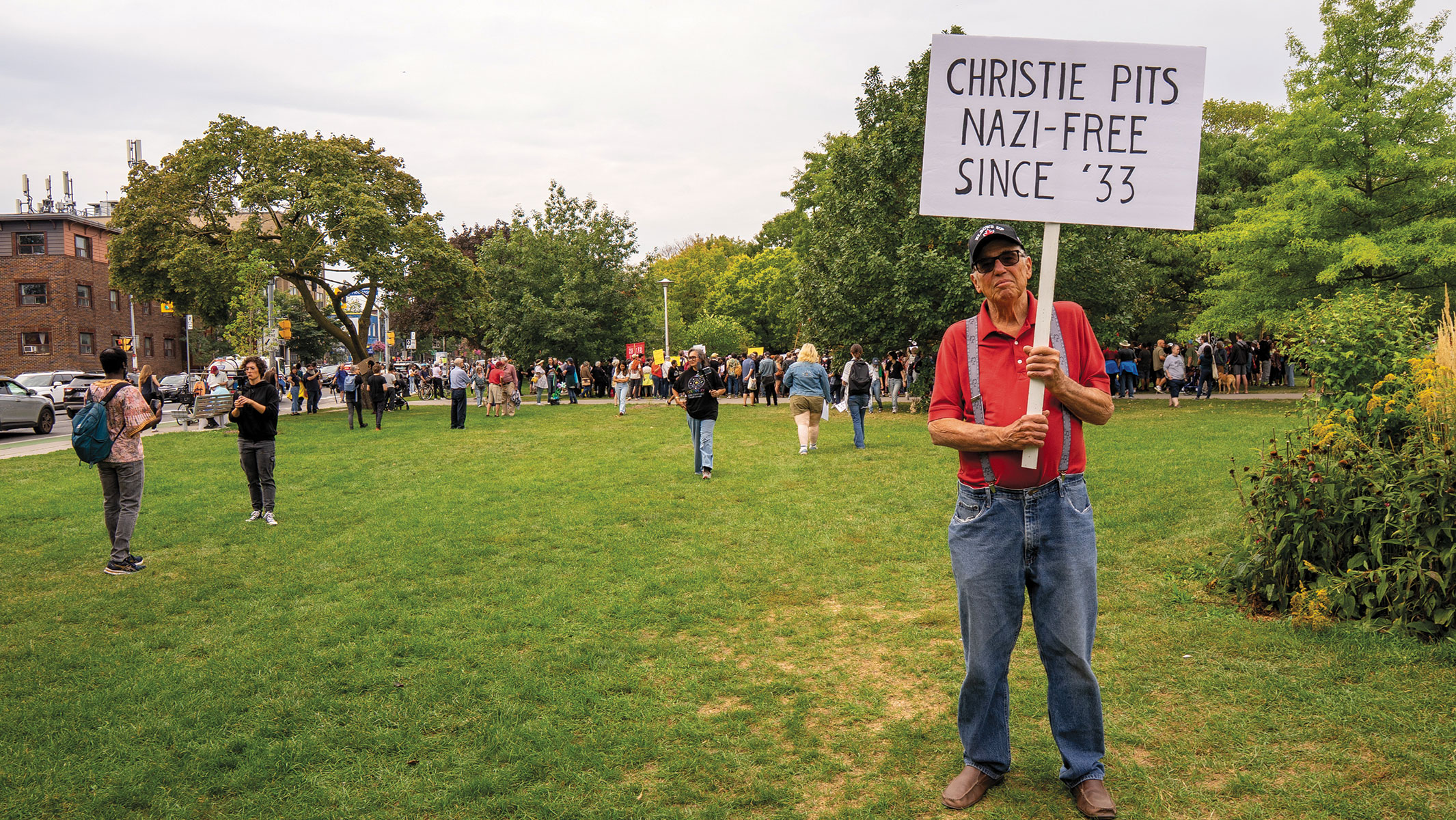
On Saturday, Sept. 13, a “Canada First” rally of approximately 100 anti-immigration demonstrators were met by hundreds of counter protestors in Christie Pits Park. Tom Needham, a former resident of the area, said “given the history, I felt I had to come down. My uncle was here in 1933.” NEILAND BRISSENDEN/GLEANER NEWS
December 15th, 2025 · Comments Off on NEWS: Maple Leafs wrap up historic season (Sept. 2025)
A summer of memorable moments outshines early playoff exit
Jordan Castaldo of the Toronto Maple Leafs captured the 2025 IBL home run crown with 12 round trips this summer. CRAIG AIKEN/GLEANER NEWS
By R.S. Konjek
For fans of the game, baseball is the annual accumulation of statistics and memories.
Another season of Toronto Maple Leafs baseball has been recorded onto spreadsheets and written into hearts.
After finishing a disappointing seventh in the regular season, the Leafs upped their game in the Intercounty Baseball League playoffs and almost ousted the defending champions.
They made trouble for the Barrie Baycats and pushed their longtime rivals to the brink of an upset in the quarterfinals.
The best-of-five series went to a deciding game on August 27 in Barrie. It was a close battle, and the Leafs took a 3-2 lead in the sixth inning. They were unable to hold onto it, as the champs came back to win in the ninth with a final score of 5-4.
It was a frustrating finish to a season that left fans with many indelible memories.
The club made history before a single pitch was thrown, signing Ayami Sato of Japan as the first woman in Canadian history to play baseball professionally in a men’s league.
Sato was a sensation whose presence drew larger-than-average crowds to the ballpark at Christie Pits all summer.
The Leafs also welcomed an enthusiastic group of youngsters to the team.
Spencer MacInnis, Kalayo Shaw, and Ben Sitarenios may be budding stars of the future. MacInnis hit a couple of home runs and showed speed on the basepaths. Shaw caught everything hit to his vicinity in centerfield. Sitarenios flashed his stuff as a two-way player, playing outfield and also pitching in a couple of games.
Former player and general manager Damon Topolie made a surprise return to the Leafs. One weekend in July, the 49-year-old came out of retirement to fill a roster hole. He played in a couple of games and was all smiles during his brief comeback.
Ryan Dos Santos set a single-season record with 46 walks, breaking a record that had stood since 1988.
While there were plenty of highs, there were some lows too. The Leafs’ 18-24 record was underwhelming, and they won only six out of 21 games at home.
The nadir of the season came in July, when general manager and pitcher Dustin Richardson resigned after falling out with club ownership. Conflicting views of the roster’s makeup proved irreconcilable, and the two sides parted ways.
For the Leafs, the highest of highs had to be the season that first baseman Jordan Castaldo put together.
The 15-year veteran and former league MVP had a resurgent year at the plate. Castaldo batted .336 and led the club with 12 home runs and 38 RBIs. The dozen round trips were his second highest in one season and won him the IBL home run crown.
In one game in August, he hit a grand slam and drove in eight runs.
At 36, Castaldo ascended to some rarified air among the league’s all-time greats. He became only the third man to record 500 career RBIs, the fourth man to hit 100 home runs, and the fifth man to reach 700 hits.
He credits his great season with being in better shape.
A hero on the diamond, Castaldo is also a hero in real life.
In 2024 he became a full-time firefighter with Toronto Fire Services. Based out of North York, he finds a way to balance his job’s 24-hour shifts with playing for the Leafs.
“It can be tough, especially with a hot summer like this,” Castaldo said prior to a recent game at Christie Pits. “It was a busy summer call-wise at work. You take off that gear and you put on this gear; you lose a few pounds that’s for sure.”
This is Castaldo’s second stint with the Leafs. In between, he played parts of seven seasons with the Baycats and enjoyed some memorable moments at the Pits. He is the only man in memory to hit a home run that not only cleared the centerfield fence but went over the concessions stand and hit the clubhouse roof, a monster shot that may be the longest in the park’s history.
He was also on the Baycats team that clinched an IBL title at the Pits in 2016.
“The Pits has always had its charm,” he said. “We’ve had really strong fan support this year, and we’re all grateful for the fans who come down and watch us.”
A quiet leader in the clubhouse, Castaldo is happy to help younger players seeking advice.
“If there’s something they want to talk about, I try to be somebody they can talk to or ask questions,” he said. “It’s never been my style to go around and tell people what to do or how to do it. I just try to be a good teammate and listen and provide what knowledge I can. It’s a tough game. I try to take care of myself and my performance first and then help out the other guys the rest of the way.”
Castaldo can’t see himself playing at age 49 like Topolie. Then again, Topolie had a few years off and seized the opportunity to make a brief return, something many athletes wish they could do.
The pull of the diamond is strong. If he can continue to balance work and baseball, Castaldo is likely to return to the Leafs next year.
After falling short, the Leafs will rebuild and bounce back for another season at the Pits in May 2026.
More information about the Leafs can be found at www.mapleleafsbaseball.com.
December 15th, 2025 · Comments Off on HISTORY: If these walls could talk (Sept. 2025)
St. George Street home has many stories to tell
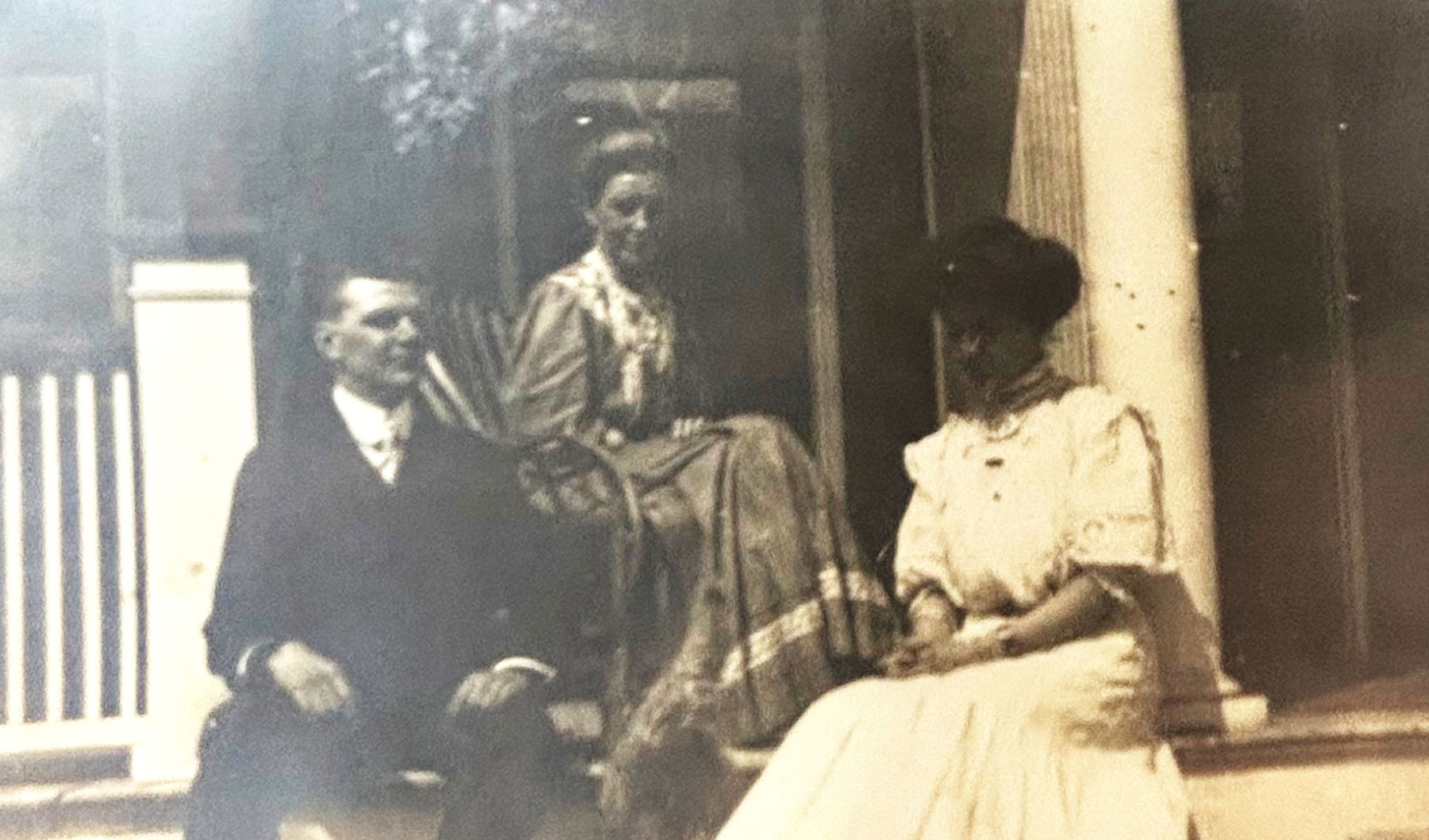
Circa 1915. Left to Right: William Arthur Peel Durie (left, the war veteran), Anna Durie (mother, centre), and Helen Durie (sister). COURTESY TORONTO PUBLIC LIBRARY
By Michael Mastromatteo
This is the first in a series of columns speculating on the lived history of various houses in the Annex. Imagine that the “walls” of these homes secretly absorb some of the actions and experience of those living within. If we accept that the “listening walls” witness the lives and actions of its occupants, we can ruminate about the stories they might tell.
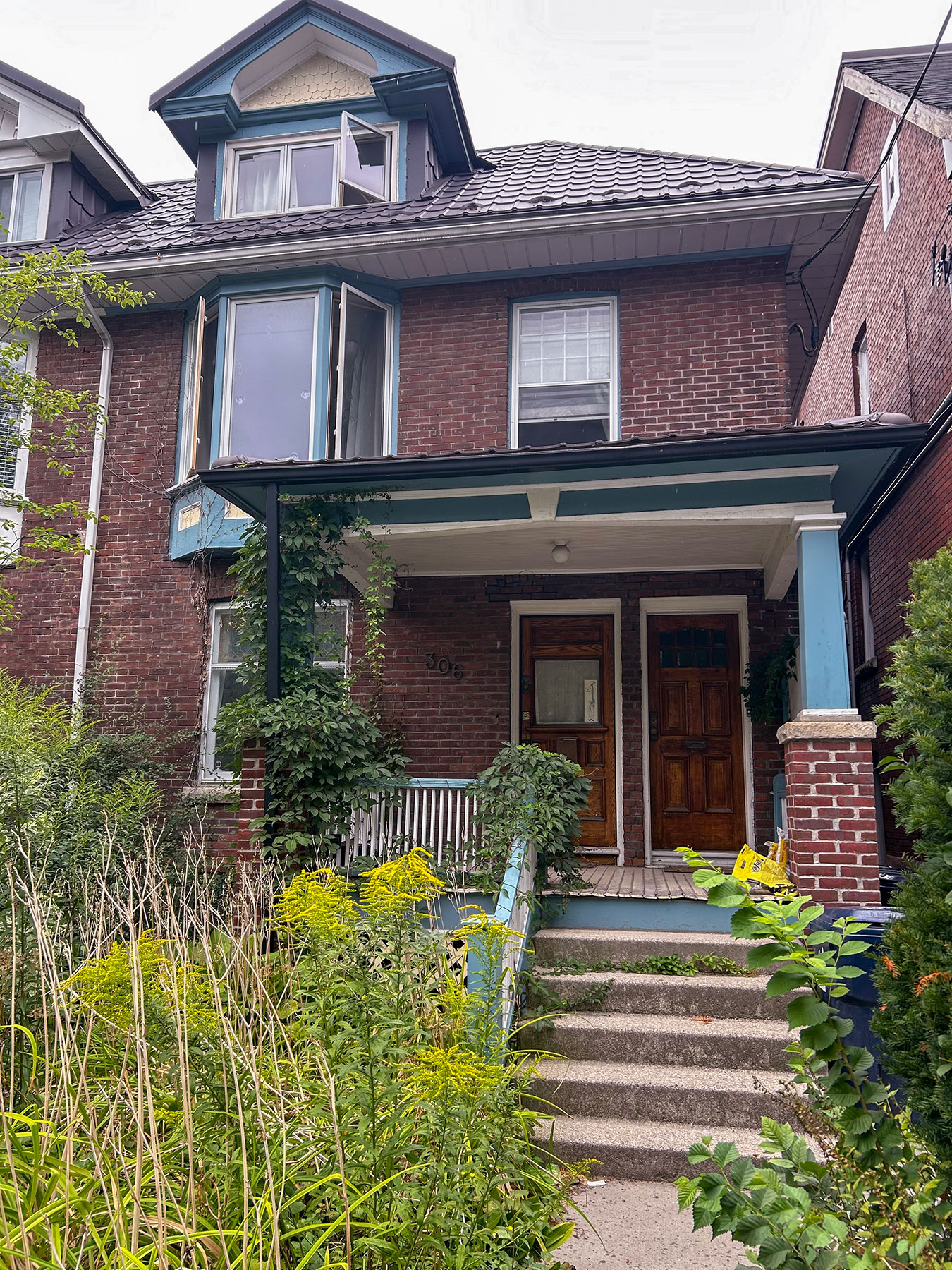
The house at number 306 doesn’t stand out among its St. George Street neighbours. Nestled on the west side of the street a few doors south of Dupont, the semi-detached, 115-year-old home is tall, symmetrical and stately.
But while the home blends in well with its neighbours on the outside, it has a history all its own.
The first occupant was “agent” Henry J. Hollinrake who resided at 306 with his wife from 1908 to about 1912.
The social columns in the newspapers of the day recorded the Hollinrakes’ frequent receptions for well-heeled friends and neighbours.
A Toronto Globe and Mail news report from Nov. 6, 1912 heralded the beginning of the Durie era at 306 St. George.
The story reads: “The inaugural meeting of the Canadian Society for the Prevention of Cruelty to Animals was held Nov. 5 at the residence of the president, Mrs. [Anna] Durie, 306 St. George St.”
Anna Durie was certainly energetic and civic minded, but the sprightly spirit would not last. The atmosphere within the home undoubtedly changed after Anna’s son, William Arthur Peel Durie, left his position as a clerk at the Royal Bank to join the Canadian army in the First World War.
Durie was killed in action on Dec. 29, 1917 near the small village of Lens, France.
A telegraph addressed to Mrs. Anna Durie of 306 St. George Street arrived on Jan. 11, 1918. It read: “Regret to confirm Captain William [Arthur] Durie officially reported killed Dec twenty ninth nineteen seventeen. Have asked England for circumstances death report copy.”
Devastated by William’s death, Anna and her sister’s misery clouded the atmosphere for the next 12 years; however, Anna eventually succeeded in having her son’s body exhumed from a cemetery in England and reburied in St. James Cemetery in Toronto.
306 St. George Street today. MIKE MASTROMATTEO/GLEANER NEWS
One can imagine that the gloomy atmosphere at 306 St. George Street lifted in the 1930s. The parade of owner/occupants included: real estate agent Alex Sutherland, insurance salesman Huson Coon, insurance adjustor Neville Howard McDermott, and dentist Charles Collard. They all no doubt experienced the regular highs and lows of life in Toronto during the Great Depression. That they were all gainfully employed suggests more good times than bad.
The 1940s brought a new raft of occupants to number 306.
Perhaps the most intriguing resident at this time was lawyer and civil engineer William B. Raymond, who purchased the home in 1944.
Born in Welland around 1858, Raymond achieved notoriety in the 1880s for his work in the construction of the Welland Canal.
He later earned his law degree and practiced with the firm Raymond and Honsberger until his death in 1945. He was survived by his wife Alexis Cromer Raymond who remained at 306 St. George Street for another 14 years.
Photographer and “rooming house operator” Pauline Rinas moved into the well-worn home in 1960.
Her time there coincided with the conversion of 306 St. George into a rooming house, a fate common to many Annex homes between 1950 and 1980. After that, gentrification restored value and appeal to many older homes.
A Toronto Star news report from June 4, 1974 reveals some of Rinas’s safety and property value concerns. T
he newspaper reported a meeting of disgruntled Huron and St. George Street homeowners objecting to the establishment of homes for “disturbed children” in the area.
“The place is becoming a slum,” Rinas said. “It’s impossible to get decent people to rent rooms.”
However, “decent people” continued to find their way there. One of the more recent occupants of number 306 was Vera Cudjoe who resided there for a short time in 1970.
The Trinidadian native arrived in Canada 10 years earlier and toiled as a nurse at the Toronto General Hospital until she acted on a dream.
In 1973, Cudjoe founded Black Theatre Canada which opened the door to a flourishing of acting and stage production opportunities for Black actors, playwrights, and producers.
Although the organization ceased operations in 1988, it marked a milestone in the diversification of theatre in Toronto and across Canada.
We’ll close our examination of 306 St. George Street and its lore with the thoughts of Dr. Anthony Strelzow, a Toronto-born orthodontist who now practices in Vancouver and Whitehorse.
Strelzow owned the property from 1983 until 1986, during which time he undertook several renovations, including removal of the stairs to the servants’ quarters.
Although he has owned and lived in a number of houses since 306 St. George, Strelzow has special regard for the old Annex home and for the stories it harbours.
Describing one of his upgrading projects, Strelzow told the Gleaner that “While removing some of the original lath and plaster…we stumbled across a single page of a newspaper hidden in the vacant stud spaces. We spent an evening reading and imagining the times gone by. There was no date on the paper fragment we found, but it had a horse and buggy feel to the various ads and snippets of stories we could read. When we finally closed the stairwell, I placed a full Toronto Star newspaper in the stud wall with my and my wife’s names on it, wishing whoever finds the buried treasure a warm hello. I wonder if anyone has discovered this treasure?”
Comments Off on HISTORY: If these walls could talk (Sept. 2025)Tags:Annex · History · Life
December 15th, 2025 · Comments Off on CHATTER: JCC gets some protection (Sept. 2025)
BRIAN BURCHELL/GLEANER NEWS
The Miles Nadal Jewish Community Centre (MNjcc) is adding substantial security bollards to its Spadina and Bloor Street frontages. In a statement, the MNjcc said the measures conform to a “widely adopted security standard now common among major public buildings across the city.”
Comments Off on CHATTER: JCC gets some protection (Sept. 2025)Tags:Annex · News
December 15th, 2025 · Comments Off on NEWS: Rep basketball is coming to the Annex (Sept. 2025)
Miles Nadal Jewish Community Centre to host JCC Warriors
One of the teams from the JCC Warriors from the 2024/2025 season. COURTESY MNJCC
By Rose Haberer
The Miles Nadal Jewish Community Centre (MNjcc), located at 750 Spadina Ave., is tipping off a new chapter this fall with the launch of its boys U13 (under 13 years of age) rep basketball team. As part of the JCC Warriors program, the Downtown Warriors will bring competitive youth basketball to the Annex community.
Tryouts for the team were held on August 27 and Sept. 3, giving young athletes the chance to showcase their skills and compete for a spot on the roster.
With longtime MNjcc-affiliated coach Elias Mousmoules leading the team, the MNjcc is focused on helping players improve their skills, become team players, and develop a lasting love for the game.
The JCC Warriors rep basketball tryouts for other teams took place at two additional locations: the Schwartz/Reisman Centre in Vaughan, which hosted the north campus tryouts, and the Prosserman JCC, which serves as the south campus.
But why did the MNjcc choose to take the U13 division under their wing?
Jodi Katzeff, chief experience officer at the institute, explained that given the number of youth within the U13 age group interested in basketball, they decided to take the leap and establish their own team.
Katzeff said that the 12-player roster will practice twice a week, splitting sessions between the MNjcc and an outside facility. Competing within the Ontario Basketball League, they will face off against rep teams from across the province.
April Hazan, chief development & marketing officer at the MNjcc, said sports have always been a powerful tool for building leadership skills and resilience.
When asked why it was important to bring this new program to their location, Hazan stated that the MNjcc had not had a rep basketball team for a long time, despite it being a part of their long legacy of basketball in the building. “We had a unique opportunity. We were able to accommodate the U13 team by giving them a new home to practice and play in.”
For the JCC, hosting the U13 Warriors rep basketball team is also about connection, as it brings people together across cultures and within the community.
“The MNjcc is a Jewish space, but we welcome non-Jewish players as well, which at this point in time is really important to us,” Hazan explained.
“We want people to have experiences here that are meaningful, positive, and community-minded. Sports foster unity and harmony, and for us, they’re a way to stay connected to the Annex community,” she stated.
Comments Off on NEWS: Rep basketball is coming to the Annex (Sept. 2025)Tags:Annex · News · Sports · Life
December 15th, 2025 · Comments Off on EDITORIAL: Pierre is in a political pickle (Sept. 2025)
Conservative leader Pierre Poilievre successfully ranted and rhymed his way into an almost certain win in the last federal election. The politics of fear and division took him a long way but then left him high and dry. Before the election, he finally got what he was demanding, the resignation of Justin Trudeau as prime minister. It turned into a bittersweet event for the wannabe prime minister.
Enter from stage right, Mark Carney. Elected as Liberal leader, he automatically became prime minister. His first act was to eliminate the consumer carbon tax. This is when things really started to unravel for Poilievre. With no policy ideas of their own, the Conservatives were banking on a negative campaign of “Fire Trudeau, Axe the Tax, Stop the Crime, Build the Homes.”
With the loss of two key planks of his negative campaign, he was forced to pretend they were still there. The Conservative leader mused Carney was really the same as Trudeau, which clearly no one was buying, and that the carbon tax was still lurking there waiting to bite the consumer. Bizarrely, Poilievre then tried to argue that the federal cabinet lacked the authority to halt the tax. Apparently, Poilievre needed to get elected right away and wanted the optic of removing the tax, but Carney robbed him of his thunder. That cagey Carney.
Poilievre’s “Stop the Crime” rhyme has a basic fact problem that anyone who can google can see. According to the most recent numbers from Statistics Canada, reports of violent crime in Canada from 2023-2024 fell 4.02 per cent, and nonviolent crime fell 5.7 per cent over the same period. Yes, there is still crime, but less of it to stop.
The final plank, “Build the Houses,” has a constitutional problem. Housing is a provincial responsibility which is shared with municipalities. Yes, the federal government can incentivize building but can’t really be in the driver’s seat.
According to the CBC Poll Tracker, in January 2025, the Conservatives held a 44.8 per cent lead in the polls among decided voters compared to the Liberals under Justin Trudeau at 21.9 per cent. That’s quite a margin to blow and still expect to lead the party, but leader he still is, at least until January, when there will be a mandatory review of his leadership.
The pickle for Pierre is to get himself reconfirmed as the leader by a sizeable majority of his base while still be seen as a prime minister in waiting. This will be a difficult task as he will need to promise one thing to the party and subsequently another to Canadians. These are in conflict. Of course, this may be moot, as it’s not clear if becoming likeable and reasonable is even in his DNA.
According to a recent Spark Insights national survey, most voters now prefer pragmatic leaders, as opposed to ideological ones, by a margin of 4-1. Most voters, 69 per cent, see Mark Carney as a pragmatist, including surprisingly 55 per cent of Albertans.
Mark Carney appears to have outflanked the Conservative leader as the practical get-it-done leader while always sounding reasonable, competent, and reassuring. Carney summons Canadian pride whereas Poilievre encourages self-loathing with his frequent go-to line “Canada is broken.” Most voters, 55 per cent, see Pierre Poilievre as an ideologue, not a fixer.
Carney enjoys a 67 per cent approval rating and is not someone just playing to his base. He has successfully revealed himself as someone who treats all Canadians as his base. For the Conservative leader to get re-elected by his party he will need to continue playing himself, the punk throwing snowballs at the bus, but that won’t get him elected as prime minister.
As this political theatre evolves, the question is whether Pierre Poilievre will.
December 15th, 2025 · Comments Off on FORUM: A busy August in Ward 11 (Sept. 2025)
A raft of transit and park initiatives
By Dianne Saxe
Here are the top three things you should know this month in Ward 11:
The TTC received federal and provincial support to buy 55 made-in-Canada subway cars for Line 2 (Bloor subway). This will keep most of the $2.8 billion of public money in Ontario, keep Ontario workers employed, and hopefully speed up delivery of the sleek new trains.
Toronto Hydro is running much better. This is a change I’m proud to have helped make happen. One year into its new CEO, renewal is spreading with a new board chair, new board members, new senior staff, and a newly open and inclusive culture. Staff turnover is down, engagement is up, and the strategy is shifting to a stronger focus on electrification and resilience, with a close eye on affordability. It is no accident that Toronto Hydro delivered such high reliability through this summer’s climate-breakdown heat waves.
The Ford government has finally approved most of Toronto’s 2021 official plan amendments about real estate development close to subway stations, with amendments to drive up density. The four-year delay and other Ford actions have cheated the city of thousands of affordable units, and the city is now barred from requiring accessible or visitor parking in some buildings.
In other news:
4. We’re making good progress on park upgrades in Ward 11.
The revitalized Ramsden Park tennis courts are receiving rave reviews, and (after my intervention) the Bill Bolton Arena roof repair went smoothly without disrupting summer skating.
The design competition for Ramsden Park’s Community Recreation Centre has been launched with a request for architect qualifications, and the Ramsden Park skating rink upgrades are on schedule.
More data is being collected about soil conditions, and survey results are being incorporated into a new design for Pricefield Park.
The new grass looks great at Vermont and Sibelius squares, and we have a signed contract for the new park at 819 Yonge St.
Seaton Park looks great now that the Bloor Annex BIA has taken over its maintenance, and the plan for upgrades to the Village of Yorkville Park is almost complete.
Scheduled for September: the new Honest Ed’s Park will be completed; the Evergreen Brickworks Children’s Garden should reopen; and construction should begin on College Park’s turf repair.
I am still pushing to get construction started on the Huron-Washington playground and the new park at Sussex and Spadina.
5. Construction is underway for the Avenue Road Safety Coalition’s long-awaited pedestrian crossing of Avenue Road at Ramsden Park. This crossing will lead directly to the new entrance to Ramsden Park, scheduled to be built next year.
Putting pedestrian safety first is only possible because last year we returned Avenue Road to four traffic lanes from Dupont to Bloor.
6. Installation of the new RapidTO Bathurst streetcar lane from Lakeshore to Bloor will begin around the end of September. Construction staging details should be available by mid-September.
7. Speeding up the Bathurst bus north of Bloor will be back on the agenda at Toronto and East York community council on Sept. 18, as well as other local traffic issues.
8. Traffic monitoring confirms that installation of bike lanes on Avenue Road between Davenport and Bloor has improved safety for both cyclists and pedestrians without increasing travel times for motorists, except that illegal speeding has been reduced.
9. If you are having recurrent problems with illegal parking in your neighbourhood, please file your complaint directly with the police and encourage your neighbours to do the same. Complaints trigger enforcement, and I have the parking enforcement group’s attention.
10. Bike lane maintenance and enforcement are improving, with more tickets issued to thoughtless drivers from January to August than in all of 2024.
And the city is finally making some effort to keep mopeds out of bike lanes. Much more is to be done, though.
11. The controversial wall on public property at 135 Glen Road, in Rosedale, will be considered by the Heritage Preservation Board on Sept. 22 and by planning and housing on Sept. 25, giving concerned neighbours two opportunities to be heard. The application should be posted on the city website on Sept. 17.
12. I’m opening a constituency office at 622 College St. It has taken years to find an office in Ward 11 that we can afford, that is convenient for constituents, and that meets city accessibility and security requirements. Now it just needs Wi-Fi, furniture, phones, lighting, etc. which should all be done in a few weeks. Come by and say hello!
Dianne Saxe is city councillor for Ward 11, University-Rosedale.
December 15th, 2025 · Comments Off on FORUM: Province late to the party on affordable housing rules (Sept. 2025)
What do the new housing rules mean for University-Rosedale?
By Jessica Bell
In August, the Minister of Municipal Affairs and Housing, Robert Flack, approved changes to encourage the construction of more apartments and condos near transit stations and to require new developments to include some affordable homes.
How will these new rules impact the look and feel of University-Rosedale? Who will benefit? Who’s missing out? What can we do to improve them?
The rules will increase density and raise maximum heights in the areas surrounding 120 transit stations, including every transit station in University-Rosedale. Allowable density ranges from 20 to 30 storeys on very large lots near some stations to four- and six-storey buildings further away. The city has a map detailing the new rules for each train station.
The province also gave Toronto permission to implement an inclusionary zoning policy to require big condo developments to allocate five per cent of the homes for moderate and middle-income households for up to 25 years. Developers do not have to pay development charges on these affordable homes.
These new homes will be priced to be affordable for households earning between $44, 000 to $112, 000 a year, depending on the size of the family. An affordable one-bedroom condo will be priced at $374,000, and an affordable two-bedroom apartment will cost about $1985 a month to rent.
I have long advocated for increased density near transit stations and an effective inclusionary zoning policy because these rules will help address our housing affordability and housing supply needs. That said, I also have some concerns.
As Toronto embarks on building new housing, there is value to making sure the housing we’re building matches our city’s housing needs. Toronto has a lot of bachelor and one-bedroom condos, but not enough two- and three-bedroom homes, purpose-built rentals, and senior and student housing. I would like to see the province give the city the power to put additional conditions on new buildings to require the construction of needed housing.
The second is that the affordable housing requirement is small. The province has imposed an inclusionary zoning policy on Toronto that is a modest version of the policy the city passed back in 2021, four years ago.
The original inclusionary zoning law required developments to make up to 10 per cent of the homes affordable for 99 years. It applied to purpose-built rentals, not just condos, and it extended across much of the city, not just near stations. These rules were developed by the city after extensive economic studies and public consultation to ensure developers got the height increases they needed to still make a profit.
The third issue is timing. These inclusionary zoning rules will only apply to developments that have not yet been approved by the city. All the new developments that have been approved on Dalton, Walmer, Spadina, and Bathurst are not required to build any affordable housing. If the city’s inclusionary zoning policy had been approved by the province back in 2021, 9,000 affordable homes could have been approved by now. What a massive lost opportunity.
The fourth issue is the lack of clarity around who gets to decide who lives in these homes. Currently, it’s each developer’s responsibility to set up an application process for eligible people to apply, meaning an applicant would have to apply dozens of times for each building under construction. It would be better to have a centralized, transparent system run by the city so people who are eligible can apply and then automatically be eligible for all new available homes.
The fifth is that inclusionary zoning and new supply do not solve our city’s homelessness and addiction crisis. These homes will not be for the 81,000 people on the official City of Toronto wait-list for subsidized housing, nor the people living in ravines and encampments in Kensington, Rosedale Valley Road, or Dufferin Grove who desperately need supportive housing.
Governments at all levels need to implement immediate short-term solutions to move people out of tents and into housing, while implementing the long term plan of building, buying, and investing in affordable housing, including building housing on public land.
From the modular housing being built on Bellevue Avenue to 877 Yonge St. that the city bought with federal money and converted to supportive housing, we have examples of what we could do all around us.
We have to scale up housing that meets the housing needs of our city.
I welcome your feedback on these new changes to density and inclusionary zoning.
Jessica Bell is the MPP for University-Rosedale and the Shadow Minister for Finance and the Treasury Board. You can reach her office at jbell-co@ndp.on.ca or 416-535-7206.