August 17th, 2022 · Comments Off on CHATTER: Man wanted for aggravated assault (Aug. 2022)
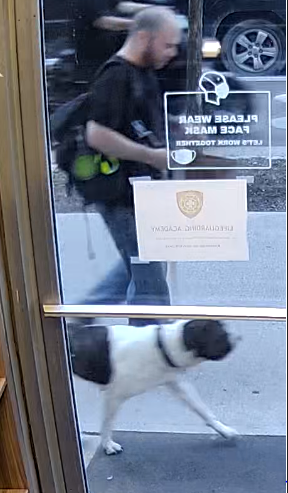
The Toronto Police Service is requesting the public’s assistance with identifying a man in an aggravated assault investigation.
On Wednesday, July 6, 2022, officers responded to a call in the Bloor Street West and Major Street area.
It was reported that at approximately 8:45 p.m., two men became involved in a brief verbal interaction, and as a result, the suspect assaulted the other man. The victim was transported to hospital with serious injuries.
The suspect is described as in his late 30s, approximately 6’, medium to muscular build, balding, wearing a black t-shirt, blue jeans, black backpack, walking with a white and brown dog.
Anyone with information is asked to contact police at 416-808-1400, Crime Stoppers anonymously at 416-222-TIPS (8477), or at www.222tips.com. Case #: 2022-1287373.
—Brian Burchell/Gleaner News
Comments Off on CHATTER: Man wanted for aggravated assault (Aug. 2022)Tags:Annex · News
August 17th, 2022 · Comments Off on EDITORIAL: Farewell Mike (Aug. 2022)
After 12 years on city council, Mike Layton, representative for University-Rosedale’s Ward 11 will not seek another term. Given the systemic changes made to the city’s governance in recent years, it’s no surprise Layton’s made this call—but it’s a shame and a real loss to this community.
He’s not alone in his decision to step away from public service: Joe Cressy, who also served previously as a councillor representing our area, resigned earlier this year after serving as chair of the Toronto Board of Health for the bulk of the pandemic; Councillors Ana Bailao, Denzil Minnan-Wong, and John Filion have also chosen to not seek re-election; Krystyn Wong-Tam and Michael Ford left city council to run successfully in the recent provincial election.
The biggest change to the job of city councillor came in 2018, when Bill 5, the “Better Local Government Act,” cut the number of council seats from 47 to 25. It was widely seen as payback for the city because it refused to elect Ford as mayor. Like most of Premier Ford’s legislation, the bill has had the opposite effect: it doubles the amount of work councillors have on their plates and offers no extra support to help them get it done. Layton’s previous ward had 42,000 residents, but his current one has 104,000, almost the size of Kingston.
According to Layton’s office, there are over 20 resident associations (RAs) in Ward 11, which does not include issue-specific groups like Avenue Road Safety Coalition, Friends of Kensington Market, or Friends of Chinatown which are also resident-based, but do not identify as RAs. He also sits on the the board of all 18 Business Improvement Areas in the ward.
There are currently 99 active rezoning applications; there were times during his term when the number was 150. This number does not include buildings that have been approved and are under construction, nor the management of those processes.
Even with the high caliber crew he has recruited in his office, this job is impossible given the amount of direct and personal attention he must devote to each project or issue.
Layton was elected when he was 30 and is now married with two young daughters. In his parting letter, Layton says he has “missed far too many dinners, and far too many bedtimes” and “let’s face it they’re only young once.”
About city council working with only half its complement of councillors, he says, “there’s just not enough hours in the day to get what we need done, not enough time to engage with the community.”
And yet, despite all the foregoing, Layton managed to step out of the reactionary box of day-to-day city councillors’ lives and take initiatives such as getting the city to try to forge a path to reconciliation with Indigenous people, setting a city-wide climate change goal of Net Zero by 2040, tirelessly promoting cycling infrastructure, and securing more affordable housing. He even started a targeted “Cask Force” to make it easier to set up craft breweries in the city.
It’s been a journey, and he should be proud to have made a difference, despite the seeming impossibility of the job.
August 17th, 2022 · Comments Off on FORUM: Revenue, revenue, revenue and the lack thereof (Aug. 2022)
Why is city council afraid of getting what the city needs to deliver services?
By Mike Layton
By the time this reaches your doorsteps, council will have completed our last legislative cycle before the election period begins, and the agenda is as busy as ever. Top of mind for me is continuing to work toward correcting the service deficiencies many residents have been noticing as the weather has warmed and people are engaging with our public spaces and services.
Access to water and public toilets remains a primary issue in our parks, and the inability of the city to hire enough lifeguards to patrol all our pools has been challenging.
These problems are not unfixable; in fact, the solution to both is straightforward.
We need to increase our service standards, invest in our public infrastructure to expand availability, and pay our staff living wages.
It is not a matter of people working harder. The late and delayed openings and early closures are a symptom of a budget that does not treat the needs of its residents as a priority.
Parks and pools are not alone. Many residents are frustrated with the timelines involved while waiting for the city to address noise concerns, forestry issues, road safety (and implementing subsequent interventions), and a lack of shelter space. These are just the issues I am contacted most often about.
Lately, the mayor has been touting delays to infrastructure projects if other levels of government do not come through with funding related to the necessary pandemic and public health measures the city has in place.
While I am in full agreement, we must have government share the costs of keeping people safe in the pandemic.
There is so much more council could do to prevent these rainy-day scenarios, and it starts with seriously evaluating our revenues and our ability to deliver and increase the services people want and need.
Council has continuously kicked the can down the road on this.
We have not implemented new revenue sources in over a decade (despite my yearly attempt to reinstate the vehicle registration user fees).
We have kept property taxes below the level required to maintain service levels set when we were a smaller city and we have shown no serious willingness to address the gaps this has created, both in hiring within the public service and the resultant services that provides. This is not a new issue.
Every city manager who has left the job since I started here at city hall has told us we need to better address our revenue sources. We take in barely enough to perform the status quo, and we will have trouble should emergencies arise.
Many of you may be aware that our current city manager is planning to step away from the job this summer, and I have been asked to participate in the hiring process for a new city manager.
Ensuring the top of the civil service is dedicated to ensuring all city divisions are funded appropriately and has an eye to expansion and improvement of services is my top priority.
The status quo is not working for many people; we cannot accept someone new who is content with the way things are.
Mike Layton is city councillor for Ward 11, University–Rosedale.
August 17th, 2022 · Comments Off on FORUM: We need to ban harmful single-use plastics (Aug. 2022)
A case for reducing plastic in our environment
By Steven Guilbeault
Plastic is everywhere. We use it in packaging, construction, agriculture, automobiles, electronics, textiles, and medical equipment.
While plastic has revolutionized our lives, plastic pollution has emerged as a key environmental issue worldwide.
Of the four million tonnes of plastic waste that are thrown away in Canada every year, only eight per cent is recycled. The rest ends up in landfills and our natural environment, littering our parks, beaches, streets, and other places we value. Plastic pollution chokes wildlife and clogs waterways. It breaks down into tiny pieces, ending up in the soil, oceans, and air, and even our drinking water and food.
We have to change this. It’s what Canadians are asking for. Now is the time for action.
Just recently, our federal government announced we are banning some of the most common and harmful single-use plastics, including plastic checkout bags, plastic cutlery, six-pack rings, stir sticks, straws, and certain hard-to-recycle food containers like clamshells.
While the domestic production and import of these harmful single-use plastics will be banned at the end of this year, Canadian businesses like restaurants can use them until the end of next year, which gives them time to adjust.
Over the next decade, this world-leading ban on harmful single-use plastics will result in the estimated elimination of over 1.3 million tonnes of hard to recycle plastic waste.
This is all about creating cleaner communities and a cleaner environment. It’s about giving Canadians the sustainable alternatives they’re asking for and developing new business opportunities in a greener economy.
This ban represents a historic step in our government’s promise to cut plastic waste from across our society, wherever possible.
But we know we cannot ban our way out of this problem. Plastic will remain a useful part of our lives. Our government’s plan is about responsibly managing plastic so it stays in the economy and stops polluting our environment.
Our comprehensive plan will also mean plastic manufacturers will have to use 50 per cent recycled plastic in any plastic products they make, and that the “chasing arrows” recycling symbol on products can only be used if we know these products can actually be recycled in Canada.
These are just good, common sense management measures. And they will help to grow our economy towards a more circular management of waste products that is proven to generate jobs and reduce business costs.
Canadians have been very clear. They want to get plastic pollution off our streets, out of our water, and out of our environment. With the proper tools and rules in place, a better, greener, and more circular economy awaits.
Steven Guilbeault, is the federal minister of environment and climate change Canada.
Comments Off on FORUM: We need to ban harmful single-use plastics (Aug. 2022)Tags:Annex · Opinion
August 17th, 2022 · Comments Off on SPORTS: Leafs prepare for postseason push (Aug. 2022)
Veteran players hope to hoist the Intercounty Baseball Championship trophy at Christie Pits
Toronto Maple Leafs third baseman Johnathan Solazzo in action at Christie Pits on July 31. The Leafs defeated the Welland Jackfish 5-2. R.S. KONJEK/GLEANER NEWS
By R.S. Konjek
Prior to the start of this summer’s Intercounty Baseball League season, Damon Topolie was confronted with several holes in the Toronto Maple Leafs’ roster.
Some veteran players had departed or would be absent to start the 2022 season.
Topolie decided it was time to experiment.
The Leafs’ vice president of baseball operations, general manager and field manager invited a group of junior players from the Toronto area, ranging in age from 18 to 22, to fill the gaps. Mother of invention and all that.
The experiment proved a success. Three months into the 2022 season, the Leafs enjoy a 20-13 record, good for fourth place in the league standings.
“When I first saw them, I thought, ‘Topolie, what have you done, these look like children,’” laughs veteran Leaf Johnathan Solazzo. “But these guys can hit. They started hitting home runs, getting hits down the line, hitting doubles, we needed that.”
Several of the rookies made solid contributions over the season’s first three months. Luca Boscarino, Brady Cerkownyk and Aidan McAskie impressed at the plate. Diego Dominguez, Rhys Montgomery and Ryan Wells ate up valuable innings on the mound.
“One who really stood out is Wells,” says Solazzo. “He’s nineteen years old and throwing in the 90s. He’s going to be something special.”
Most of the rookies have committed to colleges in the United States, seeking further exposure of their baseball skills in hopes of being drafted by a Major League club. As the month of August arrived, they bid a fond farewell to Christie Pits and headed south one by one.
The Leafs’ season now takes on a transitional feel.
With the postseason on the horizon and the rookies all gone, Topolie will look to the mainstays on his roster to step up.
That includes Solazzo, a twelve-year IBL veteran currently playing his seventh season for Toronto.
“It was good to finally get my first home run of the season,” he says of the blast he hit on July 6.
After a slow start, Solazzo went on a tear in the month of July. He raised his batting average 77 points to .343 while tallying 19 hits, 13 runs, 5 home runs, 18 runs batted in, and 10 walks over thirteen games.
The Leafs’ roster has managed to stay mostly injury-free, and with the playoffs scheduled to start later this month, Solazzo sees the team peaking at the right moment.
Entering August, the Leafs trailed the Welland Jackfish, London Majors and Guelph Royals in the league standings, but all four clubs were separated by just four games. There is no runaway favourite to win the championship this year.
“The postseason is a new season, everybody has a go at it,” he says. “I can’t say any of [the league’s other teams] is unstoppable, and we can take on any of them. It definitely would be nice if we won a championship for Jack.”
“Jack” being the late Jack Dominico who owned and operated the club for 53 years before passing away in January.
The Leafs’ first season without Dominico at the helm has been successful, as evidenced by their winning record and the large crowds in attendance for home games at Christie Pits. Maple Leafs baseball is as popular in Toronto as it has ever been.
For long-time players like Solazzo, it has been hard not to feel Dominico’s absence.
“It’s the little things, like when you walk out of the change room and he’s not there at his usual seat,” says the Leafs third baseman, who misses his interactions with the oft-irascible owner.
“I miss the late-night phone calls after games on the road. I’d be driving home, and he’d call on the Bluetooth. Jack was never pleased if you weren’t winning a championship, but he was always helping us out too.”
Dominico established a paternal bond with many of his veteran players. Solazzo believes this helped create the Leafs’ closely-knit clubhouse, which has remained intact.
“He would be proud of us.”
After falling short of a championship by one game last year, the team embraced “unfinished business” as its theme for 2022.
The regular season is winding down and the playoffs beckon. Players and fans alike hope that the Leafs will win their first championship since 2007.
July 18th, 2022 · Comments Off on ON THE COVER: Wiener’s Home Hardware Celebrates 100 (July 2022)
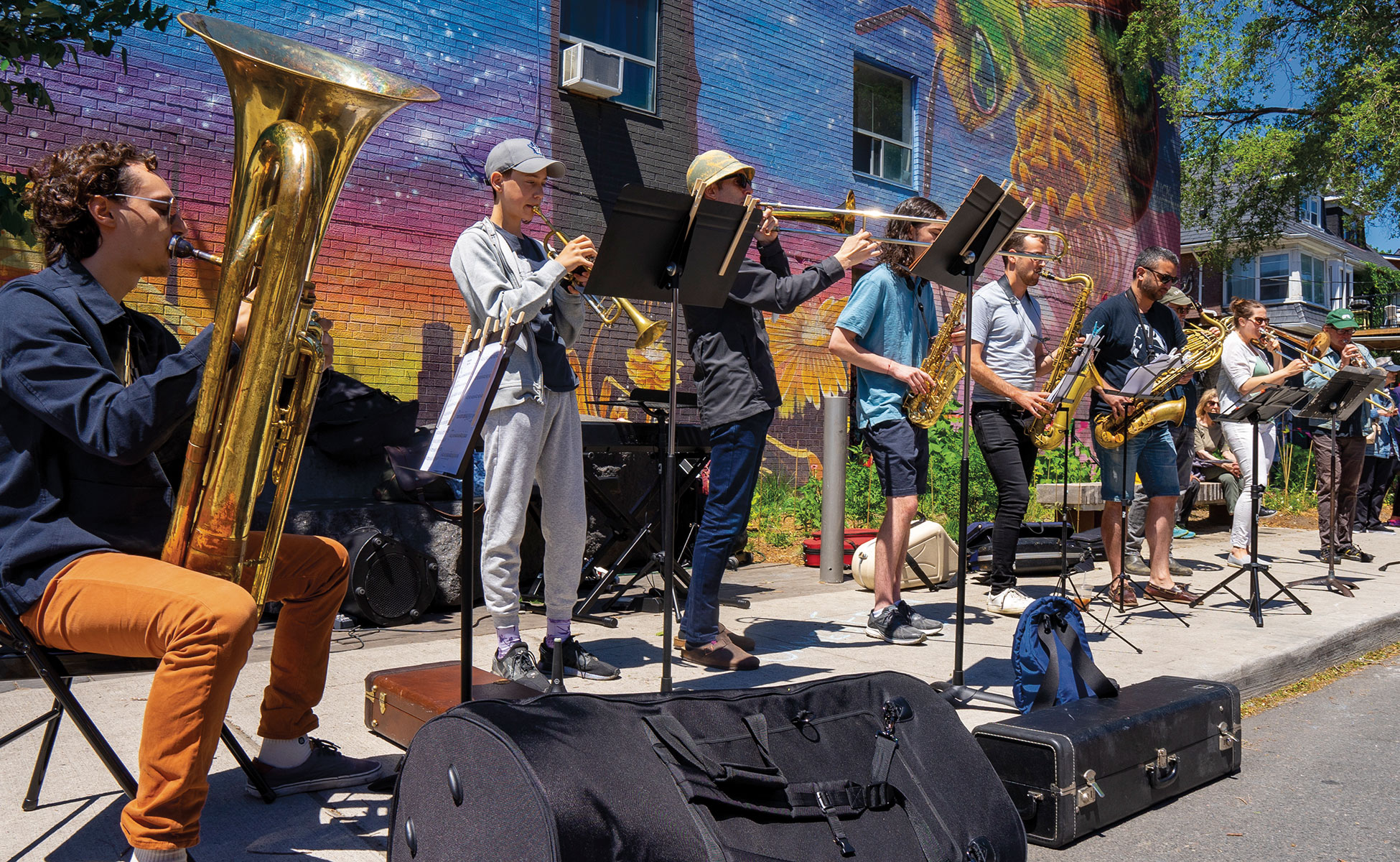
Members of the community brass band Horn on the Cob perform a tribute at Wiener’s Home Hardware’s 100th birthday celebration held June 18 on Howland Avenue. The event was organized by the Bloor Annex Business Improvement Area together with the Annex Residents’ Association and the Harbord Village Residents’ Associations. NEILAND BRISSENDEN/GLEANER NEWS
July 18th, 2022 · Comments Off on NEWS: Bell re-elected in University–Rosedale (July 2022)
Annex backs NDP, province backs PCs overall
By Carly Penrose
New Democrat Jessica Bell won University-Rosedale by 4,000 votes while Doug Ford’s Progressive Conservatives won a sweeping majority in the bid to lead Ontario’s government.
“It’s an honour to be chosen again to be the MPP for University-Rosedale,” Bell said in an interview with the Gleaner. “It’s a huge privilege and great responsibility. It’s my commitment to give it my all to serve our riding and fight for the values we care about.”
In 2018, Bell won 50 per cent of the vote. The NDP has won this riding in the past seven provincial elections.
“I’m feeling reflective,” said the runner-up Andrea Barrack, who added that she “was just really grateful for the residents of University-Rosedale who took the time to talk with me and our canvassers.”
She also encouraged residents in the riding and throughout the province to engage with provincial politics and vote.
“I just feel very strongly it’s something we should treasure,” said Barrack.
The third-place finisher, Carl Qiu of the Progressive Conservatives shared the same message.
“We need to vote. We need to get our voices heard, regardless of who you support,” he said.
There was record-low voter turnout this election. In University-Rosedale, turnout was 43.5 per cent, an almost exact mirror of provincial numbers, which saw 43.53 per cent of eligible voters cast a ballot. This election was notable for having the lowest voter turnout in Ontario’s history.
Despite the record-low turnout, the Progressive Conservatives were the clear winners of the night. The party gained seven seats in the legislature, while the NDP remained the official opposition, but with fewer seats. The Liberals gained only one seat compared to their 2018 finish, and the Greens maintained their caucus size of one. An independent MPP was also elected to the legislature which is a rare occurrence in Ontario politics.
Though Qiu, the PC candidate in University-Rosedale came third in the riding, he said he was feeling good after the election results.
“I recognize downtown is challenging,” he said, referring to the voting history of downtown Toronto ridings which regularly go to NDP and Liberal candidates.
Qiu said he believed “the premier was able to reach out to nontraditional ridings,” and he pointed to the Essex and Windsor-Tecumseh ridings which flipped from orange to blue after not electing a conservative candidate in more than 60 years.
The overwhelming win by Ford’s PCs also saw the resignations of party leaders Andrea Horwath and Steven Del Duca on election night. Del Duca lost his riding of Vaughan-Woodbridge to PC candidate Michael Tibollo. Meanwhile, Mike Schreiner was re-elected in Guelph by a margin of over 18,000 votes, the biggest blowout of the election.
In University-Rosedale, Green Party candidate Dianne Saxe managed to get twice as many votes as the Green candidate in 2018.
“The overwhelming PC majority is very bad news for Ontario,” said Saxe. “Three climate disasters within a week and a half of the election—but that wasn’t enough to get people to think [about the] climate crisis.”
Still, Saxe said she was proud of the work her team did and mentioned how “wonderful it is to work on the biggest issue of our lifetime with a wonderful team.”
As Bell prepares to return to Queen’s Park, she says she is excited to have four more years to “build power” and work with the community to achieve common goals like action on climate and housing affordability, two of the top issues she heard at the door.
Bell also gave credit to Barrack and Saxe whom she faced in multiple local debates. She said their strength, awareness, and engagement are a testament to the people who live in University-Rosedale.
July 18th, 2022 · Comments Off on NEWS: New mural celebrates Indigenous storytelling (July 2022)
Artwork weaves together stories of creation and coexistence
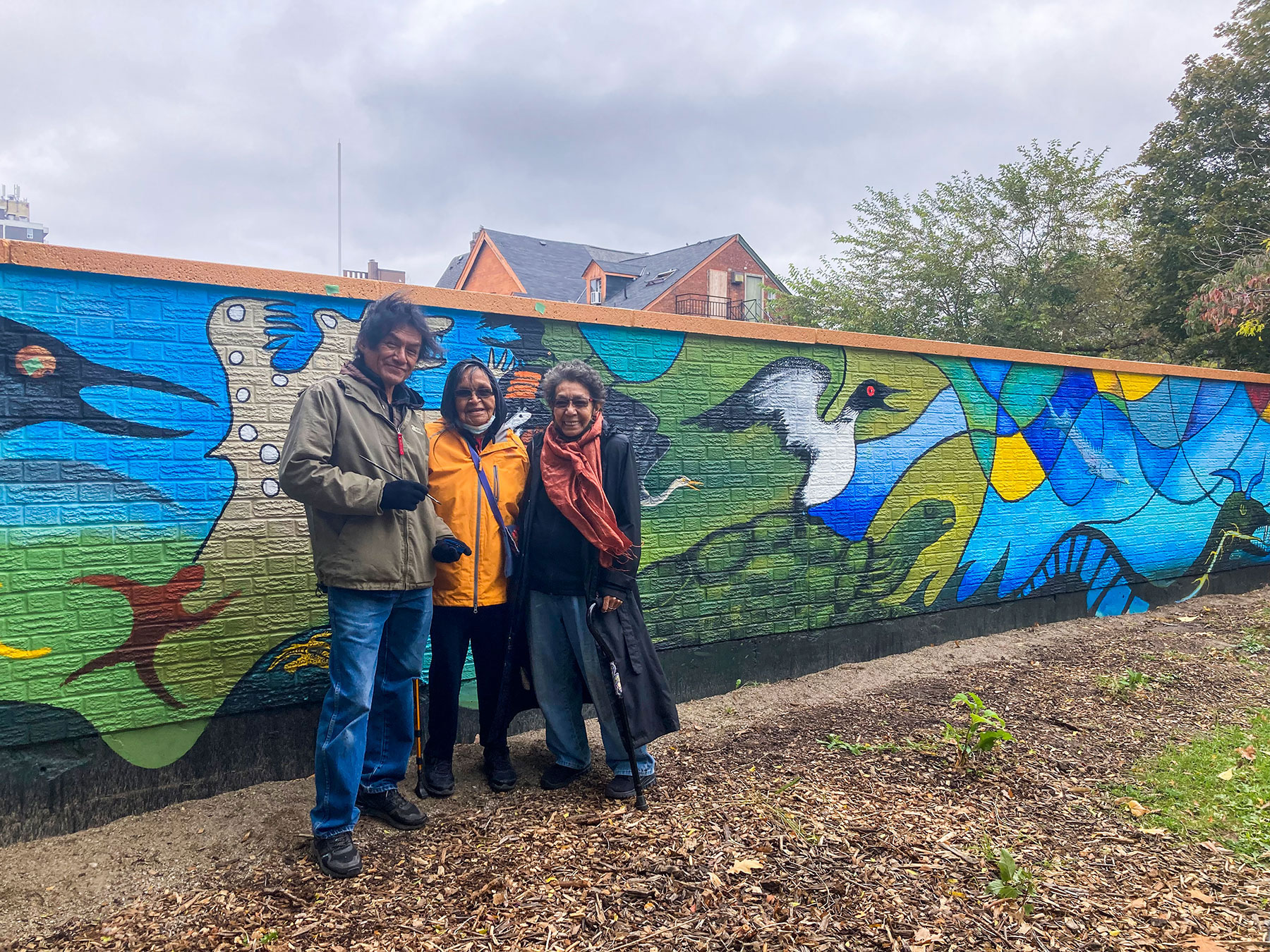
Joseph Sagaj with Elder and Knowledge Keeper Jacque Lavallee (Jacqui Lavalley) and Grandmother Donalda Ashkewe (Winnie Ashkewe). The 86-foot-long mural includes artistic contributions from Denise Aquash, Sonja Clarke, Larry M. Holder, and Mike Rowade (aka Ron Wild). COURTESY JOSEPH SAGAJ
By Meribeth Deen
Joseph Sagaj is Anishinaabe, a residential school survivor, and an artist. A few years ago, he took up gardening as well and joined a group of Indigenous tradespeople and Elders known as the Earth Helpers who made it their mission to bring biodiversity and native species back to Paul Martel Park. As Sagaj weeded and put plants in the ground, he would look up at the bare wall of the TTC station that bordered the park and conjured scenes of what could be there.
“I had the idea of doing something on creation stories because we all have creation stories,” he says.
“And I heard this Elder Jim Dupont say, ‘In the beginning, before the beginning,’ and I kept thinking about that. I thought about something totally pitch black—something darker than a thousand midnights—and it triggered a sort of big bang in my process.”
Fortunately, that big bang of creativity came with permission to get to work.
A juried committee with the Bloor Annex BIA selected his proposal to create a mural with the theme of “Indigenous Storytelling.” Creation stories would be the starting point, but Sagaj said there was a line in the Bible he needed clarification on first.
“I have never felt too connected to the story of Genesis,” he says. “But in that story, there was one line that nagged at me. It’s the line that says, ‘And God moved over the surface of the waters.’ I kept wondering what it meant. So, when I saw a Pastor that I knew walking across the street, I caught up to him and asked him about it. He said to me, ‘As an artist, you’ll get this. He’s watching how it’s coming along, this work he’s started. He’s in process.’ I thought, that’s where I’m at! And I knew I needed to just keep going and keep listening to the Elders.”
And so, for every day of painting, which started in August 2021, Sagaj was joined by Elders of various backgrounds who would sit nearby and tell stories.
“There are so many stories intertwined that show our various ways and knowledge in there. While all our cultures are different, the Indigenous people of this land have a shared history.”
And while the stories are different, there’s a commonality in how the stories are told.
“Our stories are told through metaphor, and when I was a kid, my cousins and I would race for the rocking chair, as it was the best seat in the house, and gather around and wait for the Elder to begin telling stories. You had to figure the stories out. But when Europeans landed on these shores and started hearing these stories, they dismissed them and said they were ridiculous. Then, when Charles Darwin or Carl Sagan told the same stories in a different way, they said, ‘Hey, that really makes sense.’ Our stories have been disregarded, but now I have the chance to share them on a wall and people really want to hear them.”
Joseph says he has spoken with locals about the mural (the response has been positive, and they’ve bought him a few coffees) and with people from all over the world.
“I hope people see a little of themselves in this mural no matter where they come from,” he adds. “And I hope that they see that we are all here for the same purpose whether you are two-legged or four-legged, one of our winged brothers and sisters, whether you are fire, water or air, and they understand that we will not exist without each other. By sharing our stories—whether we choose to do so from an ecological perspective, a cosmological perspective, a mythological perspective—there’s so much in there about how we can and should relate to one another.”
July 18th, 2022 · Comments Off on NEWS: Celebrating 50 years of sustainable food and community (July 2022)
In a laneway behind Palmerston a not-so-secret food co-op thrives
The Karma Co-op blackboard wall getting decorated on their 50th anniversary on June 25. COURTESY DAVE BELL
By Rebecca Weigand
On Saturday, June 25, a crowd gathered to celebrate Karma Co-op’s 50th anniversary in the laneway outside the store. Longtime members joined with newer ones, Karma staff, and Karma kids to connect over a shared appreciation of this co-operative community store.
While enjoying fresh strawberries and produce from local farmers, eating homemade cake, enjoying wine from Frogpond Farm Organic Winery and cooling off with popsicles from one of Karma’s suppliers, Karma members chatted and relaxed under much appreciated shade sails.
A few co-op members shared what Karma means to them and their visions for the co-op over the next 50 years.
In between taking photos, Dave Bell shared that climate change and overconsumption have guided his decision to be part of Karma Co-op. “It’s the ability to do something better for everything I need,” he said.
Erika Reyes also talked about how being a member of Karma has deepened her commitment to organic food.
“What attracted us to Karma was the zero waste products and organics. To be honest, it was a little bit difficult in the beginning to pay for organic products. In the orientation session we learned why it’s so important to purchase organic products so we decided we would try it out, and we have come to realize that all our vegetables are good again!” she said.
“We trust Karma’s choices because the choices are made by the community, for the community. That means a lot to us. We like to see where it’s coming from, whether it’s fair trade, organic, or just conventional produce. Whenever we enter Karma, we can relax.”
As the conversation wrapped up, Reyes and her partner, Clement Bureau, mentioned that their commitment to zero waste led them to create Inwit, a new reusable container takeout option and a true reminder of the exciting possibilities and cross-pollinations that happen when people come together in a sustainable community.
“I always run into people I know when I come to Karma,” said Harriet Friedmann. The former chair of the Toronto Food Policy Council has been a member of Karma since 1990 and says that having studied the problems facing food systems, she joined the call for more food co-operatives.
“Instead of trying to grow bigger, you be a model. You scale out rather than scale up. And we tried to do that many years ago, and it didn’t work. But I think it’s still a brilliant idea. So, my vision would be to have Karmas in every community and to be able to help from very practical experience, you know, what are your connections to farmers, or to artisans, any of those suppliers.”
Marina Querelos added “I think we should have a co-op in every neighbourhood with a public market attached.”
Friedmann and Querelos are not alone in wanting to share the co-op model. Councillor Mike Layton (Ward 11, University-Rosedale) joined the celebrations with his daughters Phoebe and Chloe.
He talked about his hopes to replicate Karma’s model of co-operative community.
“We got through the pandemic and what we realized is that access to healthy food as well as community networks didn’t exist for many, and we have to almost invent it. But when you have something like Karma Co-op you have that embedded in your community. It’s not only about the sustainable food, it’s about the resilience that you get as a community.”
As she watched her son and other children decorating the new outdoor chalk wall, Karma’s General Manager Talia McGuire reflected on how the co-op offers community for kids and adults.
“There are kids here who grew up at Karma. They are pure joy, seeing them running in the aisles. The biggest thing for me is the people: that connection, that sense of community.”
Karma Board president Andrea Dawber shared that Karma will be embarking on a visioning process over the next year.
July 18th, 2022 · Comments Off on CHATTER: PARA AGM all about green initiatives (July 2022)
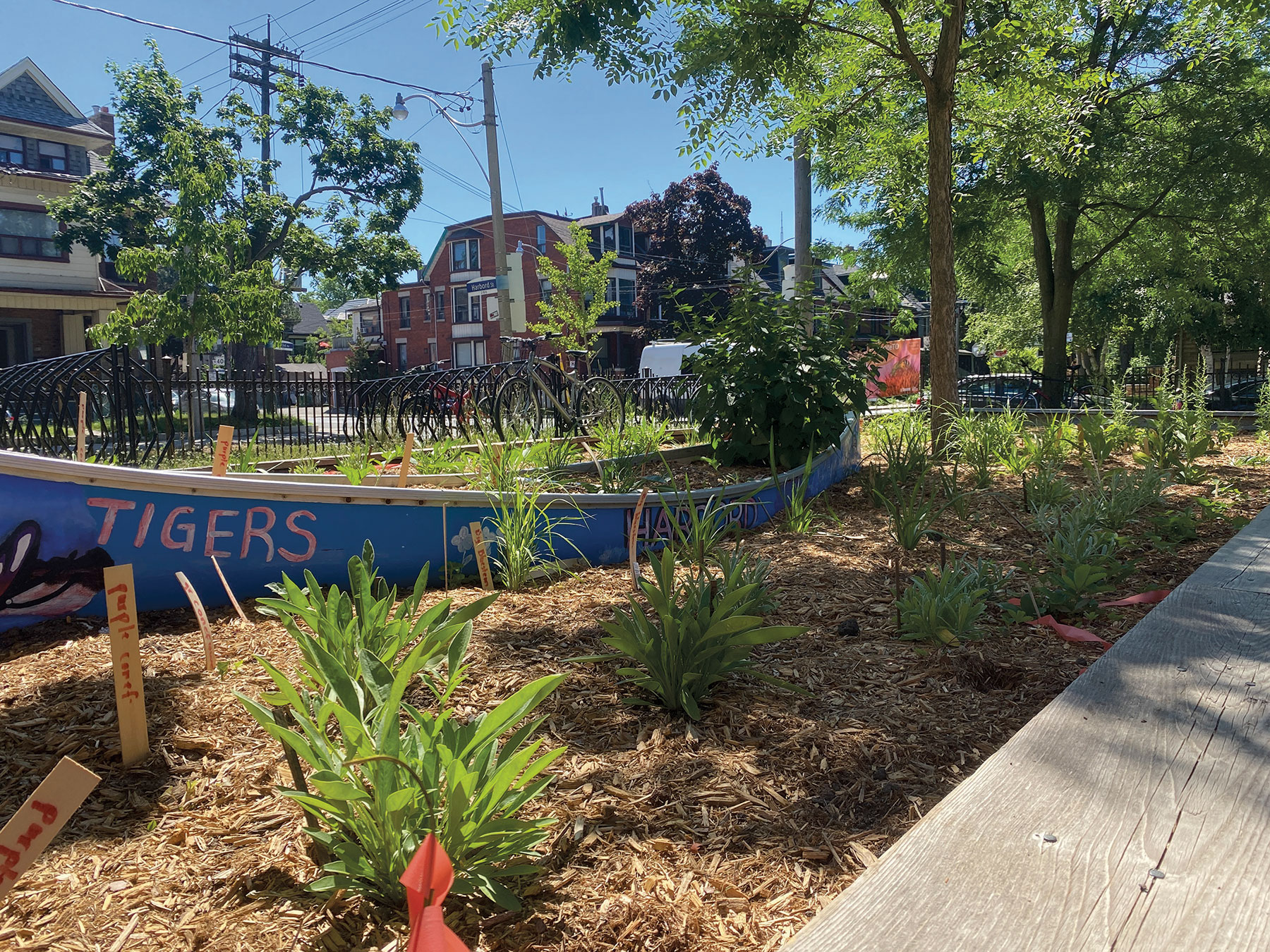
The newly planted pollinator garden thrives in the sun outside of Harbord Collegiate Institute. The planting of this garden is one of many environmental initiatives the Palmerston Area Residents’ Association is taking this summer. FOX OLIVER/GLEANER NEWS
The Palmerston Area Residents’ Association (PARA) held their annual general meeting on Thursday, May 26, via Zoom. At this year’s meeting, members focused on the environment and sustainable living. Guest speakers discussed the dangers of, and alternatives to, single-use materials and how homeowners can upgrade their homes into more sustainable dwellings and apply for valuable grants.
Before the guest speakers, a brief update was given on PARA’s ongoing projects. A new pollinator garden has been planted in front of Harbord Collegiate Institute and planting and garden maintenance are scheduled for Healey Willan Park, Palmerston Gates, and Korean grocer PAT Central. A planning group is working on a College Street upgrade plan which includes additional bike lanes and greenspace in the Palmerston area. If you live in the area, expect to receive a survey by the fall asking what you want to see on College Street.
Emily Alfred, a representative from the non-profit organization Toronto Environmental Alliance, brought up the consumption of single-use disposable items as an issue that needs to be addressed at all three levels of government, as well as on an individual basis. Alfred predicted that a federal ban on six single-use plastics (bags, stir sticks, six-pack rings, utensils, straws, and food containers) will likely come by the end of the year. Municipal regulations on single-use disposable materials have already received heavy community support, as the city has the power to regulate the distribution of these materials through food services. Possible means to regulate these disposable materials include charging a mandatory fee for these items or only being allowed to distribute them if specifically requested by the customer.
Alfred then provided a list of innovative ways to reduce waste alongside government regulation. Restaurant customers can bring their own reusable containers for takeout, similar to how many already bring reusable thermoses to coffee shops. While some may worry that this is unsanitary in a restaurant, it is completely safe if restaurants follow proper food preparation procedures. Restaurants could also offer reusable containers for delivery which could be returned for a deposit.
Tim Grant, chair of the net zero committee and the Harbord Village Residents’ Association (HVRA), discussed changes that homeowners can make to save money while upgrading their homes; for example, the government of Canada offers $5000 grants for homeowners for rooftop solar electric systems, new windows, air sealing, exterior insulation retrofits, and air source heat pumps. Grant also announced that the HVRA has partnered with Best Buy to offer Torontonians in the area discounts on induction ovens, stoves, and cooktops which are greener alternatives to gas appliances.
PARA has a very active green committee that has undertaken a long list of projects to improve the neighbourhood and push for broader environmental responsibility. They are creating a pollinator garden at Harbord Collegiate, working on the revitalization of neglected spaces, participating in community consultations and much more.
July 18th, 2022 · Comments Off on CHATTER: NDP’s pattern of prevailing in the Annex continues (July 2020)
Jessica Bell of the New Democratic Party (NDP), has represented the University-Rosedale riding (District 112) since her success in the 2018 election. She was re-elected on June 2. Of the 49,412 votes cast in the University-Rosedale riding in 2018, Bell earned 24,537 of them (49.66 per cent), followed by Liberal candidate Jo-Ann Davis who earned 10,898 votes (22.06 per cent), PC candidate Gillian Smith who earned 10,431 votes (21.11 per cent) , and Green Party candidate Tim Grant who earned 2,652 votes (5.37 per cent).
Throughout the history of the University-Rosedale district, and its predecessor the Trinity-Spadina district (created in 1999 but replaced by the University-Rosedale district in 2018), the election result has almost always been NDP. NDP MPP Rosario Marchese was elected four terms in a row between 1999 and 2014. In 2014, Liberal MPP Han Dong beat Marchese 26,613 votes to 17,442 votes, marking the only time when the riding was represented by a non-NDP candidate since its creation.
In every election since the riding’s 1999 creation, the Liberal candidate has been the runner up to the elected NDP MPP, except for 2014, when Marchese (NDP) was the runner-up to Dong (Liberal). Additionally, the Green party has gained momentum in the area compared to the province, winning an average of 7.25 per cent of votes in the University-Rosedale riding over the past four elections compared to the provincial average of 5.1 per cent of votes for the Green party.
In the 2018 election, provincial voter turnout was 56.7 per cent of all eligible voters. Voter turnout in the Annex was similar, with a 56.3 per cent turnout. This year, the lowest voter turnout in history was recorded with only 43 per cent of eligible voters in Ontario taking to the polls. Turnout in the Annex was only marginally better, with a 43.5 per cent turnout.