December 16th, 2025 · Comments Off on EDITORIAL: Toronto has matured; Doug Ford has not (Dec. 2025)
Doug Ford never met a car he didn’t love. That’s easy to see from the just-passed Bill 60, particularly its transportation sections. This love affair with the car isn’t new—at least for anyone who remembers the late Rob Ford’s chaotic reign as mayor. Back then, with brother Doug as a city councillor, the Fords attacked any perceived slight against the motorist as part of a supposed “War on the Car.” The City of Toronto has matured since then; Doug Ford has not.
Bill 60, Fighting Delays, Building Faster puts the earlier Bill 212, now incorporated into the Highway Traffic Act, into plain language. Bill 212 required provincial approval for new bike lanes that reduced the number of car lanes. Only the naïve believed the province would grant such approval. Many bike lane projects have been preemptively abandoned. Bill 60, which passed third reading after fast-tracked debate and hearings, makes clear that cities shouldn’t bother asking for permission to build a bike lane at the expense of a car lane. The answer is “no.” (Bill 212 also included the removal of bike lanes on Bloor, University, and Yonge—a matter that goes to the Court of Appeal in January).
Other community improvements that might require the reallocation of space from cars— busways, wider sidewalks, or more greenspace—are not specifically prohibited by Bill 60, but Ford has bestowed upon himself the power to prevent their implementation if they displease him. Bill 60 allows the government to prescribe initiatives, in addition to bike lanes, that can be prohibited if they require a reduction in car lanes.
Ford is among a long line of politicians who were convinced that creating more road space was the answer to traffic congestion. In the 1950s, Metro Toronto Chair Fred Gardiner was given colossal resources to solve traffic congestion. One of his targets was sidewalks. (There were no bike lanes). “I would cut five or six feet off many sidewalks, shove the poles back and create two new lanes for traffic.” Ford could learn from past mistakes and the simple lesson that our problem isn’t too few roads; it’s too many cars.
Instead, Ford has been busy removing impediments to driving. Bill 60, as well as the recent ban on speed cameras, elimination of tolls on Highway 407 East, and reductions in gas taxes, at least make it clear that Ford isn’t simply fixated on bike lanes. The obvious irony is that we (that is to say, those who follow the evidence) know precisely where Ford is taking us: when it’s easier to drive, more people drive, resulting in more congestion.
Sure, pity the motorist, but not for the reasons that Ford spins. Driving a car is absurdly expensive, averaging over $8,000 per year—a lot of money for a machine that sits idle for over 90 per cent of the day.
The trajectory toward efficient modes of transportation is well-established. Ford’s interventions will only delay progress. Ontarians will pay a heavy price for his misguided policies, including higher climate emissions, transportation costs, and road deaths—and more traffic congestion.
Fortunately, all is not lost for our old friend, the bicycle. Many projects in Toronto’s cycling plan don’t require removing a car lane and can proceed. The value of existing bikeways can be enhanced with new connections. Bike lanes, such as on Davenport Road, can be upgraded to modern standards with raised curbs. The disconnected strands of many of the city’s off-road trails can become a network. A 73-km loop trail around the city is compromised by 10 small gaps, which, if finally closed, would serve both recreational and utilitarian cyclists, as well as tourists.
Ford will ultimately succeed only in demonstrating, yet again, the futility of trying to solve motor traffic congestion by creating more space for inefficient, single-occupant cars instead of focusing on better transit, walking, and cycling.
Albert Koehl is an environmental lawyer, coordinator of Community Bike-ways, and author of Wheeling Through Toronto: A History of the Bicycle and its Riders (University of Toronto Press, 2024).
December 16th, 2025 · Comments Off on FORUM: Pursuing a green agenda (Dec. 2025)
New neighbourhood stores and the need for more electric buses
By Dianne Saxe
Season’s greetings to one and all! It’s been a busy time of year as we work towards the holidays. Here’s a list of the top things affecting our ward heading into 2026:
1. To give more people places to shop, play, learn, or work close to home, Toronto city council has eased zoning rules for three kinds of local businesses:
Home-based businesses are already permitted nearly everywhere, but now, home-based businesses will be able to hire up to two employees and operate from auxiliary buildings on-site such as garages. Schools, artist studios, offices, service shops, and custom warehouses will now be able to see clients on-site. This will help more Torontonians start or grow a business from their home.
Small commercial activities (generally 150 square metres or less) will now be permitted on the ground floor in residential areas on major streets and could include art galleries, artist studios, custom workshops, schools, massage therapy centres, performing arts studios, personal service shops, pet services, production studios, recreation, religious education, retail and service stores, wellness centres, and restaurants with small patios.
Within the old City of Toronto, very small retail stores (110 square metres or less) will again be possible on street corners or next to schools, parks, or commercial sites. Unlike last year’s proposal, this excludes most interior neighbourhood streets. The stores may have interior cafes but no patios or on-site food preparation.
These changes should come into effect in the coming months, with their impact monitored for two years.
2. The federal and provincial governments have announced important incentives to help individuals and businesses invest in clean equipment which typically saves money over time but has a higher upfront cost. For example:
Individuals can claim rebates of up to $200 on high-efficiency ENERGY STAR appliances such as refrigerators, freezers, laundry equipment, and induction stoves to replace old electric models.
Businesses will be able to write off 100 per cent of capital expenses for clean energy generation, energy conservation equipment, and zero-emission vehicles. They may also be able to claim a federal Clean Technology Investment Tax Credit.
There are significant new incentives for verified energy savings by large electricity users.
3. Doug Ford’s latest moves include abolishing the speed cameras that save children’s lives in school zones and that pay for road safety measures like crossing guards (Bill 59). His Bill 60 makes it easier and faster for landlords to evict tenants, as well as gives Metrolinx a freer hand to ignore city bylaws and take city assets. The bill also cuts funding for infrastructure and threatens the city’s ability to prioritize pedestrians or transit over cars.
The Ford government is also considering cutting its contribution to the Canada Ontario Housing Benefit, the key rent subsidy that allows the most needy to move out of homelessness and into stable housing. Cutting this rent benefit will mean more severely distressed people in shelters, on the TTC, and in our parks.
In other news:
4. The Hospital for Sick Children, while celebrating its 150th anniversary, has been recognized as the world’s top pediatric hospital. Congratulations!
5. Metrolinx’s Finch West light rail transit should finally open to TTC riders on December 7.
6. Toronto is making it cheaper and faster to build missing mid-rise housing, with some units available as early as June. To encourage building on unused land, the city has just approved a second single exit stair design which architects love because the buildings cost less and are more spacious and comfortable.
7. In December, council will consider zoning options for Christie, Dupont, Bathurst, Ossington, Dundas and small pieces of Sherbourne and Bloor East. These streets are about 20 metres wide and have better transit times. Staff are proposing to rezone properties currently used as residential to apartment neighbourhoods and to CM (mixed use). In our ward, this will not change permitted building heights.
9. I was proud to represent Toronto at C40’s 20th anniversary summit. C40 has been extraordinarily successful in helping cities around the world collaborate on climate action. Seventy-five per cent of C40 cities have reduced climate pollution more than their countries have, with knock-on benefits for human health, affordability, and quality of life; for example, Toronto’s electric bus fleet, at 200, is the largest in North America. Sao Paulo has 1,000, and Shenzhen has 16,000. I was also honoured to represent Toronto at two United Nations Environment Programme meetings on cities and nature.
Many happy returns to everyone for the coming holiday season!
Dianne Saxe is the councillor for Ward 11, University–Rosedale.
December 16th, 2025 · Comments Off on FORUM: Doug Ford thumbs his nose at democracy (Dec. 2025)
PCs are centralizing power
By Jessica Bell
We are witnessing the terrifying rise of fascism in the United States, where President Trump defies Congressional votes, ignores court rulings, and directs law enforcement against citizens.
Ontario is not the United States; that said, under the Ford Conservative government, we are also witnessing the dismantling of our democratic institutions and practices.
It is reaching a new low this legislative session.
The government is moving omnibus bills through the legislature at breakneck speed, with almost no debate.
Public participation in committee hearings is being banned. These hearings are where citizens, experts, and stakeholders provide feedback and help to shape legislation. It’s also the site where opposition parties introduce amendments.
It’s now much harder for opposition lawmakers to be fully prepared to present evidence and testimony from constituents and carefully deliberate legislation. Often, I go into the legislature with up to eight briefing notes because I need to be ready to speak to any one of many bills at a moment’s notice. Why? Because the Conservative government has been refusing to consistently tell opposition MPPs which bills we are debating and when.
When lawmakers are not given the time to understand a proposed law, listen to constituents and stakeholders, and properly deliberate, we pass worse laws. This is not how Queen’s Park should function.
The government is undermining the power of other democratic institutions. Elected school board trustees are being stripped of their authority. In their place, the Conservative government is appointing handpicked supervisors.
The new supervisor appointed to the Toronto District School Board, Rohit Gupta, has no experience in the education sector, does not regularly answer emails and calls from parents, and earns $350,000 a year.
Supervisor Gupta’s first major decision was to cut funding to special education, leading to class size increases. Why on earth would anyone want to make school even more challenging for our most vulnerable kids?
Special economic zones are being created that are exempt from democratically decided local rules, including environmental protections and laws to keep workers safe in dangerous work sites, like mines.
Municipal authority has been weakened.
We all remember when the Ford government meddled with municipal elections, cutting Toronto city council from 47 to 25 wards in the middle of an election, and banning Toronto, London, and Kingston from using ranked-choice voting.
Since 2018, over 170 municipalities have been forced to adopt “strong mayor” powers, allowing a single mayor to override a majority of city councillors—but only on matters important to the provincial government.
Planning power has been concentrated in the hands of the Ministry of Municipal Affairs and Housing—they have far greater say now over who can build what and where.
Many regional municipalities, including York and Peel, have lost much of their power to oversee planning. Conservation authorities have lost a lot of their power to deny permits based on pollution or conservation. Now, a conservation authority can only deny permits if a development wants to build in a flood plain or an area with natural hazards.
Fixed election dates have been scrapped, giving the governing party the sole advantage of choosing when Ontarians go to the polls. The governing party can choose to call a snap election when the polls are in their favour and when they’re ahead in fundraising and candidate recruitment, giving them an incredible advantage over competing parties.
Moving away from a fixed election date will further supress Ontario’s abysmally low voter turnout. With a snap election, Elections Ontario is only required to provide three advance voting days, not 10, and voters will have weeks to get informed, not months.
And let’s not forget, the government used the hammer of the notwithstanding clause to override democratically negotiated collective agreements and impose wage suppression on public sector workers with Bill 124.
This rapidly growing list reveals a troubling pattern: a disregard for the democratic principles that are fundamental to Ontario, and to Canada.
Power is being concentrated in the hands of the premier. Public input is being shut down. Transparency is being replaced by secrecy. Accountability is being eroded.
Ontarians deserve a government that respects institutions, public input, and democratic norms. As the Conservative government continues to undermine these values, we must speak out. Because democracy is easier to undermine, than it is to rebuild.
Jessica Bell is MPP for University-Rosedale and is Shadow Minister for Finance and the Treasury Board. You can reach her office at jbell-co@ndp.on.ca or 416-535-7206.
December 16th, 2025 · Comments Off on IF THESE WALLS COULD TALK: Before the Maddy was a pub it was a mansion (Dec. 2025)
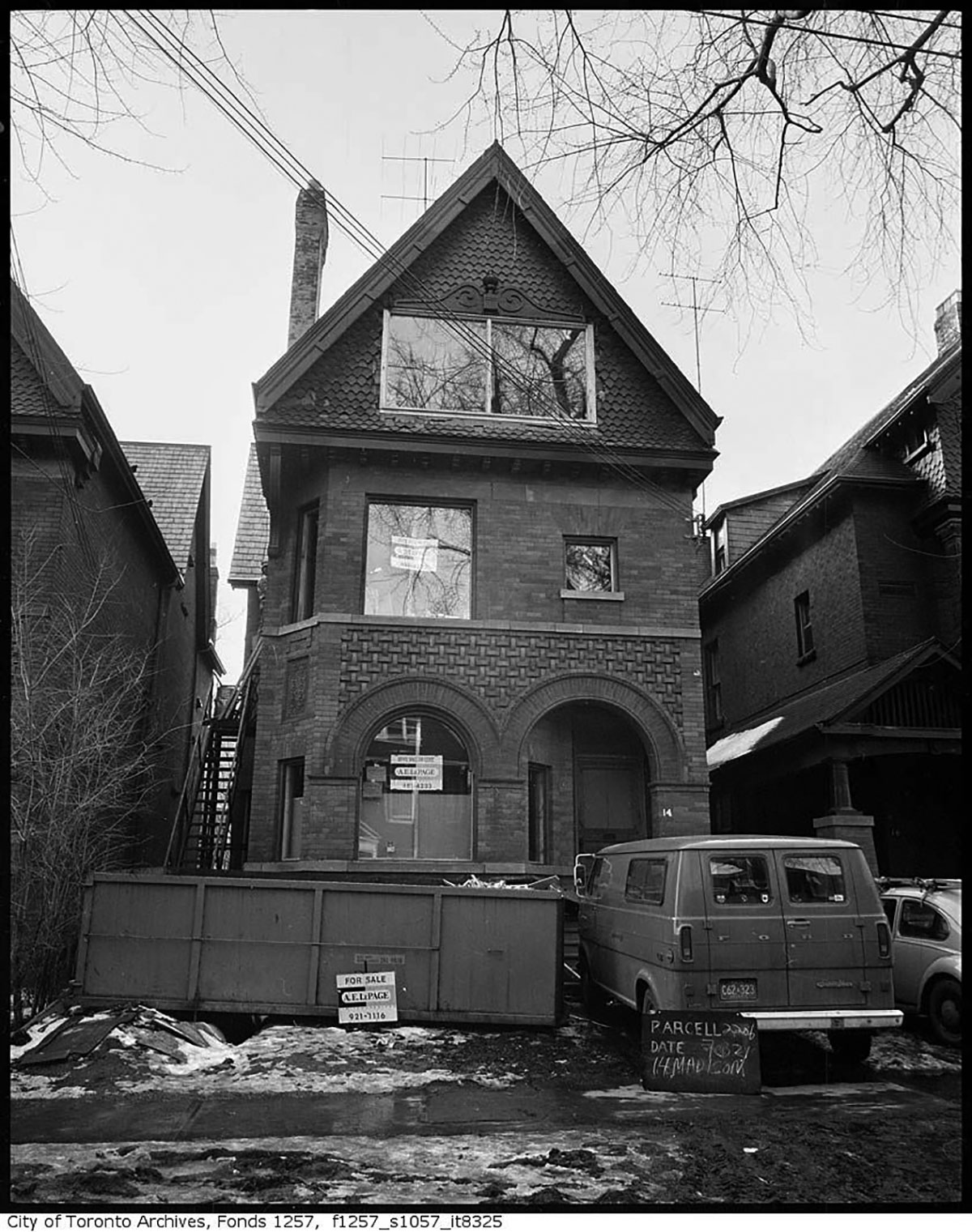
Many prominent families lived at 14 Madison Ave.
14 Madison Ave as it appeared in 1974. COURTESY CITY OF TORONTO ARCHIVES, FONDS 1257, f1257_s2057_it8325
By Michael Mastromatteo
Nearly 100 years after they were first constructed, three old mansions at 14-18 Madison Ave. gained a new lease on life.
In 1983, after surviving the “rooming house malaise” of the 1960s, the houses evolved into the Madison Pub, a popular fixture in the Annex.
In addition to the pub itself, the “Mad” now includes restaurants, a niche boutique hotel, and another hotel property in Puerto Vallarta, Mexico.
Although the pub today includes 14, 16 and 18 Madison, this month’s “If walls could talk” story will focus on number 14.
One of the first owners of the property was John Bertram, who in 1895, operated a wholesale hardware business at 76 Wellington St. W. Betram may have been quite a mover and shaker in late 19th century Toronto. The name John Bertram is associated with boat design and Toronto Harbour operations of the day.
There was at least one happy celebration at 14 Madison during the Bertram era. On June 16, 1897, the Toronto Daily Star reported the marriage of Bertram’s daughter Kate to a Thomas Bradshaw. The happy couple later took up residence on Lauder Street.
Bertram and family resided at 14 Madison until about 1900 when the home was taken over by George Kerr, a lawyer with the old Toronto firm Kerr, Bell & Shaw.
As with many Annex homes, the Kerrs needed cooks, servants, and domestics. A Toronto Daily Star classified ad from Sept. 25, 1905 reads: “General servant, small family, best wages, apply evenings, Mrs. Kerr, 14 Madison Ave.”
In 1915, the house was taken over by Dr. Benjamin P. Watson who resided there with his wife Angele, daughter Monique, and son David, for the next six years. In August of 1919, Mrs. Watson advertised for “an experienced cook wanted – at once.” Just three months earlier, Mrs. Watson advertised for “a Nursemaid for child of 10 months. Apply with references.”
The Toronto Daily Star of June 16, 1917 made mention of Watson’s marriage to the former Angele Hamendt of Belgium at St. Andrew’s Church on King Street West.
Dr. Watson certainly left a legacy. A New York Times obituary dated August 8, 1976, reported his passing at age 96. Dr. Watson was born on Jan. 4, 1880, in Anstruther, Scotland. He attended Edinburgh University and received his medical degree in 1905. A tall, distinguished?looking man, he was appointed professor of Obstetrics and Gynecology at the University of Toronto in 1912, a job he held for 10 years, with time out for service in the First World War. He was a captain in the medical corps of the Canadian Army and served in Macedonia, Greece.
In 1949, he became president of the New York Academy of Medicine. Dr. Watson was a professor at Columbia and became professor emeritus in 1960. He continued to practice as a surgeon until well into his 80s.
Before moving forward, here’s an interesting anecdote from the house at 18 Madison, now the site of the Madison Pub’s boutique hotel.
Early in the 20th century, 18 Madison was home to Commanding Officer John Irvine Davidson who, in 1905, founded the renowned 48th Highlanders Regiment. Baby boomers will certainly remember that for many years, the 48th Highlander’s pipe band performed God Save the King/Queen and O Canada on opening night for Leafs games at Maple Leaf Gardens.
Commanding Officer John Davidson died April 28, 1910. His widow Mary, lived on at 18 Madison from 1914 until her death on April 17, 1930. Mary, the daughter of Robert Hay (MP Centre Toronto), was active in Toronto’s social circles and volunteered at the Red Cross, the Hospital for Sick Children and a number of British Empire societies.
Getting back to 14 Madison. From 1922-1934, the building housed the Alpha Kappa Kappa (AKK) medical fraternity of the University of Toronto’s medical school. The housekeeper/den mother was a Margaret (or Mary) Fortier, who must have had a lot of patience. One can wonder if a Toronto medical fraternity in the 1920s and early ’30s resembled the Animal House frat from the John Belushi movie.
The Statten family, Waldermar and wife Helen, resided at 14 Madison from 1936 to 1938. They might have been the first family to begin letting rooms. An assortment of Toronto Daily Star ads from 1936-37 offered “double and single rooms, fireplace seat, bath floor, excellent meals.”
From 1939 until 1970, the home sheltered one Annie Millar. Try as we might, we couldn’t find any information on Annie and her family, despite her 31 years of residency. Oh where have you gone Annie? What are the stories you and your listening walls might have told?
With Millar’s departure in 1970, the story of 14 Madison gets a little sketchy. In 1975, an A. Milne resided there, and around 1980, the home was the business address of Lawson and Jones (possibly a printing company) and an enterprise known as Cobett-Jenner-Wasylow International.
This brings us to 1983 when Dave and Isabel Manore turned an aging Victorian mansion into what is today’s four-house strong Madison Pub and hotel complex. “We’ve been part of the city’s social fabric for decades,” says the Madison website.
Let’s hope today’s walls—whether original or those installed during extensive renovations—are still paying attention to what goes on within.
December 16th, 2025 · Comments Off on FOCUS: Coach House Books celebrates 60th anniversary (Dec. 2025)
Publisher held their annual wayzgoose on Sept. 4
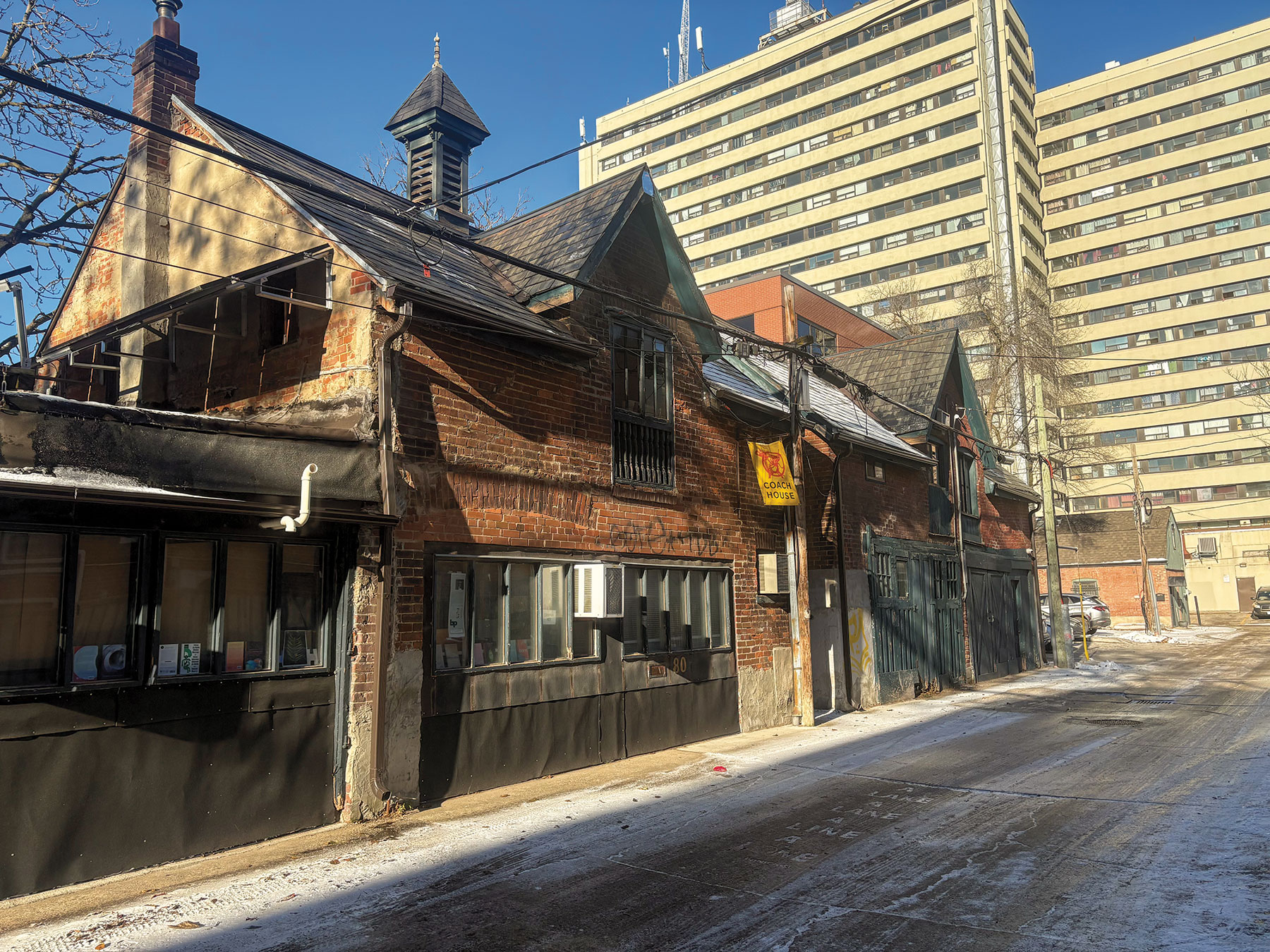
Coach House Books has helped “[drive] our national literary conversation” from its bpNichol Lane location for 60 years. BRIAN BURCHELL/GLEANER NEWS
By Drew Glennie
Located on bpNichol Lane, a hidden road nestled between Huron and St. George streets, Coach House Books has been printing and publishing books since it was founded by Stan Bevington in 1965.
According to publicist James Lindsay, their wayzgoose has been held annually for 20 years (including virtual events during the COVID-19 pandemic). While this event is unique to Toronto, it is actually part of a centuries-long tradition in the printing/publishing world.
“[Wayzgoose] is the traditional party printers would have in the beginning of autumn when they would turn to use candlelight,” Lindsay explained. “So it was a time to sort of honor the solstice and the sun going down. And they would invite the public into the press to sort of give them tours and show them around and see how you do things.”
This year’s wayzgoose at Coach House involved guests mingling and chowing down on hot dogs, chips, chocolates, and beverages in the packed back lot while some wandered into the coach house to see the printing operations in action.
This included one of their two Heidelberg-printed pages from the recently published Messy Cities, as well as the binding and cutting of Anaïs Barbeau-Lavalette’s forthcoming When Water Became Blue.
These books join Coach House’s extensive catalogue of publications which includes fiction, nonfiction, poetry, and playscripts. Well-known works include André Alexis’ Fifteen Dogs (2015) which won the Atwood Gibson Writers’ Trust Fiction Prize; early poetry collections by Michael Ondaatje (late 1960s to early 1980s); Encampment (2025)by Reverend Canon Maggie Helwig from the Church of Saint Stephen-in-the-Fields; and poetry by the Four Horsemen, a sound poetry ensemble (1970-1988), including the lane’s namesake bpNichol (1944-1988).
“Canadian-owned and -operated publishers like Coach House Books drive our national literary conversation, discovering and developing authors that would otherwise be overlooked,” wrote Lauren Perruzza, executive director of Literary Press Group of Canada, in an email to the Gleaner. “English Canada is uniquely disadvantaged in telling its own stories, with the media giant that is the United States to the south of us, and to a lesser, but not insignificant extent, the United Kingdom’s influence as well. Around 80 per cent of Canadian-authored books are published by Canadian independent publishers, meaning that companies like Coach House are essential for us to continue to tell our own stories.”
At Coach House, this involves having a special focus on Toronto books. “It’s really important for every city to have a book publisher that does books about that city, not just fictional books about that city, but nonfiction, like specific journalism and history and things like this. And Coach House does specialize in that,” said Lindsay. “And I think it’s a really important part of Toronto literature to have Coach House there as someone who cares about its history and wants to keep documenting it and archiving it.”
Through hosting wayzgoose, Coach House also contributes to the local community.
“It is a community event in the full sense, so it’s a really special way to sort of bring in people who we might not usually have contact with and introduce a lot of especially younger people to Coach House, which is really important for us,” said Lindsay. “Often we’ll get a lot of older writers sort of show up at Coach House as well. So it’s a way to just keep the tradition alive.”
Coach House Books also fosters community by offering events throughout the year, including readings and book launches. They can be found at chbooks.com along with a catalogue of books available to order online.
Lindsay also notes that they have benefited from their strong community of booksellers and readers, particularly as the printing industry struggles elsewhere.
“We’re very lucky in the way that I think the industry is feeling a lot of pressure obviously on all sides, on both sides of the border. But Coach House has readership, which is great. And we have fantastic authors,” he explained. “We’re doing a ton of work trying to be symbiotic with the bookstores themselves and have…close relationships with them. And think of it as sort of something holistic within publishing where, you know, without the bookstores, there’s no us. And without us, there’s no independent bookstores as well. So we want to work really closely with people who are still interested in books. Obviously the fan base for literature is shrinking, but there are still people buying books out there, and we just want to have as close a relationship with them as we can.”
December 16th, 2025 · Comments Off on NEW IN BUSINESS: Clothing options on Bloor for the fashion conscious (Dec. 2025)
Relocation, Common Sort, and Value Village each worth a visit
Value Village Boutique at 481 Bloor St. W. NEILAND BRISSENDEN/GLEANER NEWS ARCHIVE PHOTO
By Howard Pressburger
If you have recognized me outside of work, you know I’m a pretty sartorial guy. As my Instagram says: “I was born in the ’60s, so were most of my clothes.”
The Annex is not quite Carnaby Street, but we do have three unique choices for the fashion-conscious.
Value Village Boutique, located in the former Brunswick House at 481 Bloor St. W., is a mass-market seller of decent, utilitarian clothing. This small version of the well-known, international thrift store is volume-driven, and a portion of the profits are donated to local charities. Prices are very reasonable, and selection is wide, but quality can vary; make sure you give your items a thorough inspection before purchase. I have found Value Village to be a great source for workout clothes and argyle sweaters.
One of Common Sort’s curated window displays. COURTESY COMMONSORT
Common Sort, at 444 Bloor St. W., near the northwest corner of Bloor and Howland, is relocating across the street to the former home of Penguin Pickup. It has a more curated collection of quality second-hand name-brand clothing. It’s easy to find something you’d be willing to wear to work or on special occasions. Owners Nicole and Stefan value their connection to the community and work hard to match their fashion mix to the proclivities of the Annex. I’ve had many conversions with Stefan recently while he was getting his hands dirty building out the new location. He explained that moving will allow them to have a larger selection but also keep their prices affordable as their overhead will actually be reduced. Stefan, Nicole, and their staff, have a genuine commitment to making sure that Common Sort remains an integral part of the Bloor Street Retail Powerhouse™.
On the south side, at 499 Bloor St. W., next to Simit-Chi, there is the upstart vintage clothing store, Relocation.
Co-owner of Relocation (499 Bloor St. W.) Isa “Pope” Cargill. BRIAN BURCHELL/GLEANER NEWS
Considering its modest size, Relocation focuses specifically on vintage and streetwear clothing. Streetwear is a combination of New York City hip-hop style and California surf culture. It is heavily dominated by sports clothing, like basketball shirts and satin team jackets, as well as repurposed work wear, especially heavyweight denim and cotton. Vintage clothing these days refers to the ’90s and the ’00s. For older collectors like me, clothing from the ’50s to the ’70s used to be considered vintage, but these items are now referred to as “true vintage.” Who thought being fashionable would be so complicated?
When I first visited Relocation in early January, co-owner Mark, quickly realized that I am, in fact, a proponent of true vintage, and suggested that I come back and meet Pope. This curious suggestion—as the only other time I was told I should meet the Pope was when I was visiting Rome—turned out to be quite fortuitous.
The Pope Mark was referring to is Isa “Pope” Cargill, co-owner, lead salesperson, stylist, and all-around arbiter of cool. Although half my age and with twice as much hair, we do share a common admiration for sharp, alternative fashion. Because of this connection, and my never ending hope of finding another perfect piece of clothing in a store like this, I decided that if I saw Pope, I would pop in and say hi.
On a Friday afternoon in July, I stepped into Relocation and found myself among half a dozen close friends seemingly excited that they finally found a time and space to be together. Pope was filling a rack with clothing that was being handed to him by a friend with an impressive number of tattoos. It turned out the gathering was a pop-up sale by his friend, one of the designers behind the fashion brand La Ropa Life.
Don’t worry if you’ve never heard the name, just trust me when I say they’re like this generation’s, Vivienne Westwood. I spent the weekend hanging out, learning about this style, and seeing the people who came out to meet the designer and buy his clothes. I found it a little surreal, and I felt like I was once again 30 years old.
Since then, their store has continued to do well, and they’ve opened a second location on Dundas West. As the company matures, we now talk as much about business as we do about fashion, and Relocation remains the smart choice for the fashion-conscious youth of the Annex.
I have yet to find out how Isa became Pope, but I like to think that there’s a synod of fashion that chose him, and I’m pretty sure there was some smoke involved.
When not providing sartorial advice, Howard Pressburger is the manager of Wiener’s Home Hardware located at 432 Bloor St. W.
December 15th, 2025 · Comments Off on ON THE COVER: Oct./Nov. 2025
BRIAN BURCHELL/GLEANER NEWS
The illegal mushroom dispensary, Shroomyz, located at 475 Bloor St. W. has twice had trucks drive through the front wall, has been fire-bombed four times, and raided by police at least twice, since July. —Gleaner News Staff
December 15th, 2025 · Comments Off on NEWS: By The Way closes after more than 40 years (Oct./Nov. 2025)
A community favourite, doors closed at the end of August
By Zoe Mason & Gleaner Staff
When Amir Benedikt left Israel for Canada in 1980, he didn’t dream of working in the restaurant business. But after almost 40 years at the helm of By The Way, running a restaurant gradually became a labour of love.
By The Way closed its doors at the end of August. It’s not the end that Benedikt wanted— conflict with the City of Toronto pushed him to his breaking point. He hopes future restaurant owners in the Annex won’t face the same bylaw enforcement issues that led him to walk away.
The loss of By The Way marks a major change in the neighbourhood where it operated since 1978.
“We’re the last restaurant standing from the ’80s,” said Benedikt. “Everybody else came after us. So many things change, but By The Way has been here.”
In fact, the restaurant’s presence on Bloor predates its owners. Amir and his wife met on a kibbutz in Israel and were married in her hometown, Mexico City. On their way back to Israel, they stopped in Canada to visit Amir’s sister, Esti Filar. Esti was running the restaurant, then called the Lick’n Chicken, with her husband Dubi. She invited the newlyweds to join the venture.
“It was an opportunity to change my life. To try something completely different,” said Benedikt.
In 1980, the Benedikts immigrated and partnered with the family on their restaurants. In 1986, they split their holdings—the Filars took the Rosedale Diner, and the Benedikts took By The Way.
The work was gruelling. Benedikt often put in 15-hour days, seven days a week. “I cooked, I did dishes, I even served sometimes; I did everything,” he said.
But his hard work didn’t go unnoticed. By The Way quickly became a beloved neighbourhood haunt.
The restaurant’s early quirky nomenclature is remembered fondly by regulars. In its early iteration as the Lick’n Chicken, it inherited the name and décor of the fried chicken joint that preceded it, even though it served up a vegetarian menu. To dispel confusion, they displayed a cheeky sign that read: “Sorry, out of chicken.” When it was renamed By The Way, the chicken signs remained.
By The Way was also known as an early adopter of vegan offerings and yogurt-based smoothies. “Middle Eastern cuisine features a lot of vegetarian and vegan options like hummus, falafel, and babaganoush, and even in the ’80s, it quickly became apparent that there was a real need to provide these options in Toronto,” explained Benedikt.
The restaurant was perhaps best known for its weekend brunches on the patio that featured their infamous dill sauce that smothered the cheekily-named Eggs Benedikt and French toast sandwiches that were stuffed with brie and apples.
In the ’80s, By The Way was frequented by University of Toronto students. It was one of the first patios in the area, and its young clientele would sit outside on milk crates. It was a casual dining establishment, but the Benedikts were committed to providing healthy, high-quality food. Everything was made in-house from scratch, including the French fries, the falafel, and the hummus.
Over the years, By The Way became a favourite spot for locals. “We’ve heard from so many of our customers that they had their first date at By The Way and that their children grew up coming to the restaurant,” said Benedikt. “Couples got engaged to be married here, some got divorced here too, but not the same couples.”
But clashes with bylaw enforcement were frequent throughout the restaurant’s operation. In the late ’80s, a noise complaint from an upstairs tenant led to patio restrictions, prompting Benedikt to hire a lawyer and appeal to city council. He eventually regained patio hours but was troubled by the city’s approach. He hadn’t known about the complaint until the restrictions were levied.
“The attitude was the city deciding things instead of engaging the parties,” he said.
A few years later, a bylaw officer came knocking again, complaining about the canopy and other elements that had been installed on the patio. This time, Benedikt brought his case to the city councillor who provided assistance.
That was around 1990. For 30 years, By The Way flourished. In 1993, its signature mural was painted. In 2014, a new set of renovations revitalized the aging restaurant and ushered in an era of finer dining.
But in 2023, Benedikt was charged with infractions concerning the same patio issues from the ’80s, as well as issues relating to patio heaters he installed during COVID-19. Despite receiving support from City Councillor Dianne Saxe, it took two years to reach a conclusion, and under the advice of his legal team, he felt compelled to settle with the city and pay substantial punitive fines.
“I survived it, but it could have had [the effect of] me going bankrupt if it was a different business,” he said.
And the principal cost was not financial. In November 2023, Benedikt suffered a breakdown that left him hospitalized.
“I reached a point where I couldn’t take it anymore,” he said. “What came to my mind is: is my city my friend? Or my adversary? It felt like one half of the city, city council, wanted to support small business and work collaboratively, while the other half, municipal licensing & standards (MLS), was aggressively punitive. I hope that this culture changes for future small business owners.”
In 2025, he made the call to close. It’s a bitter end to a business that has meant so much to not only the Benedikts, whose three children have grown up living and working in the restaurant, but to the community.
Just before the restaurant closed, Wensley Ng, a server at By The Way since 2014, reflected on the Annex community. “Our regular customers are loyal. They keep coming back. I think we provide amazing food, and we provide amazing service.”
The staff at By The Way also became like family, with many employees working there for over a decade. One longtime employee, Don Dolan, worked there for 26 years until his passing in 2023. A memorial was held at the restaurant in his honour.
“There are regular customers that I got to know over the years, and watch their kids grow up. I watched all [Benedikt’s] kids grow up,” said Ng. “They share things with me. I share things with them.”
“It’ll be a sad day when we close. I’ll miss the restaurant. I’ll miss the customers. I’ll miss the staff.”
Looking back, the Benedikts are proudest of the people.
“I had such a good team here. It wasn’t just a place to get the best food in the world. I never wanted to be Michelin. I want to be myself, down to earth, and make good food for good people,” said Benedikt.
The Gleaner reached out to the head of MLS, Carlton Grant, for comment.
Grant was provided a complete summary of the events leading to Benedikt’s decision to close By The Way’s doors when he did.
The summary chronicled both Benedikt’s persistent efforts to become compliant with the patio regulations and the relentless enforcement by bylaw officers to punish him while he tried.
In a written statement to the Gleaner, Grant did not acknowledge any failure on the part of the city: “City staff worked closely with By The Way Café to support their efforts to meet these requirements and appreciate their collaboration and commitment throughout the process…. Businesses operating in Toronto can now report their experiences with red tape or regulatory burdens encountered at the municipal level such as permitting delays and duplicative or outdated bylaws.”
The publisher of this newspaper is also the general manager of the Bloor Annex BIA. In this capacity he advocated for By the Way Café. The art director of this newspaper also advocated for the restaurant as a consultant.
December 15th, 2025 · Comments Off on IF THESE WALLS COULD TALK: 351 Palmerston Blvd. (Oct./Nov. 2025)
Politics and comedy add to home’s aura
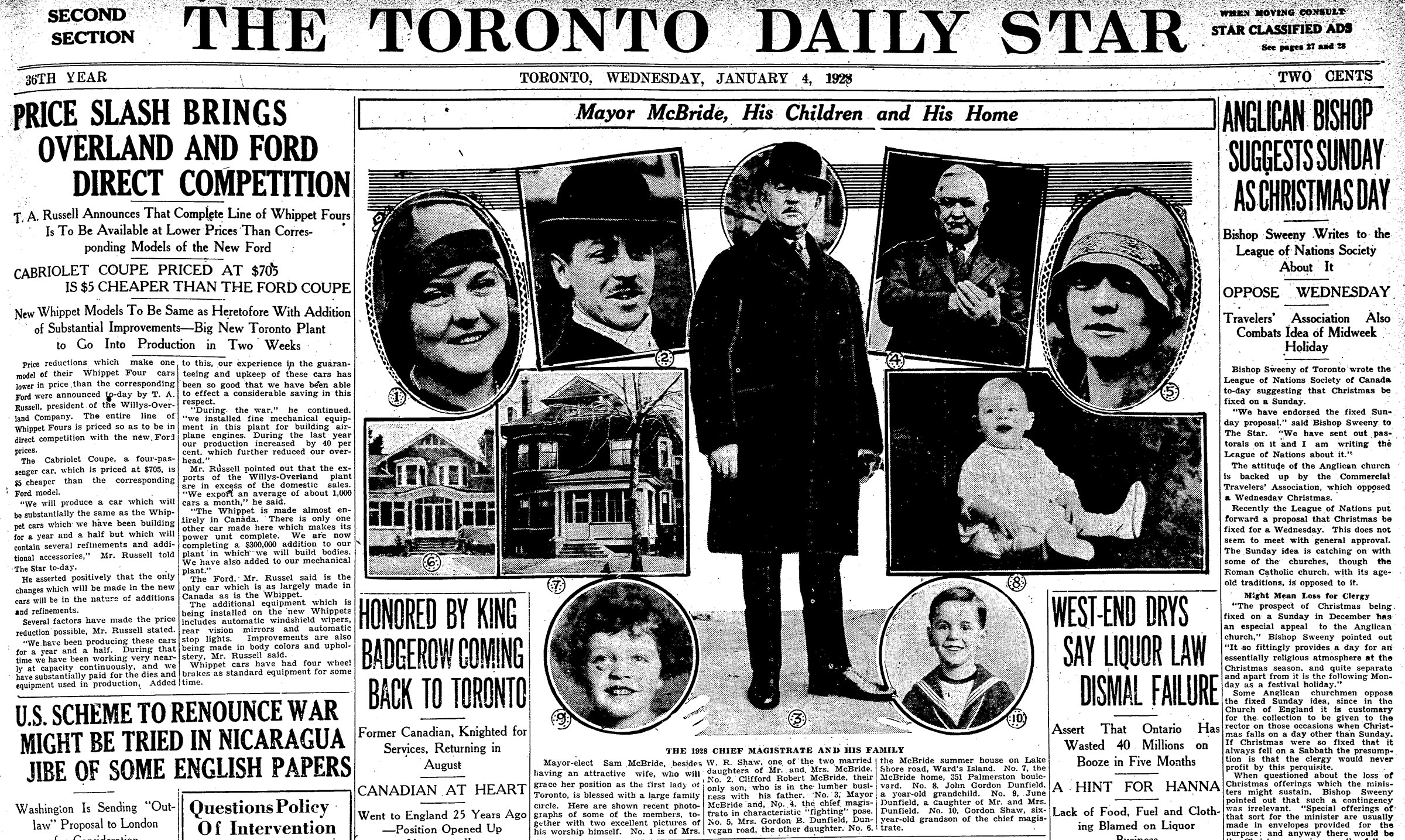
In January of 1928 the Toronto Star featured Mayor elect Sam McBride and his family home at 351 Palmerston Boulevard. COURTESY THE CITY OF TORONTO ARCHIVES
By Michael Mastromatteo
This is the second in a series of columns speculating on the lived history of various houses in the Annex. Imagine that the “walls” of these homes secretly absorb some of the actions and experiences of those living within. If we accept that the “listening walls” witness the lives and actions of its occupants, we can ruminate about the stories they might tell.
It’s a big house on the east side of Palmerston Boulevard, just a little north of College Street. Befitting its big size, 351 Palmerston also has a big history.
The apex-style three-storey house has been home to two iconic figures in the history of the Annex, and in turn, all of Toronto.
Between 1910 and 1930, the home was the residence—and probably the campaign headquarters—of Sam McBride (1866-1936), the 41st and 45th mayor of Toronto (1928-29, and 1936). Centre Island habitués might have also noticed that the esteemed early 20th-century municipal leader has a ferry boat named after him.
For 20 years the walls of this impressive and expansive residence no doubt reverberated with many social engagements and political strategy sessions. McBride or his house lieutenant placed several help wanted ads over the years. In September 1912 someone at 351 Palmerston advertised for “a competent general,” and eight years later, the household advertised for “a cook general – no washing.”
However, it wasn’t always housework and drudgery. A Toronto Daily Star news item on June 8, 1920, described an evening of frivolity: “Mr. and Mrs. McBride held a reception at their home at 351 Palmerston Blvd., where white lilies and snowball decorated the pretty room. Mrs. McBride was wearing black kitten’s ear car crepe and carrickmacross lace, a black mohair hat with bird of paradise and a bouquet of orchids and sweetheart roses.” It’s interesting to note what passed for news in the Toronto dailies in the early 1920s.
The walls and atmosphere in the home might have taken on a more sombre note on New Year’s Day 1930. Again, the Toronto Daily Star reported that “His Worship [McBride] received the [municipal election] returns at his home, 351 Palmerstone Blvd. Surrounded by his friends and relatives, he listened with some stoicism to the returns as they came in by both telephone and radio.” McBride alas lost that mayoralty race to the unfortunately named Bert Wemp.
While the McBride era at 351 Palmerston may have ended on a sullen note, the new occupants turned the place into a house of mirth. Garment industry worker Charles Weingarten owned the home from 1931 until 1948. One of his sons, John Lewis Weingarten—later to become Johnny Wayne—was 13 years old when his family moved into their new home. Shortly afterward, Wayne met fellow Harbord Collegiate classmate Frank Shuster, and an iconic Canadian comedy partnership came into being.
If we accept that Wayne developed and refined some of his comic skills while living at 351 Palmerston, we can speculate that the walls within echoed with a lot of good gags—and perhaps a few clunkers.
There’s no need to rehash the comedic accomplishments of Wayne and Shuster, but there’s no doubt their success over the next several decades created an atmosphere of pride and contentment at 351 Palmerston.
Wayne’s son Michael Wayne, an author and history professor at the University of Toronto, told the Gleaner that his late father was tight-lipped about his time at 351 Palmerston. “I’m afraid my dad never said a word about 351 Palmerston to me,” Michael Wayne said. ”All I know is that he was born on McCaul Street in 1918, so they moved to Palmerston some time after that.”
Another academic with special interest in the Weingarten homestead is Robert Vipond, professor emeritus of political science at the University of Toronto. In 2019, Vipond and the Palmerston Area Residents’ Association were instrumental in having an unassuming path running north-south behind several Palmerston Blvd. homes renamed Wayne and Shuster Laneway. The laneway renaming project was their way of honouring individuals, families, or institutions that were important to the neighbourhood’s development.
While Vipond has no particular insights into the zeitgeist at 351 Palmerston during the Wiengarten era, he can visualize a likely scenario. “Johnny Wayne’s house at 351 Palmerston Blvd. backed onto this laneway, and my fantasy—based on nothing but my imagination—is that he and Frank Shuster would have walked to and from Harbord Collegiate along this laneway, dreaming up skits as they went.”
In 1949, the Weingarten/Wayne family sold the house to Fred Zahrebelny, owner of the neighbourhood butcher shop. Municipal records indicate that Zehrebelny resided at 351 Palmerston until about 1951, after which the house was sold to a Sam Engelhardt, who may have been employed as a travel agent. It was during Engelhardt’s ownership that parts of the house were rented out to various roomers. A Toronto Daily Star classified ad from May 11, 1953, offered two rooms to let at number 351. Other ads would follow.
Walking by the house today, one notices four separate letter boxes affixed to the front porch indicating that this stately home—as with many of its Annex neighbours—is moving into the future as a rooming house. It’s yet to be determined if any present-day occupants can detect the spirits of McBride, Wayne, or other souls who lived out their time within this space.
December 15th, 2025 · Comments Off on FROM THE ARCHIVES: Remembering an Annex race riot (Oct./Nov. 2025)
The riot at Christie Pits on Aug. 16, 1933
Approximately one hundred “Canada First” marchers were met by hundreds of counter-protestors in Christie Pits and as they made their way to Sankofa Square, like this one at Bloor and Spadina. NEILAND BRISSENDEN/GLEANER NEWS
The September 2025 edition of the Gleaner featured a photo of a counter-protester holding a placard that read “Christie Pits Nazi-Free since ‘33.” This person was protesting against the anti-immigration rally held near the park on September 13. Not every reader will understand the significance of the reference to the events of 1933. We are republishing our story from the summer of 2023 which chronicles that event.
By Fox Oliver
In the 1930s, Toronto was predominantly British and anti-Semitism was commonplace and permeated all neighbourhoods in the city.
In an already difficult depression-era city, Jews had an even more difficult life. They were routinely excluded from high-paying jobs, from attending universities, and from buying homes in certain neighbourhoods. Many Canadians used Jews as scapegoats for the cause of the ongoing economic depression.
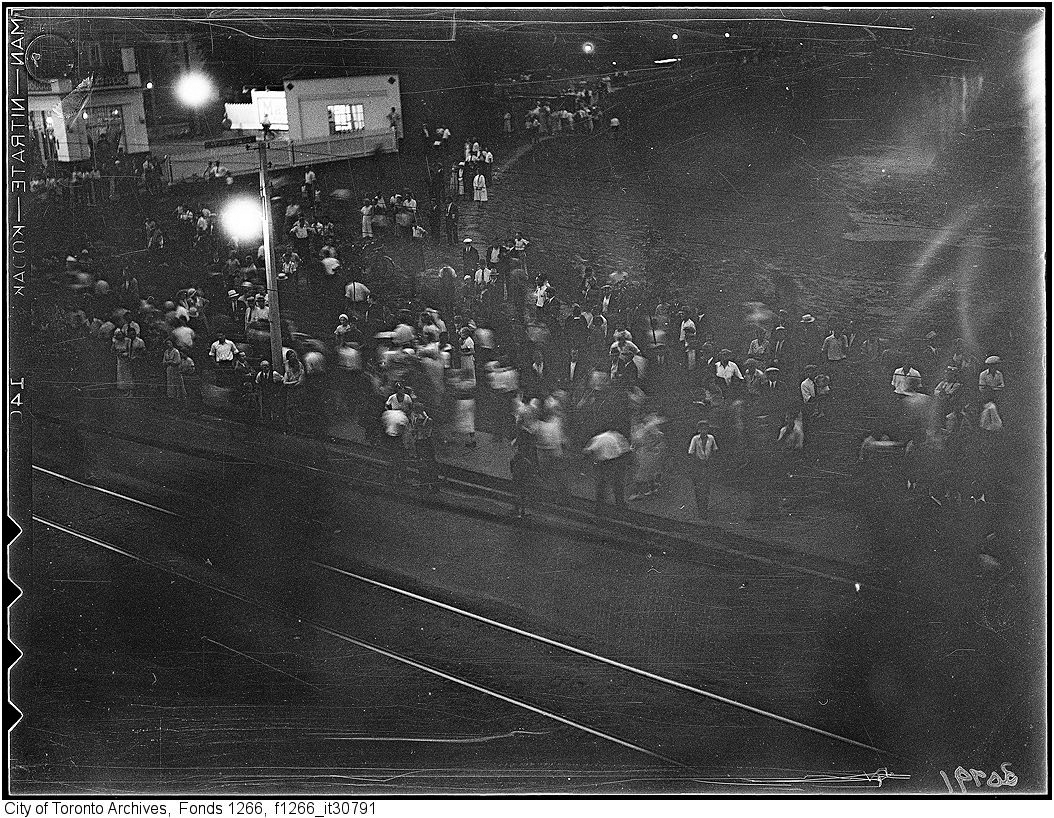
Taken by an unknown photographer, this is the only known photo of the riot on August 16, 1933. COURTESY THE CITY OF TORONTO ARCHIVES, Globe and Mail fonds, Fonds 1266, Item 30791
Newspapers in Toronto, such as the Toronto Daily Star, reported on Hitler’s rise to power and the atrocities committed in Nazi Germany in great detail.
“Torontonians probably knew more about what was occurring to Jews in Germany during those fateful months than most Berliners. For the Jews of Toronto, the swastika immediately became a symbol of persecution, torture, and death,” wrote historian Cyril H. Levitt in The Riot at Christie Pits.
Swastika clubs, groups of Toronto youth flaunting the swastika began to form in Toronto.
One swastika club told the Toronto Evening Telegram that “[w]e, the members of the Swastika Club do hereby declare that we are in no way connected with any political or racial organization.”
Another told The Globe that the club was an “orderly and strictly legal campaign to clean up the beaches.”
However, it was clear these “clubs” were a way for Toronto youth to spread anti-Semitic hate throughout the city under the masquerade of do-gooding. “Secretiveness about the club’s organization masked its real purpose, which was to capitalize on the dissatisfaction of the Beaches’ residents…in order to organize a Nazi movement in Canada,” wrote historian David Rome in Clouds over the Thirties. Swastika clubs regularly harassed and initiated needless violence against Toronto Jews in the summer of 1933.
On Aug. 16, 1933, during a baseball game in Christie Pits (Willowvale Park until 1983) tensions were high, and thousands of people gathered on the hills to watch the game.
As the game ended, members of swastika clubs flew a large swastika flag across the baseball diamond and yelled cries of “Hail Hitler.” This sparked outrage and violence, and a large brawl in the park broke out.
Italians and other persecuted minorities fought alongside the Jews against the swastika clubs and other Anglo-Canadians for control of the swastika flag, which was eventually torn to shreds.
“An unusually large number of mounted men and constables were stationed nearby,” reported the Toronto Evening Telegram, suggesting police were prepared for the riot.
However, it was only at 8:45 p.m., an hour after the first blows were struck, and nearly three hours after the game had started, that mounted police arrived at the park.
Even then, the brawl raged on through the night and only ended the following morning.
Police were harshly criticized by many, including the Toronto Daily Star, for their lack of preparation, slow response time, and apparent disregard of warnings of expected violence.
The Toronto Daily Star reported that over 10,000 people were involved in the riot, and although rioters used baseball bats, lead pipes, and other improvised weapons, no one was killed.
The one person convicted for their involvement in the Christie Pits Riot received a sentence of either two months in prison or a $50 fine.
Following the riot, Toronto mayor William James Stewart outlawed displays of the swastika, making this one of Canada’s first policies prohibiting hate speech.
December 15th, 2025 · Comments Off on CHATTER: The great Harbord Street pumpkin “reshowing” is back this year (Oct./Nov. 2025)
An example of some of the spookier carved creations one might see on the night of Nov 1. ARCHIVE PHOTO BY BRIAN BURCHELL/GLEANER NEWS
Harbord Village’s cherished pumpkin festival is back this year on Nov. 1. Dozens of pumpkins will light up the neighbourhood along Harbord Street, from Spadina Avenue to Borden Street. After what seems like years of construction, neighbours can finally begin to reclaim their street and gather for what has historically been a cherished event.
Between 5:30 p.m. and 9:00 p.m., people will parade along the street to view each of the lit pumpkins, drinking hot apple cider, eating baked goods from Harbord Bakery, and displaying the last of their Halloween spirit. Pumpkins carved at homes in the neighbourhood are brought to Harbord Street for a “reshowing.”
A lot of effort goes into this green community event. Sponsored by the Harbord Street BIA and the Harbord Village Residents’ Association, event staff hire students to prepare and clean up after the festival. “We call them the pumpkin heads,” said Neil Wright, chair of the Harbord Street BIA, and they do the heavy lifting, taking carved pumpkins from neighbourhood porches. Local businesses provide free food and drink for the public along with their own admirable creations. At the end of the night, the city collects and recycles the artwork.
Residents within Harbord Village receive a blue flyer explaining the event and if they wish to contribute their pumpkins to the event they leave the flyer near the pumpkin for volunteers to collect on Nov 1.
Harbord Village has opened the event up again this year to anyone willing to contribute their jack-o-lanterns to the parade; the more, the merrier at this family-oriented event