December 16th, 2024 · Comments Off on EDITORIAL: Bill 212 causes congestion (Dec. 2024)
Bill 212, Reducing Gridlock, Saving You Time Act, 2024, is a reckless piece of legislation based on the false premise that bike lanes add to traffic congestion and are bad for business. The Annex is a shining example of how neither is true.
The government has now passed legislation empowering itself to remove bike lanes without any evidence they contribute to traffic congestion; in fact, they know there is evidence to the contrary. They will be endangering lives, and they have added an amendment to the bill at the eleventh hour to prevent anyone from suing the government if they become injured because of the wilful negligence of ripping out bike lanes. You can’t make this stuff up.
Ministry of Transportation (MOT) staff are still in data gathering mode trying to find a set of facts that fit the “problem” to which the premier already “knows in his gut” is the solution.
If anything, the available data tells a different story.
The Canadian Automobile Association commissioned CPCS, a Canadian-based international transportation consulting firm, to examine best practices to ease congestion. In their report, they made several recommendations including improving traffic management systems, improving traffic incident management, and investing in relatively low-cost solutions like bike-sharing, bicycle infrastructure, carpooling and ride-sharing.
The Toronto Region Board of Trade’s congestion task force echoes this sentiment in their Congestion-2023 Mayoral By-Election Issues Guide which states that “Mayoral candidates must be ready to pursue solutions that can help ease the pressure points across our transportation network including: improving traffic management systems, bringing our roads to good repair, seeking to upload costly regional expressways, better utilization of bike lanes, and more thoughtful construction planning that ensures viable traffic detours.”
On Bloor Street, the Bloor Annex BIA is dedicated to providing its business membership with data-driven and evidence-based decisions. That’s why, in 2015, when the City of Toronto proposed installing a bike lane as a pilot project along Bloor Street, from University Avenue to Shaw Street, the BIA, in partnership with the city, the Korea Town BIA, and the Metcalf Foundation, commissioned the Toronto Centre for Active Transportation (TCAT) to investigate the economic and safety impacts—positive, negative or neutral—of the bike lanes.
This academic-level study included baseline data that was obtained pre-pilot, as well as data from when the pilot concluded in 2016, in both the Bloor Annex and Korea Town BIAs. Data was also collected along a comparable section of Danforth Avenue which was used as a control. To ensure impartial data collection and analysis, TCAT partnered with researchers from the U of T.
The TCAT study found that in the Bloor Annex, looking just at the economic data, sales went up after the installation of the pilot bike lanes across all parameters. This was verified by Paymentech, the payment terminal, which provided locally sourced data.
And from a safety perspective:
• conflicts between all road users decreased by 44 per cent
• conflicts between motorized vehicles decreased by 71 per cent
• bike/motorized vehicle conflicts decreased by 61 per cent
• pedestrian/motorized vehicles conflicts decreased by 55 per cent
After receiving this positive data, the Bloor Annex BIA supported the permanent installation of bike lanes.
Eight years later, what we’re seeing on our main street is an inclusive retail area that supports 270 small businesses. It’s a main street that is welcoming to all—whether they arrive by bike, on foot, by public transportation, or by car. Women are 50 per cent more likely to bike on Bloor as well as the elderly, children, or whole families; all feel safer and are coming to Bloor more frequently.
Toronto works because it is a collection of neighbourhoods which are sustained by amenities found on main streets. Without main streets, we cannot sustain neighbourhoods. In the Annex, bike lanes have become part of our main street, and they help make our businesses economically viable. We are not a freeway. We do not aspire to be one; we are a village.
Based on all the evidence, removing bike lanes on our stretch of Bloor and disconnecting Toronto’s cycling network would only undo the complete streets work we’ve fostered over the last 10 years, make the roads more dangerous for all users, and increase congestion.
December 16th, 2024 · Comments Off on FORUM: Time to file your vacant home tax declaration (Dec. 2024)
Not to late for the flu shot or an updated COVID vacine
By Dianne Saxe
Two years have now passed since I was first elected to Toronto city council, and I am tremendously proud of the improvements we have made together.
I feel especially satisfied for having earned a reputation at city hall for doing my homework, following up, and causing “good trouble.”
My focus throughout my tenure has been on substantive interventions, listening carefully, and giving thanks and praise where it is due.
Budget season is upon us. Thank you to everyone who participated in the preliminary consultation in October, whether online or in person.
There will be another round of intensive consultations in January before the mayor brings her budget to council on Feb. 11.
I am doing everything possible to accelerate our multifaceted Housing Action Plan, with its ambitious goal of 65,000 new affordable homes.
Much of this depends on federal and provincial cooperation, which is not yet forthcoming, but we are doing a lot with what we have.
It’s time to make your 2025 vacant home tax declaration. The process is much simpler this year; watch for the instructions in the mail.
Would your condo board, church, or other group like us to come hold a clinic to make it easier for your members? Please let us know and we will be glad to come.
What else can we do together to make Toronto better?
Bike Lanes: Many of you have asked what you can do about Doug Ford’s attack on our bike lanes. I urge everyone to contact their local MPP’s office, join a group, and visit cycleto.ca and sign their petition.
Water bills: The transmission unit that sends your meter readings to the city may have failed early due to battery problems.
These units have saved the city more than $300 million; now, we will be spending a small part of those savings to replace the broken units or to function without them. Details on what to do have been mailed to every water customer. If you need help resolving an unexpectedly large water bill or with finding and reading your water meter, please let us know.
You can call the special line at 311 for help; if that doesn’t work, ask our office.
Noisy garbage trucks: Do you lose sleep because of nighttime private waste collection which the previous council exempted from the noise bylaw? If so, please contact 311.
Working with No More Noise Toronto, I have successfully compelled municipal licensing and standards to start resolving these complaints, but nothing will happen unless you let them know.
If the problem persists, please report it again.
Vaccines: It’s time to get your COVID and flu shots to reduce the risk of serious illness. Get them from your family doctor or pharmacy.
Do you need a volunteer for tree planting, Christmas giveaways, or other public services? Does your school, church or other group hold an event where my team and I can meet your members? Please invite us! Thank you so much for including us!
Wishing everyone a joyous holiday season!
Dianne Saxe in councillor Ward 11, University–Rosedale.
December 16th, 2024 · Comments Off on FORUM: Dangerous road safety bill is a distraction (Dec. 2024)
It’s as if being premier is too hard and he would rather be mayor of Toronto
By Jessica Bell
The Conservatives anti-bike bill went to committee in mid-November. It came into committee bad, and it went out worse.
The Conservatives introduced an 11-page amendment that gives the government power to remove the entire Bloor, University, and Yonge Street bike lanes, bans municipalities from creating new bike lanes on all streets, including side streets, if a vehicle lane is removed without first getting permission from the province, and blocks lawsuits arising from injuries or deaths from the removal of these bike lanes.
In committee, I listened to people’s testimony and read people’s written submissions. In my six years at Queen’s Park, I have never seen more people sign up to speak to a bill. Not a single person who spoke in committee was in support of Bill 212.
We heard from the Bloor Annex Business Improvement Association that the bike lanes have led to an increase in sales at retail outlets along Bloor.
The Association of Municipalities of Ontario recommended the government focus resources on accelerating its own approval processes for transit projects—like the Eglinton Crosstown—that can have much higher impacts on congestion, instead of micromanaging bike lane removals.
Volunteers with Friends and Families for Safe Streets shared devasting stories of loved ones—sisters, mothers, children—being killed while cycling on Toronto’s roads. They begged for safe, protected infrastructure like bike lanes.
City of Toronto staff said the installation of the bike lanes has reduced injuries and deaths, led to an increase in bike traffic, and had minimal impact on vehicle commute times, and has had no negative impact on emergency vehicle response times.
The fact is that the three bike lanes in downtown Toronto are not the reason why our entire region has the worst commute times in North America.
Congestion is caused by many things. Our population has doubled over the last 40 years, yet we have about the same number of roads. We have traffic accidents, construction blocking traffic lanes, bad weather.
If the government was serious about making it easier for us to get around, then they would move ahead with practical solutions to congestion, not divisive games.
Let’s allow transport trucks to travel on the 407 for free, freeing up space on the 401. Make transit a fast, cheap, and attractive option by investing in transit operations and maintenance. Build more apartments—and services—along transit routes so more of us can take transit, walk, or bike to our destination instead of permitting low-density and expensive suburban sprawl, which locks people into long commutes by car.
With an early election looming, the Conservatives’ move to blame bike lanes for congestion is a way for them to blame something or someone instead of showing leadership and addressing the challenge. They’ve doing this a lot right now.
The Conservatives are blaming the liberal carbon tax for the affordability crisis—a crisis they could help address by stabilizing housing prices and cracking down on price gouging at the supermarket.
The Conservatives are blaming the poor for living in encampments—when this government has failed to build affordable housing or provide more affordable rental homes.
The truth is the Ontario legislature is a very powerful political body, that absolutely has the power to fix our most pressing issues, like ending homelessness, ensuring everyone has a family doctor, funding our public schools so our kids get a good education, and addressing congestion.
To that end, the province’s pre-budget consultations for its 2025 budget have just begun. You can sign up to speak in committee in Toronto on January 29 or submit your written comments by going to https://www.ola.org/en/apply-committees.
Please contact our office at jbell-co@ndp.on.ca if you need help, wish to volunteer, or give us feedback.
Jessica Bell is MPP for University-Rosedale and the Housing Critic for the Official Opposition at Queen’s Park.
November 8th, 2024 · Comments Off on ON THE COVER: Redo of intersection itself a hazard (Oct./Nov. 2024)
Import of a Dutch design was a response to cyclist death at Bloor and St. George streets
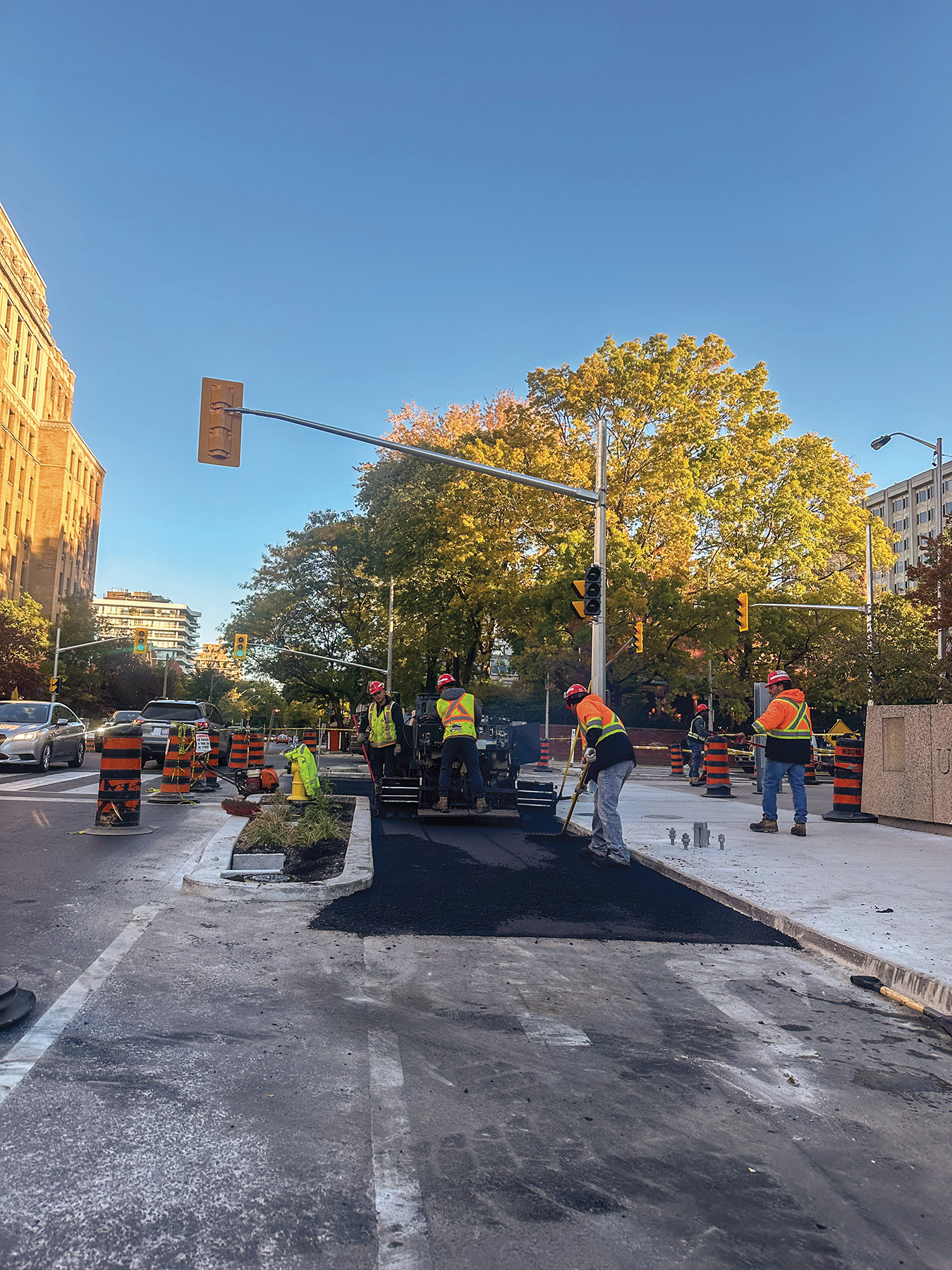
City crews work to amend the recently redesigned intersection of Bloor and St. George by removing trip hazards that were injuring cyclists and pedestrians. BRIAN BURCHELL/GLEANER NEWS
By Austin Kelly
Construction crews are back at the
Bloor and St. George intersection to fix potential injury hazards after its design caused further issues. The “fix” for the intersection completed in late July brought its own problems.
The City of Toronto is readjusting bike lanes and pedestrian crossings at the busy intersection of Bloor and St. George streets. The initial redesign which replicates a European style of lane safety caused as much of a problem as it had originally looked to solve for both cyclists and pedestrians.
Construction during the summer involved installing protected bike lanes along Bloor Street West, from Spadina Avenue to Avenue Road; however, the Bloor and St. George intersection got a special treatment inspired by the cyclist-friendly pathways of the Netherlands. The city implemented their “Dutch model” in hopes of improving safety for bike riders in the area. In 2018, 58-year-old cyclist Dalia Chako was killed after being struck by a truck turning right onto Bloor from St. George Street, leading the city to push for a safer intersection.
Six cyclists have died this year in the city, surpassing the number of fatalities in the last three years combined. This includes a female cyclist who was killed this past summer at Bloor and Avenue Road. At Bloor and St. George, on August 30, Sally Danto, an administrative assistant at Havergal College, was injured while riding her bike through the new intersection. A statement released from the family on Sept. 10 said that Danto suffered serious brain injuries and was still unconscious in intensive care. The statement, released by her son, Justis Danto-Clancy, a criminal defense lawyer, said that he had personally witnessed other cyclists fall in the same intersection and he is appealing for any witnesses in his mother’s accident.
An apparent flaw in the design is the gutter that crosses the pedestrain and cycle path.. This makes for a potential fall hazard for cyclists and pedestrians because of the awkward transition between sidewalk and street. Bright yellow “bump” signs were put up as a way of visibly alerting pedestrians. Reconstruction is now underway to level the surface and remove the bump to make an easier transition.
Councillor Dianne Saxe said she feels satisfied by the new replaced lanes, commending the quick response undertaken by the city to fix the issue, and she says she has trust in the renovations done by construction crews. Saxe told the Gleaner that she had been made aware of concerns about the newly designed intersection and pedestrian paths from city officials overseeing the project.
Saxe said the original design she viewed and approved did not have a bump, and she wasn’t sure when or why the design was later altered. Although Saxe admits errors in the original execution, she feels necessary action has now fixed the lanes. “This was an attempt to make things better. I think it is better now, but certainly the process to getting here was worse than I had hoped,” Saxe said.
The Gleaner contacted Mark DeMiglop, the city’s field ambassador for the project, for a response to the project, its redo, and the problems that arose. City of Toronto media relations redirected the request to transportation services and engineering & construction who were overseeing the work. A media spokesperson provided a statement on the redesign:
“Based on site observations and user feedback, staff are making further modifications to the intersection design. Curb adjustments have been made at the three corners where beveled curbs were present, smoothing and lowering them to create a better path for pedestrians and cyclists. The concrete in these curbs has also been tinted for improved visibility. Hanging signs indicating right and left turn restrictions for motorists have been installed to improve traffic flow and the new signals for cyclists and motorists will be activated by Oct. 25.”
Furthermore, the statement read: “The City remains committed to ensuring the safety and functionality of the newly reconstructed intersection. Staff will continue to monitor the site and make any necessary adjustments.”
Koehl said the city has “done all the right things” in terms of cyclist friendliness, but wants to see more urgency, saying that oversight wasn’t undertaken, and criticism was only addressed once the intersection caused injuries. Koehl also wants more bike lanes to be built more quickly, stressing the necessity of Toronto to meet its climate goals for the Vision Zero Road Safety Plan which means building at least 40 kilometres of bike lanes yearly.
Despite the original error in design at the intersection, Koehl did express understanding for the design flaws. “This was a novel intersection design for the city, so it’s no surprise that there would be some growing pains and lessons learned.”
Comments Off on ON THE COVER: Redo of intersection itself a hazard (Oct./Nov. 2024)Tags:Annex · News · On the cover
November 8th, 2024 · Comments Off on NEWS: An attempt to stem renovictions (Oct./Nov. 2024)
City council works to develop a new bylaw
By Meredith Poirier
In response to repeated outcries from tenants the city is developing a legislative framework to help protect them.
Many tenants fear being forced out of their homes, regardless of how good a tenant they are or how long they’ve lived in the building. There are very few protections in place for renters. Right now, a major issue affecting renters in the city is renovictions. Renovictions are evictions of tenants under the guise that renovations or repairs are needed for the unit. They may also include not allowing a tenant to come back to their unit post-renovation, raising the rent after repairs, or not actually completing any renovations.
Currently the City of Toronto is developing a new bylaw that is aimed at supporting tenants and stopping renovictions from happening. The bylaw is being modelled after successful initiatives in other cities, particularly Hamilton. Ontario’s bylaw will take effect on Jan.1, 2025. Presently, the city is seeking feedback, via an online survey, from tenants and landlords, as well the general public and organizations that support and work with landlords. The insights and opinions garnered from the survey as well as from the public drop-in sessions will inform the development of the bylaw and the city will report back with the proposed bylaw by Oct. 30. While the input from renters and landlords is important, the “proposal would have to receive the support of the majority of council, ” explained Dianne Saxe, city councillor, University-Rosedale.
A few components of the bylaw include requiring landlords to apply for a renovation licence within seven days of issuing an N13 notice. An N13 notice is legal notice to end a tenancy due to renovations or repairs. N13 requests have increased during the past few years by 300 per cent; however, it is not clear which of these N13s were under bad faith and led to renovictions. Under this proposed bylaw landlords would also be required to submit more sufficient documentation and would be prohibited from beginning renovations until a licence has been obtained. . Bylaws like this are crucial in supporting tenants given the precariousness of being a renter. Rebecca Gimmi, a renter herself in the City of Toronto and a tenant advocate, is cautiously optimistic about this proposed bylaw. “It shows a growing understanding of the complex solutions needed to address our housing crisis. One crucial component is to maintain and protect existing units with rent control and support tenants’ rights to return to their units. The proposal does seem to move towards exploring these goals,” said Gimmi. However, some concerns she has are how this bylaw will support tenants facing demoviction and how it will be enforced. She says that currently “it is very difficult for tenants to report bad faith evictions or track multiple-offending landlords.”
Tenants aren’t the only ones with concerns about the efficacy of this potential bylaw. Some city councillors believe that any issues related to housing should remain under the realm of provincial responsibilities and that complications could arise if renovictions and the consequences of them are now a municipal responsibility. However, others argue that renovictions are already a municipal issue. Renovictions often lead to homelessness, and in Toronto over 7000 individuals are homeless. This is already a major issue in Toronto, with a lack of housing and support available for these individuals. An increase in unhoused people adds stress to an already buckling system.
While many landlords may have concerns about this new bylaw as well, their concerns don’t quite line up with those of renters and local politicians. Katherine Wauthier, a community legal worker and representative of Landlord’s Self-Help Centre, is concerned that the bylaw will add pressure and financial constraints to the “already cash-strapped landlords who are just trying to make ends meet.” The Landlords Self-Help Centre works with clients, many of whom are “seniors, newcomers [to Canada], and people with disabilities,” explained Wauthier. The centre is a clinic, funded by Legal Aid Ontario, that only works with the small landlord community, which essentially means landlords who own houses, duplexes, and other residences of that nature. Wauthier also explained that there is already an act in place, the Residential Tenancies Act, 2006, which aims to protect tenants from bad faith renovictions.
Regardless, tenants in Toronto need help. “Tenants are half the population of Toronto and we’re living in too precarious a position to not be a part of the discussion [on] how to fix the housing crisis,” said Gimmi.
City staff will present final recommendations regarding the proposed by-law on October 30 to the city’s planning and housing committee.
November 8th, 2024 · Comments Off on NEWS: Hot Docs/Bloor Cinema to reopen (Oct./Nov. 2024)
A soft reopening is planned for third-party rentals
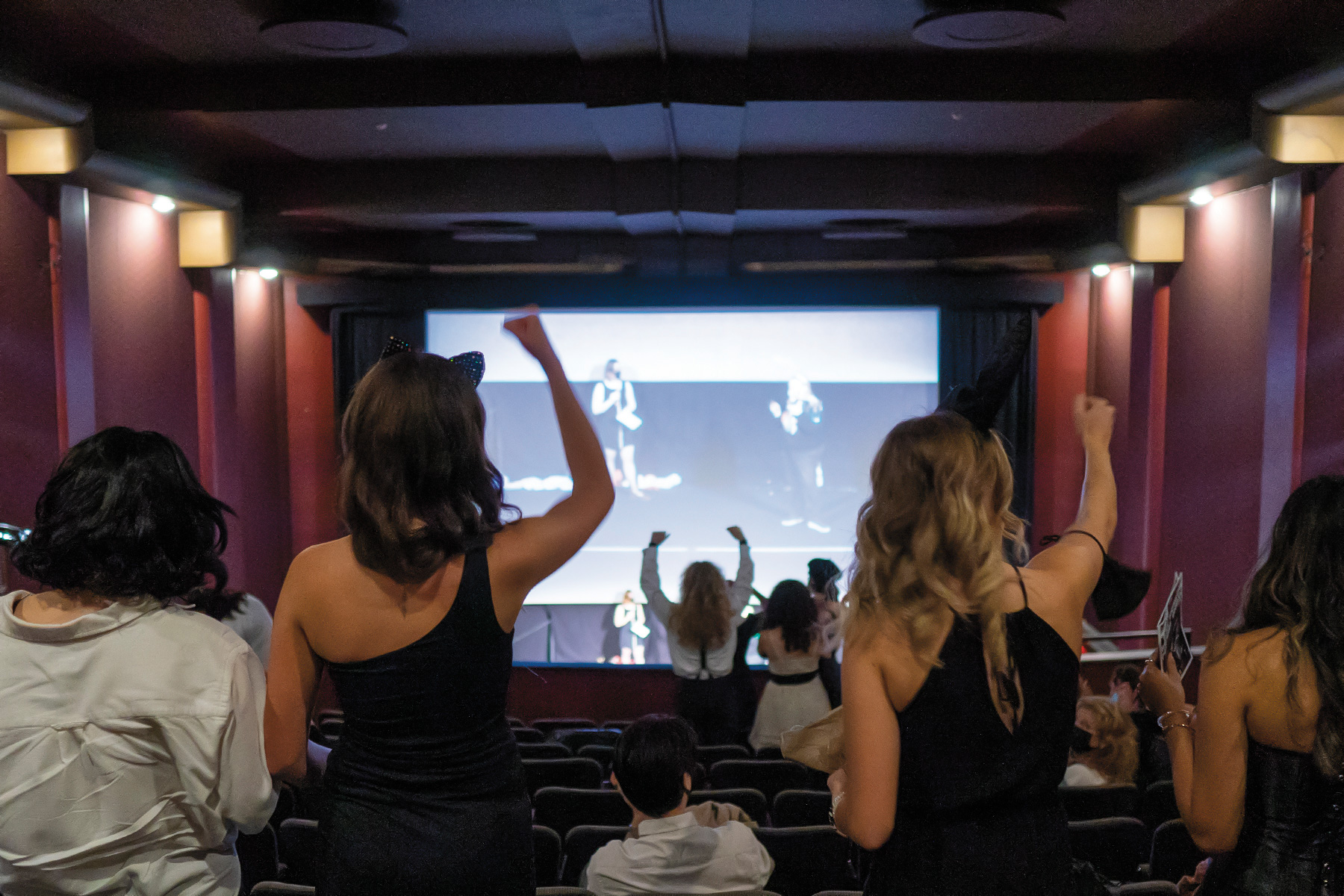
The Rocky Horror Picture Show returns to Hot Docs this Halloween. NEILAND BRISSENDEN/GLEANER NEWS
By Rose Haberer
Since its closing in the heat of mid-June, questions about the fate of the Toronto gem and documentary film-scene staple, Hot Docs, have been left open-ended, until now.
Despite support from film enthusiasts and the success of their 31st annual film festival, Hot Docs could not withstand the financial repercussions of COVID-19 that still loom as a heavy miasma over the city. Other complications affecting the organization’s stability included a missed grant opportunity and complaints by former staff about the company’s inner turmoil. All these factors contributed to the closing of the Hot Docs curtains. As well, one month after the closure, Hot Docs released a public announcement saying that Marie Nelson, Hot Docs’ president, had taken her leave.
The statement said that as “Hot Docs navigates its next chapter, we are fortunate to have the continued stewardship of Interim Executive Director Janice Dawe and Managing Director Heidi Tao Yang. The Board has full confidence in them to capably steer the organization through this period.”
Finally, three months after their catastrophic storm of complications, an official statement has been released to the public, providing new information about the corporation’s future and its desire to achieve sustainable operations.
“Significant work has been done to stabilize Hot Docs and establish a solid foundation for a sustainable path forward,” stated the organization.
A new three-person board, formed at the beginning of the closure, has been entrusted with working towards stability. This fall, their focus is on finding new directors, as well as a new executive director. Additionally, the team is on the path to improving the company’s financial governance.
Hot Docs reports recent engagements with major sponsors, partners, and funders, highlighting a desire for the organization to survive.
As a result of successful attempts at financial damage control, Hot Docs has officially announced a temporary reopening for “third-party rentals and select partner screening events.”
Upcoming films include:
For Viola: We Will Be Brave: Free Screening
A documentary written and directed by Chrisann Hessing focusing on the intricate tapestry of mental health in Black and POC males. Their experiences and emotions are conveyed through various art forms.
The Rocky Horror Picture Show – Toronto Shadowcast
Directed by Jim Sharman, the quirky, classic Rocky Horror Picture Show is performed by Toronto’s shadowcast, Excited Mental State. They implore you to wear your favorite costume and join them for some spooky fun.
Stop Making Sense
Experience Jonathan Demme’s 1984 concert film, Stop Making Sense, in collaboration with A24. Every Saturday, Hot Docs celebrates the irresistible rhythms of Talking Heads by inviting you to groove to the band’s classic songs.
Hot Docs’ statement said that they hope to share further plans on the resurrection of routine Hot Docs programming but no other details were given. In terms of their 2025 film festival, which is usually held every year in May, no additional information was provided other than the prospect of updates in October. With minuscule amounts of information about these events, documentary, and Hot Docs devotees are left at a cinematic crossroad with many questions still left unanswered.
November 8th, 2024 · Comments Off on GRADING OUR GREENSPACE: Annex parks report card (Oct./Nov. 2024)
Third instalment of the Gleaner’s review of area parks for 2024
Each year the Annex Gleaner reviews the many parks and parkettes in our coverage area using a variety of criteria.
While there is no decisive “winner” of the grading, letter grades are assigned to convey the quality of the parks, considering aspects such as upkeep, design, and amenities. The reviews accompanying the grades also let the reader know what makes each space unique. This is the third instalment of reviews for 2024.
By Ammara Khan
Huron Street Playground
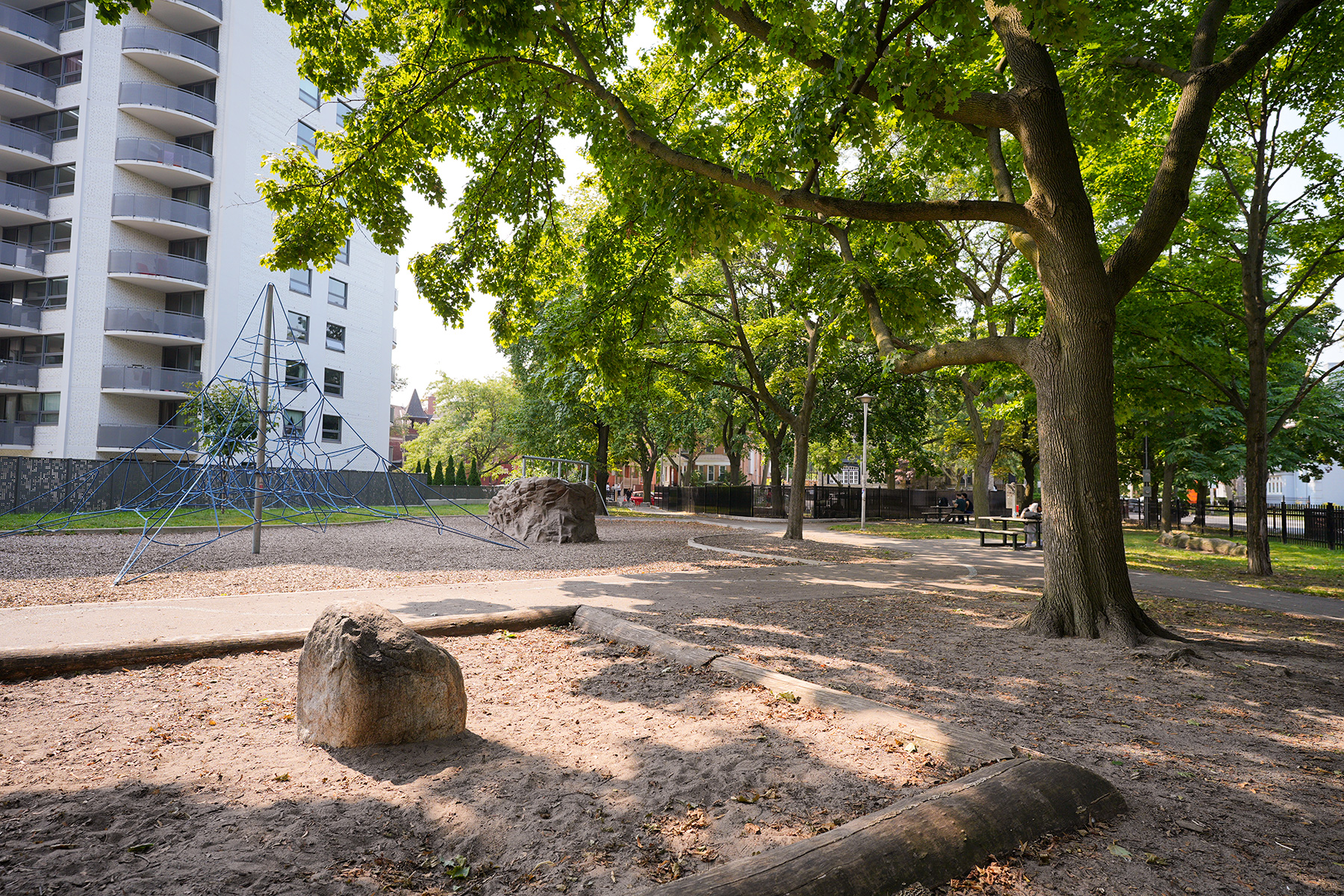
Huron Street Playground “provides a sort of stillness that is uncommon to come across in the busy city.” AMMARA KHAN/GLEANER NEWS
495 Huron St. Grade: A-(Last year’s B-) Time: 1:23 p.m. Overheard: Wind blowing through the leaves. Airplanes flying overhead. This young couple has a speaker and they’re playing rap music. The girl is filming a TikTok dance. Reasons to go: I (birkenstock-clad) was extremely grateful to see woodchips for the playground covering. I was able to comfortably make my way to the very interestingly shaped swings and reconnect with my childlike whimsy. Bring yourself, bring your kids, bring your dogs. This park is ideal for a variety of people. The playground is equipped for children but it’s not childish to the point of deterring people who no longer identify as children. Curious children might enjoy the toy rock conveniently placed at the center of the park. Even I could not resist the urge to take a closer look. The benches are comfortable; a great place to read, write, or just sit. You can sit for a long time because the park has the perfect number of trees, and a tall enough building to provide much needed shade. There are also picnic tables—a great place to enjoy lunch outside. Dogs can also appreciate the dog enclosure (and the dog-friendly watering station). The watering station is people friendly too. There is also a rack where you can keep your bicycles. The trees and the architecture are the main actors in this park. They create an energy that is calm and peaceful. The park provides a sort of stillness that is uncommon to come across in the busy city. Did you know: The tall apartment building, Brazil Towers, which provided much of the shade I was sitting in, was designed by architect Uno Prii.
Taddle Creek Park
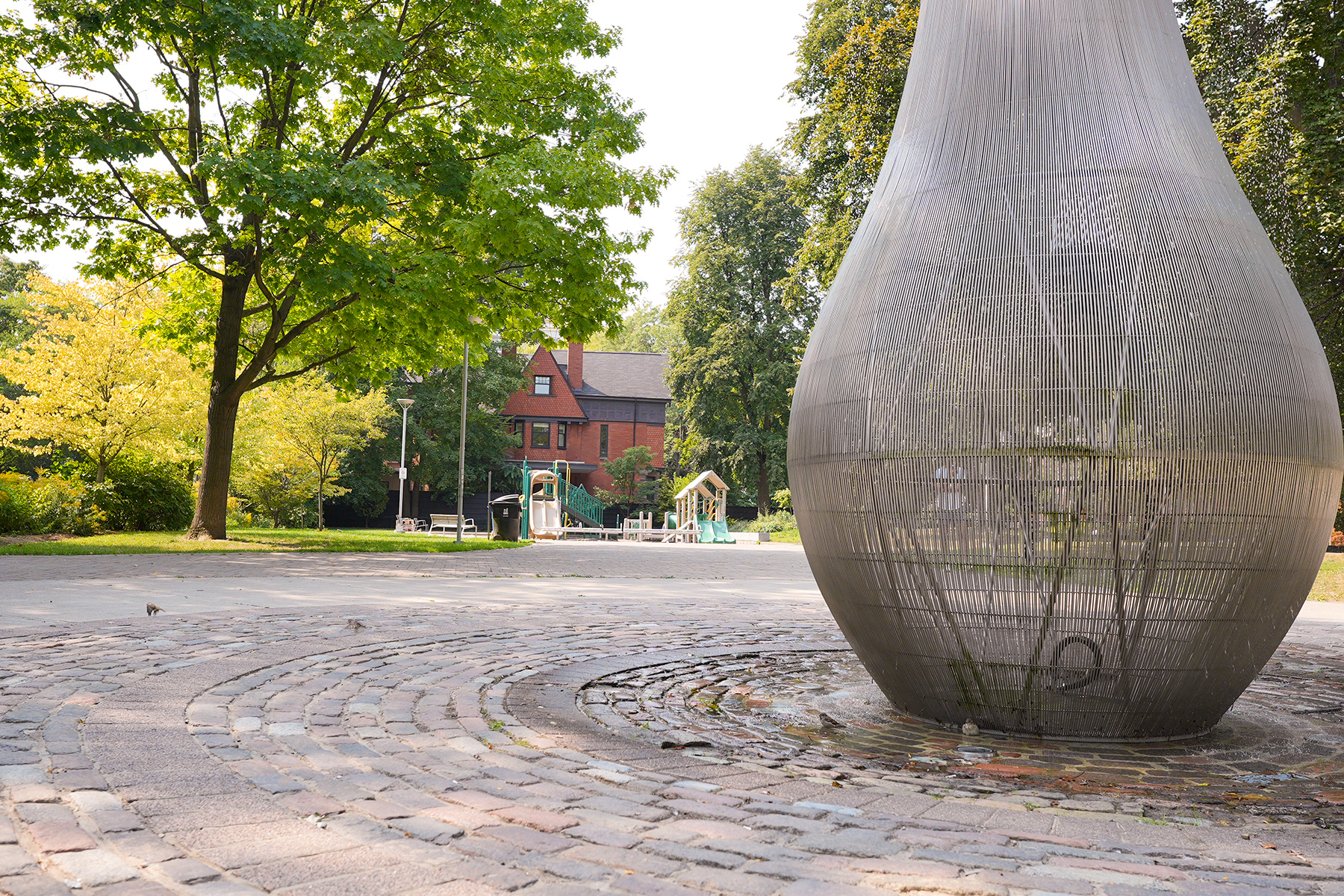
Sir Frederick Banting lived right by Taddle Creek park at 46 Bedford Rd. AMMARA KHAN/GLEANER NEWS
40 Bedford Rd. Grade: A (Last year A) Time: 1:40 p.m. Overheard: A group of friends laughing. Raindrops consistently hitting the ground at the foot of the giant fountain which is a sculpture of a pitcher. Reasons to go: Upon entering the park, I was greeted by a squirrel sprawled out on its belly, arms stretched fully out by its sides. I needed to walk past it to enter the park, which deeply disturbed it. It got up, its back to me, threw an unhappy (I assume) glance my way and bolted away. I did not let this altercation deter me, and I moved on. On one side of the park there’s a playground for kids, and on the other side of the park there’s a sitting area surrounding a large sculpture of a pitcher with water dripping down the edges. I sat at the benches surrounding this fountain. Water falls from the top and hits the bottom forming little puddles. Little birds, (I counted six of them) use this puddle to cool down and take baths. They fly back and forth between the puddle and a bush, and it seems like such a great time. There is a Bike Share rack here too. There is a lot of foot traffic. People use this park to cut across the corner of the street. Some choose to sit for a little bit and enjoy the sounds of the birds having a blast and the water droplets hitting the ground. Did you know: Sir Fredrick Banting’s Home was at 46 Bedford Rd.
Philosopher’s Walk
Philosoher’s Walk offers a nice stroll off busy Bloor Street. AMMARA KHAN/GLEANER NEWS
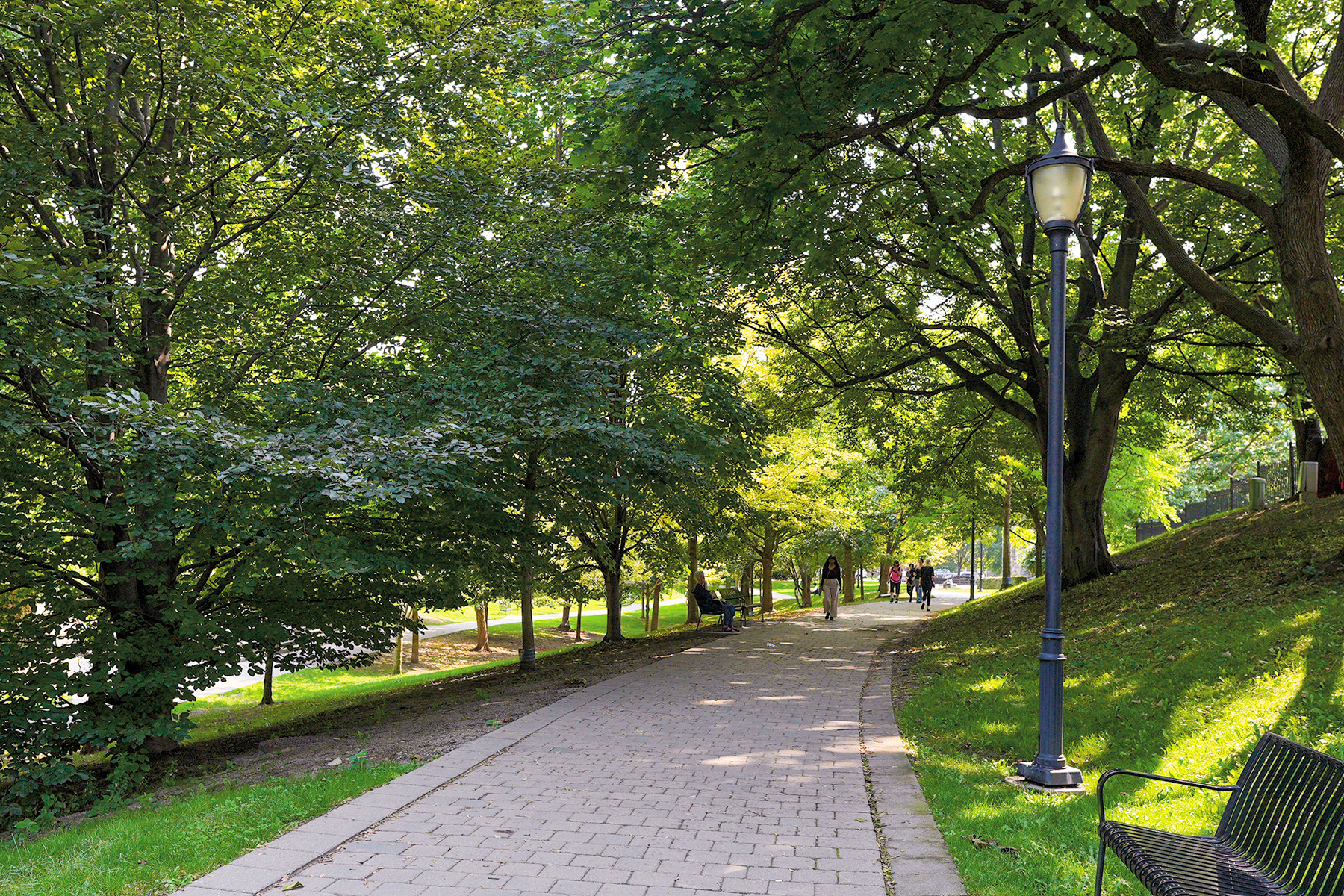
78 Queen’s Park Cres Grade: A+ (Last year A+) Time: 2:11 Overheard: So many different languages (both human and bird)! Also, “Beagle!…nice.” Reasons to go: I sat on a bench that commemorates the celebration of Rachel’s graduation from Trinity College in 2018. It is dedicated to “her future filled with success! With love, from Peter, Mai, and Bella.” If you walk along the length of Philosopher’s Walk, you’ll see that most of the benches are dedicated to various people. It was by chance that I got to enjoy the company of Rachel, Peter, Mai, and Bella. There are so many trees here providing a lot of shade. This park feels secluded; I enjoy the fact that I cannot see any cars when I am in the centre of the park. If you enjoy listening to the sounds of birds, this is the place to be. I heard so many different types of birds. Short chirps and longer tweets blended into very beautiful melodies. Similarly, you can hear a lot of different human sounds. I overheard so many snippets of conversations in languages I could not understand. This park attracts a variety of people: alone; in groups; old and young; cycling or walking; pets or no pets; babies or no babies. No one really seems rushed to me. The calm feeling of leisure came over me too, and I found myself not wanting to leave. Did you know: In the city of Toronto, installing a new bench with an engraved metal plaque costs $2,530 and engraving a metal plaque onto an existing bench costs $1,753.
Queen’s Park North
A statue of King Edward VII watches over Queen’s Park North. AMMARA KHAN/GLEANER NEWS
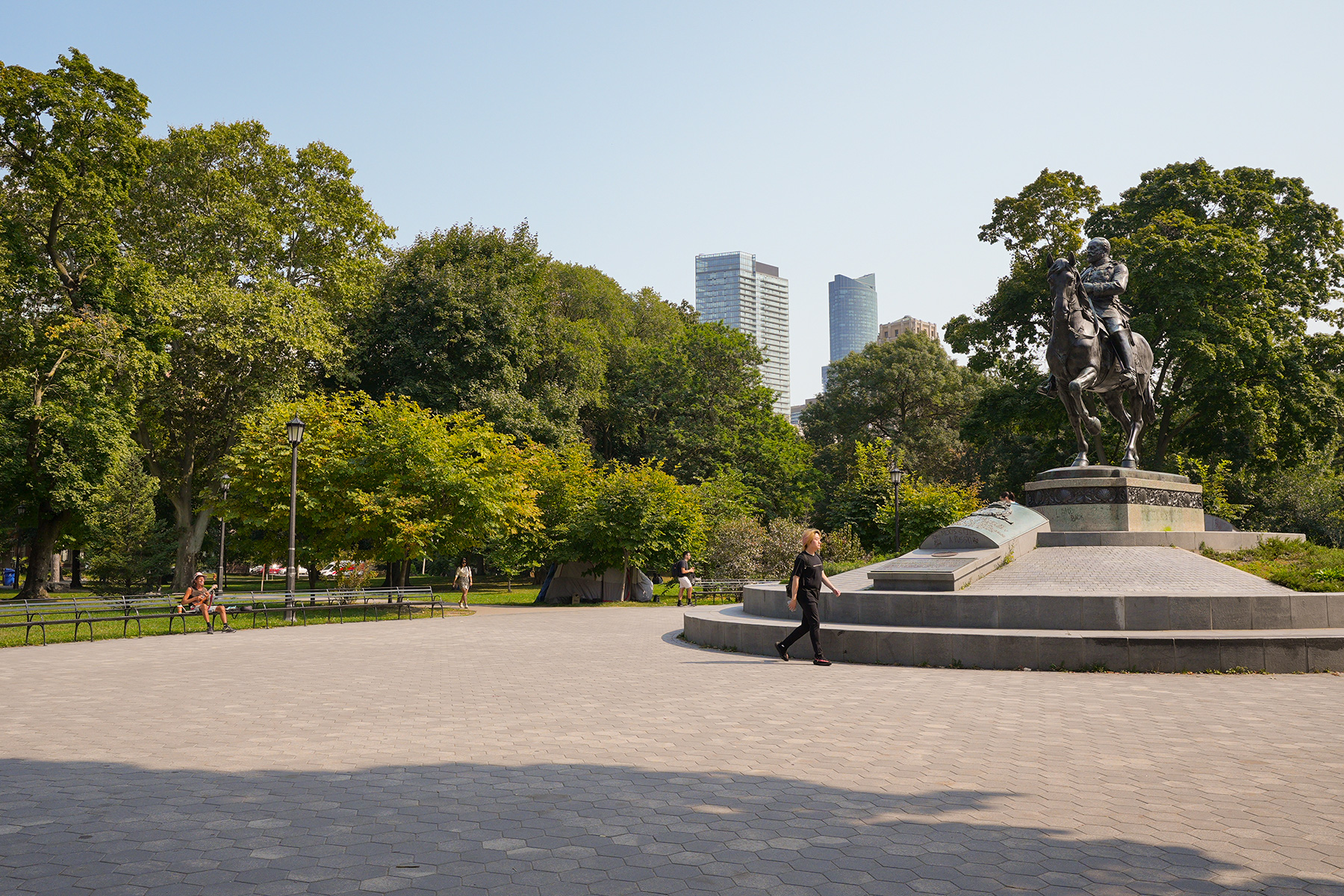
47 Queen’s Park Cres. Grade: A (Last year A) Time: 2:42 p.m. Overheard: Someone is playing a ukulele. He taps his feet along with the beat of the music. He’s singing too. And he’s actually really good. Reasons to go: There are benches encircling an equestrian statue of King Edward VII. It looks like the type of place that tourists would visit, not just to gaze upon the statue, but to observe what the Toronto public looks like. I am sitting on the benches among many people and none of them seem to be paying any mind to the sculpture; to each their own. Some wait for friends, read books, play games in the grassy area, or eat picnics. One notable man plays the ukulele. He sits on one of the benches around the statue. I think this park perfectly encapsulates the unpredictability of Toronto. It’s beautiful and crowded and confusing. I witnessed two boys attempting to co-ride a bicycle. One of them is wearing rollerblades, and his legs straddle the front wheel. They attempt one full circle around the king. In a mess of wheels and limbs, they crash to the ground after making impact with another unsuspecting boy on a skateboard. They fall directly in front of the man with the ukulele, who responds to the crash with an understandable “weeeheeeee!” He finished his tune and set the ukulele aside. He then pulls out a notebook. The boys are still on the ground, now with their water bottles, where I guess they decided to take an impromptu water break. Toronto is a fun city. Queen’s Park is a fun park. Did you know: The name of King Edward VII’s horse depicted in the statue is Kildare.
Queen’s Park
110 Wellesley St. W. Grade: A (Last year n/a) Time: 2:57 Overheard: The siren from a fire truck driving past. Reasons to go: If you want to go to Ottawa to look at the parliament buildings but you do not want to drive for four hours, then I have some great news for you. When you are looking at the legislative building at Queen’s Park, it does not look like it belongs in Toronto. Opposite to the legislative building is a view of the city. The legislative building is grand with its beautiful romanesque architecture. Those who appreciate architecture could spend significant time here simply looking at this building. There is so much detail. At the foot of the building, towards the left side if you look at it from the front, there is a statue of Queen Elizabeth II. There is a long path that goes right down the middle of the park, from the legislative building to the street. I found it very entertaining to stand in that path and consistently look back and forth because I love juxtaposition. I would say that there is not enough shade around the path, which makes it difficult to enjoy for long under the sun. But the gardens surrounding the path are worth spending some time admiring. The bushes are trimmed to perfection. Did you know: The legislative building has a variety of guided tours which you can book on their website.
November 8th, 2024 · Comments Off on CHATTER: Trinity-St. Paul’s blesses all creatures great and small (Oct./Nov. 2024)
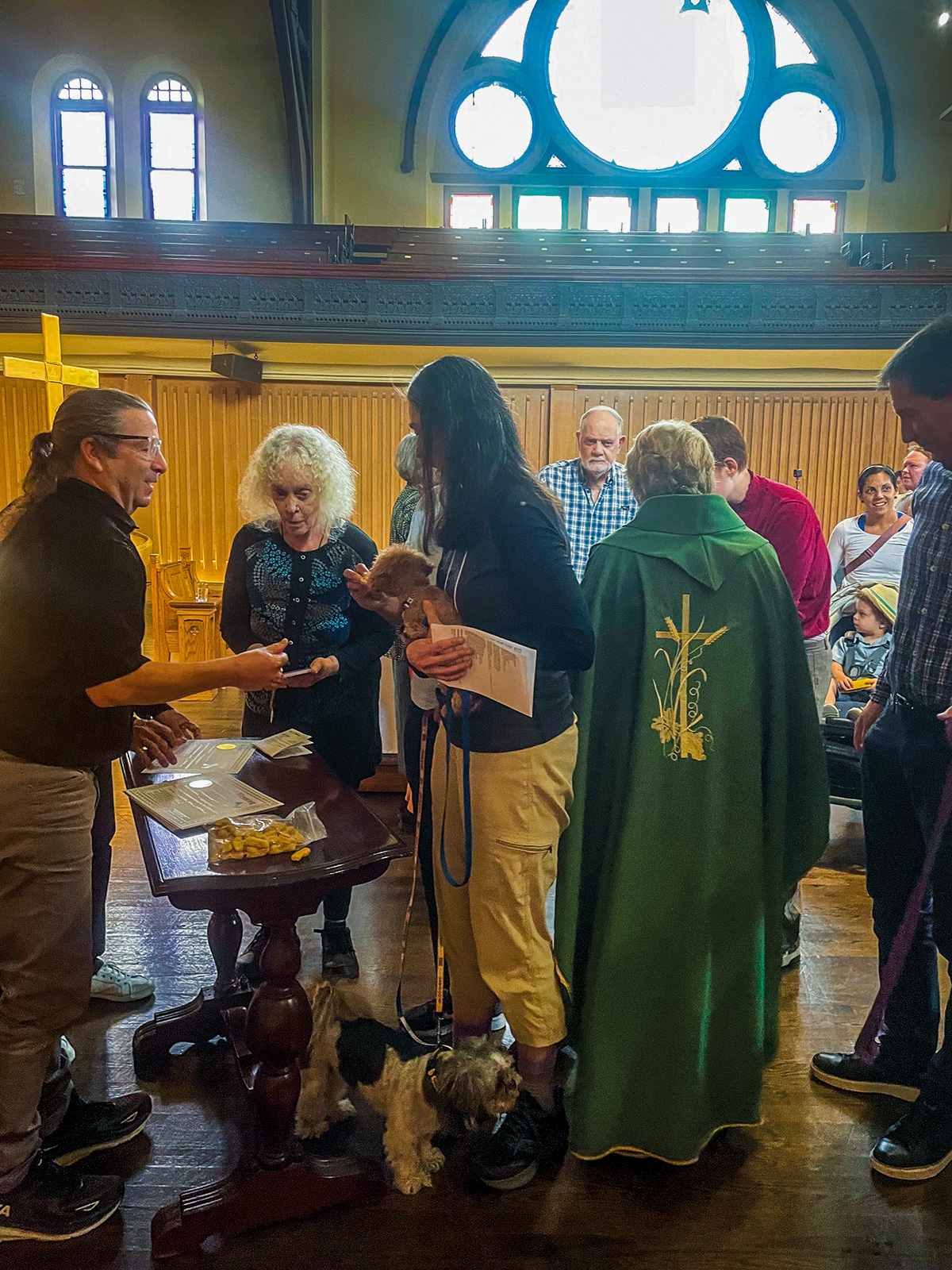
The annual tradition pays tribute to the creatures we love. ROSE HABERER/GLEANER NEWS
If you happened to be at the Trinity-St. Paul’s Centre for Faith, Justice and the Arts this past Sunday, Oct. 6, you would have found the pews full of people replaced with a gaggle of pointy eared, furry friends, there for the annual Blessing of the Animals.
The Blessing of the Animals is celebrated each year on the feast day of St. Francis of Assisi, who was a benefactor for all animals. Christians worldwide celebrate the feast of St. Francis with a blessing of animals and prayers for creation.
“St. Francis is a classic saint whose ministry is really marked by his love for animals,” said Rev. Dr. Cheri DiNovo, when asked about the significance of the blessing.
In remarks made during the service, Rev. Dr. DiNovo emphasized the ancient relationship between humans and other animals, especially dogs. But what are the biblical connections between these two? What do religious texts have to say about it?
“These are animals that have been with us since the very beginning and predate the bible by a long way. We were created, as heard in Genesis, the last, not the first. Humans came last. Humans came to look after the other creations, so I think that’s a very important spiritual lesson. That’s our purpose, to look after what has been given to us,” said Rev. Dr. DiNovo.
Following the words of welcome from Rev. Dr. DiNovo and a song from the choir and music director Deborah Park, called The Creatures We Love, the usual communion had an additional feature. Owners lined up with their pets to receive their blessings. Furry friends that couldn’t make it were represented by stuffed animals, pictures, prints on shirts, and other symbols that were blessed in their stead. Treats and certificates of blessing were handed out.
Rev. Dr. DiNovo tells me why this blessing is important and how it celebrates those who we often forget to celebrate: “They are also members of our family. They are beloved, and when we lose them, it causes incredible sorrow and heartache. I think we don’t recognize that, and it’s good to have a time to recognize how important they are.”
But how do pet owners feel about the blessing?
When asked about what the Blessing of the Animals meant to her, owner of cat Peanut-Marie-Crump had much to say: “The idea that every creation is special and important on this earth and that all creatures are equal and equally important. She’s an older girl now.” Glancing at Peanut-Marie-Crump she continued: “So we aren’t active in any religious community but I just thought lets go and get blessed and see everyone else in the community and have a nice morning.”
It seems that even those who are not particularly religious still have deep appreciation for the commemoration of animals that the blessing brings.
“The blessing is a recognition that we’re guardians for all of our pets. This is a blessing of their lives and the care that we are stewards for,” said Ashwyn, owner of dog Scarlett, who is two, and Olive, who is nine.
—Rose Haberer/Gleaner News
Comments Off on CHATTER: Trinity-St. Paul’s blesses all creatures great and small (Oct./Nov. 2024)Tags:Annex · News
November 8th, 2024 · Comments Off on EDITORIAL: Fact-checking Ford (Oct./Nov. 2024)
Premier Doug Ford, while apparently unable or unwilling to address urgent provincial crises in health care, education, and the ongoing existential threat of climate change, has instead told an Empire Club luncheon last week that he is planning to “rip out bike lanes on major roads such as Bloor Street.” The elites at the lunch were thrilled, a group whose praise Ford craves.
Ten years ago, Doug Ford ran to be mayor of Toronto; he lost, and he never let go of it. He has spent much of his time as premier trying to micromanage Toronto: Cutting the size of city council in half during the municipal election cycle; controlling city health budget spending; taking over the planning of new subways; closing the science centre; secretly creating a new waterfront redevelopment spa; issuing zoning orders that override the city; and giving any mayor that agrees with him extra powers.
Now he has turned his focus to attacking bike lanes. He has come to the view that they “cause” congestion and are “killing” business. He has no evidence of this, but in his gut, he knows its true. If bike lanes are removed, many cyclists will continue to use the roads, causing traffic mayhem, and some will be injured or killed. The other cyclists who opt to travel by car will of course only add to congestion.
How does Ford justify his intrusion into municipal governance and his attack on bike lanes?
Ford claim #1: “Talk to our first responders that are pulling their hair out, the fire trucks that can’t get across the road because there’s barriers or there’s bike lanes and they’re backed up. Talk to our police that are trying to get to a call or our paramedics. It’s an absolute disaster. It’s a nightmare.” The truth: The chiefs of Toronto Paramedics and Toronto Fire told the city’s infrastructure and works committee that there was no evidence of increased emergency response times as a result of bike lanes.
Ford claim #2: “Go on Bloor. There’s a petition just in Etobicoke for 50,000 people to get rid of these bike lanes.” The truth: The only thing that is true about this claim is that there was indeed a petition. It’s not clear where those that signed it are from as there is no control for that variable. The number of signatures is 13,000 not 50,000, and the petition actually recognizes the importance of providing a “right of way for bikes.”
Ford claim #3: “Believe it or not, my brother Rob [when he was Toronto’s mayor] put more bike lanes in than David Miller, but didn’t do it down the middle of University or Bloor.” The truth: This is a particularly pernicious claim. It rings like “some of my best friends ride bikes.” It is true that Rob Ford did have something to do with bike lanes. In 2010, before Rob Ford was mayor, the city installed bike lanes on Jarvis at a cost of $86,000. When Rob was elected, he called advocates for bike lanes “pinkos” and had the lanes removed from Jarvis at a cost to taxpayers of $270,000.
Ford claim #4: “Bike lanes are killing our businesses.” The truth: The Bloor Annex BIA and the Metcalf Foundation partnered with the Toronto Centre for Active Transportation (TCAT) who did an arms-length study of the economic impact of the then pilot bike lanes on Bloor. TCAT found that while most businesses felt that over half of their customers came by car, the reality, after interviews with 3000 customers, was that only 7 per cent did. Before deciding to make the bike lanes a permanent fixture on Bloor, the city commissioned Moneris, the payment terminal provider used by most establishments, to share data on sales. Moneris confirmed that sales had gone up by almost 3 per cent while the pilot bike lanes were installed. It seems that cyclists are more likely to stop and shop or dine than motorists.
Bike lanes are not just about safety; they are about giving people transportation choices, and using a few Trumped up excuses, Ford seeks to take some away.
I appreciated Albert Koehl’s excellent editorial piece regarding the serious hazards bike riders face as underlined by the recent death of a young female cyclist on Bloor Street.
Construction projects and aggressive motorists indeed present a serious challenge to bike safety especially in situations where there are merge points.
I absolutely agree that the safety of pedestrians and cyclists in those situations must be paramount as they are the most vulnerable. However, in the same way that cyclists are at risk from aggressive motorists, pedestrians are at risk from aggressive cyclists.
I live at the corner of St. George Street and Lowther Avenue and frequent the Annex neighbourhood as a pedestrian. I have to say that most of my near-death experiences have been related to cyclists rather than cars.
On St. George Street many cyclists interpret stop signs as mere roadside decoration as they whip through intersections with nary a pause.
At night one often encounters cyclists dressed in black with no lights or reflectors on their bikes.
My wife and I have both had close encounters with cyclists riding on sidewalks, the supposedly safe domain for pedestrians. Rarely do the cyclists dismount as they should.
Albert Koehl has also written in a recent newspaper article about the virtues but also the challenges of e-bikes. They are heavier and faster. A physician friend in her seventies was recently on holiday in Vancouver walking on a pedestrian path in Stanley Park when she was struck from behind by an e-bike.
She sustained serious injuries including a concussion, broken nose and kneecap, herniated disc, among others. There was a bicycle path beside the pedestrian path.
I have been a cyclist in this city and support the expanding cycling infrastructure. However, with opportunity comes responsibility.
The cycling community must make a serious effort to comply with the laws of the road and have more respect for the rights of pedestrians.
In addition, as Albert Koehl states in the aforementioned newspaper article, the government should introduce educational programs for cyclists as well as legislation governing the classification of e-bikes.
November 8th, 2024 · Comments Off on FORUM: A busy legislative agenda ahead (Oct./Nov. 2024)
TTC and safety initiatives dominate
By Dianne Saxe
Fall is a lovely time in University-Rosedale. Mornings are cool, summer gardens yield a few more delights (my cherry tomatoes are still ripening), and the leaves are starting to turn yellow, orange, and red. Fresh fall apples are crisp and tart; farmers’ markets are bursting with produce and looking ahead to Halloween. I always enjoy fall celebrations, such as the Annex Residents’ Association cornfest, BENA’s social and the HVRA fall fair’s auction and concert. Thank you to everyone who said hello.
Fall is also, of course, when the pace of work at city hall snaps back into high gear.
Having no council in August plus a limited scope for council in September, entails a heavy agenda every October. Flashpoints at this council will likely include: fixing the vacant home tax; Ports Toronto’s request to add safety buffers to the Toronto Island Airport; the perennial topics of congestion and housing; and whether to give up on an ambitious and long-awaited redevelopment of the St. Lawrence Centre for the Arts.
Some of my own motions will also be on council’s agenda, including:
My compliance and enforcement strategy for transportation services
Much higher maximum fines for serious road obstructions
Zoning obstacles to home energy efficiency, energy storage, and renewable energy
Protecting tenants of older buildings from lead contamination in their drinking water
A promising building-based approach to curbside EV charging for garage orphans
Whether 16- and 17-year-olds should be able to vote in neighbourhood polls (not general elections)
Refusing greenwashing ads that conflict with Toronto’s climate commitments
I will also be making section 37 motions to fund mass timber affordable housing in Kensington Market and to beautify the forthcoming pedestrian space on Avenue Road between Davenport and Dupont.
At the TTC, I am progressing in two areas of critical importance: fare enforcement and the impact of road congestion on bus and streetcar reliability.
For the first time since COVID, the TTC is stepping up fare enforcement and closing off weak points where fare evasion is rampant. Legacy tickets/ tokens will no longer be accepted after December 31, and most crash gates are being closed.
Ticket issuance is up sharply to about 1000 tickets per month, halfway to what it was in 2019. On road congestion, I am coaxing TTC staff to work more effectively with city staff, and to document the worst pinch points.
In other TTC news:
We welcomed Greg Percy (former CEO of Metrolinx) as interim CEO. He is already making an excellent impression!
Hillcrest Yard celebrated its one hundredth anniversary with a popular open house.
Because of my swing vote, staff will give the board options for continuing free public WiFi after Rogers closes down the old, collapsing technology on December 31.
The TTC board adopted my motion to prescreen advocacy advertising from documented fossil fuel greenwashers like the Pathways Alliance and to not accept such advertising unless the advertiser proves their claims to be true. Thus, at long last, the TTC will stop lending its brand and credibility to false, misleading claims that the billionaire tar sands companies are compatible with our net-zero commitments and a liveable future. This decision, apparently the first of its kind in North America, was quickly adopted by Montreal’s transit system, which has been musing about such action for months. Thank you to CAPE and StandEarth for their inspiration and support.
It’s great to have my office team almost back in full force, with Tasneem, Sydney, Daniel and Anne joining William, Christian, Ben and Andrew, plus Cameron part-time for the school year. Holli, Jessica, Quinn and Teodoro are thriving in their new gigs and send everyone their best wishes.
Dianne Saxe is city councillor for Ward 11, University-Rosedale.