July 25th, 2016 · Comments Off on GREENINGS (JULY 2016): The school of the future
A model for learning and sustainability
By Terri Chu
Two months ago, the province and the Toronto Catholic District School Board announced plans to build a new school on the site of St. Raymond Catholic School, which abuts Christie Pits. As a new parent, I’m very excited by the prospect of a new school in the neighbourhood, as well as for the opportunities presented by greenfield project (a development that is not limited by existing infrastructure or buildings), a rarity in this city.
With the funding only just announced, the new school’s design has yet to be developed. But parents have said they’d like the building to be as environmentally friendly as possible, and I thought I would reflect on what that could look like.
In terms of the building itself, being beside a huge open park provides lots of opportunities to include innovative features into the building. Geothermal loops (storing heat in the ground) could be incorporated if residents didn’t mind losing access to the park during construction. Solar panels could be used as an energy source; though I still have mixed feelings about solar panels due to their toxicity during production and end of life (depending on the type of panels used), they do help reduce peak demand, which is the dirtiest part of electricity production.
[pullquote] I don’t think any modern school should be built without a greenhouse on the roof. Not only is it energy efficient, but kids in the city don’t have as much connection to food and soil as their rural counterparts.[/pullquote]
Personally, I don’t think any modern school should be built without a greenhouse on the roof. Not only is it energy efficient, but kids in the city don’t have as much connection to food and soil as their rural counterparts. As a parent, I don’t believe there are enough opportunities to teach kids that food doesn’t start in foam packages.
Things like grey water recycling — re-using water that goes down sinks to flush toilets for example — are easy, no brainers, given that how we waste water right now should be criminal. And when it comes to lighting, current technology can virtually eliminate the need for overhead lights on all but the cloudiest of days.
Lots of research has gone into highly efficient ventilation systems that can now not only recover most of the heat out of the air, but ensure that only stale air gets ventilated away. Up-to-date recovery ventilations can recapture heat and moisture, and reduce space heating requirements by huge amounts, while passive heating and cooling drastically reduce the need for supplemental climate control.
The entire field of building sustainability has been the focus of a lot of research over the years. There are ways to get to net zero energy buildings, even in a cold climate like ours, though all of these low carbon and energy footprint technologies have one thing in common: they are expensive.
As some of these initiatives would cost significantly more initially, but lead to long-term savings, the capital cost of building the school should not be considered in a vacuum, but alongside future operating costs as well. Anything short of accounting for at least a decade of operating expenses should be considered a failure.
The question isn’t whether or not we can build sustainably, it’s a matter of whether we’re willing to invest in it…and that requires an entirely new way of doing business. Let’s make sure the school board and the province know that we are paying attention. There is so much potential value in a greenfield project like this for our city.
This new school isn’t just about the latest in sustainability, it should set the standard for how things are done.
Terri Chu is an engineer committed to practical environmentalism. This column is dedicated to helping the community reduce energy, and help distinguish environmental truths from myths.
READ MORE:
NEWS: A $9.4-million school with a view (June 2016)
READ MORE GREENINGS BY TERRI CHU:
Taking action on climate change (June 2016)
Cloth diapers have gone from burden of the poor to luxury of the rich in one generation (May 2016)
Provide help or stand aside (April 2016)
Don’t fall prey to marketing (March 2016)
Tags: General
June 15th, 2016 · Comments Off on ON THE COVER (JUNE 2016): PATROLLING THE PARK
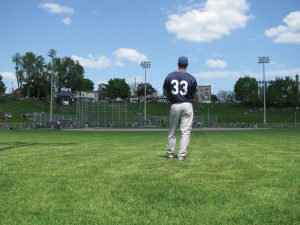
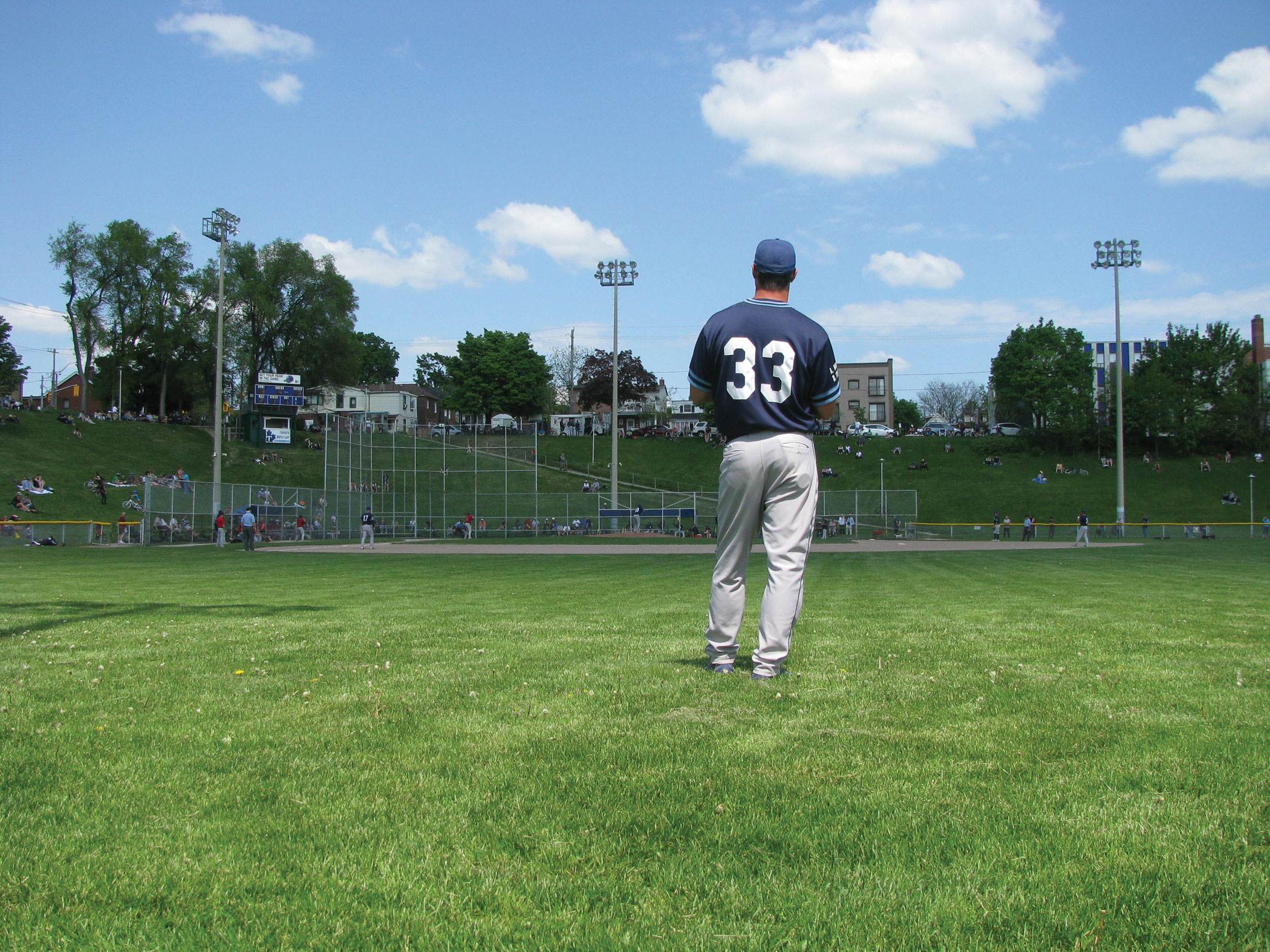
PHOTO BY R.S. KONJEK: Jon Waltenbury patrols the outfield at Christie Pits during the Toronto Maple Leafs’ game against the Brantford Red Sox on May 22. Waltenbury’s three-run homer put the Leafs ahead for good, and ensured an 8-6 victory. R. S. Konjek summarizes a month of Maple Leafs in his baseball column.
Tags: Annex · Sports · Maple Leafs Baseball
June 15th, 2016 · Comments Off on Green sanctuaries in the heart of the city
Annual parks survey returns
Upkeep, or lack thereof, marks the return of our popular Grading our Greenspace feature. Published in two parts, we visit parks in our coverage area and review them based on cleanliness, amenities, and atmosphere. Our round-up reflects a mixed bag: some parks continued to be great, while others seem to have dipped further into mediocrity. Unkempt parks, with uncut grass, poorly maintained amenities, and dying flowerbeds, are a major complaint among park users, something that shouldn’t be difficult to address. With greenspace at a premium in our neighbourhoods, our parks have become more important than ever. What our reviews demonstrate is that parks, when well maintained, are thriving community hubs. We’ll publish our second part in the July edition and look forward to your comments, whether they be on parks or on our reviews. All reviews and photography were done by Geremy Bordonaro and Emily Rea.
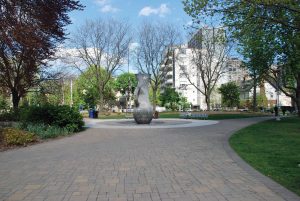
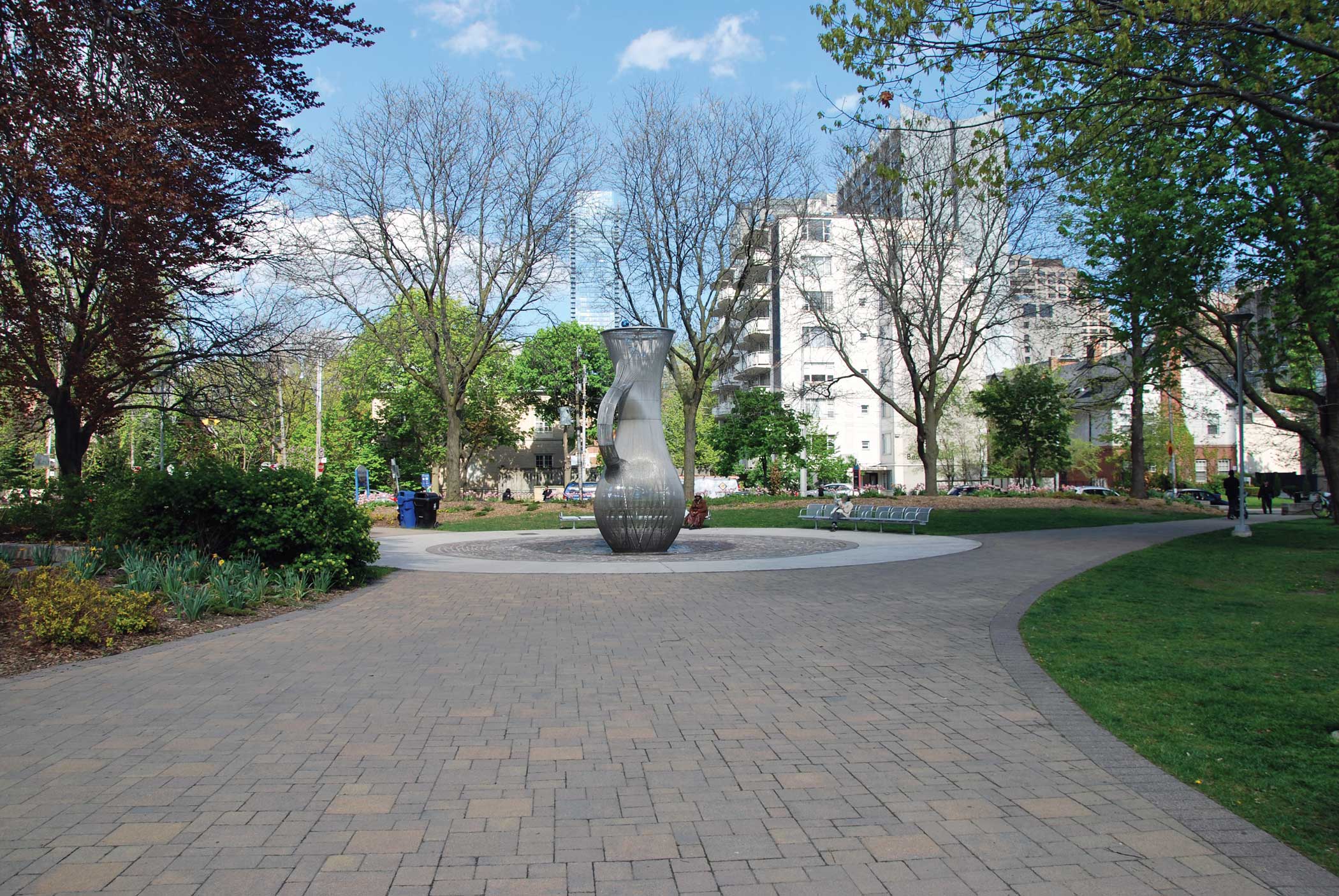
PHOTO BY EMILY REA: The Vessel, a sculpture by Ilan Sandler made of stainless steel rods, serves as a centrepiece for Taddle Creek Park, which was one of the best parks reviewed this year.
Taddle Creek Park
Bedford Road and Lowther Avenue
Time: 4:00 p.m.
Grade: A+ (last year A+)
Reason to go: Taddle Creek Park is a clean, spacious park located at the corner of Bedford Road and Lowther Avenue, a block north of Bloor Street. The playground is not fenced in, but set back from the street and protected from traffic and noise by large planters and trees that create a natural barrier and make the park feel more open. During the spring, hundreds of daffodils and pink tulips bloom in the planters, adding a dose of colour. The playground has a wood chip base and features two play structures, a swing set geared toward younger children, and a sandbox. The centrepiece of the park is a large stainless steel sculpture of a jug that doubles as a fountain. The playground and the fountain are surrounded by long metal benches that provide ample seating for parkgoers. The apartment building that the park borders on its south edge is currently undergoing construction on its parking lot, so there is temporary noise pollution. Taddle Creek Park is a beautiful park that has been well maintained since its 2011 revitalization, making it one of the best in the neighbourhood.
Overheard: “Don’t lick the hand sanitizer off your hands!”
Did you know: Taddle Creek Park is built on the former site of Sir Frederick Banting’s house. Banting won the Nobel Prize for medicine in 1923 for the isolation of insulin for the purpose of treating diabetes.
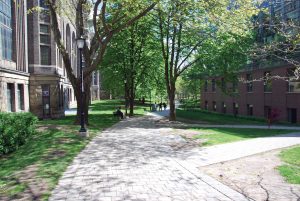
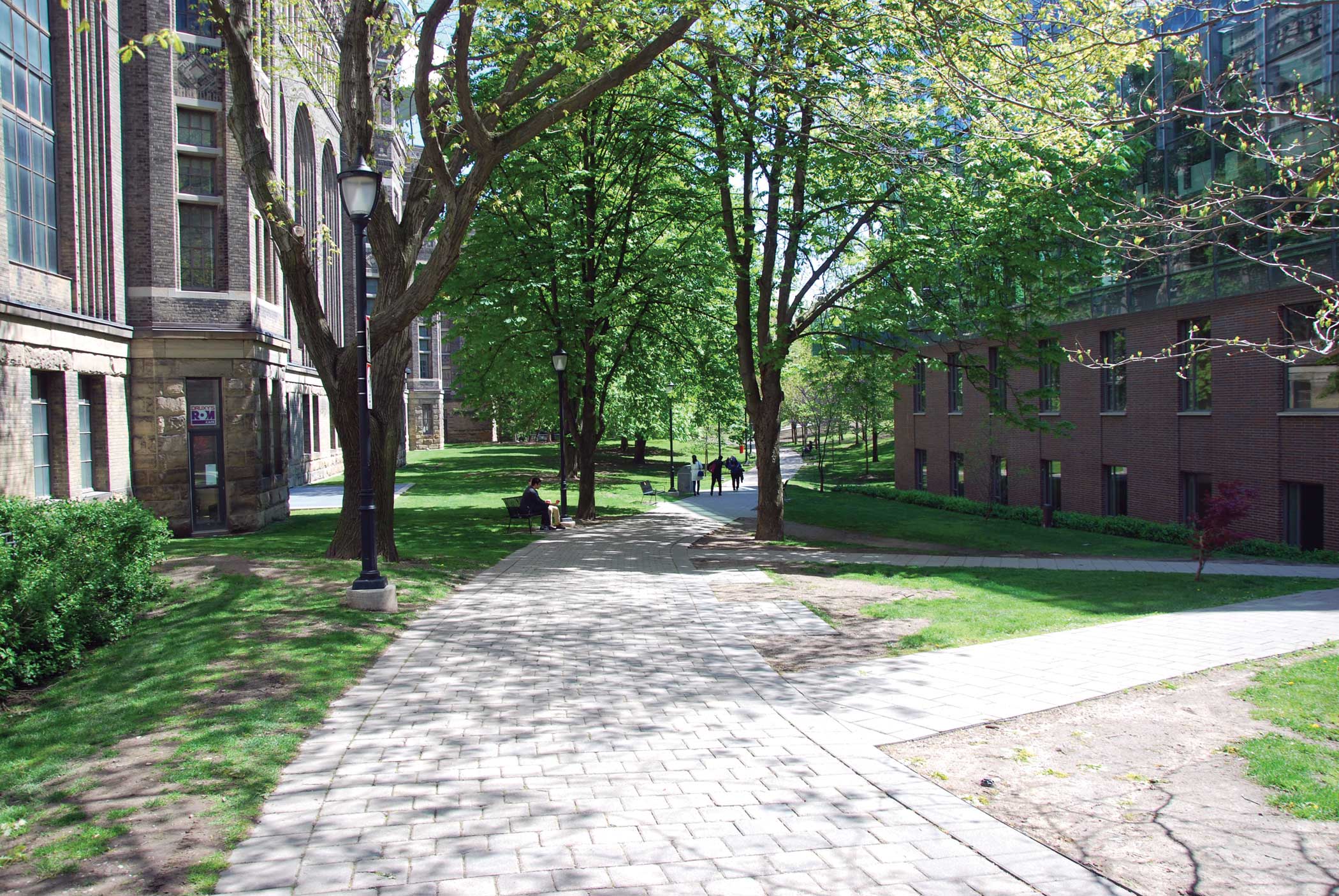
PHOTO BY EMILY REA: Philosopher’s Walk, framed by the Royal Ontario Museum and the Royal Conservatory of Music, is both park and path. It’s also a great spot for a picnic.
Philosopher’s Walk
Bloor Street and Hoskin Avenue
Time: 3:30 p.m.
Grade: A+ (last year A+)
Reason to go: Used as a thoroughfare between Hoskin Avenue and Bloor Street, Philosopher’s Walk is a very popular park favoured by locals and people who work in the area. The winding path features a wide diversity of trees and benches along its side for the length of the park, providing lots of seating. Down the hill off the path, there are areas perfect for a summer picnic or lunch break. Philosopher’s Walk is framed by the beautiful buildings of Trinity College, the University of Toronto Faculty of Law, the Royal Conservatory of Music, and the Royal Ontario Museum. The serenity of the southern portion of the path is temporarily disturbed by construction of a new Faculty of Law building, but the rest of the park remains a serene spot in the middle of the bustling downtown.
Overheard: “Does anyone like vacuuming?!”
Did you know: The gates at the northern entrance of Philosopher’s Walk were originally constructed in 1901 at the corner of Bloor Street and Avenue Road and were later moved to the top of Philosopher’s Walk when Avenue Road was expanded in 1960.
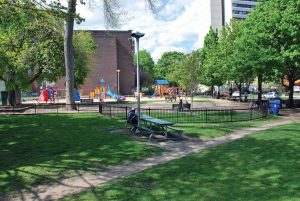
PHOTO BY EMILY REA: The fenced in playground, and large number of equipment, makes Huron and Washington Park a perfect destination for families.
Huron and Washington Park
Huron Street and Washington Avenue
Time: 3:00 p.m.
Grade: A- (last year A)
Reason to go: Huron and Washington Park is a pleasant park conveniently located just south of Bloor Street near Spadina and St. George subways. The fully fenced-in playground area is large and has a wide variety of equipment, including a climbing wall and balance beam that are great for older children, as well as spring riders, a sandbox, and other equipment that is friendly to smaller children. This park is usually busy with families, children from the nearby playschool, and students from University of Toronto Schools during the day. The relatively small green space adjacent to the playground has areas shaded by large trees as well as a hill perfect for sunbathing. There are multiple picnic tables and benches available. The park does not have many plants aside from the trees, but nonetheless is a pleasant place to sit or play.
Overheard: “Can my car go down the slide?”
Did you know: The park is an equal distance (350 metres) from Spadina and St. George stations.
Blood-Bedford Parkette
248 Bloor St. W.
Time: 2:00 p.m.
Grade: B (last year B+)
Reason to go: Bloor-Bedford Parkette is a small park nestled between the Ontario Institute for Studies in Education and the Faculty of Social Work on busy Bloor Street. It is most popular for office workers on their lunch break and people taking a break from walking down Bloor Street. The park is clean and features lush grass and large trees that cast shade and there are several benches that provide lots of seating. It is small and bordered by a parking lot and a busy street, affording no sense of seclusion from the bustling city. The dose of green space provided is nice to have in the middle of Bloor Street, but Bloor-Bedford Parkette is not a destination in and of itself.
Overheard: The sounds of Bloor Street traffic.
Did you know: Before the Bloor-Danforth subway opened in 1966, the Bedford Loop was located on the grounds of Bloor-Bedford Parkette. The loop provided passengers leaving St. George station easy access to eastbound and westbound streetcars.
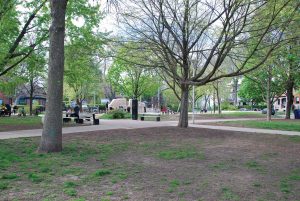
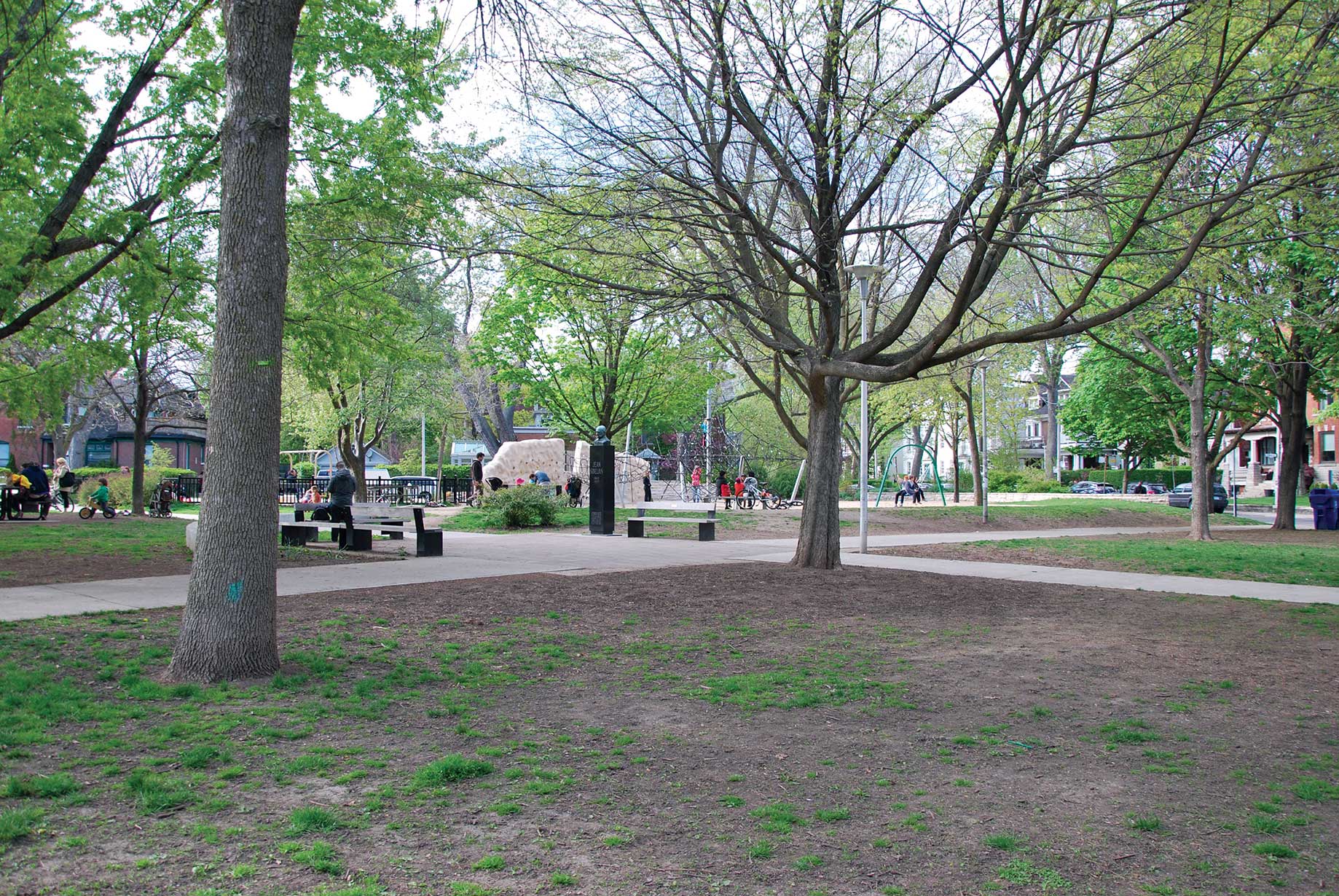
PHOTO BY EMILY REA: Jean Sibelius Park has lots of space and many amenities, making it attractive to all ages.
Jean Sibelius Square
50 Kendal Ave.
Time: 4:00 p.m.
Grade: A+ (last year A)
Reason to go: Jean Sibelius Square is a spacious park with ample seating and green space, and a clean public washroom. The large swathes of shaded and sunny grass provide plenty of space for parkgoers to play sports or sprawl out on the ground. The playground at Jean Sibelius Square is surely one of the best in the neighbourhood, featuring a large climbing wall and web that is great for older children and a fenced-in section for younger children that includes a sand pit with a faucet. Jean Sibelius Square is an excellent, quiet park, perfect for spending a summer afternoon there.
Overheard: “I hope I don’t fall!”
Did you know: Every winter community members make an ice rink on the field in the park.
Albany Parkette/Seaton Park
Albany Avenue, north of Bloor Street West
Time: 12:30 p.m.
Grade: B (last year B)
Reason to go: Despite its proximity to both Bloor Street and Bathurst Station, this parkette provides a good quiet getaway. There is an ample amount of seating to just sit, relax, and admire the beautiful graffiti mural. Flowers, grass, and foliage are kept in good condition and placed strategically to cover potential blemishes like the nearby subway grating. Many people end up using this park as a shortcut to the street from the subway but find themselves stopping to relax. Despite there being two light fixtures and plenty of garbage bins this park is not ideal for visiting any time aside from midday due to its location.
Overheard: “You’ve got to swish your hips!”
Did you know: The nearby graffiti mural bears the logo for Sonic Boom Records, which has moved to Spadina Avenue.
Ed and Anne Mirvish Parkette
In front of Bathurst subway station
Time: 12:00 p.m.
Grade: D+ (Last year C)
Reason to go: This small space of green in front of Bathurst station does not have much going for it. There is a single bench at the far south of the park. The grass is thick, uneven, and cluttered with dandelions and weeds. Some flowers are clearly dying and there is a small dead tree taking up space in the middle of the area. Its location is another downside as the constant hum of streetcars and oncoming Bathurst Street traffic stop this park from being even a good place to relax. On the day of this review cigarette butts were strewn all about the park bench. The one saving grace is that it is otherwise pretty to look at and breaks up monotonous concrete.
Overheard: A car honking at another commuter trying to turn left at Bloor and Bathurst streets.
Did you know: The park’s single bench is dedicated to Leonard and Gwendolyn Johnston, owners of an influential Black-culture bookstore in Seaton Village.

PHOTO BY GEREMY BORDONARO: A rotting tangerine tied to a fence post is the most depressing aspect of Aura Lee/Robert Street Park. This odd feature reflects how deep the park has fallen into disrepair in recent years.
Aura Lee Playground/Robert Street Park
Robert Street and Sussex Avenue
Time: 1:30 p.m.
Grade: F (last year F)
Reason to go: Fans of urban decay can rejoice knowing this park exists. The tennis courts are the only accessible parts as the rest is completely padlocked shut. Old equipment is strewn about, ground is sinking, and buildings are clearly in disrepair. At the time of this review, the ice rink was being used as storage space for broken sidewalk garbage disposals. Grass on the field is well maintained despite the fact that it’s completely inaccessible and there are clothes thrown about it. There is a new code blue emergency pole in case you decide to go to the park in a crisis. The most entertaining part was a rotting tangerine hanging from a shoelace tied to a fence.
Overheard: The quiet sound of despair that hangs over this park.
Did you know: This park is owned by the University of Toronto with the southern part being on loan to the city.
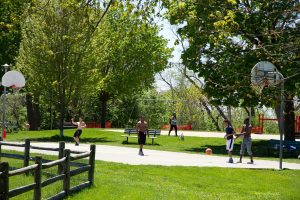
PHOTO BY GEREMY BORDONARO: Though not very accessible for people living with disabilities, Hillcrest Park is a great place to relax, bring your children, or get in some physical activity.
Hillcrest Park
950 Davenport Rd.
Time: 1 p.m.
Grade: A (last year A+)
Reason to go: Hillcrest Park has everything. There are basketball and tennis courts, an off-leash dog park, plenty of playground equipment for the kids, a surprisingly clean washroom, and lots of seating. All of these amenities, as well as the grass and trees, are in great condition. The playground has a good number of swings sets, slides, and climbing activities as well as a wading pool that is open during the summer. This park is well populated for good reasons. The downside here is accessibility: it is located on a fairly steep hill making it difficult to get to for people with disabilities, especially those in wheelchairs. Despite that Hillcrest Park remains a must-go park this year.
Overheard: “Ball! Sorry, about that, man,” as a basketball comes flying towards the benches.
Did you know: Since the park is located on such a steep hill it gives a beautiful view of the Toronto skyline and Lake Ontario.
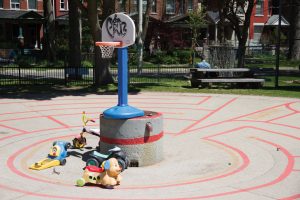
PHOTO BY GEREMY BORDONARO: Nestled in a thriving neighbourhood, Margaret Fairley Park has a popular wading pool feature with a small labyrinth mural.
Margaret Fairley Park
100 Brunswick Ave.
Time: 2 p.m.
Grade: A (last year A)
Reason to go: This is one of the best parks for families with children. There are a large number of toys and play-sets around here for kids to use. Picnic benches and log benches bring in just enough seating for everyone. The neighbourhood gives an ideal atmosphere and quick access to a nearby convenience store. Although the grass here is thin in places, the trees and other foliage are in great condition. This park may prove small at peak hours, as even with only a few families there, at the time of this review, children did not have a lot of space to run amok.
Overheard: “Konichiwa. Bye-bye park!”
Did you know: The stone plate in the middle of the park is dedicated to namesake Margaret Fairley, a political activist.
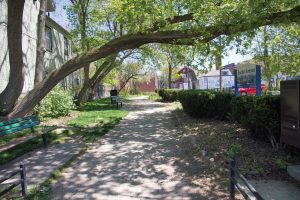
PHOTO BY GEREMY BORDONARO: Euclid Park, littered with garbage and emitting a sickening smell, has very little to offer but a dirt path.
Euclid Parkette
711 Euclid Ave.
Time: 12:20 p.m.
Grade: D- (last year D-)
Reason to go: This small parkette is cursed by both its location and its lack of upkeep. Its location, behind a KFC and dumpsters, should make the sickening smell of garbage mixed with fried chicken enough to keep most people from visiting. Though bins are readily available there were half-empty smoothies, plastic bags filled with broken metal, and plenty of cigarette butts out on the ground at the time of this review. Most of the space here is a dirt path with only small pieces of unkempt grass and flower beds to break it up. The three benches provide more than enough seating but they are all in differing states of disrepair. If a bad look and even worse smell aren’t deal-breakers then there is enough shade here to keep comfortable for a little while.
Overheard: A group of nearby bicycle police asking a young man about the neighbourhood.
Did you know: Euclid Park is in the middle of Koreatown, and plenty of great Korean restaurants are just a short walk away.
Matt Cohen Park
Spadina Avenue and Bloor Street West
Time: 1:00 p.m.
Grade: C (last year C+)
Reason to go: This park is located on the busy intersection of Bloor Street and Spadina Avenue, adjacent to the University of Toronto Schools, and is tiny, covering only the southeast corner. There are benches and large domino-shaped rocks that serve as seating. Students often use the park to eat a quick lunch or settle down to work. Aside from the seating there is very little else to Matt Cohen Park. Noise from the cars in the streets was overwhelming and makes the space more of a convenience for locals than a destination.
Overheard: “Let’s get Pizza Pizza.”
Did you know: Metal leaves adorn the subway grating in the park as part of the park’s theme of nature and city living.
Christie Pits Park
750 Bloor St. W.
Time: 12:00 p.m.
Grade: B+ (Last year A)
Reason to go: Christie Pits has something for everyone. There are basketball courts, baseball fields, soccer fields, a covered patio, an ice rink, and new lookouts. The park also has a water park that has a large water slide, a pool, and water attractions for kids to play in. The area is currently undergoing construction, which makes many of the facilities inaccessible, and the noise from the machines occasionally ruins the park’s normally great atmosphere.
Overheard: “This is such a great park! And they have a kiddy pool!”
Did you know: Christie Pits Park was a dumping ground for trash during the 2009 garbage strikes.
Sgt. Ryan Russell Parkette
250 Avenue Rd.
Grade: D+ (last year C)
Time: 1:15 p.m.
Reason to go: Though there is a playground and a few benches around the area there isn’t very much to this parkette. The grass is thick and full of weeds. Cigarette butts, abandoned construction signs, and other trash littered the ground. This parkette is in desperate need of upkeep, which it had not received at the time of this review. Nearby traffic and the occasionally passing train make the noise level around the area nearly unbearable.
Overheard: Two minutes of oncoming freight train horns.
Did you know: Formerly known as the Dupont Parkette, the parkette is dedicated to Sgt. Ryan Russell who was tragically run down in the winter of 2011.
Sally Bird Park
194 Brunswick Ave.
Grade: B (last year B)
Time: 12:30 p.m.
Reason to go: Sally Bird Park is a well-secluded area with a fair amount of shade. There is quite a bit of seating around the park to sit back and relax. The pathway is easy to access and provides a good get-away in a quiet neighbourhood. Workout equipment is available though and well used. On the day of this review there were lots of weeds in the gardens but they weren’t intrusive.
Overheard: “Yeah hey man, what’s up?”
Did you know: Last year, Sally Bird was one of the meeting points for performances of The Postman, the popular site-specific theatre production about Canada’s first Black postman.
READ MORE:
Grading our Greenspace (2015)
Tags: Annex · Life
June 14th, 2016 · Comments Off on NEWS (JUNE 2016): New landscaping for Lennox Street
Concerns raised about lack of consultation for Central Tech space
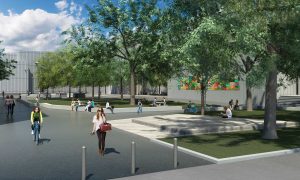
PHOTO COURTESY RON BERNASCH/JSW+ ASSOCIATES: The landscape architect overseeing the enhancements said the aim is to emulate a university campus.
By Geremy Bordonaro
Improvements to the Lennox Street expanse between Central Technical School and its art centre are well underway, but residents attending a May 5 information meeting questioned whether the design reflected the best use of the land.
When the refurbished landscaping — now in progress — is done in late summer or early fall, the area will feature more walkways and spaces for students to gather, broken up by portions of foliage.
“What we’re really trying to provide is a campus feel, like if you went to U of T or Ryerson,” said Ron Bernasch, the landscape architect serving as the primary consultant on the improvements. “That’s really unique for a high school.”
A land survey revealed that the soil contained ash and cinder, so the initial designs had to be revised to salvage as many trees as possible, something that required adding more paving.
“Just providing that physical barrier allowed us to save as many trees as we could,” explained Bernasch. “The second part is that we tried to find an area in the middle of that central area where we could plant many trees. In order to do that we had to remove a metre of soil.”
Many residents at the information meeting, however, suggested that too many trees were removed in favour of the pavement, and that key community locations were being removed in favour of stage and “art” areas. They also suggested that the community wasn’t consulted enough and that their needs for a space to use after students were gone were largely being ignored.
“They brought forward these plans for that greenspace and it was a surprise to us that they were as far advanced as they were,” said Sue Dexter of the Harbord Village Residents’ Association. “The initial reaction [for us], it was kind of puzzling.”
[pullquote]“What we’re really trying to provide is a campus feel, like if you went to U of T or Ryerson”—Ron Bernasch, landscape architect[/pullquote]
She’s skeptical about the hard surface that Bernasch has argued will help save trees, and believes more can be done to help involve the community in the process and get the most out of the new space.
“We have to learn how we can engage with one another,” she said. “Bit by bit we will. We’ve gone from total isolation to baby steps of positive cooperation.”
Ausma Malik (Ward 10, Trinity-Spadina) reiterated the importance of keeping both the community and school setting in mind when redesigning the campus. She did not say how much it would cost to rehabilitate the area, nor where the funds would come from.
“[Spaces like this] really are a vital part of how our school community functions, how students use it and benefit from it,” said the trustee at the meeting. “It’s such an important place where community comes together and uses it just as much and cares just as much about it.”
Joe Cressy (Ward 20, Trinity-Spadina) agreed.
“We have to balance two different interests that should come together,” said the councillor. “This has to serve students during the day. It has to serve them well. In the context of the community, in the context of an efficient greenspace, I’m also always trying to see how we can maximize the amount of greenspace. So how do we balance both?”
Bernasch, though, said that despite the large amount of negative feedback, the plan still has merit.
“There’s always going to be pushback,” he said. “Members of the community may not agree, but I think this is going to be a great resource for the community.”
Indeed, the plan has been tweaked in response to several rounds of feedback.
“We’re encouraged by the changes in the plans,” Dexter said. “If there were less hard surface it would be even better.”
Calls to Central Technical School, as well as follow-up attempts to contact Ausma Malik, went unreturned.
READ MORE ABOUT CENTRAL TECH FIELD:
NEWS: Central Tech field renewal back on track (May 2016)
LETTERS: HVRA still on board for CTS plan (March 2016)
EDITORIAL: Ship to wreck (February 2016)
Construction halted at Central Tech: Student athletes launch online petition by Marielle Torrefranca (February 2016)
Agreement reached for Central Tech field (April 2015) by Annemarie Brissenden
To dome or not to dome, that is the question (February 2015) by Terri Chu
Editorial: Mobs don’t rule, nor do pawns (February 2015)
Dome plan inches closer (February 2015) by Brian Burchell
School board appeals ruling and loses, again (October 2014) by Brian Burchell
Editorial: A strategy run amok (September 2014)
Dome plan quashed by courts (September 2014) by Brian Burchell
Raucous meeting on CTS field (April 2014) by Annemarie Brissenden
READ MORE ABOUT CENTRAL TECH:
Central Tech alumni return to mark school’s centennial (November 2015) by Annemarie Brissenden
Central Tech celebrates 100 years (July 2015) by Annemarie Brissenden
Aircraft program grounded in 2004 (July 2015) by Annemarie Brissenden
Tags: Annex · News
June 14th, 2016 · Comments Off on NEWS (JUNE 2016): Westbank submits revised application
Community meeting scheduled for June 13
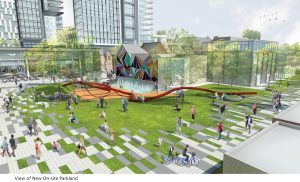
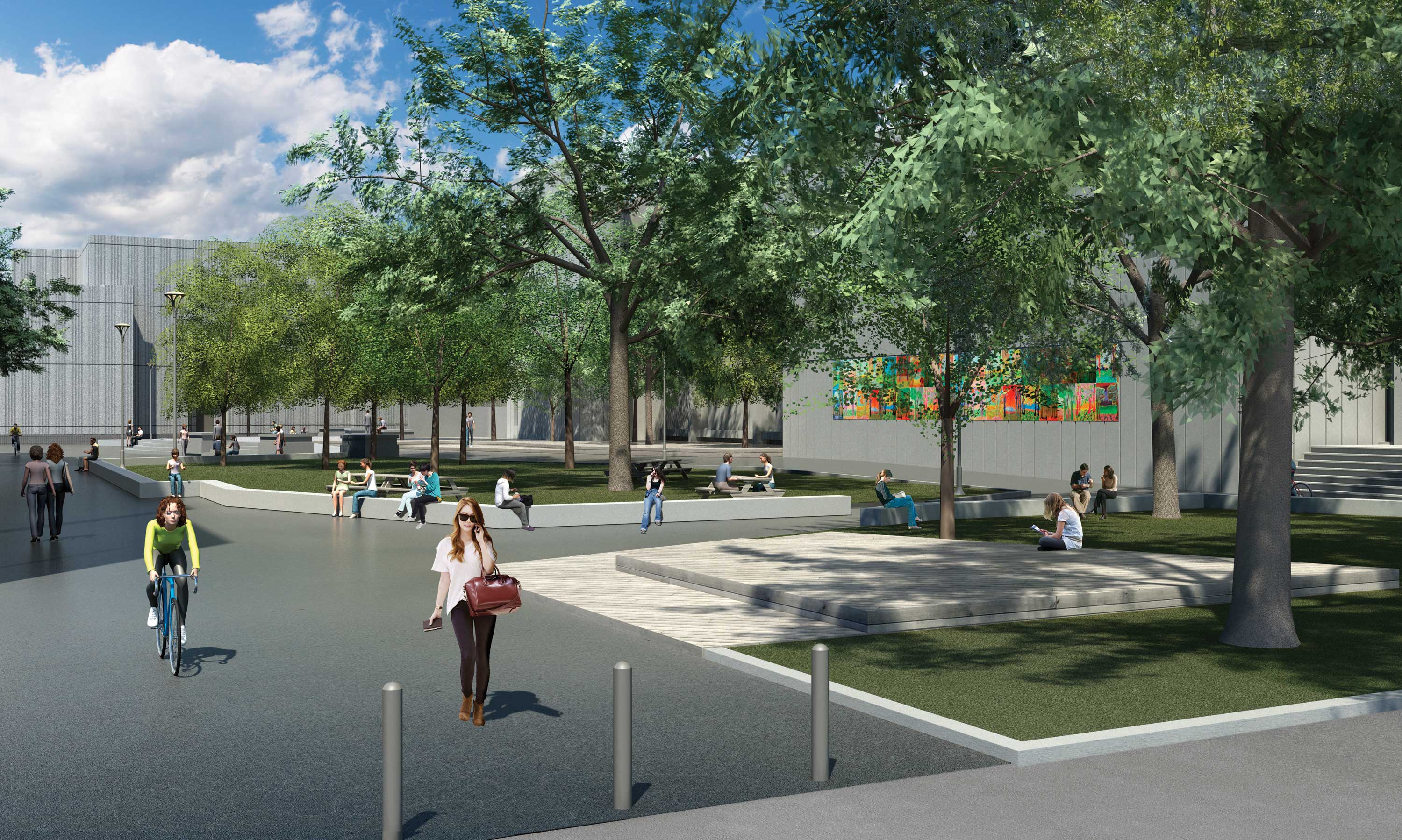
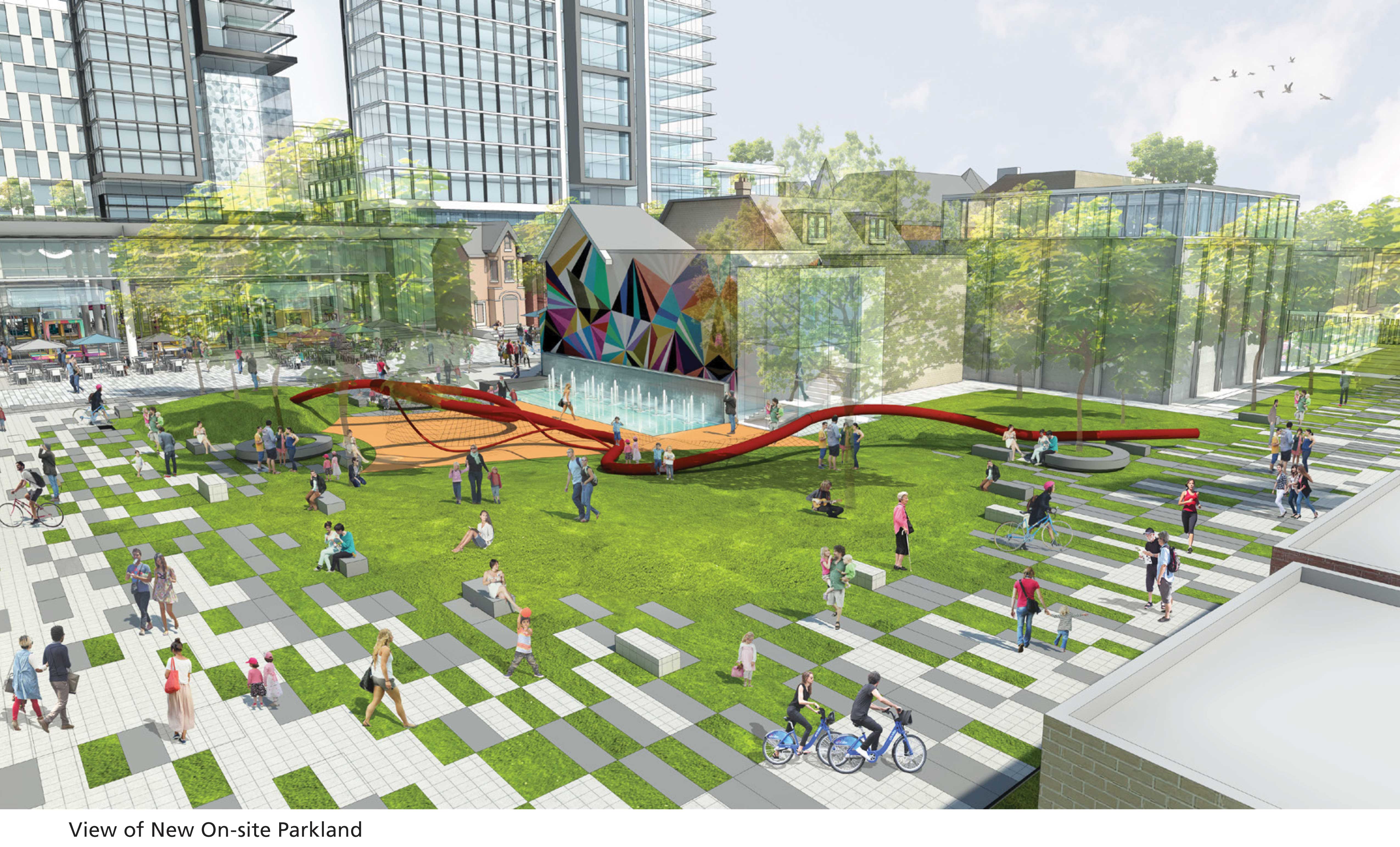
PHOTO COURTESY WESTBANK PROJECTS CORP./Henriquez Partners Architects: A new on-site park is part of Westbank’s revised rezoning application. Still at the conceptual stage, it will include a dog run, water feature, and urban agriculture.
By Annemarie Brissenden
A new on-site park with dog run, increased heritage conservation, and a refined built form that includes reduced streetwall heights and densities marks the major features of Westbank Projects Corp.’s revised zoning application, which the company submitted to City Planning last month. Westbank has embarked on an ambitious redevelopment of the parcel of land including Honest Ed’s and Mirvish Village that is bounded by Bloor, Bathurst, Lennox, and Markham streets.
The components of the original application’s vision, however, remain constant. Mirvish Village will still be 100 per cent rental housing, incorporate a vibrant public realm with market and micro-retail spaces, include a daycare, promote transportation alternatives, and be built to be as environmentally sustainable as possible.
[pullquote]“We have worked hard to revise the application to address the concerns that have been raised”—Peter Venetas, project manager[/pullquote]
“We have worked hard to revise the application to address the concerns that have been raised while keeping the overall vision for the project intact,” said Peter Venetas, project manager.
He explained that the revisions reflect feedback from almost a year of community consultation meetings, design charrettes, discussion group meetings, and comments from city staff.
“We flagged three areas to be addressed in a resubmission: parks, heritage, and built form,” said City of Toronto planner Graig Uens, who acknowledged that “Westbank has taken those into consideration in its revised proposal”, but reserved comment until he has had time to study the submission in detail.
At the heart of the revised application is the inclusion of on-site parkland located on the west side of Markham Street facing the Mirvish Village Market.
Venetas believes the park “will help with providing much needed parkland and transition to the stable neighbourhood, providing a buffer”.
The on-site daycare has been relocated to the ground floor, and part of the park includes space for the facility’s outdoor play area. Although still in the conceptual stage, the park will be an extensive addition to the public realm that includes a dog run, a water feature, and space for urban agriculture.
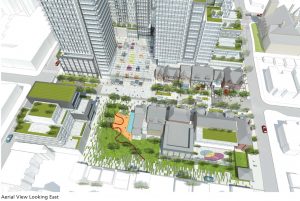
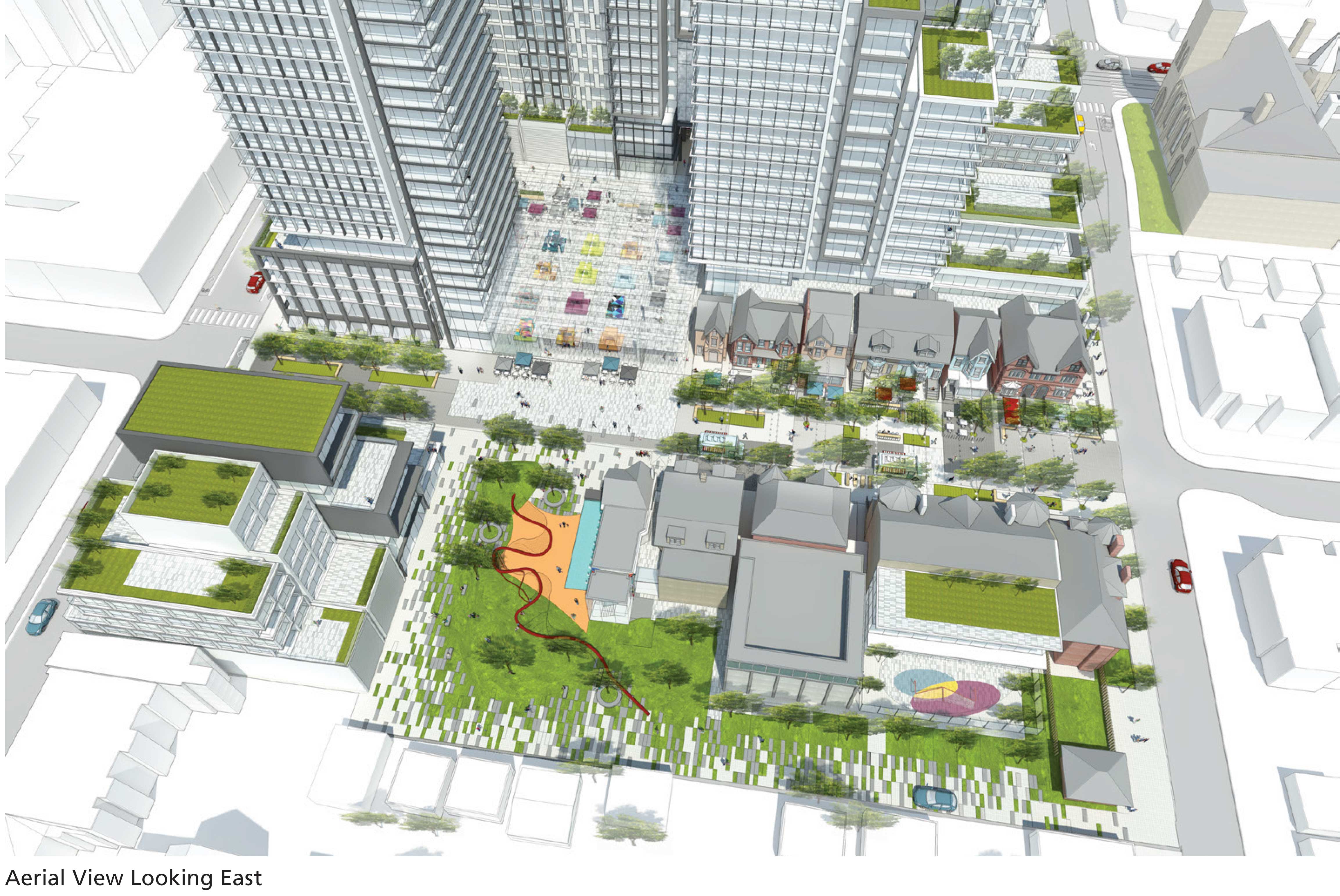
COURTESY WESTBANK PROJECTS CORP./Henriquez Partners Architects: The proposed park will wrap around the retained heritage houses.
“The extent of the park will weave into the adjoining spaces, extend behind the heritage houses, and will be carried into the lanes by the expression of the continuous ground plane treatment,” reads the application.
Heritage conservation is another hallmark of the revised proposal.
In a nod to a Toronto City Council decision to list 35 properties in the Bloor-Bathurst streets area (27 of which are on the project site) on the heritage list, Westbank has proposed to increase the number of retained properties from 15 to 21.
In order to accommodate the addition of a park and increased heritage conservation, Westbank has retained and shifted 610 Markham St. south and completely eliminated one mid-rise building, resulting in the removal of between 50,000 to 70,000 square feet of density. That also means the number of rental units has been reduced from 1,017 to 946. Honest Ed’s Alley will also be retained in its original configuration.
Although the height of a mid-block tower on Bathurst Street has been increased from 25 storeys to 29 storeys plus a mezzanine, heights along the streetwalls generally have been lowered.
“The key thing with heights is the ability to transition to the surrounding neighbourhood, which is lot-size dependent,” explained Venetas. “We are trying to create a more compatible streetwall along Lennox Street, so the tallest building on Lennox Street is six storeys.”
He added that the revised application also breaks the property up into four elements to create more porosity throughout the development as a whole.
Preserving and enhancing the public realm through on-site park land dedication, unified streetscaping, and front yard setbacks on Markham Street are part of the draft public realm policies of the Bathurst Bloor Four Corners Study, the latest version of which is set to be considered at community council on June 14.
Venetas characterizes the application as being “informed” by the draft study, while Uens said that “it’s tough to determine [at this point] whether it complies with the more technical parts of the Four Corners Study, but it is something we are going to consider”.
Uens added that he anticipates the city will have written comments on the revised application back to Westbank within six weeks.
The city’s planning department will hold a community consultation meeting on Westbank’s revised zoning application on June 13 at the Bickford Centre from 6 to 9 p.m. The project model is also regularly on view at Markham House (610 Markham St.), where Westbank representatives are prepared to answer any questions regarding the future of Mirvish Village.
READ MORE:
DEVELOPINGS: Annual review reflects tension between community activism and OMB (March 2016)
Westbank towers over 4 Corners (January 2016)
City hosts first Mirvish Village community consultation (November 2015)
Residents’ associations share concerns for Mirvish Village (October 2015)
Westbank submits application (August 2015)
BABIA endorses Westbank proposal (July 2015)
How do you make it real? (April 2015)
Tags: Annex · News
June 14th, 2016 · Comments Off on NEWS: A $9.4-million school with a view
New facility to include childcare spaces
By Annemarie Brissenden
Local Catholic elementary school students will soon have a new school with a view.
The Ontario government has announced that it will spend $9.4 million on a new school to be built where St. Raymond Catholic School currently sits on Barton Avenue, overlooking Christie Pits. The new school — which hasn’t yet been christened with a name — is consolidating St. Raymond’s and St. Bruno Catholic School, both of which are under capacity. The facility will also include a daycare on site, adding 49 childcare spaces to the neighbourhood.
“This is a huge win for the school,” said Philippe Jargaille, chair of the St. Raymond’s parents’ council. He explained that the St. Raymond’s and St. Bruno’s school communities have undergone a three-year accommodation review process during which both schools were evaluated, enrolment examined, and the physical state of the facilities considered.
“The Ministry of Education wants to spend more money in the classroom, and less on bricks and mortar,” said Toronto Catholic District School Board (TCDSB) trustee Jo-Ann Davis (Ward 9, St. Paul’s, Toronto-Centre, Trinity-Spadina). “It was cheaper to build a new school than to repair St. Raymond’s.”
[pullquote]“This is a huge win for the school”—Philippe Jargaille, chair, St. Raymond’s parents’ council[/pullquote]
The Ministry of Education uses a facility condition index (FCI) to assess the condition of a building that states the cost of repairs as a ratio of its replacement value. An FCI of less than 10 is deemed good, while buildings with an FCI of 65 or higher are deemed critical. Although St. Bruno’s has a reasonable FCI of 23.17, St. Raymond’s — at 66.51 — has one of the top FCI’s in the TCDSB.
“The review process is a little stressful at the parents’ end,” said Jargaille, “but the board said that if we amalgamated the two schools and increased the population, we’d have a better chance for money for a new school.”
After three years of uncertainty, it’s clear that parents are welcoming the future. St. Peter’s Church on Bathurst Street serves the St. Raymond’s school community, and its pastor, Rev. Michael McGourty, suggested that “speculation that the school would close contributed to low enrolment.”
Davis acknowledged that accommodation reviews “are hard to go through. People have a lot of connection to their school, and there are cases where parents went to the school as well as the children.”
“Trustee Davis is very mindful that the school board has to manage [its] assets more efficiently,” said Han Dong (MPP, Trinity-Spadina), whose office made the announcement.
Plans for the new school have yet to be drawn up, but it will accommodate up to 350 students in addition to the 49 childcare spots, and Jargaille said that he hopes it will make use of the prime location over-looking Christie Pits.
“The access to the park provides incredible opportunities,” agreed Mike Layton (Ward 19, Trinity-Spadina). “It’s an incredible asset; the board is right in suggesting they should invest in it.”
Layton added that he believes that St. Bruno’s should be retained and transformed into some sort of community hub.
“It doesn’t make much sense for any level of government to sell off land like that,” said Layton. “We have to hang onto our [community] assets, because having to buy them back is very expensive. If we can adaptively re-use the site, we should do so.”
Although Davis stresses that St. Bruno’s is not going anywhere for a while (it will be home to the consolidated school while the new facility is built on the St. Raymond’s site), she wants to “hold on to community assets, including schools, because once something is gone, it’s gone.
“I’ll be meeting with potential community partners to see if we can co-locate.”
Dong would also like “to see St. Bruno’s remain as a community hub. It should stay in the community and serve the community; it’s not going to be condos.”
“It’s quite clear to me: there is tremendous growth with all neighbourhoods in the community,” said Layton. “People are having kids in the neighbourhood, and want to raise children in Toronto. It’s exciting, but we want to make sure we have the core services to meet needs.”
Davis, who characterized the number of families moving back into the city as a mini baby boom, pointed out that “there is not enough public space in Toronto, so the city is looking at school boards to solve planning problems”.
She said she wants to ensure that students have a good learning environment, while balancing the need for a community hub.
“I am very much looking forward to the new school,” said Dong. “It’s going to give the neighbourhood a new life.”
Tags: Annex · News
June 14th, 2016 · Comments Off on NEWS (JUNE 2016): Building community over fattoush
Newcomer Kitchen a welcome taste of home
By Geremy Bordonaro
Imagine that you have been stuck in a hotel room. You were thrown from the comforts of your own home and now find yourself in an unfamiliar land. Nothing looks the same. No one speaks the same language. All you have is you and your family crammed into a small hotel room without utilities.
This was reality for many Syrian refugees once they arrived in Canada, while waiting for clearance to get to their sponsors.
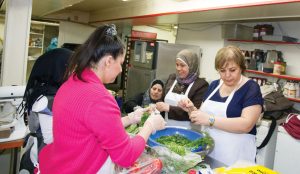
PHOTO BY GEREMY BORDONARO: In the first Annex Newcomer Kitchen event, Syrian women make maqlooba with fattoush in Butler’s Pantry. Organizers hope the initiative will spread to other parts of the city.
For Len Senater, owner of Depanneur on College Street, this simply would not do. So he launched Newcomer Kitchen, a deceptively simple plan that helps the city’s newest citizens cook a good meal for their families, but also gives pointers to those interested in a career as a restaurateur.
“We were hearing more and more about the families stuck in the hotels. It became clear that those families had no access to kitchens at all to cook for themselves or their families,” said Senater. “I have this large kitchen and I have a venue…that is not being used during the day. Why not invite these families to come so that they can cook food for themselves and for their family.”
Senater hasn’t gone without some help in his mission. Len recruited a friend, Atique Azad, owner of Butler’s Pantry in Mirvish Village.
“[Azad] has been a friend and a mentor to my project for many years. He has much more experience in the restaurant business than I do. I knew that he and his wife spoke some Arabic and were interested in some humanitarian issues,” Senater said, adding that Azad volunteered immediately upon hearing of the initiative. Newcomer Kitchen also gained traction on social media, finding sponsors, and attracted the involvement of the Arab Community Centre.
Senater explained that Newcomer Kitchen gives people who have lost so much the opportunity to regain the most basic of home comforts.
“I met one woman who was an X-ray technician back at home,” said Cara Benjamin-Pace, a Newcomer Kitchen assistant. “She hadn’t cooked in a long time but when she picked up an onion and a knife, it came back to her instantly. She was back home.”
As others mingled preparing maqlooba with fattoush, it became clear that, for them, there was more to cooking than just the nourishment.
“It’s about the act of cooking, the act of feeding, and it’s clear to me when inviting these people here that cooking is not a solitary activity in Syrian culture,” Senater said. “It’s a community building activity, something done together with friends and family.”
It’s also a reminder of normalcy, of skills that haven’t been lost.
“Imagine that there’s one thing that you’re really good at, that people are relying on you to do, and you don’t have a chance to do that one thing,” he said. “When somebody comes and gives you a chance to do it, that’s got to feel good.”
Though most refugees are now on their way out of the hotels, the Depanneur will still continue to host Newcomer Kitchen, and Senater hopes the program will inspire other kitchens, whether they’re commercial or residential, to launch similar initiatives for refugees.
“[Longevity] is a driving force,” said Azad. “For a project like this, it’s important to keep the future of it in mind.”
READ MORE:
NEWS: A warm welcome for new arrivals (January 2016)
EDITORIAL (DECEMBER 2015): Embrace Refugees
NEWS: Groups raise funds for refugees (December 2015)
NEWS: Churches raise funds for refugees (November 2015)
Tags: Annex · News · People · Life
June 14th, 2016 · Comments Off on NEWS (JUNE 2016): Bikes blessed for another season
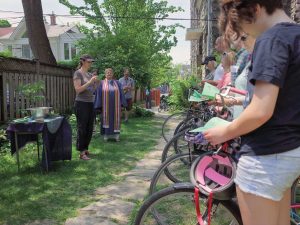
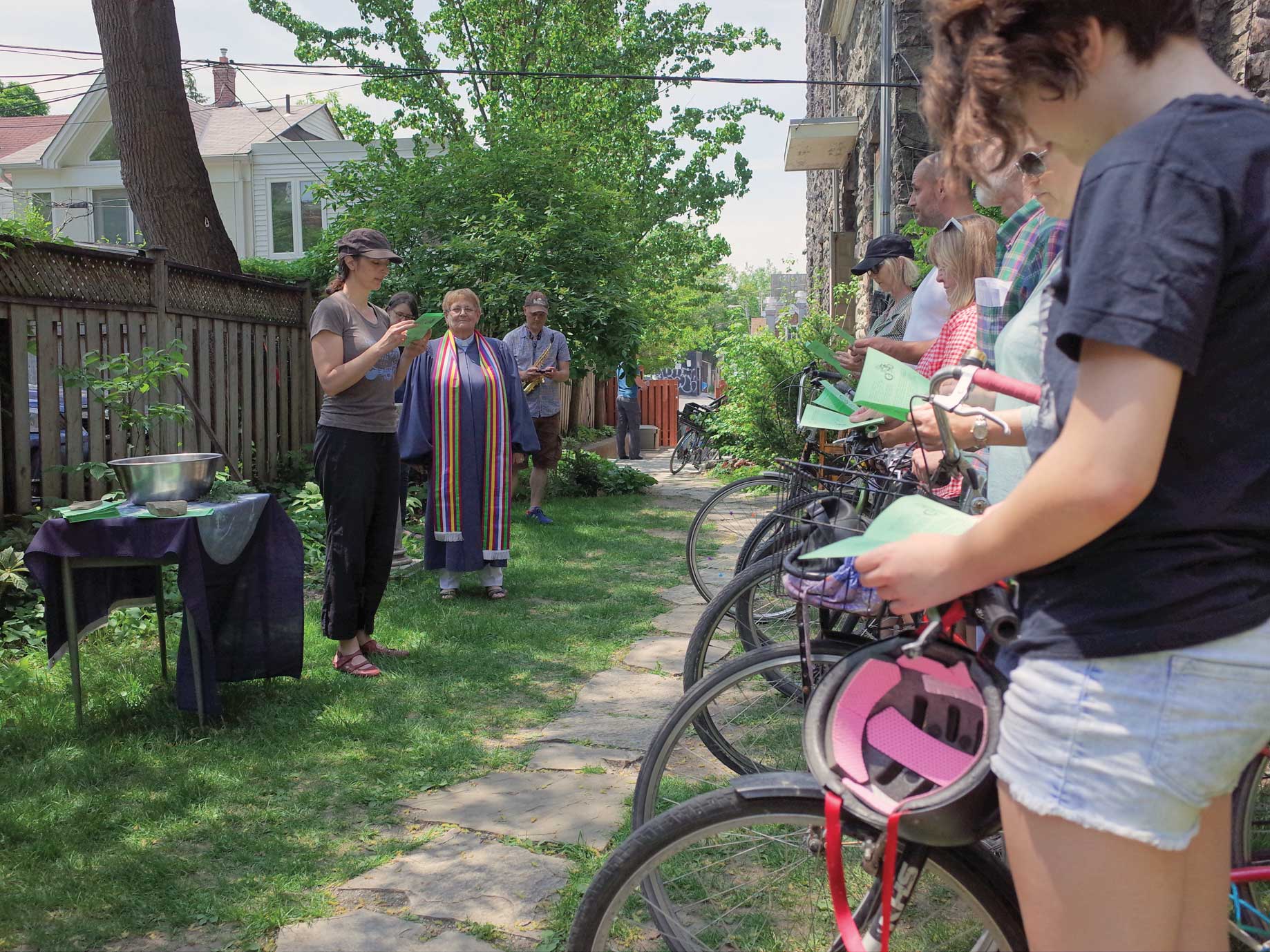
PHOTO COURTESY MARTIN REIS: Trinity-St. Paul’s United Church celebrated its seventh annual Blessing of the Bikes on May 29. Cyclists had their bikes blessed in the church’s garden after a service that included a special prayer for all those who have lost their lives in a bike accident.—Geremy Bordonaro/Gleaner News
Tags: Annex · News
June 14th, 2016 · Comments Off on NEWS (JUNE 2016): HVRA cultivates community at spring meeting
It’s probably the only residents’ association meeting that begins with neighbourhood caucuses. The Harbord Village Residents’ Association (HVRA) spring meeting on May 18 included a review of the planning challenges in various parts of the village, the public launch of the association’s plan to green 24 laneways, a ward update from Joe Cressy (Ward 20, Trinity-Spadina), and readings of two award-winning essays on community service (see page 14).
Litter and garbage (particularly in laneways behind Harbord Street businesses), noise from bars on College Street and some restaurants operating without a patio licence, drivers going the wrong way on one-way streets, and absentee landlords featured among the top concerns of the five neighbourhood caucuses. Informing the city by calling 311 is one approach to dealing with the some of these issues, but the HVRA is taking a pro-active approach to laneways that members hope will not only reduce litter but increase the area’s green footprint.
Working in conjunction with the Laneway Project and the David Suzuki Foundation, and supported by the TD Friends of the Environment Foundation, the HVRA is giving Croft Laneway a facelift. After a clean-up on May 29, greenery and flowers were planted along the lane on June 4. The association targeted Croft for its first project because it would be relatively easy to monitor and already featured some nice plantings.
The project is one component of the HVRA’s official green plan, which has been endorsed by city council, and which, Cressy reported, the city is studying to adapt as a model for neighbourhoods across Toronto. The councillor also gave updates on the implementation of the reduction of the residential speed limit to 30 km/hr (two city staffers are tasked with changing all the street signs and are expected to be in the area in approximately five to six months); on Margaret Fairley Park (phase two of the much delayed improvements is set to begin in September); and, on the College Street Study (should be finalized this fall).
—Annemarie Brissenden/Gleaner News
Tags: Annex · News
June 14th, 2016 · Comments Off on POLICE BLOTTER (JUNE 2016): BREAK-INS ABATED, ARRESTS MADE
By Geremy Bordonaro
Wave of local break-ins appears to have abated
The Toronto Police Service (TPS) has told Annex and Harbord Village residents to remain vigilant in the wake of several local residential break-ins.
The perpetrators, who remain at large, accessed homes through unlocked doors and windows on the ground floor. The break-ins occurred at night, occasionally when the owners were at home, and the perpetrators targeted small, expensive items that are easy to conceal like cash, wallets, purses, credit cards, identification, jewellery, and electronics.
“It was a two- or three-day span of increased [break and enters],” said Detective Darren Worth of 14 Division, the investigator on the case. “After that time it kind of died off.”
Although the wave seems to have abated, Warren recommends that community members lock their doors and windows at night.
“Residents should always be vigilant in protecting their property,” said David Harrison, chair of the Annex Residents’ Association.
Anyone with information is asked to contact the TPS at 416-808-1400 or Crime Stoppers at 416-222-8477.
Arrests made in armed robbery case
Two suspects have been arrested in relation to a series of armed robberies that occurred between Harbord and Queen streets, and between Spadina Avenue and Markham Street. As reported in last month’s Annex Gleaner, five separate robberies took place in these areas from April 15 to 30 between 12:00 a.m. and 4 a.m.
In each case, the victims were approached by two men. One would brandish a firearm, after which both suspects would demand that the victim hand over any cash and valuables. The Toronto Police Service has arrested and charged Ruben Ricketts, 21, and Shaquille Martin, 23, but has yet to recover a weapon.
Charges laid in relation to May 20 investigation
The Toronto Police Service (TPS) has arrested three people after responding to a 4 a.m. call on May 20. Sent to Walmer Road and Bernard Avenue to investigate a possible stolen vehicle, the TPS found cocaine, marijuana, and a loaded 9 millimetre handgun inside the car.
The police have laid 54 charges relating to the incident. Brenda Muscat, 49, and Benjamin Todd, 20, have been charged with a variety of charges related to the possession of an illegal firearm, while Kevin Levar Prince, 35, has been accused of possession of cocaine for the purpose of trafficking, failure to comply with probation, and charges related to the firearm.
All three appeared at Old City Hall on May 21.
Tags: Annex · News · General
June 14th, 2016 · Comments Off on EDITORIAL (JUNE 2016): Mayo no, marijuana maybe
The Toronto Police Service’s recent crackdown on 45 pot dispensaries, many of which are just steps from the Annex, signals the City of Toronto’s frustration with the federal government’s lack of progress on the decriminalization of marijuana, as well as the need for a framework regulating the production, distribution, and sale of the green bud. Although a Liberal campaign promise to amend the decriminalization of pot is expected to be realized in 2017, entrepreneurs have already begun to establish a thriving retail market.
The only thing that the federal government’s point person on the file, former Toronto police chief now member of Parliament Bill Blair, has to offer is that the rapid spread of dispensaries is reckless, illegal, and “only designed to make a quick buck”. While all this may be true, it does nothing to help Toronto, or any other Canadian municipality, navigate the legal vacuum.
[pullquote]The city has more restrictions on the provision of mayonnaise by a licensed hot-dog food-cart vendor than on the sale of an ounce of marijuana.[/pullquote]
Indeed, the city has more restrictions on the provision of mayonnaise by a licensed hot-dog food-cart vendor than on the sale of an ounce of marijuana.
Blair is committed to establishing strict regulations for governing the industry, which to date has been limited to selling to patients with a prescription from a doctor. Under the law such patients are required to place an order with a licensed producer who will then dispense the supply by mail or courier.
Those who have opened retail shops defend themselves by arguing they are simply providing a more convenient way for patients to procure marijuana. But the retailers are skating on thin ice, as they are essentially making the case that they are now pharmacists. In that capacity, the pot shops are poor professionals. The drugs they dispense are from unknown sources, contain elements that are not quantified, and have potencies that represent something of a moving target. Furthermore, profits from the retail sales line the pockets of organized crime further up the food chain.
Vancouver is ahead of Toronto on this issue. It has developed bylaws that help it navigate the legal vacuum where police are reluctant to charge for simple possession, while the federal government dithers on the question. Vancouver regulates where the stores can be located, ensuring, for example, that shops are not close to schools or even each other.
In Toronto, on the other hand, bylaw officers threatened commercial landlords with infractions should tenants be allowed to sell marijuana from their premises, only to have the police cart away stock and charge shop owners with possession for the purpose of trafficking. The shop owners were hardly hiding their intent, instead selling their product openly and unabashedly. All the crown attorney need do for evidence is submit images of neon signs from the storefronts. The city took this blunt instrument approach, because it lacks the tools to apply a more nuanced one.
The Liberal commitment is born of the widespread recognition that the prohibition model is not working. The highly restrictive approach was further frustrated by various court rulings ordering the federal government to make marijuana available for medical use. This medicinal use angle has been the wedge that has opened up the market so freely.
While strict prohibition is not working that does not mean that legalization without regulation works any better. The strategy that the federal government intends is not likely to result in mom-and-pop stores selling the stuff. The new laws are expected to prevent such sales from these dispensaries. The government has just appointed Anne McLellan, a former Minister of Public Safety, Health, and Justice under the governments of Jean Chrétien and Paul Martin, to lead a federal-provincial task force to develop a strict regime for the production, distribution, and sale of marijuana, and provincial officials have publically mused that it might make sense for sales to run through the Liquor Control Board of Ontario.
McLellan is said to be a very, very rules-oriented person. That may be what’s needed to bring order to this chaos.
Tags: Annex · Editorial
June 14th, 2016 · Comments Off on how nice! Water, water, everywhere!
Tags: General