August 26th, 2016 · Comments Off on CHATTER (AUGUST 2016): Self-described former gang member shot at Christie Pits
The Toronto Police Service is requesting assistance with a shooting investigation in the Bloor Street West and Christie Street area. On July 30 at approximately 9:00 a.m., a man shot two people during a fitness class in Christie Pits. One victim, who was nearby when the shooting occurred, was hit in the foot by a stray bullet. The other victim, identified as 35-year-old former gang leader Alejandro (Jose) Vivar, was leading the class.
In 2007 Vivar — whom police believed in 2003 to be the former leader of the Latinos Americanos or L.A. Boys, a rival gang of the Christie Boys — and nine other men were arrested on 16 counts of criminal weapon and drug charges. Vivar went on to spend almost 9 years in prison, where he earned his fitness instructor certification and wrote a first-person column entitled “Prison Diary” that was published in the Kingston Whig Standard.
At this time, however, police do not know if last month’s attack was gang related, but Vivar may end up back in prison due to public safety concerns once he is out of the hospital.
The shooter is described as black or having a dark complexion, aged 25 to 30, and 5 feet 8 inches to 5 feet 9 inches tall with a thin build. At the time of the attack, he had short cornrows hanging out of a black baseball cap, and was wearing a black hoodie with a white logo in the centre, black sweat pants with a light logo on the left front hip area, light-coloured running shoes, and dark sunglasses with gold trim on the arms.
Police caution that the shooter — considered armed and dangerous — should not be approached, and anyone seeing him should call 9-1-1. If you have any information about this or any other crime, please contact the TPS at 416-808-1400 or Crime Stoppers at 416-222-8477.
—Summer Reid/Gleaner News
Tags: Annex · News
August 26th, 2016 · Comments Off on NEWS (AUGUST 2016): City approves safe injection sites, as council embraces a public health approach

PHOTO COURTESY BRITISH COLUMBIA CENTRE FOR EXCELLENCE IN HIV/AIDS: After a spirited debate on July 14, city council voted 36 to 3 to establish three Supervised Injection Sites throughout the city. According to research from the British Columbia Centre for Excellence in HIV/AIDS, supervised injection facilities can reduce public drug use and overdose deaths, as well as increase access to addiction treatment. People who use safe injection sites are 30 per cent more likely to enter detox programs and 70 per cent less likely to share needles.
By Brian Burchell
Spurred on by a recent spike in drug overdose deaths, Toronto City Council voted 36 to 3 on July 14 to establish three Supervised Injection Sites (SIS) throughout the city. Typically run through public health clinics, such sites provide a space for clients to self-administer drugs — which they supply themselves — in a safe environment under the direct supervision of a nurse. It’s a harm reduction strategy that discourages using drugs in public areas, particularly in back alleys and bathrooms.
The sites will be established at locations that currently provide needle exchanges as well as a wide array of health and counselling services: Queen West Central Community Health Centre (on Bathurst Street just south of Queen Street West), the Works (near Victoria and Dundas streets), and the South Riverdale Community Health Centre (at Queen Street and Carlaw Avenue). The city will still need permission from the federal government to set up the locations.
Launching the lengthy council debate, health board chair Joe Mihevc (Ward 21, St. Paul’s West) described the plan as “a paradigm shift around how we deal with addictions, from a model of criminalization and ostracization to a compassionate public health care approach”.
[pullquote]“A person afflicted with addiction needs the opportunity to be treated in a holistic fashion”—Mark Saunders, chief, TPS[/pullquote]
However, Giorgio Mammoliti (Ward 7, York West) — who proposed an amendment that failed to pass requiring injection sites to operate exclusively out of hospitals and pharmacies — questioned why the city was facilitating the injection of illegal substances, instead of focusing solely on treatment, such as providing methadone programs for heroin addicts.
The city’s Chief Medical Officer of Health, David McKeown, explained that there are already 10 or so methadone clinics in this city, and that this proposal targets different aspects of addiction: unsafe injections in public spaces, the transmission of diseases like HIV and Hepatitis C through the use of dirty needles, the discarding of used needles, and the increasing risk of users overdosing. He added that 70 per cent of the clean needles the city distributes are within 10 blocks of these proposed locations.
Other speakers questioned the $1.7 million annual expense. McKeown was optimistic that the province would cover 100 per cent of the expense as it is considered health care, a provincial jurisdiction.
Mike Layton (Ward 19, Trinity-Spadina) chronicled the “very fulsome dialogue” the city held with the communities in which the injection sites will be located. He was pleased with the extent to which stakeholders embraced “a compassionate approach to people not property”.
Letters were received from the Downtown Yonge Business Improvement Area (BIA) and the Toronto Police Service (TPS).
The BIA chair, Paul Seaman, supported the city’s efforts in “finding a harm reduction solution for at-risk individuals”, but urged that “specific metrics” be put in place to gauge the impact the operations will have around the site locations.
Police Chief Mark Saunders expressed strong support based on his view that a “person afflicted with addiction needs the opportunity to be treated in a holistic fashion and be offered services to become and remain whole”. He added that having drug users under supervision gives health professionals an opportunity “to provide information to [their] clients to undertake activity to break the cycle of addiction, [and] encourage them to rehabilitate. I see this as a public safety issue as well.”
Although Major John Tory admitted to having some initial discomfort with the idea, he explained that he came to support it after seeing a parallel between addiction and autism. He has fought personally to ensure that those who suffer from autism — a disease of the mind, like addiction — are not treated as second-class citizens, and he said that he now thinks drug addicts deserve the same protection.
“This is the right thing to do, it’s the moral thing to do, [and] it will save lives,” concluded Tory.
Joe Cressy (Ward 20, Trinity-Spadina), chair of the Toronto Drug Strategy Implementation Panel, stickhandled the file for the last 18 months and had the last word.
He described the proposal as “one part of a comprehensive approach to drug use that includes treatment, prevention, harm reduction, and yes, enforcement,” and added that he did not expect so many local residents and business-owners to come out and say “yes, in my backyard”.
“I could not be prouder.”
Tags: Annex · News
August 26th, 2016 · Comments Off on EDITORIAL (AUGUST 2016): “An egregious breach of trust”
Six years in a federal penitentiary.
Given the judicial constraints in this case, Ontario Superior Court Justice Edward Then has delivered a fair sentence to Constable James Forcillo of the Toronto Police Service for the attempted murder of Sammy Yatim on a Toronto streetcar three years ago. A jury had previously found Forcillo not guilty of second degree murder, or manslaughter, but guilty of the lesser charge of attempted murder.
[pullquote]It has never been more critically important for the courts to send the right message to police.[/pullquote]
Forcillo shot Yatim nine times. The three initial shots felled the teen who had been wielding a 10-centimetre pocket knife and shouting obscenities at the officer, who was standing outside the streetcar.
Forcillo paused for six seconds and then fired six more shots.
It is this pause, and the second volley of shots, that led to officer’s conviction. Police officers are trained to know that they cannot use lethal force against someone who is not an imminent threat. After three shots, Yatim was no longer an imminent threat to anyone, and was likely already dead. Although Forcillo testified at trial that Yatim was getting up after the first three shots, ample video evidence showed that this was not the case.
It is troubling to think that had the officer not fired the second volley of shots there might not have been a criminal conviction at all.
Defence counsel had requested a sentence of house arrest, while the Crown argued for eight to 10 years in prison. Constraining the judge’s ruling was a section of the criminal code that prescribes a mandatory minimum sentence of five years for any person found guilty of attempted murder while using a gun (including police officers though the defence argued otherwise, an argument the judge ultimately rejected).
It must have been a challenge for Then to determine the appropriate sentence, but we think he struck the right balance in his 32-page decision. The six-year sentence, wrote the judge, “will serve to emphasize to other officers in executing their duties with respect to the discharge of their firearms that they do so only as a last resort…not as their first and only option”.
Although the conviction is unprecedented — no Canadian police officer involved in an on-duty shooting death has ever been found guilty of committing a crime — it is important to remember that the crime itself is equally unprecedented. As such, Forcillo’s actions are not a reflection of poor training, but rather his extraordinarily poor judgment.
Consider that according to former Supreme Court Judge Frank Iacobucci’s 2014 report on use of lethal force by the TPS, approximately 20,000 calls the service receives annually relate to “persons-in-crisis”, of which 8,000 involve apprehensions under the Mental Health Act. The report notes that only five such encounters between 2002 and 2012 resulted in the fatal shooting of emotionally disturbed persons. (As the data does not include 2013, Sammy Yatim is not counted among the five.)
It’s a revealing set of statistics that not only demonstrates the professionalism of the majority of Forcillo’s colleagues in such contexts, but also the sheer volume of police interactions with persons-in-crisis. It has never been more critically important for the courts to send the right message to police.
Stressing that “the sentence I am about to impose should not be taken to reflect adversely on the well-deserved reputation of the [TPS] as a whole,” Then described Forcillo’s actions on that July night a little over three years ago as “an egregious breach of trust”.
Reflecting on the sentencing, the Yatim’s family lawyer Julian Falconer said, “There is a significance to today because [the sentence] reflects the fact that there may be some equality under the law; that maybe police, today, just once, are as accountable as the rest of us.”
We believe they should always be as accountable as the rest of us.
Let this sentence serve as a reminder.
READ MORE:
EDITORIAL: Turning the Queen Mary (July 2016)
EDITORIAL: Mayo no, marijuana maybe (June 2016)
EDITORIAL: It just makes census (May 2016)
EDITORIAL: An injection of leadership (April 2016)
Tags: Annex · Editorial
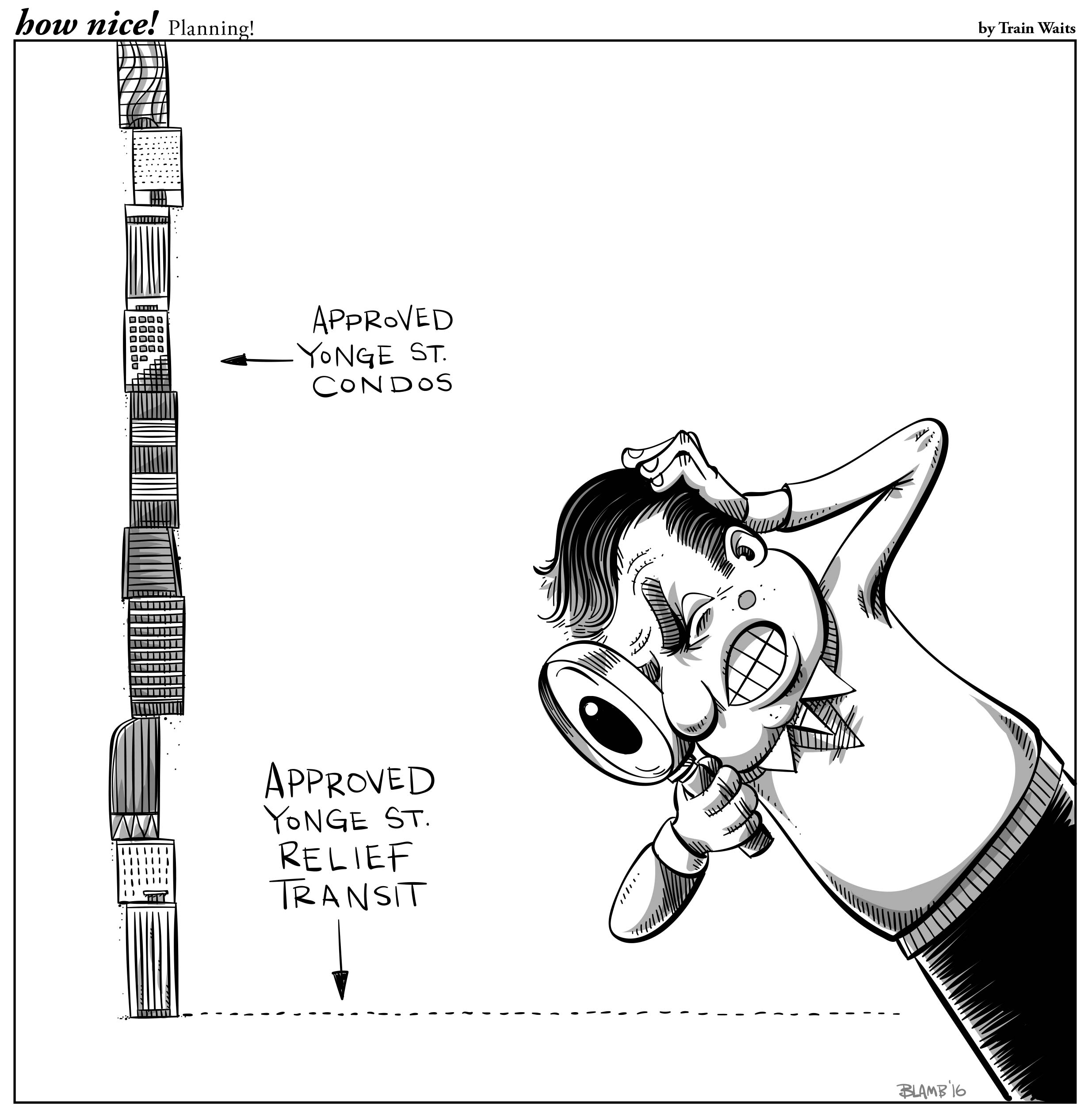
August 26th, 2016 · Comments Off on EDITORIAL CARTOON (AUGUST 2016): A clear path! by Dot Tedline

MORE how nice!:
Planning! by Train Waits (July 2016)
Water, water, everywhere! by W.H. Consin (June 2016)
How to meet your quota! by Otto Mobile (May 2016)
A carpet of green! by Don Mower (April 2016)
Tags: Annex · Editorial · General · Opinion
August 25th, 2016 · Comments Off on FORUM (AUGUST 2016): Curious story of Christie Pits pool liner ends in extended hours at Alex Duff
By Mike Layton
The phone started ringing in my office almost immediately. Why is the Alex Duff Memorial Pool closed during the hottest days of summer? Why wasn’t the pool fixed earlier in the season? Why doesn’t it look like anyone is working on it?
All valid questions that deserved answers. And especially when the pool we are talking about is the Duff, which features a 25-metre lap pool, a shallow splash pool for children, a conversation pool, and a deep pool for diving with both a one-metre spring board and a two-storey water slide.
[pullquote]We were all watching the sealant dry.[/pullquote]
Why the delay? Let’s go back to 2015.
Last season, the liner in one the pools began to strip away, and as a result that pool needed to be closed. The problem was temporarily resolved, but City of Toronto staff planned for a more thorough repair before the 2016 swim season.
Given the anticipated scope of work being limited to liner repair, city staff scheduled the necessary repairs for late 2015, after the end of the swim season.
Repairs began as planned in October 2015, but as the liner was removed they discovered the damage was far greater. It wasn’t only the liner that was damaged, but the pool was leaking almost half-a-pool worth of water daily.
Staff determined the necessary scope of work was beyond their expertise and that these repairs would need to be completed by a contractor. This required a bidding process to ensure both fairness and competitive prices which normally takes months. It takes even longer when, as happened in this case, an unsuccessful bidder objects and the process goes through a legal review, delaying the work even further.
Once the contract was finally awarded, city staff worked to ensure the pools could be opened as quickly as possible. They approved work through the night and on the weekends.
We ran into another delay in the weeks leading up to the scheduled opening because the special order sealant used in the pool was delivered late and needed a week to dry. This is why, in early July, many of us in the neighbourhood thought that no work was being done for days. We were all watching the sealant dry.
Because of the delays, I asked the general manager of Parks, Forestry and Recreation to extend pool hours for the community. They said yes. We gained extra hours and a few extra weeks into the fall.
While I am grateful for the repairs and the extended pool hours, I am walking away with a few lessons, one of them being that contracting out too many of our repairs and services contributes to delay, as was the case here, and places us at the whim of contractors. It would be better if more asset repairs could be done in house and then residents and those in need of cooling during hot summer days wouldn’t be left waiting. The second lesson was that we should be more proactive with our city assets and not wait for problems to arise before attempting to fix them. Yes, hindsight is 20/20, but had we caught this sooner through inspections, it might have been a much simpler and much faster repair.
Thankfully the Duff at Christie Pits is finally open and it’s hopping. My family and I have been visiting and I hope you’ve had the time to enjoy it too. Thank you for your patience as permanent repairs were made and please, no running on the pool deck.
The Alex Duff Memorial Pool will be open from 12:00 to 9:00 p.m. Monday to Friday, and 10:00 a.m. to 8:00 p.m. on Saturday and Sunday until Labour Day. Thereafter, until Sept. 18, it will be open from 4:00 to 7:00 p.m. Monday to Friday, and 12:00 to 4:00 p.m. on Saturday and Sunday.
Mike Layton is the councillor for Ward 19, Trinity-Spadina.
READ MORE BY MIKE LAYTON:
FORUM: A tribute to a friend (June 2016)
FORUM: Large problem, small solution (March 2016)
FORUM: Happy New Year from a new Dad with a new perspective (January 2016)
Tags: Annex · Columns · Opinion
August 25th, 2016 · Comments Off on GRADING OUR GREENSPACE (AUGUST 2016): Meet our parks supervisor

GRAPHIC COURTESY BEINENSTOCK NATURAL PLAYGROUNDS: Green highlights the Margaret Fairley Park revitalization as an example of how the approach to local greenspace has changed over the years. The fencing is being replaced, which will make the park bigger, and the splash pad will provide more opportunities for water play than the old wading pool.
By Annemarie Brissenden
Although it may seem from his last name that his future was pre-ordained, Brian Green’s career at the City of Toronto’s Parks, Forestry and Recreation department really began as the result of a lark. Thirty-one years ago, he wrote a gardener’s test at the suggestion of his sister. When he passed, his jaw dropped, and he eventually worked his way up to parks supervisor for wards 19 and 20, which includes the Annex. Following on the heels of our popular annual parks review, we thought that we would learn a little more about the man tasked with overseeing all things park-related in the Annex.
How many parks do you oversee?
I manage 80 parks, but it’s a big geographical area that includes some of the city’s biggest parks: Trinity-Bellwoods, Canoe Landing, and Christie Pits.
What makes a great park?
A space where people are enjoying themselves doing multiple kinds of recreation from playing to reading books. I recently saw two guys on a huge bench in Christie Pits writing a song. That was great.
What’s the one thing you wish people could know about parks in our area?
I’m interested in the history of the area. A lot of people don’t know about that. I recommend going to the Grange Park next year; it represents the concept of future parks, and is being built as we speak. It will have lots of art, new fountains, and lots of new benches. It will open July 2017.
How often are the parks maintained?
We try to get to most parks every day or every second day. Keeping up with the litter is hard. Most parks have garbage cans just outside the park, so people have to go outside to put garbage into the bins. If [the bins] are not obvious, the garbage is left on the ground.
What’s a big problem in our parks?
Garbage and litter. It’s tough to keep up with garbage in the parks, particularly the smaller ones that are right on the periphery of our ward. We’re losing a lot of ash trees due to the ash borer, which gets inside the bark and stops the nutrients from being transferred to the leaves, so the trees die. We have a solution, but we don’t have total control; I think we’ll probably lose more, and it takes 20 to 30 years for a tree to be able to provide ideal shade. It’s also hard keeping up with increased density; it’s difficult to provide spaces for trees to grow and for people to relax.
How often should the parks be renewed?
Every 15 to 20 years. That’s generally when standards kind of lapse.
Do you think the Gleaner’s reviews of the local parks are fair?
I thought they were fair. I wouldn’t be debating any of them. I look forward to improving the parks that didn’t get great marks. We will take Huron Playground to a different level in September when it is renewed. Sergeant Ryan Russell Parkette is due for a major reno in 2017. It’s an older park that hasn’t had much significant work aside from being renamed. I’d like to see a more meaningful memorial, and maybe some relevant play equipment like a little police car.
What’s your favourite park?
That’s like asking a Dad to name his favourite kid. I love the Garrison connection, which goes from Fort York to Stanley Park, Trinity-Bellwoods, Fred Hamilton, and Christie Pits; how they interconnect. I also like the philosophy of the David Suzuki Foundation, the notion of the city as a national park, integrating park spaces, getting the community involved, and creating pathways for birds and animals. One of the Annex’s smaller parks, Gwendolyn MacEwen Park at Walmer Road, is a lovely little park, even if it needs some work.
READ MORE:
NEWS: Renewing Margaret Fairley Park (July 2016)
GRADING OUR GREENSPACE: Part two of our 2016 parks review (July 2016)
GRADING OUR GREENSPACE: Green sanctuaries in the heart of the city (June 2016)
NEWS: Huron Street Playground renewal (April 2016)
Tags: Annex · People · Life
August 25th, 2016 · Comments Off on NEWS: Farmers’ market thriving but under threat due to declining provincial dollars
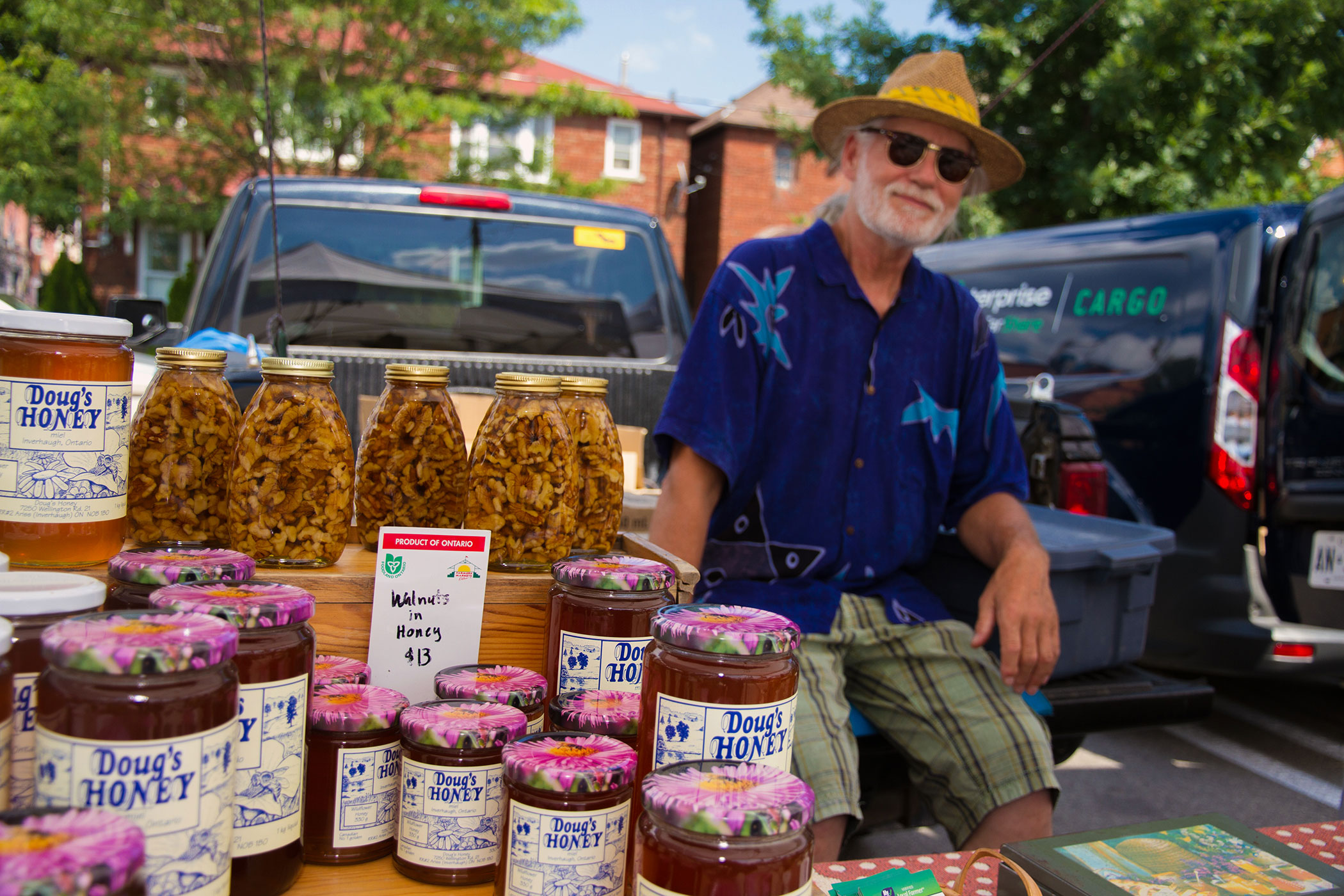
PHOTO BY GEREMY BORDANARO/GLEANER?NEWS: Doug Eiche (background) sells his honey at the Bloor-Borden Farmers’ Market. An initiative of the Harbord Village Residents’ Association, the market runs every Wednesday until Oct. 19 from 3 to 7 p.m. out of the Green P parking lot just south of Bloor Street between Borden and Lippincott streets. The market’s 22 stalls also offer bread, vegetables, meats, wines, and fruits from a variety of producers.
By Annemarie Brissenden
Founders of the popular Bloor-Borden farmers’ market are concerned that they will be unable to run the market for much longer if their provincial grants continue to decline.
Now in its ninth year, the market operates every Wednesday until Oct. 19 from 3 to 7 p.m. out of the Green P parking lot just south of Bloor Street between Borden and Lippincott streets.
[pullquote]“In a couple of years we won’t have a market if we don’t get some funding”—Helen Goldlist, HVRA[/pullquote]
“Anybody will tell you the budget is not big enough. We are in a deficit position right now, and we’ll have to see what happens next year,” said Rory “Gus” Sinclair, one of the founders of the volunteer-run market. “When we first started we had a much bigger budget than we have now. [Today it’s] one tenth of what we had back then.”
“We used to be funded fully but over the years it has gotten less and less,” said Helen Goldlist, chair of the Harbord Village Residents’ Association’s (HVRA) market advisory committee, which organizes and maintains the market. “In a couple of years we won’t have a market if we don’t get some funding.”
The residents’ association receives approximately $3,000 annually from Farmers’ Markets Ontario (FMO), a provincially-funded organization, to run the market. That amount covers towing parked cars from the area, a market manager’s salary, and liability insurance. The HVRA and Annex Residents’ Association also each contribute $500, which goes largely towards advertising and musicians’ fees.
“The market has to sustain itself,” said Catherine Clark, FMO’s Membership, Outreach and My Pick manager, adding that sales are better at the [Bloor-Borden market] than at the other two Toronto markets the organization funds.
“It’s our busiest market: 22 of the market’s 25 stalls are taken, all the premium farmers are there with excellent produce, and it is well supported by shoppers.”
But despite all evidence that the market is thriving, Sinclair insists that the funding is not enough.
“We pay to have cars towed, that’s $100 a car, which is a big expense when people disobey the signs,” he said. “It takes about $3,000 to run the farmers’ market…every year, and about half of that is paying for the musicians.”
Clark noted that other markets have musicians, but not to the same extent as Bloor-Borden, which is as much a weekly mini-festival for the community as anything else.
“I started the farmers’ market nine years ago because I wanted to have a community building exercise,” Sinclair related. “People tell us how much they like it, you meet new friends here and you linger and you talk about how Johnny is doing at school and you get a good jam recipe.”
Every Wednesday, he pipes open the market with his bagpipes, after which other musicians take over to perform for the shoppers. It’s a different group each week.
There’s an ersatz public square in the centre of the market with tables and chairs where anything non-political, not-for-profit, and/or good for the community goes. It’s also a spot for special visitors.
“We organize who visits the market,” explained Goldlist. “Today we have people from early childhood education from the University of Toronto; they are doing a project with kids.”
And, it’s hard to know if the enhancements are what accounts for the number of shoppers visiting the thriving market each week.
The HVRA also works hard to promote the market, even with its declining budget.
“We got little signs made in colour, bought stakes which I’ve sharpened, and then we put them around. These are up all summer,” said Sinclair.
Clark, who said that she expects the Ontario Ministry of Agriculture, Food and Rural Affairs to “slash” funds again next year, is hopeful that the market will find a way to continue.
“We would hate for them to pull out.”
Despite repeated requests, the Ontario Ministry of Agriculture, Food and Rural Affairs did not provide a reason for decreasing its funding to Farmers’ Markets Ontario. Abigail Dancey, who is with the ministry’s issues, media and editorial services department, did write in an email that “our 2016 Budget reaffirms the importance of the Ontario agriculture and agri-food sector in the province of Ontario. Our government continues to support local food initiatives with a $6 million investment over three years to the Greenbelt Fund to deliver programming across Ontario, including the new Local Food Investment Fund”.
—with files from Dilara Kurtaran
READ MORE
NEWS: A sensory experience (August 2015)
NEWS: The Bloor Bordon Market is up and running again (September 2013)
NEWS: Bloor-Borden farmers market returns with a little help (June 2012)
NEWS: Growing food and raising farmers in the city (December 2012)
Tags: Annex · People · Life
August 25th, 2016 · Comments Off on ARTS (AUGUST 2016): Library’s ukulele drop-in program leverages diminutive instrument to launch musical journeys
By Annemarie Brissenden
It’s hard to feel sad when playing a ukulele.
“Everyone feels good when they play the music,” laughs Sarah Bradley, a branch head librarian with the Toronto Public Library (TPL). She and her colleagues have been running a ukulele program at the Lillian H. Smith branch at College Street and Spadina Avenue that is proving surprisingly popular.
[pullquote]“We want to be completely accessible and welcoming”—Sarah Bradley, TPL branch head[/pullquote]
The drop-in program runs once a month on Wednesday evenings, and is open to people of all ages and all abilities.
Bradley says she doesn’t mind if people show up with their instrument in an unopened cardboard box (which has happened); those leading the class are happy to help unpack the ukulele, tune it, and launch someone on their musical journey.
“We want to be completely accessible and welcoming,” she says.
Although ukuleles aren’t expensive — they are available for as little as $30 — the library also provides a few for use during the class. Bradley is also keen to spread the word about the new instrument-lending program, which is run out of the Parkdale branch.
Ukuleles are a bit trendy at the moment, so there are several drop-in programs throughout the city, but few are designed to get a budding musician going from zero to strumming in an hour or less, and without cost.
“It’s hard to find places where you can learn for free,” notes Bradley.
The August drop-in was reflective of a typical night. The evening begins as participants — ranging from 8 to 80 — unpack their instruments and get tuning. Once everyone has their instrument tuned, many with the help of library staff, Bradley reviews the basics: how to hold the instrument, how to strum, where to place one’s fingers, and a few standard chords. Then the group progresses to playing songs very quickly, tackling everything from “You are My Sunshine” to “This Land is Your Land” to “The Adams Family”.
Ivy, who uses a branch instrument throughout the session, during which she has picked up the ukulele for the first time, says she came to see what it was all about.
With little or no musical background, she’s thinking of purchasing her own ukulele.
“It’s good for the well-being of a senior to learn an instrument,” says Ivy, adding she will be back.
Siblings Aiden, 12, and Andie, 8, have fun sharing a branch ukulele throughout the drop-in. It’s their first time playing the small stringed instrument, though both play the piano and the recorder.
“It’s a bit challenging, changing hand positions,” says Andie.
Ian, who plays guitar but has only been playing ukulele for about a month, brought his tenor ukulele. Slightly longer than the standard uke, it has a deeper tone that adds a richer sound to the music that results when the budding musicians start to play in sync.
As Bradley leads, she picks like a professional, even though she has only been playing for six months. She started in order to participate in the program, and credits her musical background along with the versatility of the instrument for gaining a familiarity with it so easily.
“The ukulele is one of the most welcoming instruments,” explains Adam Platek, a music teacher at King Edward Jr. and Sr. Public School, who has also held ukulele jams in Seaton Village during the annual Open Tuning festival. “Once you learn three or four chords, you can play hundreds of songs.
“It is diminutive, but very powerful.”
Platek introduces students to the ukulele early, sometimes as early as grades four or five, as it prepares them for learning the guitar in later grades.
“It starts them on their musical road,” he says, “and it’s an instrument that they can carry for the rest of their lives.”
“Kids are drawn to it at a young age,” agrees Bradley, who practises with her 9-year-old nephew on a ukulele she has borrowed from her 12-year-old.
Both she and Platek encourage anyone interested in picking up an instrument to consider the ukulele.
“It’s really affordable, easy to learn, and with very little you can do a lot,” says Platek. “If anyone is interested in learning music at all, the uke is the best instrument to start on.”
The TPL’s Lillian H. Smith branch fall programming schedule is still being organized, but will be posted on the events section of the branch’s website once finalized.
READ MORE:
ARTS: Connecting neighbours through music (May 2016)
NEWS: A haven for children’s literature (September 2015)
FROM THE ARCHIVES: A grand gesture in the age of thrift (September 2015)
Tags: Annex · Arts · General · Life
August 25th, 2016 · Comments Off on SPORTS (AUGUST 2016): Baseball Leafs head to the playoffs with high hopes
Fans celebrate another up-and-down season

PHOTO BY R.S. KONJEK/GLEANER NEWS: Brett van Pelt of the Toronto Maple Leafs delivers a pitch on July 31 during the final game of the regular season.
By R.S. Konjek
Baseball won’t be rushed.
It is a pastime to be sipped and savoured.
The game will outlast all manner of hindrances en route to its conclusion — be it a rainstorm, a tie score, or a lopsided blowout demanding a show of mercy.
With few exceptions, the same nine innings and 27 outs need to go into the books before the game is over. It might take 90 minutes, it might span days, but that’s how it has always been.
That’s why we love it so. Every summer, Toronto Maple Leafs baseball at Christie Pits provides the opportunity to take in a game, or a couple of dozen. For all its rules and requirements, no two ballgames are ever alike.
The promise of seeing something unexpected keeps bringing us back.
Fans can sprawl out on the Pits’ generous slopes and soak in the sun, or find a cosy spot under a tree. The club’s diehard followers — the Christie Crazies — cluster tightly around the infield to cheer on the home nine.
The close proximity of fans and players allows for a friendly familiarity between the two groups, as they while away the summer in each other’s company.
If the clock is not the enemy in baseball, then it’s the calendar.
The Maple Leafs’ 2016 season provided plenty of ups and downs, and the regular season came to an end on July 31 when the Leafs hosted the Barrie Baycats.
The Barrie team is a curious clowder of cats. Almost half of the club’s roster is made up of former Leafs. Some players were traded there, some sought more playing time up north, but most of them remain local to Toronto. Whenever these two teams meet, it’s as if there are two home teams on the field and the rivalry is intense.
In recent seasons the Baycats have done well against their former team. Barrie eliminated Toronto in last year’s IBL semi-finals, but not before both sides battled to a seventh and deciding game in the series.
The final day of this regular season saw the latest chapter in this rivalry unfold.
Stakes were high.
The Leafs had an opportunity to clinch fourth place and home field advantage in the first round of the playoffs.
On an individual level, catcher Justin Marra was chasing the league’s home run title.
Marra entered the day tied for the league lead with a player from the Kitchener Panthers. A newcomer to the club, Marra thrilled the Pits this summer with a swashbuckling, all-or-nothing approach at the plate. His ferocious swings reminded observers of Reggie Jackson, a home run basher of a different era.
Pow! In his first turn at the plate, Marra hit his 16th home run of the season. That gave him the edge in the home run chase.
The Leafs and Baycats battled all afternoon, exchanging the lead four times before Barrie concluded the affair with a barrage of ninth inning home runs to steal a 9-6 victory.
The Leafs finished in 5th place in the league standings. In the home run race, Marra’s edge did not last long. His Kitchener rival ended up hitting two on the final day to win the crown.
With the regular season ended, it’s time for the playoffs. In the first round, beginning in early August, the Leafs’ opponents will be the Brantford Red Sox. This matchup is a repeat of last year’s first round, which the Leafs won.
The Leafs have got the bats and they have demonstrated that all season. Their 54 home runs were second in the league, and the team’s .307 batting average bested that of Brantford.
Hopes are high that the local boys will go on another run deep into the month, giving all of us Leaf watchers many more chances to enjoy baseball at the Pits. Once it’s over, there will be nothing left but to count the long, cold days until spring.
The Maple Leafs’ playoff schedule will be posted on the club’s website. As always, admission to Leafs games at Christie Pits is free. As always, admission to Leafs games at Christie Pits is free.
READ MORE:
SPORTS: Christie comebacks and walk-offs (July 2016)
SPORTS: Leafs ahead 3-1 after first four games of the season (June 2016)
SPORTS: The bats are back at Christie Pits (May 2016)
NEWS: Second phase of park revitalization to begin (May 2016)
NEWS: Christie Pits renewal set to begin (July 2015)
Tags: Annex · Sports · General
July 25th, 2016 · Comments Off on ON THE COVER (JULY 2016): An Annex bee celebration

PHOTO BY GEREMY BORDONARO/GLEANER NEWS: The June 23 unveiling of Nick Sweetman’s mural on the east wall of 442 Bloor St. W. coincided with the proclamation that Toronto is now the first official Bee City in Canada. Commissioned by Burt’s Bees, Sweetman’s mural — which features the female metallic green sweat bee responsible for a large amount of pollination — is intended to demonstrate the bee’s importance, and how we, on earth, says the artist, “are the single house on the block” with only one earth to keep healthy.
READ MORE:
ARTS: Bringing art to the people (April 2016)
NEWS: Untapped potential: Animating our local laneways (February 2016)
NEWS: Incubating micro-retail: Laneways untapped realm of urban design (December 2015)
ARTS: Graffiti artist Erica Balon creates mural on Bloor Street West (July 2015)
NEWS: A new side to graffiti: SPUD counters war on graffiti with gallery exhibit (April 2012)
Tags: General
July 25th, 2016 · Comments Off on NEWS (JULY 2016): A permanent home for storytelling
Rogers family donates $5 million to Hot Docs
By Annemarie Brissenden
Ninety years after John Grierson — who would go on to become the first commissioner of the National Film Board of Canada — coined the term documentary, Toronto’s burgeoning narrative feature industry has secured a permanent home.
Late last month, Hot Docs received a $5-million gift from the Rogers Foundation, enabling the organization to purchase the historic Bloor Street theatre and rename it the Hot Docs Ted Rogers Cinema. The donation also includes $1 million for the establishment of the Hot Docs Ted Rogers fund, which will provide production grants for feature-length documentaries to Canadian filmmakers.
[pullquote]“We need documentary films to share stories”—Martha Rogers, chair, Rogers Foundation[/pullquote]
“Having a home is an important step in an organization’s evolution and growth,” said Chris McDonald, president of Hot Docs, the only independent cinema in the world dedicated to documentaries and host of the international film festival of the same name.
Or as Martha Rogers, chair of the Rogers Foundation, said, “This allows Hot Docs to own the building and protect the future. It’s a cultural asset for this city.”
It’s also a way to honour Ted Rogers, who was one of the original sponsors of Hot Docs.
“We’re just a little in love with documentary film,” admitted the foundation chair.
And she’s not the only one.
According to McDonald, Toronto has the third largest cinema-going audience in the world, and is home to more film festivals than anywhere else.
“Canadians by nature of our national character are really good at [documentaries],” said documentarian Jennifer Baichwal, director of Watermark and Manufacturing Landscapes. “We don’t have an agenda to push, and are served by looking at things from different angles, not just the dominant perspective.”
That multi-dimensional perspective is one that appealed to Tiffany Hsiung, first as a viewer, and then as a producer.
Hot Docs ignited her love for documentaries, and Hsiung recently made her filmmaking debut at this year’s festival, where she was the runner-up audience favourite for The Apology. The film, seven years in the making, follows three grandmothers in their fight for justice after the Japanese Imperial Army made them sex slaves during the Second World War.
For Hsiung, these are the kinds of important stories best served by feature-length documentaries.
“I learned about these ‘comfort women’ and was meeting these female survivors from across Asia,” she said, “but no one knew what I was talking about and that enraged me. That sparked the need to be able to tell the story.”
“We need documentary films to share stories,” said Rogers. “It’s one of the most important mediums we have out there.”
McDonald — who pointed out that documentary is an inclusive medium that suits everything from serious stories about human rights to very personal narratives to subjects as silly as a competitive endurance tickling organization — said that in documentaries “we learn more about each other, ourselves, and we also learn more about the world”.
“We are incredibly lucky to have two world-class festivals in our city,” said Baichwal. “It brings the world to us, and it allows us to showcase Canadian filmmakers to the world.”
Just as important as the purchase of the cinema — “a huge boon to the filmmaking community and an incredible vote of confidence for the documentary community” — is the creation of the production fund, added the filmmaker.
“Being a documentarian is not a cushy or lucrative job; even though we are as established as we are ever going to be, it is still a dicey situation for making a living,” explained Baichwal. Providing a production fund — which adds to the support that the organization has always given to filmmakers at critical stages — “fills out the support Hot Docs gives to the community”.
That community spirit is something the organizers take very seriously, whether it is the filmmakers they support or the neighbourhood they call home.
“The cinema is very much the heart and soul of the Annex and the community. It could have been redeveloped into condos, but it survived for a reason: there is a great community all around it,” said McDonald. “We’re going to be friendly and responsible neighbours.”
Other than putting up a new marquee and making some small changes to the front, McDonald said he doesn’t anticipate making any major changes to the building.
“Our goal is to continue running a great cinema and a great community cinema.”
READ MORE:
ARTS: Making her mark (July 2016)
Tags: Annex · News · General
July 25th, 2016 · Comments Off on NEWS (JULY 2016): Renewing Margaret Fairley Park
Phase two additions include a new stage area
By Geremy Bordonaro
After a long wait, Margaret Fairley Park is set to undergo its second, and final, stage of revitalization this summer. Construction is expected to begin in the middle of July and finish this autumn.
The park’s space will be expanded, the wading pool will be improved, two play structures and a new stage area for fall fairs added, as well as more trees, plants, and seating. During phase 1 — completed in August of 2013 — old structures and a utility building were demolished, the current play structures installed, and new wooden furniture added.
[pullquote]“It’s really important as a community gathering place as there are not a lot of parks in Harbord Village”—Amy Furness, community volunteer[/pullquote]
“At the time that the revitalization began it was just a somewhat neglected, fairly ordinary park. It had play structures that were nearing the end of their lifetime,” said Amy Furness, a community volunteer who sat on the redesign committee and who remembers a time when the space was not in good condition. “There was very little opportunity for more creative play and very little room for nature in the park.”
Joe Cressy (Ward 20, Trinity-Spadina) said that he welcomes the upgrades but still sees room for improvement when it comes to the area’s parks.
“The area of Harbord Village is deficient in greenspace,” he said. “What we’re doing is to enhance the space we already have.”
Furness agreed.
“It’s really important as a community gathering place as there are not a lot of parks in Harbord Village,” she said. “In fact, there are no other parks in Harbord Village apart from that little Sally Bird adult park, which is for more structured use.”
The community played a large part in the redesign process, and worked with the councillor’s office, staff at Toronto parks, and the Harbord Village Residents’ Association to develop a plan for the renewal.
“We had a community event where people got to imagine what they wanted for the new park,” Furness said. “What came out of that was a really playful, nature-based, creative vision for a park that was not reflective of that.”
One of the major concerns of the community that is being addressed is the need for more space.
“Everyone has expressed a need for more open room in the park,” Furness said. “More room for unstructured play in the park. Picnic blankets, kicking around soccer balls, the ability to gather for that sort of thing.”
Dinny Biggs, who has lived in Harbord Village for over 30 years, also stressed the importance of having a community gathering space.
“You informally get to meet other parents and talk, just share ideas and funny things that are happening with raising kids,” Biggs said. “And now there’s similar things happening. I have a five-year-old grandson. When he comes to visit here I get him over to the park. It’s one of his favourite parks.”
Though the park’s construction schedule is slated to keep the park cut off for most of the summer, Biggs said she was unconcerned.
“We know the design will be better in the end.”
Phase two of the park renewal had been delayed until now due to the availability of funds. The $600,000 cost was more than was projected in the initial budget, and it took this long to secure the money.
But after a long wait, Amy Furness said she is anticipating the completion of the park’s renewal.
“We’re really looking forward to this process being over because it will let us turn the energy of community members towards programming and enjoying the park.”
READ MORE:
Part two of our 2016 parks review (July 2016)
PART ONE: Green sanctuaries in the heart of the city (June 2016)
Grading our Greenspace (2015)
Tags: General