December 16th, 2025 · Comments Off on ON THE COVER: A “Beacon” in the winter (Dec. 2025)
This year’s December cover is Beacon by Brian Harvey (Oil on Panel, 36” x 48” x 1.5”).
From the artist: “Beacon is a painting that came about in the aftermath of a heavy snowstorm. As the weather let up and the sky began to clear I headed out to explore the quiet of nearby alleys blanketed in new snow. I am continually drawn to the the play of light that happens in overlooked urban spaces. With this piece, the warm glow of the garage light amidst the cool end of day light drew me in. Winter in the city can be hard to love but it’s one of my favourite seasons to paint.”
Brian Harvey lives and works in Toronto. He has been painting and exhibiting for over a decade, and his work can be found in public and private collections across Canada, the United States, and Europe. His paintings are studies of the commonplace and the typically mundane: the everyday objects, spaces, and urban landscapes that surround him and that are frequently overlooked. He studied at Seneca College, Sheridan College, Toronto School of Art, and the Art Centre at Central Technical School. He recently completed a BFA from OCAD University in Toronto.
December 16th, 2025 · Comments Off on NEWS: Making knives on Bloor Street (Dec. 2025)
A Japanese forger demonstrates a craft with a rich history
Blacksmith Masahi Yamamoto demonstrates knife-making skills at a public event hosted by Knifewear located at 517 Bloor St. W. ROSE HABERER/GLEANER NEWS
By Rose Haberer
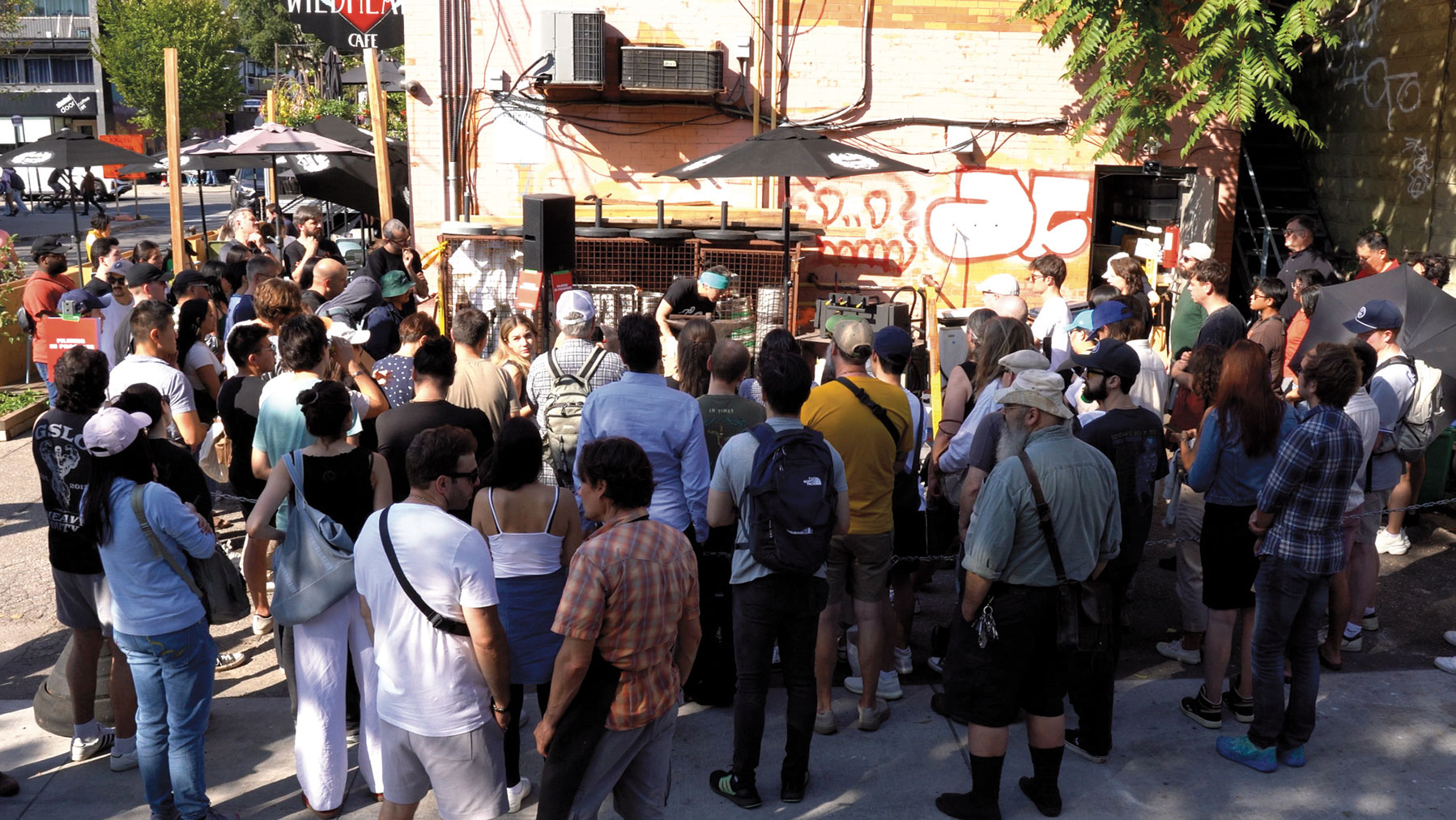
Sparks flew on Oct. 4, when master blacksmith Masashi Yamamoto, one of Japan’s premier knifemakers, performed a live forging demonstration in Toronto’s Annex at Knifewear (517 Bloor St. W.). Knife enthusiasts and curious passersby gathered to witness the spectacle.
Japanese knifemaking carries a rich history which can be traced back to the country’s ancient swordsmithing traditions.
During the Edo period (1603-1868), as the demand for swords declined, blacksmiths redirected their skills towards kitchen knives, applying the same forging and tempering techniques used for samurai swords.
Over time, these knives evolved into highly specialized tools for precise culinary tasks.
The knowledge, techniques, and traditions were passed down through generations, preserving Japan’s renowned standards of craftsmanship.
Yamamoto, renowned for his exceptionally sharp blades and his careful attention to detail, hails from blacksmithing royalty—his family has practiced the craft for 13 generations and they own the esteemed knife company Yoshikane Homano.
A crowd gathered behind Wildhearts Café to watch Yamamoto practice his craft with a forge and anvil. COURTESY KNIFEWEAR
Yamamoto began his training, alongside his brother, under the guidance of his grandfather and uncle, learning the traditional techniques that shaped his family’s legacy. At 36, Yamamoto struck out on his own, beginning his own forge.
With a focus on preserving the time-honoured traditions of Japanese craftsmanship while integrating scientific methods to refine and adapt the process, he opened his workshop in 2013.
A guiding philosophy in Japanese blacksmithing is shokunin kishitsu, the spirit of the master craftsman, which is cultivated through years of disciplined practice and dedication.
“Shokunin kishitsu is the outcome of putting into practice what has been passed down through generations,” said Yamamoto, via a translator, when asked how he interprets this ethos.
Traditions shape the distinctive qualities of Yamamoto’s knives. He explained that Japan’s humid climate leads to rapid food spoilage, compelling early knifemakers to adapt their techniques.
“We make knives so sharp that when they cut ingredients, they won’t go bad as quickly,” He added.
An awareness of the environment and a focus on efficiency are integral to all of his work. He explained that “steel was once a scarce resource in Japan, though very useful,” which led him to carefully consider how to produce knives with minimum waste and maximum efficiency.
What makes Yamamoto’s craftsmanship truly unique is the meticulous tailoring of each knife to its purpose. Even knives made from the same steel are forged differently depending on their use, ensuring optimal performance. Certain parts of his process, such as proprietary heat treatment techniques, remain closely guarded secrets, giving his blades unmatched durability.
It is fitting that Yamamoto’s demonstration was held at Knifewear, a retailer renowned for its high-quality handcrafted products. Since 2022, Knifewear has carried exclusive lines of Yamamoto’s knives, including the Kokuen and Kaijin series.
Kaijin knives use VS1 steel for exceptional hardness and edge retention, while Kokuen knives use SLD steel for a balance of durability and sharpness.
Throughout the event, many bustled into Knifewear hoping to purchase a knife by Yamamoto and to be one of the select few to have their knives engraved by the great blacksmith.
But how does Yamamoto view his knives? As tools or as works of art? For him, the beauty comes from the blade’s functionality.
Shaping the molten hot iron into a blade in the traditional fashion. COURTESY KNIFEWEAR
“If you’re trying to make the knife functional for the users, without thinking about making it beautiful, it will become really beautiful,” he explained.
Referring back to shokunin kishitsu, he explained that his teachers taught him that the spirit of the craftsman is infused in the knife through the maker’s intentions.
Since the knives are handmade, users can feel the presence of a human touch in the final product, which is often absent in machine-made knives.
Though Japan’s blacksmithing history runs deep, younger generations began turning away from the forge.
Yet, amid a surge of international fascination with Japanese knives, many Japanese youth turned to the anvil, reviving a centuries-old art. Knifewear’s brand communications lead, Nathan Gureau, highlighted this during the event:
“When Knifewear opened 20 years ago, the art of blacksmithing was dying out,” Gureau said, addressing the crowd. “It’s because of folks like you that there’s been a massive surge in business for makers like Masashi-san, allowing them to continue their work, and sparking a renewed interest in knifemaking among younger generations in Japan.
Global enthusiasm has breathed new life into the knifemaking craft, allowing it to not only survive, but thrive.
December 16th, 2025 · Comments Off on FOCUS: Residents discuss heritage conservation designation (Dec. 2025)
The city is considering applying the HCD designation to the West Annex as part of its Phase II Heritage Conservation District Study.
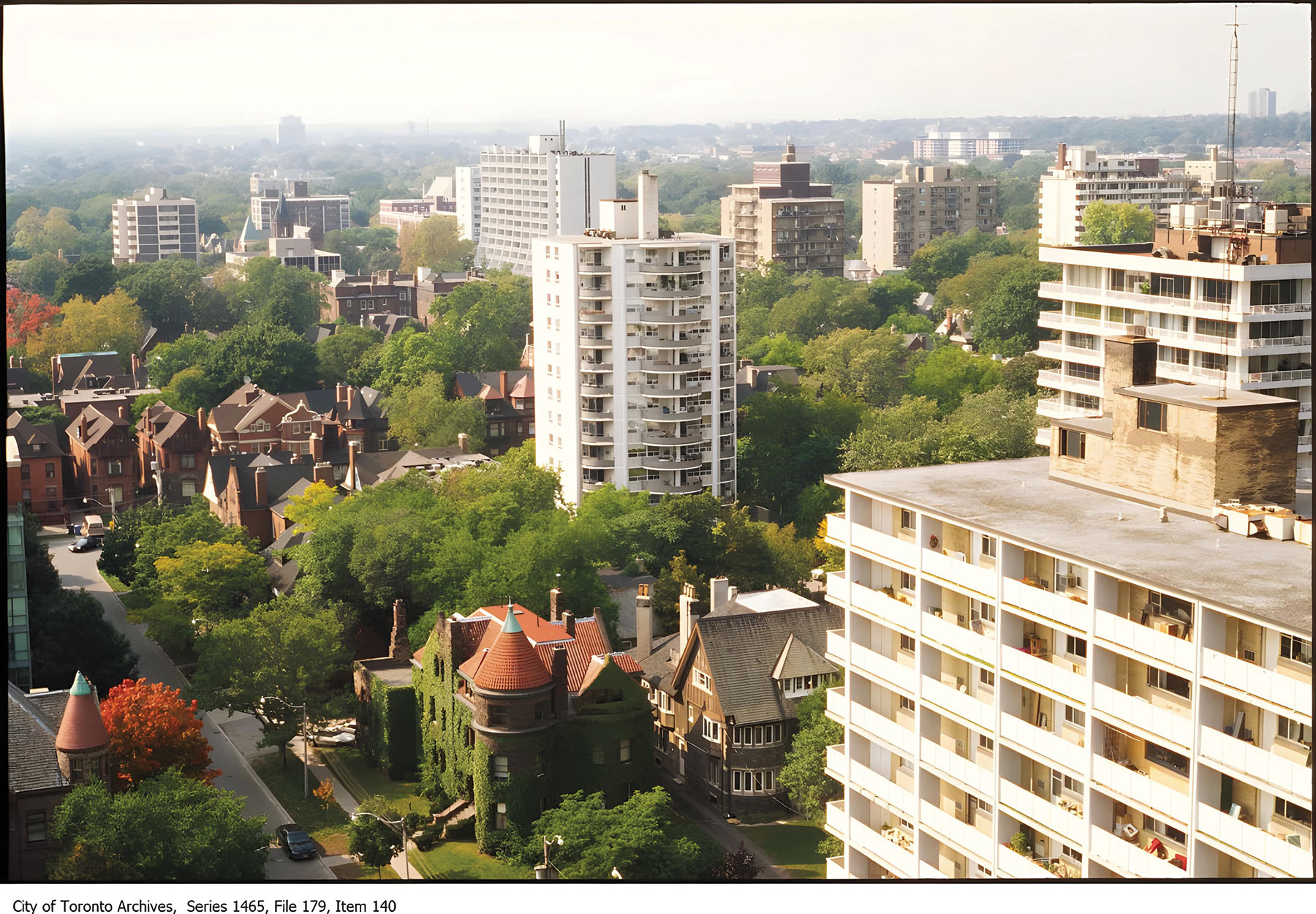
An aerial view of the West Annex. COURTESY CITY OF TORONTO ARCHIVES, Series 1465, File 179, Item 140
By Damola Omole
On Oct. 21, 2025, City of Toronto planning staff hosted an open house at the Native Canadian Centre of Toronto (NCCT), where individuals from the Annex neighbourhood provided feedback on the city’s new West Annex Phase II Heritage Conservation District (HCD) Study.
Over the course of the three-hour event, various Annex residents popped in and out of the NCCT to learn more about the logistics of the HCD process and to chat with members of the City of Toronto’s planning team.
“We’re particularly interested in stories and understanding what makes places special or unique,” said Tamara Anson-Cartwright, a member of the City of Toronto’s urban design team.
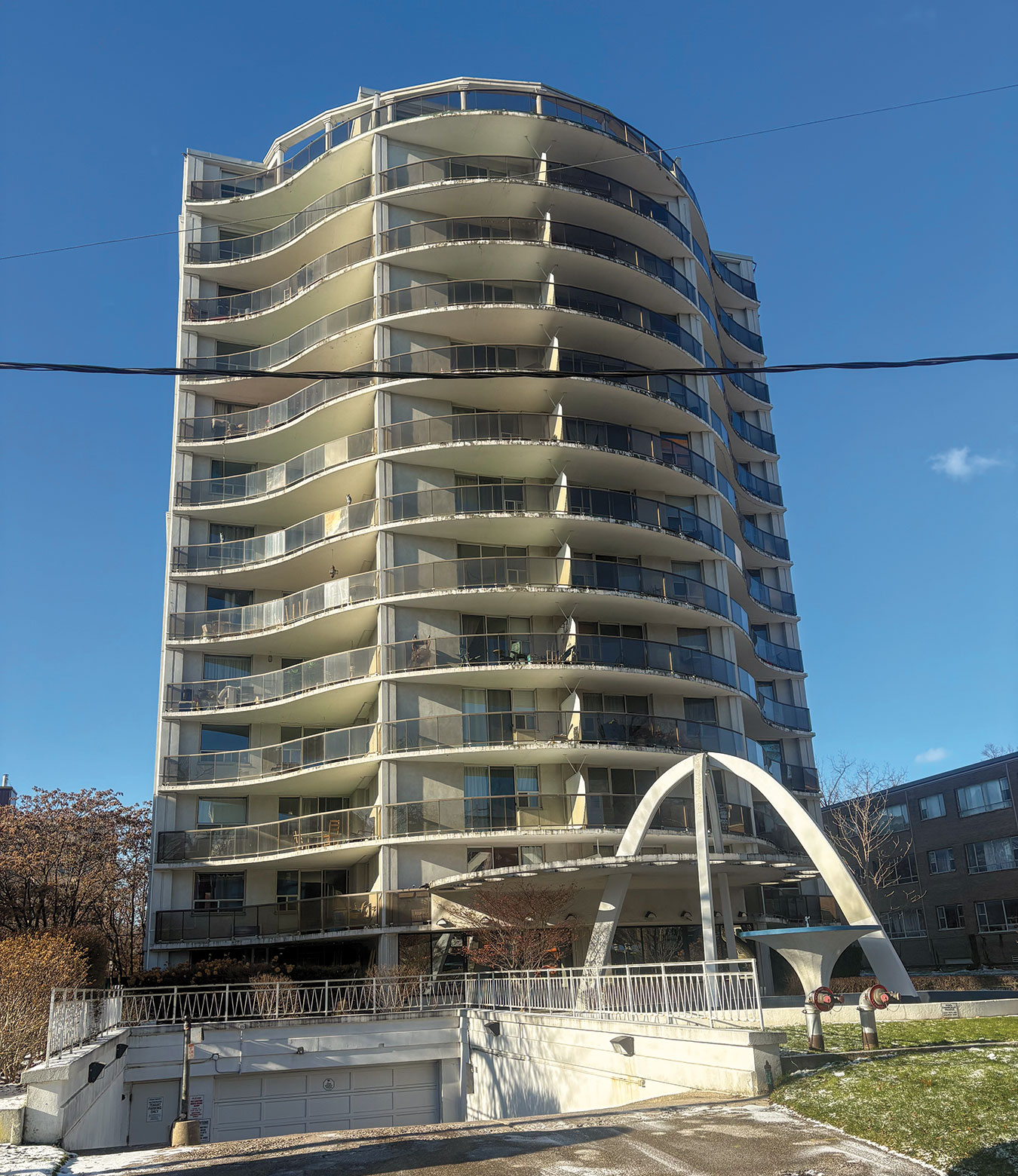
One of architect Uno Prii’s heritage apartment buildings at 44 Walmer Rd. BRIAN BURCHELL/GLEANER NEWS
The traditionally recognized boundaries of the Annex are north to Dupont Street, south to Bloor Street, west to Bathurst Street, and east to Avenue Road. However, the City of Toronto recognizes a broader neighbourhood definition that includes the adjacent Seaton Village and Yorkville areas.
The Phase II study area covers the blocks between Bathurst Street and Bedford Road and between Dupont Street and Bloor Street West. It includes all properties within these boundaries except those already designated under the Madison Avenue HCD, which runs through the Phase II area and encompasses the properties fronting onto Madison Avenue from Dupont to just north of Bloor.
According to the City of Toronto, an HCD designation is a “a planning tool that guides change in neighbourhoods that represent Toronto’s rich social, cultural, and architectural history—places that contribute to the livability and appeal of Toronto as a multicultural, sustainable, and equitable city.”
Factors such as the many students who frequent the West Annex (thanks to its proximity to the University of Toronto and its inherent transitonal population) overall, make the West Annex worthy of an HCD designation, according to Annex resident Christopher Varley.
With this sentiment in mind, Varley is also cognizant of the city’s proclivities for construction and alteration.
“We do have a lot of subway stations, and, of course, I understand there’s a lot of pressure for development because of that,” Varley said.
According to the city, HCDs preserve the historicity of Toronto’s most storied neighbourhoods, while still enabling the city to seek “opportunities for contextually appropriate growth.”
Several sites within the Greater Toronto Area have received the designation, such as the King and Spadina intersection, Queen Street West, and Union Station.
Various parts of the Annex have also received the designation. The East Annex, which was the first large-scale residential neighbourhood to be studied in Toronto as a potential HCD, received the designation in 1994.
More recently, Madison Avenue, known for its collection of 20th residential houses designed by renowned Toronto architects, had its request for the designation approved by the local planning appeal tribunal in 2019.
Annex resident and member of the Annex Residents’ Association, Sara Shaul, believes that the West Annex deserves to be next in line.
“They started with the East Annex, and everyone was going, ‘What about the rest?’ So, we wanted [it] studied the way the east was,” Shaul said.
Shaul doesn’t merely think the West Annex deserves a designation; she thinks it needs one. To her, an HCD label may also help the community retain its character during the sometimes harsh uncertainties of Toronto’s infrastructure development scene.
“We have layers of architectural development that responded to changing needs…and I hope the city maintains pieces of each of those layers,” Shaul said.
While the HCD designation doesn’t spare buildings from all forms of change and renovation, it exists to ensure that changes complement the existing unique built form rather than detract from it.
It also adds extra steps to the renovation process for property owners who may want to alter their own buildings. Certain types of alterations or renovations to a property within an HCD require a heritage permit.
A heritage permit is not required if an alteration or renovation is not visible from the street, or if it only affects the interior of a building.
Various sections of the GTA are consistently bogged down by large construction projects, and so Shaul hopes to see the City of Toronto acknowledge the history and architecture of the Annex so as to preserve its history.
“We must protect what’s of great value,” Shaul said.
While, by law, HCD sites are not immune to construction or alterations, the designation does require any new developments initiated within the area to follow tighter and more careful guidelines.
As stated on the City of Toronto website, “Proposed new construction, alterations, and additions should conserve heritage attributes, contribute to, and be compatible with the district’s character and sense of place.”
A notable example somewhat contrary to this sentiment can be seen through the Eglinton West, or Little Jamaica neighbourhood, which has been greatly impacted by the city’s prolonged LRT construction project.
Many businesses within the area had to shut down or completely overhaul practices as a result of the construction.
Even though the City of Toronto has consistently affirmed the cultural and historic significance of the Little Jamaica neighbourhood, Eglinton West has not been officially designated as an HCD.
The designation would likely not halt the LRT construction altogether; however, it might ensure proper measures are in place to help businesses within the area remain as unscathed as possible.
“We have policies that say no demolition of those amazing [heritage] buildings…but many districts also allow for change to happen that is of a bigger scale,” Anson-Cartwright said.
The process is still in its early stages, and there is no set deadline for when the West Annex can expect its designation to be approved. Other districts, such as Bloor West Village, have been waiting for as long as eight years, so the process can be a lengthy one.
In the meantime, more community engagement is coming, according to Anson-Cartwright. “We’re going to set up a local advisory committee, and we’ll be looking for people to volunteer,” Anson-Cartwright said.
“Most of the focus of the advisory group is with associations that represent the community…that will occur in the next two weeks.”
December 16th, 2025 · Comments Off on CHATTER: A new steward for Seaton Park (Dec. 2025)
RENDERING COURTESY OF DTAH
In May, the Bloor Annex Business Improvement Area (BIA) was approached by Councillor Dianne Saxe and the Annex Residents’ Association to take over the maintenance of Seaton Park at 14 Albany Ave., a long-neglected green space behind Hot Docs’ Cinema, currently operated by city parks.
Since then, the Bloor Annex BIA has been monitoring and cleaning the park daily. The BIA would now like to improve the park to the standards of its other, award-winning parkettes, located at Bloor St. and Howland, Major, Robert and Brunswick. Above is an early rendering of the improved park by DTAH landscape architects.
To accomplish this, the BIA has to expand its footprint to include the park which Councillor Saxe is supporting through a motion that was passed at the City of Toronto’s Economic and Community Development Committee on Dec. 2. The motion goes for final approval at city council on Dec. 16.
—Gleaner News Staff
Comments Off on CHATTER: A new steward for Seaton Park (Dec. 2025)Tags:Annex · News
December 16th, 2025 · Comments Off on EDITORIAL: Toronto has matured; Doug Ford has not (Dec. 2025)
Doug Ford never met a car he didn’t love. That’s easy to see from the just-passed Bill 60, particularly its transportation sections. This love affair with the car isn’t new—at least for anyone who remembers the late Rob Ford’s chaotic reign as mayor. Back then, with brother Doug as a city councillor, the Fords attacked any perceived slight against the motorist as part of a supposed “War on the Car.” The City of Toronto has matured since then; Doug Ford has not.
Bill 60, Fighting Delays, Building Faster puts the earlier Bill 212, now incorporated into the Highway Traffic Act, into plain language. Bill 212 required provincial approval for new bike lanes that reduced the number of car lanes. Only the naïve believed the province would grant such approval. Many bike lane projects have been preemptively abandoned. Bill 60, which passed third reading after fast-tracked debate and hearings, makes clear that cities shouldn’t bother asking for permission to build a bike lane at the expense of a car lane. The answer is “no.” (Bill 212 also included the removal of bike lanes on Bloor, University, and Yonge—a matter that goes to the Court of Appeal in January).
Other community improvements that might require the reallocation of space from cars— busways, wider sidewalks, or more greenspace—are not specifically prohibited by Bill 60, but Ford has bestowed upon himself the power to prevent their implementation if they displease him. Bill 60 allows the government to prescribe initiatives, in addition to bike lanes, that can be prohibited if they require a reduction in car lanes.
Ford is among a long line of politicians who were convinced that creating more road space was the answer to traffic congestion. In the 1950s, Metro Toronto Chair Fred Gardiner was given colossal resources to solve traffic congestion. One of his targets was sidewalks. (There were no bike lanes). “I would cut five or six feet off many sidewalks, shove the poles back and create two new lanes for traffic.” Ford could learn from past mistakes and the simple lesson that our problem isn’t too few roads; it’s too many cars.
Instead, Ford has been busy removing impediments to driving. Bill 60, as well as the recent ban on speed cameras, elimination of tolls on Highway 407 East, and reductions in gas taxes, at least make it clear that Ford isn’t simply fixated on bike lanes. The obvious irony is that we (that is to say, those who follow the evidence) know precisely where Ford is taking us: when it’s easier to drive, more people drive, resulting in more congestion.
Sure, pity the motorist, but not for the reasons that Ford spins. Driving a car is absurdly expensive, averaging over $8,000 per year—a lot of money for a machine that sits idle for over 90 per cent of the day.
The trajectory toward efficient modes of transportation is well-established. Ford’s interventions will only delay progress. Ontarians will pay a heavy price for his misguided policies, including higher climate emissions, transportation costs, and road deaths—and more traffic congestion.
Fortunately, all is not lost for our old friend, the bicycle. Many projects in Toronto’s cycling plan don’t require removing a car lane and can proceed. The value of existing bikeways can be enhanced with new connections. Bike lanes, such as on Davenport Road, can be upgraded to modern standards with raised curbs. The disconnected strands of many of the city’s off-road trails can become a network. A 73-km loop trail around the city is compromised by 10 small gaps, which, if finally closed, would serve both recreational and utilitarian cyclists, as well as tourists.
Ford will ultimately succeed only in demonstrating, yet again, the futility of trying to solve motor traffic congestion by creating more space for inefficient, single-occupant cars instead of focusing on better transit, walking, and cycling.
Albert Koehl is an environmental lawyer, coordinator of Community Bike-ways, and author of Wheeling Through Toronto: A History of the Bicycle and its Riders (University of Toronto Press, 2024).
December 16th, 2025 · Comments Off on FORUM: Pursuing a green agenda (Dec. 2025)
New neighbourhood stores and the need for more electric buses
By Dianne Saxe
Season’s greetings to one and all! It’s been a busy time of year as we work towards the holidays. Here’s a list of the top things affecting our ward heading into 2026:
1. To give more people places to shop, play, learn, or work close to home, Toronto city council has eased zoning rules for three kinds of local businesses:
Home-based businesses are already permitted nearly everywhere, but now, home-based businesses will be able to hire up to two employees and operate from auxiliary buildings on-site such as garages. Schools, artist studios, offices, service shops, and custom warehouses will now be able to see clients on-site. This will help more Torontonians start or grow a business from their home.
Small commercial activities (generally 150 square metres or less) will now be permitted on the ground floor in residential areas on major streets and could include art galleries, artist studios, custom workshops, schools, massage therapy centres, performing arts studios, personal service shops, pet services, production studios, recreation, religious education, retail and service stores, wellness centres, and restaurants with small patios.
Within the old City of Toronto, very small retail stores (110 square metres or less) will again be possible on street corners or next to schools, parks, or commercial sites. Unlike last year’s proposal, this excludes most interior neighbourhood streets. The stores may have interior cafes but no patios or on-site food preparation.
These changes should come into effect in the coming months, with their impact monitored for two years.
2. The federal and provincial governments have announced important incentives to help individuals and businesses invest in clean equipment which typically saves money over time but has a higher upfront cost. For example:
Individuals can claim rebates of up to $200 on high-efficiency ENERGY STAR appliances such as refrigerators, freezers, laundry equipment, and induction stoves to replace old electric models.
Businesses will be able to write off 100 per cent of capital expenses for clean energy generation, energy conservation equipment, and zero-emission vehicles. They may also be able to claim a federal Clean Technology Investment Tax Credit.
There are significant new incentives for verified energy savings by large electricity users.
3. Doug Ford’s latest moves include abolishing the speed cameras that save children’s lives in school zones and that pay for road safety measures like crossing guards (Bill 59). His Bill 60 makes it easier and faster for landlords to evict tenants, as well as gives Metrolinx a freer hand to ignore city bylaws and take city assets. The bill also cuts funding for infrastructure and threatens the city’s ability to prioritize pedestrians or transit over cars.
The Ford government is also considering cutting its contribution to the Canada Ontario Housing Benefit, the key rent subsidy that allows the most needy to move out of homelessness and into stable housing. Cutting this rent benefit will mean more severely distressed people in shelters, on the TTC, and in our parks.
In other news:
4. The Hospital for Sick Children, while celebrating its 150th anniversary, has been recognized as the world’s top pediatric hospital. Congratulations!
5. Metrolinx’s Finch West light rail transit should finally open to TTC riders on December 7.
6. Toronto is making it cheaper and faster to build missing mid-rise housing, with some units available as early as June. To encourage building on unused land, the city has just approved a second single exit stair design which architects love because the buildings cost less and are more spacious and comfortable.
7. In December, council will consider zoning options for Christie, Dupont, Bathurst, Ossington, Dundas and small pieces of Sherbourne and Bloor East. These streets are about 20 metres wide and have better transit times. Staff are proposing to rezone properties currently used as residential to apartment neighbourhoods and to CM (mixed use). In our ward, this will not change permitted building heights.
9. I was proud to represent Toronto at C40’s 20th anniversary summit. C40 has been extraordinarily successful in helping cities around the world collaborate on climate action. Seventy-five per cent of C40 cities have reduced climate pollution more than their countries have, with knock-on benefits for human health, affordability, and quality of life; for example, Toronto’s electric bus fleet, at 200, is the largest in North America. Sao Paulo has 1,000, and Shenzhen has 16,000. I was also honoured to represent Toronto at two United Nations Environment Programme meetings on cities and nature.
Many happy returns to everyone for the coming holiday season!
Dianne Saxe is the councillor for Ward 11, University–Rosedale.
December 16th, 2025 · Comments Off on FORUM: Doug Ford thumbs his nose at democracy (Dec. 2025)
PCs are centralizing power
By Jessica Bell
We are witnessing the terrifying rise of fascism in the United States, where President Trump defies Congressional votes, ignores court rulings, and directs law enforcement against citizens.
Ontario is not the United States; that said, under the Ford Conservative government, we are also witnessing the dismantling of our democratic institutions and practices.
It is reaching a new low this legislative session.
The government is moving omnibus bills through the legislature at breakneck speed, with almost no debate.
Public participation in committee hearings is being banned. These hearings are where citizens, experts, and stakeholders provide feedback and help to shape legislation. It’s also the site where opposition parties introduce amendments.
It’s now much harder for opposition lawmakers to be fully prepared to present evidence and testimony from constituents and carefully deliberate legislation. Often, I go into the legislature with up to eight briefing notes because I need to be ready to speak to any one of many bills at a moment’s notice. Why? Because the Conservative government has been refusing to consistently tell opposition MPPs which bills we are debating and when.
When lawmakers are not given the time to understand a proposed law, listen to constituents and stakeholders, and properly deliberate, we pass worse laws. This is not how Queen’s Park should function.
The government is undermining the power of other democratic institutions. Elected school board trustees are being stripped of their authority. In their place, the Conservative government is appointing handpicked supervisors.
The new supervisor appointed to the Toronto District School Board, Rohit Gupta, has no experience in the education sector, does not regularly answer emails and calls from parents, and earns $350,000 a year.
Supervisor Gupta’s first major decision was to cut funding to special education, leading to class size increases. Why on earth would anyone want to make school even more challenging for our most vulnerable kids?
Special economic zones are being created that are exempt from democratically decided local rules, including environmental protections and laws to keep workers safe in dangerous work sites, like mines.
Municipal authority has been weakened.
We all remember when the Ford government meddled with municipal elections, cutting Toronto city council from 47 to 25 wards in the middle of an election, and banning Toronto, London, and Kingston from using ranked-choice voting.
Since 2018, over 170 municipalities have been forced to adopt “strong mayor” powers, allowing a single mayor to override a majority of city councillors—but only on matters important to the provincial government.
Planning power has been concentrated in the hands of the Ministry of Municipal Affairs and Housing—they have far greater say now over who can build what and where.
Many regional municipalities, including York and Peel, have lost much of their power to oversee planning. Conservation authorities have lost a lot of their power to deny permits based on pollution or conservation. Now, a conservation authority can only deny permits if a development wants to build in a flood plain or an area with natural hazards.
Fixed election dates have been scrapped, giving the governing party the sole advantage of choosing when Ontarians go to the polls. The governing party can choose to call a snap election when the polls are in their favour and when they’re ahead in fundraising and candidate recruitment, giving them an incredible advantage over competing parties.
Moving away from a fixed election date will further supress Ontario’s abysmally low voter turnout. With a snap election, Elections Ontario is only required to provide three advance voting days, not 10, and voters will have weeks to get informed, not months.
And let’s not forget, the government used the hammer of the notwithstanding clause to override democratically negotiated collective agreements and impose wage suppression on public sector workers with Bill 124.
This rapidly growing list reveals a troubling pattern: a disregard for the democratic principles that are fundamental to Ontario, and to Canada.
Power is being concentrated in the hands of the premier. Public input is being shut down. Transparency is being replaced by secrecy. Accountability is being eroded.
Ontarians deserve a government that respects institutions, public input, and democratic norms. As the Conservative government continues to undermine these values, we must speak out. Because democracy is easier to undermine, than it is to rebuild.
Jessica Bell is MPP for University-Rosedale and is Shadow Minister for Finance and the Treasury Board. You can reach her office at jbell-co@ndp.on.ca or 416-535-7206.
December 16th, 2025 · Comments Off on IF THESE WALLS COULD TALK: Before the Maddy was a pub it was a mansion (Dec. 2025)
Many prominent families lived at 14 Madison Ave.
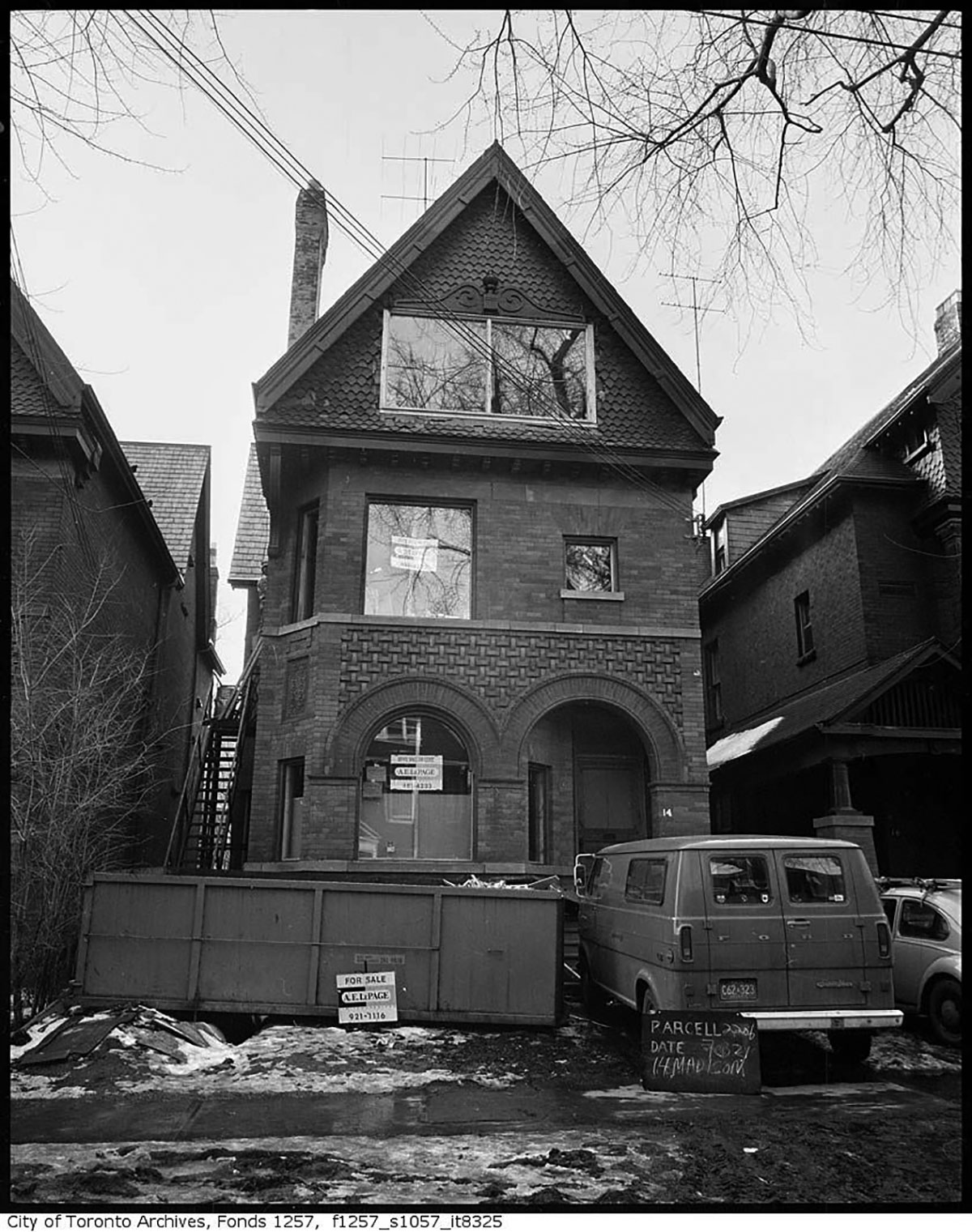
14 Madison Ave as it appeared in 1974. COURTESY CITY OF TORONTO ARCHIVES, FONDS 1257, f1257_s2057_it8325
By Michael Mastromatteo
Nearly 100 years after they were first constructed, three old mansions at 14-18 Madison Ave. gained a new lease on life.
In 1983, after surviving the “rooming house malaise” of the 1960s, the houses evolved into the Madison Pub, a popular fixture in the Annex.
In addition to the pub itself, the “Mad” now includes restaurants, a niche boutique hotel, and another hotel property in Puerto Vallarta, Mexico.
Although the pub today includes 14, 16 and 18 Madison, this month’s “If walls could talk” story will focus on number 14.
One of the first owners of the property was John Bertram, who in 1895, operated a wholesale hardware business at 76 Wellington St. W. Betram may have been quite a mover and shaker in late 19th century Toronto. The name John Bertram is associated with boat design and Toronto Harbour operations of the day.
There was at least one happy celebration at 14 Madison during the Bertram era. On June 16, 1897, the Toronto Daily Star reported the marriage of Bertram’s daughter Kate to a Thomas Bradshaw. The happy couple later took up residence on Lauder Street.
Bertram and family resided at 14 Madison until about 1900 when the home was taken over by George Kerr, a lawyer with the old Toronto firm Kerr, Bell & Shaw.
As with many Annex homes, the Kerrs needed cooks, servants, and domestics. A Toronto Daily Star classified ad from Sept. 25, 1905 reads: “General servant, small family, best wages, apply evenings, Mrs. Kerr, 14 Madison Ave.”
In 1915, the house was taken over by Dr. Benjamin P. Watson who resided there with his wife Angele, daughter Monique, and son David, for the next six years. In August of 1919, Mrs. Watson advertised for “an experienced cook wanted – at once.” Just three months earlier, Mrs. Watson advertised for “a Nursemaid for child of 10 months. Apply with references.”
The Toronto Daily Star of June 16, 1917 made mention of Watson’s marriage to the former Angele Hamendt of Belgium at St. Andrew’s Church on King Street West.
Dr. Watson certainly left a legacy. A New York Times obituary dated August 8, 1976, reported his passing at age 96. Dr. Watson was born on Jan. 4, 1880, in Anstruther, Scotland. He attended Edinburgh University and received his medical degree in 1905. A tall, distinguished?looking man, he was appointed professor of Obstetrics and Gynecology at the University of Toronto in 1912, a job he held for 10 years, with time out for service in the First World War. He was a captain in the medical corps of the Canadian Army and served in Macedonia, Greece.
In 1949, he became president of the New York Academy of Medicine. Dr. Watson was a professor at Columbia and became professor emeritus in 1960. He continued to practice as a surgeon until well into his 80s.
Before moving forward, here’s an interesting anecdote from the house at 18 Madison, now the site of the Madison Pub’s boutique hotel.
Early in the 20th century, 18 Madison was home to Commanding Officer John Irvine Davidson who, in 1905, founded the renowned 48th Highlanders Regiment. Baby boomers will certainly remember that for many years, the 48th Highlander’s pipe band performed God Save the King/Queen and O Canada on opening night for Leafs games at Maple Leaf Gardens.
Commanding Officer John Davidson died April 28, 1910. His widow Mary, lived on at 18 Madison from 1914 until her death on April 17, 1930. Mary, the daughter of Robert Hay (MP Centre Toronto), was active in Toronto’s social circles and volunteered at the Red Cross, the Hospital for Sick Children and a number of British Empire societies.
Getting back to 14 Madison. From 1922-1934, the building housed the Alpha Kappa Kappa (AKK) medical fraternity of the University of Toronto’s medical school. The housekeeper/den mother was a Margaret (or Mary) Fortier, who must have had a lot of patience. One can wonder if a Toronto medical fraternity in the 1920s and early ’30s resembled the Animal House frat from the John Belushi movie.
The Statten family, Waldermar and wife Helen, resided at 14 Madison from 1936 to 1938. They might have been the first family to begin letting rooms. An assortment of Toronto Daily Star ads from 1936-37 offered “double and single rooms, fireplace seat, bath floor, excellent meals.”
From 1939 until 1970, the home sheltered one Annie Millar. Try as we might, we couldn’t find any information on Annie and her family, despite her 31 years of residency. Oh where have you gone Annie? What are the stories you and your listening walls might have told?
With Millar’s departure in 1970, the story of 14 Madison gets a little sketchy. In 1975, an A. Milne resided there, and around 1980, the home was the business address of Lawson and Jones (possibly a printing company) and an enterprise known as Cobett-Jenner-Wasylow International.
This brings us to 1983 when Dave and Isabel Manore turned an aging Victorian mansion into what is today’s four-house strong Madison Pub and hotel complex. “We’ve been part of the city’s social fabric for decades,” says the Madison website.
Let’s hope today’s walls—whether original or those installed during extensive renovations—are still paying attention to what goes on within.
December 16th, 2025 · Comments Off on FOCUS: Coach House Books celebrates 60th anniversary (Dec. 2025)
Publisher held their annual wayzgoose on Sept. 4
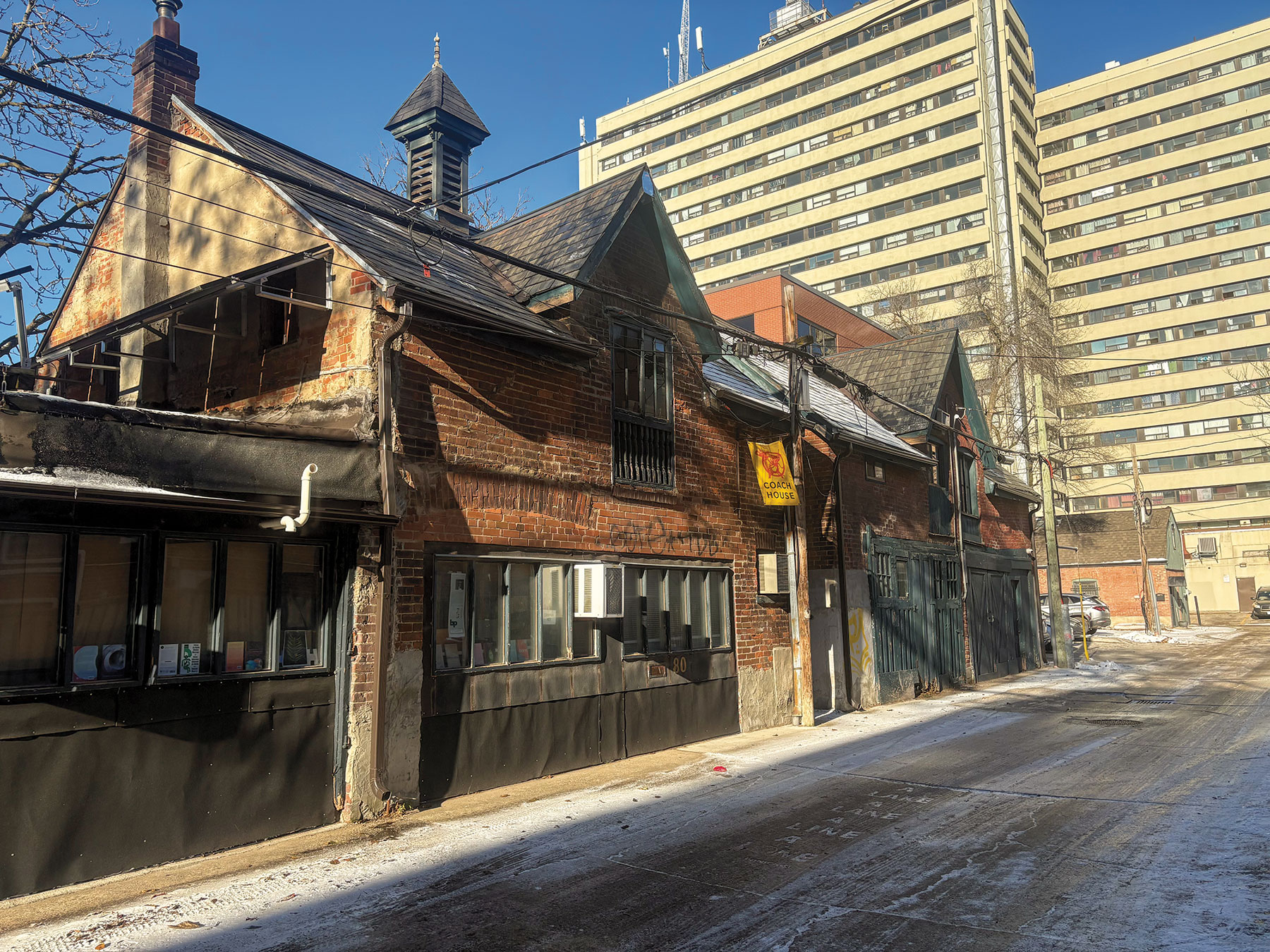
Coach House Books has helped “[drive] our national literary conversation” from its bpNichol Lane location for 60 years. BRIAN BURCHELL/GLEANER NEWS
By Drew Glennie
Located on bpNichol Lane, a hidden road nestled between Huron and St. George streets, Coach House Books has been printing and publishing books since it was founded by Stan Bevington in 1965.
According to publicist James Lindsay, their wayzgoose has been held annually for 20 years (including virtual events during the COVID-19 pandemic). While this event is unique to Toronto, it is actually part of a centuries-long tradition in the printing/publishing world.
“[Wayzgoose] is the traditional party printers would have in the beginning of autumn when they would turn to use candlelight,” Lindsay explained. “So it was a time to sort of honor the solstice and the sun going down. And they would invite the public into the press to sort of give them tours and show them around and see how you do things.”
This year’s wayzgoose at Coach House involved guests mingling and chowing down on hot dogs, chips, chocolates, and beverages in the packed back lot while some wandered into the coach house to see the printing operations in action.
This included one of their two Heidelberg-printed pages from the recently published Messy Cities, as well as the binding and cutting of Anaïs Barbeau-Lavalette’s forthcoming When Water Became Blue.
These books join Coach House’s extensive catalogue of publications which includes fiction, nonfiction, poetry, and playscripts. Well-known works include André Alexis’ Fifteen Dogs (2015) which won the Atwood Gibson Writers’ Trust Fiction Prize; early poetry collections by Michael Ondaatje (late 1960s to early 1980s); Encampment (2025)by Reverend Canon Maggie Helwig from the Church of Saint Stephen-in-the-Fields; and poetry by the Four Horsemen, a sound poetry ensemble (1970-1988), including the lane’s namesake bpNichol (1944-1988).
“Canadian-owned and -operated publishers like Coach House Books drive our national literary conversation, discovering and developing authors that would otherwise be overlooked,” wrote Lauren Perruzza, executive director of Literary Press Group of Canada, in an email to the Gleaner. “English Canada is uniquely disadvantaged in telling its own stories, with the media giant that is the United States to the south of us, and to a lesser, but not insignificant extent, the United Kingdom’s influence as well. Around 80 per cent of Canadian-authored books are published by Canadian independent publishers, meaning that companies like Coach House are essential for us to continue to tell our own stories.”
At Coach House, this involves having a special focus on Toronto books. “It’s really important for every city to have a book publisher that does books about that city, not just fictional books about that city, but nonfiction, like specific journalism and history and things like this. And Coach House does specialize in that,” said Lindsay. “And I think it’s a really important part of Toronto literature to have Coach House there as someone who cares about its history and wants to keep documenting it and archiving it.”
Through hosting wayzgoose, Coach House also contributes to the local community.
“It is a community event in the full sense, so it’s a really special way to sort of bring in people who we might not usually have contact with and introduce a lot of especially younger people to Coach House, which is really important for us,” said Lindsay. “Often we’ll get a lot of older writers sort of show up at Coach House as well. So it’s a way to just keep the tradition alive.”
Coach House Books also fosters community by offering events throughout the year, including readings and book launches. They can be found at chbooks.com along with a catalogue of books available to order online.
Lindsay also notes that they have benefited from their strong community of booksellers and readers, particularly as the printing industry struggles elsewhere.
“We’re very lucky in the way that I think the industry is feeling a lot of pressure obviously on all sides, on both sides of the border. But Coach House has readership, which is great. And we have fantastic authors,” he explained. “We’re doing a ton of work trying to be symbiotic with the bookstores themselves and have…close relationships with them. And think of it as sort of something holistic within publishing where, you know, without the bookstores, there’s no us. And without us, there’s no independent bookstores as well. So we want to work really closely with people who are still interested in books. Obviously the fan base for literature is shrinking, but there are still people buying books out there, and we just want to have as close a relationship with them as we can.”
December 16th, 2025 · Comments Off on NEW IN BUSINESS: Clothing options on Bloor for the fashion conscious (Dec. 2025)
Relocation, Common Sort, and Value Village each worth a visit
Value Village Boutique at 481 Bloor St. W. NEILAND BRISSENDEN/GLEANER NEWS ARCHIVE PHOTO
By Howard Pressburger
If you have recognized me outside of work, you know I’m a pretty sartorial guy. As my Instagram says: “I was born in the ’60s, so were most of my clothes.”
The Annex is not quite Carnaby Street, but we do have three unique choices for the fashion-conscious.
Value Village Boutique, located in the former Brunswick House at 481 Bloor St. W., is a mass-market seller of decent, utilitarian clothing. This small version of the well-known, international thrift store is volume-driven, and a portion of the profits are donated to local charities. Prices are very reasonable, and selection is wide, but quality can vary; make sure you give your items a thorough inspection before purchase. I have found Value Village to be a great source for workout clothes and argyle sweaters.
One of Common Sort’s curated window displays. COURTESY COMMONSORT
Common Sort, at 444 Bloor St. W., near the northwest corner of Bloor and Howland, is relocating across the street to the former home of Penguin Pickup. It has a more curated collection of quality second-hand name-brand clothing. It’s easy to find something you’d be willing to wear to work or on special occasions. Owners Nicole and Stefan value their connection to the community and work hard to match their fashion mix to the proclivities of the Annex. I’ve had many conversions with Stefan recently while he was getting his hands dirty building out the new location. He explained that moving will allow them to have a larger selection but also keep their prices affordable as their overhead will actually be reduced. Stefan, Nicole, and their staff, have a genuine commitment to making sure that Common Sort remains an integral part of the Bloor Street Retail Powerhouse™.
On the south side, at 499 Bloor St. W., next to Simit-Chi, there is the upstart vintage clothing store, Relocation.
Co-owner of Relocation (499 Bloor St. W.) Isa “Pope” Cargill. BRIAN BURCHELL/GLEANER NEWS
Considering its modest size, Relocation focuses specifically on vintage and streetwear clothing. Streetwear is a combination of New York City hip-hop style and California surf culture. It is heavily dominated by sports clothing, like basketball shirts and satin team jackets, as well as repurposed work wear, especially heavyweight denim and cotton. Vintage clothing these days refers to the ’90s and the ’00s. For older collectors like me, clothing from the ’50s to the ’70s used to be considered vintage, but these items are now referred to as “true vintage.” Who thought being fashionable would be so complicated?
When I first visited Relocation in early January, co-owner Mark, quickly realized that I am, in fact, a proponent of true vintage, and suggested that I come back and meet Pope. This curious suggestion—as the only other time I was told I should meet the Pope was when I was visiting Rome—turned out to be quite fortuitous.
The Pope Mark was referring to is Isa “Pope” Cargill, co-owner, lead salesperson, stylist, and all-around arbiter of cool. Although half my age and with twice as much hair, we do share a common admiration for sharp, alternative fashion. Because of this connection, and my never ending hope of finding another perfect piece of clothing in a store like this, I decided that if I saw Pope, I would pop in and say hi.
On a Friday afternoon in July, I stepped into Relocation and found myself among half a dozen close friends seemingly excited that they finally found a time and space to be together. Pope was filling a rack with clothing that was being handed to him by a friend with an impressive number of tattoos. It turned out the gathering was a pop-up sale by his friend, one of the designers behind the fashion brand La Ropa Life.
Don’t worry if you’ve never heard the name, just trust me when I say they’re like this generation’s, Vivienne Westwood. I spent the weekend hanging out, learning about this style, and seeing the people who came out to meet the designer and buy his clothes. I found it a little surreal, and I felt like I was once again 30 years old.
Since then, their store has continued to do well, and they’ve opened a second location on Dundas West. As the company matures, we now talk as much about business as we do about fashion, and Relocation remains the smart choice for the fashion-conscious youth of the Annex.
I have yet to find out how Isa became Pope, but I like to think that there’s a synod of fashion that chose him, and I’m pretty sure there was some smoke involved.
When not providing sartorial advice, Howard Pressburger is the manager of Wiener’s Home Hardware located at 432 Bloor St. W.
December 15th, 2025 · Comments Off on ON THE COVER: Oct./Nov. 2025
BRIAN BURCHELL/GLEANER NEWS
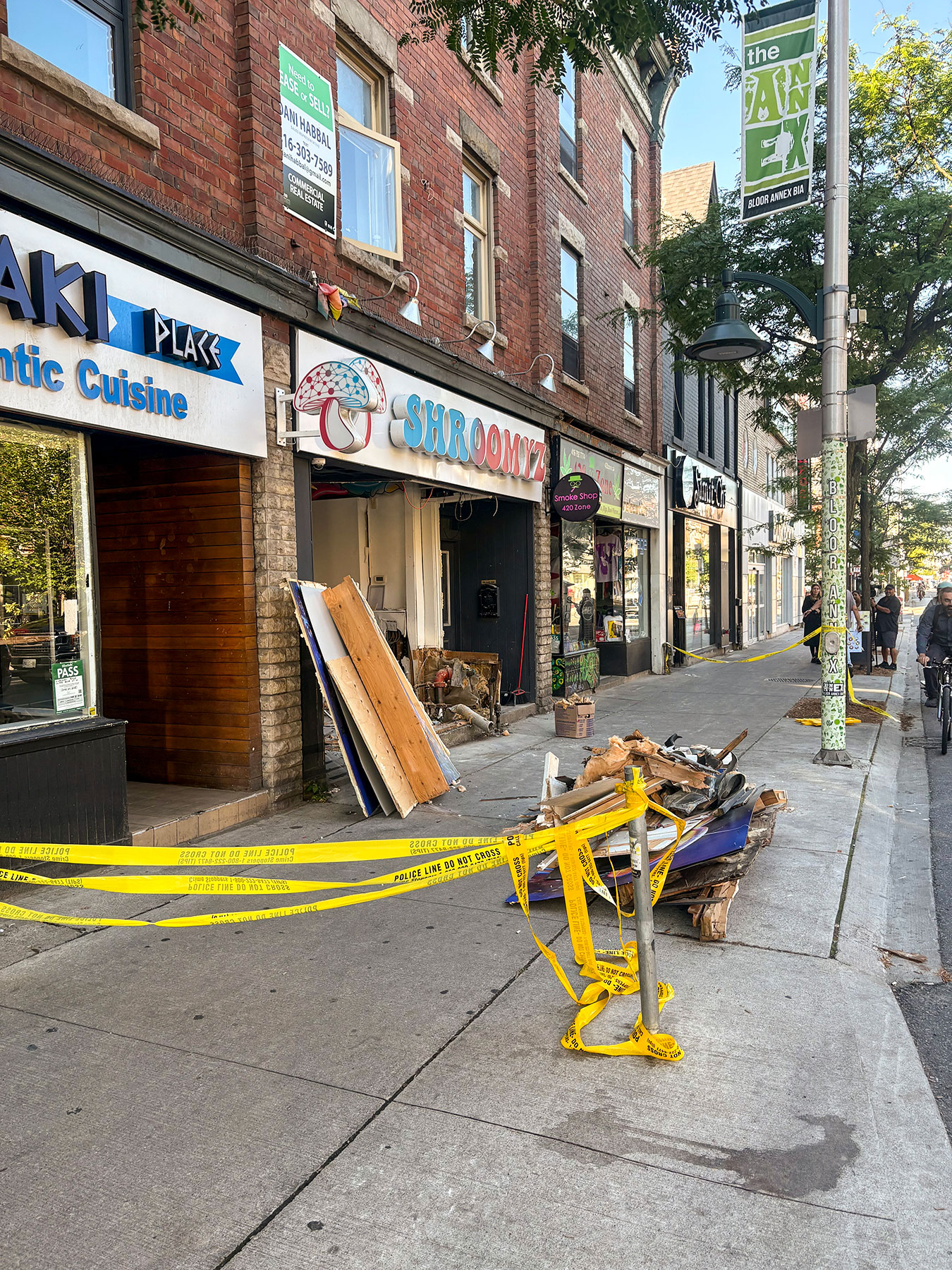
The illegal mushroom dispensary, Shroomyz, located at 475 Bloor St. W. has twice had trucks drive through the front wall, has been fire-bombed four times, and raided by police at least twice, since July. —Gleaner News Staff