November 18th, 2016 · Comments Off on EDITORIAL (NOVEMBER 2016): Freeland got it done, with flair
Getting the Comprehensive Economic and Trade Agreement (CETA) ratified is a big win for Canada, and an equally big win for Chrystia Freeland, not just our Member of Parliament but also our nation’s Minister of International Trade.
We needed this deal with the European Union (EU), if for no other reason than to show the increasingly trade-averse Americans that we have other economic dance partners. We now have greater access to the 28-member EU, whose consumer market consists of over 500 million citizens. Until now, Canadian goods have been subject to significant tariffs, and some estimates suggest that CETA will result in an annual increase of $1.4 billion in goods exported to Europe by 2021. The pact also allows for more streamlined trade in services such as telecommunications, transport, and energy.
[pullquote]“CETA is more than a bright light in a world seemingly hell-bent on protectionism and isolation (Mr. Trump’s rhetoric), building walls (more Trump), and breaking ties (see Brexit).”[/pullquote]
It hasn’t been easy getting this deal across the finish line, and it was Freeland who was primarily responsible for getting derailed negotiations back on track last month, after progress was stopped by the Belgian region of (population: 1.3 million), which could veto that nation’s endorsement. Freeland’s tireless efforts to get the Walloons on board ended when she shocked many by walking out of talks with their prime minister in frustration.
Speaking to reporters afterward, our visibly choked-up trade minister delivered a blunt message: if the Europeans can’t negotiate with Canada, a nation whose values the EU shares, then they are no longer able to negotiate with anybody. It may have been a bit of drama on Freeland’s part, but it forced Belgium and the EU to take a good long look in the mirror. That she managed to express sadness and anger without belittling or bullying the Walloons also demonstrated no small amount of tact and respect.
CETA is more than a bright light in a world seemingly hell-bent on protectionism and isolation (Mr. Trump’s rhetoric), building walls (more Trump), and breaking ties (see Brexit). It’s also a building block for other trade deals, and a good model for working through differences of opinion.
It’s been a long time coming. It was begun under the previous government with the approval of the then leader of the third party, Justin Trudeau, who stood in the House of Commons to congratulate the prime minister of the day, Stephen Harper, for initiating the trade deal.
So it is with some irony that the Conservatives have attacked Freeland for her actions: Gerry Ritz, her critic in the house, suggested she needed “adult supervision” and accused her of having a “meltdown”. Rona Ambrose, meanwhile, described the minister’s conduct “as strange and unfitting”. While Ritz’s ad hominum remarks rang of sexism and paternalism, Ambrose clearly could not see the actions as strategic posturing, or chose to ignore that as a possibility.
The EU saw Freeland’s actions differently.
The European envoy to the talks, Marie-Anne Coninsx, praised the minister’s actions as critical to helping Wallonia to overcome its objections. Coninsx pointed out that Freeland met with Martin Schulz, the president of the European parliament the day after she walked out of the talks. Freeland had also previously attended the convention of the Social Democratic Party in Germany which, it turns out, shared the Wallonian prime minister’s concerns about CETA’s investor protection provisions. Having invested the time with the Germans on the question, Freeland was familiar with the issues when it came time to deal with the Walloons.
Those who consider her conduct unbecoming in a Canadian politician should remember that 29 years ago Simon Reisman, lead negotiator of NAFTA, declared an impasse and walked away from the talks to establish a free trade deal with the United States and Mexico. Eleven days later a deal was signed.
Minister Freeland did her homework, stood her ground, and, despite knowing that continued talking was not getting anywhere, did not burn her bridges. Indeed, like Reisman, she ended up building one.
READ MORE:
FORUM: Inclusive prosperity (September 2016)
FORUM: Getting down to work (December 2015)
FORUM: Ensure capitalist democracy delivers for everyone (September 2015)
READ MORE EDITORIALS:
EDITORIAL: Stealth rate hike may work (October 2016)
EDITORIAL: Train derailment changes the conversation (September 2016)
EDITORIAL: “An egregious breach of trust” (August 2016)
EDITORIAL: Turning the Queen Mary (July 2016)
EDITORIAL: Mayo no, marijuana maybe (June 2016)
Tags: Annex · Editorial
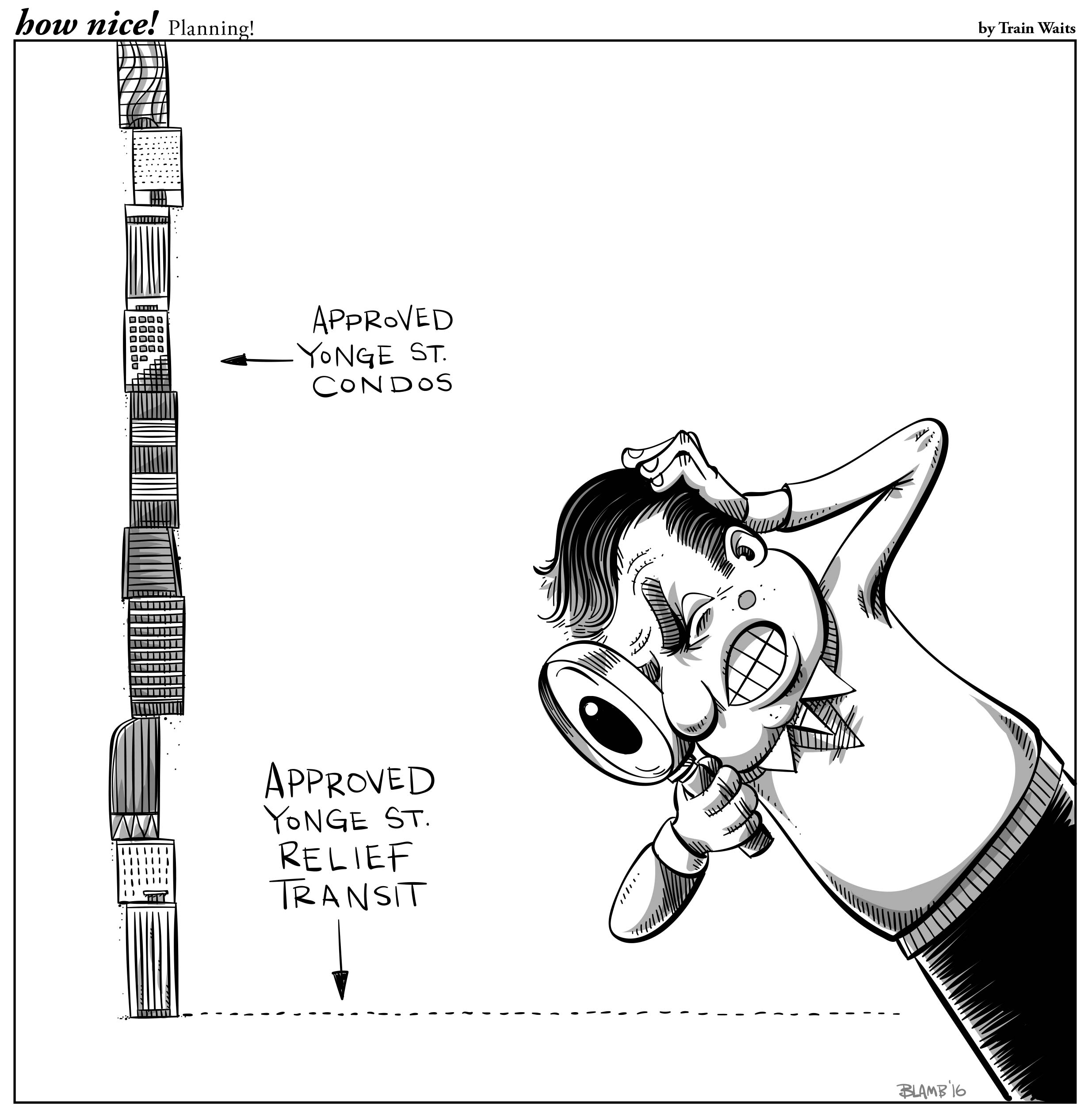
November 18th, 2016 · Comments Off on EDITORIAL CARTOON (NOVEMBER 2016): Previously rejected police car designs! by Designed Without Public Consultation

MORE how nice!:
The sincerest form of flattery! by Dow Indepols (October 2016)
A warm carbon blanket! By Hock Estique (September 2016)
A clear path! by Dot Tedline (August 2016)
Planning! by Train Waits (July 2016)
Tags: Annex · Editorial · Opinion
November 18th, 2016 · Comments Off on FORUM (NOVEMBER 2016): Our dynamic Kensington Market
Protecting the intangible along with the tangible
By Joe Cressy
Ward 20 is home to some of our city’s most vibrant neighbourhoods — communities characterized by unique and diverse groups of neighbours, businesses, physical structures, contemporary public art, and iconic cultural destinations. And, neighbourhoods that are actively working on initiatives to transform forgotten laneways and green spaces, to protect critical historical value, and to build equitable, fair, and livable communities for all our friends and neighbours.
I’m sure you’d all agree that one of our most important neighbourhoods, significant in the hearts and minds of not only Torontonians but all Canadians through its designation as a National Historic site, is Kensington Market. A jewel in the heart of our downtown community, Kensington, which has been an ever-changing market space for generations, has a unique history. Jewish history, Portuguese history, Chinese history, Afro-Caribbean history, and a legacy of social and political activism; these diverse chapters in the history of the market are not only woven into the physical structures in the community but continue to breathe life into the energy and culture of Kensington each and every day.
[pullquote]“However, like so many of our downtown neighbourhoods, Kensington Market is facing increased pressure that endangers the very thing that makes it what it is.”[/pullquote]
However, like so many of our downtown neighbourhoods, Kensington Market is facing increased pressure that endangers the very thing that makes it what it is: development pressure both adjacent to and within the market, rising rents, and the loss of some of the critical components of the street-market culture, just to name a few. In this shifting landscape, we’re working hard with the Kensington community to protect the area and ensure that it will continue to grow and change in the unique, locally-driven way it always has with the Kensington Market Heritage Conservation District Study (HCD).
A critical planning tool that protects and preserves the heritage of our communities, this study, like Kensington Market, has been unique. It is the first of its kind, and we are aiming to incorporate intangible features, such as culture, as well as tangible features, such as the architectural flourishes, that make Kensington, Kensington. Our goal, however, is not to freeze the area in time, as that would in itself be contrary to the historic nature of the market. Instead, an HCD guides change in a way that protects an area’s character, and ensures that future change is complementary to the uniqueness of neighbourhoods like Kensington. This is a critical project for a critical neighbourhood.
As with many neighbourhoods across the city, Kensington’s mom-and-pop retail storefronts are key to the vibrancy of the fabric of the neighbourhood. The local butcher, green grocer, and spice emporium are what draw so many of us to Kensington on a regular basis; however, many small, long-standing business owners have expressed the concern that they are being priced out of the market.
Many business owners aren’t only facing rising rents and increased competition from e-commerce, but are also struggling to keep up with commercial property taxes. Under the current system, commercial properties are assessed at the property’s highest and best use instead of the property’s actual use, a more realistic assessment. Taken together, these economic forces are changing the face of the market, shifting Kensington from its traditional mix of independent retailers to corporate chain stores, restaurants, and bars. That’s why I led a motion, which was approved, at the City of Toronto’s Executive Committee to investigate incentives for supporting raw food grocers and vendors in the area.
Economic incentives and the HCD are just a couple of the initiatives aimed at protecting and growing Kensington that we have underway. Celebrations like Pedestrian Sundays and the winter solstice have made the market a family-friendly destination that draws thousands of visitors each year. And local art initiatives, street murals, park improvements, and public space improvements are just a few more of the many dynamic, community-led projects that truly make Kensington Market the vibrant local gem we all know and love.
As we grow as a city, we need to ensure that we are not only building neighbourhoods but supporting them. Our collective work to protect and support Kensington Market is a step forward in ensuring we do just that.
Joe Cressy is the city councillor for Ward 20, Trinity-Spadina.
READ MORE ABOUT KENSINGTON MARKET:
CHATTER: Painted streets launch in Kensington (September 2016)
ARTS: Molly Johnson launches new jazz festival (September 2016)
CHATTER: Kensington Market consultation focuses on culture (July 2016)
NEWS: Kensington Market to become heritage district (May 2016)
READ MORE BY JOE CRESSY:
FORUM: A new central park for Toronto (September 2016)
FORUM: Building a livable city (July 2016)
FORUM: Bike lanes on Bloor Street (May 2016)
FORUM: Untapped potential (February 2016)
Tags: Annex · Opinion
November 18th, 2016 · Comments Off on HISTORY FROM THE ARCHIVES: Sculptor marks the lessons of war
Walter Allward designed Vimy Ridge, local war memorials
By Alfred Holden
In honour of Remembrance Day, this month we reprint former Citybuildings columnist Alfred Holden’s November 2003 piece on the sculptor who designed many of the nation’s most affecting and prominent war memorials.
Though he was an artist, Walter Allward believed no picture, story, or other artistry could adequately capture and represent the real horrors of war. Humility is a sign of wisdom and talent, and Allward, a sculptor, delivered. In his home studio at 76 Walker Ave., north of the CPR tracks just west of Yonge Street, he designed one of the most inspiring war memorials yet created.
[pullquote]“War memorials have long been flashpoints for such debates. They are sanctioned and official — the king’s version of events, as it were. They are symbols, necessarily abstractions representing complicated, chaotic events, to which there are varied interpretations. They are also, just as hotly, public art.”[/pullquote]
It stands today at Vimy Ridge in northern France, two majestic pylons rising like an apparition from the white stone base on the edge of the Douai Plain. Visitors walk right onto the monument and among the thousands of names of Canadian war-dead, etched on impregnable walls, at the site of the horrific First World War battle. Carved figures thrust from points on the monument’s geometric edges: a cloaked, brooding mother stares down at a tomb, where her sons are buried; a dead soldier seems to be aiding the living — for that’s what humans now dead here did, said the sculptor.
“There is in Allward’s work much of the character of Beethoven in music, something of the great writer of sonnets in literature,” a Canadian reviewer wrote about the Vimy design. “He never wastes a line.”
An American profiling Allward in The New York World was less reserved. “By reason of the work he is doing on war memorials, Walter S. Allward, a Canadian, is acclaimed as the greatest sculptor for monumental work in the world. It is claimed, indeed, that he is doing the best work in that line since the days of ancient Egypt.”
What a compliment.
So too is the fact that most people today know of the Vimy memorial, but have never heard of Allward. The art speaks, not the brand. “He creates not merely for himself or for the present, but for the nation, for the crowd, and the future,” wrote Augustus Bridle, an art-critic contemporary of Allward’s.
You need not go to France to see an Allward. If you live in midtown, you don’t even have to board a streetcar to find half a dozen. Just go over to Queen’s Park.
The statue by Allward of General Simcoe, first governor of Upper Canada, stands east of the legislature doors. A few steps west, Sir Oliver Mowat, of Mowat Block fame (and an Ontario premier), has been immortalized in a signed and dated bronze. So has the other Macdonald, J. Sandfield, Ontario’s first premier. On the west side of the legislature, for some reason hidden in the bushes, is Allward’s bust of William Lyon Mackenzie’s push for democracy in Upper Canada.
Allward grew up in Toronto and attended Dufferin Street Public School and Toronto Technical School (now Central Technical School). He apprenticed as an architect, but got the sculptor’s bug. He got his first major commission in 1895, at the age of 19, to create a figure of peace for the top of the memorial to those who fought in the 1885 Northwest Rebellion. This was Louis Riel’s battle. Appropriately, an olive branch is yet today in the lady’s hand, where she stands on her pedestal at Queen’s Park Crescent and Grosvenor Street.
The sculptor’s most notable Toronto artwork stands a few blocks south of the legislature, along University Avenue on the north side of Queen Street. Available for viewing on the centre boulevard 24 hours a day and 365 days a year, it is the monument to the 1899-1902 South African or Boer War.
It is dignified, substantial, unconsciously erotic — a 70-foot obelisk topped by the bronze figure of winged victory. At the base, a beautiful gowned woman, flanked by sinewy soldiers armed for combat, looks purposefully south.
The Boer War is considered by some to be an ignoble war. The white descendants of Dutch settlers fought the British (and the Empire, including a typically divided Canada) in remote southern Africa, over gold and diamonds that more rightfully belonged to the Xhosa tribes who lived there.
Does Allward’s monument at University Avenue and Queen Street offer sober commemoration and consolation for those lost on behalf of an important national cause? Or does it glorify violence, distort truth, and justify injustice?
War memorials have long been flashpoints for such debates. They are sanctioned and official — the king’s version of events, as it were. They are symbols, necessarily abstractions representing complicated, chaotic events, to which there are varied interpretations. They are also, just as hotly, public art.
“Vulgar taste was typified by the civic monuments which began to dot American towns in the late 1870s — statuary pieces of a pronounced foundry type intended to commemorate the heroic achievements of the late (civil) war,” the great Harvard historian Arthur Schlesinger Sr. commented in his urban history, The Rise of the City. “Nothing less than an earthquake could have cleared away the monumental excrescences of American cities….”
But some people see the broader power of monuments. In Moby Dick, Herman Melville compared mast-heads — brave men who’d grow weary, even die, weathering storms high on a ship’s rigging as they watched for whales and reefs — to “iron and bronze men”, dead at their posts, such as “Napoleon, who, upon the top of the column of Vendôme, stands with arms folded…careless now who rules the decks below”. It is true that in memory and experience, maps for the endless human voyage can be found.
Allward, who left with his wife Margaret and their two children on June 5, 1922, to begin construction at Vimy Ridge and remained in Europe until the monument was completed in 1936, must have observed the rise of Nazism. He considered metal a “material” for war, so the whole monument was planned in stone, and left untouched during the Second World War.
I was there in June of 1988, and will never forget it.
Remembrance Day is November 11. We all remember in our own way, as the complexity of war dictates we must. At intervals war is seen as a great adventure, a patriotic duty, an unavoidable circumstance, a bloody mistake, or mass-murder. It represents the greatest failing-point of humanity.
It is worth remembering, taking lessons from, brooding over, analyzing, commemorating — until such a day as war is no more.
READ MORE:
FROM THE ARCHIVES: If buildings are art, should they be altered from their original form? (September 2015)
FROM THE ARCHIVES: A grand gesture in the age of thrift (September 2015)
Tags: Annex · History · Life
November 18th, 2016 · Comments Off on ARTS (NOVEMBER 2016): Toronto Mandolin Orchestra celebrates 60 years
Milestone coincides with 125th anniversary of Ukrainian immigration

PHOTO COURTESY TMO: Unlike many mandolin orchestras in other parts of the world, the Toronto Mandolin Orchestra (above) does not include guitars, though it does at times perform with woodwind instruments, percussion, and two accordions.
By Summer Reid
It’s a humble yet versatile instrument that was a bit of a fad in certain parts of Europe around the turn of the last century. But after the mandolin — a lute that has four pairs of strings tuned in a progression of perfect fifths — was brought over the sea by immigrants seeking a new home, it became an indelible part of their ethnic heritage.
So it was with the Ukrainian diaspora in Canada, where the Toronto Mandolin Orchestra (TMO) was founded 60 years ago to preserve traditions that predated it by 65 years. And this month the orchestra is celebrating that milestone with an anniversary concert on Nov. 19 at the Trinity-St. Paul’s Centre featuring popular folk and classical pieces, and special guest soloist Tamara Volskaya.
[pullquote]“For both waves of immigrants, mandolins were the instrument of choice for providing children with a musical education because they were accessible and inexpensive.”[/pullquote]
The very first Ukrainian immigrants came to Canada before the First World War. The federal government at the time was determined to settle the western provinces to prevent them from becoming an American territory, and specifically sought out farmers from the Ukraine, which was struggling economically.
“There was a $10 registration fee, but you got a quarter section of land,” explained Maxim Tarnawsky, an associate professor of Ukrainian Studies at the University of Toronto. A second wave of Ukrainian immigrants arrived after the Second World War, but, said Tarnawsky, these people were “by and large intellectuals” escaping Soviet rule, and they chose to settle in Toronto.
For both waves of immigrants, mandolins were the instrument of choice for providing children with a musical education because they were accessible and inexpensive.
Indeed, the Gibson Mandolin-Guitar Manufacturing Co. in Kalamazoo, Mich., had been producing the whole family of mandolins since the turn of century, facilitating the growth in popularity of the instrument, as well as the formation of mandolin orchestras.
As a result, various ethno-cultural associations and clubs incorporated the mandolin, establishing schools for children, and providing individuals from working-class families with the musical training they may not have been able to afford otherwise.
Although there were many orchestras that included the mandolin alongside other stringed instruments, it was not until 1956 that Eugene Dolny, a conductor and the music director of cultural groups of the Association of United Ukrainian-Canadians, established an orchestra dedicated solely to the mandolin: the Toronto Mandolin Orchestra.
The orchestra’s uniqueness extends beyond its focus on the mandolin. It was the first to use the tenor (or octave) mandolin in the string section, and it incorporates the domra, a Ukrainian and Russian version of the mandolin with four strings instead of the usual eight. Further, unlike many mandolin orchestras in other parts of the world, the TMO does not include guitars, though it does at times perform with woodwind instruments, percussion, and two accordions. Finally, Dolny, who had formed a relationship with the world-renowned Osipov Folk Orchestra of Moscow, received many of that orchestra’s original compositions, specifically transcribed for the TMO.
The TMO joined the National Shevchenko Musical Ensemble Guild of Canada (SME) in 1964, and began to accompany the ensemble’s dancers and choir in addition to performing in its own concerts. Together, they have performed across Canada, and toured Ukraine twice, in 1970 and 1989.
“They say that it’s better one time to hear than 10 times to tell,” said TMO’s artistic director Alexander Veprinsky, of the orchestra’s unique sound. He’s been with the group for 21 years, during which time he has arranged almost half of the orchestra’s repertoire. These days the orchestra is made up of musicians from a wide variety of backgrounds, and performs music from all kinds of genres including classical, folk, and popular music, in addition to Russian and Ukrainian music.
The musicians, who become family through performance, tended to stay with the orchestra for a long time.
“Mary Kuzyck, she was the concert mistress of the orchestra from the very beginning, and she was like a mother to me here,” said Ira Erokhina, the orchestra’s concert mistress of Kuzyck, who assumed the position when the TMO was formed. Described as the glue holding the orchestra together, Kuzyck was the TMO’s concert mistress for 56 years, until her death at the age 94.
The Toronto Mandolin Orchestra will celebrate its 60th anniversary with a concert on Nov. 19 at Trinity-St. Paul’s Centre.
READ MORE:
ARTS: Library’s ukulele drop-in program leverages diminutive instrument to launch musical journeys (August 2016)
ARTS: Esprit Orchestra goes to China (July 2015)
Tags: Annex · Arts
November 18th, 2016 · Comments Off on FOCUS ON EDUCATION (NOVEMBER 2016): Building a respectful future
TDSB schools adopt traditional territories acknowledgement
Our local acknowledgement: “I would like to acknowledge that this school is situated upon traditional territories. The territories include the Wendat (wen-dat), Anishinabek (ah-nish-nah-bek) Nation, the Haudenosaunee (ho-den-oh-sho-nee) Confederacy, the Mississaugas of the New Credit First Nations, and the Métis (may-tee) Nation.
The treaty that was signed for this particular parcel of land is collectively referred to as the Toronto Purchase and applies to lands east of Brown’s Line to Woodbine Avenue and north towards Newmarket. I also recognize the enduring presence of Aboriginal peoples on this land.”
By Clarrie Feinstein
Every student in the Toronto District School Board (TDSB) begins their day in the same way, with announcements and the national anthem. It’s an enduring ritual that creates a connection amongst diversity. But this year, that ritual has been updated to reflect a modern act of redress; from September forward, students have also acknowledged that the land on which they study forms part of the Ancestral Lands of Aboriginal peoples.
“Indigenous people gave settlers the most beautiful gift, which was an unblemished continent,” said Dr. Duke Redbird, an Aboriginal elder, who is also the TDSB’s curator advisor for Indigenous culture and a consultant to the board’s Aboriginal Advisory Committee. “It was given but never acknowledged. How could someone get a beautiful gift and never acknowledge it? This is the first step towards the future of the Indigenous and non-Indigenous relationship.”
The acknowledgement is the result of a motion unanimously passed last summer by TDSB trustees, who directed the board’s 588 schools to make it part of their daily opening exercises, said prior to the playing of the national anthem.
“It’s the first step to decolonize our schools,” said Dr. Suzanne Stewart, special advisor to the dean on Aboriginal education at OISE and coordinator of the Indigenous Education Initiative. “It creates a conscious importance of Indigenous land and expresses appreciation to the indigeneity as a traditional matter that settlers must honour.”
The larger goal of the land acknowledgement is to make students aware of which traditional territory their school was built on, and to teach them of the territories that are in close proximity to their school. By doing this, students will have access to information about their local history and where they are situated in Canadian history.
“It is important to understand the long history, and for each student to understand that place in our history,” explained Stewart. “But, the acknowledgement is not about the past, it’s about what’s going on right now and building a relationship now with Indigenous people.”
It’s also in line with the many education-related calls to action that informed the final report of the Truth and Reconciliation Commission of Canada, mandated with memorializing the lasting impact Indian Residential Schools have had on the nation’s Indigenous population.
“Many students and Canadians haven’t really learned about privilege,” said Stewart. “Teachers often feel threatened by Indigenous teachings because they think it reflects on them personally, [but] we need indigenous pedagogy in the curriculum. People need to stop personalizing the problem and realize these issues go beyond them.”
That’s why the Ontario Ministry of Education has developed recommendations for including Indigenous teachings in all subject areas from social sciences and history to math, the arts, and more in elementary and middle school. The curriculum is an essential tool for restructuring the way in which non-Indigenous people view Indigenous livelihood, and it teaches students about the history of colonization and oppression.
Incorporating Indigenous teachings into the curriculum is particularly important as it helps Indigenous students feel like they belong.
Although Toronto has the third largest urban Indigenous population in Canada, Indigenous students — who report feeling isolated and invisible in the TDSB — have a lower attendance rate than non-Indigenous students, and have less chance of graduating from secondary school.
Stewart said that most Aboriginal students she has talked to say they have experienced racism in the classroom from peers and teachers, especially in higher levels of education. Acknowledging the long local history of Aboriginal peoples may start to create a new atmosphere for learning across the board, even if it is but the first step in Indigenizing the school landscape.
According to Dr. Redbird, representatives and teachers from schools across Ontario believe the protocol should be implemented in schools throughout the province.
“The TDSB needs to be applauded for how well developed and progressive they are,” said Stewart. “It’s time for others to come on board.”
READ MORE:
HISTORY: Honouring those who honour history (October 2016)
NEWS: U of T committee tasked with responding to Truth and Reconciliation Commission delivers interim report (August 2016)
ON THE COVER: Tracking history in the Annex (April 2016)
Tags: Annex · Life
November 18th, 2016 · Comments Off on FOCUS ON EDUCATION (NOVEMBER 2016): Palmerston P.S. hosts costumes and Cinderella
PHOTO BY NOELLE DEFOUR/GLEANER NEWS: Teachers and administrators from Palmerston Avenue Public School perform in a short play based on Cinderella on Oct. 31. The amateur theatrical, and the parade that followed it, is a much-loved annual event at the school.
Tags: Annex · Life
November 18th, 2016 · Comments Off on FOCUS ON EDUCATION (NOVEMBER 2016): Parents decry lack of resources at local schools
New executive director underscores board’s equity focus
By Clarrie Feinstein
Parents at last month’s Toronto District School Board (TDSB)?ward council meeting leveraged a meet-and-greet with the new director of education into an opportunity to question him about the lack of resources at their children’s schools. Dr. John Malloy was at the Oct. 24 meeting at the invitation of Ausma Malik (TDSB Ward 10, Trinity-Spadina) to introduce the board’s new structure and its four new learning centres.
The audience patiently sat through Malloy’s presentation before angrily launching questions.
[pullquote]“We must ask these difficult and personal questions in order to better our education system”—John Malloy, TDSB[/pullquote]
The Huron Street Junior Public School’s ward representative — who did not wish to be named — said the school has only a few computers left after the others were aged out because they were so old they weren’t compatible with the board’s system.
“We’re at a road block,” said the representative. “We have parents that can provide their kids with laptops. But does that give our school an advantage over others where parents can’t afford these necessities? If we can’t privately fund them, will my kids come out of school being behind in technological skills?”
Huron’s annual school budget amounts to approximately $68,000, which includes a $3,402 technology allocation. School budgets are largely determined by enrolment.
Huron, for example, has an enrolment of 404 students and receives $96.50 per student. It also receives per pupil money for the library and the office, a base school allotment, and supplements for special education and learning opportunities. However, the school, which dates back to the 1880s, is in a building that was erected in 1958, and maintenance absorbs a large part of the budget.
Although Malloy urged the Huron representative to speak to the school’s superintendent about the computers, he did note that the TDSB does not have the money to provide new computers for every school. That’s why individual schools are left to solve the problem, sometimes by raising money or by seeking donations to get new computers.
Perhaps ironically, one of the mandates behind the board’s reorganization into four learning centres is to “ensure that all students across the TDSB have equitable access to programs and services”.
The board is at the start of an ambitious three-year plan aimed at ensuring that all students have access to the same high quality of education, no matter which school they attend or their background.
“The goal is to engage with our own bias and barriers and ask, whose voices are heard most?” explained Malloy. “How is this affecting our learning environments? We must ask these difficult and personal questions in order to better our education system as staff and parents.”
Established in September, the centres will help individual schools access specific resources, support classroom teachers, allow staff to be more responsive to their students’ educational needs, and ensure that all students have equal access to programs and services. Each learning centre will be led by an executive superintendent, who in turn will be supported by seven superintendents. Every school in the board will feed into a centre, characterized by the TDSB as “hubs where staff can collaborate and share resources”. Superintendents of education Mike Gallagher and Mary-Jane McNamara are responsible for the schools in Trinity-Spadina, all of which feed into Learning Centre 4, led by executive superintendent Sandy Spyropoulos. All three educators were at the meeting, and expressed their excitement at embarking on the new school year with this forward-thinking strategy.
Malloy said that he believes the learning centres will improve student achievement and well-being by making the board more responsive to the individual needs of Toronto’s diverse communities.
“There needs to be an internal focus, there should be local ownership of the learning,” he said. “Ministry requirements need to be fulfilled, but what about the unique, individual needs of each school?”
READ MORE:
NEWS: Provincial investment falls short (September 2016)
Tags: Annex · Life
November 18th, 2016 · Comments Off on LIFE (NOVEMBER 2016): Pumpkins on parade


COURTESY RICHARD LONGLEY: The Harbord Village Residents’ Association and the Harbord Street Business Improvement Area celebrated their tenth annual Harbord Street Pumpkin Festival on Nov. 1. Featuring hot cider, a silent auction, and, of course, many glowing pumpkins, it drew crowds to Harbord Street between Spadina Avenue to Borden Street.
READ MORE:
NEWS: Harbord Street to become pumpkin patch (October 2015)
NEWS: Lit pumpkins lined Harbord Street (November 2013)
Tags: General
November 18th, 2016 · Comments Off on GREENINGS (NOVEMBER 2016): Force the focus
Draw attention to what really matters
By Terri Chu
Sometimes I wonder why, knowing what we know about climate change, there are people who continue to buy things they don’t really need for the sake of it. We have our share of green businesses in the Annex, but that doesn’t make us immune from replacing our perfectly functioning phones with newer ones, or falling for the latest fashion trends (none of which are sustainable).
The media, be it mainstream or what we like to call “social media”, plays such a big role in how we view the world and what we think is important. As I flip through my own social media feed, the sad reality sinks in of why measures to protect the environment have failed over the years.
[pullquote]“Witnessing the Standing Rock protest and how we, as a society, are responding to it leaves me with a pit of hopelessness.”[/pullquote]
In one social media circle, Toronto moms are engaged in an asinine debate over the safety of our fluoridated and chlorinated municipal drinking water. In happy-land, some mothers believe they are doing their babies’ future a favour by buying them distilled water in single use disposable plastic for fear of exposing them to a chemical proven to reduce cavities. Further down the feed, photos and videos are popping up about the standoff between the Standing Rock Sioux Tribe and heavily armed agents. The contrast between environmental concerns and realities could not be starker.
Two groups of people worried about their health and environment, yet one is facing a real threat while the other is worried their kids might not get enough cavities. No doubt both groups have the best interest of their children in mind, but what each group is concerned about could not be more different. This contrast epitomizes why we’ve failed to protect the environment despite knowing about climate change for decades.
The Standing Rock Sioux are galvanizing international support for their fight against the 1,885-kilometre North Dakota Pipeline, whose proposed route travels under the Missouri River, the tribe’s main source of drinking water.
Their concerns were never taken seriously, the media has barely acknowledged that they are fighting to protect something as basic as drinking water, yet ample air time is dedicated to causes like “could this life saving vaccine actually be responsible for a condition that medical science has already conclusively proved it isn’t?”
Witnessing the Standing Rock protest and how we, as a society, are responding to it leaves me with a pit of hopelessness. How can we possibly find the political will to deal with our environmental problems when the drinking water for an entire group of people, living, breathing human beings, is treated so nonchalantly while non-problems get the royal click bait treatment?
We are no different north of the border.
Now that Attawapiskat is out of the news, has the water situation there improved? Have we spared a thought for it? It seems one thing we have in common with our neighbours to the south is how abhorrently we treat First Nations people.
It’s probably too much to ask that the media presents real news and moves beyond “this year’s hottest Christmas toys” to report on the depressing realities of how climate change and pollution is already affecting people. This should not be relegated to the fringe news sites. Keep Attawapiskat in the news until the situation changes. Report on the water crisis. Unless environmental realities are at the forefront, those who don’t see it in our day-to-day lives will continue to ignore the issues.
An environmental activist once told me about his son, who asked “when is all this bad stuff with climate change going to happen?” Even he didn’t know it was already happening. I used to think it was the politicians who had the greatest impact on environmental policy, but now I realize it’s the media overlords.
If there’s one thing we can do, it is to annoy the heck out of our friends and share every piece of depressing environmental news we can every single day. Make the issues relevant and keep them at the tip of public consciousness. Unless the issues are actually understood, having governments take action that might be even remotely unpopular will be too much to hope for.
Terri Chu is an engineer committed to practical environmentalism. This column is dedicated to helping the community reduce energy, and help distinguish environmental truths from myths.
READ MORE GREENINGS BY TERRI CHU:
The school of the future (July 2016)
Taking action on climate change (June 2016)
Cloth diapers have gone from burden of the poor to luxury of the rich in one generation (May 2016)
Provide help or stand aside (April 2016)
Don’t fall prey to marketing (March 2016)
Tags: Annex · Life
October 28th, 2016 · Comments Off on ON THE COVER (OCTOBER 2016): Celebrating Bloor Street
PHOTO BY NEILAND/BRISSENDEN: Gleaner art director Neiland Brissenden’s annual chronicle of Nuit Blanche returns this month. In an installation at the Royal Conservatory of Music (RCM), Jody Naderi and John Fillwalk combined art and app to create The Firefly Effect.
This month’s issue includes a story on how the City of Toronto designated the stretch of Bloor Street that includes the RCM as a cultural corridor just as the conservatory received some much needed debt relief, as well as stories on the Miles Nadal Jewish Community Centre’s newly reopened accessible pool, and how citizen cyclists marked new bike lanes by ringing bells on Bloor Street.
Tags: Annex · News · Arts
October 28th, 2016 · Comments Off on NEWS (OCTOBER 2016); Ardent for arbour
Forestry activists call on province for support
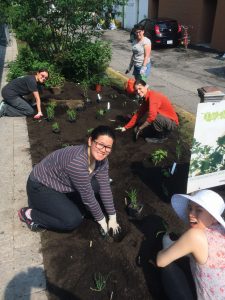
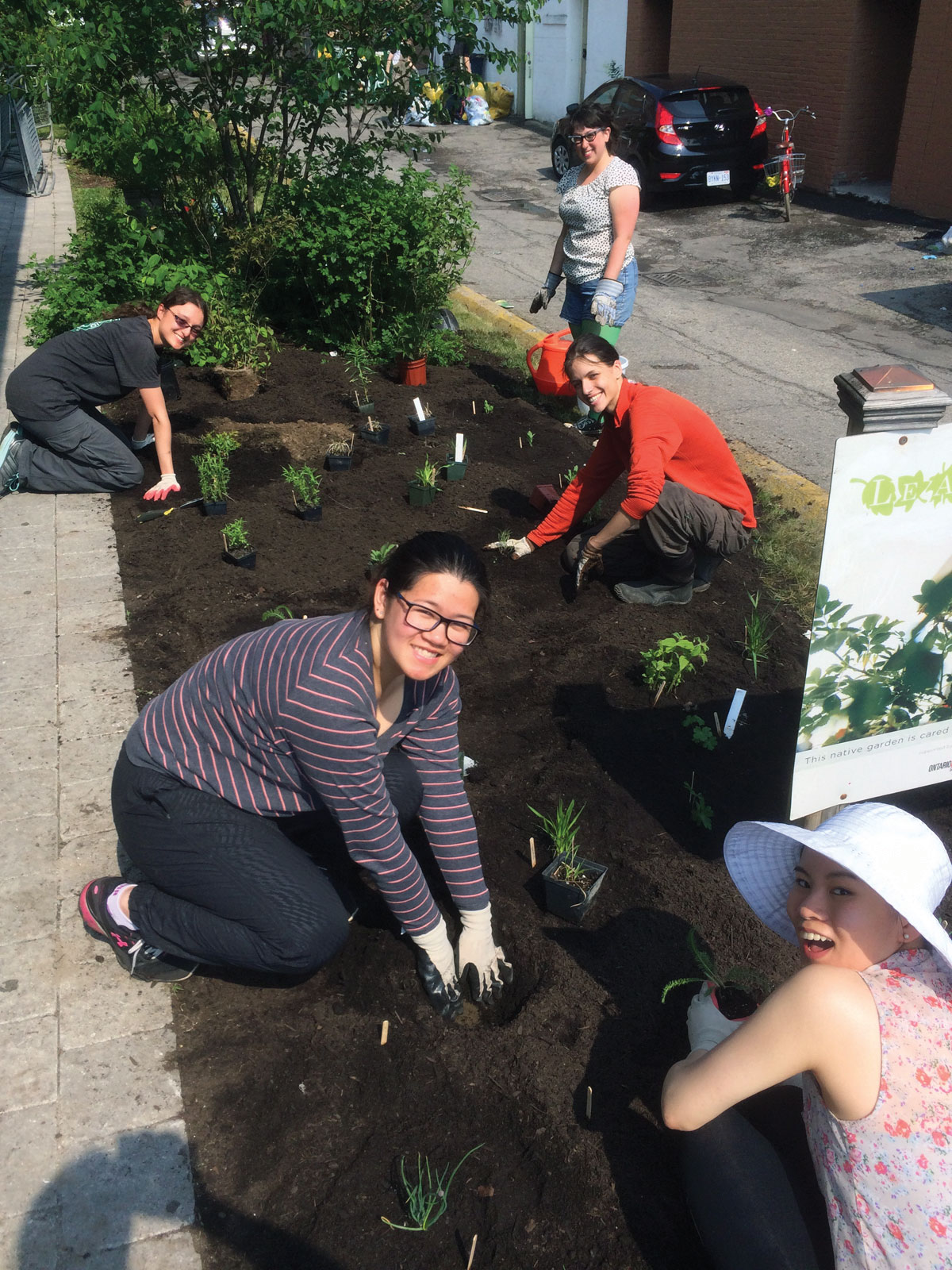
PICTURE COURTESY ©ERIN MACDONALD/LEAF: Volunteers tend to LEAF’s Urban Forest Demonstration Garden at the Markham Road entrance of Bathurst subway station.
By Clarrie Feinstein
After paradise was paved over this summer at a North York building site, an organization dedicated to preserving the city’s urban forest hosted a September meeting to discuss how citizens can help enforce Toronto’s tree bylaws. The clearing of 40 trees, including a 150-year-old linden tree, to make way for condominium units was top of mind for many of the approximately 60 people in attendance at the meeting.
“We were very aware of the confusion and frustration that the public felt, which is why we hosted the event,” said Janet McKay, the executive director of Local Enhancement and Appreciation of Forests (LEAF). “We need to reduce the frustrations and clarify what the bylaws can and cannot do.”
Supervisor Mark Ventresca and manager Arthur Beauregard of the City of Toronto’s Urban Forestry division led the discussion on the city’s tree bylaws and explained its tree protection policies.
A city permit is required to remove any tree that is greater than 30 centimetres in diameter. If approval is granted, the removal is monitored, and steps are taken to ensure a new tree is planted in its place. Most tree removals occur in construction zones, and 90 per cent of applications relating to building sites are approved.
If trees are not removed during construction, the builders must install a protective fence around each individual tree. Should a site not comply, a maximum fine per tree of $10,000 would be assessed by the city.
Even unhealthy trees are subject to the approval process.
Beauregard and Ventresca, who said their motto is “all trees are good”, will protect trees until it’s proven that a tree will be a serious safety risk. Even if it is home to an invasive species but still healthy, a tree will not be approved for removal.
The city has made significant progress in regulating tree removals since 2011, stressed Ventresca, who added that there has been a 2.5 per cent increase in tree removal permits over the last eight years.
But Tim Grant, chair of the Harbord Village Residents’ Association (HVRA), said the bylaws still aren’t strong enough.
“We’re losing canopy to pavement,” said Grant. “The violations that occur are routine because there is a lack of enforcement, which then makes people not fear any penalty charges.”
Although most HVRA residents are sensitive to protecting and growing the city’s tree canopy, Grant has witnessed tree bylaw violations in the area. Some years ago, he saw the death of a mature Norway maple in the neighbourhood after homeowners installed flagstones around the tree, strangling its roots in only 12 inches of soil. It’s been four years since the homeowners were told to replace the tree, and still nothing has been done.
“That’s the real trouble,” Grant said, “there is no follow-up. The process is unclear and the policy is not enforced. No one feels the long-term repercussions, but we will soon if we keep treating our trees in this manner.
“By cutting down that maple, there is reduced canopy coverage and privacy. That will have an impact. The lack of species diversity is a huge problem we are currently facing — older trees are nearing the end of their lifetimes.”
Other imminent threats to the tree canopy include invasive forest insects and continuing challenges related to managing invasive plant species, in addition to the uncertain related climate change effects.
The most pressing threat, however, is Toronto’s intensification and rapid development, which is placing increased pressure on the city’s green space and trees.
“Trees should be managed like assets,” said McKay. “If people were to incorporate protecting and maintaining an urban forest like an asset then people are more likely to invest in the maintenance of it.”
According to Every Tree Counts: A Portrait of Toronto’s Urban Forest, trees provide numerous benefits to the city that more than make up for the cost of their upkeep: reduced energy use from heating and cooling of residential buildings, improved air quality, and the absorption of carbon emissions.
All of which makes caring for the urban forest more urgent than ever before.
Yet a report released by the Green Infrastructure Ontario Coalition (GIOC) — an alliance of business, not-for-profit, community groups and local governments working to promote green infrastructure across the province — demands that provincial and federal governments provide meaningful support to help municipalities manage their urban forests as assets.
With 444 municipalities in Ontario, creating a green infrastructure and policy plan from scratch is a task many communities do not have the resources to complete. Even Toronto, which has developed the nation’s leading urban forestry protection plan, only has 40 staff working citywide and very limited resourcing.
“It puts a strain on what we can actually accomplish,” said Ventresca. “We simply do not have enough people and therefore our time is limited.”
He wants to build on Toronto’s first ever Strategic Forest Management Plan, which was approved by Toronto City Council in 2013. It targets increasing the city’s tree canopy cover from 28 to 40 per cent by 2050.
“It’s a lofty goal,” McKay said, “but at least the city has a plan. Now, it’s how can we make this a multilevel government plan.”
READ MORE:
NEWS: Help grow the urban forest (September 2016)
NEWS: Bloor Street goes green (April 2016)
City seeking street greening opportunities: Harbord Village plan targets laneways, parkettes (February 2016)
FOCUS: Urban Elms (September 2015)
Tags: Annex · News