December 20th, 2016 · Comments Off on YEAR IN REVIEW (DECEMBER 2016): A focus on livability, grindertude
Year in review reflects community initiatives
By Annemarie Brissenden
Little did we know last year that our annual holiday cover — a reproduction of a painting by Lawren Harris — would be quite so appropriate for 2016. Harris enjoyed a renaissance this year as the subject of both an Art Gallery of Ontario exhibition curated by Steve Martin and a documentary by White Pine Pictures.
Upon review, our cover photos were a good barometer of the stories featured in our pages throughout the year. Our April cover, for example, showed a canoeist portaging across Bay Street on Davenport Road, part of the old Aboriginal trail linking the Humber and Don rivers. It not only reminds us of the rich heritage of our Aboriginal and Indigenous community members, but of the importance of the work of the Truth and Reconciliation Commission. In August, the cover photo of a rail derailment summed up a year’s worth of coverage quite succinctly, while the actors, artists, and athletes gracing our first page reflect the diversity of our coverage area. All of that said, some themes did emerge time and time again, summarized in what is becoming a December tradition: our year in review.
Sustainability no longer a luxury
While development continued to dominate our pages in 2016, we are starting to see a new layer added to some projects: sustainability. Set to open next year is One Spadina Crescent, which features storm water harvesting, green roofs, and large windows that invite light into the building. There are also spaces for bicycles, which in turn take centre stage in Westbank Project Corp.’s plans to redevelop the parcel of land including Honest Ed’s and Mirvish Village. The proposed new development entrenches cycling as a primary mode of transit, providing for a bike valet and repairs. The company has said it is aiming to meet LEED Platinum Neighbourhood and Toronto Green Standard Tier 2 for Mirvish Village, and has planned to include a centralized heating and cooling plant that will transfer energy between individual buildings, as well as green roofs. It’s exactly the type of sustainable development many in the community would like to see — albeit on a much smaller scale — enshrined at the new Catholic school set to be built on Barton Avenue where St. Raymond Catholic School currently sits. Abutting Christie Pits opens up a wealth of opportunities — school gardens and the like — and many parents view this as a chance to incorporate green education into the school’s curriculum.
When will Toronto gain control of its destiny?
When read in concert, a series of seemingly unconnected articles on the Ontario Municipal Board (OMB) and crumbling infrastructure in public schools hints at the biggest challenge facing Toronto: our ability to control our own destiny. Take the Toronto District School Board (TDSB) budget as an example. The province does a very good job of convincing the TDSB’s stakeholders that the board is unable to manage its own money. However, the TDSB has no say in how much money it pays its staff, one of the biggest line items in the budget, and no ability to raise additional funds to pay for things like much needed infrastructure repairs. And the TDSB is but one example of the many publicly-funded institutions in the city that rely on the province for money but don’t get nearly enough in sustainable funding. With the city scrambling to fill the cracks — both literally and figuratively — left behind by the province, it’s no wonder that there isn’t a lot of money left behind to fund things like transit. At one point in its history, this newspaper ran a lot of articles floating the idea of reclassifying Toronto as a province. Perhaps it’s time to resurrect that discussion.
To OMB or not to OMB
The biggest surprise to come out of the province’s review of the Ontario Municipal Board (OMB) is that not everyone would see it abolished. Some argue that it should be reformed, while others would like to exempt Toronto from its oversight completely. Watch this space for an article in January, but suffice to say that everyone agrees it cannot stay as it is. And no wonder: nearly every article about a development published in these pages references the OMB, usually relating a resident’s concern that the provincial agency (okay “arm’s-length” agency) will overturn a decision made by Toronto City Council. That’s not to say that the city gets off without criticism, for there are often rumours of secret, last minute deals swirling around big name developments. What’s particularly clear is that we need a transparent, consistent, and effective process for evaluating development applications in this city.
The path to reconciliation
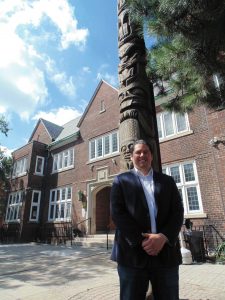
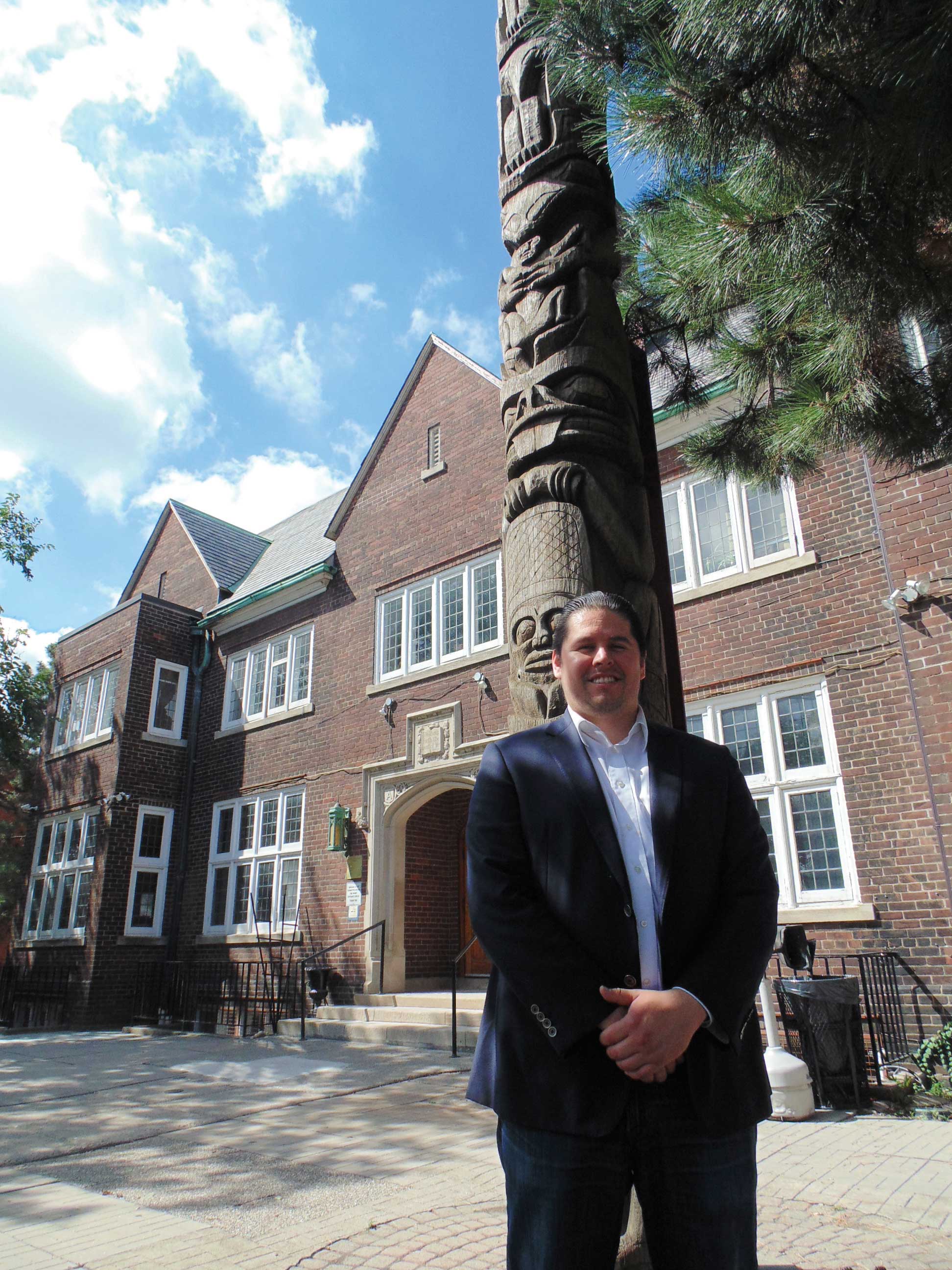
PHOTO BY BRIAN BURCHELL/GLEANER NEWS: Michael Etherington, manager of cultural programming at the Native Canadian Centre of Toronto, who argued that incorporating Indigenous teaching techniques in so-called traditional educational institutions could prompt a complete paradigm shift.
The Truth and Reconciliation Commission of Canada (TRC) published its final report almost 18 months ago, including 94 Calls to Action aimed at redressing the historical imbalance caused by our nation’s Indian Residential Schools. A significant number are education-related reforms, and educational institutions in our coverage area are starting to pay attention. The University of Toronto steering committee mandated with prioritizing the institution’s response to the TRC is slated to submit its report by the end of this year, and has established five areas of focus: Indigenous curriculum, Indigenous students, Indigenous faculty and staff, Indigenous co-curricular educations, and Indigenous research ethics and community relationships. The Toronto District School Board has also begun to respond, and as of September, students at all of its schools make an Indigenous land acknowledgement before the singing of the national anthem. These are small but important steps on the path to reconciliation.
A shout out to our boys in blue

PHOTO BY R.?S. KONJEK/GLEANER NEWS: Brett van Pelt of the Toronto Maple Leafs delivers a pitch during the final game of the recent season on July 31.
No, we don’t mean the Blue Jays, or the Toronto Maple Leafs hockey team. We mean the other Maple Leafs, the ones that actually win a game or two: the Toronto Maple Leafs baseball club, who play at the diamond at Christie Pits. Like the Toronto Football Club, our Maple Leafs ground their way to the championship, only to lose to the defending Barrie Baycats. It was that loss that inspired Gleaner Leafs’ columnist R.S. Konjek to present two new words for consideration by the English language: stepability and grindertude. It also inspires us to remember what sport is really about: determination, grit, and drama, none of which are the domain of the city’s big name sports teams. We hope this inspires you to consider supporting some of the lesser-known teams like the Toronto Marlies Hockey Club by taking in a game or two. As they are more affordable for families (Maple Leafs games are free), it’s the perfect way to introduce a whole new generation to the glory of sport.
Risky rails redux
The Aug. 21 derailment near Howland Avenue and Dupont Street exemplified the risks many residents have been trying to highlight for years. That incident — which sent two locomotives and several rail cars off the tracks — is still under investigation, and was but the latest for concern. Residents are quick to note that the train from the July 2013 derailment that killed 47 residents in Lac-Mégantic, Quebec, had passed through the Annex with crude oil only days before meeting its end in the small town. At a well-attended town hall in April organized by Chrystia Freeland (MP, University-Rosedale) and several of her Toronto-based colleagues, residents questioned whether safety regulations adequately account for today’s typical loads (crude oil, chemicals, etc.), as well as whether the rail cars themselves meet the highest safety standards, before asking why dangerous goods could not be diverted altogether.
The better way needs a better plan
How many among us can attend one more community consultation meeting on a future development that does not contemplate the projected public transit ramifications? The province and city have decreed that development should occur at transit nodes, without providing any assurance to those of us who actually use transit how our already-overflowing buses, subways, and streetcars will take on more passengers. It is all very well and good to note that the closer a person lives to their place of work, the more likely that person is to walk or ride a bike to work, as a certain local councillor is fond of saying, but that doesn’t really address the issue. Thus, the absence of a plan is what earns transit a presence on this list.
Welcome to your (new) home
The neighbourhoods that fall within our coverage area have long welcomed people seeking a new home. And this year was no different. It’s almost a year since our nation officially opened its arms to refugees from Syria, and our residents are continuing to provide support to those arrivals. But we covered other types of homecoming in our neighbourhood as well. Sprott House opened its doors to LGBTQ2S youth in January, while the Evergreen Centre for Street-Involved Youth is set to relocate to Spadina Avenue in September of next year. The Rogers Foundation also made Hot Docs cinema a permanent home for storytelling thanks to its $5-million donation that enabled the Hot Docs to purchase the Bloor Street theatre and rename it in the family’s name.
Making our neighbourhoods more livable
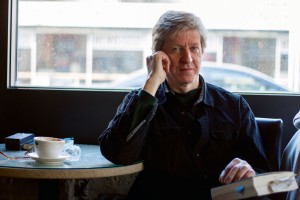
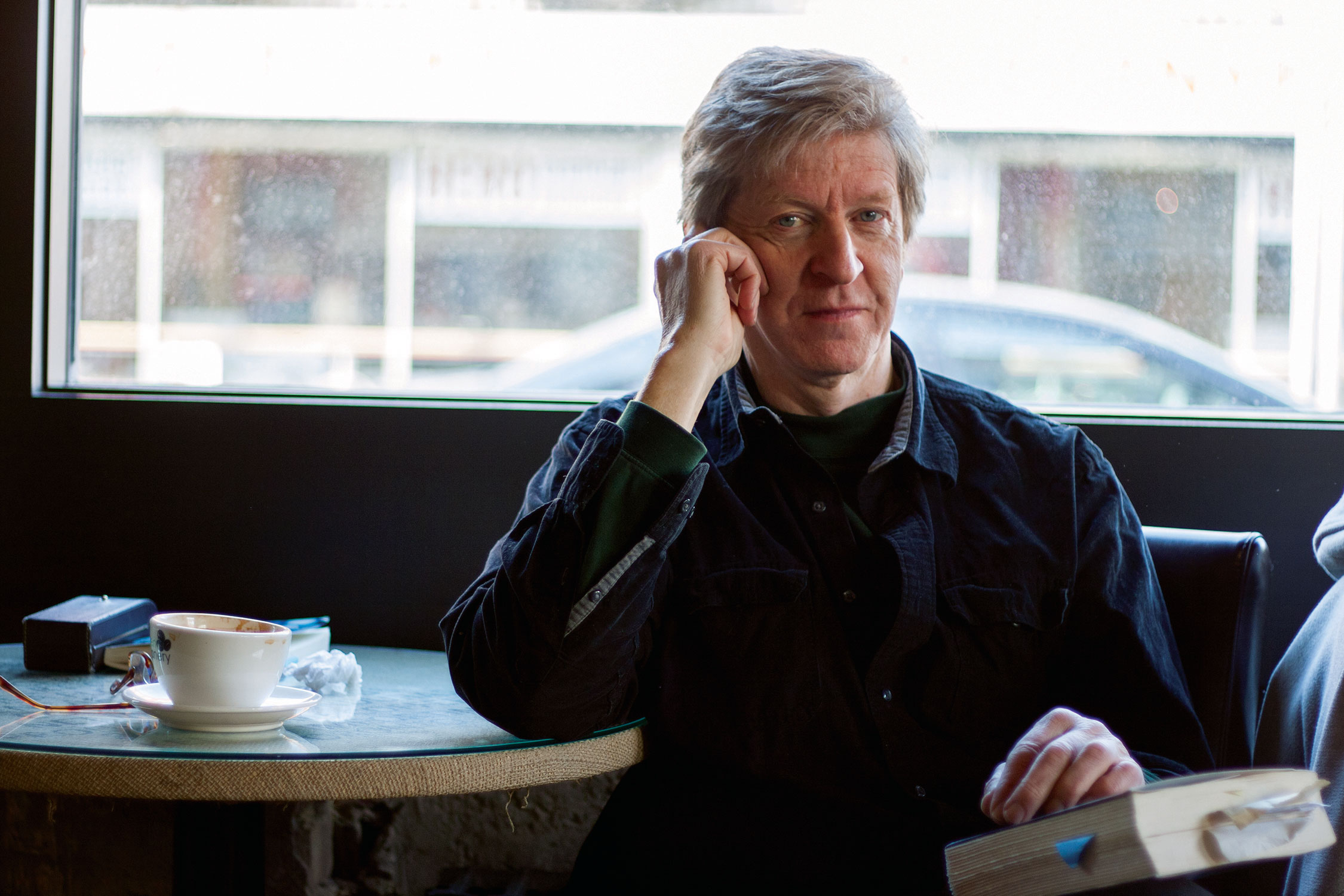
PHOTO BY NEILAND BRISSENDEN/GLEANER NEWS: R.H. Thomson poses at the Green Beanery in March. The Order of Canada member starred in You Will Remember Me at the Tarragon Theatre in March and April.
Livability was a major theme on our pages this year. We’ve covered the City of Toronto’s initiatives on dog ownership, a plethora of park initiatives (both renewing old parks and finding creative ways to add new ones), and plans for streetscaping. What we’ve noticed is how many of those initiatives come from the community itself, without whom we wouldn’t have such a vibrant farmers’ market, say, or bike lanes on Bloor Street. (For the latter matter, we unabashedly tip our hat to this newspaper’s publisher, who as the chair of the Bloor Annex BIA managed to finish something that was begun 40 years ago.) That commitment to building our neighbourhood, whether tree by tree, bike lane by bike lane, or festival by festival, is what makes our neighbourhood such a special place to live.
Tags: Annex · Life
December 20th, 2016 · Comments Off on ARTS (DECEMBER 2016): HMS Terror found on greeting cards
Thomas Fisher Rare Books a treasure trove unto itself
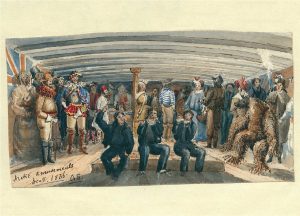
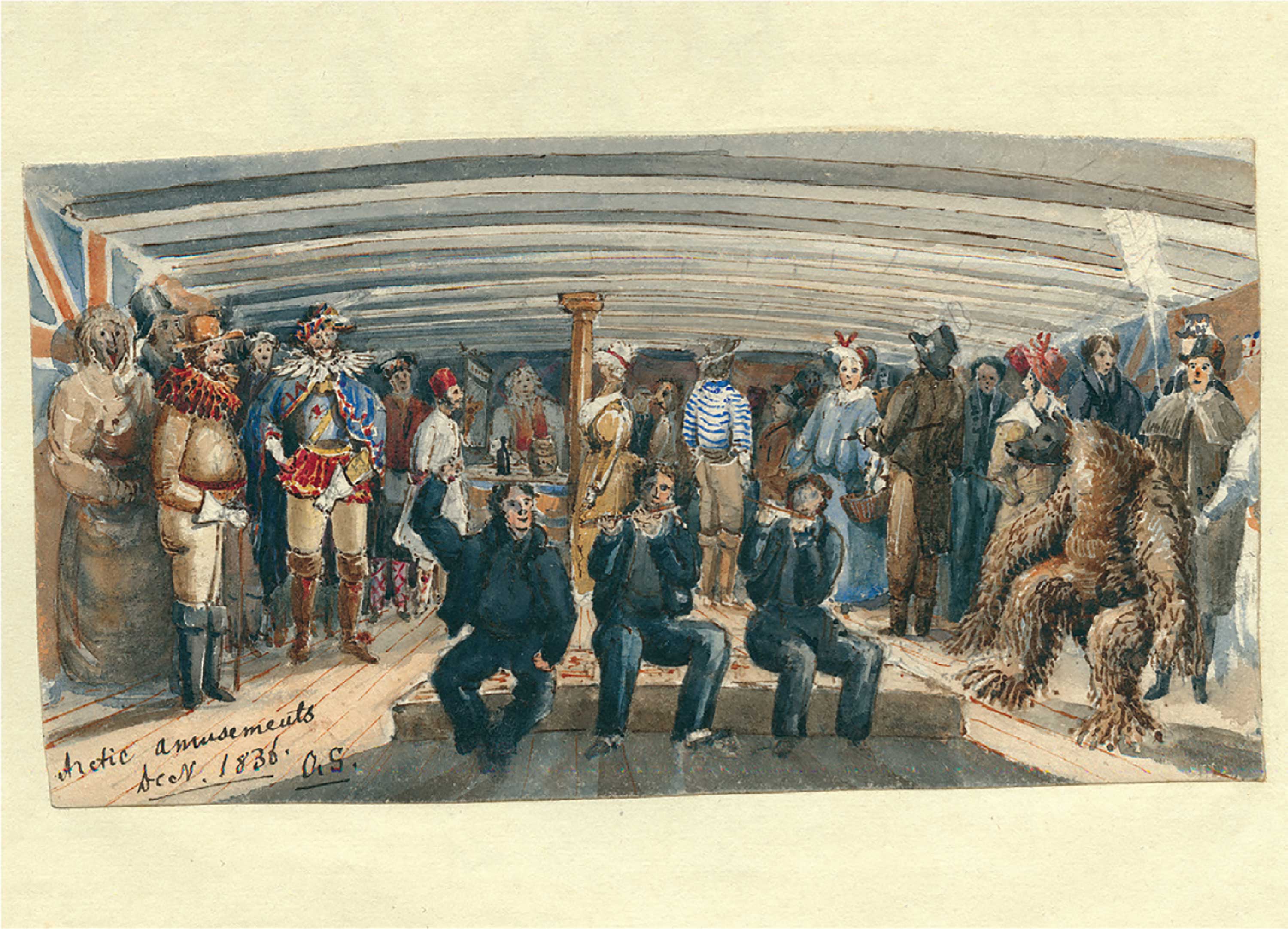
PHOTO COURTESY U OF T THOMAS FISHER RARE BOOK LIBRARY: “Arctic Amusements” by Owen Stanley depicts the ship’s crew passing the time while stuck in sea ice in 1836-7.
By Annemarie Brissenden
You may know that a maritime mystery was solved this September when Arctic researchers found the HMS Terror, one half of the Franklin Expedition that had set out to seek the Northwest Passage in 1845. Her sister ship, the HMS Erebus, had been found by the same team last year.
What you may not know is that it has an Annex connection.
[pullquote]“Canada’s Arctic is one of the few places in the world that is still so unknown”—Adrian Schimnowski, CEO, Arctic Research Foundation[/pullquote]
A naval officer and surveyor named Captain Owen Stanley had served on the Terror when it sailed to the Arctic in 1837-38. Stanley kept a daily diary and made sketches depicting the activities of the ship, later using them to create original watercolour paintings. That diary, those sketches, and the resulting watercolours are to be found in the University of Toronto’s Thomas Fisher Rare Books Library.
And this year, the sketches and watercolours are the basis of the library’s holiday card collection, a popular annual tradition.
“We first used the Owen Stanley image of the HMS Terror for the Chief Librarian’s card in 2014,” explained Maureen Morin, a graphic designer with the university’s libraries, in an email. “We had already selected it when the prime minister announced in September of that same year that the wreck of one of Franklin’s lost ships had been found, although we wouldn’t learn until later that it was the Erebus. When the wreck of the Terror was located in 2016, we thought it fitting to use that image as well as ‘Arctic Amusements’ for the holiday cards we sell.”
The HMS Terror had a long history, and had travelled to the Arctic more than once before being lost, said Pearce Carefoote, one of Thomas Fisher’s librarians. It was originally fitted to be a bomber during the War of 1812, and was at Baltimore where it was perhaps responsible for some of the bombs that inspired Francis Scott Key to write the “Star Spangled Banner”.
“Because the bombers were stronger, they had a better chance of surviving in the Arctic ice,” he added, explaining how the ship came to be part of arctic expeditions.
The items have been in the library’s collection since they were purchased from a rare book dealer in London, England, in 1971.
Carefoote said he believes the Franklin has captured the Canadian imagination because “it’s part of the enigma of the north that Canadians understand”. He also thinks that while we may never fully know what went wrong with the expedition, we do “know what they were up against”.
“Canada’s Arctic is one of the few places in the world that is still so unknown,” agreed Adrian Schimnowski, chief executive officer of the Arctic Research Foundation, the team that found both the Terror and the Erebus. The Franklin Expedition is “about human experience and condition; what’s interesting in the Arctic is that we’re always going to be facing the same element: environment. It’s so extreme.”
Loryl MacDonald, Thomas Fisher’s director, believes this year’s cards will be particularly popular. And not just because they are timely or speak to something uniquely Canadian, but because they are incredibly beautiful. Proceeds from the sale go towards the library’s development fund, which supports various projects with the university’s library system, including acquisitions.
She said that the rare books library is one of the top research libraries in Canada and North America.
“It’s a jewel in the crown, and it’s a gem,” said MacDonald. With a broad index of varied things ranging from Shakespeare’s folio to Leonard Cohen manuscripts, it is open to the entire community for free.
“People come from as far away as Japan, and as close as Huron-Sussex wanting to research the neighbourhood. It’s pretty amazing that you have these collections right in our neighbourhood.”
For further information on the University of Toronto’s Thomas Fisher Rare Book Library, or to order greeting cards, please visit the library’s website.
YOU MAY ALSO BE INTERESTED IN:
HISTORY (SEPTEMBER 2015): A haven for children’s literature by Annemarie Brissenden
Tags: Annex · Arts
December 20th, 2016 · Comments Off on GREENINGS (DECEMBER 2016): A green, meaningful Christmas
Five alternatives to store-bought gifts
By Terri Chu
When I was a child, Christmas was a magical time. But as I grew older and became more environmentally aware, the holiday quickly became one of my least favourite times of year. Now I can’t even step into a mall during the holidays: just the mere sight of so many useless gifts meant as a token, ultimately destined for the landfill, makes me grieve for the planet.
[pullquote]“It’s important to me to teach my daughter that gift giving is about the person, the thought and effort, and not just about having something to unwrap.”[/pullquote]
In an attempt to reduce our environmental footprint this Christmas, my husband and I have agreed that our gifts will fall under one of five categories: handmade, edible, experiences, heirlooms, or charitable donations. (Getting the extended family to come on board is a different challenge altogether, a fight I’ve been advised not to wage.)
Handmade (Look, I made you a scarf!)
A handmade gift, in my opinion, gives the gift added importance. There’s something about dedicating hours to a project that simply forking over a few bucks for a cheap dollar-store mug doesn’t give you. It’s important to me to teach my daughter that gift giving is about the person, the thought and effort, and not just about having something to unwrap.
Edible (I baked you this delicious cake!)
In the lieu of something handmade, I turn to something edible. (The assumption here is that it isn’t packaged in plastics forever to grace this earth.) For the times when I cave and end up getting takeaway or prepackaged food, I save the containers for a second life as a gifting vessel for homemade treats.
Experiences (I would like to take you to this concert)
Someone once told me my children will remember me more for the time I spend with them than for the things I buy for them.
Heirlooms (These earrings belonged to your grandmother, cherish them)
There will always be things that get passed down through the generations. There are items that meant a lot to our parents, and to us, that we will want our children to cherish. Material gifts have such a short shelf life (do toys even last six months?); it’s nice to see gifts that can last generations. If we treated material gifts as possessions meant to last, our oceans would certainly be less toxic to marine life.
Donation (I am contributing in your name to this important cause)
This Christmas, however, my girl is getting a different gift. In her name, I will be making a donation to the Standing Rock Medic and Healer Council. I can’t think of another environmental battle in my lifetime that has had greater significance than this one. Water protectors are out there, in sub zero temperatures reportedly getting sprayed with water cannons, rubber bullets, and concussion grenades. Their only crime is protecting water on lands that were historically theirs.
Every engineering student is told in school that all pipelines will rupture. It is not a matter of if, but a matter of when, and how well controlled the resulting spill will be. If the Dakota Access Pipeline gets built and a resulting spill contaminates this water supply, life for most of us will go on, but just not there. The lands will be uninhabitable. The people will be forced to move, and it will happen again and again until there is no more land that is safe to live off.
The era is of big oil is drawing to a close and I see this as a gift to my daughter’s future. How ever you choose to celebrate Christmas, I hope you celebrate with the future in mind.
Terri Chu is an engineer committed to practical environmentalism. This column is dedicated to helping the community reduce energy, and help distinguish environmental truths from myths.
READ MORE GREENINGS BY TERRI CHU:
Force the focus (November 2016)
The school of the future (July 2016)
Taking action on climate change (June 2016)
Cloth diapers have gone from burden of the poor to luxury of the rich in one generation (May 2016)
Provide help or stand aside (April 2016)
Don’t fall prey to marketing (March 2016)
Tags: Annex · Life
December 20th, 2016 · Comments Off on LIFE (DECEMBER 2016): Ontario travel vaccines made easy
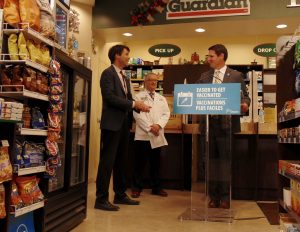
PHOTO BY NOELLE DEFOUR/GLEANER NEWS
Pharmacists will be able to administer 13 common travel vaccines starting Dec. 15 announced Dr. Eric Hoskins, Ontario’s minister of health and long-term care, at Snowdon Pharmacy on Dec. 1.
“Nobody wants to be scrambling to get into their doctor’s office while juggling all of the other things they need to do during the holiday season,” said Hoskins.
Among the approved vaccines are those that prevent shingles, Hepatitis A and B, HPV, and rabies, as well as meningococcal and pneumococcal diseases.
Patients who choose to receive vaccinations from a participating pharmacist will have to pay for the vaccine. The publicly-funded flu vaccine will continue to be available to Ontarians for free from their primary care provider, as well as from participating pharmacies.
—Summer Reid/Gleaner News
Tags: Annex · News · Life
December 20th, 2016 · Comments Off on FROM THE ARCHIVES (DECEMBER 2016): The importance of independent pharmacies
In this latest piece from our archives, we reprint a story from our May 2010 edition on Snowdon Pharmacy. We thought it would make an interesting companion piece as it illustrates just how much independent pharmacies do for our community, something that we, as an independent newspaper, know a little something about.
By Emina Gamulin
Snowdon Pharmacy (264 Bloor St. W.) has had many tough times in its 104-year history, but the changes the provincial government proposes to cut drug costs may be the biggest challenge the community institution has faced thus far.
[pullquote]“When some of the elderly get confused, rather than give them ten bottles and have them flush them down the toilet, or only take the pretty pink ones, we’ll make them a blister pack”— Anneke Allen, Snowdon Pharmacy[/pullquote]
The government announced its plans that as of May 15, pharmacies will no longer be able to receive “professional allowances” from generic drug makers, which amount to $800 million a year for Ontario pharmacies.
Contrary to the notion that the rebates are kickbacks, Anneke Allen of Snowdon Pharmacy says they go directly back to the consumer. Every three months, she sends a report to the government proving that the money goes to patient care.
“When some of the elderly get confused, rather than give them ten bottles and have them flush them down the toilet, or only take the pretty pink ones, we’ll make them a blister pack,” said Allen, describing one free service.
She offers other examples. “If you just came from Shoppers and say ‘The pharmacist didn’t have time to talk to me but I need a little more information,’ he [Snowdon] doesn’t kick you out, he pulls out the book, hell, makes the photocopies for you because that’s what a pharmacist does — they care.”
The money has also gone towards things such as providing free deliveries, hiring students in the summer, holding customer appreciation days and flu shot days, amongst other things.
“Are you getting the gist of what this money did for pharmacies?” she asked, adding that all these things will go out the window if this becomes law.
“If you want to speak to your pharmacist I’m going to have to say to you, ‘It will be 45 minutes and it will be $25.’”
Allen said that the government led pharmacies along to believe that there would be some sort of a negotiation process.
“We were about two weeks into our campaign saying, ‘Give pharmacists a chance, don’t take away our money’ when the McGuinty government threw their hands up and said. ‘Please call off the dogs we’ll negotiate with you.’”
Next thing they knew, a 16-page report outlining the changes was announced.
“They haven’t seen the full impact of how pharmacies, pharmacists, employees, patients and anyone associated with a pharmacy will react to this.”
MPP Rosario Marchese (Trinity-Spadina) says that while drug costs have been skyrocketing in Ontario and they need to be reduced, he believes the government went about it in an entirely inappropriate way.
“I’m not sure they thought it through very well,” he said. “The problem with this measure is that it is sort of buried in the budget bill, so there are no hearings. People have 30 days to comment on it, but it’s not a reasonable debate where you allow people to come and give their personal stories, and then legislatures on the basis of this say ‘That’s interesting, we never thought of that, how do we deal with some of those problems that we didn’t anticipate?’
“We are worried about how many pharmacies might be affected. Because when you take $800 million to a billion dollars out of the system someone is going to be affected by it. Clearly the dispensing fees are going to have to go up, we know that. But will the dispensing fees first be enough for some pharmacists to recover those costs? We suspect in most cases it may not be.”
Snowdon Pharmacy invited Marchese to visit their store but he declined.
Allen says that the $1 increase to the current $6.99 that the government pays them will not be anywhere near enough to cover the difference, and in some cases doesn’t even cover their current drug costs, saying some products cost $10 that the government only gives them $8 for. “So we took a loss from the get go, that’s just one example.”
For now, Snowdon is going to try to keep all their staff but may have to cut hours. Allen is busy setting up a system to show customers exactly what they will have to pay extra for if the changes pass as planned.
Larger pharmacies like Shoppers Drug Mart have already started cutting pharmacy hours and introducing fees for deliveries.
On April 21, pharmacists in white lab coats came in droves to Queen’s Park to protest the proposed cuts. Health Critic Christine Elliott (Whitby-Ajax) brought forth a motion to protect seniors from the increased costs and reduced services that may result from the cuts that day. It was voted down.
When asked about the possibility of Snowdon having to close because of this, Allen replied, “That’s a hard one to say. We’re going to fight the fight.
“As a community pharmacy in this community they fought long and hard to keep it here, so we are going to fight to stay here for them.”
Tags: Annex · Life
November 18th, 2016 · Comments Off on ON THE COVER (NOVEMBER 2016): Cycling in the city
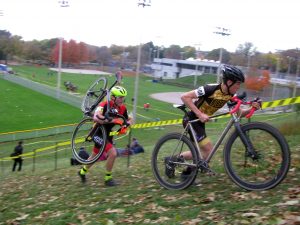
PHOTO BY R.S. KONJEK/GLEANER NEWS: Christie Pits saw cyclists of all ages and skill levels take on a variety of challenging cross-country bike courses on Oct. 29. Cyclocross Toronto organized the citywide event to promote cycling in parks and other public spaces.
READ MORE:
CHATTER: Bells ring a perfect offering (October 2016)
NEWS: Bikes blessed for another season (June 2016)
FOCUS: An early advocate for bike lanes (June 2016)
NEWS: Second phase of park revitalization to begin (May 2016)
NEWS: Christie Pits renewal set to begin (July 2015)
Tags: Annex · News
November 18th, 2016 · Comments Off on NEWS (NOVEMBER 2016): OMB opened
Residents glimpse settlement offer
By Brian Burchell
In an effort to bring transparency to the Ontario Municipal Board’s (OMB) mediation process, Joe Cressy (Ward 20, Trinity-Spadina) took the unusual step of bringing a developer’s confidential settlement offer to the community for comment before that offer is voted on by Toronto City Council.
“You have an undemocratic and unelected OMB making decisions…. In addition [to that], these decisions [are] made behind closed doors, then [subject to] an in camera debate at city council, without any say from the community,” said Cressy of his decision to call the October community consultation meeting.
[pullquote]“Right now, we have the same amount of development proposed in Ward 20, little old Ward 20, [as in] all of Etobicoke and Scarborough combined”—Joe Cressy (Ward 20, Trinity-Spadina)[/pullquote]
The offer relates to a highly controversial application to raise two towers of 15 and 29 storeys respectively at 328 (328, 332, 344, & 358) Dupont St. The application dates from 2010, when it was initially made by the Wynn Group of Companies, which is building a private student residence at 484 Spadina Ave., home to the Waverley Hotel and Silver Dollar Room. Council rejected the application in 2011, and the developer appealed it to the OMB, where it has been under mediation ever since. At some point in the project’s evolution, the development’s ownership was transferred from the Wynn Group to Freed Developments.
Under the without prejudice offer, the developer has agreed to reduce the height of the towers to 9 and 13 storeys, with setbacks from the Dupont rail line to be determined by a safety audit. The lower tower conforms to the maximum height allowed under the terms of the Dupont Street Study, which council approved in 2014 and which governs development between Kendal and Ossington avenues.
In describing the offer, Cressy characterized negotiating at the OMB as a game of high stakes poker.
“Do you risk it all and get a really tall poorly designed building or do you find a compromise? In this case the unique challenges include the transition to the neighbourhood, and the setback from the rail corridor.”
The councillor said that he believes the heights have been reduced as much as possible, because there is no guidance for development east of Kendal Avenue and because of the proximity to a subway line. Should council decide against the settlement, it is believed the developer will pursue its original application at an OMB hearing.
“On heights alone the [OMB] will accept 9 and 13 storeys, but on the issue of the rail setback I just don’t know,” admitted Cressy at the meeting.
David Harrison, chair of the Annex Residents’ Association (which, along with the city and developer, was one of the parties to the mediation), said he supports the settlement offer, cautioning that the rail safety component has yet to be settled.
A study to determine a safe distance between the Canadian Pacific Rail (CPR) tracks that line Dupont Street and any new developments is currently underway. The Dupont Study originally set that distance at 30 metres, but it was subsequently reduced to 20. The importance of this safety setback was brought into sharp relief in August when two CPR freight trains collided in August, causing a derailment at Dupont Street and Howland Avenue, just west of the site of the proposed development.
“I am limited as to how much I can say, but let’s just say that rail safety is a big issue,” said Harrison, adding that if city council does not approve the settlement and the project goes to a full hearing, the result could impact up to seven previously negotiated settlements for other projects on Dupont Street. Should the OMB rule in favour of the developer in a full hearing, it would potentially nullify those settlements or at least open the door for further negotiations.
“Right now, we have the same amount of development proposed in Ward 20, little old Ward 20, [as in] all of Etobicoke and Scarborough combined,” said Cressy. “Given that [the OMB] operates in secret and the Ontario government has thus far been unwilling to change or abolish it, I am going to do everything in my power to make sure local residents have a say.”
“I wholeheartedly support [Cressy’s] efforts to open the process and let the local residents see what’s in store for them,” said Jennifer Hunter, chair of the Seaton Village Residents’ Association, arguing that city council should vote to approve the settlement offer.
“Normally you can’t talk about these things publicly,” added Harrison, “but [Cressy] persuaded the developer to go along with this, and it’s in the developer’s interest to make it look like [it] cares what the community thinks.”
Toronto City Council voted to accept the staff’s recommendation not to accept the settlement offer just as this issue was going to press.
—with files from Noelle Defour
CORRECTION: November 21, 2016
In the original version of this article posted on November 18, 2016, we stated that Toronto City Council had voted to endorse the settlement offer. This was incorrect. City council had in fact voted to accept staff recommendations, which was not to accept the settlement offer. The error was as a result of a miscommunication with the councillor’s office, and that minutes of the in camera council meeting were not made public until after we had gone to press.
READ MORE:
NEWS: Trains in the night (September 2016)
ON THE COVER: Dupont Derailment (August 2016)
NEWS: Height, density still top concerns (July 2016)
EDITORIAL CARTOON: Planning! (July 2016)
CHATTER: Annex Residents’ Association app tracks developments (April 2016)
DEVELOPINGS: Annual review reflects tension between community activism and OMB (March 2016)
NEWS: Preserving a sense of community (March 2016)
Tags: Annex · News
November 18th, 2016 · Comments Off on NEWS (NOVEMBER 2016): A legacy of city building
One Spadina Crescent integrates new into old

PHOTO BY NEILAND BRISSENDEN/GLEANER NEWS: Architect Nader Tehrani (above) wanted to emphasize interconnectedness within and without in One Spadina. It was a challenge, he said, to “design a building whose main audience are designers of urban landscape”.
By Annemarie Brissenden
On a cool, crisp morning in early November, two architects in anticipation flit about a light-filled atrium like children on Christmas morning. Their excitement is palpable as they prepare to unveil a sneak peek of One Spadina Crescent, which for the past several years has been a boarded-up construction site.
The Gothic Revival building dates back to the mid 1870s when the Presbyterian Church bought the land from the Baldwin family and built Knox College on the circular site. Since then its many incarnations have included medical laboratory, miscellaneous university offices, and ghostly ruin. The mishmash of little warrens even provided a home to this newspaper at one point. But as this day revealed, One Spadina — due to open in 2017 — is almost ready for its next iteration as home to the University of Toronto John H. Daniels Faculty of Architecture, Landscape, and Design, a home that Richard Sommer and Robert Levit are eager to share.
[pullquote]“It’s a wonderful, great place”—Eberhard Zeidler, architect[/pullquote]
The building has both undergone a renovation and gained an addition. Its historical elements — a prominent staircase, arched hallways, and fine masonry — have been carefully uncovered and restored. The wings of the old building have been filled in to create interconnected space, and a north-facing glassed-in conservatory-like annex adding undergraduate and graduate studios that are marked by transparency from within and without. The studios that look down on to a Principal Hall able to accommodate up to 400 people can also be looked upon from outside.
The effect is, as Levit, the director of the faculty’s master of architecture program, said, “super, super dramatic”.
The university is aware that One Spadina is a marquee project for the university. It denotes a new gateway to its St. George Campus (consider the difference between this building and the now infamous graduate house at Harbord Street and Spadina Avenue), and models how to integrate new into old. Perhaps most importantly, though, it also marks a new openness with the community and city in which it finds itself.
Meric Gertler, the university’s president, stressed that the faculty and its new home on a prominent avenue in Toronto will be a conduit for learning, and play a key role in citybuilding.
Noting that One Spadina, one of the oldest buildings on campus, will become the third largest design centre in the country, he said that “A very important building and precinct are being revitalized.”
“It’s been more than two generations since they almost tore up a highway [along Spadina Avenue]”, said Sommer, of what he described as a game changer work of architecture. “This building will be a catalyst for a new age for this area.”
With such heavy expectations appended to the structure, it’s perhaps surprising that the building feels so light and airy. And yet it does. Openness marks the space, in which long bright corridors give way to even bigger and brighter offices and laboratories.
That sense of interconnectedness — between past and future, town and gown, within the building itself — was done by design, explained architect Nader Tehrani.
“Here people are scrutinizing every aspect as if each move was a didactic function,” said Tehrani, acknowledging the challenges of such a project. “It’s a historic building; we were building in and adding onto it. Absorbing new into old is difficult.”
“It’s a wonderful, great place,” said architect Eberhard Zeidler, a member of the Order of Canada whose many designs include the Eaton Centre and Ontario Place. He and his wife are prominent donors to the project, and One Spadina’s library, located in the building’s original cloister, will be named for him. He also underscored the need “to reuse that old building and make it new again”.
Indeed, it’s so cherished by the local community that block studies aim to protect the view of its spire from north and south. At one point, admitted Rory “Gus” Sinclair, the Harbord Village Residents’ Association (HVRA) even worried that the addition itself would be higher than the spire. But now, said the past chair of the HVRA, “Old Knox College never looked so good”.
But even the view is two-sided: just as the community strove to guard the view to the building, so too has the university carefully protected the view from the building, establishing the Paul Oberman Belvedere. The large raised terrace, said Sommer, “will restore this site in its role as a prospect to the lake”. He explained that Oberman was a real estate developer known for “bringing significant heritage properties back to life and integrating them back into the city”, making the belvedere emblematic of the building itself in more ways than one.
And so it goes with One Spadina: a building that contains more than itself.
READ MORE:
NEWS: Tall tower before OMB, as city battles back with block study (August 2016)
NEWS: Planning for the future (May 2016)
HISTORY: Catching up with history (May 2014)
Tags: Annex · News
November 18th, 2016 · Comments Off on NEWS (NOVEMBER 2016): City to propose dog bylaw changes
System to provide more tools for responding to aggressive behaviour

PHOTO BY NOELLE DEFOUR/GLEANER NEWS: Dogs ramble at Bickford Park, home to one of the city’s off-leash areas.
By Annemarie Brissenden
After a year of public consultations, the City of Toronto’s Municipal Standards and Licensing Division (MS&L) will propose an amendment to the section of the Toronto Municipal Code that governs dogs and dog behaviour.
“Primarily it’s about dog bites, and how the city responds,” explained Intiaz Ruffudeen, the manager of policy for the city, of the draft bylaw, which will be made public later this month. “The proposed system provides the city with more tools.”
[pullquote]“Most dogs put up with unimaginable idiocy and don’t bite people”—Naomi Kane, CKC[/pullquote]
Animal Services investigates each complaint of a dangerous dog or dog bite that it receives from MS&L, the city’s 311 service, or Toronto Public Health. Under the current system, if the complaint merits action, Animal Control Officers can issue a notice of caution or a warning to the dog’s owner, or require the dog to be muzzled whenever not on the premises of the owner. In extreme cases, such as severe bites or those resulting in death, officers can impose fines or order the destruction of the dog under the province’s Dog Owners’ Liability Act (DOLA).
The proposed changes, which will not prevent city staff from using provisions under DOLA if necessary and are not breed-specific, include new dangerous dog definitions and provide for a staged response to dog-related incidents. If an investigation determines an incident to be the dog’s first bite, a warning letter to the dog’s owner will be issued. If an investigation determines an incident to be the dog’s second bite, or the incident is found severe, the city can deem the dog dangerous and require the dog-owner to comply with additional regulations: muzzling the dog at all times, microchipping the dog, prohibiting the dog from leash-free areas, ensuring the dog wears a visible dangerous dog tag, putting a warning sign on their property, and receiving additional dog training.
According to Ruffudeen, the proposed measures are rehabilitative in nature, not extremely costly or punitive, and balance dog ownership with public safety.
“Owners are held responsible and accountable for their animal,” he said, of the city’s approximately 230,000 dogs.
In 2015, there were only 754 dog-to-human and 295 dog-to-animal reported bites, so it’s a relatively small problem, admitted Ruffudeen.
“Most dogs put up with unimaginable idiocy and don’t bite people,” commented Naomi Kane, chair of the Canadian Kennel Club’s responsible dog owners committee. She said she doesn’t understand why the city is revising its bylaw, when the provincial legislation spells it out.
“There is really good dangerous dog legislation on the books; the issue is that nobody is enforcing it.”
The challenge, responded wards 19 and 20 parks supervisor Brian Green, is that if you’re going to bring in a bylaw enforcement officer, “you’ve typically got a 10-minute window” before the dog-owner has left the area with the dog in tow.
Although he agreed that dog bites aren’t a big issue in the city, he pointed out that off-leash dogs are a big problem, particularly in the south end of the wards, where there are as many as five dogs a floor in the tall condominium buildings and so few parks to serve them.
In parks without off-leash areas, the dogs spray urine everywhere, strangling trees and shrubs, threatening the survival of the city’s tree canopy.
The city has also launched a publicity campaign to promote greater harmony between dog-owners and non-dog-owners, reminding dog-owners that for some people, every dog, no matter how friendly, is a threat.
“It’s a very small percentage of dog-owners that don’t follow the rules,” said Green. “We find the best way to deal with it is to have other dog-owners talk to the dog-owner in question.”
“The way we live with dogs has changed,” added Kane, who advised “knowing what you’re getting into, knowing what’s on the end of your leash. Do your research before you get that husky and expect it to lie around all day.”
The final report on the proposed changes to the bylaw, which will be made public on Nov. 23, will go before Toronto City Council’s Licensing and Standards Committee on Nov. 30. It will go before full council in December, and if passed will be implemented in the spring of next year.
Tags: Annex · News
November 18th, 2016 · Comments Off on CHATTER (NOVEMBER 2016): Dollar deals at Bathurst Station!
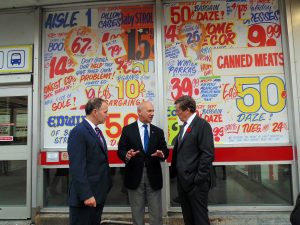
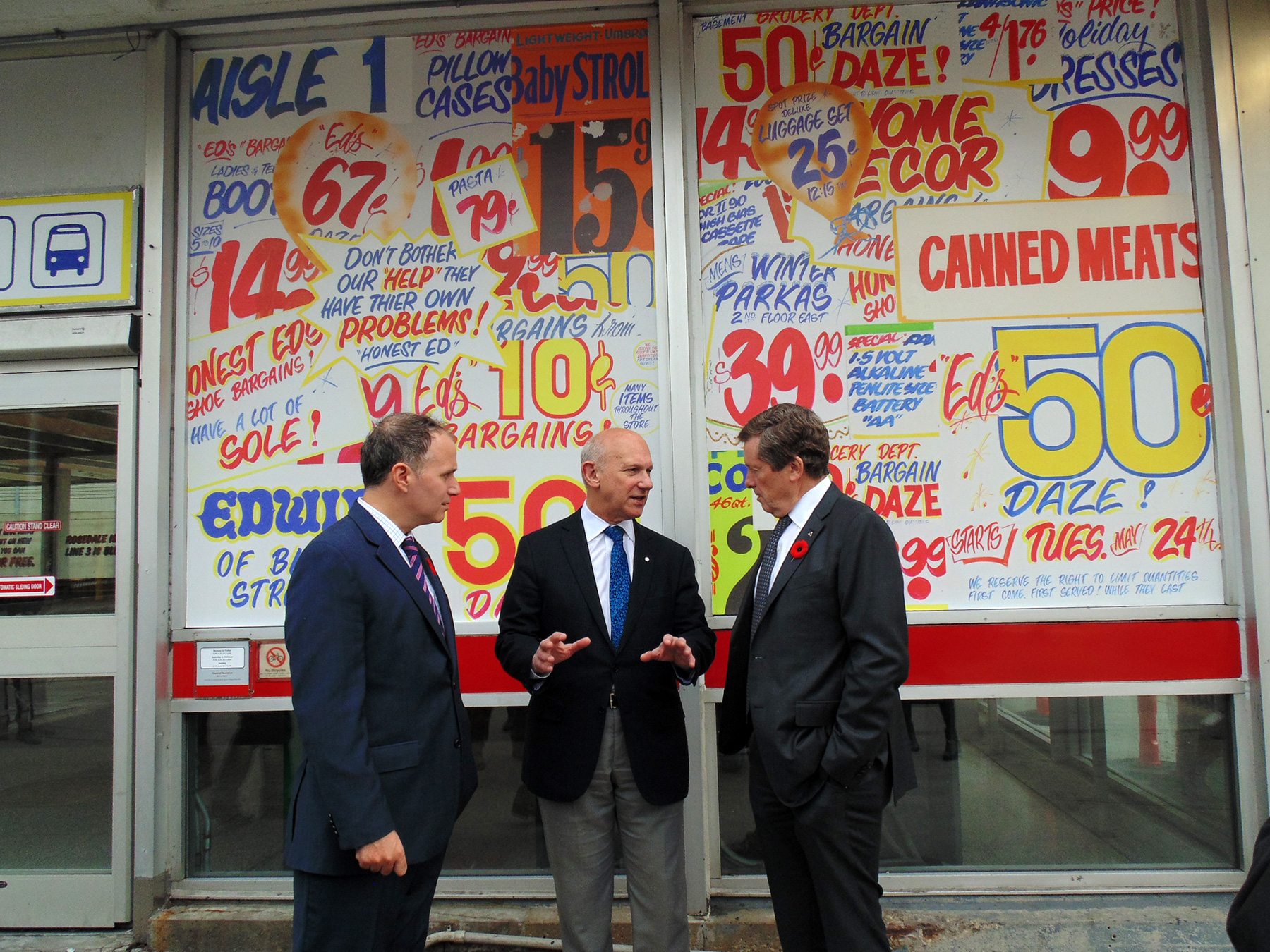
PHOTO BY NOELLE?DEFOUR/GLEANER NEWS: TTC chair Josh Colle (Ward 15, Eglinton-Lawrence), David Mirvish, and Mayor John Tory mark the impending closing of Honest Ed’s by unveiling a poster mimicking the discount store’s signature advertising style at the Bathurst Street entrance of Bathurst Station on Nov. 1. The store will officially close on Dec. 31.
Tags: Annex · News
November 18th, 2016 · Comments Off on POLICE BLOTTER (NOVEMBER 2016): Police make sexual assault arrest
The Toronto Police Service has arrested and charged 55-year-old Jeffrey Dewey of Toronto with sexual assault and impersonating a peace officer in connection with a Sept. 11 incident. At 12:06 p.m., a 36-year-old woman was in the College Street and Spadina Avenue area, when a man approached her and showed an object resembling a police badge, before proceeding to sexually assault her. It is alleged that Dewey may have assaulted other women, and police are asking them to come forward. Dewey has two distinctive tattoos: a mermaid on his left bicep, and a large multi-coloured star with a human eye in the middle of his right forearm. If you have further information, please contact the police at 416-808-5200, or Crime Stoppers anonymously at 416-222-8477.
—Summer Reid/Gleaner News
Tags: Annex · News
November 18th, 2016 · Comments Off on CHATTER (NOVEMBER 2016): Community policing update
Crime in 14 Division for August and September was less than the previous year across six major categories, reported Detective Sergeant Brian Kelly at a Community Police Liaison Committee meeting on Sept. 20. The division’s boundaries are Spadina Avenue, Bathurst, Front, and Adelaide streets.
Although six people were arrested for a violent robbery that had occurred on June 5, assaults have decreased by 16 per cent. Break and enter commercial and residential offences decreased from 16 to 9 and 25 to 13 respectively. Robberies in the area decreased from 21 in 2015 to only 15 this year, but there have been a few gun point robberies and the arrests have been made.
“This summer was remarkably successful. We have been successful in identifying where our crime trends are and place our officers there,” said Police Constable Iris Flekeisen, acknowledging the positive impact of neighbourhood groups in reducing crime, particularly gun crime, gang-related issues, and auto theft.
Police Constable Gordon Reid spoke on the division’s approach to local marijuana dispensaries. Stressing that such stores are currently illegal, he acknowledged that they will not be a target of police action if the protocols for medical use are being followed and no complaints about the dispensary are made. If a complaint about a dispensary is made to the police, the storeowners may be evicted and/or subject to an arrest warrant.
Brian Burchell who publishes this newspaper, sits on the committee in his capacity as chair of the Bloor Annex BIA.
—Noelle Defour/Gleaner News
READ MORE:
EDITORIAL: “An egregious breach of trust” (August 2016)
NEWS: Crime down overall in 14 Division (March 2016)
Tags: Annex · News