November 2nd, 2017 · Comments Off on CHATTER (Oct. 2017): Margaret is back
COURTESY RICHARD LONGLEY
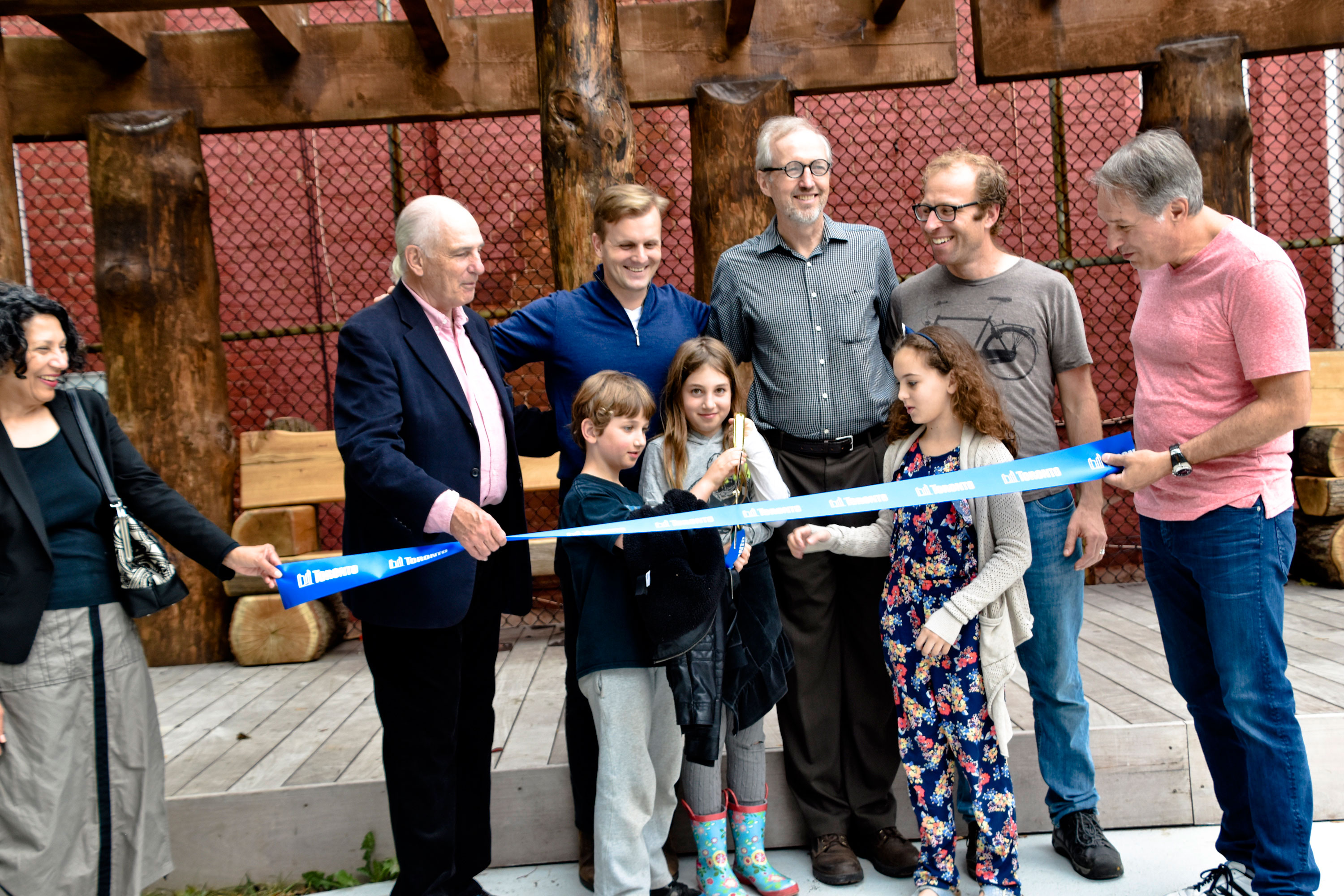
Marco Cupido and Gary Bloch help their children cut the ribbon to mark the official reopening of Margaret Fairley Park, also on October 14.
They were joined by Joe Cressy (Ward 20, Trinity-Spadina), and Harbord Village Residents’ Association chairs past and present, Gail Misra, Gus Sinclair, and Tim Grant.
Children are the forefront of the redesigned park, which includes new equipment, wading pool, and green space.
READ MORE:
GRADING OUR GREENSPACE: Open spaces in the heart of the Annex (JULY 2017)
GRADING OUR GREENSPACE: Meet our parks supervisor (AUGUST 2016)
NEWS: Renewing Margaret Fairley Park (JULY 2016)
Green sanctuaries in the heart of the city (JUNE 2016)
Park marks (AUGUST 2015)
Tags: Annex · News
November 2nd, 2017 · Comments Off on NEWS (Oct. 2017): Victory Cafe to reopen
Mirvish Village icon finds new life
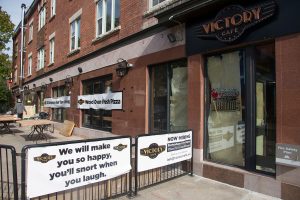
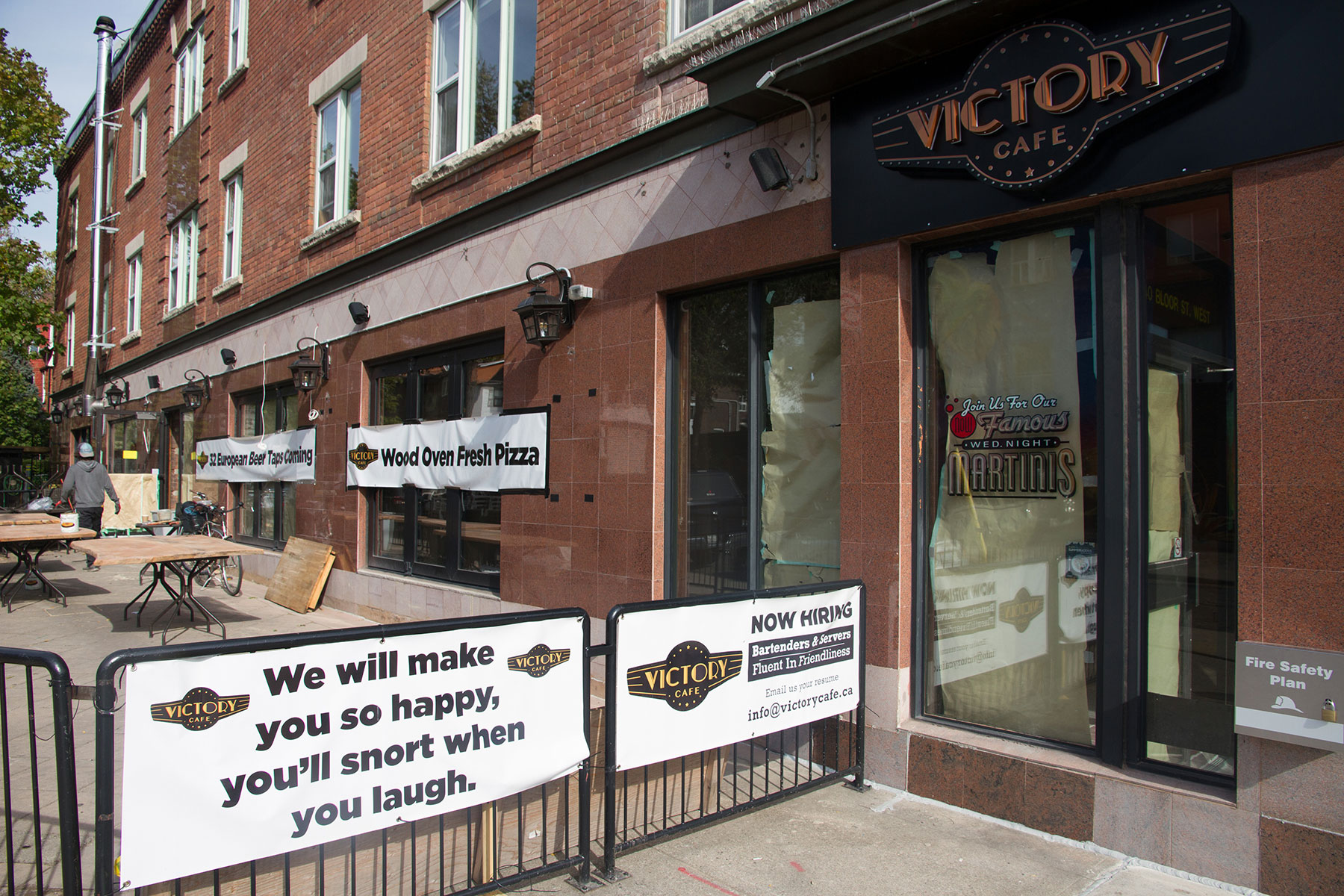
The Victory Cafe will reopen this fall at the corner of Bloor Street and Howland Avenue. It will offer a different selection of beer, as well as a new and improved distinctive menu. GEREMY BORDONARO/GLEANER NEWS
By Geremy Bordonaro
What are some Annex icons? The Hot Docs Ted Rogers (formerly Bloor) cinema perhaps, or the Trinity St. Paul’s Centre. Some might point to the University of Toronto, or the streets lined with bay and gable style houses. Until recently, surely one would have said Honest Ed’s, or even the Victory Cafe.
[pullquote]“We had Jeff Healey, who loved old jazz and was playing it with the Django Reinhardt group [Club Django] on Friday nights”—Paul Kellogg, founder, Victory Cafe[/pullquote]
The neighbourhood pub closed late last year to make way for the Mirvish Village redevelopment, and seemed poised to go the way of that other storied pub, the Brunswick House. However, it’s about to reopen, and not for the first time.
Opened in the 1990s, the Vic has been a go-to destination thanks to the vision and determination of original owner Paul Kellogg, who built the business on a simple, but effective, concept.
“Its first incarnation was at Bathurst [Street] at the corner of Follis [Avenue]. We started there in a 26 licensed space, but we squeezed in 36 seats,” recalled Kellogg. “We wanted to turn it into a new place, an alternative, that would offer comfort food, quality comfort food, that was inexpensive. A place where students and creative people would hang out. And that’s exactly what happened.”
The cafe had humble beginnings, to be sure. The first of the its three, soon to be four, locations was small but unique. Kellogg made an interesting decision when settling on the name for his new place.
“Yeah, I stole it. I had a girlfriend in New York at the time who was a vice president at JP Morgan Bank and from a wealthy family. She took me to a fabulous hamburger place in New York called the Victory Cafe. I looked up at this guy’s polo shirt and it had the same logo on it and I said that’s it.”
And soon enough the Vic gained a following. People — artists, professionals, students — from all over the city frequented the small cafe.
“Strangely it wasn’t only the hangout for actors and creative people in the Annex and Seaton Village but beyond,” Kellogg said. “Because there just weren’t enough places that were reasonably priced that were not greasy spoons at the time.”
When Kellogg ran the Victory Cafe it became a who’s who of people from throughout the city, including Mike Layton (Ward 19, Trinity-Spadina).
“I first met the Victory Cafe probably when I was a recent graduate student and it was a fun place to have a beer,” said Layton. “They tended to have a bit more of a selection than a lot of the other places that we were used to. They had a nice outdoor space, a good upstairs space for events, reasonably priced food, and good company. Through my twenties and probably until the end of my thirties I frequented the place.”
But even though the cafe found success it was still difficult to keep up with bills and demand. The Victory Cafe needed a bigger venue, and quickly, or it would soon start to flounder.
“I was about to give up and Ed Mirvish’s people called and offered me this huge, 5,000-square-foot double Victorian on Markham Street,” Kellogg said. “I didn’t know it at the time, I was thrilled to take over the space, but it had over 20 years of bankruptcies: a very fine dining Chinese restaurant (one of the earliest in the city), a Greek place, and everything in between, but they were all going out.”
The Victory Cafe managed to defy the building’s legacy and become an even bigger success in its new location, which Kellogg renovated.
“I then built the second floor where we had Second City improvisational groups, comedy, and we had Jeff Healey, who loved old jazz and was playing it with the Django Reinhardt group [Club Django] on Friday nights,” Kellogg said. “I spent my life in radio and always wanted to support creative people who never made enough money to pay the rent.”
Posters from all sorts of performances lined the walls and the Victory saw the likes of John Candy and Stuart McLean come through its humble doors.
“The Victory Cafe has been a name in the Annex since the early ’90s. It is the Annex,” said Nick Ndreka, who bought the Victory Cafe in 2015. “It’s sad that Victory had to close but we got lucky and found a place.”
The Vic’s new home at 440 Bloor Street West will have the same atmosphere as its previous locations, but feature a selection of European beer and a wood-fired pizza oven.
He vows to maintain the spirit of the cafe in its new home. But a legacy like that is not likely to die out as Kellogg points out.
“There are a million stories that came out of the Victory. Some people have them, I have them, and it is kind of nice that things live on through those stories.”
Tags: Annex · News
November 2nd, 2017 · Comments Off on EDITORIAL (Oct. 2017): Pandering to religious intolerance
Quebec recently passed Bill 62: An Act to foster adherence to state religious neutrality and, in particular, to provide a framework for requests for accommodations on religious grounds in certain bodies.
Unwieldy title aside, Bill 62 does little to separate church and state as its sponsors allege. The bill, which requires a person who delivers or receives public services to have their face uncovered, is a thinly veiled discriminatory attack on the fundamental rights of the minority of Muslim women who cover their face with a niqab or burka.
The law is a clear violation of the Charter of Rights and Freedoms and is a politically motivated oppression of a socially vulnerable religious minority. A de facto healthy dose of gender discrimination is thrown in, just in case you think this thing will survive a court challenge.
Many in the media have taken a technical read of the bill and decided it would be fun to report on this as a war on dark sunglasses. Yes, the bill is poorly crafted, doomed to fail, but reducing it to comedy misses the point.
The Quebec government is facing a general election in a year’s time, and the opposition parties are even more hawkish in opposing religious accommodation. As it stands, all parties are trying to garner support from the 87 per cent of the electorate that support the mandatory removal of the religious garb. It’s yet another way of telling women how to dress, and that is no laughing matter. Particularly so, when you consider how universally the law would apply. Anyone taking public transit, using the library, attending a publicly-funded school, or receiving health care would be affected.
“To take public transit you have to have your face uncovered, all through the ride,” said Justice Minister Stéphanie Vallée. A veiled woman might be reasonably expected to reveal her face to confirm photo identification, but why insist that she do so while in transit? It’s all about an inability to embrace the “other”. Diversity may be a hard pill to swallow but it’s not only our future, it’s our present.
Most people in Toronto, for example, now identify themselves as visible minorities: 51.5 per cent of respondents according to Statistics Canada’s 2016 census. Across the nation, one fifth of the population was born outside of Canada. They settle largely in urban centres like Toronto, Montreal, and Vancouver and represent 250 unique ethnic origins.
It’s disturbingly clear that many are not willing to accept this new reality.
Some critics of women who choose to be covered say they are acting for the oppressed who are unable or powerless to recognize and oppose the oppression. Indeed, Vallée considers herself a trailblazer in crafting this legislation.
It’s telling that the Quebec government keeps insisting this is all about the religious neutrality of the state, but this is the same government that refused to entertain an opposition motion made by Quebec Solidaire to remove the crucifix over the Speaker’s Chair.
It has been there for 81 years, and there it remains.
READ MORE
EDITORIAL: Bike lanes, good for business (Fall 2017)
EDITORIAL: Don’t sacrifice safety for political gain (August 2017)
EDITORIAL: Thank you Mr. Asti (July 2017)
EDITORIAL: A watershed moment (June 2017)
EDITORIAL: Revoke U of T’s unchecked “licence to build” (May 2017)
EDITORIAL: Westbank’s positive precedent (April 2017)
EDITORIAL: Foreign buyers tax a necessary cliff jump (March 2017)
Tags: Annex · Editorial
November 2nd, 2017 · Comments Off on FORUM (Oct. 2017): Building a better Bickford Park
Large fenced off-leash area for dogs

The new and improved Bickford Park is a great place to take in the autumn leaves. It features large fields, a customized dog park, and new benches. GEREMY BORDONARO/GLEANER NEWS
By Mike Layton
Bickford Park has something for everyone. It is highly programmed with many residents competing for space for youth baseball, adult softball, pick-up soccer, off-leash dogs, tobogganing, and simply enjoying the natural beauty of the park.
Despite its natural beauty and heavy use, Bickford Park has been a source of frustration for many residents. Soon after taking office in 2010, I was approached by neighbours about making changes to the park that might help relieve some of the conflicts that existed. While there wasn’t consensus on what needed to be done, everyone agreed something needed to be done.
[pullquote]New Bickford Park, while not perfect, has become an improved experience for all park users.[/pullquote]
Knowing that conversations about off-leash dog areas often lead to difficult discussions, we initiated a thorough consultation process, aiming to gather perspective from as many stakeholders as possible before making recommendations to build a better Bickford Park. All our neighbours, however they used the park, needed to be part of a lasting solution.
Over fours years, we held regular meetings with a stakeholder committee, community open houses, and collected public opinion surveys. Developing an understanding of how others experience the park was at the core of getting the changes that Bickford Park needed to better function.
Consultants were hired to work with the City of Toronto’s landscape architecture team to bring together plans for the park. One of the approaches we took was to look at the surrounding park spaces (in this case Christie Pits, Bickford, and Art Eggleton parks) and determine how we might be able to ensure that all the parks in this area of the city were providing a variety of programs and opportunities to local residents.
I can confidently say that new Bickford Park, while not perfect, has become an improved experience for all park users.
I would like to offer my deepest gratitude and thanks to all those residents who participated in this long consultation process. Your commitment and dedication have resulted in a better park for all!
The new pathways allow for an accessible entranceway into the park and a better experience moving around the space. The new tree planting reinforces the park’s natural beauty. The large fenced off-leash area has led to fewer conflicts between dogs, kids, and sports players. And by building a second T-ball diamond in Art Eggleton Park, a new space has been created for the next generation of neighbours to enjoy our outdoors.
New challenges will continue to emerge within the park, as they do in all parks, but the trust and strength of the relationships we have built through planning the new Bickford park will help us face them together.
Realizing the potential Bickford Park contained is one of my proudest achievements as councillor for this area. And one that I hope all who put time into the project can say they are proud of as well.
Mike Layton is the councillor for Ward 19, Trinity-Spadina.
READ MORE BY MIKE LAYTON
FORUM: Recognize and reconcile Canada at 150 (July 2017)
FORUM: San Francisco a model to follow (April 2017)
FORUM: Tolls, taxes, and Toronto (February 2017)
FORUM: Seeing our neighbourhood through new eyes (December 2016)
FORUM: We can do better: Dangerous summer for Toronto pedestrians and cyclists (October 2016)
FORUM: Curious story of Christie Pits pool liner ends in extended hours at Alex Duff (August 2016)
FORUM: A tribute to a friend (June 2016)
FORUM: Large problem, small solution (March 2016)
FORUM: Happy New Year from a new Dad with a new perspective (January 2016)
Tags: Annex · Opinion
November 2nd, 2017 · 1 Comment
Merchants need to look to themselves
By Albert Koehl
What if Bloor Street merchants — especially those who believe the bike lane is bad for business — could magically create a new supply of parking spots for their motoring customers?
A recent report commissioned by the local BIAs (Bloor Annex and Koreatown) and the City of Toronto suggests that the possibility is hardly far-fetched.
Issues about parking demand and supply have traditionally been informed by assumptions, particularly that a parked car equals a deep-pocketed shopper. In reality, the car owner might be engaged in any number of other activities that don’t include spending money, like visiting a tenant who lives above a store. A new report sheds light on the parking demands of a particular group — merchants themselves. The Toronto Centre for Active Transportation (TCAT) found that 49 per cent of local merchants drive to their businesses. Most of them then park on Bloor Street, a side-street, or a Green P lot. Spots taken by merchants are obviously not available to their customers.
The TCAT study, which interviewed ground floor merchants in Koreatown and the Annex, found that in real numbers, merchants (who responded) take up 62 parking spots. Less than one quarter of these spots are in private areas, like exclusive merchant parking areas. In the context of the much-ballyhooed 160 parking spots removed from the entire length of the pilot bike lane, merchant parking demand is significant.
The total number of merchant parking spots along the bike lane is actually much higher. The study did not include the large number of below-ground and upper floor merchants, nor did it include the area outside of the Koreatown and Bloor Annex BIAs (east of Madison Avenue and west of Montrose Avenue). When the entire 2.5 kilometre Shaw Street to Avenue Road area — as opposed to the 1.5 kilometre study area — is included, there are about 345 merchants, according to Toronto employment surveys used by TCAT. Assuming that the same percentage of these merchants drive, the total number of parking spaces occupied by merchants would be about 130 — not far off the 160 parking spots lost to the bike lane.
Merchants therefore have the opportunity to open up parking spots for their customers by changing their mode of travel. For those merchants who must drive (though it would be useful to establish why) — perhaps to pick up supplies during the day — there are options, including local driveways that remain empty during the day or a parking app like Rover that connects (for a fee) motorists with residents who have available parking.
Anecdotally, I recognize the cars of two merchants who always park in spots on my side-street close to Bloor Street. These parking spots are free of cost during the day, and there is no time limit. (It’s no surprise that one of these merchant is an ardent opponent of the bike lane.)
Since merchants will generally arrive earlier than their customers, and stay longer, the demand on the parking supply by merchants is magnified. If a merchant parks for three hours this would replace nine customers who shop for twenty minutes.
There is little disincentive for merchants who drive to work. The fees in Green P lots are surprisingly low. A car can be parked all day in a Green P lot along the bike lane for $8 — a bargain that might have impressed Honest Ed. The fact that parking costs can be written off by merchants is an additional benefit. Even on-street Bloor Street parking in Koreatown is cheap. A motorist can park for three hours for $6.75.
Merchants, particularly those operating variety and drug stores, or drycleaners, who may need Bloor Street parking spots for customers who pop in quickly, would do better to point the finger at their fellow (motoring) merchants than the bike lane.
Merchants’ driving habits may explain why many continue to oppose the bike lane. Merchants may simply be assuming that their own driving habits reflect those of their customers.
Despite earlier studies by TCAT showing that only 10 per cent of customers arrive by car, many merchants continue to wildly over-estimate the contribution of motorists to their businesses. According to TCAT’s survey, 58 per cent of merchants believe that over one-quarter of their customers arrive by car. Indeed, 11 per cent of merchants estimated that 75 to 100 per cent of their business comes from motorists!
Merchants who remain concerned about the loss of parking on Bloor Street — despite TCAT’s findings that business in the area is up since installation of the bike lane — would do better to speak to their fellow merchants than to blame cyclists.
Albert Koehl is an environmental lawyer and founder of Bells on Bloor. The group was a partner in the Tour de Bloor passport, which promoted local businesses to cyclists.
READ MORE:
NEWS: Here to stay? (October 2017)
EDITORIAL: Bike lanes, good for business (Fall 2017)
CHATTER: Preliminary data on Bloor Street pilot bike lane released (March 2017)
CHATTER: Ground-breaking bike lanes launch on Bloor Street (August 2016)
NEWS: Bikes blessed for another season (June 2016)
FOCUS: An early advocate for bike lanes (June 2016)
NEWS: Bike lanes for Bloor Street (May 2016)
The faster we lower speeds, the more lives we save (October 2015)
Tags: Annex · Opinion
November 2nd, 2017 · Comments Off on ARTS (Oct. 2017): Focusing on education and history
Lectures, arts talks, and creative workshops
By Heather Kelly
HOLOCAUST EDUCATION WEEK EVENTS
The 37th Annual Neuberger Holocaust Education Week takes place throughout Toronto November 2-9, 2017. This year, the event examines Pivotal Moments that have shaped our understanding of the Holocaust.
The Miles Nadal JCC is presenting a gallery exhibition, Built to Remember – The Holocaust Museums of Today and Tomorrow, on view from November 2 to 29, which shows how museums’ narratives and stories have had a significant impact on how the Holocaust is understood. A free lecture entitled Living Room Witnesses: The Holocaust on American Television by Professor Jeffrey Shandler is on November 4.
The Toronto Jewish Film Society will present the powerful documentary, Bogdan’s Journey, on November 5, about forty Holocaust survivors seeking shelter in Kielce, Poland, who were murdered by townspeople, and how Polish authorities suppressed the story. A panel discussion LGBTQ+ in the Holocaust and Beyond will take place on November 6.
And finally, violinist Isabelle Durin and pianist Michaël Ertzscheid will perform Music, Cinema and Memory at Alliance Française on November 8.
INDIGENOUS CINEMA AND FILMS FROM AROUND THE GLOBE
Enjoy a free screening of The Road Forward, part of the NFB Indigenous Cinema on Tour, at the Bata Shoe Museum on November 22.
The Japan Foundation also presents free film screenings throughout the month, including The Tale of Samurai Cooking; Mitsuko Delivers; and Time of Eve.
The Estonian Documentary Film Festival EstDocs will take place at the Museum of Estonians Abroad November 3-7.
If you haven’t checked out Alliance Française’s ongoing Movie Thursdays, stop in for a different film each week.
Hot Docs Ted Rogers Cinema presents an unflinching look at the uprising in Ferguson, Missouri, with Doc Soup’s screenings of Whose Streets?, November 1-2. Discover The Dangerous Life of John Mcafee on November 7 at True Crime Tuesdays. Jane, life with Jane Goodall and her chimpanzees, opens November 10.
Career advice and free arts and culture networking takes place November 14 at Culture Workers Unwind, Bill Nye: Science Guy opens November 17, and Game Changers returns to the Hot Docs Ted Rogers Cinema.
FASHION
Is Fashion Modern? Find out at an illustrated talk presented by the Istituto Italiano di Cultura and Bata Shoe Museum on November 7 at the Bata Shoe Museum. Paola Antonelli from The Museum of Modern Art will examine the relationships between fashion and functionality, cultural etiquettes, aesthetics, politics, labour, identities, economies, and technology. And at the ROM, in celebration of the House of Dior’s 70th anniversary, a new exhibition Christian Dior explores the brilliance behind Dior’s dramatic creations, opening with access during Friday Night Live: Chic on November 24.
CONCERTS & MUSICAL THEATRE
Latino singer Yasmin Levy returns to The Royal Conservatory of Music‘s Koerner Hall November 1 with NYC band The Klezmatics. Soprano Barbara Hannigan performs an artful look at the Second Viennese School on November 10. Canadian jazz singer Holly Cole makes her debut on November 17. Then two of the best Latin jazz pianists and band leaders in the world, Danilo Pérez and Alfredo Rodríguez, bring their trios to Koerner Hall on November 25.
Acclaimed fortepiano virtuoso Kristian Bezuidenhout returns to direct Tafelmusik in Mozart’s Piano at Trinity-St. Paul’s Centre, November 9-12, a program of eighteenth-century keyboard gems and orchestral works. Ivars Taurins leads the orchestra and chamber choir in Four Weddings, a Funeral and a Coronation, November 29-December 3, at Trinity-St. Paul’s Centre. Life’s milestones get a baroque close-up with music by Charpentier, Handel, Purcell and Pachelbel’s famous Canon and Gigue. There will be a free chat before each concert. Then on November 18 at 2 pm, Tafelmusik has a Close Encounter…in Paris, an intimate, hour-long informal chamber concert featuring music by Couperin, Rameau, and Marais at Temerty Theatre, in the TELUS Centre.
The Toronto Consort kicks off its season with the courts of Renaissance Europe at Renaissance Splendours, November 17 and 18, at Trinity-St. Paul’s Centre. Elizabeth I of England, Charles IX of France, and the Dukes of Bavaria and of Milan are featured in this lavish program of songs, dances, fantasias, and madrigals.
Randolph Centre for the Arts presents MOLL, a world premiere musical from Leslie Arden and Cathy Elliott with Anna Theresa Cascio, November 28-December 4 at the Randolph Centre for the Arts’ Annex Theatre. MOLL is a contemporary adaptation of Defoe’s Moll Flanders, the story of an abused and desperate orphan, Sarah, who becomes a sex worker and tries to navigate her way out.
The 918 Bathurst Centre hosts the Music Works fundraising concert on November 8, the Music Gallery’s TAK: Love, Crystal and Stone + Darren Creech on November 18, and the musical comedy You Want it What Way: A Boy Band Tale, November 24-26.
ARTS TALKS & CREATIVE WORKSHOPS
The Bata Shoe Museum celebrates World Origami Day November 5 with a drop-in workshop 1-3 pm, and offers a two-part workshop November 11 and 18, to make beautiful earrings with Anishinaabekwe beading artist Stephanie Pangowis.
At 918 Bathurst, Pallas celebrates photography on November 11. On November 16, get ready for Hello Gorgeous!, a film lecture about Barbra Streisand’s career at the Miles Nadal JCC. Finally, the Gardiner Museum‘s winter clay classes offer a chance to learn a new skill and make unique, hand-crafted gifts just in time for the holidays.
Heather Kelly is the founder and director of the Bloor St. Culture Corridor. More information about events and locations can be found at www.BloorStCultureCorridor.com.
Tags: Annex · Arts
November 2nd, 2017 · Comments Off on GREENINGS (Oct. 2017): Down to the data
What’s left out is just as important
The data is in on the Bloor Street pilot bike lanes, and it seems to support keeping the lanes. (Now that the bike lanes are in, even on a pilot basis, it’s a little surreal to me that anyone actually wants to pull them out.) But speaking of data, it’s worth thinking about which data gets included, as well as how the data itself is interpreted.
[pullquote]Why should the neighbourhood continue to function as a thoroughfare for car commuters? This is a neighbourhood, not a highway.[/pullquote]
There’s the traffic flow studies, whether cars have been delayed, and how many cyclists use the lanes. The local BIAs have also spent a lot of money studying the impact on businesses, considering the difficulty with loading supplies and that sort of thing. But absent from these studies is data that is harder to quantify.
For example, a Barcelona Institute for Global Health study found that children exposed to fine particulate matter (found in car exhaust) had a reduction in the growth of working memory. Then there’s the association between commuting by bicycle and lower rates of cardiovascular disease and cancer.
The majority of people operating businesses on Bloor Street have reported an increase in business, something that goes against the wisdom of the majority of shop owners. It’s a sign of the changing times that more business comes from foot and bike traffic than cars. Young people are shunning vehicle ownership in droves and with good reason. Who wants to sit in traffic all day long? Fewer than 10 per cent of patrons along the corridor depend on a car to get where they are going.
Why should the neighbourhood continue to function as a thoroughfare for car commuters? This is a neighbourhood, not a highway.
If we want to increase business further, we need to take the money we put into subsidizing car parking spots and put it into making transit more affordable. At $3.25 per ride, it’s a big deterrent for me to get out and spend money. I know, for my family, we stopped going to dinner at places that aren’t within walking distance unless we are meeting friends or family. The extra $13 every meal adds up.
Here’s another piece of data we know. Westbank plans on adding 800 residential units to the former Honest Ed’s site. If cars have a long commute now, wait until there are 800 more cars in the neighbourhood and there are no bike lanes to encourage cyclists to relieve the congestion.
The data also leaves out the impact of technology on transportation.
Few people in the tech sector think that a broad rollout of driverless cars is more than five to ten years away. Self-driving vehicles will mean a lower percentage of vehicle ownership altogether.
Car culture will go down in history as one of the biggest mistakes any society has ever made. The more we build, the more congestion we will get. Public policy that focused on moving cars is an anachronism of the past. The reality is that we no longer have to plan our cities, and our lives, around cars. Car makers are no longer the big employers they once were.
The evidence is already overwhelming in favour of the bike lanes. A lot of data has been presented, but a lot of data has been left out, mostly because we can’t quantify it. This goes for all data-driven decisions.
Evidence-based decision making is great. We just have to know which evidence is and isn’t being considered.
Terri Chu has a master’s degree in engineering, and is committed to practical environmentalism. This column is dedicated to helping the community reduce energy, and help distinguish environmental truths from myths.
READ MORE GREENINGS BY TERRI CHU:
Reducing paper waste (Fall 2017)
Taking tolls to the Gardiner and Don Valley Parkway (July 2017)
Lessons from Madrid (June 2017)
Thoughts on hitting the 400 benchmark (May 2017)
Solving the food waste problem (April 2017)
Kellie Leitch was right (March 2017)
Tags: Annex · Life
November 2nd, 2017 · Comments Off on NEW IN BUSINESS (Oct. 2017): A secret feast
Apollo 11 an Annex favourite

Served every other Wednesday, co-owner’s Roula Gitzias’ homemade moussaka is an absolute treat. Apollo 11 welcomes many Annex regulars, and serves a wide range of comfort food like grilled cheese, egg salad sandwiches, and hot chicken sandwiches. GEREMY BORDONARO/GLEANER NEWS
By Linda R. Goldman
It may be the best kept secret in the Annex. Every second Wednesday, Apollo 11 (1093 Bathurst St.) serves a house specialty: homemade moussaka, as good as Yaya (Greek for grandmother) might make. Moussaka is a traditional Greek baked dish that features minced beef or lamb cooked in a tomato sauce layered with eggplant and béchamel.
Roula Gitzias, who has co-owned the restaurant with her husband Paul since 1991, makes the moussaka biweekly. They took over the place from Andy and Helen Diolitsis, who opened it in 1969, naming it after that year’s moon landing. It’s a theme that Paul and Roula keep up — they added pictures of the Apollo 11 landing when they renovated in 2010.
The restaurant has been as much of an Annex staple as the dish — for those neighbours in the know.
Martin Waxman and his son Jacob live around the corner on Albany Avenue. When Jacob was seven his parents let him walk over to Apollo 11 and buy a Coke by himself. Twenty years later, Jacob and Martin have a weekly lunch at the restaurant, and the whole family still stops by regularly for breakfast.
“This is the best place for breakfast,” says Martin. “I love the old style diner and the warm welcome I receive.”
“I stumbled across Apollo 11 one day [in 1978 when I was an undergraduate living at Dupont Street and Brunswick Avenue],” says Gary Waters, who eats at the restaurant every day.
“I’ve always loved comfort food and a nice quiet table where I could read my paper at lunchtime.”
His favourite meals are the vegetarian omelette with cheese, a club sandwich or hot chicken. He also speaks highly of Paul and Roula.
Paul talks about how the area has changed over the years.
In the early days the restaurant was open 24 hours, and attracted taxi drivers, Toronto Transit Commission (TTC) employees, and police officers looking for a good meal. The taxi drivers mostly came from Royal Cab, which was located on Dupont Street, the TTC employees from a credit union at the corner of Bathurst Street. There were also newspaper delivery truck drivers from a city daily, and employees from the Weston Bakery, which is now Loblaws. Even actors like Jackie Burroughs, rehearsing around the corner at the Tarragon Theatre, were known to stop by for a quick meal.
But with so many chain restaurants opening up at gas stations, small owner-operated restaurants are feeling the pinch. And of course, Royal Cab, the credit union, and the bakery are all gone.
Many TTC employees still trek down from the main office at Davenport Road and Bathurst Street, but several trendy new cafés have opened and it is hard to compete. And food trends are changing — bacon, eggs, and fried foods aren’t as popular as they once were.
But regulars like David Douse of La Parete Gallery remain loyal.
“Every Saturday religiously seven art dealer friends of mine and I meet here for breakfast,” says Douse, who is a daily customer. “We love the bacon, [there’s] no bacon like it anywhere in the city.”
In addition to moussaka, breakfast and other diner staples, Apollo 11 also serves chicken and pork souvlaki on a bun or pita, Greek salad, and gyros. Apollo 11 is open Monday to Friday from 6:00 a.m. to 4:00 p.m., and on Saturday from 6:00 a.m. to 2:00 p.m.
Linda Goldman is an Annex resident and regular customer at Apollo 11. In addition to the moussaka, her favourite dishes are the grilled cheese, cheeseburger and fries, and egg salad sandwich, which she says is the best in Toronto. Goldman recommends Apollo 11 to anyone who asks her to suggest a good place to eat in the Annex.
Tags: Annex · Life
October 12th, 2017 · Comments Off on ON OUR COVER (FALL 2017): CYCLING THE PITS

GLEANER NEWS FILE PHOTO BY R.S. KONJEK: The CXTO Cookie Cross returns to Christie Pits on October 28. Open to riders of all skill levels and bikes, the event will feature Try a Cross, Elite and Masters races, and Bateman’s Bicycle Company will give away a Norco Threshold Cycle Cross Bike. For further information, please see www.cxto.ca.
Tags: Annex · News · Sports
October 12th, 2017 · Comments Off on NEWS (FALL 2017): Students argue for new residence
Finding a place to live an urgent need
By Marielle Torrefranca
When Maureen Gustafson was searching for a place to live near the University of Toronto, she quickly hit a wall.
“I did think about graduate school housing for U of T,” said Gustafson, who just started a masters program in health promotion this year. “But unfortunately, by the time I looked into it a few months ahead, the wait list was a couple of hundred people long.”
[pullquote]What’s long been at the heart of the university’s argument is a need for as many as 2,300 new residence spaces by 2020 to meet demand.[/pullquote]
From there, she described her search for a home as “a tough go”. Gustafson, who was living in Hamilton throughout the summer, decided to search Toronto rental listings online, and was visiting the city sometimes two or three times a week in her search. She was left in limbo for nearly three months before she found a suitable home.
With that ordeal in mind, Gustafson had a positive take on the university’s proposal for a new residential building.
The proposed development includes a 23-storey mixed-used building containing a student residence, office, and retail space on Spadina Avenue. The residence would house 550 beds and 246 units in total, ranging from one- to four-bedroom units. A fitness centre, meeting rooms, and study rooms would be available to residents. An additional 3-storey townhouse development on Sussex Avenue is also included in the proposal. The proposal has outlined that the units are intended for a mix of undergraduates, graduate students, and faculty.
The proposed residence building is a development that has been in the works for several years now: a planning process that, since December 2013, has reached a stalemate. Issues regarding heritage designation, added noise, and density continue to be argued over. But what’s long been at the heart of the university’s argument is a need for as many as 2,300 new residence spaces by 2020 to meet demand. According to Scott Mabury, the University of Toronto’s vice-president of operations, the percentage of international students has increased from 3 to 30 per cent since 1996 and continues to rise.
For this reason, U of T’s student union has come out in support of the project.
“Given the current — and, it would appear permanent — shortage of on-campus housing for those 36,000 [St. George campus] students, the value of a new, 550-room residence cannot be overstated,” Mathias Memmel, the president of U of T’s student union, said in a statement. “However, our support for the proposal remains conditional — we require a guarantee that the new residence would be accessible to low-income students, as well as a substantive commitment to making on-campus housing more affordable.”
Arguably, it’s a crucial time for affordable housing, not only for students, but for all Toronto residents as the city deals with a rental crisis. Many tenants have reportedly been priced out of their homes due to skyrocketing rates. For example, a report by the Toronto Foundation says the average monthly rent near St. George station (one of the stations closest to the university) was among the highest in the city last year. A map in the report, which sorts rent prices by subway station proximity, shows one-bedroom apartments averaging from $1,900 to $2,000, and two-bedroom apartments averaging $2,700 to $2,800. According to Rentseeker, which tracks prices in real time, the average rental price for a one-bedroom apartment in the entirety of Toronto is $1,304.
However, a need for affordable housing is but one argument being challenged by a multitude of other concerns put forward by the community.
The Harbord Village Residents’ Association has raised concerns as the proposed development advances into a residential neighbourhood. Sue Dexter, the HVRA’s U of T liaison, consistently flagged the following in an interview, report, and letter to committee members: the residence building’s “excessive” height and density walling off the low-rise residential community nearby, the added vehicle and pedestrian density, concerns of “student behaviour” in the neighbourhood, “inadequate respect” for the adjacent Heritage Conservation District, provision for on-site green space in a community already lacking in this regard, and protection for the tenants currently living on the proposed development site.
Gustafson, who previously attended McMaster University in Hamilton, said concerns about “student behaviour” are familiar.
“The people in residential areas around McMaster had the exact same concerns,” she said. “In my opinion, some of those concerns are somewhat valid — it’s always a risk because you will get some students who are not respectful, especially in first year, but I don’t think those are the majority of students.”
The site is also home to the Ten Editions bookstore, which has been a fixture in the area since 1984. The store, which sits at 698 Spadina Ave., is part of a three-storey Victorian block built in 1885. The Toronto Heritage Preservation Board gave the building unanimous approval for heritage designation, characterizing it as a landmark in the late-nineteenth-century origins of the South Annex and Harbord Village.
That approval significantly protects the site, in effect causing conflict with U of T and the Daniels Corporation’s application to rezone the development area. The university is now appealing the heritage designation.
“The behaviour is just so unseemly and it’s not helpful to anything,” said Dexter. “There’s a pattern to it. They want what they want, [but] the university and the community should be partners.”
According to Dexter, negotiations have reached a frustrating deadlock due to U of T and Daniels’ lack of transparency, lack of communication, and unwillingness to compromise. While hearings mediated by the Ontario Municipal Board are supposedly on the horizon, it’s still a question of when.
“There’s been no movement on any of the other files they have,” said Dexter. “The OMB is so backed up it’s going to be a long time, and I would think the mediation on Sussex-Spadina would be a week in a room.”
There has been nothing to signal that U of T plans to strike some sort of settlement during mediations, said Dexter.
However, Gustafson remained positive. “It’s great they’re thinking of adding a new residence equitable to students who need it the most,” she said. “I really hope they can find a way to do it fairly.”
At press time, Mabury did not respond to an interview request.
READ MORE
NEWS: Regulating short-term rentals (August 2017)
CHATTER: The latest from the OMB (June 2017)
CHATTER (MAY 2017): University to appeal Ten Editions heritage designation (May 2017)
NEWS: New chapter for student residence? (February 2017)
NEWS: Preventing a wall of towers (October 2016)
CHATTER: Two new rezoning applications submitted to city (September 2016)
Tags: Annex · News
October 12th, 2017 · Comments Off on ARTS (FALL 2017): Dance that provides sustenance
Sandra Laronde debuts new piece with Toronto Symphony Orchestra
By Geremy Bordonaro
Dance, as an art form, has the power to change lives. No one knows this better than Sandra Laronde, who wants to put Indigenous dance on the world stage.
She is leading her company as they work in tandem with the Toronto Symphony Orchestra (TSO) on a new piece called Adizokan that premieres on October 7. In some ways, it’s like a homecoming for Red Sky.
“Our very first piece was actually a 72 hander for the TSO called Caribou Song by Tomson Highway, adapted from a children’s book he had written. We staged it and orchestrated it,” explained Laronde.
“It was just a 15-minute piece but it helped us adapt other pieces and tour across the world. That was back in 2002 and now in 2017 we’re back with the TSO.”
Laronde, a resident of the Annex, founded Red Sky Performance in the early 2000s to demonstrate what Native American art could be like. She wanted to challenge accepted norms in Native art.
“I would go to shows and I would see and think about things that could be happening on stage and the moments that were missed,” Laronde said. “I’d see what was happening on stage and I’d say why don’t they go there or why don’t they do this. I noticed a gap.”
Laronde grew up in Temagami in northern Ontario. The small town of 500 nurtured her love of physical arts through sports.
Her family was also constantly involved with music. Everyone in her household sang or played an instrument. These two facets of Laronde’s life would naturally lead her into dance — something she values not just for the art itself, but what it could do for her people.
“I’m interested in the lift of art; something that you can’t find in the everyday world, something that lifts you above daily life, above politics, above everything. That’s the best way I can describe it,” Laronde said. “It’s something that is above. Something that provides sustenance [and] provides inspiration. It lives with you and gives you energy.”
This passion as well as her sense of leadership has led to an admiration among those who work with her.
“She is fantastic. Sandra has such a keen eye for certain things,” said Jera Wolfe, an associate artist with Red Sky who was a finalist on So You Think You Can Dance Canada. “I’ve done a lot of work with her and she just has that sense of what will work.”
This sense of what works and what doesn’t has helped in her collaboration with the Toronto Symphony Orchestra.
“Sandra’s work was perfect,” said Francine Labelle, director of public relations at TSO. “She helped in selecting the composer and guiding everything. She’s the curator of that whole program.”
The TSO invited Laronde and Red Sky Performance to be involved in their Canada Mosaic project as a part of Canada 150. Canada Mosaic aims to bring together Canada’s vast history of music and performance and highlight some of the best our country has to offer.
“We’ve been aware of Sandra’s work for a long time and we know Red Sky Performance does something very unique. The right occasion came along when we were working on Canada Mosaic,” Labelle said. “We want to put forward Canadian creators and Canadian culture. They fall exactly into this category where they are just perfect for the context.”
Balancing responsibilities between her own company and curating for the TSO may seem daunting but Laronde is up for the task.
“She’s handling it excellently,” said Wolfe. “For a lot of people balancing something like Red Sky against her curator work would be too much but she’s really got the focus and the drive to make it work so well.”
Adizokan has its world premiere on October 7. Backbone, a raw and ferocious look at the geography of North America through dance, runs November 2 to 12 at the Berkley Street Theatre.
Tags: Annex · News · Arts
October 12th, 2017 · Comments Off on HISTORY (FALL 2017): Remembering Sir William Howland
Howland Avenue takes its name from noted reformer
By David Raymont
An Annex-area street recalls the contribution of one-time local business titan and politician Sir William Howland.
Howland’s speculation in land in the Annex area resulted in Howland Avenue being named for him. He also founded the village of Lambton Mills on the Humber River.
[pullquote]Howland dictated his memoirs at the request of Sir Wilfrid Laurier.[/pullquote]
A friend of George Brown, Howland was a leader in the Reform Party of the 1850s and 1860s. He participated in the London Conference of 1866, which drafted the country’s constitution — the British North America Act — and gave the federated colonies a new name “The Dominion of Canada”.
He was a cabinet minister in the first federal government of Canada and was later appointed Lieutenant Governor of Ontario. His two sons, William Holmes Howland and Oliver Aiken Howland, both served as mayors of Toronto — a record yet to be beaten!
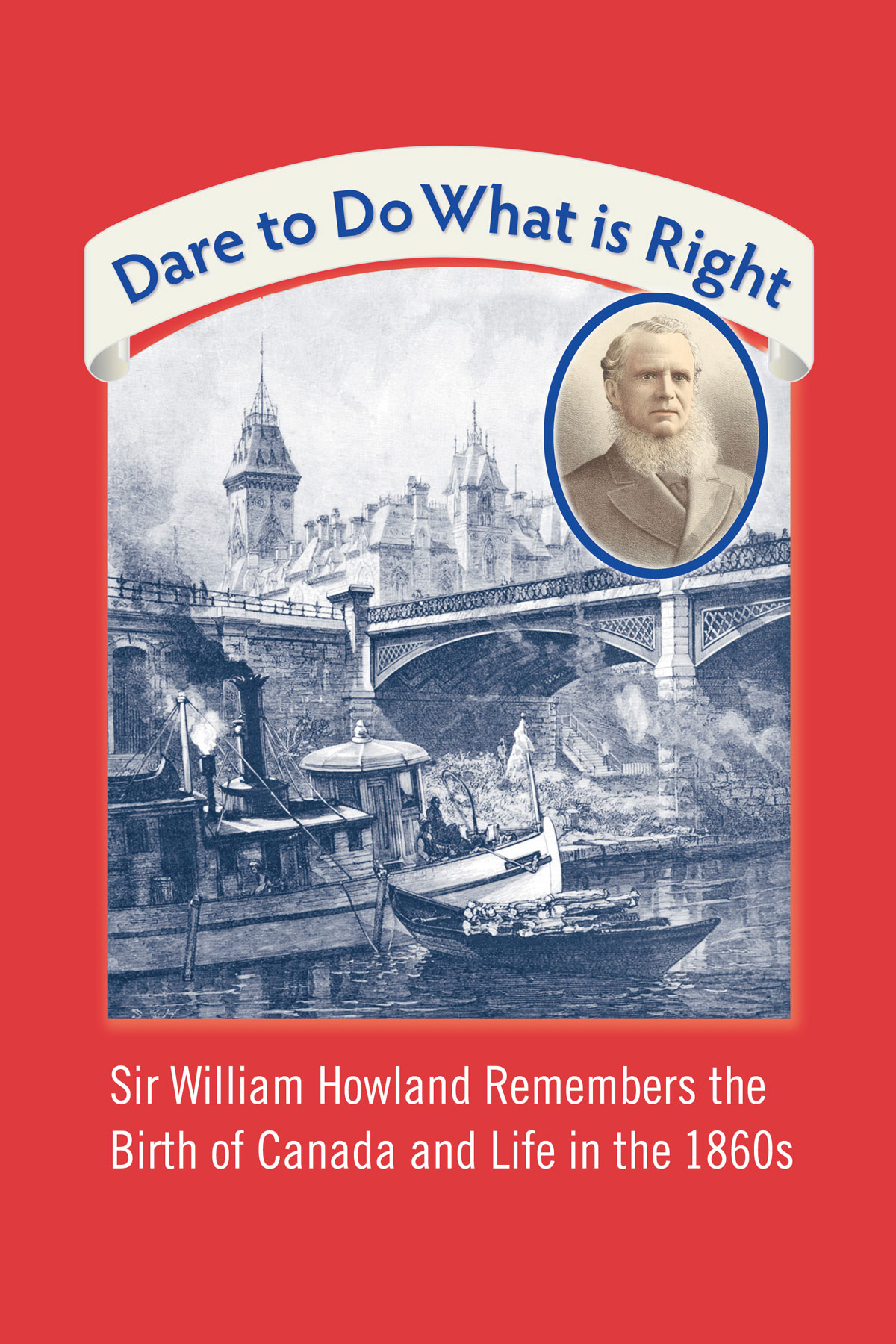
In 1906, Howland dictated his memoirs at the request of Sir Wilfrid Laurier, who was then prime minister of Canada. His lively memoir describes the negotiation of Confederation, as well as the plans of Toronto business people to trade with settlers and Metis in the West and attempts to renew a trade treaty with the United States. Some issues just don’t go away.
The memoir includes vivid descriptions of people he knew, including William Lyon Mackenzie, John A. Macdonald, and George-Étienne Cartier.
To celebrate the 150th anniversary of Confederation, two local heritage groups — the York Pioneer & Historical Society and Heritage York — collaborated to put in print his unpublished manuscript.
The memoir was given the title Dare to Do What is Right to recall Howland’s commitment to Confederation and as a reminder of how Canada continues to inspire the best in people.
Copies are available at www.yorkpioneers.com and make a great souvenir of Canada’s 150th birthday.
David Raymont is the president of the York Pioneers.

An excerpt from Howland’s memoirs
After languishing in archives, the memoirs of local reformer and a founder of Canada — Sir William Howland — were published this year. In the summer of 1866, Howland confronted his friend George Brown over support for Confederation and political strategy for the Reform Party. He recalled:
“The relationships between the delegates who went to England in April 1865 had not been of a very friendly character. Mr. Brown complained on his return of the treatment he had received…
He raised a dispute over a question of very little importance and left the cabinet table declaring his intention to resign — a proposal which caused me to feel great anxiety and concern.
I followed him to his lodgings and at his bedside proceeded to urge upon him not to take the course which he proposed.
I pointed out that if [I] went into opposition under his leadership and the majority of the Reform Party went with us…it would destroy the chances of carrying and completing [Confederation] for which the Government was specially formed and which was of such great importance to the interests of the country.
…He refused, however, to give any weight to my arguments on the subject and I finally said to him, “I came into this Government at your instance for the special purpose which the representatives of our party have fully endorsed and I will ask you as my leader to say to me what I should do under the present circumstances.”
This he refused to answer. I then said, “If you refuse my request, I will call together the Members of the House belonging to the Reform Party and will lay the whole matter before them and get their decision.”
He said, “You dare not.” I said, “I dare do anything that is right and I will do it.”
In the morning Mr. Brown [resigned and] …I carried out my determination and met the members of the Reform Party at Guelph, where the whole matter relating to Mr. Brown’s action was discussed.
They decided that it was my duty under the circumstances to remain in the Government and, if necessary, fill Mr. Brown’s place.…This plan was adopted. I then went as one of the delegates to England to obtain from the Imperial Government the Act of Federation, which we did….”
READ MORE
Harbord’s history a mystery (January 2016)
Early brewer the basis for Bloor Street’s name (May 2015)
Tags: Annex · News · History