December 15th, 2017 · Comments Off on EDITORIAL CARTOON: How Nice (Dec. 2017)

More how nice!
EDITORIAL CARTOON How nice! (August 2017)
EDITORIAL CARTOON How nice! (JULY 2017)
EDITORIAL CARTOON: how nice! by blamb (June 2017)
EDITORIAL CARTOON: TCHC (May 2017)
EDITORIAL CARTOON: The Grand Tory (April 2017)
FORUM: Celebrating 20 years of cartoonist Brett Lamb (April 2017)
EDITORIAL CARTOON: A second chance! by Brett Lamb 2037 (February 2017)
EDITORIAL CARTOON: Not really! It’s actually nice! by Stumpy the Subway(January 2017)
Tags: General
December 15th, 2017 · Comments Off on EDITORIAL: Intolerance leading to Quebec’s decline (Dec. 2017)
In 1995, Quebec sought independence from Canada through a referendum, the second time since confederation. It failed by the narrowest of margins — 54,288 votes. The leader of the independence movement, the late Parti Québécois leader and premier Jacques Parizeau, upon learning the news of defeat gave a revealing and memorable speech in which he said “Battu par l’argent et le vote ethnique” (we were beat by money and the ethnic vote).
Parizeau was graceless in defeat and fanned the embers of resentment of non-Francophones in Quebec. The intolerance of the “other” evident then is a fire that still burns today over 20 years later. In October, the National Assembly adopted Bill 62, which requires a person who delivers or receives public services to have their face uncovered. This was widely seen as an attack on the fundamental rights of the minority of Muslim women who wear the face-covering niqabs or burkas. In December, the same National Assembly voted unanimously to ban businesses from greeting customers with “Bonjour-hi”, which is a common greeting in Montreal. The “hi” part is now forbidden.
How sad and petty.
It rings of the 2013 Quebec investigation dubbed “Pastagate”, a notorious incident covered worldwide, after an inspector found that a menu at a Montreal Italian restaurant violated Quebec’s language law as it used the word “pasta” and ordered it removed.
It’s too early to tell how the ban on “bonjour-hi” will be received, but one thing is clear. It does not exactly signal openness or tolerance, and is more likely to invite ridicule.
Bill 62, less than two months old, has already started to unravel. On December 1, Quebec Superior Court Justice Babak Barin ordered a temporary stay on the provision of the law that prohibits citizens from receiving or giving public services with their faces covered. Barin ruled that Quebec cannot force people to uncover their faces until the province establishes clear guidelines under which someone can apply for a religious accommodation. When it enacted the law, the Quebec government said it would give until next summer to draft those guidelines.
The National Council of Canadian Muslims and the Canadian Civil Liberties Association challenged the law on Charter grounds, but the judge did not wade into that debate. He found the act was half-baked: “It is not unreasonable to expect that a state religious neutrality law enacted by the government should apply in a well-thought-out and comprehensive manner, especially when the law in question has been in preparation for some time…. In the interim, noble as the ideology of state religious neutrality may be, the government must ensure that the law it is adopting for the public good is coherent and complete.”
Enacting incoherent legislation aimed to alienate religious minorities and telling citizens how they may and may not greet each other in the normal course of their lives removes the welcome mat from Quebec’s doorstep. It’s especially troubling given the province’s declining birth rates. That means Quebec, like other provinces, needs immigration to fuel a labour shortage and support an aging population increasingly dependent on health care.
Unlike other provinces, Quebec can’t seem to hold onto its new immigrants: a quarter of those who arrived in Quebec between 2004 and 2013 left for other provinces. Those that stay take much longer to integrate than immigrants to other provinces: consider the unemployment rate among immigrants in Quebec is 16.9 per cent, while in Ontario it is 5.5 per cent for the same group.
Quebec leads the country in progressive parental leave programs, subsidized day care, and affordable post-secondary education (all paid for by the rest of Canada through transfer payments), and despite this can’t seem to hold onto new immigrants. It’s the other mean-spirited policies that drive this demographic exodus.
Tags: Annex · Editorial
December 15th, 2017 · Comments Off on FORUM: Looking back on 2017 in Ward 20 (Dec. 2017)
Ensuring our communities are livable, sustainable, and equitable
By Joe Cressy
It wouldn’t surprise you that we’ve had a busy year together in Ward 20. We’ve made critical strides as we work to build our communities and a city that is more equitable and sustainable for all. We’ve worked hard on the dozens and dozens of development files that populate downtown, creating new green spaces, and building livable communities. And as we look back on another year, we have a lot to be proud of.
[pullquote]We know that building livable communities means planning for the future.[/pullquote]
We’ve worked hard together to build new green spaces — from our now funded project at Monsignor Fraser in Seaton Village, to a brand new park in Harbord Village, to expanding our green space in Kensington Market and further south in King-Spadina. We’ve continued to implement countless neighbourhood visions for improvements to our existing park spaces – Margaret Fairley and the Doctors’ Parkette in Harbord Village are finally complete, and we’re launching preliminary designs for Ryan Russell Parkette in the Annex in January. And, Phase 1 of the implementation of the Harbord Village Green Plan is well underway. Together, we’re building greener, more sustainable communities.
We’ve continued our push for the spaces and services our communities need to be truly livable. Our YMCA at 505 Richmond St. in King-Spadina is now under construction, we’re working on new opportunities in the Annex, and we secured a brand new 3,500 community space and new childcare facility as part of the Mirvish Village development.
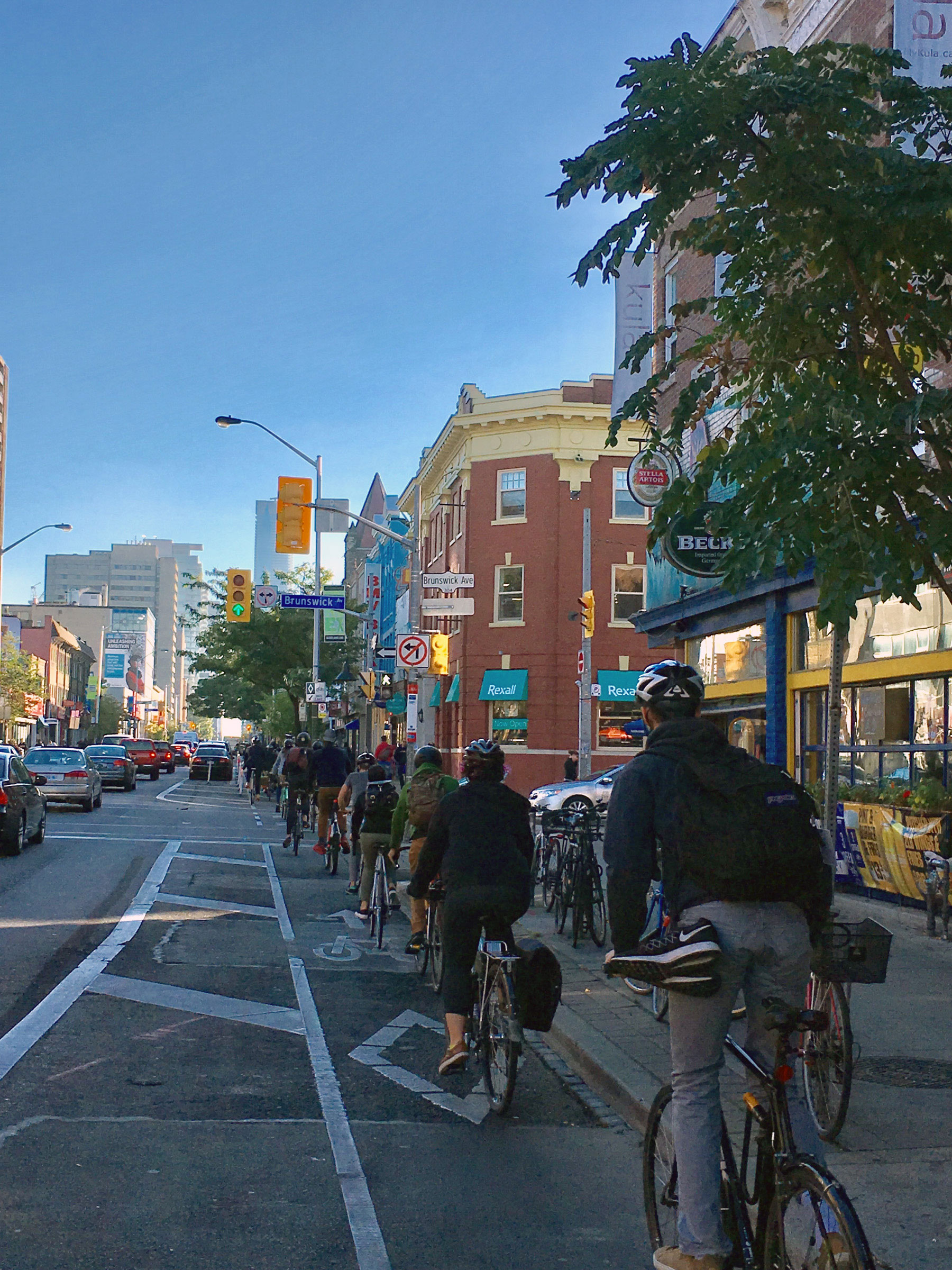
As our communities grow, we must ensure they are livable — and we must ensure that we are building safe ways to move through and around our neighbourhoods. This year, we’ve made critical strides in building safe streets, through expanding our cycling network and putting permanent lanes on Bloor Street. The data was clear — the bikes lanes worked. We built it, and indeed they came. The bike lanes on Bloor Street were 40 years in the making, and wouldn’t have been possible without the work of so many. We’ll continue this work as we make changes as part of the permanent design, but after decades, bike lanes on Bloor are here to stay.
While we need a citywide focus on speeding up the city’s Vision Zero road safety plan, in our community we’ve focused on traffic safety throughout our neighbourhoods –— a new mid-block traffic signal at Dupont Street and Palmerston Avenue, speed humps installed on Major Street and Albany Avenue, with more to come on Howland Avenue, Robert Street, and more. Together, we’re making critical strides in building safer streets.
Our neighbourhoods will not truly be livable unless they are equitable, and supportive. We’re working hard to secure new affordable housing units, while continuing to improve Toronto Community Housing buildings and to revitalize communities across our ward. And, we’re fighting to save the lives of our friends and neighbours through work on Overdose Prevention across our city.
We know that building livable communities means planning for the future — and in Ward 20, that means working together to develop our vision and to see it implemented.
This year, we fought hard at the Ontario Municipal Board on 316 Bloor St. W. and 203 College St., and got a better result for our communities. The College Street Study has now been approved, and the Spadina Avenue Study continues. For three years, we worked together on the Mirvish Village development application — and, we got a result that includes a brand new park and enhanced greening throughout the site, increased heritage retention, reduction in overall height and density to conform with the Four Corners Study, overall 40 per cent two- and three-bedrooms, sixty units of affordable housing and a commitment to work towards 20 per cent and more. And, as with everything in Ward 20, none of this would have been possible without the tireless work of our Residents’ Associations, businesses, institutions, and so many more.
Our Ward 20 neighbourhoods are truly special — ones where we support each other, and they are made better by the work of so many in our neighbourhood. As we move closer to the final year of this term of office, I couldn’t be prouder of the work we continue to do together.
READ MORE BY JOE CRESSY:
FORUM: Establishing a new Indigenous Affairs Office (Nov. 2017)
FORUM: Toronto — an artistic city (FALL 2017)
FORUM: Address affordable housing (June 2017)
FORUM: Build a neighbourhood (March 2017)
FORUM: Conserving past to enrich future (January 2017)
FORUM: Our dynamic Kensington Market (November 2016)
FORUM: A new central park for Toronto (September 2016)
Tags: Annex · Columns · Opinion
December 15th, 2017 · Comments Off on YEAR IN REVIEW: Marking major anniversaries (Dec. 2017)
A celebratory year in review

GEREMY BORDONARO/GLEANER NEWS Ten Editions Bookstore (698 Spadina Ave.) is at the centre of tension between town and gown. Heritage Preservation Services has recommended adding the building to the city’s protected list of heritage sites, but the university wants to tear it down to make way for a new student residence at Spadina and Sussex avenues.
By Annemarie Brissenden
Is it possible that we just like cake?
Because it seems that we just couldn’t stop celebrating this year. Maybe all the calamity outside our borders made our small local victories all that sweeter. But from bike lanes to major anniversaries to plaque unveilings to greener parks, we had a lot of reasons to indulge our sweet tooth this year.
Even as we pushed back against increasing density, we’re slowly getting better at working with each other to keep our neighbourhood a neighbourhood. We’re also reclaiming an inclusive heritage that’s more respectful of our past. While the Family Compact still features prominently on our streets and in our buildings, Anishinaabe names are clamouring to join them. We’ve unveiled a plaque to Albert Jackson, Canada’s first black postman, and are continuing to bring Jewish and Chinese history into the official narrative of our past. It’s about time — history can no longer be a received narrative written by the so-called victors.
That in and of itself is a reason for cake. So, grab a slice of something sweet, and join us as we bring you this year’s iteration of a December tradition: our annual year in review.
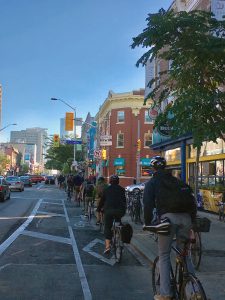
COURTESY ANDRE VALLILLEE Considered by many as a major victory for the area and for cyclists generally, the Bloor Street bike lanes, which run from Avenue Road to Shaw Street, are now a permanent feature of our community.
Riding to victory
It’s taken 40 years, but we finally got them: permanent bikes lanes on Bloor Street from Avenue Road to Shaw Street. A study sponsored by local business improvement areas demonstrated that businesses along Bloor Street do not suffer because of the lanes, and that the bike lanes are a popular, safe thoroughfare for many cyclists. For a city that needs to rethink transit and its transit infrastructure — there’s way too much focus on cars, and, as everyone knows, public transit is bursting at the seams — the lanes are a major victory.
Academic tension
With the downtown campus of Canada’s largest university sitting on the southeastern corner of the Annex, there’s bound to be some tension between town and gown. And this year was no exception. While the university opened the restored 1 Spadina Crescent, the university’s beautiful new home for the school of architecture and design — a stunning mix of old and new that is as much a gateway to the Annex as to the campus itself — neighbours were suspicious of attempts at community outreach. Plans to build a student residence at Sussex and Spadina avenues — which would see a much-loved heritage-listed bookstore torn down — and the school’s request to have a planning exemption for a broad swath of midtown gave many pause.
The next Westbank
After years of speculation and uncertainty, the Bloor Street United Church has revealed its plans to redevelop its site, which, admittedly, is due for an upgrade. The initial proposal calls for a 38-storey mixed-use tower to be built on site, which will presumably pay for renovating and restoring the century-old church, whose main steps and entrance were truncated in 1927 to make way for the widening of Bloor Street. Like Westbank Projects Corp. before them, the developers have begun consulting with the community before submitting their application to the City of Toronto, and like Westbank, have faced resistance from neighbours concerned about density and height. However, we wonder if it’s time to set aside our fear of towers, and start to think more about how to transform Bloor Street into a grand avenue that accommodates multiple modes of transit, lots of light, many swaths of green, and lots of independent retail and dining options.
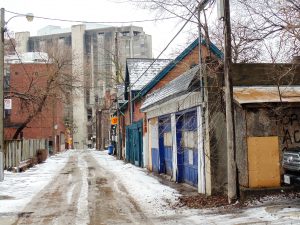
BRIAN BURCHELL/GLEANER NEWS As density increases, we need to think more creatively about how to integrate more people into our neighbourhood. Two city councillors have argued that making laneways, like bpNichol Lane, available for housing might be one solution.
Damn that density
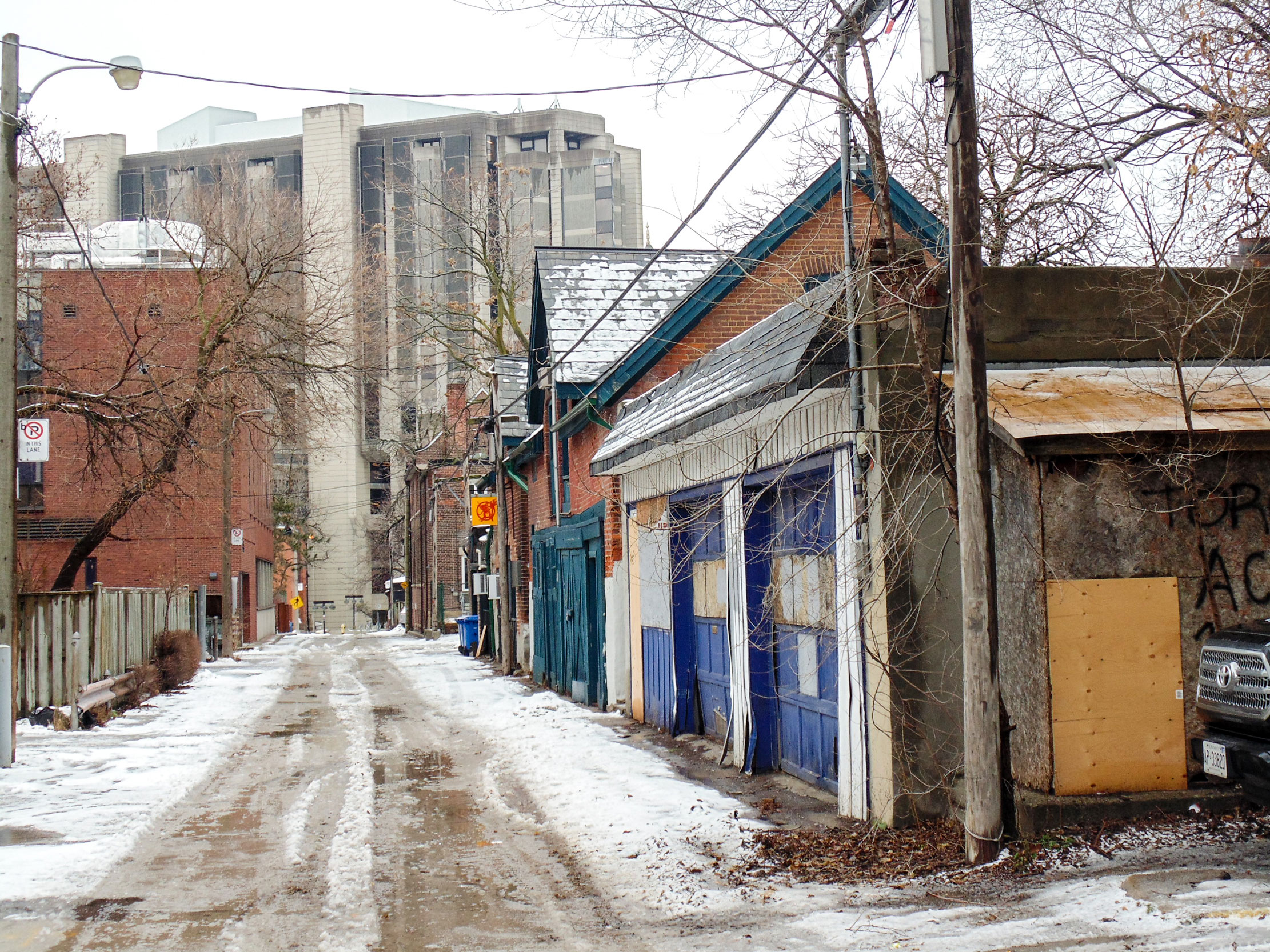
At the heart of every community meeting on a new development proposal are concerns about how increased density will impact our neighbourhoods. Residents are right to be concerned. There doesn’t appear to be a plan for delivering increased services, or even some explanation of how everyone will fit on the subway during rush hour. But that doesn’t mean we should treat every new development with suspicion, demonize those who favour renting over buying, and ignore the fact that we’re bound to share our space with more than our share of students, given our proximity to so many universities and colleges. If we have to absorb greater density, let’s stop fighting that, and start fighting for better ways to integrate young and old (buildings and people alike). Some enterprising folks have suggested laneway living as an alternate to building tall towers, which we, despite the Harbord Village Residents’ Association’s (HVRA) longstanding policy against it, think worthy of exploration. We can be welcoming when we want to — consider how we welcome refugees and new immigrants. After all, a classic bay and gable is becoming increasingly out of reach for most people, and if the projections are correct, many of us will be closing out our years in an apartment or smaller dwelling of some sort.
To those who came before
As we grapple with how to absorb so many newcomers to our neighbourhoods, we should look to those who came first: our Aboriginal and Indigenous residents. The Annex sits in the heart of a what was once a major route for Indigenous peoples, and, thankfully, we’re starting to reclaim that past. The Dupont by the Castle BIA worked with the Ogimaa Mikana project to install permanent Anishinaabe signs on major streets in the Dupont area. This summer also saw Toronto host the Indigenous Games, and the Royal Ontario Museum mounted an exhibition of Indigenous artifacts that were unearthed from numerous locations throughout the city. These are small steps towards reconciliation, steps that could grow by launching an Indigenous Affairs Office at city hall.
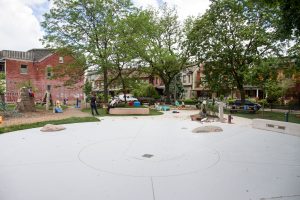
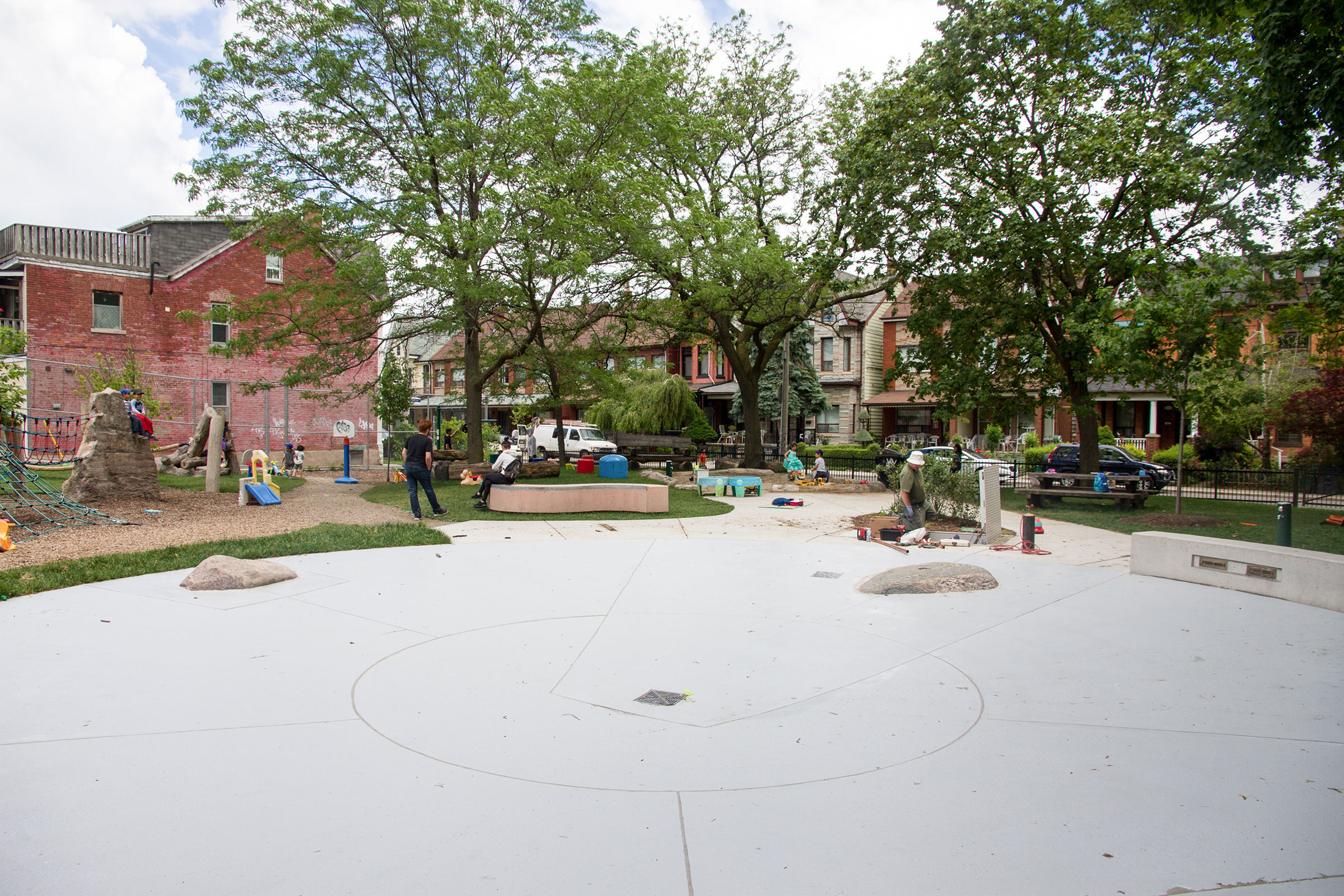
GEREMY BORDONARO/GLEANER NEWS Margaret Fairley Park was one of three parks that were upgraded this year. With fewer and fewer people having access to their own backyards, green space is becoming more important than ever.
Moving to a greener Annex
Our green space got a bit of a boost this year. Three park revitalizations — the Doctors’ Parkette on College Street, Margaret Fairley Park on Brunswick Avenue, and Bickford Park on Grace Street — were completed. As density increases in the neighbourhood, and fewer people have less green space to call their own, such urban oases aren’t so much a luxury as a necessity. The Palmerston Area Residents’ Association, following a model set by the HVRA, also launched its own green plan process, and the Bloor Annex business improvement area shared its vision for street revitalization that will transform four unused rights-of-way at Howland Avenue, Brunswick Avenue, Major Street, and Robert Street into parkettes with granite seating, trees, and pollinator-friendly gardens.
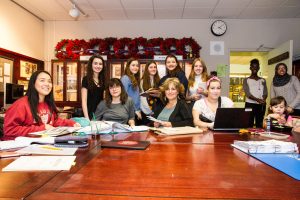
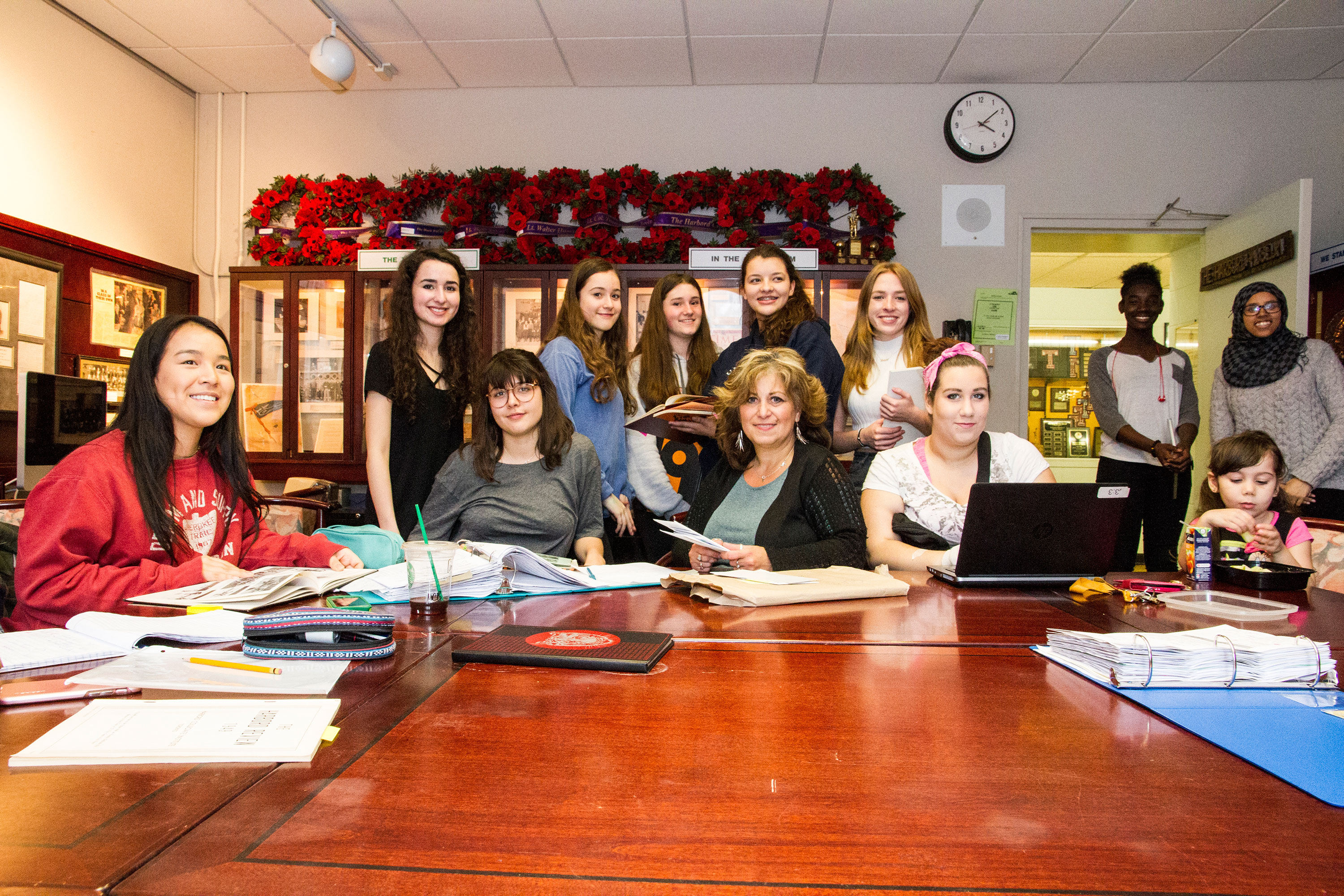
GEREMY BORDONARO/GLEANER NEWS Harbord Collegiate Institute teacher Belinda Medeiros-Felix and student volunteers prepared to celebrate the school’s 125th anniversary in the spring. Memorabilia is on display in the school’s museum, the first of its kind in Canada.
Marking more than 150
As the nation celebrated its sesquicentennial, we marked a few major, local anniversaries. The Women’s Art Association of Canada — whose founder Mary Ella Dignam had close relationships with members of the Group of Seven and twice welcomed Emily Carr to Toronto — celebrated 130 years at its annual garden party in June. Harbord Collegiate Institute marked 125 years with a little of Oola and a lot of Boola in May. The school, which launched the careers of Wayne and Shuster, is the third oldest in the Toronto District School Board. In Seaton Village, Karma Co-op celebrated 45 years of sharing food, and in these pages we did a retrospective of cartoonist Brett Lamb’s 20 years at the Gleaner. Finally, the Bloor St. Culture Corridor, whose executive director Heather Kelly writes an arts column in this paper, celebrated three years. More than three million people visit the arts and culture organizations in this unique corridor every year.
READ MORE:
YEAR IN REVIEW: A focus on livability, grindertude (DECEMBER 2016)
YEAR IN REVIEW: Grassroots activism marks annual review (DECEMBER 2015)
Tags: Annex
December 15th, 2017 · Comments Off on ARTS: Exceptional gifts (Dec. 2017)
Arts, culture, film, and music

COURTESY BLOOR STREET CULTURE CORRIDOR Tickets for a Calypso Rose and Kobo Town show at the Royal Conservatory of Music make a great gift.
By Heather Kelly
Beautiful things and special experiences are wonderful gifts. For those of you still doing your holiday shopping, a small suggestion: start local. In addition to the great retail stores along Bloor Street West, there are hundreds of gift ideas right here at our local culture organizations.
Did you know that there are gift shops at the Native Canadian Centre, Bata Shoe Museum, the Royal Ontario Museum, the Gardiner Museum? And book shops at A Different Booklist Cultural Centre, Alliance Française, and the Toronto Reference Library? There will also be a Holiday Pop-Up Market at A Different Booklist on December 16. Here are a few more ideas.
Surprise your loved ones with a subscription to the Toronto Jewish Film Society’s 40th season. The Miles Nadal JCC presents outstanding film events, each with a notable guest speaker and a discussion, at its Al Green Theatre. The series includes feature films and documentaries from Germany, Israel, the U.S., the U.K., and France, on eight Sundays in 2018.
There’s nothing like sharing an inspiring evening of music. Concert tickets are easy to purchase online or in person. The Royal Conservatory is offering more than 30 classical, jazz, and world music performances at Koerner Hall in the new year, with artists like DJ Jazzy Jeff, Angelique Kidjo, Calypso Rose, and classical pianist Beatrice Rana.
You can give tickets to Tafelmusik performances being presented in the new year: Safe Haven, a new program from Alison Mackay that is directed by Elisa Citterio, Handel Alexander’s Feast, J.S. Bach: The Circle of Creation, Bach B-Minor Mass, and others.
This year the Toronto Consort marks their 45th anniversary concert season, and tickets are available for their multi-media concert based on illuminated manuscripts called Illuminations, or Quicksilver presents Fantasticus with music from 17th century Germany, or their season finale in May, Monteverdi’s Orfeo. Alliance Française presents classical, jazz, and world music at its Spadina Theatre. Tickets to concerts like Africa Without Borders or From Rome to Venice: Sonata by Corelli, Veracini, and Tartini are a lovely gift idea.
Memberships to arts organizations are great gifts that usually come in individual, student, and family options. The ROM, Bata Shoe Museum, Gardiner Museum, and the Hot Docs Ted Rogers Cinema all offer membership options. Memberships provide free or discounted access to exhibitions, screenings, and events, and special perks like invitations to exclusive members’ events, for a year.
You can get Hot Docs 2018 passes or ticket packages of 6, 10, or 20 tickets for someone on your list — or treat yourself. The 25th anniversary Hot Docs festival will take place April 26 to May 6. New this year is that package holders get to select their films before single tickets go on sale. Passes and packages are on sale with special holiday season prices in effect until January 3.
Arts or music classes are fantastic for people who want to get out, learn a new skill, and get creative. No experience or special knowledge is required for beginner instrument lessons at the Royal Conservatory.
The Royal Conservatory School also offers music appreciation classes like “Comedy in Mozart,” “Beethoven Symphonies,” and “Double Agents: Musician Spies,” for anyone curious to learn more about music.
The Miles Nadal JCC also offers talks on music, including “Hollywood’s Oscar-Winning Songs” in January, and “Exotic Operas from Around the World” in March.
And Tafelmusik’s Listening Club delves into baroque music with Radio host and musicologist Dr. Hannah French and violinist Christopher Verrette.
For those who want to get hands-on, the Native Canadian Centre offers beading classes, and the Gardiner Museum’s Clay Classes include wheel throwing, hand building, tableware, and more.
Of course, learning a new language is on many people’s to-do lists, and in this neighbourhood there are French language classes at Alliance Française, Italian classes at the Istituto Italiano, Japanese at the Japan Foundation, Mohawk and Oneida at the Native Canadian Centre, and Hebrew, Yiddish, and Sign Language available at the Miles Nadal JCC.
Don’t forget gift certificates! When you can’t decide what to get for someone, gift certificates are a great option. Most of the local arts and culture organizations offer gift certificates for performance tickets or at the gift shops.
All of these arts and culture events are part of the Bloor St. Culture Corridor, a collaboration of 19 arts and culture organizations located on Bloor St. West.
Heather Kelly is the founder and director of the Bloor St. Culture Corridor, one of the city’s leading cultural districts.
Tags: Annex · Arts
December 15th, 2017 · Comments Off on GREENINGS: No solutions for nobody’s problem (Dec. 2017)
Governments must move sooner to address issues big and small
By Terri Chu
If it’s nobody’s problem, does it really need to be solved?
Scientists are once again sounding the alarm about the untenable amount of plastic in the world’s oceans. It is estimated that there will soon be more plastic in the ocean than fish. This is a problem. But whose problem is it anyway?
[pullquote]If there’s one thing I’m comforted by, it is knowing that invertebrate politicians aren’t limited to the first world.[/pullquote]
Part of the reason nothing has been done about it is because, like climate change, the problem doesn’t belong to any one country. Small things have been done when problems are recognized. India banned plastic bags in Delhi after realizing its sewers were being clogged and costing money to deal with it. Certainly it wasn’t done out of the goodness of its heart.
Governments tend to take action only when the quality of life for the majority of their citizens is affected. In Ontario, we did nothing despite knowing about toxic mercury contamination in Grassy Narrows First Nation since it merely affected a small population of Indigenous people, a minority group that’s been treated shamefully throughout our history. Even when our citizens are killed, we are loath to care, especially when it’s nobody’s problem.
Unless money is on the line, governments tend not to act. Delhi did a great thing by banning all single-use plastics but its air pollution is choking its own citizens to death. Rather than tackle the source of the problem, something that could have an impact on its economy, the government decided to drop water from airplanes and hope for the best. If there’s one thing I’m comforted by, it is knowing that invertebrate politicians aren’t limited to the first world.
Back to plastic that’s killing Nemo, whose problem is it anyway? In truth, nobody’s.
A lobster was recently caught with a Pepsi logo essentially tattooed on its claw. It raises some concern over trash in our own waters, but don’t expect governments on any level to actually act on it. Not until lobster fisheries are severely affected will any government make a move to deal with the problem.
During the post-war era, we were a little better as a species to deal with collective problems. We created organizations like the International Whaling Commission (IWC) as we watched whale numbers decline drastically. In 1982, the IWC successfully put a moratorium on commercial whaling that has mostly been respected save for a few countries. Notably Japan’s delicious whales caught for “scientific” purposes where the meat then can’t go to waste. Arguably, the IWC has had at least some positive impact on whale recovery despite continued whaling operations from a small number of nations.
In the Brexit and Trump era, creating such a body to deal with the ocean’s trash would be too hard to imagine. What were once two of the most powerful nations on earth have to pander to constituents that barely believe the earth is round. Getting them to believe that our plastic trash is pooling in international waters would be too far a stretch of the imagination when it’s supposed to fall off over the edge into the ether…. And of course, it becomes nobody’s problem.
The truth is, we have an economy that’s addicted to plastic. With seven billion of us on the planet, we are slowly writing our own death sentence. At some point, we have to realize that our current modus operandi is not working. Alanis Obomsawin from the Odanak reserve in Quebec is credited with saying “When the last tree has been cut down, the last fish caught, the last river poisoned, only then will we realize that one cannot eat money.” It’ll be a little late then.
Action has to be taken, and we can no longer rely on the superpowers of old. The United States and Britain are stuck in a bygone era and we must move on without them. Canada has an opportunity to take a leadership position on this issue. We are bordered by three coasts. We have a heavy interest in keeping the oceans clean.
There will certainly be a cost to taking action. Goodness knows the 1 per cent can’t afford not to control 50 per cent of the world’s wealth. The cost of inaction is rapid population decline and the lords will find they have nobody to rule over.
Terri Chu is an engineer committed to practical environmentalism. This column is dedicated to helping the community reduce energy, and help distinguish environmental truths from myths.
READ MORE GREENINGS BY TERRI CHU:
Celebrate science not milestones (Nov. 2017)
Down to the data (Oct. 2017)
Reducing paper waste (Fall 2017)
Taking tolls to the Gardiner and Don Valley Parkway (July 2017)
Lessons from Madrid (June 2017)
Thoughts on hitting the 400 benchmark (May 2017)
Solving the food waste problem (April 2017)
Kellie Leitch was right (March 2017)
Tags: Annex · Columns · Opinion
December 15th, 2017 · Comments Off on FROM THE ARCHIVES (Dec. 2017): Changing the character of 44 Walmer Rd.
If buildings are art, should they be altered from their original form?
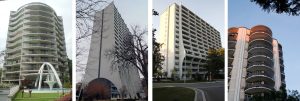
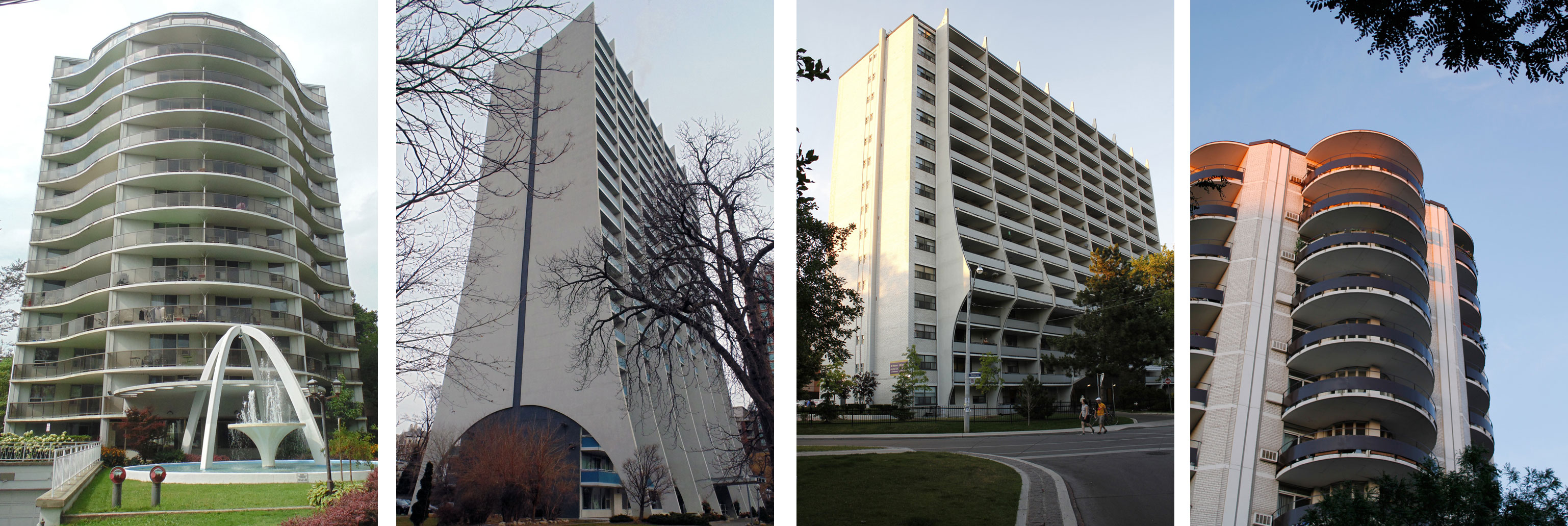
Although diminished by the removal of its curvaceous balcony adornments, architect Uno Prii’s 44 Walmer Rd. (far left, photo by Brian Burchell for Gleaner News) — as it stands today — remains an artistic statement in design. A few more examples of his work are 20 Prince Arthur Ave. (second from left, photo by Brian Burchell for Gleaner News), his “most expressive building”, 35 Walmer Rd. (second from right, photo by Arthur Rozumek/Wikimedia Commons), and 485 Huron St. (far right, photo by Arthur Rozumek/Wikimedia Commons).
In Building a Community: Estonian Architects in Post-War Toronto, the Museum of Estonians Abroad (VEMU) at Tartu Colleges features the work of Uno Prii, who designed at least ten buildings in the Annex. These include the Senator Croll Apartments (formerly Rochdale College) at 337 Bloor St. W., 666 Spadina Ave. at Sussex Avenue, and 20 Prince Arthur Ave. In 2001, former Gleaner columnist Alfred Holden wrote about 44 Walmer Rd., also designed by Prii. It seemed timely to reprint that column.
By Alfred Holden
Are buildings art?
The question is seldom posed. But it’s a legitimate one that raises some potentially important legal and ethical issues, in the light of construction work that’s going on right now at the large apartment house at 44 Walmer Rd.
In recent weeks crews have removed the building’s most artful and distinctive feature — the curvilinear, circle-patterned balcony railings that made 44 Walmer something of an icon.
Just last month, in its Icons column, Toronto Life pictured 44 Walmer on a two-page spread. The headline was “Flower tower” — a nice play on the way the sensuous design of 44, like the attitude of youth in the sixties era during which it was built, went against boxed-in ways of thinking.
“Playful whimsy” is how a new book East/West: A Guide to Where People Live in Toronto sums up this design by architect Uno Prii. With its “idiosyncratic quality and lightheartedness”, the building “brings an unexpected lightness and joie de vivre to sometimes staid Toronto”.
Prii died last November and I wrote about him in February’s Gleaner.
The current alteration was undertaken so crews could get at balcony concrete for much needed repairs. Nothing wrong with the repairs, but the building’s owner, Gaetano D’Addario, has said the old railing design is gone for good. “I did not like it,” he told me point blank over the phone. And as he put it emphatically, he owns the place.
Legally perhaps, but does he own it completely?
Some readers may remember the case of the Eaton Centre Canada geese, which may offer legal, and certainly moral, inspiration for those concerned about 44 Walmer Rd., and other buildings of merit.
In 1982, as part of a Christmas marketing campaign, it was decided to tie red ribbons around the necks of the flock of fiberglass geese that hang in the south end of the mall’s galleria. The geese are the creation of noted Canadian artist Michael Snow and he was horrified. Snow took the Eaton Centre to court.
A judge found that under Canadian copyright law artists can sell their work, but retain important residual rights: their artistry isn’t to be distorted or modified in unseemly ways by those who buy it. In December of 1982, the red ribbons flew south.
Typically, buildings are not seen as art. Yet buildings everywhere, from the Parliament buildings to the Toronto Dominion Centre to many midtown homes, clearly are art.
Uno Prii was an artist. When I visited him and his wife a couple of years ago, I found their Bloor Street condominium filled with paintings, sculpture, and pottery by the architect. Instantly, I knew where his sculptural buildings came from.
In Ontario, various rules and protocols exist for protecting historic and significant structures. But as Rosie Horn of the Toronto Preservation Board admitted when I called her about 44 Walmer Rd., the system is gutless, toothless. The free-enterprising freewheeling United States has much tougher rules, and enforceable standards set by the Secretary of the Interior. Compared to Canada, Margaret Thatcher’s Britain was, and is, draconian. In France, the prosperity of the nation is seen to depend, in part, on strategic, intelligent stewardship of the nation’s remarkable store of landmark architecture. Is 2001 the time, and 44 Walmer Rd. the place, for ordinary people to take on the issue, by playing hardball under something like the copyright law? The tenants have a law student working on their behalf, in what’s become a long-standing battle with their landlord.
With the balcony railings already off, it seems too late to do anything about the building, but I am not sure.
D’Addario, judging from his response to my phone call, is certainly feeling the pressure. “Wait until the decision is made,” he said to me, opening the door, later in the interview, at least superficially. “It’s a decision we have to make and I am going to take my time to make it.”
“He keeps the place up,” tenant David Aylward told me in the lobby on April 30, “but he’s a bit fancy in his ideas.” Other recent alterations — a marble floor in the foyer and lobby over original terrazzo, a new stucco-over-foam exterior with classical details — reflect a bid to remake modernist 44 into neo-Casa Loma. D’Addario didn’t mention another fact — that his company, Navy & Jim Investments Ltd., has applied to convert 44 Walmer Rd. into a condominium. That’s something with multiple implications for the lives of the tenants today and tomorrow. A public hearing will be held at City Hall at 10 a.m. on May 15. If I lived there, I’d be sure to go.
Whatever happens, I think the owner, by removing a key architectural feature, is taking the wrong approach to his real estate. The very people to whom the building is marketed — the tenants and ultimately the public — have long noticed 44 is a real designer building. Newspapers, magazines, and books are giving the property unsolicited praise, the kind of publicity that cannot be bought at any price. That reflects more about what people want than faux columns and marble floors.
Larry Richards, Dean of Faculty of Architecture at the University of Toronto, in an April 12 letter to the Toronto Preservation Board chair Catherine Nasmith, wrote: “44 Walmer is a highly sculptural, landmark tower…designed by one of Toronto’s most important 20th century modernist architects.” Referring to the railings which define the building, Richards wrote, “this change will drive our city further toward architectural mediocrity”.
In recent years, not enough has been said about botched renovations and still less is done about it. Apartment buildings, so important to the city fabric, are particularly prone — they are treated by their owners, of all people, like worthless old cars, to be patched up with Bondo and souped up with stick-on accessories from Canadian Tire.
So I urge 44 Walmer tenants and their legal advisers to think art, take action, and make theirs a landmark case. These should kick some teeth into worthless laws that right now allow the willy-nilly destruction of art, architecture, and achievement that is of immense value to the future pride and reputation of the city.
READ MORE BY ALFRED HOLDEN:
FROM THE ARCHIVES: Sculptor marks the lessons of war (November 2016)
FROM THE ARCHIVES: A grand gesture in the age of thrift (September 2015)
FOCUS: Urban Elms (September 2015)
Tags: Annex · History
November 24th, 2017 · Comments Off on ON THE COVER (Nov. 2017): Remembering
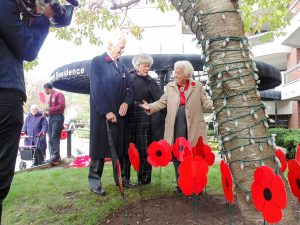
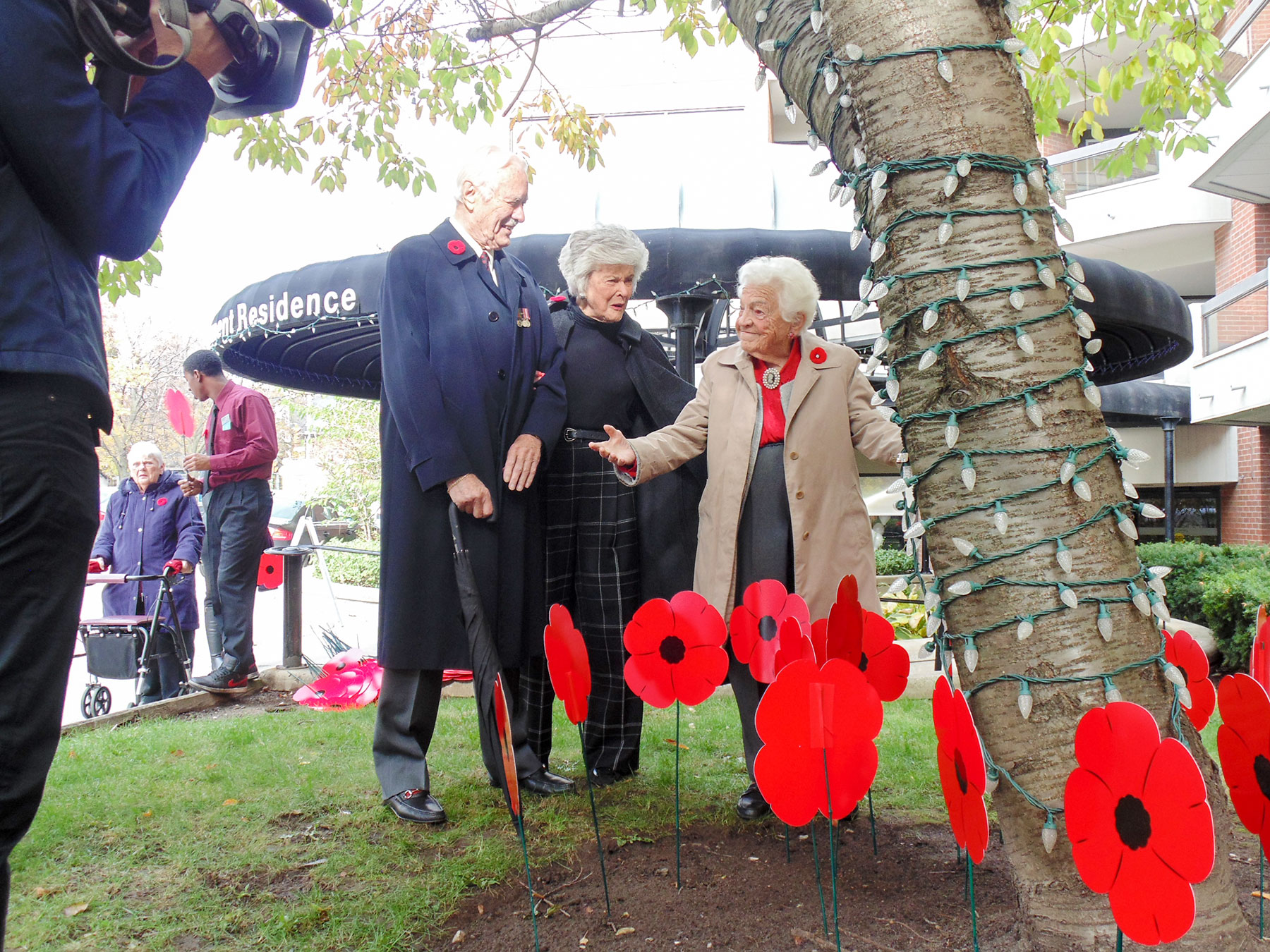
BRIAN BURCHELL/GLEANER NEWS Second World War veterans Shirley and George Brickenden place poppies at Revera Retirement Residence on November 9 in honour of Remembrance Day. The Brickendens, who live at Revera, were joined by Hazel McCallion, Revera’s chief elder officer and Mississauga’s former mayor. Revera residents across Canada made over 17,000 poppies for displays all over the country.
READ MORE
HISTORY FROM THE ARCHIVES: A childhood in war-torn Holland (Nov. 2017)
HISTORY FROM THE ARCHIVES: Sculptor marks the lessons of war(November 2016)
BLACK HISTORY MONTH: A long history of activism (February 2017)
FROM THE ARCHIVES: A time of loss, horror and excitement (March 2017)
FROM THE ARCHIVES: Harbord C.I. connects with history (April 2017)
CHATTER: University community stops to remember (November 2015)
Tags: Annex · News
November 24th, 2017 · Comments Off on NEWS (Nov. 2017): Building a legacy
UTS launches fundraising campaign
By Geremy Bordonaro
The University of Toronto Schools (UTS) has launched Building the Future, a $60-million fundraising campaign aimed at restoring its current building and developing a new building that will include a performance centre.
Upgrading the facilities is part of the terms of its agreement with the University of Toronto (U of T).
“In December of 2015 we finalized our affiliation agreement with the university. Part of that agreement called on the school to rebuild the site,” said Rosemary Evans, the school’s principal. “In order to stay here, and to continue as a school affiliated with U of T, we have to rebuild.”
More than half of the funds have already been raised from a private alumni fundraiser.
“The students stay connected, even after leaving the school. Many see attending the school as something that truly transformed their lives,” Evans said. “As a result, they stay connected to one another and the school. They feel a sense of wanting to give back and they don’t want to see the school disappear.”
UTS — located at the foot of Madison Avenue on Bloor Street — has seen a long list of well-known names come through its doors including current mayor John Tory, who has publicly supported the school and its campaign.
The U of T, which has a loose affiliation with the school, has an oversight role in the planning process.
“Our role is really in working with them to ensure that their project aligns with broader university planning and the campus master planning,” said Scott Mabury, U of T’s vice president of university operations.
Mabury stressed that although UTS is a separate entity, the school needs to fill its land obligations.
“We spent a number of years discussing how to redo an affiliation agreement with the school. We signed the new agreement based on the very long and valued relationship we had,” he said. “That affiliation imagined a capital build that sat on U of T land, that would be a U of T building.”
The relationship between the school and university dates back to the beginning of the twentieth century.
“As an affiliated entity that is long-standing, lots of friends of UTS are friends of U of T. Oftentimes alumni of UTS are alumni of U of T,” Mabury said. “There is lots of goodwill back and forth across that relationship.”
Both the university and UTS have reached out to the community to keep them involved in the planning process.
“UTS’ plans are excellent as far as Harbord Village is concerned. We haven’t had a problem with UTS at all,” said Sue Dexter, U of T liaison for the Harbord Village Residents’ Association (HVRA). “But we have a problem with the way that the university wants the school to meld in with [its] plans.”
The concerns are mostly about how the school will treat the community, particularly with respect to getting rid of green space.
“We just have concerns about green space, always. And the encroachment on the park isn’t necessary,” Dexter said. “The minute you build into a park, some existing trees would have to go and we just don’t want to do that.”
“We value our community partnerships. That’s really important to us,” said Evans. “So we’ve tried to make that a driving force in our plan.”
The school hopes to break ground in late summer or early fall, if the fundraising goes as planned. Construction is expected to take around two and a half years.
READ MORE
NEWS Tentative deal for UTS (December 2015)
Tags: Annex · News
November 24th, 2017 · Comments Off on NEWS (Nov. 2017): Pilot project becomes permanent
Council resoundingly votes in favour of Bloor Street bike lanes
By Geremy Bordonaro
It’s been a long time coming but the Bloor Street bike lanes are now a permanent fixture of the community.
After hours of debate, questions, and rhetoric, Toronto City Council resoundingly voted 36 to 6 in favour of keeping the lanes. The decision came after an October Public Works and Infrastructure Committee vote in favour of adopting the recommendation of the city’s transportation staff to make the lanes permanent. The bike lanes were installed in August 2016 after council approved a pilot project that May.
“I cannot overstate the significance and importance of the decision that we’re about to make today,” said Joe Cressy (Ward 20, Trinity-Spadina) at the council meeting. “Because for 40 years people have been working to make bike lanes permanent. For 40 years.”
The city and various organizations conducted extensive studies that measured the impact the lanes had on the street. Within a year it was found that biking on Bloor Street increased by nearly 50 per cent. The street had become the second most used bike lane in the city after Adelaide and Richmond streets. Safety was significantly increased, and a large majority of pedestrians, cyclists, and residents support the lanes.
This made the decision easy for city staff.
“Our city staff have stated, unequivocally, that bike lanes on Bloor [Street] not only work but they work well and should be made permanent,” Cressy said. “And I agree with them completely. Bike lanes on Bloor should be here to stay.”
Not all of the councillors supported the lanes, however.
Issues like the increase in car travel times during rush hours, lack of parking, and difficulties loading and unloading on the street were sticking points during the council debate. One councillor in particular, Giorgio Mammoliti (Ward 7, York West), called the lanes reminiscent of a scene from a Third World country.
“I cannot believe how this has been rammed through,” Mammoliti said. “I can’t believe the amount of intimidation that is going on [along] Bloor Street.”
Mammoliti thought of the decision as foregone. He was one of six councillors to vote against the lanes but he pledged that he would be back and that the lanes would not stay.
“You got your way today. But at the end of the day this doesn’t finish here, folks. Don’t think for a second that you’ve won this thing. At the end of the day it’s going to come back and it’s going to be reversed.”
Mammoliti said he believes that businesses — which are mixed in their support of the lanes — will help support the removal of the lanes. He also called on drivers to shout down the decision.
“Bike lanes do not need to be on our streets,” Mammoliti said. “And we have forced them out, not because of safety matters, but because there is a war on the car.”
Joe Mihevc (Ward 21, St. Paul’s) saw the decision as an opportunity to look back at the differences between the city’s old boroughs.
“Maybe this is, on the occasion of the twentieth anniversary of the mega city amalgamation, a cause for reflection. To me, that is, certainly one of the reflections is that we’re a very big and complex city,” said Mihevc. “In downtown we have our own reality. The fact that this vote will be unanimous from a downtown point of view I think should inform some folks in the suburbs that mobility is happening differently on Bloor Street.”
He also pointed out that drivers are not responsible for the business activity on Bloor Street.
“It’s funny that on the economic side 90 per cent of the people who are attracted to businesses on Bloor Street come there walking, cycling, and on public transit.”
READ MORE:
NEWS: Here to stay? (Oct. 2017)
FORUM: A magical new supply of parking spots (October 2017)
EDITORIAL: Bike lanes, good for business (Fall 2017)
CHATTER: Preliminary data on Bloor Street pilot bike lane released (March 2017)
CHATTER: Ground-breaking bike lanes launch on Bloor Street (August 2016)
NEWS: Bikes blessed for another season (June 2016)
FOCUS: An early advocate for bike lanes (June 2016)
NEWS: Bike lanes for Bloor Street (May 2016)
The faster we lower speeds, the more lives we save (October 2015)
Tags: Annex · News
November 24th, 2017 · Comments Off on Chatter (Nov. 2017): Bloor Annex BIA updates street revitalization plan
COURTESY BLOOR ANNEX BIA
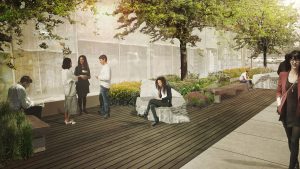
The right-of-way on the western flank of the grocery store at Bloor and Robert streets will be redeveloped into a park, thanks to the Bloor Annex BIA.
The Bloor Annex Business Improvement Area (BIA) met this month to discuss the upcoming, and much anticipated, Bloor Street revitalization plan due in 2019.
Spanning Madison Avenue to Bathurst Street, the BIA intends to replace the tree planter boxes with new trees that will be level with the sidewalk. A proprietary root system has been designed that will allow these trees to grow to maturity.
Four unused rights-of-way at Howland Avenue, Brunswick Avenue, Major Street, and Robert Street will be converted to parkettes that feature wood decking, granite seating, trees, and pollinator-friendly gardens that should attract birds, bees, and butterflies.
There have been three major changes to the original plan. The park benches are now less intrusive, lighter, and more flexible, accommodating more seating. Lighting will now be placed behind the benches and will be harder to vandalize. Finally, some of the layouts have changed.
The chair of the Bloor Annex BIA publishes this newspaper.
—Geremy Bordonaro/Gleaner News
Tags: Annex · News
November 24th, 2017 · Comments Off on CHATTER (Nov. 2017): Coming down
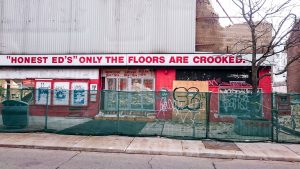
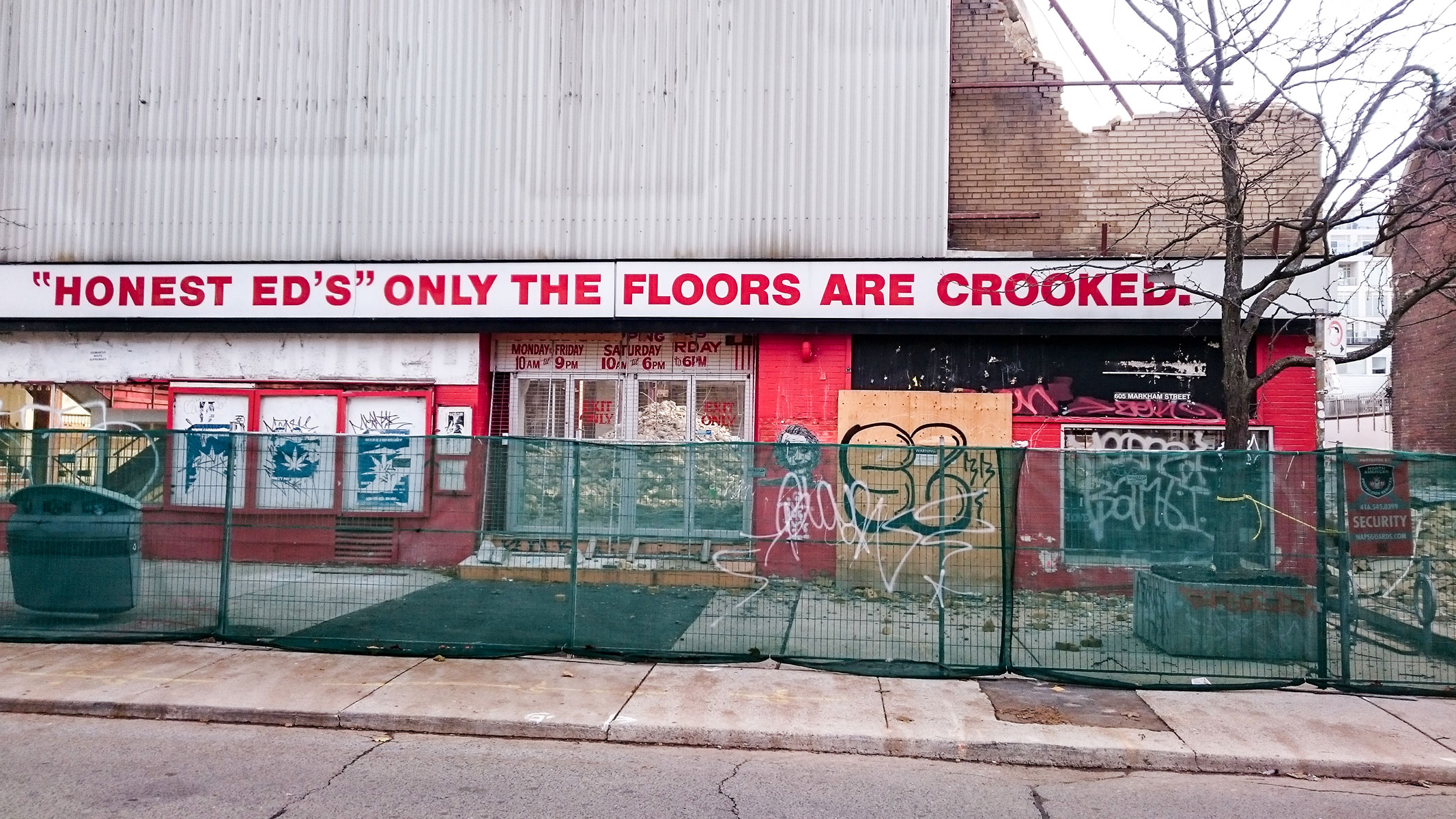
NEILAND BRISSENDEN/GLEANER NEWS Honest Ed’s is slowly crumbling, as excavators have begun to pull down the west building from the rear to make way for a mixed use development at Bathurst and Bloor streets. Ed Mirvish built this part of his store over existing houses, which is why the floors were crooked. The developers are preserving 27 buildings on Markham and Bathurst streets, and will incorporate them in the development.
READ MORE
EDITORIAL: Westbank’s positive precedent (April 2017)
NEWS: Westbank presents latest proposal (MARCH 2017)
FORUM: Build a neighbourhood (March 2017)
NEWS: Height, density still top concerns (July 2016)
NEWS: Westbank submits revised application (June 2016)
DEVELOPINGS: Annual review reflects tension between community activism and OMB (March 2016)
Westbank towers over 4 Corners (January 2016)
City hosts first Mirvish Village community consultation (November 2015)
Residents’ associations share concerns for Mirvish Village (October 2015)
Westbank submits application (August 2015)
BABIA endorses Westbank proposal (July 2015)
How do you make it real? (April 2015)
Tags: Annex · News