January 29th, 2018 · Comments Off on ARTS: New year adventures in arts and culture (Jan. 2018)
Learn a new language, gain a new skill or try something different

The Japan Foundation, Toronto is celebrating film in January with special screenings of Japanese films, including The Vancouver Asahi, a baseball drama about a Japanese baseball team in Vancouver in the 1930s. COURTESY JAPAN FOUNDATION
By Heather Kelly
Whether you call them resolutions, aspirations, or vows, most of us go into the new year intending to make this one better, do more of some things and less of others. We want to be inspired, reduce stress, learn something new, pursue our interests, meet people, and yes, share more quality time with friends and family members. Did you know that there are more than two hundred arts events — exhibitions, concerts, documentaries, and talks — here in the Annex area every month all year? Here are some ideas for starting your 2018 creatively.
Learn a new skill
For everyone who wants to get hands-on, develop a skill, and get creative, there are beading classes at the Native Canadian Centre, Sketching in the Galleries at the Bata Shoe Museum on January 26, and drop-in clay classes at the Gardiner Museum.
No experience is required for beginner instrument lessons at The Royal Conservatory of Music, where they offer Learn to Play classes for piano, guitar, violin, or cello, and a community chorus. If the stage is calling to you, 918 Bathurst is hosting acting workshops with Joy Tanner.
If you want to learn a new language, you can learn French at Alliance Française, Italian at the Istituto Italiano, Japanese at the Japan Foundation, Mohawk or Oneida at the Native Canadian Centre, and Hebrew, Yiddish, and Sign Language classes at the Miles Nadal JCC.
Ideas and inspirations
The Istituto Italiano di Cultura hosts two English-language lectures on “Rome through Italian Cinema” with Dr. Franco Gallippi. On January 26 at 10 a.m., discover “Rome in Italian Cinema: From La presa di Roma to La grande bellezza,” and on February 2 at 10 a.m., explore “Federico Fellini and the City of Rome.”
For everyone curious to learn more about music, The Royal Conservatory School offers Music Appreciation classes like “Comedy in Mozart,” “Beethoven Symphonies,” and “Double Agents: Musician Spies.” The Miles Nadal JCC offers talks on music, including “Hollywood’s Oscar-Winning Songs” with critic and musicologist Jordan Klapman on January 25, and “Exotic Operas from Around the World” in March. And Tafelmusik’s Listening Club delves into baroque music with radio host and musicologist Dr. Hannah French and violinist Christopher Verrette.
Wildlife photographer and National Geographic contributor Joel Sartore lectures at the Royal Ontario Museum on January 23, where the world-renowned Wildlife Photographer of the Year exhibition runs until March. And on January 30, you can enjoy an evening with the Bata Shoe Museum’s Senior Curator Elizabeth Semmelhack, as she leads a tour of the museum’s newest exhibition The Gold Standard – Glittering Footwear from Around the Globe.
The popular Curious Minds Morning Speaker Series returns to the Hot Docs Ted Rogers Cinema with three fascinating winter courses: “Starchitects: The Men Who Built America” starting January 15, “Shadow States: Politics on Film” starting January 16, and “Leonard Cohen: Words and Music” starting January 25.
In addition, EstDocs screens an encore of the documentary Naine pildil/The Woman in the Picture on January 21 at 4 p.m. at the Museum of Estonians Abroad.
High profile artists, thinkers, and experts are at the Toronto Reference Library’s Bram & Bluma Appel Salon year-round.
The coming season includes Canadian favourites David Frum on his latest book Trumpocracy, Ken Dryden discussing Game Change: The Life and Death of Steve Montador, and the Future of Hockey, as well as international superstars Andrew Morton and Martin Amis.
Try something different in 2018
Have you been to the Native Canadian Centre lately? The Thursday evening Big Drum Social events have been running for years. Everyone is welcome at the multi-generational drum, dance, and food-sharing events.

The University of Toronto’s Faculty of Music is marking the new year with a celebration of new music that runs until January 28 and features some of Canada’s brightest award-winning musicians and composers. COURTESY U OF T FACULTY OF MUSIC
Art exhibitions are a great conversation-starter with young family members and adult friends. At the Japan Foundation you can see Variation and Autonomy: Prints by Contemporary Japanese Painters, and until January 21 you can enjoy Hello, Other Moon illustrations by Yaara Eshet after poems by Ronna Bloom at the Miles Nadal JCC, Steven Heinemann: Culture and Nature at the Gardiner Museum, and I Am Canada exhibition celebrates the work of Canadian illustrators at the Toronto Reference Library’s TD Gallery. On January 31, Black History Month celebrations at A Different Booklist Cultural Centre feature the Welcome to Blackhurst Exhibition. At the Gardiner Museum, Yoko Ono: The Riverbed invites visitors to collaborate and participate in the artwork through contemplation and actions like extending a string across the gallery space, creating a web that will grow and evolve over the course of the exhibition.
The University of Toronto Faculty of Music kicks off 2018 with its annual New Music Festival from January 21 to 28.
This year’s festival highlights Canadian composer, sound artist, and keyboardist Nicole Lizée. Tafelmusik has become famous for bringing baroque music to life, and their newest multimedia concert by Alison Mackay, “Safe Haven,” on stage January 18 to 21, explores the influence of refugees on the music and culture of baroque Europe and present-day Canada. Pre-concert chats and talks with the creator, musicians, and guest artists after the performance are an excellent opportunity to have your questions answered while they are fresh in mind.
May 2018 be an interesting, enriching, and inspired year!
Tags: Annex · Arts
January 29th, 2018 · Comments Off on ARTS: Beauty, through the eyes of a beast (Jan. 2018)
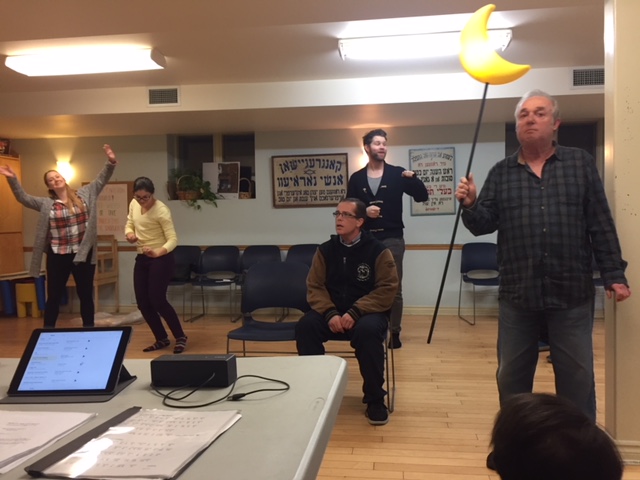
The NAGs Players rehearse Beauty and the Beast, which opens February 1 at the Tranzac Stage. Written by Ben Crocker and adapted for the NAGs Players by Ginty Burns & Lina Minniti, this fun-filled family entertainment tells the story — through a poodle’s eyes — of a prince who falls in love with a beautiful girl and suffers the consequences of a glamorous witch’s jealousy. For more information, please visit www.nagsplayers.com. COURTESY NAGS PLAYERS
Tags: General
January 29th, 2018 · Comments Off on GREENINGS: Driving fuelled by unseen subsidies (Jan. 2018)
Invest in transit and public works, not roads and parking
If all goes according to plan — and with the Toronto Transit Commission (TTC) it never does — Torontonians should enjoy time-based transfers starting in August. It’s great news for transit users but critics — who claim it’s an unfair subsidy — are livid.
“How about transit users paying their fair share?” said one vocal naysayer on my ever-burdensome Facebook feed.
It struck me as an impressive level of cherry-picking data for him to come to the conclusion that transit is being unfairly subsidized at the expense of cars.
I will argue any day that cars benefit from a far greater subsidy than transit.
Road maintenance
A 2013 study showed that drivers pay between 70 to 90 per cent of a $7.5 billion provincial road maintenance bill. This leaves between $750 million and $2.25 billion, which is funded from general tax revenue.
By comparison, the TTC, the province’s largest city transit operator, got a whopping $411 million in 2013. Just last month, a paltry $11 million funding announcement for Brampton’s transit system was photo-op worthy. Even on the low end of the estimate, transit users don’t get the kind of subsidies that drivers do out of general tax revenue.
Opportunity cost
Giving space to cars is often seen as an “investment” and “economic driver” that pedestrians, cyclists, and transit users don’t enjoy. The City of Toronto owns about 160 parking lots containing roughly 20,000 spaces. The lot between Lippincott and Borden streets just south of Bloor Street has 144 spots and takes up almost 37,000 square feet of surface area. This lot charges $4 per hour to park a car there.
The city is essentially sitting on land and subsidizing drivers to park. This land could be put to much more productive uses that generate far greater amounts of revenue for the city. Between Bathurst Street and Spadina Avenue, the going rate for ground floor retail is approximately $75 per square foot per year.
According to the Greater Toronto Transportation Authority (or Metrolinx), each off-street space generates roughly $1,000 of net revenue annually, which amounts to slightly under $4 per square foot per year. The city is getting a tiny fraction of the real value of the land by leaving it to languish as a surface lot. This is a massive subsidy for drivers. If arguing against the time transfer is about fiscal responsibility, I demand that the city make better use of these land resources. It’s called responsible asset management.
The city could develop these properties, bringing in a steady stream of revenue, or sell it off to developers for a one-time windfall. Either way, it is worth a lot more than the $4 per hour each parking spot currently generates.
One might argue that this is about promoting businesses, but so is the timed transfer. How much more money would people spend if they could pop out at any station, pick up what they’re looking for, and pop back in for free? There have been many trips I don’t make because paying another fare is just enough of an inhibitor.
“I can do it another day” I tell myself. Meanwhile I don’t spend the money I would have spent.
Viewing subsidized parking as the way of the world and a timed transfer as an unfair subsidy is simply hypocrisy of the highest order.
Investing in transit
We have finally turned a page where transit is getting decent infrastructure investment. For four decades, the Greater Toronto Area has seen one road-widening project after another with limited investment in transit. Now that car manufacturers no longer wield the political influence they once did (i.e. they don’t write cheques nearly as big as they used to), we have woken up and see the light.
Widening roads has gotten us nowhere. A friend who worked at the University of Toronto recently retired. She bought a house in Richmond Hill early in her career. It took her 20 minutes to hit campus every morning and she was quite happy with the commute. Fast forward to her retirement, it takes over an hour to get to campus and the roads have more lanes than when she bought her home.
We now know that roads and cars are an inefficient means of transportation. It was, and continues to be, a highly profitable one for manufacturers and oil companies, but they should no longer be writing our policy books. Multi-car families have created urban planning disasters that will take decades to recover from. There are neighbourhoods where one can’t even access a community centre without hopping into a vehicle.
It’s time to start looking at car costs as “subsidies” and transit costs as “investment”.
Terri Chu is an engineer committed to practical environmentalism. This column is dedicated to helping the community reduce energy, and help distinguish environmental truths from myths.
Tags: Annex · Life · Opinion
January 29th, 2018 · 1 Comment
Can a park’s past set the tone for its future?
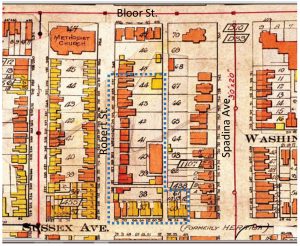
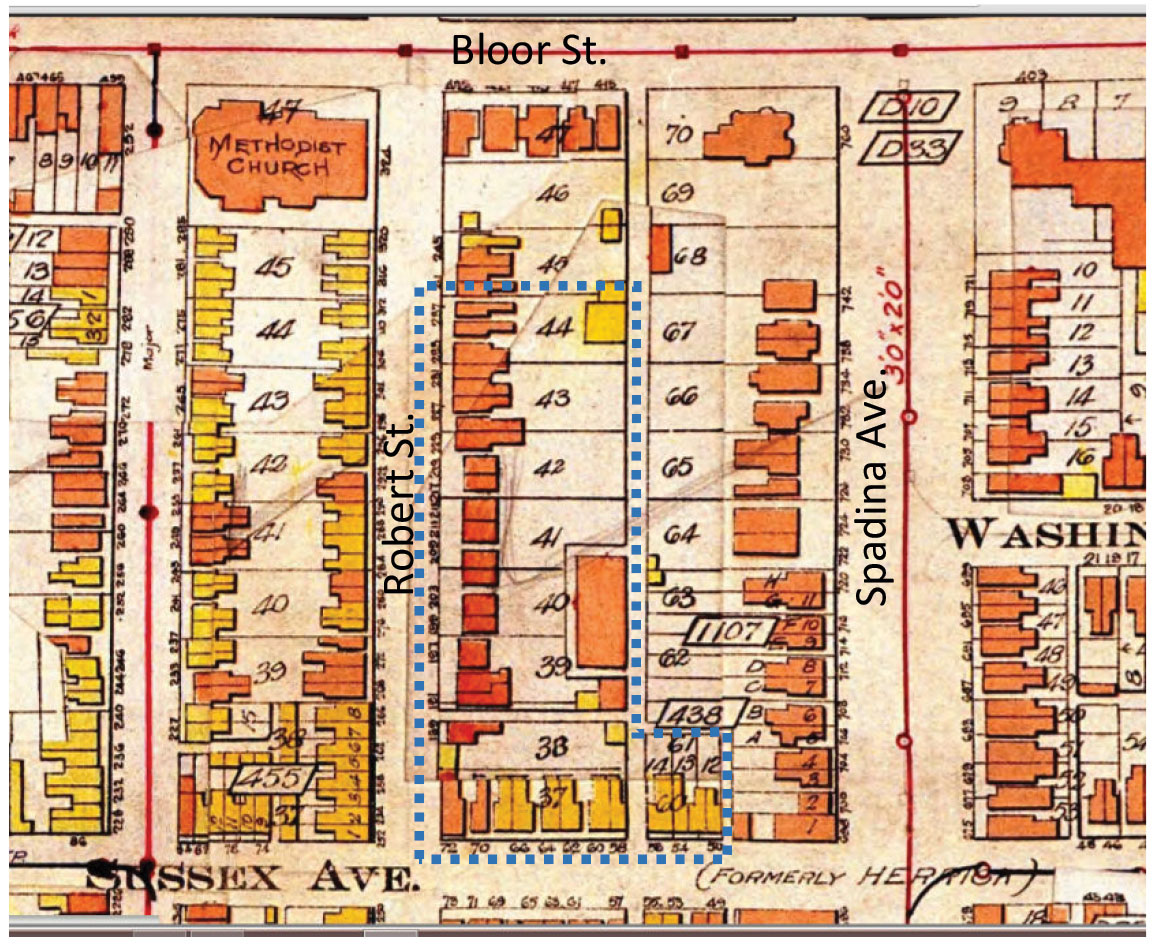
Had the Spadina Expressway been built, there might have been a development like St. James Town west of Yonge Street. The city had rezoned the area, and a developer had quietly purchased many of the 32 properties on Robert and Sussex avenues. COURTESY CITY OF TORONTO ARCHIVES
By Nicholas Provart
Fifty years ago, around the same time that the City of Toronto was planning the Spadina Expressway, urban planners had a bold vision for the area surrounded by Robert Street, Sussex Avenue, Bloor Street, and Spadina Avenue. The thought was to build two tall towers and create another St. James Town. The city rezoned the area, and a developer quietly purchased many of the 32 properties on Robert and Sussex avenues.
The residents who lived in the area, however, were not so quiet. The Sussex Area Residents’ Association responded with an 80-page report detailing their grievances. They highlighted the loss of affordable housing both for students and owners of the houses in the area, increased density, and limited green space. They also underscored the lack of recognition of how the area functioned “in the creation of the Canadian nation”, absorbing successive waves of immigrants.
By June 1967, the rezoning was repealed, and the developers, University of Toronto and City of Toronto agreed to what’s become known as the Aura Lee Transfer.
The city wanted to extend Ramsden Park, between Roxborough and Pears avenues, all the way to Avenue Road. The university’s Aura Lee Playing Field was just east of Avenue Road at the west end of Ramsden Park, and the developer had properties on the south side of Pears Avenue.
Instead of purchasing the playing field, the developer exchanged its Robert Street land for the Aura Lee Playing Field. By 1968, the developer had enough land to build two towers on Pears Avenue, and received permission to build from the city by pledging the northerly 1.6 acres of Aura Lee lands to create the western extension of Ramsden Park.
In 1968-69, deaf to affordable housing concerns, the university tore down 32 houses on Robert Street and Sussex Avenue to create the Robert Street Field. It was well used by the community, and a skating rink and tennis courts were built on the site.
In 1971, the university and the city came to what council called an exemplary agreement: the public would be able to use the facilities and the city would pay the cost of maintaining them.
The city also created a children’s play area at the site’s south end, now a parkette on Sussex Avenue, and the University of Toronto Schools built its own changing facilities for the rink house.
In 1973, the university renamed the Robert Street Field the Aura Lee Playing Field.
Over 20 years later, and the university’s once lauded behaviour isn’t quite so exemplary.
The rink’s ice making equipment — deemed the university’s responsibility in the agreement with the city — failed in 1998, the university is storing an army of garbage cans (including, oddly, garbage cans labelled “Ryerson”) on the rink, there’s snow fencing in lieu of nets on the pitted tennis courts, and the university’s ground crews are using what was once the three original tennis courts as storage space for landscaping materials.
With this history, it’s no wonder local residents have a sense of déjà vu about the university’s plan to build a student residence on the northeast corner of Sussex and Spadina avenues.
It would be an interesting exercise to have students from the university’s architecture program reimagine this area with a view to incorporating heritage and green space. Or if the university is unable to maintain the rinks and the tennis courts, perhaps the land could be given to the city for much-needed green space.
Nicholas Provart is a member of the Harbord Village Residents’ Association. This article is condensed from the original version, which appears on the association’s website www.harbordvillage.com. It has been reprinted with the writer’s permission.
Tags: Annex · History · Opinion
December 15th, 2017 · Comments Off on ON THE COVER: Snowshoes and a red sweater (Dec. 2017)
This year’s annual holiday
cover comes to us courtesy of the
Justina M. Barnicke Gallery of the University of Toronto’s Art Museum.
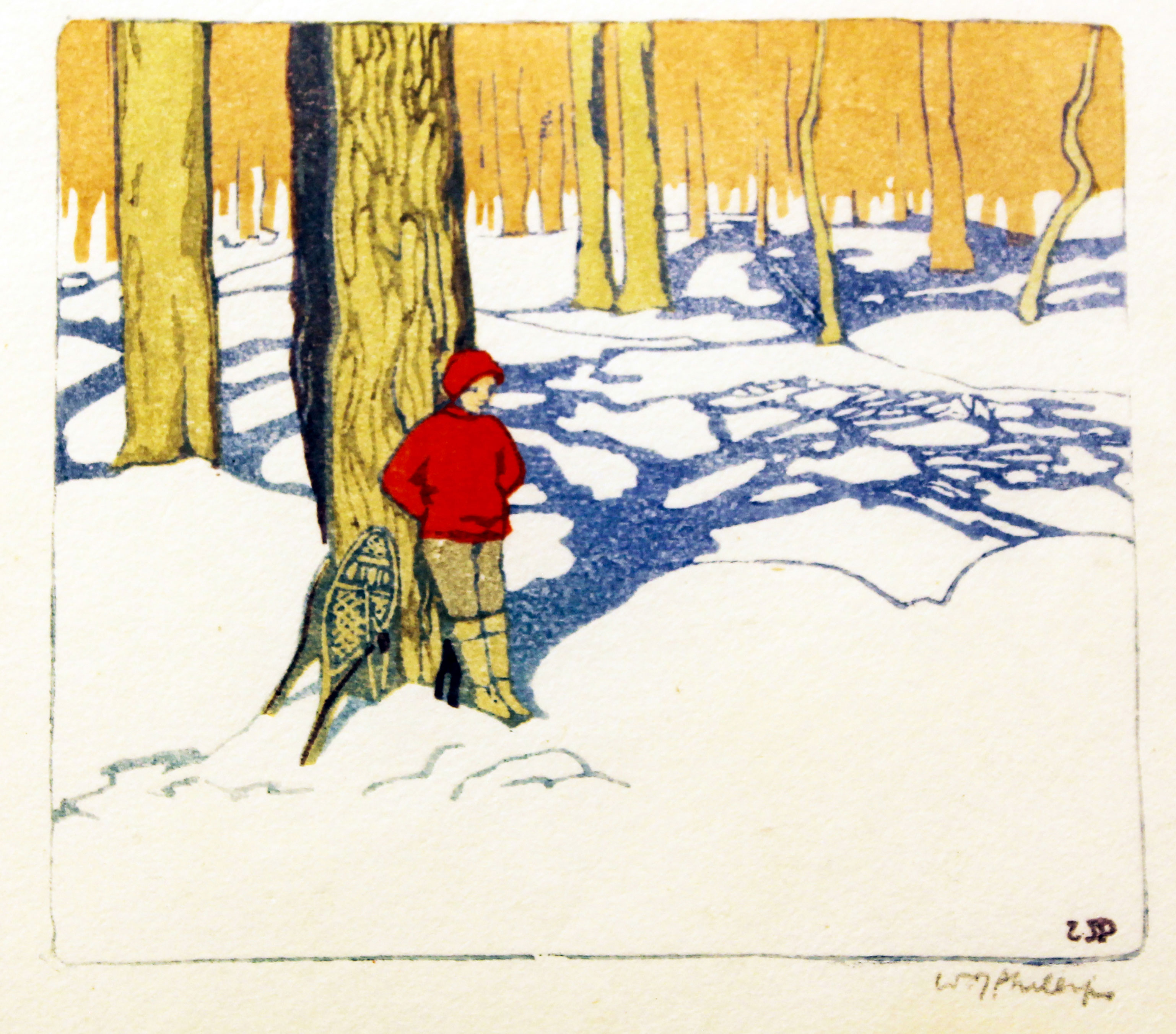
Winter Woods by Walter J. Phillips (1884-1963) is a 9.5 by 11 centimetre colour woodcut that is part of the Winter Woodcuts Portfolio. Born in Engand, Phillips was a Canadian painter and printmaker who is credited with bringing the Japanese style of colour woodcut to Canada.
Tags: Annex · Arts
December 15th, 2017 · 2 Comments
Residents still concerned about BSUC proposal
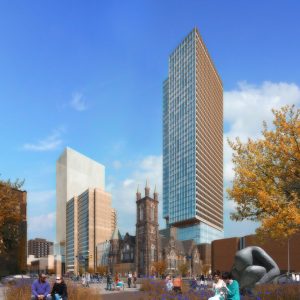
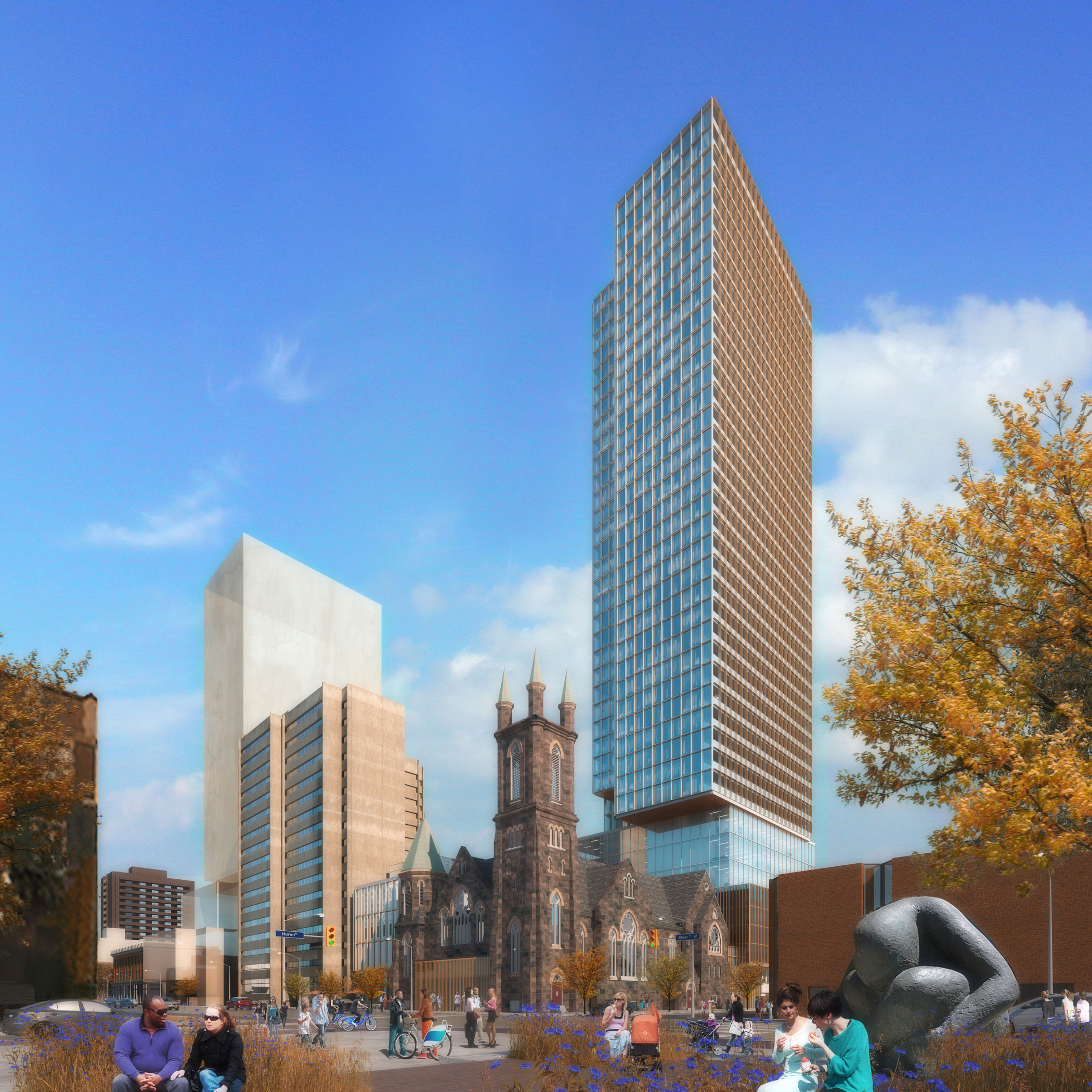
COURTESY KPMB ARCHITECTS An artist’s rendering of the proposed redevelopment of Bloor Street United Church. The heritage aspects of the church will be restored, and a 38-storey mixed-use tower added to the church grounds.
By Geremy Bordonaro
Many community members remain unhappy with the proposed redevelopment of the Bloor Street United Church, even after the third — and final — community consultation in late November.
[pullquote]“It’s a beautiful design but it’s just in the wrong place” —David Harrison, chair, Annex Residents’ Association[/pullquote]
The plan calls for a 38-storey mixed-use building that will occupy the west end of the church’s grounds and retain most of the heritage elements on the east.
Although the developers have not yet submitted their application to the city, they hope to do so sometime in the new year.
“What we’ve said is that in any consideration of this site certain core principles need to guide the thinking. One of those principles is heritage retention. Another is appropriate height,” said Joe Cressy (Ward 20, Trinity-Spadina).
“We have two studies, both endorsed by the city, which make it pretty clear the type of height which would be expected. And what the city’s plan would speak on is probably something closer to the teens.”
Cressy has dealt with a very similar proposal process like this. The developers have tried to engage the community from the outset, as Westbank Projects Corp. did for its redevelopment of Mirvish Village, but as with Westbank, there has been a lot of pushback.
“While what has been proposed is not something that is supportable at this time the process that they are taking, before they put in an application, to engage and work with the community is the right one,” Cressy said.
One major player is the Annex Residents’ Association (ARA), which opposes the plan in its current form.
“You can’t fault them on trying to embrace the community. They’ve tried, we’ve had several meetings, but they still haven’t reduced the size of what they have on offer,” said David Harrison, ARA chair. “It’s a beautiful design but it’s just in the wrong place.”
The church has given its land to the developers, Collecdev, Northrop Development Incorporated, and Strategy Corp., to pay for the building’s revitalization. Reverend Martha ter Kuile said that she wasn’t surprised by the negative reaction, but has urged the developers to work with community.
“Generally I’d say these meetings have gone very well but the major issue has been the height of the building,” said Marianne McKenna of KPMB Architects, which is designing the development. “I think everybody has initially embraced the idea that the church was important to retain. It’s a benefit to retain the church in its entirety. The stickler has been the height and the fear of the residents.”
Reverend Kuile said that the community’s opinion matters highly to the church and they’re trying to do everything in their power to accommodate local residents. But, it’s easier to get an agreement for a plan like this in the crowded, tower-filled streets of the downtown core, but the Annex is still grappling with the impact such developments could have on the future of the area.
“It sets a precedent in the city. And we try to accommodate the hundreds of thousands of people who will come to Toronto in the next decade. Maybe millions,” McKenna said. “We’re going to have to build. We’re going to have to build perhaps taller than people anticipate. And it should be on the main streets, like Bloor Street.”
McKenna says her concern is about “younger people who want to live in the city” and who would want to take up residence in a bustling area like the Annex. And though the pushback from the community has been vocal, she still hears from people who support the design.
“There were a lot of people at that community meeting who were quite positive. Who spoke up, not in the public forum, but afterwards said look, my tomato plants will be shadowed for half an hour. I get it. I’m in favour of this,” McKenna said “But they’re not the people who speak.”
Meanwhile, the ARA hopes to set up a group to continue the discussions between the architect, community, and developer before the plan finds its way into the application phase.
“They’ve sort of agreed, I wouldn’t say they have agreed, but they have heard the idea that they shouldn’t submit until they’ve met with a working group,” Harrison said. “But all developers at the moment are very focused on the fact the new rules from the Ontario Municipal Board (OMB) will be done soon and they’ll all have to put in application appeals before that happens.”
There are still fears from an untrusting community that if talks turn sour the developers would turn to the OMB, which some residents believe hasn’t ruled in their favour in the past.
Yet Cressy is still hopeful about the process.
“What we need to see ultimately, though we’re still early in the process, is some shifts in the response to the proposal. Often the process that takes place is a developer comes in, throws in an application, and then you talk afterwards,” Cressy said. “I think the process here of talking first is important. What we need to see are some changes to what’s in there though.”
READ MORE:
NEWS: New vision for Bloor Street United (JULY 2017)
Tags: Annex · News
December 15th, 2017 · Comments Off on FOCUS: Radical reverend finds new home (Dec. 2017)
Cheri DiNovo leaves politics for ministry at Trinity-St. Paul’s

GEREMY BORDONARO/GLEANER NEWS After 11 years in provincial politics, Cheri DiNovo is returning to the Annex and her ministerial roots. She performed the first legalized same-sex marriage in North America when she was a minister at Emmanuel Howard Park United Church.
By Geremy Bordonaro
After serving 11 years in the provincial legislature, the Rev. Dr. Cheri DiNovo (Parkdale-High Park) is returning home to the Annex, where she will become the new minister for Trinity-St. Paul’s United Church, effective January 1.
“It was time. I don’t think I’ve ever had a job that I stayed at for more than ten years, including owning my own company,” said DiNovo. “The perfect church came up, which is Trinity-St. Paul’s. It’s the perfect mix for me of faith, justice, and the arts.”
[pullquote]“This is a community that is very, very excited about her coming” —James Holzbauer, member, Trinity-St. Paul’s United Church[/pullquote]
It took the church a long time to find the perfect candidate. Following a process called “listening to the spirit”, the church considered what they value, what they are passionate about, and who they are as a congregation.
“We’re a very inclusive, very progressive, affirming congregation in the downtown city of Toronto,” said church member James Holzbauer, who was also a member of the selection committee. “We have been well aware of Cheri’s ministerial work at Howard Park United prior to being elected to [the legislature]. And we were all very well aware of the types of initiatives that she has so successfully championed…all of them fit our value base just like a glove.”
DiNovo fought for LGBTQ2S rights during her time as MPP, and her final bill was to recognize November 20 as a Transgender Day of Remembrance.
“Here’s a church that has been affirming of queer people since the 1970s, even considerably before the United Church of Canada ordained openly gay and lesbian people in 1988,” DiNovo said. “When the church decided that, they lost a third of their members, that’s how contentious it was. You can imagine what kind of backbone it took for a church in Toronto to stand up for queer rights.”
“We have a lot of queer people in the congregation,” said Holzbauer. “A lot of us had read Cheri’s book on queering evangelism. We’re very impressed by that. She had put a stained glass window of a trans woman in Howard Park United years before anyone else had. She was way ahead of that curve.”
DiNovo is an expert in Queer Theology.
“Queer theology…presumes inclusion,” explained Dr. Natalie Wigg-Stevenson of Emmanuel College. “It’s about how we can imagine the Christian tradition from a queer perspective.”
So, when DiNovo’s name was brought up for selection, it was hard for the congregation not to get excited.
“When this whole situation started, I was in the Philippines. We received Cheri’s application and I’m surprised people here didn’t hear me shout with joy from 7,000 kilometres away,” Holzbauer said. “She is just really the perfect candidate for us.”
DiNovo grew up in the Annex on Bedford Road in a boarding house run by her family, “a far cry from the chi-chi Bedford Road of today,” she noted.
She was ordained in 1995, and soon became known as the Radical Reverend for her trailblazing ways.
She performed the first legalized same-sex marriage in North America at Emmanuel Howard Park United Church, before the law changed.
“At that point the church didn’t back me,” she said. “The government threatened to take away my licence.”
DiNovo is looking forward to taking up her new ministry in the new year and continuing the progressive tradition Trinity-St. Paul’s is known for.
The congregation is equally excited. “This is a community that is very, very excited about her coming. So stay tuned,” Holzbauer said. “We’re pretty darn good at what we do at the moment and I think we’re just going to be even better. I can’t wait and I know a lot of others can’t either.”
Tags: Annex · News
December 15th, 2017 · Comments Off on CHATTER: Celebrate the solstice with Kensington’s festival of lights (Dec. 2017)
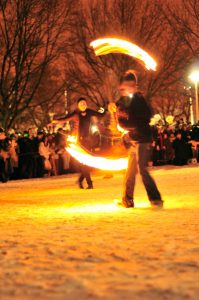
MATT JAMES/GLEANER NEWS FILE PHOTO
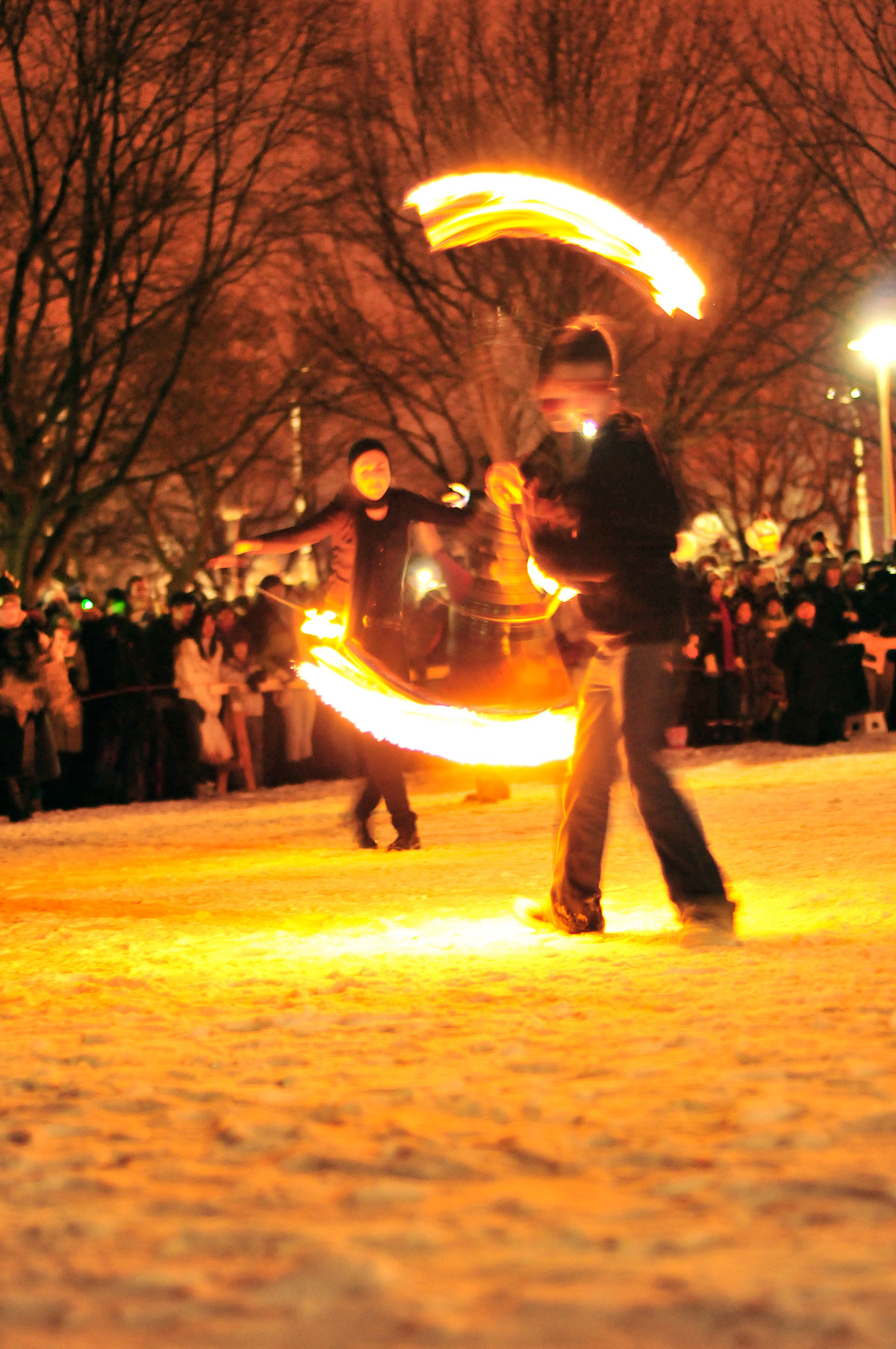
Kensington Market’s 28th annual winter solstice parade returns on December 21. Organized by Kensington-based Red Pepper Spectacle Arts and sponsored in part by the Kensington Market BIA and the Kensington Market Action Committee, the parade marks the returning of the light after the shortest day of the year, and features hand-made lanterns, theatrical scenarios, and a fiery finale at Alexandra Park. The parade starts at Oxford Street and August Avenue at 7 p.m., though lantern sales start at 4 p.m. Unlike the Santa Claus parade, this is a participatory event, so bring your own drum or pan, and wear a costume.
—Brian Burchell, Gleaner News
Tags: Annex · News
December 15th, 2017 · Comments Off on CHATTER: City budget balanced on thin ice (Dec. 2017)
City Manager Peter Wallace tried again, in vain, to alert members of city council to the threat posed by hedging the city’s budget against the apparent unrelenting strength of Toronto’s real estate market. The city has enjoyed explosive growth in revenue from the land transfer tax over the last ten years, and projections for next year suggest that Toronto will get $808 million, four times what it got when the tax was first introduced.
Wallace is concerned that the city’s bureaucracy has grown too dependent on a revenue stream that is as unpredictable as real estate values, and at a preliminary budget presentation at city hall said “recurring expenses continue to be matched with potentially cyclical revenue sources, as in prior years”. To put this in perspective, the entire budget for the fire department, paramedics, the planning department, and municipal licensing and standards could be funded by this sum of money.
This kind of tax, explains Wallace, is “cyclical”. It rides the wave of home prices. If they fall precipitously, so does the city’s revenue stream But if the city has assumed “recurring” expenses then it is stuck with the fixed costs but will have no means to fund them.
—Brian Burchell, Gleaner News
Tags: Annex · News
December 15th, 2017 · Comments Off on CHATTER: Cyclists prey for open doors (Dec. 2017)
The Public Works and Infrastructure Committee (PWIC) of city council has been asked to help reduce the number of “doorings” — when a car door is opened into the path of an oncoming cyclist — in Toronto. Although this falls under the provincial jurisdiction of the Highway Traffic Act, one advocate believes the city needs to act.
“These are completely preventable accidents,” says Chris Glover (Ward 2, Etobicoke Centre), who brought the motion forward. He’s a trustee with the Toronto District School Board Trustee and a member of the Toronto Board of Health. “We need both levels of government to take measures to reduce doorings and to keep cyclists safe.”
Bike advocacy group CycleTO reports that the number of doorings has increased from 132 in 2014 to 209 in 2016. Many of these accidents lead to serious injuries and have even led to deaths. In 2011, the provincial government downgraded doorings from “accidents” to “incidents” because they involve a stopped car.
At committee, Glover demonstrated how to prevent doorings with simple measures like the “Dutch Reach”, a method of opening a car taught in the Netherlands: drivers use their right hand to open their car door, forcing them to swivel in their seat and do a shoulder check for oncoming cyclists. Teaching the Dutch Reach in Ontario is one of the recommendations in the motion.
PWIC referred Glover’s recommendations to city staff for further advice.
—Brian Burchell, Gleaner News
Tags: Annex · News
December 15th, 2017 · Comments Off on FORUM: Fairness and cleaner air (Dec. 2017)
A case for road tolls
By Tim Grant
Why is the idea of charging drivers for the use of roads something that provincial politicians steadfastly avoid?
Twenty years ago, the then Premier Mike Harris downloaded the costs of maintaining the Don Valley Parkway and the Gardiner Expressway to the City of Toronto. Since that time, Toronto has been the only city in Ontario that has to pay for provincial highways. To date, we have paid $1.5 billion for highways that others use for free.
[pullquote]To date, we have paid $1.5 billion for highways that others use for free.[/pullquote]
A year ago, Mayor John Tory asked Premier Kathleen Wynne for permission to charge tolls on those two highways. Although she had previously expressed a willingness to give such permission, this time around the premier said no. The NDP and Conservatives also said no. Worse, not one of the three major parties offered to take back the maintenance costs that Harris had downloaded onto Toronto. Instead, they betrayed Toronto in order to win votes in the 905 belt around the city.
For many years, drivers across the Greater Toronto Area have endured some of the worst traffic congestion in North America. Virtually every major transportation report in Ontario in the last five years has acknowledged that the only way to deal with Toronto’s severe traffic congestion and build the transit we need is to charge drivers something for using the roads. Quite apart from the views of transportation experts, there is also a question of fairness. When you and I get on the TTC, our fares help to cover 76 per cent of the cost of the transit system. But according to a 2008 study by Statistics Canada, drivers pay only 40 per cent of the cost of the roads.
Unfortunately, none of the main political parties have a strategy for reducing traffic congestion. Nor do they acknowledge what the experts already know: that in and of itself, providing better public transit has only a small impact on the roads.
By contrast, road tolls are a proven means of reducing traffic congestion. Experience elsewhere tells us that if all the revenue from road tolls goes to improving transit, 15 to 30 per cent of drivers will switch to transit. Those that would switch were only driving because they had no alternative. The remaining drivers — those that will pay the tolls — enjoy a significant benefit. They will spend less time stuck in traffic. And because of tolls, all of us will breathe cleaner air.
Tolls have come a long way over the years. No one installs toll booths anymore, and the cost of the tolls usually varies depending on the level of congestion. For example, if you are driving out the city during the morning rush hour, you might pay a dollar, while those driving into the city might pay $2.50 to $3.00. In off-peak hours, the charges would be minimal or waived altogether.
One objection to tolls is that they are unfair to those of the poor who have no choice but to drive. But those who take public transit also pay for their rides. And with reduced congestion, all drivers will get to work faster. Some, such as tradespeople, may actually earn more money because of tolls.
However critics who say that it is unfair to charge tolls until better transit is available have a good point. In 2003, on the very first day that the City of London’s congestion charge came into effect, there were 3,000 new buses on the road to meet the increased demand for transit. When the province of Ontario finally agrees to road tolls — and it is only a question of when — a similar investment will be needed here.
Isn’t it time for Ontario’s political parties to have an adult conversation about how we’re going to reduce traffic congestion and pay for transit?
Tim Grant is the Green Party of Ontario’s Transportation Critic, its candidate in University-Rosedale, and the former chair of the Harbord Village Residents’ Association.
Tags: Annex · Opinion
December 15th, 2017 · Comments Off on CHATTER Deals disappear with December demolition!! (Dec. 2017)
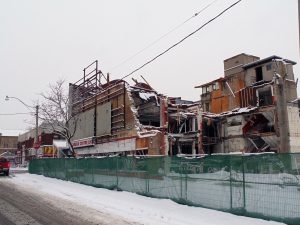
BRIAN BURCHELL/GLEANER NEWS Deals fell to the floor as the Honest Ed’s demolition continued with the dismantling of masonry, lumber, and steel. Originally divided by a city-owned alley called Honest Ed’s Way, the store’s sections were constructed very differently. Pictured here is the west annex, which was built on the houses that once stood there and featured crooked floors, because the houses were not built to the same elevations.
READ MORE
CHATTER: Coming down (Nov. 2017)
EDITORIAL: Westbank’s positive precedent (April 2017)
NEWS: Westbank presents latest proposal (MARCH 2017)
FORUM: Build a neighbourhood (March 2017)
NEWS: Height, density still top concerns (July 2016)
NEWS: Westbank submits revised application (June 2016)
DEVELOPINGS: Annual review reflects tension between community activism and OMB (March 2016)
Westbank towers over 4 Corners (January 2016)
City hosts first Mirvish Village community consultation (November 2015)
Residents’ associations share concerns for Mirvish Village (October 2015)
Westbank submits application (August 2015)
BABIA endorses Westbank proposal (July 2015)
How do you make it real? (April 2015)
Tags: General