October 16th, 2018 · Comments Off on SPORTS: Leafs’ fiftieth season ends sadly (October 2018)
Ball club swept from semi-finals
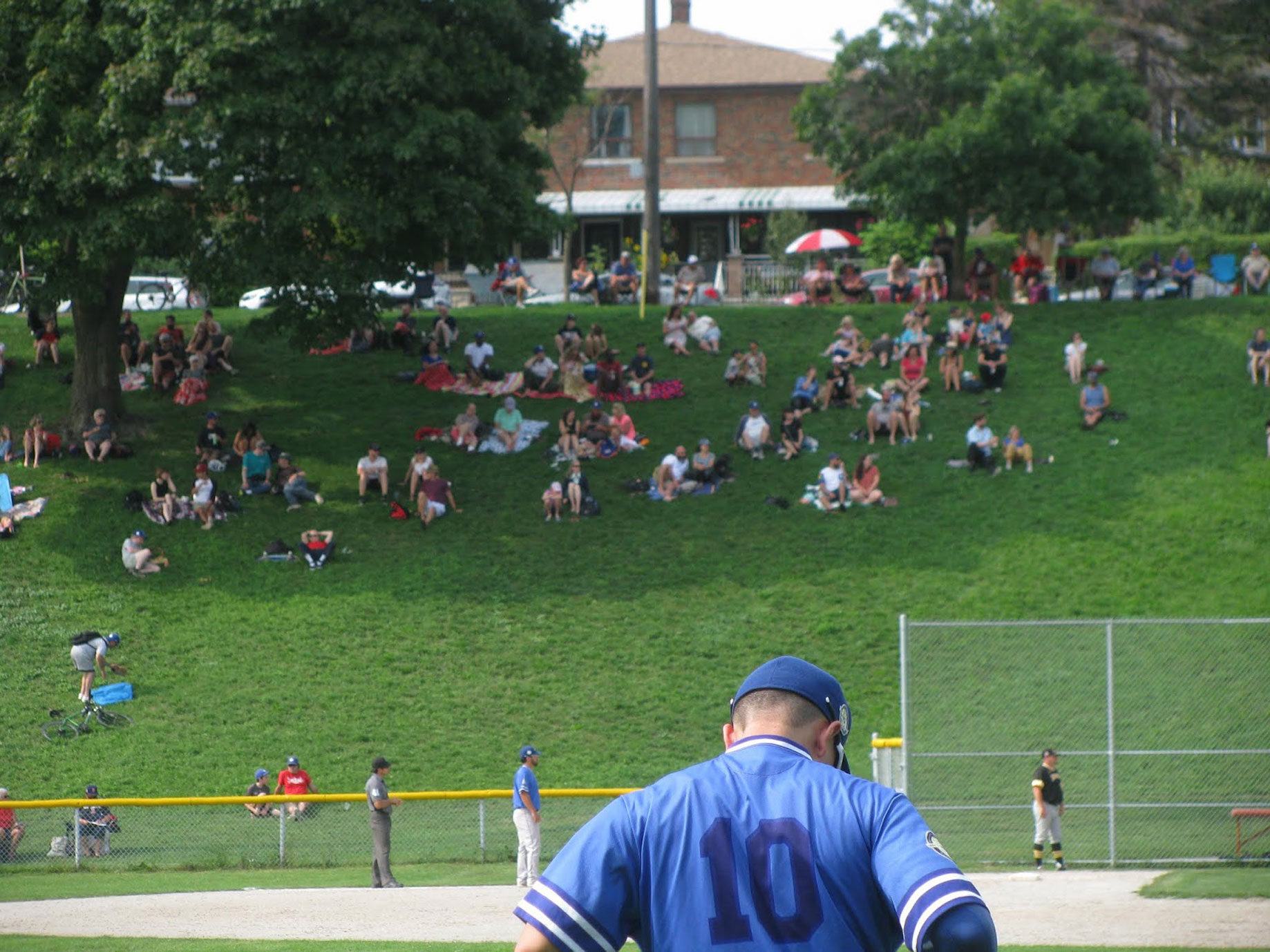
Fans watch from the hillside as the Maple Leafs came up short at home during this year’s semi-finals. R.S. KONJEK/GLEANER NEWS
By R.S. Konjek
When we last caught up with the Toronto Maple Leafs of the Intercounty Baseball League (IBL), they had begun a spirited quest to win their first championship since 2007.
Back in early August, the Leafs faced the Guelph Royals in the first round of the playoffs. Pitchers Zach Sloan and Marek Deska made history when they combined to toss a no-hitter in the deciding game of the series. The Leafs moved on to a semi-final matchup against the favoured Kitchener Panthers with the wind at their backs.
Unfortunately, they were swept away like so much fallen foliage when the best of seven semi-final series was decided in the first game.
It was an unusual affair. Game one began on August 17 in Kitchener, and ended two days later at Christie Pits. A Friday night rainstorm caused the game to be suspended after seven innings. The league determined that play would resume the following Sunday in Toronto, before the scheduled second game of the series.
The Leafs had built up a 4-3 lead in Kitchener and took the field in Toronto on August 19 just six outs away from a surprise victory.
It all fell apart in the bottom of the eighth inning. Zach Sloan proved that you can be the hero one day and the goat the next. He allowed two Panthers to get on base. A hasty call to the bullpen did not help. Closer Dustin Richardson gave up a two-run hit, Kitchener grabbed a 5-4 lead, and they held on for the win.
The Leafs and their fans barely had time to get over the result before game two began a half hour later. It went from bad to worse, as the Panthers romped to an 8-0 victory.
The weather played havoc with the series schedule again as the third game — scheduled for August 21 — was rained out in Kitchener. The league decided to shift the series back to Toronto the following day.
Game three took place at Christie Pits on August 23 and the Panthers won 9-3. The Leafs were unable to break through Kitchener’s solid corps of Cuban pitchers, and found themselves facing elimination after just three games.
The fourth game was played on August 23 in Kitchener. In the end, it was all Panthers.
The Leafs blew an early 2-0 lead and the game remained tied 2-2 until the bottom of the eighth inning. A solo home run put the Panthers ahead 3-2 and they held on to clinch the series.
Kitchener advanced to the IBL championship against the Barrie Baycats. (The Baycats ended up winning their fifth consecutive title.)
Looking back, the Leafs’ playoff run was undone by that shock defeat in game one. They were never able to regain any momentum. Their fiftieth anniversary season ended on a sad note, away from home and their unique family of fans.
Torontonians have made the act of isolating themselves within a crowd into an art form.
It’s one of those things we do. So much of our time is spent in close proximity to strangers. Wheel to wheel in traffic, shoulder to shoulder on the subway, elbow to elbow in theatres, elevators, checkout lines; rather than engage, we withdraw. It’s a kind of coping mechanism for urban life.
I’m sure it happens in other large cities, but here in this little outpost that supposedly outgrew its Protestant foundations, avoiding unintended contact with unfamiliar people remains a daily aspiration.
All of this to say that Christie Pits is an exceptional place.
Home of the Toronto Maple Leafs since 1969, the park is a place where I have seen the unlikeliest of people lower their defences and interact with total strangers.
The free admission to Leafs games makes for an egalitarian experience. Fans can come and pick out a spot to sit or stand wherever they like, without thought for one’s status or station in life.
When the game begins, everyone takes it in together. Rather than casting a thousand crosswalk stares, people look each other in the eye. The action on the field provides the spark for spontaneous discussions, whispered opinions, angry ejaculations, and resigned sighs. For a couple of hours at Christie Pits, no one is isolated.
It’s an incredible experience, one to look forward to again in 2019 when the Leafs return for their 51st season of Intercounty League baseball.
READ MORE:
SPORTS: Fans cheer hair and history (Aug./Sept. 2018)
SPORTS: Slumping Leafs hope to change (Summer 2018)
SPORTS: Many hats, one goal for Topolie (July 2018)
SPORTS: Maple Leafs back at the Pits (Election Special 2018)
NEWS: Celebrating a legendary Leaf (Jan. 2018)
ON OUR COVER: Cycling the Pits (Fall 2017)
SPORTS: Leafs fall early this summer (AUGUST 2017)
Tags: Annex · Sports
September 11th, 2018 · Comments Off on ON THE COVER: Bringing it to the table for 40 years (Aug./Sept. 2018)

The Tafelmusik Baroque Orchestra and Chamber Choir celebrates its 40th anniversary with a fall social at Trinity-St. Paul’s Centre (427 Bloor St. W.) on September 15. Performances this season include a new cycle of Mozart concertos, Vivaldi, and the St. Mathew Passion by Bach. Please see CHATTER: Enjoy baroque at a bargain (Aug./Sept. 2018) for more details. COURTESY SIAN RICHARDS/TAFELMUSIK
MORE COVERS:
ON THE COVER: Pop up pit stop (Summer 2018)
ON THE COVER: Ghost bike installed (July 2018)
ON THE COVER: The Ballot Bunch (Election Special 2018)
ON THE COVER: Accidental Parkland (May 2018)
Tags: Annex · News · Arts
September 11th, 2018 · Comments Off on NEWS: Hundreds protest cuts to council (Aug./Sept. 2018)
Defending downtown democracy
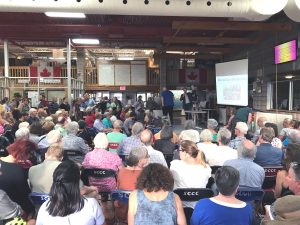
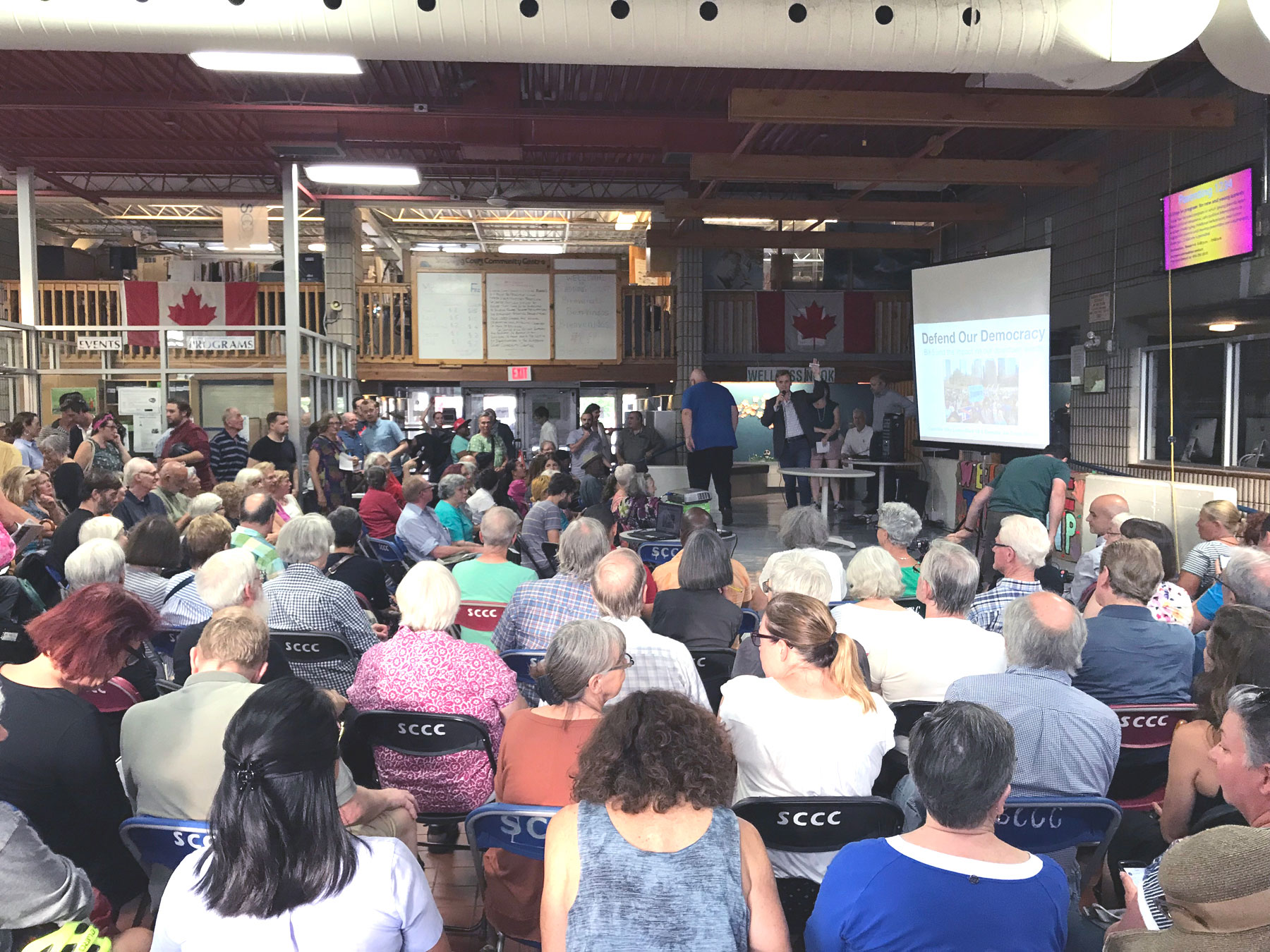
Joe Cressy (Ward 20, Trinity-Spadina) speaks at an emergency public meeting at Scadding Court Community Centre on August 13. ELLIE HAYDEN/GLEANER NEWS
By Ellie Hayden
“Shame!”
Hundreds of people huddled shoulder to shoulder shouted the rallying cry at an emergency public meeting on August 13 at the Scadding Court Community Centre.
The event was organized by Mike Layton (Ward 19, Trinity-Spadina) and Joe Cressy (Ward 20, Trinity-Spadina) to protest Bill 5, The Better Local Government Act. Passed in the provincial legislature on August 14, the act cuts Toronto City Council almost in half, reducing it from 47 seats to 25.
“The larger wards are, the harder it is for local councillors to work with neighbourhoods, to work with frontline harm reduction agencies, to work with residents and businesses to manage our communities together,” said Cressy, whose ward — one of the largest in the city — is home to about 100,000 residents. “If there is one fundamental reason why we need to ensure why local democracy matters, it’s to ensure livable neighbourhoods in the city.”
Ausma Malik, who is the Toronto District School Board (TDSB) trustee for Ward 10 and had announced her intention to run for council during the summer, said the reduction compresses downtown schools — where the density of schools and students is already among the highest in the province — into three wards. She explained that the board had to make difficult restructuring decisions over a matter of days or the premier would have done as he sees fit.
It’s not the only municipal organization that’s feeling the pressure.
Adam Vaughan (MP, Spadina-Fort York), who is the parliamentary secretary to the federal minister of families, children and social development, warned that the act threatens “reasonable government in Toronto”, as it strives to “[take] away the boards that run local community centres like this and [put] it all inside City Hall.”
Layton talked about the effect the act will have on neighbourhoods, focusing on Business Improvement Areas. Councillors are ex-officio (which means they have a vote but do not count towards a quorum) members of the BIA boards, and work closely with BIAs to improve communities and make sure that local voices are heard.
There are 12 BIAs in Layton’s ward, and each meets about once a month. He pointed out that it will be very difficult to sustain the necessary level of community engagement in a bigger ward.
Many at the meeting wondered if the act was legal, whether there was still enough time to hold a free and fair election, and what recourse the City of Toronto had in the courts.
“Are we going to let them run over us like this or are we going to go out kicking and screaming and perhaps in the process give our allies a little more time,” said activist and writer Desmond Cole, advocating for immediate action.
Craig Scott, a professor with the Osgoode Hall Law School and former MP for Toronto-Danforth, spoke at length about the legality of the act. While the city cannot simply say no to the legislation, or postpone the election, it can say with some validity that it can’t change the rules with such short notice.
“I’m hoping that the city is going to come bursting out the gates with a vigorous and strong argument that will prevent Bill 5 from going through,” said Scott, of the chance that the city will take the province to court.
He also warned that what he called “this abuse of arbitrary power” would not stop here.
Vaughan agreed, saying “this fight is about so much more than the hijinks at Queen’s Park and this egregious move by the provincial government that will literally wipe out local democracy. This is a fight for our city.
“If they can do this on the back of an envelope in 15 minutes, imagine what they can do in one term,” the MP and former councillor for Trinity-Spadina added. “The city is going to have to process and navigate very complex issues. As the provincial government damages the city of Toronto, I want to promise you the federal government will be there to step back in and support Torontonians building strong cities. That’s the support we can provide.”
Tags: Annex · News
September 11th, 2018 · Comments Off on NEWS: Don’t worry be happy (Aug./Sept. 2018)
Happiness eludes pursuit
By Ahmed-Zaki Hagar
A study from the University of Toronto found that a person pursuing happiness can also feel unhappy. Sam Maglio, assistant professor at the Rotman School of Management, says that he wanted to understand “the head of somebody who wanted to be happier”.
“Previous research has found that when you walk around trying to make yourself happier, you get the ironic effect where people end up feeling less happy,” he says. “We wanted to understand why that might be.”
Maglio and co-author Aekyoung Kim from Rutgers University had conducted a series of studies on how a person’s perspective on pursuing happiness can impact their happiness.
Maglio says that the reasons why pursuing happiness leaves people feeling unhappy is because they feel like they do not have enough free time. He says that viewing it as a long-term goal can negatively impact happiness.
“What our research adds is that even things that do make you feel happy, once you see them as in service of pursuing a goal, even the stuff that makes you feel happy makes you feel unhappy,” he says.
Maglio compared the pursuit of happiness to pursuing a specific goal.
“With happiness, you are never done being happy. Everyone wants to be happy all the time,” he says. “When we get in this frame of mind that says happiness is a goal we have to work towards, it reminds us that if I want to stay this happy forever, I have to keep doing the things that keep me happy forever.”
Maglio also says that social media negatively impacts happiness because people compare their current situation to the curated feed of friends who showcase the most interesting parts of their lives.
He believes that social media can have a counterproductive effect on someone’s happiness because of how people perceive fulfillment.
“Exposure to these environmental cues, be it social media or offline, would be detrimental to happiness,” he says.
Maglio found that having a gratitude journal to write down the things that make you happy can help with maintaining happiness, because it helps people focus on the present and appreciate the experience that does bring happiness.
“Focus on that one experience. Do not think about all the future time that you would need to keep doing the same stuff to maintain happiness. Focus on the one, and enjoy the one and it should bring people more lasting happiness.”
Tags: Annex · News
September 11th, 2018 · 1 Comment
The Tafelmusik Baroque Orchestra and Chamber Choir will open its 40th season in the Annex with a fall social on Sept. 15 in Jeanne Lamon Hall at Trinity-St. Paul’s Centre that will feature a concert followed by refreshments in the garden.
Tafelmusik is a type of German music that was played at feasts and banquets in the mid-sixteenth century, and the orchestra and choir specializes in baroque, classical era music, and reinventions of classics from that era.
“It is exciting to be doing this,” said Sarah Baumann, the organization’s marketing director. “We have not done a concert like this at the beginning of the season before; some of the members of the orchestra live in the area, so it will be a good opportunity for us to give back to the community. We hope that the community will enjoy it as well.”
Then there’s Tafelmusik’s Mozart 40 at Koerner Hall from September 20 to 23. Music director Elisa Citterio will take centre stage as the soloist when the orchestra launches a new cycle of Mozart concerts with its first ever performance of Mozart’s Violin Concerto in D Major. Mozart’s arresting 40th symphony is the centrepiece of the program, though, and will take listeners on a journey of great beauty, urgency, and passion. This music, which pushed the boundaries of the classical style, still feels bold and extraordinary today.
This is at the heart of Tafelmusik’s mission. While the orchestra plays on period instruments and according to the style of the time, it still aims to perform in a way that’s fresh and modern.
“Tafelmusik is different from a large symphony orchestra. It is a chamber-sized orchestra; for baroque music you’ll usually see 15 to 20 musicians on stage. For baroque orchestral programs, we are usually directed by a violinist. For programs with our choir, and for later classical/romantic programs, we work with a conductor,” explained Baumann.
Tafelmusik has a global reach thanks to its television broadcasts and recordings, but still performs over 80 concerts a year in and around Toronto, with half performed at Trinity-St. Paul’s.
The fall social begins at 4 p.m. and tickets are at heavily discounted prices of $5. For further information on Tafelmusik or any of its performances, please visit www.tafelmusik.org.
—Temi Dada and Laura Philips/Gleaner News
Tags: Annex · News
September 11th, 2018 · Comments Off on CHATTER: Meet and greet at the fall fair (Aug./Sept. 2018)
If it’s the first Sunday after Labour Day, it must be time for fun at the fair. On September 9 from noon to 6 p.m., residents of Harbord Village will be out in full force for music, socializing, and a silent auction at its annual fall fair in Margaret Fairley Park. Refreshments like burgers, soft drinks, and wine will be available for 50 cents to $5, depending on the item.
Now in its 26th year, the fair was first held in 1992 by the Sussex Ulster Residents’ Association, a precursor to the Harbord Village Residents’ Association (HVRA), which now organizes the event. It’s only had to be cancelled twice for rain since then.
“The real gift is to see our neighbours greeting, meeting each other, and chatting, getting along. There are no arguments or discussion about politics, there are kids running around with more freedom than they are allowed to at home,” said Rory Gus Sinclair, former HVRA president and the association’s fall fair co-chair. He added that organizing the event is very much a team effort, with volunteers handling even the smallest of tasks before, during, and after the event.
—Temi Dada/Gleaner News
Tags: Annex · News · General
September 11th, 2018 · Comments Off on CHATTER: Go behind closed doors in your own neighbourhood (Aug./Sept. 2018)
Discover some of the area’s architectural treasures in the third annual tour of houses and cultural groups organized by the Annex Residents’ Association (ARA). The guided tours will run from noon to 4:30 p.m. on September 23, and explore streets bounded by Bedford and Avenue roads, and Prince Arthur and Bernard avenues.
This year’s tours feature inside access to the Women’s Art Association of Canada, founded in 1887, and two outstanding buildings associated with the neighbourhood’s diverse religious organizations: First Church of Christ, Scientist, the Friends House, and the Women’s Art Association of Canada. There will also be tours of private residences, including a stunning Georgian built in 1875 for a Yonge Street hardware merchant that is now an artist home and studio.
Registration, check-in, and a café with light snacks and beverages will be located at the Women’s Art Association (23 Prince Arthur Ave.). Tickets are $25 for one person or $40 for two people, and early bird discounts are available until September 10. Please visit the ARA’s website at www.theara.org for further information or to reserve a ticket.
—Brian Burchell and Laura Philips/Gleaner News
Tags: Annex · News
September 11th, 2018 · Comments Off on NEWS: New life for old theatre (Aug./Sept. 2018)
Brunswick Avenue boutique hotel set to open
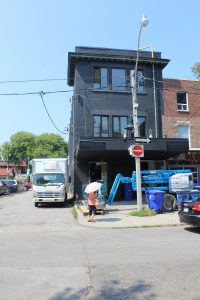
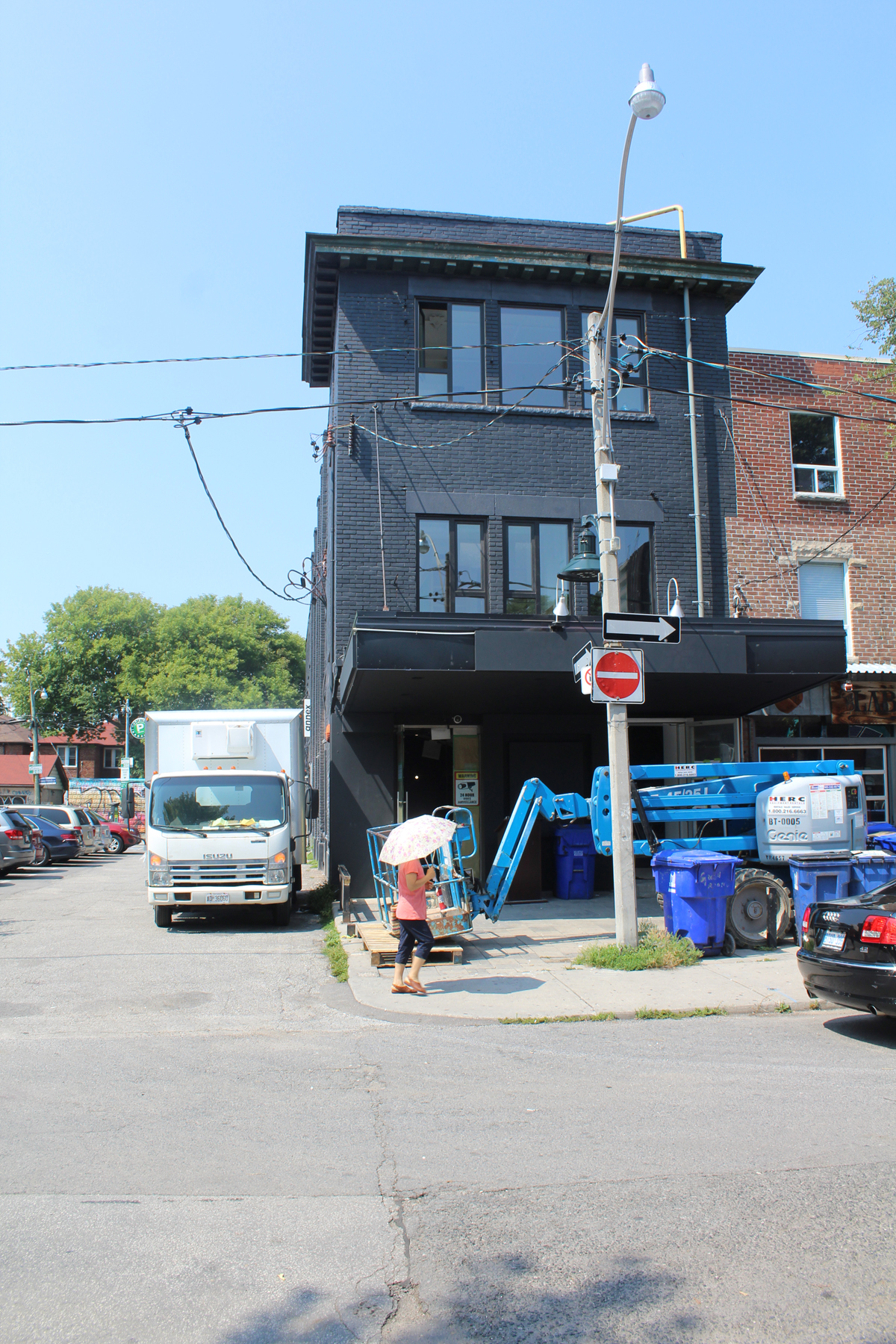
It’s taken a lot of renovation to refurbish 296 Brunswick Ave. into a 24-room boutique hotel. TEMI DADA/GLEANER NEWS
By Temi Dada
Since its original incarnation as a horse stable in 1902 it’s been home to a live theatre, bar, and arcade. But starting next month, 296 Brunswick Ave. will have a new face: boutique hotel.
Located just south of Bloor Street West, the hotel is called The Annex, in a bid to embody the neighbourhood, according to general manager Michael Shea.
“I moved to Toronto in 2011 but I was always on the road. I didn’t have the opportunity to live in the city and experience it,” said Shea, who always wanted to be part of the city and contribute something of value. He has worked in the hotel business since 2001, and has wanted to open a hotel for a long time.
“The big focus is to be a part of the neighbourhood. Toronto has so many great neighbourhoods, but our part of the Annex — which is further down, close to Koreatown — is where the tourists don’t typically see but is unique,” Shea said.
The location of the hotel will give guests a complete Annex experience, because it is close to cafes, restaurants, and local landmarks like Hot Docs Ted Rogers Cinema. The hotel will have 24 rooms over two floors, and rates will range from $200 to $300 per night, depending on size.
The hotel has partnered with Annex businesses like DMV books to add a local flair to each of the rooms. Each room will have a collection of books from the bookstore, and the food commons will feature food from Big Trouble Pizza and Seven Lives Tacos from Kensington Market.
“We hope that the hotel does great in the Annex,” said Mike Murray, manager of BMV Books. “Could be pretty cool to have some people travelling and staying in our neighbourhood. There are lots of great places and businesses in the Annex.”
Brian Burchell, chair of the Bloor Annex BIA (and publisher of this newspaper), agreed.
“The style of the hotel speaks volumes about the character of this neighbourhood. The hotels are not built like fortresses; they are very communal and open, they encourage their guests to experience everything about the community. It is a confirmation that the Annex is a destination and a completely livable community.”
Shea said that it’s where he’d want to stay if he were from out of town.
“It is informal and relaxed but at the same time there is a great deal of attention into the decor. It is modern without forsaking any kind of comfort or luxurious elements just for the sake of being modern. You won’t find another place in the city like this.”
It took some time to finish all the work on the site. The hotel, which is almost 120 years old, was supposed to open in May.
“We are looking forward to having a positive impact on our neighbourhoods and hopefully inspiring other people, neighbours, and businesses. We want to build something special for the people of this city. Toronto is becoming a destination for independent travellers,” Shea said. “We want to make sure that we are going to be the option they decide to stay.”
The hotel’s owners hope to open other branches in Toronto, other parts of Canada, and the United States using the same model: finding an old building that needs a bit of care, and bringing it back to life.
Tags: Annex · News
September 11th, 2018 · Comments Off on EDITORIAL: A lost cause worth fighting for (Aug./Sept. 2018)
We believe that lost causes are the ones worth fighting for. A case in point is the City of Toronto’s battle against the premier’s Better Local Government Act, which cut Toronto City Council from 47 to 25 seats.
It was a move that reinforced the provincial government’s wide-ranging powers over the city, powers that are set out in the Canadian Constitution. It was also a move that Doug Ford never mentioned during the election campaign, and one that seems to have caught his staff and caucus off-guard. His rationale was that it would save taxpayer money and make city council more efficient, and that of the thousands of people he spoke to during the campaign, not one wanted more politicians.
He seems to have inferred from this that they want fewer. We note — not without irony — that the Ontario Legislature just grew from 107 to 124 members as a result of the election. He remains silent on this, and appears to have no plans to reduce the size of the legislature.
At an emergency meeting on August 20, council voted to take the province to court over the act. While the province may have the authority to regulate municipalities, it also has a duty to the city’s residents, who expect and deserve the respect of getting consulted with due notice. This is enshrined in The City of Toronto Act, which requires that the city and province conduct their relationship with “mutual respect, consultation, and cooperation”.
As North America’s fourth largest city, Toronto’s municipal government is larger than many provincial governments. Announcing this act in the middle of the municipal election is hardly respectful of the city, its residents, or to the principles of a well-run democracy. It’s clearly a rash act.
We can’t help but think that Ford’s actions were aimed singularly at Toronto. As a failed mayoral candidate, his thin argument “to get Toronto moving again” reads like a vengeful tantrum.
Are Ontario’s other 443 municipalities well-oiled machines not in need of provincial fixing? City councillors provide essential services in making the city accountable to its taxpayers. Under the Ford legislation each of the 25 Toronto city councillors, in a city of 2.8 million, will need to serve, on average, 112,000 constituents each. In all probability, not everyone will get their calls returned. By contrast, the City of Kitchener with a population of 204,000 and 20 city councillors has one representative for every 10,200 residents. If the issue is excessive expense on political representation, it strikes us that Kitchener could do with some trimming. But that’s not really the issue is it?
In a preliminary written submission before the hearing on August 31, lawyers for the province wrote, “This court should be particularly cautious about intervening in an ongoing electoral process.” This sounds eerily like what the province just did.
Those same lawyers for the province, in a scramble to make up good reasons for the act and its urgency, have made voter parity the central thrust (not something Mr. Ford thought to mention or appears to give a damn about), which means that all votes should have equal weight and all wards be equally balanced in population size.
However, that concept was central to the nearly four-year review conducted by independent consultants hired by the city, who recommended the 47-ward option approved by council in 2016. The city has already been deeply engaged in the principles expected by the Supreme Court about effective representation.
As for the savings, the city estimates that the savings brought to taxpayers by reducing council size and having to hire more staff to help councillors to do their jobs, are a paltry $2.04 per resident.
Two dollars versus an immeasurable cost to local democracy. This is a battle worth fighting, even though it’s a long shot.
READ MORE EDITORIALS:
EDITORIAL: Reclaiming our city (Summer 2018)
EDITORIAL: City staff ignore bike lanes (July 2018)
EDITORIAL: The market has no moral compass (Election Special 2018)
EDITORIAL: Lessons to be learned from Excessive Force (Spring 2018)
EDITORIAL: A social contract is a precious thing (March 2018)
EDITORIAL: Intolerance leading to Quebec’s decline (Dec. 2017)
EDITORIAL (Nov. 2017): Student safety suffers as trustees cave
EDITORIAL: Pandering to religious intolerance (October 2017)
EDITORIAL: Bike lanes, good for business (Fall 2017)
EDITORIAL: Don’t sacrifice safety for political gain (August 2017)
EDITORIAL: Thank you Mr. Asti (July 2017)
EDITORIAL: A watershed moment (June 2017)
EDITORIAL: Revoke U of T’s unchecked “licence to build” (May 2017)
EDITORIAL: Westbank’s positive precedent (April 2017)
EDITORIAL: Foreign buyers tax a necessary cliff jump (March 2017)
Tags: Annex · Editorial · Opinion
September 11th, 2018 · Comments Off on EDITORIAL CARTOON: How nice (Aug./Sept. 2018)

More how nice!
EDITORIAL CARTOON: How Nice (Summer 2018)
EDITORIAL CARTOON: How Nice (July 2018)
EDITORIAL CARTOON: How Nice (Election Special 2018)
EDITORIAL CARTOON: How Nice (May 2018)
EDITORIAL CARTOON: How Nice (Spring 2018)
EDITORIAL CARTOON: How Nice (Mar. 2018)
EDITORIAL CARTOON: How Nice (Dec. 2017)
EDITORIAL CARTOON How nice! (August 2017)
EDITORIAL CARTOON How nice! (July 2017)
EDITORIAL CARTOON: how nice! by blamb (June 2017)
EDITORIAL CARTOON: TCHC (May 2017)
EDITORIAL CARTOON: The Grand Tory (April 2017)
FORUM: Celebrating 20 years of cartoonist Brett Lamb (April 2017)
EDITORIAL CARTOON: A second chance! by Brett Lamb 2037 (February 2017)
EDITORIAL CARTOON: Not really! It’s actually nice! by Stumpy the Subway (January 2017)
Tags: Annex · Columns · Opinion
September 11th, 2018 · Comments Off on FORUM: Ford is sending Ontario backwards (Aug./Sept. 2018)
Our elected officials matter now more than ever
By Jessica Bell
Doug Ford has been Ontario’s premier for just six weeks, and he’s dragging Ontario backwards fast.
First, Doug Ford is harming our schools. The Conservatives cut $100 million from the school maintenance budget at a time when our public schools are in chronic disrepair. A local advocacy group, Fix our Schools, used government data to calculate that schools in University-Rosedale need $271 million in repairs, and all the public schools in Ontario need $15.9 billion. We need more funding, not cuts.
As a parent, I can see how our school repair backlog hurts kids.
[pullquote]Now is a time for action to stand up for the Toronto we believe in, a Toronto that is thriving, green, and has a place for everyone.[/pullquote]
In June, I spoke at Queen’s Park about Jed Sears, a student at King Edward Junior Public School. Jed said that without adequate cooling, his classroom temperature regularly exceeds 30 degrees in May, June, and September, something that affects his ability to learn. He said many kids in his school didn’t come to class when it was hot. That’s unacceptable.
The Conservatives have also cancelled the updated 2015 sex education curriculum, which teaches students about consent, LGBTQ rights, cyber-bullying, and healthy relationships. I attended a teachers’ rally at Queen’s Park on August 14 where I heard student Rayne Fisher-Quann talk about how the 2015 curriculum is for the 275,000 students who were cyber-bullied in Ontario in 2015, the 284 boys she blocked on Instagram because they didn’t know the word “no”, and her sister who was bullied for two years.The 2015 sex education curriculum is about our kids’ safety and it must stay.
The Conservatives made the anti-democratic move of slashing the number of Toronto city wards from 47 to 25, and halving the number of school board trustees just 100 days before the election. University-Rosedale will now have just one councillor, and our riding will share a school board trustee with Toronto Centre.
Fewer elected officials means that we will have less access to City Hall. It will take longer to secure the help of our councillor and school board trustee when our child needs help at school, when we want to report a pothole, when we are applying for a committee of adjustment approval or speed-bumps, or when we want to have a say over a new development.
Why did the Conservatives gerrymander Toronto’s wards? They did it because they want to maintain Conservative control over City Hall, and they don’t want new progressive downtown elected officials in the newly-created seats opposing their plans to privatize public services.
Third, Doug Ford has gone backwards on tackling catastrophic climate change. This summer, the world has been plagued with extreme weather events from fires across Europe, the United States, and Ontario, to killer heat waves in Quebec and Japan.
The Conservatives’ response to climate change is to cancel over 700 green energy contracts, and introduce a bill to cancel Ontario’s cap and trade program and replace it with no climate plan at all. The bill to cancel cap and trade will be debated once the house resumes on September 24.
Some of you might be feeling hopeless by the Conservatives’ draconian behaviour. Don’t. Now is a time for action to stand up for the Toronto we believe in, a Toronto that is thriving, green, and has a place for everyone.
I invite you to take action to stand up for a progressive Toronto. Here’s two strategic ways to get involved.
Join me and give to and volunteer for candidates that share your values in the upcoming Toronto elections. The advocacy organization, Progress Toronto, can help you identify and support progressive candidates.
Join our riding association and volunteer with us. Our outreach committee meets regularly to organize on key issues that affect University-Rosedale residents, from improving our schools, to defending our elections, to standing up for affordable housing, to making sure Ontario does its part to tackle climate change.
Jessica Bell is the new Member of Provincial Parliament for the riding of University-Rosedale.
Tags: Annex · Opinion
September 11th, 2018 · Comments Off on GREENINGS: Urban under-representation (Aug./Sept. 2018)
Giving the suburbs a leg up at the expense of progress
Premier Ford wants to do Toronto a favour by slashing the size of council, and only Toronto seems to be targeted. Our ward of University-Rosedale, population 98,600, is now represented by a single councillor. To put this into perspective, Grey County, population 93,000, has 19 representatives to make decisions about roads, sewers, zoning, and all the other services that are vital to day-to-day living.
[pullquote]This wasn’t about cost savings. This move was about gerrymandering. Councillor Mammolitti admitted as much when he gleefully declared the move would produce fewer left-leaning councillors.[/pullquote]
The population of the Annex alone is similar to Haliburton, with its eight municipal representatives. If this was about slashing costs, surely there are better ways to do it than decrease representation for the most densely populated city in the province. Substantial costs are unlikely to be saved since representing 100,000 people will be no easy feat. The reality is that more staff will need to be hired to take on the added workload.
This wasn’t about cost savings. This move was about gerrymandering.
Councillor Giorgio Mammoliti (Ward 7, York West) admitted as much when he gleefully declared the move would produce fewer left-leaning councillors. The 47-ward system will briefly bias the urban centre as the condos fill in and, by the next election, the over-representation is projected to balance out. This is obviously a threat to car lovers, so we are now back to the core being woefully under-represented and the suburbs of Toronto having the greater voter influence.
Take for example Spadina-Fort York, our neighbours to the south, which has a population of 115,000 and is projected to grow substantially. By comparison, Scarborough Rouge Park has a population of 103,000, and a much lower population growth trajectory. Under-representation of the urban core was the agenda, not cost savings.
For the foreseeable future, the urban core — which tends not to drive, taking public transit and bikes everywhere — will have less of a voice on council. The threat wasn’t the waste of funds by having too many city councillors. The threat was that councillors might actually vote for bike lanes and get them.
Ford has been vocal about his disregard for climate change. Though he admitted during a debate it was likely a man-made phenomenon, every policy position he has taken since assuming office has been on the side of climate change denialism: green energy initiatives have been cancelled and he earmarked $30 million to fight the federal carbon tax (a legal fight no legal minds think he can win). Slashing council to give the right-leaning suburban councillors the edge is absolutely in line with this.
When he was city councillor, his brother the mayor killed the 5 cent plastic bag fee, and went as far as removing bike lanes that were already in place.
The ideology knows no bounds and has no cost limits.
Thanks to this premier, we can expect much of the same from city council in the future. Projects that get people moving, like the King Street Pilot, will not see the light of day. New bike lanes? Not likely.
Increased tree-planting budgets? Don’t hold your breath…they want your lungs black from the car exhaust.
Perhaps we will see a twist of fate and Ford will grant Toronto a “strong mayor” system in time for it to backfire if we elect a progressive mayor who will fight for a greener Toronto.
Toronto has to fight back. The health of our city depends on it.
Terri Chu is an engineer committed to practical environmentalism. This column is dedicated to helping the community reduce energy and distinguish environmental truths from myths.
READ MORE BY TERRI CHU:
GREENINGS: Nurture the neighbourhood by cultivating green canopy (Summer 2018)
GREENINGS: Results beg for electoral reform (July 2018)
GREENINGS: Choosing the lesser evil (Election Special 2018)
GREENINGS: Reduce, reuse, and then recycle (May 2018)
GREENINGS: Car-free parenting is not rare (Spring 2018)
GREENINGS: The science of board games (Mar. 2018)
GREENINGS: Driving fuelled by unseen subsidies (Jan. 2018)
GREENINGS: No solutions for nobody’s problem (Dec. 2017)
GREENINGS: Celebrate science not milestones (Nov. 2017)
GREENINGS: Down to the data (Oct. 2017)
GREENINGS: Reducing paper waste (Fall 2017)
GREENINGS: Taking tolls to the Gardiner and Don Valley Parkway (July 2017)
GREENINGS: Lessons from Madrid (June 2017)
GREENINGS: Thoughts on hitting the 400 benchmark (May 2017)
GREENINGS: Solving the food waste problem (April 2017)
GREENINGS: Kellie Leitch was right (March 2017)
Tags: Annex · Columns · Life