October 17th, 2018 · Comments Off on CHATTER: Take in a play or three at the Tranzac Club on November 1 (City Election 2018)
NAGs Players will kick off its 42nd season with The Coarse Acting Show 2 by Michael Green. Running November 1 to 3 and 8 to 10, the hilarious play explores what happens when a quaint community theatre group decides to put on four short but challenging plays. And, according to Martin Edmonds, 28-year NAGS member and production co-ordinator, everything that can go wrong does go wrong.
“This is going to be an exciting season,” said Edmonds. “It is going to be a challenge. We have our 42nd pantomime which was the best part of our season last year, [and] it will be difficult to top that. For the November show we have three new directors directing the four shows which is a task but with the proper guidance it seems to be going on well.”
NAGs Players was founded in 1976 by members of the Nomads Rugby Club. Most of the rugby players were British, and they decided to put on plays in the winter when they couldn’t play rugby.
While the group is no longer largely British, it does retain a link to its early days: every year it performs a pantomime, a traditionally English form of theatre. Pantomimes are typically a musical and comedic take on a fairy tale, usually performed at Christmas. NAGSs, however, puts on its pantomime in February (nobody really knows why, notes its website), and this season will perform Dick Wittington and His Cat starting January 31.
For further information, please visit nagsplayers.com. —Temi Dada/Gleaner News
Tags: Annex · News
October 17th, 2018 · Comments Off on CHATTER: Find a treasured gift at Christie Gardens on November 3 (City Election 2018)
Baked goods, crafts, cards, knitted items, jewellery, books, and plants make up the treasure trove of items featured in the Holly Sale and Luncheon hosted by the Christie Gardens Residents’ Association. All the proceeds from the annual fundraiser will support social programs and activities for the retirement community.
The sale runs from 9.30 a.m. to 12.00 p.m. on November 3 at Christie Gardens (600 Melita Cres.), and will be followed by a three-course lunch served in the Maple Dining Room. Tickets cost $15 and can be purchased at the door or in advance. For more information, please call 416-530-1330 or visit christiegardens.org. —Brian Burchell/Gleaner News
Tags: Annex · News
October 17th, 2018 · Comments Off on CHATTER: Send your pumpkin back to the patch on November 1 (City Election 2018)

GEREMY BORDONARO/GLEANER NEWS
The pumpkin patch returns to Harbord Village on November 1 from 5:30 to 8:30 p.m. Pumpkins will line Harbord Street from Spadina Avenue westward for the annual Pumpkin Festival, co-sponsored by the Harbord Street Business Improvement Area and the Harbord Village Residents’ Association. If you want to participate, put your pumpkin on your front porch in the morning on November 1, and volunteers will collect it to put it on display later that evening. —Brian Burchell/Gleaner News
Tags: Annex · News
October 17th, 2018 · Comments Off on NEWS: Pausing to preserve (City Election 2018)
Demolition freeze for Kensington Market
By Temi Dada
In mid July, Toronto City Council voted to prevent the demolition of commercial and mixed-use buildings for one year in Kensington Market. This gives the city time to complete work on designating the market a Heritage Conservation District (HCD), and makes sure that developers don’t tear down any buildings in a bid to launch a redevelopment project before the HCD gets finalized.
“This is a significant step in our work to protect one of the most important neighbourhoods in our city,” said Joe Cressy (Ward 20, Trinity-Spadina), in a news release.
The bylaw was enacted pursuant to Section 40.1 of the Ontario Heritage Act, which gives municipalities the power to enact an HCD study area bylaw to maintain the stability and integrity of the area while the study is being undertaken.
Some believe it will also help prevent high-rises from springing up in the area bounded by College Street, Spadina Avenue, Dundas and Bathurst streets.
“It a good idea, so nobody can build high-rise buildings and we can maintain the look of old-style buildings,” said Dave Chopra, who owns Sugar & Spice, a health food store on Augusta Avenue.
“I’m okay with no high-rise buildings in Kensington Market,” said Yashar Oghabi, a storeowner in the market. “It is a national historic site and I don’t want the market to change. I think there is so much space in Toronto to do that; there is no point attacking just four blocks of space.”
According to the Parks Canada website, there are almost one thousand national historic sites in Canada, which can be in cities, in a park, or in farm country. They are sites that inform Canada’s history, its diverse cultural communities, and its Indigenous history and culture. They include sacred spaces, archaeological sites, battlefields, heritage houses, places of scientific discovery, and historic districts.
Chopra’s store has been in the market for over 25 years, and he’s watched Kensington evolve over the years from a Jewish market into a Portuguese market into a Spanish market and now a multicultural market.
“It used to be more vegetables, fruits, and people from the liberal class buying food. Now [these] yuppy restaurants [are] coming in, causing a big change in the market. There used to be fish stores, chicken stores before — you could buy a live rabbit here,” said Chopra, also highlighting the historical significance of the market.
Jack Carrusco agreed.
A market should look like a market and not a mall, said Carrusco. He’s owned Harry David Limited — also on Augusta Avenue — which sells workwear and safety boots, for over 50 years.
And that’s, of course, part of the appeal of Kensington. It’s an island of diversity, entertainment, and history nestled in the sea of corporate downtown Toronto. It’s a polarizing contrast to sleek, modern buildings with its informality, graffiti, open markets, and jumbled outdoor displays. And it’s all capped off by the scent of fresh fruit and spices.
It’s a hard atmosphere to capture, much less protect. But the city is trying. After two years of study and community consultation, the Toronto Preservation Board in 2017 endorsed a staff recommendation to designate the area an HCD. And both tangible and intangible cultural values and heritage attributes are being carefully considered.
According to Cressy, requests for residential demolitions are already subject to restrictions, per city planning restrictions, but they will be monitored and reviewed to protect residential heritage as the ongoing HCD plan progresses.
READ MORE
CHATTER: Kensington Market HCD enters planning phase (Nov. 2017)
NEWS: Preserving culture and history (MARCH 2017)
FORUM: Our dynamic Kensington Market (November 2016)
NEWS: Kensington Market to become heritage district (May 2016)
Tags: Annex · News
October 17th, 2018 · 1 Comment
A sample of this year’s exhibits in the Annex
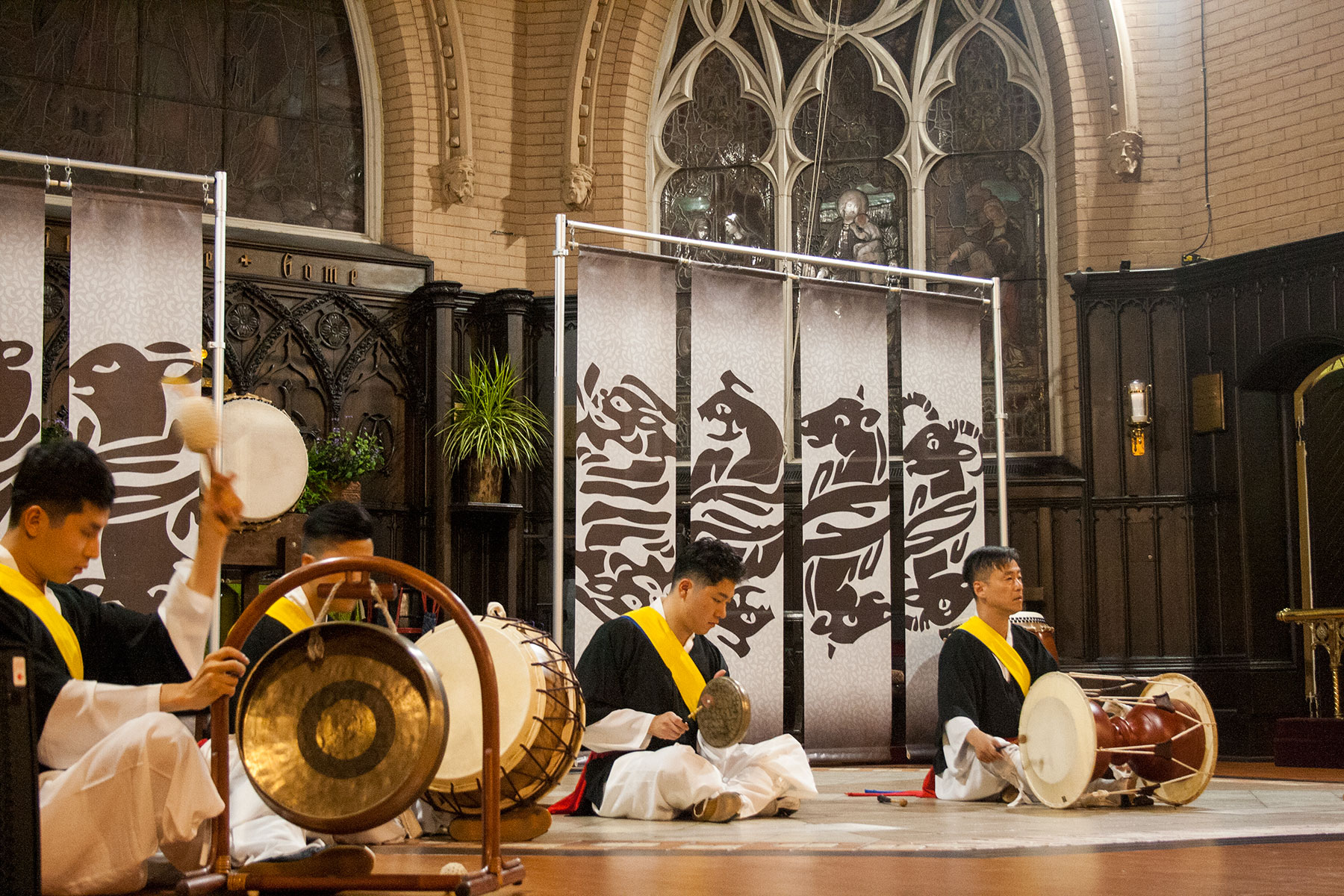
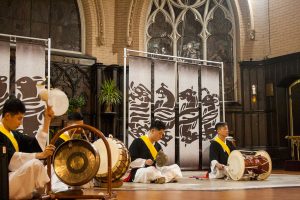
Star Moon Water Stone by Ensemble Jeng Yi at Church of the Redeemer:
HÜSNA SARI/GLEANER NEWS

HÜSNA SARI/GLEANER NEWS

HÜSNA SARI/GLEANER NEWS
More information on the exhibit: Star Moon Water Stone
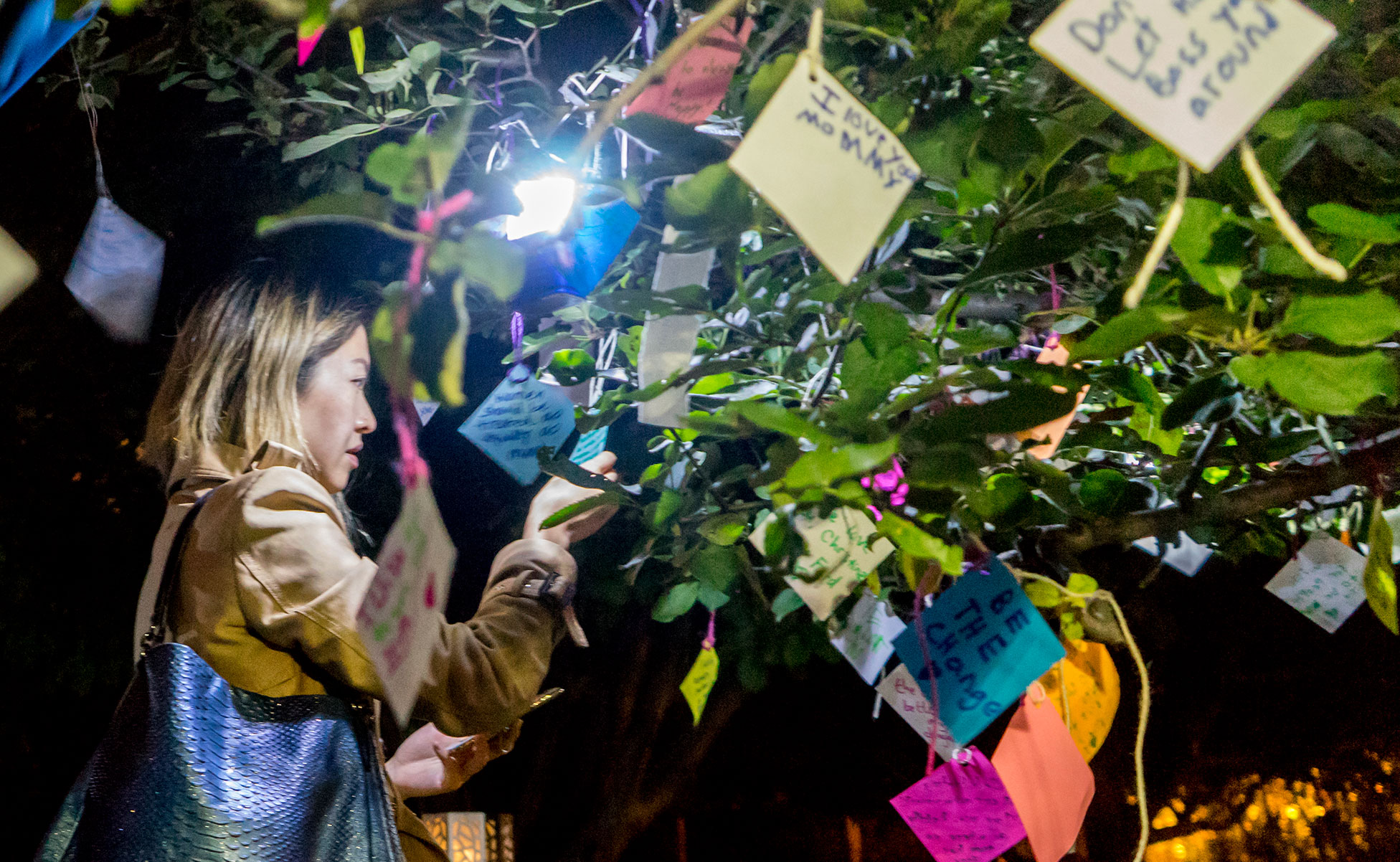
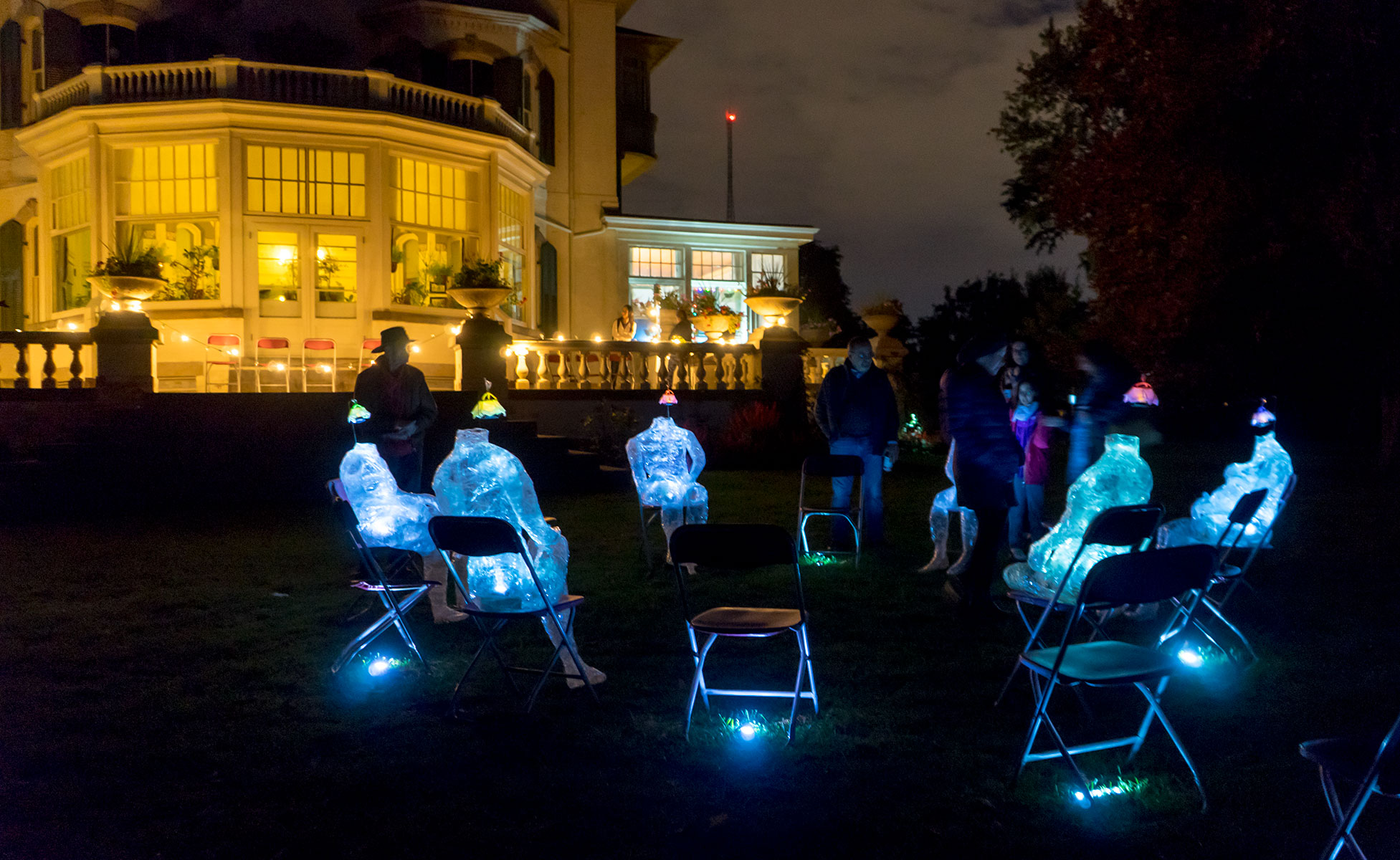
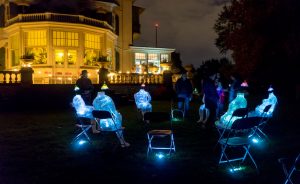
W-O-M-A-N, a large-scale, interactive, multi-artist installation created and curated by women, at Spadina Museum:

HÜSNA SARI/GLEANER NEWS

NEILAND BRISSENDEN/GLEANER NEWS

NEILAND BRISSENDEN/GLEANER NEWS
NEILAND BRISSENDEN/GLEANER NEWS
More information on the exhibit: W-O-M-A-N
SEE MORE:
ON THE COVER: Eyes on Nuit Blanche (City Election 2018)
ON THE COVER: Transitory night (Oct. 2017)
ON THE COVER: Celebrating Bloor Street (OCTOBER 2016)
ARTS: Interactive installations celebrate Annex icons (OCTOBER 2016)
Tags: Annex · Arts
October 17th, 2018 · Comments Off on EDITORIAL CARTOON: How Nice (City Election 2018)

READ MORE:
EDITORIAL CARTOON: How Nice (October 2018)
EDITORIAL CARTOON: How nice (Aug./Sept. 2018)
EDITORIAL CARTOON: How Nice (Summer 2018)
EDITORIAL CARTOON: How Nice (July 2018)
EDITORIAL CARTOON: How Nice (Election Special 2018)
EDITORIAL CARTOON: How Nice (May 2018)
EDITORIAL CARTOON: How Nice (Spring 2018)
EDITORIAL CARTOON: How Nice (Mar. 2018)
EDITORIAL CARTOON: How Nice (Dec. 2017)
EDITORIAL CARTOON How nice! (August 2017)
EDITORIAL CARTOON How nice! (July 2017)
EDITORIAL CARTOON: how nice! by blamb (June 2017)
EDITORIAL CARTOON: TCHC (May 2017)
EDITORIAL CARTOON: The Grand Tory (April 2017)
FORUM: Celebrating 20 years of cartoonist Brett Lamb (April 2017)
Tags: Annex · Columns · Opinion
October 17th, 2018 · Comments Off on EDITORIAL: This premier is not for the people (City Election 2018)
On October 2 Premier Doug Ford told the Ontario legislature, “We’re getting rid of Bill 148. We’re going to make sure we protect the front-line workers.”
It’s not clear how these two sentences relate, because the bill he wants to axe — which he said was destroying Ontario and making it uncompetitive — is designed to give workers more protection, not less.
Ford claims he came to this decision after speaking to thousands and thousands of Ontarians. Yet one resident that he failed to speak with was Jim Wilson, his own Minister of Economic Development, who said outside the legislature later that same day that the bill was merely under review.
Like the recent, all-consuming effort that the premier embarked on to reduce the size of Toronto City Council, there was no mention of this plan to reverse these labour reforms during the provincial campaign. He did promise to stop the scheduled increase of the minimum wage from $14 to $15 per hour, but that is a relatively small part of much-needed progressive reforms introduced by the previous Liberal government.
In addition to increasing the minimum wage from $11.24 to $14 an hour effective January 1, 2018, Bill 148 — The Fair Workplaces, Better Jobs Act —also set out regulations that ensured part-time employees would be paid the same as full-time employees for the same work. All employees are now entitled to two sick days a year, and do not have to get a physician’s note, something that was seen as a nuisance by the medical establishment. And, employees who have been with the same employer for more than five years are now entitled to three weeks of paid vacation per year.
Lesser known but important elements of law are the new regulations against requiring employees to wear specific footwear (like high heels, for example), unless required for safety.
Victims of domestic or sexual violence are entitled to 15 weeks of leave, five days paid and 10 days unpaid.
Some businesses responded to Bill 148 with doom and gloom warnings of price increases and massive layoffs. None of this has come to pass, even though the lobby groups have sustained the narrative.
Rocco Rossi, the president and chief executive officer of the Ontario Chamber of Commerce, claims that 80,000 jobs have been lost to automation as a result of the act.
But Douglas Porter, the Bank of Montreal’s chief economist, said that “from a very big picture view, the Ontario job market is holding up relatively well given the shock of a plus 21 per cent increase in minimum wages”.
In August Statistics Canada said that “the province added 61,000 new jobs in July and the jobless rate fell from 5.9 per cent to 5.4 per cent — the lowest level since 2000”. That’s an 18-year low, six months after the minimum wage hike.
The minimum wage increase wage was designed to help lift 1.6 million workers out of poverty. Though it falls short of that goal, it does bring greater fairness to the province’s workplaces.
There’s no evidence of any jobs lost as a result of the legislation, but then this is not a government interested in evidence-based policy. Ford may have campaigned on a promise that he was there for the little guy, but now he plans to stick it to them.
READ MORE EDITORIALS:
EDITORIAL: Eight weeks lost to Ford’s madness (October 2018)
EDITORIAL: A lost cause worth fighting for (Aug./Sept. 2018)
EDITORIAL: Reclaiming our city (Summer 2018)
EDITORIAL: City staff ignore bike lanes (July 2018)
EDITORIAL: The market has no moral compass (Election Special 2018)
EDITORIAL: Lessons to be learned from Excessive Force (Spring 2018)
EDITORIAL: A social contract is a precious thing (March 2018)
EDITORIAL: Intolerance leading to Quebec’s decline (Dec. 2017)
EDITORIAL (Nov. 2017): Student safety suffers as trustees cave
EDITORIAL: Pandering to religious intolerance (October 2017)
EDITORIAL: Bike lanes, good for business (Fall 2017)
EDITORIAL: Don’t sacrifice safety for political gain (August 2017)
Tags: Annex · Editorial
October 17th, 2018 · Comments Off on FORUM: Take back Toronto on the 22nd (City Election 2018)
Vote progressive on election day
By Jessica Bell
Doug Ford has hurt Toronto. Ford slashed Toronto’s wards from 47 to 25 in the middle of an election, and threatened to suspend our Charter rights and freedoms by invoking the notwithstanding clause for the first time in Ontario’s history.
Why did Ford trample on Toronto? Because he wants to get back at the “downtown elites” and keep conservatives in control at Toronto City Hall.
[pullquote]There is nothing more persuasive than having a local resident talk to their neighbours about why they are supporting a candidate.[/pullquote]
Doug Ford got his way at Queen’s Park. Let’s make sure Toronto wins on election day.
Here’s the plan. We need to strategically help progressive candidates so we can have a progressive voting majority at City Hall. That means we need to win at least 14 of the 26 races.
By help, I mean voting, volunteering, and giving money to candidates. Campaigns need people who can volunteer on evenings and weekends to canvass and phone residents. In this era of fake news, distrust of institutions, and political apathy, there is nothing more persuasive than having a local resident talk to their neighbours about why they are supporting a candidate. At this stage, campaigns don’t need people to provide policy or communications advice. Early donations are the best, and the good news is you get up to 75 per cent of your donation back.
Here’s who to help.
Help new candidates win battleground races. Some races are not competitive because a longtime incumbent is running. Other races have two progressives running against each other, which is heartbreaking because Toronto did not need a Hunger Games election.
And then, there are some competitive races that could have a huge impact on the balance of power at City Hall. Here’s three candidates who are running serious races in winnable wards. These candidates are women, young, or people of colour — all voices that are sorely needed at City Hall.
Elementary school teacher and community advocate Felicia Samuel is running in Ward 23 Scarborough North. Samuel is running in an open-seat ward with no incumbent. Incumbents have an unhealthy advantage over new candidates.
Chiara Padovani is running in Ward 11 York South Weston. Padovani has been running a year-long powerful community-led campaign that could have the momentum to unseat conservative incumbents Frances Nunziata and Frank Di-Giorgio. Both incumbents have voted against improving TTC service, more affordable childcare spots, and measures to address the inequities facing York South Weston. They have to go.
Amber Morley is running in Ward 3 Etobicoke Lakeshore. Electing a progressive councillor in Etobicoke-Lakeshore is important if we want to unseat Conservative Member of Provincial Parliament Christine Hogarth in 2022 and take back Queen’s Park.
Keep our downtown councillors: Mike Layton is running in University Rosedale, Joe Cressy is running in Fort York Spadina, and Kristyn Wong-Tam is running in Toronto Centre. These councillors have always stood up for the issues that matter. From voting for two-hour TTC fare transfers, to stopping Walmart in Kensington Market, to ensuring the Honest Eds development has some community benefits, to bike lanes on Bloor and Sherbourne streets, to approving fair regulation of Airbnb, these councillors consistently advocate for good public services, affordable housing, livable neighbourhoods, and safe streets.
Jennifer Keesmaat for mayor because she has the vision and policy knowledge to lead Toronto in the right direction. I attended the mayoral transit debate in Scarborough on September 26, and listened to Keesmaat share her vision, her deep understanding of our city, and her bold policy platform that includes building 100,000 affordable housing units, community benefits agreements for major infrastructure projects, building the relief line, and a luxury surtax on $4 million homes. I left that debate convinced that Keesmaat was the mayor for me and Toronto.
Here’s my simple dream. After a long day of encouraging people to vote, I hope to spend the evening of October 22nd watching the election results roll in and cheering because progressives finally won on election night. Let’s roll up our sleeves and make it happen.
Jessica Bell is the Member of Provincial Parliament for University-Rosedale.
READ MORE ON THE ELECTION:
FOCUS: Putting candidates to the Gleaner test (City Election 2018)
FOCUS: Should the public and Catholic boards be amalgamated? (City Election 2018)
FOCUS: TCDSB candidate queries remain largely unanswered (City Election 2018)
Tags: Annex · Opinion
October 17th, 2018 · Comments Off on GREENINGS: Municipalities should flex their green muscles (City Election 2018)
Time to stop subsidizing cost of garbage
By Terri Chu
“I’ve got more freezer packs for you,” my friend said as she handed me a gigantic bag. She recently started using those meal delivery services where they pack and portion ingredients for you, include a recipe card, and you cook it when you’re ready to eat. Sounds like a great idea except for the box of garbage she generates weekly from it. When I heard she had excess freezer packs, I asked if I could have a few. She gets so many she’s told to snip the corners, pour the contents down the drain, and “recycle” the plastic. Her weekly meal delivery is more like a weekly waste delivery.
The problem is, many packages labelled “recyclable” are not (it can vary by municipality what is actually accepted) and Torontonians are some of the worst offenders for contaminated recycling. So much so that the City of Toronto is looking at an increase in our garbage fees to absorb the cost of people recycling badly.
[pullquote]What if we reduced or eliminated the flat garbage fees and instead had it charged by weight at the till?[/pullquote]
I thought it was ridiculous how much waste is generated: if waste wasn’t a subsidized cost and they actually had to pay for it, it would become economically feasible for them to use reusable containers and pick them back up when they drop off the next box.
And there was the crux of it.
Garbage is free for companies to produce. We pay for it as a line item on our taxes, but we essentially don’t have to think much beyond that. There’s very little incentive for anyone to reduce generated waste because it is so cheap. It is cheaper to provide freezer packs with every new box of delivered food than it is to pick up old ones and reuse them.
So, what can big cities do about their garbage problem?
For one thing, stop subsidizing the cost of garbage!
Garbage is charged a flat fee and nobody thinks about it beyond that. What if we reduced or eliminated the flat garbage fees and instead had it charged by weight at the till? Consumers would start making decisions differently and businesses would start to adapt very, very quickly. The reality is that municipalities have a lot of influence on how much garbage is generated, how much people drive, how much electricity is used, and in general, how much we contribute to climate change.
Granted, the premier could just decide to un-incorporate Toronto and completely take over, making all these arguments moot, but in general, a city has a lot it can do to change behaviours, much of it starting with hitting people in their wallets.
We saw the resounding success of charging for plastic shopping bags.
The five-cent fee cut use by half. The city could just as easily demand fees for plastic cutlery, straws, and food packaging.
Manufacturers know exactly how much packaging weighs. One only needs to look at product specifications on Amazon to understand the level of details that manufacturers know their products.
They know every dimension, product weight, and shipping weight. If the difference between product weight and shipping weight was charged a fee per gram, the race for manufacturers to package their goods smartly and reduce waste would be on.
When consumers are faced with a marginal cost they can control, their behaviour is startlingly different from when they face flat costs that they can’t.
Surely lobbyists will be descending on Toronto if we did this, but we are long past the time for action. There will soon be more pieces of plastic than fish in the ocean, 500-year storms are now nearly an annual occurrence, and this year, British Columbia alone lost 1.2 million hectares of forests to fire. Cities need to take proactive roles in the battle against climate change. We’ve already lost a lot, it’s a matter of preserving what we can now.
Though transit is on the top of everybody’s mind this election, be sure to ask the candidates for council what they would do to curb municipal waste. There’s a lot in their power. It’s only a question of whether or not they dare to use it.
Terri Chu is an engineer committed to practical environmentalism. This column is dedicated to helping the community reduce energy and distinguish environmental truths from myths.
READ MORE BY TERRI CHU:
GREENINGS: Short-term solutions haunt future (October 2018)
GREENINGS: Urban under-representation (Aug./Sept. 2018)
GREENINGS: Nurture the neighbourhood by cultivating green canopy (Summer 2018)
GREENINGS: Results beg for electoral reform (July 2018)
GREENINGS: Choosing the lesser evil (Election Special 2018)
GREENINGS: Reduce, reuse, and then recycle (May 2018)
GREENINGS: Car-free parenting is not rare (Spring 2018)
GREENINGS: The science of board games (Mar. 2018)
GREENINGS: Driving fuelled by unseen subsidies (Jan. 2018)
GREENINGS: No solutions for nobody’s problem (Dec. 2017)
GREENINGS: Celebrate science not milestones (Nov. 2017)
GREENINGS: Down to the data (Oct. 2017)
Tags: Annex · Columns · Opinion
October 17th, 2018 · 2 Comments
TDSB candidates weigh in
Only four of the 13 candidates running for trustee in the Toronto District School Board (TDSB) Ward 10 — which includes city wards 11 and 13 — replied to our questions. We did not receive answers from Mahbubul Alam, Ted Crysler, Kate Frischkorn, Baquie Ghaza, Jooheon Lee, Aaron Macgregor, Chris Moise, Alamgir Muhammad, and David Oliver. We reached out to the candidates by phone and email, and gave them a week to provide answers, asking them to keep each answer to 100 words or less.
The questions below were developed by the residents’ associations and BIAs in our coverage area. We’ve published all the answers we received, editing only for length, grammar, and style.
Compiled by Ellie Hayden
Do you support amalgamating the public and Catholic school boards? —Annex Residents’ Association

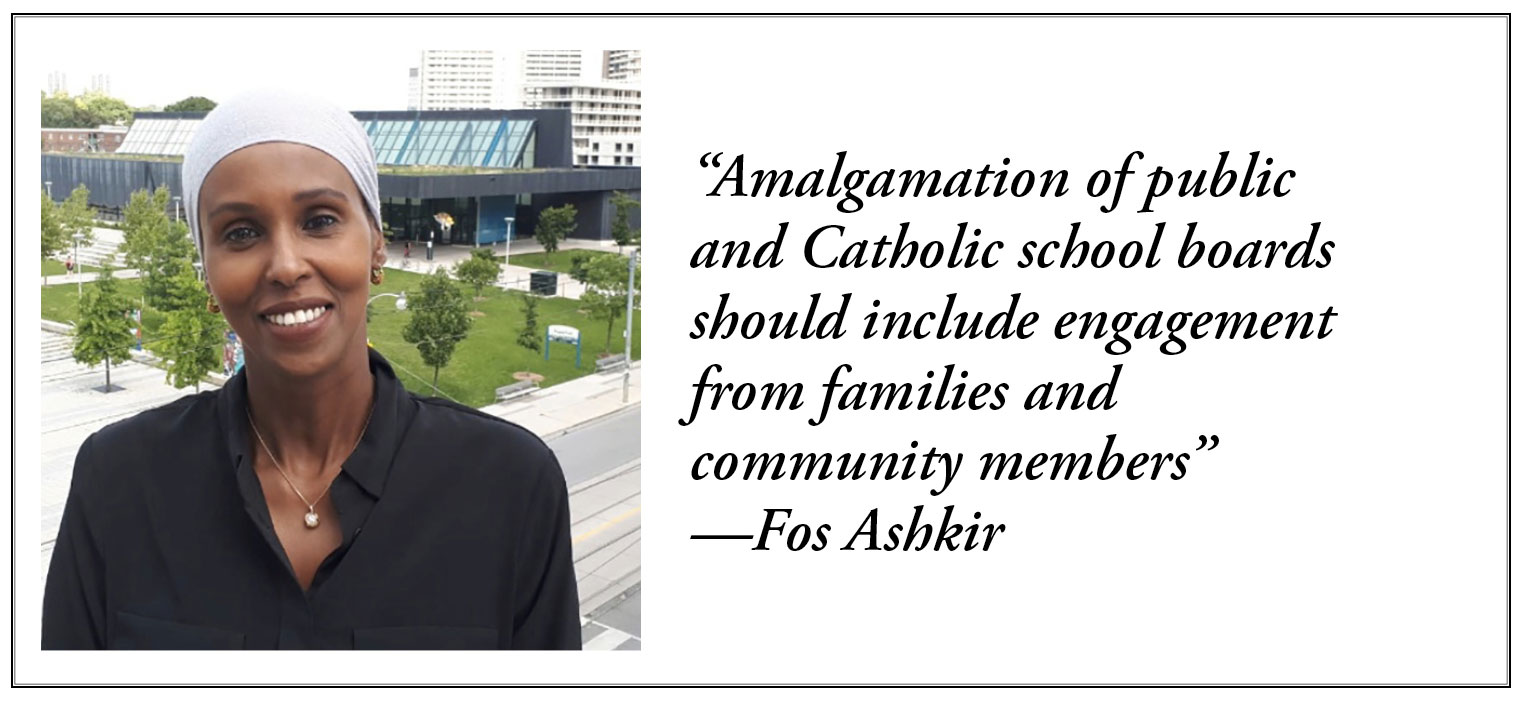
Fos Ashkir: Amalgamation of public and Catholic school boards should include engagement from families and community members. It should also include further conversation with higher levels of government, which would subsequently be responsible for making any decisions regarding amalgamation. I certainly support further dialogue and conversations regarding this.
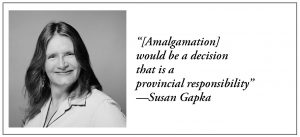
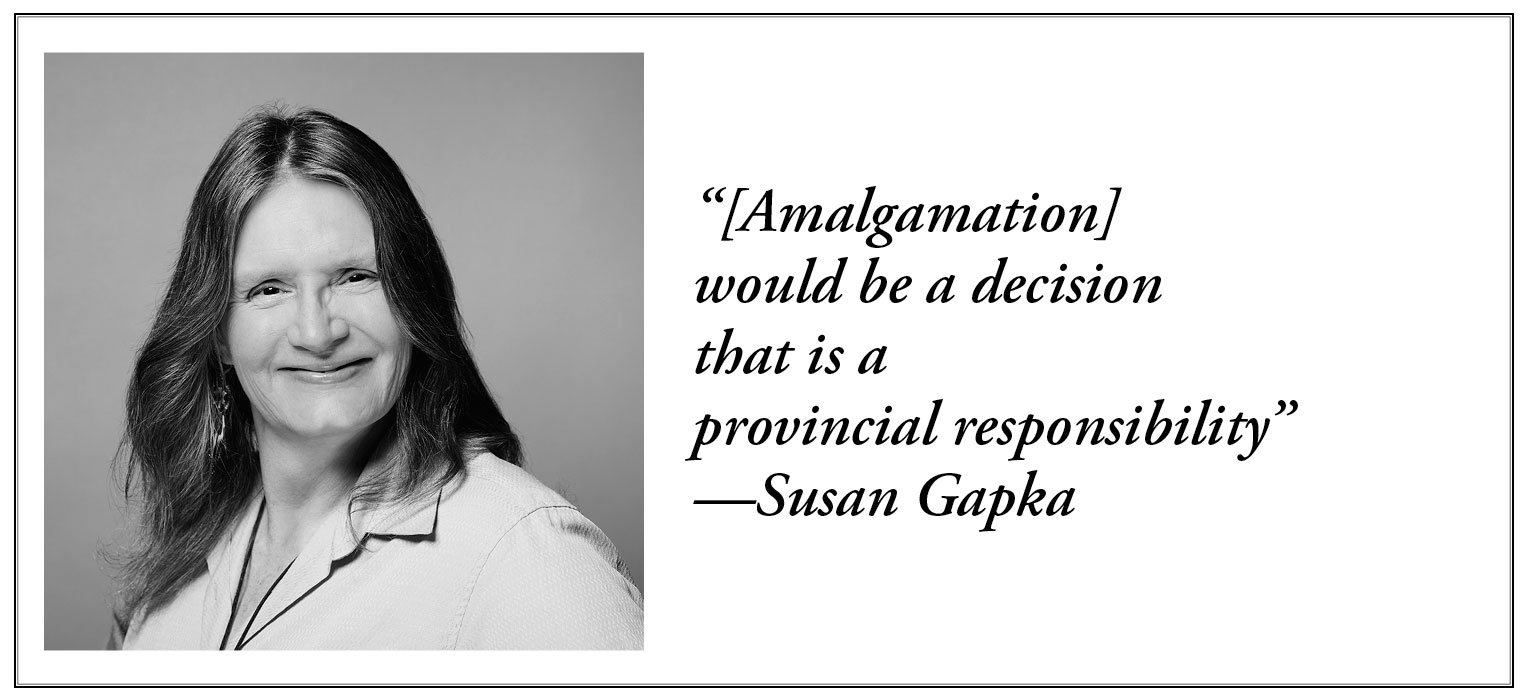
Susan Gapka: Not at this time. This would be a decision that is a provincial responsibility. At the moment, due to provincial legislation impacting ward boundaries, mechanisms and procedures on managing the new ward system should be a careful and important priority consideration.
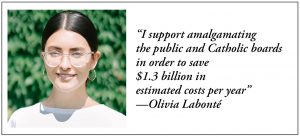
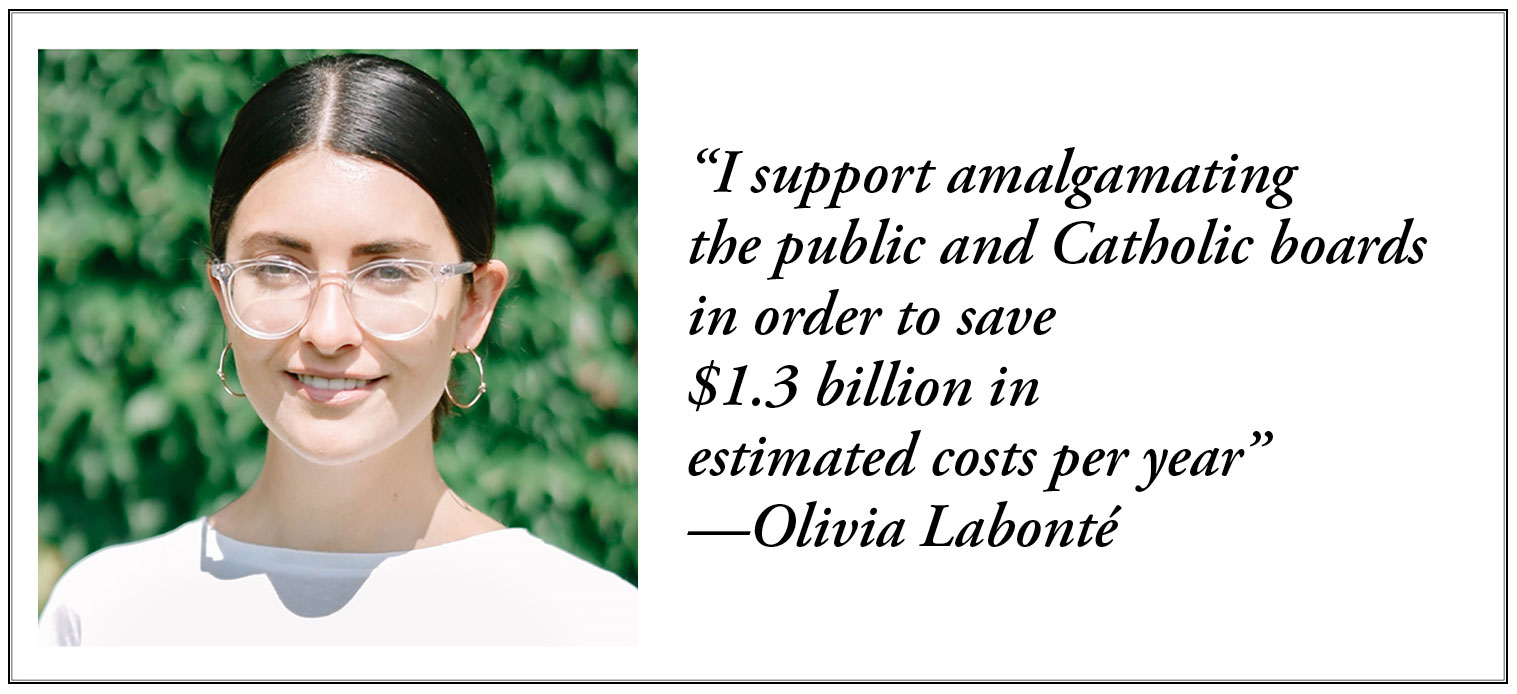
Olivia Labonté: I support amalgamating the public and Catholic boards in order to save $1.3 billion in estimated costs per year. We can put that money directly back into front line programming, reducing class sizes, and conducting school repairs. While I understand that Catholic programming is appreciated by a number of parents, I believe that this programming could be fulfilled in institutions outside of school, and that we could instead use this public funding to improve schools for all.
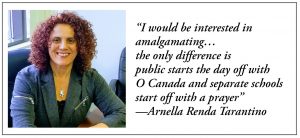
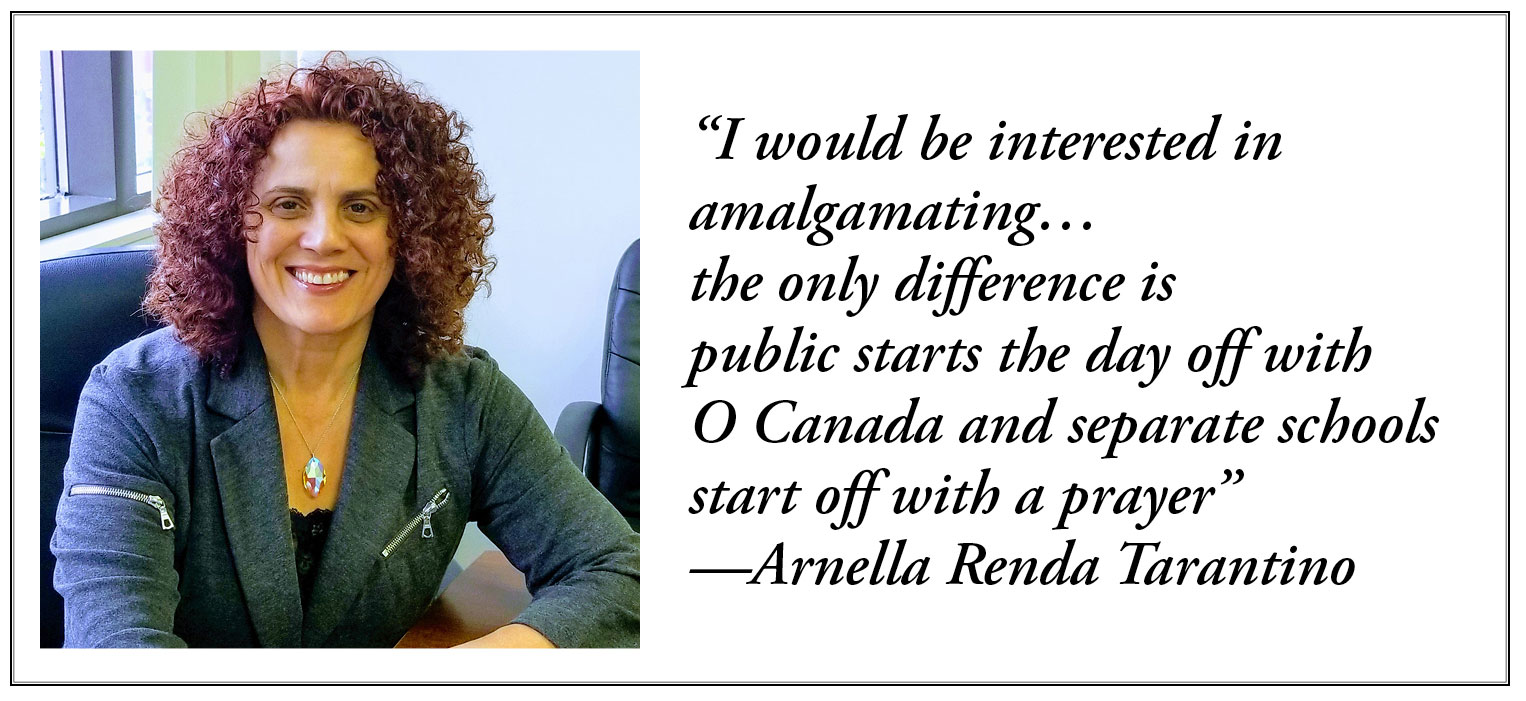
Arnella Tarantino: I would be interested in amalgamating the Catholic and public school boards on one hand and keeping them separate on the other hand. The only difference is public starts the day off with O Canada and separate schools start off with a prayer. Joining the two would increase the power, a broader spectrum having much more money to spend in the classrooms fixing the older schools, therefore making it easier to manage properties.
What background and experience do you have in educational and institutional financial management? —Harbord Street BIA
Gapka: My experience is from a wealth of academic and community boards including the York University Board of Governors and Senate.
I helped lead a campaign to persuade the Minister of Health to fund sex reassignment surgery for trans people in Ontario, helped change the Vital Statistics Act sex designation so that trans people’s legal documents more accurately reflect their lived identity, and amended the Ontario Human Rights Code to include gender identity and gender expression.
More recently I have been employed at the 519 in the education department as a training and education facilitator. I also have been elected to the CUPE Ontario Pink Triangle Committee in 2017 and appointed to CUPE National Pink Triangle in 2018.
Labonté: I have a Masters in Applied Economics from the University of Montreal and have significant experience overseeing budgets and sitting on various boards including the World Urban Campaign standing committee and being the North American representative on one of UN-Habitat’s advisory boards.
Combined with my professional background doing business process improvements in the public sector, I know I can bring financial and facilities related expertise to the table should I be elected to the TDSB.
Tarantino: I have extensive experience having worked in a financial institution since the 1980s then getting my real estate licence in 1987 and working extensively with bankers and citizens. I’m self-taught over the years; I bought and sold properties for myself, my family, friends, and clients. I understand the financial market really well. I know what to look for and I understand corrections and adjustments quite well. I would like to see kids learn ways to make money and save money for big rewards in the future. I’m all about the kids, helping them to succeed. Starting young is the key.
Ashkir: For over 14 years, I have been on TDSB school councils, running workshops for parents and, with the help of community members, worked to bring families, trustees, and the school administration together to tackle issues. I continue to strive for an education system that families deserve. I currently serve as the chair and president of the Jarvis Collegiate Institute Public School Parent Council and chair of the Lord Dufferin Daycare Board, which provides me with insight around the administrative management of the school, along with the quality of education our students are receiving.
How will you address violence in the classroom towards both children and teachers? —Palmerston Area Residents’ Association
Labonté: I was shocked and saddened by the results of the Elementary Teachers’ Federation of Ontario workplace survey on violence in schools released earlier this year. It revealed that 70 per cent of public elementary school teachers have personally experienced violence and witnessed violence against another school staff member. It is entirely unacceptable that any staff or student feels unsafe in their school and this trend must be reversed.
Schools need the resources to effectively deal with violence in all its forms — this includes educational assistants, social workers, counsellors, and children’s mental health supports for students. It is incumbent upon school administrators to address resource gaps by working with TDSB to ensure the most appropriate solution is applied to a given situation.
Tarantino: I grew up with the strap and the ruler. I don’t agree in going that far, though kids need to know more about respect. It’s a lost art from both sides. I have seen some pretty rude teachers whose jobs are very secure push both parents and their kids around. Not fair. Kids too need to be respectable though they need to know it’s earned and not given freely. A few tweaks at both sides. Kids only know what they’re taught and teaching them early is the key. Some pretty rude kids out there. Somewhere along the line kids weren’t being heard and I believe this caused the noise. We need to have respect for the rest of our lives for one another.
Ashkir: As someone who raised both of my children in Ward 10 — specifically, in the Regent Park area — I take the safety of our students very seriously. In fact, I have previously run workshops for parents to boost parent engagement, and have encouraged the use of mentorship programs as a method of strengthening the safety in our schools. I myself have been a strong advocate of the Sister 2 Sister mentorship program, which helps to turn young women into leaders. Afterschool programs are also a critical resource for the enhancement of school safety and, if elected, I will call for its expansion.
Gapka: Violence in the classroom impacts children and teachers negatively and requires a focused series of interventions to ensure safety and security so that children are able to gain an excellent education. Addressing social determinants of health such as accessibility, food security with nutritional programs, and having a well-rounded broad-based educational curriculum including consent and healthy relationships and cultural competency is just a beginning.
Students must be supported with appropriate social work counselling, nurse practitioners, and, when needed, community policing which operate as crisis intervention teams within the school systems. Finally, children require strong adult role models in schools as well as at home and in society.
READ MORE ON THE ELECTION:
FOCUS: Putting candidates to the Gleaner test (City Election 2018)
FORUM: Take back Toronto on the 22nd (City Election 2018)
FOCUS: TCDSB candidate queries remain largely unanswered (City Election 2018)
Tags: General
October 17th, 2018 · Comments Off on FOCUS: TCDSB candidate queries remain largely unanswered (City Election 2018)
Only one hopeful responded to Gleaner questions
Seven candidates are running for trustee in the Toronto Catholic District School Board (TCDSB) Ward 9: Norm Di Pasquale, Iola Fortino, Alfredo Garcia, Denise Gracias, Angelo Harrison, Marnie MacCallum, and Sandra Weber. Ward 9 includes city wards 10, 11, 12, and 13.
The questions below were developed by the residents’ associations and BIAs in our coverage area. We emailed the questions to all candidates, and gave them a week to respond, asking them to keep each answer to 100 words or less. Only Di Pasquale responded to our calls and emails; his answers are below.The answers were edited only for length, grammar, and style.
Compiled by Ellie Hayden
How will you address violence in the classroom towards both children and teachers? —Palmerston Area Residents’ Association
I would ensure that the Catholic board implements all recommendations from the Provincial Working Group on Health and Safety. The recommendations include ensuring all parties understand the requirements of the Occupational Health and Safety Act, ensuring staff understand any potential risk of physical injury in their school, and streamlining requirements to report incidents of violence in schools. Also important are ensuring there are up to date resources for bullying prevention, as well as progressive discipline while promoting positive student behaviour.
What background and experience do you have in educational and institutional financial management? —Harbord Street BIA
I ran an IT company for 10 years, setting a monthly and annual budget for the corporation. As a Virtual CIO for companies I worked for (including governmental organizations), I would take companies’ annual IT budget and determine the best way for them to spend that budget for maximum business value. As the chair of the successful community group NoJetsTO, I was responsible for setting and determining our budget, ensuring we didn’t overspend to meet our goal, which we did.
Do you support amalgamating the public and Catholic school boards? —Annex Residents’ Association
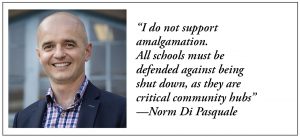
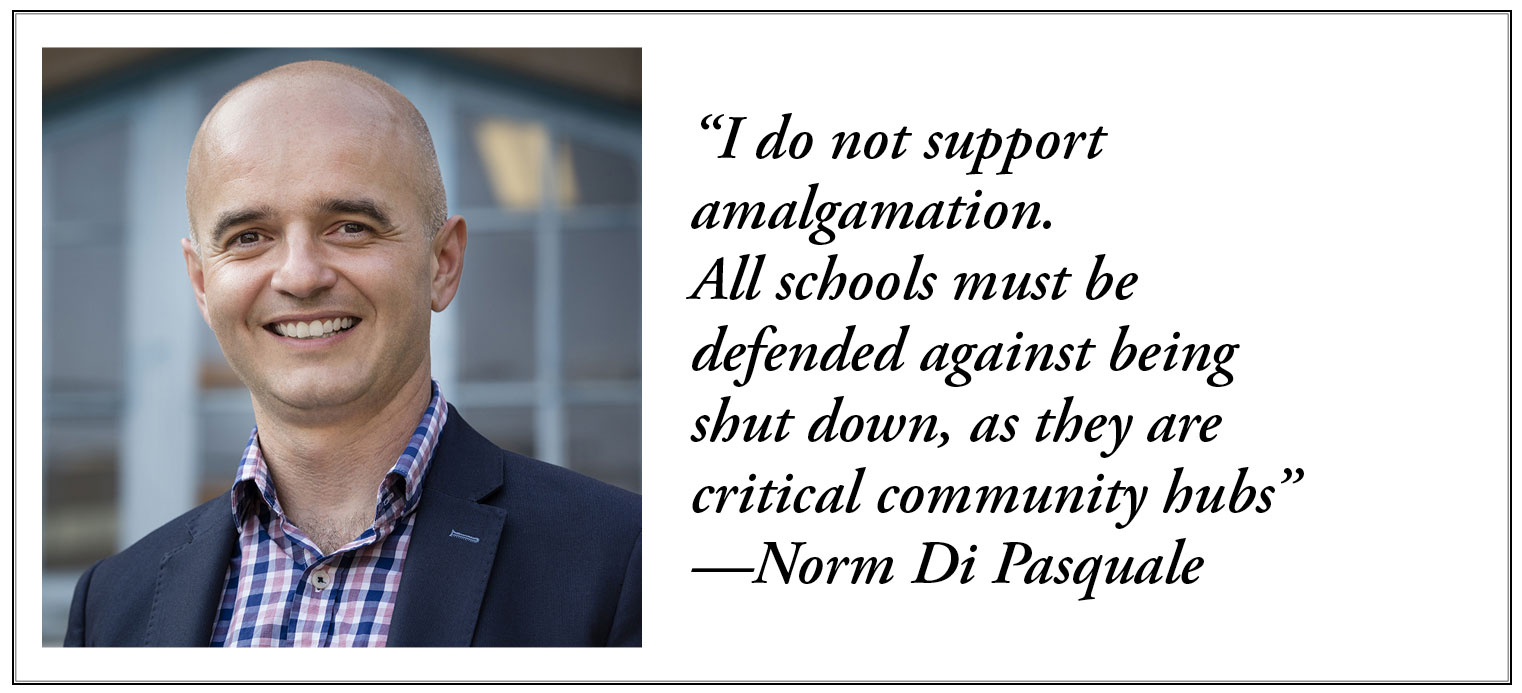
I do not support amalgamation of the school boards. All schools must be defended against being shut down, as they are critical community hubs. Amalgamation would certainly lead to schools being shut down. I am also concerned at the potential loss of jobs amalgamation of the boards would bring. Finally, I ask rhetorically, how well did Toronto’s amalgamation go with respect to saving costs?
READ MORE ON THE ELECTION:
FOCUS: Putting candidates to the Gleaner test (City Election 2018)
FORUM: Take back Toronto on the 22nd (City Election 2018)
FOCUS: Should the public and Catholic boards be amalgamated? (City Election 2018)
Tags: Annex · News
October 17th, 2018 · Comments Off on ARTS: Get your spook on for Halloween (City Election 2018)
Travel round the world through the arts
By Heather Kelly
The end of October is a creepy, crawly, spooky fun time of year. With that in mind, everyone can get up close and personal with some of the biggest and baddest arachnids in the world, including new additions to the Spiders: Fear & Fascination exhibition at the Royal Ontario Museum.
Related spider-themed programming with exclusive evening access to the exhibition includes the talk Spider-Man: Legend & Legacy on October 30, where comic giants Chip Zdarsky and Adam Kubert discuss the history of Spider-Man in popular culture.
On October 26, adults have the opportunity to check out the creepy and crawly world of arachnids at ROM Friday Night Live “Wicked” and enjoy psychobilly band The House of Haunt and Scarlett LaFlamme Burlesque’s show Monsters.
At the Bata Shoe Museum’s “Halloween Spooktacular,” children ages 3 to 12 can decorate a Halloween-inspired cookie, make a special craft, and play ISpy in the galleries, and kids in costume get in to the museum for free, October 27-28.
The Gardiner Museum is offering a Jack-O-Lantern Workshop, September 29 to October 13, where you can make a Jack-O-Lantern out of clay to put in the window for Halloween.
Horror Rama returns to 918 Bathurst Centre for a two-day festival of all things horror, November 3-4.
The Japan Foundation is presenting free screenings of dark and occult films from Japan. The first part of the series features three films by cult favourite Shinya Tsukamoto, including the beautiful and macabre film Vital on October 23, Nightmare Detective on October 30 where, after a string of suspicious suicides where the victims slash themselves in their sleep, Detective Keiko Kirishima seeks the help of the Nightmare Detective who has the power to enter dreams.
The cyberpunk horror cult favourite Tetsuo The Iron Man screens on November 1, and additional films will be presented throughout November. Note that all of these films are rated R.
The 10th anniversary concert season continues at Koerner Hall with Juno Award winner Quique Escamilla’s Day of the Dead celebration on November 2. The concert will be a high-energy El Día de los Muertos party with theatre, dance, storytelling, and décor. There will be a pre-concert celebration of life where audience members can put photos of departed loved ones on an altar and honour them with food and drinks.
The Native Canadian Centre of Toronto’s culture department and the University of Toronto’s Indigenous student services are presenting an October 29 workshop that corrects the misconception that Indigenous-themed costumes are acceptable to purchase and wear. It will include a presentation and panel discussion about the importance of headdresses, regalia, and sacred items.
At A Different Booklist Cultural Centre, Reaching Intelligent Souls Everywhere presents spoken word on November 1. This month’s notable launches include Randell Adjei’s I Am Not My Struggles on November 3 and “Global Warming and the Sweetness of Life” on November 7.
Daniel Hope and Friends’ “AIR – A Baroque Journey” takes audiences on an outrageous romp through the baroque with a dazzling ensemble of virtuosi minstrels on November 3 at The Royal Conservatory’s Koerner Hall.
While the origins of the violin can be traced back thousands of years to Mongolia and India, it was the Italians to whom we can almost certainly attribute the creation of the violin in its modern form, as violinists and composers went on a journey seeking more extravagant and original ways in which to express themselves on this fascinating new instrument. AIR sets out to trace one such journey.
At the Istituto Italiano: the exhibition Guido Guidi – A New Map of Italy gathers more than 50 works, from the Canadian Centre for Architecture of Montréal. Guidi focuses on the spontaneous suburban architecture, on harsh secondary roads, on spray-painted walls, abandoned depots, and construction sites to form a complex and stratified portrait of the contemporary landscape.
As part of the Canadian Arabic Orchestra’s Festival of Arabic Music and Arts, Photocopy – Movie is at the Hot Docs Ted Rogers Cinema on October 28.
Directed by Tamer Ashry, the film tells of Mahmoud, who lives a traditional life until he settles for early retirement, buys a nearby storefront, and sets up “Mahmoud’s photocopy”.
Then as part of the festival, a concert, “Nur Sufi” with Dalal Abu Amneh, will take place on Thursday, November 1 at 918 Bathurst Centre.
The celebrated singer will take audiences on a holistic spiritual journey that combines Sufi whirling with music set to some of the greatest poetry of Rumi, Ibn Arabi, and Al Hallaj.
All of these arts and culture events are part of the Bloor St. Culture Corridor, a collaboration of 20 arts and culture organizations located on Bloor St. West.
Heather Kelly is the founder and director of the Bloor St. Culture Corridor, one of the city’s leading cultural districts.
Tags: Annex · Arts