The prospect of a little time-travelling attracted a large gathering of residents to A Different Booklist on May 29. There was a definitely palpable sense of intrigue and excitement at the event as messages had been prepared to send to the future.
The future of Westbank’s Mirvish Village at Bloor and Bathurst Street is a work in progress, but thanks to a concept launched by A Different Booklist, the diverse history of the area will be enshrined within it. The bookstore and cultural centre gathered more than 1,000 messages and had them buried at the former site of Honest Ed’s.
“Bathurst Street and the former Mirvish Village was a place of memory and history and so we added to that,” says Ita Sadu, co-owner of A Different Booklist.“We believe that in doing the time capsules our narratives, the history of African-Canadians, of Caribbean-Canadians of Koreans, of Ukrainians, or of the Jewish community will be recorded.”
Each capsule contains the name of the person who wrote it, and the name of someone who inspires them. A reception at the bookstore gathered project participants, including local elders and students from the nearby Alpha Alternative School, to walk together to the proposed burial site for the time capsule at the south-west corner of Bloor and Bathurst Streets.
At the construction site, the group handed the box over to Westbank construction workers to bury.
Jonah Letovsky, a development manager at Westbank, says there will be a parkette built right above the area where the time capsule was buried.
“We are looking into the idea of installing a plaque immediately above the time capsule. The plaque would identify what it is and why we placed it there,” says Letovsky. He adds that when Sadu approached him about the project, he immediately liked the idea. “We see the idea of adding the time capsule to create a new marker in time instead of continually referencing the Mirvish period. This is a great way to indicate the importance of this location as a cultural icon.”
September 2nd, 2019 · Comments Off on EDITORIAL: Let cabinet do its job (August 2019)
After a five-month break from public scrutiny, enabled by not having a sitting legislature, the provincial government of Premier Doug Ford should emerge from the rock it has been hiding under. A new modus operandi is needed, one that respects cabinet and treats ministers as more than mere Premier’s pawns.
After a tumultuous first year in office Premier Ford’s embrace of populism, reflected in the sentiment “governing for the people” is running thin. We are not really certain what “populism” means, but it must surely include some element of popularity? He has set records though; last month we reported that according to MainStreet Research, his rating was “falling harder and faster that than any incumbent premier has ever seen this soon after being elected.” Even if those who supported him had not lost their fervour, is this any way to govern? How did we get here?
Former leader of the Ontario PCs, Patrick Brown, had a serious platform prior to his dramatic fall from grace. The hastily convened leadership convention which followed it saw Christine Elliot win the popular vote, but due to the mechanics of the party’s electoral system, Ford got the leadership.
That’s how we got here: to a place where the person running our province can’t even make it to page two of his briefing notes. Ford should take note at both how quickly things can change and how others enjoy wide support from within the Conservative party.
By an unfortunate coincidence, we are at a time when the practice of cabinet-style government is on the wane and the extreme concentration of power (in this case in the premier’s office) is the norm. It’s a perfect storm really, pairing unbridled power with an unqualified, disinterested leader. To further cement the catastrophe, Ford selected Dean French as the Premier’s Office Chief of Staff. Though he is as unqualified as Ford, French was more engaged (unfortunately). He is rumoured to have lectured cabinet members on subjects such as the need to rise in the legislature to give standing ovations upon the Premier’s every utterance. French’s reckless use of the levers of power ultimately cost him his job.
The actions of the Ford government in the first 15 months in office have demonstrably offended its audience. To campaign on the notion that Ontario was in a fiscal death-spiral and then deliver a budget that does not have austerity as its central focus indicates that the emergency was either forgotten or fabricated.
How are PC members of the legislature who face their constituents in a little more than two years’ time going to justify the actions of this government? The electorate did not vote for the agenda Ford put in place now which is neither “progressive” nor “conservative”. Ford has pulled the carpet out from his own elected colleagues. Relentless attacks on everything — Toronto even has people in Wawa puzzled over the outpouring of hate.
But what about PC back benchers and cabinet ministers, many of whom are professional and competent? What about the expert bureaucracy, who have served government of every stripe? It’s time to take advantage of all this talent, it’s time to press the pause button. The province should reverse course on cuts to education, its relentless attack on Toronto, its losing battle with Ottawa over cuts to carbon emissions, and its billion dollar battle with the Beer Store all to bring a six-pack to the 7-11. Cabinet can play a role in this reversal and help the government adopt a more modest tone: we hope they have listened, learned, and wish to chart a new path. It does not have to end in implosion. If Ford fails to widen his circle and allow others to do as they are elected and appointed to do, the Progressive Conservative Party should call a leadership convention and select a new leader. That person would automatically become the new premier, and the party and the province would be all the better for it.
September 2nd, 2019 · Comments Off on GREENINGS: Sing the same tune, PLEASE (August 2019)
No unity of purpose from arms of the city
By Terri Chu
Nearly a decade ago, a fire ravaged the beloved Children’s Storefront at 1079 Bathurst St. just south of Dupont. The lot has been sitting empty ever since, waiting for its next reincarnation. Now that Orchard Properties has a development proposal in the works that wait could be over. Like any development proposal there are problematic aspects, but the bigger problem is with the city and its lack of a coherency about climate change resiliency and how it is reflected in municipal decision-making.
Mayor John Tory likes to wax poetic about making the City of Toronto climate-resilient, but the city’s foot soldiers seem to be ignoring the memo. Trees are a vital part of climate change resiliency.
The proposal hopes to see a 5-storey mixed-use building with seven dwelling units, one commercial unit, and no parking spaces. It is a great spot to add more density, given the accessibility to public transit. However, if Orchard Properties gets the go-ahead to build as they wish – deeper and higher than what is currently allowed – a 75-year-old silver maple with three trunks which provides shade to six properties is more than likely to meet its end within the next decade.
The planned property design triggers rules for storm water retention and, in this case, involves the digging out of most of the root system of the tree. While we don’t know what the decision will be, we do know that the body that governs these decisions, the Committee of Adjustment, treats trees as neighbourhood nuisances.
Mayor John Tory likes to wax poetic about making the City of Toronto climate-resilient, but the city’s foot soldiers seem to be ignoring the memo. Trees are a vital part of climate change resiliency. They soak up excess rain water (this means less flooding), they clean the air, and they provide pockets of enriched oxygen. Their usefulness should not be understated. Reforestation is a vital part to solving our climate crisis. Urban trees are as important as heavily forested areas as they do double duty in polluted environments.
If the City of Toronto is serious about playing a role in the climate crisis, it needs to make sure that EVERY department in singing the same tune. It means that everyone needs to consider the climate crisis in decision-making, be it at the Committee of Adjustment or during sidewalk repairs. Taking the climate crisis seriously means that everyone who works for, represents, or makes decisions on behalf of the city, understands that Toronto will consider the impact of every decision, no matter how great or small, on our climate crisis and the ability of humans to continue living not just in the city but on the planet. Stop the speeches. Start the action. Every city employee and representative needs to start singing the same tune on climate to ensure Toronto moves forward on climate resiliency.
September 2nd, 2019 · Comments Off on FOCUS: Police raid Café weed dispensary on Harbord (August 2019)
City installs concrete blockade of entrance
By Juan Romero
A shop belonging to the chain Cannabis and Fine Edibles on Harbord Street has been raided by police numerous times over the summer. Similarly to other Café locations raided by police, these raids have proved largely ineffective — with the shops managing to be up and running in less than 24 hours following each one.
On July 9, Toronto police raided the Café location at 104 Harbord St., just off Spadina. In the operation they seized large amounts of marijuana and bags that presumably contained edibles. All the workers and a man who claimed to be a tenant from the second floor of the location were escorted out.
According to the director of investigation services for municipal licensing and standards Mark Sraga, the initial plan was to place concrete blocks in front of the entrance of the shop to prevent future break-ins; however, this did not happen as the overhead wires made it impossible for the crane to manoeuvre the blocks safely.
Soon after the raid a few black SUVs were spotted by residents and business owners in the area. Witnesses say these would frequently drop by the shop and pick up customers to presumably take them to different Café locations. On Wednesday, the Café location on Harbord was running like nothing happened.
Sraga was aware that it was very possible for re-entry to occur because of previous experiences with other Café shops that had been raided.
“We know they are not going to close up and go away, because they have done it in other locations where we’ve done closure orders and barring of entry,” he said following the raid.
Most of the raided locations have had tenants living above the shops. This prevents police from sealing the entrance by law, therefore making it easier for the workers to access the building and resume business once police officers are gone. It seems that the Café was using this strategy as a legal loophole.
However, this past June the provincial government passed amendments to patch the loophole. This caused the tenant at the Café on Harbord Jeff Brodie to be removed from the premises. He was very upset with the police and the city.
“I’ve lived above the Cafe for two years. I don’t have anything to do with downstairs, I work, I am a subcontractor, I get cheap rent here, I can’t find anywhere else to go tonight, I am sleeping on a park bench, I have nowhere else to go. And this is what the city has done to me? It’s not right,” said Brodie.
Residents of Harbord Street and surrounding areas have expressed mixed reactions to the situation. Café customers strongly support the establishment. A customer, who identified himself as Mark, said that it is a great place with excellent service.
“It’s a shame they want to shut this place down. I don’t get it, why is it legal for some and illegal for others? This whole thing just seems like persecution to me. I have been coming here for the last few months and I have nothing but praise for this place,” says Mark.
Harbord resident and former area business owner Sue Purvis expressed the belief that the dispensary is destroying the neighbourhood. In a statement sent to various councillors and to police, Purvis said that she is unimpressed by the authorities’ inability to close the Café down for good.
“During the few hours that they were closed they were able to regroup, and most importantly restock. How is this possible? Are police not stationed around the building to intercept these deliveries? Where is the stock coming from? They would not be able to source a legal grow op, so it must be illegal. Can these not then be seized?”
Mark Sraga told the press that they will continue to keep coming back to close Café locations if needed. He claims that the locations are selling an illegal product that poses a risk for people who are consuming it, as it is unclear as to what the products contain.
“We are making tremendous progress on the issue of compliance,” says Sraga. “And hopefully in the near future, when the new provincially licensed stores start opening, that will help.”
In early August the police raided the location again, placing concrete blocks at the entrance to prevent entry. Time will tell whether the closure will be permanent or not.
Comments Off on FOCUS: Police raid Café weed dispensary on Harbord (August 2019)Tags:Annex · News
September 2nd, 2019 · Comments Off on GRADING OUR GREENSPACE: Park it here (August 2019)
The best and the worst of our greenspaces
In this final instalment of this year’s Gleaner’s park evaluation once again Christie Pits score an A+ for its design, maintenance, and the sheer volume of activities and facilities there. Paul Martel Mark on Madison Avenue just north of Bloor can fall no further on our scale. It got an F because of the City’s utter neglect of the site.
Compiled by Juan Romero
Hillcrest Park
950 Davenport Rd.
Time: 2:00 p.m.
Grade: A+ (last year A+)
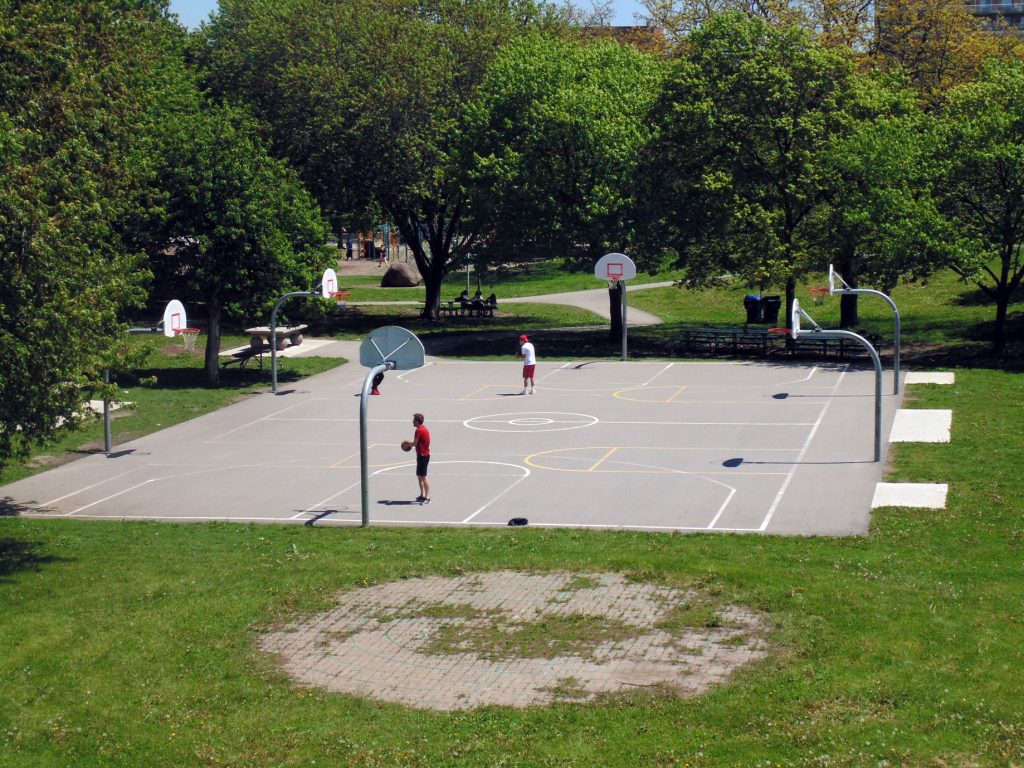
Reasons to go: Hillcrest Park is a sports-lovers paradise, there is always something fun to do. The park has a basketball court, a baseball field, four tennis courts, a tennis table made of stone, and an open area of grass where people can be found playing Frisbee. One side of the park is typically filled with sports activities, while there is lots of room for kids to play and for people to relax and sunbathe. Kids can enjoy the wading pool and park in their own little corner, while basketball is popular among teenagers. The park features an off-leash area for dogs securing its title as a park with variety.
Overheard: “Ohhhhhh!” A group of teenagers playing basketball, upon the ball falling in a puddle.
Did you know: The park was featured in the Toronto-set film Scott Pilgrim vs. The World in 2010.
Vermont Square Park
819 Palmerston Ave.
Time: 1:30 p.m.
Grade: A- (last year A)
Reasons to go: Nestled in the quiet and peaceful Seaton Village, this park has a lot of features to grab your attention. Some standout pieces include the playground, sandbox, chess board picnic tables, the wading pool, huge ornamental rocks, and the stage. There is a lot of space for dogs to run around, seating for those looking to relax, and pirate ship-themed playground equipment that is popular among children. The park could use some maintenance at this point, patches of grass in front of the stage having faded away over time. Nonetheless, it is really enjoyable for people of all ages. Additionally, the ice-skating arena and daycare centre make the park a community hub for everyone.
Overheard: “The sharks, they wanna eat us!” Two kids playing in the pirate ship-themed playground.
Did you know: The park was renovated in 2012; the new design included the wavy bench, the playground equipment, sandboxes, and stage.
Paul Martel Park
10 Madison Ave.
Time: 2:00 p.m.
Grade: F (last year D+)
Reasons to go: Paul Martel Park is more of a green space than a park, and one that requires more regular maintenance. For starters there is plenty of litter all over the area and the sign that usually sits at the front to point out the park’s name was taken down due to vandalism, but never replaced. This makes it look less appealing. On the plus side the location is pretty calm, not many cars pass by and, despite it being located right behind Spadina station, the sound of the buses isn’t too loud or disruptive. There are also plenty of benches to sit on. Overall this park seems to have been forgotten by the city.
Overheard: Buses leaving and arriving at Spadina station.
Did you know: Paul Martel is an architect who has volunteered throughout the years to build parks in the community.
St. Alban’s Square Park
90 Howland Ave.
Time: 12:30 p.m.
Grade: A (last year B+)
Reasons to go: We would highly recommend paying a visit to St. Alban’s Square this summer. The park is perfectly balanced in every sense. There is a good amount of green space as well as a sidewalk right through the middle of the park with both shady and sunny areas and lots of benches. The overall atmosphere is very relaxing as it is in the middle of a residential area, so not many cars pass by. The park is clean and also full of people as it is a very attractive place to take a break and enjoy the outdoors. Yet even when a lot of people are there, its large size offers plenty of open space.
Overheard: A man talking on the phone and dogs barking.
Did you know: St. Alban’s Square Park used to be owned by the historic St. Alban’s Cathedral.
Euclid Avenue Parkette
711 Euclid Ave.
Time: 1:30 p.m.
Grade: F (last year F)
Reasons to go: It’s hard to find reasons to go, so we’ll just suggest that you don’t bother. There are three benches beside a patch of dirt pretending to be a trail, and that’s it. The“parkette”sits right in-between a house and a building so there is no view of anything. You likely wouldn’t notice it unless you looked for it, or knew it was there already. Also you would think that being hidden, the place would be calm, right? Wrong, because there is a parking lot across the street from it. The only good thing I could find to say about this parkette is that if you are looking for a place to sit in the shade, you could find it here. However, it really only serves this purpose for people walking by to sit down and take a break.
Overheard: Birds chirping and cars passing by.
Did you know: There are plenty of good restaurants just steps away on Bloor Street. Go there and enjoy the food instead.
Christie Pits Park
750 Bloor St. West.
Christie Pits Park has courts and fields for all kinds of sports. With the Toronto Raptors coming off an exciting championship season, the basketball courts have been very popular recently. Raptors fever has caused many young aspiring ball players to come out with their friends to Christie Pits for small pickup games. JUAN ROMERO/GLEANER NEWS
Time: 1:00 p.m.
Grade: A+ (last year A+)
Reasons to go: Christie Pits is one of the best parks in the Annex with something for everyone to enjoy. The park has seating areas, a playground, basketball courts, baseball diamonds, and a pool. You can also walk across it using the many sidewalks that go across the park. It is just off Christie Station which makes accessibility very easy. It is a great spot to take your children to play, if you want to play sports, or if you just want to relax and enjoy the weather. Despite being beside Bloor Street, the park is deep enough for you to get away from the sound of traffic. Christie Pits Park is a must-go this summer.
Overheard: “Get Buckets!!” A teenager said while playing a game of 21 with his friend.
Did you know: Every Sunday night from June 30 to August 29, Christie Pits Park will host an outdoor film festival.
Jean Sibelius Park
50 Kendal Ave.
Time: 12:00 p.m.
Grade: A+ (last year B+)
Reasons to go: Jean Sibelius Park is a great spot to enjoy a picnic with the whole family. It has a big playground for children to enjoy, as well as washrooms and lots of places to sit including picnic tables. Most of the seating areas are in the shade, and they are well placed all over the area. The park is in a residential area so it has a pretty relaxing atmosphere as long as you are away from the playground. The park is clean and the benches, the playground, water fountains, and washrooms are all in good shape. The neat thing about the park is the balance between playground and green space.
Overheard: Children laughing and yelling on the playground.
Did you know: The park is named after Jean Sibelius, who was a highly influential Finnish composer in the late 19th and early 20th century.
Boswell Parkette
4 Boswell Ave.
Time: 11:30 a.m.
Grade: B (Last reviewed in 2017, B)
Reasons to go: Boswell Parkette sits at the dead end of Boswell Avenue. It is located where Boswell Avenue and Avenue Road meet, right behind a TTC stop. This parkette serves a good purpose for those waiting for their bus to arrive. There are plenty of places to sit despite its small size. Almost all of the parkette is well covered by massive trees which shade the area during the middle of the day. There are two walkways across the area which connect Boswell Avenue with Avenue Road, making it easier and faster for residents to cross between the two streets without having to go around. There is some litter by the actual bus stop but not in the parkette. This location can get a bit noisy due to traffic from Avenue Road.
Overheard: The sound of a TTC bus beeping as its platform lowered for a rider to exit.
Did you know: The parkette is named after Toronto’s 24th mayor, Arthur Radcliffe Boswell. He served one term from 1883 to 1884.
Jay Macpherson Green
255 Avenue Rd.
Time: 12:30 p.m.
Grade: A- (last year: N/A)
Reasons to go: Jay Macpherson Green is a great spot with lots of green space, trees, and a walkway across the park. It is easily accessible and you will find many birds and benches to sit on. It is very clean and this is a little surprising due to the fact that it sits beside a very busy street with a lot of pedestrian traffic. Jay Macpherson Green serves as a spot where you can sit and relax, as well as one where you can take your kids to play a game of catch. The level of noise coming off Dupont Street is the only thing that might make the Green unappealing. This park is located right in front of the Sergeant Russell Parkette which has been under renovation since last spring. Since Sergeant Russell is not currently open, Jay Macpherson can be a great alternative to go to this summer.
Overheard: “I’ve already done 3 km today…” A man told his jogging partner while crossing the park.
Did you know: Jay Macpherson was a well recognized Canadian poet, who received the Governor General’s Award for her poetry book The Boatman in 1958.
Jesse Ketchum Park
1310 Bay St.
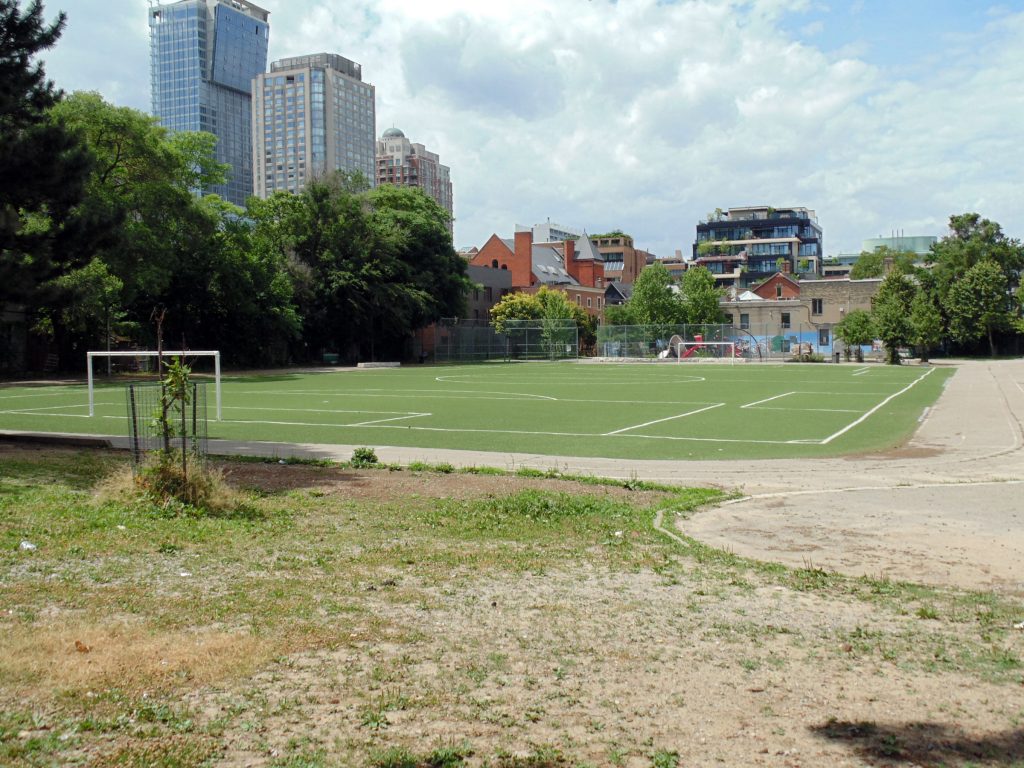
The turf field at Jesse Ketchum Park is what really makes it unique compared to others. During the summer months the field is hardly ever empty. It is a huge attraction for those who practise the beautiful game. JUAN ROMERO/GLEANER NEWS
Time: 12:00 p.m.
Grade: A (last year: N/A)
Reasons to go: It is spacious, there is lots of shade, lots of seating, and a good balance of green space and sidewalk. The first thing you will notice is the art structure sitting right in the middle of it. It is eye-catching and it draws your attention to the park. Then you will see the vast green space on offer, with various trees and lots of beautiful flowers in some areas. The seating is one of the best things, as there are many benches and they are well balanced and scattered across the area. If you enjoy playing soccer, Jesse Ketchum Park has a very well maintained turf field right behind the park itself, as well as some picnic tables. The park also sits beside Jesse Ketchum public school so during recess time it will get a little bit loud. Yet despite sitting on Bay Street, the traffic is not as loud as you would imagine. Most benches sit deep enough into the park that it makes it far enough for you to not be too bothered by the cars. Overall the park is mostly clean; there is some litter but not too much.
Overheard: Children yelling and having fun during their lunch.
Did you know: Jessie Ketchum, who was a philanthropist in the early 1800s, was the first person to introduce sidewalks in Toronto.
Walmer Road Parkette
227 Walmer Rd.
Time: 1:00 p.m.
Grade: C+ (last year: N/A)
Reasons to go: There are positives and negatives to this parkette, some people will like it and some people won’t. It is located on Walmer Road very close to Casa Loma. In fact you can see part of Casa Loma from the benches at the parkette. The neighbourhood it sits in is extremely calm, I would say it is mostly local traffic that sporadically passes by. So if you are looking to just relax this is a great place. However, the parkette itself is very small, and it is even smaller this summer due to construction, which is taking up approximately one-third of an already small area. The parkette is somewhat hidden and it sits in the middle of the neighbourhood. There was a lot of litter, but the green space is quite nice and the flowers are very colourful.
Overheard: Birds chirping
Did you know: Casa Loma was originally built to serve as the residence of Canadian financer and soldier Sir Henry Pellat.
Wychwood Park
76 Wychwood Ave.
Time: 1:30 p.m.
Grade: A (last reviewed in 2012, A+)
Reasons to go: This is a great place to go with your kids. It has a huge playground with swings and even a splash pad. It has benches all around the playground for parents to look after their children. If you are just going by yourself and looking to relax then this park is also for you. There is a large green space on the other side of the park, which has benches, picnic tables, lots of trees and flowers, and is perfect to enjoy a relaxing time. The area as a whole is very clean and the green space is also great for dog owners, despite the fact that there is no official “off leash” area. The park is also home to Wychwood Barns, which hosts different events throughout the year, especially on weekends. Overall, it doesn’t matter what your plan is, Wychwood Park has something for everyone to enjoy.
Overheard: “Go get it… good boy!!!!!!!!” A woman said to her golden retriever as she threw a ball for the dog to fetch. Did you know: The park is named after a forest in Oxfordshire County in south-east England, the birthplace of the park’s designer, Marmaduke Matthews.
July 16th, 2019 · Comments Off on ON THE COVER Let it flow (Summer 2019)
Construction is well underway to replace the 142 year-old water mains running under Bloor Street. Expected completion end of 2019. BRIAN BURCHELL/GLEANER NEWS
Comments Off on ON THE COVER Let it flow (Summer 2019)Tags:Annex · News
July 16th, 2019 · Comments Off on NEWS: Patio proposal moves ahead, tentatively (Summer 2019)
Layton helps forge a compromise for cheesecake purveyor
By Nabahat Hussain and Juan Romero
After a lengthy dispute with the Harbord Village Residents’ Association (HVRA), the recently opened “LeTao Sweets” bakery is up and running with tentative plans for a patio next summer.
The bakery’s owner, Alex Lau, opened LeTao this past month at the north-west corner of Brunswick Avenue and College Street.
His initial proposal for a patio at LeTao was shut down by the HVRA. His second proposal got the city’s approval, with some compromise.
Lau says he still feels some uncertainty about the future of the patio and confusion about why the proposal was denied in the first place.
“It was frustrating and disappointing because we opened up the discussion with the HVRA by providing them with the hard copy of the plan, but we’ve been shut out,” Lau said. “We still don’t understand the reasoning behind their initial opposition.”
Lau was advised by councillor Mike Layton’s office to seek support from at least 60 per cent of the residents within immediate proximity of the restaurant. He claims to have gained 80 signatures as of May 7, and said that many neighbours have dropped by to voice their support for the patio.
The agreement finally came on May 22 at a community council meeting between councillor Mike Layton, the proponent (Lau), the Municipal Licensing Services (MLS), and the city’s transportation division which looks after assigning such spaces for commercial use.
Rory (Gus) Sinclair, the co-chair of the HVRA, said that the association was not involved directly in the agreement, but they did sign off on it. Sinclair also mentioned that the negotiation process was slowed down because the owner of LeTao was involved with the press.
“The councillor had been trying to negotiate with the proponent, and while we were in the middle of negotiations the proponent went to the press. We don’t negotiate in the press, so we waited to make the deal and then spoke about it,” says Sinclair.
There were sixteen conditions the city asked of the proponent including the design of the patio, the public space, and the inclusion of green spaces.
The patio’s design and shape must provide at least 2.13 metres of sidewalk clearance. Between Oct. 31 and Apr. 15, the patio will have to be opened and shared with the public, as an un-enclosed space. Finally, the owner of the establishment will have to come up with a landscaping plan for the patio, which must include the retention of the already existing healthy trees that are in front of the café.
Alex Lau has to implement the recommended landscaping plan no later than April 2020. However, the current patio can be operational until the deadline.
With regard to the back and forth arguments before coming to an agreement, Lau says that he understands the residents’ association just needs the neighbourhood a certain way. “There is no conflict or grudges, they came by for ice cream!” Lau said.
Comments Off on NEWS: Patio proposal moves ahead, tentatively (Summer 2019)Tags:Annex · News
July 16th, 2019 · Comments Off on NEWS: Chess for everyone (Summer 2019)
The legacy of Ted Winick
Ted presenting a trophy to Max England at Annex Chess Club in 2016. COURTESY MARCUS WILKER, CHESS INSTITUTE
By Meribeth Deen
You might not have ever met Ted Winick, but you’ve likely walked by the Bloor Street, and formerly Bathurst Street, location of his business, the Spirit of Math, and his passion project, the Chess Institute of Canada. As they mourned his passing in early June, Winick’s friends and colleagues reflected on his dedication to community as well as his use of chess as a tool to bring people together and teach life’s most important lessons.
“When he was playing with a kid, he’d always ask, are you willing to take responsibility for that move?” recalls his old friend and former city councillor Joe Mihevc. “Ted’s pedagogy and perspective of life all boiled down to what happened on the chess board: use your brain, take responsibility, and find a strategic way around the obstacles you encounter, because there are bound to be obstacles.”
As Marcus Wilker, the current director of operations at the Chess Institute of Canada recalls, Winick didn’t play in tournaments, didn’t actively try to improve his game, and wasn’t known for his skill as a player.
“He was great at welcoming people, he’d sit down and play with anyone,” says Wilker. “As Ted’s wife, Heidi, can confirm, he’d always pack a chess board with him on vacations. He’d wait for a game and inevitably find one. He’d get to know whoever he played. For Ted, chess was all about relationships.”
Winick’s involvement with kids and chess started at his son’s school chess club, and from there he went on to put together the Annex Chess Club. Wilker says that in 2010 there were no chess clubs in downtown Toronto. A planning committee came together to organize a club, and Ted volunteered to find a space and run it.
“One of his strengths was definitely bringing people together,” says Wilker. “He had a special talent for giving people ownership and involvement of a project, and making the work really satisfying. We were all really inspired by Ted’s dedication.”
Wilker adds that Winick was also set on making the club as diverse as possible.
“He’d say – chess is for everyone!” recalls Wilker. “Although Toronto is diverse, people often tend to get segregated. Ted went out of his way to make the club as welcoming as possible to newcomers, even if they didn’t speak the same language. Chess was the common language. Of course, if someone showed up who didn’t speak much English, Ted would find someone who spoke their language.”
Today, the Annex Chess Club has 40–50 tournament players who meet every week, plus a dozen or so adults and children taking classes.
Mihevc also has fond memories of Winick’s entrepreneurial spirit.
“He could really hustle and muscle, but it was never for himself,” says Mihevc. “If I was hosting an event where I needed lots of tables and lots of people, I would call Ted. He never said no, and he’d bring an almost life-sized chess board. He’d play with anyone, any kid, that came along.”
Mihevc recalls that Winick had a way of getting other people on board with his ideas.
“His kids went to Oakwood Collegiate, and at one point there was some kind of class trip coming up. Ted wanted to do something to make sure every kid could afford to go, so he bought a giant crate of oranges and got people to sell them to raise money. This is how he got a local councillor to become his agent selling oranges. Really, a lot of what drove him was a strong sense of public good.”
Megan Shaw met Winick when she applied for a job with his Spirit of Math schools.
“I didn’t get the job, but I hit it off with Ted and his wife, Heidi,” says Shaw. “I was new to the city, and I found it big and intimidating. Everyone kind of kept to themselves, except Ted. Ted seemed to interact with everyone. I was really awe-struck by that.”
Later on, after Shaw had attempted to launch her own business, Ted stepped in to help out.
“He said, why not start a non-profit? And he helped me put the pieces in place to make that happen,” recalls Shaw. “I had just finished up my Bachelor of Education when I met him, so I knew so many administrators and teachers, but Ted was by far the person who was most passionate about education. He was in love with community, and he believed that education should be tied to community. I think that’s why the Chess Institute was so important to him. He loved math and strategy games, language and words – education for education’s sake.”
While his business, the Spirit of Math, works mostly with kids already considered to be high-achieving, the Chess Institute was created to connect with students from the tougher neighbourhoods and backgrounds, and teach the life skills required to improve their circumstances.
“He was never looking for the next grandmaster,” says Wilker. “And he’s left us with a clear sense of his mission, which we will work hard to carry forward now that he’s gone.”
Comments Off on NEWS: Chess for everyone (Summer 2019)Tags:Annex · News
Aerial view of the proposed 3-storey Estonian Cultural Centre and the set to be built at 9 and 11 Madison Ave. in Toronto. The building will have an eye-catching rooftop garden for visitors to enjoy. COURTESY ALAR KONGATS
New building plan clears hurdles at Committee of Adjustment
By Juan Romero
The Committee of Adjustment at the City of Toronto and the Annex Residents’ Association (ARA) have approved the latest changes proposed for the New Estonian Cultural Centre. The new centre, to be located in the Annex, will replace the current building, located on Broadview Avenue.
The Estonian Centre’s project committee had submitted eight minor changes to the design of the building. These changes, which included adjustments to the building’s eight and parking, were well received by neighbours.
“In the latest proposal we liked the design and we were in favour of the changes. We think it will be really beneficial for the Estonian community,” says Sandra Shaul, the chair and director of the ARA.
The three-storey building will be located on Madison Avenue, where the Green P parking is located, which is very close to the Estonian Tartu College.
On the building’s third floor there will be a music hall which will be used for special Estonian celebrations, as well as by the Estonian Choir and schools. COURTESY ALAR KONGATS
The new centre will be used by the Estonian Credit Union, the Estonian Choir, and Estonian schools and it will be occasionally rented out to third parties as well. Public events such as Estonian events and celebrations will also take place there.
Despite the wide approval for the development of the centre, the Estonian Vice-Consul in Toronto, Tom Heinsoo, says the community is divided on the project.
“Some people in the community thought it would be better to spend the money on the existing house on Broadview and renovate the current building,” says Heinsoo, who adds that he is in favour of the creation of a new centre. “I do think the majority of people realize that it wouldn’t be financially logical to renovate the old building since it would cost a small fortune to bring it up tomodern standards.”
According to the Estonian Centre’s due diligence report, the Madison Avenue project is set to cost approximately $25 million. Construction is scheduled to begin in January 2020.
July 16th, 2019 · Comments Off on CHATTER: Clinic not spared by Ford’s reversal (Summer 2019)
Despite Premier Doug Ford’s announcement that some of his proposed funding cuts are being reversed, cuts to Kensington Market’s St. Stephen’s Community House remain intact.
The overdose prevention site in Kensington is still seeking approval for provincial funding because donations alone are not sustainable for the long-term operation of St. Stephen’s. There are now enough donations for the site to keep running until December 31 according to St. Stephen’s Executive Director, Bill Sinclair.
St. Stephen’s has added two hours of much-needed service recently due to generous donations. To support St. Stephen’s, donations are still welcome at www.sschto.ca.
—Nabahat Hussain/Gleaner News
Comments Off on CHATTER: Clinic not spared by Ford’s reversal (Summer 2019)Tags:Annex · News
July 16th, 2019 · Comments Off on CHATTER: The Bloor-Borden Farmers’ Market is back (Summer 2019)
The farmers’ market at Bloor and Borden returns to the Annex the first week of June and will be open every Wednesday from 3-7 pm until the last week of October. Look for the Green P parking lot just south of Bloor and you’ll catch sight of the action.
The farmers themselves bring their food to market every Wednesday. BRIAN BURCHELL/GLEANER NEWS
This year the market will feature some new prepared-food vendors and will also see a lot of returning vendors. Shoppers can expect to see strawberries mid-June, blueberries by the end of July, and peaches by August. The long winter of sad-looking imported fruits and veggies will soon come to an end!
The future is uncertain for farmers’ markets in the province as the model depends on provincial funding. Farmers’ markets bring fresh local produce to urban areas. They put more money into the pockets of farmers, and help city slickers connect to the food they eat. By supporting a local farmers’ market, patrons are sending a message that they care about the plight of farmers and about the environment, and want to put their money where their mouths are. This year, it is more important than ever to show support to farmers.
Did you know that all farmers must be vetted by Farmers’ Market Ontario? Every farmer has had their farm inspected and provided proof that they planted crops themselves. Re-sellers are not welcome at the Bloor Borden Market.
Cooked food vendors need to buy their produce (where possible) from farmers. Though Ontario doesn’t grow much wheat, when you buy a kale and squash pie you can be assured that the kale and squash came from an Ontario farmer.
—Terru Chu/Gleaner News
Comments Off on CHATTER: The Bloor-Borden Farmers’ Market is back (Summer 2019)Tags:Annex · News