Bling bling! Jaws dropped and the media was bedazzled by the newly unveiled Toronto Raptors championship rings on October 23. For the team’s opening game, each player was awarded a golf-ball of 10 karat gold covered in 14 carat diamonds, and the nearly 20,000 fans watching at Scotiabank Arena were given replicas. Instead of being star struck, I feel sick. Instead of celebrating the making and baring of those rings, we should be denouncing them and the culture that clouds the story they really tell.
Bling is all about “making a statement”. That statement never seems to have much to say about the devastating cost of getting gold and diamonds into our hands. According to Osgoode Law Professor Shin Imai, between 2000 and 2015, 44 people died from violence around Canadian-owned mines in Latin America, 4 people connected to mines have disappeared, and 403 were injured.
Global Witness, a group that tracks statistics of environmental defenders, documented 185 killings across 16 countries in 2015 alone. One of them, Alfredo Ernesto Vracko Neuenschwander, a Peruvian community forestry worker, was gunned down in his home in Madre de Dios on 19 Nov. 2015. He led a local movement to resist gold mining in an ecologically sensitive area.
The fact that the Raptors sourced the gold and diamonds from Canadian mines means little. Canadian gold is still an environmental catastrophe and the rights of Indigenous people in Canada are constantly trampled upon for mineral extraction. Besides, gold is a commodity and regardless of where it is purchased from, it fuels global demand.
The highest grade Canadian gold mine averages 22.2 grams of gold per ton of ore. This means that for every ounce of gold, over a ton of ore needs to be crushed down and refined to separate out the gold from the rest of the rock. No wonder that according to EarthWorks.org, 20 tons of toxic waste are produced for every 0.333-ounce gold ring with mercury being among the highest pollutants. (There is almost no way these rings are “only” 0.333 ounces of gold.) Somewhere in Canada (probably the Canadian Shield) there is a toxic sludge pond holding the toxic waste from the production of these rings.
While diamond mining is less environmentally devastating than gold mining, it causes soil erosion and dust pollution as mines are blasted with explosives. Let’s not forget that from 1991 to 2002, over 50,000 people were killed in Sierra Leone during their civil war, largely fuelled by “blood diamonds”. It has been almost two decades since governments sat down and tried to stem the flow of these around the world. Two decades later, diamonds still cause human suffering as rights groups complain that the definition of what is tracked by the Kimberly Process (the mechanism created to ensure diamonds are conflict free) remains too narrow.
We the North. We are a country that proudly waves the flag of environmental stewardship (mostly). We are a country that just told the science-denying Conservatives that we didn’t want them to govern us. Nearly two-thirds of the Canadian population voted for a political party that supports a carbon tax. We wear our environmentalism on our sleeves. We are a country that just elected a government that subsidized camping on its platform. It is as if connecting to the outdoors is a patriotic duty. Protecting the environment is our shtick, yet we enthusiastically cheer on our champions for their destructive bling.
We the North need to consider the South: the global south. Environmental destruction should never be fashionable. No one should have to suffer for our bling, drink contaminated water for our gold, or be killed for our diamonds. Statement jewellery needs to be seen for what it is: exploitation. Refusing it is the powerful choice, and needs to be celebrated.
Terri Chu is an engineer committed to practical environmentalism. This column is dedicated to helping the community reduce energy use, and help distinguish environmental truths from myths. Send questions, comments, and ideas for future columns to Terri at terri.chu@whyshouldicare.ca.
October 17th, 2019 · Comments Off on ON THE COVER (Oct. 2019)
Juan Romero/Gleaner News
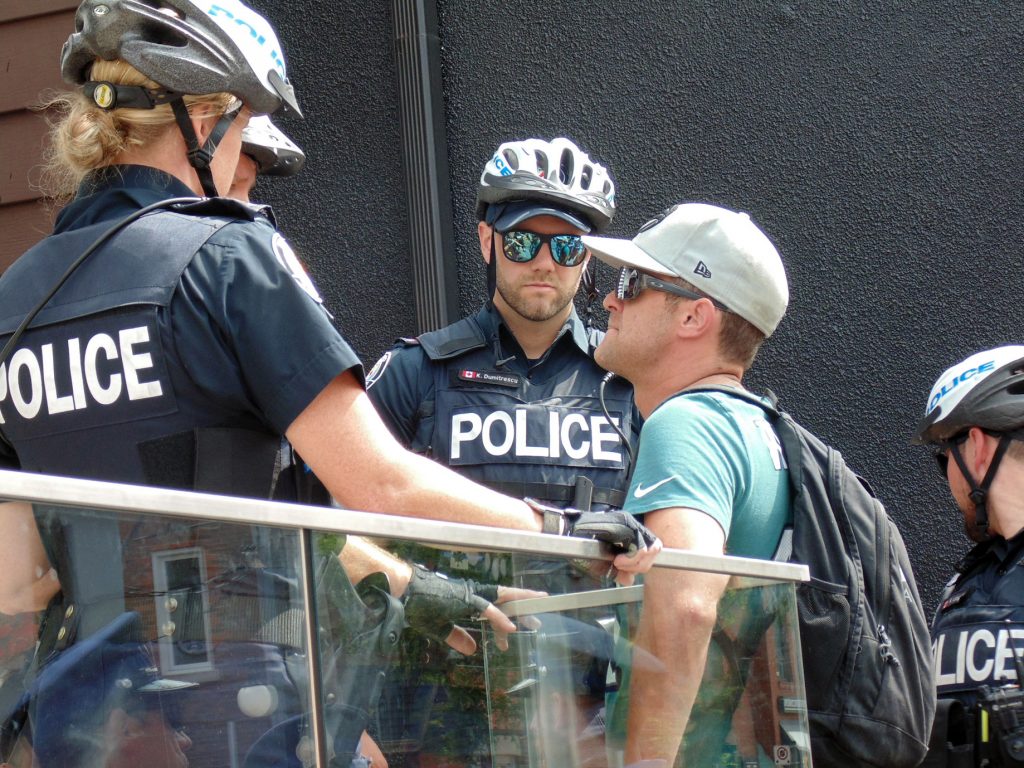
At right, Jeffrey Brodie tries to regain access to what he describes as his residence at 104 Harbord St. The location is know as CAFE, a popular illegal marijuana dispensary where the city has erected concrete barriers to its entrance way. Brodie recently lost his bid to get an Ontario court to order removal of the barrier. READ MORE HERE
October 17th, 2019 · Comments Off on NEWS: Refugees get Major investment (Oct. 2019)
Major Street residents band together to welcome new Canadians
By Leah Borts-Kuperman
At a Christmas party in 2015, ten neighbours living in Harbord Village decided to contribute $1,000 each to help Syrian refugees. The group, which would eventually call themselves the Major Street Refugee Initiative (MSRI), would go on to raise $80,000 and support a family of eight. That support continues today.
MSRI provided the family with a home rent-free from a man who had vacated to a retirement residence, and helped them to find medical assistance, food, and clothing as they adjusted to life in Canada. Each MSRI member took on a different set of responsibilities.
Gus Sinclair’s job was to take the family members to doctor’s appointments all over the city, as many of them hadn’t seen a doctor for the better part of a decade.
“There was a huge amount of medical issues–getting checkups, finding out what needed to be fixed up, there were serious teeth issues,” he recalls.
James Murdoch’s role was to be the “cell phone and internet” guy, responsible for getting the family all set up with required technologies. All members of the group took on responsibilities well beyond those assigned to them.
Sinclair says that the family had to learn to use the TTC, to navigate a new alphabet, and learn how and where to purchase their food. Pita, says Sinclair, was a staple of the family’s diet. However they were not able to find a brand of pita that was right for the Syrian family and went through 40 brands before finding one that was just right. Once they found the best option, they bought a full garbage bag of the product.
MSRI’s obligations to the family were supposed to wrap up this year; however, one of the family members didn’t arrive in Canada until the spring of 2019. The group continues to work with this individual to help him adjust to his new life.
According to a federal government website, “Canada will resettle 29,950 refugees from abroad through our various programs in 2019, with 19,000 arriving through the Private Sponsorship of Refugees Program. This is quadruple the number of privately sponsored refugees that Canada resettled prior to 2015.”
“They invited us out two months ago for a big thank you dinner,” says Sinclair. “It was huge, a humongous amount of food…They’re in charge of their lives now and that’s the point.” Murdoch says he would do it all over again, given the opportunity.
“They keep saying ‘thank you.’ I just keep saying to them, ‘don’t thank us, just get on your feet, become independent, and give back whenever you can,’” Murdoch said. “It’s sort of the Canadian way. And we’ve seen already that they’re really working hard to become independent and part of the fabric of the country.”
Comments Off on NEWS: Refugees get Major investment (Oct. 2019)Tags:Annex · News
October 17th, 2019 · Comments Off on NEWS: Kensington mainstay Zoltan Zimmerman dies at 93 (Oct. 2019)
A Holocaust survivor, “he had no bitterness, always looked at the good”
By Ron Csillag, The Canadian Jewish News
Zoltan Zimmerman, whose Zimmerman’s Discount store was among the last of the old Kensington Market shops that sold a bit of everything and was a mainstay of the cacophonous neighbourhood for more than six decades, died in Toronto on Sept. 4. He had turned 93 just a few weeks earlier.
His was the classic tale of the Holocaust survivor who came to Canada to start afresh and succeeded through a combination of business smarts, bruisingly hard work and having a heart. For example, he freely extended credit. How did he know which customers needed it? “He could tell by their punim (faces),” said his son Danny, who was 13 when he started in the business.
“For over six decades, before there was Costco, there was Zimmerman’s,” said Rabbi Baruch Frydman-Kohl, rabbi emeritus of Beth Tzedec Congregation, in a eulogy sent from Israel. “Breakfast cereal and eggs, vegetables and canned goods, suitcases and jeans, personal care and plastic sandals. The shop grew.”
Situated on Augusta Avenue, Zimmerman’s was a fixture in the multi-ethnic neighbourhood. It helped that Zimmerman spoke Czech, Slovak, Hungarian, Yiddish, German and a smattering of other languages. He not only gave credit, but cashed the paycheques of poor newcomers, some of whom could only endorse the cheques with an X.
“He loved his customers,” said his son. “He always said, ‘You learn from your customers.’ ”
But Zimmerman knew the area had changed and, in late 2014, he took the sale of the store – now an organic supermarket – in stride.
Zimmerman was born in 1926 in a Slovak village hard by the border with Hungary and Romania. His father farmed, traded in cattle and ran a grocery and general store. In 1944, the clan was deported to a nearby ghetto and then to Auschwitz, where his parents and a sister were murdered immediately. Zimmerman survived as a stable boy in the sister camp of Birkenau.
He arrived in Toronto in 1951 to join a sister and found work right away at a pickle factory and, later, at a scrap yard. Each evening, he worked some more at a Baldwin Street fruit market, whose owner agreed to sublease the store to Zimmerman and his cousin. They never looked back and, in 1953, sought larger premises on Augusta Avenue.
“The first couple weeks, we sold three truckloads of bananas on a Saturday. It was easy to do business, not like today,” Zimmerman told Toronto Life in 2014. “Back then, there were so many people, you couldn’t move. People were selling rabbits and chickens. It was different. There was a theatre nearby, and at night the people would come after the show, and there wasn’t anything you couldn’t sell. Potatoes, apples, anything cheap you would sell on the sidewalk.”
The simple fruit stand soon started selling meat, fish, dairy products, groceries, clothing and a wide array of household miscellany – “anything we thought our customers would buy,” Zimmerman wrote in a brief biography.
“He worked from 4 a.m. to 10 p.m. He was the hardest-working man I ever met,” his son recalled. “But he loved the store.” At its peak, the shop occupied 7,000 square feet and had six delivery drivers.
“He was a happy man,” said Danny Zimmerman. “He had no bitterness. He always looked at the good. But he was tough in business, strong. On his deathbed, he told me, ‘Whatever I went through made me honest, humble and appreciative of what I have.’ ”
Zimmerman is survived by his wife of 63 years, Sara; a sister, Ella Hartman; children Alice Goldberger, Evelyn Farber and Danny Zimmerman; 13 grandchildren; and seven great-grandchildren.
Reprinted with permission of the Canadian Jewish News.
October 17th, 2019 · Comments Off on NEWS: Candidates face-off (Oct. 2019)
Conservative candidate absent for climate-dominated debate
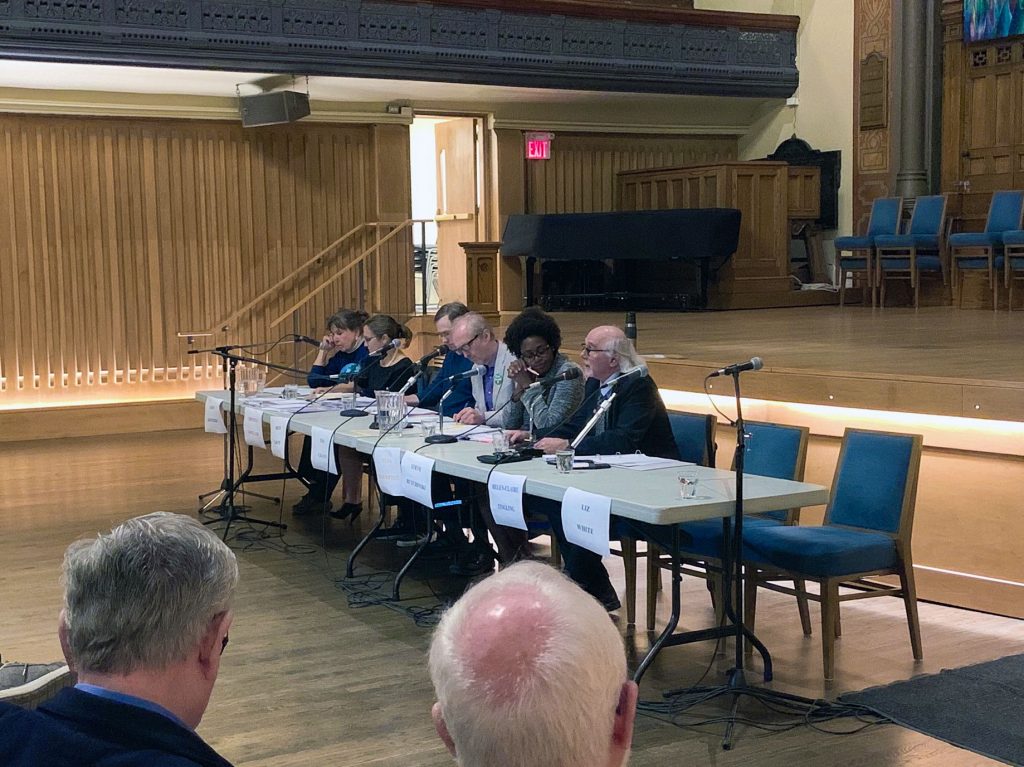
Candidates who were present expressed consensus on the need to address climate change but disagreed how it should be tackled. Ahmed Hagar/Gleaner News
By Ahmed Hagar
Every candidate but the Conservative party’s Helen-Claire Tingling running to represent the constituents of the University-Rosedale riding made it to the planned all-candidates forum on October 7. The climate crisis dominated the conversation and all present agreed that implementing policy to combat it was critical, but each expressed different approaches to doing so.
“We need emergency mobilization to enact critically needed legislation. The Paris Agreement gives us 11 years to bring our carbon use down. We do not know if we have that much time.”
— Karin Brothers, Stop Climate Change party
Rory Gus Sinclair, the former chair of the Harbord Village Residents’ Association, moderated the debate. All five local residents’ associations shared the responsibility of hosting the event.
Green party candidate Tim Grant described the election as a “climate election”. Some of the candidates voiced their disagreement with the Liberals approving pipelines, such as Trans Mountain and Keystone XL.
Chrystia Freeland discussed the Liberal party’s commitment to plant two billion trees nationwide, saying “trees are one of nature’s best technologies to fight climate change.”
As a member of the Stop Climate Change party, Karin Brothers said the party’s main goal is to transition Canada to renewable energy. Their plans include making electric cars toll-free and increasing public transportation funding to reduce reliance on vehicles.
“We need an emergency mobilization to enact critically needed legislation,” she said. “The Paris Agreement gives us 11 years to bring our carbon use down. We do not know if we have that much time.”
Hecklers disrupted the event on several occasions, voicing their disagreements with Freeland on climate change, NAFTA, and foreign affairs. In a few instances, audience members argued with the moderator and the audience.
“You can do some heckling, but a bunch of you are doing it every 15 seconds,” Sinclair said. “We are going to ask you to cooperate, otherwise we have got a problem.”
On the topic of immigration, the candidates discussed supporting migrants and refugees. Steve Rutchinski of the Marxist-Leninist party argued for Canada to build international relations based on mutual respect and benefit.
“If you want to stop the migration crisis, you stop the wars,” he said. “Those people who are victims of this should not be further penalized because they find themselves in these intolerable conditions.”
The candidates also answered questions about congestion and transit infrastructure in the city. Tim Grant, of the Green party expressed support for “a new deal” for cities and for tying federal infrastructure funding to transit planning that can be accessible and sustainable.
“The new subway and LRT lines for the past 30 years have been commuter lines that have been empty 16 hours a day,” he said. “The TTC has been in a worse financial condition when the stations were open because there are not enough people to ride them.”
On foreign policy, Communist party candidate Drew Garvie argued that the Liberal party’s lack of oversight over Canadian-based mining companies has led to their impact internationally.
“We have some of the most lax laws that allow these companies to act with impunity,” he said. “That allows for outrageous things, like our foreign policy with Venezuela.”
Freeland said that the Liberal party appointed an ombudsman to monitor mining companies and their international operations. She also said Venezuela was an issue that was about “democracy and authoritarianism”, which garnered a loud response from hecklers.
Another topic of discussion was affordable housing. All candidates supported the notion of housing being a human right. As a local affordable housing advocate, Vajda said that “people are feeling left behind” and the NDP platform would build 500,000 new units across the country.
“I have been on the other side where we are trying to get developers to set aside 10 per cent of units for affordable housing,” she said. “It is a battle and it does not always work.”
With the concluding statements, Freeland supported having a dialogue with various perspectives within the community and said that her focus will be to maintain liberal democracy if re-elected.
“Canada today is the strongest liberal democracy in the world,” she said. “And we, as a community and citizens, need to make our civic fabric strong.”
October 17th, 2019 · Comments Off on CHATTER: Brodie barred from 104 Harbord (Oct. 2019)
In July, the Gleaner reported that once again the illegal pot dispensary operating out of 104 Harbord Street just west of Spadina had been raided by police. Jeff Brodie who claimed to be a legal residential tenant of the premises was evicted because the building was being used as an illegal cannabis store. Police erected concrete barriers to the storefront making access for any purpose impossible.
Brodie recently lost his bid to be allowed to return while he challenges the constitutionality of the law that had allowed his eviction. An Ontario judge decided that allowing Jeffrey Brodie to go back home would allow the unlicensed pot retailer, CAFE, to start up inside sales again. Many illegal dispenaries had sought to employ residential tenants as a way of confounding police efforts to blockade the storefronts. In July the province amended the Cannabis legislation taking away the tenant rights of people living in illegal dispensaries.
“I recognize that (Brodie) is in difficult circumstances,” Superior Court Justice Peter Cavanagh wrote. “However, (he) has failed to discharge his onus….of satisfying me that if an order is made that entry to the premises cease to be barred, the use to which the premises will be put will not involve resumption of CAFE’s illegal business.” Brodie through his lawyer argues the “draconian” law contravenes his charter rights in part because it allows eviction of law-abiding tenants, and the seizure of their belongings, without due process.
After the most recent raid, authorities placed concrete blocks to barricade the entrance. CAFE then moved its operations outside, but Brodie lost access to his second-floor apartment and most of his possessions. Perhaps ironically the only legal use of the site was Brodie’s alleged occupancy which is now barred. The illegal use continues now in full view under a tent in front of 104 Harbord Street.
Justice Cavanagh accepted Brodie’s claim that he had no knowledge of the retail pot operation happening in his apartment.
October 17th, 2019 · Comments Off on CHATTER: Park still ignored by city (Oct. 2019)
Brian Burchell/Gleaner News
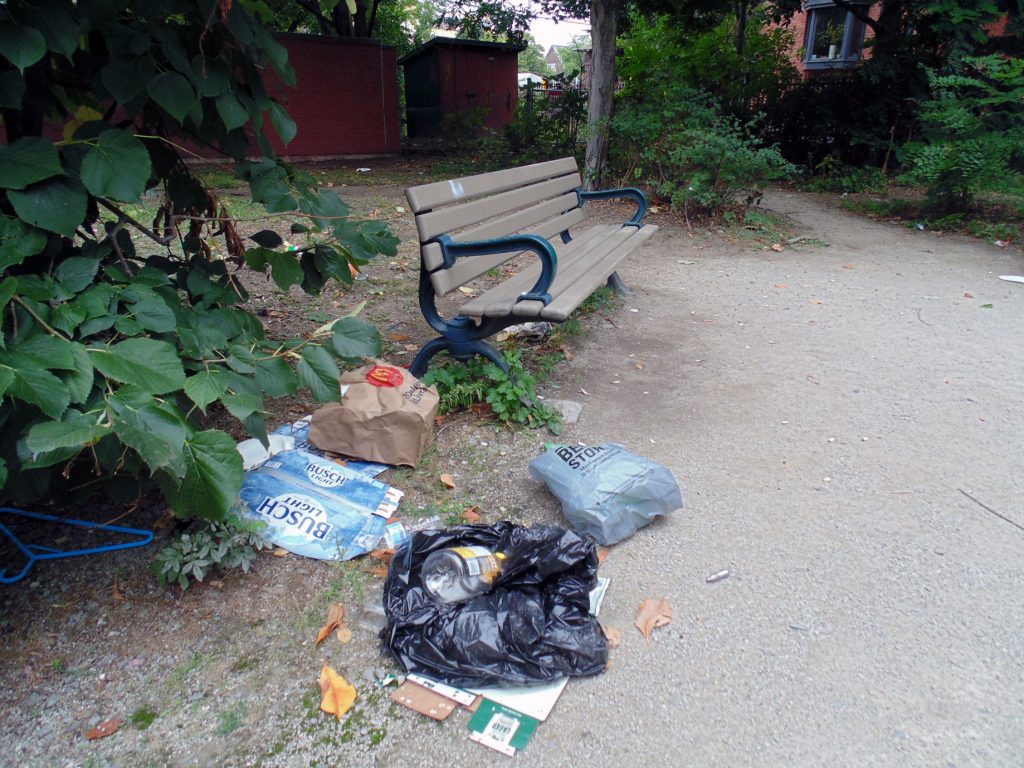
Despite the public outcry city staff have still not taken steps to address the concerns of residents about the neglect of Paul Martel Park located on Madison Avenue. City councillor for University-Rosedale Mike Layton has joined the chorus of those advocating for a solution, “I have made repeated requests to parks staff to have the signage replaced and attend to the overall state of the park. With two retirements of parks managers within the south district, maintenance this year was a challenge as the positions were not permanently filled until the end of the summer. Now that both those positions have been filled, I’m confident the city will be better able to respond to requests from the community.”
City of Toronto senior Park Supervisor Peter White remains unresponsive to requests from the Gleaner for comment.
October 17th, 2019 · Comments Off on CHATTER: Police Scholarship Awarded (Oct. 2019
Courtesy Toronto Police Service
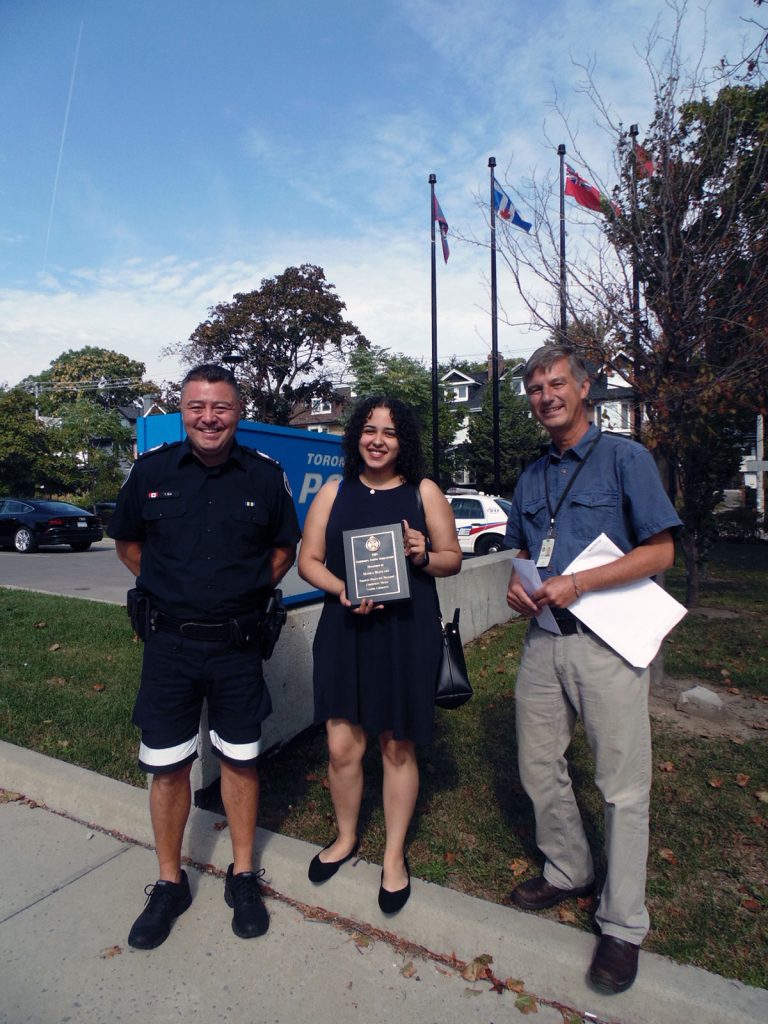
Monica Maitland, who was a student at Central Toronto Academy, has won this year’s safety scholarship from Toronto Police 14 Division. Pictured above from left is Staff Sgt. Tam Bui, Monica Maitland, and Brian Burchell, Scholarship Chair (and publisher of this newspaper). Monica overcame significant family hardships but still managed to make her community a safer more welcoming place. One of the many things she has done is to organize gift bags of essentials for homeless people in her neighbourhood. She approached corporate stores to make donations for these essentials. Thanks to the scholarship, Monica is now enrolled at Seneca College where she intends to study Behavioral Psychology.
Comments Off on CHATTER: Police Scholarship Awarded (Oct. 2019Tags:Annex · News
October 17th, 2019 · Comments Off on EDITORIAL: The hidden cost of Conservative climate plans (Oct. 2019)
As they look to win votes in Ontario, federal Liberal candidates point to Doug Ford as a sort of warning about the dangers of casting a vote in favour of the Conservative Party of Canada. It seems even the Conservatives are buying into this narrative, as party leader Andrew Scheer brought Alberta Premier Jason Kenney to Ontario to give his campaign a boost this month. The distraction does little to veil the similarity between Conservative leaders, particularly when it comes to their climate plans.
Since scrapping the Wynne government’s carbon cap-and-trade program, the Ontario government has found itself embroiled in court battles.
In September 2018, a coalition of environmental groups filed a lawsuit on behalf of Greenpeace Canada in response to the Ford government’s decision.
“The Ford government’s first action when it stepped into office was to gut a program designed to reduce greenhouse gas pollution, without offering any immediate alternative,” said lawyer Charles Hatt, in a statement. “We’re suing to remind the premier that winning an election does not give his government carte blanche to ignore the statutory rights of Ontarians to be consulted on major changes to the laws and regulations that protect them from climate change.”
While government lawyers argued that the Ontario Conservatives had campaigned on the promise of cancelling the program and reducing the price of gas by 10 cents a litre, two out of three Ontario Superior Court judges determined a political campaign doesn’t count as consultation. Amir Attaran, a lawyer for Ecojustice, told the National Observer that the decision will likely pave the way for disgruntled investors in the cap-and-trade market to launch their own lawsuits against the government.
Meanwhile, the Ford government went to court to fight the implementation of the federal carbon tax. Ford called carbon pricing a “cash grab”, and as explained by Jim Karahalios (founder of a website called axethecarbontax.ca), tried to persuade the court to accept less stringent carbon targets than those set by the federal government. The strategy failed with the court’s decision that deems the imposition of the federal carbon tax constitutionally sound. Dogged as ever, the Ford government has promised to keep fighting the Greenhouse Gas Pollution Pricing Act.
“We have seen the very real costs on the people of Ontario,” said Ontario Environment Minister Jeff Yurek after his government filed its appeal to the Ontario court’s decision.
Clearly, the legal costs are lumped in with environmental costs, and are not being tallied. Never mind the ecological costs – economists say the GDP is going to drop as temperatures go up.
It looks unlikely that a Scheer-led federal government would do the calculations much differently. Out on the campaign trail he’s promising to put more money in Canadians’ pockets by scrapping the carbon tax. If he ends up as the next prime minister, Ontario and other carbon-tax opposing provinces will save money on legal fees, but we’ll all pay a bigger bill in the long run.
October 17th, 2019 · Comments Off on FORUM: Our streets should be safer (Oct. 2019)
Dump truck strikes woman exiting streetcar
Jessica Bell, MPP University-Rosedale
On the morning of September 17, a young woman exited the streetcar at Bathurst and Ulster and was hit by a driver of a dump truck who failed to stop behind the streetcar, as is the law.
The woman went to hospital and is expected to fully recover, but the dark truth is she should never have been hit, and there are many victims who never recover.
There must be proper penalties for rule breakers. As the law stands, drivers who kill a pedestrian are sometimes walking away with just a fine. That is not acceptable.
Toronto has a road safety crisis. Every day six people are hit by vehicles in Toronto, and in 2018, 47 people were killed – a grim 10 year record that our city might exceed in 2019.
As the Ontario NDP’s transit critic, I work with victims of road violence, like Meredith Wilkinson. In 2017, Meredith was hit by a truck that made a right hand turn into her cycling lane. Her leg was crushed under the truck, and eventually it had to be amputated above the knee. “Losing a leg is a death sentence,” she told me.
Daniella Pinto-Levy is an advocate for Walk Toronto and is legally blind. She joined me at a press conference on September 24 to ask the Ford Government to approve the use of safety cameras on streetcars. Daniella described the feeling of exiting a streetcar like this: “I put my life in the hands of a driver I will never see. If I die on the roads I want a law named after me,” she said.
There are many reasons why our roads are not safe. There has been a big increase in congestion. Toronto’s roads and intersections are engineered for the speedy passage of cars, and not for the use and safety of pedestrians and cyclists. For example, curved corners at intersections allow drivers to turn at speed, putting pedestrians at risk.
Road rules are not properly enforced so drivers can break the law with impunity. The mass adoption of cell phones has led to a marked increase in injuries caused by distracted driving. Toronto’s speed limits in some urban areas are too high.
When we walk our children to school, cross an intersection, exit a streetcar, or use our bikes we should not be killed or injured by a vehicle.
All levels of government and the police should work together to reduce road deaths and serious injuries to zero. Ontario should develop its own Vision Zero plan, just like British Columbia and Alberta. This plan should include measures to redesign roads and intersections, funding for cycling and pedestrian infrastructure, and lower speed limits in key areas.
Governments should do more to enforce existing traffic laws. Cities like Seattle and Portland have proven that safety cameras that find and fine drivers who are breaking the law are a cheap and effective way to reduce injuries and fatalities. The Ford Government must stop stalling and permit Toronto to install safety cameras near school and community zones, such as Avenue Road, as well as on TTC vehicles.
There must be proper penalties for rule breakers. As the law stands, drivers who kill a pedestrian are sometimes walking away with just a fine. That is not acceptable. I will continue to advocate for the Vulnerable Road Users Law so drivers who are breaking the law when they kill or injure a pedestrian, road worker, or cyclist face tougher penalties, mandatory community service, driver re-education, licence suspension and a requirement to hear victim impact statements.
Change happens when we fight for it. I encourage you to work with my office as well as groups that care about road safety, such as CycleTO, the Avenue Road Safety Coalition, Walk TO, the Harbord Village Residents’ Association, and the Annex Residents’ Association to advocate and build the safe streets we deserve.