December 15th, 2025 · Comments Off on GRADING OUR GREENSPACE: How do our parks rate? (Sept. 2025)
Part 3 of grading our greenspaces
Each year the Annex Gleaner reviews the many parks and parkettes in our coverage area using a variety of criteria. While there is no decisive “winner” of the grading, letter grades are assigned to convey the quality of the parks, considering aspects such as upkeep, design, and amenities. The reviews accompanying the grades also let the reader know what makes each space unique. This is the third and final instalment of reviews for 2025.
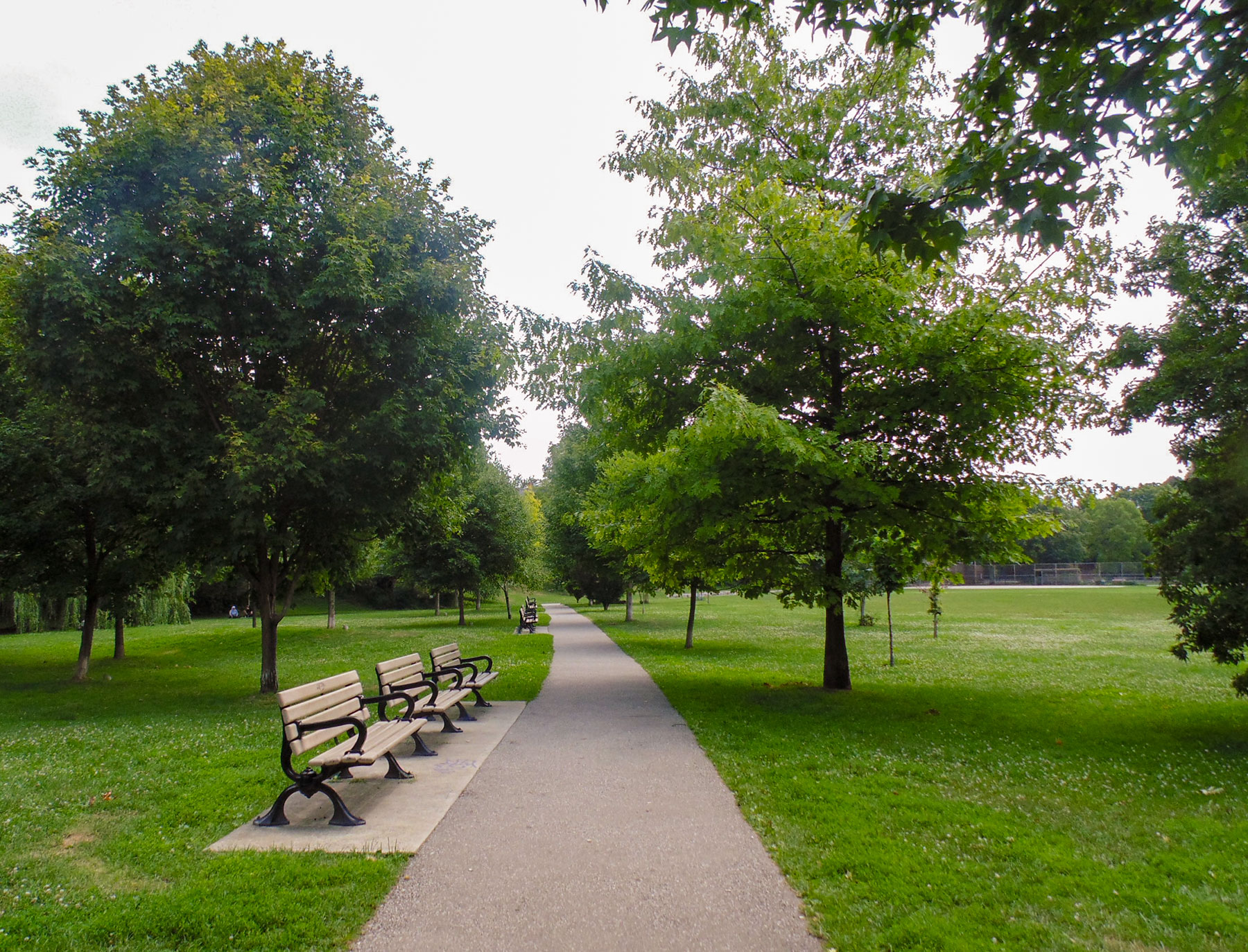
Bickford Park: A perfect place for a picnic. ABIGAIL HARRIS/GLEANER NEWS
Reviewed and compiled by Abigail Harris and Drew Glennie
HILLCREST PARK 950 Davenport Rd. Time of visit: 8:40 p.m. Grade: A+ (Last year’s grade: A+) Reason to go: Just above the thick tree line on Davenport is the quiet Hillcrest Park. If you are willing to brave a steep incline (via stairs or road), this park has everything: basketball and tennis courts, a ping pong table, numerous swing sets and play structures, a splashpad, and even a fenced dog park. For those wanting to sit and relax, it also has beautiful grassy expanses for a picnic blanket as well as several tables and benches. Overheard: A dog—some sort of doodle—yipping, tennis ball volleying, two kids racing towards their parents Did you know? The Toronto Nature Stewards meet up every Thursday from 6-8 p.m. to remove invasive plants from the park.
ST. ALBAN’S SQUARE 90 Howland Ave. Time of visit: 1:51 p.m. Grade: A (Last year’s grade: A+) Reason to go: St. Alban’s Square is a picturesque pocket of green at Howland and Barton avenues. It sees a lot of foot traffic and has one path right down the middle. There’s plenty of shaded benches scattered around and a drinking fountain that is dog-friendly for especially hot summer days. At the back of the park is the site of what was going to be the first cathedral in Toronto, the Cathedral of St. Alban the Martyr. However, the cathedral ran into financial problems, and its status as a cathedral was cancelled before the building could be completed. Today, it is the school chapel for Royal St. George’s College. This charming park is worth a visit whether you’re interested in the surrounding history or not. Overheard: A woman asking her dog if he would like to say hello to a passerby. Did you know? In 1990, environmental group Grassroots Albany led a project for the beautification of the park, in part to honour local resident Jane Jacobs.
BICKFORD PARK 400 Grace St. Time of visit: 9:04 p.m. Grade: A (Last year’s grade: A-) Reason to go: Bickford Park is like Christie Pits’ chiller, less popular young brother, and—as with all younger siblings (sorry guys)—their proximity means they must be understood in tandem. While it does not have nearly as many bells and whistles (or benches, or baseball diamonds) as Christie, Bickford does have two things its older brother does not: the train does not shake the ground every few minutes, and there’s an ever-popular dog park; need I say more. If you’re looking for a calm picnic spot in the area, I’d check out Bickford first. Overheard: Overlapping conversations from the dozen or so ongoing picnics; a busker playing the saxophone Did you know? This valley-turned-park is along the former Garrison Creek, one of Toronto’s lost rivers.
December 15th, 2025 · Comments Off on NEW IN BUSINESS: Delightfully Turkish (Sept. 2025)
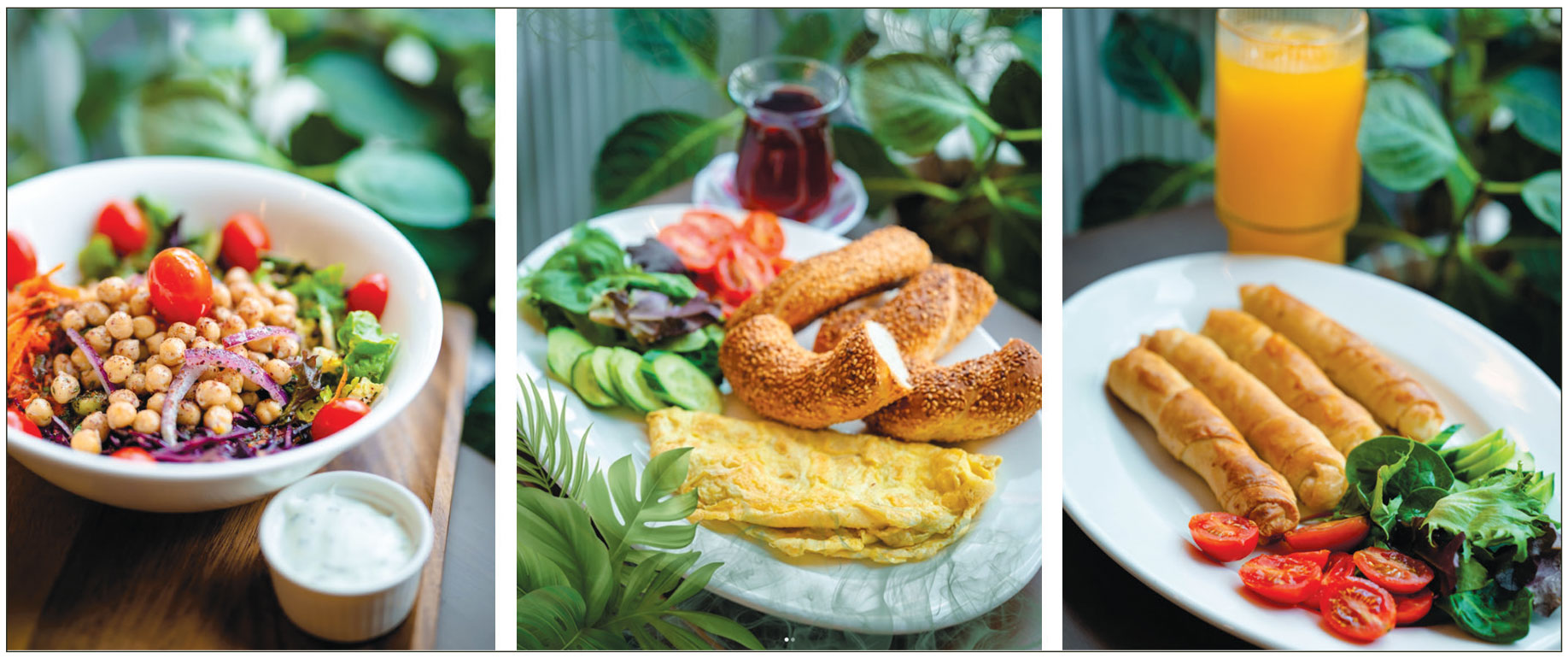
Top left: Simit-Chi salad with chickpeas; at centre, fresh omelet, crispy simit, vibrant greens, and a glass of Turkish tea; and, at top right: crispy sigara börek, fresh salad, and vitamin-rich orange juice. COURTESY SIMIT-CHI
Simit-Chi is authentic and sooo delicious
By Howard Pressburger
I’m not saying that the Book City building at 501 Bloor St. W. is cursed, but since the landmark store was crushed under the heel of online bookstores, it has mostly rested in the dark, save for a vain attempt by Chipotle, when they learned the hard way that the Annex does not pay extra for guacamole.
So for quite a while the building was shuttered, only dressed by a fading green poster pleading “rent me.” The ghosts of what was were still strong enough as I was often asked “What’s going into Book City?”
This spring, a new sign was hung that read Simit-Chi, and on April 1, the paper came down. Suddenly there was a complete restaurant, ready for business. I was surprised because I did not see any work being done. It was as if this cafe was created by magic, or maybe there was a back entrance through the alley.
I was at the hardware store when a friendly Turkish gentleman, bearing baked goods, dropped by. The paper bag was filled with warm simits, the Turkish version of the bagel. This was unlike any bagel I had ever encountered, and I’ve been to New York AND Montreal.
Imagine the best bagel you’ve ever eaten had a love child with the tastiest croissant. In this moment of epicurean wonderment, I knew I had to try more.
And try more I did.
So I invited my cousin Tom to lunch. The atmosphere in the restaurant is casual and clean with an ample counter in front showcasing their wide variety of baked goods and several tables towards the rear.
Ordering at the counter, I got the lahmacun, while cousin Tom ordered hummus with a chicken doner and simit.
Lahmacun is a pizza-like crispy flatbread with spiced ground beef and lamb, mozzarella cheese, tomatoes, red and green peppers, parsley, garlic, and tomato and red pepper paste. A bit of chilli adds a nice touch of spiciness. It is a surprisingly light meal with complex flavours and a high palate finish that pleasantly lingers. I paired it with a bottle of legendary Uludag orange soda.
Cousin Tom’s hummus and doner and simit (oh my!) was anything but run of the mill. Instead of being all crammed up inside a pita, it is plated, letting you control the proportions of the ingredients. The hummus was light and airy with a modest amount of garlic. The chicken doner was delicately spiced, moist, and tender. The simit was soft on the inside with a thin, crispy crust. Cousin Tom, an architect, seemed to really enjoy applying his trade by creating different combinations of his lunch.
To drink, he chose Turkish coffee, which is a robust, creamy brew, with the grounds left in when served.
Just to make sure I hadn’t missed anything, I went back the next day for breakfast with my wife. Ali, the manager, recognized me from the previous day, as if he knew I’d be back. I asked him how this place came to be, and he told me of the story of the Turkish family who had a secret recipe for simit. They have been selling it as a street food in Turkey for a few decades and decided to bring it to Toronto, which is how they ended up here in the Annex. I wasn’t able to get much more history from Ali, but it is a secret recipe after all.
Meanwhile, my wife ordered menemen which is the Turkish version of shakshuka. This time around however, the egg is scrambled and cooked into a pleasantly mild tomato and green pepper sauce. Served with a soft and crunchy simit, it is a hearty breakfast that is not overly filling.
I had the Turkish breakfast plate. It’s an assortment of goodies, including a Turkish spring roll, a Turkish cheese bun, a boiled egg, feta cheese, cream cheese, olives, butter, honey, a tahini and organic Turkish grape syrup, and, of course, a simit.
The spring roll, although it resembles a typical Asian one, is savoury without the tanginess. The cheese bun is filled with a sweet mascarpone-like cheese. The tahini and grape syrup is a mysterious taste combination of sesame paste and a sweet grape reduction, perfect for dipping the simit. The breakfast plate is great for sharing.
Both my wife and I had Turkish tea which is a mildly spiced red tea served in a tulip-shaped glass.
I made one more visit to Simit-Chi and thought I’d be clever and use the Turkish greeting “Merhaba” with the counter person. Well, either they weren’t expecting it, or my pronunciation was ghastly (more likely), and I was served baklava. Not wanting to embarrass myself more, I took my purchase and swallowed the baklava, along with my wounded pride; they were both delicious.”
Howard Pressburger is the manager of Wiener’s Home Hardware across the street at 432 Bloor St. W.
Comments Off on NEW IN BUSINESS: Delightfully Turkish (Sept. 2025)Tags:Annex · News · New In Business
December 15th, 2025 · Comments Off on FOCUS: Robert Street Parkette to grow (Sept. 2025)
425 Bloor St. W. development includes expansion of public space
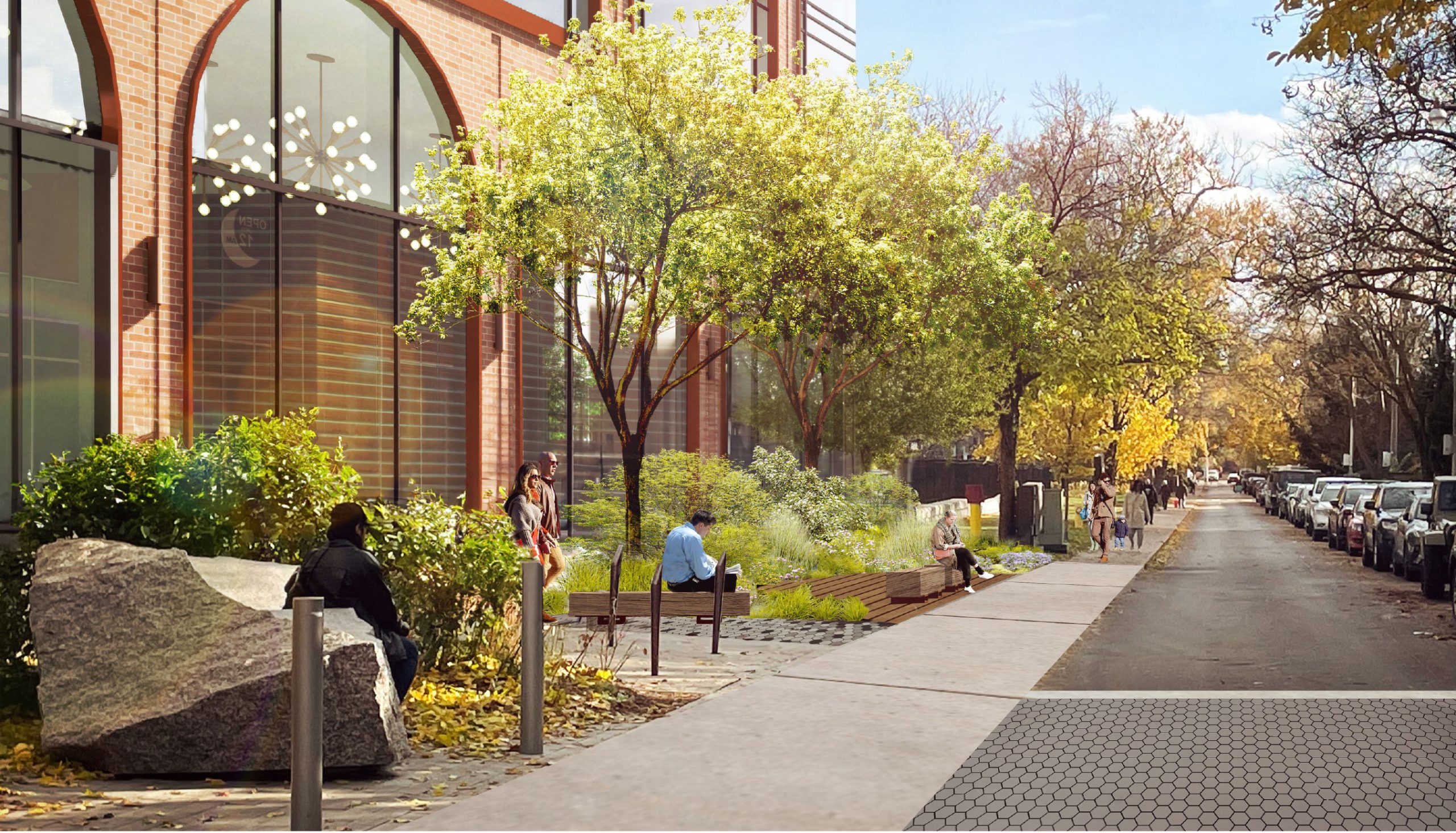
An artist’s rendering of the expanded Robert Street Parkette. COURTESY DTAH/BLOOR ANNEX BIA
By Gleaner Staff
Plans to demolish Metro at 425 Bloor St. W. and replace it with a 35-storey condo have not changed; however, the schedule is delayed due to market conditions affecting all new condo builds.
However, design work for an expanded parkette on Robert Street south of the playing field has continued.
Metro will be moving to the lower level of the new development on the northwest corner of Bloor Street West and Spadina Road (where 7-Eleven and Tim Hortons are currently located).
Since that development is delayed, so is the one at 425 Bloor St. W.
The Bloor Annex BIA currently occupies the city-owned right-of-way on the west side of Robert Street with a year-round CaféTO parklet; this is the only permanent one in the city.
“People do sit at the tables all year and the BIA has a winter planting scheme for the planter boxes there,” said Brian Burchell, general manager of the Bloor Annex BIA and publisher of this newspaper.
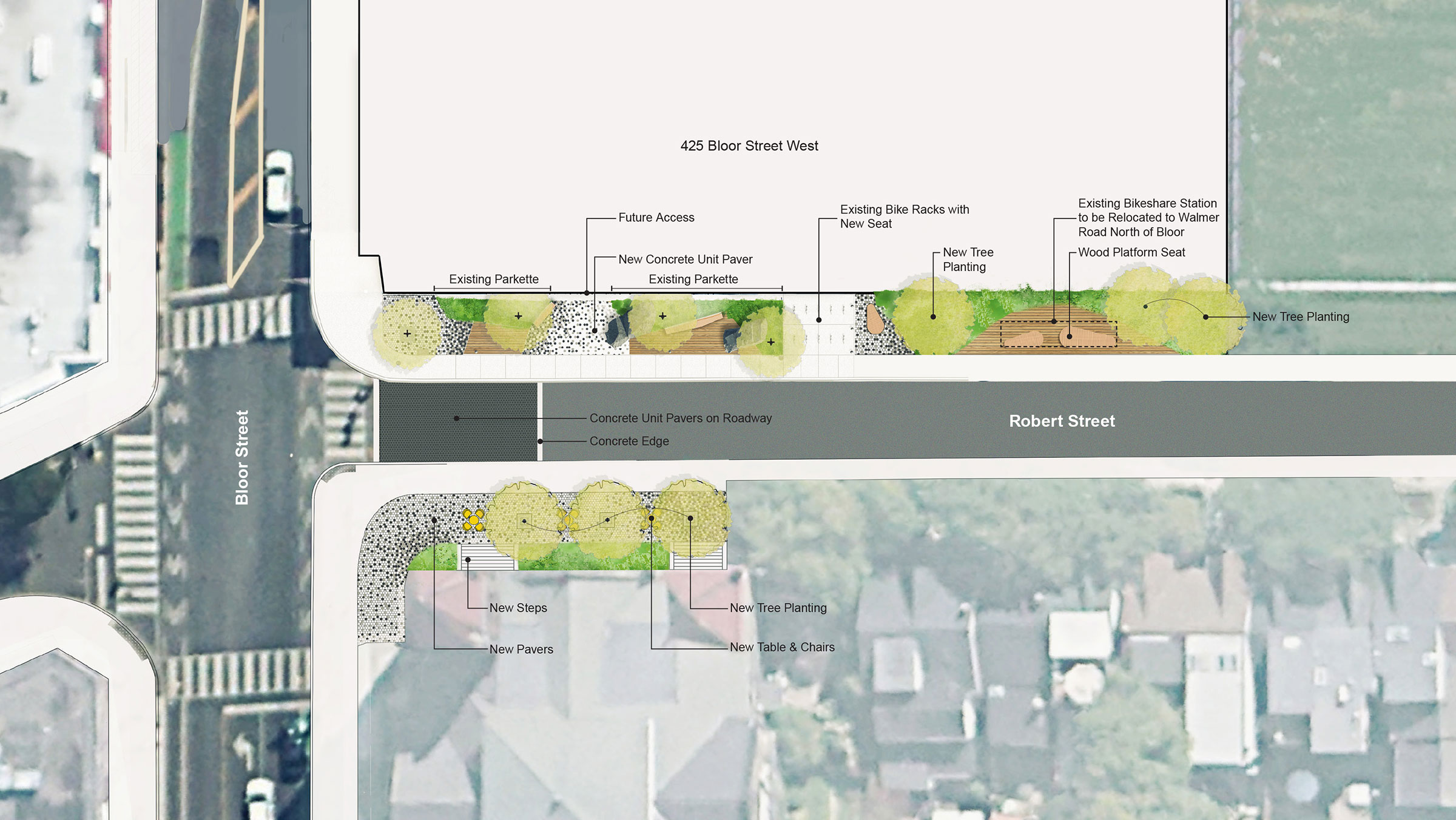
The east side of Robert Street has the existing parkette which will be expanded south and will repeat many of the elements: boulders, decking, trees, and pollinator gardens.
The public realm at the top of the street will be a unified space with soft curbs and road surface that would bring the two sides together. Cars could still pass through, but the design elements would significantly calm their movement.
The elimination of the grocery store and associated parking lot will diminish vehicular traffic to a fraction of what it is now.
As part of this plan, the developer will contribute community benefits funding (previously known as Section 37 funds) which the BIA will use to fund this new capital project.
This BIA-conceived plan enjoys full support from local Councillor Dianne Saxe, the developer, the Harbord Street Residents’ association, and Trinity St. Paul’s Church.
The BIA has built five parkettes along Bloor Street.
In 2023, the parkette designs won city council’s Toronto Urban Design Award for Small Open Spaces for their attention to detail, unique granite rock landscaping, and environmental considerations.
The plan is to expand upon this design success using the same landscape architect DTAH.
The parkette expansion would extend from where it currently terminates all the way to the south end of the existing parking lot. It will also include a redesign of the CaféTO parklet on the other side of the street. COURTESY DTAH/BLOOR ANNEX BIA
September 29th, 2025 · Comments Off on ON THE COVER: By the Way to close on August 31 (Aug. 2025)
SORRY ! OUT OF CHICKEN !! A neighbourhood stalwart, By The Way at 400 Bloor St. W., is closing on August 31. When they first opened, their landlord insisted they keep the “Lick’n Chicken” sign—despite not serving any chicken. Please turn to page 2 for more. COURTESY BY THE WAY
A fixture on Bloor Street since 1978, By The Way will close its doors on August 31 for the last time.
The restaurant is remembered fondly by regulars for its quirky nomenclature, Levantine cuisine, and as an early adopter of vegan and vegetarian options as well as frozen yogurt treats.
In its early iteration as the Lick’n Chicken, it inherited the name and décor of the fried chicken joint that preceded it, even though it served up a vegetarian menu. To dispel confusion, they displayed a cheeky sign that read: “Sorry! out of chicken!!” When it was renamed By The Way, the chicken signs remained.
The restaurant’s presence on Bloor predates its owners. The Benedikts met on a kibbutz in Israel and were married in Mexico City. On their way back to Israel, they stopped in Canada to visit Amir Benedikt’s sister, Esti Filar. Esti was running the restaurant, then called the Lick’n Chicken, with her husband Dubi. She invited the newlyweds to join the venture.
“It was an opportunity to change my life. To try something completely different,” said Benedikt.
In 1980, the Benedikts immigrated and partnered with the family on their restaurants. In 1986, they split their holdings—the Filars took the Rosedale Diner, and the Benedikts took By The Way.
The work was gruelling. Benedikt often put in 15-hour days, seven days a week. “I cooked, I did dishes, I even served sometimes – I did everything,” he said.
But his hard work didn’t go unnoticed. By The Way quickly became a beloved neighbourhood haunt.
Everyone in the community is invited to stop in at By the Way for an open house on Sunday, August 31 at 6 p.m. to say goodbye.
Stay tuned for a full story on By the Way in the next issue of the Annex Gleaner.
—Gleaner News Staff
Comments Off on ON THE COVER: By the Way to close on August 31 (Aug. 2025)Tags:Annex · News · On the cover
September 29th, 2025 · Comments Off on NEWS: Self-driving delivery vehicles spark privacy concerns (Aug. 2025)
Province approves Magna pilot for several wards including University-Rosedale
Magna’s pilot program supports small-package deliveries like food, groceries, and retail items.COURTESY MAGNA
By Abigail Harris
Magna International, a global automative supplier and mobility tech company, launched their Automated Vehicle Pilot Program in May 2025.
The program is testing electric, self-driving delivery vehicles (SDVs) as part of a food delivery service, and the pilot area includes the Annex.
The Ministry of Transportation Ontario (MTO) approved the pilot in April, allowing the vehicles to operate in Ward 9 and in portions of Wards 4, 5, 11, and 12.
All vehicles will receive their own Ontario licence plates and will be subject to the same road rules as conventionally operated vehicles.
According to Magna’s website, sensors on the vehicle will collect data from the surrounding area which will “incidentally include personal information such as images of people and vehicle license plates.”
In June, Khasir Hean and Ilya Kreynin, members of the group Technologists for Democracy, wrote a letter to Magna along with four other members detailing their privacy concerns with the pilot.
Kreynin and Hean joined other Technologists for Democracy members at city hall in June to discuss their concerns with the city’s infrastructure and environment committee, and city councillors passed a motion on June 26 to investigate data privacy issues surrounding Magna.
Kreynin said that they became aware of the issue when fellow member JJ Fueser told them about the new self-driving vehicle pilot.
“When JJ [Fueser] first brought this to our attention, and we gave a brief read of the open privacy policy that Magna has, it was egregiously overstepping,” Kreynin said. “We realized that there was really low awareness of this and that there wasn’t anybody else who was speaking out about this directly.”
Hean said Magna is recording faces because they believe them to be useful in determining the gait of passersby in relation to their vehicles.
“Magna fully intends to record the faces of individuals that it passes by on the streets because it believes that faces are useful to help predict where people are walking,” Hean said. “Other self-driving vehicle companies don’t record people’s faces. They blur them.”
Magna states that they will retain this data for “as long as necessary,” which Kreynin says sets a dangerous precedent.
“That’s entirely vague. They can keep it however long they want,” Kreynin said. “This is a new level of privacy breach in terms of this type of storing and anonymization. This company is running their cameras and robots into our neighborhood where people did not choose and consent to this happening.”
The privacy policy also asserts that data will be shared with third parties such as insurance providers, law enforcement, and other officials when required by law.
Hean says this raises many questions about Magna’s process of sharing this information and its ethicality.
“Where’s the accountability in that?” Hean said. “How will we be informed if the police decide to use Magna as a live tracking device as well as a food delivery service? How do we and the public know this? There’s no mechanism to inform the public.”
Kreynin says Magna responded to their letter in July, not by addressing their concerns, but by inviting them to tour their facility.
“While they invited us to the facility, they have not responded to any of the clear and direct concerns laid out in the letter in writing,” Kreynin said. “We have not received any kind of satisfactory or clear response from Magna at this time.”
According to Kreynin, an important consideration in this emerging new technology is whether it is helping or hurting communities
“The point of the vehicles is to replace workers,” Kreynin said. “This industry is only set to expand in a way that is likely to hurt local businesses and communities. The question is, what is the effect that this has on our society? This pilot is not just a pilot technology; it’s a pilot of integration into our society.”
Magna International did not respond to the Gleaner’s request for an interview.
Comments Off on NEWS: Self-driving delivery vehicles spark privacy concerns (Aug. 2025)Tags:Annex · News
September 29th, 2025 · Comments Off on NEWS: Telling human history through footwear (Aug. 2025)
Bata Shoe Museum celebrates 30 years of innovative programming
As part of their 30th anniversary celebrations, the Bata Shoe Museum unveiled their Rough & Ready: A History of the Cowboy Boot exhibit which runs until October 2026. COURTESY BATA SHOE MUSEUM
Curated by Elizabeth Semmelhack, the director and senior curator at the BSM, the exhibition launched in May and traces the history of cowboy boots far beyond the Wild West, from the 10th century to today. Semmelhack chose this theme for the milestone celebration as its complex narrative represents the museum’s mission to illuminate human history through footwear.
“It’s not always known that the origins of the cowboy boot stretch far beyond the American West, including innovations developed in Asia, Spain, North Africa, and present-day Mexico. Since their invention in the late nineteenth century, cowboy boots have embodied contradiction,” said Semmelhack in a press release. “They have symbolized labour and leisure, freedom and domination, as well as resistance and reclamation. Whether worn in the saddle, on screen, or in the streets, cowboy boots are a cultural touchstone, embodying both tradition and transformation in a constantly changing world.”
The BSM was founded by Sonja Bata (née Wettstein), who was the wife of Thomas Bata, the head of the global shoe manufacturing company and retail store Bata Shoes. Sonja Bata acquired a large collection of footwear artefacts during her business travels around the world, and she founded the Bata Shoe Museum Foundation in 1979 which was dedicated to footwear collection and research. The BSM now holds 14,000 shoes and shoe-related artefacts from auctions, donations, and manufacturers. At any given time, the shoes on display account for only about three to four per cent of the collection.
The BSM officially opened on May 6, 1995 at 327 Bloor St. W. The building was designed by Canadian architect Raymond Moriyama who drew inspiration from a shoe box. That year, Moriyama received the City of Toronto’s Urban Design of Excellence.
Proximity to other major institutions such as the Royal Ontario Museum, the Gardiner Museum of Ceramic Arts, the University of Toronto, and TTC subway stations was an important consideration when choosing the location of the museum because the collection is intended for both researchers and the general public.
Since opening, the museum has had a large impact on not only the neighbourhood but also the city and the province.
“The Bata Shoe Museum is a special delight. It’s truly a gift to have an iconic Moriyama building in our neighbourhood,” wrote Charlotte Mickie, a vice-chair of The Annex Residents’ Association. “The exhibits are often delightfully whimsical, but they always have an appropriately firm footing in everyday life and revealing connections to popular culture.”
The Ontario Cultural AttractionsFund (OCAF) supports the marketing and promotional costs for cultural organizations such as the BSM to “increase the cultural cachet of Ontario,” said Thomas Vaughan, the executive director.
“What they’re doing is really interesting programming,” said Vaughan, “Not only is it all based around footwear, so that’s unique in and of itself, but they do really innovative programming. It’s not just like, ‘Oh, this type of shoe, that type of shoe.’ They really go deeper into the cultural significance of footwear.”
OCAF has invested $780,000 in the BSM since its decennial, including $80,000 for the 30th anniversary celebrations.
“They’ve been a fantastic client of the fund,” explained Vaughan. “They really showcase a unique cultural attraction, and it’s a real gift of the Bata family to the province of Ontario.”
“For 30 years, the Bata Shoe Museum has illuminated the global history of footwear and explored its profound cultural significance through groundbreaking exhibitions, publications, and programming,” wrote Semmelhack. “As we honour the legacy of our past, we also look to the future, affirming our commitment to education, preservation, and impactful storytelling through the lens of shoes. With an unwavering commitment to community, we look forward to celebrating with you and creating new memories for decades to come.”
Rough & Ready will remain on display at the museum until October 2026, joining the permanent exhibition All About Shoes which traces not only the history of shoes but history through shoes.
Running concurrently until March 2026 is Art/Wear: Sneakers x Artists, which follows the history and impact of these collaborations. Exhibit A: Investigating Crime and Footwear will also be on display until September 28, and its varying and subversive interpretations of crime are not to be missed.
Tickets for the BSM are $16 for adults, $12 for seniors, $8 for post-secondary students, and $5 for children aged 5 to 17. Admission is free for everyone on Sundays, as well as for children under four, care and support workers, and Indigenous Peoples every day.
September 29th, 2025 · Comments Off on NEWS: Porch View Dances return (Aug. 2025)
150 residents attend 14th annual performance
Lucia Rojas performs I am who we are, choreographed by Pulga Muchochoma, at the opening night of the Porch View Dances on July 16. ABIGAIL HARRIS/GLEANER NEWS
By Abigail Harris
Contemporary dance studio Kaeja d’Dance hosted their annual Porch View Dances (PVD) in Seaton Village from July 16-20.
Audience members traveled as a group to watch choreographed dance works performed on the porches and lawns of local residents. The PVD concept was created by Karen Kaeja and has been co-developed alongside her husband, Allen Kaeja.
Kaeja told the Gleaner the idea was conceived in 2012 after she was inspired by watching interactions between her neighbors outside her front window.
“I noticed what was happening across the street and started dreaming about the gestures that were coming out of them while they were talking,” Kaeja said. “I started imagining that being put into choreography and teaming these everyday folks that live in these homes with professional choreographers.”
This year’s show featured three porch performances, three vignettes and one installation. The tour ended with a Flock Landing in Vermont Square Park, inviting audience members to participate in a choreographed group movement.
Roughly 150 residents came along for the opening night performance, with Councillor Dianne Saxe (Ward 11, University-Rosedale) and Councillor Josh Matlow (Ward 12, Toronto-St. Paul’s) in attendance.
Tour guides Kunji Ikeda and Allen Kaeja took on the personas of Amon and Emon, guiding the audience between houses, from London Street to Euclid Avenue to Manning Avenue.
Kaeja said that the festival aims to bring together not only dancers, but participants from across Toronto.
“There are diverse choreographers from all over the city from all different backgrounds, and they bring their colleagues, friends and people that they know in their lives,” Kaeja said. “So not only are the choreographers from all over the city, so are the participants.”
According to Kaeja, the festival is designed to keep the audience on their toes while also feeling bright and approachable.
“We add in these surprises and make sure that the choreographers are keeping work light and joyful,” Kaeja said. “Really, this festival is about joy.”
Those interested in making a donation to support Kaeja d’Dance and PVD can visit their website at kaeja.org.
September 29th, 2025 · Comments Off on GRADING OUR GREENSPACE: How do our parks measure up? (Aug. 2025)
Part 2 of grading our greenspaces
Each year the Annex Gleaner reviews the many parks and parkettes in our coverage area using a variety of criteria. While there is no decisive “winner” of the grading, letter grades are assigned to convey the quality of the parks, considering aspects such as upkeep, design, and amenities. The reviews accompanying the grades also let the reader know what makes each space unique. This is the second instalment of reviews for 2025.
Reviewed and compiled by Abigail Harris except where noted by Drew Glennie
Healy Willian is an ideal destination for young parkgoers.
Healey Willan Park 50 Sussex Ave. Time of visit: 1:30 p.m. Grade: A (last year’s grade: B+) Reason to go: Healey Willan Park, located at Euclid Avenue near Harbord Street, is an excellent greenspace for younger parkgoers. One of its most exciting features is the sandy playground area that includes a plethora of shared toys. In addition, there’s a lush children’s learning garden in the corner of the park and a wading pool for hot summer days. It’s a great spot to pair with a visit to Margaret Fairley Park which also boasts an impressive supply of children’s toys and is only a 10-minute walk east. There’s plenty of shade and benches around the perimeter of the park. The park’s residential location in Palmerston-Little Italy makes for a peaceful, uninterrupted atmosphere. Overheard: A dog chasing after a deflated soccer ball it’s owner just kicked. Did you know? Healey Willan was a celebrated Canadian organist and composer. For over 45 years, he served as the choir master of the Church of St. Mary Magdalene which is right next to the park.
Euclid Avenue Parkette By Drew Glennie 711 Euclid Ave. Time of visit: 12:57 p.m. Grade: F (last year’s Grade: D-) Reason to go: Euclid Avenue Parkette is at best a desire path and at worst an abandoned lot. The grass is sparse and yellowed, and it has begun to spread onto the rocky trail (and, in other areas of the path, vice versa). Signs and trash cans are covered in graffiti. Trash is strewn about, and not just food containers, cutlery, and straws, but also unbelievably a computer keyboard hidden in the shrubbery. There are three benches lining the walkway, but the tree canopy is so sparse that it does not provide adequate shade; plus, unlike other parkettes in the area, Euclid is too far from the main strip of Bloor to provide a convenient respite. Overheard: Folks helping a driver navigate the small back parking lot of the neighbouring Palmerston library branch. Did you know? The tree at the center of the parkette is not a willow but just a drooping ash.
Huron Street Playground 495 Huron St. Time of visit: 11:27 a.m. Grade: A- (Last year’s grade: A-) Reason to go: Huron Street Playground offers a versatile park experience for a variety of folks. A renovation in recent years added a small off-leash dog area with artificial turf, making it perfect for dog owners. A rope play structure, sandpit, artificial rock, and swing set provide a modest selection of entertainment for younger guests. The greenspace is nicely shaded with some picnic tables and benches to relax on while you watch your little ones play. Unfortunately, noise surrounding the park seems to be a constant, especially given the park’s proximity to Bloor Street West. Two towering apartment buildings line the perimeter, providing shade and a sense of privacy which is a plus. Overheard: A parking enforcement officer rides by on his bike surveying for violations. Did you know: Huron Street is named after the Wendat people who were given the name Huron by the French.
Philosopher’s Walk 78 Queen’s Park Cres. Time of visit: 1:57 p.m. Grade: A+ (Last year’s grade: A+) Reason to go: Nestled between The Royal Conservatory and The Royal Ontario Museum, Philosopher’s Walk is a beautiful footpath located in the city’s core. When entering the park through the northern entrance on Bloor Street West, you are welcomed by the Queen Alexandra Gates. They were donated to the city in 1901 to commemorate a visit from the Duke and Duchess of Cornwall. The path is lined by spruce trees and benches that make it the perfect spot to take a break from the busy city streets. The park’s topography includes dips and valleys which serve as a reminder of the historical Taddle Creek which was buried in the 1880s. Overheard: Two mothers walk by, and one asks, “Do your kids get enough sleep?” Did you know? In the 1860s, the portion of Taddle Creek that flowed through the University of Toronto was dammed to create McCaul’s pond. It was a popular spot among students until it was covered in 1884.
Queen’s Park North 47 Queen’s Park Cres. Time of visit: 12:48 p.m. Grade: A (Last year’s grade: A) Reason to go: Queen’s Park North is one of those places every Torontonian should visit at least once. The main spectacle here is an imposing equestrian statue of King Edward VII who opened Queen’s Park in 1860 when he was the Prince of Wales. Benches encircle the statue where you can sit and observe tourists and locals taking pictures with the monument. At the north end of the park is the 48th Highlanders Regimental Memorial which was erected in 1923 in memory of those in the 48th Highlander Regiment who lost their lives in the First World War. But the park has more to offer than just history. Tree fanatics will enjoy this greenspace, and there’s an infographic along the path that shows the variety of common Toronto trees you can find in the park, from Norway maples to Austrian pines. If you feel up to it, you can try to track down all 12 variety of trees in the park. Overheard: “Get closer than that!” says a visitor taking a picture next to the statue of King Edward VII. Did you know? Established in 1860, Queen’s Park is one of the oldest urban parks in Canada.
Queen’s Park is a must-see spot in the city core that’s rich with history.
Queen’s Park 110 Wellesley St. W. Time of visit: 1:37 p.m. Grade: A+ (Last year’s grade: A) Reason to go: Home to the Ontario legislature, Queen’s Park is another must-see park in the city core. You can choose to admire the stately Romanesque Revival architecture from a distance or book a free guided tour of the building online. Tours run every 30 minutes. The greenspace is home to 38 plaques and monuments, all central to Canadian history. A legend at the south end of the park shows you where to find them. The front entrance of the building is framed by two statues. One is Queen Elizabeth II, and the other is John Sandfield Macdonald, Ontario’s first premier. The landscaping is beautiful, and there are some lovely shaded areas which make the park not only a historical landmark but a great spot for a picnic. Overheard: “Excuse me, do you know where the John A. Macdonald statue is?” Did you know? This park is home to several eastern white pines which were declared Ontario’s official tree in 1984.
Taddle Creek Park 40 Bedford Rd. Time of visit: 12:14 p.m. Grade: A (Last year’s grade: A) Reason to go: The picturesque Taddle Creek Park is in the heart of the Annex at Bedford Road and Lowther Avenue. Although the park is near Bloor Street, it feels sheltered from the city noise and chaos. A large stainless steel sculpture of a pitcher, titled The Vessel, pays homage to the buried waterway of Taddle Creek that used to run through the neighborhood. Water from the fountain is stored underground and used to irrigate the park. Parkgoers can sit and watch as water drips from the top of the pitcher’s spout. There’s a playground area on the other side of the park with a sandbox and swing set. A plaque at the Lowther Avenue entrance of the park honours Beatrice Worsley who lived next to the park and was the first female Canadian computer scientist. Overheard: Sparrows chirp and flap their wings as they cool off at the base of the fountain. Did you know? The Vessel is made from four kilometres of stainless steel rods because this was the length of Taddle Creek when it ran from downtown Toronto to Lake Ontario.
Huron Washington Parkette 420 Huron St. Time of visit: 1:05 p.m. Grade: B (Last year’s grade: B+) Reason to go: Huron Washington Parkette is a charming miniature greenspace just south of Bloor Street. Most of the parkette is a fenced-off playground area with a lone picnic table outside for parents to keep a close watch. The parkette used to be located across the street next to the University of Toronto Schools. If you visit, you will be reminded of this because the sign is confusingly still at its old site. If you want to be immersed in nature, Huron Washington Parkette is probably not the park for you. However, it’s a great place to take your little ones if they want to blow off some steam. Overheard: Construction on Bloor Street. Did you know? This park was once on the north side of Sussex, but it was relocated temporarily to the south side during the University of Toronto Schools’ renovations. There appears to be no rush to move it back.
The landscaping and architecture of the Village of Yorkville Park represent the diversity of Canadian ecosystems.
Village of Yorkville Park 115 Cumberland St. Time of visit: 1:57 p.m. Grade: A- (last year’s grade: B) Reason to go: The Village of Yorkville Park is an innovative urban greenspace with many unique features and an interesting history. The site used to be a parking lot, but after years of protest, an international design competition was held in the ’90s to build the park. One of its most striking characteristics is a 700-ton rock, transplanted from the Canadian Shield. The top of the massive outcrop is a great place to sit and look out on Yorkville Village. There’s a stainless steel water curtain next to it that turns into an icicle display in the winter. The park is laid out in separate gardens that reflect a range of Canadian ecosystems. There’s a wetland garden, a cluster of serviceberry trees, beds of wildflowers and more. Plenty of moveable tables and chairs make this the perfect spot to stop for lunch. Overheard: Typical Yorkville activity such as loud cars driving by and shoppers hustling along. Did you know? In 2012, the park won the American Society of Landscape Architects Landmark Award.
Walmer Road Parkettte 227 Walmer Rd. Time of visit: 2:47 pm Grade: C (Last year’s grade: C+) Reason to go: This humble parkette is located among a row of townhouses just south of Davenport Road. It’s a nice place to sit and read or talk on the phone, but not much more. The space doesn’t have much to offer, other than four benches and a handful of trees. Casa Loma is conveniently located just steps away if you’re in the mood for sightseeing, but this park is not much to write home about. Overheard: Traffic on Davenport Road. Did you know? Casa Loma’s architect E. J. Lennox also designed Old City Hall and the Bank of Toronto.
Wychwood Park is the kind of greenspace you can spend hours in.
Wychwood Barns Park 76 Wychwood Ave. Time of visit: 2:16 p.m. Grade: A (Last year’s grade: A) Reason to go: Wychwood Park is a beautiful greenspace that provides something for every kind of parkgoer. It’s home to Artscape Wychwood Barns, a converted heritage building that was built in 1913 as a streetcar maintenance facility. Now, the space contains artist studios, a theatre, and office spaces for local community groups. Outside, there’s a greenhouse, a beach volleyball court, and a fenced-off dog park. The Stop Community Food Centre hosts a farmer’s market year-round on Saturdays, featuring over 35 farmers and prepared food vendors. There’s a playground area with a splash pad for children, as well as a grassy open field and ping pong table. Almost hidden in the corner of the park is a learning garden that showcases Toronto’s “best nature.” This park is the kind of place you can spend hours in as there’s a lot to discover. Overheard: “I got you, keep going!” as a father teaches his son how to ride a bike. Did you know? Those interested in volunteering at the learning garden can visit www.yourleaf.org/volunteer to get involved.
September 29th, 2025 · Comments Off on CHATTER: Watered-down version of Bathurst priority bus lanes approved (Aug. 2025)
A TTC bus navigates north on Bathurst Street earlier this summer. COURTESY ALBERT KOEHL
On Wednesday, July 16, Toronto city council approved the construction of priority bus lanes on Bathurst and Dufferin.
The proposal, titled RapidTO, was first endorsed by council in February of 2024 and is expected to improve transit travel times for the six FIFA World Cup games Toronto will be hosting in 2026.
Council voted 18 to 5 for RapidTO bus lanes on Bathurst Street, and 20 to 3 for RapidTO bus lanes on Dufferin Street.
Backlash from residents and business owners between Dupont and Bloor Street West resulted in the lanes being installed on a shortened stretch of Bathurst than was initially planned.
Protect Bathurst, a grassroots coalition of Toronto residents, local business owners, and accessibility advocates, hosted a press conference in June opposing the bus lanes.
Bathurst Street’s lanes will run from Bloor Street West to Lake Shore Boulevard West, excluding the stretch between Nassau Street and Dundas Street West. Dufferin Street’s lanes will run from Bloor Street West to King Street West.
Construction is scheduled to begin in the fall of 2025. City staff have been tasked by council to further study a RapidTO proposal between Bloor and Dupont which remains controversial. .
September 29th, 2025 · Comments Off on EDITORIAL:Fact over fiction: Ford’s Bill 212 fails on its merits (Aug. 2025)
In a scathing ruling, an Ontario court has found that sections of the provincial government’s Bill 212, the Reducing Gridlock, Saving You Time Act, violated the Charter of Rights and Freedoms by infringing on cyclists’ rights to life and security of person. The sections of Bill 212 empowering the province to rip out bike lanes on Yonge Street, University Avenue, and Bloor Street are now nullified under Section 7 of the Charter. The Ford government is appealing the decision to the Ontario Court of Appeal.
In his decision Superior Court Justice Paul Schabas found that “the government has led no evidence to rebut the applicants’ compelling position, supported by evidence, that removing the protected bike lanes will cause cyclists to ride in more dangerous mixed traffic…and that cyclists will be injured, and worse, if the protected target bike lanes are removed.” The government of course knows this, which is why it included in the legislation a perverse clause that prohibits anyone or anyone’s family from suing the government for damages should they be injured or killed because of the bike lane removal. That clause which self-indemnifies the province showed that the Ford government knows that it is a demonstrable, probable fact that removing bike lanes will sentence a certain number of citizens to death or serious injury. Does the government have the right to kill you? The court says it absolutely does not.
The government faces a hard pedal at appeal. It fully and completely lost the case. In discovery proceedings, the province had to reveal its own expert advice that stated that bike lane removal would not reduce congestion, would increase collisions between all road users, and would likely lead to injuries and deaths of cyclists. That makes Ford look like someone guilty of willful neglect. Schabas did not go that far but he did call Bill 212 “arbitrary” which takes the government onto thin ice constitutionally. Ford would simply say it’s all about “common sense.” For him, it’s about ideology, not about smart transportation planning. No amount of fact will dissuade him from the view that we could each hop in our individual cars and head down to the Rogers Centre for a ball game with ease if it were not for those pesky bike lanes.
Innumerable studies have found that safe bike infrastructure contributes not only to the safety of all road users, but it also contributes to the local economy. The Bloor Annex BIA reported an increase in sales, verified by Moneris Sales Terminal data, when it participated in a pilot bike lane project for Bloor Street. The BIA endorsed making those lanes permanent, and they are now part of a complete streetscape.
A leaked internal report from the provincial government acknowledges that “most research…suggests reducing road capacity by introducing bike lanes can encourage biking [no kidding?] and discourage car use, alleviating congestion.”
In their piece in The Globe and Mail last fall when Bill 212 was first introduced, University of Toronto academics Sarah Elton and Madeline Bonsma-Fisher rejected the notion that bike lanes are the latest salvo in the “war on the car.” Rather, they argued, “this bill is a war on the facts— on evidence and data—that we are witnessing spread across the continent. It’s an example of post-truth politics in Canada.” This is not just an issue south of the border; decision-making based on feelings versus facts knows no border.
The right to life and liberty in Section 7 of the Charter is not absolute. Issues of “fundamental justice” exception or “reasonable limits” under Charter 1 can thwart or diminish a person’s Section 7 rights. Evidence at trial showed the government was advised by numerous experts of two things: the measure would lead to more deaths, and the move would do nothing to reduce congestion and would likely have the opposite effect. There was no balance of rights for the courts to arbitrate.
This bid to rip out bike lanes is not only arbitrary in a legal sense; it is frivolous and mean- spirited. The Court of Appeal would be right to dismiss Ford’s bid to overturn the decision.
September 29th, 2025 · Comments Off on FORUM: Celebrating greenspaces, easing congestion (Aug. 2025)
Park revivals and Bathurst bus lanes dominate agenda
By Dianne Saxe
What a month July was! I’m thrilled that we had a very productive city council session, with real progress on RapidTO Bathurst and more shelter space for Toronto’s homeless.
Three top things this month:
1. The incredible new Biidaasige Park
After 35 years, it is exhilarating to celebrate the restored Don River and the first 50 acres of Biidaasige Park. This extraordinary transformation of industrial wasteland protects the Port Lands from flooding, reintroduces nature, and creates an inspiring new park: the playgrounds are Toronto’s best; the Indigenous art is moving and playful; the riverside walks are gorgeous; fish and kayaks have found the river; birds and butterflies have found the wetland; century-old seeds have sprouted. Join me there for our community tour and picnic at 5 p.m. on Aug. 17. You can get there by bike, transit, car, or kayak.
2. Faster transit on Bathurst
After intense consultations, data gathering, and door knocking, we are speeding up transit on Bathurst. July council approved three key steps:
Bathurst will get a dedicated streetcar lane from Lakeshore to Bloor, enhancing the reliability, speed, and frequency of the Bathurst streetcar, with a target of a six-minute headway this fall.
From Bloor to Eglinton, the northbound bus is trapped in traffic from about 2 p.m. every afternoon. On Sept. 18, staff will recommend to the Toronto East York community council which parking, turning, and signal changes will speed up the afternoon northbound bus, while leaving some parking to support local businesses. Most changes should be implemented this fall.
Staff may recommend temporary measures to improve transit during FIFA, including temporary bus lanes. Afterwards, city staff will recommend long-term next steps, which may include adjusting the time of day or implementing permanent bus lanes; by then, we will know whether my targeted measures have made enough of a difference for transit riders.
Special thanks to the five Bathurst/Dupont businesses that wrote in support of this targeted, data-based approach: Summerhill Markets, Flur, Tattoo People, and Qalat, She Said. Please give them your support.
3. Bringing back the Vale of Avoca
A century ago, the Vale of Avoca ravine, located near Yonge and St. Clair, was a popular park destination. The Vale remains an important refuge from the city’s noise and heat, but it is suffering badly from erosion and neglect. The rough trails are being eaten away with every storm; trees are falling as the slopes collapse; access stairs are broken. After all of Ford’s cuts, the city cannot afford more than an occasional Band-Aid solution, even though thousands of new condo units are expected nearby.
I am therefore delighted to partner with the Midtown Ravines Group to restore the Vale to a beautiful, accessible, walkable park that links the Don River trails to midtown. This coalition of residents’ associations has agreed to raise $40 million for capital and maintenance in the Vale, but first, they need a high-quality plan. I negotiated with Councillor Matlow and with staff to jointly fund a $1.5 million redesign to achieve ecological, recreational, and flood management objectives. The planning and consultation phase should be completed next year, with construction beginning in 2027.
Other community improvements I helped deliver this month include:
a) $200,000 in funding to build a signalized pedestrian crossing across Avenue Road at Ramsden Park;
b) $109,000 in funding to build a recording studio and accessible doors in the new performance centre at 877 Yonge;
c) $883,625 in funding to rebuild the Rosedale Valley Multiuse Trail and to plan a safe exit from it;
d) Changes to the Landlord and Tenant Board so that evicted tenants should get better information from the board;
e) Six suburban homeless shelters will now be built.
f) Noise exemptions have been tightened for loud events at Christie Pits.
g) The Dafoe Urn will be reinstalled at Craigleigh Gardens.
h) Kids’ baseball diamonds will be improved at Christie Pits.
i) The developer of 126 Avenue Road has committed to indoor garbage pickup and to allowing the flower shop to return.
j) The city will take small steps to discourage greenwashing in ads on city assets; and
k) The University of Toronto will install district clean energy pipes for its campus.
I hope you’re taking time for whatever makes summer joyful for you and your family. Have you tasted University-Rosedale’s best ice cream? Watched a play outdoors? Joined a neighbourhood potluck? Do let me know what summer treats you love best.
Dianne Saxe is city councillor for Ward 11, University-Rosedale.