November 2nd, 2020 · Comments Off on NEWS: COVID-19 at 7-Eleven? (Oct. 2020)
Store closes but not coming clean as to why
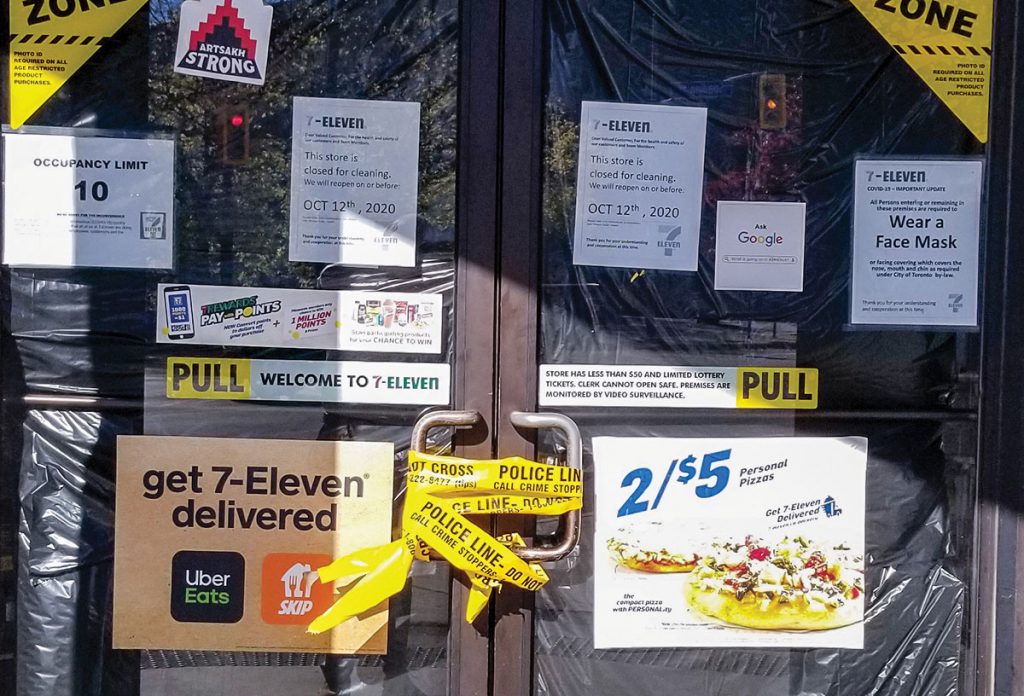
7-Eleven (334 Bloor St. W.) unexpectedly closed its store at Spadina Rd. and Bloor St. for cleaning. The reasons behind the closure are unknown. NEILAND BRISSENDEN/GLEANER NEWS
By Mary An
The 7-Eleven located at Spadina Rd. and Bloor St. W. closed from Sept. 14 to 16 “for the health and safety of our customers and team members.”
Beyond the poster stating this basic information, 7-Eleven has provided very little explanation for the closure. The 7-Eleven Canada COVID-19 Store Safety Plan, as written on the company’s website, states that each store has ongoing calls with management, regular check-ins, and an increased amount of conversations and training for staff.
Under the Policies Implemented to Reduce the Risks of COVID-19 section, the website states that a store must immediately close and conduct a “deep-cleaning” process if a team member has contracted the virus. It also states to “alert all 7-Eleven team members, the public and suppliers that a team member at the store has tested positive and people who visited the store during the potential exposure period should self-monitor for symptoms.”
No such notification has been made, and some of the store’s neighbours didn’t even know they had closed for cleaning.
“Honestly, I had no idea they closed. My favorite spot is the Tim Horton’s right next door. I’ve only been there [7-Eleven] two or three times in the past six months,” Vishakha Sharma, the manager at Freedom Mobile right next door said. Sharma believes that there might be another reason behind the store’s closure. “They probably just needed some regular cleaning, because their floors weren’t that great.”
According to Sylvanus Thompson, Associate Director of Healthy Environments with Toronto Public Health, a business owner has a right to close their store at any time for cleaning without having to disclose the reason. 7-Eleven has yet to respond to any inquiries about the store’s closure.
Comments Off on NEWS: COVID-19 at 7-Eleven? (Oct. 2020)Tags:Annex · News
Bells on Bloor asks for enforcement of bike lane rules
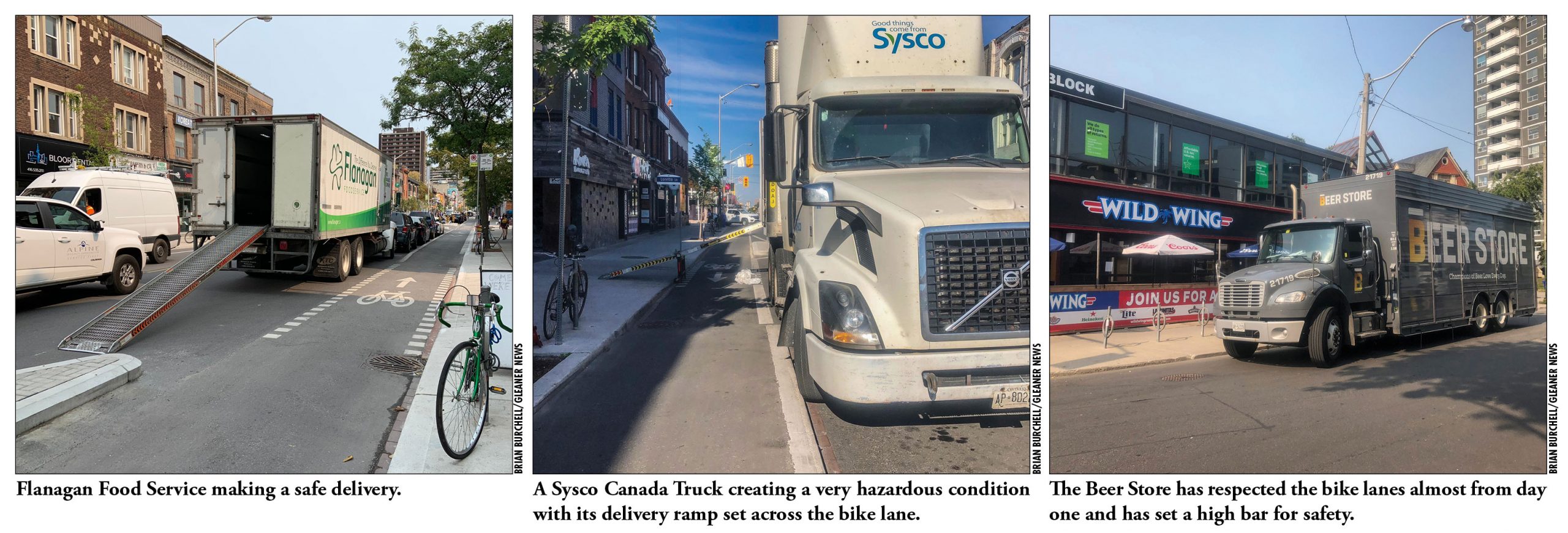
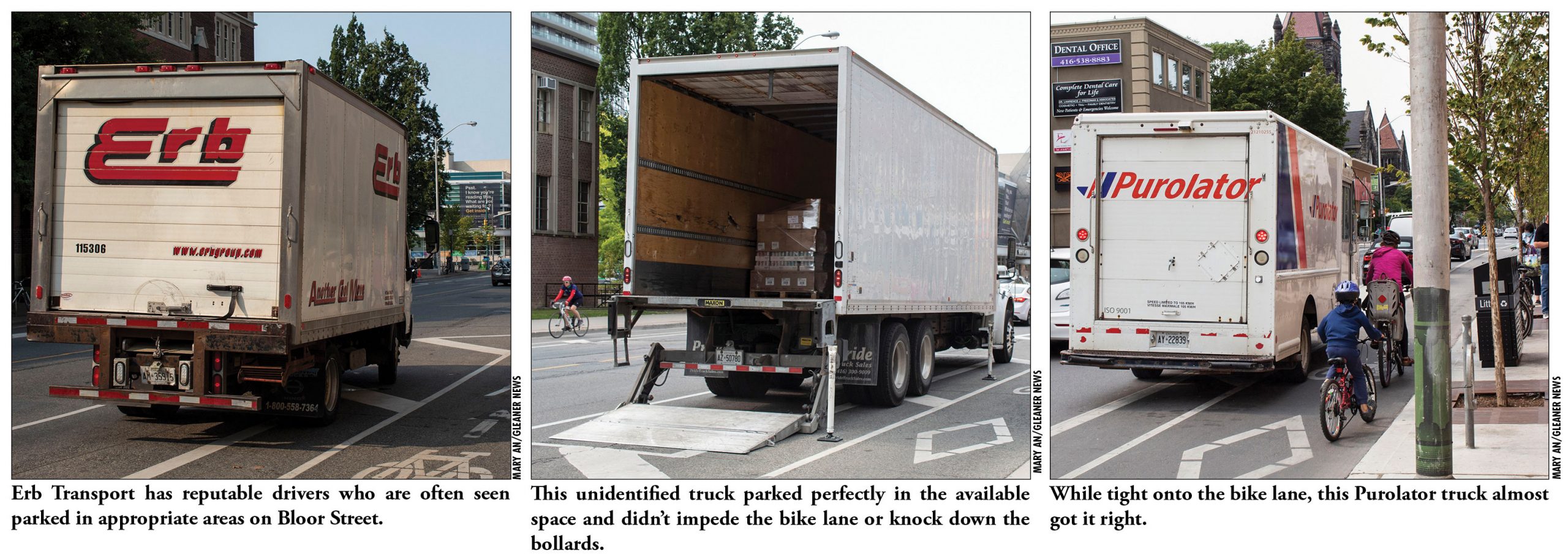
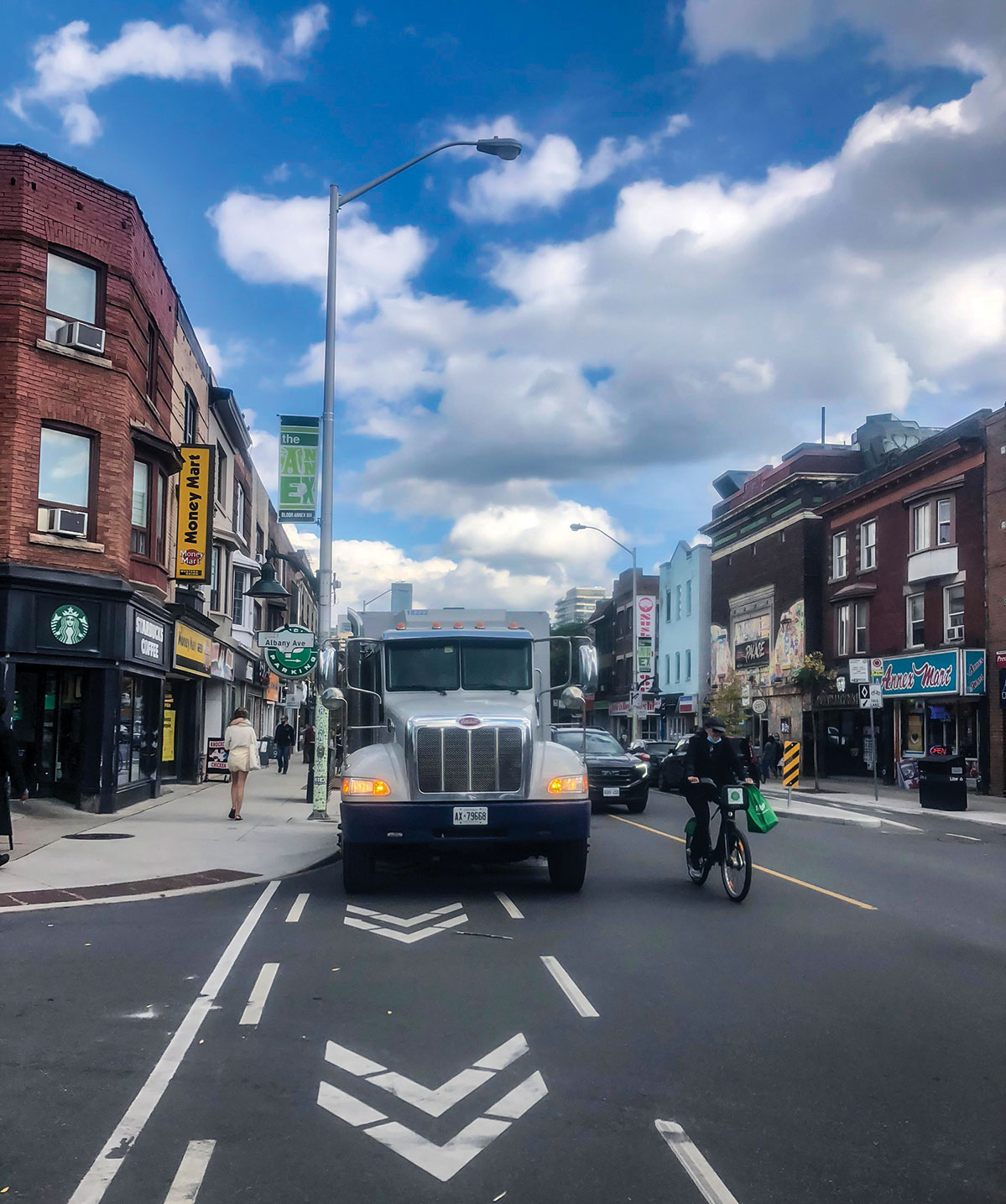
Over a six week period, the Gleaner photographed active daytime deliveries along Bloor St. West in order to give a snapshot of which companies respect the bike lanes and which don’t. Most do. Some Sysco truck drivers obey bike lane rules, while others do not. Brinks trucks must deliver via the front door of their customers, and seem to actively ignore the rules while doing so.
By Mary An
In 2016, the City of Toronto built bike lanes on Bloor Street West in the Annex neighbourhood to ensure a safer commute for cyclists. These lanes do not guarantee cyclist safety though, as getting “doored” remains a serious concern. Bells on Bloor, the community group that advocated for the creation of bike lanes, is asking the city to do more.
“Sometimes I shudder because I see some novice cyclists pull out into the roadway and a car behind them might not notice that,” says Albert Koehl, co-founder of Bells on Bloor. “It’s very dangerous and so unnecessary. The lane is there to provide safety.”
After noticing many interruptions of the bike lanes, Koehl and his team at Bells on Bloor wrote a letter to the city in March 2019 requesting help in protecting cyclists. They requested an increase in enforcement on the roads, spreading awareness through ads or through ride-share and transportation services, and the installation of more barriers to protect cyclists from any interferences. Since then, the city has made it a requirement for private transportation services (such as Uber or Lyft) to ask passengers to “look out for cyclists.”
However, problems caused by large delivery trucks failing to observe the rules persist.
Brinks trucks can often be found parking in the bike lanes, creating a hazard for all road users. BRIAN BURCHELL/GLEANER NEWS
In early August, Brian Burchell, Chair of the Bloor-Annex Business Improvement Association (and publisher of this newspaper) spotted a large Sysco truck cutting off the south side of Bloor’s bike lane by placing a ramp from the truck to the sidewalk. Cyclists were forced to maneuver their way around the semi-trailer truck during the morning rush into the middle of busy Bloor Street.
TheAnnex Gleaner brought the incident to the attention of the Sysco Corporation, and they responded with an e-mail stating: “We care about our communities and expect all our employees to abide by local bike lane laws. We will share this information with our local operating team to take appropriate action.”
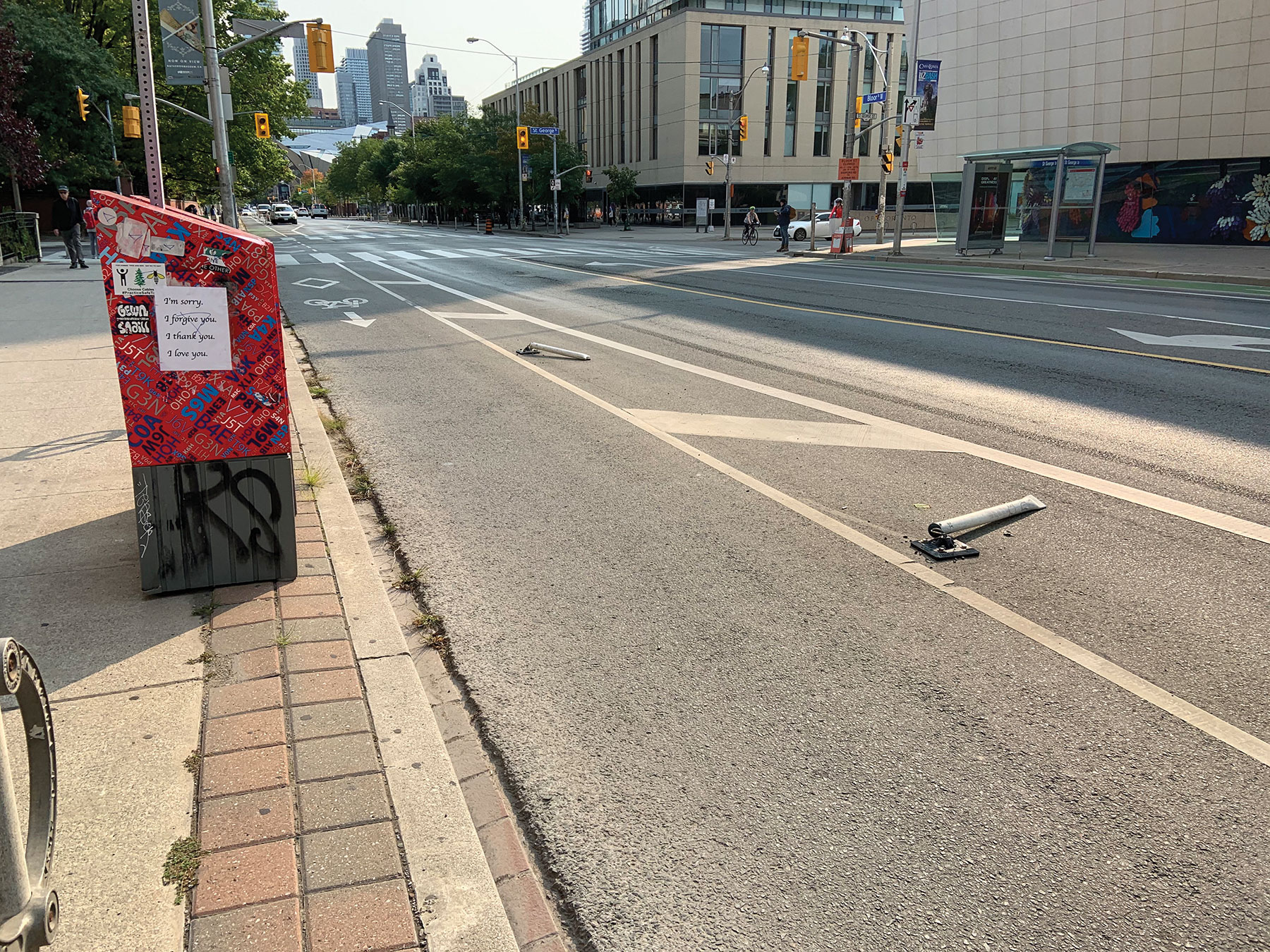
Though the poles were in place to ensure cyclist’s safety, this type of barrier doesn’t prevent vehicles from interfering with the lane and destroying them. MARY AN/GLEANER NEWS
Sysco semi-trailer trucks have been seen during the day interfering with the bike lanes, though the number of sightings seems to have gone down slightly.
One driver who routinely parks safely in a side alley told the Gleaner, “there is a bit of a war going on inside the [Sysco] company with half the drivers sticking to their schedules no matter what [and parking in the bike lanes] and the other half, like me, that don’t want someone to get killed because I forced a bike into a live car lane.”
One company that has an outstanding reputation for never interfering or blocking the bike lanes on Bloor street is The Beer Store. According to Burchell, the company’s delivery drivers were caught blocking bike lanes in 2016. However, Beer Store trucks have since gained a reputation for respecting the safety of cyclists and parking on side streets, avoiding the bike lanes altogether.
According to an Empire Foods driver, deliveries cannot happen off-peak due to the lack of access inside businesses. Because of this, daytime drivers often struggle to find parking spots near their destination.
“Delivery drivers can’t pull over far enough on the road to do deliveries,” the driver said. The driver is also aware of the safety issue for cyclists and often parks on any available side road, but says the city should take more action and input a designated delivery parking spot to avoid such issues.
Burchell believes that it’s not just up to the city, but to the businesses to hold their delivery drivers accountable as well.
“We all have a social contract, a duty to one another. I think it’s incumbent on each of us to try to raise the bar, and make sure that our neighborhood is a safe and inclusive environment where people can gather, shop and enjoy the surroundings,” Burchell said.
Currently, the bike lanes on Bloor Street in the Annex neighbourhood are merely painted on the north side of Bloor Street, which does not prevent vehicles from driving into and stopping in the lanes.
On the south side there is an elevated cycle track protected, perhaps ironically, by a lane for parked cars.
“It’s the question of whether they are being respectful to people in the neighbourhood that are riding bikes, and people from other neighbourhoods that are riding through our area,” Koehl said.
As a community leader on road safety, Koehl hopes that the city starts enforcing regulations around bike lanes, and that more barriers will be created to protect cyclists from vehicles interfering or parking in them.
November 2nd, 2020 · Comments Off on NEWS: Midblock fire station on Howland Avenue gets a facelift (Oct. 2020)
Fire Station 23 once housed steamed-powered, horse-drawn pumpers
“Steamers” refer to the horse-drawn carriages that used water to fight fire in the 1800s. Station 23 (as it was then known) housed this equipment until they were replaced by gasoline-powered fire trucks. While the steamers were used in parades, there is no evidence that they were actually used locally in fire emergencies. COURTESY CITY OF TORONTO ARCHIVES
By Mary An
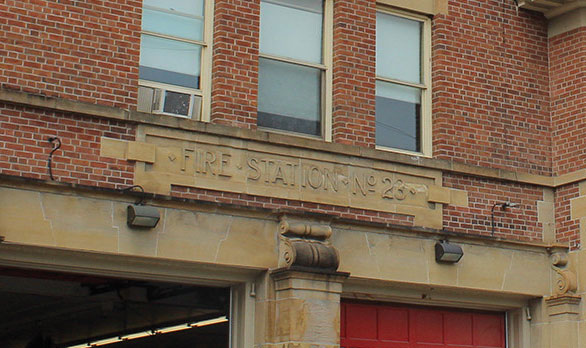
Major renovations are underway to bring Fire Station 344 on Howland Avenue into the 21st century. Built in 1910, it was originally given the number 23, then re-named in 1999 when Toronto amalgamated. The number 23, however, still sits in stone overlooking the entrance to the building, and this decorative feature will remain in place alongside the building’s entire historic facade.
First built in 1910, Fire Station 344 (formerly known as 23) is getting renovated. The historic Fire Station No. 23 sign still hangs proudly above the garage untouched. MARY AN/GLEANER NEWS
When the station was first built, fire engines were steam-powered and horse-drawn, until equipment advancements became too heavy for the horses to pull. Eventually, the horse-drawn steamers diminished and were replaced by gasoline-fueled engines. Fire Station 23 (now 344) still had horse-drawn steamers that were used in parades over the years, but whether they used them for actual fire emergencies is unknown.
Project manager Ryan MacNeil says virtually every aspect of the building’s interior, including stairways, kitchens, and bathrooms will be re-built to be brought into compliance with the Accessibility for Ontarians with Disabilities Act (AODA).
“The footprint of the building will stay the same. There will be no expansions, just renovations,” MacNeil said. Being a historic structure, the Toronto Historical Association requires the historic character of the building to be preserved.
While the planned renovations were scheduled to wrap up this September, there were unforeseen obstacles due to the age of the building, delaying the end date to early 2021. In the meantime, Station 344’s crew is carrying out their duties from a temporary home at 339 Queens Quay West.
Comments Off on NEWS: Midblock fire station on Howland Avenue gets a facelift (Oct. 2020)Tags:Annex · News · History
November 2nd, 2020 · Comments Off on CHATTER: Clinton’s Tavern returns, features a monthly flea market (Oct. 2020)
TANYA IELYSEIEVA/GLEANER NEWS
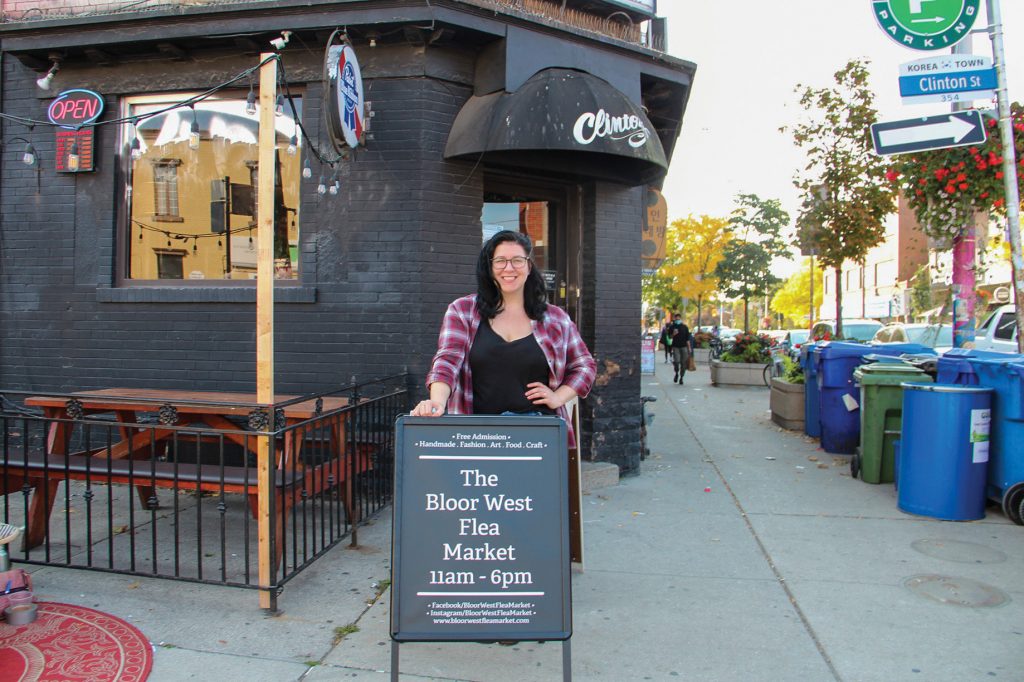
Clinton’s Tavern has re-opened under new ownership after closing back in February and is set to house the new Bloor West Flea Market as its Sunday special event.
The 83-year-old bar at 694 Bloor St. W. has been bought and re-opened by Echo Karaoke. The new ownership developed a menu incorporating Korean food with pub food.
“The new owners of Clinton’s are very invested in the neighbourhood. They’re very invested in making Clinton’s a great space again. It has long been neglected, and just left by the wayside, so they’re really excited to revive Clinton’s and, you know, make it that space that people love in the neighbourhood,” says Felicia Laplume, organizer and curator of the flea markets.
Laplume is converting the Clinton’s building into the Sunday Bloor West Flea Market. Laplume adds that the patio and bar are open for drinks and food while the market is running. Nonetheless, people cannot eat inside the market space due to COVID-19 precautions.
“We really want to help people understand that Clinton’s is now committed to being not only a bar and restaurant but a community space as well, and a performance space, a place for artists and musicians,” says Laplume.
Laplume, who launched the Trinity Bellwoods Flea in 2015, says one of the reasons behind the new flea is to provide more vendor and customer spaces.
“At the beginning of 2020, Clinton’s old ownership kind of abandoned the building, and in the midpoint of the summer, it was taken over by the new ownership. Clinton’s is assumed to be a historical landmark in the city, and the monthly market can help the space be revived into more of multi-purpose space, not so much just a bar but also a place where people can visit during the day.”
Launched on September 27, The Bloor West Flea Market is a curated monthly market and runs on the final Sunday of each each month from 11 am to 6 pm. Visit www.bloorwestfleamarket.com for details.
November 2nd, 2020 · Comments Off on CHATTER: A soulful performance from a Howland porch (Oct. 2020)
TANYA IELYSEIEVA/GLEANER NEWS
Stephanie Martin has been singing and performing her whole life. The singer-songwriter and actress has been on the national and international scene for 30 years, but when the new coronavirus hit, everything changed.
“For showbiz people, it has just been devastating. Going from working all the time and travelling and having an outlet for what we do, to nothing. No money, no fulfillment, no connection with our people, and it’s really tough,” she says.
When the government eased the COVID-19 restrictions, Martin decided to perform a small porch concert with her band, David MacDougall (drums), Chad Irschick (Rhodes keyboard), Mike Francis (guitar), and Tom Szczesniak (bass).
“It was a relief for people to have a little bit of normal. But more than that, when you go to the theatre or when you go see a concert, you have a moment of losing yourself and losing your worries and losing your own ego and anxieties melt away,” says Martin. “I would want to encourage artists to have good ideas about how to reach people and how to provide that because it’s a service. It’s like a medical service for the soul.”
The concert wasn’t advertised much in the area, nonetheless, about 60 people attended (within the guidelines at the time of the event).
“I did it for myself, for my band, and for people. I love my neighbours. It’s amazing what’s happened,” says Martin. “It’s bizarre that it is maybe one of the most meaningful concerts I’ve ever done and that happened right on my front porch.”
The concerts took place on August 15 and September 12.
November 2nd, 2020 · Comments Off on EDITORIAL: Confusion reigns in COVID-19 response (Oct. 2020)
As the pandemic continues and enters its second wave, the people of Ontario, and especially Toronto, Ottawa, and Peel region can count on one thing: chaos in the rules and guidelines that allegedly exist to protect us. While confusion reigns it is clear that we need a leader who knows how to lead, and if that’s too much to ask, that leader needs better people to be following himself.
Recently, the City of Toronto requested that the province re-impose Stage 2 type restrictions on bars and restaurants with indoor dining. The city provided no evidence, at least none shared with the public, that these venues are a specific source of coronavirus transmission. Yet, the province has heeded the request. By most accounts, restaurants and bars have done a really good job keeping patrons and workers safe by making their establishments meet every rule the health authorities insisted upon only to be suddenly shuttered now for at least 28 days. By the way, there are no new restrictions on daycare centres or places of worship, which can remain open.
In almost the same breath, Premier Doug Ford called upon Ontario residents not to have family and friends over for Thanksgiving, and to confine themselves to dining with the people they live with. He added perplexingly, “don’t kiss and hug your aunts and uncles.” Is the suggestion that there are a lot of people having their turkey with the aunts and uncles who they live with? Or, does he recognize that no one is listening to him anymore? So what he is really saying is that he knows everyone will have family dinners anyhow, but when they do they should just avoid kissing relatives.
No one seems to be correlating the spike in cases to the return to schools. If children tend to be asymptomatic then how do we know they are not super spreaders? It’s not just the schools themselves but all the other interactions that people are having that are enabled by it. The potential for exponential increases is on our doorstep and before we know it the ICU beds will be full of COVID-19 patients, with no room for those suffering from other life threatening medical conditions.
One needs to look behind the curtain to see who is feeding Ford theses back-of-the-napkin plans. Chief Medical Officer of Health Dr. David Williams seems to have a vote of confidence from both Ford and Health Minister Christine Elliott. This seems to be the bulk of his fan club. Williams endorsed the back to school strategy, which the province said was backed by advice from Sick Kid’s Hospital. It was not.
At a press conference on August 27, in response to a question about the risks posed to teachers when schools re-opened for in-person learning, Williams drew a comparison to health-care workers who he said were not being careful when they “go home, casually go around and don’t wear a mask, go off to the mall or wherever and expose yourself.” According to the province’s own data, 2,642 health-care workers at long-term care facilities have contracted COVID-19, and eight of them died. Williams does not see this as something they contracted while on the job.
Dr. David Fisman, an epidemiologist at the University of Toronto, tweeted that William’s resignation is “long past time, to my colleagues who say this in private [yet] are reluctant to speak out publicly: we don’t have a lot of time.”
Ford needs new advisors. We need coherent, consistent, fact-based policy. Show us the facts, Mr. Ford, on how this virus is spreading. Otherwise, it just looks like you are making it up as you go. People will stop listening to you, and it may be true that they already have.
November 2nd, 2020 · Comments Off on FORUM: Inclusionary zoning is the answer (Oct. 2020)
Growth in affordable housing is impossible without making it mandatory
By Mike Layton
The city’s need for affordable housing has never been more apparent than over the course of the pandemic. The public seems to have taken notice. My colleagues and I have been working on this issue and asking for additional and substantial investments in housing for more than a decade. We believe that housing is a human right and we need the funding and policies in place to treat it as such.
Not a week goes by when we don’t hear about a major condo or luxury rental development displacing cultural institutions in our city such as Sneaky Dee’s concert venue and restaurant, for example. Our neighbourhoods are changing, and prices are going up.
With the power that the current provincial government gives developers, the community benefits that can be achieved through private developments are extremely limited. Now is the moment to change that.
In mid-September, city staff released a report on Inclusionary Zoning (IZ) that could transform the state of affordable housing in Toronto. The proposed policies put forward a framework outlining how this tool – which would require that developers include a certain amount of affordable housing in new residential buildings – might be employed.
Short of significant intergovernmental investment in affordable housing – the likes of which our city has not seen in decades – IZ is Toronto’s best chance to finally build the units desperately needed by our low- and moderate-income residents.
Implementing the strongest possible IZ framework is especially important now.
As a city councillor, I am seeing countless first-hand examples of how the pandemic is threatening Torontonians’ housing stability. Many who have lost their jobs or had their hours reduced have been unable to make rent, and the provincial government is now allowing landlords to evict them.
Finding affordable alternatives will be next to impossible for most. I personally know families where four or more individuals have been forced to share a one bedroom apartment, and this type of situation – always unacceptable, but especially dangerous during a pandemic – will only become more common.
There’s a lot that city staff have gotten right in this report. The affordability period for units created through IZ would be 99 years, which means this housing stock would be protected for future generations. IZ housing would also comprise a mix of sizes, ensuring that affordable family-sized units are built.
More good news is that the report’s definition of “affordable housing” would take into consideration tenants’ incomes, and not just average market rates. As of July, the average monthly rent for a 751 square foot Toronto condo (approximately the size of a 1-bedroom) was $2420. With the suggested IZ formula, a one-bedroom would cost $491 for a one-person household in the 30th percentile of incomes, and $806 for one in the 60th.
But when it comes to the proposed set aside rate – how much of a building is required to be affordable – the report falls short. Toronto city staff are proposing that only 5-10% of a condo’s residential floor area be dedicated to affordable units, and 2.5-5% in purpose-built rental buildings. They are worried that higher rates will discourage development. But the reality is that Toronto could set much more ambitious IZ requirements, and developers would still be able to make their buildings – and their profit – happen.
Additionally, city staff have suggested that developments be exempted from the policies if they have fewer than 100 units in some locations, and 140 in others. Last year, the Ford government hindered Toronto’s ability to employ IZ outside of Major Transit Areas. The city should be aiming to maximize IZ’s outcomes where it is permitted, rather than impeding them further.
In the coming weeks, as Toronto starts consulting on these proposed policies, residents must let the city know it is imperative that we create as many units, in as many buildings as possible. Now is our moment to shift the power from developers to people, and to begin to turn the tide of the housing crisis.
Please let me know if you would like to become more involved in this process and I will be sure to share opportunities to make your voice heard, and make a difference.
Mike Layton is the councillor for Ward 11 University-Rosedale.
November 2nd, 2020 · Comments Off on FORUM: Waiting on a second-wave plan from Mr. Ford (Oct. 2020)
Development proposals sneak through during crisis
By Jessica Bell
The cooler weather has arrived, but there is no respite from the coronavirus. The second wave has begun. The spread of the new coronavirus, the need for affordable housing and concerns about development along with developer and affordable housing pressures, are the key issues I’m hearing about this season.
Cases of COVID-19 are rising fast largely in response to the Ford government’s decision to move to Stage 3 and ease restrictions in July. The case counts are increasing at the same time as schools reopen, flu season begins, and businesses are just starting to recover from the spring shutdown. The timing couldn’t be worse.
It is vital the government release an effective second-wave plan that includes tighter restrictions as directed by public health, an increase in the capacity and number of testing sites so sick people don’t have to wait four hours to get a test like they do at Toronto Western Hospital, an investment in schools which includes the hiring of more teachers to reduce class sizes, and the implementation of paid sick leave so people can stay at home and not expose others. We got a taste of normal life in August. Let’s all do our part, and that includes the government, so we can eventually live normal lives again.
The pandemic has turned the ongoing tension between neighbourhood interests and big development into a massive migraine. Premier Ford has used the pandemic to justify his decision to override Toronto’s noise rules, which means residents from 666 Spadina Avenue to Yorkville to Robert Street can be exposed to construction noise, including non-essential construction, from 6 a.m. to 10 p.m. seven days a week. I fully support the move to support essential construction, such as testing sites for the coronavirus, but residents deserve more peace and quiet from non-essential construction than what they are currently getting.
The development proposal to build a 13-storey condo at Bathurst and College to displace the beloved Sneaky Dee’s bar has highlighted once again how our laws favour developers over community needs for affordable housing, good schools, and great venues for music, art, and small business. We can’t just grow, we need to grow well.
As your representative to Queen’s Park, I am advocating for laws that will give the city and the people of University-Rosedale more say over what developers can build, and what they should give back to the community in return. For a start, Toronto should be exempt from the Local Planning Appeals Tribunal, which allows developers to hold up and contest planning decisions made by a democratically elected council. Both the city and the province should require developers to give back more to the community in the form of community benefits agreements, affordable housing, and higher fees to fairly contribute to the amenities residents need, including parks, schools, and transit.
Sneaky Dee’s is one of many cultural institutions facing closure. Many music, theatre, and dance venues, from Lee’s Palace to The Free Times Cafe, are struggling to survive in the face of pandemic restrictions, shrinking revenue, rising rent costs and development pressure. These venues entertain us, challenge us, and tell our stories. They need our help. I encourage you to contact our office and suggest ways to help our creative sector.
Finally, one silver lining has emerged around the gloomy cloud of being a renter during the pandemic in the most expensive city in Canada: three years after the motion was approved, the City of Toronto has finally begun enforcing its new short-term rentals rules. This motion restricts short-term rentals to one’s primary residence. We expect this move will return many units to the long-term rental market, and provide relief to condo dwellers who want to replace the overnight partygoers with long-term neighbours. Starting this September, short-term rental hosts are now required to register with the City of Toronto. Please contact 311 if you want to initiate a complaint against an illegal AirBnB listing.
These improvements to our housing market happened because we fought for them. If there’s one thing the pandemic has taught us, it is that change can happen very quickly; we just need to steer that change in the right direction.
Please contact my office if you have questions or concerns. Make sure to stay safe by social distancing, hand washing and mask wearing when required.
Jay Macpherson paved way for next generation of female professors
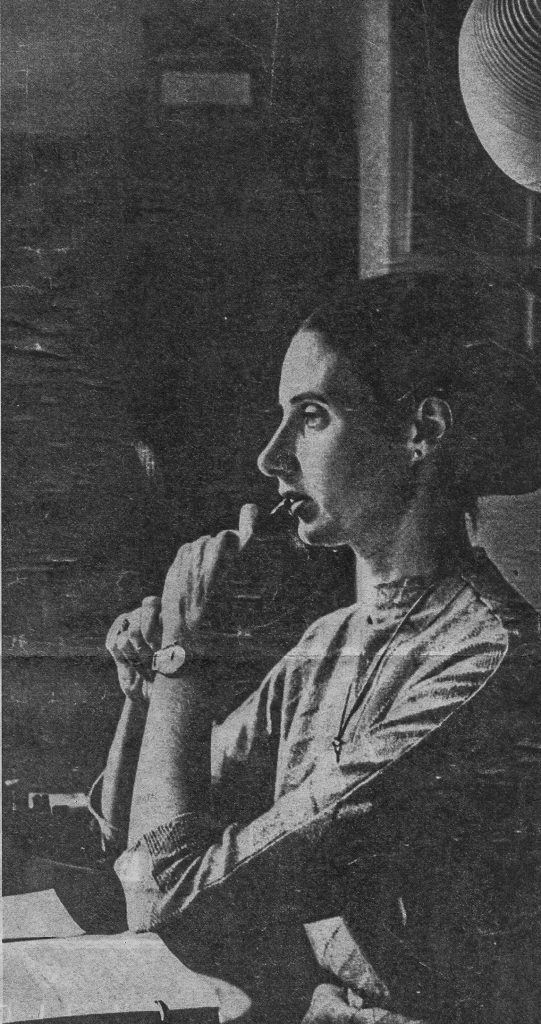
A young Jean Jay Macpherson during her teaching years. COURTESY VICTORIA UNIVERSITY
Correction: On page 11 of the August 2020 issue of the Annex Gleaner, in the annual Grading our Greenspace section, Jay Macpherson was misidentified as “he”. This error was brought to our attention by Alexandra F. Johnston, professor emerita, Department of English, Victoria College, University of Toronto. The Gleaner regrets the error.
By Mary An
Jay Macpherson Green at 255 Avenue Rd. was named after Jean “Jay” Macpherson in 2013, one year after her death. She was a much-loved English professor to writers including Margaret Atwood, Dennis Lee, and Alexandra Johnston. Her legacy, however, extends beyond a park and inspiring a handful of successful Canadian writers.
Born in London, England, in 1931, Macpherson didn’t like being called by her first name, so she chose to go by “Jay.” At nine years old, she was brought to Newfoundland as a war guest, and then moved to Ottawa where she studied at Carleton University. She continued her studies at McGill University before finally landing at the University of Toronto (U of T). At Victoria College she studied under the renowned literary critic Northrop Frye, and began publishing her own contemporary poetry in 1949. She won many prizes, including the Governor General’s Literary Award for poetry, the Levinson Prize by Poetry magazine, and the University of Western Ontario President’s Medal for The Boatman. She even established her own small press: Emblem Books, where she published distinguished writers including Dorothy Livesay, Alden Nowlan, Al Purdy, and others.
All of these achievements are impressive enough, before even considering what she accomplished in her career. Macpherson did what was nearly impossible for a woman in 1957 – she became one of five female professors in the English department at U of T.
Macpherson was considered to be an “excellent teacher,” and an outstanding friend by both Margaret Atwood and Alexandra Johnston.
In her fourth year as an undergraduate, Johnston lived in the same building on campus with Macpherson when, as the story goes, she heard a knock on her door at 10 p.m.
“It was Jay, in her dressing gown with her braid down her back, handing me back a marked essay,” she said in an interview with the Annex Gleaner. “It’s not the sort of thing professors do, going out of their way like that.”
Johnston is now a retired Professor of English at Victoria College, and between 1981 and 1991, acted as the first female principal of the college. Johnston says that as a teacher, Macpherson took on the role of mentor and by doing so, helped pave the way for a new generation of female academics.
“She was the link between the senior generation who had been teaching since the 1940s and the new people who came on in the 1960s,” Johnston said, adding that Macpherson also proved herself to be someone with an enormous heart. “Even during the last years of her life, she looked after another elderly colleague, who was in a wheelchair, and did everything for him,” Johnston said. “She exhausted herself doing it, but none of us could compel her to stop.”
November 2nd, 2020 · Comments Off on LIFE: Paying homage to local characters (Oct. 2020)
Vibrant mural meant to appeal to children
MARY AN/GLEANER NEWS
By Mary An
At the intersection of Bloor Street West and Major Street, the Annex has welcomed a new mural. With help from the City of Toronto’s StreetARToronto grant, the Bloor Annex Business Improvement Area (BIA) held a competition last year to fill the wall in a way that would best represent the neighbourhood.
This unique, vibrantly colored mural was painted with children in mind, and features key Annex residents. The artist wanted to capture different personalities through colour.
“It’s nice to paint something that is child-friendly because a lot of murals are beautiful, but they’re more for adults,” Daniela Rocha, the artist, said in an interview with the Annex Gleaner.
Behind the bushes, on the left side of the mural, a young boy with the name ‘Oscar’ on his cap is captured riding a bike. This drawing of Oscar was not originally planned. Rocha said she added him because he would often visit her while painting.
“He would be super excited about it – like he would just talk to me, and he was super sweet. So, I thought it was like a nice surprise,” she said.
Rocha’s mural also depicts Ted Winick, who was known to be a strong pillar of the community, who died in May, 2019. Winick appears as a man playing chess next to a dog. Winick and his wife Heidi Winick were co-owners of the Spirit of Math schools located in Toronto. He was also the founder of the Chess Institute of Canada, where he not only taught chess but also taught valuable life skills to youths and supported the community for many years. Winick passed away in June 2019, and Rocha was asked to include him in the mural as an homage.
“Daniela submitted her work and it was accepted. Then, last minute, we asked her to add the little chess player in the corner,” Melanie Ramsay, Project Administrator of the Bloor Annex BIA said.