January 27th, 2021 · Comments Off on CHATTER: A new green space within the Annex (Jan. 2021)
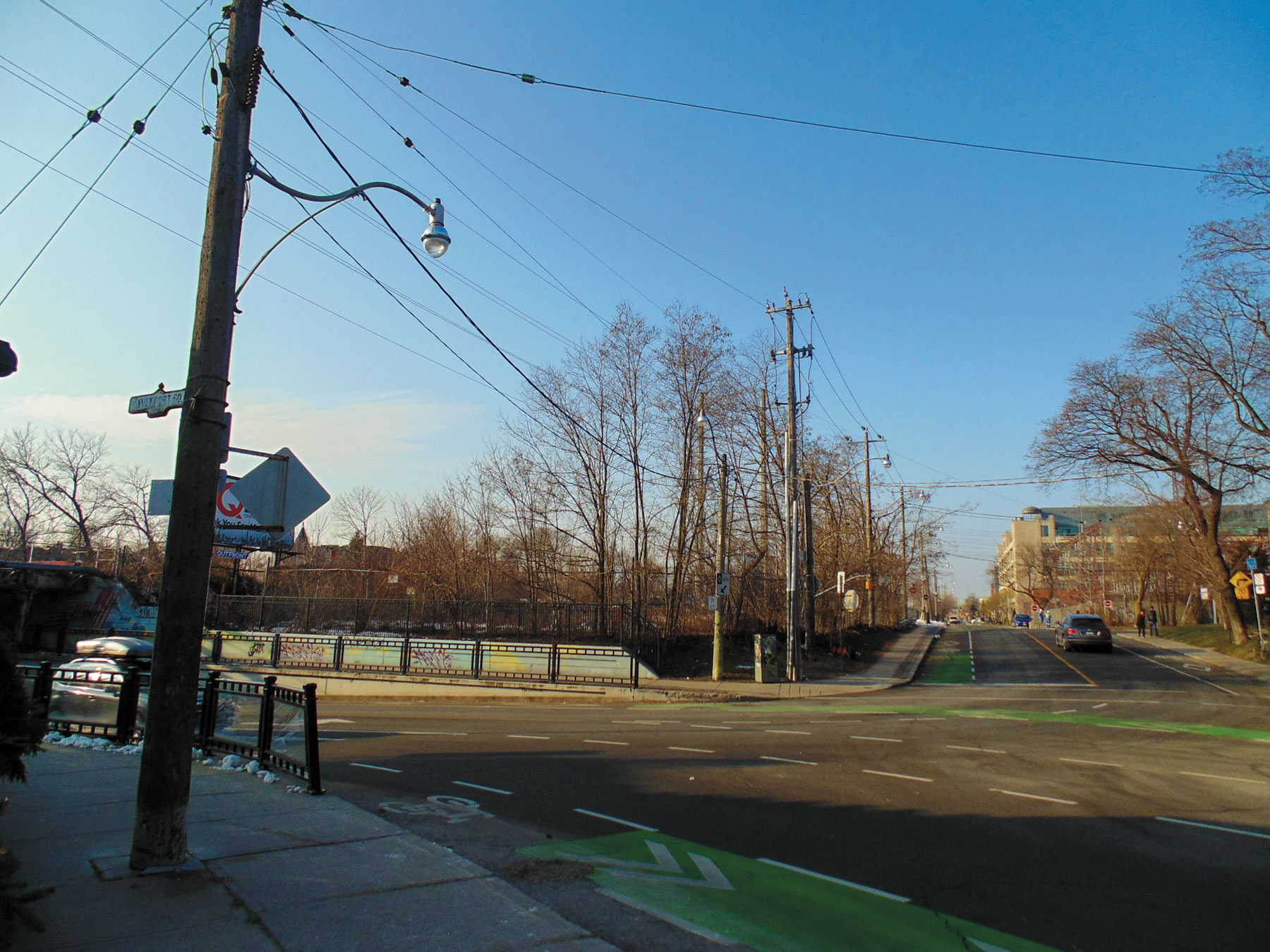
As part of the 5-km long Green Line project, a new park is propose at Dupont Street and Davenport Avenue. BRIAN BURCHELL/GLEANER NEWS
A new park is coming to Macpherson Avenue as a part of the city’s Green Line project. Macpherson Avenue Park will be located at Macpherson Avenue and Davenport Road, down the street from Jay Macpherson Parkette. This park is a part of a bigger project proposed by the city called the Green Line project which, according to the city, would “transform a currently in-use electric transmission corridor into a five km-long connected park and open space.” This new park will be the first of three new parks to be initiated for their Green Line project.
As the city explains it, the Green Line project will be a “linear park system in an active hydro-electric corridor that will connect neighbourhoods and expand the broader open space network in midtown and west Toronto.”
The city held a virtual public meeting in November for Macpherson Avenue park where they were able to work with citizens and gain their input on this project. Macpherson Avenue Park has been proposed to have adult exercise equipment, an Indigenous garden with diverse plants along with Indigenous place-keeping markers within a sculpture and markings on the pavement for historical design. They are also implementing enough open space to ensure the park would have “outdoor classroom flexibility.”
Macpherson Avenue Park will be the first new park to be implemented within this project. Currently, the city is still designing the concept of the park, and plans to start construction in the spring of 2022.
January 27th, 2021 · Comments Off on CHATTER: Huron St. Playground going leash-free (Jan. 2021)
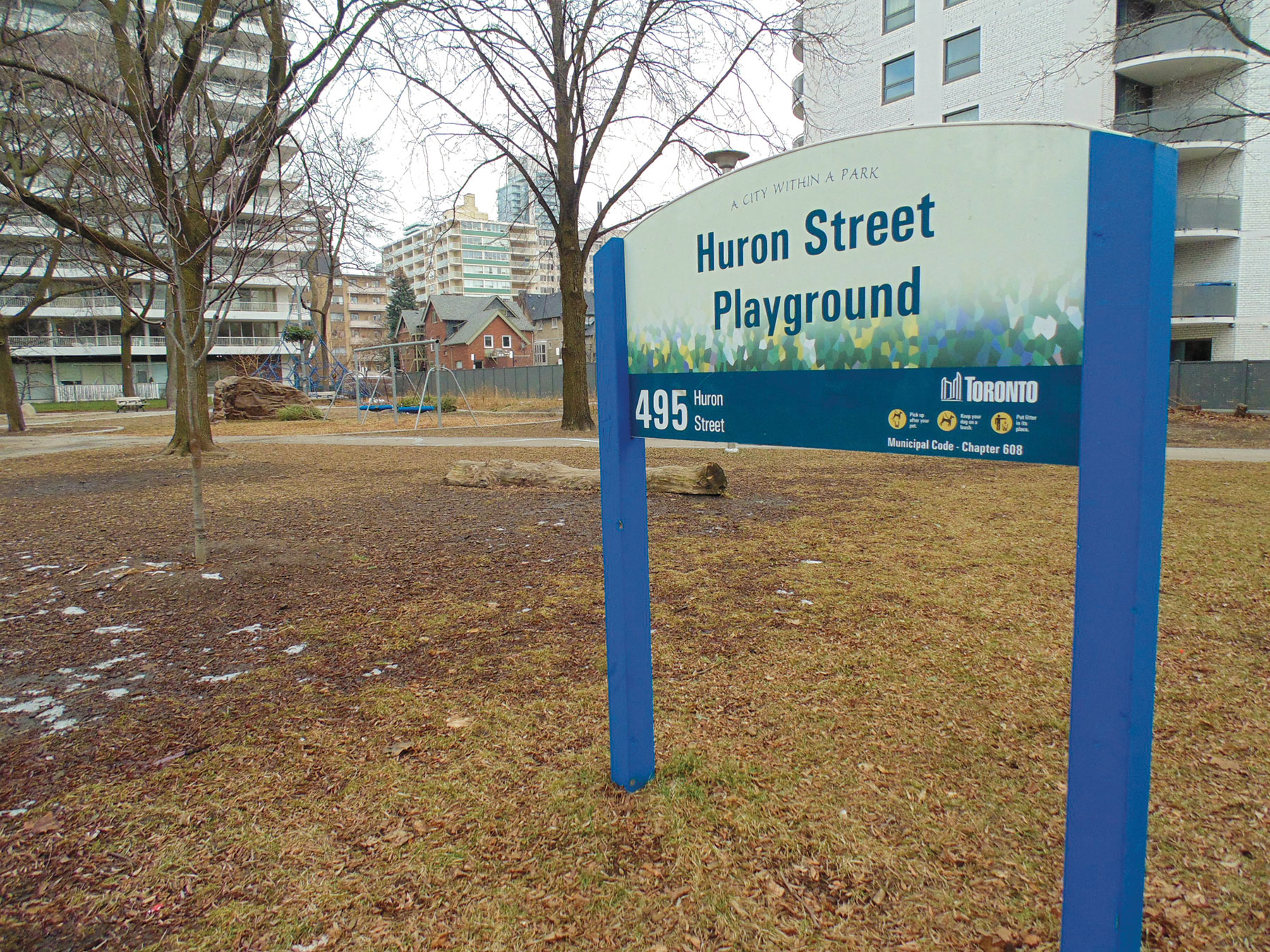
300 square metres of off-leash freedom is being implemented on the West side of the park. BRIAN BURCHELL/GLEANER NEWS
The Annex has just three designated off-leash dog park areas: Bickford Park, Ramsden Park, and Vermont Square Park. A 2018 motion to add a fourth off-leash area (OLA) in the neighbourhood is now underway at Huron Street Playground. Located just northwest of Bloor Street West and St. George Street, the park currently has a few playground structures including a rope climber, a sandbox, a swing set, and a small rock-climbing structure.
According to Jaclyn Carlisle, Senior Communications Coordinator with the City of Toronto, they plan to add a new fence, accessible benches, artificial turf along with mulch surfacing around the trees, and a water fountain with a dog bowl. The OLA will take up 300 square metres of the park on its west side, and will be open throughout regular park hours.
Generally, all owners and dogs are welcomed at any OLA, but there are different amenities in the OLAs labelled by the city; commercial dog-walker areas, specific fenced areas, and small dog areas.
Ramsden Park will be an example of a small dog area for dogs under 20 pounds. There will also be a general fenced area for dogs to run around in. The OLA addition to Huron Street Playground will have a commercial dog walker area, meaning professional dog walkers will be welcome at this OLA. More information on what type of amenities are included in any OLA is on the City of Toronto website. Walkers and owners can also get fined $365 if dogs are unleashed outside of OLAs.
According to the city’s website, the project’s current state is within the design development stage, and they plan to start construction on the park in the summer of 2021.
January 27th, 2021 · Comments Off on EDITORIAL: Ford’s half measures (Jan. 2021)
New projections warn that the new and more contagious variant of the coronavirus could result in Ontario seeing 40,000 new infections per day in February. Meanwhile, the province has announced a state of emergency allowing the government, with the support of cabinet, to introduce new public health orders more quickly. This could be a good thing, depending on how the powers are used. It’s hard to be hopeful, though, when the province is led by a premier who seems so determined to deliver mixed messages and sweeping regulations riddled with enormous loopholes.
On Tuesday, January 12, Premier Ford announced stay-at-home orders to take effect two days later, at which point, Ford said, police would begin to hand out tickets to anyone who leaves home for anything beyond the “essentials.” Apparently, this was news to the police. Spokespeople for the police said simply that if they encountered a large group gathering in public they would break it up, or if they received a complaint about an adamant anti-masker in a grocery store, they would attend to it.
“A person taking their dog on a nightly stroll is not going to have to worry about a police officer pulling them over,” said Joe Couto, who represents the Ontario Association of Chiefs of Police. “We have to use common sense.”
Mayor John Tory called for rule-makers to be clear and consistent in their messaging. Premier Ford did not seem to agree, replying that, “if you feel your trip is not essential, it probably isn’t.”
There are definitely a few details that warrant some scrutiny and clarification. In his announcement, Premier Ford said that all construction must cease unless it is deemed essential. One might consider hospital expansion or the repair of a collapsed sewer or old bridge to be considered essential. However, instead of a short list, there is a very long list of construction projects deemed essential. In a nutshell, they include just about anything that is already underway. In other words, construction is considered essential, and will not be stopped.
No retail business or food establishment within this newspaper’s distribution is impacted by the announcement. Retail remains open for curbside pick-up and restaurants for take-out. One might wonder if this is not a contradiction. If a citizen can only leave home for, “essentials” are we considering the goods sold at a store like EB Games essential? Faced with this logic problem the government announced (the day after Ford’s presser) that anything that is open for curbside pick-up is deemed essential. In other words, all shopping is essential. Big box stores remain open but must now close at 8pm. Ford tried to announce a 50% capacity limit in those venues but was forced to admit that this rule was already in effect.
“I will come down on them like a 800-lb guerrilla if they exceed store limits,” he boasted. Walmart is surely shaking with fear at this statement.
The only good thing the province has done right here is keeping schools closed a little longer. The health minister announced, as if it was a revelation, that this may have the net effect of keeping more people home as they need to care for their children.
Vaccine rollout in Ontario, a provincial responsibility, has been inconsistent at best. Many long-term care homes with outbreaks are yet to see a single vaccine, while hospital workers seeing no patients and working from home have had open access. Angry at any criticism, Ford has tried to blame the federal government for supply issues, but according to the feds the delivery to the provinces is right on schedule and Canada has more in the pipeline per capita than any country in the world.
Ford recently announced that Prime Minister Trudeau has agreed to send the military to help get outbreaks in long-term care homes under control. Unsurprisingly, he’s got no clear answer to what the military will do. Like every other measure this premier takes, we’re seeing too little and too late. With a crisis of this magnitude, Ontario needs real leadership, and Premier Ford keeps proving that’s something he does not have the chops to deliver.
As we enter the new year, I know the majority of us are still having to make big sacrifices to keep each other safe and healthy, but I also believe there is positive change in the air and I am hopeful for the coming year.
There is hopeful news that vaccine rollouts across our country and world will continue to develop. We should celebrate this much needed light at the end of the tunnel, while still remaining vigilant in our efforts to slow the spread. This month, our Medical Officer of Health, Dr. Eileen de Villa, put forward additional public health requirements to protect workplaces in Toronto, which could work to curb the recent high numbers of community transmission.
The requirements (as of January 7, and I state this because the instructions seem to consistently shift as needed) say that if two or more people in a workplace test positive for COVID-19 — within a 14-day interval that can be directly attributed to their workplace — they are required to contact Toronto Public Health immediately. Once they report the cases, employers are required to follow specific instructions given to them from Toronto Public Health. The information collected will then be available to the public through the City of Toronto COVID-19 dashboard. It is important to note that the information will only be posted publicly if the workplace is substantially large enough to ensure that employees’ names and identities will remain private.
The experience of the past year has also undeniably demonstrated what our collective priorities should be. Working towards a Toronto where everyone who chooses to make this city their home can thrive must be at the core of our collective policy making.
For me, 2021 brings with it a renewed sense of optimism. For one, council has finally started vital conversations about systemic anti-Black and anti-Indigenous racism and I am looking forward to seeing these conversations turn into more representative social supports and services. This much needed change in the public discourse has been driven by many of you and I am grateful for your continued advocacy.
Locally, the year ahead will bring with it several developments on issues that I have spent years of my time on council advocating for, including the solidifying of plans to bring 100% affordable rental housing to 25 Bellevue Avenue. I will continue to work on a green and just recovery from the pandemic that is guided by the C40 Cities’ COVID-19 Recovery Task Force’s Statement of Principles. The development of A Different Booklist Cultural Centre will also continue. The proposed centre will celebrate the decades-long history of African Canadian and Caribbean Canadian community and heritage on Bathurst Street at Bloor. I will also work on the continuation of the expansion of our cycling network, which will mirror major transit routes on Bloor and University in Ward 11.
It remains critical that we follow the advice of Toronto Public Health. Our Medical Officer of Health has noted that we still have many months of this pandemic ahead of us, regardless of the plans to distribute vaccines. It is also extremely important that we get our information from reliable, informed sources and stay home when we can. I continue to have full confidence in TPH to learn, adapt, and evolve as new information becomes available to guide our response and keep residents of Toronto safe.
As always, my staff and I are here to assist in any way we can. Please don’t hesitate to contact my office by emailing Councillor_Layton@toronto.ca or calling 416-392-4009 to let us know your questions and concerns.
Mike Layton is the city councillor for Ward 11, University—Rosedale.
For-proft LTC home in University-Rosedale has Ontario’s largest COVID-19 outbreak
By Jessica Bell
St. George Community Living, which is located in my riding of University-Rosedale, now has the largest COVID-19 outbreak in Ontario. As of January 5, 84 residents and 51 staff have COVID-19, and 6 residents have died. The staff and residents need help now, and we, as a society, need to change the laws of our province to stop these preventable tragedies from happening again.
Let me tell you about St. George. I have visited the Community Living centre during better times. The residents are a mix of seniors and younger people with big challenges. The staff are dedicated and caring. The building is also old, and many residents live four to a room. St. George is managed by Sienna, one of Ontario’s largest for-profit long term care home chains.
Sienna management has made assurances that the outbreak at St. George is being managed sufficiently, but the staff I have spoken to tell a different story. They complain of chronic staffing shortages that have existed for years. They talk of having staff ratios so low during the pandemic that sometimes just one person is responsible for 30 to 49 people at night. They talk of nurses having to do a deep cleaning of the home themselves because there are not enough professional cleaners to do the job. They talk about being angry and scared.
Staff reports about conditions at the home are corroborated by a review of government inspections of St. George, which show recent incidents of preventable death and neglect.
These workers have asked for anonymity because they fear they’ll be persecuted at work if they speak out. I believe them. It is shocking to me that the Ontario government can praise essential healthcare workers with one breath, yet fail to pass laws to provide them with protections and proper pay. This is especially important now because many residents living in homes under outbreak are isolated, with family members being unable to visit — and complain. We have asked for whistleblower protection for frontline workers, but the government rejected our demand.
What can be done? In the short term, residents and staff at St. George need priority access to the COVID-19 vaccine, and that is happening, albeit not as fast as it should be.
St. George staff and residents also urgently need more staff, including clinical staff. It is good to hear that the University Hospital Network has now temporarily taken over the facility and is directing hospital staff to work at the home.
The problem, however, is that these exhausted staff are coming from hospitals that are facing staff shortages of their own. Hospitals are also providing these resources from their own budgets, and despite assurances from the government that they will be reimbursed for their costs, the money has not yet arrived.
It is also Sienna’s responsibility to immediately recruit and pay (decently) enough staff to work at the home to provide safe and high-quality care.
COVID-19 has shown that the Ontario long term care home system must be fundamentally transformed. There needs to be a guarantee of four hours of staff care a day for each person – which the government recently agreed to after years of advocacy from us, families and staff. Staff, especially personal support workers, should be paid properly. The government needs to build more homes. There should be tougher regulation on homes, and the laws should be enforced.
The pandemic has also demonstrated that a for-profit long term care system just doesn’t work. It doesn’t work because it means management has to reconcile daily with the impossible question of how much money can they siphon from staff and the care of vulnerable people in order to give to owners, who already have enough.
Take the case of Sienna. Sienna was the subject of a recent Star investigation revealing the company gave out $43 million in dividends to shareholders during the first wave of COVID-19, despite receiving $53 million in provincial government funding to help them manage their homes during the crisis. That’s immoral, yet it’s legal.
When profit is redirected back into care, safety and quality of life improves. The facts speak for themselves. A report by CBC’s marketplace revealed that the death rate from COVID-19 in for-profit homes is 5.8 per 100 residents, far exceeding the death rate in municipally run homes (1.8 per 100 residents) and non-profit homes (2.8 per 100 residents). Sienna is one of the industry’s worst, with a COVID-19 death rate of 6.5 per 100 residents. These numbers represent people whose deaths could have been prevented.
Tragedies allow us to reflect and learn. They are an opportunity for societies to evolve for the better, to right wrongs. In a caring and democratic city like ours, vulnerable people should be treated with compassion, love and dignity, not left alone in neglect. I am fighting for them, and I know that many of you share this fundamental value. We are better than this. Please reach out to my office if you want to get updates or get involved in improving the state of long term care. It’s going to take all of us.
January 27th, 2021 · Comments Off on ARTS: Online culture is real – dive in (Jan. 2021)
Digitally speaking it’s wide open to explore
By Meribeth Deen
Is 2021 everything you’d hoped it would be? Sure, you would crave a face to face conversation with a perfect stranger, but your pyjama pants are basically glued to your body at this point and who can keep up with what you’re allowed to do vs. what you’re not allowed to do and the whole world has found its way to your laptop screen. Seriously though, push yourself. Get out for a walk and expose and inhale the smell of the streetscape; and don’t you dare forget to exercise your urban right to arts and culture. It’s still out there, and the Bloor St. Culture Corridor has still got you covered, and the artists and culture makers of the world still need your support.
First stop: the Bata Shoe Museum website to download their “Colour the BSM,” colouring book, the essential companion to your online life. It features beautiful shoes from ancient to contemporary times, and if you print it out, you can get creative and colourful, beyond the laptop. You might even create a sheet gorgeous enough to warrant pinning up on your refrigerator!
Next: consider the brain-stretching benefits of learning a language. These include: mental flexibility, multitasking, listening skills and problem-solving. You are in Toronto so you don’t have to go too far out of your way to hear any language spoken in the world today, and there is tons of teaching happening online (including classes offered by The Japan Foundation and Alliance Francaise). But wait a second, have you ever considered learning any of the languages Indigenous to this part of the world? On Facebook, the Native Canadian Centre of Toronto offers Indigenous Language Word of the Day videos geared toward young children.
While you’re there, check out the centre’s robust schedule of online programming which includes; arts and craft workshops, health and wellness workshops, educational workshops on critical information including best practices for inviting indigenous speakers to your events, Awareness 101, and Transformation.
Your next stop might just be the ROM’s website, where you will find an interesting read and video under the heading, “Turning a Page in History.” This is the story of the museum’s “Tree Cookie,” a 2.3 metre cross section of a 500 year old Douglas Fir Tree with a timeline marking historical events on it. One of those events happens to have occurred in 1492, and to be described as a discovery. Learning how the museum addressed this historical inaccuracy without defacing the work is like tagging along on a journey where we see the embrace of a previously suppressed worldview. It’s also a wonderful break from the news cycle, and while you are “visiting” the museum, you may decide to stick around the site for a while, browse the museums’ collections, or take your kid on a virtual field trip.
Another solid destination is the Miles Nadal JCC. It’s not actually open, of course, but the good people at the community centre will keep you fit virtually, keep you learning virtually, and even get you learning an instrument virtually (similar brain benefits as learning a language, by the way). If listening’s more your thing, they’ve got some great options for that as well. Their guided listening series, Now Hear This, will bring you deep into the sound of klezmer and Yiddish music. On Tuesday evenings, starting on January 18, the director of the MNJCC Klezmer Ensemble and the Artistic Director of the Ashkenaz Festival, Eric Stein, will lead you through his treasure trove of old, new, famous and obscure recordings. Really, this sounds like a great way to spend a Tuesday evening.
There’s more, so much more on offer, and as much as we all want to be unshackled from this pandemic, maybe this is an opportunity to get to know our artists and cultural institutions in a whole new way. Their resilience and creativity is more accessible than ever, and now is the time to pour your appreciation into them to keep them creating.
Stay safe and warm, Annex neighbours.
Comments Off on ARTS: Online culture is real – dive in (Jan. 2021)Tags:Annex · Arts
January 27th, 2021 · Comments Off on GREENINGS: May you find your xingfu in 2021 (Jan. 2021)
You won’t find true happiness inside a box
By Terri Chu
As we leave behind one of the most collectively awful years in living memory, let’s hope we find some happiness in 2021. During my own, personal review of 2020, one life lost in particular stood out to me. Tony Hsieh’s death hit me in a way celebrity deaths usually don’t. Hsieh was the former CEO of American online shoe giant Zappos, a billionaire. I heard him speak at a conference about a decade ago, and I was so impressed that I stood in line to buy his book and get it signed just so I could ask him one question: What is your plan to lower the environmental impact of your company?
Disappointingly, he gave me a canned response about how important the environment was to Zappos but said nothing of value. I managed to flip through his book, but I can’t say I ever bothered to read it. The title never sat well with me, “Delivering Happiness.”
I just don’t buy the premise: happiness, delivered in a box? The rush that comes with the delivery of some new good is only followed by boredom and then by the insatiable desire for more “stuff.” What’s the average lag time between the joy brought on by the arrival of a new pair of shoes, and the time those same shoes are lost in the abyss of an evermore overcrowded closet?
When snippets started to come out about Hsieh’s death, I felt incredible sadness that his own quest for happiness ended the way it did. He seemed like a genuine guy who truly cared about people. I got the impression that he cared about the well-being of those who worked for him and really wanted to make customers happy by delivering it. Hsieh was well respected for building a company that empowered people to “do the right thing.”
However, his company was still built on the belief that happiness could be found in material goods.
Unfortunately the contents in the boxes delivered by Zappos, and so many other consumer goods, are created through the systemic exploitation of the living world.
The Chinese have a term that can be loosely translated into “a lifetime of happiness,”: Xingfu.
Weddings and births are the usual times to wish someone “Xingfu.” The term has a temporal significance that “happy” alone fails to capture. If someone says they feel “Xingfu,” it means they feel happy, cared for, loved, and fortunate about their life. It usually implies a culmination of life events.
Xingfu could never be delivered in a box. It could never come from the shopping mall or an online retailer.
Xingfu comes from the family and friends who surround you. In a popular 2000s era drama set in ancient China, the protagonist orphan is happily singing with her sworn sister and adopted father in a horse drawn carriage. As the music travels out, another character asks “do you hear that? That is the sound of Xingfu.”
Every single one of us knows that delivery-box “happiness” is fleeting. In 2020, when the world briefly stopped and the malls along with it, we faced a void.
Those of us with families suddenly had to focus our attention on their well-being. Those of us without families were suddenly cut-off from the webs of social support that sustain us on a day to day basis.
Most of us missed our friends and family. We missed making music, we missed having drinks with friends, hugs, kisses and chance encounters with people who we otherwise took for granted.
Xingfu is that happiness many of us didn’t know we had until it got taken away. While so many of us kept clicking for online delivery, we knew all too well that the feeling we sought would not emerge from the boxes that landed on our doorsteps.
In 2021, may we all find true happiness and realize that planetary destruction is not required in order to conjure it. May we find pleasure in spending time with loved ones. May we reach out to our neighbours, lend a helping hand, and immerse ourselves in the beauty of the living world we are a part of. May we find Xingfu now that we know it can be found right in front us.
Terri Chu is an engineer committed to practical environmentalism. This column is dedicated to helping the community reduce energy use, and help distinguish environmental truths from myths. Send questions, comments, and ideas for future columns to Terri at terri.chu@whyshouldicare.ca.
January 27th, 2021 · Comments Off on LIFE: Preserving your poinsettia (Jan. 2021)
Gardening resolution for the new year
In May 2020, the Annex Gleaner celebrated 25 years of publishing. In acknowledgement of this history we are offering timely highlights of our past; this feature Preserving your poinsettia is from January 2006.
By Sarah Brierley
Here are some realistic resolutions you may actually have a hope of keeping!
1. Dust the leaf surface of your indoor houseplants. Perk up their air -cleaning capabilities by de-clogging their dusty pores with a damp cloth. Exfoliation takes on a whole new meaning!
2. Mist your houseplants — especially in winter’s dry crackling indoors weekly, or even daily if you can remember. This is an important pre-emptive strike against spider mites. Symptoms that you’ve already got the little visitors: top of leaves have yellow blotches, and tend to drop off; white webbing detected on branches. Give the plants a brick showering and swabbing down in the bathtub for exorcism.
3. Re-pot your houseplants (unless they are the types that like being root-bound).
4. Save those holiday-gift amaryllis bulbs for re-blooming. Who wouldn’t want to give these sparklers a second chance? (“Amaryllis” is a Greek word for sparkling) After blooming, remove the blooming stem to prevent it from draining the plant’s energy by trying to form a seed. Move to a sunny location and continue to water. The leaves are creating and storing food to power next year’s blossom.
When the leaves start to turn yellow (hopefully around the autumn), it is time to store it in a cool, dry, TOTALLY dark place and ignore it for eight weeks. (I’ve heard stories of amaryllis bulbs bundled into disused basement ovens) Seriously, it is like a souffle- you’ll upset the whole process if the bulb senses a peep of light too early.
After its eight-week hibernation, re-pot in fresh indoor potting soil with a bit of bone meal, and bring back to the light. Water as before.
Non-blooming is an indication that the bulb wasn’t dormant long enough, or that that the storage and forcing temperatures were too high. Bulbs that had four or more healthy leaves during the summer should have enough oomph to flower; those with less foliage may not flower. However, with time they can be coaxed into re-blooming in future years.
5. A bit of a challenge, but might as well give it a good green try: re-blooming a poinsettia.
Native to Mexico, the Aztecs used ‘Cuetlayochitl” to make a reddish dye. The flower is actually a “bract” (type of leaf). The plant has been maligned by red-flag poison warnings: an Ohio State University study showed that a 50-pound child who ate 50 bracts might have a slight stomach ache.
When the leaves start to fall off, cut back the stems to 4 to 6 inches in height. Do this in February or early March. Keep almost dry, in a shady spot. This will promote new growth. Come late spring, repot in a slightly larger pot and gradually introduce to a sunnier window, keeping the soil moist. Turn the poinsettia pot regularly to prevent rooting through the bottom hole. A quarter turn each week is suggested.
If you want the eye catching red bracts to develop again, come September you have to put it on strict light rationing. It needs to have 14 hours of TOTAL darkness per day, i.e. 5:00 pm to 8:00 a.m. Use a black plastic bag, and do so for eight weeks. (You are mimicking the light patterns in its native land at that time of year.) then position and water as before.
6. Line your household green bin with several layers of newspaper, not a plastic bag. Newspaper more readily decomposes in the big compost melt-down to which the stuff is sent. And then the system is less costly to our tax dollars as there aren’t so many plastic bags to be extracted from the process by technicians.
7. Salvage Christmas tree boughs to protect your garden beds and tree bases. Cut the branches off the main trunk, and lay them on top of your garden beds and around trees. Multiple benefits: traps snow as insulation against winter thaws and temperatures fluctuations; protects against drying winter winds; provides added moisture bonus during spring melt off. Remove in spring once shoots start peeping through.
8. Water evergreens during winter thaws (especially if under the roof overhang). As conifers still “breathe” through their leaves, evergreens lose moisture through transpiration. During no-snow periods, they are in danger of desiccating, and need to be watered weekly, just as if it were a summer drought. Branches can be freed from heavy snow pile up, but don’t knock off ice — you’re too liable to accidentally rip off living needles and branchlets.
9. Identify spots where you need to fill in with winter interest items.
10. Consider a live holiday tree for next year. (Especially good for filling in those winter interest gaps!)
If you don’t have your own garden, consider donating one to a park, church, cemetery, school, or apartment complex. Just make sure to get the okay ahead of time and check out if it can be considered a tax-deductible charitable contribution.
In the fall, buy from a reputable nursery. Store in a protected spot in your yard and water regularly. Excavate where you’ll be placing it. Put the dug earth somewhere where it won’t freeze.
Before bringing it inside, acclimatize the tree by putting it in an interim space for a few days, e.g. cool garage or unheated porch. The maximum amount of time a living tree can be in a house is five to seven days. Place in a cool spot away from heat sources. Keep lights to a minimum at they ‘cook’ the needles. Water daily. Try putting a tray of ice cubes on the root ball where they’ll gradually melt in.
Once your five to seven days of tree-dom are over, put it back in the transition site for a few days, then outdoors in the hole that’s been dug for it (still in it’s pot).
Pile the earth around it, and also other mulching material so that the roots are well protected against temperature variations and thaws and earth heaving. Come early spring, gently remove the insulating material and plant it for real.
Comments Off on LIFE: Preserving your poinsettia (Jan. 2021)Tags:Annex · Life
December 21st, 2020 · Comments Off on ON THE COVER: “No pandemic doesn’t have an ending” (Dec. 2020)
Based on the “Cowan’s Cocoa” sign, the Gleaner muses that this photo, dating from between 1908 and 1912, was taken just west of the Annex off Sterling Rd.
These intrepid tobogganers embody the winter spirit that will carry us through this holiday season.
The photo gracing the cover of this year’s December issue is courtesy of the City of Toronto’s Archives the photo and is from Fonds 1244, Item 438A of the William James family fonds.
The Annex Gleaner wishes you and yours lots of safe, outdoorsy fun, and a Happy New Year! Just remember the words of Canada’s Chief Public Health Officer Dr. Theresa Tam, “No pandemic doesn’t have an ending.”
Comments Off on ON THE COVER: “No pandemic doesn’t have an ending” (Dec. 2020)Tags:Annex · News
December 21st, 2020 · Comments Off on NEWS: Seven storeys proposed for Davenport/Dupont (Dec. 2020)
Plans for a futuristic condo at 361 Davenport unsettled
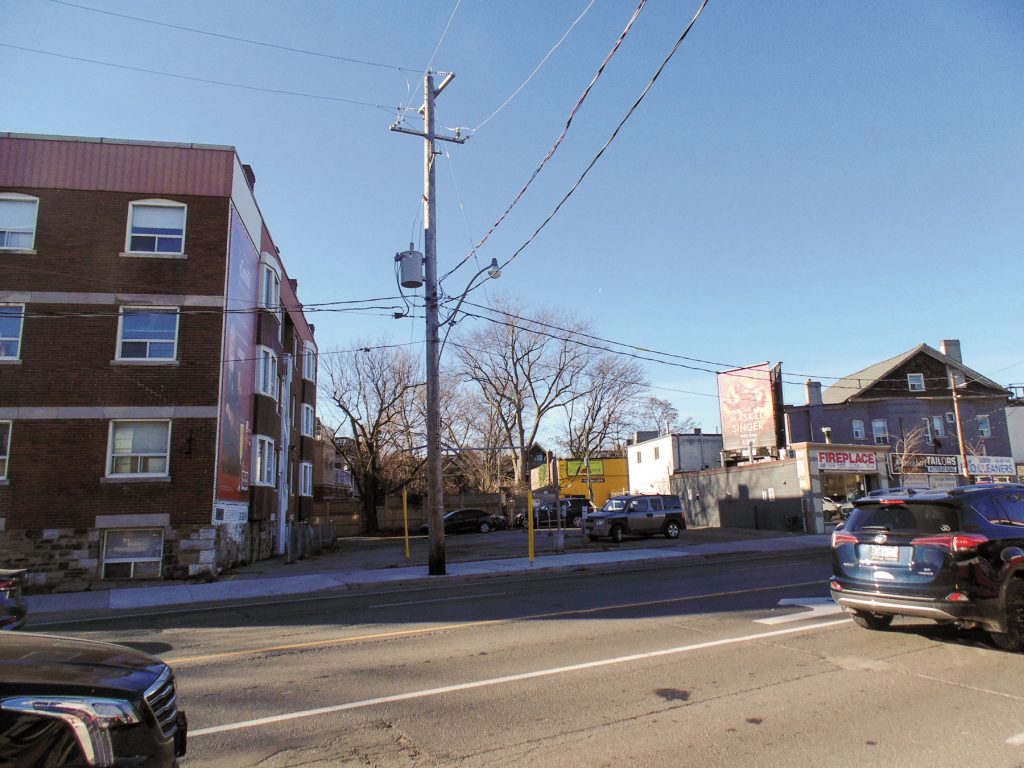
The trapezoidal-shaped lot here on Davenport is a challenge to squeeze density into. BRIAN BURCHELL/GLEANER NEWS
By Tanya Ielyseieva
A unique 7-storey mixed-used building from the developer Bianca Pollak is set to rise for 361 Davenport Rd., near Dupont.
If approved, this development will rise above an existing trapezoidal-shaped paved parking lot at Dupont and Davenport and include 16 residential suites. The development proposes a mix of six one-bedroom units, nine two-bedroom units and one three-bedroom unit ranging in size from 538 to 1,571 square feet. A commercial office is planned for the 60 square metre ground floor. The total gross floor area will be 1569 square meters.
“The proposed building would be constructed with a variety of materials and textures which shall not only help in breaking up the perception of building mass but also provide a standard of aesthetic which can be appreciated in the given aspirational value of the neighbouring context. The 3-storey high base building facade on Davenport shall be primarily composed of aluminum brise-soleil while the facade above shall be a combination of sky-grey stone finished solid walls and transparent glazing for openings,” stated the application by KFA Architects and Planners in September 2020.
The proposed height of the building is 24.7 metres, and the mechanical penthouse will rise another 5.4 metres above the roof of the 7th floor for a total height of 30 metres.
“Due to the smaller size of the lot and limited footprint, a unique form has been proposed for the building allowing it to respond in scale to the context, especially on the western side of the property adjoining the neighbourhoods,” stated the application.
Vehicles would enter the one-level automatic underground parking garage through the private one-way lane on the North side. This double-stacked parking system will house 13 parking spaces, 12 resident and one visitor. The rear entrance around the centre will have space for 20 bicycles, 16 long term and four short term.
This building will not require a loading and garbage pickup space as it will only include 16 residential units.
The current proposal is a result of cooperation and revisions between the Annex Resident’s Association (ARA) and the developers.
“I can say that we put a lot of effort to accommodate not only our client but the entire community too,” said Stefano Pujatti, founder of architecture firm ELASTICOSPA+3, in an email to the Gleaner.
According to Gillian Bartlett, ARA’s Communication Director and a member of ARA’s planning and development committee, the company originally wanted to build a 9-storey building and the project was considerably reduced in scale during the consultation process. Nonetheless, Bartlett believes that the application was “sloppily prepared, in a hurry.”
“They have understood that everybody said this nine-story thing just doesn’t fit in. It’s like trying to shoehorn an elephant into a mouse hole, kind of work. They could not come back to us with this seven-story one, instead, they went straight ahead and went into the application process. We haven’t had a chance to talk with them about that. They obviously listened to the fact that there’s no way to get their nine-story done. However, they haven’t come to chat about the seven-story,” said Bartlett.
In 2011, the City of Toronto approved two development proposals for three net-zero townhouses and then in 2017 they approved another development, for three freehold townhouses. However, according to Bartlett, the past developers chose not to build but to sell the land at a higher value.
The land was sold for $1,700,000 in 2012, then for $2,180,000 in 2017, and finally it was bought by Pollack designs in 2019 at $3,200,000.
“Truth to tell, we’d have loved to see three townhouses on the site, but as it gets flipped for increasingly high amounts, a real plague, in my personal estimation, in this city, developers naturally want to squeeze every penny they can from the lot without any larger, publicly informed sentiment. Trust me – if I won the lottery, I’d buy that land and turn it into a forested park. But obviously, that’s not gonna happen!” said Bartlett in a letter to the Gleaner.
Comments Off on NEWS: Seven storeys proposed for Davenport/Dupont (Dec. 2020)Tags:Annex · News
December 21st, 2020 · Comments Off on NEWS: Holiday giving adapts to COVID-19
Westbank Corp. donated $5,000 to the Winter Table program at St. Peter’s Church on December 19. The developer was unable to host the neighbourhood turkey giveaway this year due to Covid-19 restrictions. Shown are (left to right) Richard Tone (Winter Welcome Table, St Peter’s Church), Father Michael McGourty (St Peter’s church), John Lee (Westbank), Councillor Mike Layton, Mario Catarino (Winter Welcome Table, St Peter’s Church), Ian MacLeod (Westbank), Michelle Naray (Westbank), and Carla Cameira (Winter Welcome Table). COURTESY WESTBANK CORP.
Due to the current public health safety restrictions, Westbank Corp., the developer of the Mirvish Village project, was unable to host its annual turkey giveaway this year.
For 28 years the Mirvish family hosted a turkey giveaway out of Honest Ed’s and Westbank picked up the tradition in 2018. More than 1,000 turkeys were given away by Westbank Corp. each year in the first two years of its program.
This year Westbank partnered with the Winter Table program at St. Peter’s Church (840 Bathurst St.) in partnership with St. Joan of Arc Parish at Bloor and Keele streets to donate $5,000 for the program. It not only paid for all of Winter Table’s takeaway meals on December 21, but hopefully will pay for meals for the remainder of the winter season.
The December 21 Winter Welcome Table will provide a full turkey or ham takeaway dinner to all those who come to receive one. Leftovers will be delivered to local shelters for their residents. The Winter Table program has run for over 25 years, and provides meals every Monday night for those in need from November to March.