May 12th, 2021 · Comments Off on LETTER TO THE EDITOR: “On the road to a roof over his head” (Apr. 2021)
Things are looking up for Jeff Reid, who has finally found a home
Jeff Reid can now afford the market rent at his new home, thanks to a provincial subsidy called the Toronto Transitional Housing Allowance Program: Homeless Stream. In his letter to the Gleaner, he shares a few suggestions for making the shelter system more welcoming to Toronto’s homeless population. NICOLE STOFFMAN/GLEANER NEWS
Hi! It’s me, the guy on page 7 of the [March edition] of the Gleaner! I have received so many comments about the article, it’s unbelievable. Instead of walking by me like I don’t exist, more people are treating me like I’m actually real or something! So happy!
A little update: I’ve been accepted into housing, so my last days on the streets will be the first week of May. I’m looking forward to getting cleaned up, getting a new wardrobe, taking a week’s worth of showers, sleeping for four straight days, and being fresh as a daisy once again.
A note to the City of Toronto’s Shelter Support and Housing Administration (SSHA): invest in cameras. Desperate people steal from other shelter residents to get money for their fix. That’s a fact.
Secondly, the lockers shelters provide so guests can keep their valuables safe don’t do much when people pick or break the lock. Invest in cameras for those too. For lockers that staff must open, I suggest the SSHA make new staff wait before they’re permitted to open them. Let them get to know the residents before they go unlocking Greg’s locker for Terry because Terry said he was Greg. It happens all too often.
By and large, shelter staff are good-hearted people who want to see positive change for their clients’ lives. They are railroaded with the care of various numbers of homeless people in close quarters under a system that is overlooked or ignored as ‘good enough,’ and I send my respect to every one of them.
The solution, then, would be to change the clientele. How do we do that? I suggest shelters adopt zero tolerance drug and alcohol policies. Some of the best shelters I’ve been to were in Newmarket, Moncton, and Halifax, to name but a few, where if you came back intoxicated, you slept it off outside. There were still thieves but the junkies couldn’t come in. Nowadays it seems like shelters are introducing harm reduction into everything, and it’s doing nothing to solve the problem of shelter crime.
In the current system, it’s up to the resident to secure their own belongings. You may think this is fair, I did too. Two winters ago, when it was too cold outside for my dog, I stayed at the winter respite at the Queen Elizabeth Building at Exhibition Place. The large warehouse-style building had over 200 residents crammed together in one very large room. There were five security guards for the entire place, or one guard for every 40 people. This was anything but safe.
While I was there for a grand total of two days, I witnessed a man steal another man’s cell phone. When the victim went to retrieve his property, the thief put up a fight. Security mistook the victim as the aggressor, put him down and brought him to the back for the police to arrest. When the thief asked for “his phone” back, security gave him the victim’s phone and no more was made of the actual crime that I witnessed. The poor guy lost his phone, his dog got picked up by animal services, and he most likely had to spend time in jail for failing to protect his property. I attempted to clear things up but was told to “stay out of it.” Is this what passes for justice?
I can’t blame the security in this instance. I have a security background, I’ve worked the industry, and five guards for over 200 people is completely unacceptable. No private company would ever allow such a tiny detail to guard a mall or even a larger store, but when it’s a public respite for homeless people, a lower standard is applied, and this happens. No one should be expected to look after more than ten people at the best of times. Throw in drugs and desperation and the security detail is so far stretched that their effectiveness is negligible.
I wish I could say this is an example of the worst that happens and it’s a rare occurrence, but it’s not. Most times I went out for a smoke there were residents either fuming or in tears over theft, violence, threats, or abuse of some other sort.
If you’re a heavy sleeper, like me, you risk being stolen from in your sleep. I once had a mattress stolen out from under me. These seem to be things you just have to accept as a fact of life to successfully stay at shelters.
So, I guess I should take this time to reflect on my time out here. I’m not going to lie, I loved it. From the friendly community to the free food at the end of the night, the Annex has been extremely good to me and I am eternally grateful for the tolerance and hospitality of the neighbourhood. The Annex is always my recommendation to visit if and when you hit Toronto because it really feels like home; and y’know? It really does.
May 12th, 2021 · Comments Off on FOCUS: Another legal weed shop heading to Bloor Street (Apr. 2021)
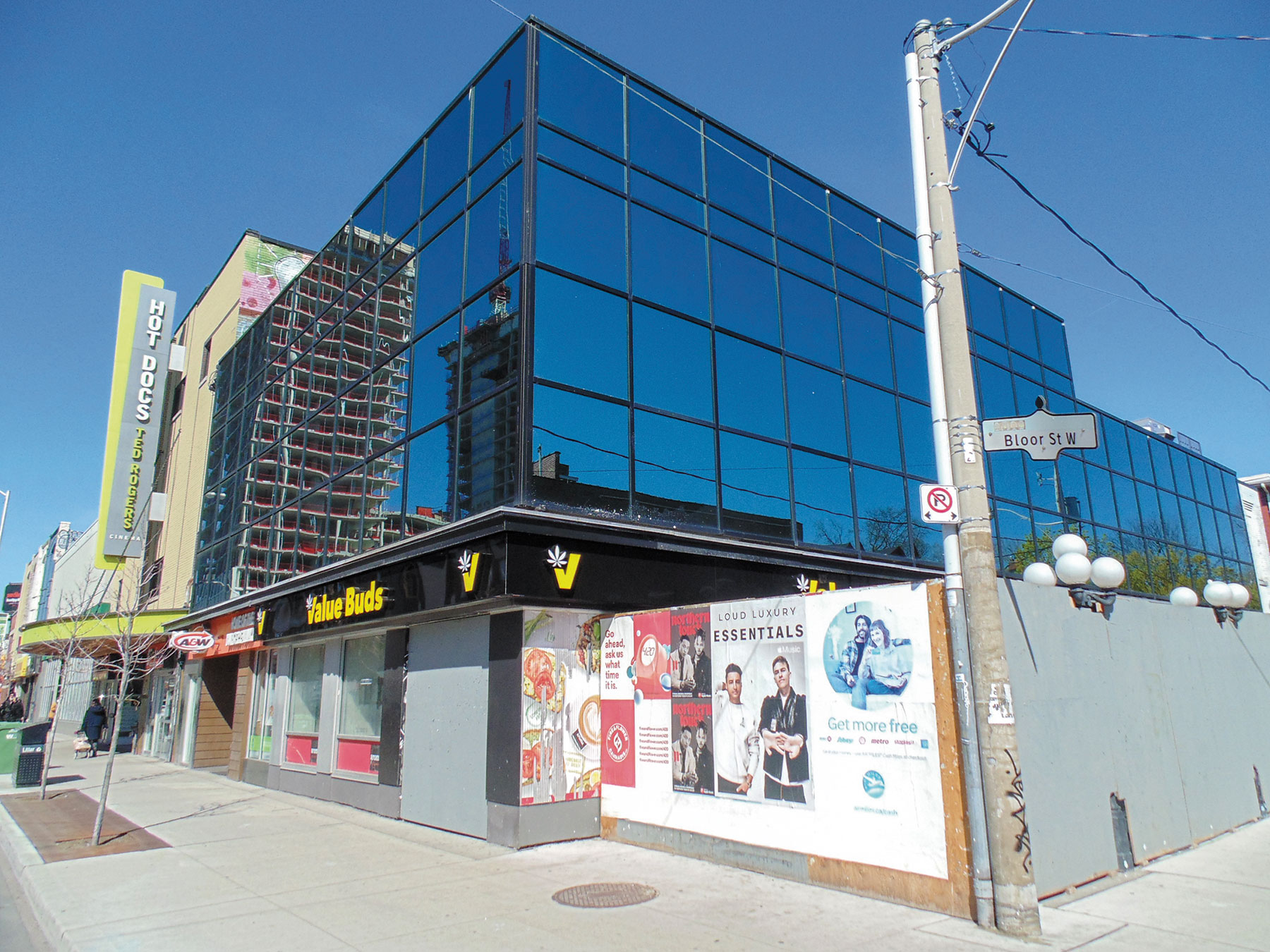
Value Buds to open where Aroma Coffee operated
Value Buds is moving into the former home of Aroma Coffee at 500 Bloor St. W. LUCA TATULLI/GLEANER NEWS
By Luca Tatulli
The legal cannabis business is booming in the Annex. Value Buds, whose slogan is “get high, spend low,” is opening at 500 Bloor St. (the site of the former Aroma Coffee shop) – just a few doors down from Tokyo Smoke, a store whose aim is to provide an “education first” approach to the cannabis business. The business people behind these storefronts stand by their belief that their businesses will succeed, despite what some may call market saturation.
“What’s really key about our stores is it’s not about selling cheap weed, it’s about selling good weed cheaply,” said Darren Karasiuk, CEO of NOVA Cannabis, the company that owns the Value Buds chain.
Value Buds has one store at 499 Queen St. W. and is in the process of opening two others on Queen, one on the Danforth and one at Bloor Street and Landsdowne Avenue. NOVA Cannabis also has a total of six pending applications for stores in Ontario according to the Alcohol and Gaming Commission of Ontario website.
With this explosion of new storefronts dedicated to cannabis, some residents are wondering whether the Annex is set to become “cannabis central.”
“My only concern is that these will be vacant storefronts in six months time. There is not enough market demand to support what is a commodity product and one which can be easily serviced online. Weed is not really an impulse good,” said Annex resident Carlo Timpano.“It can be stored for long periods of time, there is a mild sensory aspect, but not really. It would be great if there could be a food and beverage component.”
Value Buds’ location is the former home of Aroma Espresso Bar, which had a large patio space. Some residents, including Vanness Mirovic, have questioned the “wasted” space.
While Timpano supports the idea of opening a store like Value Buds he thinks the over abundance of cannabis stores will lead to more empty storefronts along Bloor Street. This concern has led to further opposition from residents, who would rather see the storefront used for a restaurant or café.
Despite the concerns from residents, Karasiuk remains optimistic that the Value Buds brand will succeed in the Annex and Toronto due to his company’s extensive experience in the cannabis industry. He cities the Value Buds brand having previous experience in the private liquor market in Alberta. Karasiuk believes this experience in the liquor and cannabis market will translate into success with Value Buds.
“Value buds is backed by a very well established private liquor retailer based in Alberta,” says Karsiuk. “So we have over a quarter century worth of experience in retailing, regulated products, and having deployed similar strategies in liquor retailing.”
Currently there are around 264 applications for cannabis stores across Toronto, according to data from the Alcohol and Gaming Commission of Ontario.
May 12th, 2021 · Comments Off on ARTS: Cream cheese and Covid Culture (Apr. 2021)
Your May 2021 Arts Brief
In Dream Scenes, photographer Martha Davis allows seniors to fulfill their wildest fantasies thanks to the magic of green screens.
By Meribeth Deen
May 16th, 2021 is a Sunday, and in all likelihood, you will not be going anywhere, certainly not to a museum or concert. Maybe, maybe… you will go to a park.
So why not eat carrot-zucchini bread covered in cream-cheese icing, just because you can? And because you do not have any plans to go anywhere, you may as well make it yourself. If you get on it, you can even have the expert tutelage of award-winning cookbook author and columnist Amy Rosen. Just go to the Miles Nadal JCC’s site for Tikkun Leil Shavuot, an annual festival of Jewish learning open to people of all backgrounds.
If you don’t like cream-cheese icing, carrots or zucchini, you should still check out the Tikkun Leil Shavuot site because the opportunities for learning (and enjoying) between 6pm and midnight are practically endless.
Are you going crazy thinking about how to fight racism? Join Tema Smith in a conversation about how we can root out racism. Tema is mixed-race and Jewish, and her experience has led her to work towards creating a more racially inclusive and equitable Jewish community. If a conversation on queering Jewishness, or queering families is more your speed, you’ll find that conversation too. Maybe you want a more general conversation on ethics? You’ll find it at Tikkun Leil Shavuot.
If your brain craves a break from conversations about community, spirituality and philosophy; devising a strategy to excavate the details of your family history; or learning Yiddish, there are also opportunities to put your hands to work. Art Therapist Or Har-Gil will lead a meditation and reflective art exercise on the theme of revelation. Participants will wander through their own wilderness before they make their way to “the sacred centre” to receive divine wisdom.
Basic art supplies (paper/notebook, pencil crayons, markers or pastels) required! OR grab your scissors and join artist Bareket Kezwer in this hands-on workshop where you’ll learn about the lost art of Jewish paper cuts.
And if all of that just sounds like a bit much for your pandemic weary mind, head over to the JCC’s virtual gallery and cruise through the photos in Dream Scenes.
Running until June 30, this exhibit takes portraiture to a new level by empowering senior citizens to fulfill their dreams virtually, using the magic of the green screen. Don’t we all need a reminder that dreams really do come true – but in the strangest ways?
The Miles Nadal JCC is just ONE of 22 organizations that make up the Bloor Street Culture Corridor, and each one of them is working hard to keep making life interesting, despite restrictions.
Make a point of browsing the listings and keep “getting out there” in whatever ways you can.
Comments Off on ARTS: Cream cheese and Covid Culture (Apr. 2021)Tags:Annex · Arts · Life
May 12th, 2021 · Comments Off on GREENINGS: More greenspace, fewer cars (Apr. 2021)
Let’s not go back to unhealthy “normal”
By Terri Chu
While we all wait for vaccines to bring us back to some sense of “normal” (don’t hold your breath as the variants might beat us at this game), let’s take a moment to reflect on how much normal really sucked: for so many Torontonians, “normal” meant sitting in the car for hours just to get to work.
Despite six decades of warnings, we have not managed to get a hold on atmospheric climate change.
The promise of cheap energy was supposed to free us of our labour and give us time to enjoy ourselves.
Instead, we got busier and used that cheap energy to move further and drive longer distances. Hopefully a “new normal” that starts with working from home can reverse this trend.
Slowing down, if we can pull it off, will be bad for an unsustainable economic system dependent on infinite growth and consumption, but the reality is that none of us will suffer an iota when it comes to our standards of living. In fact, we will enjoy what we have much more of and free ourselves from the pointless grind of consumption, garbage creation and sitting in traffic.
We will be able to focus on our interactions with others, our experiences, and physical and mental health. A post-COVID-19 economy based on people, not stuff, is possible, but none of this is feasible without massive investments in transportation. As we discovered during lockdown, we don’t need very much stuff at all to meet our basic needs, and the thing we missed more than anything is social interaction, not material accumulation.
Social interactions, experiences, physical and mental health activities mean that we need to get around, both within the city and outside of it. Doing it all by car will simply get us back to the choked-up world of traffic congestion: this is not the normal we want.
We need to get people out of cars for short distances, particularly for things like grocery and errand runs.
What is stopping us from having publicly available light vehicles (think glorified golf cart) for small grocery runs? Vehicles that are lightweight, not terribly fast, not terribly dangerous (unlike cars) and relatively easy to operate could decrease so many short trips currently made by car.
Where are the city-run cargo bikes at the bike share? Why is transit still so expensive?
Taking your family for brunch by car will cost pennies for gas since there is so much free street parking, but would cost you over $20 in public transit fees.
Imagine a Toronto with such decreased traffic that we could reclaim roads for green and public spaces.
Instead of yelling at our children to watch for cars the moment they step out the door, we could turn our backs and let them run into community gardens or a local piazza the moment the door opens.
We have come to normalize so much going to the car that we can no longer imagine what life could be like if we didn’t give up so much space to these murderous polluters.
COVID is a perfect opportunity for us to rethink our car-centric society and build a better future. Normal was awful, and we don’t want to go back to it, but unless we put money into building a society that will support our need for human interactions, experiences, and recreation, that’s what we’re stuck with.
March 26th, 2021 · Comments Off on ON THE COVER (Mar. 2021)
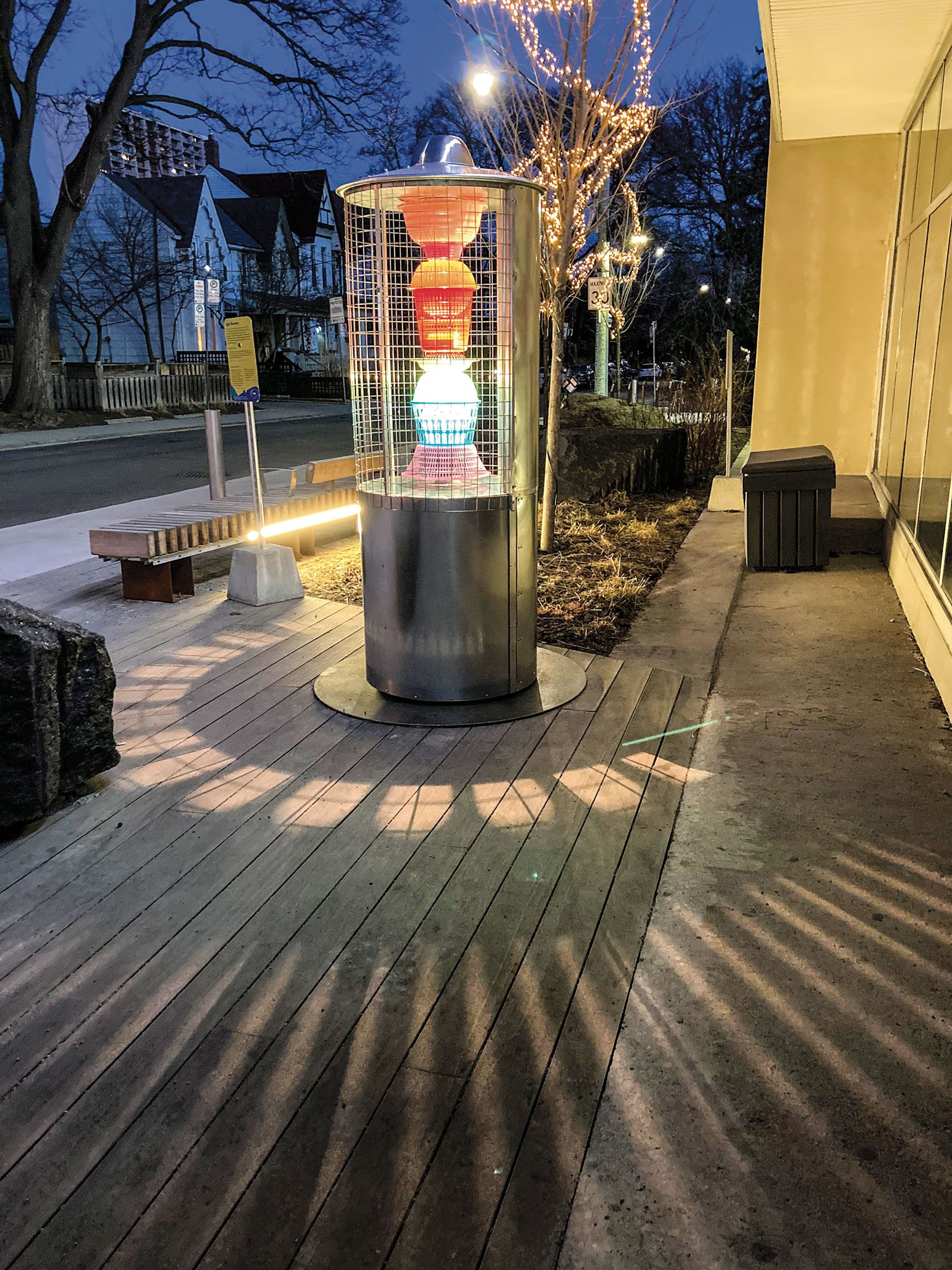
The Bloor Annex BIA, in partnership with STEPS Public Art and local artists Chris Foster and Layne Hinton, has transformed three of their new parkettes into lighting spectacles. These kinetic installations use bright light sources that slowly pass through a long column of common kitchen colanders. The patterns create dynamic projections that shift as the light passes through in a gesture to the diversity of restaurants that are a staple of the Annex. On site along Bloor St. at Robert St., Major St., and Brunswick Ave. until May 31. COURTESY MELANIE RAMSAY, BLOOR ANNEX BIA
March 26th, 2021 · Comments Off on NEWS: Bike lane refresh for Davenport (Mar. 2021)
Updates would mirror protected bike lanes on Danforth
By Luca Tatulli
In 2015, a young cyclist named Adam Excell was killed in a hit and run at the corner of Avenue and Davenport roads. Between 2016 and 2020, there were 27 more collisions involving cyclists and pedestrians on Davenport. Now Magazine placed this bike lane on its list of the city’s worst. However, the City of Toronto is hoping upgrades can improve the safety of the area. They outlined their plans during a consultation meeting on Feb. 4.
Their proposal would involve turning existing bike lanes on Dupont and Bay streets into protected lanes or cycle tracks located next to roadways but separated by physical barriers. New pavement markings will replace fading ones. The proposed upgrades would mirror the protected bike lanes on Danforth Avenue.
The upgrades would also see bus-bike platforms installed at the major intersections of Davenport Road. The platforms would create a space for cyclists and passengers boarding and disembarking buses.
The platforms would be separated by a yellow line. Pedestrians would wait outside the line and could only cross when getting on or off buses.
Cyclists would also have to yield to pedestrians.
If approved, the proposed upgrades will be installed by this summer. The city says the projected cost for the upgrades is between $150,000 to $200,000.
“With the passage of time, the bike lane is clearly deficient along Davenport. Number one, in many places, it’s too narrow, it’s got parked cars overlapping onto it,” says Albert Koehl co-founder of Bells on Bloor. “In other places, the bike lane has faded, you can’t even see it anymore and also importantly, it’s not a protected bike lane.”
Koehl supports the proposal and says he foresees limited opposition to the project.
“I’m not expecting to see much opposition, in part because it’s an upgrade as opposed to a new lane,” said Koehl. “But more importantly, because of the trend that we’re seeing across the city towards more support for walking, cycling and transit.”
However, some local residents are already voicing concern.
“I’m not concerned with the bike lanes I just think this is a poor choice of a route for that simply because it is a pretty major connecting roadway,” said Frank Marra, the moderator of the Toronto Car People Facebook group and an employee for an architectural firm in the Annex.
The deadline for public feedback on the project upgrades ended on Feb.18.
A report to city council and its Infrastructure and Environment Committee will be filed in March. If approved by city council, construction on the project would start by summer.
Comments Off on NEWS: Bike lane refresh for Davenport (Mar. 2021)Tags:Annex · News
March 26th, 2021 · Comments Off on NEWS: Community input changes Bloor/Spadina build (Mar. 2021)
Developer returns to the table with a 35-storey plan for corner
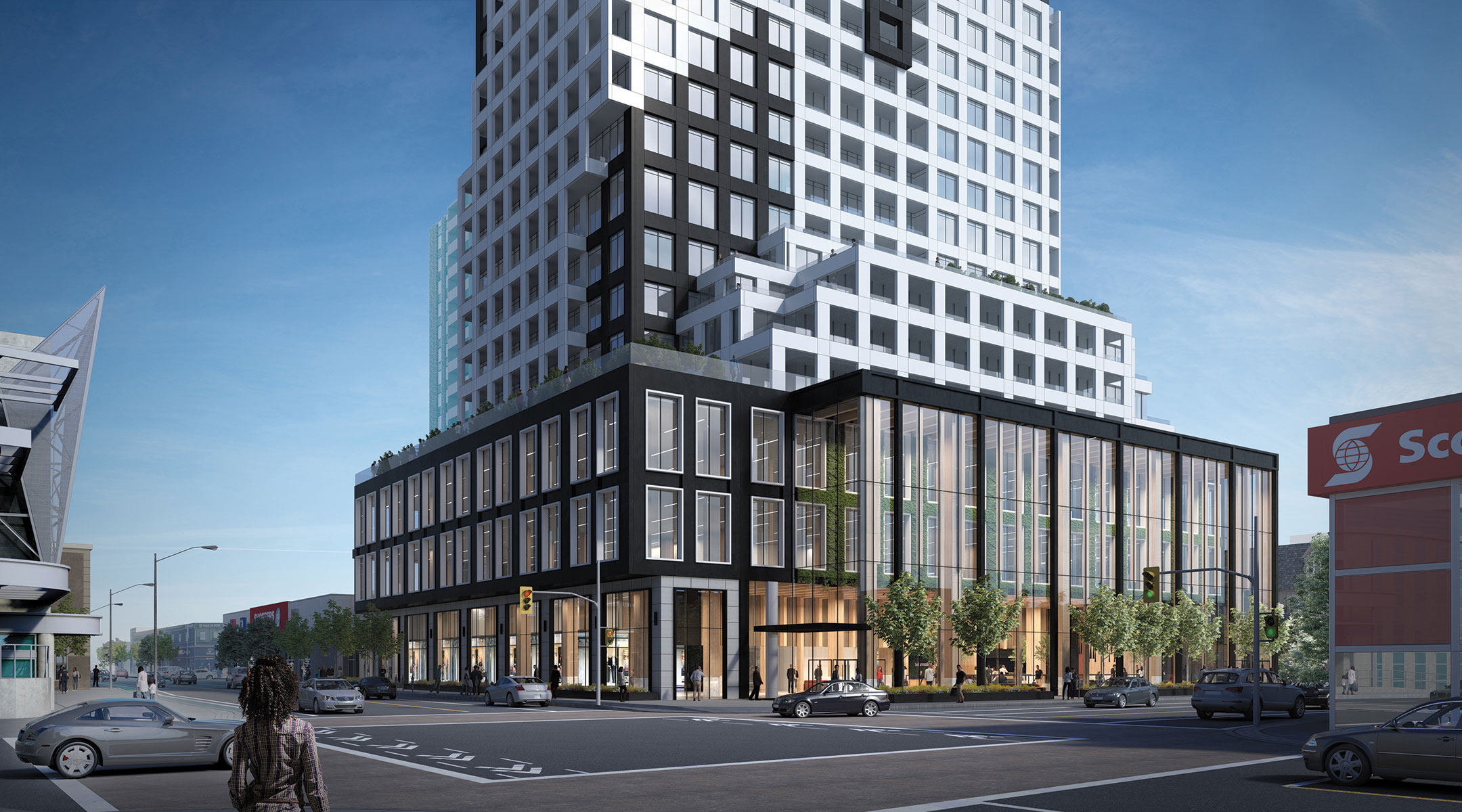
A mix of commercial and residential development is proposed for the northwest corner of Bloor and Spadina. The plan includes a commercial podium. COURTESY IBI GROUP
By Mary An
After four community workshops and some community consultation meetings, the developers of a 35-storey mixed use building proposed for the northwest corner of Bloor and Spadina are confident they have addressed most community concerns.
“I think we’ve really worked hard to understand some of the community input and the issues that were identified. We put forward a development application that speaks to that with those development principles,” said Project Manager Peter Venetas.
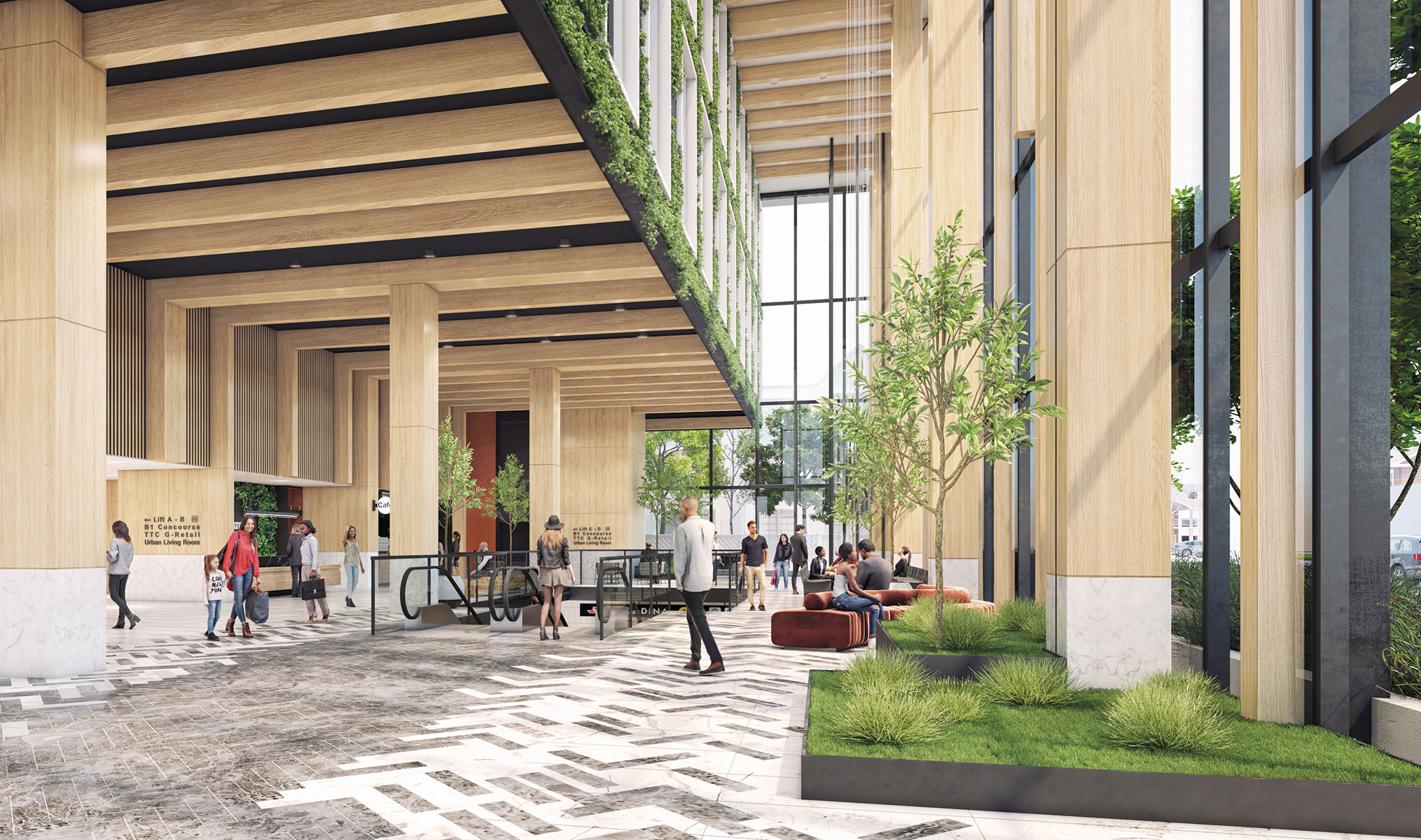
The plan includes an atrium. COURTESY IBI GROUP
The development team – consisting of five different companies – plans to tear down and redevelop the existing buildings at this location.
In a consultation meeting in January of 2020, community members expressed concerns about protecting the view of the Knox College [now the Faculty of Architecture] corridor, shadow impacts, and social housing. In a recent community meeting, the developers addressed all of these concerns and displayed renderings and plans of the proposed building. One rendering was of [the former] Knox College and the minimized impact of the new proposal.
“The idea was to keep the buildings north of College and Spadina below the view corridor of [the former] Knox College when viewed from the northeast and the northwest corners of College and Spadina,” said Senior City Planner Barry Brooks during the meeting. “There is no projection above those at the moment of the proposed building, because the applicant was aware that that was something which should not be breached.”
Within their proposed 35-storey mixed use building there will be 380 residential units and 24 rental replacement units. COURTESY IBI GROUP
The development team also displayed shadow impact renderings of the site displaying how far the shadow would go each month and each hour.
“It’s a very fast moving shadow, not staying in a particular building or area for more than an hour. It is a tall building, and will have some shadow, but I would say the impacts are minimal,” said Mansoor Kazerouni, an architect with the IBI group.
The site currently has a few rental residential units. According to Mike Dror, an Associate of Bousfields Inc., current residents at the site have the right to return to the new building to a unit of similar type, size, and rent. Current residents will also be notified four months in advance to vacate the unit, and will receive a compensation package.
Within their proposed 35-storey mixed use building there will be 380 residential units and 24 rental replacement units. No affordable housing units have been announced.
“We understand what’s happening in Toronto right now, and this project will be subject to a Section 37 agreement,” said Venetas during the meeting. “Whether or not that gets allocated on site or that gets allocated elsewhere in the Ward is probably something that would happen as this process continues forward.”
A Section 37 agreement is a part of Ontario’s Planning Act, which allows the city to ask for better community benefits, such as the inclusion of affordable housing.
Though the developers are confident they have addressed many resident issues with the proposed building, there are still some lingering concerns.
“Toronto will look like a pincushion with these needle towers,” Paul Richard, long-time Annex resident said in an interview with the Gleaner. “What I like about this neighbourhood is that it’s close to the subway, and it’s a nice sort of residential neighbourhood. I don’t want that downtown feel. So, I feel like it’s destroying the residential neighbourhood atmosphere.”
Richard also put an emphasis on quality of life with the lack of and impacted green space this building will bring, due to its position in the neighbourhood. The building will cast shade on Paul Martel Park to the east, Richard said. He also argued that instead of needle towers there should be more green space for the community.
“There’s no point in building more residential buildings if the quality of life in the neighbourhood is very minimal,” Richard said. “We need some long-term planning that’s comprehensive that takes into consideration the environmental heritage, the architectural heritage, cultural heritage, and livability of the neighbourhood.”
The current building at the very corner of Bloor and Spadina was constructed in the pre-war era around 1914. In order to preserve that building, the city must assess its heritage value.
March 26th, 2021 · Comments Off on NEWS: Permanent pad for the Pits (Mar. 2021)
Layton leads the initiative to get skateboarding pad installed quickly
DIY skateboarding ramps and half-pipes in Sid Smith Rink are finding a new permanent home in Christie Pits. COURTESY MIGS BARTULA, CO-CHAIR OF THE TORONTO SKATEBOARDING COMMITTEE
By Mary An
Since 2017, Christie Pits Park has welcomed local skateboarders on Sid Smith Ice Rink during the warmer seasons. With more people looking to get outside and get active with limited feasible options, the “pop-up” skateboarding pad has seen a drastic increase in traffic. However, the skate pad echoed loudly, being surrounded by wooden rink boards. This resulted in a lot of community tension, since it was at the edge of the park very close to homes.
“It’s noisy, really noisy,” said Councillor Layton. “It’s not people noise, it’s constant banging, over and over again. You can imagine, like seven days a week of being up until 11 p.m. because your windows are open and can hear the noise from your windows.”
Layton said that changing it to a single, flat concrete pad, affixing obstacles to the ground, and moving the skate pad further away from homes should address the noise issues. The new pad will “allow stakeboarders to create another DIY space for immediate access,” he said. Skakeboarding will no longer be allowed in Sid Smith Rink.
Nearby resident and coordinator of Christie Pits Skateboard Park, Raelynn Pluecks, proposed the pop-up park and coordinated with the Toronto Skateboarding Committee and local volunteers to build the ramps and half-pipes that have enjoyed so much use over the past year. She says the park was necessary due to a lack of skateboarding facilities in Toronto’s west end.
“To be able to go to an existing concrete park, it takes about an hour and 15 minutes on transit,” she says.
In the fall of 2020, tensions over the pop-up park were running high in the neighbourhood. In his motion to council proposing the creation of a concrete skatepad at Christie Pits, Councillor Layton wrote that “Parks Operations staff, my office, those involved in the Christie Pits DIY skate park, and local residents have been meeting for the last three months to try and get a better handle on the noise, but with limited success due to the acoustics created by the rink boards and positioning of the rink.” He also wrote that the amenity and its use are “too great to lose for any extended period of time.”
Layton says with the project approved, his goal is to set records with its implementation and to have it operational at the beginning of the next skateboard season.
The city gained public consultation last fall through an online survey to get a better sense of what the community thinks of a permanent skateboard pad within Christie Pits Park. In a newsletter Councillor Layton sent out on February 5, he states that out of 575 completed surveys, “89.2 percent of responses are wanting to see a permanent, dedicated space created at some point in the future.”
The newsletter also identifies three potential locations, far away from homes to address the sound issue, for the permanent skate pad within Christie Pits Park: the area south of the soccer field, the area east of the washroom building, and the area west of the basketball court. All locations would need a certain amount of concrete and lighting to ensure visitors have enough space and light all year round.
According to Pluecks, there is some concern with the space of the permanent skate pad, as the proposed locations offer a significantly smaller footprint than the pop-up skateboarding pad on Sid Smith Ice Rink. Increased skateboarding traffic is also expected because the skate pad at Dufferin Grove Park is currently under construction.
Councillor Layton’s February newsletter contains yet another survey seeking input on the new skate-pad’s location, orientation and size.
“We are trying to maximize the amount of space and minimize the amount of paving that has to be added to the park,” says Councillor Layton.
March 26th, 2021 · Comments Off on CHATTER: Runners Shop keeps the pace during pandemic (Mar. 2021)
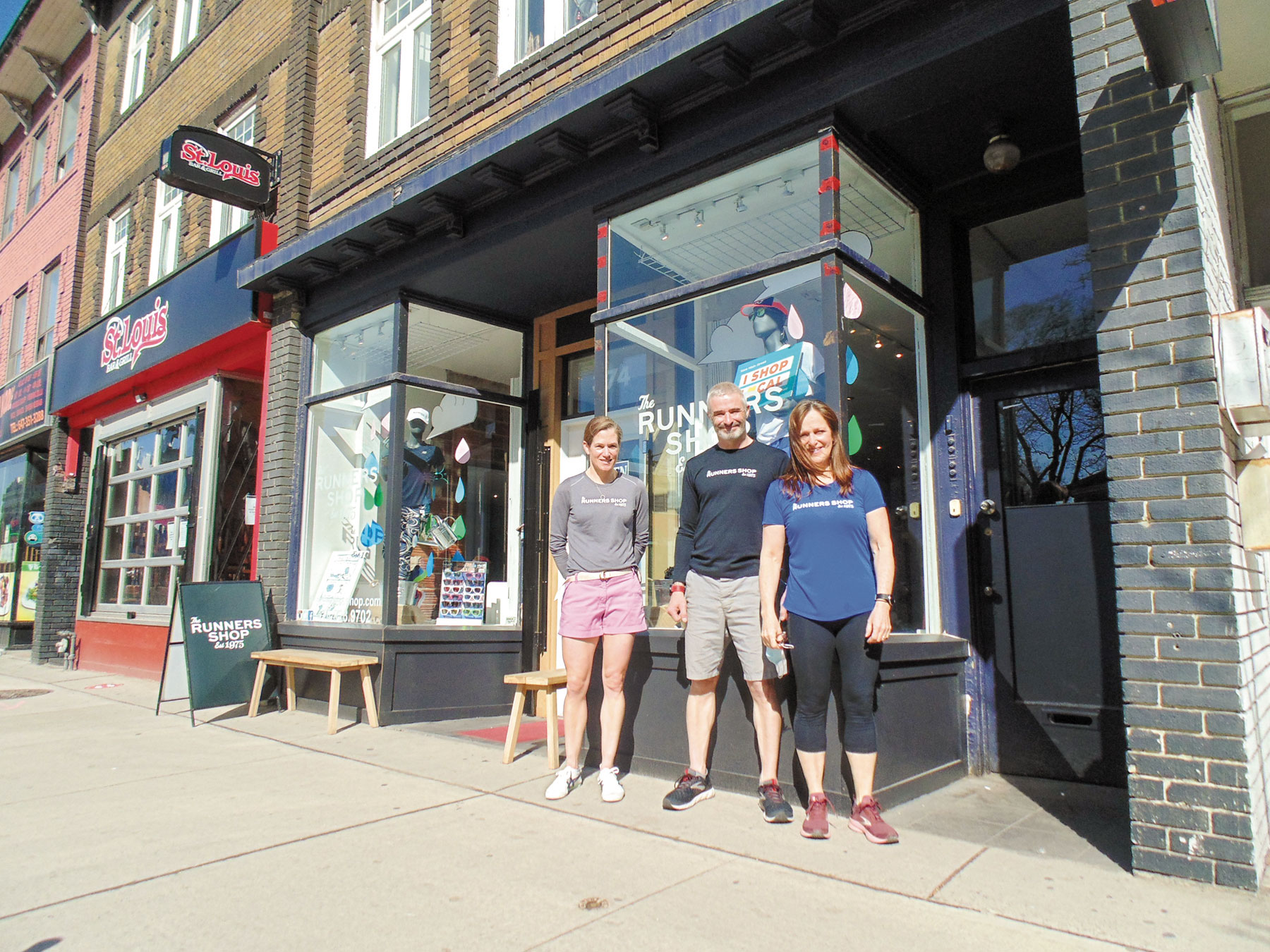
The Runners Shop team, celebrating one year in the Annex, includes (from L to R): Tara Lapstra, Greg Lindsay, and owner Lynne Bourque. BRIAN BURCHELL/GLEANER NEWS
March 2021 marks one year since the start of the first lockdown in Toronto under the COVID-19 pandemic in Toronto. It also marks a year since The Runners Shop moved to a more visible location at 374 Bloor St. W. The store’s opening came on February 18, just four weeks before the first lockdown.
As the community aspect of running was put on hold last spring along with the city’s marathon season, The Runner’s Shop was able to step-up as a community hub for everything related to running during the pandemic. Lynn Bourque along with her team of experienced runners, Greg Lindsay and Tara Lapstra, were able to provide a coaching-type customer service along with their curbside shoe fittings.
“We’re here to serve, that’s what I’m most proud of,” says Bourque, “I want this to be a place where people feel welcome.”
The shop-local movement has been a determining factor in the shop’s success, though Bour-que commends the Annex community for supporting local businesses even before the pan-demic.
Despite the need to physically distance, many new runners joined the scene as gyms and team sports closed down.
“The great thing about running is that it’s simple, all you need to start is a pair of shoes,” says Bourque, who adds that the right running gear can make a world of a difference in terms of comfort. The shop offers all sorts of apparel and shoes meant to make the process of running as smooth as possible. Bourque pointed out a windbreaker with a channels made to wick away sweat as soon as possible, proving the apparel to be more for technical than aesthetic purposes.
The Runners Shop was first opened in 1975 by David Ellis, an accomplished runner. Though many things about running have changed about the sport since then, the thing Bourque says she most loves about it is its growth towards inclusion.
“The first Olympic women’s marathon wasn’t held until 1984,” she says. “Which means that women wouldn’t have been able to set their sights on this event when Dave opened the shop.”
In terms of getting started as a runner, Bourque urges people to connect with a friend who wants to do it too, or get your kids involved. Also, the one critical mistake she says many new runners make is that they out-distance themselves.
“Consistency is key,” she says. “As is taking breaks and building in recovery time.”
Queen’s Park, Christie Pits, King’s College circle, the Central Tech track, Bickford Park, and the ravine behind Casa Loma are some great places to get started. For more advice, call the shop at (416) 923 9702. The shop’s Facebook page is regularly updated @RunnersSHOPTO.
—Nabahat Hussain/Gleaner News
Comments Off on CHATTER: Runners Shop keeps the pace during pandemic (Mar. 2021)Tags:Annex · News
March 26th, 2021 · Comments Off on CHATTER: “One-legged stool” build plan quashed on Prince Arthur (Mar. 2021)
After years of opposition, many Annex residents relished the defeat of a proposed development on 64 Prince Arthur Ave. The proposal was brought to the City of Toronto twice – the first time as a 29-storey condominium building with luxury rentals, the second time as a 19-storey building. In both instances, the design was one of twisting steel and glass that would have stood in stark contrast to the low-rise brick and vine neighbourhood. At the end of January, the Ontario Municipal Board (OMB) wholly dismissed the developers’ appeal.
“In summary the Tribunal finds the development proposal akin to a one-legged stool: it is built solely on the locational attributes of the subject lands,” wrote the OMB.
Councillor Joe Cressy of Ward 10 was one of the project’s most vocal opponents and in a 2018 meeting he told the developer, ADI Development Group, that the project was one of the ugliest he had seen in his time at city hall and “the city will not allow this.”
The current 2-storey building at the proposed development site is a vacant medical office. Currently ADI has not specified any future plans for the site.
—Luca Tatulli/Gleaner New
Comments Off on CHATTER: “One-legged stool” build plan quashed on Prince Arthur (Mar. 2021)Tags:Annex · News
March 26th, 2021 · Comments Off on EDITORIAL: Organization, not talk, needed for vaccine roll-out (Mar. 2021)
We called in the army to fight COVID-19, then hired a retired general to lead the vaccine roll-out. Now, as the process stumbles forward, the general’s off with a pat on the back from our noble premier. At a press conference announcing the end of General Rick Hillier’s contract, Premier Ford told the press, “I tried to get him to renew (his contract) but, as he said, ‘Doug, I did the job I came for, we got everything set up.’’’ Yet here we are, with fewer than three quarters of our seniors over the age of 80 vaccinated and the premier still falsely blaming the Federal government for a lack of supply. The governmental incompetence on display is as astounding as it is dangerous.
Our province has been one of the hardest hit areas of Canada, yet we’re among the slowest to roll out vaccines. Ontario’s online portal for registration did not open until March 15, and by then frustrated municipalities, hospitals, and health districts had set up their own systems. So many people and organizations have pushed this roll-out forward – even the Toronto Public Library team has stepped up, calling all members over the age of 70 to help them register for their vaccination – but we have not seen the same commitment coming from our provincial government.
They were pleased to announce recently that they were “ahead of schedule,” and that the 75-80 year old cohort could begin inoculations. As good as that sounds, it is only possible because 30 percent of people over 80 did not get a dose – the prospect of long lines and the perceived risk of infection at inoculation sites served as a major deterrent. Some are homebound and there is no system in place that allows them to get vaccinated.
The province’s “ethical framework” around the vaccine roll-out is supposed to prioritize those people most at risk from COVID-19. The biggest risk factor is age, but police and firefighters have been pushed ahead in the queue. Stating that, “our cops are tops,” does not equate to a public health strategy, rather, it’s an election strategy.
Premier Ford likes to blame the federal government for problems with the vaccine roll-out, pointing to a lack of supply. Those problems have been resolved, the supply chain from Ottawa is set to triple by April. The federal government has distributed vaccines equitably, and the province is not following suit. Toronto represents 20 per cent of the province’s population, has one half of its doctors, and has received only enough vaccine from the province for 6.5 per cent of its population. Haldimand—Norfolk has received 10.8 per cent by comparison.
What we need now is an equitable and risk-based plan to get the supplied doses to the people who need them most. The race is on to get people vaccinated before COVID variants spike. We need someone like Dr. Isaac Bogoch, a top infectious disease specialist at the University of Toronto and member of the task force, to take charge. Science needs to take the lead, not politics.