
Sponsored content – In the windows of “Green Beanery Cafe at 565 Bloor St. W. For more information please visit @arnie_guha on instagram or www.acid4yuppies.com.

Sponsored content – In the windows of “Green Beanery Cafe at 565 Bloor St. W. For more information please visit @arnie_guha on instagram or www.acid4yuppies.com.
Comments Off on Acid for YuppiesTags: Sponsored Content
Comments Off on ON THE COVER: The white elephant (Apr. 2021)Tags: Annex · News
Construction on first Green Line initiative set for 2022
By Mary An
One of the first initiatives within the Green Line is underway. As chronicled in the Annex Gleaner’s February edition, the Green Line will be a five kilometre-long park running along the hydro-electric corridor north of Dupont Street.
There are forty-five land parcels along the corridor which need either improvement, expansion, or a complete transformation into a new park. One of the first parcels of land the city is looking to work on in the Green Line is the Geary Avenue Parkette.
“We want to have green walkable neighbourhoods, and this checks all the boxes. It improves walkability and access to green space and communities that are growing already,” Ana Bailão, city councillor for Ward 9 and deputy mayor said in an interview with the Gleaner.
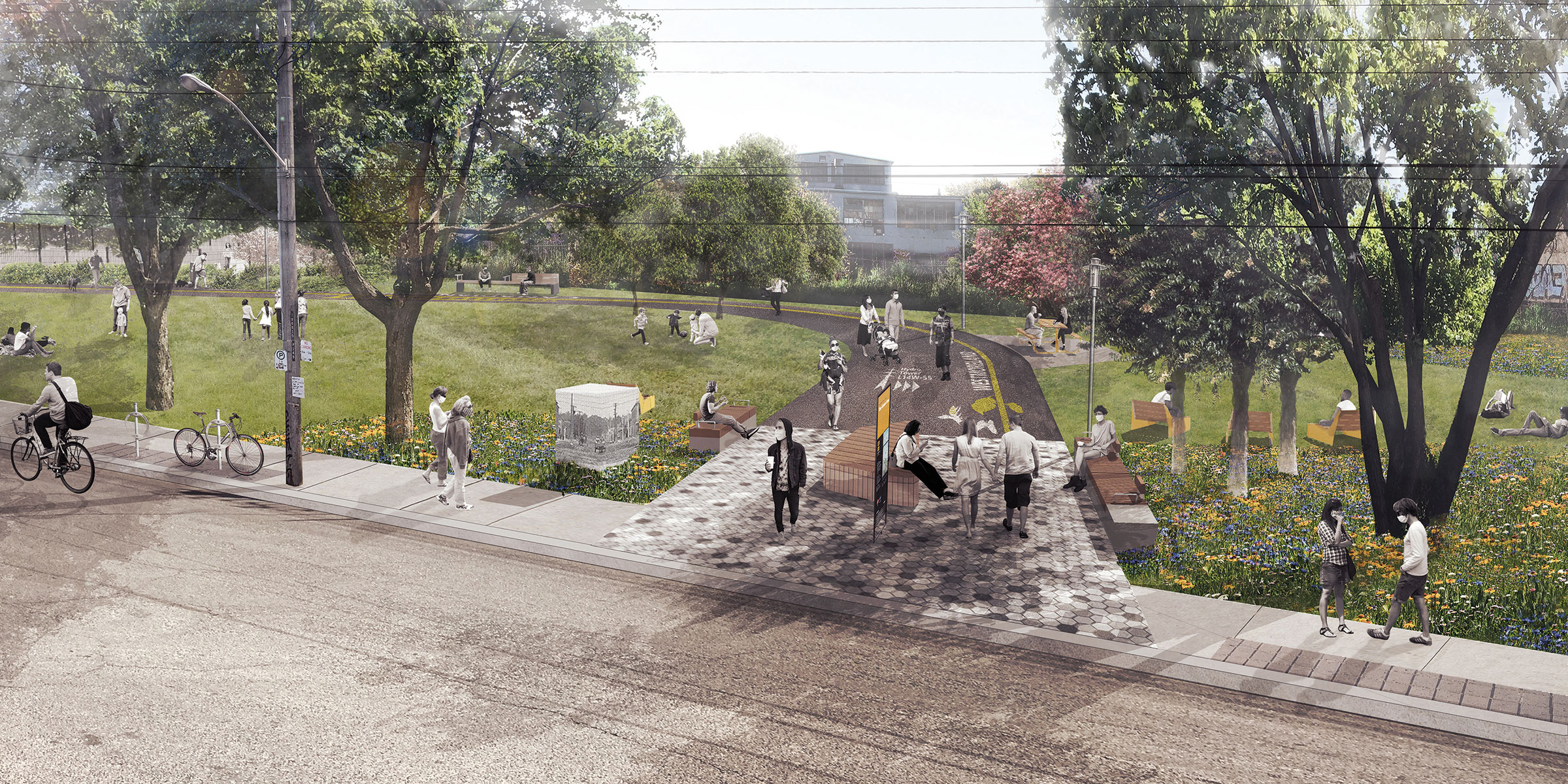
This parkette is located southwest of Geary and Ossington avenues, and extends west to Delaware Avenue North.
The proposed expansion for the parkette will extend west past Dovercourt Road to Westmoreland Avenue North. The city is currently working with DTAH, an architectural firm, to help design the new space.
“We think it’s a great opportunity to provide more accessible pathways and in-park opportunities in the neighbourhood, and especially with a lot of the development being proposed within the area both east and west,” says Yvonne Battista, Associate Partner with DTAH.
According to Battista, new park features will include accessible pathways with pavement designs that highlight the history of the neighbourhood, pedestrian lighting, a variety of seating options, flexible lawn areas, native meadows supporting pollinator species as well as fun graphics sharing Indigenous history, new bike racks, and a much-needed fenced area where dogs will be able to roam off-leash.
DTAH is also proposing to widen the existing sidewalks.
“We heard through the councillor and the community that the speed of cars on Geary Avenue and crossing opportunities are things that need improvement,” says Battista, who added her firm is working closely with transportation services on the pedestrian safety aspect of the project.
During the planning and community input phase of the parkette’s expansion, many residents mentioned the need for a public washroom to be included in the project. However, this request will not be fulfilled.
“One of the challenges we have is working underneath the hydro lines,” says Battista. “Anything that we propose needs to be approved by Hydro One to make sure that we’re keeping their staff as well as the public safe. Which means, at least at this point, that no structures will be built on their parcels of land.”
Construction of this parkette, whose name will be finalized following its completion, is set to begin in 2022.
READ MORE:
Comments Off on NEWS: Geary goes green (Apr. 2021)Tags: Annex · News
By Nicole Stoffman
Seven percent of Ontario tenants, or 98,000 families, can’t pay their full rent because of pandemic-related job loss. They are accumulating rent arrears that many will never be able to repay, according to the Federation of Rental Providers of Ontario (FRPO). In the Annex alone, 16 eviction applications have been made since November.
Three of the applications were made at 50 Walmer Rd., owned by Mountrealco Inc.
According to the Keep Your Rent Campaign, some tenants at 50 Walmer Rd. asked Mountrealco Inc. for rent forgiveness in April, but were offered individual rent deferral plans instead. Some of those tenants declined the deferral plans citing uncertain financial futures, however, tenant organizer Pri Sharma did not grant the Gleaner an interview.
Other eviction applications include one at 245 Howland Ave., managed by COGIR Siteline, and another at 206 St. George St, managed by Better Living Homes. These companies did not return the Gleaner’s request for comment. The remaining Annex eviction applications as listed by Evictions Ontario did not identify the property owners.
The Ontario government stopped eviction enforcement on Jan. 14th, but only during Toronto’s “stay-at-home” order, while allowing eviction hearings to continue. That is why evictions resumed on March 8, when Toronto shifted into “grey-lockdown.”
“It scares me,” says Ria Rinne, from the anti-poverty group ACORN. “Evictions due to inability to pay rent through no fault of the tenant are going to whoosh in and I think we’re going to see more [homeless] encampments.”
The NDPs housing critic, and University-Rosedale MPP Jessica Bell says that informal evictions – where the tenant gets a notice and moves out – have been ongoing through the pandemic.
“The majority of tenants do not want to deal with the expense and stress of the Landlord Tenant Board (LTB),” explained Bell. “So the majority of evictions are informal.”
As for landlords, they are still on the hook for maintenance, property taxes, and other expenses, and don’t qualify for mortgage deferrals, according to the FPRO. However, independent research published by Parkdale Community Legal Services argues that large corporate landlords could forgive rent arrears out of their considerable profits, profits that have continued during the pandemic.
Toronto City Council has taken steps to protect tenants: it has called on the province to stop evictions and all associated hearings, and to provide an emergency rent subsidy for qualifying tenants. In March, the city extended its eviction enforcement moratorium in community housing for three additional months, and approved 15 new affordable housing developments.
The NDP has called for rent support and for the eviction ban to extend 12 months after the pandemic so tenants can rebuild their finances. Bills to this effect were voted down.
“The eviction blitz is on again, even though the pandemic is still raging,” says MPP Bell.
When asked by the Gleaner if they’d consider a rent subsidy program, Matt Carter, spokesperson for the Ministry of Municipal Affairs and Housing, pointed to the Canada-Ontario Housing Benefit, launched in partnership with the federal government prior to the pandemic.
“Over 7,500 households have been approved to date for direct rent assistance payments – with more families receiving approvals every day,” says Carter. “In direct response to COVID-19, we invested $765 million through the Social Services Relief Fund, which municipalities can use towards rent banks and utility banks, and to provide emergency loans for those most in need.”
Carter also pointed to Bill 184, the Protecting Tenants and Strengthening Community Housing Act, which “promotes repayment agreements over evictions,” but tenant advocates roundly denounce it.
They argue the bill gives landlords the right to negotiate a repayment plan, a process normally overseen by the LTB, and if a tenant misses a repayment, under Bill 184, the landlord can evict them without a hearing.
Even the FRPO has proposed a generous rental assistance program called the Ontario Rental Assistance Program (ORAP) which would cover 25% of a qualifying tenant’s rent arrears if the tenant can cover 25%, and the government would cover the remaining 50%.
Under this proposal, the total cost to the government would be $210 million.
FPRO President and CEO Tony Irwin told the Gleaner the Ministry of Housing is “very concerned,” about tenants falling into arrears and asks for regular updates from his organization, who continue to lobby for ORAP.
Another eviction enforcement moratorium was announced by Premier Ford alongside new stay-at home orders on April 7, but as the ban only applies to enforcement, some tenants risk losing their homes as soon as the moratorium is lifted.
Comments Off on NEWS: Tenants at risk of eviction (Apr. 2021)Tags: Annex · News
By Mary An
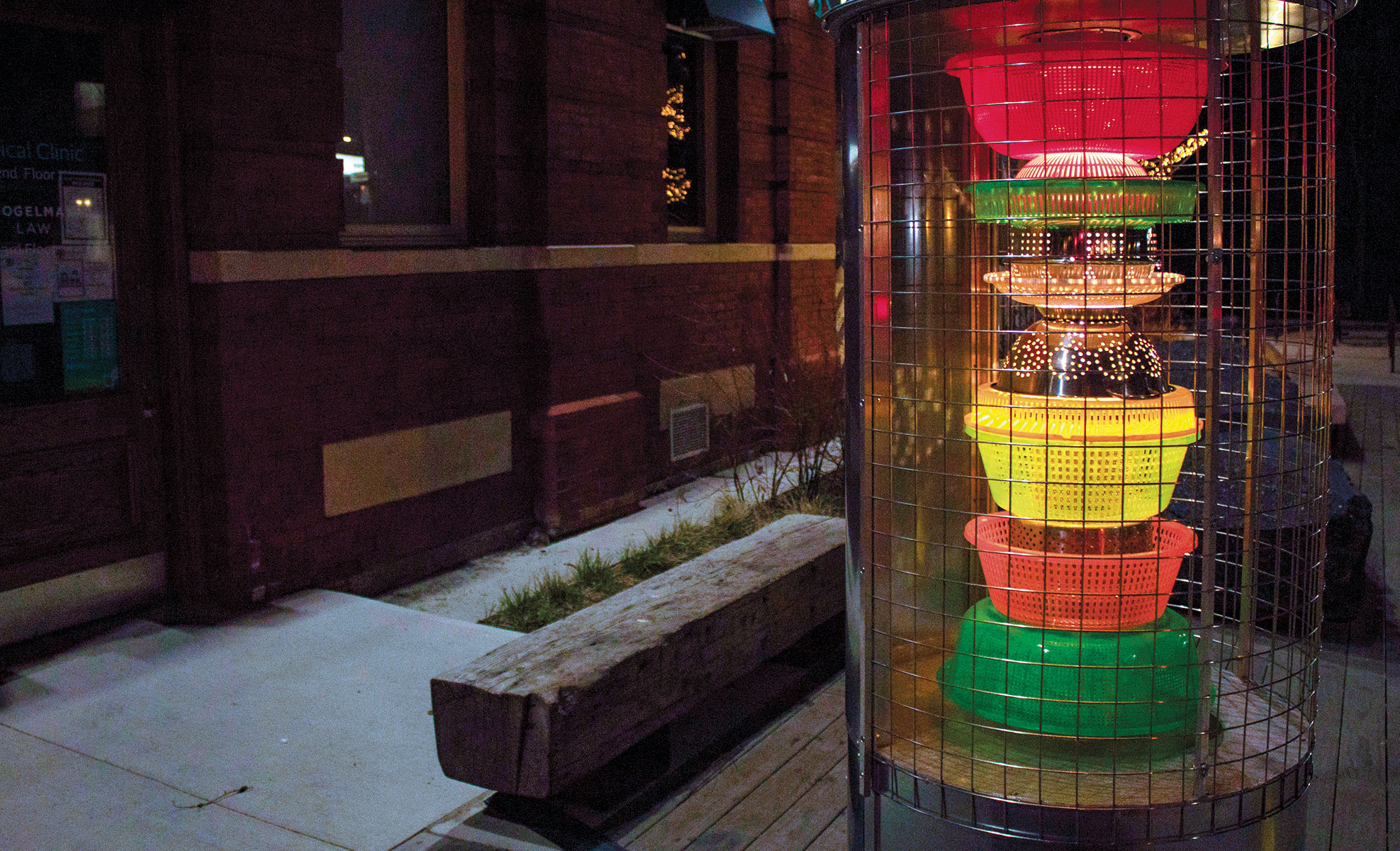
If you find yourself walking down Bloor Street and suddenly entranced by a pile of colanders, it might be time to stop and consider that you’ve effectively engaged with a piece of interactive art. There are now three different colander columns on Bloor Street to choose from, located at the new parkettes on Brunswick Avenue, Robert, and Major streets. Each column has multiple strainers inside as well as a light bulb to highlight the impacts of independent restaurants in a year when many have lost business or been forced into closure.
“We’ve been able to make an artwork that speaks to the challenges faced by local restaurants – that brings life and light back into kitchen equipment,” says artist Layne Hinton.

Hinton and her partner, Chris Foster, worked on the project with the Bloor-Annex BIA and Sustainable Thinking and Expression on Public Space (STEPS) to activate the new parkettes and encourage people to get outside and engage with art. This light art installation is the first interactive kinetic sculptural artwork to be promoted by the BIA.
“We were looking at it as starting a conversation about what’s happening to restaurants, post-COVID or during COVID,” said Melanie Ramsay, project administrator of the Bloor-Annex BIA. “We’re looking to build strong relationships and partnerships with art service organizations and artists going forward so that we could have more stuff like this.”
Each sculpture has a lightbulb inside it, so is best experienced after dusk.
Originally, the art was proposed for January during the winter months as the night would be longer than the day, but the installation date was moved to March – just in time for patios to open temporarily.
According to the artists, there is a “satisfying variety in the world of strainers,” because of the shadows they create against the concrete.
“As the light bulb moves up and down, it casts all these different shadows and patterns. There’s these unique mandala patterns that happen,” says Hinton.
Foster adds that they experimented with many different kitchen materials, including pizza pans, but landed on strainers as the best fit as they constrained the space inside of the artwork.
“There’s this cinematic quality that happens with light and motion that makes it captivating,” says Foster.
The interactive art sculptures at the new parkettes will be removed by the last day of May.
READ MORE:
Comments Off on NEWS: Light sculptures appear on Bloor (Apr. 2021)Tags: Annex · News

Rainbows, sparkles and onesies, it turns out, are no match for a global pandemic. That’s what Lien Nguyen and her business partner found out after COVID-19 forced numerous strategic pivots just to stay alive. Their enterprise, the Unicorn Café, opened up in January of 2020 at 561 Bloor Street W., and attempted to continue running via Uber Eats. Like many businesses, the Unicorn Café entered the mask trade and in that, found some hope.
“Because our theme is designed for families with kids, we had to find something to meet their needs,” says Nguyen. “So we decided to sell masks for kids through our storefront window. If people need the masks, we will keep making them.”
David Dunkley Fine Millinery, a unique store which sells handmade hats and headpieces, has also transitioned to selling masks.
“Masks for me was a very logical transition,” said Dunkley. “I had the fabrics, I had the skill, and it’s something that is similar to all the other work I do.”
Dunkley’s masks are all handmade and offer unique features. As a person who wears glasses, he was motivated to create a mask that does not fog up the lenses and was successful in creating one with three layers of protection. He also created masks for a wedding, working with unique fabrics like lace. He has also focused on creating masks that are comfortable for men.
“Surprisingly, many gentlemen with beards found it really hard to find a mask that fit snugly. So, I also created a pattern that would fit over a beard,” Dunkley said. “But, hopefully, we don’t need them in the future.”
He adds that, for him, profit was not a major motivator.
“Masks have saved my mental health. They gave me a purpose, a reason to come into the shop and do something, because what I did was no longer needed,” said Dunkley.
—Mary An/Gleaner News
Comments Off on CHATTER: The pivot to the mask trade (Apr. 2021)Tags: Annex · News

The Tarragon Theatre has stayed afloat through the third wave of this pandemic by bringing theatre lovers a full season of audio dramas. This art form enjoyed its golden age in the 40s and had been enjoying a rebirth which has boomed with the pandemic. Theatres have been discovering its usefulness as a cheaper and more reliable way to deliver shows than filmed productions or Zoom plays. Actors record their parts remotely, which are combined by the producers who then add in the sound design.
There’s still time to catch Scorched by Wajdi Mouawad and Come Home-The Legend of Daddy Hall by Audrey Dwyer.
Scorched is the story of twins who discover their estranged mother’s painful past after her death. The 2007 production won two Dora Awards and the Globe and Mail called it, “The best piece of theatre this country has produced this millennium.”
Come Home-The Legend of Daddy Hall is a new play by Audrey Dwyer, Artistic Director at the Royal Manitoba Theatre Centre. Daddy Hall was the Town Crier of Owen Sound in the 19th century. One of the first African-American citizens of Owen Sound, his job was to ring his bell and announce the news and advertisements of the day. He was well liked throughout the town and lived to be over 100, according to historian Paul White. The play will feature original music.
Scorched runs from May 13-26, and The Legend of Daddy Hall from May 30 to June 13. Tickets are $12.50 and are available at tickets.tarragontheatre.com. Within 24 hours, an email is sent with access information for the play, which is available for two weeks from the date of purchase, day or night. The full Tarragon Acoustic subscription of 18 plays is also available for purchase for $152.
—Nicole Stoffman/Gleaner News
Comments Off on CHATTER: Tarragon’s Reinvention (Apr. 2021)Tags: Annex · News
By Nabahat Hussain
The City of Toronto announced the latest addition to the Westbank development at the corner of Bloor and Bathurst this month – a park to accompany the mixed-use residential development. Although there was no park in the original plans for the site, Councillor for Ward 11, University-Rosedale, Mike Layton, said that at one community consultation that resulted in five different design suggestions for the lot, “every one of them had a park.”
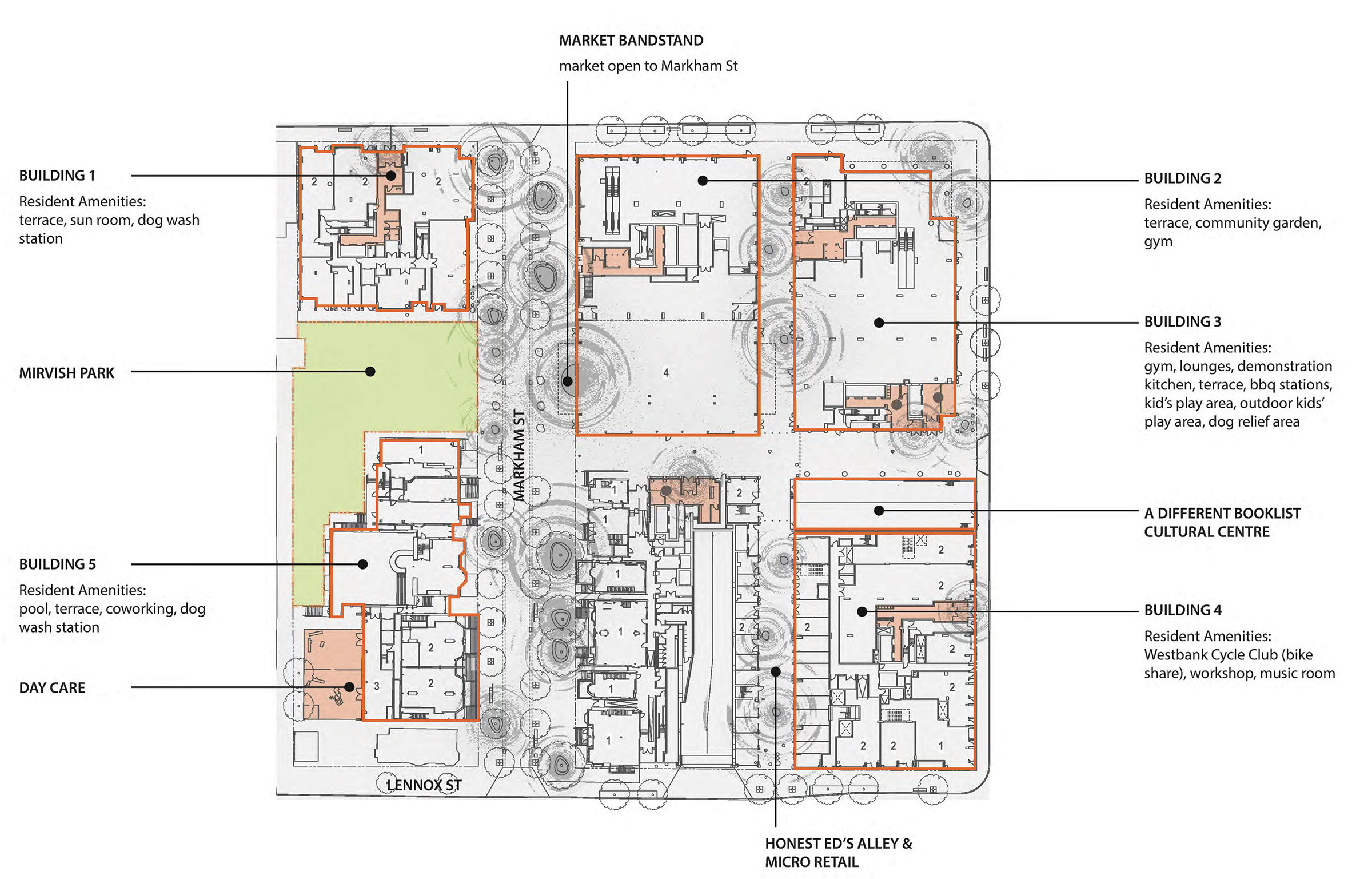
The City’s Parks, Forestry and Recreation department (PRF) laid out the details of the project during a virtual public information session on March 25th. The project’s senior project coordinator, Carol Martin, and senior public consultation coordinator, Rajesh Sankat, told the public that the park will be developer-delivered. This means the developer (Westbank) and PFR worked on the design together and it will be funded by the city, through ‘development charges’ set aside for Parks and Recreation, as well as by the developer and some donations.
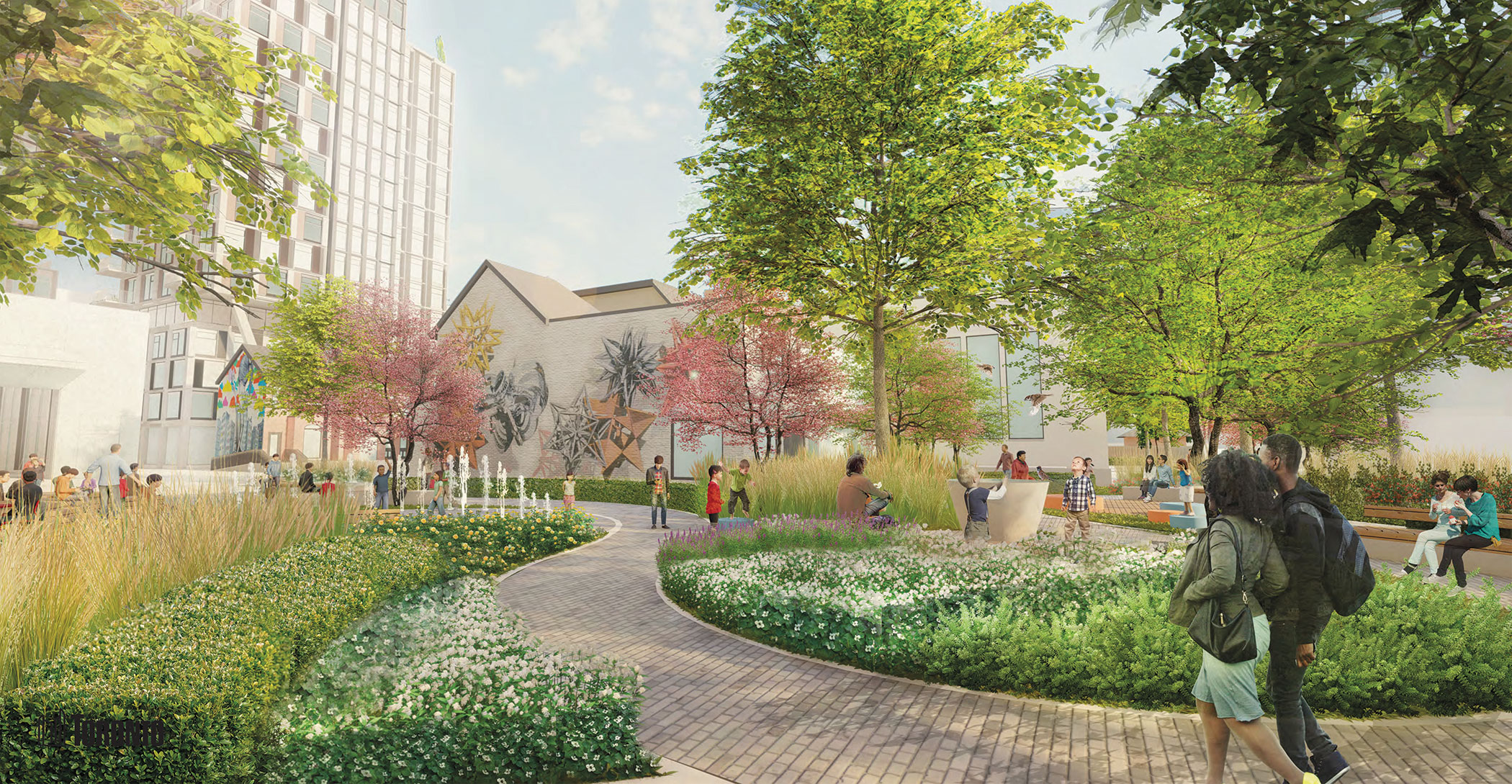
Designed by Vancouver-based PFS Studios, a leading planning, urban design and landscape architecture studio, the park will be divided into two zones; the passive zone serving as a place for peaceful walks, and the active zone for socializing.
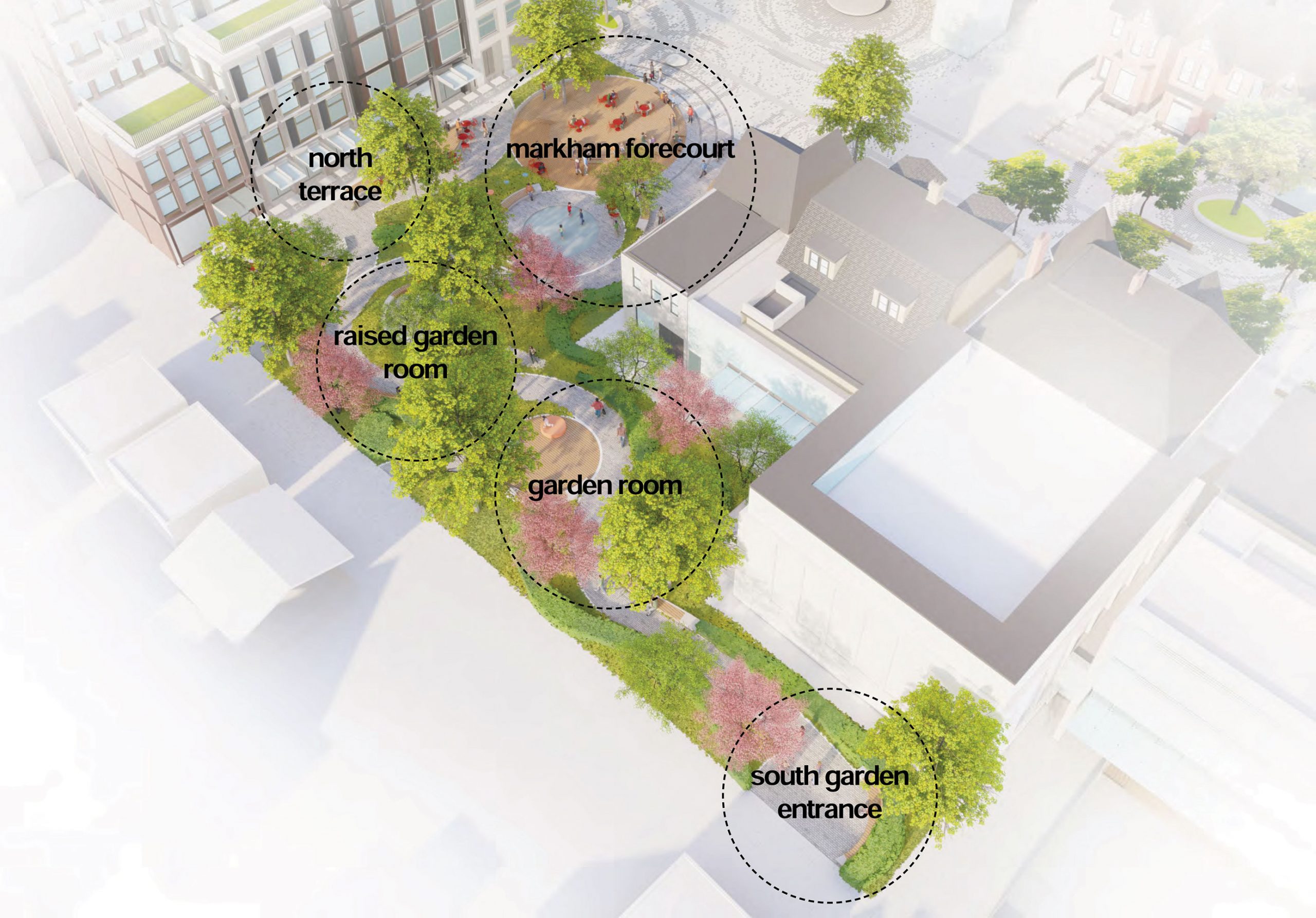
Swirling pathways will emulate the swirls under the Honest Ed’s sign, and the so-called “inspirational pathway” will work its way around various “garden rooms.”
From Bloor Street, people will be able to walk through green space friendly to birds and pollinators alike, and move their way towards the main pavilion.
As detailed in the public meeting, the areas are divided by use: the ‘Markham forecourt’ will feature an elevated circled stage with tables for dining, the ‘north terrace’ on the eastern wall will serve as a quieter locale for seating, the ‘raised garden room’ and ‘garden room’ are two points within the main path for nature lovers.
Blossom trees will stand in between the greenery, with shrubbery and flowering bushes to dispel any concerns about a lack of colour. Cherry red chairs and tables, as well as a mural facing the Markham forecourt are meant to brighten and bring even more vitality to the park space.
Other features include mood lighting under the twisting benches, and a fountain intended for interactive play.
“It’s not a huge park,” remarked Councillor Layton, “but it’s going to have a little bit of everything for a wide range of people.”
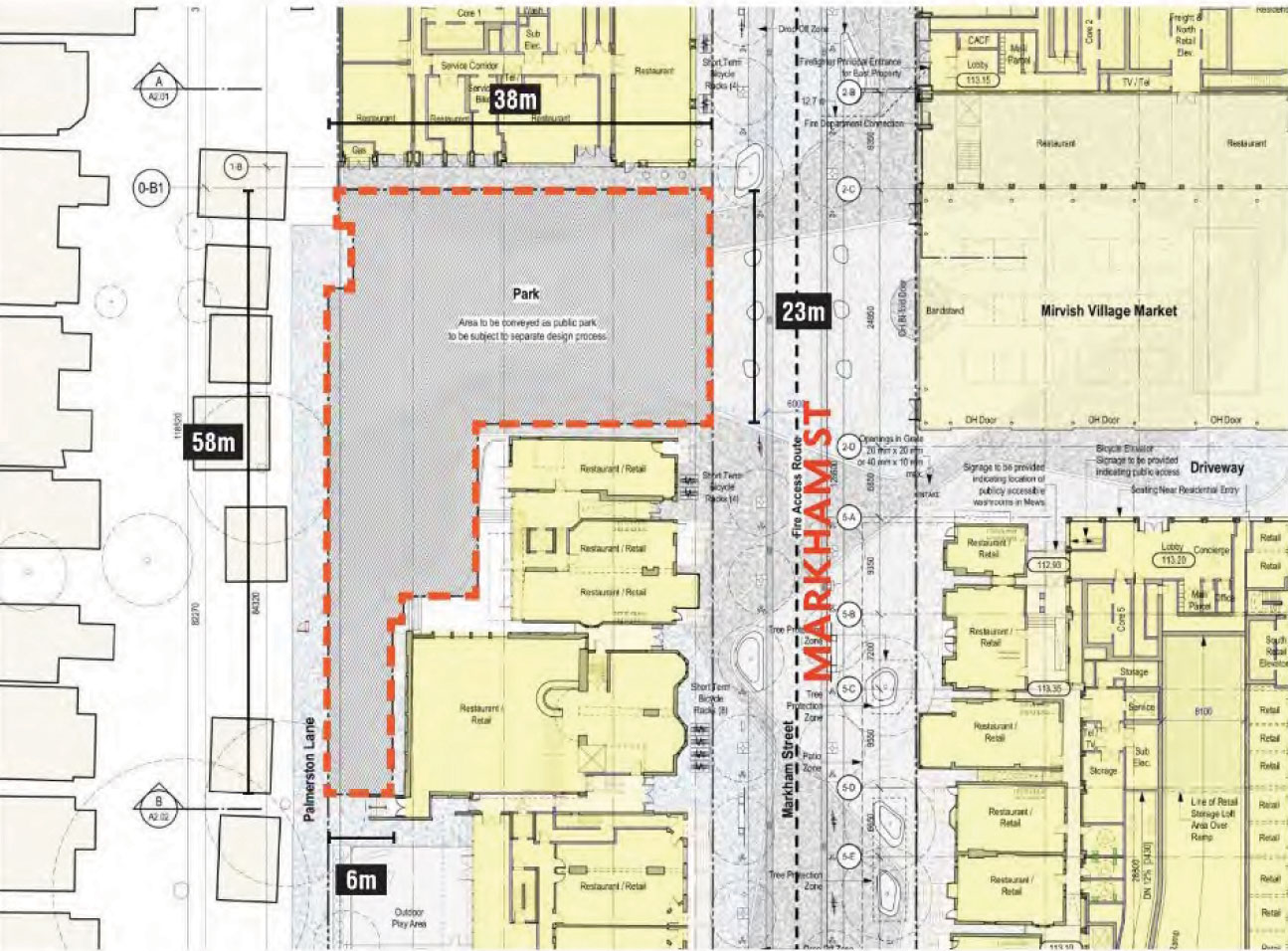
PFR says the focus of its design was on making the space interactive rather than just decorative, and hopefully it will serve as community hub for families, residents, university students, tourists and anyone passing through town.
Parallels to Honest Ed’s can also be found in the choice of amenities. Affordable housing can relate to the store having been an affordable place to shop. The marketplace along with the already large variety of shops around the intersection, ties into the store’s expansive selection (reminiscent of its colossal size). The Honest Ed’s alley, undoubtedly familiar to longtime residents, will have artisan shops; playing into Mirvish Village’s history of being a place for artisans to sell their work.
By next year, the community can finally look forward to seeing some aspects of the familiar, nostalgia- inducing discount shop return.
READ MORE:
Comments Off on FOCUS: New park imbued with nostalgia (Apr. 2021)Tags: Annex · News
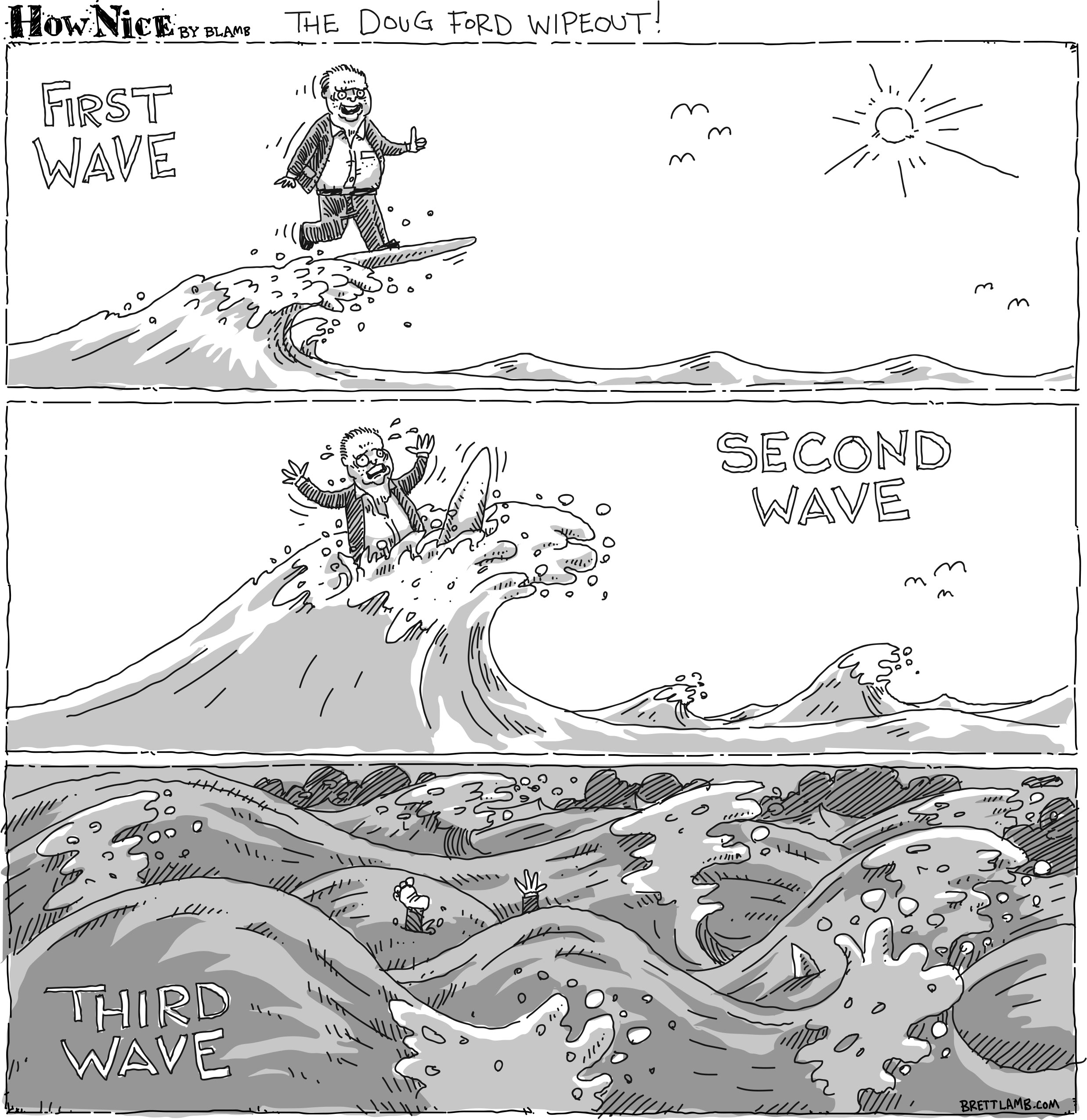
SEE MORE BY BRETT LAMB:
Comments Off on EDITORIAL CARTOON: How Nice (Apr. 2021)Tags: Annex · Editorial · Opinion
Ontario Premier Doug Ford has just announced three days of paid sick leave while on day nine of his 14-day PAID leave. He is self-isolating after a colleague in his office tested positive for COVID-19. The hypocrisy does not cause Mr. Ford to flinch, though he claims to be following the advice of “the brightest minds in the world.”
Ford’s aides have dressed him up in a new “crisis commander” jacket with a badge and his name emblazoned on it. The new uniform, if perhaps a little ridiculous, inspires confidence until he opens his mouth: “Folks,” he’ll say, “everything’s on the table… I won’t hesitate… I’ll come down like an 800lb gorilla,” and so on. In all this blather he has made only one thing clear: he is blameless. This province may sink under the weight of this self-described gorilla, but we shouldn’t bother to feign shock when he fails to take responsibility for it.
Conservative populists are often suspicious of advice coming from experts for a simple reason: those experts often don’t share the same world view. Experts want leaders who are willing to do what it takes to protect public health and well-being. Theoretically, once you take the reins following a successful bid for public office, you have a duty towards all the citizens within your jurisdiction – whether they voted for you or not. Premier Ford’s cabinet seem happy to follow a different set of leadership ethics.
Former Conservative Premier Mike Harris, a populist from another era, acted against the advice of experts and cut regulations meant to protect Ontario’s water supply. Seven people in Walkerton, Ontario died as a result and another 2,300 people fell ill, many severely.
In late April, faced with a third wave of infections, Premier Ford got advice from Ontario’s Science Table to do three things; close non-essential workplaces such as warehouses and factories, shut down non-essential construction sites, let outdoor activities (where the risk of transmission is low) continue, and provide paid sick days. Instead, Ford closed playgrounds and most outdoor activities, shuttered construction sites that are not running anyhow (like sites building malls and office towers) and failed to legislate paid sick days. He deflected blame for the lack of sick days to the federal government even though Justin Trudeau lacks the constitutional authority to tell Ontario employers what to do in this regard. Doug Ford knows this, but it doesn’t matter because he’s only speaking to his base.
Most police forces in Ontario were so appalled by the Premier’s orders that they openly stated their unwillingness to enforce his rules. When the troops ignore your orders that is a clear sign, Doug. On the other hand, at least one OPP officer felt emboldened by Ford’s announcement and assaulted a 12-year-old riding his scooter through a playground. Ford has inspired bullies to act with impunity.
It costs $4,000 per day for Ontario taxpayers to operate an ICU bed. It costs $120 per day to keep a minimum wage earner at home while they have COVID-19 symptoms. At a minimum that cost should be borne by employers for 14 days. Ford is robbing taxpayers in order to protect the bottom line of his buddies in the manufacturing and construction sectors.
A 13-year-old girl named Emily Viegas has become one of the youngest victims of the pandemic. Her father, whose wife was already in the in the ICU with COVID-19, is a warehouse worker in Brampton. He could not afford to stay at home. This case was both tragic and preventable. Enough of Ford’s flailing about aimlessly while people die needlessly. It’s time for the Premier to resign.
READ MORE EDITORIALS:
Comments Off on EDITORIAL Ford must resign (Apr. 2021)Tags: Annex · Editorial · Opinion
By Mike Layton
Homelessness in Toronto and our neighbours living in encampments have been top of mind for many of you throughout the pandemic. It continues to be clear that all levels of government need to do more to fund and create housing, and it needs to be done faster. Our ultimate goal must be to ensure we have housing for everyone and to provide support for those who need it so they can stay healthy.
In Toronto’s current real estate market, affordable multi-unit rental buildings are rapidly being converted into expensive rentals, or demolished to make way for new condominium development.
There is a critical need to permanently protect the affordability of existing rental housing across the city, and partnerships with the non-profit housing sector provide a viable pathway towards doing so.
As councillor, it has been one of my highest priorities to build affordable and supportive housing through every means available to me.
Recently, advocacy efforts led to an incredible affordable housing win for University-Rosedale that I am excited to see come to fruition and I want to share with you.
Two years ago, residents of 54-56 Kensington Ave. began receiving illegal eviction notices.
The property at 54-56 Kensington Ave. is an existing mixed-use property with twelve dwelling units and five retail units at grade. Ten of the twelve units are currently occupied.
I knocked on doors in the community, and together we helped to ensure those tenants were made aware of their rights and resisted the attempts of the landlord to make them move.
Through hard work and determination, the Kensington Market Community Land Trust was founded with the intention to acquire property to protect our housing supply and put together a plan to buy this building.
This meant that these existing tenants would not lose their affordable housing, and I worked with the land trust to help secure the additional necessary funding to put this acquisition over the top.
Officially, the city successfully helped the Kensington Market Community Land Trust to protect and create 100% affordable housing at 54-56 Kensington Ave.
I brought forward a motion recommending that city council direct staff to provide $3,000,000 in funding from development charges to the Kensington Market Community Land Trust so they could acquire, renovate, and operate the property.
The motion passed at council in April and now the property will maintain its 12 units as affordable rental housing for the next 99 years.
This is the culmination of years of work and it started with the tenants standing their ground.
It is clear that gentrification and real estate speculation is taking housing security from our city, but this story is proof that we can fight for creative solutions when working together.
I hope to see models like this repeated throughout the city.
While it is not always going to be resolved favourably in this way, working together, we have shown we can still make a difference.
I will not stop working for housing to be treated as a human right, and for steps toward housing people across our ward and the city.
I will continue to fight tirelessly for more affordable housing.
As always, please don’t hesitate to get in touch with my office with your questions or concerns at Councillor_Layton@toronto.ca.
Mike Layton is the city councillor for Ward 11, University—Rosedale.
READ MORE BY MIKE LAYTON:
Comments Off on FORUM: A victory for affordable housing in Kensington (Apr. 2021)Tags: Annex · Opinion
By Jessica Bell
The Ford government released its 2021-2022 Budget on March 24. The government will spend $186 billion next year, a cut of $4.8 billion from the previous year.
As lawmakers, we have a responsibility to listen, consult and collaborate to make good decisions for the people of Ontario. This is not a part of Premier Ford’s playbook. Despite the significance of the budget, the government did not organize traditional pre-budget public consultations, and only allowed about 20 people to give testimony in committee.
Here’s a budget breakdown:
Education
The government is cutting $1.6 billion from education. There will be no replenishment of the $500 million in reserve funds that school boards spent to prepare for the pandemic, and which are now exhausted. There is no commitment to extend COVID-19 funding into next year. Distressingly, school boards are already announcing there will be a reduction in teachers for next year.
Childcare
The government is not increasing direct funding to childcare, even though child centres are in crisis. The Canadian Centre for Policy Alternatives reports that over 123 centres in Toronto have closed, and enrolment dropped by two thirds in the first wave alone.
What the government is doing is increasing the one-off cash payment to parents to $500, and increasing the childcare tax credit for one year. Of course, that is a relief to parents who are struggling but it’s coming at the expense of deep cuts to public services. We should invest in affordable childcare and high-quality public education, not starve them of critical funds.
Health Care
Health care spending will rise by $3 billion next year. Is this a step in the right direction? Yes. It is enough? No. The Ontario Hospitals Association is calling for an additional $82 million for base hospital funding, and we are calling for an additional $425 million to clear the massive surgery backlog, which is what other provinces have done. Our office has received many emails from residents whose surgery and treatments have been delayed or lengthened. They need help.
Long term care
COVID-19 has exposed the failure of Ontario’s broken and underfunded for-profit warehouse model of long-term care. The government has announced it will increase funding to long-term care to build new beds, improve living conditions, including ensuring homes have air-conditioning, increase the average daily care to four hours of staffing care per person per day, and pay tuition fees for new personal support workers to attend school. This wouldn’t have happened without all of us speaking up. We will continue to call for an end to for-profit care, a permanent increase in PSW wages, and more stringent and regular inspection of homes.
Affordable Housing
Toronto has an affordable housing crisis, and it’s getting worse. The agency that investigates the Ontario government’s finances, the Financial Accountability Office, estimates the number of people spending more than 30% of their income on housing or living in overcrowded housing is growing, yet the government has decided to cut funding for housing programs. If this was our budget, we would invest in building supportive housing and affordable housing, introduce real rent control to cap skyrocketing rents, and increase taxes on speculators and investors so first-time home buyers have a chance of bidding and buying their forever home.
Business
Across University-Rosedale, small businesses are closing. The Ontario government has established a Small Business Support Grant program, and this budget permits eligible businesses to reapply and receive two grants. That’s the good news. The bad news is the program is not working well. Our office is working with many businesses who have applied, been approved, but have never received any money, as well as many others who are not eligible, such as many working in the arts sector. We are calling for the program’s eligibility to be widened. For those who want to personally help our business friends, we have launched an I Shop Local sign campaign to encourage our neighbours to shop locally. If you want a sign delivered to your lawn, please contact us.
Climate Change and the Environment
There’s no mention of climate change in the entire budget. After significant cuts in the first year of the Ford government, Environment Ministry funding is flatlined compared to previous years. It is very hard to watch this government squander the precious time we have to take provincial action on climate change. We are calling for a fully funded Green New Deal plan and a real commitment to reduce our emissions to net zero.
These are the highlights and significant lowlights of the budget. If you have questions about these programs and more, please reach out to our office.
Jessica Bell is MPP for University–Rosedale.
READ MORE BY JESSICA BELL:
Comments Off on FORUM: Mr. Ford cuts into the future of public services (Apr. 2021)Tags: Annex · Opinion