September 8th, 2021 · Comments Off on SPORTS: Cross-border reinforcement bolsters Leafs for playoff push (Aug. 2021)
Long-time hurler overcomes travel restrictions to rejoin team
Justin Cicatello makes his first appearance on the mound for the Leafs on August 29. R.S. KONJEK/GLEANER NEWS
By R.S. Konjek
Summer is almost over, but the Toronto Maple Leafs are hoping to stretch it out a while longer.
It is a hot Sunday afternoon in late August. At Christie Pits, the humidity is oppressive. Fans cluster around the baseball diamond and welcome any slice of shade or cooling breeze.
The Leafs are playing the Hamilton Cardinals in a game with postseason implications. Both teams are bunched in the middle of the 2021 Intercounty Baseball League standings. A win today could vault either club over several others.
It has been an unconventional season for the Leafs. The most recent pandemic shutdown delayed the start of their season by two months.
The pandemic impacted the schedule, but also the make up of this year’s team.
They re-signed former Leaf Sean Reilly – the league’s all-time leader in hits, home runs and runs batted in – when his current club the Guelph Royals shut down operations for the second year in a row. They also added former Leaf sluggers Jordan Castaldo and Garrett Takamatsu to an already potent lineup featuring returning stars Justin Marra, Johnathan Solazzo and Marcus Knecht.
The Leafs have been dynamite at the plate, leading the league in most offensive categories.
This afternoon they are off to a slow start, recording one measly hit in the first three innings while the Cardinals have already scored three runs.
Beyond the centerfield fence, a player emerges from the Leafs’ clubhouse. He’s late arriving to the park, but it’s not a concern. He’s a relief pitcher and won’t be called upon until later. He also had to cross an international border to get here.
Justin Cicatello, 37, is a native of Buffalo, New York. He has been pitching for the Leafs since 2013, as both a starter and reliever.
The Leafs have struggled on the mound this year, giving up an average of over eight runs a game. The veteran’s return is welcome relief.
Pandemic travel restrictions kept Cicatello from joining the Leafs at the start of the season. When the border re-opened on August 8, he let the team know he wanted to play. Only a hamstring injury picked up while playing for a local men’s league prevented him from appearing before today.
After checking in with Leafs manager Damon Topolie and exchanging greetings with his old teammates on the bench, Cicatello joins the rest of the relievers in the bullpen.
“It’s awesome,” he says later, describing the experience of playing at Christie Pits. “There’s a great atmosphere. Damon Topolie [fan group], all the fans, it’s great.”
As unlikely as his return to the Leafs was this year, Cicatello traveled an unlikely path to join the club in the first place.
He began playing baseball as a youngster and the sport has always been part of his life. He played in high school in New York state, at junior college in Florida and at the University of Pittsburgh.
It was in university that he transitioned from being an infielder to a pitcher, seeing greater opportunities to play a starting role on the mound rather than as a fielder.
His career took a unique turn after university. Rather than progressing to the minor leagues in the States, he went to Europe and played Italian league baseball from 2009 to 2012.
He aspired to pitch for the Italian national team and earned a spot on the roster, but was devastated to be cut from the team just prior to the 2013 World Baseball Classic, the sport’s biggest international tournament.
“I could have had the chance to pitch to Derek Jeter,” he says. “That’s a story you can tell the rest of your life.”
The Cardinals add two more runs while Cicatello begins stretching and warming up in the bullpen. It’s now 5-0 through seven innings.
When he returned to the States, Cicatello began putting his life outside of baseball in order. He prepared to go back to school and pursue a career in corporate finance.
A friend in Buffalo mentioned to him that he knew Jack Dominico, owner of the Maple Leafs baseball club in Toronto, and made an introduction.
Still feeling the competitive fire burning, Cicatello joined the Leafs and organized his summers around marathon round trips between Buffalo and Bloor Street. On average, from the time he leaves his house to the time he returns, it can be an eight-hour journey. Two hours of driving with a stop to cross the border, four hours at the ballpark, then another two hours back home.
In the eighth inning, Topolie signals for Cicatello. He calmly trots to the mound and pitches a scoreless inning. That is all that will be asked of him today.
The Leafs’ bats finally awaken late in the game. They score seven runs in the final two innings, but the Cardinals pull away for an 11-7 win.
The postseason picture remains unclear. Toronto will be in the playoffs, but their first-round opponent is still not confirmed. It may not be known until the final day of the season.
Despite there being IBL teams in Welland and Hamilton, a much shorter commute, Cicatello wouldn’t think of leaving the Leafs now.
“It’s a routine, it’s all I know,” he says of his time with the Leafs. “It was kind of random that I got to Toronto and it’s funny I’m still there.”
He notes that the Leafs high-scoring offence gives them a strong chance at winning the championship this year.
“It wouldn’t feel right to be on another team and see the Leafs win without me.”
The Maple Leafs’ complete 2021 season schedule can be found at www.mapleleafsbaseball.com.
September 8th, 2021 · Comments Off on ARTS: Space, the local frontier (Aug. 2021)
Locally-made film Sound of Space lifted off at Toronto Fringe Festival
By Joshua Chong
Hilary June Hart in Sound of Space. COURTESY TYLER MORGAN.
The premiere of Tyler Morgan’s Sound of Space was a meta-experience. The 12-minute film, which streamed virtually at this year’s Toronto Digital Fringe Festival, had a private in-person screening on July 20 at Seaton Village’s Proxima Command Escape Room—the very location where Morgan’s sci-fi flick was filmed.
Proxima Command’s spaceship-themed escape room, filled with gadgets and gizmos galore, makes for the perfect set for Sound of Space, which follows Captain Isa (Hilary June Hart) as she sets off on a solo mission to Mars to deliver much-needed aid to a settlement in distress. She spends much of her time interacting with the ship’s onboard AI system ‘Mac’ (Leo Mates), eating potatoes—the only food onboard—or watching pre-recorded videos of her son (Benjamin Yaremko).
It’s a largely banal multi-month journey, until a cabin depressurization compromises the mission and causes Captain Isa to lose her hearing.
Despite its economical runtime (Sound of Space was tied with another film as the shortest production playing at this year’s festival, according to Morgan), Sound of Space is highly ambitious in both its scope and production values. Raymond Tuquero’s Star-Trek-esque visual effects and cinematography is fast-paced and includes stunning intergalactic sequences. His crisp, futuristic soundscape adds to the foreboding atmosphere that permeates the film.
It’s hard to believe that the movie almost failed to achieve lift-off. Ten days before filming was slated to begin, the production company financing the project pulled out unexpectedly. Since the original producers were also going to provide an actor to play the role of Captain Isa, Morgan was left without a leading lady.
“And so sadly I kind of had to phone Fringe and say, ‘I think I’m gonna have to cancel,’” said Morgan, who is the film’s director and writer, and one of the co-producers.
Luckily, at the eleventh hour, Proxima Command co-owners Michael Chapman and Bob Papadopoulos offered to step in as co-producers and finance the project. It was a perfect fit, since Morgan was already planning to work with Chapman and Papadopoulos to shoot the film inside the escape room.
“I got people together in 10 days,” said Morgan. “And one thing just led to another.”
He recruited students from Ryerson University to help out behind the scenes. Then, he found Hart, who would step into the leading role.
She embodies the role of the mentally-drained commander with a versatility of emotion. Lending voice to the Machiavellian AI system Mac, Mates is mercurially devilish. And Yaremko is never cloying in his cameo role as Captain Isa’s young son.
Morgan’s script begins at a pedantic pace as he establishes the world (or rather, space) Captain Isa is living in. But as it progresses, the film falls into a brisk rhythm and Morgan nicely blends moments of humour and pathos.
He touches on many themes in his short film: mother-son relationships, the ethics of artificial intelligence, living with disabilities. It all seems a bit overstuffed for a film of this length, and the themes would have been better served if explored in greater detail. The unexpected twist ending seems especially unearned.
But for all its flaws, Sound of Space still offers a scintillating, though brief, escape from planet earth—something we could all use that right about now.
Sound of Space streamed from July 12 to 31 as part of the 2021 Digital Fringe Festival. It was one of the winners of the David Seguin Memorial Award for Accessibility in the Arts.
Comments Off on ARTS: Space, the local frontier (Aug. 2021)Tags:Annex · Arts
August 16th, 2021 · Comments Off on ON THE COVER: Horn on the Cob (July 2021)
Horn on the Cob performed their 120th porch concert on July 21 before taking their summer break. Featuring special guests Tania Gill on Accordion and Dave Clark on drums, the 15-person band opened with Odessa Bulgar, a lively Klezmer tune. “They’re a treasure to the neighbourhood,” said local resident Susan Starkman. Horn on the Cob looks forward to playing again but doesn’t have a set schedule. “We all love making music together and sharing it with the neighbourhood!” said director Adam Seelig. NICOLE STOFFMAN/GLEANER NEWS
ARA, city, seek to find ways to accommodate growth
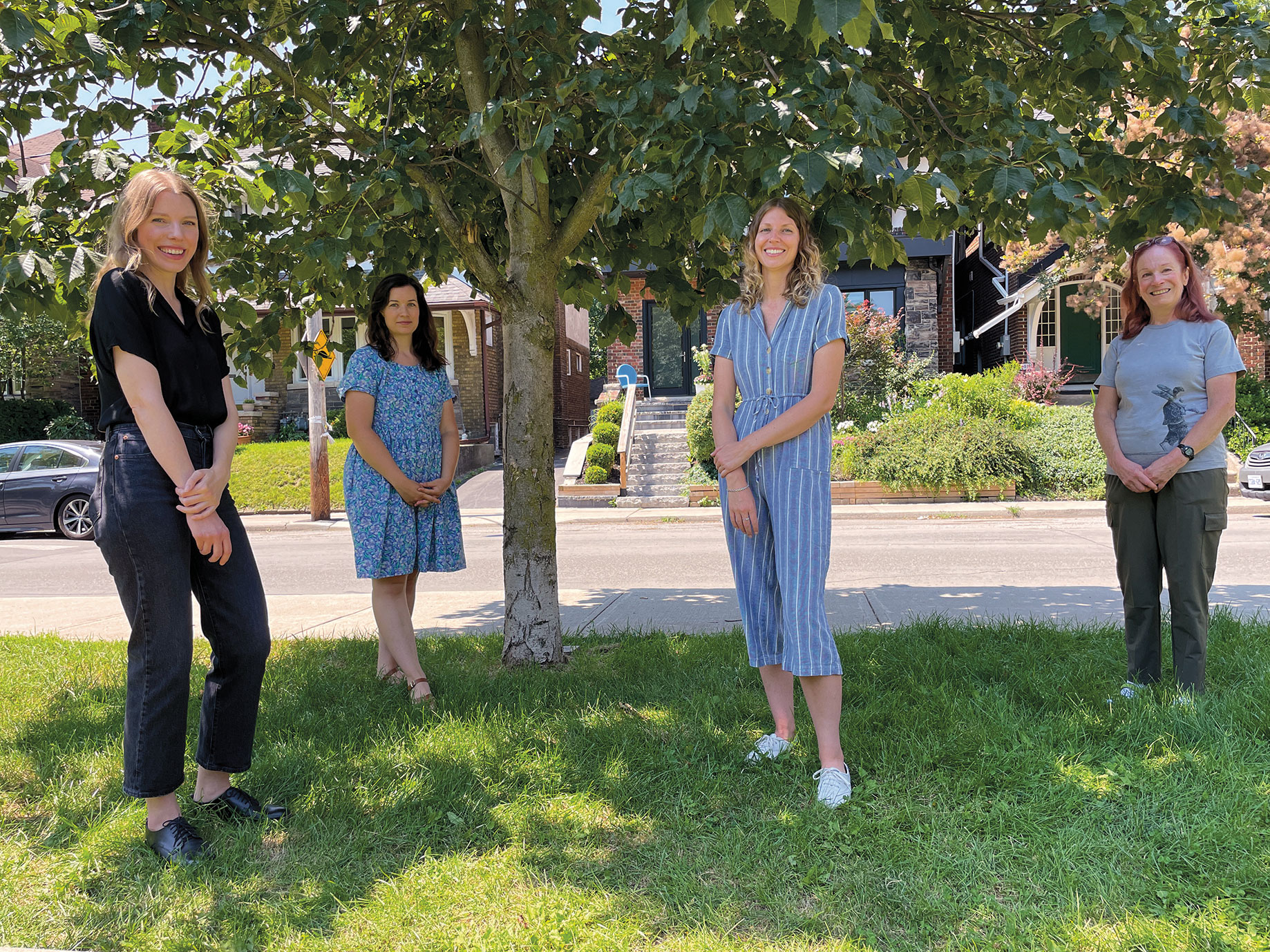
(From left) Jessica Bisson (project administrator and survey technician), Kristina Martens (lead cultural heritage specialist), Meredith Stewart (researcher and survey coordinator) and Rebecca Sciarra (principal-in-charge, not pictured) of ASI Heritage consultants will be surveying the West Annex’s 1,007 properties from September to November as part of the West Annex Heritage Project. ARA project lead, Sandra Shaul (right), hopes the research will convince the city to declare the West Annex a Heritage Conservation District. NICOLE STOFFMAN/GLEANER NEWS
By Nicole Stoffman
The Annex is facing intense pressure, with 25 major development projects currently underway. Can the neighbourhood grow without losing its unique character? Heritage consultants will be defining that character over the next seven months as they scour the neighbourhood to document 1,007 properties within the boundaries of Dupont, Bloor, Bedford and Bathurst streets. The goal is for the city to declare the “West Annex”—defined as the area west of Bedford— a Heritage Conservation District (HCD) so that future development takes heritage into consideration. There are 21 HCDs in Toronto, and 11 more are being studied. It’s called the West Annex Heritage Project, and has taken 13 years to launch, due to changes in the Ontario Heritage Act.
The Project is an unusual collaboration between the Annex Residents’ Association (ARA), ASI Heritage consultants, and city planning. To speed up the process at city hall, the ARA is paying for a survey and historical context statement from ASI, the largest heritage consultancy in Ontario. When their final report is given to the city in August 2022, the hope is that an expedited Heritage Conservation Study will be launched, sent to council for approval, and an HCD plan completed within the following year and a half.
Community input will be sought at a virtual meeting in late September, and at subsequent focus groups.
“We want to make sure as many people in the community as possible have input, and can have their say, as to what heritage is in their mind,” said Sandra Shaul, ARA heritage director and project lead.
Focus group participation will be crucial to understanding the living, contemporary Annex.
“Often that’s not the stuff you find in the historical record,” said ASI Partner Rebecca Sciarra. “Often at these sessions we spend time with people looking at maps, identifying the spaces where they gather that are so essential to their sense of place in the community.”
Shaul hired ASI Heritage with Section 37 funds from the building of the condo tower at 1 Bedford Rd. in 2005. The funds are named after Section 37 of the City of Toronto Planning Act, which obliges developers to fund community benefits in exchange for being permitted to build higher or with greater density than the city’s Official Plan allows. Realizing that 1 Bedford would be the first of many new developments, Shaul and others fought and won this funding for a heritage study for the West Annex, with the city’s approval.
In 1993, the area between Bedford and Avenue Road was declared the East Annex Heritage District, as was Madison Avenue in 2015 – a project also led by Shaul.
“Ultimately, a Heritage Conservation District is a good planning tool,” she said.” It’s something that helps developers proactively understand what is considered of value and has restrictions on it, and what isn’t.”
Gavin Schwartzman, CEO of Peerage Realty Group, would agree. The United Bldg., a 55-storey condo, was built over the historic MacLean-Hunter building in 2019 at University and Dundas. Restoring the original 9-storey printing house at its base and recessing the tower so as not to overwhelm the 1920s heritage building was an added expense, but turned out to be a gift for the marketing and sales team.
“The incorporation of the MacLean-Hunter building was part of what made it special,” said Swartzman.” We turned it into an advantage. It’s really attractive…It was a good blend of heritage people and developers working together.”
Swartzman says Toronto needs to add urban housing because land is scarce, and Canada is set to welcome 400,000 immigrants per year over the next 5 years, the majority of whom move to Toronto. He thinks this can be done while respecting the city’s history, and building more mid-rise and infill housing in established neighbourhoods.
“We’re not a museum, I worked in museums for half of my career,” said Shaul, who supports the idea of more townhomes, laneway and infill housing in the area. “We’re a living, growing neighbourhood.”
Property owners and residents should feel free to come out and say hello when they see any of the four heritage experts surveying and photographing their property from the sidewalk, but they will not be requesting interviews. Between August and October, the consultants will be collecting data using the City of Toronto’s ‘Built Form and Landscape Survey Form.’ They will be using a data collection software called ArcGIS, developed in Redlands, California, to build a database that will be handed over to city planning to guide the city’s own future study.
The West Annex Heritage Project will not result in any heritage designations. However, residents and property owners are welcome to share information about their property directly with the ARA. The city will determine which properties are of heritage interest and contact individual property owners when the city conducts its own study.
Should the city decide to approve the West Annex as an HCD, it will not be a blanket heritage designation: only those properties considered to have heritage value will require permits for any modifications that are visible from the street. Grants and tax rebates to help with the cost of conservation will also be available to owners of listed or designated heritage properties. All other properties will still have to negotiate with city planning (heritage) if a demolition permit is sought, to ensure their replacements fit in with the streetscape and use appropriate massing and materials.
Heritage controls provided by an HCD could avoid explosive situations like the one currently playing out at 145 St. George, where tenants are consulting with MPP Bell and Councillor Layton on how to protect their rent-controlled apartments from being demolished for a 29-storey rental and condominium tower.
If this mid-century modernist apartment were deemed to have heritage value—and an HCD will apply a broader definition of heritage that includes modern architecture— the developers would have to negotiate with city planning from the outset to demonstrate how the property would be preserved or integrated into a new development.
The entire community is invited to participate in a virtual kick-off meeting on September 23.
To hear more about the project, ask questions of the team, and learn how to participate in focus groups check www.theara.org, or email info@theara.org with the subjet line: West Annex Heritage Project.
August 16th, 2021 · Comments Off on NEWS: Lamon steered Tafelmusik to international acclaim (July 2021)
Director remembered for leadership, dedication to education
Tafelmusik trailblazer Jeanne Lamon died on June 20, at age 71 in Victoria, BC. She is credited with putting the city of Toronto on the map in the global classical music scene. COURTESY SIAN RICHARDS/TAFELMUSIK
By Joshua Chong
Jeanne Lamon was a titan and trailblazer on the classical music scene. Throughout her tenure as Tafelmusik’s director, which lasted from 1981 to 2014, Lamon guided the Toronto-based orchestra and chamber choir from its humble beginnings as a tiny ensemble of young musical idealists into an internationally-acclaimed group known for its commitment to artistic training and baroque music excellence. She died of cancer in Victoria, B.C. on June 20, at age 71.
Born in New York City on Aug. 14, 1949 as the youngest of three siblings, Lamon’s love of music came from listening to her mother play Bach on the piano. But it was only when she saw violinist Isaac Stern play on television that she truly became enthralled with music.
“I wanted to do what he was doing,” she said in a 1986 interview with the Toronto Star. “I told my parents immediately I wanted a violin.”
At age 7, she enrolled in her first lesson. She continued with the violin throughout her youth, studying at Westchester Conservatory of Music and earning a bachelor’s degree in music at Brandeis University.
Lamon then moved to Amsterdam to study under Herman Krebbers, concertmaster of the Concertgebouw Orchestra. It was there where she met her partner of 43-years Christina Mahler, a cellist who would follow Lamon to Tafelmusik and become principal cellist.
Later, Lamon specialized in baroque violin under Sigiswald Kuijken, a Belgian early-music specialist.
This was the 1970s, the era of the baroque renaissance, and Lamon made a name for herself as a soloist and conductor for the burgeoning crop of early-music orchestras. One of those was the Toronto-based Tafelmusik ensemble, playing out of the Annex’s Trinity St. Paul Church, located on Bloor St. W and Walmer Road.
Founded in 1979 by Kenneth Solway and Susan Graves, the group had an ambitious goal: establish a world-class baroque ensemble.
It seemed absurd at the time, and even Lamon acknowledged it. Toronto was practically unknown in the classical music world and had few supports available for musical visionaries like Solway and Graves. Yet when they invited Lamon to be their guest conductor for Tafelmusik’s first season, she jumped at the opportunity. Soon after, she was appointed music director.
Lamon would realize the unthinkable goal of putting Tafelmusik, and Canada, on the map. With over 70 recordings, nine Juno Awards, a Grammy nomination, and multiple world tours—including several trips to Carnegie Hall—under Lamon’s leadership, Tafelmusik became one of the world’s foremost early-music orchestras.
“Jeanne was an extraordinary individual—ahead of her time,” said the ensemble’s executive director, Carol Kehoe. “She was a passionate musician who was totally engaged with the donors, subscribers, volunteers, and funders who supported her ‘baby’—a baroque ensemble that grew into a world-recognized powerhouse.”
Lamon’s leadership style was one of collaboration and creativity. Tafelmusik excelled, in part, due to its frequent partnerships, including a long-standing association with Opera Atelier, Toronto’s baroque opera company.
Her dedication to musical excellence and creative programming helped Tafelmusik grow its audience base, and shed the stereotype of the ‘pretentious baroque orchestra.’ For an ensemble whose repertoire primarily consisted of music that is roughly 400 years-old and written by white European men, Lamon programmed concerts that were bold, daring, and inventive.
Perhaps none more so than “The Galileo Project,” a multimedia performance piece filled with astronomical projections and narration, all paired with the music of Vivaldi. Conceived and scripted by Tafelmusik’s bassist Alison Mackay, the show went on to tour internationally and receive critical acclaim.
After stepping down as music director in 2014, Lamon continued to help train a new generation of baroque music specialists by leading Tafelmusik’s Baroque Summer Institute and Winter Institute, the company’s two training programs.
Her career as a musician, conductor, and educator received numerous awards, including the Order of Canada and Order of Ontario.
For current music director Elisa Citterio, Lamon was a gifted leader.
“She remains and will always be an integral part of our wonderful organization because we are the fruit of her tireless passion and tenacity,” said Citterio. “We are heartbroken to have lost her, but the memory of her smile, laughter, and unbridled creativity will console and uplift us.”
In 2019, Lamon and Mahler moved to Victoria, B.C., where they continued to perform as guest musicians. In January of this year, Lamon was diagnosed with lung cancer. She passed away on June 20, leaving behind Mahler, her older sister and brother, and 19 nieces and nephews.
Comments Off on NEWS: Lamon steered Tafelmusik to international acclaim (July 2021)Tags:Annex · News
August 16th, 2021 · Comments Off on GRADING OUR GREENSPACE (July 2021)
Part 1 of our annual Grading our Greenspace feature includes Christie Pits Park.
Compiled and photos by Madeline Smart
We might be at the point of finally seeing the light at the end of tunnel when it comes to COVID-19 with vaccination rates rising and restrictions lifting, but that doesn’t mean park hangouts will be going anywhere anytime soon. The improving pandemic situation has led to some of the parks that were locked up last year to be set free again. Huron Washington Parkette and Margaret Fairley Park have been restored to their former glory. But, neglect and lack of resources have persisted in others like Sally Bird Park and Euclid Avenue Parkette.
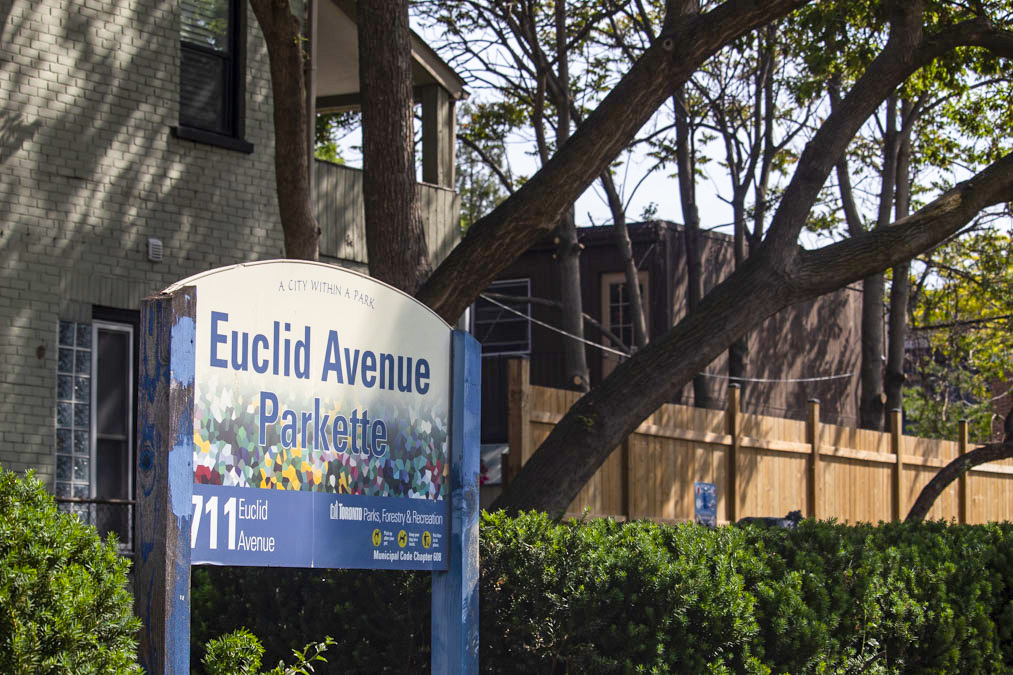
Euclid Avenue Parkette.
Euclid Avenue Parkette
711 Euclid Ave.
Time: 10:00 a.m.
Grade: F (Last year F)
Reasons to go: None. “Parkette” is a generous word, honestly. The parkette has been given an F for the last three years in a row and it’s well deserved. It’s quite literally just a walkway between some houses and a parking lot featuring a small patch of grass and a few benches usually covered with litter and graffiti. Currently the waste bins in the park are overflowing from neglect too, adding to the amount of litter. The ground is home to probably the largest collection of cigarette butts known to man and the air is filled with flies swarming over all the garbage. It’s barely worth walking through briefly so it’s probably best if you don’t bother.
Overheard: “C’mon let’s go.” A man said while walking through the parkette to his two dogs who had stopped to sniff some of the trash left on the ground.
Did you know: Euclid Parkette may not be pretty but it is in a great area, just off of Bloor Street West and in the heart of Koreatown where you can find some of the best food in the city. Stay on Bloor and avoid this park.
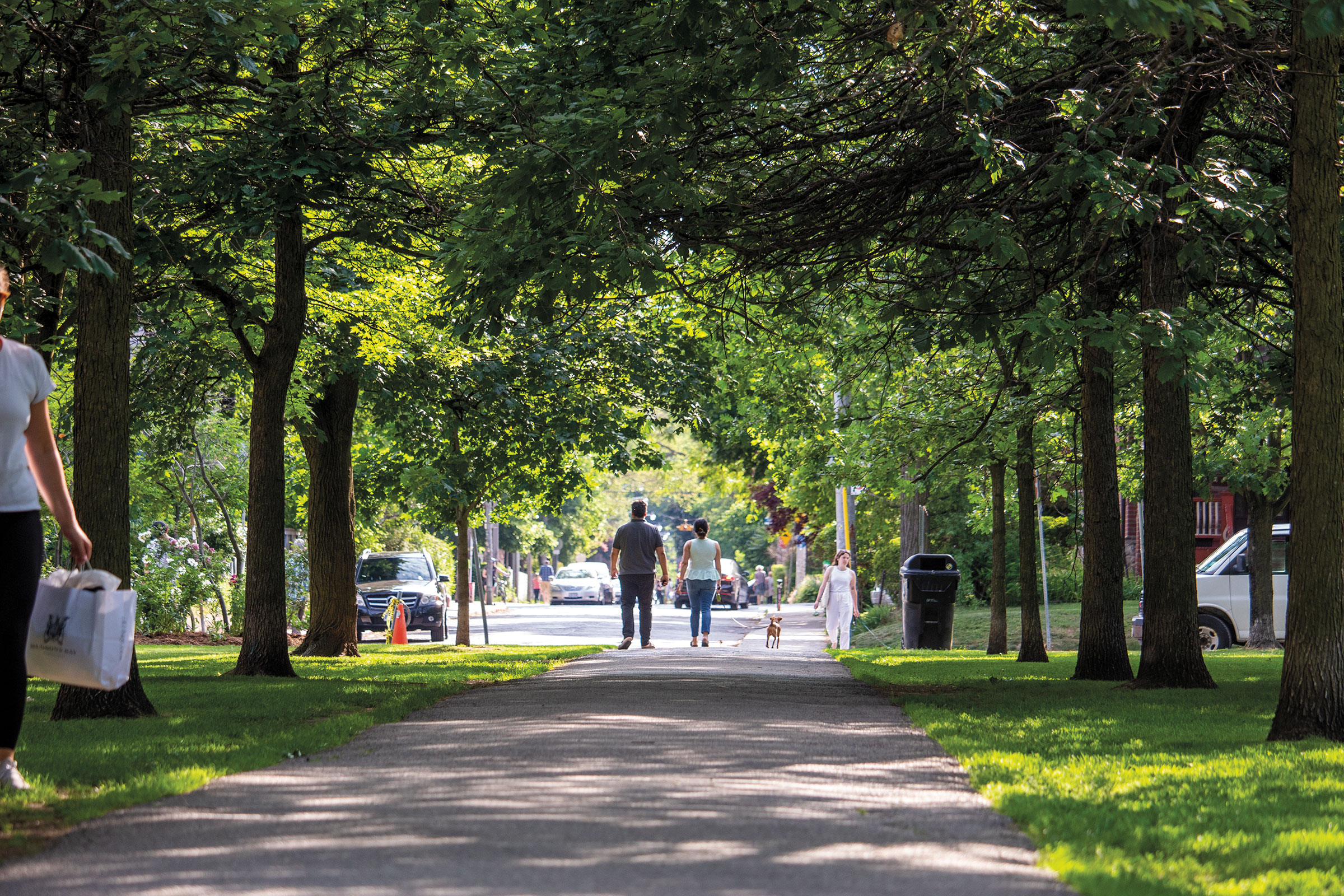
St. Alban’s Square feels a little like a tiny magical escape from the bustle of the city, there’s no playground equipment but there are large patches of grass that make the park a great spot to relax or catch up with a friend.
St. Alban’s Square
90 Howland Ave.
Time: 10:30 a.m.
Grade: B+ (Last year B)
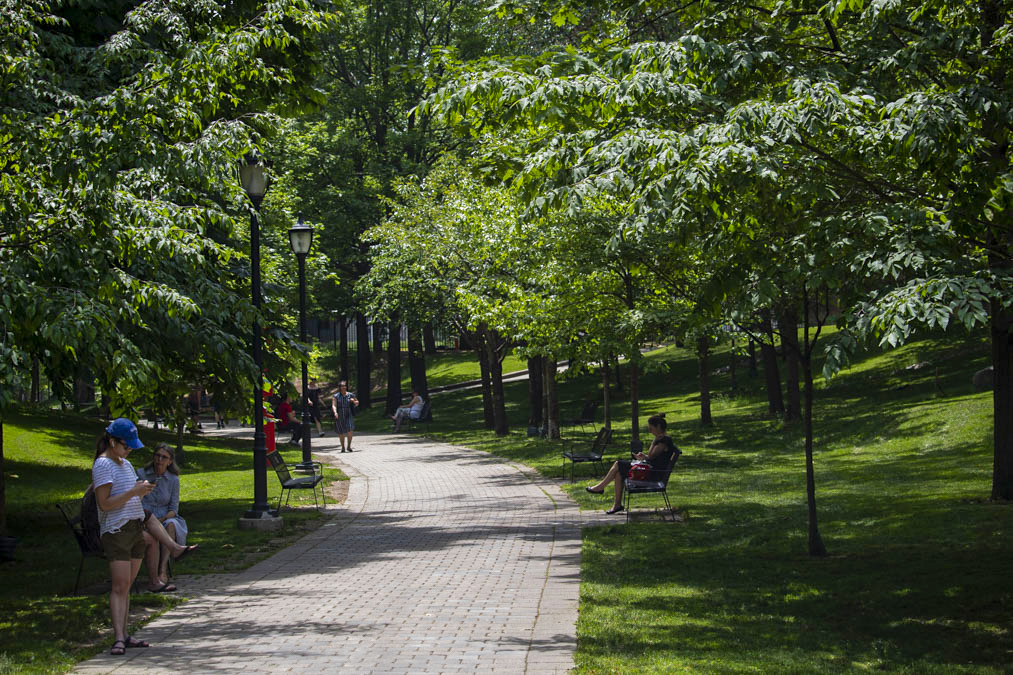
Reasons to go: St. Alban’s Square is a lovely patch of greenery with a paved path straight down the middle surrounded by some gorgeous trees. Tucked away inside a residential neighbourhood, it feels a little like a tiny magical escape from the busy city despite being surrounded by roads. There’s a few benches and a city bike docking station which would make this a great spot to take a break while on a Bike Share bike ride. Nice and quiet as well as being incredibly well maintained, it’s a popular spot for people to read a book or catch up with a friend over coffee. There’s no playground structures but the large patches of grass under the shade of the trees would still make it a great place to hang out and relax with your kids or without.
Overheard: “Yup I can see your screen now.” A man said loudly to his phone screen, presumably on a zoom call, while his dog slept in the shade at his feet.
Did you know: In 2000, the city almost turned St. Alban’s Square into playing fields for the nearby boys’ private school, Royal St. George’s College, but a group of local residents successfully petitioned against it.
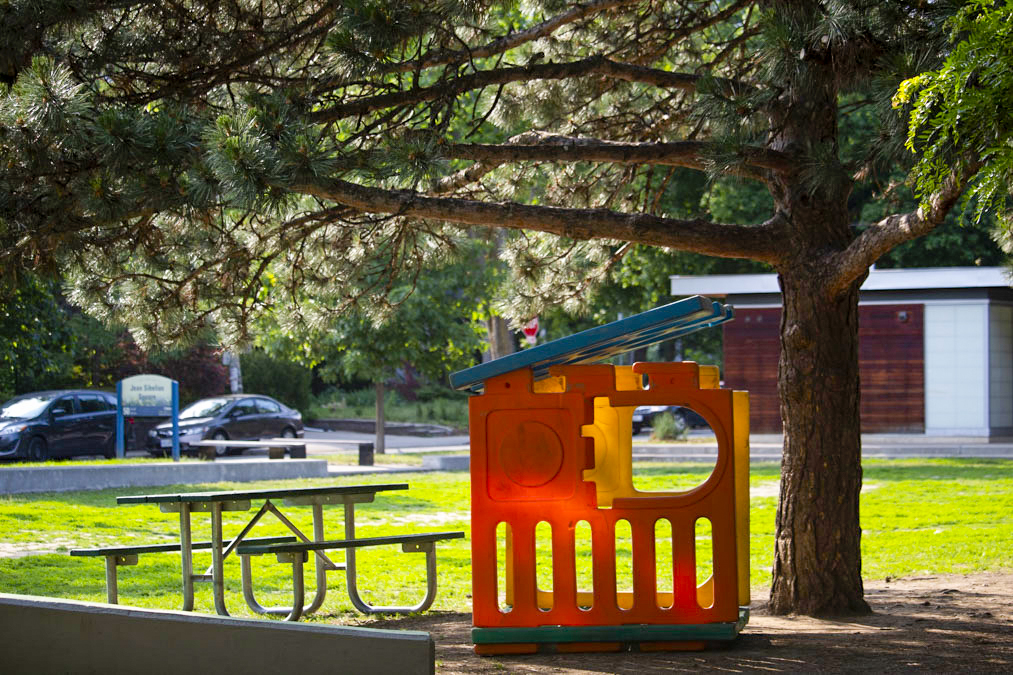
Jean Sibelius Square.
Jean Sibelius Square
50 Kendal Ave
Time: 11: 00 a.m.
Grade: A+ (Last year A+)
Reasons to go: This park is such a great place to bring your kids, have a socially distanced hang out or to even just read a book. There’s plenty of grass, albeit a little patchy in some places, so it’s perfect for any outdoor activity. Multiple picnic benches and an awesome playground featuring a climbing wall, web and sand pit are also positive features of this park. With a ton of trees providing some cool shade it makes for a great place to spend a whole day. Another huge plus is the large gender-neutral washroom that is surprisingly clean for a public toilet.
Overheard: “Who’s gonna need a shower when we get home? It’s you Scott, you’re disgusting.” A woman said to her dog who had rolled around in the dirt while she was busy working on her laptop.
Did you know: The city of Toronto bought the land of the park in 1906 and named it Kendal Square at first. Later, in 1956 it was renamed after the Finnish composer Jean Sibelius after the Toronto Finnish community lobbied city council.
With a plethora of weeds and graffiti on the playground equipment, Sally Bird Park stands out for its decline over the past year.
Sally Bird Park
194 Brunswick Ave.
Grade: C+ (Last year B)
Time: 11:30a.m.
Reasons to go: Sally Bird seems to be another park that got a little neglected over this pandemic year.. The tiny park that’s sandwiched between two houses with a walkway that connects Brunswick Avenue and Alan Powell Lane has become slightly overgrown with weeds and the workout equipment is covered in graffiti. What was reviewed for many years in the Gleaner as a quiet place to sit with your thoughts and escape the noise of the city is now filled with the sounds of construction due to a house renovation across the street on Brunswick. There’s a couple of benches and a few big trees but overall, nothing too special is happening at Sally Bird. It’s easy to miss but that might be a good thing.
Overheard: Sounds of construction and people just walking straight through the park.
Did you know: There’s actually a fair number of parks in the city that have outdoor gym equipment but Sally Bird looks like it could use a revamp. Most of the other parks were outfitted in 2018 by TREKFIT, an outdoor gym equipment company making them a bit more enticing than Sally Bird’s old and graffitied equipment.
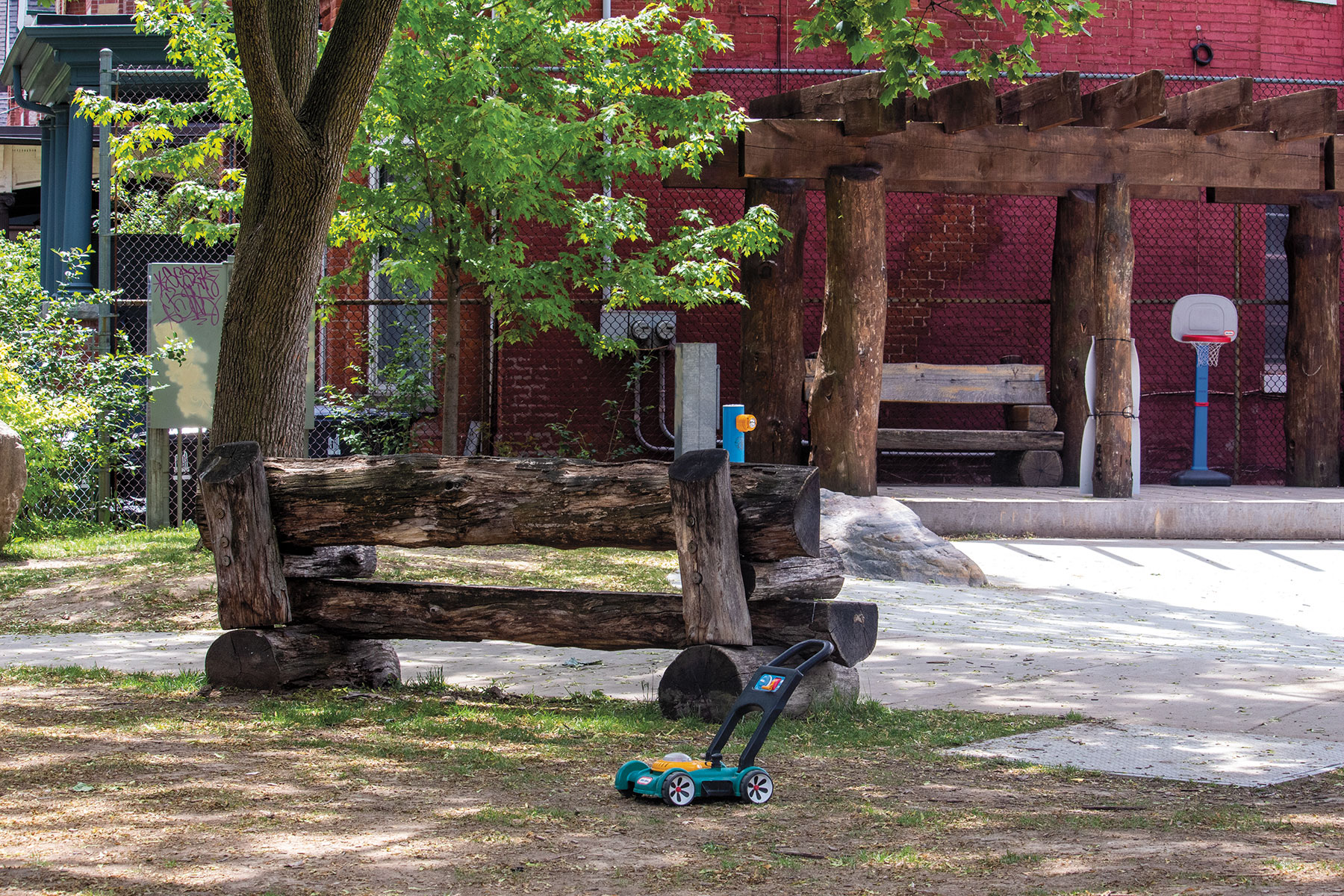
A treehouse, a sandpit full of toys, and beautiful trees earn Margaret Fairley Park an A- and make it another great place to bring the kids.
Margaret Fairley Park
100 Brunswick Ave.
Grade: A- (Last year B)
Time: 12:00 p.m.
Reasons to go: Margaret Fairley Park, named after the Canadian writer, educator, and political activist is tucked away at the corner of Brunswick Avenue and Ulster Street. Last year the swings were tied up due to COVID-19 protocols but now the swings have been freed and it makes it a great park to bring your kids this summer. There’s a sand pit full of toys, buckets and shovels for anyone to play with. There’s also a treehouse, a couple climbing structures as well as a splash pad which should be open again as part of the phase one reopening plan. Beautiful trees surround the large picnic benches, including one made of stone with an inlaid chess board. The park is in a residential area so it’s pretty quiet and usually not too busy so it also would make a great place to have lunch or read a book.
Overheard: “I love your helmet! It’s beautiful, I would wear it if I had one,” an older woman said to a little boy in a bright green dinosaur helmet with spikes on it.
Did you know: Margaret Fairley Park was renovated in 2016 and reopened in the fall of 2017. The renovation actually went over budget due to the oversized wooden chairs and picnic tables.
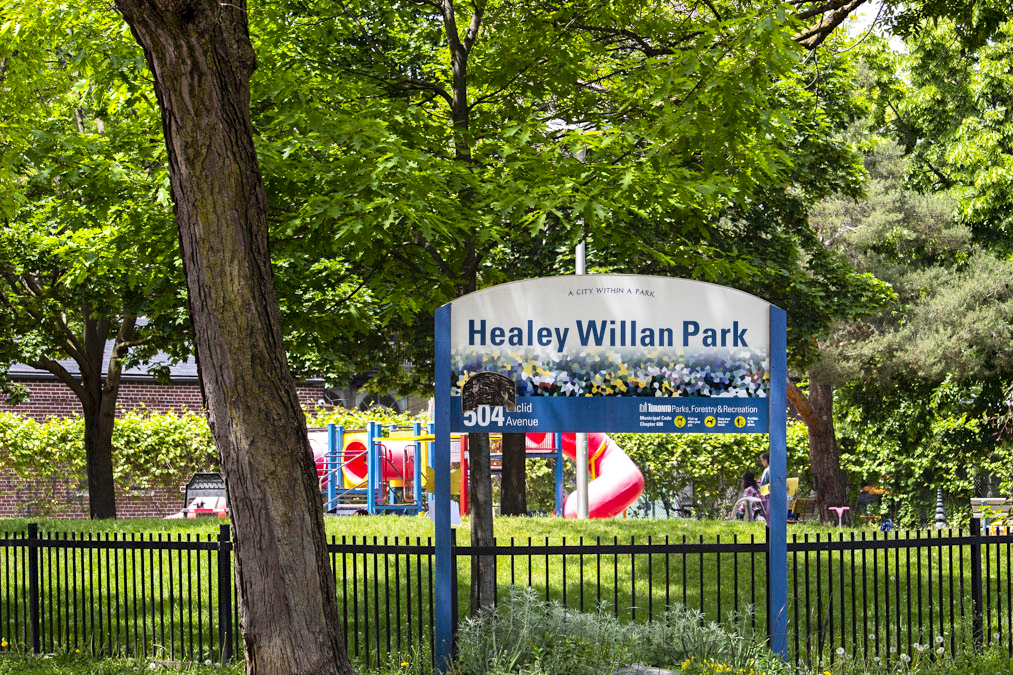
Healy Willan Park.
Healey Willan
504 Euclid Ave.
Time: 12:00 p.m.
Grade: B (Last year: B)
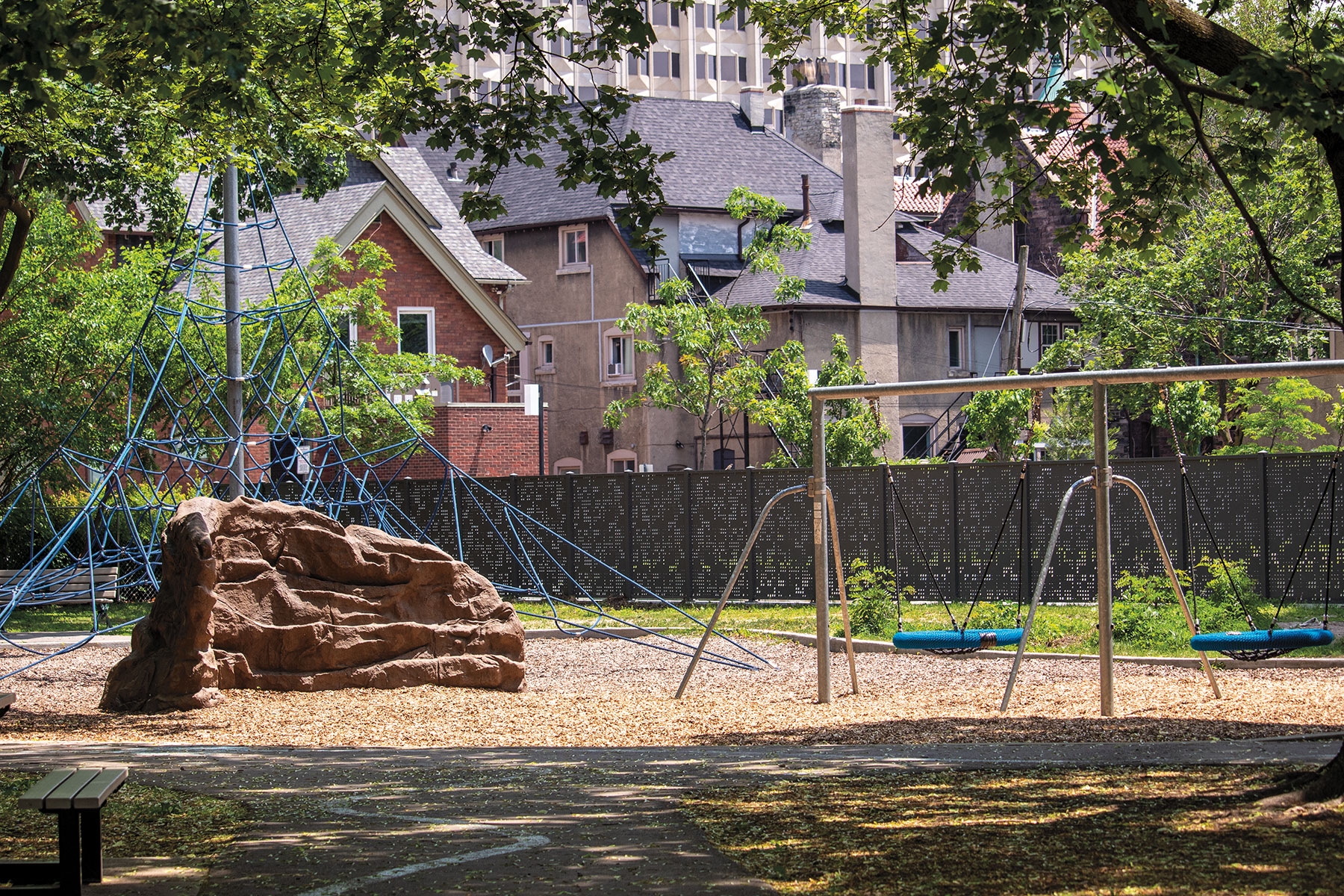
Reasons to go: If your kids missed hanging out at parks over the last COVID-19 summer, this will be the perfect one to bring them to this season. Healey Willan is fairly big and enclosed making it great to let your little ones wander. There are swings, a play structure, a sandbox, and tons of toys scattered around for them to play with. The grass is looking a little overgrown and there’s some weeds but otherwise it’s very well maintained. Right at Ulster Avenue and Euclid Avenue, the park is calm, quiet, and away from all the noise of the city.
Overheard: “Okay here I come!” A kid yells to her brother before running up to the top of the slide.
Did you know: The park is named after Canadian composer, organist, choir master, and teacher of the same name, who was known for fighting against typical “mediocre” church music. He also used to teach at the Toronto Conservatory (now the Royal Conservatory of Music) and was the organist and choirmaster at St. Mary Magdalene church.
Huron Washington Parkette.
Huron Washington Parkette
Huron St. and Washington Ave.
Grade: B (Last year: No Grade)
Time: 11:00 a.m.
Reasons to go: The original Huron Washington Parkette used to be right where the University of Toronto Schools renovation has been happening since 2019. The park was temporarily moved across the street to 406 Huron St. which was closed last summer due to the pandemic but has since been reopened. It’s a fenced playground with two swing sets, a playground structure with slides and some other fun structures for your kids to enjoy. There’s also some remaining trees and benches from the old park across the street which make a great place to either sit and relax or watch your children play in the park. Due to the construction project, the park is less busy. So if you’re looking for a quiet park to bring your children to this summer, this might be the one.
Overheard: “Well it’s not really fair,” a woman says on the phone while relaxing on one of the benches.
Did you know: The park will be moved back to its original place once construction is over.
The swings at Huron Street Playground have been set free since last years’ COVID-19 protocols. This hidden gem will be welcoming an off leash dog park, to be constructed in the fall.
Huron Street Playground
459 Huron St.
Grade: B- (Last year C)
Time: 2:00 p.m.
Reasons to go: This park is a hidden gem and close to St. George station. Located at the corner of Huron Street and Lowther Avenue, the park is quiet, shady and pretty well maintained. It’s also another one of the Annex parks that have since been set free from the COVID-19 shackles leaving the swings open for business. Now children can freely enjoy the unique swing set, rope climber, sandbox and a small rock climbing wall. There’s also lots of green space and some seating, most of which is nice and cool in the shade thanks to some beautiful trees as well as one of the Uno Prii buildings that casts a shadow over most of the park. The city approved an off-leash dog park addition to be added to Huron Street Playground last fall. Construction is supposed to start this summer, which might impact the calmness of the park this year but will be great for dog owners.
Overhead: A book club discussing their newest read.
Did you know: An off-leash dog park addition to this park will make it the fourth one in the Annex. The other ones are Bickford Park, Vermont Square Park, and Wychwood Barns Park.
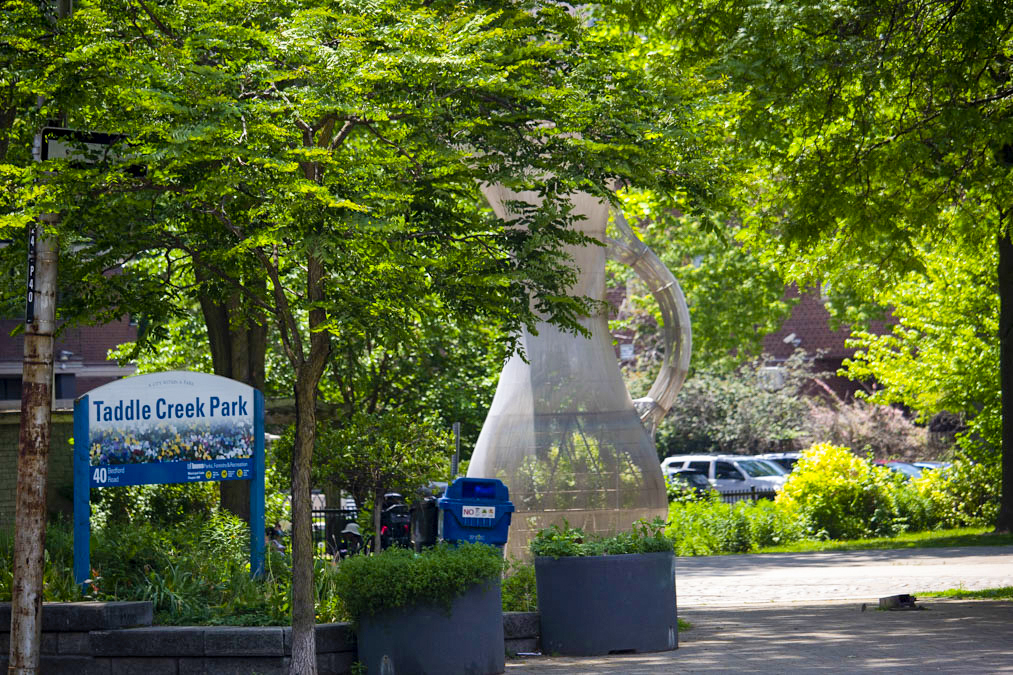
Taddle Creek Park.
Taddle Creek Park
40 Bedford Ave.
Grade: A- (Last year A-)
Time: 1:00 p.m.
Reasons to go: Unfortunately, not much has changed in Taddle Creek park when it comes to the famous massive public art piece called “The Vessel.” Created by Ilan Sandler for the park renovation back in 2011 the massive sculpture usually has a water feature but it was turned off last year due to the pandemic and has yet to be turned back on. The metal benches and the grass are still looking a bit worse for wear but overall, the park is clean and quiet. The playground structure is still holding up well and makes a worthwhile stop for the family or some friends for a nice socially distanced hang at one of the picnic benches.
Overheard: A group of girls laughing over their bubble teas.
Did you know: Taddle Creek is named after the stream of the same name that used to pass through the area. The creek that has long since been buried used to start at a small creek-fed pond at Wychwood Barns park that still exists today.
Bloor Bedford Parkette.
Bloor-Bedford Parkette
245 Bloor St. W.
Grade: B- (Last year: B)
Time: 1:30 p.m.
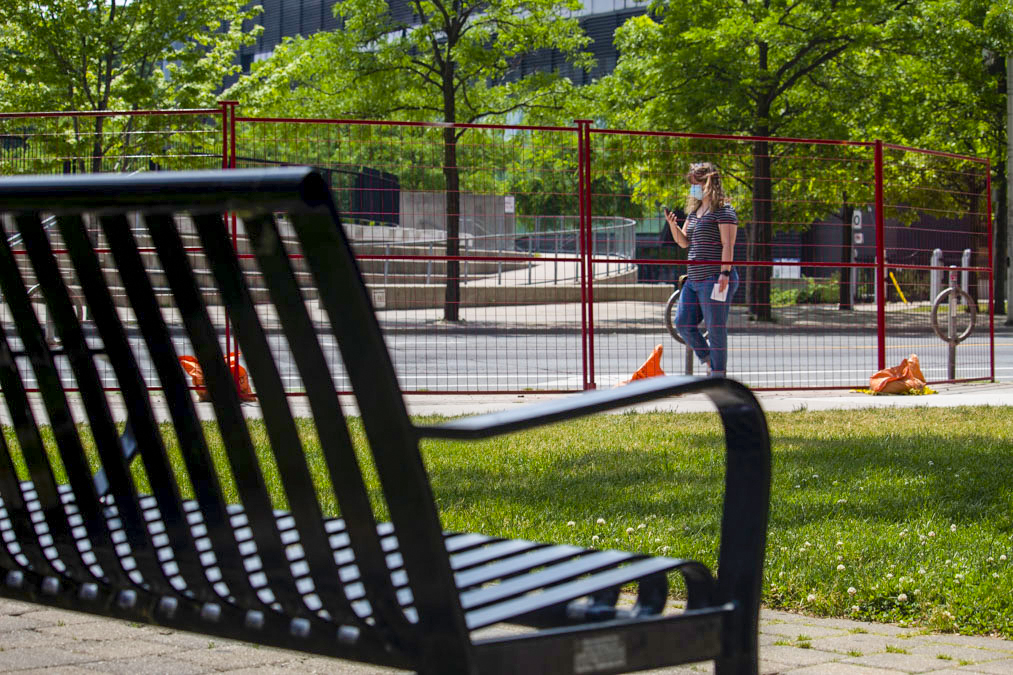
Reasons to go: This parkette is a great place to stop and take a rest out of the sun, maybe with a coffee, while you’re out and about downtown, but don’t take too long. The building beside it with the Tim Horton’s at street level is under construction. It is noisy and there’s a construction awning outside to protect pedestrians from falling debris and a bright orange fence at the front of the park. This means from pretty much any of the seven benches your view is of a fence whether it’s the orange one or the slightly nicer fence that looks out onto a not-as-nice parking lot. If you work in the area or just happen to be coming out of St. George station, it would be a relatively nice place to sit with some beautiful trees lining it to give you shade but due to the construction the relaxing atmosphere just isn’t what it used to be.
Overheard: “How long has she been in heat?” A woman asked the owner of a pitbull as the dog rolled on its back in the grass.
Did you know: This parkette was actually the spot where the Encampment Support Network Toronto (ESN TO), an advocacy group that focuses on supporting the homeless and decommodifying housing in the city, held a demonstration earlier this year where attendees taped eviction notices to a cardboard cutout of Mayor John Tory as a response to the city trying to remove housing encampments in parks.
Matt Cohen Park.
Matt Cohen Park
393 Bloor St. W.
Grade: C- (Last year: C-)
Time: 11:00 a.m.
Reasons to go: Parks have really been an escape for a lot of people throughout the pandemic, being a safe place to be outside while also enjoying the benefits nature has to offer. Matt Cohen Park does not in any way feel like an escape. Located directly at one of the busiest intersections in the city, Bloor Street and Spadina Avenue, this park is filled with sounds of traffic and construction and lacks greenery. There are a decent number of places to sit (most of which have been graffitied) so it would be a good place to take your lunch break outside if you worked close by but it is by no means a top park destination.
Overheard: Sounds of loud traffic and a man peeing on the adjacent building.
Did you know: The park used to be called the Bloor-Spadina Parkette before being renamed in honour of Toronto writer and novelist Matt Cohen in 2002. Cohen spent most of his life living in the area which led to it making its way into many of his books including the last book he finished before passing away, a memoir where he called Spadina “the centre of the universe.”
Queen’s Park North.
Queen’s Park North
11 Wellesley St. W.
Time: 2:00 p.m.
Grade: A (Last year A-)
Reasons To Go: There are plenty of reasons to get out and enjoy the newer park that is Queen’s Park North. Renovated in August 2019, this park still feels fresh and is arguably much more grand than most of Toronto’s parks. The gorgeous and wide paved paths that stream from every side and connect at the middle are strewn with beautiful benches and statues of historical figures. Despite being in the middle of a busy central point of the city, the park is very quiet due to its sheer size and the many trees, which you can actually identify using the ROM’s “Trees for Toronto” project. There’s no playground equipment but because of all of the open green space this would make a great alternative to some of the busier parks to spend a day with the kids or even with a group of friends for a picnic. Being so close to Queen’s Park also means it definitely benefits from being very well maintained.
Overheard: “Hey bud can I get a picture to send to mommy?” A dad asked with his phone pointed toward his son who was running with outstretched arms like an airplane.
Did you know: Queen’s Park is one of the first public parks in Canada and is still the largest public green space in the central core of Toronto.
Philosopher’s Walk.
Philosopher’s Walk
78 Queen’s Park Cres. W.
Time: 2:30 p.m.
Grade: A (Last year: A)
Reasons to go: Philosopher’s Walk may go unnoticed by people not familiar with the University of Toronto’s St. George campus but, that doesn’t mean it isn’t a gorgeous park. Running straight through the campus and located in a busy part of the city, this park still manages to feel like a hidden oasis. Surrounded by Trinity College, the Faculty of Music and Law, The ROM and the Royal Conservatory of Music, and lined with beautiful trees, there’s something that feels a bit magical about the Philosopher’s Walk. The grass is well maintained and the mostly shaded benches lining the paved path make this a great spot to read a book, catch up with a friend over coffee, or just simply stroll through on your way to Bloor Street.
Overheard: “He’s an IT guy, you’d think he’d be on Facebook.” A woman says to her friend over coffee.
Did you know: The Alexandra Gates at the head of the park were originally made at the corner of Bloor Street and Avenue Road in 1901 to commemorate Prince George and Princess Margaret’s royal visit. The gates were later moved to the north entrance when Avenue Road was widened but you can still find an E and A on the posts which stand for Edward and Alexandra who were the reigning King and Queen at the time.
Bickford Park.
Bickford Park
468 Grace St.
Time: 7:00 p.m.
Grade: A- (Last year: A-)
Reasons to go: If you want to have a socially distanced park to hang out with your friends but don’t want to have to deal with the large amount of people that Christie Pits and Trinity Bellwoods often bring in, Bickford Park is the one for you. During the day the park is pretty quiet, with a few people scattered amongst the hills reading, catching up with friends and even sunbathing while joggers run through or take a rest and dogs enjoy the off-leash dog area. The baseball diamonds are sometimes occupied with people practicing their catches and the soccer fields are often used by people working out. Then in the evening the park really comes alive, picnic blankets and friends laughing over drinks and snacks fill the hills. People playing frisbee and catch can usually be found at the bottom enjoying the open space. On a clear day you can even watch the sunset behind the CN Tower. Compared to the virtually spotless washrooms at Jean Sibelius Park, these washrooms needed cleaning. Overall, this park is a top destination for anyone wanting to get outside and avoid the busy patios this summer.
Overheard: “I told her that when I ask her to keep it down upstairs I’m not asking her to hover above the floor or anything. I just want her to stop stomping everywhere.” A woman tells her friend while sitting on their individual picnic blankets.
Did you know: Bickford Park used to be owned by Colonel Edward O. Bickford who was a wealthy landowner, former businessman and politician. Then in 1908, Bickford’s widow sold the land that the park sits on to the city for $44,250.
Christie Pits Park.
Christie Pits Park
750 Bloor St. W.
Time: 5:00 p.m.
Grade: A (Last year A+)
Reasons to go: Christie Pits Park is easily one of the best parks in Toronto and with over 20 acres of land it’s the perfect place for all ages and all interests. With a few playground structures, swings, and a wading pool it’s a popular spot for families and their children. The basketball courts, soccer fields, baseball diamonds, and even table tennis means that all types of sport players can find their place here. At the top of the park there’s lots of picnic tables and benches where you can sit and enjoy some beautiful live jazz music played by local musicians. You can also usually find a group of slack liners and hula hoopers hanging out which really adds to the creative energy that seems to fill the park. There can be some litter to be found scattered across the ground and with summer in full swing the line to the washroom can get a bit long and there’s often no soap in the dispensers. Overall, Christie Pits will still beat out most of the other popular parks in the city.
Overheard: “Do you want to get back in the stroller?” A caregiver said to the child. “No! I want to kick!” The toddler yelled back while punting a soccer ball that looked about half its size.
Did you know: Christie Pits briefly became a temporary trash site during the 2009 Toronto strike. In June of 2009, approximately 24,000 city employees went on a strike that lasted six months which greatly impacted garbage collection. The city eventually announced 19 temporary garbage disposal sites and Christie Pits was one of them.
August 16th, 2021 · Comments Off on CHATTER: Patio pioneer passes (July 2021)
Fans of Italy’s national soccer team fill the Diplomatico Café’s patio in Little Italy during the Euro Cup. Little Italy exploded with joyous fans after Italy defeated England in penalties. COURTESY CAFÉ DIPLOMATICO
When Rocco Mastrangelo Sr. and his younger brother Paul established Café Diplomatico in 1968 under its original name, Bar Diplomatico, patio dining was unheard of in Toronto. With the help of two city councillors, it took the brothers a year to convince Toronto Public Health that it was safe for customers to eat outdoors, and that vehicles driving by would not contaminate food.
How fitting that 53 years later, the concept pioneered by Café Diplomatico is now keeping restaurants across the city alive while they deal with ever changing risks and regulations resulting from the COVID-19 pandemic.
Café Dip, as it is affectionately known, has become a cultural landmark at College and Clinton streets, and has witnessed Little Italy transform around it.
Mastrangelo Sr.’s son, Rocco Mastrangelo Jr., who runs the business alongside his wife Connie, attributes the restaurant’s success to its customers.
“Our loyal, long-standing customers have become part of our family,” he said. “There’s this connection that this business has with people who live and work in the community and the customers that we have obtained over the years.”
Within Café Dip’s cozy walls which are covered with old-time movie posters and news clippings you often find tourists eating pizza or neighbourhood regulars sipping their daily espresso.
Much of that has been missing, however, over the better part of the last year. And that has been difficult for Mastrangelo Jr. and his family.
“Not only is it my job, not only is it my livelihood, and not only is it a business that I have to take care of, but it’s part of my social life too,” he said. “So I was going stir crazy all these months being locked down.”
This past year has been challenging for other reasons as well. In April, Mastrangelo Sr. died at the age of 87. Born in Anzano Di Puglia, Italy, Mastrangelo Sr. was one of the 400,000 Italians who immigrated to Canada between 1945 and 1970.
As an entrepreneur, he helped shape Little Italy. He owned multiple Italian restaurants, cinemas, and a video store. But his true passion was Café Dip.
—Joshua Chong/Gleaner News
Comments Off on CHATTER: Patio pioneer passes (July 2021)Tags:Annex · News
August 16th, 2021 · Comments Off on CHATTER: Tarragon offers a pay-what-you-can plan (July 2021)
Budget-conscious theatre buffs rejoice: The Tarragon Theatre is offering a pay-what-you-can 2021-22 subscription season. Artistic Director Richard Rose wants to make the shared experience of theatre broadly accessible after a pandemic year that has kept audiences and actors apart.
“The theatre fills our lives with meaning and emotion,” said Rose in a press release. “Catharsis is so necessary to what makes humans human. This congregating in a dark room to feel the unpredictable, the inexplicable, but the necessary.”
The PWYC season will be accessible in more ways than one. From September to June, subscribers can enjoy, “Tarragon Acoustic Reboot,” a selection of Tarragon’s greatest hits from the past 50 years, recast as audio plays. Subscribers will receive a password for unlimited online access to them all. Bonus behind-the-curtain content, such as in-depth interviews with playwrights, directors and designers from the original stage productions, are included.
Live, in-person theatre will run from January to June with six shows, including four world premieres. Topics range from intergenerational conflict (Three Women of Swatow, by Chloé Hung), to Black Lives Matter (Our Fathers, Sons, Lovers and Little Brothers, by Makambe K. Simamba), to Indigenous tradition in a modern world (The Herd, by Kenneth T. Williams), inviting all audiences to experience diverse stories told onstage.
Bill Glasco, Tarragon’s co-founder, introduced pay-what-you-can Sunday matinées in the early ‘70s. For those with an artistic bent, the Sunday theatre matinée became a ritual, and inspired many theatre careers (including this writer’s). A PWYC season could inspire a whole new generation of theatre artists.
Subscribers must decide what they’ll pay for the season, and they have until September 17th to make their first payment, with the second half of the total amount due when the live season dates are announced. Visit tarragontheatre.com for details.
August 16th, 2021 · Comments Off on NEWS: Limited-edition brew named through a community contest (July 2021)
“Pitstop,” developed by the Henderson Brewing Company, will soon be Christie Pits Park’s official beer
Spencer Murray of Henderson Brewing Company pulls a pint at their Sterling Road taproom. The award-winning craft brewery partnered with the Friends of Christie Pits Park to launch “Pitstop,” a new beer in honour of the popular park. COURTESY HENDERSON BREWING COMPANY
By Joshua Chong
Christie Pits Park will soon be getting an official beer in its honour. The Henderson Brewing Company, in partnership with Friends of Christie Pits Park (FCPP), is developing a limited-edition brew that will be available mid-August.
The idea to have a beer celebrating Christie Pits Park came from Monica Gupta, co-chair of FCPP.
“During the spring of 2021 I was sitting on our front porch drinking my favourite beer by Henderson’s called, The Best,” wrote Gupta in an email to the Gleaner.
“I felt somewhat hopeful that the city would be opening up out of lockdown soon and thought to myself ‘Wouldn’t it be nice to have an official beer of Christie Pits Park?’ So I sent a quick email to [everyone] at Henderson’s Brewery stating exactly that.”
In May, FCPP and Henderson’s ran a contest to name the beer. They received over 68 name submissions, including several related to baseball, picnicking, and the 1933 Christie Pits riot.
Ultimately, the judges chose “Pitstop,” a name that was suggested by Rob Maxwell (a city councillor who represented the Christie Pits neighbourhood between 1988-1997), and Phinjo Gombu.
“A Pitstop is a break or a timeout—a time to catch your breath and relax. Christie Pits offers us a place to do that,” wrote Maxwell in an email to the Gleaner.
For Gupta, the name perfectly encapsulates the character of the park.
“The park is a place to play with your kids, toss a frisbee and listen to music and enjoy a beer,” she wrote. “Many people use the park as a pitstop throughout their day.”
For winning the contest, Both Maxwell and Gombu will receive one of Henderson’s signature converted milk crates of 28 beers.
FCPP and Henderson’s are also running a label design contest for the beer.
The winning design has yet to be chosen.
According to Steve Himel, general manager of Henderson’s, Pitstop will be a light beer with cherries and peaches.
“First off, we wanted a good light refreshing daytime beer that was consistent with the idea of a pitstop—something that someone could take a moment to enjoy and get all the benefits of a beer without it being too heavy,” he wrote in an email to the Gleaner.
“The second reason is that we wanted something with ‘pits’ in it to riff on the name, thus the cherry and peach.”
Pitstop will be part of Henderson’s Ides Series of beers, each of which will be released in the middle of each month and tell the stories of people, places, and events in the community.
Past beers have paid homage to Honest Ed’s, Laura Secord, and the Corktown neighbourhood.
August 16th, 2021 · Comments Off on EDITORIAL: Ford’s school plan is a fail (July 2021)
Ontario parents have been eagerly awaiting the “robust” plan for a safe re-entry back to classrooms Premier Doug Ford promised in June. The past year has been brutal for both the education and mental health of Ontario students, as they have spent more time out of classroom than young people in any other part of the country. However, the 26 page document outlining how the government intends to keep students safe does them no favours: it’s late (coming out less than a month before the start of school) and is little more than a carbon copy of last year’s failed plan.
Yet again, we will see no reduction in class sizes and school buses will again be full. This year, students will be allowed to play contact sports, participate in music classes, gather in the cafeterias, libraries, and common areas outside of their cohorts. There will be no vaccine requirement for staff or students. It’s not even clear if the schools are allowed to ask who is fully vaccinated – for COVID 19 – schools can demand proof of measles or whooping cough vaccinations.
The back-to-school plan appears to pin its hopes on vaccines to keep community transmission down, yet, does not require them for congregating teachers, staff or students. There is still no vaccine available for children under age 12 and the Delta variant of COVID-19 is more contagious than past variants. so why is Ford’s plan to relax restrictions? While in many cases it appears that kids are better at fighting COVID-19 than adults, some children who contract it require hospitalization, treatment in the ICU, and to be placed on a ventilator. According to the Mayo Clinic, kids with underlying conditions are at a higher risk of serious illness with COVID-19.
In Scotland, students and staff alike are offered rapid tests twice a week and carbon monoxide monitors regularly assess airflow in shared spaces. In Ontario, the plan is to provide cash to school boards and simply hope that the right equipment is purchased, installed, and maintained. Knowing the Ford government, would it be too cynical to think that the plan is to throw money at school boards three weeks before schools open, and then blame them when schools shut down due to high infection rates?
The University of Toronto’s approach with its residence buildings is pro-active and just might work. The school is testing waste water from each building to detect copies of the virus. If found, the students and staff in the originating building will be tested by a rapid screening team to try to prevent an outbreak. Further, the University is requiring staff in close proximity to students to get vaccinated, if not they will need to endure daily rapid-testing.
Queen’s Park has also failed to release any metric as to what threshold of infection within a school would warrant a closure. If there is an outbreak, will they contact trace back to the parents? Will the whole family have to isolate? Hard to imagine that this would happen, considering there are no paid sick days, meaning that parents may choose to go to work despite being ill.
The Ford back-to-school plan sounds a lot more like a fourth-wave plan.
Just to re-cap: the plan that kept kids out of school last year is on repeat this year, with a few questionable new permissions added in alongside money for new ventilation systems in schools. The tools that could be used to keep kids safe in the classroom continue to be ignored: vaccine requirements for those 12 and older, rapid-testing of the asymptomatic, school windows that actually open, ventilation monitoring, reduced class sizes, and clear protocols for what happens when positive cases are detected.
Once again, our esteemed premier cooks up a plan that is incoherent and cowardly and now we are likely doomed to repeat our recent history, having apparently learned nothing.
August 16th, 2021 · Comments Off on FORUM: Excessive force will not solve a housing crisis (July 2021)
The violent eviction of homeless from parks is shameful
By Mike Layton
The violence and tactics on display by the City of Toronto in Trinity Bellwoods Park, Alexandra Park and Lamport Park this month is a deeply troubling use of resources and force. The number of armed police present to forcefully remove handfuls of residents experiencing homelessness is disgraceful.
It is an obvious attempt to make poverty and homelessness invisible.
Considering the number of truly pressing issues plaguing the city, it speaks loudly to our real priorities that this is where resources are deployed.
It didn’t have to be this way and we cannot police our way out of poverty.
Housing everyone using a human rights approach should be the only way forward.
In council I proposed another path, and supported other motions which would have worked to restore trust and dialogue with the goal of connecting people to housing and shelter.
This approach has been championed by Leilani Farha, an Ottawa-based lawyer who served as Special Rapporteur on adequate housing as a component of the right to an adequate standard of living, and on the right to non-discrimination at the United Nations for 6 years.
Housing must be recognized as a human right, not a commodity or an extractive industry as it has been historically.
We must restore the understanding of housing as home, challenging the ways financial actors have undermined the right to housing and land use processes.
Using a human rights framework, we can provoke action to end homelessness, lack of affordability, and encampment evictions in Toronto.
In my discussions with encampment residents, I have come to understand better that these individuals are afraid for their health and safety and worried about their future.
There are many that will not go to shelters and without understanding that point better, we will only be criminalizing their behaviour instead of trying to resolve the deeper issues that are keeping them outside.
Sadly, city council and Mayor Tory voted against my proposal to co-create a path to housing collaboratively with those in encampments from a human rights approach and the other motions aimed to move the city past this antagonistic relationship, and instead supported a “zero-encampments” policy. Here we are.
I have worked with my colleagues to amplify the voices of the disadvantaged and have called on the mayor to work to cease the encampment clearings immediately and pursue the options presented by myself and other housing advocates immediately.
I know that this does not correct the wrongs that have already occurred, but it will be a start toward trying to rebuild a broken relationship.
As for those who orchestrated the police violence against encampment residents, I will continue to hold them responsible at council.
Things needs to change.
I will continue to work from within and against the system, striving to defund the police regardless of the inertia from city council.
What happened, and has been happening, is wrong and needs to stop.
Mike Layton is the city councillor for Ward 11, University—Rosedale.