December 17th, 2021 · Comments Off on GREENINGS: Avoid the stress of stuff at Xmas (Dec. 2021)
Do it for the planet, and for yourself
By Terri Chu
As an environmentalist, few things make me cringe quite like Christmas does. We are heading into the season when Canadians will each discard a staggering 50 kg of trash over the holidays.
Experts with the waste electrical and electronic equipment forum estimate that in 2021 alone, the world will discard a mass of e-waste equivalent to that of the Great Wall of China, the world’s heaviest human made object.
This is a gentle reminder that most of us don’t need more stuff. Uncle Joe definitely does not need another “Best Uncle Ever” mug and the grandkids really don’t need another battery-operated Jeep.
Christmas has become an event in consumerism and barely resembles the religious roots it came from – which may be perfectly fine in a secular society. Only, it’s not making us any happier and it certainly isn’t making us any healthier.
The politics and stress of gift giving over the holiday season has gotten out of control.
The holidays are a source of so much stress that CAMH has created a guide for managing Christmas anxiety. Last year, COVID-19 was a great excuse to give us a nice reprieve from the usual holiday anxiety. The Omicron variant may give some of us a similar excuse this year, but we shouldn’t be using the pandemic to get us through traditions that seem to have a stranglehold on us.
Here are some tips that I use in order to create a more manageable and meaningful holiday season.
Draw Boundaries
Years ago, I loudly opted out of Christmas. I told my mom she can either have her 80 person Church-filled house party or she can have me home for the holidays, but not both. Dorm was closed for the season, but I would couch surf if that’s what it took. My dad and brother both hated the event.
It was a costly and time intensive undertaking that nobody in our household wanted except my mother in the name of showing “face.”
Under no circumstances was I going to spend the holidays at home if that party was happening again. What seemed like a harsh and unloving move on my part saved my dad, brother, and extended family a lot of grief and as a result, we all started to enjoy the holidays together after that.
Drawing boundaries, especially with your own family can be very difficult but can be well worth the initial blow up.
Even if you can’t draw such a harsh line as I did, it’s okay to draw your own boundaries around the holidays. Let the parents or in-laws know that you will do this, but not that.
Opting out can be as simple as not participating in the gift exchange.
Gently (or not so gently, your call) tell whomever you need to that you won’t be doing gifts this year or hint loudly that gifts need to follow certain guidelines.
Cite climate change as a reason or a house overflowing with useless stuff as a reason, give whatever excuse you need. You’ve got one more year of using COVID-19 as an excuse.
Food Gifts
Though nearly 60% of food is wasted, giving gifts of food is still better than electronics or anything made of plastic over the holidays. If you make it yourself, all the better. There’s something about homemade food that feels very special to the receiver.
It’s more intimate because you put time and energy into making something instead of shelling out, even for expensive packaged goods. Takeout and delivery have been on fire since the start of COVID-19 and almost everyone I know is sitting on a pile of black plastic food containers. Reuse those for gift giving this season. I promise, no matter how disastrous you think the batch of cookies turned out, it will be better received than anything you can buy. For those of you not into baking, try your hand at something simple like making your own hot chocolate mix. I’ve been in love with Karma co-op since I discovered their bulk section. You can buy hot chocolate mix or the ingredients to make your own using your own containers. Last year’s spiced hot chocolate in reused jelly jars were a big hit for me.
Pillowcase/Newspaper Wraps
And lastly, if you really can’t do away with gifts, the lowest hanging fruit would be to at least wrap with newsprint or get pillowcases for the task. Either reuse some old ones or make a big song and dance about getting some festive pillowcases you can reuse year after year. Whatever it takes to get the rest of the family on board.
Reducing our reliance on fossil fuels also means reducing our reliance and addiction to stuff. It takes an incredible amount of fossil fuel to mine for the materials, to produce, and finally to transport our gadgets and gizmos over to us. We tend to think about climate change only in terms of the fossil fuels we see burning (driving being the main one). The fossil fuels that went into making our stuff is what engineers refer to as “embodied energy.” It might not seem like much, but if we all opted out of Christmas, we would do immense damage to a system that keeps us hooked on fossil fuels.
November 11th, 2021 · Comments Off on ON THE COVER: Greenspaces graded (Fall 2021)
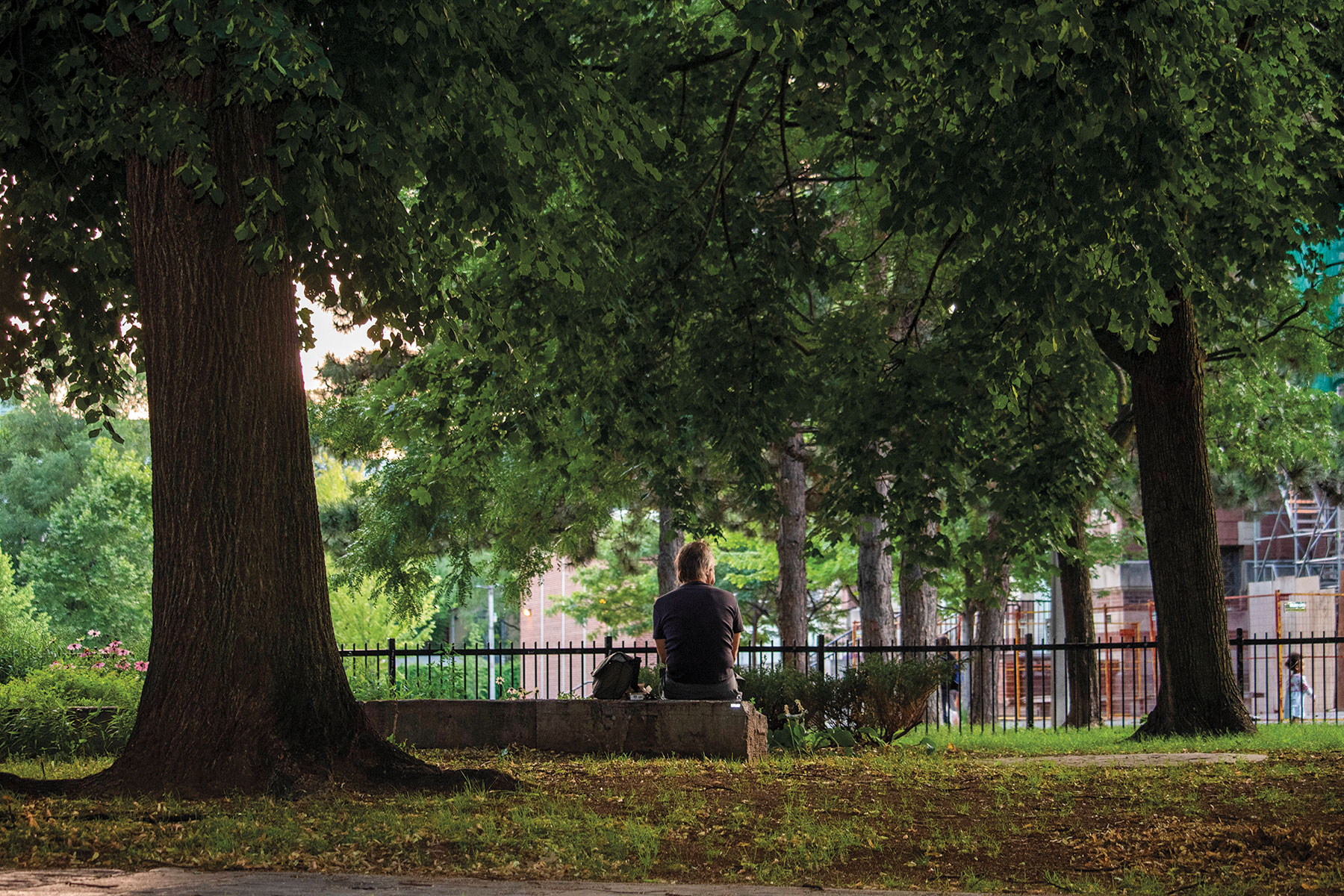
A man sits at the edge of Jesse Ketchum Park on one of the many stone benches facing the public school of the same name. Find out how Annex parks have fared in the second summer of the pandemic in our annual park reviews, part two. MADELINE SMART/GLEANER NEWS
November 11th, 2021 · Comments Off on NEWS: Freeland wins despite lower turnout (Fall 2021)
Order of results in Uni-Rosedale largely unchanged this round
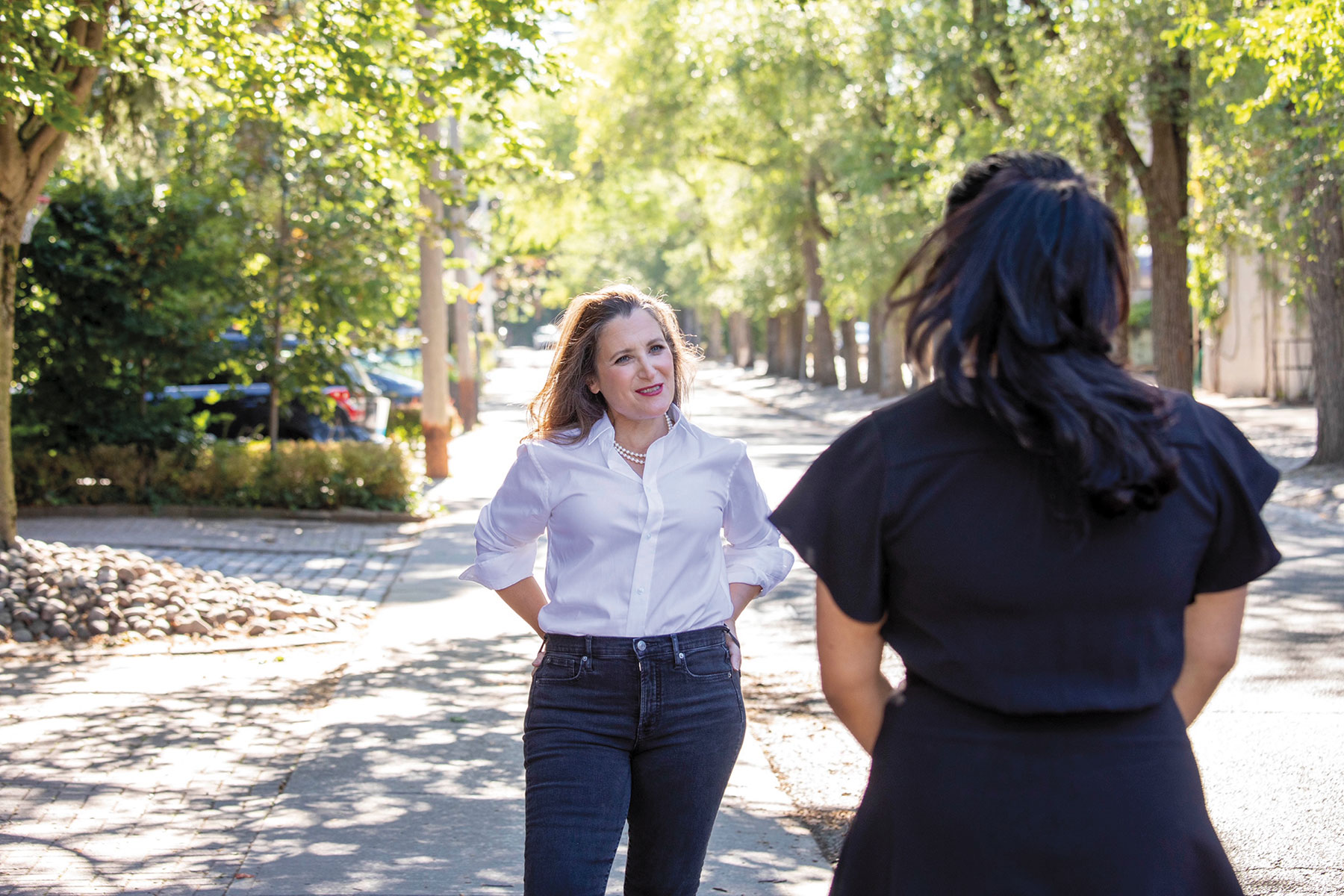
Deputy Prime Minister Chrystia Freeland was re-elected for the third time in University-Rosedale on September 21. Her message that the Liberals could be relied upon to finish the fight against the pandemic and bring in $10-a-day child care earned her 47.5 per cent of votes in the riding, despite fewer polls and lowered voter turnout. COURTESY CHRYSTIA FREELAND
By Nicole Stoffman
Chrystia Freeland was re-elected for the third time as the member of Parliament for University-Rosedale in Canada’s 44th election on September 21. The Liberals won all 25 seats in the City of Toronto. Prime Minister Justin Trudeau will lead his second minority government in a row with 160 seats.
University-Rosedale was formed in 2012 out of sections of Trinity-Spadina and Toronto Centre, and has only ever been represented by Freeland, the country’s current deputy prime minister and minister of intergovernmental affairs. She was first elected MP for Toronto Centre in 2013.
Voter turnout in the riding was down from 69.1 per cent in 2019 to 61.3 per cent this election. Pandemic voting protocols leading to long lines and fewer polls in University-Rosedale (down to 31 from 82 in the last election), likely had a role in discouraging voters.
Nationwide, voter turnout for the 2021 General Election was 62.25 per cent, down from 67 per cent in the last election.
Minister Freeland won with 47.5 per cent of the vote and 22,451 ballots, down from 51.4 per cent and 29,652 ballots in 2019.
Mail-in ballots have been available since 1993, but due to the ongoing COVID-19 pandemic, over 1 million voters decided to vote this way. In the 2019 election, only 50,000 mail-in ballots were cast.
The incumbent overtook Nicole Robicheau, the NDP candidate, who received 25.2 per cent of the vote with 11,921 ballots, a vote share increase up 3 per cent from 21.9 per cent and 12,573 ballots in 2019.
“The Liberals were down 3 per cent and we were up 3 per cent,” said Robicheau, “Maybe there was less of a feeling that Conservatives were going to take power, so people were voting with their hearts as opposed to voting strategically.”
Robicheau says she met a lot of young, first time voters at the door, who were planning to support the NDP because climate was their priority issue.
Steven Taylor, the Conservative candidate, earned 20.1 per cent of the vote with 9,307 ballots, a vote share increase up from 16.3 per cent and 9,473 ballots in 2019.
“Families are worried that their children won’t be able to afford housing in the Toronto area in the future,” Taylor said. “I think the Conservative housing and economic plan offered some hope to residents in the riding.”
Tim Grant, the Green candidate, came in fourth place with 4.2 per cent of the vote and 1,974 ballots, down significantly from 8.5 per cent or 4,861 ballots in 2019.
Green party support cratered nationwide this election, from 6.5 per cent in 2019 to 2.3 per cent in 2021. Former leader Elizabeth May said the party’s poor performance was due to leaked stories about internal conflict within the party under leader Annamie Paul, who lost her seat in Toronto Centre.
Justin Trudeau called the election on August 15 when his party was ahead in the polls. The Conservatives caught up and led in the polls for a few weeks. Following the debates, Grits and Tories remained in a tight race until the bitter end, with the Liberals gaining only three seats to win a minority government with 160 seats, and the Tories losing two seats, for a total of 119 seats. With the Bloc Quebecois and NDP in third and fourth place respectively, the 44th Parliament of Canada is almost unchanged from the 43rd. The Conservatives won 33.7 per cent of the popular vote, compared to the Liberal’s 32.6 per cent.
Three Liberal cabinet ministers lost their seats, prompting Conservative pundits to call this election “A 600-million-dollar cabinet shuffle.” Trudeau was attacked for calling an election during the fourth wave of a pandemic by opposition leaders throughout the race. The prime minister countered that he needed a new mandate to steer the country out of the crisis.
Minister Freeland spent much of the 5-week campaign outside the riding in support of her fellow candidates. She campaigned on the idea that the Liberals are the best party to finish the fight against COVID-19. She also reiterated the Liberal promise to bring in a $10-a-day national child care program, build affordable housing, and a create a green economy.
From 2015 to 2017, Freeland served as Canada’s Minister of International Trade, overseeing the negotiation of Canada’s free trade agreement with the European Union (CETA).
From 2017 to 2019, she served as Canada’s Minister of Foreign Affairs, leading the renegotiation of the North American Free Trade Agreement (NAFTA).
She was appointed deputy Prime Minister and Minister of Intergovernmental Affairs in 2019 and Minister of Finance in 2020.
In 2018, she was recognized as Foreign Policy’s Diplomat of the Year.
Ms. Freeland was born in Peace River, Alberta. She was educated at Harvard University before continuing her studies on a Rhodes Scholarship at the University of Oxford. Before entering politics, Ms. Freeland was a journalist for the Financial Times, The Washington Post and The Economist. She served as deputy editor of The Globe and Mail and the Financial Times. She was also a managing director at Thompson-Reuters.
She has written two books: Sale of the Century: The Inside Story of the Second Russian Revolution (2000); and Plutocrats: The Rise of the New Global Super-Rich and the Fall of Everyone Else (2012). Plutocrats is an international best-seller and won the Lionel Gelber Prize and National Business Book Award.
Ms. Freeland speaks Russian, Ukrainian, Italian, French, and English. She lives in Toronto with her husband and three children.
After the official results came in, Freeland took to Twitter to thank those who supported her, and promised to work just as hard for those who didn’t. Due to the ongoing pandemic, there was no victory party in the riding. Minister Freeland watched the results at home with her family.
November 11th, 2021 · Comments Off on NEWS: TDSB consults after community garden razed (Fall 2021)
New plans and promises accompany hurt feelings
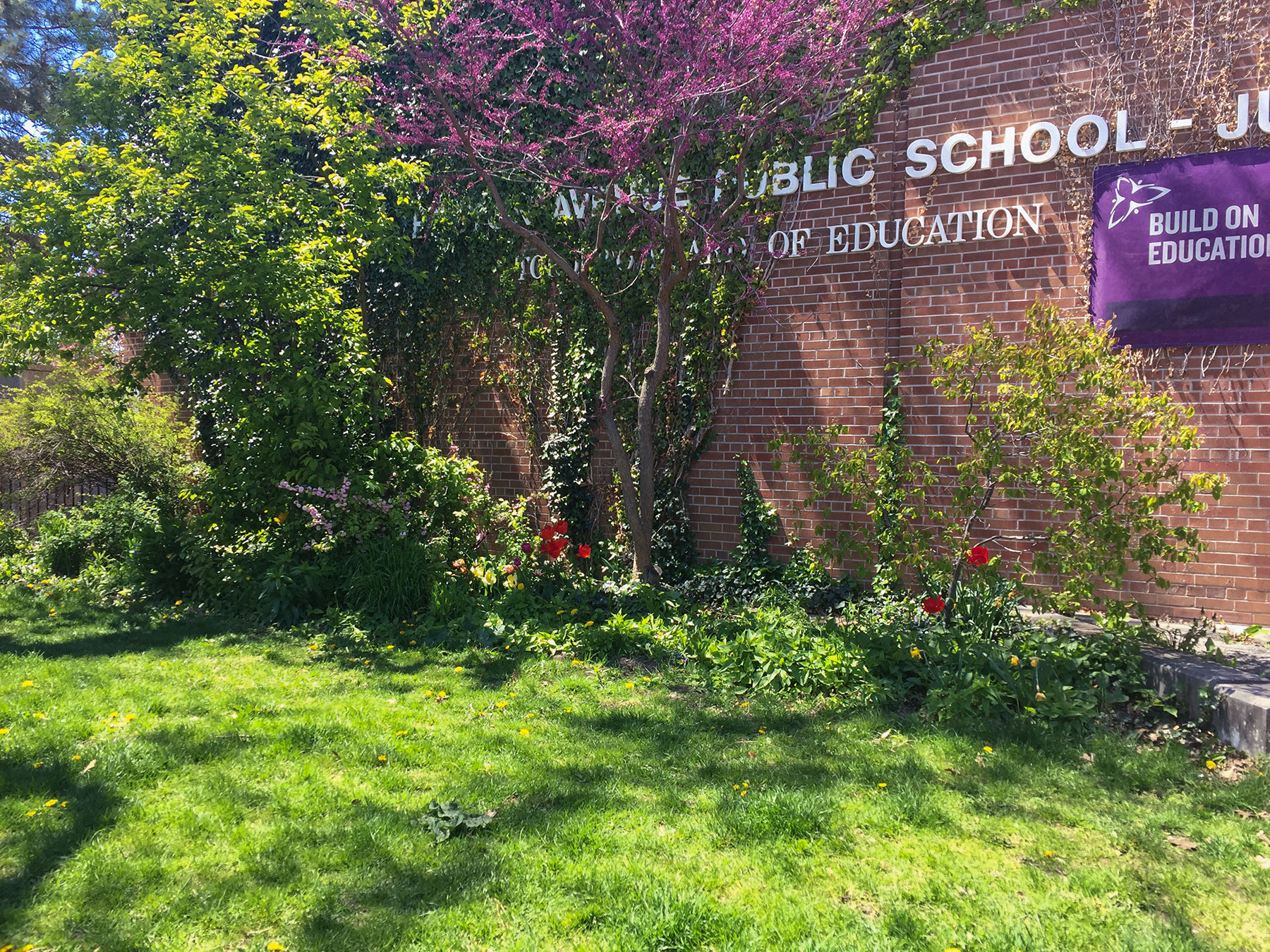
The once full community gardens along Palmerston Avenue Junior Public School now sit empty. MADELINE SMART/GLEANER NEWS
By Madeline Smart
On September 8, Trustee Chris Moise held a community meeting to address the abrupt razing of the Palmerston Avenue Junior Public School. The school and the TDSB faced major criticism from the community over the action, especially by those who volunteered countless hours maintaining and planting the garden over the 20 years it had stood. While sincere apologies were made and accountability was taken by Senior Facilities staff, the plans for the replanting of the garden fell short of what most community members were hoping for.
The replanting of the community garden will be added into a large-scale master plan because Senior Facilities staff are already redesigning the outdoor space that childcare and kindergarten classes share.
The school has also received other suggestions about how to use the grounds over the years, so they are taking the opportunity to redesign the entire site. This would mean that minor landscaping projects could take place in 2022 but any major ones will happen, at the earliest, in 2023 – and those will depend on available funding. Some community members expressed their concern that the garden’s progress and direction would be slowed down by bureaucracy.
“We want restitution and we want the garden to be unhitched from the master plan,” said Howard Law, a former parent of the school and community member. Law commended the board for taking accountability and creating a process in which something like this wouldn’t happen again, but he and other volunteers of the garden were taken aback by this announcement of a master plan.
“It kind of came out of left field,” he added. “I think there were some people that felt like our gardens were being railroaded into something else.”
Law says that adding the garden to a larger scale plan doesn’t provide the community with enough reassurance that it will be restored in a way that honours all the work people put into it over the years.
Richard Christie who led the meeting and works on the TDSB sustainability board encouraged any community members who wished to be involved in the master plan to connect with the school’s principal Rory Sullivan in order to become a community representative. He added that there will likely be three separate planning meetings regarding the master plan before any work will begin.
Christie also announced during the meeting, a new process of communication to ensure that nothing can be done to the garden without approval from the Senior Facilities managers and the Board’s team of landscape architects. This system will be implemented across all TDSB schools with community gardens.
“Moving forward, any work to be completed in this capacity will first be communicated with the school, providing them time for consultation with school/community groups involved, should there be further discussion/consultation about the scope or the work and what can/cannot be done,” wrote Principal Sullivan in an emailed statement following the meeting.
“There were definitely lessons to be learned here,” Moise told the Gleaner. “We are in education and I think [we’re demonstrating] the ability to show our students that it’s okay to make mistakes. As a system I think we are recovering from this and we’re moving forward, hopefully with our community.”
The Board is committed to covering the full cost of replacing the garden but it seems that for many who spent so much of their time and energy working on the original, it hurts to start from scratch after over 20 years of effort.
“All that work, all that effort, all that money, all that coordination, all that community feeling, it’s hard not to get emotional about it, because it was something that was near and dear to a lot of us,” said Caroline Murphy during the question period of the meeting. Murphy is a former parent of the school and early volunteer with the garden.
Principal Sullivan also stated that they are working on establishing a steering committee to oversee the consultation process for the master plan.
Law and other “community garden activists” have requested that the replanting of the community garden be disconnected from the master plan and start in April 2022.
November 11th, 2021 · Comments Off on NEWS: City fails to move forward as Avenue Road plans evolve (Fall 2021)
Bike lanes added to Avenue Road re-design
Avenue Road Safety Coalition has introduced a project that would create a bike lane on the east side of Avenue Road in a shared space with pedestrians. COURTESY BROWN AND STOREY
By Margarita Maltceva
Avenue Road Safety Coalition (ARSC) and Brown & Storey Architects Inc. held an online meeting September 13 to discuss their plans for making Avenue Road safer for pedestrian traffic. The project launched following the death of an 18-year-old cyclist in August, and following a report by the City of Toronto that estimates some 60,000 cars speed on the road each week. However, the city still has not hired a consultant for the project and its time frame remains unknown.
Last May, Councillor Josh Matlow moved a motion for city staff to study how a bike lane on Avenue Road would affect the flow of traffic. The initial plan by Brown & Storey Architects did not include a bike lane, but widened sidewalks for pedestrians. This would have brought the street back to what it was in the 1950s, before extra lanes were added to accommodate more cars.
After the city added a temporary bike lane on Bloor Street this year, Brown & Storey added a bi-directional bike lane to its plans for the east side of Avenue Road. This new design would consist of two 1.5-metre bike lanes separated from pedestrians by trees and lighting.
ARSC coordinator Albert Koehl told the Annex Gleaner that the new bike lane would become a part of the bike lane network connecting downtown streets.
The innovations on Avenue Road would also create a linear park with 580 new trees, potentially providing access to the Green Line and making new entrances to Ramsden Park.
James Brown, one of the founders of Brown & Storey, said the structured verges would hold trees and plants, separate the sidewalks from the road and create a “linear garden running all the way along the street.”
Councillor Matlow, who attended the meeting on September 13, expressed frustration about the lack of progress the city has made on this project.
“It will take several months or a year to do all the work, the study and the consultation,” he said, and explained that one of the reasons why the project is taking so long is because the transportation staff that would have worked on Avenue Road have been seconded to other priorities.
Matlow stressed that safety on Avenue Road also should be a priority for the city.
“The city has demonstrated during the COVID-19 pandemic that when it wants to reimagine how we use the public realm, it’s able to do so very quickly. We’ve seen that with ActiveTO and with CaféTO. Why should Avenue Road be any different? Why should it be left any less safe than any other streets?”
Apart from the pilot project, he said the city should take immediate steps to create more space on Avenue Road for pedestrian safety.
Koehl stresses that creating a safer environment for pedestrians and cyclists would also help the city achieve its Net Zero strategy – which sees residents walking or cycling to make 75 per cent of their trips under five km by 2050.
“We know we need to reduce motor traffic,” said Koehl. “And in fact, that’s exactly what the city’s policies say.”
Councillors Layton and Matlow will move another motion on October 2 to ask the city to evaluate and consider the changes proposed by the ARSC.
November 11th, 2021 · Comments Off on CHATTER: ARA’s ambitious tree audit planned for renewal in 2022 (Fall 2021)
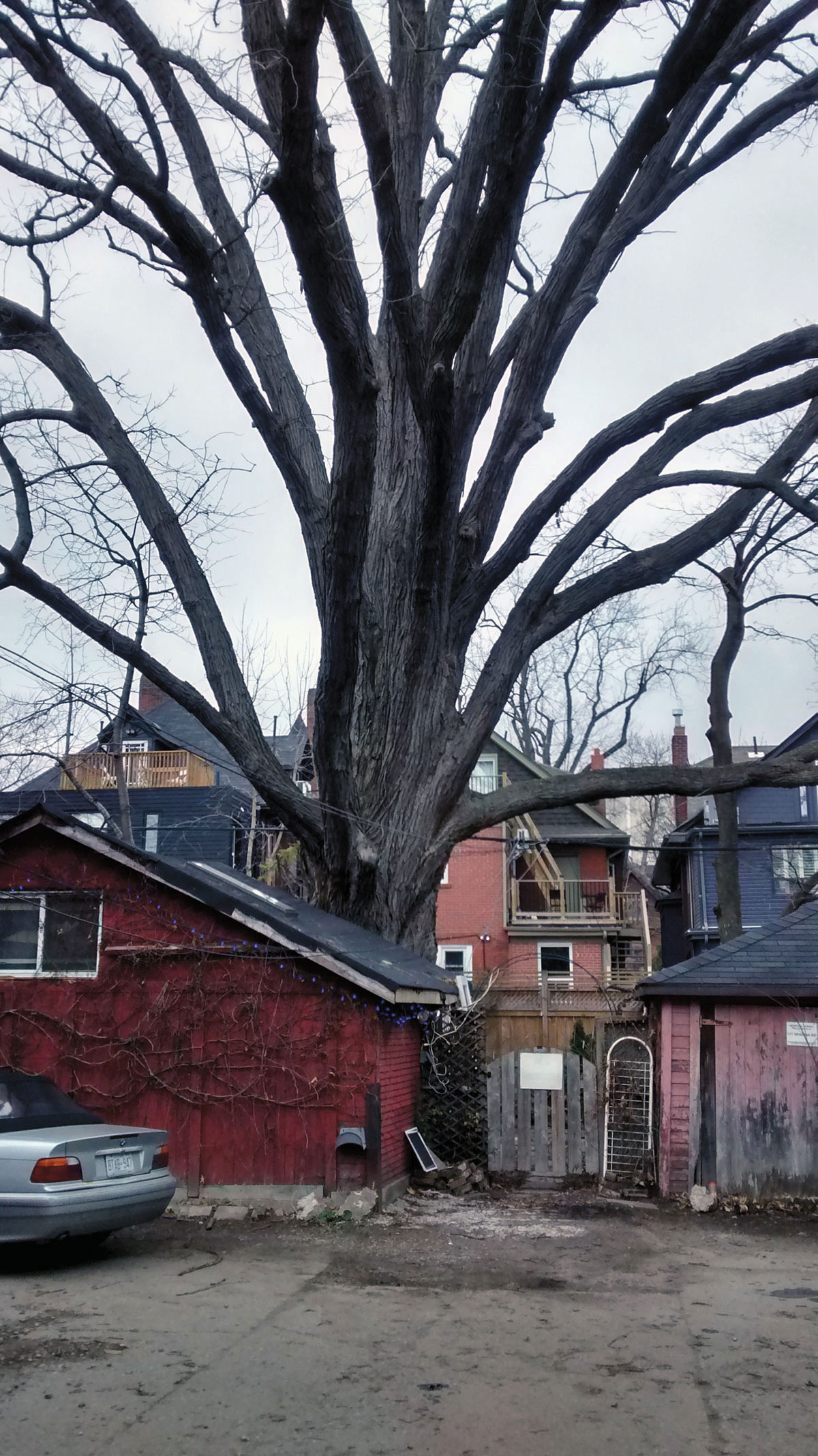
This 400 year old oak tree off Spadina Avenue is one of the oldest trees in the city. The ARA is about to update its survey of all 10,000 trees in the Annex. New data will help protect the tree canopy from developers, says project lead, Terri Chu. GLEANER FILE PHOTO/COURTESY MICHAEL LOW
In 2009 the Annex Residents Association (ARA) took on the impressive task of cataloging over 10,000 trees in the Annex neighbourhood. A team of forestry students and numerous volunteers worked over the course of four summers logging the trees’ species, age, varieties and their ownership. Now, 12 years later, they’re looking to do it all over again.
“If we don’t collect data, we won’t know what has happened to our trees,” said Terri Chu, the chair of the ARA’s Environment Committee. The last 10 years have been hard on the Annex tree canopy, especially with the wind and ice storm of 2018 which Chu estimates caused a loss of about 1,000 trees. So, the canopy is overdue for a checkup.
The survey will give the ARA an accurate accounting of where trees have been lost and where new ones need to be planted. This will also help keep the City of Toronto accountable to their promise of expanding the city’s tree canopy to 40 per cent by 2057, said Chu.
The data can also be beneficial when it comes to new developers looking to build in the neighbourhood.
“How will we argue in favour of preserving trees, especially really mature ones, if say a developer wants to uproot six of them to put a larger condo in?” Chu asks.
Chu supports densification in the city, but says she also believes there needs to be a balance. With a newer set of data on the trees in the area Chu says they’ll be able to better fight back against developers in order to continue to preserve the canopy.
A comprehensive study on the individual species of trees will possibly help catch any early warnings of disease and help predict which trees will soon be reaching the end of their life span.
“Conceivably we’re going to start having gaps in the canopy here and there in 10 years, 20 years, and the time to start planting those trees is not 10 years from now, it’s today.”
It’s no secret that the Annex is known for its tree-lined streets. The trees add practical value like shade on hot sunny days and increased property value but they also simply make it more beautiful and enjoyable to get outside and take a walk, something that has become increasingly important during this pandemic.
The committee estimates that the survey will cost $15,000 for each of the four years but, if they can raise half, or $7,500 per year, they can apply for a grant for the rest. The committee received $2,000 from Cohen and Masters, and $5,500 from a community fundraising drive, reaching their goal for this year. The campaign will repeat yearly for the next four years. Chu hopes to raise another $7,500 with a grant from MITACS, a national non profit that partners with industry and academia. If she is successful, she’ll be able to hire two U of T forestry students to expedite the survey.
November 11th, 2021 · Comments Off on CHATTER: Access to winterized washrooms set to improve (Fall 2021)
In 2021, the City of Toronto opened up 79 new public washrooms for use throughout the winter, nearly doubling the previous number. This project was a direct response to pandemic restrictions which made access to public washrooms extra challenging, making life especially hard for vulnerable segments of the population.
Bickford Park and Dufferin Grove are among the 148 City of Toronto parks that now have accessible public washrooms all year long.
To build and improve upon this project, the city’s parks department wants to make five more washrooms operational and increase the number of park pathways and trails that get ploughed following a snowfall. High traffic areas and pathways that link parks and community centres to major roadways and TTC stations will be prioritized by this plan.
Councillor Mike Layton (Ward 11) supports this plan. His own experience of having to carry a stroller with a child inside through three feet of snow along the sidewalk beside Christie Pits Park demonstrates its necessity, he said.
However, Deputy Mayor Denzil Minnan-Wong questions the larger plan of expanding access to park washrooms through the winter months, suggesting that providing this service may “have the unintended consequence of encouraging encampments.”
Edith Wilson, who runs a website called torontotoilets.org says the deputy mayor’s resistance to the expansion of public washrooms is “classic City of Toronto.”
In 2018, Wilson completed a Master’s Thesis in Sociology from the University of Guelph titled Washrooms for Customer’s Only: Space, Dignity and Sh*tting in the City.
“My archival research showed that not having public washrooms in the city was politically deliberate, and the strategy dates back to the 1950s,” says Wilson. “Any time there is an expansion of public washrooms I consider that a good thing, however, the expansion of their maintenance needs to happen as well. There’s no low-cost solution to this.”
Councillor Layton moved to adopt the motion at the city’s October 26 Infrastructure and Environment Committee Meeting.
—Meribeth Deen/Gleaner News
Comments Off on CHATTER: Access to winterized washrooms set to improve (Fall 2021)Tags:Annex · News
November 11th, 2021 · Comments Off on EDITORIAL: Doug Ford, the chaos king (Fall 2021)
Frustration. Nonsense. Chaos.
These are just a few words that are used to describe the situation for Ontario businesses following the release of the province’s plan to lift all Covid restrictions for businesses. You’d think there would be more celebration, but it’s hard, given the fact that small businesses are being impacted extra hard by policy that seems designed to hurt them.
Our premier likes to talk about how he’s the one looking out for the “little guy,” but this pandemic has proved that to be patently false as restaurants have been forced to wait at least two weeks before their pandemic restrictions were lifted while concert halls, sports venues, big box stores and theatres were allowed to open to 100 per cent capacity.
While the Ontario Chamber of Commerce said they welcomed the plan, the organization’s CEO, Rocco Rossi, took the opportunity to express his frustration at the rollout.
“Lifting capacity limits for some businesses and not others, without presenting data, public health indicators or a clear rationale has left many in the business community completely frustrated,” he wrote in a recent press release. “As we have said from the beginning, transparency and clear communication from the Government of Ontario are critical for confidence in public health measures during this time.”
When faced with heat after making questionable decisions, Premier Ford likes to deflect and blame his advisors. A favourite target is the Chief Medical Officer of Health, Dr. Kieran Moore. But in this case Moore felt obliged to contradict the premier, “this a government decision, it is not mine. It is that of the government.”
The founder of the advocacy group SaveHospitality.ca John Sinopoli said many restaurants are teetering on the edge of bankruptcy with patio season ending and the onset of colder weather. Sinopoli accused Ford of again favouring large corporations such as Maple Leaf Sports and Entertainment (MLSE), the owner of the Raptors and Leafs, while ignoring the plight of small businesses. MLSE partnered with the province in creating the newly minted vaccine app.
“Pure nonsense”, is what Sinopoli said about the premise that eating in restaurants is more of a risk than spending hours surrounded by shouting, often maskless fans. Data that suggested bars and restaurants were risk centres for COVID spread was gathered before the 84 per cent of the province’s eligible population were fully vaccinated and before food establishments required indoor diners to prove they had received both jabs.
Peter Juni, head of the province’s science table, was apparently not asked either about the sudden decision to open large sports venues, concert halls, and theatres to 100 per cent capacity. This seems to be the premier acting on his own which might explain why many of these rules continue to make no sense.
Restaurant employees still don’t have to be vaccinated, according to the province. Nor do the employees at the aforementioned large venues, though those businesses may require it. Personal service businesses such as hair salons, barber shops, nail spas and tattoo parlours don’t require vaccinations for either staff or customers. How can that be safe?
Ford did recently ask the science table whether it thought it was a good idea or not to require health care workers to be vaccinated. Are you kidding? Hospitals are suspending staff now who are not fully protected for the sake of vulnerable patients and co-workers, and the premier is only now pondering if it’s a good idea or not for the province to require it? That horse has left the barn.
November 11th, 2021 · Comments Off on FORUM: Status quo streets unsustainable (Fall 2021)
Government must be proactive to protect cyclists, pedestrians
By Mike Layton
As kids are finally settled into a new school year, road safety continues to be a priority for me. On one of my rides home this past month, I crossed paths with someone not older than 12 using the bike lane on Bloor Street to travel home from school with his backpack. This is not something we would have seen a few years ago and I was excited to see how many young people were making use of the new bike lane.
As we travelled along the bike lane my mind went to all the intersections and routes across the city where more needs to be done to make roads safer for pedestrians and cyclists.
Following the devastating news about the death of an 18-year-old cyclist on our streets and several other reports of poor pedestrian safety this summer, I am working to get immediate intervention on Avenue Road, and other essential streets in the ward.
This young person’s death could have been prevented. It took place along a stretch of Avenue Road which council has previously identified for study for ActiveTO intervention and the installation of basic cycling infrastructure. Investing capital into transforming our streets is essential. Other cities across the world have done this, challenging the status quo, and prioritizing substantially bolder, safer streets.
We need a broad-based approach to proactively address roads with similar characteristics as Avenue Road: major arterial roadways of six lanes or more with high speed limits to major destinations.
Our recent budgets have featured billions of dollars toward funding of repairs and construction on the Gardiner Expressway. Meanwhile we wait years for cheap, cost efficient cycling infrastructure that has been proven to make our roads safer for drivers, cyclists, and pedestrians alike.
Immediately prior to the tragedy on Avenue Road, an area of cycling infrastructure just southeast on Bloor Street was obstructed by road work and insufficient signage, causing drivers to dangerously merge into the cycling lane, and leading to many near misses and other dangerous interactions. The following day, the same thing occurred at the southwest corner of the intersection. Council has repeatedly asked to review these issues, which come up frequently, and to make changes that would support the safety of residents. However, we continue to be met with delays.
I wrote a letter to the director of Transportation Services detailing the decisions council has made and how their implementation could have saved a life, and can save lives in the future. This letter advises staff to begin the installation of cycling infrastructure on Avenue Road; to expedite the Avenue Road Safety Coalition’s requests for intervention and extend this south of Davenport; to review the implementation of the 1-metre passing rule; and request a report on the existing construction practices and progress on fulfilling council’s directions.
I feel like a broken record due to the number of times I have said this, but we cannot stop fighting until we achieve change.
In the absence of regulatory changes, and the political will and dedication of resources needed to impact behavioural change, the physical environment must be altered to reflect the vision of safety that we purport to support through Vision Zero.
Speaking of Vision Zero, the city is in the process of renewing its contract for the maintenance of our red light cameras. I have learned that there are no planned expansions of this program for at least 5 years. This expansion cannot wait. We have seen many intersections, like that at Christie and Dupont streets, where fatal collisions have occurred. We must fund the expansion of this program to deter people from speeding through intersections.
Council has also received a report that the presence of Automated Speed Enforcement is having a positive impact. There are currently only 50 ASE systems installed in Community Safety Zones near schools and there are two systems per ward to ensure an even distribution.
City council must work to expand this program, in tandem with other measures to increase road safety and correct as many dangerous areas as possible in our continued work toward Vision Zero. I will be asking staff to report on costs to do so immediately in the hopes of having council support this important expenditure in the 2022 budget.
It’s been over 5 years of Vision Zero and we’re still missing the systemic, street-by-street approach that will prevent unnecessary deaths on our roads.
As always, please don’t hesitate to contact me with your questions and concerns at Councillor_Layton@toronto.ca
Mike Layton is the city councillor for Ward 11, University—Rosedale.
November 11th, 2021 · Comments Off on FORUM: A wasted election, now Mr. Trudeau please deliver (Fall 2021)
Many promises are now on the books that must be fulfilled
By Jessica Bell
Canada’s 44th election is over. The election cost $660 million, and delivered the same results as before, give or take a few seats. The Liberals got the minority they deserved.
Despite the status quo outcome, the political moment has changed. Here’s what I’m noticing:
Canadians are mostly comfortable with a minority government, they want political parties to work together, and no one wants another federal election any time soon. Canadians also want politicians to keep their promises. No one in our riding has forgotten Trudeau’s reneging on reforming our first-past-the-post electoral system back in 2015.
This is why the NDP now holds a strong bargaining position to hold the Liberals to account, and push for bold progressive change on the top election issues.
Here’s what Trudeau should do to address one key issue, the housing affordability crisis. Home prices increased by 38% last year alone, and over 40% of Canadian renters pay unaffordable rent. Federal action is vital.
On the demand side, Trudeau’s proposed two year ban on foreign buyers of residential homes should proceed, and be properly enforced.
The Liberal’s plan to impose a one percent annual tax on vacant homes owned by foreigners should extend to all vacant homes, with an exemption for primary residences.
Maverick researcher Jaco Joubet estimates the vacancy rates in Toronto’s biggest condos range from 5.5 to 13%. Joubet determined occupancy by photographing 15 Toronto condos every night for a year to monitor whether the lights were on.
To help existing renters, Trudeau should better regulate and fairly tax Real Estate Investment Trusts, or REITS.
These corporate financial landlords now own 20% of all purpose-built rental properties, including many buildings on Walmer, Spadina, St George and Bay.
To increase profit, corporate landlords cut maintenance and evict long-term tenants to raise the rent to market rates.
This business model makes home life miserable for our apartment-dwelling neighbours, and must be addressed.
To build new affordable supply, the Canadian Mortgage and Housing Corporation (CMHC) should be reformed.
CBC recently investigated CMHC’s signature affordable home building program – the rental construction financing initiative.
CBC found this program is giving billions in loans to developers at extraordinarily favourable terms, like 50 year amortization periods, to build unaffordable rental units – sometimes asking rents double the neighbourhood average.
CMHC’s programs must facilitate the construction of permanently affordable homes, including homes built by non-profit providers and cooperatives.
The election results exposed Canada’s growing political instability.
While the People’s Party of Canada did not win a seat, they got six percent of the vote.
At the door, PPC-voting residents told me they were angry about the lockdowns and vaccine mandates because it threatened their civil liberties.
I observed anger, apathy, and a deep distrust of government and mainstream media.
This divisiveness will not subside with the pandemic. There are no easy answers, but I know listening and understanding is part of the solution.
I know that often a rejection of government can be driven by big social change, like the rise of unregulated social media and its loose relationship with the truth, and growing economic inequality that drives people to blame scapegoats for their misfortunes.
I also know the path to political peace and social cohesion will not be achieved by simply dismissing our neighbours as ignorant haters.
Canada’s major federal support programs ended on October 23, including the wage subsidy program, the rent subsidy program for businesses, the caregiver program, and the recovery benefit program, which provided income support for workers not eligible for EI.
It’s immoral that the fossil fuel sector got $18B in pandemic support.
Some of these support programs should end.
That said, Canada must continue to provide stable economic support to those in need. That is why I support a guaranteed liveable income, starting with seniors and people with disabilities. People need help, not hardship.
Direct support must be twinned with government intervention to ensure a fair economic recovery. Jagmeet Singh has said that securing NDP support in parliament is contingent on the liberals raising taxes on the wealthy to address Canada’s wealth and income inequality divide.
Economic recovery must also include wise investment into sectors that yield positive long-term economic and health outcomes, from affordable childcare to a green transportation system.
That’s what I’m watching for federally, and advocating for provincially.
November 11th, 2021 · Comments Off on GRADING OUR GREENSPACE (Fall 2021)
Albeit small and with no playground infrastructure Gwendolyn MacEwan park is a great spot to stop and have a rest.
As part of the Gleaner’s annual area park reviews, here is Part Two. We grade each park and compare the score with the prior year. We look for amenities, trees, gardens, and cleanliness. We also tell you something you may not know about how the space got its name.
Compiled and photos by Madeline Smart
Gwendolyn MacEwan Park
33 Walmer Rd.
Time: 6:30 p.m.
Grade: B- (last year B-)
Reasons to go: Gwendolyn MacEwan Park is right in the middle of a roundabout at Walmer Road and Lowther Avenue. Albeit small and with no playground infrastructure this is a really lovely park to have a rest in. With benches placed around the perimeter of the park facing inwards along with some big beautiful trees, this park feels like a little island. There’s lots of places to find in the shade and it’s not usually too busy. However, as a roundabout surrounded by multiple apartment buildings, it can be a little noisy, but is still a great place to take a break on your way home or to hang out and read a book.
Overheard: “That’s what you guys are wearing?” A woman says to her friends walking towards her. “You look so cute! You look like you’re in a summer Gap catalogue!”
Did you know: The park is named after Canadian poet and novelist Gwendolyn MacEwan who was a lifelong Toronto resident. She used to write her poetry in English but she also could write them in Egyptian hieroglyphics. MacEwan also co-owned a café on the Danforth with her husband in the early seventies called The Trojan Horse.
Jay Macpherson Park is well maintained, there are nice big trees, a couple benches line the pathway and is overall a nice place to stop and have a break outside.
Jay Macpherson Green
255 Avenue Rd.
Time: 7:20
Grade: B+ (last year B+)
Reasons to go: This park at face value is really nice; it’s well maintained, there are nice big trees, a couple benches line the pathway and is overall a nice place to stop and have a break outside. However, it’s located right beside one of the busiest roads in the city, Avenue Road. If you come during rush hour it’s pretty much guaranteed that you won’t be able to hear your friend talk or even your own thoughts. At other times, it can be a really nice place to relax or walk with your dog but the noise of the road is definitely a downfall.
Overheard: Nothing but traffic on Avenue Road.
Did you know: The advocacy group called the Avenue Road Safety Coalition is lobbying to have the outer lanes of Avenue Road closed and transformed into wider sidewalks to create more safe areas for pedestrians. If approved, traffic noise could be reduced, making the park more peaceful.
The fenced-in playground structure of Ryan Russell Parkette is tucked into the north corner which is smart considering how close it still is to busy Avenue Road and Dupont Street.
Sergeant Ryan Russell Parkette
250 Avenue Rd.
Time: 7:00 p.m.
Grade: B+ (last year N/A)
Reasons to go: Located right across the street from Jay Macpherson Park, this parkette is the more child friendly option. Tucked into the north corner there’s a fenced-in playground structure which is smart considering how close it still is to busy Avenue Road and Dupont Street. It’s well maintained with nice trees, benches and some small gardens scattered around. As with Jay Macpherson Park, it’s noisy from traffic and the Playa Cabana Hacienda restaurant right next door.
Overheard: “C’mon we gotta get it!” A little girl yells to her mom while jumping up and down trying to grab a leaf from a low hanging tree branch.
Did you know: This park was renamed in 2011 in honour of Sgt. Ryan Russell, a Toronto police officer who died in line of duty after being struck by a stolen snow plow that year.
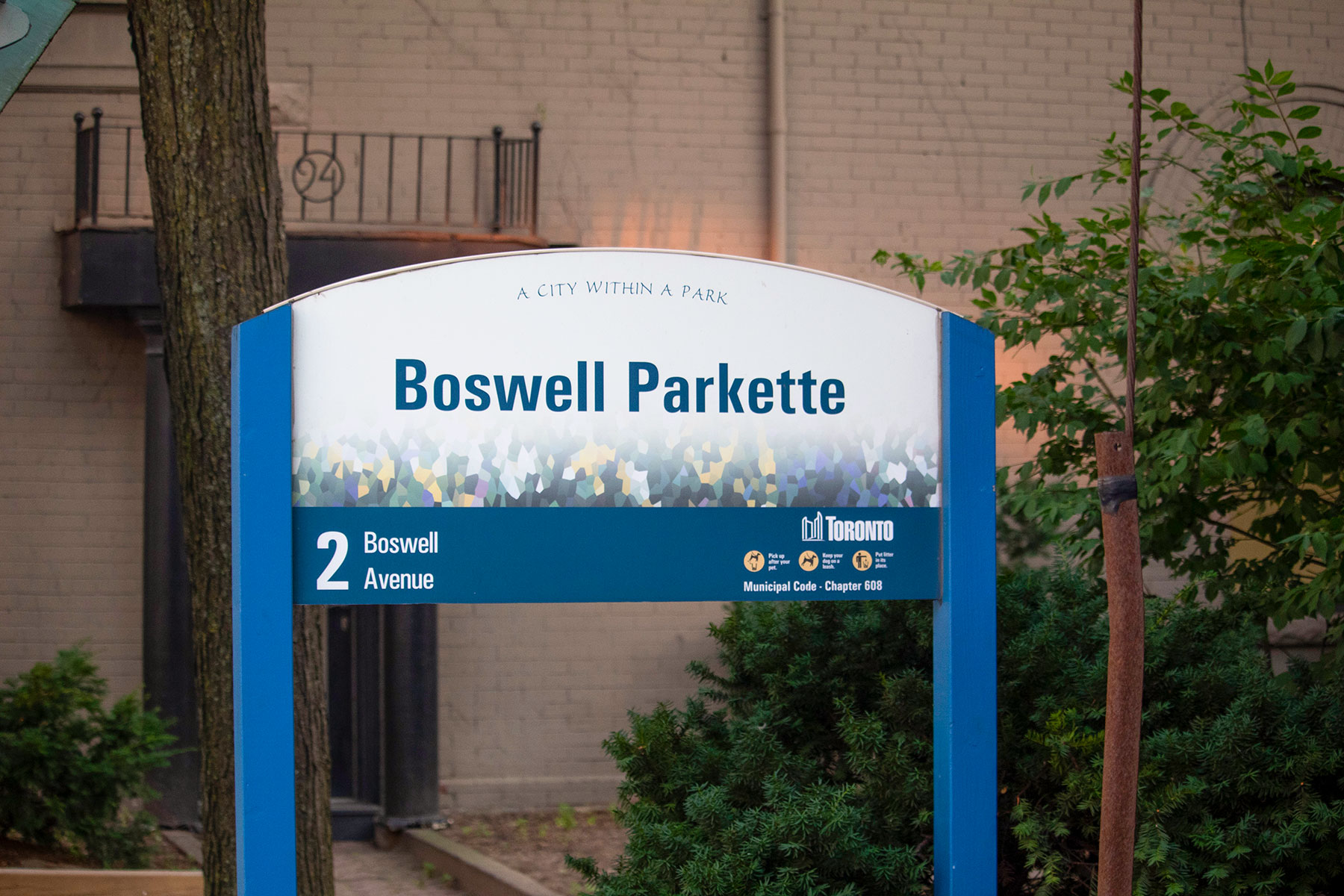
Boswell Parkette was created in 1973 as a part of the “traffic maze” phenomenon of the 1970s which hoped to shield neighbourhoods from the sound of traffic
Boswell Park
4 Boswell Ave.
Time: 7:30 p.m.
Grade: B (last year B)
Reasons to go: A small parkette at the dead end of Boswell Avenue, connecting it to Avenue Road. Boswell Parkette is a great place to have a rest, take a shortcut or wait for the bus. Literally right behind a bus stop this parkette offers a much more scenic waiting area than most TTC stops. Sandwiched between two buildings, one of them being the popular restaurant, Blu Ristorante, this parkette usually gets a lot of shade but it can be a little noisy from the patio and Avenue Road. There’s lots of places to sit despite its small size, so if you need a place to recharge after a long day of shopping in Yorkville, this could be your spot.
Overheard: Jazz music carrying over from the Blu Ristorante patio and cars driving down Avenue Road.
Did you know: The parkette was created in 1973 as a part of the “traffic maze” phenomenon of the 1970s which hoped to shield neighbourhoods from the sound of traffic. It started as just three planters which is still the basic layout of the park but has since been landscaped with bigger trees and bushes.
The park and nearby school is named after Jesse Ketchum who was a tanner and philanthropist. After the war of 1812 he helped fund the rebuilding of the bridges over the Don Valley and contributed to the first common school at York.
Jesse Ketchum Park
1310 Bay St.
Time: 3:00 p.m.
Grade: A (last year A)
Reasons to go: Located on Bay Street and right beside a school of the same name, this park can get a little noisy but the beauty and size of the park makes it a worthwhile stop for sure. With tons of space, lovely trees and well maintained gardens, Jesse Ketchum Park is a great place to relax outdoors, just pick any of the many benches or grab a seat on one of the big stones lining the garden and take a deep breath. If you want to exercise instead there’s a full-size turf soccer field right behind the park that’s great to play a game with friends or do your own solo workout. There does seem to be an unhoused person living in a tent towards the south side of the park but it seems that they are coexisting nicely with park goers and have kept everything clean.
Overheard: “I don’t think there’s a train that runs to Prince Edward Island, is there?” Two friends chat over coffee on one of the benches while their dog relaxes at their feet.
Did you know: The park and nearby school is named after Jesse Ketchum who was a tanner and philanthropist. After the war of 1812 he helped fund the rebuilding of the bridges over the Don Valley and contributed to the first common school at York. He was known for his interest in schools and education and was affectionately nicknamed “Father Ketchum.”
Hillcrest Park has received an A+ rating from the Gleaner for the last three years and we’re happy to report it has continued its excellence.
Hillcrest Park
950 Davenport Rd.
Time: 3:30 p.m.
Grade: A+ (last year A+)
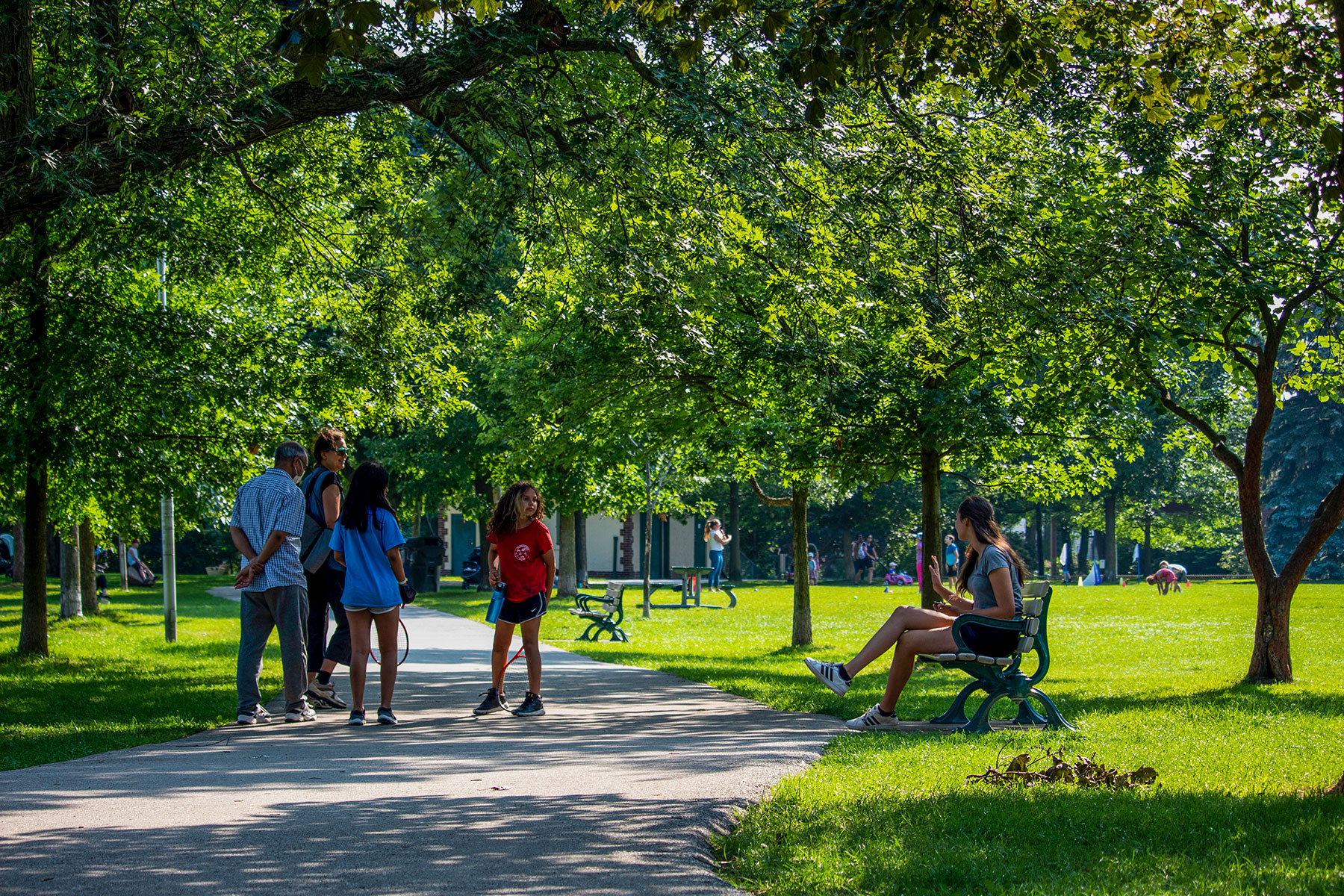
Reasons to go: Hillcrest Park has received an A+ rating from the Gleaner for the last three years and we’re happy to report it has continued its excellence. This park is truly a paradise for every type of person. Sports lovers, children, dog owners and everyone in between can find their place at Hillcrest Park. There’s a basketball court, tennis courts, a baseball field, a table tennis table made of stone, a playground, a wading pool and tons of open space for whatever else you want to do. The semi enclosed off leash dog area is also expansive, making it a popular place for owners to play fetch with their pups. The park earns its name by being located at the top of a hill at the corner of Davenport Road and Christie Street but the hillside is lined with trees which does a great job at neutralizing the noise of traffic from the streets. There’s lots of picnic benches, regular benches and beautiful trees to sit under which makes it a great place to picnic or to read a book. Literally anything you want to do outdoors can be done at Hillcrest Park.
Overheard: “Alright now try your hardest to touch your toes!” A woman instructed a small group of young children in a yoga class on the field.
Did you know: The park covers 2.1 hectares of land making it one of the larger parks in the city. You can also see Lake Ontario from the park.
Wychwood Barns Park features a beach volleyball court, a small dog park, a splash pad, playground and a still thriving community garden.
Wychwood Barns Park
76 Wychwood Ave.
Time: 4:00 p.m.
Grade: A (last year A)
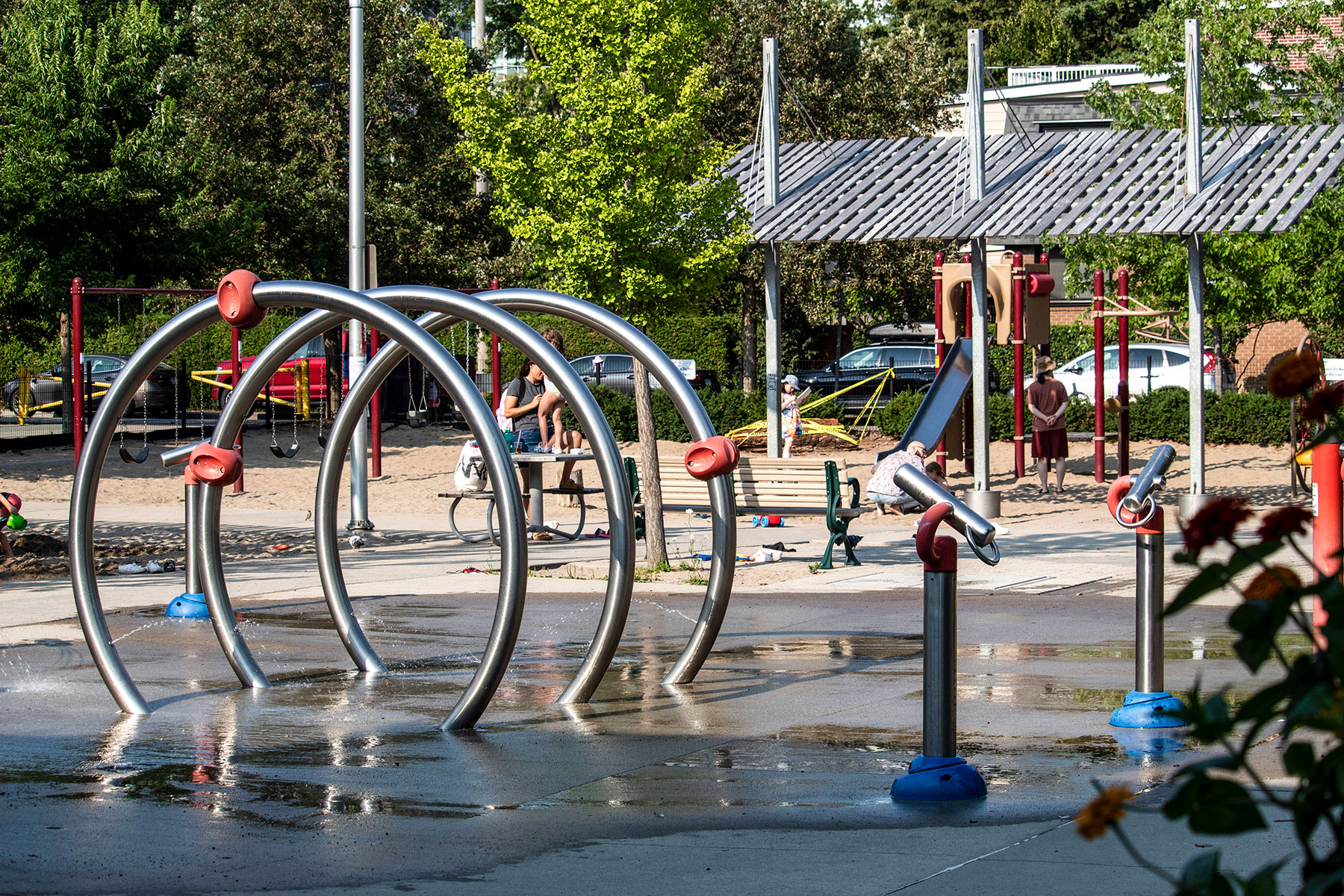
Reasons to go: This is another gorgeous multi-use space for the community that’s spacious and very well maintained. Located around Wychwood Barns which hosts all types of events all year round, the park itself features a beach volleyball court, a small dog park, a splash pad, playground and a still thriving community garden. There are benches scattered all around the park and plenty of open green space available to sit and take a breather. So, whether you’re coming to Wychwood Barns for the weekend farmer’s market, taking your kids to cool off on a hot summer day, or even to play a game of volleyball, this park is the perfect place to spend whatever day you have planned.
Overheard: “C’mon dad, I want to be sprayed again!” A young kid yells at her dad to spray her again with a water gun feature at the splash pad.
Did you know: The barns were originally built and made to be streetcar repair facilities for the Toronto Civic Railway and later the Toronto Transit Commission (TTC). Eventually in 1985 they were declared surplus and were boarded up until the redevelopment plan started in 2006.
Unlike many other public parks during the pandemic, Paul Martel Park actually seems to have received the care and attention it’s been desperate for in previous years, which is most evident in the thriving community garden.
Paul Martel Park
10 Madison Ave.
Time: 2:00 p.m.
Grade: D+ (last year F)
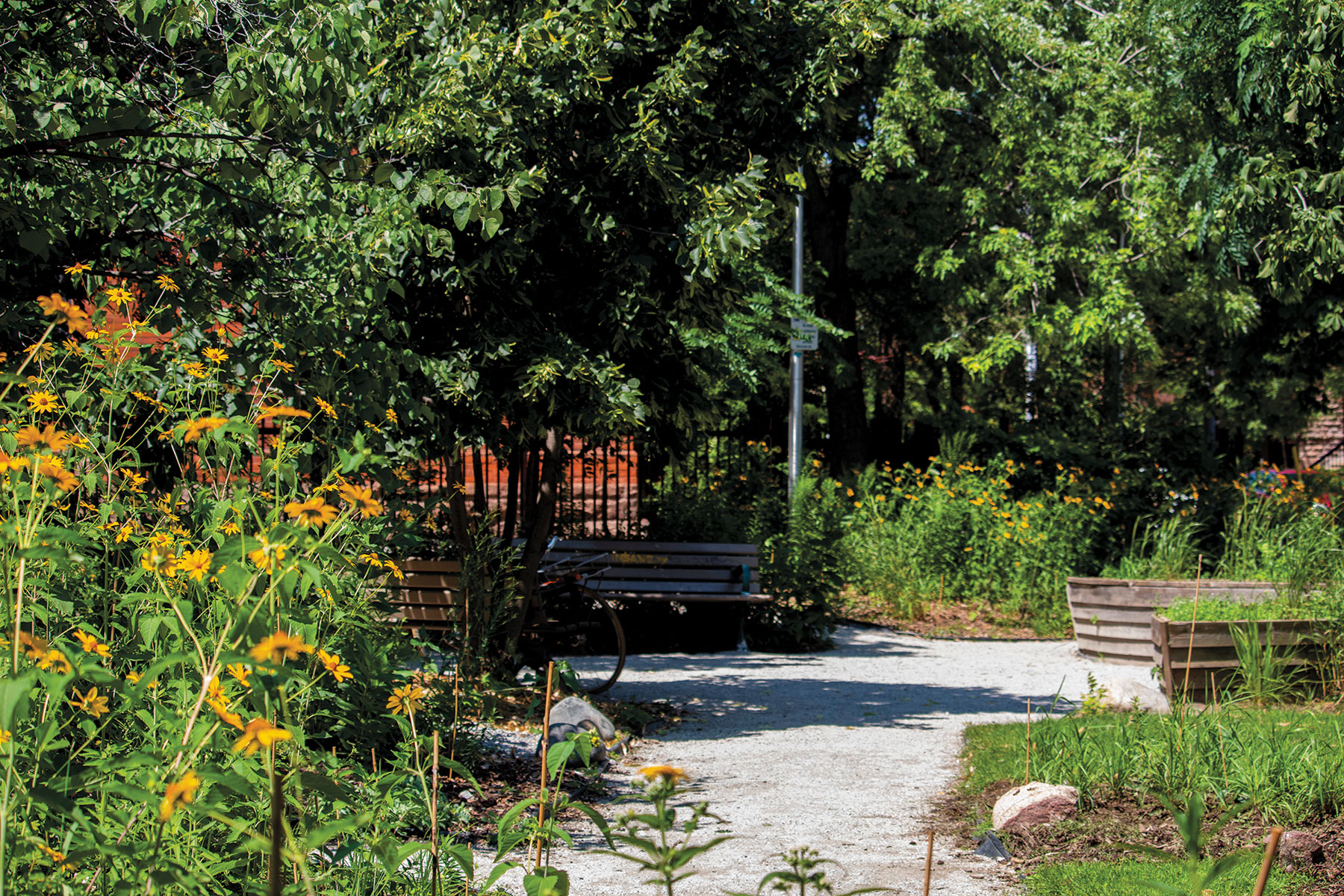
Reasons to go: In the past this park has been scored poorly due to an excess of litter, vandalism, and overall lack of maintenance. However, unlike other city parks that declined in quality over the pandemic, Paul Martel Park seems to have improved the maintenance it was previously receiving. There was almost no litter to be found and the community gardens seem to be thriving. The graffiti on the park’s entrance sign has unfortunately still remained and the sounds of traffic and construction can be heard, yet it maintains a calming atmosphere. There does seem to be a lot of pigeons, however, the gardens are looking quite luscious and this is overall, a nice place to sit and relax if you’re out and about in the Bloor and Spadina area.
Overheard: Pigeons clacking around on the gravel pathway.
Did you know: The park was formerly known as Ecology Park until it was renamed in 2014 after architect and community member Paul Martel who worked tirelessly volunteering his time towards revitalizing many Annex parks. Martel sadly passed away just last year at the age of 83. He was known for integrating social action and purpose into his architecture and urban planning.
A huge park with enough space to entertain any one of any age, Vermont Square Park is an expansive oasis hidden from busy Bathurst Street.
Vermont Square Park
819 Palmerston Ave.
Time: 4:00 p.m
Grade: A (last year A)
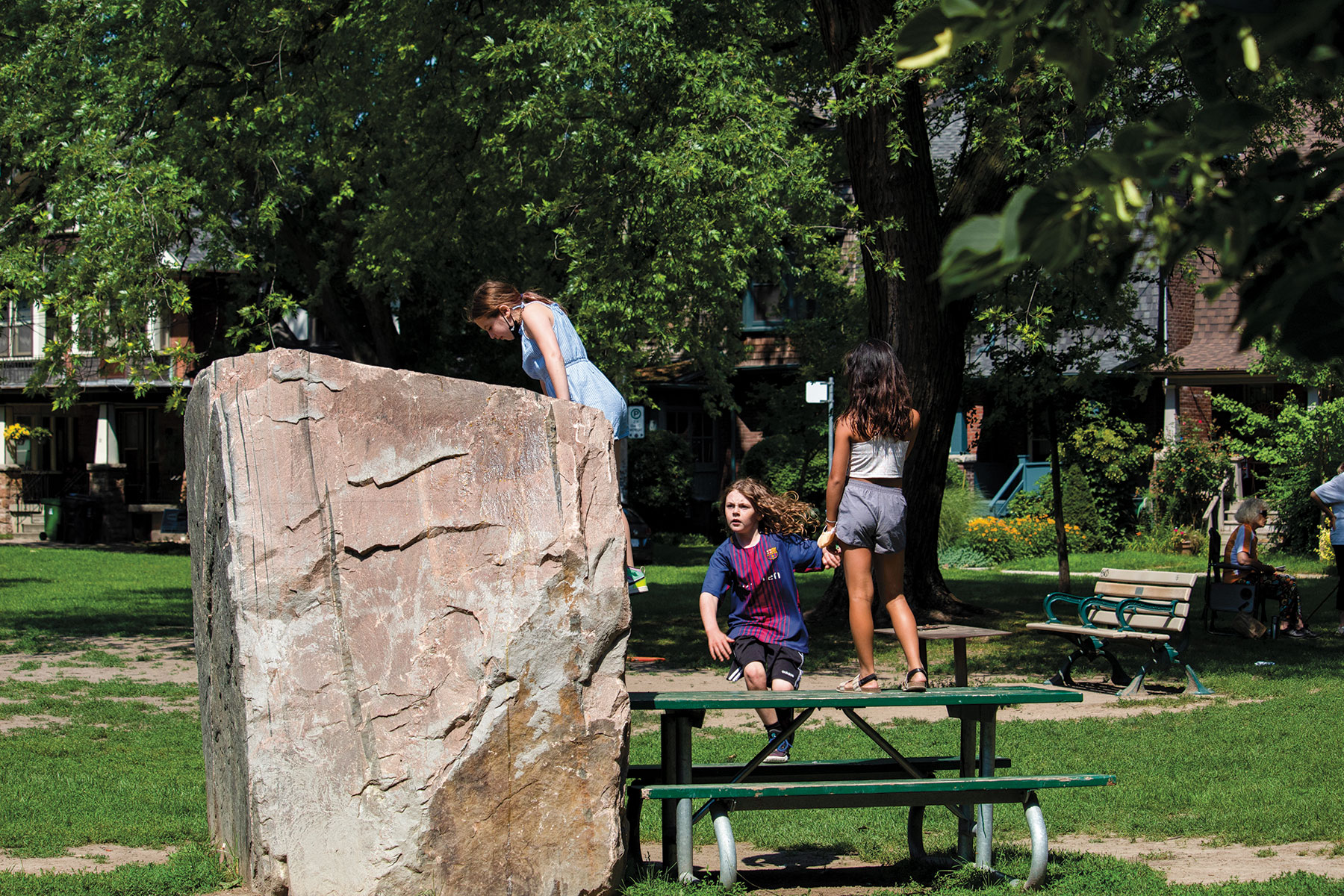
Reasons to go: Vermont Square Park is located at Palmerston and Olive avenues, tucked away from busy Bathurst street. It’s expansive, filled with big trees, small grassy hills, and even a separate area for children where a large playground structure is enclosed by long wooden benches. This has made a natural separation for adults and children. On most afternoons you can find local seniors gathered under the trees in their own lawn chairs while also having children playing on the playground or running around in the grass. There’s a small wading pool which is an added bonus on hot summer days. This park is a nice and quiet place for pretty much any summer day activity for any age group. The large rock placed conveniently right next to the picnic bench seems to also be a popular place for kids to climb and sit on top of.
Overheard: “C’mon, you can do it! Just grab my hand!” A kid yells down from on top of the large rock structure to their friend as they’re standing on top of the picnic bench trying to climb on top of the rock.
Did you know: The park underwent a revitalization in 2012 by Toronto architect and landscape collective PLANT.
Despite a project completion date of June, 2021, the Robert Street Park opened on Oct. 12. The delay was due to issues with groundwater management, according to construction workers executing emergency remedial measures at the site.
Robert St. Park
60 Sussex Ave.
Time: 4:00 p.m.
Grade: No Grade (last year n/a)
Reasons to go: After two years of construction, the Robert Street Park opened almost four months behind schedule, in late October. Delays were encountered due to issues with groundwater management according to construction workers executing emergency remedial measures at the site. The completed park features a winding path, grassy areas and seasonal plantings. U of T hopes it will bring enjoyment to residents of Harbord Village and surrounding neighbourhoods.
Overheard: People riding by on their bikes and taking walks.
Did you know: The park will also feature the country’s deepest and largest geothermal project underneath the adjacent field. The geothermal technology will aid in the University of Toronto lowering their greenhouse gas emissions for heating and cooling their new residence building.
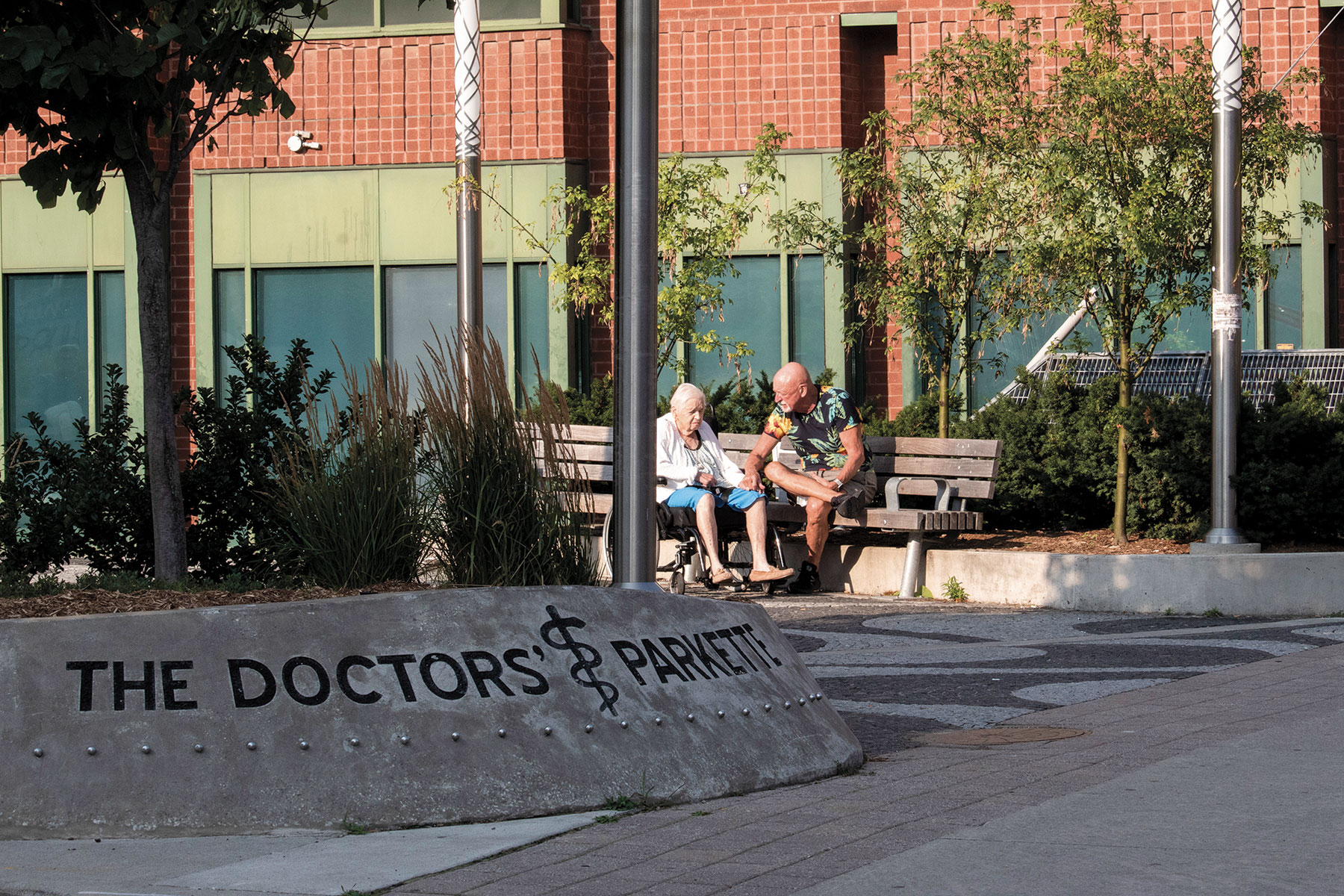
The Doctor’s Parkette may not be the greenest park but it is often a valuable meeting place for those visiting Kensington Gardens next door.
Doctor’s Parkette
15 Brunswick Ave.
Time: 6:00 p.m.
Grade: C- (last year C)
Reasons to go: A nice resting spot but very easily missed. This is partly due to its location at College Street and Brunswick Avenue right beside Kensington Health. The design of the stone tiling and lack of big trees doesn’t exactly scream ‘park’ to the average passerby. The tile work is artful to be fair, but it’s currently being ruined by the copious amount of cigarette butts on the ground falling in between the paving stones. Due to the lack of older trees there’s little shade in the parkette during the day. At night the lighting is really beautiful, but most people aren’t looking for a place to relax and enjoy the outdoors at night. It’s a good place to rest, take a phone call or have your lunch break, if you can withstand the traffic noise.
Overheard: “See, that’s the same pigeon. He comes by every time you’re out here to see you I swear.” A man tells his elderly mother as they sit in the park chatting.
Did you know: The parkette was formerly known as the Brunswick-College Parkette but was renamed to recognize the many prominent doctors who have lived and worked in the neighbourhood over the years as well as to acknowledge the rich history of hospitals in the area.
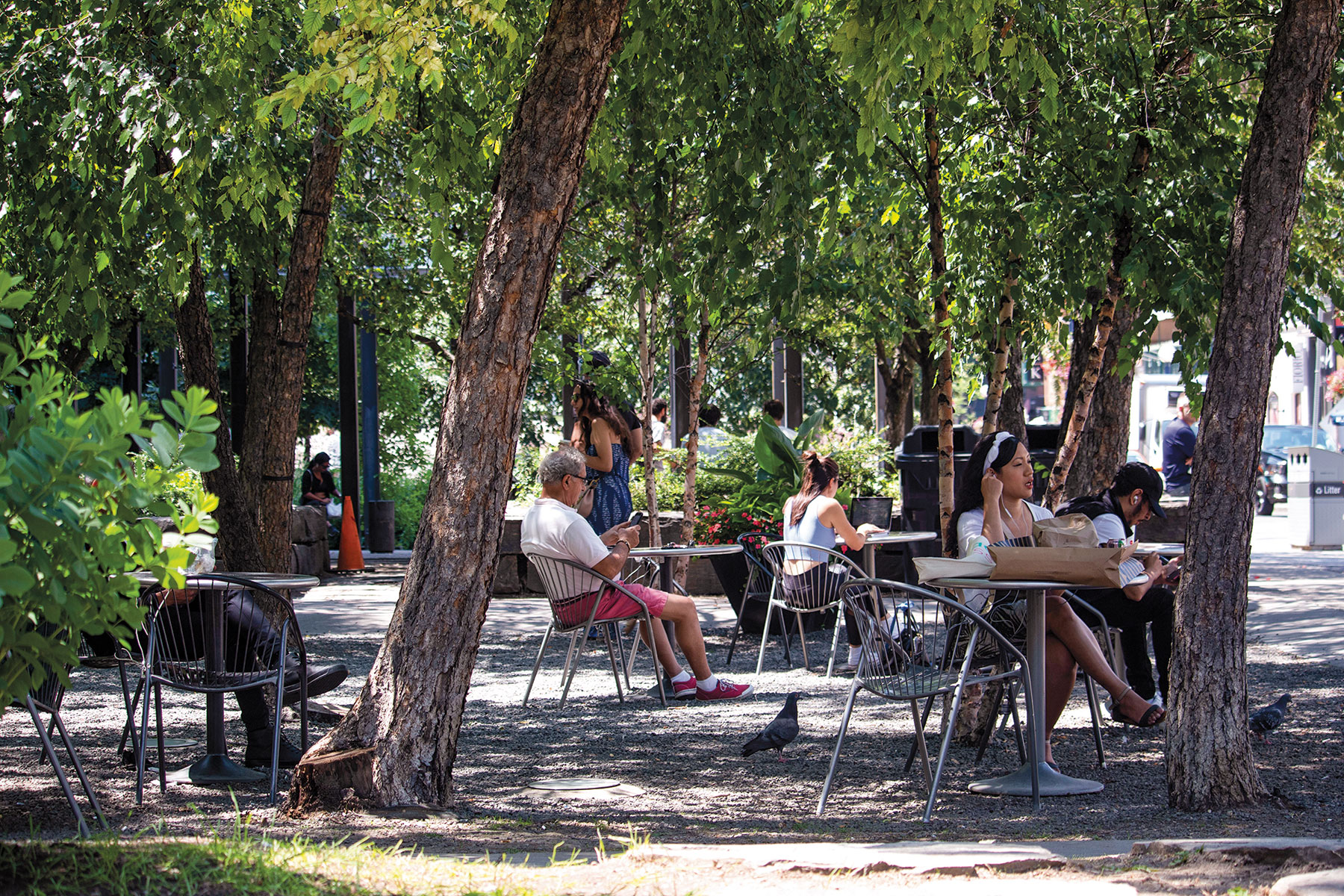
At a time when indoor seating at coffee shops was still restricted, Village of Yorkville Park offered a sanctuary for remote workers with its bistro tables and chairs.
Village of Yorkville Park
115 Cumberland St.
Time: 3:00 p.m.
Grade: B (last year B)
Reasons to go: As the pandemic has continued and certain restrictions have remained, this park has been consistently busy. In the heart of Yorkville close to Bay station, it is always teeming with people having coffee, taking meetings, working on their laptops or having their lunch break while working at any of nearby businesses. The architecture and landscape is unique and pleasing to look at and the abundant café tables and chairs are convenient. There’s no grass to sit on and every tree and flower bush is strategically placed and sectioned off within the park which doesn’t necessarily give you the break in nature that other parks in the city offer. It’s also not a great place for kids: there’s no playground structure but there is a giant rock in the middle on which you can usually spot one or two kids climbing. It still provides a little bit of an oasis in a busy and very commercial area of the city and is a great place to take a break from the surrounding chaos, if you can find a spot to sit.
Overheard: “Look at the camera!” A woman says to a teenager who is feeding and training multiple pigeons to climb up her and sit on her shoulders and hands.
Did you know: Victorian row houses used to occupy the space where the park sits but were demolished to help build the Bloor subway line. The eleven garden plots that are throughout the park actually trace the property lines of the demolished houses.
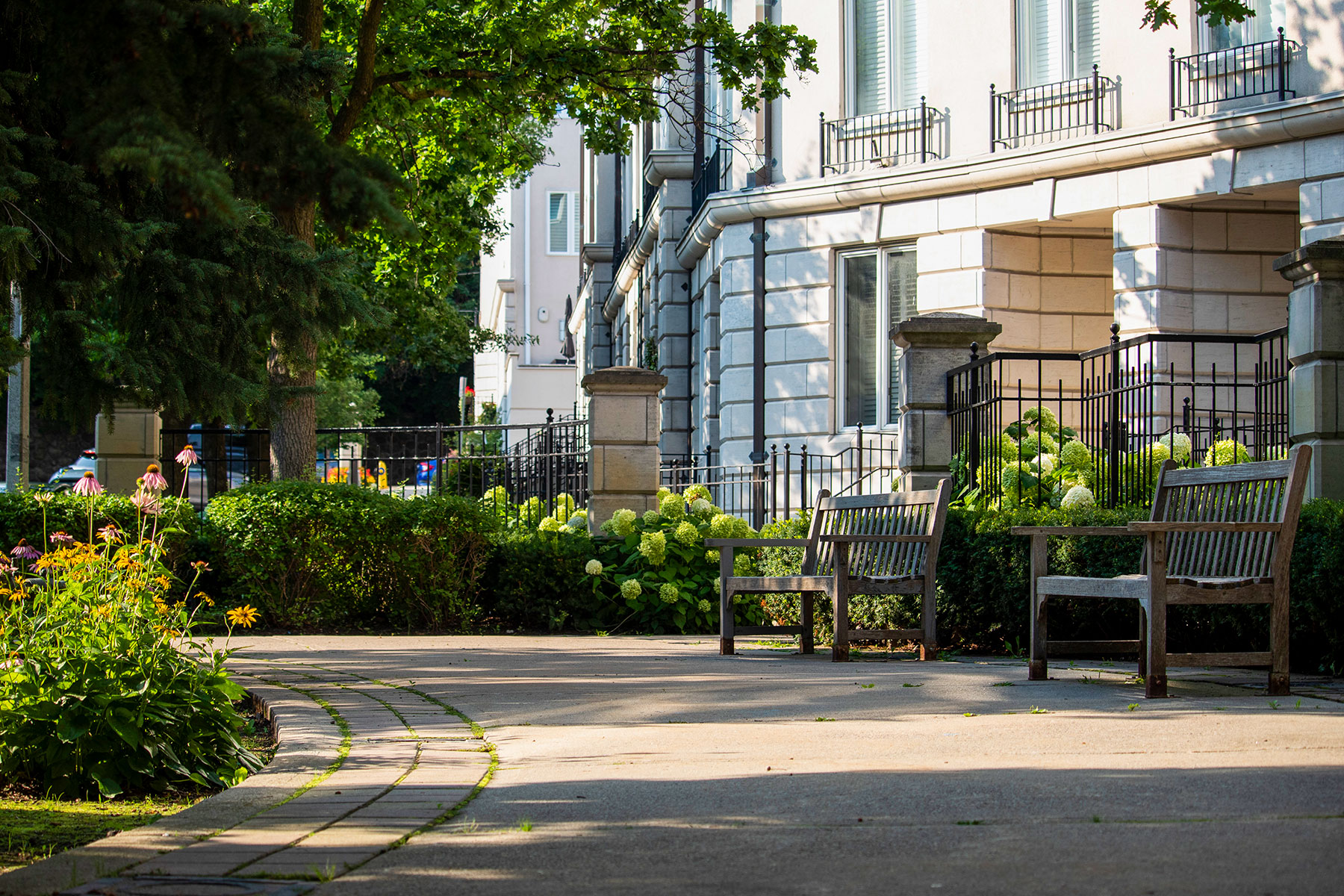
Walmer Road Parkette kind of feels like it was meant to be a private courtyard type area for the people who live in the town houses so it can feel almost intrusive to hang out in.
Walmer Road Parkette
227 Walmer Rd.
Time: 4:00 p.m.
Grade: B (last year C+)
Reasons to go: This is a really beautiful and small parkette in the middle of a row of gorgeous townhouses. It’s very well maintained with beautiful flowers and large pine trees. Four wooden benches lining the pathway facing the gardens provide a nice place to sit and relax. Because it’s a small residential street it’s very quiet, but because of that as well it sort of feels like you’re sitting in people’s front yard. The parkette kind of feels like it was meant to be a private courtyard type area for the people who live in the town houses so it can feel almost intrusive to hang out in. It seems like a nice detour to take if you’re walking around the Casa Loma area where you can avoid the busy streets and maybe take a breather but it’s definitely not great for any big activities.
Overheard: “Do you like close ups or full body shots?” “Both.” A conversation between a photographer and the woman modelling for them while they took photos on a set of townhouse steps nearby.