September 27th, 2022 · Comments Off on CHATTER: Spadina Station gets a lift—two, actually (Sept. 2022)
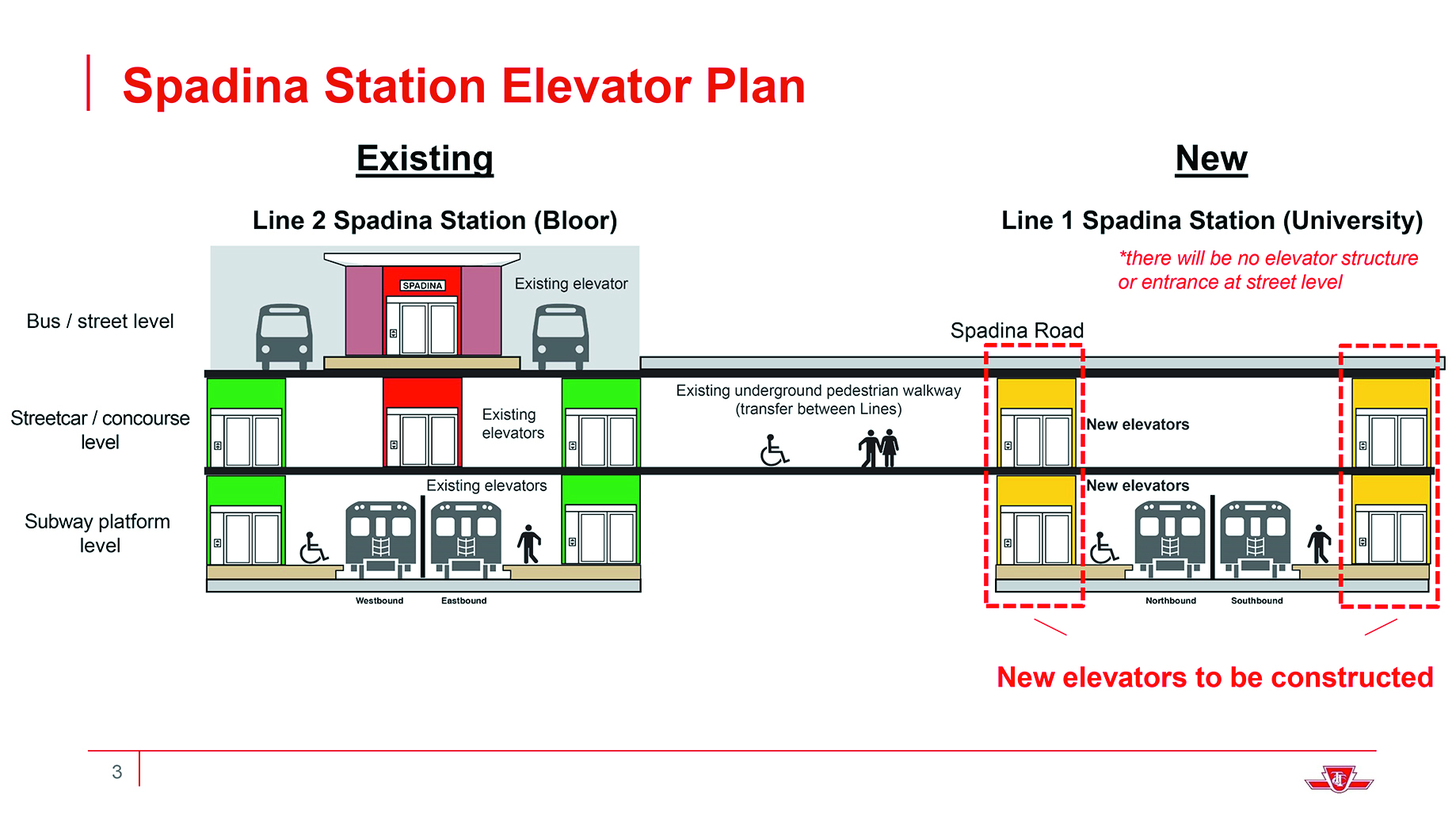
The intersection of Spadina Road and Lowther Avenue will be a construction zone as the TTC adds elevators below. COURTESY THE TORONTO TRANSIT COMMISSION
The TTC is planning to add two elevators to its sprawling Spadina subway station. These will be located under the intersection of Spadina Road and Lowther Avenue.
It’s part of the TTC’s Easier Access Program to make subway stations more accessible. Construction is scheduled to begin on September 19, 2022. Lowther Avenue west is scheduled to be closed to vehicle access to and from Spadina Road on September 19, 2022 until Q4 2023.
The pre-construction presentation, which includes conceptual staging plans, is posted online: www.ttc.ca/Spadinaconstruction
There will be barrier-free paths from the street to the subway platforms by the end of 2024.
The first major phase of work will include shoring and excavation activities for the new elevator shafts located on the northwest and southeast corners of Spadina Road and Lowther Avenue. Work will be completed in two phases, starting with construction of Elevator 2 on Lowther Avenue west of Spadina Road and then moving onto Elevator 1 on the east side of Spadina Road.
Vehicular lanes will be reduced and pedestrians will be required to detour around the construction sites through temporary crosswalks.
The TTC initiated a similar project to install an accessible street level elevator at Dupont Station just up the road and now 8 years later it is still not operational.
—Brian Burchell/Gleaner News
Comments Off on CHATTER: Spadina Station gets a lift—two, actually (Sept. 2022)Tags:Annex · News
September 27th, 2022 · Comments Off on EDITORIAL: Taking control of the narrative (Sept. 2022)
The province is dissolving Ontario’s independent COVID-19 Science Advisory Table and replacing it with, what one member described, as its exact antithesis. The science table didn’t hesitate to bring attention to facts the government didn’t want to hear, but which the public needed to know.
Just 48 hours before the surprise decision to shutter the body, the table’s new chair, Dr. Fahad Razak, penned an opinion piece for the Globe and Mail calling on the government to take COVID-19 more seriously. It seems the government, and Premier Ford specifically, does not like being called out. He’s got a fresh approach that hinges on pretending there’s no pandemic. Got a positive test? No worries, you can go back to work or school after your symptoms cease. The premier and his loyal puppet, chief medical officer of health, Dr. Kieran Moore, want you to ignore the science that says you are still contagious. This is not the flu.
Ignoring science and silencing those that espouse it, is Ford’s prayer book for the fall. The next COVID-19 wave will be greeted with the sheer will of denial. It’s not hard to predict the speech that will come soon after:
“Folks it breaks my heart to tell you this, but the chief medical officer of health leaves me no choice. Effective immediately we are locked down again. Please only shop at big box stores.”
Those who have watched the work of the U.S. Congress’s January 6 committee may have seen them interview the chairman of the Joint Chiefs of Staff, Gen. Mark Milley. Milley told the committee that the only order the White House gave to the military while their legislature was under attack was “to take control of the narrative.” This is exactly what Doug Ford is trying to do.
The science table’s advice and guidance over the past two years has sometimes run contrary to government actions. A key instance of this divide came in February 2021 as the province was preparing to ease health restrictions during a temporary lull in new cases, as new variants were beginning to emerge. The table’s then co-chair, Adalsteinn Brown, was asked by a reporter if the table was “predicting disaster” if the government did not change course. Brown replied in the affirmative. The government moved ahead with its plan; what followed was the third wave, which at its apex saw 900 patients admitted to the ICU. The government reimposed public health orders. Brown was right.
The new “science table” will not be allowed to choose its own subjects of study, will not speak directly to the public, and will just feed the province’s media message through public health, under the thumb of Moore, himself under the thumb of the premier’s office.
The now defunct COVID-19 Science Advisory Table was a loose collection of a few dozen volunteers (all unpaid, but most were on the payroll of a university or health institution). It started at the University of Toronto, and it gave itself a mandate that stressed independent thinking and transparency. It was in part created by a vacuum resulting from the inaction of Public Health Ontario (PHO). PHO was itself created as a result of the province’s bungled response to the SARS crisis. It has a $165 million budget and did nothing in response to the COVID-19 crisis and appears to continue to do nothing. Are we expected to see PHO’s next move as a welcome alternative to the science table? Based on what track record?
Will PHO stand up to its political masters and act in the public interest? Likely not, as we live in a world where the premier’s critics are roundly silenced.
September 27th, 2022 · Comments Off on FORUM: Rare summer legislature sittings (Sept. 2022)
Passing damaging bills while no one is paying attention
By Jessica Bell
Queen’s Park Roundup
The Ford government is passing damaging legislation in the middle of the summer while attention on politics is low. Here’s what’s happening.
The government’s 2022-2023 budget falls short
The budget does not do enough to help people in need, properly fund public services, or tackle the climate crisis with the urgency that is required.
When inflation and enrolment is factored in, education funding has been cut. The Centre for Policy Alternatives estimates that funding to each student has been cut by $800 over the past five years. This is why class sizes have grown, there’s inadequate support for kids who are struggling, and buildings are not being adequately maintained. This September, many schools in University-Rosedale are losing teachers and staff. In a blatant bid to woo parents, the government has promised $225 million in cash payments to pay for private tutoring. That funding should be invested in schools.
The budget doesn’t allocate enough funding to the environment. There’s no funding for climate programs to green our electricity, transportation or building sectors. While there is a big increase in funding to build four new transit lines, there’s no funding to operate the thousands of transit routes already in operation. The government is also going full speed ahead with the Bradford Bypass and Highway 413, locking us into unsustainable car use and suburban sprawl.
The new minimum wage of $15.50 per hour begins on October 1. With inflation at over seven per cent, workers need a $20 minimum wage to afford to live in Ontario and build a fair economy.
After 27 years of no increase, the government will raise the Ontario Disability Support Program rates by a paltry $58 a month, or 5 per cent. People cannot live on $1258 a month. Social assistance rates should be doubled and indexed to inflation.
Funding for health care has flatlined even though every hospital is struggling with high demand and staff shortages. In University-Rosedale, Sick Kids has over 3400 kids waiting for surgery beyond the acceptable time frame. In July, three of Toronto General’s intensive care units reached bed capacity, including units for cardiovascular and coronary issues and medical surgery. And on July 24, Toronto Western Hospital’s emergency room almost shut down due to a staffing shortage but was able to secure enough last-minute workers to remain open. Emergency rooms should never close. Ever.
Bad health-care reforms are coming
Instead of investing in health care, the government’s response has been to permit thousands more surgeries at private clinics.
This won’t help. Private clinics draw from the same pool of staff as hospitals. Recruiting staff trained to work in hospital operating rooms to private clinics will just make the staffing shortages and surgery backlogs at hospitals even worse.
We don’t know yet if a private clinic can receive OHIP funding for surgery and then bill the patient for a top-up. But we do know patients will certainly be billed for other services, such as food, a private room, and additional testing. Those who have insurance and savings will choose the private operation. Those who cannot pay will wait longer for surgery in a public hospital.
The Ford government also introduced Bill 7 which gives hospitals greater coercive power to move patients to long-term care (LTC) homes without their consent. Patients who stay could be billed the maximum rate of $1200 a day. Almost 5,000 hospital beds (or 24 per cent of all beds) are taken up by patients waiting to be discharged, with 1,850 waiting to go into long-term care. These patients are classified as ALC, meaning Alternative Level of Care.
No one wants to stay in a hospital longer than necessary. The challenge is that sometimes there isn’t an adequate place for a person to go. Bill 7 will mean these people will end up in LTC homes that have available beds. These will almost certainly be for-profit homes with overworked staff, aging infrastructure, four people to a room, and one washroom to a floor. It is next to impossible to move a person from one LTC home to a better one. The home a person moves to will almost certainly be the home where they die.
We are advocating with experts like the Ontario Health Coalition and the Advocacy Centre for the Elderly to push for a better response to our health-care crisis that includes wage increases for health-care workers to increase staffing levels, paid care for people who can return home, and improvements to the quality of long-term care homes. We need a kind response to our health-care crisis that respects people’s rights, not a cruel one.
Please contact our office if you want to work on these issues or have questions or concerns.
Jessica Bell is the MPP for University-Rosedale and the Official Opposition’s Housing Critic.
September 27th, 2022 · Comments Off on FOCUS: It’s Time to Let Loose and Celebrate (Sept. 2022)
Tartu College 50+2 is Here!
By Kati Kiilaspea
Tartu College (TC) has become a favourite meeting spot for the Toronto Estonian community and other cultural groups in the neighbourhood; it’s a true cultural hub teeming with energy. Preparations began in 2019 to celebrate its 50th anniversary in a fitting and worthy way in September 2020. Then the pandemic caught us all off guard and brought it all to a halt. Celebrations had to move to a digital platform where we could still get together, reminisce about the old days, and dream of the future, albeit from a distance. A group of Tartu College workers got together and even held a small party in the parking lot just so they could celebrate the milestone together. But the consensus and feeling among everyone was that this wonderful landmark that grew out of architect Elmar Tampõld’s vision deserved more: a spectacular celebration. Finally, two years after the initial anniversary, we’ve got a massive party in store for you all: a 5-day celebration with something for everyone; the event of the year!
But what exactly is Tartu College? Tartu College, located in the heart of the Annex, is a lively cultural hub for Estonians where events are organized by various community groups. This building has been home, not only to international university students, but also to a number of Estonian academic organizations. Tartu College facilitates rich educational and cultural programming all year round. The programs are delivered by the Estonian Museum Canada/VEMU and focus on four pillars: history, culture, language, arts, and science. All Estonian Museum Canada/VEMU programs offered in English are available to Tartu College student residents. Tartu College’s key mandate is to promote, preserve and increase the knowledge of the Estonian experience in Canada. Tartu College, along with the Chair of Estonian Studies Foundation, support Estonian language courses at the University of Toronto’s Department of Slavic Languages and Literature. We are home to the Academy for Lifelong Learning, Toronto program, that facilitates peer-led study and dialogue. Together with the Academy of Lifelong Learning, Toronto student bursaries are offered to Tartu College student residents. Currently, TC offers activities and events that speak to various age groups and people with a range of interests and backgrounds.
The multiday bash kicks off with a proper bang, with Estonia’s premiere funk band Lexsoul Dancemachine taking over downtown Toronto atop a specially set-up bus on Wednesday, Sept. 21. Raw street funk on one side, with sweet soul on the other, Lexsoul Dancemachine is a 6-man groove band known for tearing venues apart with their stage presence.
The group will perform a series of pop-up concerts around the downtown core, starting out from Tartu College at 7 p.m. and making their way toward Kensington Market and then Queen Street West. When the event organizer, Estonian Music Week’s executive and artistic director Sebastian Buccioni, was asked about the exact locations of the pop-ups, he grinned slyly and told us to keep an eye out for upcoming ads. But we can tell you this much: each of the three performances will be 30 minutes long and there will be space on the bus for 10 lucky winners that will be determined by a draw. More info on that coming soon!
To get your true funk injection, join us on Friday, Sept. 23 at the Axis Club (722 College Street) in Toronto, starting at 8 p.m.
Toronto funk legends the Shuffle Demons, known for their hit Spadina Bus, will take the stage along with Lexsoul Dancemachine for a night of absolute groovy chaos. Famed Estonian singer-songwriter Vaiko Eplik will be acting as DJ and host for the night, introducing nostalgic tunes from the Estonian diaspora and keeping the vibe flowing. Tickets are $25/$20 and selling fast. Get yours now at: www.estonianmusicweek.ca
This scintillating slew of events will finish off with the premiere of the TC50 documentary film directed by Kaisa Pitsi about the landmark building and its history on Sunday, Sept. 25, at 3 p.m. English subtitles are included and coffee and kringel will follow. The event is free, but donations are warmly welcomed.
This spectacular celebration would not have been possible without our sponsors and partners: Estonian Foundation of Canada, Northern Birch Credit Union, the Estonian Ministry of Education and Research (International Estonian Action Plan 2022-2025), Cotton Factory, and Koger Valuations.
Bring your friends from the ‘hood and come join the festivities. All are warmly awaited and welcomed! If you’ve worked at Tartu College in the past, come here for events throughout the years, or taken part in any of the various groups that meet here regularly, come and join the party and help us celebrate the important contributions of this landmark to the longevity of our Estonian culture here in Toronto!
September 27th, 2022 · Comments Off on SPORTS: Thrilling walkoff advances Leafs (Sept. 2022)
Marcus Knecht’s bottom-of-the-ninth winner sweeps Leafs into semis
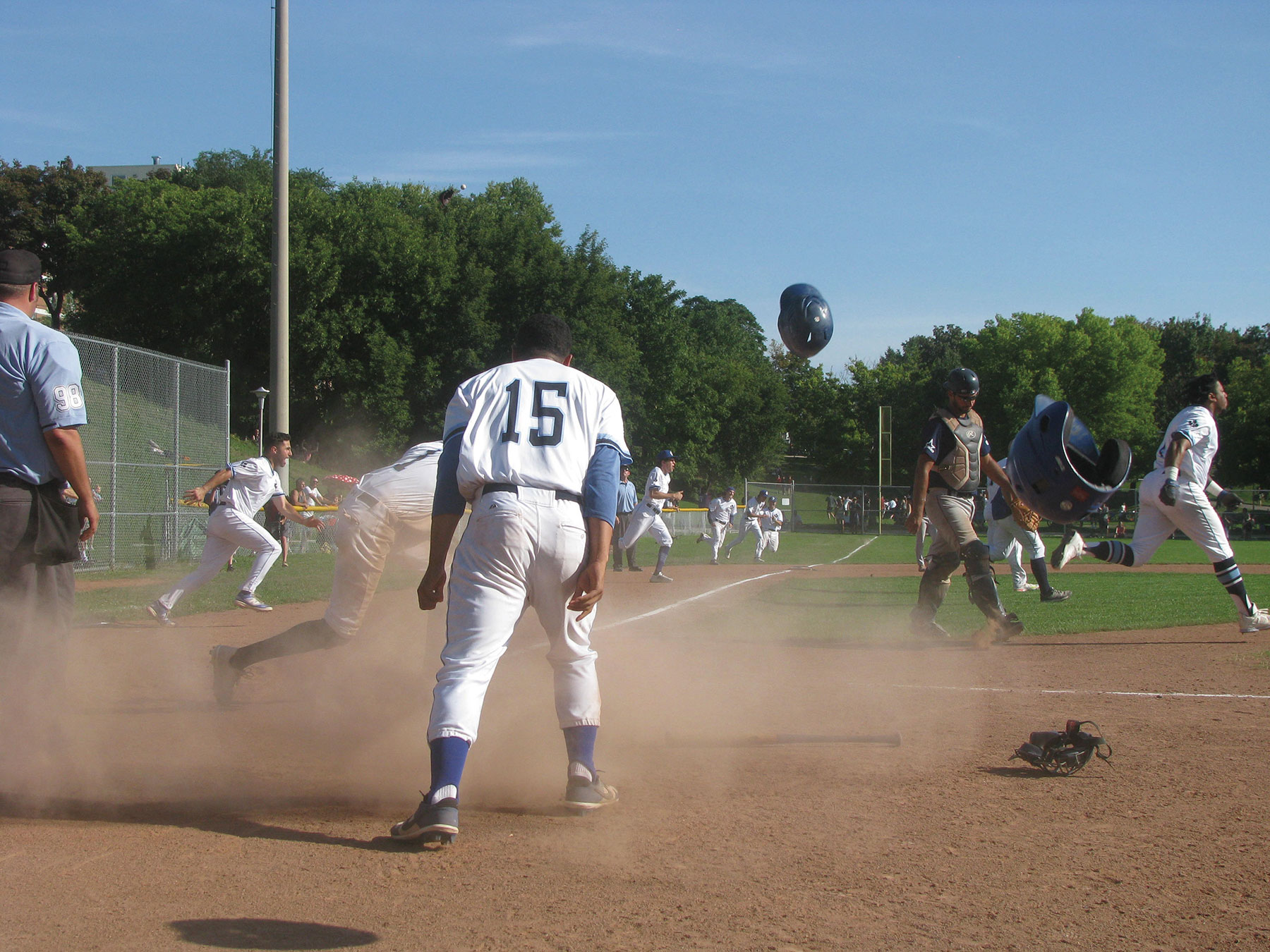
The Toronto Maple Leafs celebrate a walkoff win on Aug. 28. R.S. KONJEK/GLEANER NEWS
By R.S. Konjek
The Toronto Maple Leafs are off to a flying start in their pursuit of the Intercounty Baseball League championship.
No image better demonstrates that than the sight of an airborne Jose Vinicio diving for home plate at Christie Pits. The Leafs’ speedy shortstop scored the game-winning run to clinch his side’s victory in its opening round series, played over the final weekend of August.
With a place in the semifinals assured, the Leafs await the outcome of other quarterfinals to determine their next opponent.
As the IBL postseason got underway, Toronto faced their longtime rivals the Barrie Baycats in a best-of-five series.
Game one took place on the evening of Friday, August 26. Having finished fourth in the regular season standings, the Leafs hosted fifth-ranked Barrie.
The game was dominated by great pitching performances on both sides. Dominican Angel Castro dueled with his counterpart Frank Garces in a game-long test of wills between the two countrymen.
The Leafs came out swinging and put three runs on the scoreboard in the first inning. The Baycats struck right back with two runs in the second.
The score remained 3-2 as both starting pitchers battled through the opposing lineups. Both sides got plenty of hits and baserunners, but the game was tight throughout.
Whenever Castro was not on the mound, he engaged in his other role of chief disruptor. Seated on the bench, he rallied his teammates with a steady stream of high decibel Spanglish, cheering loudly in two languages at once. Sometimes it wasn’t even words, just exuberant whoops and shrieks that jolted Christie Pits and got under the other team’s skin.
A solo home run by Barrie tied the game 3-3 in the seventh inning.
In the bottom of the seventh, Vinicio did what he’s done all season. He slapped a single, then stole two bases in a row. The Leafs rallied for three hits and two runs in the inning. They took a 5-3 lead, and the score held.
Garces went the distance for Barrie and Castro returned to the mound to start the ninth. However, he hit the first batter he faced, and Franklin Hernandez was brought in from the Leafs’ bullpen. Hernandez recorded three strikeouts to seal the opening game win.
Game two was played in Barrie the next day. The Leafs used a combination of four pitchers to limit the Baycats to three runs and won 6-3. With the victory, they were one game away from advancing with a sweep.
Game three—by far the most exciting of the series—took place at Christie Pits the following Sunday.
The Leafs got the jump on their opponents and enjoyed a 3-0 lead after the first three innings.
One swing of the bat took all the joy out of the park. Barrie’s Ryan Rijo hit a three-run homer off starter Sam Greene to tie the game.
The game was a see-saw battle. The Leafs retook the lead, then lost it again.
It all came down to the bottom of the ninth, the stuff that players and sportswriters alike dream of.
Down 6-4, the Leafs mounted a comeback rally. Two singles and a successful bunt by Vinicio loaded the bases. Barrie brought in their closer, but to no avail. Leafs first baseman Jordan Castaldo hit a single to make it a 6-5 game. Two Leafs struck out and their final hope rested on the shoulders of outfielder Marcus Knecht. With the entire ballpark on edge, Knecht connected for a two-run, game-winning, series-clinching single.
Vinicio, on second base and representing the winning run, flew around third and raced for home. Approaching the plate, he dove through the air and landed safely. The Leafs won 7-6.
Dust, elation, flying helmets. There is no more riotous scene in baseball than a series-winning walkoff. The Leafs stormed the field to mob Knecht and spray him with water. On the hillsides, fans cheered their heroes.
Immediately following the game, Knecht was philosophical about his approach to the high-pressure situation. “Something I have been focusing on the last couple of years is how to remain calm and how to feel good in those moments,” he said. “I take deep breaths during games and let go of the things that may happen. I really have fun doing it.”
Thanks to Knecht’s timely stroke, the fun continues for him, his teammates and their fans.
August 19th, 2022 · Comments Off on ON THE COVER: Solazzo slams, salutes hillsides (Aug. 2022)
Toronto Maple Leafs third baseman Johnathan Solazzo salutes fans on the hillsides of Christie Pits after hitting a grand slam on July 24. The Leafs defeated the Guelph Royals 16-9. R.S. KONJEK/GLEANER NEWS
August 19th, 2022 · Comments Off on GRADING OUR GREENSPACE (Aug. 2022)
The best and worst of the Annex’s parks
Compiled and photos by Fox Oliver
Every year the Annex Gleaner reviews the abundance of parks in the Annex using a variety of criteria.
While there is no decisive “winner” of the grading, letter grades are assigned to convey the quality of the parks considering aspects such as upkeep, amenities, and accessibility.
The reviews accompanying the grades also let the reader know what makes each park unique, so they know which ones they should visit if they want to swim at a public pool or bring their dog to an off-leash park, for example.
This collection of park reviews contains the first fourteen parks reviewed throughout the Annex this year, with more gradings to come in future editions of the Annex Gleaner.
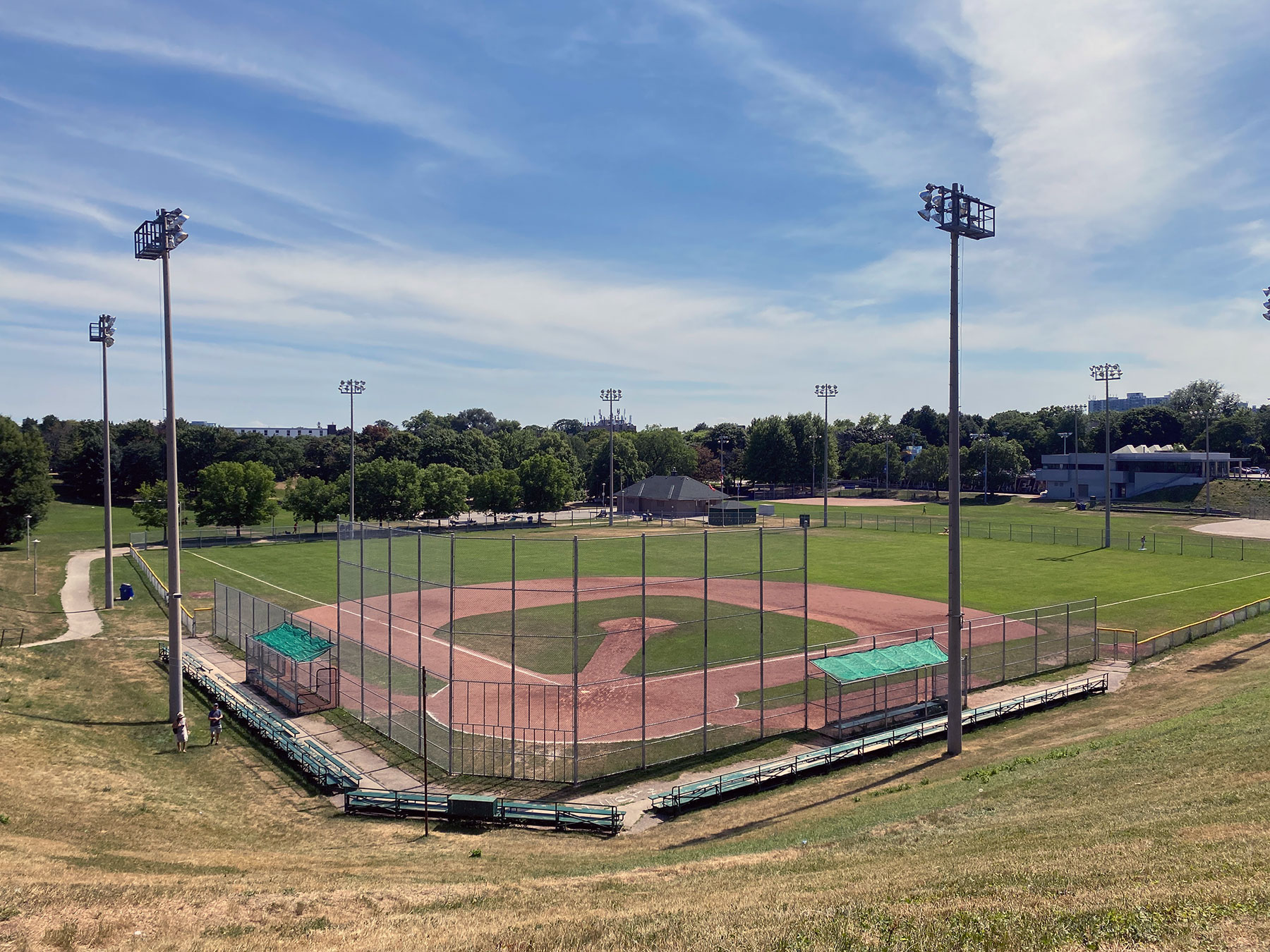
Dominico Field in Christie Pits.
Christie Pits Park
750 Bloor St. W.
Time: 6 p.m.
Grade: A+ (Last year A)
Reasons to go: Christie Pits is one of the largest parks in the city and draws in hundreds of people every day. The 8.9-hectare park has everything one could possibly want in a park, and while usually busy, never feels crowded.
Some of the notable attractions in the park are the outdoor swimming pool, outdoor ice rink, basketball courts, baseball diamonds, and the recently added Christie Pits Skateboard Park.
The massive park is also filled with green space and picnic benches, making it ideal for most park activities.
Christie Pits is also a popular place for events, including a weekly movie night on a large screen in the summer, pop-up vendors, and a recent picnic celebrating Pride month. Christie Pits’ large size, proximity to Christie Station, and large number of amenities for park-goers make it one of the city’s best and most well-known parks. Be sure to stop by and experience the heart of the Christie area this summer.
Overheard: A jazz band situated on the overlook of the park, and a group of youth selling their clothing to passers-by, along with the chatter of people.
Did you know: On August 16, 1933, acts of hate and anti-Semitism at a baseball game in the park led to the outbreak of the Christie Pits Riot. The riot grew to 10,000 participants and spectators. No one was killed and only one person was convicted. His sentence was $50 or two months in prison.
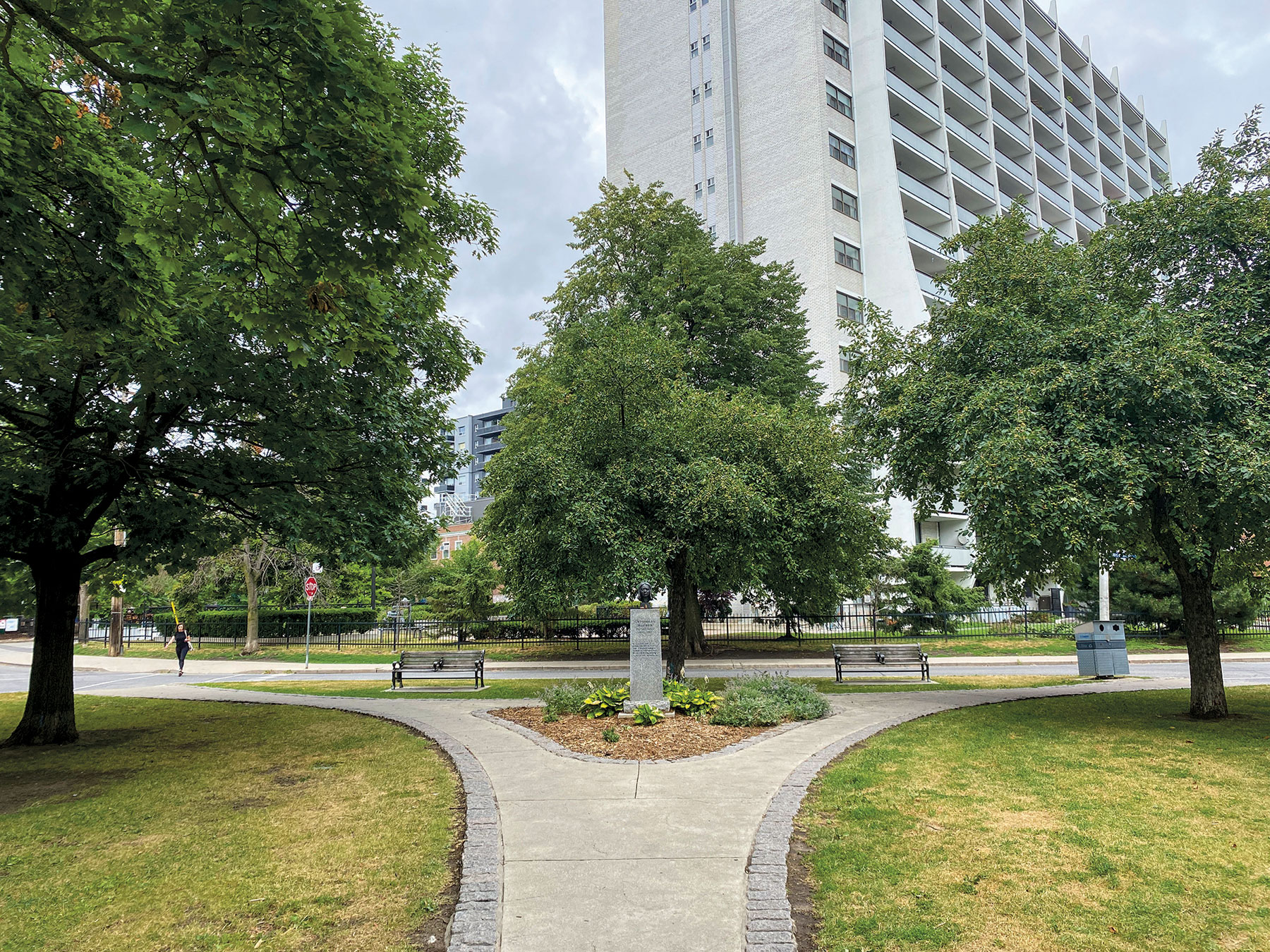
Gwendolyn MacEwen Park’s unique location inside a roundabout provides a comfortable place to rest, but brings with it noise from surrounding roads.
Gwendolyn MacEwen Park
33 Walmer Rd.
Time: 2 p.m.
Grade: B- (Last year B-)
Reasons to go: Gwendolyn MacEwen Park is a small parkette in the middle of a roundabout
at Walmer Road and Lowther Avenue. While its unexpected location in the centre of a roundabout may seem like a good thing, it brings with it the noise of intermittent traffic from adjacent cars, as well as the noise of traffic just down the road. This parkette offers benches which are shaded by large trees, small flower beds, and a memorial commemorating Gwendolyn MacEwen. All of these make the park ideal for those looking for a quick rest on their path or those wanting to enjoy a book in an accessible outdoor space. This park also adds an airy feel to the entire roundabout, elevating the look and usability of the crossroad, even for those who only spend a few moments passing through the park.
Overheard: The sound of nearby cars driving around the roundabout and the sound of traffic on Spadina, as well as the wind rustling the leaves on the trees.
Did you know: The park is named after Canadian poet and author Gwendolyn MacEwen, born in Toronto in 1941. MacEwen published more than 20 books throughout her lifetime, and her esteemed writing earned her multiple Governor General’s Awards, as well as many other awards for her poetry.
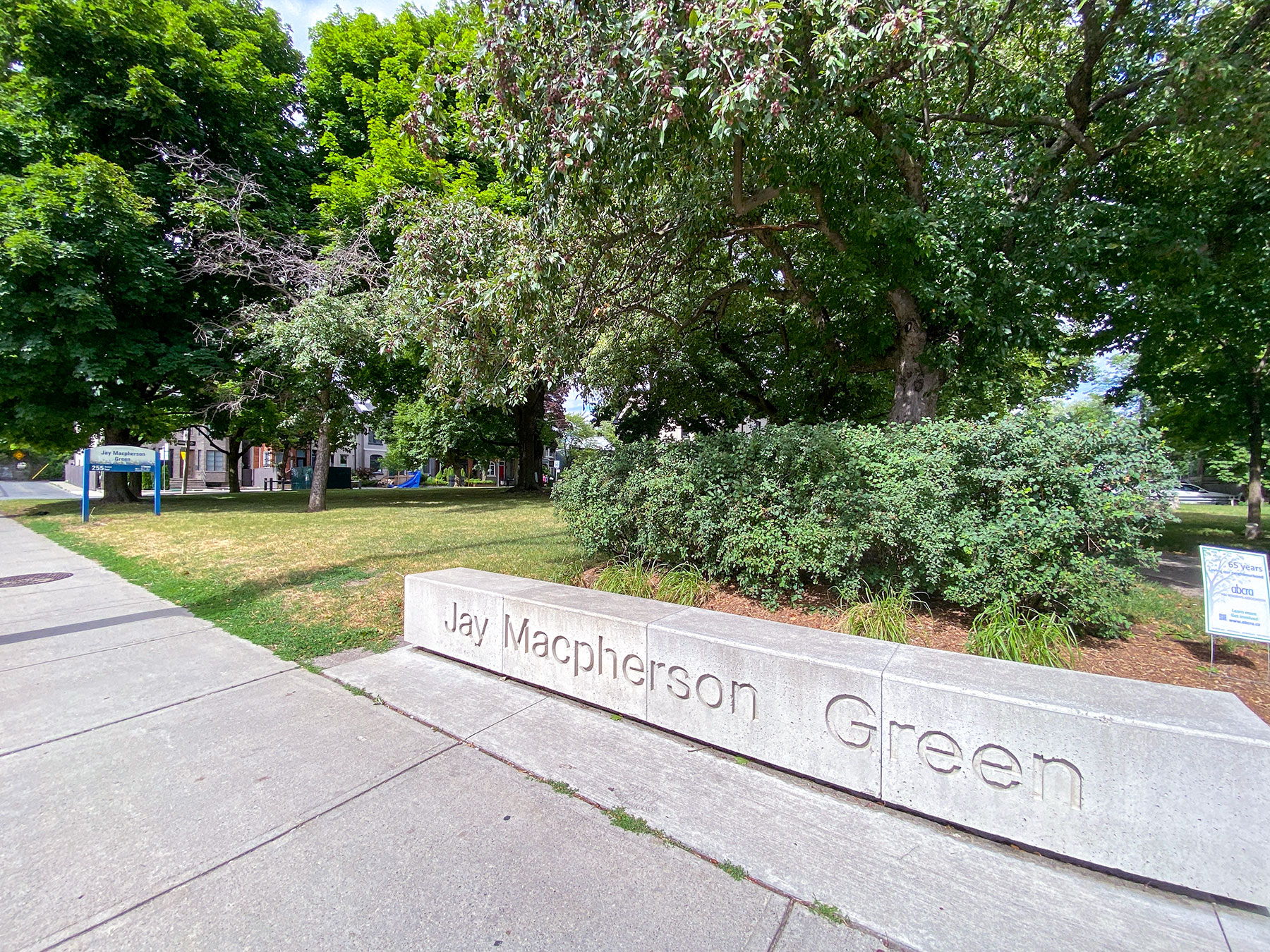
Jay Macpherson Green at 240 Avenue Rd.
Jay Macpherson Green
255 Avenue Rd.
Time: 4:30 p.m.
Grade: B (Last year B+)
Reasons to go: Jay Macpherson Green is a park with three main components: The first consists of grasses and trees (standard for most parks in the Annex); second are the benches scattered along the path (which offer a comfortable place to sit in the park); the third is much less enjoyable than the first two. Due to the park’s location at Avenue Road and Dupont Street, the roar of the passing traffic is overwhelming. While the noise is more easily ignored during the calmer hours of the day, the park can get quite loud around rush hour which makes it a difficult place to relax or even to sit and chat. Nonetheless, this park is still a nice place to visit as the space itself is well looked after. It’s also conveniently located across the street from Sergeant Ryan Russell Parkette.
Overheard: The noise of rush hour traffic speeding by on Avenue Road.
Did you know: The park is named after Jean Jay Macpherson, a Canadian poet who lived in the Annex and studied and taught at the University of Toronto. She is highly renowned for her work as a “mythopoeic” poet, a type of poet whose work focuses on creating and exploring fictional mythology in modern day prose or poetry.
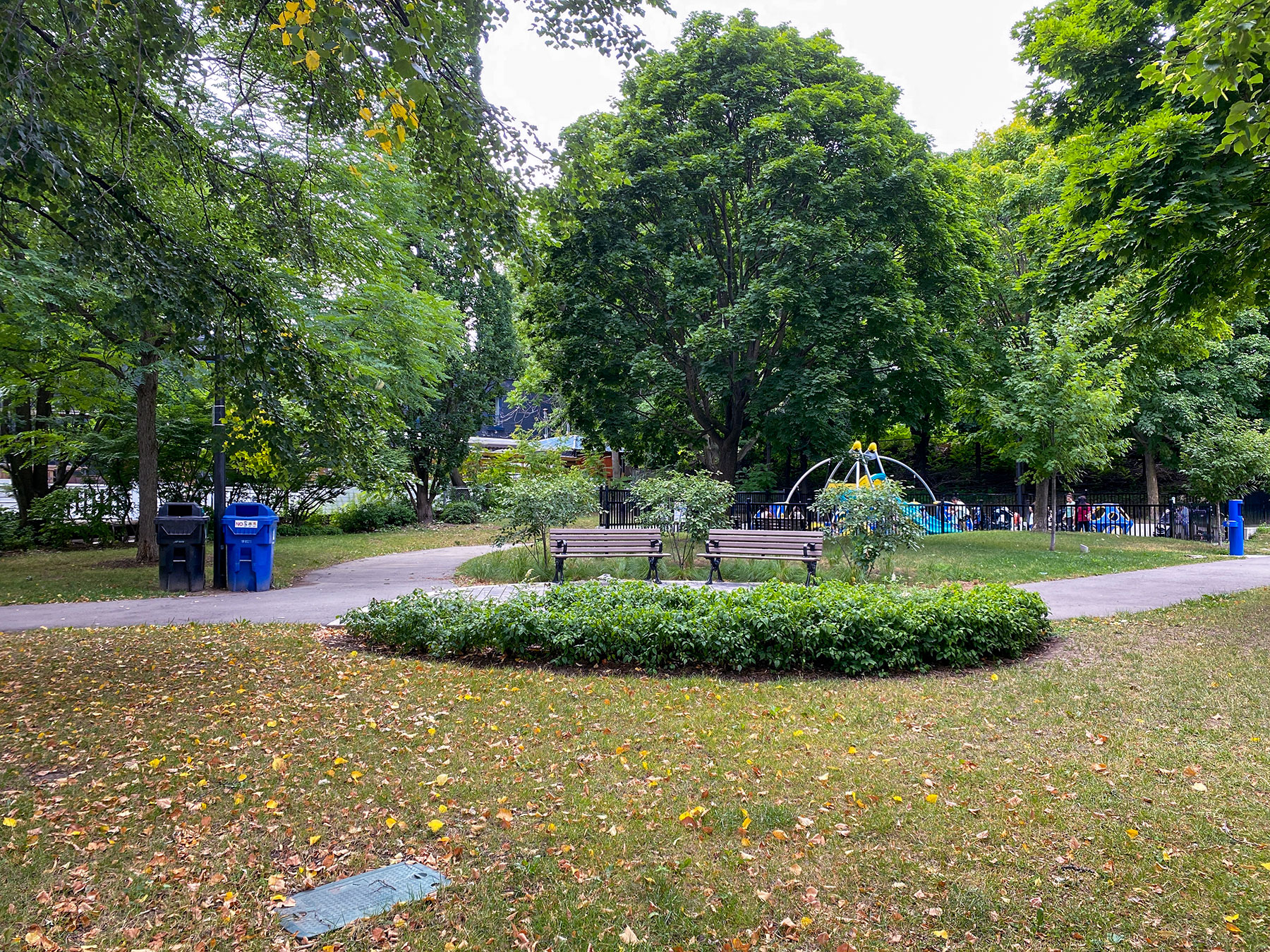
Sergeant Ryan Russell Parkette
250 Avenue Rd.
Time: 4:30 p.m.
Grade: B+ (Last year B+)
Reasons to go: Sergeant Ryan Russell Parkette is a small parkette located across the street from Jay Macpherson Green. Even though the parkette is smaller than the green across the street, this parkette offers something the green doesn’t: an enclosed children’s playground. The playground is usually busy with children, and the fencing around it allows it to be a safe space for kids to play, despite being located at the busy intersection of Avenue Road and Dupont Street. The park can still be noisy due to its location at the busy intersection, but none of the children playing seemed to mind. The shape of the parkette and positioning of the trees and benches also gives the area a sheltered feel in comparison to the park across the street. Sergeant Ryan Russell Parkette is a great place to bring children to play or to stop at and rest on the benches. The parkette is worth checking out if you are passing by or find yourself at Jay Macpherson Green.
Overheard: “I bet you can’t do this,” a child yells while playing with a group of their friends on the playground.
Did you know: In 2011, this park was renamed to remember Toronto Police Sergeant Ryan Russell after he tragically died while attempting to stop the driver of a stolen snowplow in the early hours of the morning.
Boswell Parkette
4 Boswell Ave.
Time: 3:30 p.m.
Grade: B (Last year B)
Reasons to go: Boswell Parkette is the smallest park on our list, and because of its size, it is easily missed. This parkette attractively connects the dead end of Boswell Avenue to Avenue Road for pedestrians, while cleverly blocking traffic from Avenue Road to reduce the effect of the major road on the residential space. The parkette sits directly behind a bus stop and consists of a plant bed, benches, and two pathways. Its location and decor make it a much more enjoyable place to wait for the bus along Avenue Road compared to the average bus stop. Stumbling across this park almost feels like finding a hidden gem in the Annex, and even though it’s not particularly packed with amenities, its small size makes it a cozy stop for a rest.
Overheard: “I think it’s just a bit further this way,” one person says to another while walking south and possibly talking about the Royal Ontario Museum or Yorkville area.
Did you know: While the parkette can get noisy, it was actually designed to help absorb the noise from the traffic on Avenue Road to keep the residential area behind the park quiet. The park was created in 1973 and was named after Toronto’s 24th mayor, Arthur Radcliffe Boswell.
The historical plaque at Jesse Ketchum Park.
Jesse Ketchum Park
1310 Bay St.
Time: 4:00 p.m.
Grade: A- (Last year A)
Reasons to go: Jesse Ketchum Park has all the components of a standard park, and it does them well: benches, a path, water fountains, trees, flowers, and lots of grass. It’s a spacious park considering its location at Avenue Road and Davenport Road which is right beside Jesse Ketchum School. The intersection and school bring noise, but the depth of the park allows some distance from the road. This keeps the park feeling like a park and not just a green space beside a major road. There is also an artificial turf soccer field behind the park. This park is proof that with simple, quality design, a sizable park, even without many amenities, can still provide a great space to relax.
Overheard: “Okay everyone line up against the wall,” a teacher says to children at Jesse Ketchum School, likely organizing an after school activity for the kids.
Did you know: The park and school are named after tanner and philanthropist Jesse Ketchum who donated land and money to have a park and a “free and common school” erected at this location. He gained the nickname the “Children’s Friend” for his work establishing churches, schools, and libraries in Toronto. More information about Jesse Ketchum is provided on the plaque found in the park.
Playing basketball at Hillcrest Park.
Hillcrest Park
950 Davenport Rd.
Time: 3:00 p.m.
Grade: A+ (Last year A+)
Reasons to go: Hillcrest Park sits at the top of a hill at the intersection of Christie Street and Davenport Road and is one of the city’s larger green spaces. Just by approaching the flora and steps leading to the park on Davenport Road, it’s evident that this is a well-maintained park. While the perimeter of the park is packed with luscious green space, the inner area is perched atop the hill and provides plenty of amenities. These include tennis and basketball courts, a large playground, a splash pad, a spacious off-leash dog park, and a flourishing community garden. The large size of the park, the amenities, and the forest-like green space make this park enjoyable for everyone, regardless of whether they are bringing their kids out to play on the structures or if they want to relax peacefully under the shade of a tree, far away from the noise of happy park-goers.
Overheard: Kids splashing in the wading pool and kids playing basketball, boasting about their defensive skills.
Did you know: Hillcrest Park sits across the street from the Hillcrest Complex, the TTC’s largest maintenance facility for their above ground vehicles. While Hillcrest Park is one of the city’s largest parks, occupying 2.1 hectares, the Hillcrest Complex is approximately six times as large as the park, occupying 13 hectares of space.
Gardens grow in front of Artscape Wychwood Barns, a community hub filled with artists’ studios and non-profit environmental organizations.
Wychwood Barns Park
76 Wychwood Ave.
Time: 3:00 p.m.
Grade: A- (Last year A)
Reasons to go: This large park is located around Artscape Wychwood Barns. Outside in the park area, there’s a spacious green space filled with lots of benches and tables. While the green space has an off-leash dog park, a playground, a splashpad, and a large community garden, what really shines are the multi-use Artscape Wychwood Barns. While technically not part of the park, these buildings host 41 artist studios, 9 non-profit art and environmental organizations, and a large multipurpose venue which hosts events such as farmers’ markets and theatre productions. The largest tenant is The Stop Community Food Centre which uses an entire barn, greenhouses, and some of the outdoor space to grow, process, and sell sustainable food year-round. This pleasant community hub is worth checking out for both the park and the artist studios within the barns.
Overheard:Inside the Barns, people celebrating the premiere of an art exhibit and excitedly taking pictures with photographers.
Did you know: The barns were originally built between 1913 and 1921 and were used as streetcar repair barns for the TTC and Toronto Civic Railway. The barns were shut down in 1985 but were then reopened in 2008 as the Artscape Wychwood Barns. They are now used as a community cultural hub.
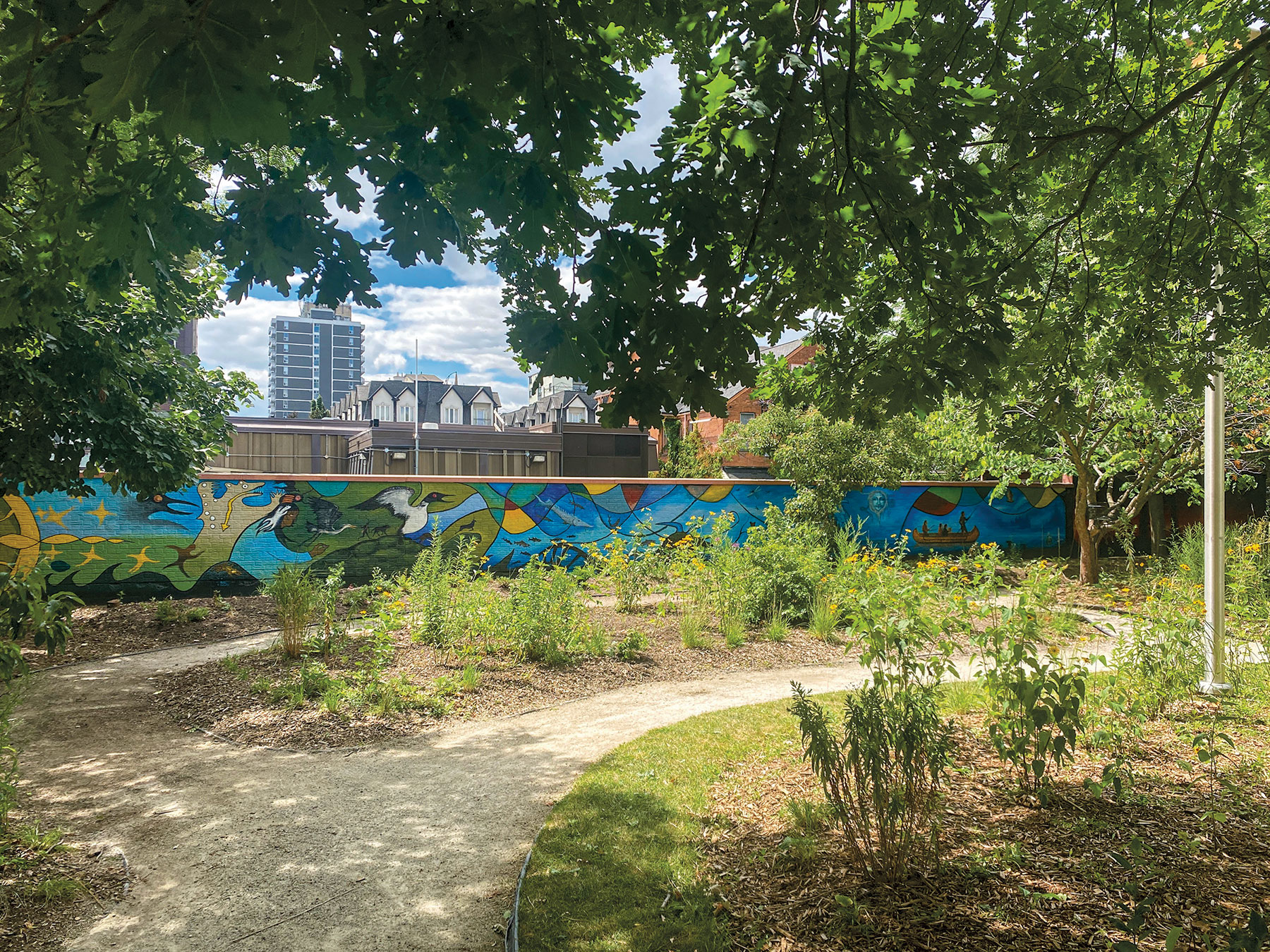
Paul Martel Park flourishes after the completion of a recent restoration project which resulted in the painting of a new mural and the replanting of gardens in the park.
Paul Martel Park
10 Madison Ave.
Time: 11:00 a.m.
Grade: A (Last year D+) *Most Improved Park*
Reasons to go: Of all the parks surveyed for the Annex Gleaner’s annual park review, Paul Martel Park earns the title of most improved. Here’s why: In the past, this park received low grades due to litter, vandalism, and low maintenance; however, its recent restoration has made the park truly shine. The gardens have been replanted, and this small but cozy park is filled with beautiful biodiversity. This makes sitting in the park and enjoying a beautiful summer day all the better. However, the newest addition to the park is a large mural painted on the back wall of the park. Painted by Anishinaabe artist Joseph Sagaj, this large mural uses the art of Indigenous storytelling to portray the tale of creation through the eyes of Sagaj. The mural alone is a good enough reason to visit the park. Paul Martel offers a place to reflect and view the beauty in plant life, and the mural offers a colourful rendering of a multitude of stories that will leave you asking questions and thinking about the stories critical to your own worldview. With plenty of benches, this park is the perfect place to sit down, read a book, and enjoy a warm summer day.
Overheard: A group of elderly women conversing with the gardener responsible for planting the gardens. They were asking about the plants.
Did you know: Joseph Sagaj, the artist behind the newly painted mural in Paul Martel Park, has worked on numerous projects within the city, including a 30-foot diameter floor installation in Seneca College. He currently lives and works in Toronto and has painted a large collection of smaller works.
The Dennis Lee playground at Vermont Square Park.
Vermont Square Park
819 Palmerston Ave.
Time: 5:30 p.m.
Grade: A (Last year A)
Reasons to go: Despite its location near the busy intersection of Bathurst Street and Dupont Avenue, walking into Vermont Square Park feels like stepping into one of the quieter parts of the city. This park has small rolling hills, lots of tree cover, three bocce ball courts, a wading pool, and a children’s playground surrounded by benches. The placement of the playground and geography of the park creates a natural separation between the kids in the playground, the dogs and their owners in the centre of the park, and those sitting around the picnic tables, some playing bocce ball. This park is a quieter alternative to Christie Pits because it is much less crowded. Its location in Seaton Village makes it the perfect place to relax. On most days, this park is bustling with kids, adults, and the elderly. While the different age groups tend to gravitate towards separate areas, the mix of people of different age groupings all enjoying the same space adds an aura of community to this park, making it a delightful local park.
Overheard: The jangle of dog collars mixed with the noises of a few young kids enjoying the playground with their parents.
Did you know: The playground in Vermont Square Park is named the Dennis Lee playground. It is named after the Toronto poet of the same name who is most well-known for his collection of children’s rhymes Alligator Pie.
The recently revitalized Robert St. Park is now complete with a playground and seating area for members of the community to enjoy.
Robert St. Park
60 Sussex Ave.
Time: 3:00 p.m.
Grade: A- (Last year no grade)
Reasons to go: Robert Street Park has undergone a major revitalization since the last time it was rated by the Gleaner. On October 12, 2021, the University of Toronto removed the last piece of fencing from the park so community members can now make use of the newly improved space. The park consists of benches situated around a well-groomed lawn and garden. There is also a new playground, and a shaded seating area beside Robert Street Field. This park is simple, and where it lacks in dense and luscious plant life, it shines in being a highly maintained green space. This is a great area to enjoy alone, to bring kids to the playground, or to use when visiting the Robert Street Field.
Overheard: A group of toddlers and young kids playing soccer as part of a summer camp on Robert Street Field which is adjacent to the park.
Did you know: Canada’s largest deep geothermal project is situated beneath Robert Street Field. The geothermal system will be used to help heat and cool the University of Toronto and has been built as part of their project to reduce their carbon emissions.
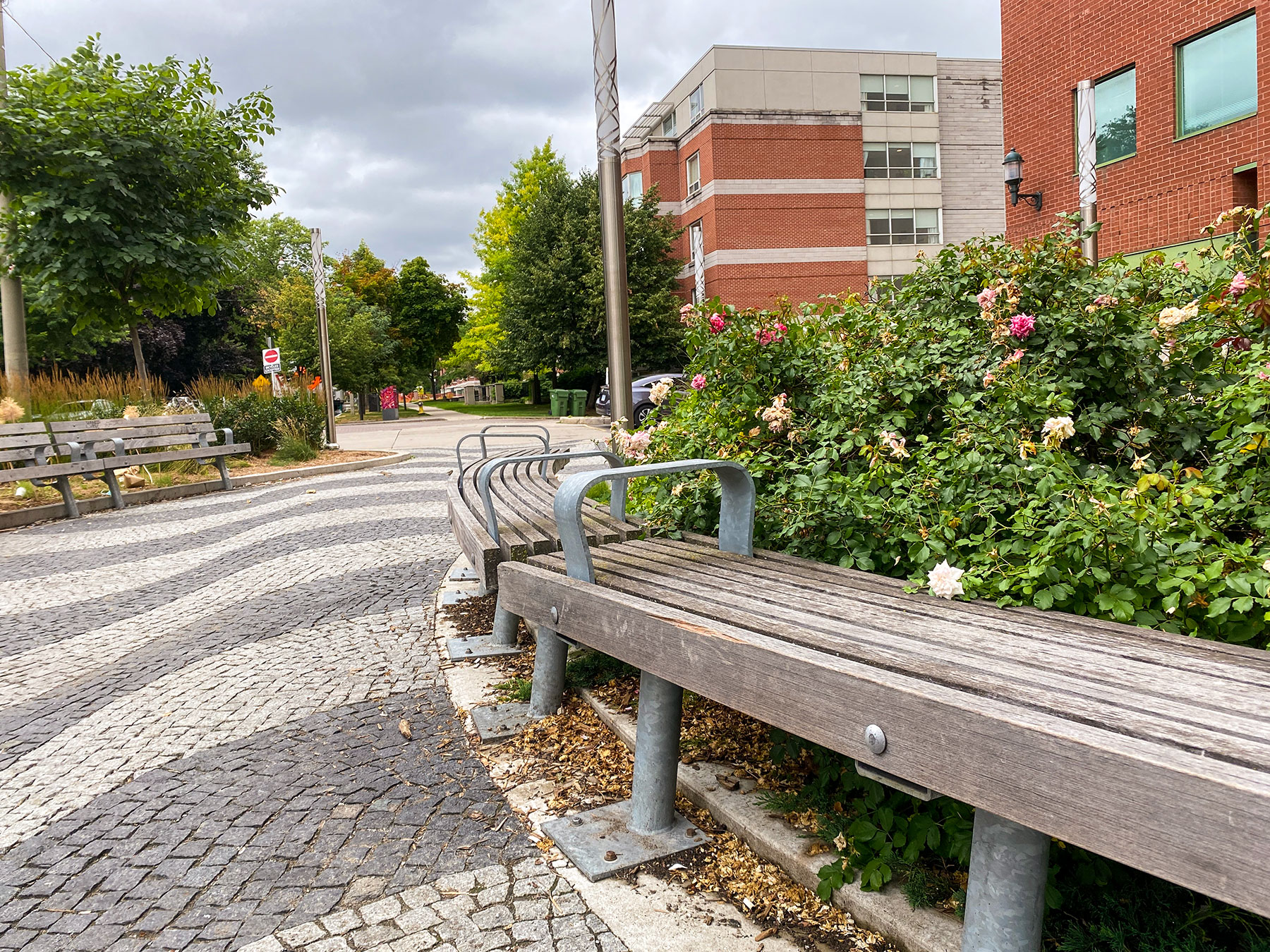
Just north of College Street, Doctor’s Parkette’s bench seating offers passersby a place to rest.
Doctors’ Parkette
15 Brunswick Ave.
Time: 3:00 p.m.
Grade: C (Last year C-)
Reasons to go: The Doctors’ Parkette is an easily missed parkette on the north side of College Street at Brunswick Avenue. Many people likely pass by this parkette daily without even noticing it due to its small size and deviation from a standard parkette. Where most parkettes have grass and trees, this parkette consists entirely of stone tiling, wooden benches, flower beds, and a water fountain. While the park doesn’t particularly stand out or offer any unique amenities, the grouping of benches makes the park a practical place to sit down on a busy street, and the full flower beds do add some colour to the stone tiling and this otherwise undecorated corner. While there has been a decrease in the amount of litter in the park since last year, there is still room for improvement.
Overheard: The ringing of the bell in the tower of the Bellevue Fire Station across the street, and the sound of traffic and pedestrians on College Street.
Did you know: Across the street from the Doctors’ Parkette lies the Bellevue Fire Station. This historic piece of architecture was originally built in 1875 with the eight-storey tower being added in 1899. The tower possessed a lookout which firefighters used to survey the surrounding area for active fires. After an arsonist ironically set fire to the station in 1972, the structure was rebuilt into the station that now exists today.
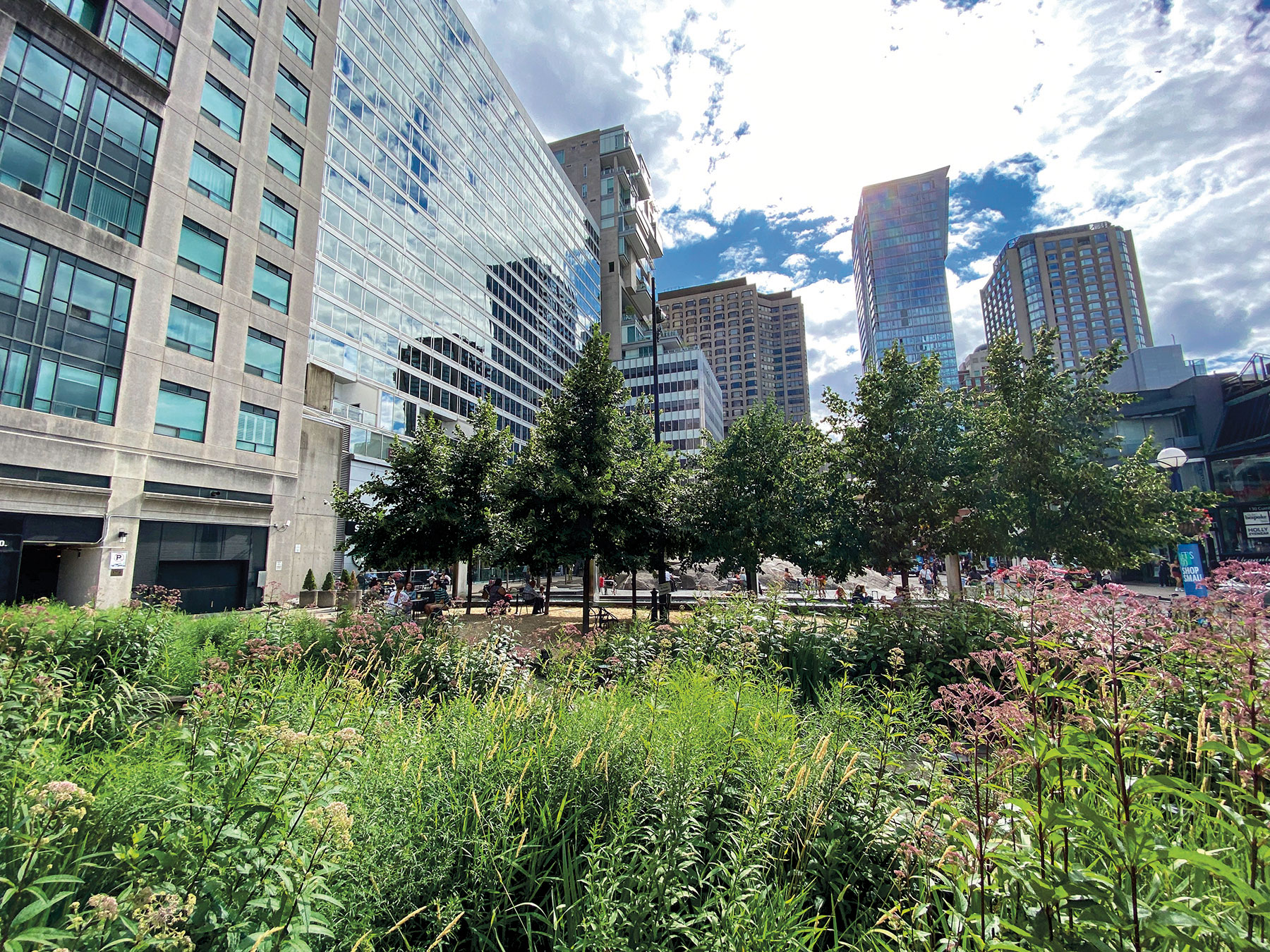
Village of Yorkville Park’s segmented greenspace includes a wooden pathway surrounded by freely growing botanical life.
Village of Yorkville Park
115 Cumberland St.
Time: 5:00 p.m.
Grade: A- (Last year B)
Reasons to go: This park is in the heart of Yorkville and has a unique design that feels different than the other parks in the area. The park is split into a few sections: decorative trees placed in orderly planters, stone tiling with chairs and tables, a grass lawn, and an area with more “natural” looking plant life. This choice in design makes the park an interesting one to walk through; it’s comparable to walking by an art exhibit that has been laid out in a city square. Because the park is in the middle of Yorkville, it can get quite busy throughout the day which leaves many of the tables occupied. However, it is still a nice centrepiece to the Yorkville Area and worth visiting for those who find themselves nearby. It is common to find kids running through the fountain and along the large rocks, as well as many people working on laptops or meeting friends for coffee around the tables situated throughout the park.
Overheard: “Come on, get down from there!” a mother beckons her children down from the collection of large rocks in the park.
Did you know: Today, Yorkville is a commercial area known for its high-end shopping and dining options. However, in the 1960s, it was Toronto’s bohemian cultural centre. It was the hub of the Canadian hippie movement and was a common hangout for Canadian artists like Neil Young, Gordon Lightfoot, and Joni Mitchell.
Walmer Road Parkette
227 Walmer Rd.
Time: 4:00 p.m.
Grade: B (Last year B)
Reasons to go: This small but beautiful parkette lies in between two rows of townhouses on the short stretch of Walmer Road between Dupont Street and Davenport Road. Its location in between the townhouses means the park is always well maintained. Walking along it provides a nice view of the houses and flowerbeds in the area. It’s a quiet area, with minimal noise from the adjacent roads. The train can be heard (and seen) passing by a few times a day on the Canadian Pacific Railroad tracks. The park contains a few benches, trees, and flowers, and is all around a very pretty space. However, part of the small parkette is currently under construction. Temporary fencing is blocking off half the parkette, and a small construction vehicle can be seen inside. There is no doubt that once this equipment is removed, the park will continue to shine. This park is recommended to those looking to sit down in a quiet area; however, keep in mind that due to its small size and proximity to houses, it may not be the best parkette to bring large groups of kids to.
Overheard: A train passing by along the CPR tracks and wind in the trees. It was very quiet other than that.
Did you know: The townhouses around this park aren’t cheap. A 3600 sq. ft. townhouse nearby is listed at $2,375,000. However, this doesn’t mean that owning a property nearby is necessary.
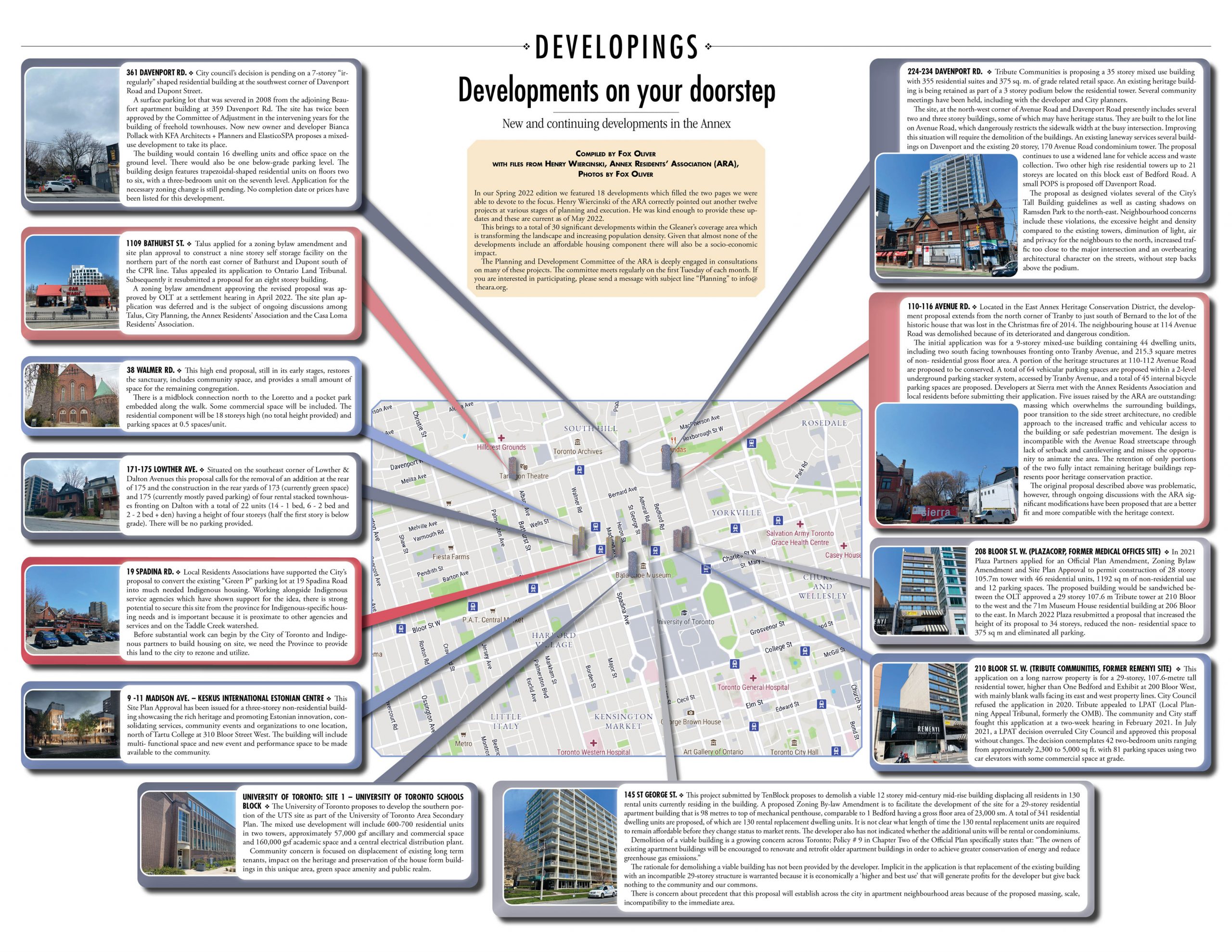
August 19th, 2022 · Comments Off on DEVELOPINGS: Developments on your doorstep (Aug. 2022)
New and continuing developments in the Annex
Compiled by Fox Oliver with files from Henry Wiercinski, Annex Residents’ Association (ARA),
Photos by Fox Oliver
In our Spring 2022 edition we featured 18 developments which filled the two pages we were able to devote to the focus. Henry Wiercinski of the ARA correctly pointed out another twelve projects at various stages of planning and execution. He was kind enough to provide these updates and these are current as of May 2022.
This brings to a total of 30 significant developments within the Gleaner’s coverage area which is transforming the landscape and increasing population density. Given that almost none of the developments include an affordable housing component there will also be a socio-economic impact.
The Planning and Development Committee of the ARA is deeply engaged in consultations on many of these projects. The committee meets regularly on the first Tuesday of each month. If you are interested in participating, please send a message with subject line “Planning” to info@theara.org.
To download a pdf of the spread, please click here:
August 17th, 2022 · Comments Off on NEWS: Developer, community come together (Aug. 2022)
Community benefits support Indigenous art and design
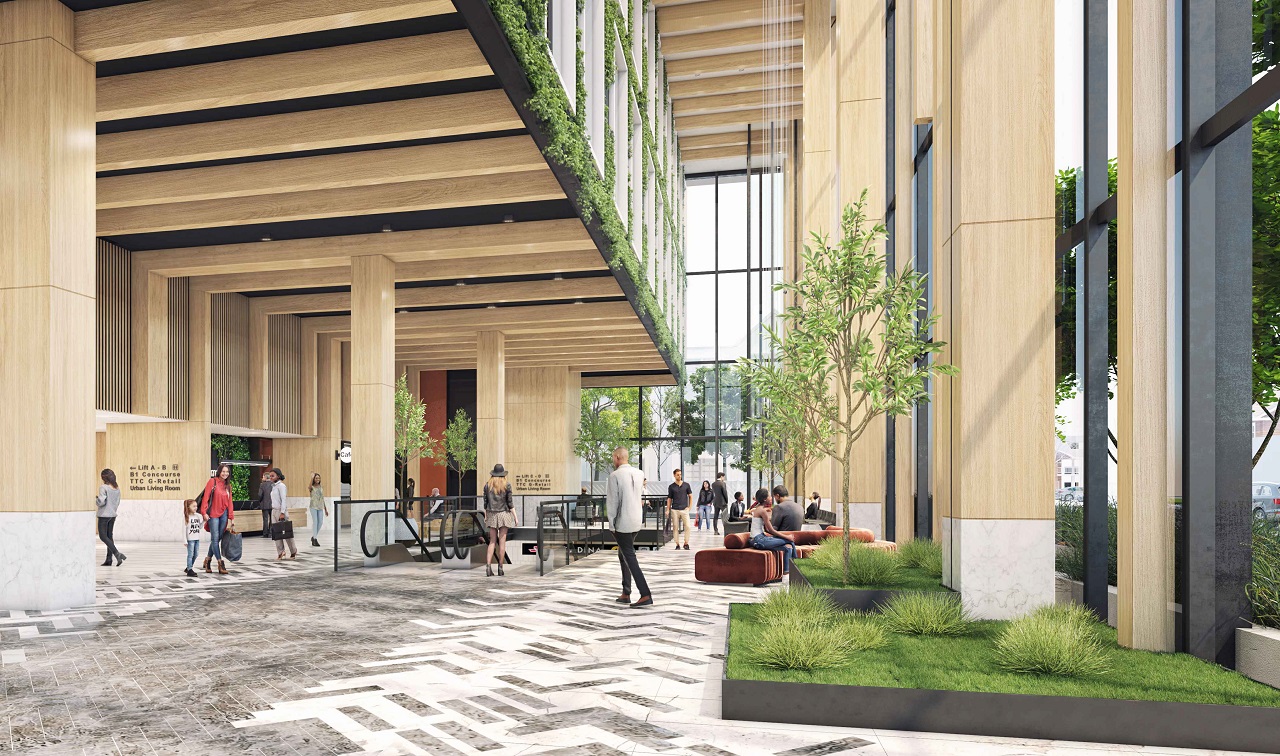
An “urban living room” is proposed with public TTC access at Bloor and Spadina. COURTESY IBI GROUP
By Carly Penrose
The new 35-storey high rise planned for the northwest corner of the Bloor and Spadina intersection has been a long time coming. The development, planning, and community consultations have been ongoing for four years. Now, with only two full council meetings before the fall election, community organizations and developers have had the opportunity to discuss how to do something tangible with the public space in the building to support the community that surrounds it.
Indigenous-led organizations, city staff, BIA members, resident organizations, and developers have come together to discuss how the community benefit funds from the development can support the community around the intersection.
“When we started to get to the discussion around community benefit,” said Councillor Mike Layton (Ward 11, University-Rosedale) who has hosted many of the consultation meetings for the project, “there was a real push from community associations to ensure we looked at the community benefit through the lens of reconciliation.”
The community benefit conversation can only happen because of a development rule called Section 37. Section 37 is a municipal bylaw that requires developers who plan to construct buildings that fall outside of typical zoning laws for the area, to pay a fee to give back to the surrounding community and to account for additional costs associated with more density.
By fall 2022, the Section 37 benefit will be no more. It will instead be replaced by the Community Benefits Charges (CBC) legislation from the provincial government. The new bylaw won’t be drastically different from Section 37, but it is less flexible and limits the types of projects the funds can be spent on. This upcoming change means the decision about how to spend the funds for the Bloor and Spadina development must be made before the council meeting in July.
In this case, the community and local agencies surrounding the Bloor and Spadina intersection expressed a desire to keep the unique history of the place at the forefront of any plans.
“It’s something of a gathering and meeting space. It offered safety and connection,” said Pamela Hart, Executive Director of the Native Women’s Resource Centre, of the intersection. “To redesign with consideration of the benefit to the community, there must be a deeply rooted understanding of what was there before. If not, it can eliminate the community.”
Layton says developers, in large part, heard the community’s concerns and wishes. They worked closely with the Indigenous-owned and operated firm, Two Row Architect, to integrate Indigenous knowledge and heritage into the way the building will be built and they have consulted with nearby organizations to ensure the public space in the entryway to the building will be what developers call an “urban living room.”
The “urban living room” will be a glassed-in atrium and a public space for anyone to use. Layton says it’s a “place that they expect people to gather, to interact.” The living room will serve as a lobby for the housing units in the building, but will also contain office space, retail opportunities and a path to the Spadina subway station.
The living room will be the site of the community benefits project funded through Section 37. Indigenous leaders, in meetings about the development, were clear that any contribution from developers must have real benefits.
“It has to go toward something tangible,” said Hart. “It has to be housing units. It has to be office space. It has to be something the community owns and can call their own, not just visible representation in a building that doesn’t offer anything tangible to give back or enhance our community.”
While Layton said the city cannot compel developers to include affordable units in the building, developers agreed to provide opportunities for office and retail space, as well as fund visible and prominent Indigenous-led art in the space.
Developers and city planners have expressed a desire to make the space a truly open and public one, and they plan for it to operate at the same hours as the TTC, rather than closing when the retail stores lock up for the night. This means there will be challenges monitoring a public place like this, but for now, the focus is on finding and securing spaces within the living room for Indigenous-led groups.
There are more development applications for the other corners of the Bloor and Spadina intersection which means there will be more opportunities to engage meaningfully with Indigenous-led groups and create spaces for their communities.
The developer declined to comment for this news story.
August 17th, 2022 · Comments Off on NEWS: Stellar student scores 100 per cent in all courses (Aug. 2022)
TDSB student graduates in only three years with a perfect average
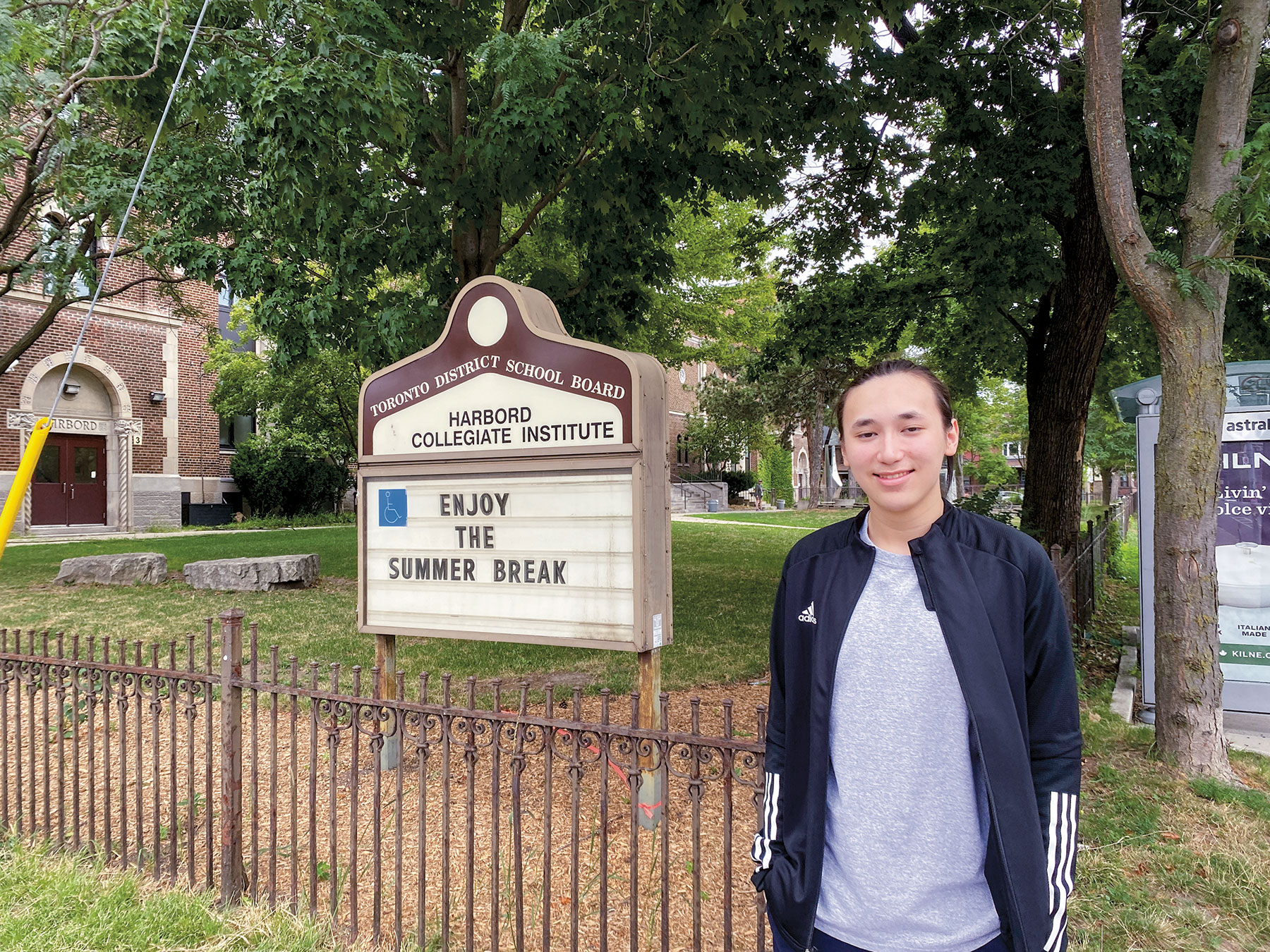
Outstanding student Pasha Ho stands in front of Harbord Collegiate Institute, the school he recently graduated from. FOX OLIVER/GLEANER NEWS
By Fox Oliver
When it comes to high school courses, everyone has a different idea as to what constitutes a “good grade.” However, with regards to recent high school graduate Pasha Ho’s marks, there is no debate. Pasha Ho is one of the TDSB’s top scholars and has just graduated with a 100 per cent average from Harbord Collegiate Institute (HCI).
Seventeen-year-old Pasha began his high school experience three years ago at HCI, his local school. When the pandemic hit at the end of his grade nine year, he wanted to make the most of his extra time off and decided he would try to graduate within three years of secondary school (instead of the usual four years).
After taking extra courses online during the pandemic, he was able to reach this deadline while earning 100 per cent in seven different grade twelve courses, which is one course more than the required six. These courses were also some of the most advanced courses at HCI.
Pasha says he earned his 100 per cent average by being diligent and by “getting a good foundation of skills down” throughout his earlier years of school, dating all the way back to first grade.
Having a good relationship with his resource teacher, Greg Smith, was also paramount, as he helped Pasha get the most out of his classes.
Pasha’s advice to new students going into high school is simple, but it has proved to be effective: “Take that first year to explore what school is like … join some clubs, meet new people.” This helped him navigate his new surroundings when he started grade nine and paid off in the long run when his course load picked up in his later years at HCI.
Pasha now works at MLSE Launchpad, an athletic centre which provides free programs for youth in the community. Next year, he will be putting his scholarly skills to work in the University of Toronto’s program for engineering science.
Pasha’s hard work has paid off, and there is no doubt his attitude and his aptitude will lead him on a grand adventure.
Comments Off on NEWS: Stellar student scores 100 per cent in all courses (Aug. 2022)Tags:Annex · News
August 17th, 2022 · Comments Off on CHATTER: New Purolator pop-up on Spadina uses e-cargo bikes (Aug. 2022)
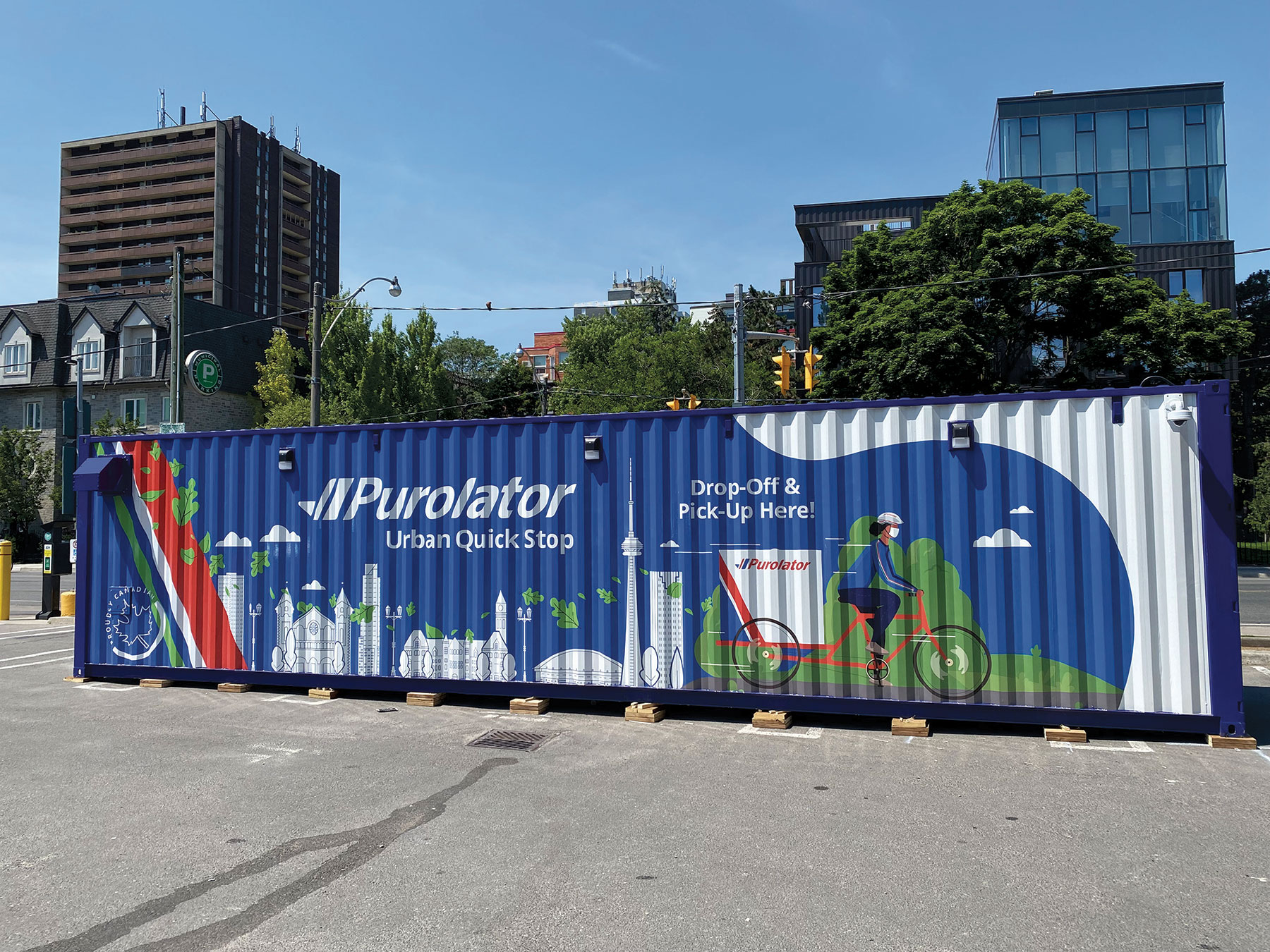
Purolator, City of Toronto and Toronto Parking Authority launch Urban Quick Stop pilot program designed to be mini hub for e-cargo bikes. BRIAN BURCHELL/GLEANER NEWS
A new Purolator Quick Stop shipping location has just launched at 90 Spadina Road (just north of the Spadina TTC station) and intends to meet two pressing needs in the community. This full-service package pick-up and drop-off location in the neighbourhood serves local residents as well as commuters who park in the Green P parking lot where it’s located. The Quick Stop will also reduce cargo emissions by removing large Purolator trucks from the road. Two e-cargo bikes operated by Purolator staff will replace the truck. The new location is housed in a converted 40-foot shipping container.
Since 1960, Purolator has operated as a courier service. It is now owned by Canada Post. Quick Stop hubs are their latest initiatives, and another will be launched near 60 St. George St. University of Toronto’s Transportation Research Institute will analyze the impact of replacing large vehicles on campus using data provided by Purolator.
The Quick Stop’s temporary summer hours are 3 p.m. – 7 p.m., Monday to Friday. In the fall, its operational hours are set to be 9 a.m.- 7 p.m., Monday to Friday. Use the Locator feature on Purolator’s website to locate the Quick Stop nearest you. Drop in and grab your packages on the go, and wave goodbye to (some) big vans in the neighbourhood.
—Marisa Kelly/Gleaner News
Comments Off on CHATTER: New Purolator pop-up on Spadina uses e-cargo bikes (Aug. 2022)Tags:Annex · News