October 19th, 2022 · Comments Off on NEWS: “Renovicted” tenants left with no recourse (Oct. 2022)
Woes for those who just want back in
11 Walmer Rd. FOX OLIVER/GLEANER NEWS
By Fox Oliver
The management company in charge of 11 Walmer Rd. is welcoming new tenants into their building after a renovation, while six former tenants, who were evicted based on work that began in 2019, watch with their hands tied. This situation exposes flaws in legal protection for renters in Ontario, and MPP Jessica Bell (University-Rosedale) says these need to be fixed as part of tackling the provincial affordability crisis.
The six tenants in question were confident they would be at the top of the list of potential renters for their old building once the renovations were complete. Cromwell Management, the real estate company that manages the building, gave them an estimated return date of December 2021. The building renovations are now complete, but Cromwell Management has started renting units in the building to new tenants without offering spaces to the former tenants.
When the displaced tenants saw new tenants moving into the newly renovated 11 Walmer Rd., they inquired as to when they could move back into the building too. Cromwell Management informed them that their specific units were not ready yet. However, many units in the newly renovated building are available for rent on Cromwell Management’s website and have been for months. The displaced tenants have even witnessed plenty of new tenants moving into the building while they themselves cannot. The tenants say this leaves them questioning Cromwell Management’s promises to them and whether the management company’s actions are legal.
According to the Government of Ontario’s Residential Tenancies Act, 2006, landlords must give tenants who are evicted due to renovations the “right of first refusal to move back into the unit following the renovation.” This means the evicted tenants must be given the chance to move back into their units without an increase in rent before their units are offered to other renters. However, as Cromwell Management says the displaced tenants’ units aren’t ready yet, and that they have not been offered to new renters, their actions are within the bounds of the law.
Cromwell Management’s actions, while legal, expose flaws in the laws protecting renters in Ontario. When a tenant believes they have been evicted in bad faith, they can submit a T-5 form to the Landlord and Tenant Board (LTB) to receive compensation. However, the T-5 form must be submitted within two years of a tenant’s eviction, and due to this renovation lasting at least two years, the evicted tenants did not have reason to submit the form until this window had passed. There is “no recourse now,” says Caitlyn Gowans, one of the displaced tenants.
Bell says that there can be up to a two-year wait for a tenant’s case to be heard by the LTB once a T-5 form is submitted, and even then, the punishments for a landlord who violates tenants’ rights are not strong enough to dissuade the landlord from attempting to do so in the first place.
Bell has been working with the evicted tenants to help ensure they return to their newly renovated units. She says that a landlord’s motivation to replace tenants likely lies in their ability to raise the rent greatly when switching to new tenants. Bell believes that the province and city need “a comprehensive response to tackle the affordability crisis.” Fixing the affordability crisis in the city will lead to more enforceable tenants’ rights, and vice versa, says Bell.
Bell’s plan to strengthen tenants’ rights includes speeding up LTB hearings and heightening penalties for landlords who violate tenants’ rights. Bell is also pushing for vacancy control which is a set of laws that limit the annual increase of the rental cost of a unit regardless of changes in tenants.
Vacancy control would prevent drastic rent increases when landlords replace tenants and reduce a landlord’s motivation to evict in bad faith.
Bell has proposed these changes to Steve Clark, the minister of municipal affairs and housing, and Doug Downey, the attorney general, but they have not been passed or implemented yet.
Comments Off on NEWS: “Renovicted” tenants left with no recourse (Oct. 2022)Tags:Annex · News
October 19th, 2022 · Comments Off on NEWS: Leafs fall in the Finals (Oct. 2022)
Game Six defeat stuns fans at Christie Pits
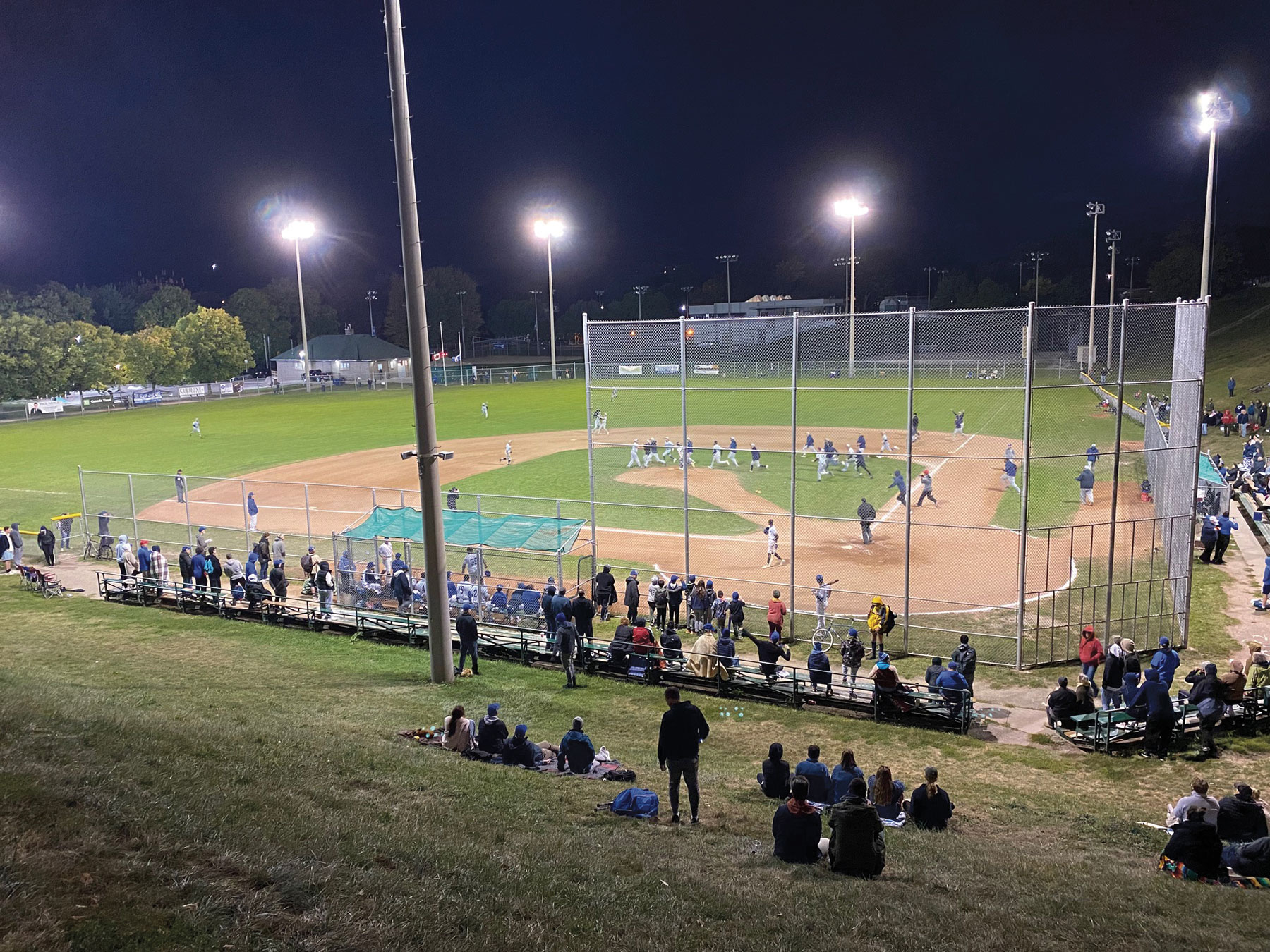
The London Majors pour onto the field to celebrate winning their second consecutive championship. R.S. KONJEK/GLEANER NEWS
By R.S. Konjek
Business remains unfinished.
For the second year in a row, the Toronto Maple Leafs made it to the Intercounty Baseball League’s championship series but failed to take home the Dominico Cup.
Baseball is a cruel sport. All sports can be, of course. With baseball, it might be the slow meander of the season or the pace of the game itself. It weaves itself into the fibre of your being.
When the season ends, it happens with sudden, jarring finality. There is no clock to count down with; there is only the end.
After a splendid summer of baseball action at Christie Pits, the Leafs breezed through the opening rounds of the postseason, dispatching the Barrie Baycats and Welland Jackfish with ease.
Then they ran into a wall. Their opponents in the finals were the league’s top-ranked team and defending champions, the London Majors.
The best-of-seven series was a tremendous battle. Each game alternated between opposing ballparks, with London hosting first.
Each of the first five games of the series were won by the home team.
Game six took place at Christie Pits on September 22. The Leafs looked to continue the pattern of winning at home and then going all-out to win the deciding seventh game in London.
They never got that far, but it looked as if they would.
Home runs by Marcus Knecht and Justin Marra gave Toronto an early lead. Starting pitcher Angel Castro put in a dominating performance. After eight innings, the Leafs led 7-3.
Castro returned to the mound to start the ninth, looking for a complete game win.
The Majors rallied with two singles, a walk, and a two-run homer. That made it 7-5, and Castro left the game without recording an out in the inning.
Leafs closer Franklin Hernandez—another of the club’s postseason stars—came in to finish the game.
A walk, a single, three wild pitches and a sacrifice fly drove three runs across the plate and the Majors took a stunning 8-7 lead.
The Pits were stunned. The Leafs looked stunned too. In the bottom of the ninth, they mustered no more than a leadoff walk. After that, a double-play and a strikeout ended the game. Cruel sport.
The Majors’ players and coaches poured onto the infield to celebrate their second straight title as the Christie faithful looked on. Game over, series over. That sudden, jarring finality.
So ends the 2022 season, one that began under the shadow of long-time owner Jack Dominico’s passing and ended with the championship cup that bears his name slipping out of the Leafs’ grasp. Unfinished business, the season’s theme, went unfulfilled.
“Losing was a tough pill,” said Damon Topolie, the club’s vice president of baseball operations, general manager, and its longest-serving active player. “The fact that we battled right to the end, that was what I loved the most about this team. The amount of adversity this team had to overcome was incredible.”
Topolie added, that while it is still early, he expects many players from this year’s roster to return next summer.
For fans, nothing beats watching the Leafs live at Christie Pits; however, the club made huge improvements to its online presence in 2022.
Ryan Eakin, the club’s director of communications and game day operations, led the effort to modernize how Maple Leafs baseball is presented to the public.
“I was most pleased with the advancements this franchise made in a lot of different areas,” said Eakin. “The [online] broadcast was better, and more people were tuning into it. Our social media accounts grew in popularity at a rate that the team was happy with, [and] we provided different types of content that no other team in the IBL was producing.”
Eakin himself was one-half of the Leafs’ broadcast team, calling home games on YouTube with partner Thomas West. Their rapport was well-received by viewers.
“Nothing was perfect and there is a lot of improvement needed, but we set a foundation for what we need to do moving forward,” he added. “A year ago, there was no foundation on the communications or game day side of things.”
A year ago, things were very different in the Maple Leafs organization. Topolie, Eakin and the rest of the club’s operations team shepherded the club into a new era, one that will continue for the foreseeable future.
Before the final out of the final game this year, an announcement came out over the public address system: the Leafs’ next home opener will be Sunday, May 7, 2023, at Christie Pits.
October 19th, 2022 · Comments Off on CHATTER: Harbord’s fall fair returns (Oct. 2022)
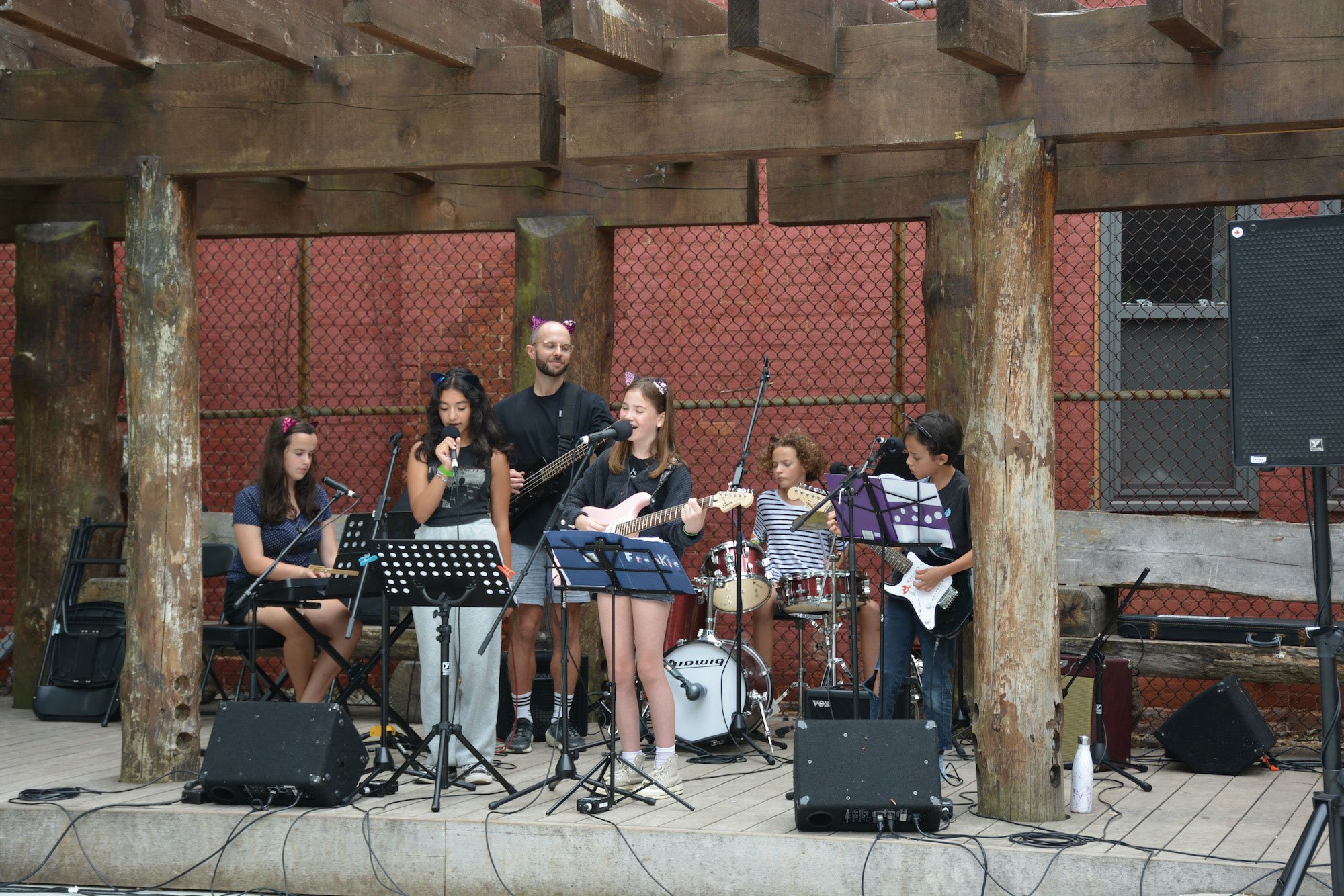
The band Feline Groovy, from the Annex Academy of Music, performed at the HVRA event. COURTESY STUART LAWLER/HVRA
Autumn is here, and so is the Harbord Village Residents’ Association’s (HVRA) fall fair. On Sunday, Sept. 11, residents of Harbord Village gathered in Margaret Fairley Park on Brunswick Avenue to celebrate their neighbourhood and the season with a joyous community event.
The fair hosted live music, a barbecue, a silent auction, and themed booths throughout the park. The heritage booth was filled with information, maps, and diagrams detailing Old Toronto, while the environmental booth provided information about climate change and gave out free seeds. At the bake sale there were homemade treats, jams, and bread made by community members.
The fall fair has some history behind it. The fair was first held in 1992 by the Sussex Ulster Residents’ Association, the HVRA’s predecessor. Since then, it has only been cancelled twice due to weather and twice more due to the pandemic.
Since the first fall fair 30 years ago, there are still some familiar faces. One of the vendors at the bake sale, Mary, has been selling her baked goods for at least 20 years and says she remembers her mother doing the same for years before that. Former HVRA president, Gus Sinclair, has been playing the bagpipes at the fair since the early 1990s, and this year was no different. He kicked off the day with a solo performance and then played later with his band Caledon County.
Many people at the fair said they enjoyed seeing the community come together to enjoy a wholesome day. Fair-goer Kathy said this was her first time at the fall fair and that she “wanted to check out the action” when she saw all the people gathered. She enjoyed the music and said that she even ran into a few of her neighbours.
This year’s fall fair was a hit and is planned to return next year.
—Fox Oliver/Gleaner News
Comments Off on CHATTER: Harbord’s fall fair returns (Oct. 2022)Tags:Annex · News
October 19th, 2022 · Comments Off on EDITORIAL: A small business tax break in name only (Oct. 2022)
In November of last year Mayor John Tory announced a new small business tax that was meant to reduce the property tax burden that small businesses must pay to the city. In theory, this meant an across the board decrease of 15 per cent for properties that met two criteria: lot size and value. It turns out however, that the methodology chosen by the city is so flawed that it appears that as many as 20 per cent of properties will not get the break even though they meet the requirements.
Apparently, the scheme has nothing to do with whether the business occupying the property is big or small. The “small business” adjective is just spin; for example, the Bank of Nova Scotia at the corner of Bloor/Spadina, an organization whose revenue last year was $7.8 billion, got the tax break. Whereas By the Way Café, located at Bloor and Brunswick, who should qualify, does not. They have been at that corner for 45 years and are independently owned.
Why should the bank get the break and not By the Way Cafe? The answer lies in the methodology chosen by the city. The city chose Municipal Property Assessment Corporation (MPAC) rolls to determine who gets the break. MPAC is the arm of the province that sets values for individual properties and reports on lot sizes. The problem is those rolls tend to notionally merge properties under common ownership. So, if a small business has a landlord that also owns the property next door, or down the block, or across the street, then all those properties will get denied the tax benefit. The reason is that the cumulative lot size of those addresses and their total value exceeds the thresholds that would otherwise apply to those individual properties.
In our section of Toronto, properties eligible for the tax break are those whose lot sizes are 7500 sq. feet or less AND whose MPAC valuation is less than $7 million. Tenant businesses pay the property owner’s tax in most commercial leases.
Side by side sushi shops may find themselves in the following predicament: shop “A” has a landlord who has no properties with a common MPAC roll number so the owner will get the approximately $7500 tax break and communicate this to the tenant; shop “B” has a property owner who owns something across the street with a common MPAC roll number and is denied the break. “A” now has a competitive advantage over “B.” This gets worse: The city is not actually reducing its revenue because the tax break is funded by the ineligible commercial taxpayers. So not only does sushi shop “B” not get the break, they are also burdened with a one per cent tax increase!
The province gave Ontario municipalities wide-ranging powers to select a fair means of applying the small business tax break. Toronto chose a crude method and failed to avail itself of the power to make exceptions; by all accounts, it’s not granting appeals.
The tax reduction is not pocket change. The average assessed value of a property on Bloor Street between Bathurst and Madison is $3 million. The tax savings for the average property is $7500 per annum at that value. That’s make or break for some businesses. The total net loss of tax savings on this strip alone on Bloor Street is estimated to be $175,000 for 2022. Do the math for the rest of the city and one can see the numbers are enormous.
That is money that businesses will have to pay through property owners that they should not have to.
The city is just being lazy by using a crude yard stick to measure which properties are eligible and appears to be unmotivated to fix the inequities their approach has created.
October 19th, 2022 · Comments Off on FORUM: Living on welfare is not healthy (Oct. 2022)
MPP subsists on welfare-funded diet
By Jessica Bell
Last month, I went on a “welfare diet” and lived on a grocery budget of $47.60 a week for two weeks to pressure the Ford government to double social assistance rates.
I went on a “welfare diet” and lived on a grocery budget of $47.60 a week for two weeks to pressure the Ford government to double social assistance rates.
—MPP Jessica Bell
About 900,000 Ontarians live on social assistance. If the person qualifies for Ontario Works, they receive $733 a month for a single person, and if they qualify for Ontario Disability Support Payments, they get $1227 a month. These meager payments keep people in poverty.
In my first week, I bought the cheapest food I could find—potatoes, lentils, kidney beans, oats, rice, milk and butter. In the second week, I augmented my meals with eggs, bread, peas, and hot sauce. This diet was not sustainable or healthy. I was often hungry. I experienced sugar withdrawal, and I dreamt of eating lettuce and apples.
The experience was humbling. I learned a lot. People contacted me to describe how difficult, humiliating, and stressful it was to be poor. They spoke about the many expenses that spiraled them into debt and hunger, from cell phone costs, transit, medications, a trip to the hospital, diapers, and more. Many residents spent less than $47.60 a week on food.
By far, the biggest cost is rent. Rent has risen much faster than inflation over the past decade. Many people on social assistance live in overcrowded and poorly maintained homes, and many more end up homeless, often because they are evicted and cannot find any apartment or rooming house that meets their budget. I’ve been appalled by the extent of hidden poverty I have witnessed going door to door in our riding.
The inflation crisis is sending more people into poverty and hunger. Bob Mandel, co-founder of the Avenue Road Food Bank, said the number of people visiting their food bank has gone up by 30 per cent in the past six weeks alone due to the rising cost of food and the arrival of people from Ukraine.
“People from across Toronto, from as far as Mississauga, start queuing at 12 p.m. in rain, heat or snow, three hours before the food bank opens its doors at 3 p.m. I’ve never seen a need like this. We used to have food left over to donate to kitchens, now we have none,” he said.
Shauna Harris, the co-founder of Spadina-Fort York Community Care, has a similar experience. Her food bank, which also serves people in University-Rosedale, provides food to people on social assistance, seniors, and low-income workers. Harris has seen food donations from grocery stores drop by about a quarter because of rising food costs. The food bank now “regularly runs out of food, forcing them to ration what people can take when they visit. People used to receive a whole carton of eggs, and now they get two or three,” she explained to me.
Poverty was a central issue in the 2022 June election. The provincial government agreed to a five per cent increase in social assistance rates this year, with future increases tied to inflation.
Reducing poverty will require a more comprehensive approach from Premier Ford. That approach must include stronger rent control, the construction of affordable housing, price caps on essential food, an increase to the minimum wage, and a doubling of social assistance rates.
Doubling social assistance rates is expensive—about $9 billion a year—but providing downstream services and support to people living in poverty is very expensive for governments as well.
Poor people are more likely to get sick, die earlier, struggle with mental health, have encounters with the police, end up in an emergency room or hospital, sleep in a shelter, lose work, and have children who struggle, fail to complete high school, and fall short of their full potential, thereby perpetuating a cycle of poverty.
On the positive side, people who are provided with more financial support are more likely to get their lives in order, care for their children, get a job, pay taxes, and contribute. People want to contribute, and to ensure more of them can, we must help them first.
Contact our office if you need help or want to help the less fortunate in our riding.
Jessica Bell is the MPP for University-Rosedale and the Official Opposition’s Housing Critic.
October 19th, 2022 · Comments Off on ARTS: You don’t have to be funny to succeed at improv (Oct. 2022)
Annex Improv celebrates 10 years of laughter and community
Annex Improv has a successful low-pressure formula which one member describes as sometimes it just “feels
good to be silly.” MARISA KELLY/GLEANER NEWS
By Marisa Kelly
“You don’t have to be funny to succeed at improv,” says Brian G. Smith on a Monday night.
We’re seated across from each other in the bottom level of the Centre for Social Innovation (CSI) in the Annex. A former teacher at The Second City (Toronto), Smith has over 20 years of experience in theatre and comedy.
“A story will happen when you continue to say yes,” he says. “If you’re honest, it’s authentic and surprising, and surprise makes us laugh.”
Being authentic is one of the key ingredients to improv, and indeed, Smith’s class was just that.
I had the opportunity to sit in with the folks taking the course. The room was full of joy, compassion, and humour.
We promptly assembled in a circle at the back of CSI at 6:30 p.m., and I quickly realized that the class wasn’t about getting comedy right, it was about play.
We started with an alphabet game, saying the first word that comes to mind starting with A, until someone decides to switch to B, and continuing with the alphabet until we reach Z.
I realize how little my brain was challenged during the pandemic lockdown.
The folks in the class feel similarly. A member of the class, Harriet Friedman, says it’s her first ever improv class and that it’s “time to learn how to be playful.”
This is Smith’s goal. He wants people to feel the therapeutic effects of laughter and community, both of which have been lacking in the pandemic.
Another class member, Amar Shah, said that COVID-19 influenced his decision to take the course.
“It’s a fun and casual way to interact with others. I look forward to Monday evenings after work. It feels good to be silly.”
I enjoyed participating and watching from the side of the stage.
Smith maneuvered around the room politely correcting people’s posture and stage demeanor and interjecting with “should have said…” as part of an activity to keep the mind working and the comedy flowing.
Everyone respects the need to take breaks, and they laugh off any embarrassment or pausing.
Over the past two and half years, Smith tried both online classes and masked outdoor classes; however, he found both of these posed a hindrance to students properly showing facial expressions and body language.
Although there have been some learning curves along the way, the comedian and teacher is celebrating 10 years of Annex Improv this year. Fall in-person classes are still available.
Hopefully, Smith’s teachings and humour will continue throughout another terrific decade.
October 19th, 2022 · Comments Off on GRADING OUR GREENSPACE: Third and final instalment (Oct. 2022)
Part 3 of the Gleaner’s greenspace reviews
Compiled by Marisa Kelly, photos by Hailey Alexander
Continuing from the August & September editions we review area parks and assign a letter grade. Park amenities, tree coverage, seating and waste management all go into the evaluations each year.
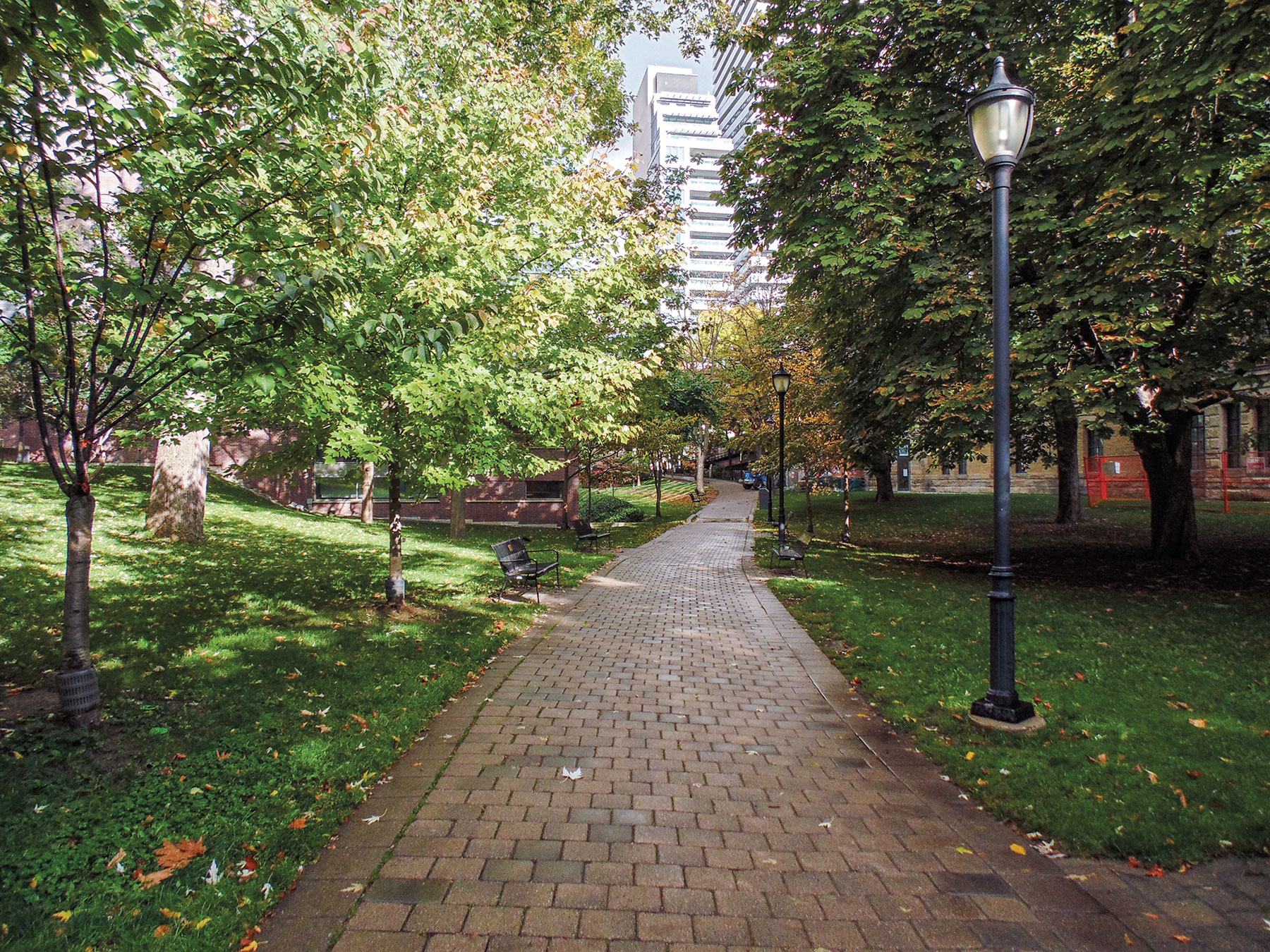
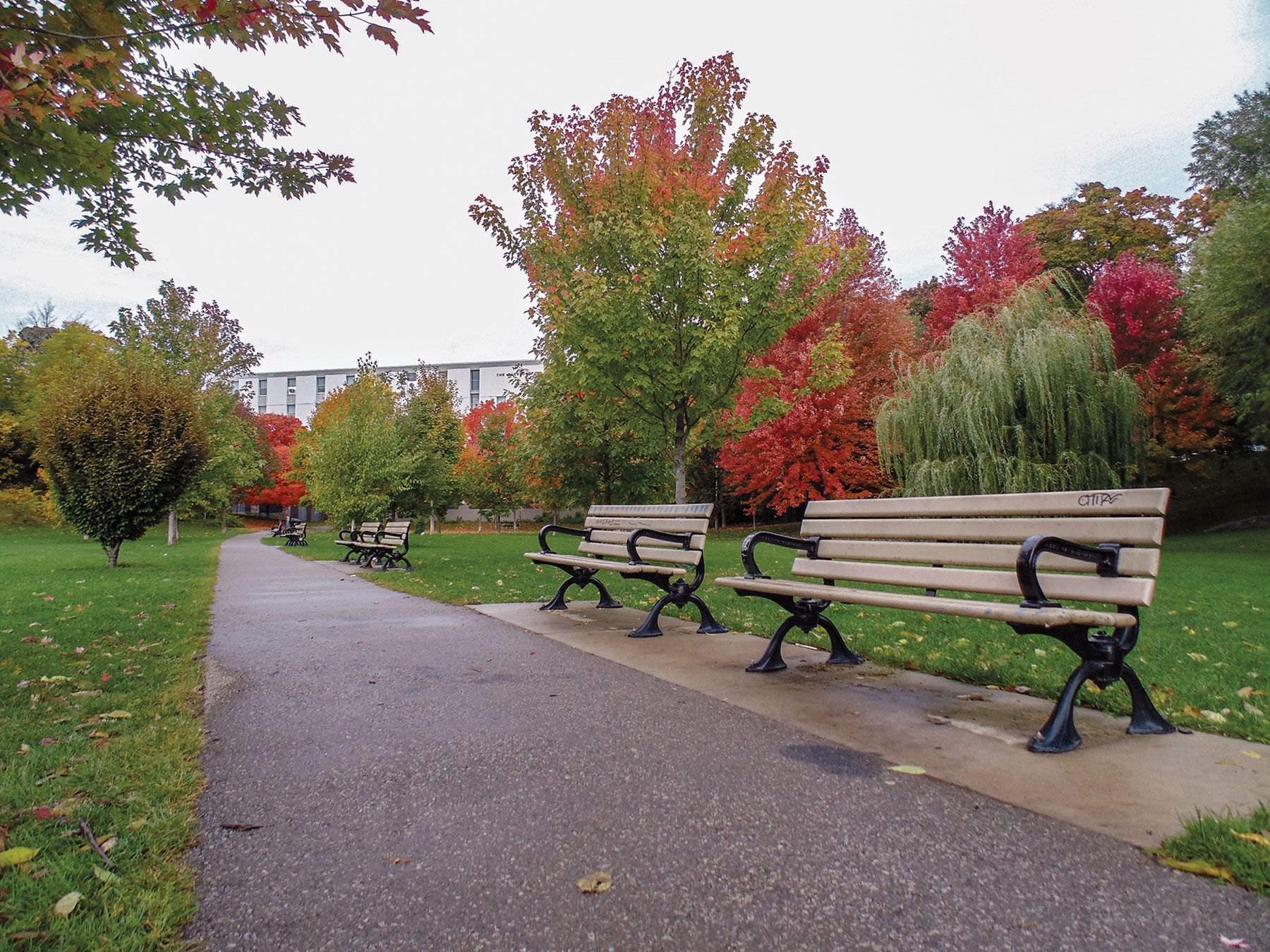
Philosopher’s Walk is a truly beloved park described by our reviewer as simply “romantic”.
Philosopher’s Walk
78 Queen’s Park Cres. W.
Time: 6:00 p.m.
Grade: A+ (Last year A)
Reasons to go: The historic and scenic winding path of Philosopher’s Walk offers the recluse serenity in the heart of the city. The maintenance of the grounds is truly remarkable. The grass is very lush and there are both wildflowers and planters. The trees have not been compromised despite city infrastructure growing around them. You can tell their age by the size of the base of the trunk. There isn’t much to do except to have a really relaxing walk or sit. However, the Romanesque and Gothic architecture of the University of Toronto campus, combined with the ambient music from the faculty of music building, make this walkway both a romantic and relaxing place to spend time.
Overheard: Piano coming from the faculty of music building, and not a single car despite Bloor Street, Harbord Street and Queen’s Park nearby.
Did you know: Philosopher’s Walk
was formerly part of Taddle Creek, a stream that flowed through this natural ravine and fed McCaul’s Pond (where Hart House Circle is now located) until the late 1800s.
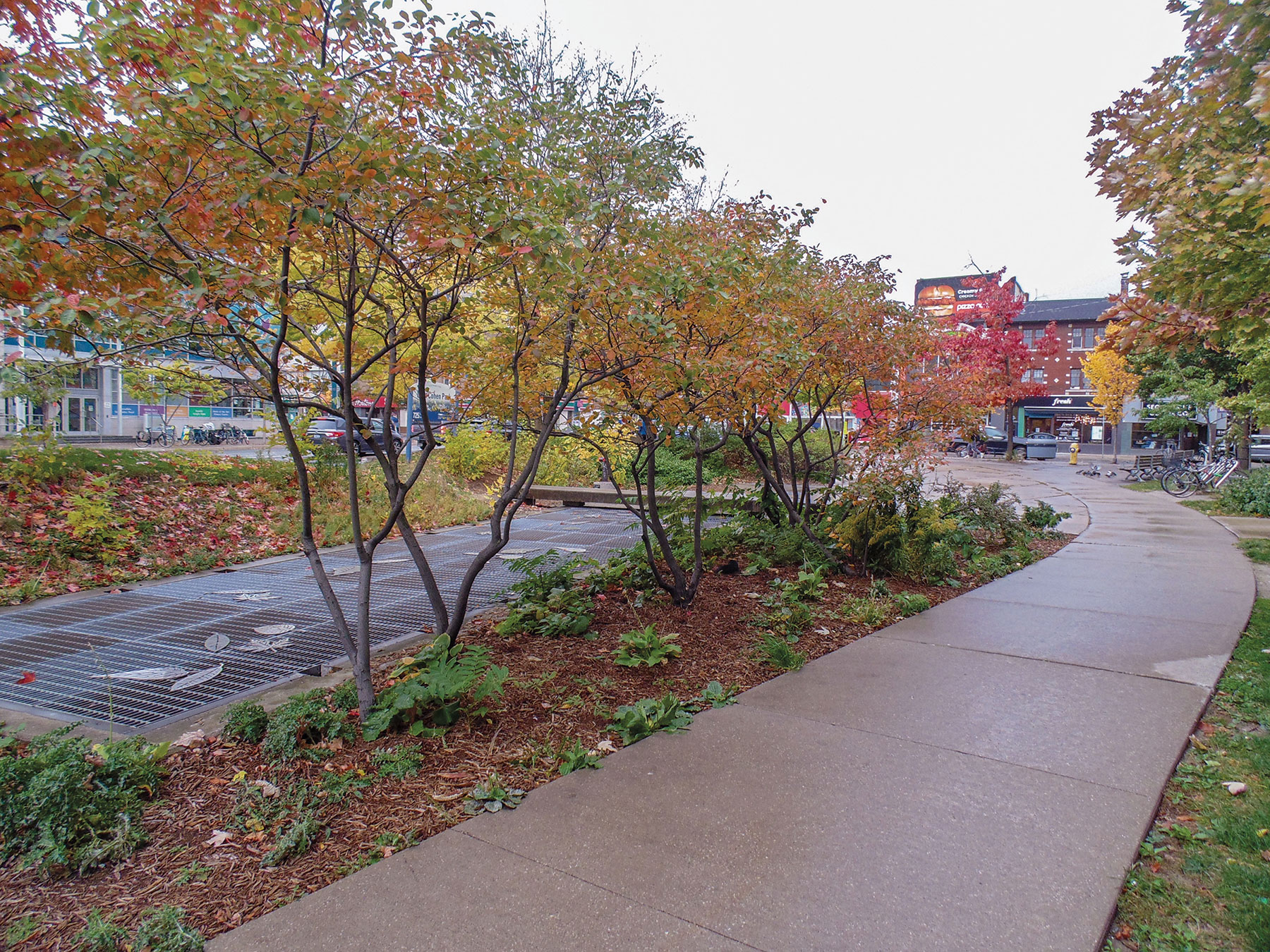
High traffic and low maintenance contribute to Matt Cohen Park’s D ranking.
Matt Cohen Park
393 Bloor St. W
Grade: D (Last year: C-)
Time: 4:00 p.m.
Reasons to go: Matt Cohen Park is an educational parkette, but because of its location, it needs some work because it is heavily polluted. The local traffic or lack of maintenance has killed most of the grass. Spadina and Bloor Streets border the park and provide excess noise and safety concerns for pets or small children. Educational plaques line the edge of the University of Toronto building, each one educating the reader about U of T alumni Matt Cohen. The park has large rocks with inlaid chess boards. However, the rocks are not at playing level, so one would be hunching significantly. The park needs maintenance work and some attention.
Overheard: All of the cars from Spadina and Bloor.
Did you know: Matt Cohen (1942-1999) was a Canadian author who wrote both fiction and children’s literature. He attended the University of Toronto which is next to the park.
Ample seating and clean working washrooms are the among the amenities that give Bickford Park a A- rating.
Bickford Park
468 Grace St.
Time: 4:00 p.m.
Grade: A- (Last year: A-)
Reasons to go: Bickford Park has a bit of joy for everyone and is well maintained. For folks looking for a dog park, there is a shaded and clean one. For friends with a large blanket to hang out on the hill side, the slope is free of debris and litter. Interested in sports? The baseball diamond and large field offer the freedom for folks to play sports. People were participating in softball, frisbee, and soccer. There’s a make-shift skate park made by locals under the Bickford Centre at the northernmost point of the park. The bathrooms are in working condition and clean, for a public lavatory, and are open from 9 a.m. until dusk.
Overheard: Friends cheering on someone learning to play softball.
Did you know: There are weekly Yoga in the Park classes every Thursday evening. From 6-7 p.m., wellness and yoga instructor Montana Skurka hosts a class until the end of October. The class can be booked on Eventbrite.
September 27th, 2022 · Comments Off on ON THE COVER: Bloor Street United demo begins (Sept. 2022)
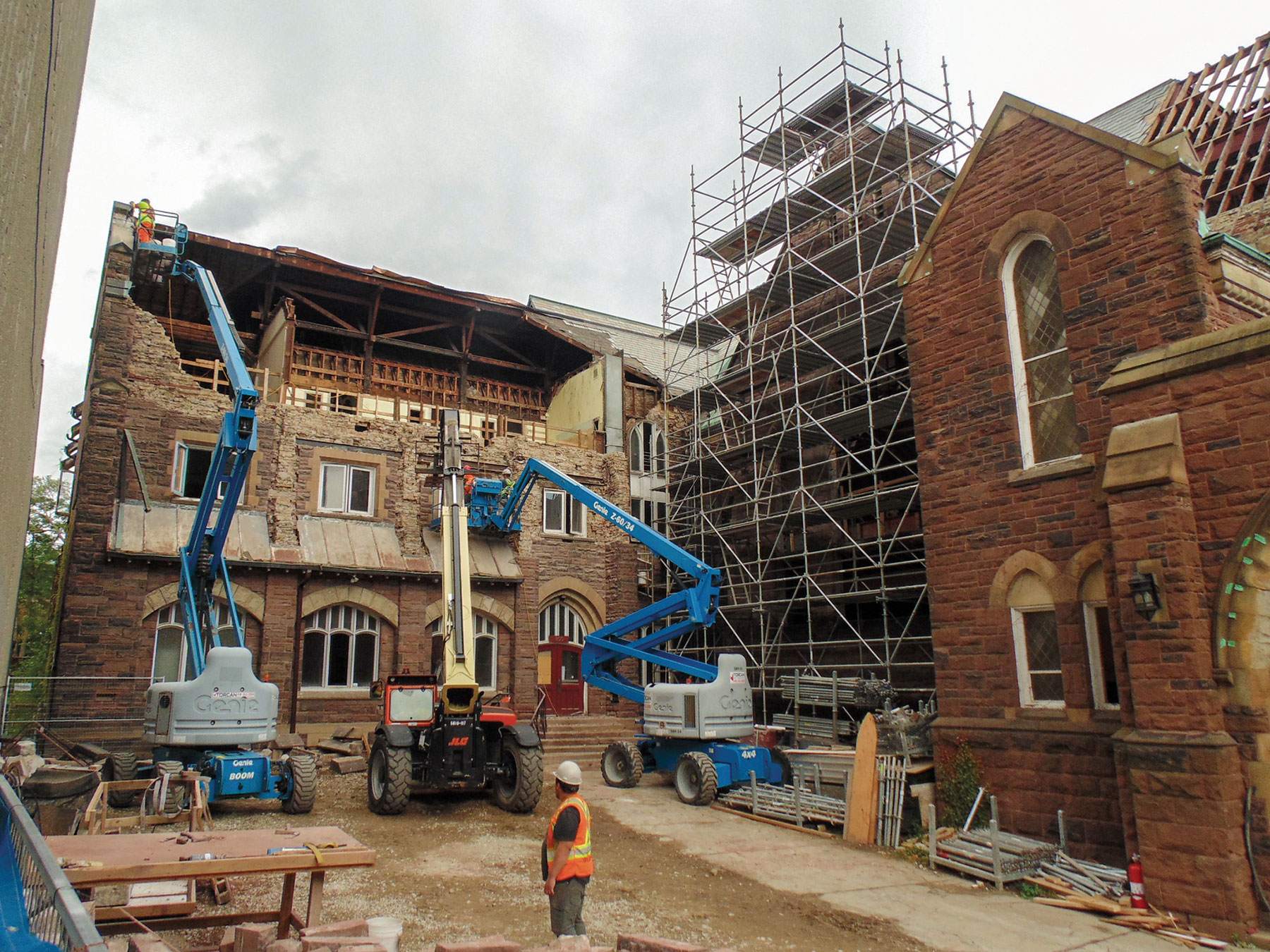
Work has begun to in part demolish, and in part to restore, the Bloor Street United Church located at Bloor and Huron streets. A new luxury condo will be constructed to the north and west of the original church building. The section on the left will be removed and the part on the right restored. BRIAN BURCHELL/GLEANER NEWS
September 27th, 2022 · Comments Off on GRADING OUR GREENSPACE: Appraising Annex parks (Sept. 2022)
Part 2 of the Gleaner’s greenspace reviews
Compiled and photos by Marisa Kelly
Continuing from the August edition we review area parks and assign a letter grade. Park amenities, tree coverage, seating and waste management all go into the evaluations each year.
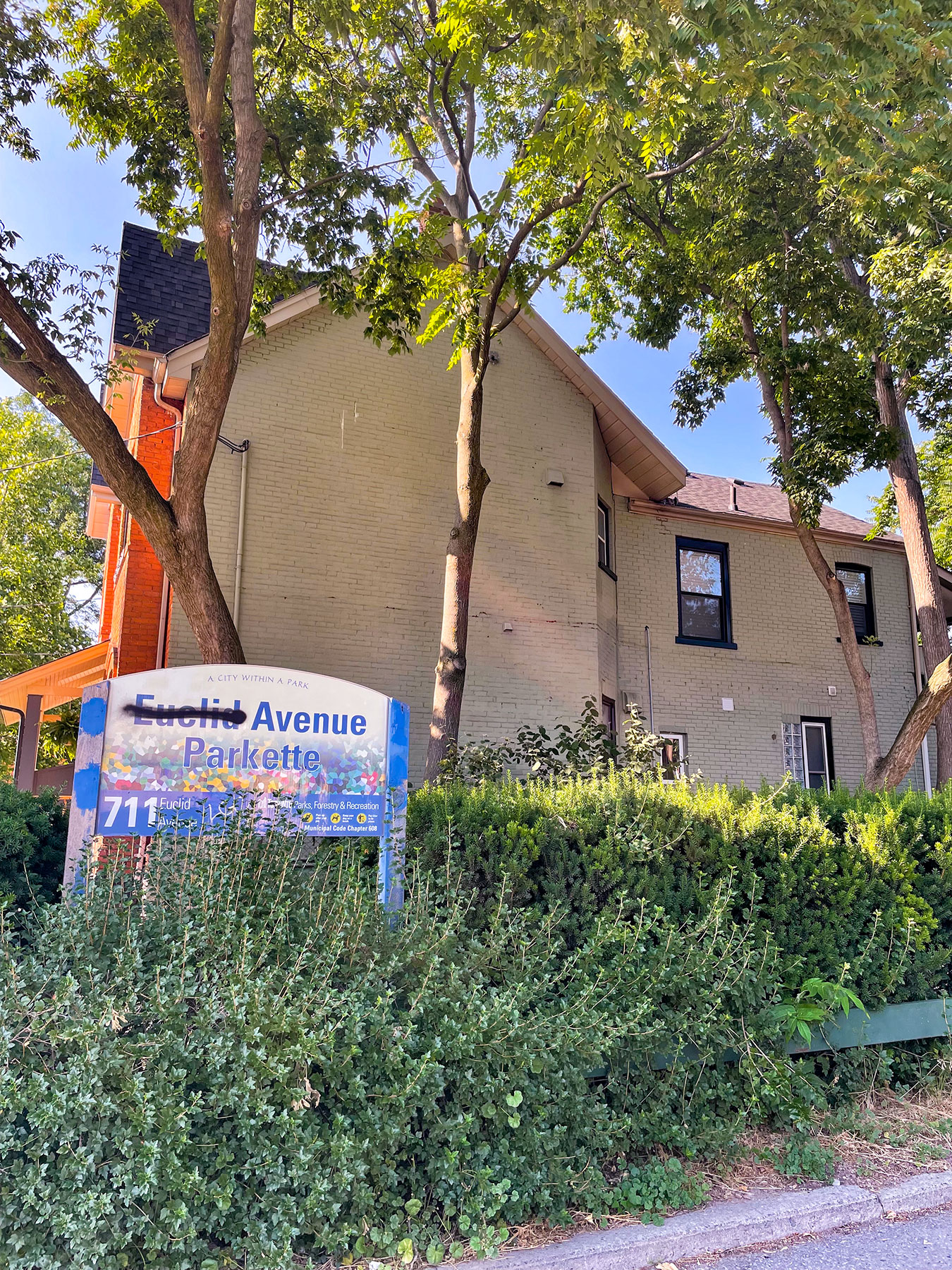
Euclid Avenue Parkette is unfortunately plagued by graffiti and litter.
Euclid Avenue Parkette
711 Euclid Ave.
Time: 4:30 p.m.
Grade: This year a D+ (Last year F)
Reasons to go: The Euclid Avenue Parkette is a tree-swaying walkway between Euclid and Palmerston Avenues. Wedged between houses and behind storefronts on Bloor Street in Koreatown, it’s a quaint resting spot with a lot of potential. The beautiful, crooked trees give enough shade to the benches midday. Unfortunately, there is some graffiti and litter, and the condos on the previous Honest Ed’s space tower nearby, so the park lacks a cozy feel. If the benches faced north instead of south, and the city cleaned it up a bit, you’d have the perfect tiny getaway. Last year Euclid Parkette was given an F for uncleanliness, but it looks like the city has started to pay attention to its upkeep.
Overheard: A cat meowing.
Did you know: The subway going from Bathurst station to Christie station shakes the ground just slightly, reminding you the hustle and bustle is still nearby.
St. Alban’s Square is a complete getaway
St. Alban’s Square
90 Howland Ave.
Time: 5:00 p.m.
Grade: A (Last year B+)
Reasons to go: St. Alban’s Square is a complete getaway. The park is the perfect place to be anonymous. There aren’t many amenities, but the space has a certain whimsy that is cultivated by the surrounding architecture of the church, the wild rose bushes, and the historic Toronto homes. The scenery is reminiscent of a European summer day. With an abundance of gorgeous, scattered trees and nourished grass, there’s plenty of spots to read in the shade, have a picnic in the sun, or drop off a Green P bike on your way to and from.
Overheard: So many birds chirping.
Did you know: There is a bike share drop off/pick up port in the park. It’s one of ten that are in the Annex.
An array of trees provide ample shade in Jean Sibelius Park.
Jean Sibelius
50 Kendal Ave
Time: 4:40 p.m.
Grade: A+ (Last year A+)
Reasons to go: The many picnic benches in Jean Sibelius Park and the free-standing mural of musical animals playing their instruments keep visitors feeling welcomed. The park is also equipped with an onsite bathroom, water fountain and a clean and well-maintained playground for kids. An array of trees provides ample shade on the walkway, and there is an open field to play a sport or lie in the grass in full sun.
Overheard: Kids playing in the playground.
Did you know: Jean Sibelius (1865-1957) was a Finnish composer who was the most noted Scandinavian composer of his time!
City staff have stepped up and improved maintenance on Sally Bird Park – which is much loved by Central Tech students.
Sally Bird
194 Brunswick Ave.
Grade: B (Last year C+)
Time: 12:00 p.m. & 5:30 p.m.
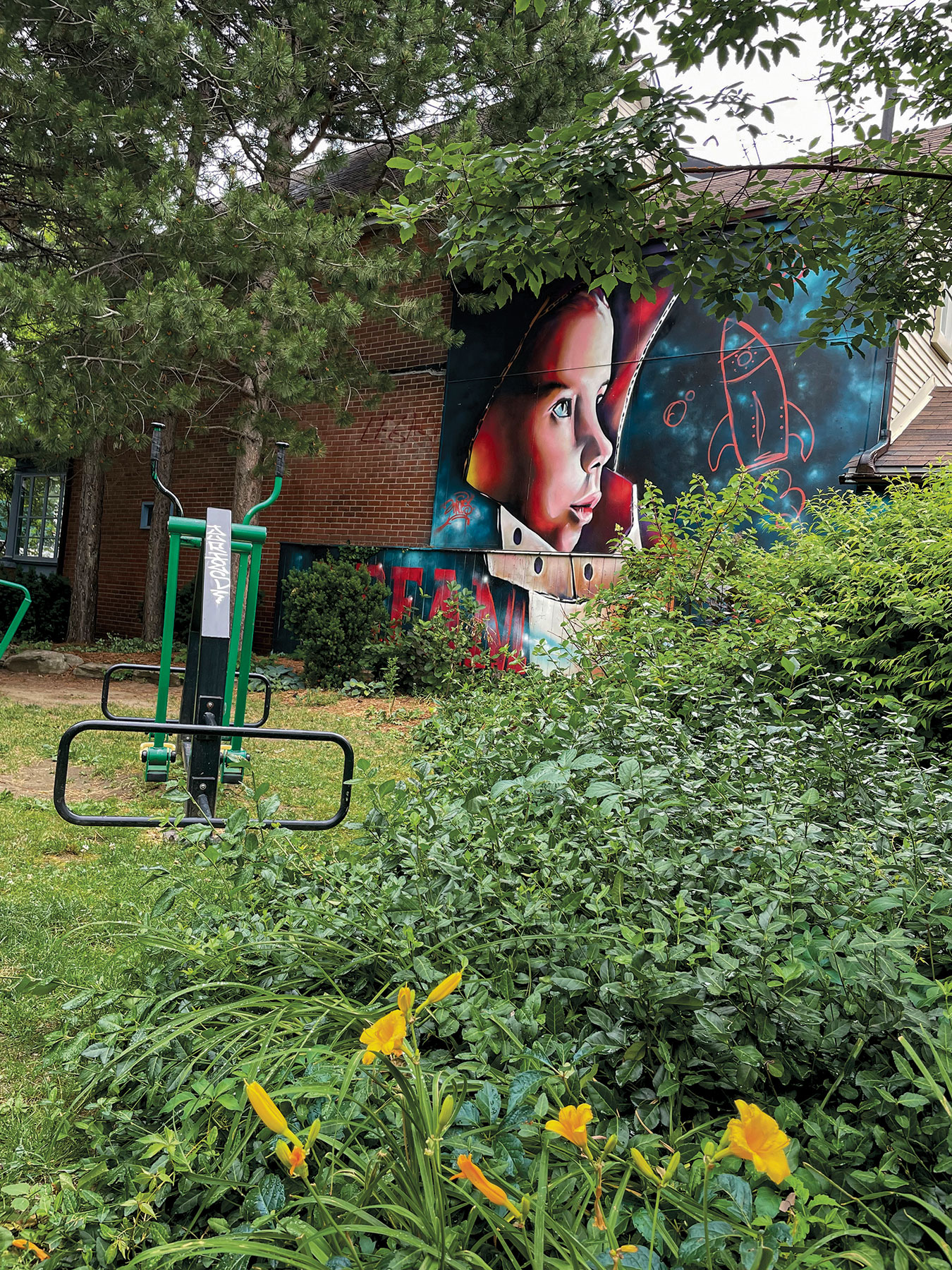
Reasons to go: This is an unassuming parkette with a large draping tree. It is perfect for leisurely sitting on a bench for a lunchtime phone call with a co-worker or long-distance friend. After school hours, it’s perfect for a self-determined workout because of the on-site built-in equipment. The park is clean and quiet, except during Central Tech’s lunch break. There is a mural on the house next to the park and the flowers lining the path are well groomed. Last year, this park was rated much lower because of poor maintenance, but recently, the city has paid attention to its upkeep.
Overheard: At lunch time, the school kids. In the evening, nothing but my own thoughts.
Did you know: The outdoor workout equipment is clean and in working condition.
Huron Street Playground
459 Huron St.
Grade: C+ (Last year B-)
Time: 3:00 p.m.
Reasons to go: A great park for neighbours with dogs or folks looking for a quick playground visit with kids. However, the Huron Street Playground is mainly surrounded by encroaching apartment buildings, contains patchy grass, and has too many wood chips. The dog park is awkwardly situated on the northwest corner behind a tall, black fence that feels cut off from the rest of the environment without a sign to indicate that it’s a dog park. The park could use some extra signs, a cleanup, and some flowers.
Overheard: Dogs barking mixed with wind chimes from the surrounding houses.
Did you know: The park has a water fountain to refill your water bottle.
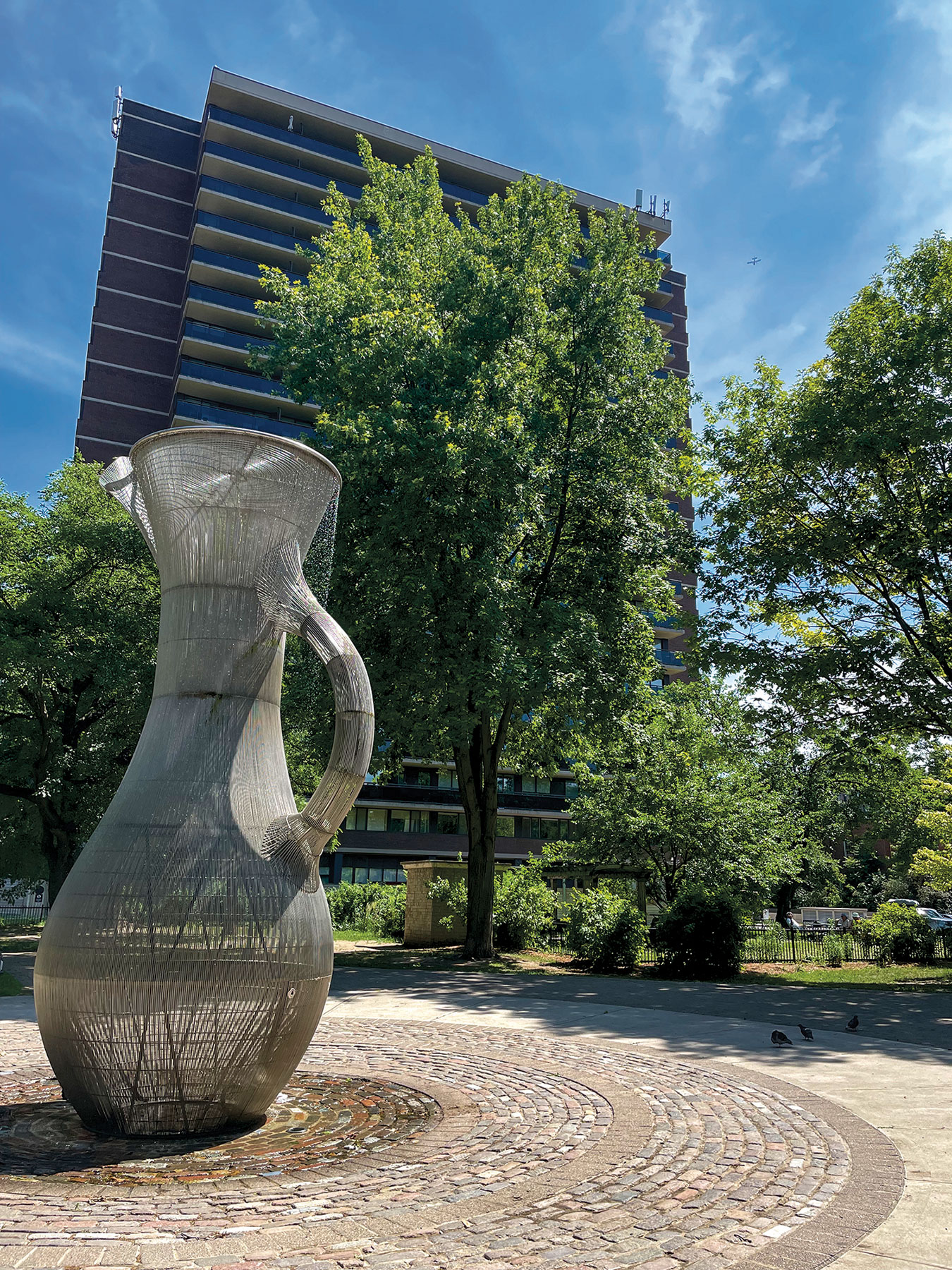
Playful and creative Taddle Creek Park upgrades to “A”.
Taddle Creek
40 Bedford Ave.
Grade:A (Last year A-)
Time: 3:30 p.m.
Reasons to go: An element of Yorkville modern art in the Annex. The gorgeous, towering, large wire sculpture of a vase trickles down water, both adding to the artistic piece itself and giving some extra moisture to the air. The abstract sprinkler was recently turned back on after being off during the recent pandemic-compromised summers. Beautiful planters contain sprouting little pink flowers next to well taken care of begonias. The playground is in perfect working condition, but it is in full sun. The wood chips are maintained, and there are plenty of large trees to keep cool under.
Overheard: Elderly folks from a local seniors’ home out on a visit with their supervisors chatting and enjoying their lunch.
Did you know: There’s a plaque commemorating Beatrice Worsley (1921-1972) who was the first female computer scientist in Canada. She lived on this block of Bedford.
Queen’s Park North
11 Wellesley St. W.
Time: 4:40 p.m.
Grade: B (Last year A)
Reasons to go: Queen’s Park is an escape in the middle of a traffic roundabout. The curved benches on the outskirts of interlocked stone and grass mimic Central Park. The architecture does not match the other larger Toronto parks and is charming. Unfortunately, there is still a large protest against vaccines that is held every Sunday. Due to a lack of city maintenance or climate change, the grass is mainly patchy and brown with a bit of green; lush is nowhere to be found.
Overheard: A busker playing the ukulele for tips!
Did you know: The statue in the park is of King Edward VII. During 2017, the performance art duo group Life of a Craphead, composed of artists Amy Lam and Jon McCurley, created a replica of the statue and paddled it down the Don Valley River to address ideas of power that statues bring to cities.
Stretch between Dupont and Bedford to include buffers
By Fox Oliver
The Bike Lane and Road Safety Upgrades on Davenport Road involve an upgrade plan which will take place over three phases, and the second phase is scheduled to begin this month.
Phase one was completed in 2021 and saw the upgrade of pre-existing bike lanes into cycle tracks on Davenport Road between Yonge Street and Bay Street. Phase two of this project involves upgrading pre-existing bike lanes into cycle tracks between Bedford Road and Bay Street. In 2023, the third and final phase of the project will involve upgrading the bike lanes on Davenport Road into cycle tracks between Dupont Street and Bedford Road.
There are a few reasons why cycle tracks are a safer alternative to bike lanes.
According to the City of Toronto’s webpage on cycling infrastructure, bicycle lanes are a “dedicated part of the roadway for the exclusive use of people cycling,” in which other road users “may not lawfully drive, stand, stop or park.”
However, road safety advocate and environmental lawyer Albert Koehl points out that “a painted (bike) lane is only that; cars can choose to ignore them.”
Although it is illegal, motor vehicles driving, idling, or parking in designated bike lanes is a very real danger in Toronto. The city’s background information on the Davenport Road Safety Upgrade project states that between 2016 and 2020 there were 27 reported collisions involving people walking or cycling on Davenport Road between Yonge Street and Dupont Street, including one fatality.
To combat this danger, the city has decided to install cycle tracks on this dangerous strip of roadway. The cycle tracks on Davenport will be separated from the road by buffers (a curb, bollards or planters), and there will also be raised areas for bus stops. The buffers create physical and visual barriers that prevent motor vehicles from entering the bike lanes.
Cycle tracks will also make the public realm safer for pedestrians because buffers also prevent cars from going onto the sidewalk. Additionally, if cyclists feel safe in their own lane, they are less likely to bike on the sidewalk and infringe on the space of those on foot. This reduces the risk of pedestrian-cyclist collisions.
Alison Stewart, senior advocacy manager at Cycle Toronto, believes that Toronto is headed in the right direction by improving cycling infrastructure. She says that many city councillors, including University-Rosedale councillor, Mike Layton, are strong advocates for an improved cycling network. Stewart says that ideally buffered lanes for bikes and outdoor patios will continue to be built following the pilot project currently in effect on Yonge Street. She adds that the recent revamping of Shaw Street to better accommodate bikes is one to emulate, and that you know the city is heading in the right direction “when you are seeing families with kids riding their bikes and walking to school (like you do on Shaw Street).”
“Safer and more plentiful bike lanes are important for cyclists and pedestrians because currently motorized vehicles dominate 76 per cent of public road space in the city,” says Stewart. Improved biking infrastructure will also increase the number of cyclists in the city. This increase in bikers comes with its own benefits, including reduced traffic and a more environmentally friendly city.
September 27th, 2022 · Comments Off on FOCUS: Layton reflects on three terms as city councillor (Sept. 2022)
Outgoing Ward 11 representative proud of legacy
A pensive Mike Layton selects a different path as he chooses family over
the gruelling life of a Toronto city councillor. COURTESY MIKE LAYTON
By Brian Burchell
As Mike Layton prepares for a very different lifestyle from that as a city councillor in one of the busiest municipal precincts in the country, he took the time to talk to the Gleaner about what he is most proud of.
Q: How are you feeling now that the announcement is made that you will not seek re-election?
A: I am proud of what we have accomplished over the last 12 years. I have pushed council on climate action, road safety, Indigenous reconciliation, supportive housing, and inclusionary zoning, to name a few. We have done this by building strong coalitions of groups and neighbourhoods to ensure the longevity of the policies with broad based support.
Beyond the nitty gritty of constituent complaints requiring resolution, committee and board assignments too numerous to list, and hosting public meetings every night and weekend, this councillor wanted to leave his mark on some bigger files.
Layton chooses to catalogue his larger achievements under the headings of climate action, healthy environments, affordable housing, safer streets, and a more inclusive city. He helped build bike lanes on Shaw, Bloor, Richmond, Adelaide, Palmerston, Argyle, Wellington, Douro, Brunswick, University, and Yonge, as well as upgrades on Harbord and College. He crafted policies to build safer streets, including lower speeds across the network, improved infrastructure, and winter maintenance for bike lanes and sidewalks.
Q: Cycling infrastructure had a huge growth spurt due to the pandemic and Active TO. Do you think that cyclists will be able to hold onto that real estate long-term?
A: I think cycling infrastructure as part of our Vision Zero road safety efforts and part of our climate action policy has become far less controversial and has widespread support.
I’m not worried the real estate will be lost, but we need to keep up the momentum.
He fought hard to make Toronto more affordable. For several years, alongside housing advocates, he pushed for more affordability in all new developments through inclusionary zoning, which eventually led to provincial policy change and a new city policy.
Layton also fought against the sale of TCHC scattered houses, of which the Annex has a surprising number, and demanded that tenants be treated with respect. He consistently advocated for better funding for supportive housing and put pressure on the provincial government to address this growing need.
Q: Are there local examples resulting from your work on policies favouring inclusionary zoning?
A: Unfortunately, the city’s inclusionary zoning policy met many hurdles put up by the province, and it is still being met with resistance. While I would have preferred a faster implementation, we can celebrate that we managed to get the province to change the regulations to allow the city to require affordable housing in new developments.
Perhaps portending what may lie ahead for Layton, he seems most proud of his contributions to important citywide initiatives on climate action and environmental health. He championed many aspects of environmental protection and climate action, including establishing a subcommittee on climate that would become the foundation for TransformTO: Toronto’s climate action strategy.
He wrote (and then seconded) the mayor’s climate emergency motion which led to an aggressive climate target: reducing Toronto’s GHG emissions to net zero by 2040.
Layton initiated the Biodiversity Strategy, the Home Energy Loan Program, stormwater funding tools, bird-friendly programs, funding to implement the Ravine Strategy, motions on protecting the Great Lakes from nuclear waste and invasive species, better regulations on single-use plastics, and increased use of biofuels.
Q: You are obviously very passionate about climate action. Can you give readers a hint about where you will be applying that passion in the future?
A: I don’t know what the future holds for me and I’m looking at how I can best contribute to climate solutions—I owe it to my kids to do the best I can to protect the planet for their generation.
Q: In 2018, the provincial government enacted legislation cutting the size of Toronto’s city council in half. This effectively doubled the responsibilities for each councillor. How much did that contribute to your decision to not seek re-election?
A: Not that much. While the workload increased and the nature of the job changed dramatically after the election, my decision not to seek re-election isn’t necessarily due to the fact that the province cut council size in half. Prior to the changes I was working most nights, and after the cut to council I was working most nights. My decision is a personal and professional one. I’d like to both have a little more time with my kids and at the same time spend more time specifically on fighting climate change and inequality.
This October 24 is the municipal election, and there are 14 registered candidates for Ward 11, University-Rosedale.
Q: Do you have any words of wisdom for your successor?
A: Toronto is a great city, with incredible potential, but a lack of investment and fear of change is holding us back from realizing that potential. I hope the next council will work with each other, with staff, and with their constituents, so we can overcome the challenges we’re facing with bold moves.