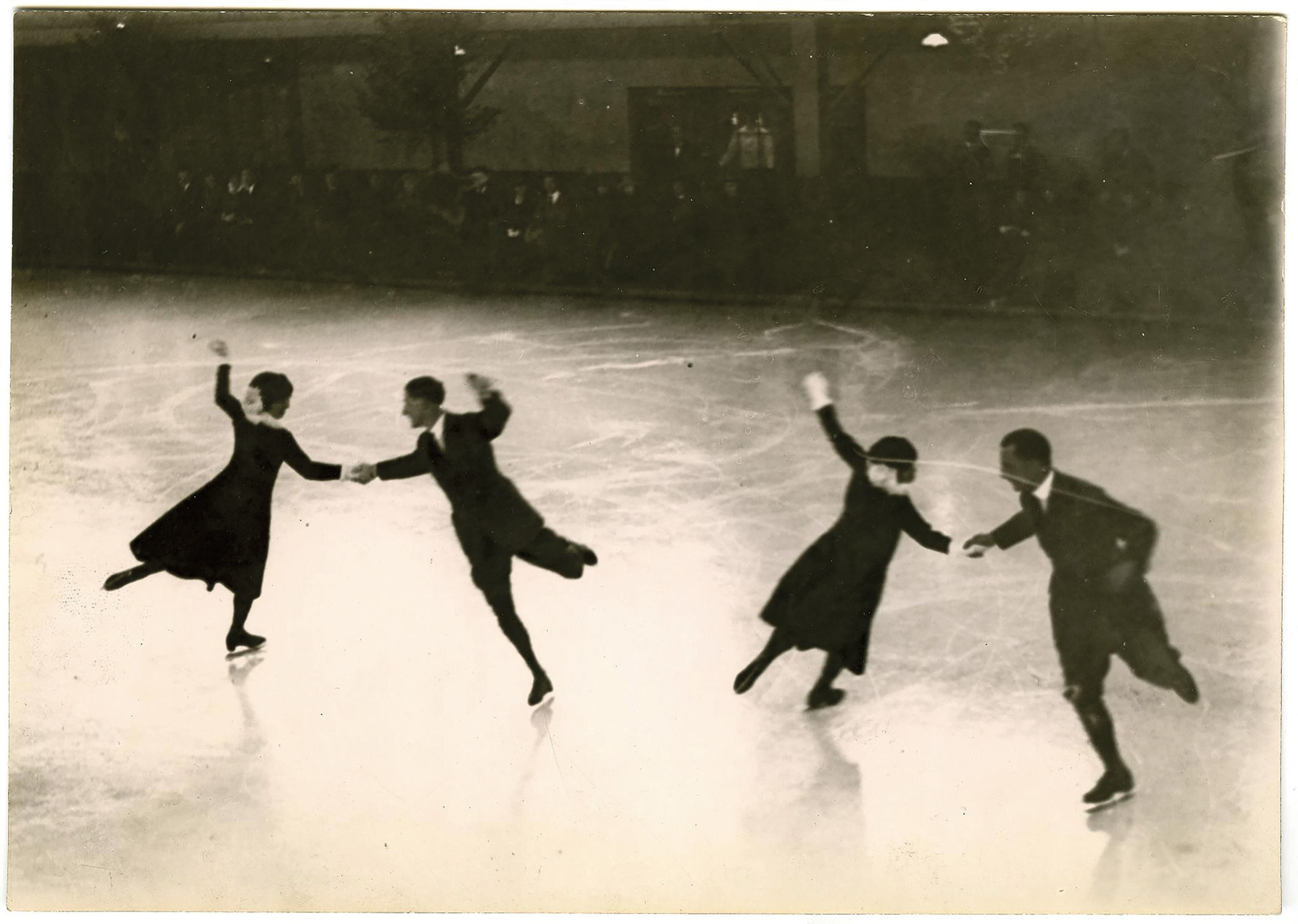
The image on (on page 1 of our printed edition) was taken in 1923, at the former Toronto Skating Club. Silhouettes of two couples hand in hand on the ice offer a glimpse into the city’s rich figure skating history.
Each person in this image was dressed to the nines, speaking to the glitz and glamour of the 1920s. The men in the photo were dressed in perfectly polished black suits typical of the times.
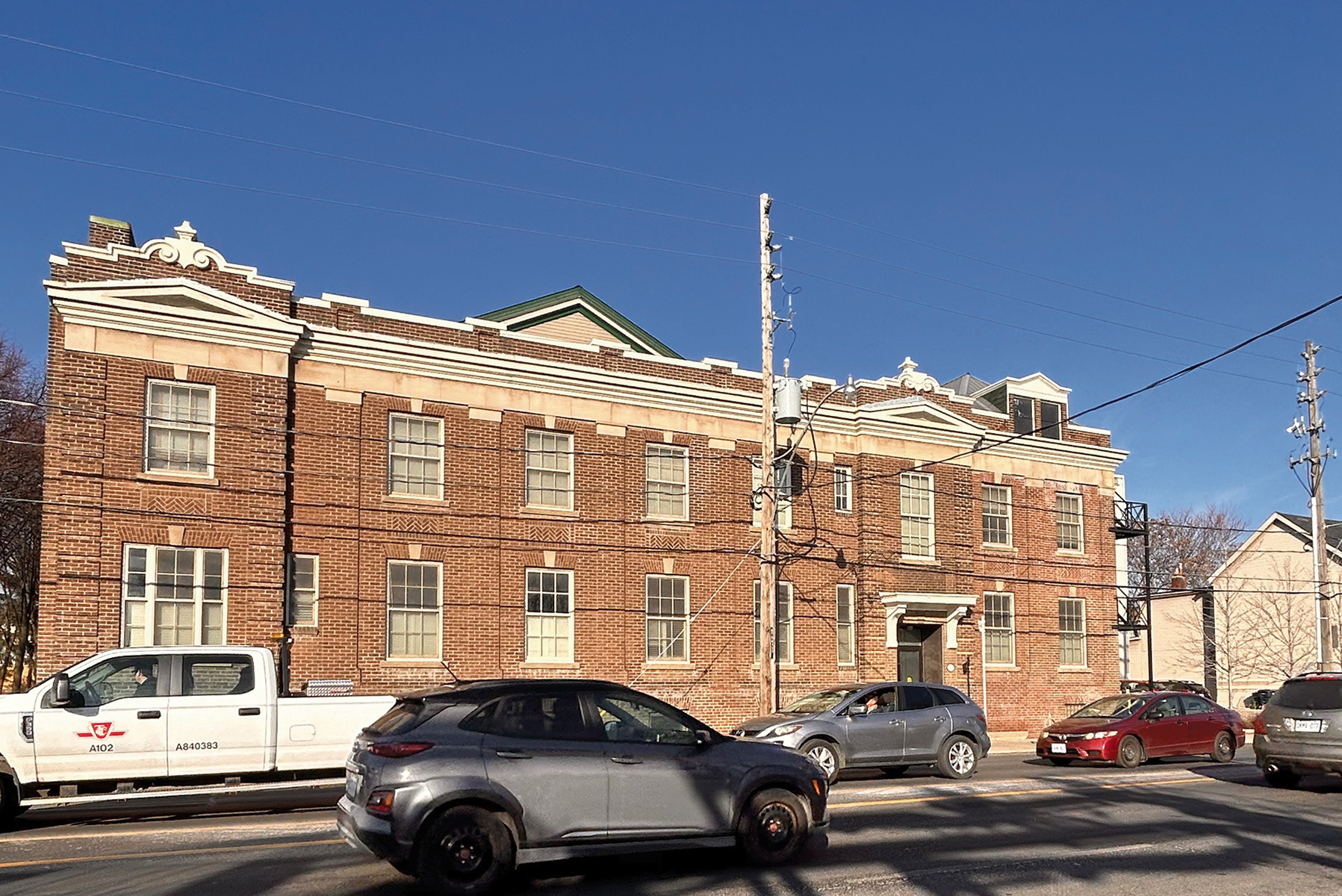
This old building occupying 568 Dupont Street now houses the posh Queen’s Club, self described as Toronto’s oldest indoor tennis club, but was once a skating venue. MIA KESKINEN/GLEANER NEWS
The ladies were adorned in alluring garments, and with skirts flying, they swiftly danced across the ice in iridescent black boots for all eyes to see.
Occasionally, it was possible to catch a glimpse of lustrous, and for the time, valiant, ebony stockings with each pirouette, each sudden movement.
The tradition of two pairs dancing on the ice together to entertain an audience was originally called Fours. The Fours competition was born in Ottawa and could be considered the first international skating competition.
Canada joined the International Skating Union in 1894, and in the mid-twenties to early-thirties skaters from the club made history. Cecil Smith was among them. She was the first woman to represent Canada at the Winter Olympics in 1924. Maude Smith and Jack Eastwood skated as a pair and placed second at the national championship in 1929 and 1933. Constance Wilson-Samuel competed in three Olympics and won Canada’s national championship nine times. All these athletes called the Toronto Skating Club home.
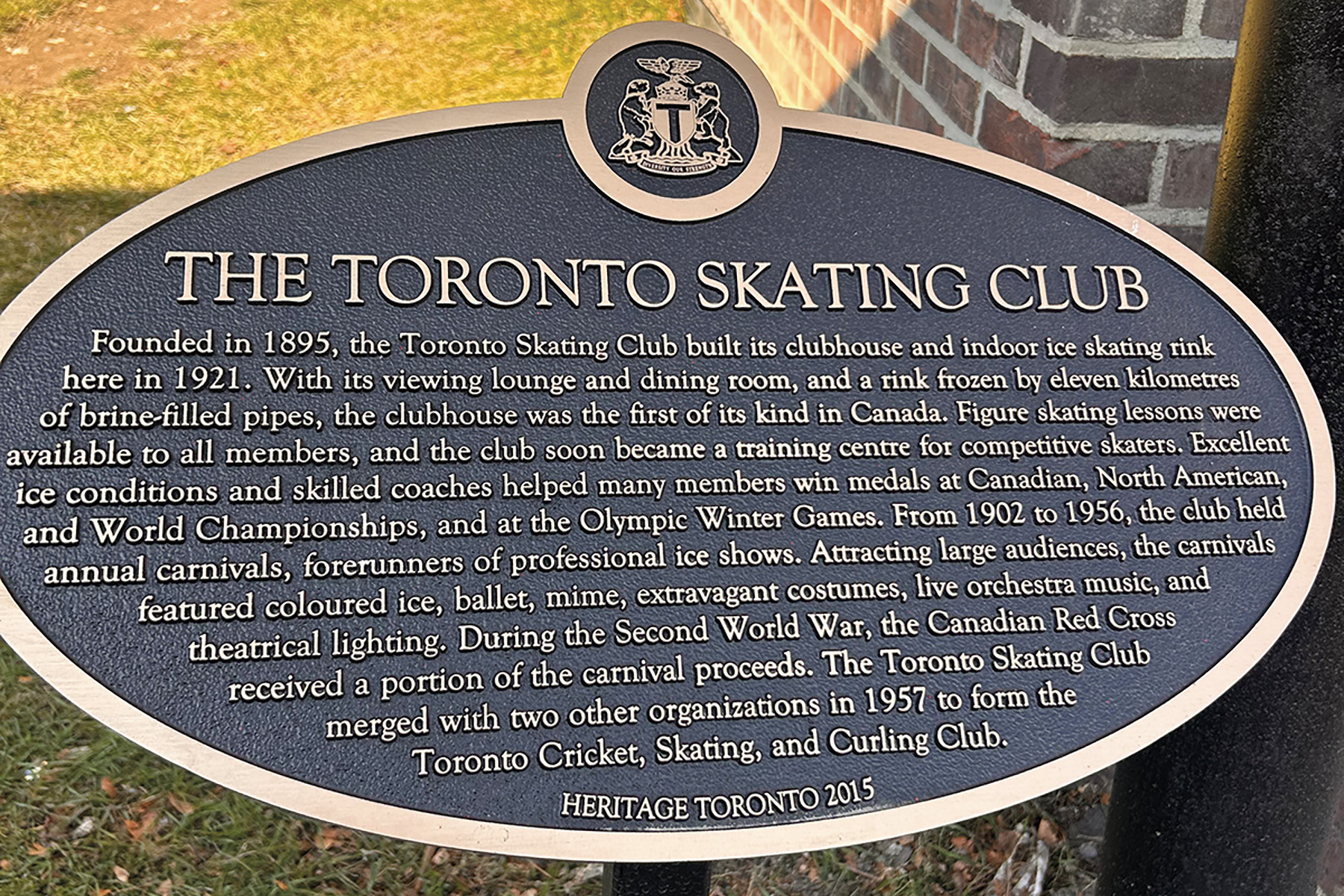
Founded in 1895, the club had exclusive rights to the Victoria Arena on Huron Street on Monday evenings and Friday afternoons.
In 1921 they built their own skating rink at 568 Dupont Street. This facility served as a rehearsal spot for skaters who trained for the popular annual winter carnivals held at the Toronto Skating Club. Beginning in 1912, these carnivals helped the club raise funds to build the facility at 568 Dupont St.
According to the website Hiking the GTA, an estimated $50,000 was raised in 1921 which enabled the club to finish construction. However, due to the seasonal nature of this sport, the club could only collect revenue throughout six months of the year.
MIA KESKINEN/GLEANER NEWS
Eventually, through mergers, the club would become the Toronto Cricket, Skating and Curling Club. It is now located at 141 Wilson Ave.
The property at 568 Dupont St. (just east of Loblaws at Dupont and Christie) had a historic plaque on the corner, but it was stolen a couple of years ago, only to be replaced recently. The building at 568 Dupont Street stands just two buildings east of Toronto’s original Model T factory (the first mass-produced automobile in history). The Queen’s Club, Toronto’s oldest indoor tennis club, purchased the Dupont Street property in 1957, transforming it into a non-profit indoor tennis club.
Although people would be far more casually dressed in a modern picture, these trailblazers of figure skating paved the way for the passion for the sport that remains prevalent in Canada. The building at 568 Dupont St. still breathes life, and the history of sportsmanship remains, inspiring present and future generations to include sport in their daily life.
December 23rd, 2023 · Comments Off on NEWS: Receipt checks raise retail conflict (Dec. 2023)
Shoppers Drug Mart faces backlash against receipt checks
A Shoppers Drug Mart employee paces behind a patron while they process their self checkout. BRIAN BURCHELL/GLEANER NEWS
By Alexa Méndez
Customers at Shoppers Drug Mart at Bloor and Spadina are logging their complaints online against random requests from staff to show they paid for their goods. Online reviews of the store at 360A Bloor St. W. say the location is one where visible minorities are likely to get profiled and harassed by employees, and in mid-June, customers united on social media to voice their concerns about the introduced receipt-checking practice at Loblaw-owned grocers. Shoppers is a subsidiary.
“If they were to do it, I think it’s best to do it with everybody,” said Sofia after stepping out of Shoppers Drug Mart. “If you’re not checking everyone’s receipt, then it’s going to feel like a personal attack.”
Kirsty Niglas-Collins, lawyer at Unified LPP, a Toronto law firm, said stores should consider their responsibilities under the Ontario Human Rights Code.
“Even if a store intends to interact with every customer,” said Niglas-Collins, “very often these practices become selective. Once a practice becomes selective, it is, in my view, likely to become discriminatory.”
Some customers feel that Shoppers Drug Mart has wrongly assumed there has been an increase in shoplifting because there are fewer cashiers and customers are using reusable bags.
“I live in the area. Most of the time [when] I go to this Shoppers there’s only one lady at the cash [register], and every now and then, there’s that security guard who stands by the self-checkout,” said Miles, another Shoppers Drug Mart customer.
According to Statistics Canada, police-reported shoplifting increased by 31 per cent between 2019 and 2022.
Some customers assume an increase in shoplifting has led to receipt checks, and they believe it does have the potential to be a successful loss prevention practice but has to be executed differently.
“I understand why they check, but at the same time, you could just base it off of your personal bias and just be like ‘Oh, this person looks suspicious,’” Sofia said.
Maithilee is among the customers who question how individuals are selected to show their receipts.
“I am noticing that some people do get checked. Some people maybe not. I honestly would like to know what it’s based on.”
Niglas-Collins said, “Stores should consider their contractual relationships with shoppers and whether they have a basis to conduct receipt checks.”
In the past three months, other customers have resorted to Google reviews to express their experiences with receipt checks.
“There was [an] undercover security person standing at the end of the self-serve,” Fern commented under the Google reviews of Shoppers Drug Mart at 360A Bloor St. W. “He said, ‘I need to verify your receipt.”
According to customers, the security guard conducting the receipt checks initially wore a vest that read asset protection, but more recently, the security guard no longer wears a role-identification vest other than a security uniform.
In response to this, some customers believe that Shoppers Drug Mart should be more transparent about receipt checks.
“If it’s someone that works for a company or a corporation, I feel like they definitely have to be more open,” Sofia said.
Niglas-Collins said that although she is not aware of cases regarding receipt-check discrimination, she is “aware of cases concerning ID checks, ticket checks and applications for jobs or housing that all featured discrimination as a result of a selective practice.”
In response to the Gleaner’s request for a statement, Shoppers Drug Mart’s regional loss prevention specialist and district asset protection manager, Linda Ringuette, said “Thanks for reaching out, but I’m not interested.”
Comments Off on NEWS: Receipt checks raise retail conflict (Dec. 2023)Tags:Annex · News
December 23rd, 2023 · Comments Off on EDITORIAL: AG confirms Ford rigged Science Centre analysis (Dec. 2023)
In an annual report, Ontario’s Acting Auditor General (AG) Nick Stavropoulos contradicts the conclusions of the government’s stated “business case” for moving the Ontario Science Centre to Ontario Place. It turns out the “savings” the government promises taxpayers is anything but.
Infrastructure Ontario announced this past week that moving the Science Centre to a new, smaller waterfront building would save $277 million over 50 years. This argument comes months after the Doug Ford government announced the move, so it is something of an afterthought. The AG report strongly disagrees with the government’s case.
According to the AG, there was no serious discussion with the City of Toronto, or the Toronto Region Conservation Authority (TRCA). Together the city and the authority are the landlords to the province with a 99-year lease for the existing location. And according to that lease, the province may only operate a science centre on the site and is contractually obliged to maintain it. The province also failed to consult with users including school groups and suburban parents who may not want a smaller science centre located in the traffic hell that is the waterfront. The province after all is close to opening the Eglinton LRT which has a stop called “Science Centre.”
The province has now backed away from its plan to demolish the existing centre on Don Mills Road. The AG estimates that $257 million is needed to repair the existing repurposed structure. Since the government likes to borrow from distant future savings in its arguments, that’s $369 million over the next 20 years. The report also says the government conveniently omitted “parking costs, financing, legal and other transactional costs.”
The fact that the new Science Centre is only half the size of the existing one is not considered. It’s the other elephant in the room. It’s an apples-to-oranges comparison.
Aside from the aforementioned deficiencies and convenient omissions in the government’s case identified by this independent assessment, it is not widely acknowledged that the order of operations is all wrong here. This is classic Doug Ford with echoes of the Green Belt fiasco, the dissolution of Peel Region, and privatization of health care. The decision to move the centre was taken long before the stated reasons to do so were conjured up.
The real reason of course is to provide cover so the premier can justify spending $370 million on a parking garage for the private spa being built by the Austria-based Therme group at Ontario Place. That parking expense, not surprisingly, is not reflected in either business case. But you will see it with your tax bill; it just won’t be itemized.
To distract voters when the AG report was published, Doug Ford reached into his bag of shiny objects and offered banning puppy mills and pulling out of the plan to dissolve Peel Region. He concluded the week with a familiar go to: let’s sell beer out of corner stores, a variation on his other abandoned commitment—“buck a beer.”
Lest too much light be shed on the flaws in the government’s plans, the ruling conservatives passed a motion to bypass debate and public hearings on the bill to redevelop Ontario Place. The opposition says the skipped hearings and the absence of an opportunity for debate is undemocratic and suggests “the government is hiding something.” No kidding.
The provincial government should go back to the drawing board and take a serious look at the investments needed to renew the existing science centre facility and decouple it from the private spa which is clearly driving this flawed proposal.
December 23rd, 2023 · Comments Off on A hectic first year in University-Rosedale
Housing, new greenspaces, traffic, and construction dominate
By Dianne Saxe
A year ago this November, I was privileged to become your voice at Toronto city council. My office has been working hard to improve Ward 11 on issues including homelessness, development, community space, climate action, and making Toronto a greener, more affordable place to live. Walks in the Annex provide a moment to appreciate local bookstores, restaurants, parks, and heritage buildings. I enjoy discussing all these issues with constituents at countless community events and have put forward or seconded more than 60 motions at council and committees.
The questions we hear most often from the Annex relate to affordable housing, greenspace/ trees, and traffic.
Affordable housing is key for many people. Premier Ford continues to prevent Toronto from forcing developers to provide affordable housing, so I join my colleagues in calling on other levels of government to support the housing needs of the city. I also strongly support Mayor Chow’s generational housing plan and was proud to amend it to request that new housing support Toronto’s climate and air quality commitments by being -free of natural gas use.
On greenspace, I’m working closely with parks and recreation to obtain new parks and playgrounds in the Annex, to better maintain what we already have, and to plant new street trees wherever possible. We had successful public consultations for the design of the new Huron-Washington playground and the new park at Sussex and Spadina. I hope to see both built next year. We are also getting some progress on installing adult exercise equipment in Sibelius Park.
Traffic is terrible everywhere downtown and has been made worse by an overwhelming amount of construction. Some is for new condos; much is for the provincial transit agency Metrolinx; and some is for essential repairs and upgrades to roads and water mains. To better manage this chaos, I obtained council approval to establish a construction hub to cover much of the Annex. I ensured that the once-in-a-generation road reconstruction of Bloor from Avenue to Spadina will improve safety for pedestrians, drivers, and cyclists. (It’s great to see this work ahead of schedule; the new bike lanes are already heavily used.) I arranged to have crosswalks repainted to make life easier for our hard-working crossing guards. And I persuaded the council to treat road fatalities as seriously as we treat construction deaths, with better investigations that lead to remedial measures. Traffic deaths are not “accidents”; they are foreseeable consequences of poor road designs that don’t take safety seriously.
We are working closely with police and transportation services on the large number of complaints about heavy traffic in residential areas and road traffic violations. Data is important for focussing scarce enforcement resources, so I encourage you to report traffic violations at: https://www.tps.ca/services/online-reporting/. Parking violations should be reported at: https://www.tps.ca/services/online-reporting/parking-complaint-access/. Council has also simplified the process of installing speed humps, in order to force drivers to slow down to the speed limit. If you would like to see speed humps installed on your block, please get a petition signed by your residents’ association and at least 25 per cent of homes on your block, and I will ask transportation to put your block on their list.
Other recent improvements include:
Funding free WiFi for the common spaces at Toronto community housing’s 250 Davenport.
Persuading council to support a national Youth Climate Corps.
Working with the TTC to bring in fare integration with GO and other nearby transit systems, starting Q1 next year.
Unearthing dormant Section 37 funds and putting them to productive use.
Convincing the TTC to take less of Paul Martel Park during construction of its new Spadina Station streetcar platform.
Arranging to use development charges so the developer will build a much-needed and expanded subway concourse for Line 2 at Spadina Station.
Honoured to cut the ribbon when the Toronto Alliance for the Performing Arts opened its wonderful new B Street collaborative hub (support, rehearsal and recording space) for emerging artists at Bathurst and Dupont.
As we look ahead to 2024, we know that there is much to do to build the city we want to live in. Thank you for working with my staff on hundreds of questions and ward improvement ideas. Together, we can continue to build a safe, beautiful, and tolerant city that showcases our values of inclusiveness and generosity. Join me as we continue this journey of growth and opportunity.
Dianne Saxe in councillor Ward 11, University–Rosedale.
December 23rd, 2023 · Comments Off on Where’s Ontario’s student housing plan?
Students are particularly vulnerable to weak rental laws
By Jessica Bell
Justin is a graduate student studying pancreatic cancer at the University of Toronto. He’s one of thousands of students who live in our downtown neighbourhoods. When his building was bought by corporate landlord, Harrington Housing, he became a victim of neglect and harassment designed to drive him out of his rent-controlled home.
“I’ve had to live through unlivable conditions,” Justin told me. “I’ve had to walk down the stairs in the dark for months because they refused to fix the lights in the hallway. I’ve had to go to bed cold when they failed to maintain the boilers. I’ve seen my neighbors try for weeks to get a working fridge. My neighbors have been locked out of the building because the landlord changed the locks and didn’t give some tenants new keys.”
When tenants give up and move out, Harrington rents out individual bedrooms in each apartment for astronomical prices. A “deluxe” 115-square-foot bedroom in a basement apartment costs $310 a week. That’s not deluxe; it’s exploitation.
In September, I hosted a student housing forum at the University of Toronto, as part of our work to provide input into the Ford government’s quiet consultation process to address the student housing crunch. At the forum, students spoke of being illegally evicted by landlords, sleeping two to a bedroom, and the astonishingly high price of rent. While some students live on campus for their first year, most students live in private-market housing.
Welcoming and keeping young people is good for our province. If we want students to come and stay, then housing must be safer, more stable, and more affordable. Here’s how we can do it.
Ontario needs to enforce its rental laws. Currently, renters like Justin have nowhere to turn if their landlord is breaking the rules. Police don’t intervene. Provincial and city bylaw officers rarely step in, and it can take two years for the Landlord and Tenant Board to hear a tenant’s case. Even when a tenant wins, the fines are small, and many landlords don’t pay them.
Ontario needs to pass stronger rental laws, starting with strong rent control on all homes, including vacancy control so there’s a cap on rent hikes between tenancies. Rent control is the single most effective way to stabilize rent for 1.7 million Ontarians and curb illegal evictions. Student housing is exempt from rent control, as are homes first occupied after 2018.
Ontario should restrict short-term rentals to people’s primary residences in most areas. There are thousands of short-term rentals in investment properties being listed for 28 days or more on platforms like AirBnB. These homes are often not for tourists, but residents who can’t find a permanent home. By renting out bedrooms on a short-term basis, Harrington Housing is one of many companies taking advantage of big legal loopholes.
Ontario needs to address its housing supply shortage and spur the construction of 1.5 million homes. The government’s housing affordability taskforce offers some sensible recommendations on how to proceed, including recruiting people to a construction career, and zoning reform to speed up the construction of apartments near colleges and universities.
Ontario cannot rely on the private sector alone to meet our housing needs because new private-market housing is expensive. In Toronto, a 490-square-foot apartment at the new Waverley building at College and Spadina costs $2900 to rent. Justin can’t afford that; not many can.
To build the kinds of homes Ontarians need, governments should get back into the job of financing and building non-market and affordable housing, including housing on public land. Canada did this well after World War II and should do so again.
Making housing, including student housing, affordable, requires a comprehensive approach.
Justin has decided to stay and fight to keep his apartment, and he’s also getting politically involved, like many others. Their involvement in the political process is necessary. The affordability of our city is at stake.
Jessica Bell is MPP for University-Rosedale and the Housing Critic for the Official Opposition at Queen’s Park.
READ MORE BY JESSICA BELL:
FORUM: Engage in the political process and change can happen (Fall 2023)
December 23rd, 2023 · Comments Off on FOCUS: Grading our Greenspace (Dec. 2023)
Compiled by Alexa Méndez
Rejuvinated Queen’s Park looking north. MIA KESKINEN/GLEANER NEWS
Each year the Annex Gleaner reviews the abundance of parks in our coverage area using a variety of criteria. While there is no decisive “winner” of the grading, letter grades are assigned to convey the quality of the parks considering aspects such as upkeep, design, and amenities. The reviews accompanying the grades also let the reader know what makes each space unique.
This collection of park reviews contains the second nine parks reviewed this year, with more gradings to come in future editions of the Annex Gleaner
Queen’s Park
47 Queen’s Park Cres.
Grade: A (Last year B)
Time: 12:30 p.m.
Reasons to go: Queen’s Park is the friend that always gives and doesn’t expect anything back. The trees are the skyscrapers of the park, a subtle shield from the city’s vibrance. This park has a space for everyone—dozens of benches for uninterrupted pondering, leaf-carpeted paths for your daily strolls, and picnic tables for a change of scene during your lunch break. Even the dogs aggressively pull away from their leashes to get a sniff of the flowers blooming all around the park. It’s certainly a spot where you feel mesmerized by your simple surroundings of trees, squirrels, and people gracefully walking through.
Overheard: “That’s a skateboard rider,” a child points out, fascinated as the skateboard smacks against the concrete.
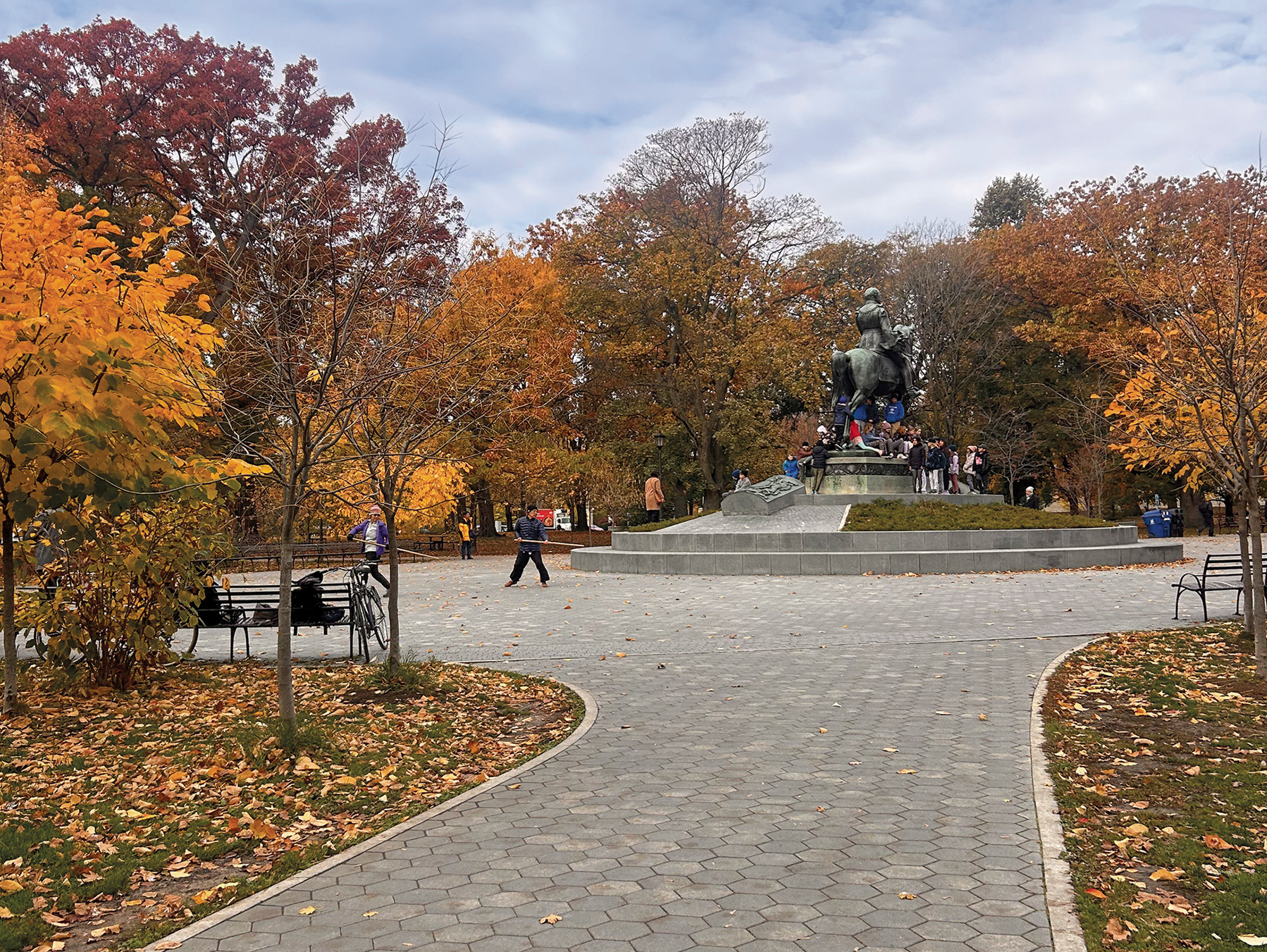
Did you know: The 15-foot statue of King Edward VII in the center of the park’s roundabout was originally located in Delhi, India for 56 years before it was installed in Toronto in 1969.
Jay Macpherson Green
255 Avenue Rd.
Grade: A- (Last year B+)
Time: 1:45 p.m.
Reasons to go: Jay Macpherson Green is on the corner of Avenue Road—often swarmed by cars—and Macpherson Avenue, a street lined by gorgeous Victorian homes. Though when the roads get lonelier, it’s harder to overlook the trees towering over the path, and even harder to ignore their invitation to stop and sit under them.
Overheard: A jogger softly panting as he passed through the park.
Did you know: Jay Macpherson was a poet and professor at Victoria College.
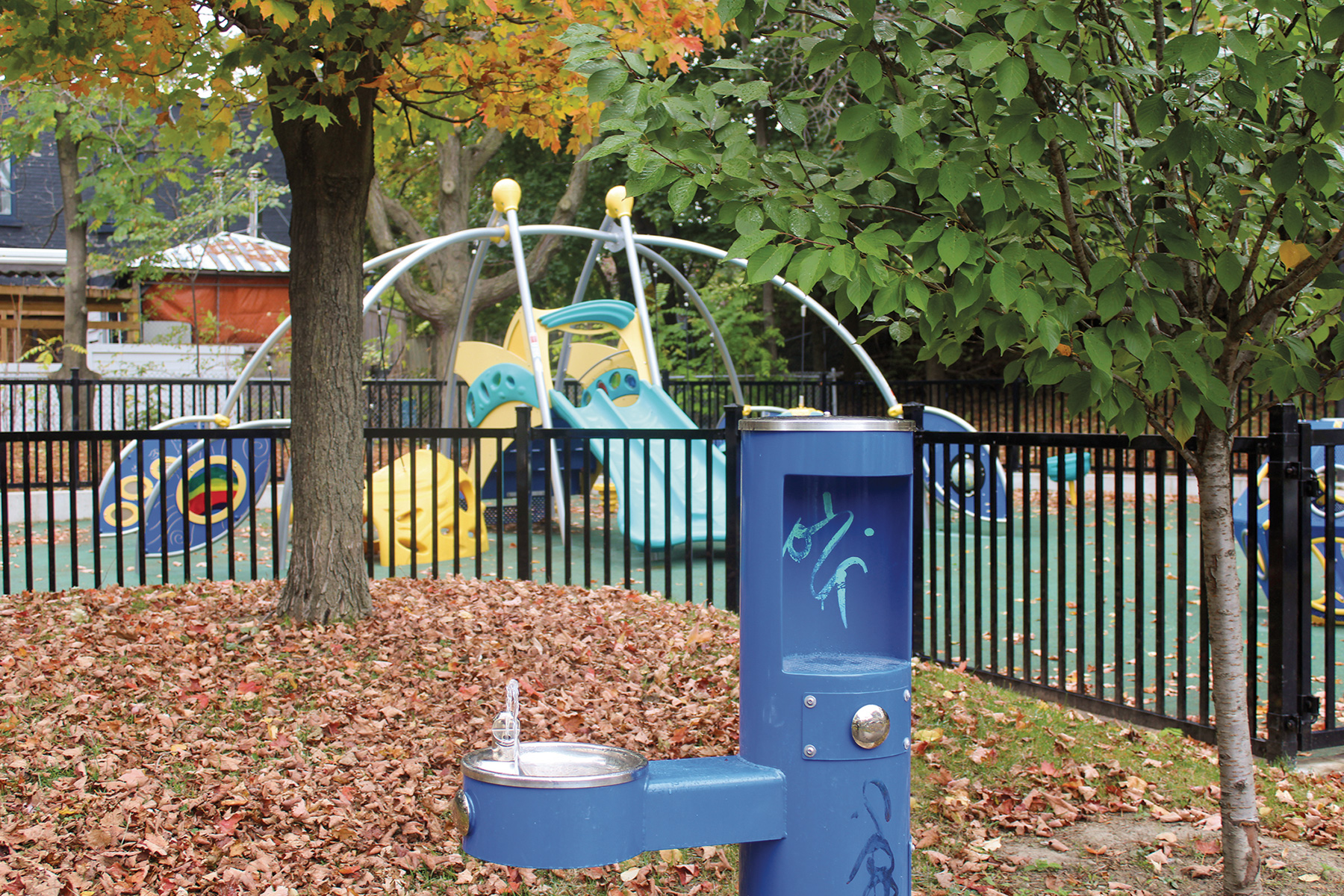
The well-appointed Sergeant Ryan Russell Parkette features a coveted water fountain. ALEXA MÉNDEZ/GLEANER NEWS
Sergeant Ryan Russell Parkette
250 Avenue Rd.
Grade: B+ (Last year B+)
Time: 2:00 p.m.
Reasons to go: Sergeant Ryan Russell Parkette may be your next stop after passing through Jay Macpherson Green right across the street. This park offers a safety blanket for children—a fenced playground—and it truly provides peace of mind for those minding them. The park also has a water fountain, a necessity for little ones after a day outside.
Overheard: “Just say excuse me,” a mother reassures her child while trying to get past a group of teenagers on the sidewalk.
Did you know: The Davey Mounsey Memorial Fund pays tribute to law enforcement, fire, EMS and military members through donating life-saving defibrillators to public buildings. The fund’s 133rd donation was in honour of Sergeant Ryan Russell, who died in the line of duty in 2011.
Boswell Parkette
4 Boswell Ave.
Grade: C+ (Last year B)
Time: 2:30 p.m.
Reasons to go: Boswell Parkette can be easily missed because it’s squeezed in between two buildings, tucked behind a bus stop, and well, its size. This small parkette may be limited, but it’s a great spot to wait for the bus or take a quick break. It is impressively well-maintained—a garbage bin nearby and a generous selection of greenery.
Overheard: An employee unloading bricks into a wheelbarrow on the back of a truck.
Did you know: Boswell Avenue—named after Toronto mayor, Arthur Radcliffe Boswell—was formally named Victoria Avenue.
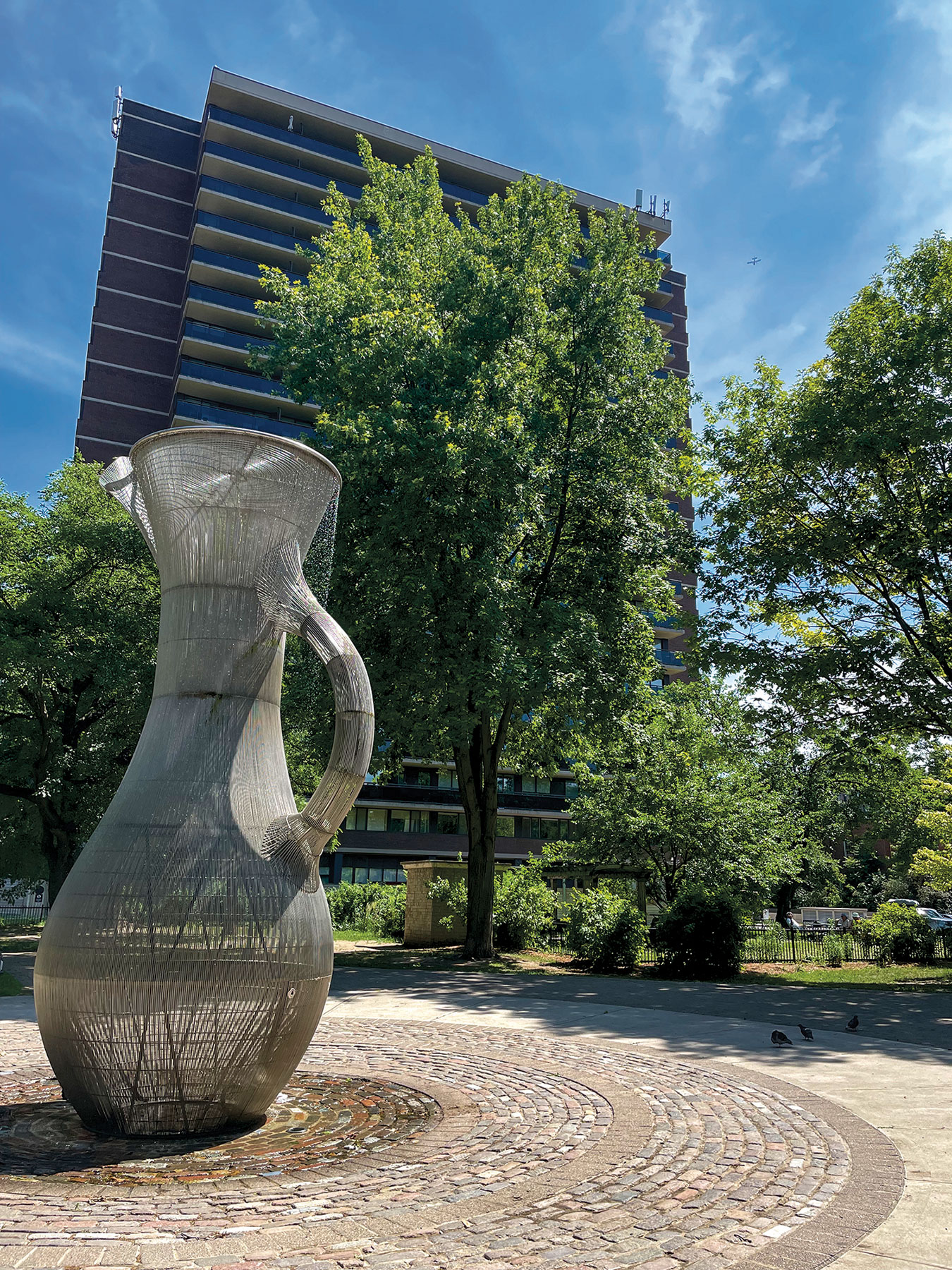
Playful and creative Taddle Creek Park continues to shine. MARISA KELLY/GLEANER NEWS
Taddle Creek Park
40 Bedford Rd.
Grade: A (Last year A)
Time: 3:30 p.m.
Reasons to go: Taddle Creek Park is a breath of fresh air. Its playground has just enough for every little one to be content for as long as they’ll allow themselves. It’s the space you feel drawn to stay in for a while longer, and luckily there are numerous benches. It would be wrong to not mention the showstopper of the park, The Vessel, a sculpture made of 4 km of stainless-steel rod. This sculpture is a water-carrying vessel that truly ties the park’s personality together.
Overheard: “Can you come and take it for the rest of the way?” a man holding a wooden sculpture yells to a woman across the street.
Did you know: Taddle Creek was one of the many water sources that the Anishinaabe Nation or Ojibway-speaking people of the region drew from.
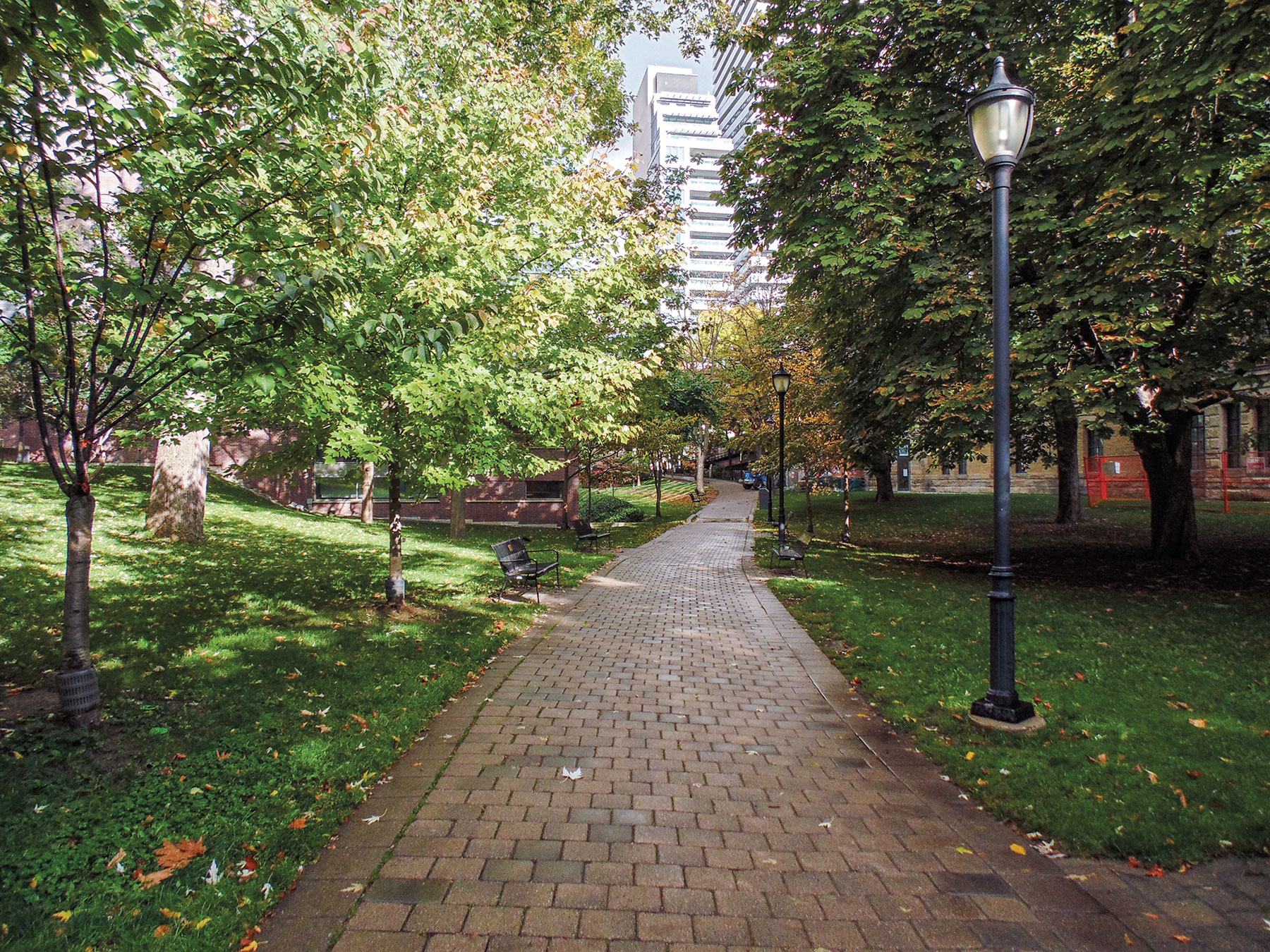
Philosopher’s Walk is a truly beloved park described by our reviewer as simply “romantic”. HAILEY ALEXANDER/GLEANER NEWS
Philosopher’s Walk
78 Queen’s Park Cres. W.
Grade: A+ (Last year A+)
Time: 4:30 p.m.
Reasons to go: Philosopher’s Walk is the walk you need after studying for hours, attending back-to-back meetings, or sinking into your mattress for too long. The ancestral trees will truly make you feel as if you have escaped to a scene in Narnia or Harry Potter. A walk can be a cure for many things. Is that what they say?
Overheard: “See! I told you,” said a man in excitement to somebody on the phone.
Did you know: Taddle Creek flowed through what is now Philosopher’s Walk, and the only bit left of Taddle Creek remains in the pond at Wychwood Park.
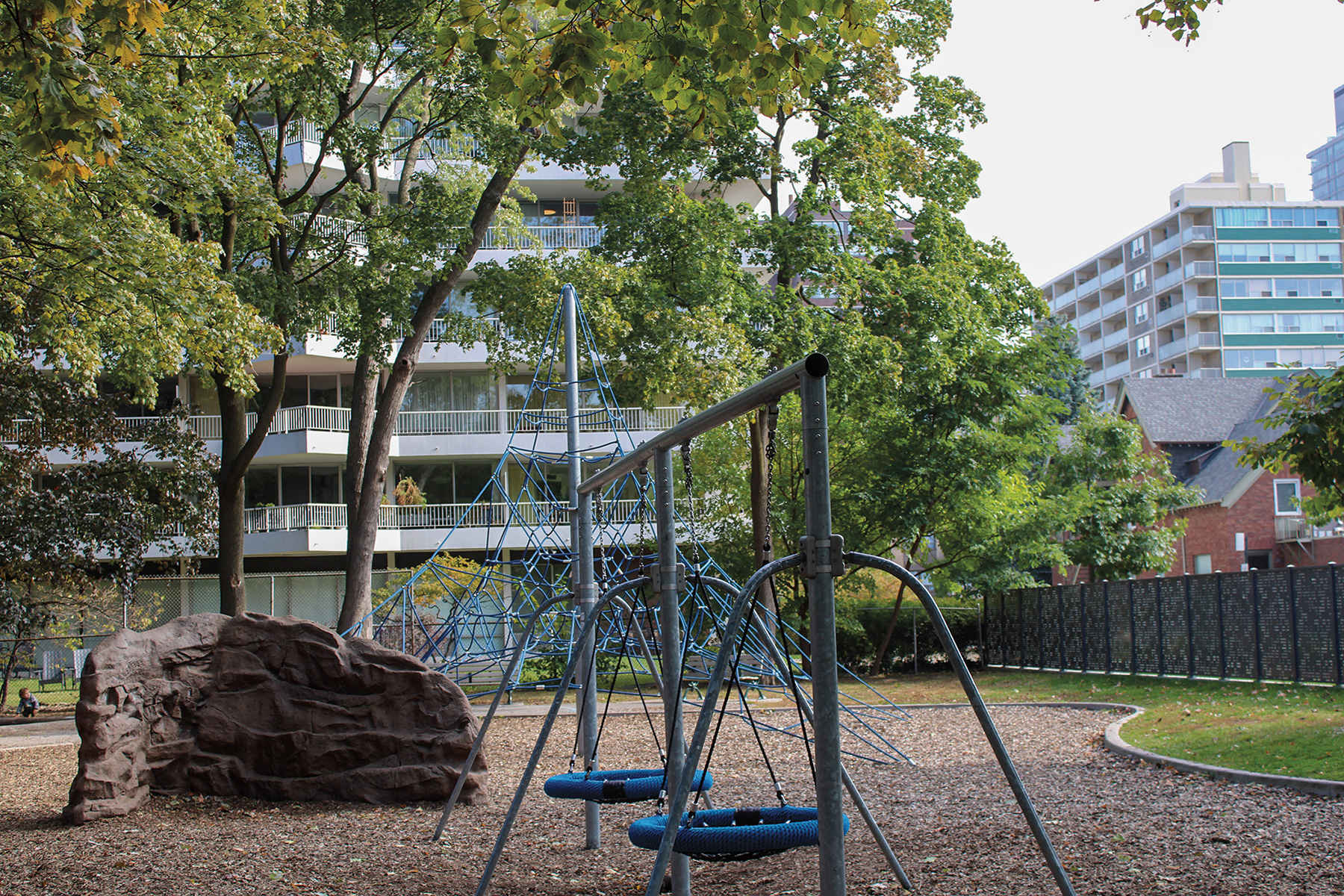
Modern playground equipment activates the Huron Street playground making it a great stopping place for kids on their way to and from school. ALEXA MÉNDEZ/GLEANER NEWS
Huron Street Playground
495 Huron St.
Grade: B- (Last year C+)
Time: 12:00 p.m.
Reasons to go: Within minutes of arriving, the playground was swarmed by dozens of children. A few swiftly climbed their way up the spider web climbing net, while others raced to the two web swings or curiously roamed the park. This park is a great stopping place on the way to and from school, but it feels like that’s all it is. It’s a fairly small space with only a few picnic tables and benches, so there is not an open invitation for all caregivers or passersby to sit down. Considering all the excitement and determination to play, the water fountain station is greatly used at this park.
Overheard: A little boy screaming when a few birds flew gracelessly over his head.
Did you know: Dogs don’t have to miss out on the fun thanks to the fenced leash-free area!
Robert Street Park
60 Sussex Ave.
Grade: A+ (Last year A-)
Time: 1:30 p.m.
Reasons to go: Robert St. Park is a friend to all. Even as you’re stepping over your feet to get to class on time or speed walking to catch your subway, this park manages to lure you in. It does nothing in particular—it has a field, a few benches, a few clusters of shaded Adirondack chairs—but you are drawn by how the community shares this space. You may get a glimpse of young girlhood—a dozen girls sit on the grassy hill, braiding one another’s hair and sharing secrets. Perhaps you will sit at one of the many benches along the outside of the grass field and listen to a group of young boys argue over who is keeping the right score in their game of frisbee. It’s a unique spot that has a space for everyone—alone or with company—and some may say the revitalization of Robert Street Park was worth the wait.
Overheard: “I’m open,” a boy yells out to his friend during an intense ultimate frisbee game.
Did you know: The University of Toronto invested in a geoexchange system to reduce their greenhouse gas emissions by drilling 153 boreholes extending 850 feet below Robert Street Park.
Huron Washington Park
406 Huron St.
Grade: B+ (Last year No Grade)
Time: 1:00 p.m.
Reasons to go: Huron Washington Park is a fenced playground with a variety of play spots for children. The main emphasis is on the playground structure and the swing set. It’s a fairly small park with no greenspace within the fenced area, but it’s a great spot for children to have fun. This area has a lot of foot traffic, but it’s a quiet place for a city park!
Overheard: “The sun is so hot,” a boy says to his friend while taking a break from throwing their football around.
Did you know: Dorothy Peebles was recognized as a lifelong, compassionate activist and her memorial tree is in Huron Washington Park.
December 5th, 2023 · Comments Off on ON THE COVER: Pretty cool (Fall 2023)
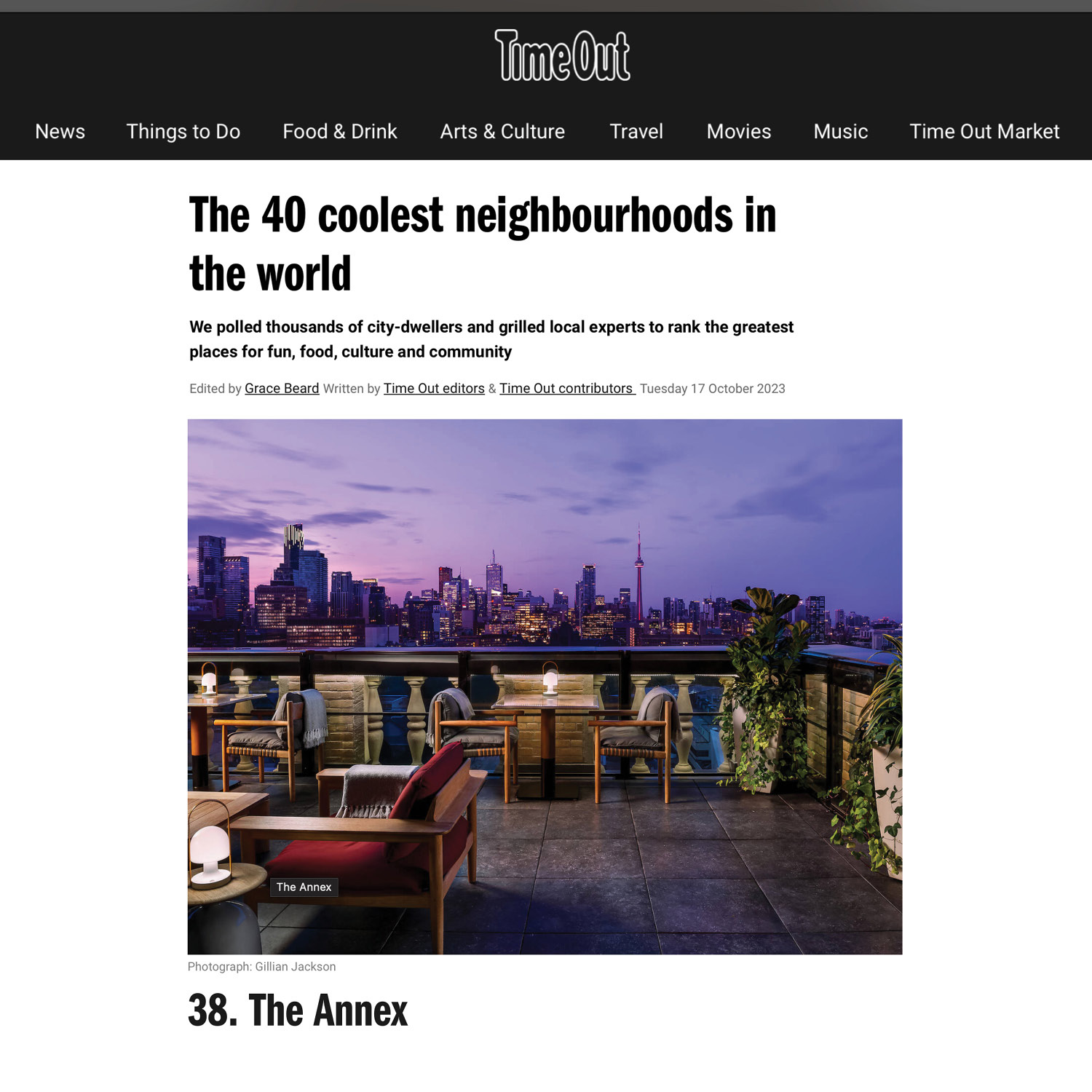
It’s great that the Bloor Annex was recognized as one of “The 40 coolest in the world” by Time Out – a leading global hospitality publication based in the U.K. Over 12,000 people voted for which places should be in the top 40. Only two in Canada were selected.
December 5th, 2023 · Comments Off on NEWS: Parkettes win Urban Design Award (Fall 2023)
Urban design firm DTAH and Bloor-Annex BIA lauded by city
Horn On The Cob playing for Wiener’s Home Hardware’s 100th Anniversary celebration in the Howland Ave. parkette. NEILAND BRISSENDEN/GLEANER NEWS
By Megan Bocchinfuso
The Toronto Urban Design Awards (TUDA) are held every other year and recognize Toronto’s exceptional designs in nine categories. This year on Sept. 13, the Bloor-Annex BIA parkettes won the Small Open Spaces Award for their attention to detail, unique granite rock landscaping, and environmental considerations.
The parkettes were designed and brought to life by artist, Robert Cram and landscape architect, James Roche, from the architecture firm DTAH. Cram, Roche and DTAH partnered with the Bloor-Annex BIA in 2019 to design these spaces: 320 Robert St. (adjacent to Metro); 290 Major St. (adjacent to Sleep Country); 306 Brunswick Ave. (adjacent to Value Village Boutique, formerly Brunswick House); and 2 Howland Ave. (adjacent to Slanted Door).
“It was an opportunity to transform the spaces from something that was paved urban space into something that could be more of a positive space,” said Roche.
In order to be considered for a TUDA, each design had to make a positive contribution to the public, successfully integrate with the surrounding urban fabric and heritage elements, follow the city’s urban design guideline, provide barrier-free access, and make a positive contribution to sustainability and environmentalism.
“This project was appreciated simply for what it is and what it is doing for the public realm, but these little details, and some of those thoughtful moments that went into this project, altogether is what made this project award-worthy,” said TUDA jury member Michael Ormston-Holloway.
The Bloor-Annex parkettes are unique in the sense that they were designed for the benefit of the surrounding environment. The spaces were originally asphalt and unused; they are now small spaces with an outsized green impact.
Massive wooden beams from the former Honest Ed’s were used for some of the benches, and the gardens contain mature trees with pollinator plants below. The stone sculptures, which double as seating, were rescued from waste piles in Quebec quarries where they were discarded because of small cracks and fissures.
“The targeting of quarry offcuts, to purpose an element otherwise destined for discarding was a thoughtful detail. Giving home and purpose to an otherwise unvalued material is an appreciated detail,” said Ormston-Holloway.
Cram said the selection of the stones was based on accessibility. Granite is incredibly heavy, and the stones had to be transported from Quebec to Toronto. Cram had to find a “middle ground” and choose the stones that could be transported despite weighing as much as 15 tonnes each.
From there, Cram started the lengthy process of sculpting the stones with a company in Quebec.
Subterranean elements such as water and electricity had to be considered to ensure the stones wouldn’t sink and to honour both the art, design, and structural elements.
“Working with James [Roche] and making sure that we could integrate the art in a way that complimented the design and make it stronger was a huge part of the process,” said Cram.
Using wood decking in the parks was also an environmental feature of the intricate design plan. The sustainable wood allows water to go straight into the ground, nourishing the trees and flowers. The lighting is also environmentally-friendly. The designs feature small soft-glowing lights in the backs of the wooden benches to avoid overhead lighting.
Brian Burchell, manager of the Bloor-Annex BIA (and publisher of this newspaper), said the project was part of a green initiative funded in part by the City of Toronto. It also involved collaborating with the David Suzuki Foundation for the planning of the garden beds “to ensure they were pollinator friendly” and attractive not just to people, but to birds, butterflies, and bees.
“We’re quite proud of that. It’s obviously for visitors, but it’s also about a huge environmental consideration,” said Burchell.
The parkettes are often occupied and in full use. When the pandemic hit in 2020, parks and outdoor spaces became “even more important,” especially for those who did not have balconies or backyards, said Roche. “Our attitudes towards parks and streets and such changed as a result and continue to change.”
Burchell and Roche also acknowledged the importance of the parks during COVID-19 and remarked on how children use the space. They said the parks were not intended to be playgrounds but have caught the attention of children more than they expected.
“I think it was a great validation for a vision that I and many others had for spaces that were normally commercialized,” said Burchell, who advocates for an inclusive and welcoming streetscape. “It was our idea that a rising tide will float all boats, and it has.”
December 5th, 2023 · Comments Off on FOCUS: Grading our greenspace (Fall 2023)
A report card on our cherished parks
The Village of Yorkville Park pictured here has stood the test of time and remains a “must see” in the Annex. MEGAN BOCCHINFUSO/GLEANER NEWS
Compiled and photos by Megan Bocchinfuso
Each year the Annex Gleaner reviews the abundance of parks in our coverage area using a variety of criteria. While there is no decisive “winner” of the grading, letter grades are assigned to convey the quality of the parks considering aspects such as upkeep, design, and amenities. The reviews accompanying the grades also let the reader know what makes each space unique.
This collection of park reviews contains the first eight parks reviewed this year, with more gradings to come in future editions of the Annex Gleaner.
Bloor-Bedford Parkette
245 Bloor St. W.
Grade: B+ (Last grade B in 2021)
Time: 12:30 p.m.
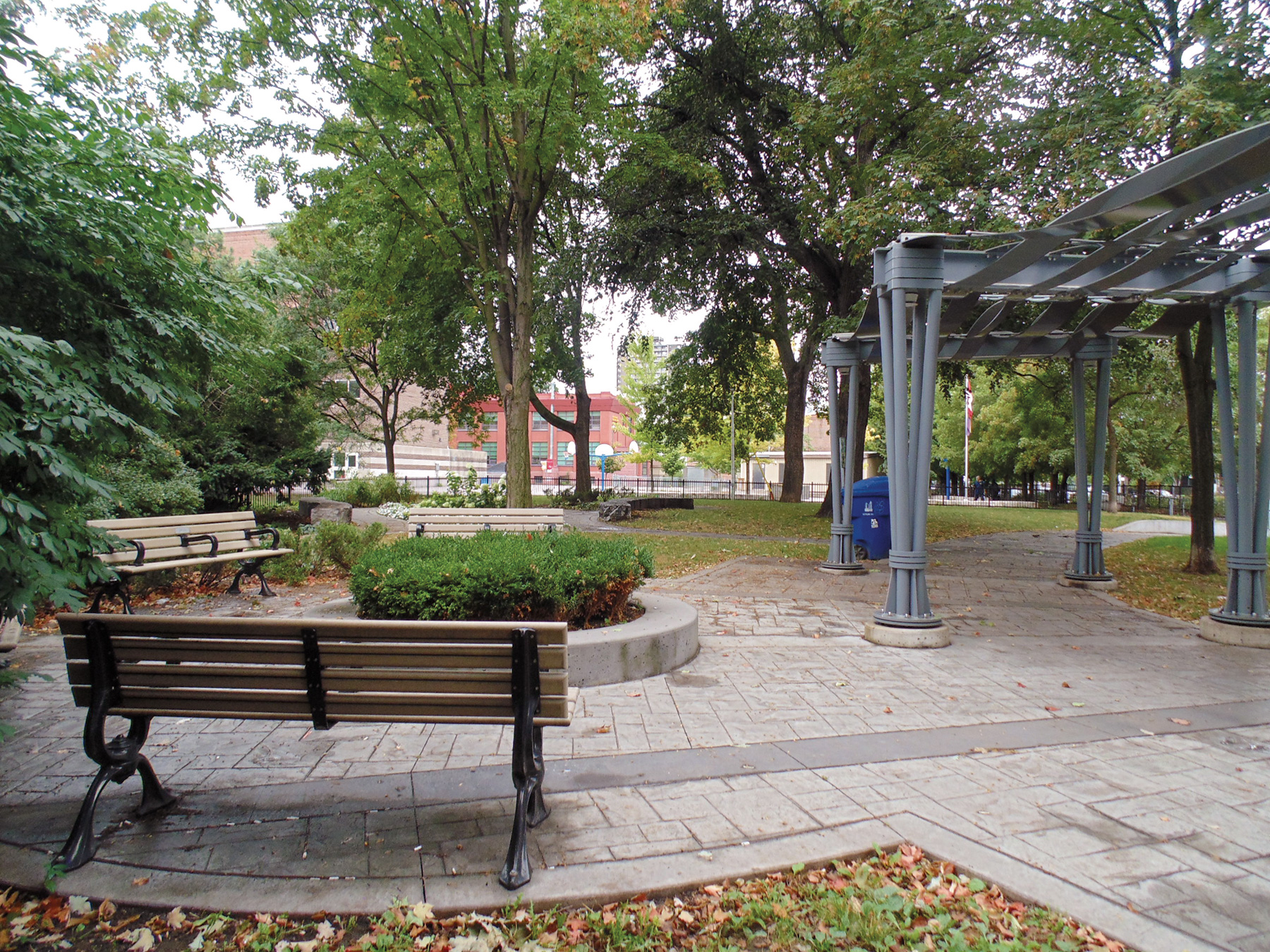
Reasons To Go: When you sit in this park, in front of the Royal Conservatory of Music and down the street from the Royal Ontario Museum, you feel involved in Toronto’s art scene, and that is a lovely thing to feel a part of. You are enveloped by the old red bricks of the conservatory, allowing you to sink into the calming presence the park offers.
What this park lacks in size and structure it makes up for in tree cover and serenity, with 10 mature trees and a wrap-around bench that faces both the street and the conservatory.
Nearby, people were lying down on the bench looking up at the trees and some were listening to music and sipping iced coffee; all were in a state of meditation.
It is important to note no one was on their cell phones, which is something of a success for a park. The space is clean and well kept, but it’s missing greenery and flower beds in the space below the trees, which is currently dirt.
Overheard: Passersby whistling in the streets.
Did you know: The Royal Conservatory is one of the largest music schools in the world, and the Toronto location is their headquarters.
Christie Pits Park
747 Bloor St. W.
Grade: A+ (Last year A+)
Time: 1:00 p.m.
Reasons To Go: Beloved Christie Pits Park is a staple in the west end community.
This massive park has flower beds, tons of seating areas (whether it’s benches or, a popular choice, towels on the grassy hill!) and playground equipment, making it suitable for all ages.
Christie Pits has multiple sports amenities such as a baseball diamond and basketball courts, making it a very useful spot for friendly and competitive games.
Or perhaps you’d like to enjoy a meal on the picnic tables or a long walk on the tree-covered foot path.
This park is one of the biggest in Toronto, and it is very well kept due to its central location and popularity.
When you are in Christie Pits, you feel like a true Torontonian, and the park allows you to be part of something that is loved by everyone.
Overheard: Buzzing cicadas and mature trees swaying in the wind.
Did you know: There are bike racks along the edge of the park.
Matt Cohen Park
393 Bloor St. W.
Grade: B+ (Last year D)
Time: 11:00 a.m.
Reasons To Go: Matt Cohen Park is an opportunity to sit and soak in the energy that is the busy heart of Spadina and Bloor. This park very much has a downtown feel; it’s not as much of a getaway as it is a green addition to downtown life, matching the energy of its urban surroundings.
After receiving a D grade last year for its heavy pollution, this park has improved significantly, and is now a clean and pleasant greenspace.
It’s a great outdoor option for coffee or lunch for commuters in the area. The space is adequately big and well-kept, with black stone sculptures for visual appeal. There is both full sun and shade-covered seating and a sectioned off area for privacy. The only thing missing from this park is an it factor, which would have separated it from other basic parks in the area.
Overheard: Noisy downtown construction and the gentle hum of busy commuters.
Did you know: This is just steps from Spadina Station for a quick and easy getaway.
Paul Martel Park
10 Madison Ave.
Grade: B- (Last year A)
Time: 2:00 p.m.
Reasons To Go: Paul Martel Park is a quaint little area on Madison Avenue, north of Bloor. The best part about this park is how colourful it is. The picnic-style chairs and benches are all painted in rainbow hues which gives the space a burst of life.
Although there are many flower beds and native plants, the vegetation was in decay and the overall grade of the park would be higher if it were better maintained.
Also, privacy is an issue with this park because it is so close to the sidewalk and street. It is not advised to come here for some alone time; however, the park was still very busy.
Chattering people could be heard from all directions and someone nearby was slung back in a yellow, red, and purple chair, listening to music and soaking up the sun. There is a section where the chairs are arranged in a circle which would be great for a picnic or a group gathering.
Overheard: Music playing in the distance and the chatter of people.
Did you know: This park used to be called Ecology Park but was renamed in honour of Toronto architect Paul Martel who volunteered much of his time to creating this park and others in the city.
One of the best maintained parks in the Annex, Jesse Ketchum Park oozes whimsy. MEGAN BOCCHINFUSO/GLEANER NEWS
Jesse Ketchum Park
1310 Bay St.
Grade: A+ (Last year A-)
Time: 10:30 a.m.
Reasons To Go: Jess Ketchum is a beautiful, upscale park at the corner of Bay and Davenport. The maintenance and of this park is among the best we have seen. The sweet smell of the well-groomed flowers and plants really elevates the space and the experience.
There is a lovely metal gazebo structure which connects one section of the park with benches to the other section with a garden and sitting stones. This park oozes whimsy and delight for a fairy-tale escape.
Overheard: The sweet sound of children playing in the school behind the park.
Did you know: There are two water bottle refill stations in this park.
Village of Yorkville Park
115 Cumberland St.
Grade: A+ (Last year A-)
Time: 2:00 p.m.
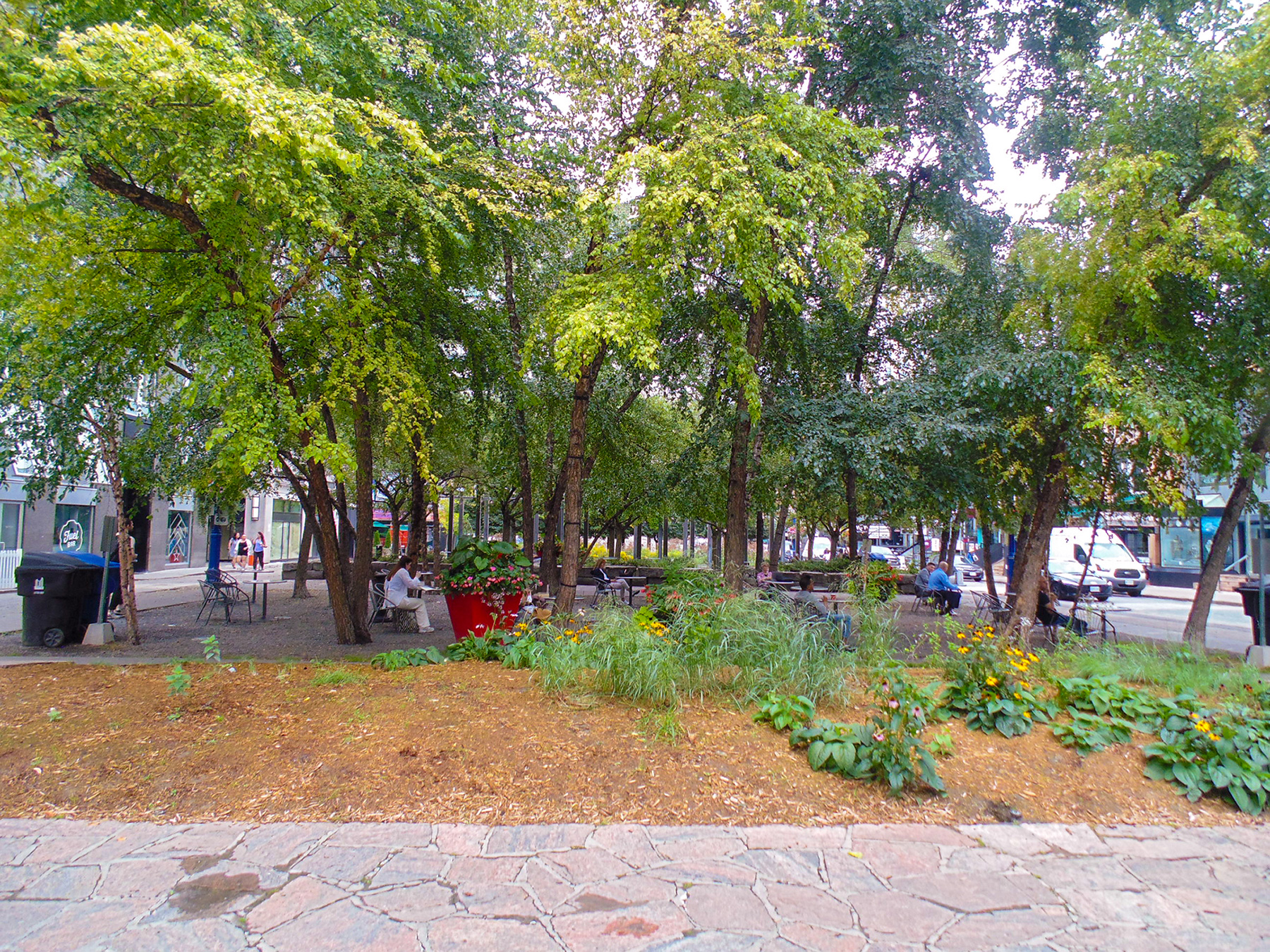
Reasons To Go: Dreamed up in the ’70s by the “Grandfather of Yorkville,” art historian Budd Sugarman, this park receives a high grade because of its genius location and accessibility.
Delicately placed between busy Cumberland Street and Bay subway station, this park has visitors coming and going. The many tables and chairs under the massive tree canopy allow for easy lunch dates and enable professionals to work outdoors.
The park is long and thin, following Cumberland horizontally which allows more pedestrians to access it with ease.
The park is meant to evoke the Canadian landscape. There are multiple water features and a massive Muskoka granite rock feature weighing 700 tonnes. The vegetation is stunning with a variety of planted and potted flowers and plants.
The layout is well thought out in its intricacy and design, making for a very comfortable environment. This park is truly the best combination of art and cityscape.
Overheard: The soft sound of cars and someone singing in the apartment building above.
Did you know: This park won an American Society of Landscape Architects Landmark Award in 2012. This award recognizes projects made over 15 years ago that have stayed true to their original design and continue to serve the public.
Sally Bird Park
194 Brunswick Ave.
Grade: C+ (Last year B)
Time: 2:30 p.m.
Reasons To Go: This park is a charming little hideout connecting Brunswick Avenue and Alan Powell Lane; however, you would never find this park if you weren’t from the area. It is very difficult to find as it is tucked between two houses.
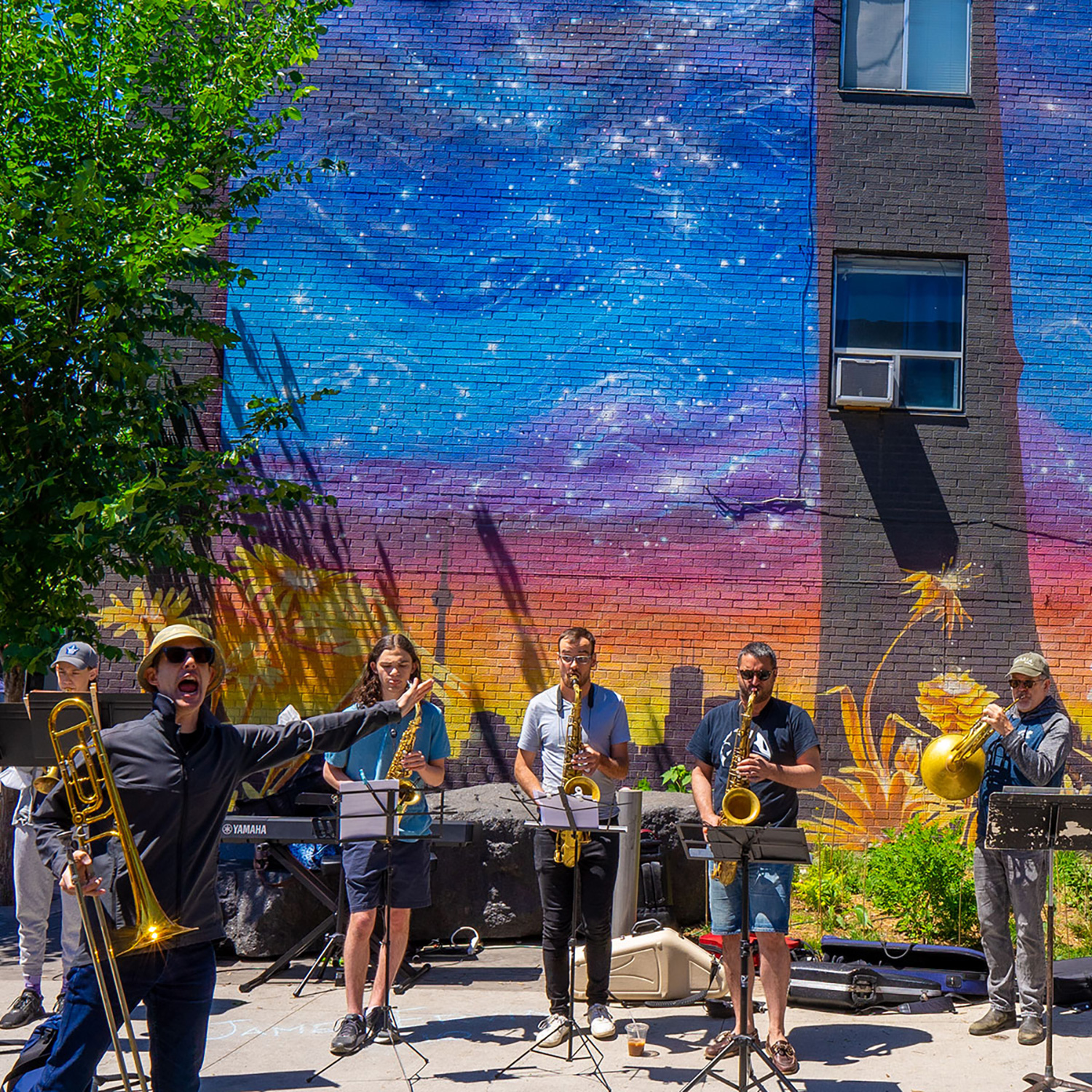
In the park there are wild and cultivated flowers on the path and a lovely mural of a child astronaut gazing into space which sets a nostalgic tone.
There are two sets of miniscule exercise equipment. Given the location and small size of the park, they are unusual amenities for the area.
However, we applaud Sally Bird Park for trying to promote an active lifestyle and exercise.
In terms of seating, there isn’t much aside from one bench, leaving us to think this park is mainly meant for strolling and admiration.
Overheard: Teenage boys laughing and sitting on the bench.
Did you know: This park is very quaint—only 37.5 feet wide!
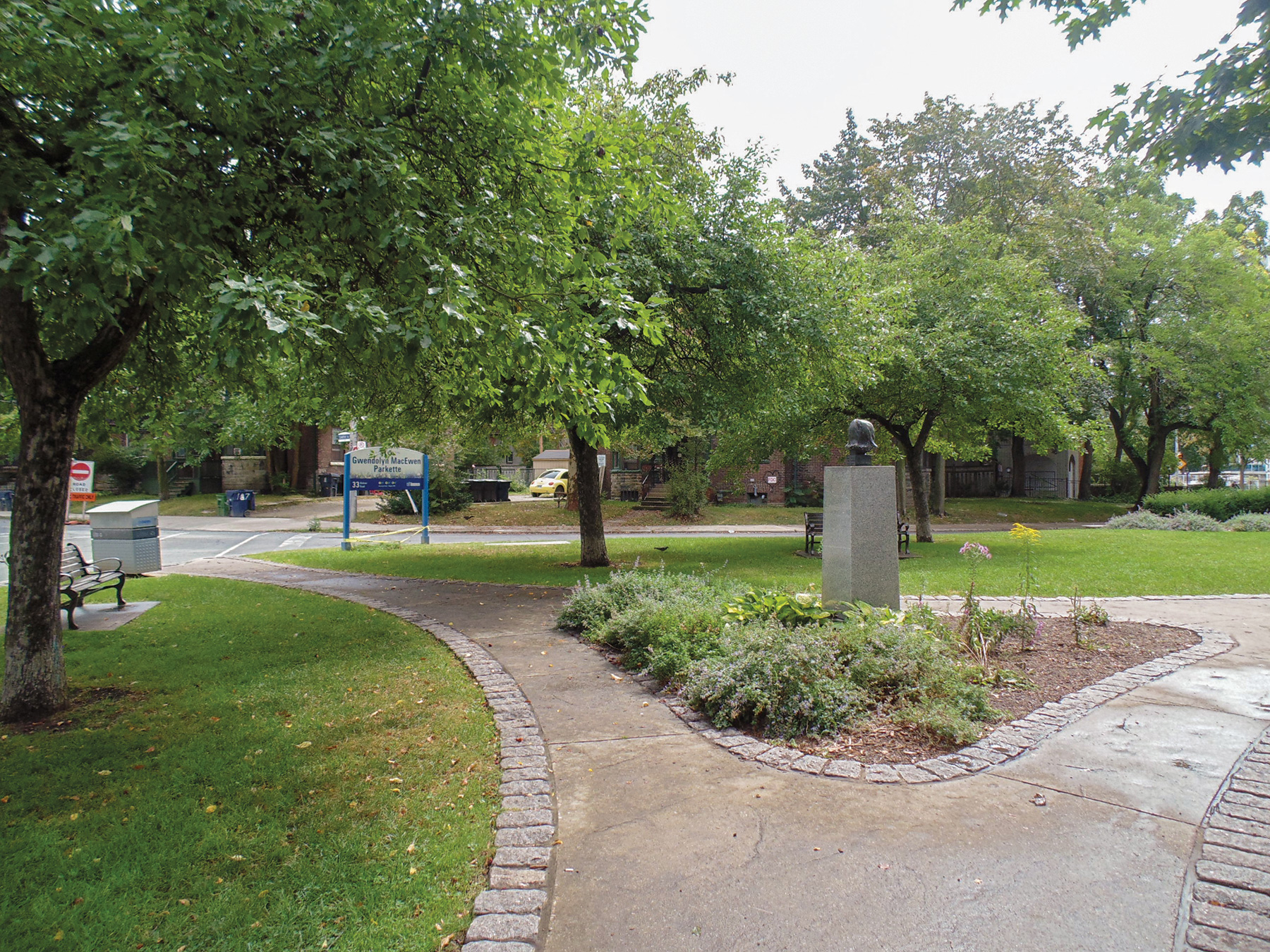
Gwendolyn MacEwen Parkette is an oasis. MEGAN BOCCHINFUSO/GLEANER NEWS
Gwendolyn MacEwen Parkette
33 Walmer Road
Grade: A- (Last year B-)
Time: 1:00 p.m.
Reasons To Go: The amount of traffic through this park is remarkable. All three pathways lead to connecting sidewalks on Walmer Road and Lowther Avenue, making it almost impossible to not pass through the park. In the centre, where all the crosswalks meet, there is a flowerbed with a bust of Gwendolyn MacEwen.
Mature trees above the benches provide protection from the sun and humidity. This park provides a lovely little break in scenery for commuters and pedestrians in the Annex. The only thing the park lacks is amenities to keep park-goers in the park, rather than just passing through.
Overheard: A woman laughing on the phone with a loved one about a bug landing on her arm from an overhead tree, then saying, “Okay, bye, I love you.”
Did you know: Gwedolyn MacEwen was one of Canada’s most influential writers. The poet, storyteller, translator and dramatist, who died in 1987, won the Governor General’s Literary Award for poetry in 1969 for The Shadow Maker and won the same award posthumously in 1987 for Afterworlds.
December 4th, 2023 · Comments Off on NEWS: Carved pumpkins to enjoy an encore on Harbord Street (Fall 2023)
Come celebrate the warmth of community
Children seen here at last year’s display of creative carving. HAILEY ALEXANDER/GLEANER NEWS
By Brian Burchell
Harbord Village’s cherished pumpkin festival is back this year on Nov. 1. Dozens of pumpkins will light up the neighbourhood along Harbord Street from Spadina Avenue to Borden Street.
Between 6:00 p.m. and 9:00 p.m., people will parade along the street to view all of the lit pumpkins, drinking hot apple cider, eating baked goods from Harbord Bakery, and displaying the last of their Halloween spirit. Creations carved at homes in the neighbour¬hood are brought to Harbord Street for a “reshowing.”
A lot of effort goes into this green community event every year. Sponsored by the Harbord Street BIA and the Harbord Village Residents’ Association, event staff hire athletes from the University of Toronto to prepare and clean up after the festival. “We call them the pumpkin heads,” said Neil Wright, chair of the Harbord Street BIA, and they do the heavy lifting, taking carved pumpkins from neighbourhood porches. Local businesses pro¬vide free food and drink for the public along with their own admirable creations. At the end of the night, the city collects and recycles the artwork.
Harbord Village has opened the event up again this year to anyone and everyone willing to share their jack-o-lanterns at the parade. The more, the merrier at this family-oriented event.
December 4th, 2023 · Comments Off on NEWS: Women’s Art Association’s Secret Postcard Society (Fall 2023)
One of many unique exhibitions put on by the association
A crafty response to the isolation of Covid. Postcards made and sent during lock down. COURTESY INGRID HAMILTON
By Hailey Alexander
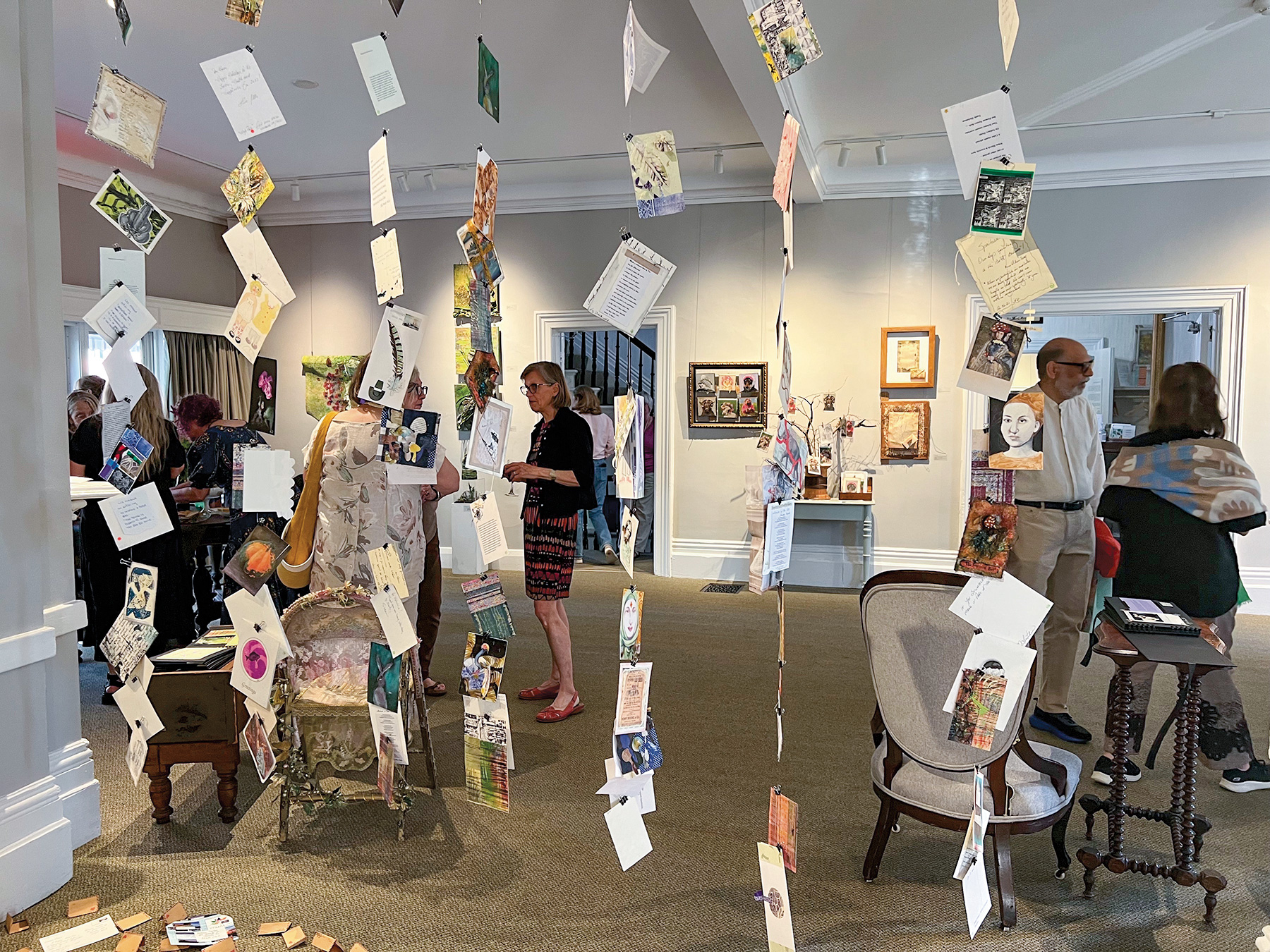
From June 28 to July 8, the Women’s Art Association of Canada (WAAC) displayed their Secret Postcard Society exhibit at 23 Prince Arthur Ave., northwest of Bloor Street West and Avenue Road. The group was delighted to share their brilliant collection of postcards in response to the community’s interest. In the Dignam Gallery, the association also showcased and sold a variety of art pieces inspired by the postcards.
The Secret Postcard Society all began with a group of three artists working in separate studios during quarantine. As artist Janet F. Potter describes, the trio “got five other artists together and mailed everyone a postcard on the fifteenth of every month.” With 64 new postcards to talk about in waves, the group’s collection grew quickly. They discussed their work online as a way of keeping spirits high and “staying socially connected to one another” throughout the pandemic. Once restrictions were lifted, they agreed to host an exhibit with strong encouragement from the association’s board and community. Their work has been further shared on their website and social media platforms.
WAAC has long been known in the City of Toronto. “Our doors are just jammed with people because there’s a lot of history,” Potter said. They began as an informal art club for young female artists in September 1887, founded by the first president, Mary Ella Dignam, for whom one of the gallery spaces is named. The original objective was to provide women with room and support for self-development in their artistic endeavours, independent of an instructor. By 1893, the newly formed club became affiliated with the National Council of Women. In 1907, the association was recognized by a bill passed in the House of Commons which officially incorporated it as the Women’s Art Association of Canada.
Currently, WAAC describes itself as a “volunteer-led, not-for-profit, charitable organization” with 230 members. The association’s objective has grown to provide public education in the arts and to support students in the arts through their scholarship program. “Generation after generation, daughters of members took over to keep the association running, but those days are gone.” Potter said. “Recently, there have been some men and very well-known artists taking interest. During COVID it was especially quiet, but now we’re getting active again.”
In 135 years, they have grown substantially. Their 19th-century building includes a library of over 2,000 art books, and they have a printing room on site. The women offer a variety of arts-related educational programs to the public and to their members.
The following artists were part of the Secret Postcard Society and participated in the July showing: Ulla Djelweh, Susan Farquhar, Heather Gentleman, Gretchen Jeens, Patricia Paolini, Karen Perlmutter, Janet F. Potter, and Deniz Ergun Seker. They look forward to displaying their postcards again as there is the possibility of another display in the future.