April 7th, 2024 · Comments Off on GREENINGS: A lament for the tree inventory (Mar. 2024)
As more people move in, more green space needs to be considered
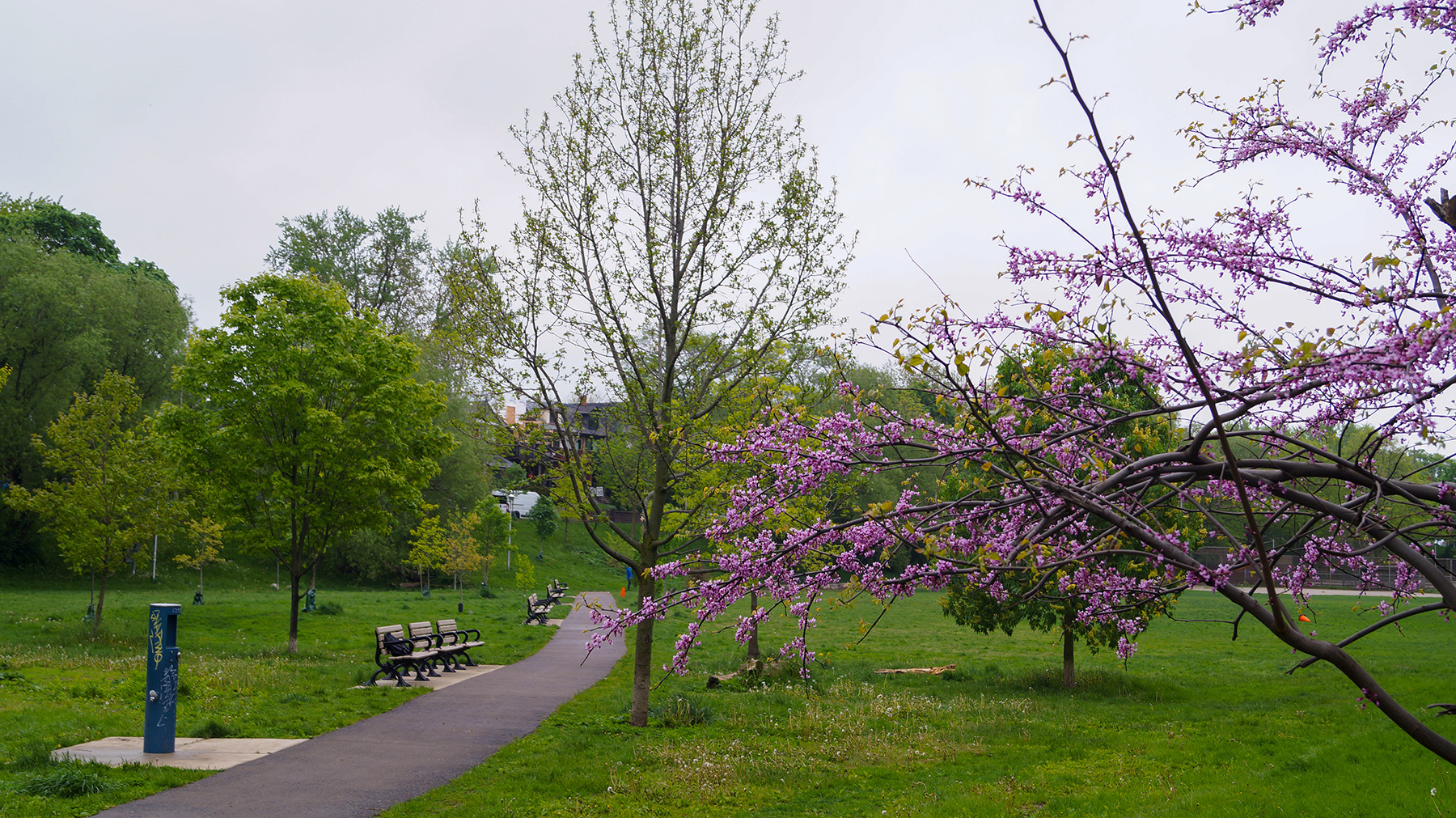
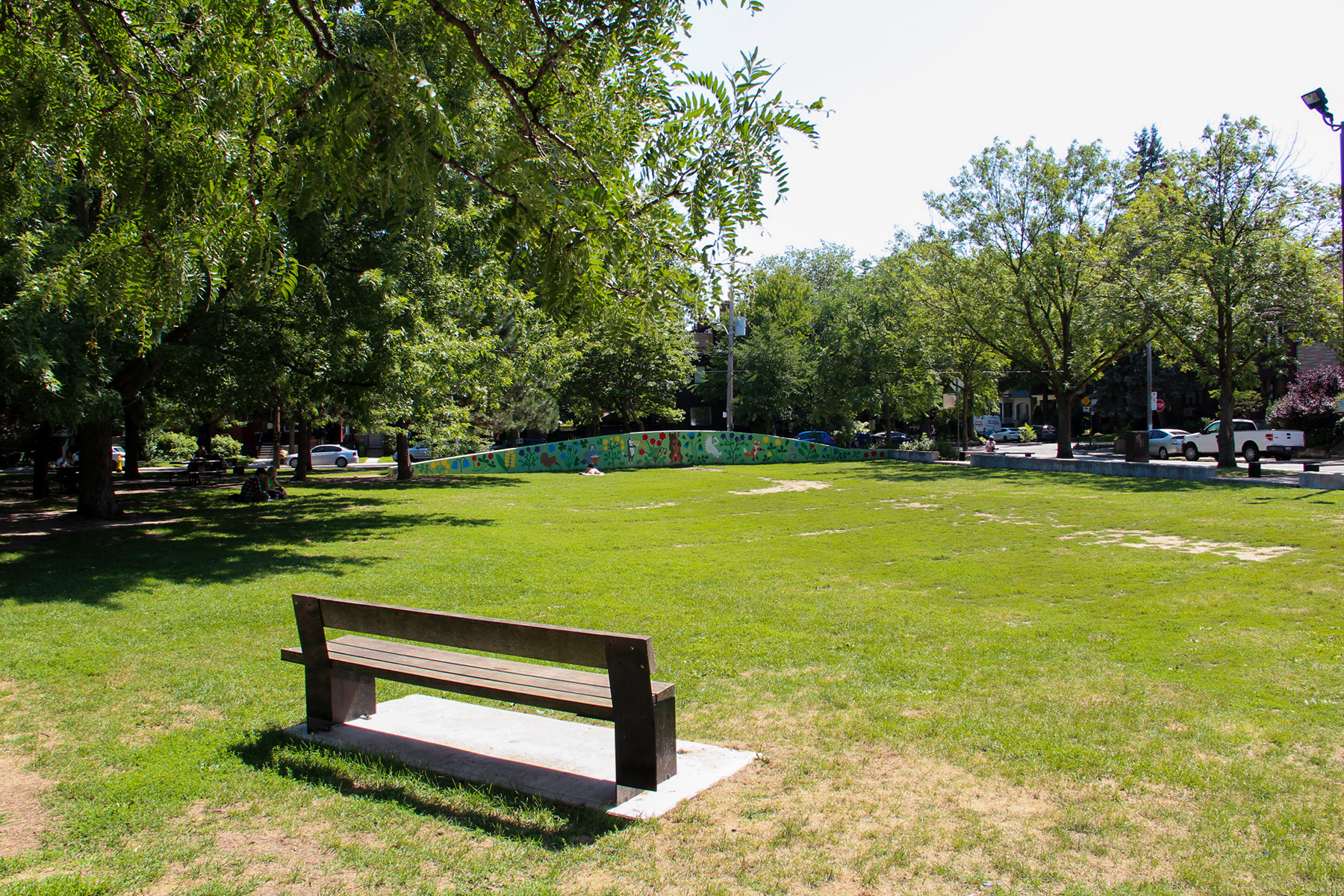
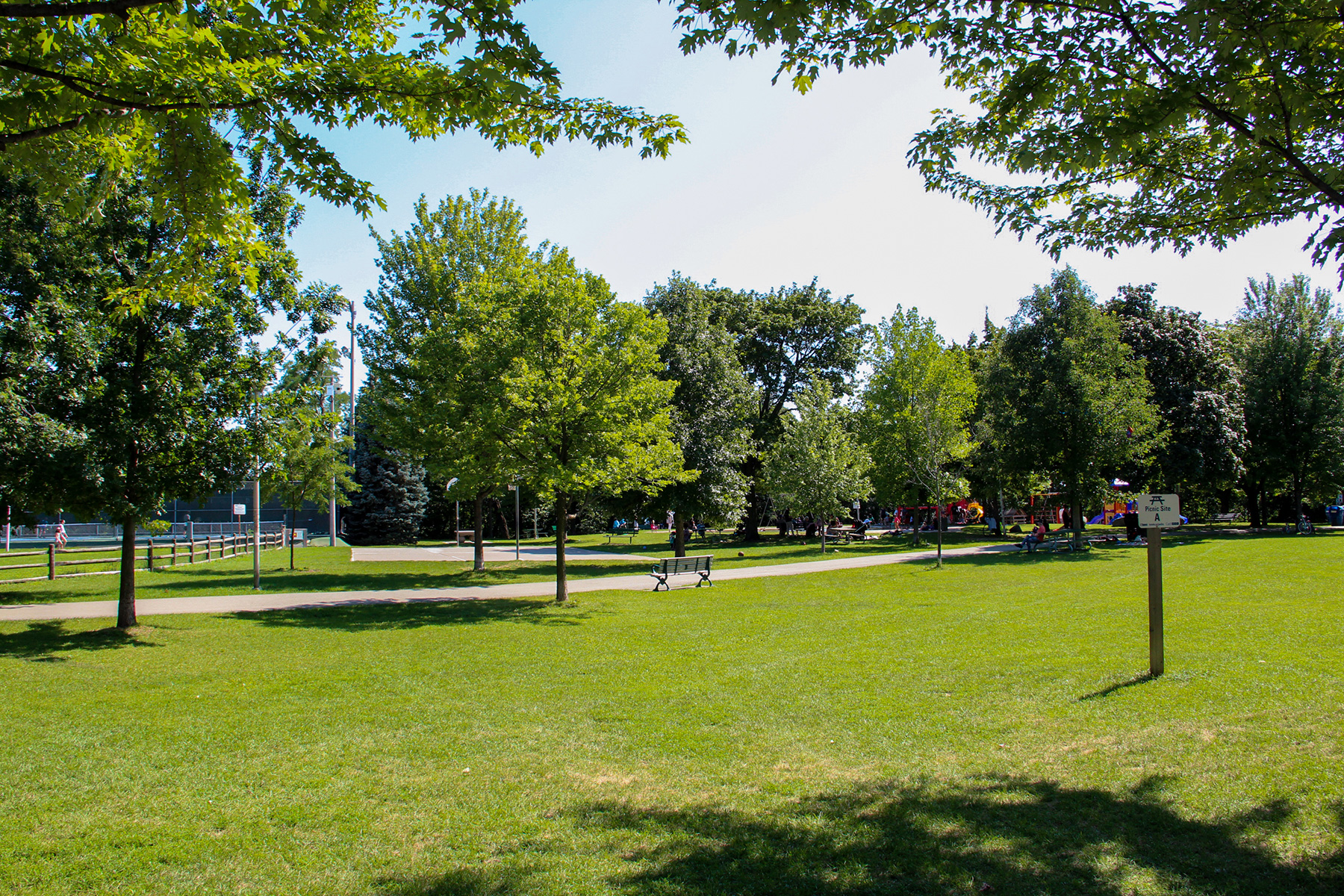
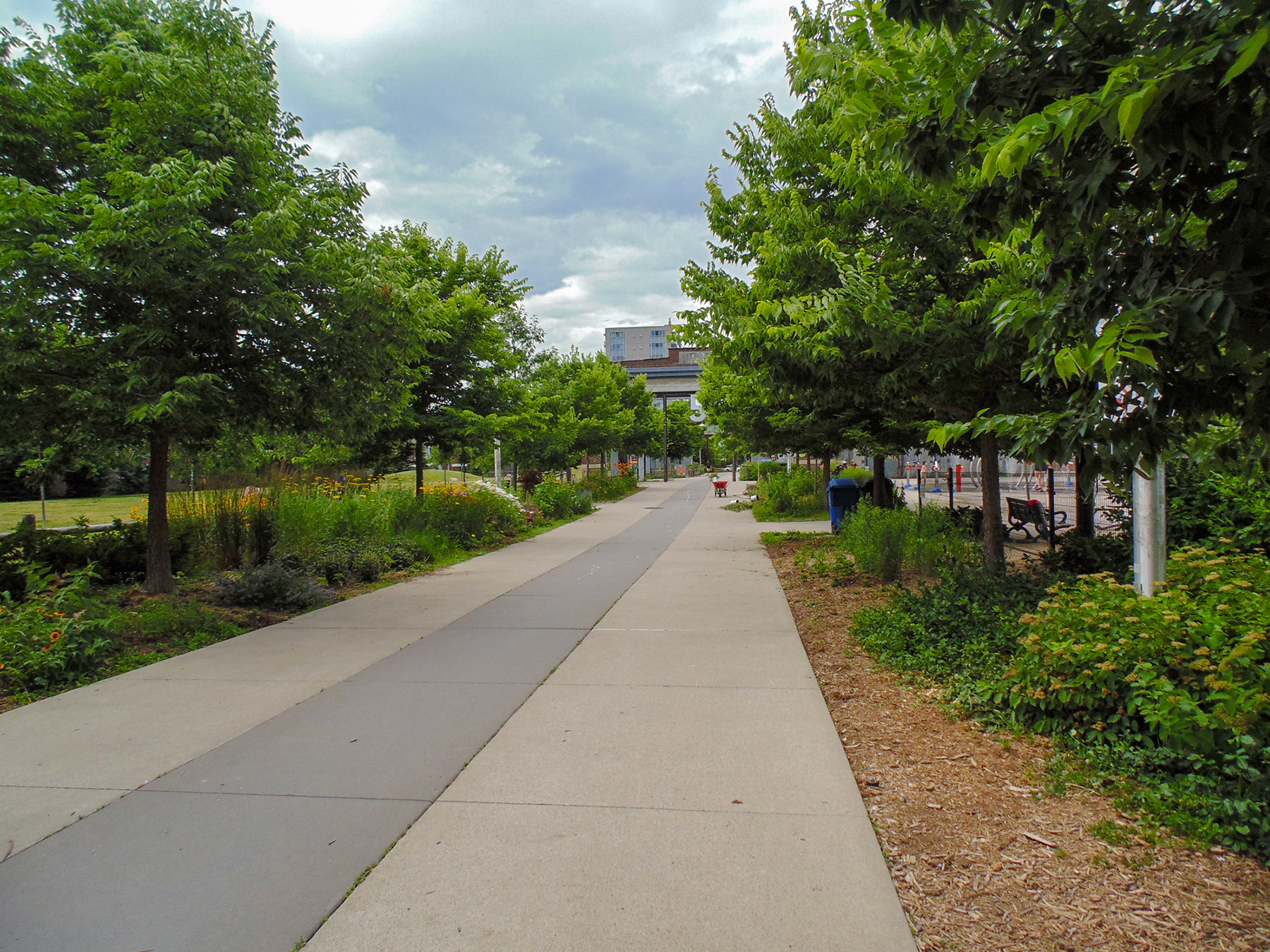
Spring is my favourite time to get outside and enjoy what park spaces this city has to offer. Sadly, there really isn’t that much of it. In the Annex, we have a few strips north of Bloor where homes were taken out for the subway, there’s Taddle Creek Park, and then there’s Jean Sibelius. It really is scant green space for the 14,000 people who call this area home. In case you haven’t noticed, the Mirvish Village development on the old Honest Ed’s lot is near completion, and it won’t be long before 1000s more call this area home, competing to use the green space that’s available. The little green space we have is also losing its beautiful canopy coverage.
We have been continuing to survey and document the neighbourhood trees for the 10-year neighbourhood tree update. The data is still preliminary but 1 in 4 trees that were standing in 2011 are now gone. This is a huge loss when we think about how large many of these trees were and that the replacements are mere saplings. What makes this worse is that there is only one new sapling planted for every two trees lost. If this sounds like a green space crisis to you, you would be correct. Losing 25 per cent of standing trees over a decade is a huge loss. For those of you with children at Huron Public School, you will know that the large beloved tree that stood in the yard is no more.
Over a half dozen trees came down at Jean Sibelius last year from what I consider overzealous chopping. Many of those trees presented as healthy according to our team of surveyors, and I do not accept the city’s response that they were a safety hazard. Children are supposed to climb trees. They took down trees for fear of children climbing them. I cannot stress enough how our extreme safety culture causes damage to our environment and even our children’s development.
Some things you can do to help. Plant a tree (or three). We need neighbours to plant trees in every spot that is available. If you have lost a tree on your property, it is especially important to get one into the ground. If there is a larger, older tree near you, plant one close to it now so it’s not completely barren sky when the inevitable happens and the large, majestic tree has to come down. It’s possible.
Let the city know that you want trees in parks replaced. Those trees in Jean Sibelius Park should never have come down in the first place. Be loud about getting them replaced. Also, let the city councillor, Dianne Saxe know that you support the idea of pop-up picnic tables along the northern edge of the park. Taking away unused car space and returning it to the community as much as we can is the only way we will have more, much-needed green space in this city.
Toronto is a city of three million people. We need to put more developments upward, along transit corridors. We should be supporting taller projects that are right on the subway. However, these developments should be car-free, and the tradeoff is that more people on foot need more pedestrian spaces. We need wider sidewalks, not wider roads, the latter is simply an exercise in futility.
Terri Chu is an engineer committed to practical environmentalism. This column is dedicated to helping the community reduce energy and distinguish environmental truths from myths.
April 6th, 2024 · Comments Off on ON THE COVER (Feb. 2024)
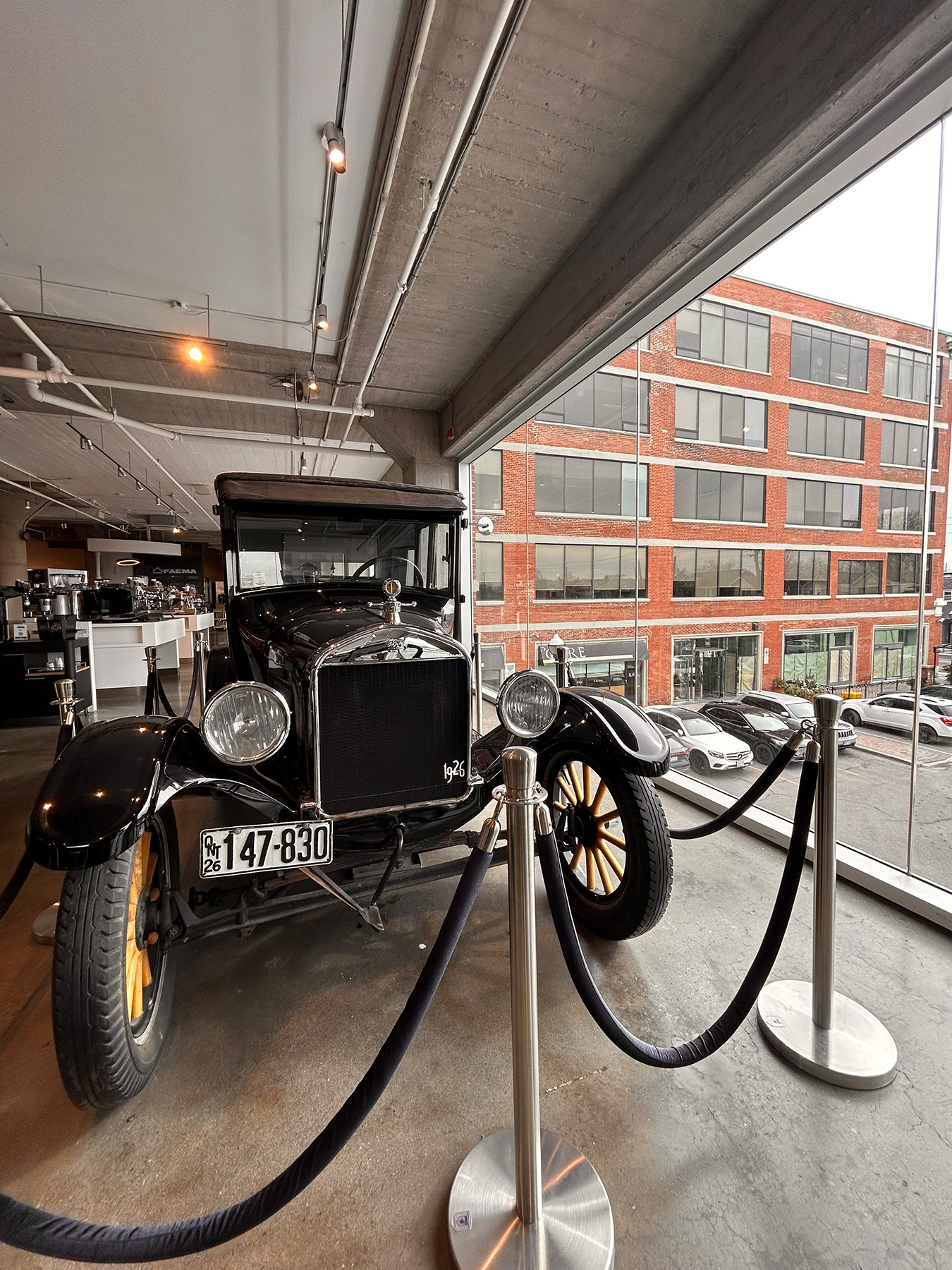
The original Model T Roadster pictured above featured a detachable roof and is on permanent display in the Dupont Street building where they were manufactured in 1915. Please click here to read more. MIA KESKINEN/GLEANER NEWS
Comments Off on ON THE COVER (Feb. 2024)Tags:General
April 6th, 2024 · Comments Off on DEVELOPINGS: Bloor and Spadina tower update (Feb. 2024)
Greater density is on the horizon throughout the Annex
By Fox Oliver and
Brian Burchell
The annual Annex Gleaner development synopsis will now be published over a series of editions. The sheer volume of developments in our area requires this. Where possible, images of the current site will be presented with architectural renderings of what is proposed/being constructed for that location. A year ago we featured the many developments pending near the intersection of Bloor Street West and Spadina Avenue. Here is an update on what has changed since then near that corner alone.
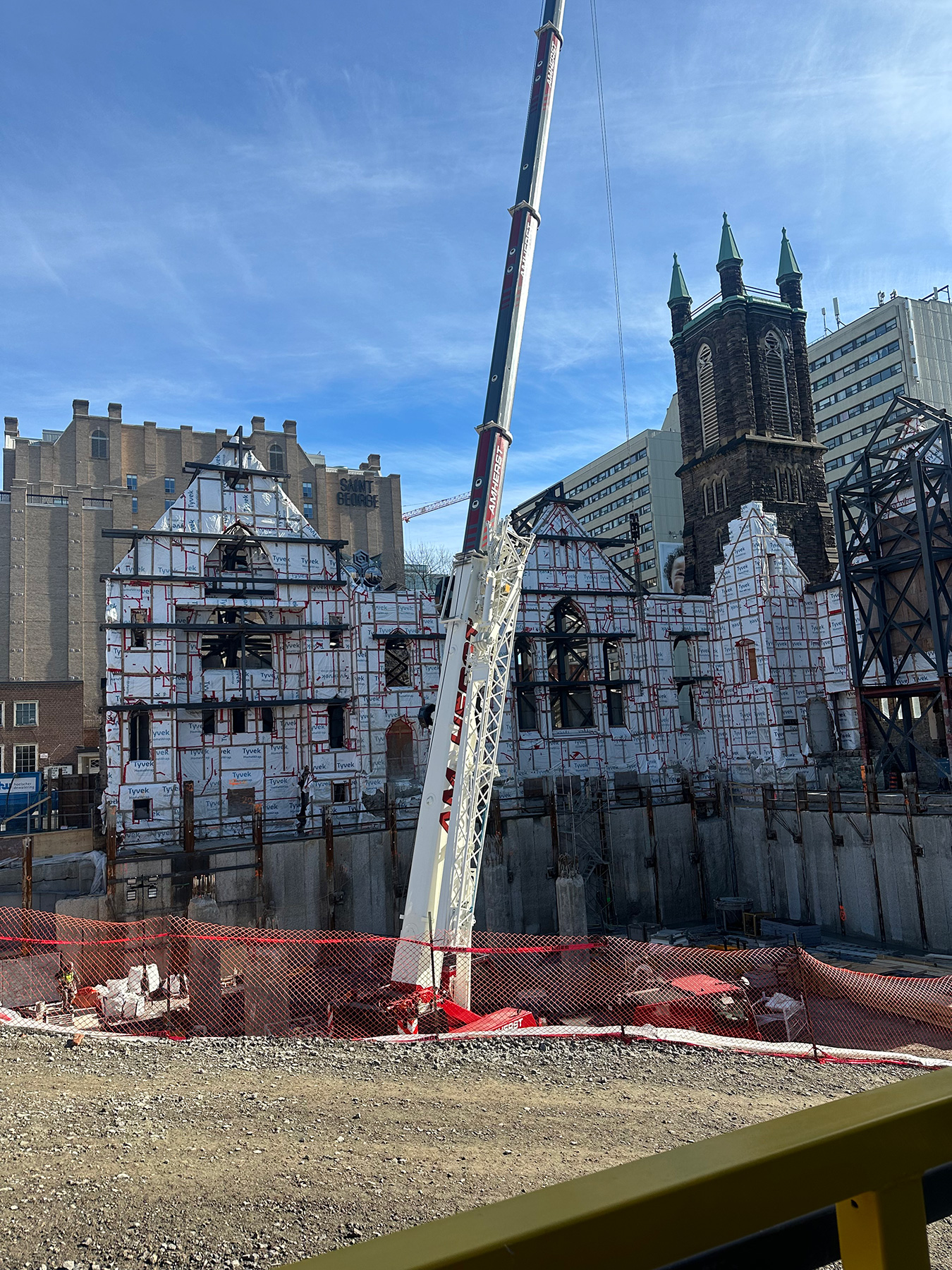
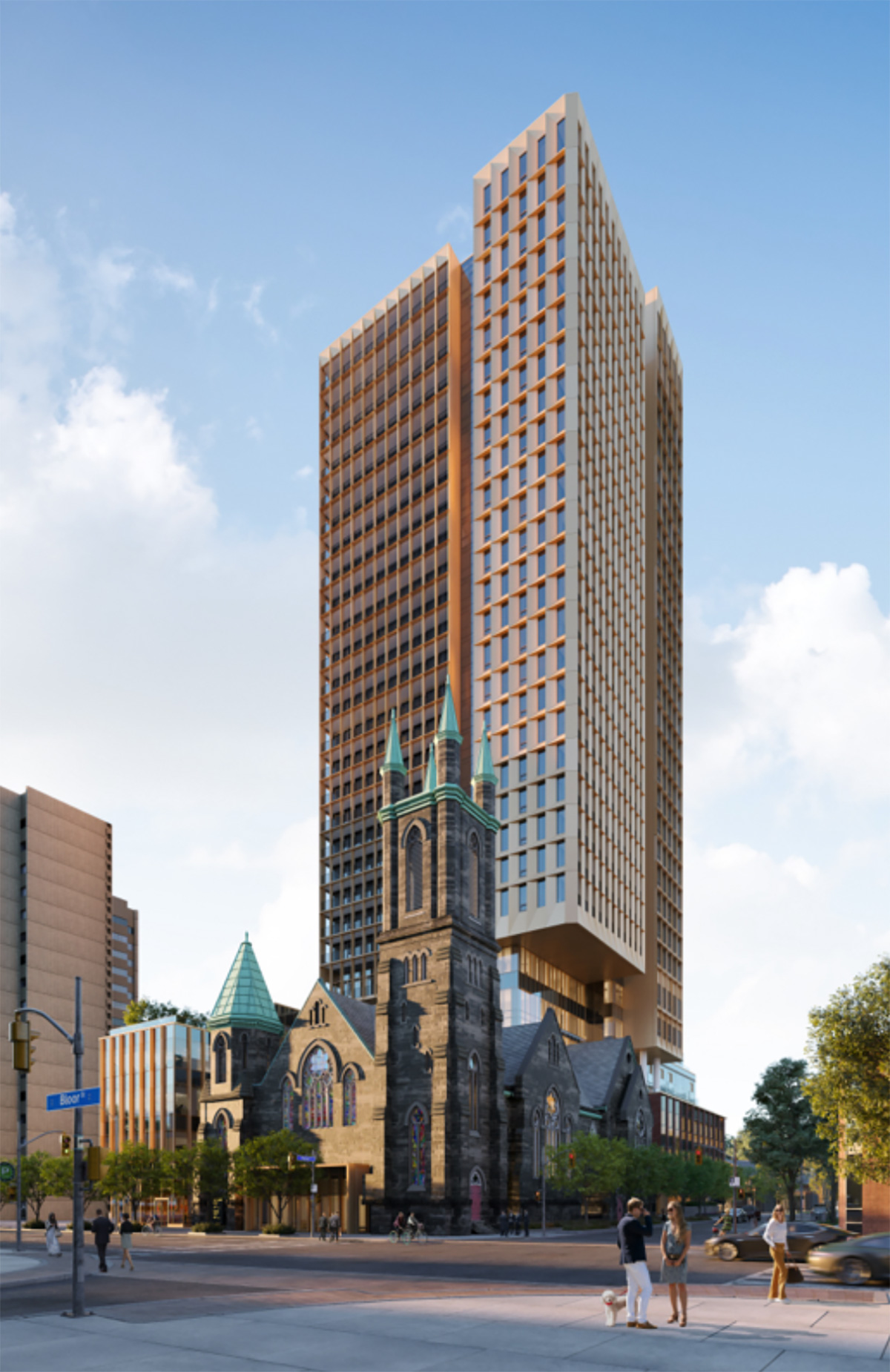
300 Bloor St. W. under construction.Rendering for 300 Bloor St. W.
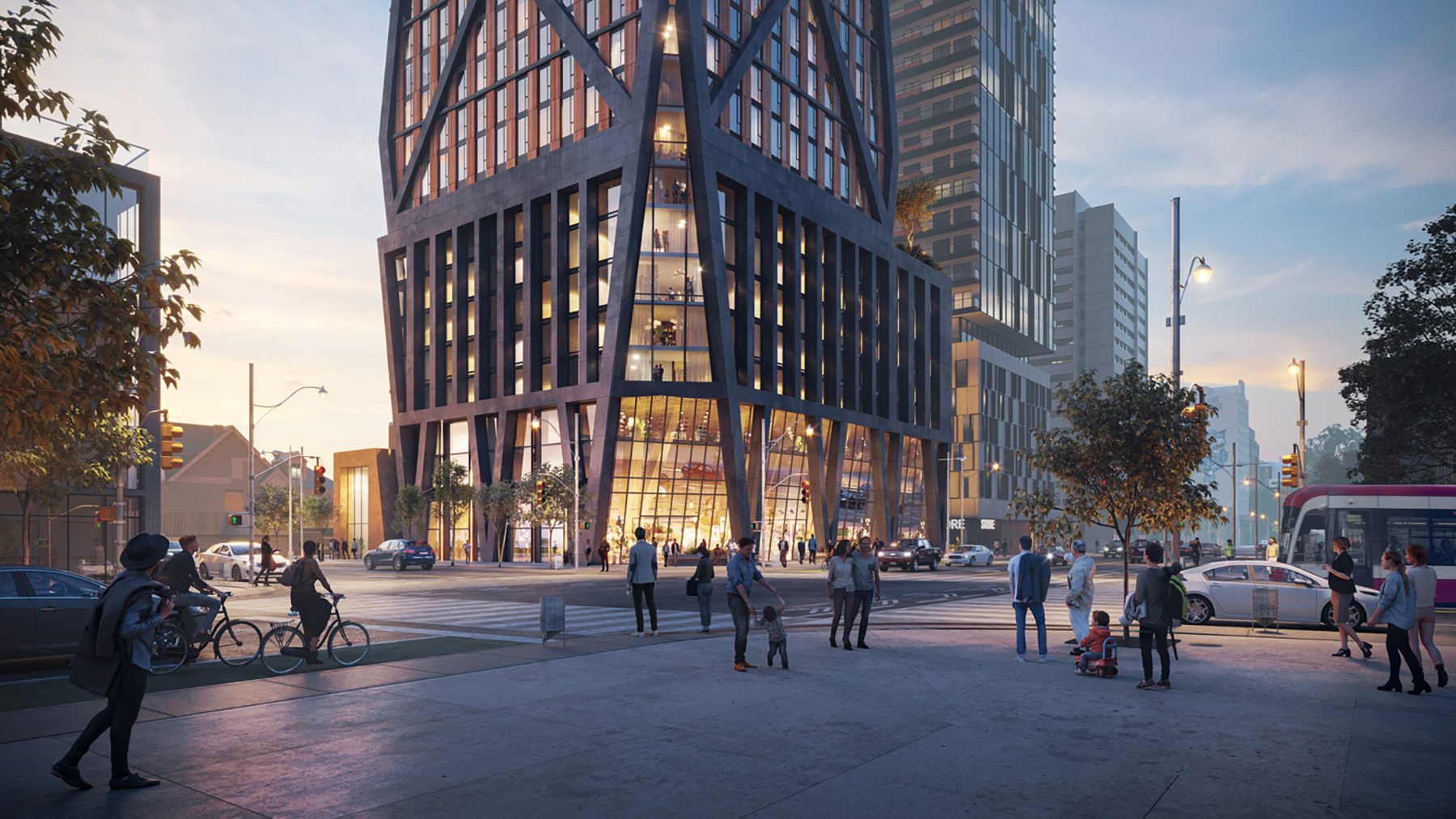
300 Bloor St. W. Construction is well underway for this tower that also straddles the subway and shares the site with the Bloor Street United Church, the walls of which are shored in situ. A portion of the original church, built in 1886, and the entirety of the Pigeon House (on Huron Street) will be retained. The 30-storey building will have 284 units, retail/café space, and office space. Worship, community, and office space for the church will also be provided.
The developer is contributing $2.3 million towards capital improvements for new or existing Toronto Community Housing units and/or affordable housing over a 15-year period, as no affordable housing will be part of the new development.
The developer recently applied to the Committee of Adjustment for an increase in height of 17 per cent, or 5 storeys, but they were denied and have appealed to the Toronto Local Appeal Body (TLAB).
Units start at $1,253,000 for a bachelor suite, with the most expensive being a three-bedroom priced at $4,795,000. Building occupancy is scheduled for 2026.
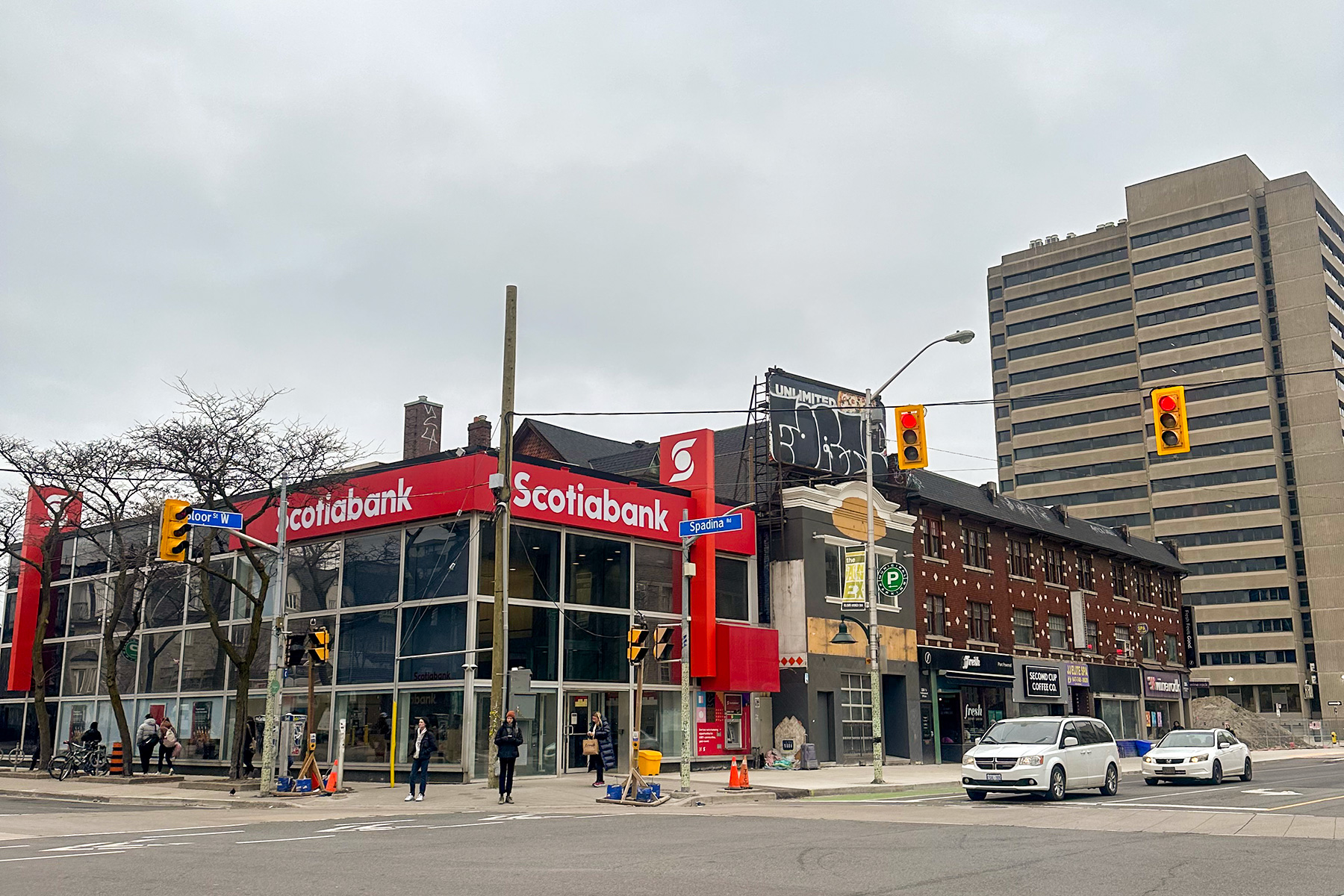
Current site of 320 – 332 Bloor St. W.Rendering for 320-332 Bloor St. W.
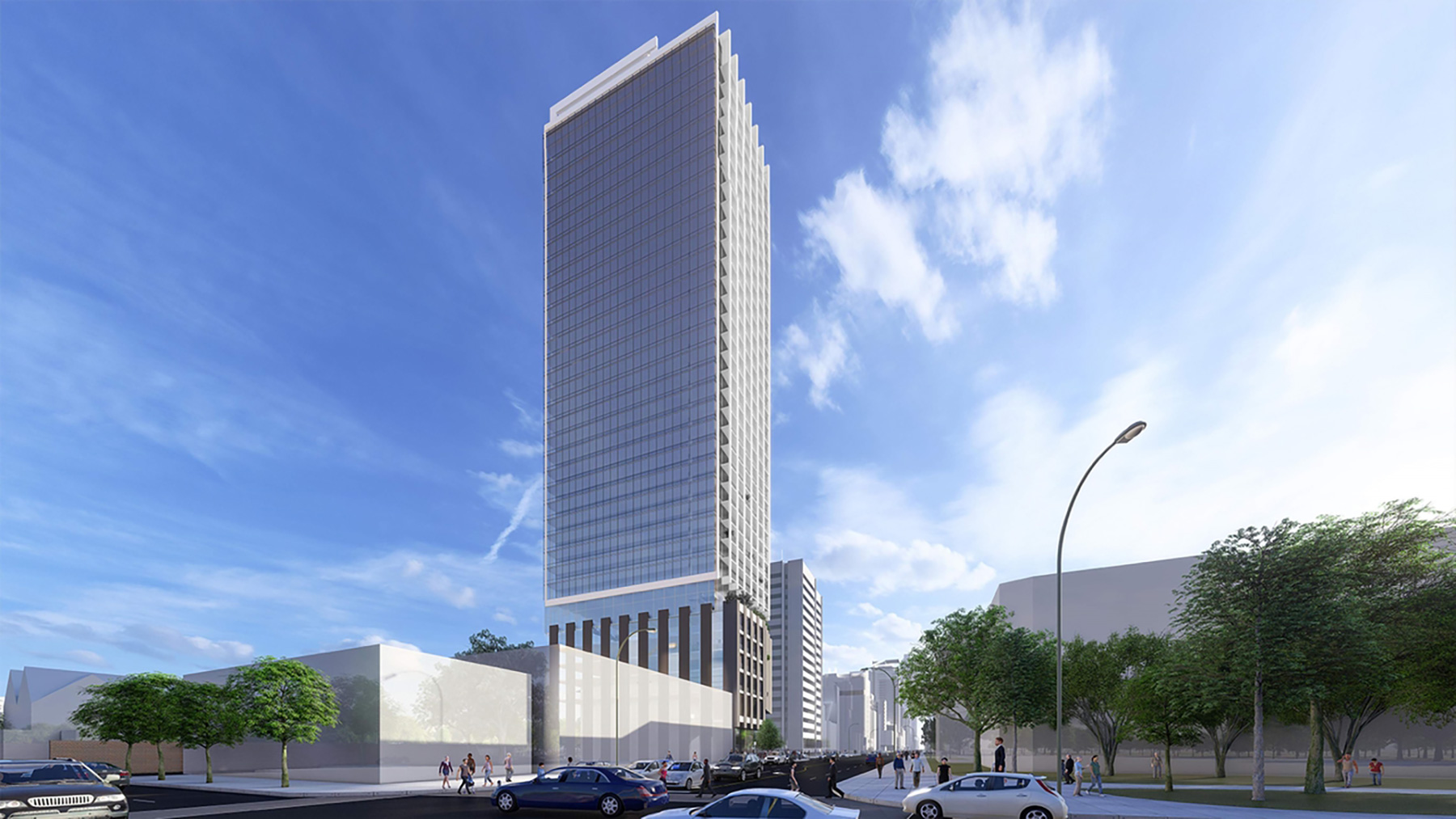
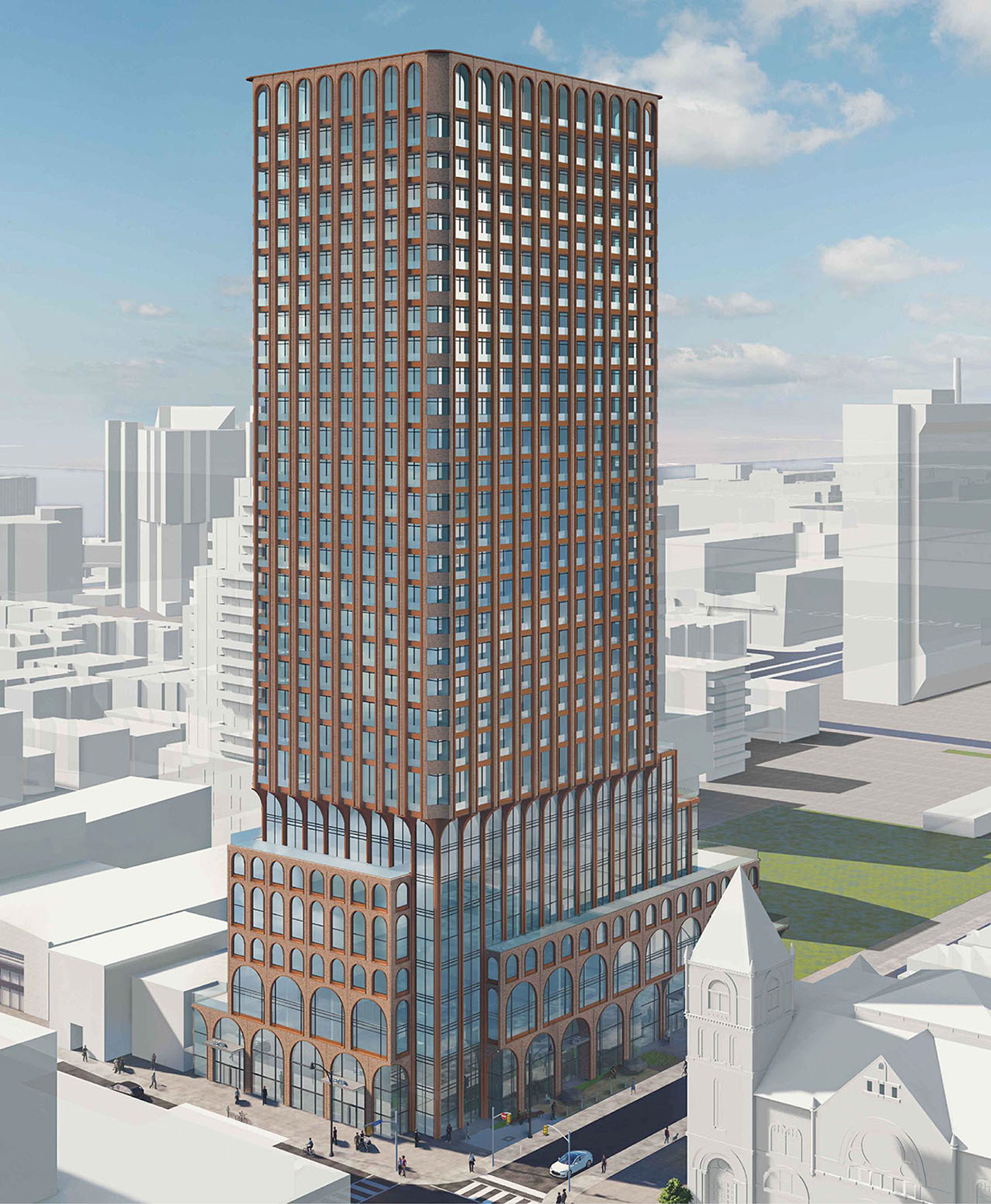
320-332 Bloor St. W. This proposed, vast 37-storey building, designed by BDP Quadrangle and developed by First Capital, will sit at the northeast corner of Spadina Avenue. and Bloor Street W., directly east of the 334-350 Bloor St. W. development. Construction hasn’t started yet as the developers are currently waiting for consent to build an overhang facing 316 Bloor St. W.
An estimated completion date of 2026 for the building is listed on BDP Quadrangle’s website. Since the application has not yet been approved, that date seems highly ambitious. In addition, the city has sought to protect the historical architecture of the 3-storey commercial facade on Bloor Street stretching from the wine store to the Fresh restaurant.
The proposed building will contain 366 residential units which have not yet been designated as rental or condo units. The building will have retail space at grade, two publicly accessible spaces bookending the site, pedestrian access from Bloor Street W. to Paul Martel Park, and access to Spadina Station.
The building’s exterior will feature a distinct vertical terracotta pattern, intended to add depth and design to its facade.
Demolition has begun at 316 Bloor St. W.Rendering for 316 Bloor St. W.
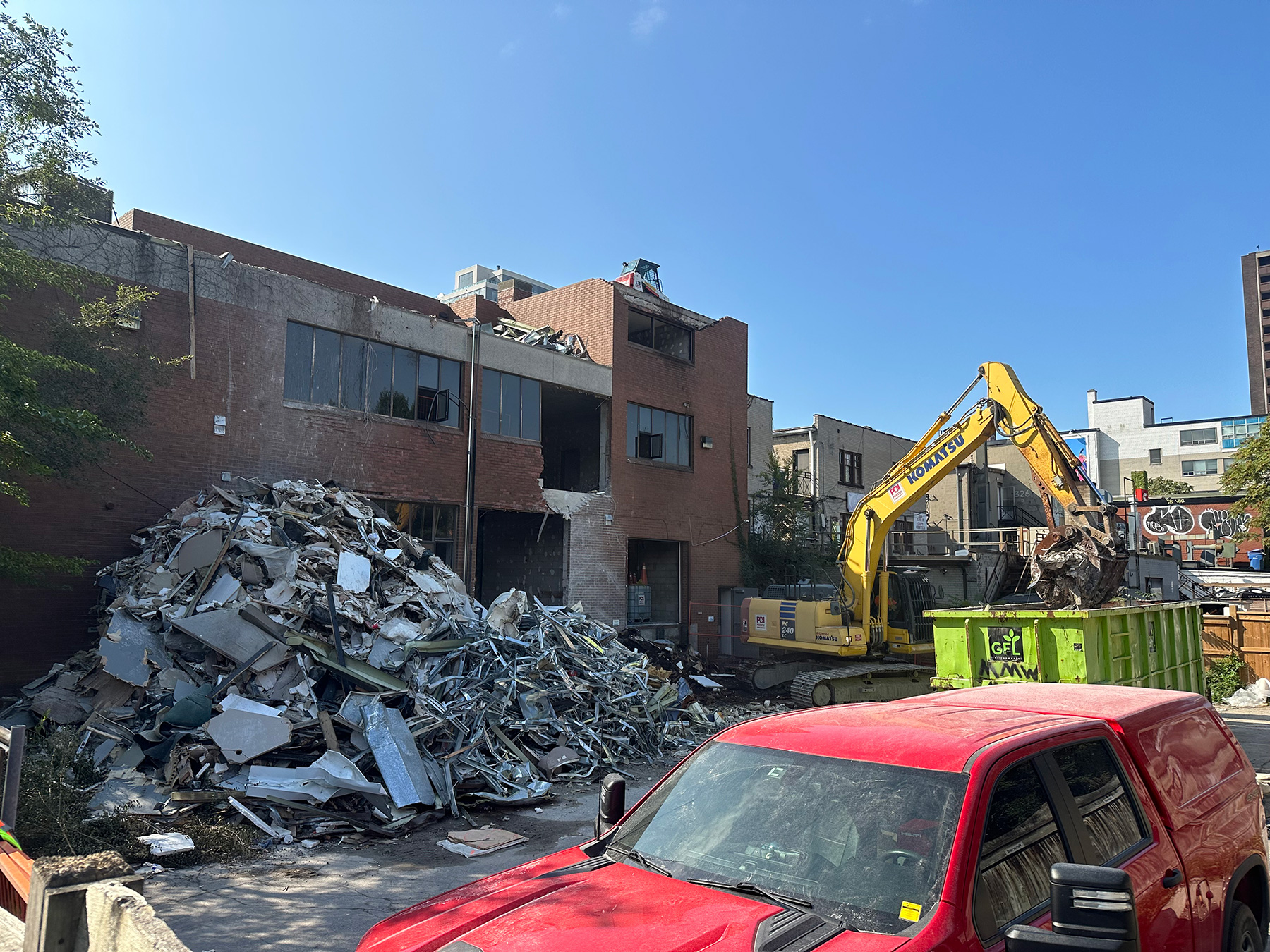
316 Bloor St. W.In the fall of 2023 demolition of the former 3-storey office building was complete. In January the pile drivers were on-site in advance of excavation.
This development is located at the northwest corner of Bloor Street W. and Madison Ave. As a result of a successful application to the Committee of Adjustment (CofA) the height of the building will increase to 34 storeys (440 units) and there will be more commercial space on the ground floor.
The Annex Residents’ Association is urging city council to appeal this decision to the TLAB. In the new provincially mandated regime only city council can appeal a CofA decision.
At the time of writing, unit configuration, pricing, and completion dates were not available.
334-350 Bloor St. W. This proposed 35-storey condominium at the northwest corner of Spadina Avenue and Bloor Street W. has city-approved zoning but awaits site plan approval.
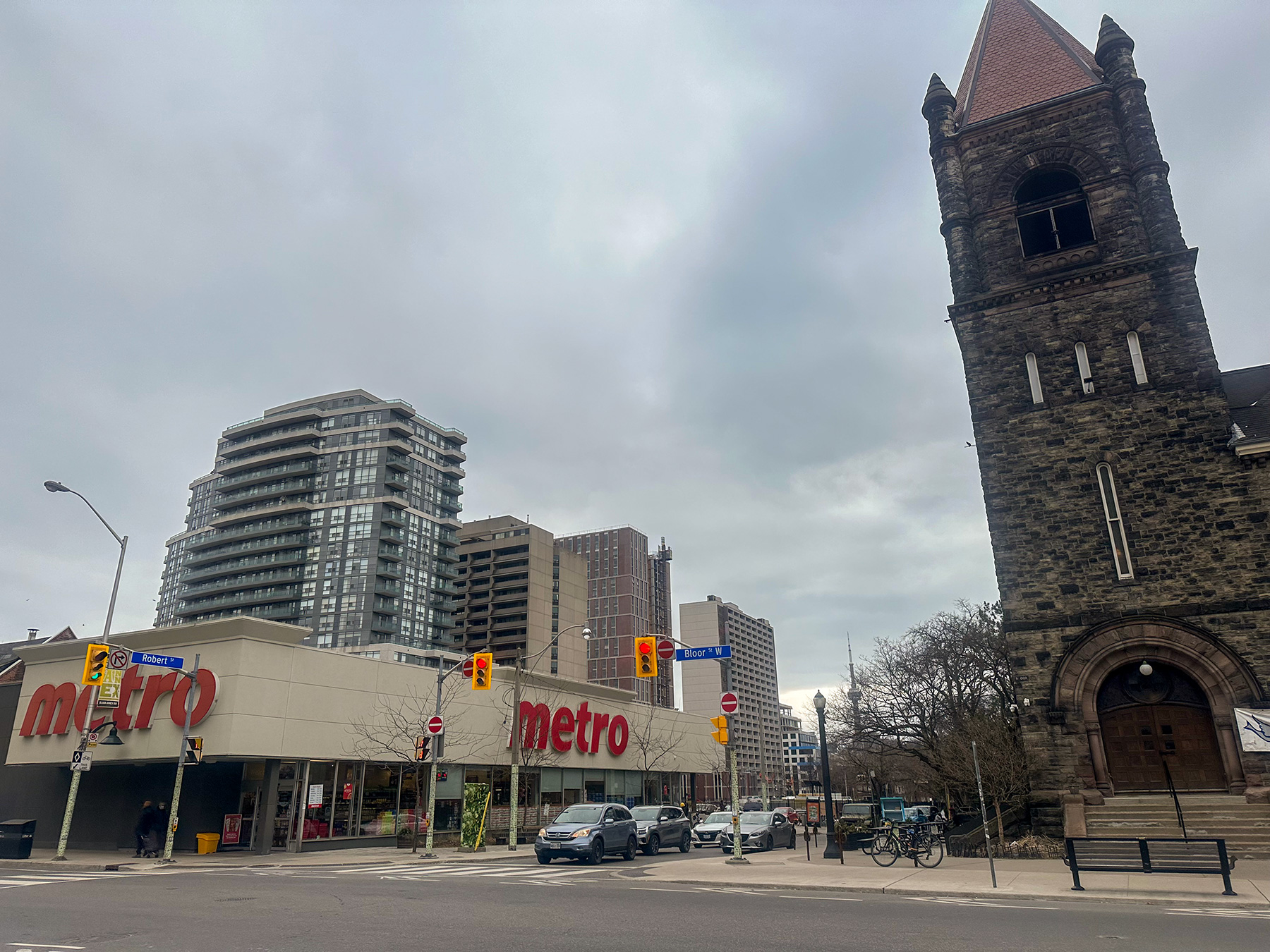
This construction would force out the 7-Eleven, Tim Hortons, and office spaces that exist on the lot currently. The developer is also waiting for TTC approval as it intends to link to the Spadina subway station below the development. There is also an agreement to house the Metro grocery store at the basement level as it will move from across the street (425 Bloor St. W).
The building would be mixed-use, containing 422 residential units, 8,200 square metres of non-residential floor space, and 3,716 square metres of office space.
An “Urban Living Room,” surrounded by kiosks, would be built on the ground floor, and public art by an Indigenous artist is proposed to be incorporated in the design.
Although construction was to begin in the spring of 2024 and last for 42 months, the developer is no longer providing a start date. The TTC’s original plans to extend the Spadina subway platform in 2040 may change to coincide with this construction which will be happening overhead.
425 Bloor St. W. is currently the home of Metro. Rendering for 425 Bloor St. W.
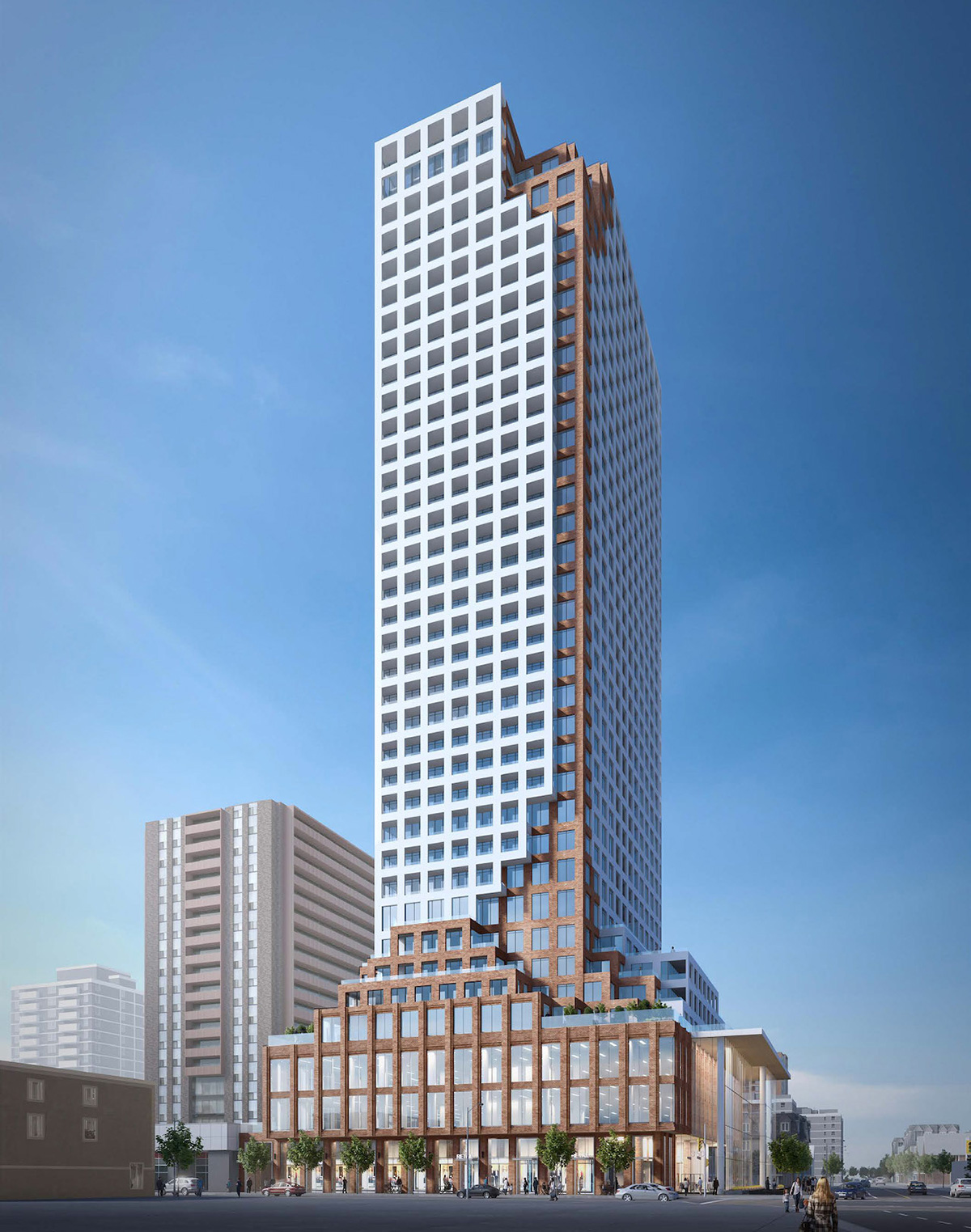
425 Bloor St. W.Currently the site of the Metro grocery store, the developer Bousfields has submitted an application to build a 30-storey condo tower on the site.
The Metro grocery store would vacate and move into a below grade site in the new development at the northwest corner of Bloor and Spadina.
The 418 residential units in the building would likely be condominium units, consisting of 79 studios, 229 single-bedroom units, 67 two-bedroom units, and 43 three-bedroom units. Over 1000 square metres of space on the ground and mezzanine floors would be used for retail.
The developer has plans to work with the Bloor Annex BIA, to not only enhance its parkette space on Robert Street, but to expand upon it.
Construction at 700 Spadina Ave. is almost complete.Rendering for 700 Spadina Ave.
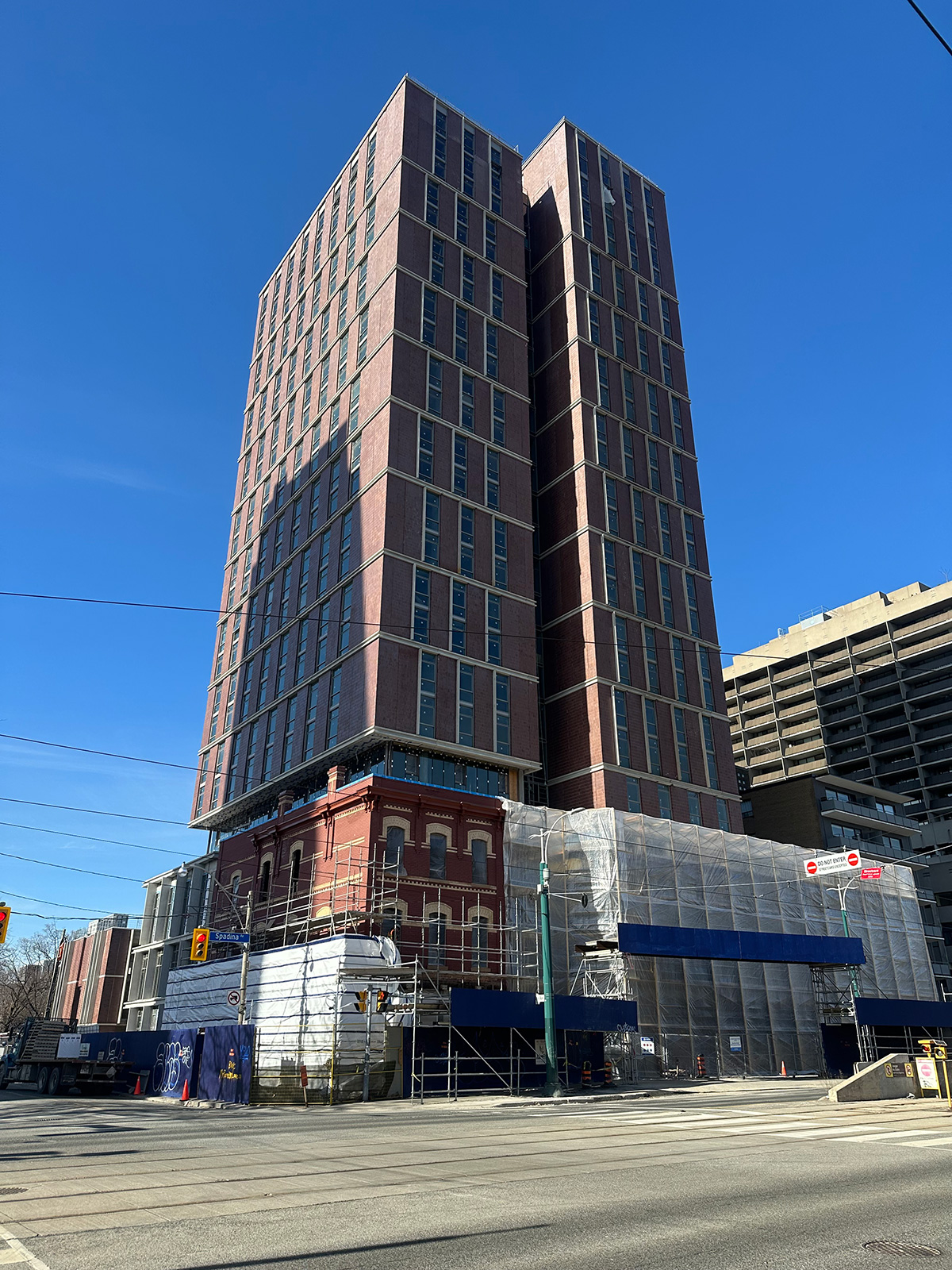
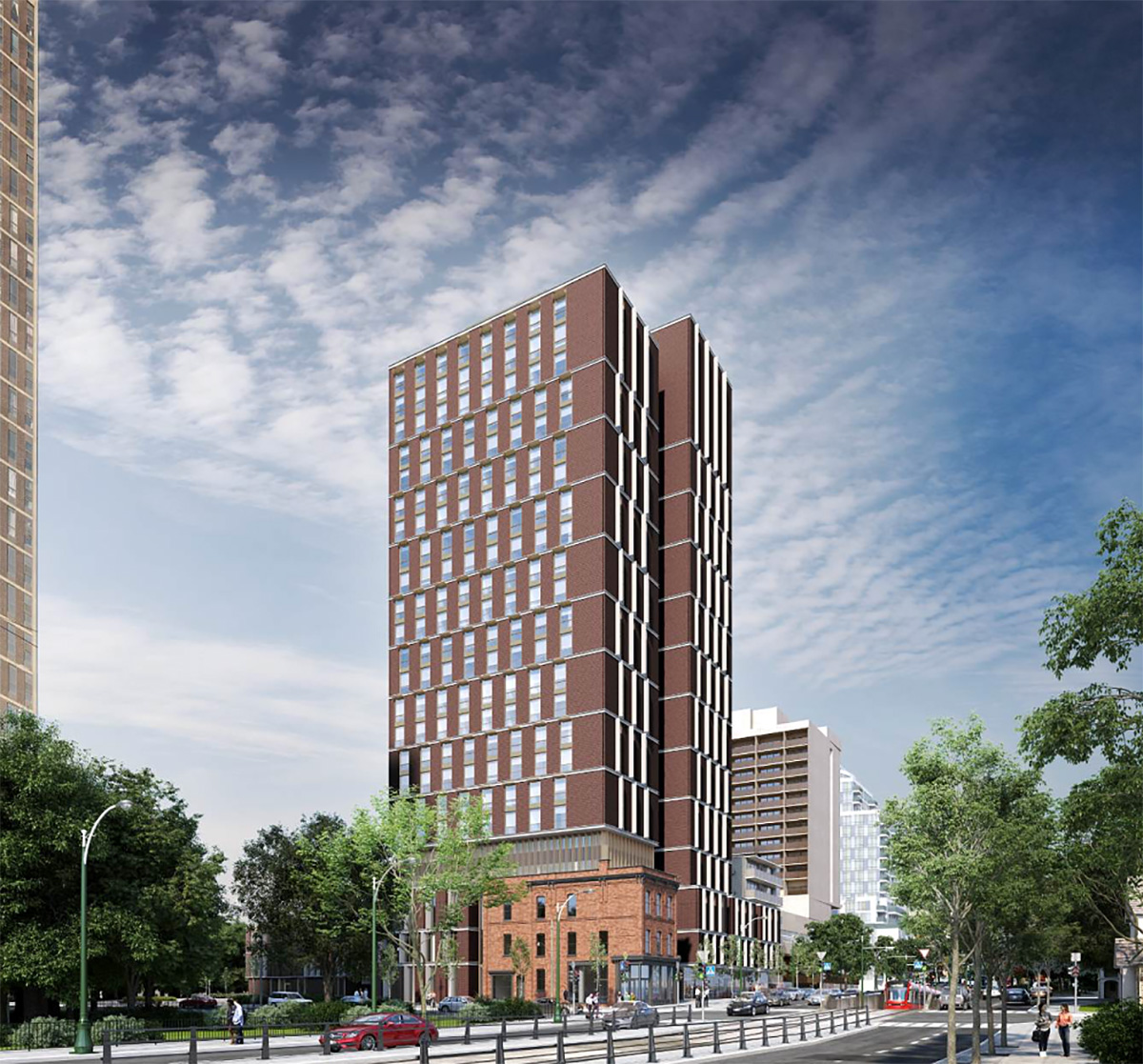
700 Spadina Ave.The University of Toronto’s new 70-metre, 23-storey student residence is near completion.
The building will house 508 students and provide student amenity space, as well as retail space along Spadina Avenue. A small row of townhouses is also being built on the site facing the alley at the rear.
Notably, the university agreed to accommodate and restore the built form of the building on the corner of Spadina and Sussex which accommodated Ten Editions bookstore for many years.
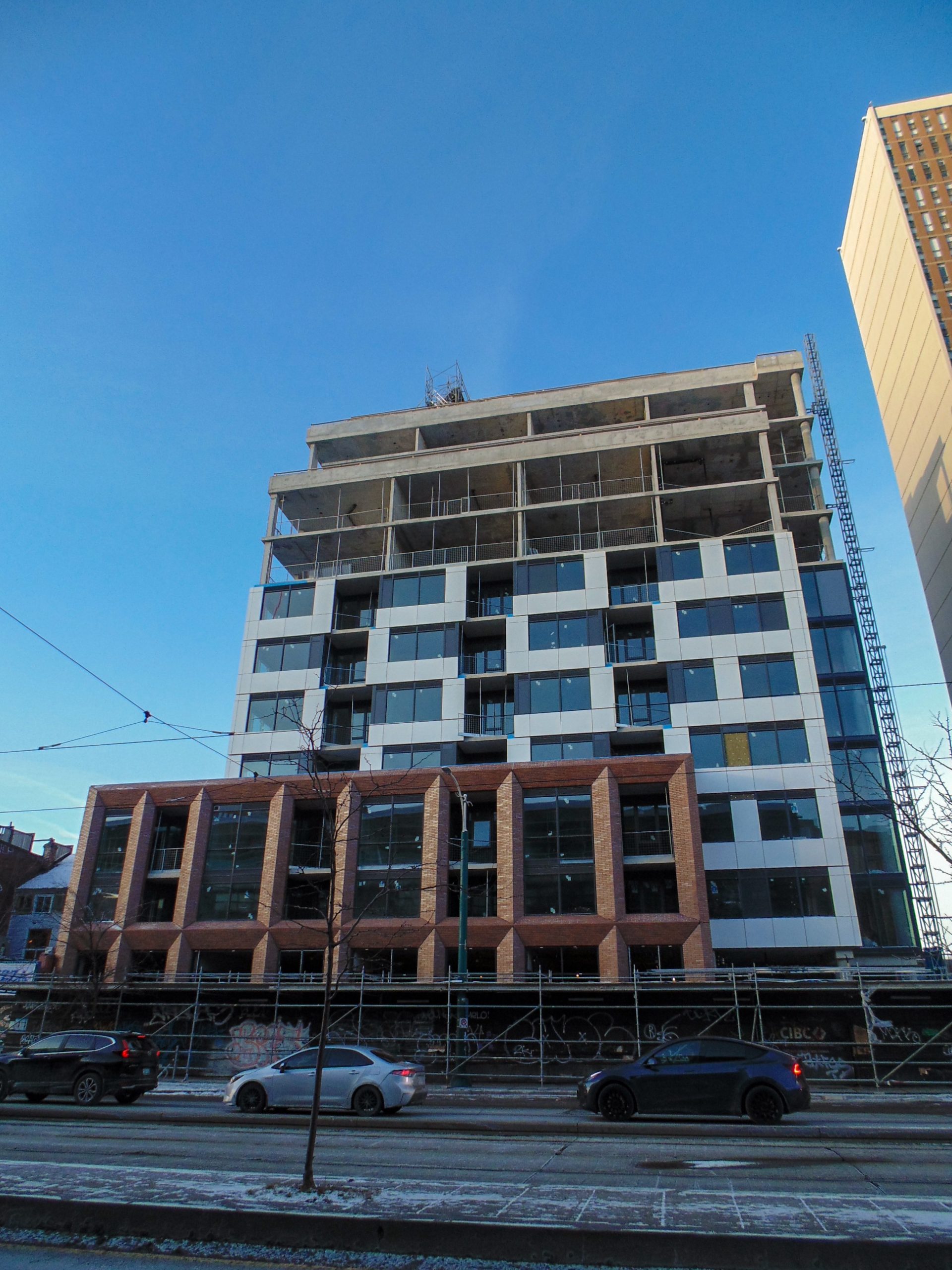
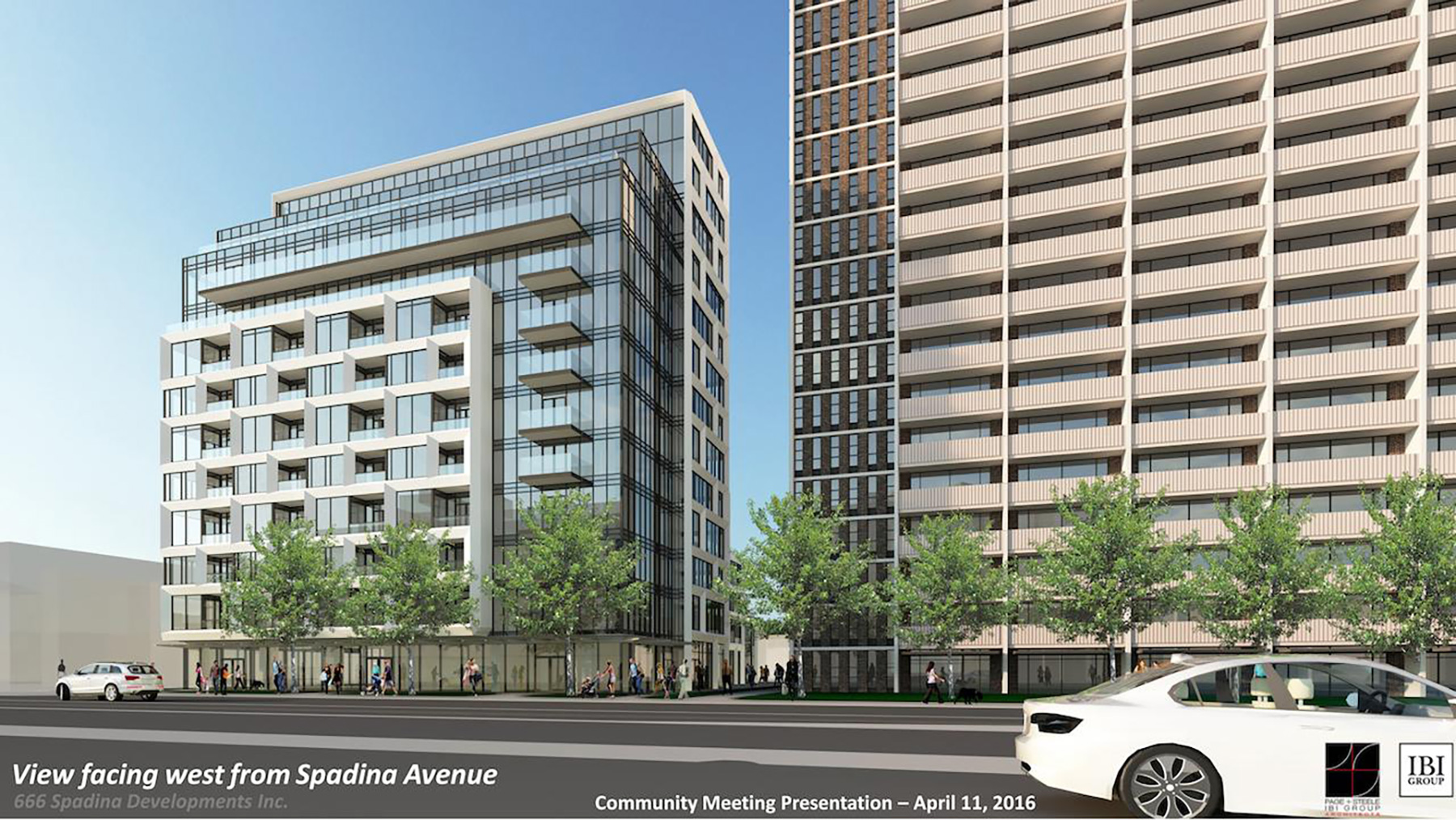
Construction well underway at 666 Spadina Ave.Rendering for 666 Spadina Ave.
666 Spadina Ave. An 11-storey condo tower is being constructed just south of an existing rental building, an Uno Prii-designed modernist tower.
The new build is south of the existing structure and north of Harbord, about a city block and a half from Bloor Street.
The tower will include 119 units and eight four-storey townhouses on the west side along the alley. Though the build is well along, the developer has not posted an expected completion date or prices.
The developer, Cromwell Property Management Group, also operates the adjacent residential tower.
—With files from Mia Keskinen. Rendering courtesy of 666 Spadina Developments
The east portion of the site, where University of Toronto Schools is housed, has undergone a recent significant capital renewal and will remain protected in the re-development. COURTESY UNIVERSITY OF TORONTO MEDIA RELATIONS
371 Bloor St. W. UTS Block Site 1 v The University of Toronto’s Site 1: The Gateway project will be located at the southeast corner of Bloor Street W. and Spadina Avenue and will feature a mix of residential, academic, retail, and outdoor space.
Two towers are planned: 27 storeys for the Bloor Street frontage and 22 storeys for the Spadina Avenue frontage.
In total 700-800 residential units would be built in varying configurations.
Westbank, the developer of the ambitious Mirvish Village project at Bloor and Bathurst, has been selected by U of T to lead the project. University of Toronto Schools, presently on the site, would not be affected, according to the university.
No plans have been submitted for approval and no dates have been published.
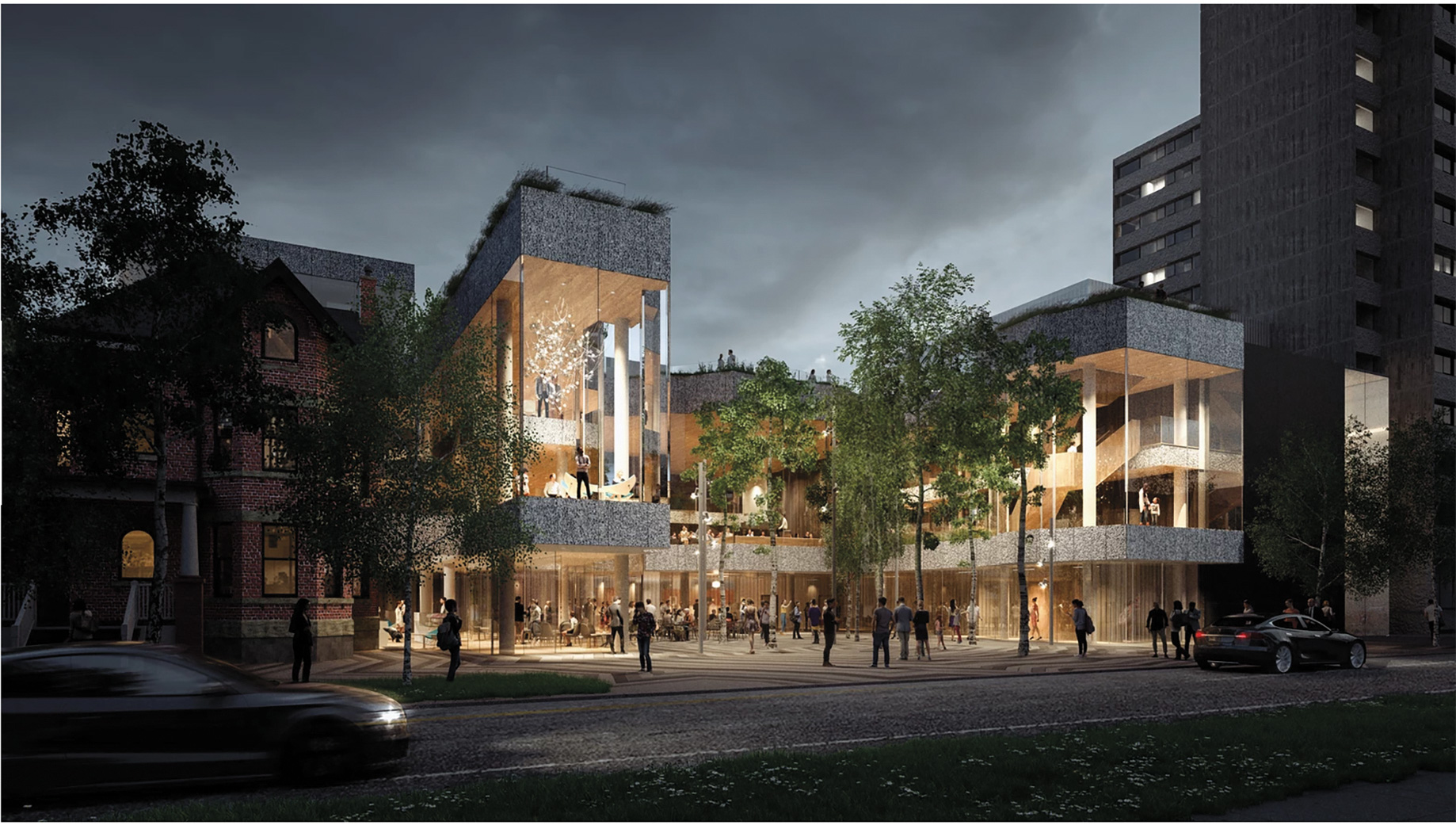
Construction at 9-11 Madison began in 2022.Rendering of the completed Keskus International Estonian Centre.
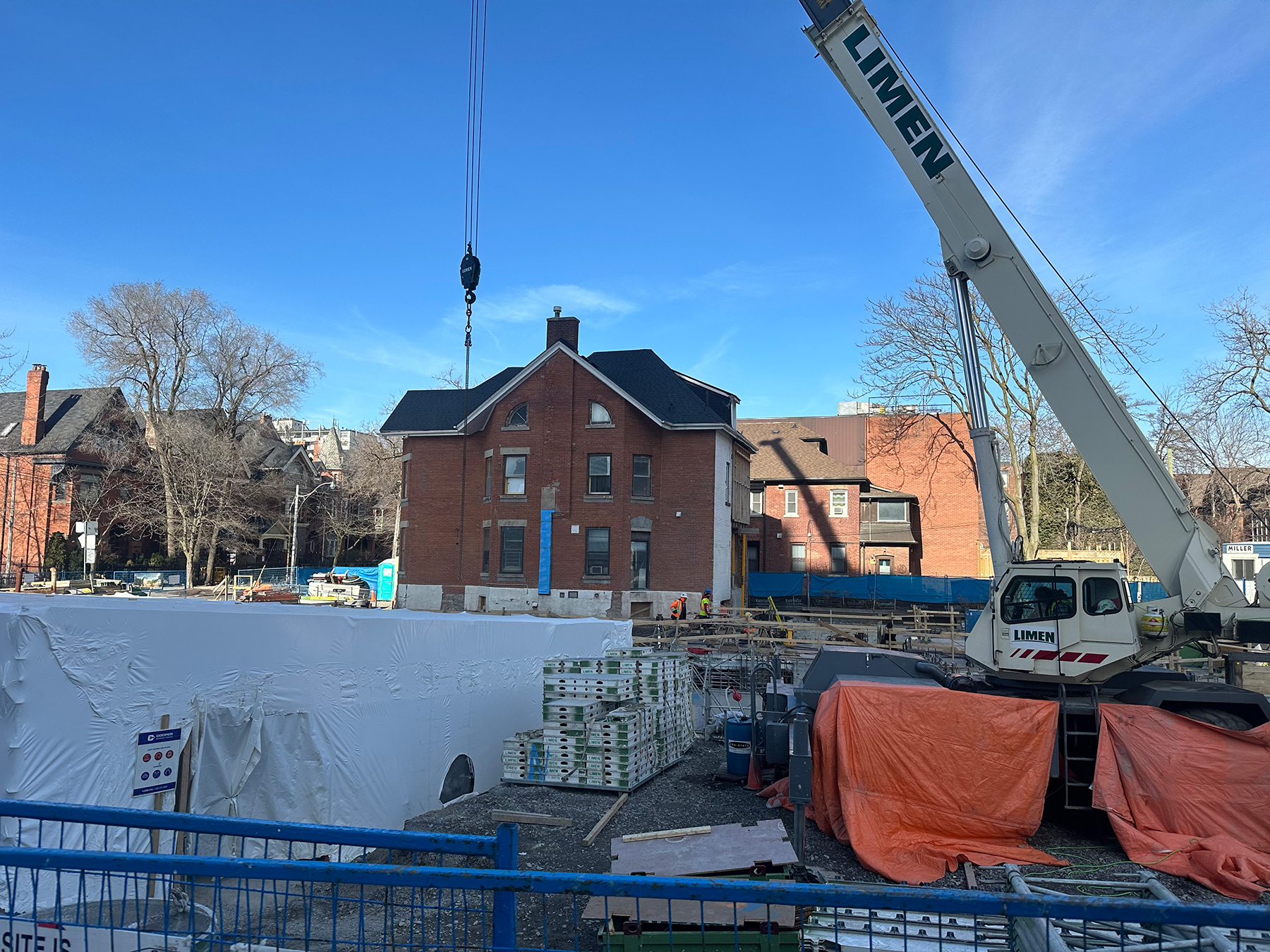
9-11 Madison Ave. Construction on the KESKUS International Estonian Centre, began in April 2022.
KESKUS will be replacing the Toronto Estonian House, originally located near Danforth Avenue and Broadview Avenue as the centre of Estonian heritage, community, and culture in Toronto. KESKUS is also meant to encourage business relations between Canada and Estonia.
This development is rapidly moving through the difficult challenge of building over and around the TTC Line 2 subway tunnel. The current construction will rise above ground level by the end this spring. The courtyard contour mirrors that of the shape of the Estonian state. Facing the courtyard is a glass wall featuring 6.5-meter-high triple glass. These 21-foot-tall panes are being produced in Europe.
The interior of the building will feature a large event and performance space that will be made available to the public, as well as spaces for other Estonian services.
This project has a budget of $41 million and an estimated completion date of 2025.
April 6th, 2024 · Comments Off on Grading our greenspace (Feb. 2024)
A plethora of parks in the Annex get judged
Compiled by Mia Keskinen
Each year the Annex Gleaner reviews the abundance of parks in our coverage area using a variety of criteria.
While there is no decisive “winner” of the grading, letter grades are assigned to convey the quality of the parks considering aspects such as upkeep, design, and amenities.
The reviews accompanying the grades also let the reader know what makes each space unique.
This collection of park reviews is the third and final instalment of the 2023 series and contains ten park reviews, with more gradings to come this summer.
Bickford Park is an expansive greenspace popular with dog owners due to its fenced-in dog park and spacious fields. JUAN ROMERO/GLEANER NEWS
Bickford Park
400 Grace St.
Grade: A- (Last Year A-)
Reason to go: This park has expansive green space and rolling hills. There’s an innate charm to this green space that is tucked into the city. Even in the fall, as the world goes quiet, life permeates the rolling hills of this park, as puppies run around behind the fences of the dog park. Overall, this park is a peaceful place of respite; however, sounds of the city can be heard over the rustling leaves of bright red and orange hues. There are several amenities that make this park enticing including a baseball diamond, a fenced-in dog park, as well as washrooms, which, as mentioned in the 2020 article reviewing the Annex’s greenspaces, could definitely be cleaner. However, this park is a hidden gem for those looking to escape the city life for a moment of quiet.
Overheard: A group of high school boys laughing at the little puppies barking at each other.
Did you know: Bickford Park is named after Colonel E. Oscar Bickford who was a businessman and politician in Toronto.
Jean Sibelius Park, named after the Finnish composer, features several amenities, such as a rock climbing park, picnic benches and a bike share. TANYA IELYSEIEVA/GLEANER NEWS
Jean Sibelius Square
50 Kendal Ave.
Grade: A+ (last year A)
Reasons to go: Jean Sibelius can be found in the heart of a historical residential neighbourhood, providing an escape from the city. The sounds of cars dissipate into the white noise of the city. There are several amenities that create a sufficient park space including a unique playground for the little ones, a rock climbing space, a clean fountain, a bike share, several park benches and picnic tables, as well a spacious patch of grass where dogs and children can be seen running around. This park makes it easier to see life in technicolour, as there is an enticing mural with bright hues painted on one of the walls in the park, reminding pedestrians to see the beauty in life. This greenspace is perfect for families, couples, dog walkers, and all parkgoers alike.
Overheard: “Oh you have two sticks now! You’re such a lucky girl!” – a woman playing with her dog.
Did you know: Jean Sibelius had an affinity for November and December, due to his Finnish heritage. His biographer wrote “. . . Even by Nordic standards, Sibelius responded with exceptional intensity to the moods of nature and the changes in the seasons: he scanned the skies with his binoculars for the geese flying over the lake ice, listened to the screech of the cranes, and heard the cries of the curlew echo over the marshy grounds just below Ainola [his home, named after his wife]. He savoured the spring blossoms every bit as much as he did autumnal scents and colours. . .” Sibelius inspires parkgoers to embrace change and to metamorphose with the seasons by continuing to enjoy nature throughout the year.
Euclid Avenue Parkette
711 Euclid Ave.
Grade: D- (last year D)
Reason to go: This parkette is not so much of a greenspace as it is a glorified strip of dirt. The park benches face a street lined with apartments and each one is covered in graffiti. It is loud, and parkgoers will have a hard time forgetting that this greenspace resides in the heart of the city with the bustling sounds of Toronto streets ever-present. As one walks through the park, the ground, littered with trash, reverberates as the subway rumbles along the underground tracks. If you are looking for greenspace to escape the fast pace of the city, it is not suggested you visit this parkette.
Overheard: A man walking three golden retrievers, each contentedly huffing and puffing.
Did you know: Just steps away from this tired strip of park, there is an eclectic street bustling with diverse businesses. Parkgoers can venture over to explore the liveliness of this neighbourhood which contrasts with Euclid Avenue Parkette’s lifelessness.
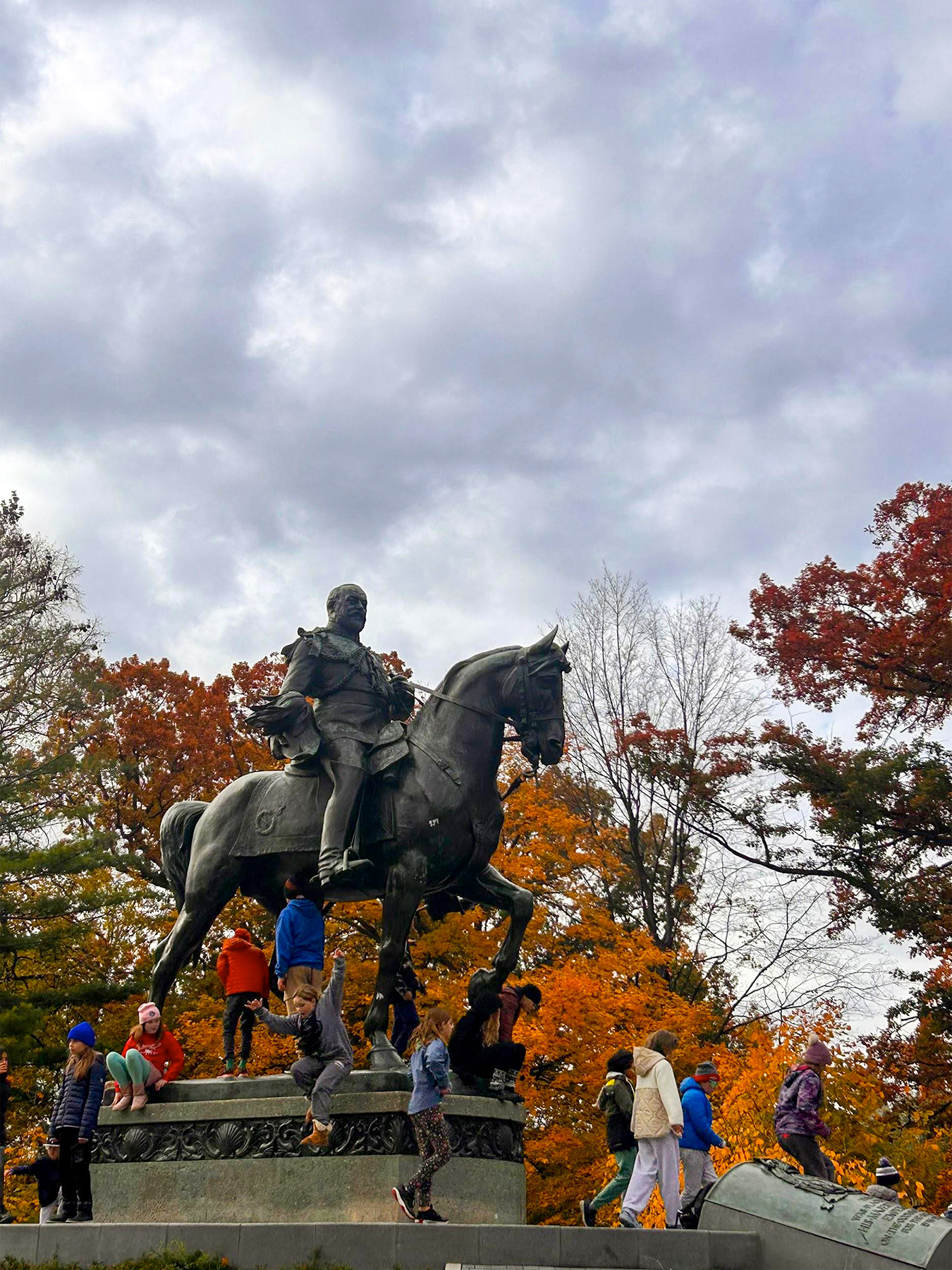
Queen’s Park with its statue of King Edward VII, remains a vibrant green space in the heart of the city. MIA KESKINEN/GLEANER NEWS
Queen’s Park
110 Wellesley Ave. W.
Grade: A (Last year B)
Reasons to go: This park sprawls across the heart of the city, close to the Ontario Legislature and the University of Toronto campus. Queen’s Park is a beautiful place to relax; however, it is likely that students and government employees will be seen walking through the park, as opposed to families, as this greenspace lacks a play structure. In the midst of the tall oak trees, lies a statue of King Edward VII and paths stretch below his stallion’s feet. Due to the lack of play structure, children can be seen climbing the statue, which in this moment, represents the connective tissue between the days of old and the youth of today.
Did you know: In the wake of Queen Elizabeth’s passing, a statue of the late Queen was erected.
Overheard: An older man doing martial arts by the statue of King Edward VII, as children play on the statue, representing the circle of life, youth and senescence ever present in the park.
St. Alban’s Square
90 Howland Ave.
Grade: A (Last Year B+)
Reason to go: This square allows parkgoers to get away from buildings that scrape the sky as it is nestled between old homes, as well as a church. St Alban’s Square is reminiscent of a park in the pages of a storybook, with its picturesque beauty. There is a lack of amenities, but it is nonetheless a lovely place to remind oneself of the importance of the little things and of stopping to smell the roses.
Overheard: “Thank you!” a man kindly gives a sleeping bag to a homeless couple.
Did you know: The church next to the square is no longer used for religious gatherings, but rather as a building for the students attending Royal St. George’s College.
Vermont Square Park
819 Palmerston Ave.
Grade:
Reason to go: This park is a beautiful hidden gem in the quaint neighbourhood of Seaton Village. It has several amenities such as rolling green hills (made for children and dogs to run amok), park benches, as well as a playground built like a pirate ship. . A certain childlike glee permeates this greenspace, as each parkgoer looks at ease, walking through the trees with autumn leaves swaying in the breeze.
Overheard: A dog jumping happily through the autumn leaves
Did you know: This city park is home to the BGC St. Alban’s Club, an agency dedicated to helping families by offering various recreational programs.
Hillcrest Park is a hidden gem with many amenities including three tennis courts, a stone tennis table, a basketball court, sand playground, and wading pool. TANYA IELYSEIEVA/GLEANER NEWS
Hillcrest Park
950 Davenport Rd.
Grade: A+ (last year A+)
Reason to go: Hillcrest continues to uphold its reputation as an excellent greenspace. Sitting in this park will evoke similar feelings to that of being entranced in an Elysium. The walkway to this park is quite charming; a staircase shrouded by forestry evokes a feeling of mystery and wonder for what will be uncovered atop the staircase. This park is perfect for anybody, as it has an abundance of amenities including several park benches, a tennis court, a playground, a basketball court, an enclosed dog play area, a table tennis made of stone, as well as clean bathrooms. The noise of Christie Street and Davenport Road is blanketed by the line of trees atop the hill, making it a serene getaway from the streets of Toronto.
Overheard: A woman and her dog chase each other through the autumn leaves, each giddy with childhood glee.
Did you know: In the famous movie, Scott Pilgrim vs. The World, a story based and filmed in Toronto, Hillcrest Park is featured in the scenes where Scott takes Ramona on their first date. There is also a song in the movie called Hillcrest Park by Nigel Godrich. Next time you visit this park, try listening to the song; it will make you feel like the main character in a movie.
Wychwood Barns, once a TTC service depot, features a beach volleyball court and an enclosed dog park. JUAN ROMERO/GLEANER NEWS
Wychwood Barns Park
76 Wychwood Ave.
Grade: A+ (last year A)
Reason to go: This multi-use park is an excellent greenspace. It is well-maintained and makes efficient use of the space with amenities such as a beach volleyball court, a small, enclosed dog park, several park benches, as well as the Wychwood Barns, a gathering place that creates a sense of community. At the Wychwood Barns, many events are held, which is an enticing aspect of this greenspace for all members of the community.
Overheard: A mother and her little one chasing each other out of the Wychwood barns and into the neighbourhood.
Did you know: The City of Toronto currently leases Wychwood Barns to Toronto Artscape Inc., a non-profit organization that provides art-based recreational activities.
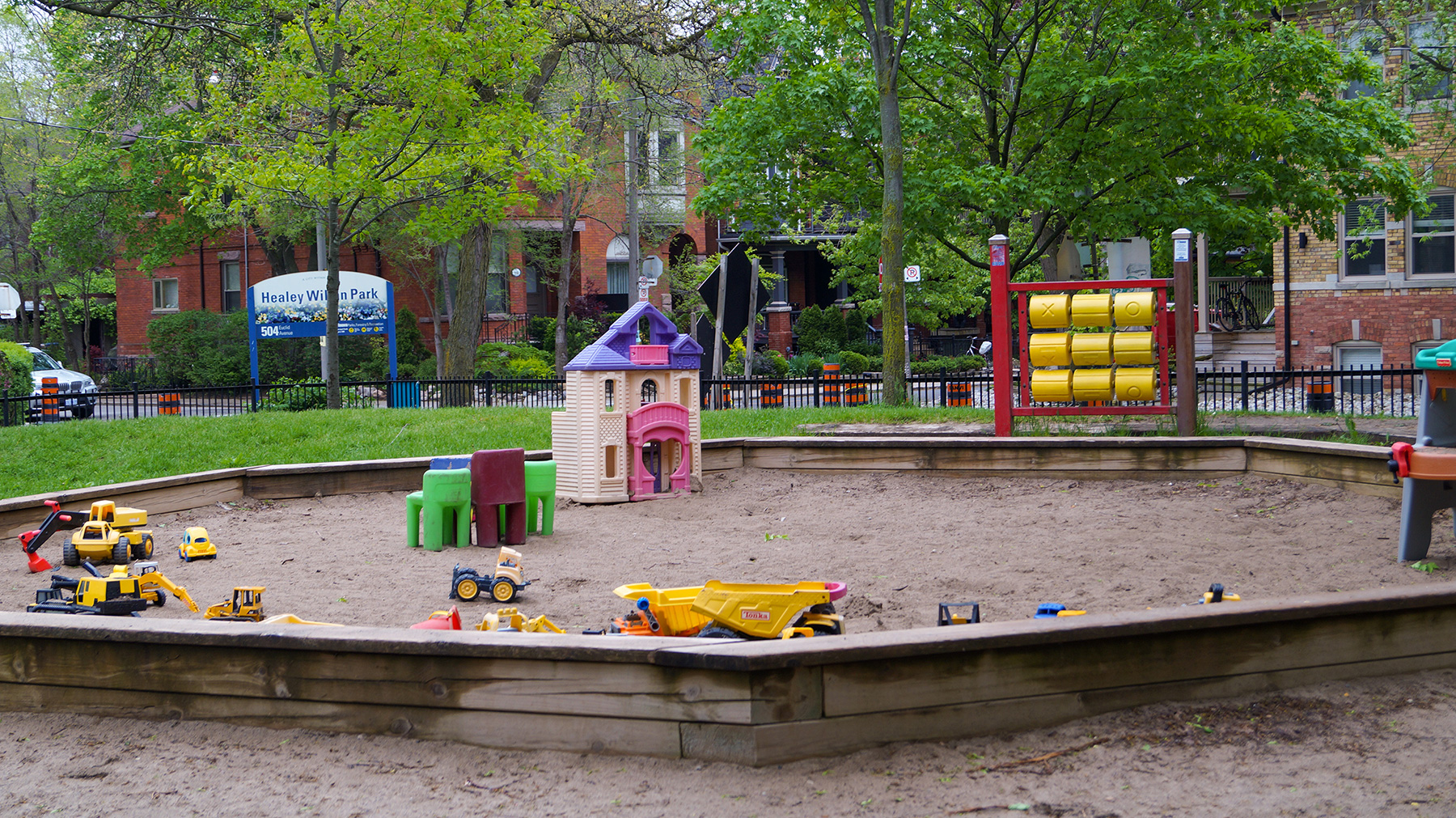
Healey Willan Park is a small enclosed park meant for little ones featuring a sandbox filled with toys and picnic benches; however, it fails to sustain a welcoming environment all year round. JUAN ROMERO/GLEANER NEWS
Healey Willan Park
504 Euclid Ave.
Grade: C+ (Last year B)
Reason to go: In the autumn this park is quite desolate, with yellow grass crunching underneath footfalls the only sound that can be heard. It is perhaps the time of year that creates a feeling of eerie desolation. The park is tucked behind a fence gate meant to keep little ones enclosed to run around to their hearts’ content. However, at the time of inspection the space is void of any children; in fact, void of anyone at all, and left behind are lonely toys, swings and several picnic tables. It evokes a sense of isolation, and there were many people within the neighbourhood who could be seen with their dogs, or children in tow, headed for Bickford Park, which is about 15 minutes down the road and has more to offer than Healey Willan Park. In theory, the park has the necessary amenities to create a sufficient park space; however, in practice, it lacks the warmth and human spirit that preserves the essence of life in the colder seasons.
Overheard: Lonely swings humming in the biting cold autumn breeze.
Walmer Road Parkette
227 Walmer Rd.
Grade: B+ (Last Year B)
Reason to go: This parkette bears a quaintness that can be found in cinema; Walmer Road Parkette is nestled in between beautiful, European-inspired townhouses. Walking through this residential street makes one think of walking through a quiet neighbourhood in London. The park is well-maintained. Tall pine trees guarding three park benches allow for sun to warm the space, in lieu of the cold autumn air. Time slows to a halt in this greenspace, and it’s a beautiful place to find yourself lost in thought amongst the trees. Adding to the beauty, Casa Loma can be seen looming over the horizon in the distance. This park may not have many amenities to offer, but its fairytale view and peaceful ambience makes up for it.
Overheard: Maintenance worker having a friendly interaction with the mail carrier.
Did you know: The homes on this residential street are inspired by the architecture of Pimlico and Bath, England, which explains the European feeling that permeates this neighbourhood.
April 6th, 2024 · Comments Off on NEWS: Shoppers Drug Mart changes course after story (Feb. 2024)
Monitoring now only occurs at point of purchase
Video surveillance has taken the place of human receipt checkers at Shoppers. BRIAN BURCHELL/GLEANER NEWS
By Brian Burchell
Following the Annex Gleaner article that appeared in December 2023: “Receipt checks raise retail conflict,” the Shoppers Drug Mart on Bloor Street West at Walmer Road has ceased the practise of asking customers to show receipts after using the self-checkout.
The article chronicled the backlash that the location was facing over the program.
Not only did the store not have the legal right to require customers to show receipts for their purchases, but the risk of discrimination was evident as security staff had to decide who they should check, leaving the door wide open to bias.
Cameras now monitor the point of purchase at the self-checkout in a manner that is both passive and universal.
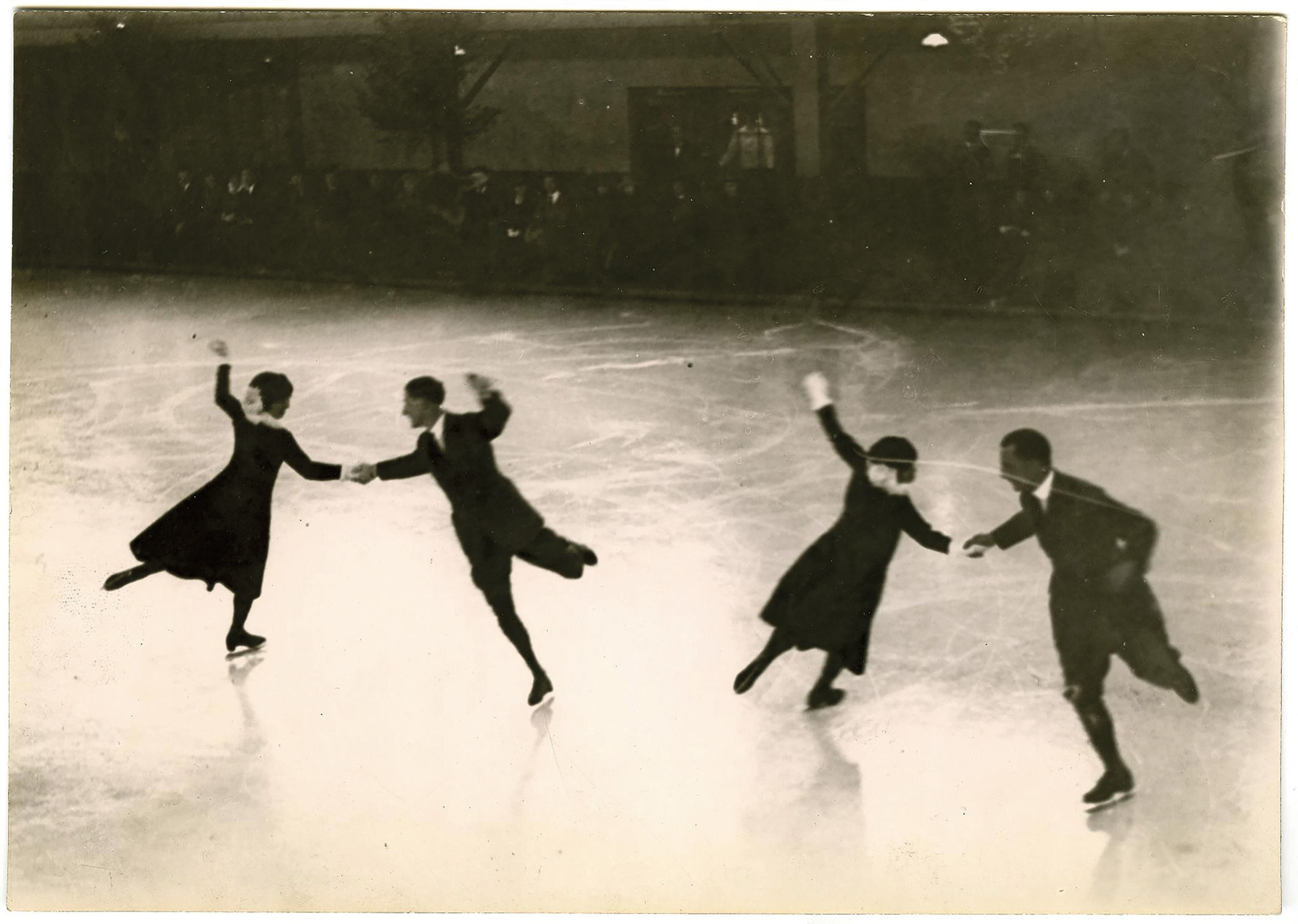
I just wanted to thank you for the lovely article [by Mia Keskinen] on the Toronto Skating Club on Dupont Street. You captured the spirit of the skating history.
As a very young child, I remember being at the Toronto Skating Club on Dupont watching my sister Petra Burka (who later became a World Champion) perform there.
Recently The Bata Shoe Museum and myself partnered to do a digital website called:
Boots & Blades: The Story of Canadian Figure Skating – bootsandblades.ca.
You will see in the section 1920-1945 Form follows Function more information about some of the skaters mentioned in your article.
April 6th, 2024 · Comments Off on HISTORY: Sturdy structure once housed Meteorological Service (Feb. 2024)
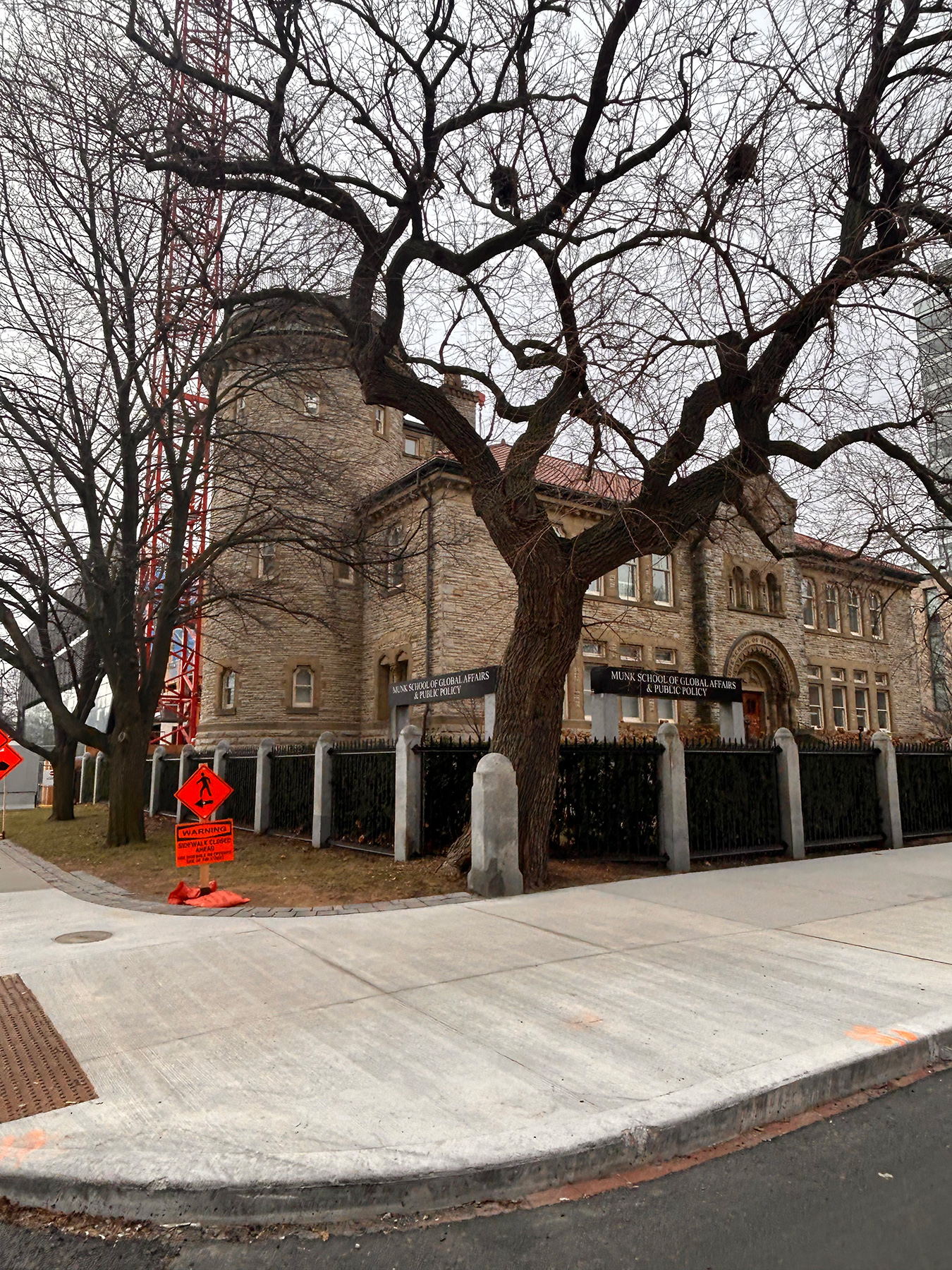
Building at 315 Bloor St. W. now occupied by Munk Centre for Global Affairs
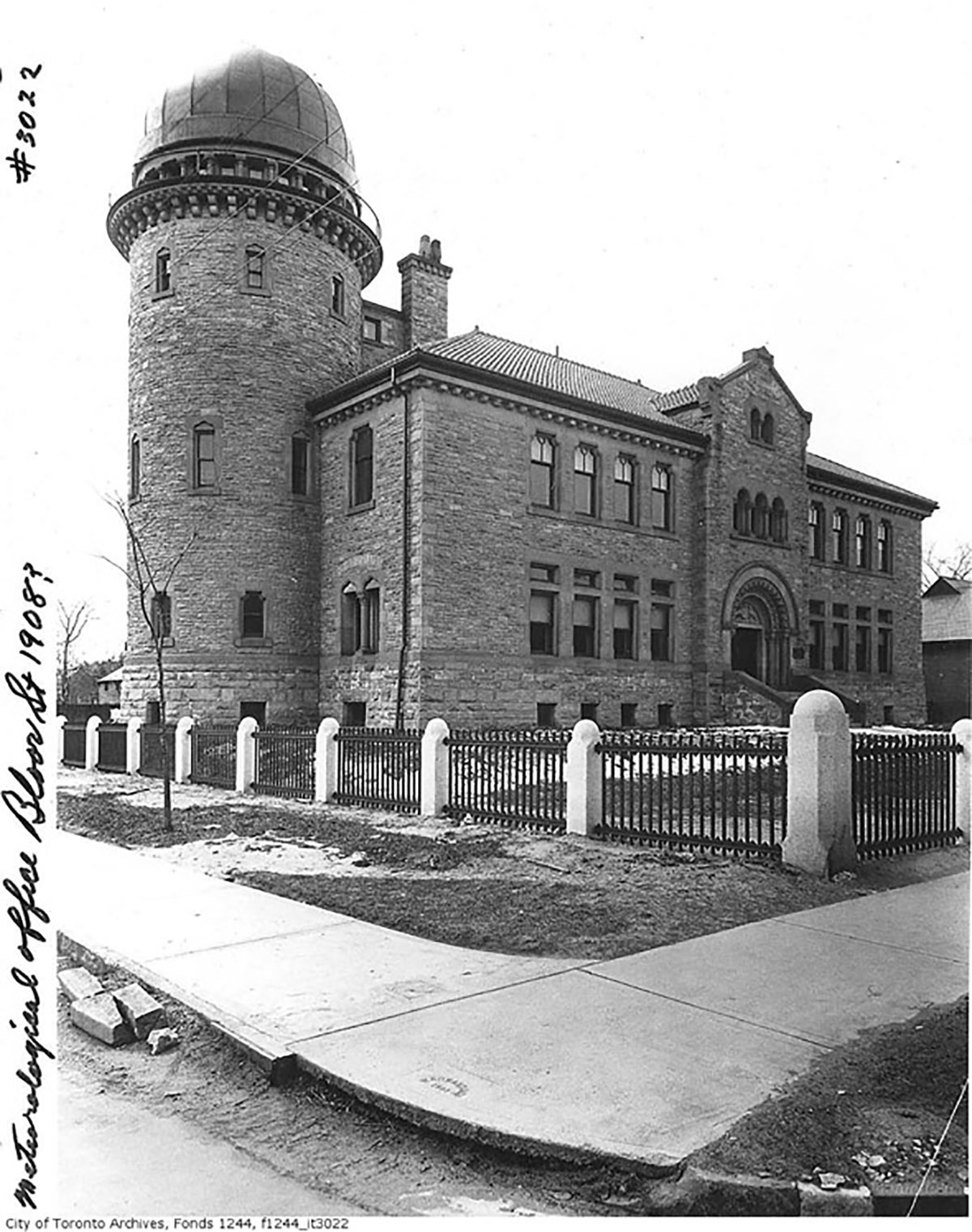
This building, located at 315 Bloor St. W. at Devonshire, was built in 1909 as one of Toronto’s first buildings designed for meteorological study. COURTESY CITY OF TORONTO ARCHIVES
By Mia Keskinen
The building located at 315 Bloor St. W. and Devonshire Place, adjacent to Varsity Stadium, is known for many things, but was built with the specific purpose of conducting meteorological and astronomical research in Canada.
Completed on August 5, 1909, the structure was designed by architects at the firm Burke and Horwood.
The building’s Romanesque Revival style is a gem in the heart of the city, a reminder of what once was, with sun-kissed, tan stone bricks, and gargoyles guarding the entrances for over a hundred years.
The picture above encapsulates its historical significance in the city, showing that it has loomed large since the date of its construction.
The study of meteorology in Canada predates this building. The Meteorological Service of Canada (MSC) was established for $5000 with a grant to Professor G. T. Kingston of U of T.
His job was to establish a network of weather observations, and the first Toronto Magnetic and Meteorological Observatory was built of wood in 1840 which was located near Convocation Hall, much further south on the U of T campus.
The electrification of newly built streetcar tracks along College Street and the usage of metal in modern buildings surrounding the facility disrupted the magnetic field in the building, making it very difficult to conduct research.
By 1907, new university buildings encompassed the surrounding area of the observatory; astronomical research quickly became impossible due to lights elucidating the night sky. Due to these factors, the Meteorological Office decided they would relocate to this “new” building in 1907 at 315 Bloor St. W.
The building at 315 Bloor St. W. played a major role in World War II, as pilots were taught how to read the weather at this facility.
The renovated and re-purposed building at 315 Bloor St. W at Devonshire stands strong. MIA KESKINEN/GLEANER NEWS
According to a plaque listing the historical significance of this building, “The British Army began regular meteorological and magnetic studies on this campus, stimulating colonial society’s fascination with science.”
For several years, the site served as U of T’s admissions office; however, in 2012, the building underwent a transformation.
With a $35 million gift from Peter and Melanie Munk, it was restored to its original historic beauty, becoming the new face of U of T’s northern entrance.
The exterior was polished, revealing golden tan stones. Today, this facility houses U of T’s Munk School of Global Affairs & Public Policy.
This Bloor Street building has stood the test of time and remains an important educational facility.
April 6th, 2024 · Comments Off on EDITORIAL: The “Get it Done Act” should get Ford out (Feb. 2024)
Premier Doug Ford’s latest gimmick is his pending “Get it Done Act.” Ford is banking on Ontario voters having short memories, being easily duped, and not minding at all being bribed with their own money. This latest omnibus legislation is a dog’s breakfast of silly, shiny objects designed to distract from a string of failures and flip flops that appear to have been authored by the premier himself.
The Act aims to constrain future Ontario governments from introducing a carbon tax without a referendum. Of course, we only have a carbon tax, the federal one, because Ford scraped the former government’s cap-and-trade policy and had no climate change plan of his own. Ford fought the feds on the federal tax all the way to the Supreme Court and lost. It’s not likely that this government is serious about addressing climate change or is really prepared to even acknowledge it as a crisis. The threat of a provincial carbon tax is not a real one. The omnibus bill is also completely toothless, as any future government can simply repeal it.
The legislation also aims to make licence plate renewals automatic. Apparently, the province’s 2022 move to relieve drivers of the $120 annual licence fee has not gone so smoothly. It costs the Ontario treasury $1.2 billion in revenue annually. The province says over one million vehicle owners did not appreciate that they still needed to renew their plates even though there is no fee. This created much confusion as many were given $1000 tickets for driving with expired permits. Even for those who renewed, no new stickers were provided. Those who travel out of province appear to be driving on expired permits which attracts extra jurisdictional fines and unnecessary police interactions.
The “Get it Done Act” also promises to prohibit tolls on provincial highways. Of course there are no tolls, or plans to have them, on provincial highways except on Highway 407. The Act will not touch the 407 which was created by another Conservative government, then led by Mike Harris. We have Harris to thank for building a highway that few Ontarians can afford to use.
It’s no wonder such useless legislation is conjured up. The premier needs to distract voters lest they reflect on his string of failures and reversals, such as:
Bill 124, the wage restraint law introduced in 2022 holding public-sector workers to a one per cent pay increase per year. It was struck down this month by the Ontario Court of Appeal on constitutional grounds. Ford had promised it would save Ontario taxpayers $9.7 billion, but instead it will cost them $13.7 billion according to Ontario’s financial accountability officer. Thanks Doug. It was a terrible law to begin with as it drove workers such as nurses away creating a myriad of new problems. The wage restraint bill was also very inequitable as it applied to nurses and teachers, female dominated professions, but did not apply to fire fighters and police officers, male dominated professions. Hmmm…. In any case, it’s just another failed Ford stunt that will cost you billions. And the nurses that left the province are probably not coming back any time soon.
On the promise to dissolve the Region of Peel and make Mississauga, Brampton, and Caledon independent cities Ford has reversed course. When the former mayor of Mississauga, Bonnie Crombie, who supported dissolving Peel, took the reins of the Ontario Liberal Party, Ford promptly abandoned the plan. As Crombie is a serious threat to Ford, he has already started the election campaign to oppose her and does not care what good policy he needs to ditch along the road to re-election.
The largest of the government’s policy reversals has been its 180-degree turn on redeveloping sections of the Greenbelt. Ford ran afoul of the auditor general, the integrity commissioner, public opinion, and is now being investigated by the RCMP. Shady land deals appeared to have happened by developers who were “in the know” about Ford’s plans to convert protected lands into subdivisions. He has now reversed course.
Ford spends more time going backwards than forwards, then spends energy on folksy populism such as the “Get it Done Act.” It’s just a lame attempt to get voters to change the channel. It’s time to change the channel on this premier altogether.
April 5th, 2024 · Comments Off on FORUM: Eventful new year at city council (Feb. 2024)
Budget, development planning, and safety, fill agenda
By Dianne Saxe
Winter weather is always challenging for city staff. Thank you again to all of our frontline workers in emergency response, shelter and outreach, and construction, who are hard at work in winter conditions. I arrived back at my desk more determined than ever to tackle the city’s challenges.
At this time every year, city hall is dominated by the city’s budget. Toronto is squeezed unmercifully between an inadequate, inflexible revenue source (property tax, which doesn’t grow even when property values do) and soaring financial demands. With only 9 cents of every tax dollar, we face aging infrastructure, spiraling construction costs, a growing population, plus about $1.5 billion needed for poverty reduction, which should be paid for by the Ford government. At the same time, many residents are facing financial hardship and feel unable to pay the city more.
The city is doing the best we can to balance these difficult pressures while protecting current service levels, despite serious financial traps, including:
The federal government is flooding the city with refugee claimants that it doesn’t look after and won’t process for more than two years. Their number doubled last year and is likely to double again this year. Even if the feds pay $250 million, as proposed, that would only shelter about 5000 refugee claimants. We have 5,800 now and are on track for over 10,000 this year, with no end in sight. No one has a plan to house or pay for them.
High quality infrastructure is indispensable for a prosperous community. But we are spending so much to shore up the province’s inadequate social services that we can’t fix our infrastructure. We are so far behind on critical repairs to roads, parks, arenas, etc. that costs and breakdowns are going shockingly higher. Expect exponential cost increases, worsening roads, and dropping reliability.
We’re almost completely off-track regarding climate, neither meeting climate reduction targets nor getting ready for what’s ahead. Both mean worse health and bigger costs ahead.
I don’t officially sit on the Budget Committee. But, to protect your interests and to strike the right balance between needs and ability to pay, I read every budget document and asked tough questions at every Budget Committee meeting. We had a great Ward 11 Townhall on the budget in January. I also read all your emails to me on the topic— thank you for caring enough to write! The final budget will be determined by the mayor, perhaps with minor tweaks by council, because of the strong mayor powers imposed by Doug Ford.
Many of your comments focused on the proposed police budget, arguing for increases to deal with hate, auto theft, and break-ins, or decreases to fund other priorities. A detailed Budget Note sets out the CFO’s rationale. A discrepancy of $12.6 million is identified between city staff and TPS budget proposals, $1,174 billion versus $1,186.5 billion net, respectively. At once, $59.7 million in funding is provided to offset added pressures in the 2024 Police Budget, equivalent to a 5.2 per cent increase. Please join me at my Feb. 15 Ward 11 Townhall to discuss safety, auto theft, and policing in our ward.
Meanwhile, I secured some wins for you at committees. Relevant to the Annex, in light of high-profile controversies at 300 and 316 Bloor St. W, the Planning and Housing Committee agreed to consider limiting how much extra height Committees of Adjustment give high-rise developers as “minor variances.” The Infrastructure and Environment Committee (IEC) agreed that bike lanes should be “safe and passable” for bicycles, not just for cars. And IEC agreed that we should obtain a net gain for endangered species when developers put replacement habitat on ity property. This builds on my success ensuring that two chimneys will be built for chimney swifts in Budd Sugarman Park, instead of just one.
Finally, there are some construction notices to report in and around the Annex. Laneway reconstruction will proceed at Albany Ave, Poulter’s Place, Barbara Barret Lane, Herrick St, and Loretto Lane. The work is due to be completed by August, weather dependent. Think of how much better these streets will look with new paving, sidewalks, and permeable treatment!
We invite you as always to reach out to our staff with questions and concerns. Happy New Year to everyone in Ward 11 once more.
Dianne Saxe is city councillor for Ward 11, University-Rosedale.
April 5th, 2024 · Comments Off on FORUM: Report confirms Ford government failures (Feb. 2024)
Independent auditor general annual report paints troubling picture
By Jessica Bell
The auditor general’s office authors an annual report that does a deep dive into a select list of government agencies, departments and government-funded or -regulated institutions to see if they are working as they should. Here’s the lowdown on the office’s latest report.
Hospitals struggle with doctor and nurse shortages, resulting in emergency room closures.
There were over 200 unplanned emergency department closures involving 23 hospitals, mostly in rural areas, in the past year. The closures were mostly due to nursing and doctor shortages. Emergency department wait times remain long, with patients waiting an average of two hours to be assessed by a doctor, up 30 minutes in the last 10 years. How can this be happening in Canada? We treasure our public health care system.
The government is not consultin with the public on environmental decisions.
The Conservatives made drastic changes to energy, land-use planning, and housing without meaningful public consultation.
Ontario’s Environmental Bill of Rights says that Ontarians have the right to be informed and to participate in decisions that affect our land, water, air, and wildlife, from expanding gas plants to permitting sprawl on thousands of acres of farmland. This isn’t happening in Ontario.
The relocation of the Ontario Science Centre is based on flawed evidence.
The decision to relocate the Ontario Science Centre was based on preliminary and incomplete costing information that excluded key costs and proceeded without full consultation from key stakeholders or a clear plan for the existing site.?
The Conservatives crowed that moving the Ontario Science Centre would save money; however, the auditor general’s report suggests that 90 per cent of the claimed savings come from the lower costs of operating a much smaller science centre with less exhibition space.
The process was rigged to reach a predetermined conclusion. The question is why?
The Conservatives are not doing enough to address homelessness.
As downtown residents we see the homelessness crisis firsthand when we walk down the street, take the TTC, or visit an emergency room. We know our city and province are not doing enough to house people.
In 2021, the auditor general released a damning report on the government’s approach to addressing homelessness, concluding the government has no plan to reduce or end homelessness.
It’s two years later, and the government has failed to implement even half of the auditor general’s modest recommendations to address one of Ontario’s biggest moral and social failings.
The report also found that the province’s lack of support for people transitioning out of jails, hospitals, and the child welfare system is a contributing factor to the number of people who are homeless, along with low social assistance rates and the high and escalating cost of rent.
The Conservatives are embracing unsustainable land-use planning.
The auditor general found that the region is building too much sprawl and not doing enough to increase density, improve transit, and protect our farmland and greenspaces.
The AG’s follow-up report concluded the Ford government had neglected most of the auditor general’s recommendations on how it could track its progress on land-use planning, implementing just one of 12 recommendations. No surprises here.
Condo residents need better consumer protections.
Thousands of Torontonians live in condos, sharing everything from elevators, air, and party rooms. Some of these buildings are so big they have multimillion-dollar budgets and house as many people as small towns. Just like there’s rules for towns, there needs to be sensible, fair, and enforceable rules to ensure we get condo living right.
I have been working with other MPPs to improve condo standards because we get many complaints from condo residents. Some of the most common complaints are about illegal Airbnbs, massive hikes in condo fees, condo boards that refuse to hold fair elections, property managers that don’t do their job, and new buildings rife with flaws and defects, from poor ventilation to flooding. Many are incredibly angry to learn that there’s little they can do to fix their problems.
The auditor general’s latest progress report shows that while some progress has been made to improve protections, Ontario still has a long way to go to ensure condo residents can seek redress if they have a concern with their condo board, property manager, building developer, or neighbour.
In the coming months, other MPPs and I will collaborate with the auditor general’s office to improve the performance of these sectors. I look forward to hearing your comments or feedback on these matters.
Jessica Bell is the MPP for University-Rosedale and the Official Opposition’s Housing Critic. She can be reached at jbell@ndp.on.ca or 416-535-7206.
April 5th, 2024 · Comments Off on HISTORY: Dupont building was a purpose-built car factory (Feb. 2024)
Examining the old and new: Toronto’s first Model T assembly plant
Pictured above at left: a 1915 Ford Model Roadster model; middle: 672 Dupont at Christie where these models were assembled; and at right: a 1915 Ford Model T Coupe. Both cars are on permanent display at 672 Dupont and it’s free to visit!
By Mia Keskinen
At the turn of the 20th century, Toronto was considered a car manufacturing town; now, this is a distant memory. Evidence can still be found today, as the location of Toronto’s first Model T factory was at Dupont and Christie streets.
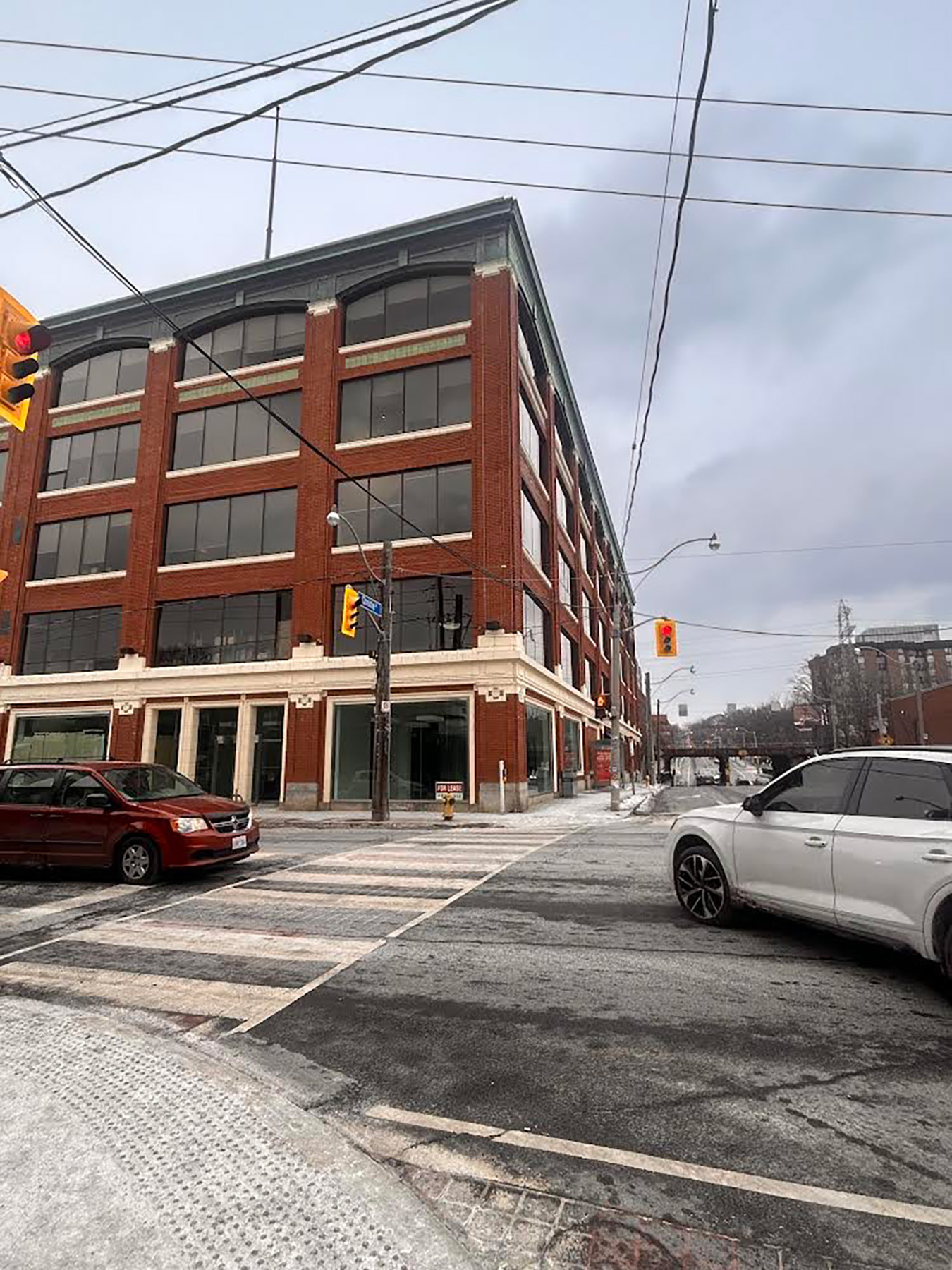
In 1915, a Ford Model T assembly plant and show room was built at 672 Dupont St., now owned by Faema, a commercial coffee equipment supplier. Each of the five floors were built with reinforced flooring to support the weight of the automobiles being assembled. Each floor also had a different purpose. The first floor was the showroom. Model Ts, which were only available in a sleek black colour, retailed for a significantly lower price than vehicles today. They cost $360, which equates to $9,566 in today’s dollars. Currently, Faema’s displays two of the original Model Ts in its windows and a sign that details the vehicle’s history, giving Toronto residents a glimpse into the past.
Henry Ford, who lived from 1863-1947, was a notable inventor and industrialist. He created the Ford Motor Company in 1903. On Oct. 1, 1908, Ford invented the Model T, the first automobile that would be mass-produced on an assembly line and would make record sales of over 16 million automobiles over the next 20 years. Given the high demand for the Model T, the Ford Motor Company expanded internationally. In Canada, it built assembly plants in Montreal, Winnipeg, Vancouver, and Toronto.
The plant on Dupont was built at that site because of proximity to the rail line. Loading docks facing the Canadian Pacific Railway tracks were located on the second floor, as this floor was created for imports and exports.
Parts were brought in by train, and cars were shipped throughout Canada and the world, especially the British Empire. The third and fourth floors contained the assembly line. This facility also manufactured right-hand drive cars that were exported to several British colonies, including India and Australia. Finally, the fifth floor was a paint shop where each Model T was painted a sleek black colour. Perhaps most surprisingly, the roof also had a test track for the finished product.
In the mid-1920s, the Ford Motor Company relocated its operational facilities to a factory close to Danforth Avenue and Victoria Park Avenue. There is significantly less public knowledge about this plant as it did not establish the same notoriety as Toronto’s first assembly plant. The original building, at 672 Dupont St., has stood the test of time. Both its exterior (vivacious red bricks) and its interior, are in pristine condition due to Faema’s historical preservation efforts. This building is a true hidden gem and is testament to the Annex’s industrial period in the early 20th century.
Comments Off on HISTORY: Dupont building was a purpose-built car factory (Feb. 2024)Tags:General