June 14th, 2024 · Comments Off on EDITORIAL: Ford needs to step up and lead for once (May 2024)
The competing notions of treating illicit drug use as a health issue versus a criminal one is at the heart of a divide between the City of Toronto and the Province of Ontario. The city wants to decriminalize and help people who are addicted and the province thinks it can arrest its way out of the problem.
Five hundred people a year die in Toronto from preventable overdoes and that number is growing. The drug toxicity problem is so acute that being an addict without access to a safe supply or a supportive place to use it is extremely hazardous. Those who overdose outside those safe zones and are thankfully rescued by emergency medical services occupy hospital emergency wards. But of course, these beds displace other equally needy patients seeking help for other reasons. It adds pressure to an already overburdened system.
The debate over decriminalization is a red herring as the number of charges laid for simple possession are very low in Toronto, and prosecutors rarely take these cases anyway. It seems that Toronto police and the Crown attorney’s office are on the same page here and have decided there is nothing to gain in trying to jail people for their addiction issues.
The federal government is stuck on the issue as it controls the heavy hammer of the criminal code but lacks the constitutional role of providing health care. It refused to heed the city’s recent request to decriminalize while the province sits on its hands and refuses to come to the table. The Doug Ford government is stuck in a 1980s Nancy Reagan “Just Say No” era and of course has no plan to help those dealing with addiction. Federal Mental Health and Addictions Minister Ya’ara Saks in denying Toronto’s request cited the “lack of support from key players including the province of Ontario.”
In a way Ford was right, for all the wrong reasons of course, to ask Ottawa to oppose the city’s request. It’s simply not enough to make possession not a crime. Effective harm reduction measures require a broad approach to treating addiction such as treatment beds, detox programs, rehab, counselling, a safe supply, a place to inject, and a promise not to incarcerate you for doing so. British Columbia (BC) tried this latter approach and it failed. Protections need to be in place, the public needs to be considered around these sites, needles need be collected and youth need to be out of harms way. A mother of two young children was caught in the cross fire and killed by a stray bullet outside a safe injection site in Leslieville last summer.
In BC, police found that the safe supply had migrated into the black market, which begs questions about how organized crime was able to infiltrate a government sponsored program. So BC’s approach was not perfect. But they tried and they will learn from it. We could learn from their experience too and develop a better program. Kieran Moore, Ontario’s chief medical officer of health says that in recent years, more than 2,500 have died each year as a result of drug toxicity alone, and opioid deaths among teens have tripled.
Neither the police, the courts, or the health care system alone can address this issue; it takes all three levels of government acting in concert. But without the resolve of the Ontario premier, who has seen the effects of addiction and drug abuse in his own family, we cannot find that community-wide solution. Ford just wants to conjure up tired old “war on drugs, tough on crime” narratives and wishes the problem would bury itself in a jail cell or a morgue.
As the issues of drug addiction, and drug toxicity increase, it touches more and more Ontario families, more and more voting families. It’s a lack of Ford’s willingness to govern for all the people that is most frustrating. As this health care pandemic grows, Ford may be motivated to try and find meaningful solutions that do not include sticking his head in the sand. Why not learn from BC’s initiative and develop an even better program for Ontario?
June 14th, 2024 · Comments Off on FORUM: Undoing vacant home tax debacle (May 2024)
Booze in parks gets green light, revamp of recycling on the horizon
By Dianne Saxe
Spring arrived early this year with turbulent weather in April and sunshine in May. It’s also been an eventful season: I hope you had a chance to enjoy the total solar eclipse, the Easter parades, Earth Day’s 45th anniversary, Toronto’s luscious bounty of cherry blossoms, and holiday meals with friends and family.
April’s council was dominated by a determination to fix the vacant home tax. I’m sure you’ve all heard moving stories about the over 65,000 Torontonians who received large, frightening tax bills for the homes they live in. No wonder so many of you wrote to our office for help! All of the incorrect bills should now have been reversed, and staff are working overtime to resolve the thousands of complaints. Toronto city council waived late declaration fees and instructed the city’s finance staff to completely rework the program for next year, possibly including my suggestion to allow residents to show occupancy through their utility data.
Second, Toronto city council relaunched the city’s climate resilience program which was dropped during COVID. We know that climate “weirding” is already costing the city heavily, with much more coming, and that planning ahead will soften the blow.
Third, it’s now clear that provincial rules will hand Toronto’s recycling system to the private sector on Jan. 1, 2026 and will cut the number of public recycling bins in half. I expect a bumpy rollout, especially if the new operator keeps using the city’s green bins marked with our logo. Staff are working to minimize the impact.
Fourth, Toronto city council has collaborated on fixing several loopholes that are used to cheat our short-term rentals bylaw to create things like “ghost hotels” while preserving income opportunities for legitimate hosts. For example, hosts will have to provide better evidence that a proposed short-term rental is their primary residence and must properly register to advertise. If you rent out your entire home, you can do so for up to 180 nights per year. A spare bedroom in your home can be rented out as often as you like. If you think there is an illegal short-term rental near you, we’ll be glad to ask staff to check.
Fifth, following the success of last year’s alcohol in parks pilot, I am glad that the policy has been made permanent for select locations. Staff reported high public satisfaction and no evidence that the policy caused increased harm. Toronto city council has therefore decided that there must now be a park in every ward where people can share a bottle of wine or beer with friends. We know this is especially good news for the half of my constituents who have been denied this opportunity as they don’t have private yards. I would be happy to add more Ward 11 parks to the list, in addition to the current permissions for Queen’s Park and Christie Pits. Residents’ associations and local groups may propose additional parks so long as they have washrooms.
One of my motions last year has now brought parking fines up to date across the city, effective August 1. Most parking fines were adjusted upward to match inflation since the last time rates were set. Fines for a small number of offences (like blocking EV charging sites or bike lanes) were increased through a motion of mine.
The spring calendar has included several engaging events in and around the Annex. We had a hugely successful first Community Environment Day at Central Technical School in May with residents donating, recycling, and disposing of books, clothing, electronics, hazardous waste, etc. The second will take place at Fred Hamilton Park on Sunday, June 23. First comers are entitled to two bags of free compost for their household!
I was proud to join the mayor and community organizers at the opening of a permanent home for the Blackhurst Culture Centre on Bathurst Street which will serve as a revitalized community space and bookshop in the Annex. I also enjoyed joining friends at the Centre for Social Innovation to celebrate Tapestry Community Capital’s sixth anniversary and the impact of their community bonds.
April and May are the classic months for spring cleaning, and in that spirit, I want to extend a big thank you to every neighbourhood group who cleaned up their parks and ravines for Earth Day, especially to those who held events on Sunday so I could attend. I was touched to plant pansies and paint flowerpots with the preschoolers at U of T Family Services’ rooftop garden at Charles and Bay. Finally, it’s great to see people of all ages enjoying the new exercise equipment at Jean Sibelius Square.
Have a wonderful conclusion to the spring season.
Dianne Saxe is city councillor for Ward 11, University-Rosedale.
June 14th, 2024 · Comments Off on FORUM: Queen’s Park roundup (May 2024)
Underfunding schools, justice system, and interference at colleges & universities
By Jessica Bell
It’s been a very busy period at Queen’s Park. Here are the highlights.
Parents stand up to pending school budget cuts
On May 8, I joined parents, students, teachers, and residents outside Kensington School for a rally to demand better funding for our public schools.
We hosted this rally because caring and dedicated parents at the school contacted our office to tell us Kensington is losing two teachers and will create a 4-5-6 split class in the 2024-2025 school year.
“The decision to have a three-grade split at our school is not based on learning outcomes. It doesn’t account for all of the range of abilities in the classroom. And it’s definitely not supportive of teachers,” said Rebecca Osolen, a parent at the school.
One of the reasons why schools are being forced to make tough choices like creating a grade 4-5-6 split is because of Toronto District School Board (TDSB) funding cuts.
The TDSB has already cut $64.7 million from its spending, and earlier this month, trustees approved an additional reduction of $17 million. Despite these cuts, the school board is still facing a $26.5 million shortfall for the upcoming 2025/2026 school year.
I want our kids to receive an excellent public-school education. Excellent public schools require investment from the provincial government, smaller class sizes, and more staffing; yet, so far, under the current government, per-student funding has fallen by $1,347 when factoring in inflation.
We are organizing events with other schools in the area to draw attention to how the cuts are affecting our children’s education.
The Conservatives want to rewrite campus anti-hate laws
We have received calls and emails about Government Bill 166. This bill requires universities and colleges to have anti-discrimination and mental health policies and gives the minister of Colleges and Universities the power to intervene in these policies.
Let’s be clear. Every university and college should have a comprehensive, balanced, and well-executed plan to support student mental health and address racism and hate on campus. This is especially important, given the very concerning rise in antisemitism, islamophobia, and anti-Palestinian racism in our city.
In committee, we heard from the post-secondary community that the vast majority of universities and colleges already have policies and services in place, but decades of chronic underfunding have compromised their ability to enact these policies.
I believe postsecondary policies should be developed through a process of broad consultation and engagement with those directly affected—students, faculty, staff, and communities—and informed by the best available evidence and subject matter expertise. I doubt overt political intervention on policies will improve student or worker safety on campus.
Our backlogged courts are denying people justice
My colleague, MPP Catherine Fife, has been working on Bill 198 Lydia’s Law for nearly two years. She wrote the law to draw attention to the experience of Lydia, a young woman who had her sexual assault case against her perpetrator thrown out after two years because of court delays.
This isn’t a one off event: 1,326 sexual assault trails were withdrawn or stayed across Ontario in 2022 alone. Too many cases are being dropped because courts do not have the staff or funding to try cases in a timely way.
Lydia’s Law would require the attorney general to provide statistics to the legislative assembly on the progress of sexual assault cases that have been in the system for eight months and not heard, and report on why.
Survivors from across Ontario had planned to watch the debate on Bill 198 this week in person, but that moment was taken away when the government sent the committee without debate or vote. The Conservatives occasionally send bills to committee to have them languish and die.
Despite the political games, survivors from across Ontario attended Queen’s Park to hold the government to account. I felt deep anger and a sense of injustice listening to their harrowing experiences at court. These survivors of violence are not going to give up until our courts are reformed, and neither will we.
Jessica Bell is the MPP for University-Rosedale and the Official Opposition’s Housing Critic. She can be reached at jbell@ndp.on.ca or 416-535-7206.
June 14th, 2024 · Comments Off on LIFE: Dupont Street’s “Dynamo on Ice” (May 2024)
Petra Burka reminded of her skating career that started in the Annex
By Mia Keskinen
Following the article A Forgotten Skating Venue on Dupont in the December issue of the Annex Gleaner, the Gleaner received a letter from Astra Burka. Astra reminisced about her experiences at the Toronto Cricket, Skating and Curling Club, watching her sister, Petra Burka, dance on the ice when they were children. No one at the time could have known the success that Petra would achieve. Petra Burka, an Olympic bronze medalist, and world champion of figure skating, became known as the “Dynamo on Ice,” and she began her journey at the Toronto Curling, Skating and Cricket club.
Petra Burka won a bronze medal for Canada at the 1964 Winter Olympics. COURTESY ASTRA BURKA
Petra Burka was born in Amsterdam, Netherlands on Nov. 7, 1946. Petra’s mother and coach, Ellen Burka, was a Dutch national champion of the sport and a visionary of her time. She was made a Member of the Order of Canada “for elevating skating to an art form and for imaginative choreography on the ice.” She was the first to introduce ballet and modern dance onto the ice. Petra became the first of Ellen’s international students, and together, the two learned the ropes and found global success.
The family emigrated from the Netherlands to Canada in 1951. At 14 years old, Petra began to practise skating at the Toronto Cricket, Skating and Curling club. When asked about how the skating club contributed to her later success, Petra mentioned that once she became a competitive skater, she would take months off school to train at the Toronto Cricket, Skating and Curling club for competitions. This club was the perfect place for her to practise because it was open all day and had much more versatile hours compared to other skating clubs at the time, which only opened in the afternoon.
Petra also mentioned that she enjoyed the competitive environment fostered within the skating club. Many skaters who later became world champions practised at the club alongside her. Because she was surrounded by competition, Petra was inspired to become “the best of the best.”
Petra said that she always had a “fighting spirit” which she attributes to growing up as a Jewish immigrant in Canada. As an immigrant, Petra always felt different. In her words, “my voice was silent, but my story was told through my craft.” She fought her way to the figures, as her career took flight at the 1962 Canadian Championships. At the national championships, Burka became the first woman to land a triple Salchow and left with a silver medal in hand. In the same year, she debuted in the World Championship in Prague, and achieved fourth place.
Burka swept the figures, as she won the first of three senior national titles in 1964. She went on to represent Canada at the 1964 Winter Olympics in Innsbruck, Austria, and won the bronze medal. Her performance was described as “dazzling.”
Burka’s success would continue after the Olympics as she won bronze at the 1964 World Championships in Dortmund. She went on to pioneer many firsts in the world of Canadian figure skating. She became the first Canadian skater to perform in the Soviet Union when she toured Moscow and Kyiv. Petra became the first Canadian woman to stand at the top of the pedestal as gold champion in the 1965 World Championship in Colorado Springs, Colorado, since Barbara Ann Scott in 1947. She also became the first woman to complete the triple salchow at the World Championship. She won Canada’s Outstanding Athlete of the Year in 1964 and Canada’s Outstanding Female Athlete of the Year for two consecutive years, 1964 and 1965.
She retired from competition in 1966, but her impact on the ice became immortalised in Canada’s Sports Hall of Fame in 1965, the Canadian Olympic Association Hall of Fame in 1972, and the Ontario Sport Legends Hall of Fame in 1995.
Though Burka retired from competition, her passion for figure skating would not die, as she returned to her roots in Toronto as a coach, following in the footsteps of her mother. Both Petra and her mother were made honorary members of the Toronto Cricket, Skating, and Curling club. Petra became her mother’s assistant, coaching at the Toronto Skating, Cricket, and Curling Club in 1980s. She became a full-time coach with the club during the 1990s, until Skate Canada hired her as a coach consultant for several years. Upon retiring from Skate Canada, Petra returned to the Toronto Cricket, Skating and Curling club as a coach from 2016 until 2020. Petra Burka dedicated her life to skating and then to coaching those who shared her passion as they learned to perfect the craft of figure skating under her guidance.
June 14th, 2024 · Comments Off on GREENINGS: Greater density along transit hubs is good for all of us (May 2024)
Mandating no cars under new builds is the way forward
It is very exciting to see the development of the old Honest Ed’s site almost come online. It means there will be more people in this city living close to transit. It means there will be more people in this neighbourhood to sustain the small businesses that make this neighbourhood liveable. We need to support high-density housing projects in this neighbourhood, but we have to make sure that these new projects come with zero new parking spots. We want walkers, cyclists, and transit users. We don’t want to be home to more polluting drivers who make the city dirty and dangerous.
In case you haven’t noticed, cars make cities terrible places. You would not fear for your kids running around outside if it weren’t for cars potentially mowing them over any minute. Cars make us miserable people. Study after study shows us that cars induce anti-social behaviours and make us horrible people. Why do we keep doing this to ourselves? It’s self-punishment of the highest order.
The Annex has four subway stations in the area; if we can’t build a car-free community, nobody can. Sadly, cars still dominate our otherwise amazing neighbourhood. Our community suffers so much from the ’70s-era legacy of prioritizing seconds of vehicular travel time over the health and safety of our children. We do not want to be a drive-through zone for people trying to get to a Jays game fast. We want this neighbourhood to be safe for kids to play ball hockey and throw a frisbee: that is what should be prioritized. Who cares if cars take an extra minute to get to the game? They should take 60 extra minutes to get to game. Drivers should be incentivized to get out of their cars and onto transit, and aside from making the cost of transit cheaper than parking, (right now it isn’t) driving should also be slower and a pain in the rear.
Making all this happen requires tremendous political will. The most pro-climate action you can take at this point is to get politically active at every level. A few things you can do for starters is to write to our city councillor, Dianne Saxe (councillor_saxe@toronto.ca) and let her know that you support high-density neighbourhoods but demand no new parking spots. Also, let her know you want to see all beg buttons a thing of the past. Beg buttons are what advocates call the crosswalk buttons that pedestrians push to beg for a light change to get across the street. They also force cyclists onto the sidewalk as the sensors never work. Let her know that lights should change for cyclists and pedestrians as a matter of course, and they, not car traffic, should be prioritized.
Write to our MPP Jessica Bell (jbell-co@ndp.on.ca) and let her know that it’s unacceptable that the province neither funds transit properly, nor do they toll roads into the city. Street parking for two hours should cost no less than a family of 4 taking transit two ways (about $28 for two hours). If it’s cheaper to drive, people will always choose that option.
Write to our Federal MP Chrystia Freeland (chrystia.freeland@parl.gc.ca) and let her know that not only do you support a carbon tax, but it should get higher, faster. Let her know that you also want to see the federal government regulate the amount of toxic dust coming off car tires that ourchildren end up breathing.
Simply getting in touch with your representative is a gateway drug to other forms of environmental action. I wish us all success in making this community a safer, better place to live.
Hopefully, we have not forgotten the horrendous wildfire smoke from last summer. Canada will face even more wildfires this year. The record-smashing heat is already in a vicious cycle. We no longer have time for political baby steps. Let’s make sure our politicians hear us.
Terri Chu is an engineer committed to practical environmentalism. This column is dedicated to helping the community reduce energy and distinguish environmental truths from myths.
May 7th, 2024 · Comments Off on ON THE COVER: Wychwood Pond (Apr. 2024)
Kids frolic in what was a tributary of Taddle Creek on June 17, 1916. The tributary was later dammed to create Wychwood Pond. Read more. COURTESY CITY OF TORONTO ARCHIVES
May 7th, 2024 · Comments Off on NEWS: Annex heritage properties at risk (Apr. 2024)
Deadline for designation is end of the year
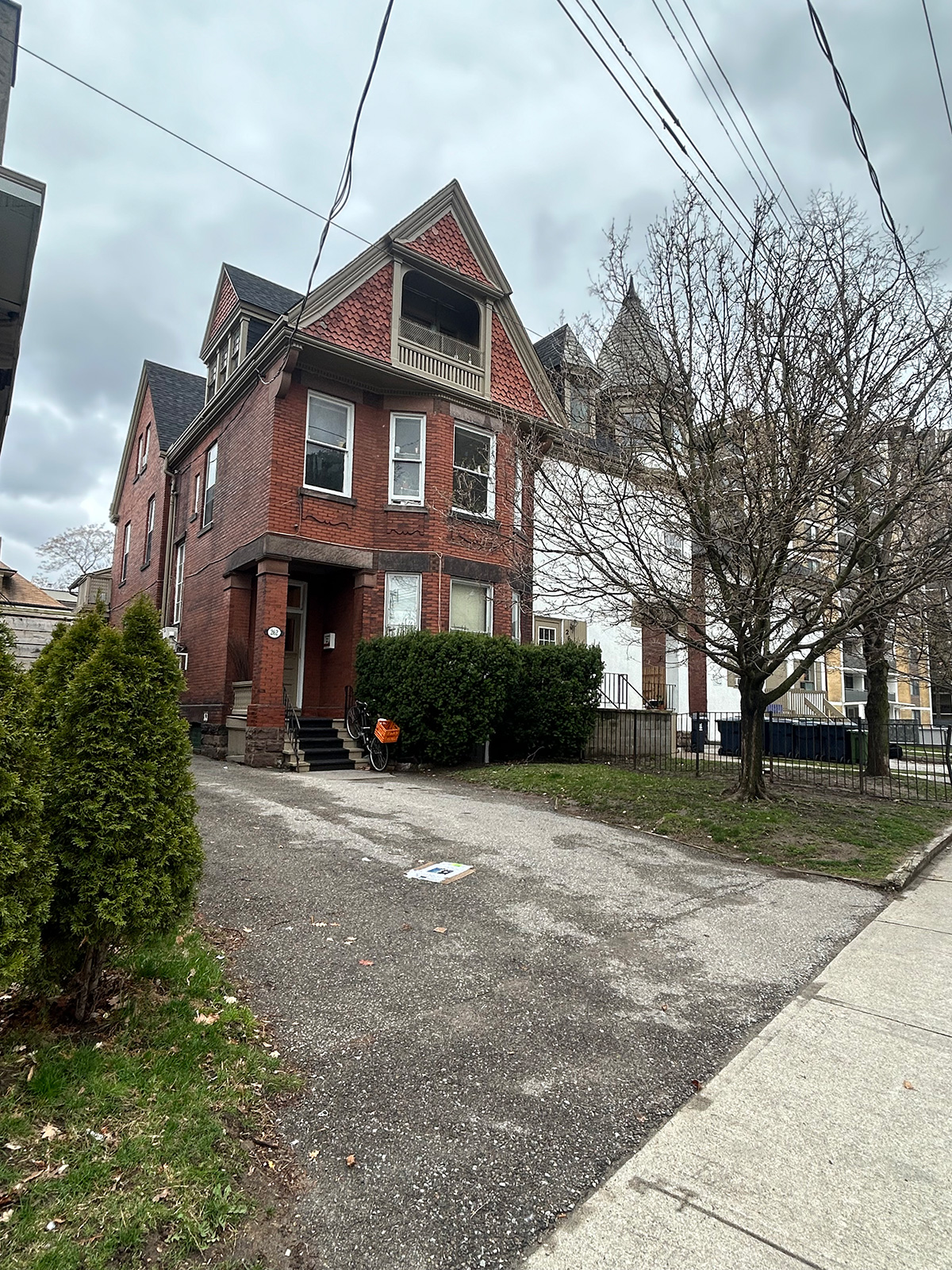
260 St. George St. 262 St. George St.
By James Bullanoff
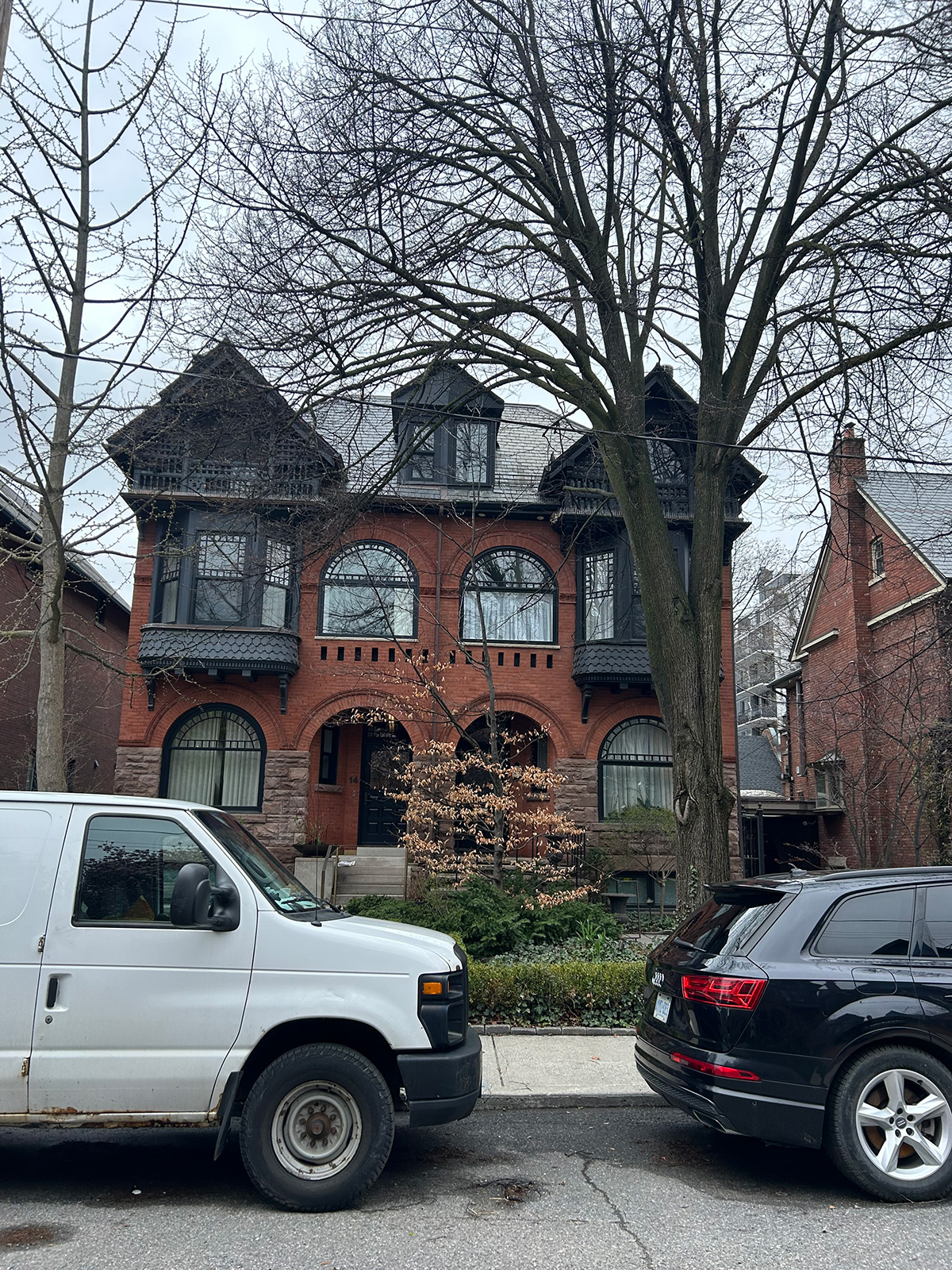
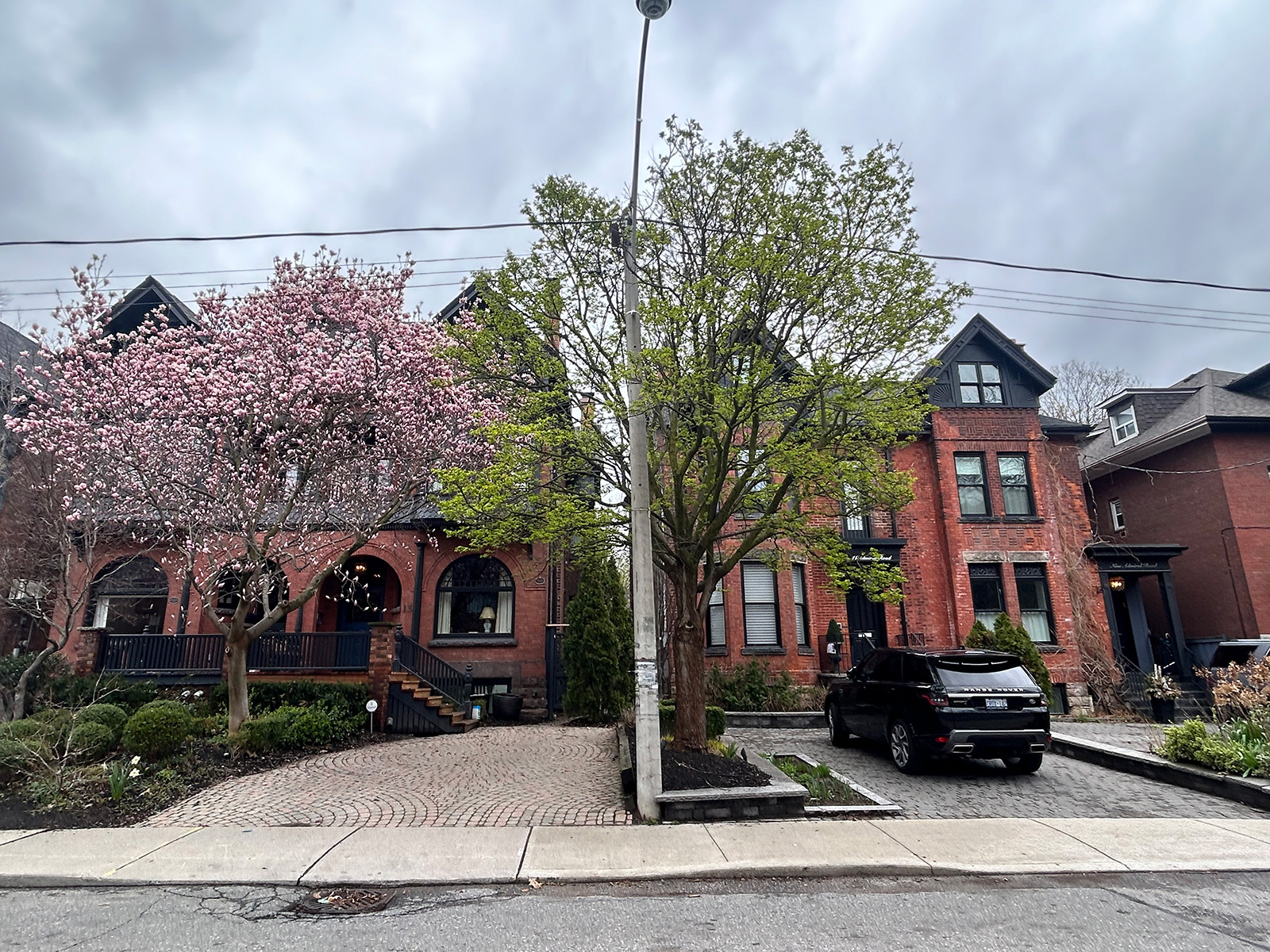
A large number of heritage properties are at risk of losing their status in the Bloor-Annex area and across Toronto. The pictures in this story are examples of the many “listed” but not “designated” heritage properties.
This comes after the city’s heritage meeting on Feb. 26 discussed plans in the face of recent amendments to the Ontario Heritage Act. According to these amendments, properties on the heritage register that are designated remain untouched; however, listed properties will lose their status after two years if they have not been researched and determined eligible for designation.
The deadline for the first batch of listed properties to be removed is Jan. 1, 2025.
In 2023, the Ontario government prioritized building more homes by passing Bill 23, the More Homes Built Faster Act. This changed the Heritage Act and has had a major effect on the future of Toronto’s historical buildings. Areas dense with historical properties—such as the Annex—are at risk of ending up in the hands of developers.
In an email to the Gleaner, Prentiss Dantzler, assistant professor of sociology at the University of Toronto, discussed the effects this will have on the communities.
17 and 19 Admiral Rd.14 Admiral Rd.9-13 Admiral Rd.
“Removing properties from the heritage register is likely to decrease the number of properties listed over the next couple of years. In response to these amendments, municipalities will have to consider more properties for full designation within a shorter amount of time,” said Dantzler.
The heritage register currently lists houses in three different ways. First, there are two types of designations. Designation part IV means that one may require permission for work that involves altering, demolishing/removing or erecting a building or structure on the property. Designation part V allows you to submit drawings or specifications to alter or demolish a building or structure on a property.
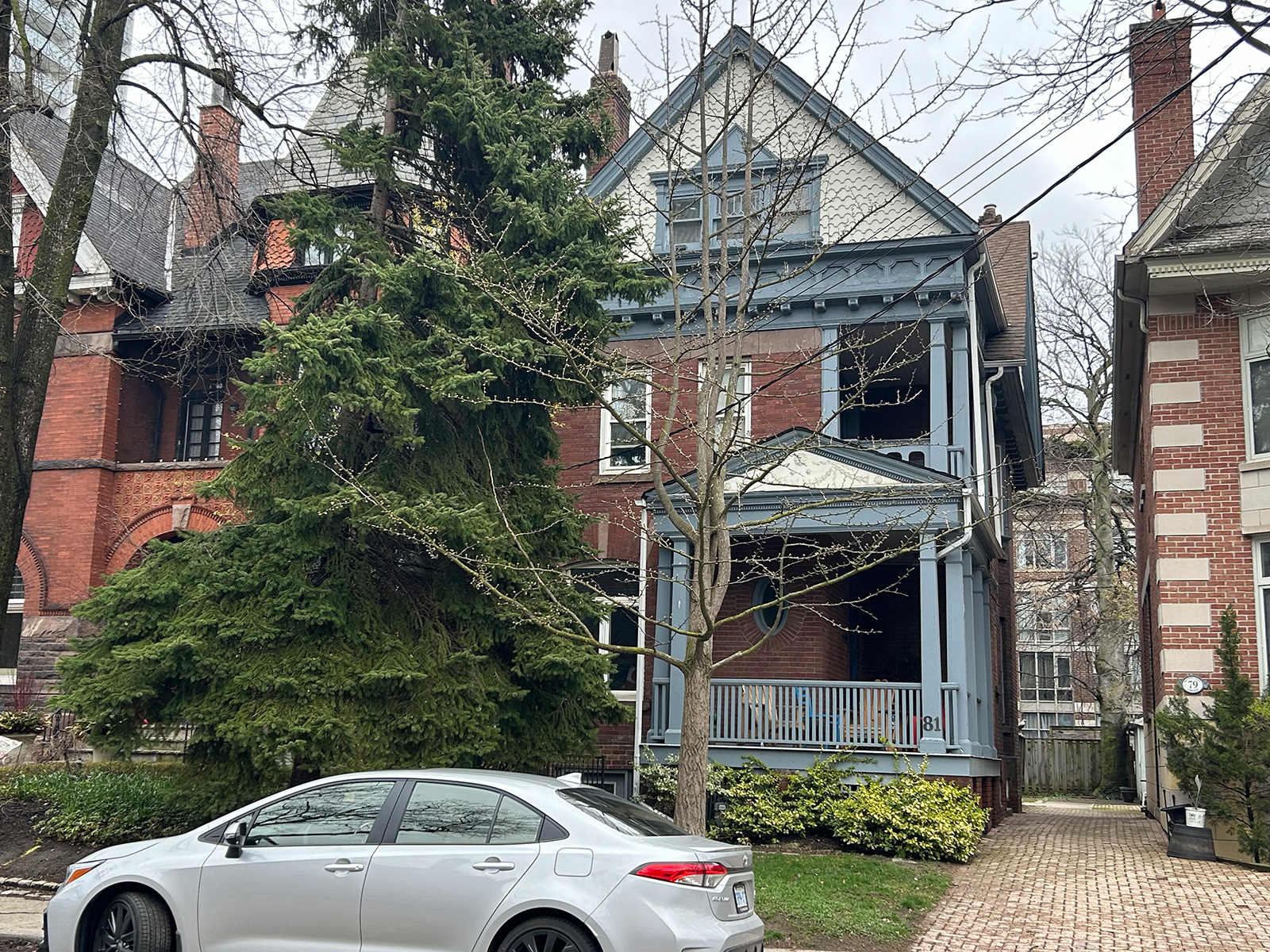
83 and 85 Walmer Rd. 81 Walmer Rd.
According to data collected from heritage planning, the city planning division for heritage properties, that for Ward 11, University-Rosedale there are 2743 properties designated under part V, 287 properties designated under part IV, and 593 listed properties. It is the latter, the 593 listed properties that Bill 23 will no longer protect from redevelopment.
“Most people would probably agree that the preservation of buildings that have historical and cultural value are worth saving. The beauty of the city rests in the charm of old neighbourhoods, many of which were the first destinationof immigrant communities who have cultivated their own local institutions and reputations,” said Dantzler.
According to the heritage planning map, the listed properties include major stretches of neighbourhoods, such as 9 to 19 Admiral Road, 81 to 85 Walmer Road, and 260 to 264 St. George St.
Dantzler explained that municipalities typically allow about 60 days to consider a property for full designation. He added the intention behind these amendments seems to be focused on reducing the time for properties to remain on the list, forcing municipalities to make a concrete decision on preservation.
“The actual impacts of these amendments are unclear; however, this approach does put older properties at risk for demolition. And given the relationship between older properties and lower rental rates and higher rates of visible minority households, these impacts are likely to not be felt by all residents of the city, at least not immediately.”
One example of how long it takes for properties to become designated is the West Annex Heritage Conservation District Phase One—Madison Avenue. It was approved for study in 2004 as a community-led project. It was completed in 2015 but only came into force in 2019, four years later.
“Historic communities will be at risk of losing some of their local institutions, which stand as symbols of their long-term efforts to claim a place for themselves within the city. ” said Dantzler.
The city hired consultants to develop a set of guidelines that assess the risks in prioritizing designations. A significant concern was houses situated in major transit station areas (MTSAs), specifically properties that are 500–800 meters away or a 10-minute walk from a subway station, or just about the entire Gleaner coverage area from College Street in the south to Dupont Street in the north, Avenue Road to the east and Christie to the west.
According to a map collected from the Annex Residents’ Association, the area of Spadina station makes almost the entire Annex an MTSA. St. George and Dupont stations add to the area being subject to MTSA planning guidelines.
“In the governments’ efforts to address the housing affordability crisis, we cannot forget about the importance of community,” said Dantzler.
May 7th, 2024 · Comments Off on NEWS: Magic mushroom dispensary opens on Bloor (Apr. 2024)
Shroomyz chain store faces police raid and vandalism
By Ammara Khan
A Shroomyz mushroom dispensary recently opened at 497 Bloor St. W., replacing a nail salon. Since its opening, Shroomyz has experienced a police raid, a staff arrest, as well as significant vandalism. Despite these challenges, it continues to conduct business.
The Shroomyz Annex location is not difficult to spot. The store’s exterior displays bright and colorful posters of mushrooms asking customers to “walk into a new reality.” The exterior is now partially covered by large wooden panels due to the recent vandalism.
The interior reflects the colors of the exterior with graffiti-style art and screens depicting the different products sold. Some of the products, such as magic mushroom-infused gummies and chocolate bars, are displayed on glass shelves.
In order to enter, customers must wait for an employee to buzz them in, and when purchasing the products, customers are asked to sign a waiver stating they understand the risks. In the waiver, Shroomyz also recommends that the product be used in microdoses to treat individual conditions and not used when engaging with “potentially hazardous activities.”
Individuals using magic mushrooms may experience hallucinations or altered states of consciousness, according to the Government of Canada’s website about controlled and illegal drugs; however, the effects will vary from person to person, the site says.
Simultaneously, the government of Canada is investing nearly $3 million in studying the possible benefits of magic mushrooms when used as part of psychotherapy. Results show they do have therapeutic benefits when paired with psychotherapy, however more research needs to be conducted.
An employee at the Annex location, who identified as Super, says the products are popular among customers of various ages. Some who do not have access to a diagnosis for mental health issues use the products to self medicate.
Super spends his free time at the Shroomyz checkout counter reading the New York Times bestseller How to Change Your Mind: What the New Science of Psychedelics Teaches Us about Consciousness, Dying, Addiction, Depression, and Transcendence. He is an advocate for, and consumer of, magic mushrooms.
Super shares his own experiences with the more therapeutic effects of magic mushrooms.
“The way that I think mushrooms work their magic is that they do dissolve your ego a little bit,” he said. “There’s a little more recognition of yourself as part or something. I think it’s that sort of connection, this idea of unity, this feeling of togetherness, the feeling that we are the same.”
“The feeling of connection feels amazing,” he continued. “It’s great to feel connected.” He explains that the best moments in our lives are the ones where we feel deep connections, even when we are on our own. That is how he describes the feeling of microdosing magic mushrooms.
While the store appears to be functioning, there are some concerns about its legality.
On March 5, witnesses saw a Toronto Police raid at the Shroomyz Annex location and arrested the store manager. Despite the raid, the store was able to reopen only two to three days later, and the manager was moved to a different location.
The Controlled Drugs and Substances Act states that obtaining, possessing, and trafficking (selling) controlled substances can be punishable by law unless authorized by Health Canada. The products sold by Shroomyz are controlled substances. Psilocybin is listed as a Schedule III drug under the legislation, hence the police raid.
“Magic mushrooms just generally refers to psilocybin-containing mushrooms. And there’s over 200 known identified species, like different genetic variations of mushrooms that contain psilocybin found all over the world. And we sell 13 of them that are professionally grown and dried,” shared Super.
In a comment made to the National Post on Aug. 31, the Toronto Public Service stated that “in terms of priorities, enforcement by TPS is largely focused on the trafficking of illegal drugs that are resulting in overdose deaths and having a traumatic and devastating impact on our communities.”
Despite the questions surrounding the legality of the business, neighbouring stores have nothing bad to say about Shroomyz.
Howard Pressburger is the manager at the hardware store Wiener’s, across the street from Shroomyz. He has been living in the Annex for 20 years. Pressburger calls Wiener’s the “unofficial hub of what happens in the neighborhood” due to being around for over 100 years. It appears the arrival of the store has brought both curiosity and an overall shrug from passersby.
Pressburger reported that aside from noticing a new store opening, none of Wiener’s customers have anything to say about the store.
He encourages pushing for more research on the use of mushrooms. He put money into an ETF (exchange-traded fund) that dealt with using hallucinogenic drugs in the medical field. “I mean, they exist, they’ve got a storefront, they’ve got signs up, they operate like any other regular ritual store of the strip. So I think the stigma just comes with what they’re selling. I think there’s a lot of preconceived prejudices towards that,” said Pressburger.
He also reflected that the community has not changed after the addition of Shroomyz to the neighborhood, “I don’t see them as being detrimental or more positive or, you know, they’re just like anybody else who’s selling stuff.”
Despite the storefront appearing to be well received by Annex locals, vandals brought hammers to the windows of both the Bloor and Queen location on April 5 without committing any theft.
Spokespeople for Shroomyz, authorized to speak to the media, were not responsive when asked to comment on the article. Toronto Police also did not reply to requests for comment.
Comments Off on NEWS: Magic mushroom dispensary opens on Bloor (Apr. 2024)Tags:Annex · News
May 7th, 2024 · Comments Off on NEWS: Rediscovering Wychwood Pond (Apr. 2024)
One of the last visible remnants of Taddle Creek
MIA KESKINEN/GLEANER NEWS
By Mia Keskinen
Wychwood Pond is a hidden gem within the Annex waiting to be discovered. The pond is in Wychwood Park, located near Bathurst Street and Davenport Road. The park is a picturesque enclave with English-style homes tucked away in a pocket of forest. Although the park is hidden in a residential area, it is open to the public to enjoy.
Upon entering the gates of Wychwood Park, a plaque explains the history of the area and the pond. According to the Wychwood Park Historical Society, the residential area was named after Wychwood Forest in Oxfordshire, England. The first home was built in 1847 by the landscape artist Marmaduke Matthews who intended to start an artists’ colony.
The pond was artificially created by damming Taddle Creek. A spring in the pond from the now underground creek still provides water in the heart of Wychwood Park to this day. Taddle Creek was once referred to as “poverty pond’’ by the Toronto Historical Association because much of the creek was akin to the muddy swamp conditions in some of the lower income areas of the city. The creek once flowed in a southeasterly direction for about six kilometres from St. Clair Avenue West and down through Wychwood Park and the University of Toronto. It emptied into the harbour near the Distillery District. Taddle Creek was buried and became an underground sewer system during the 19th century. Wychwood Park is now one of the few places in Toronto where Taddle Creek is still visible.
Over the years, residents of the park have stayed committed to preserving the park’s natural beauty. In the 1980s, this enclave was close to being demolished as developers wanted to redevelop one of the larger houses. This prompted the park trustees and residents to seek designation for the area as a Heritage Conservation District under the Ontario Heritage Act. During the 1990s, the pond became so shallow that it was on the precipice of becoming a swamp, instead of the beautiful pond it was meant to be in the heart of the artists’ enclave. Residents pooled $90,000 to dredge the pond and conserve its beauty. The pond was soon restored to its original beauty, and nature prevailed. In the 1990s, a Gleaner reporter witnessed a snapping turtle sitting on a log by the pond, a testament to an ecosystem that was once part of Taddle Creek.
Today, the pond remains an important part of the neighbourhood’s beauty. Residents of Wychwood Park are no longer solely artists, but also CEOS, lawyers, and architects; however, the heart and soul of the neighbourhood remains. Wychwood Pond changes with the seasons and brings community members together all year round. When it freezes over in the winter, hockey nets are on the ice and children and parents play together. It’s not clear if the snapping turtle, which could live over 100 years, is still in residence.
Comments Off on NEWS: Rediscovering Wychwood Pond (Apr. 2024)Tags:Annex · News · Life
May 7th, 2024 · Comments Off on NEWS: Karma’s free bike repair cafe (Apr. 2024)
Wildly popular repair cafes from last year now include bicycles
Karma Co-op member Nathalie Remond thrilled with her ready to roll wheels. COURTESY KARMA CO-OP
By Brian Burchell
This year, Karma Co-op is hosting its first spring Bicycle Repair Cafe on Saturday, April 27, 11:30 a.m. – 2 p.m. in Karma’s parking lot. The co-op is located at the rear of 739 Palmerston Ave. (off Karma Lane).
Residents are encouraged to bring their bikes to get a free diagnostic and tune-up to be ready for riding this year. In addition, the repair cafe will share some core skills to get your trusty stead road worthy. If parts are needed, technicians will specify what you need to go purchase.
“We aim to provide a mentoring relationship and enable community members to mend and fix items in their own lives and divert things from landfill, ” said Andrea Dawber, a Karma Co-op volunteer and event organizer.
All repair cafes are open to the public, and they aim to teach people bike repair skills. Bring whatever you need fixed and stay and learn a few repair skills from the volunteer fixers. Last year the repair cafes were so popular that Karma has decided to host three this year. At the next two events, one in late June and the other in late September, community members are encouraged to bring clothing and fabric items that need mending, small appliances, and electronics for repairs and/or diagnostics. If you need to replace a part, the fixer will let you know.
These free repair events are an extension of Karma Co-op’s mission to sell locally sourced food in bulk, where possible. The bicycle repair cafes provide community members with access to affordable and sustainable transportation, and diverting repairable products from landfills is consistent with Karma’s goals.
If necessary, the rain date for the bike repair event is Sunday April 28.
May 7th, 2024 · Comments Off on EDITORIAL: The Vacant Home Tax: A multi-mayor failure (Apr. 2024)
The Vacant Home Tax (VHT) is an unabashed debacle. The City of Toronto just sent 167,000 homeowners tax bills that include a one per cent VHT levy based on the values of their properties. If, for example, their Municipal Property Assessment Corporation valuation is $800,000, then the city just added a surcharge to their tax bill of $8000. Payable when? Now.
The VHT applies to individual homeowners, including condo owners, who failed to declare their residences occupied. The assumption is that if homeowners did not make this declaration, then the premises are vacant. The onus is on the taxpayer.
Imagine seniors with language barriers or people who were in Florida for the winter and missed the deadline or did not even understand it. And how about that increasing cohort of people who don’t open their mail as everything is done automatically through their banks. All these people are upset, and rightfully so. How many still don’t know that the city is just docking their bank accounts and enriching city coffers?
At the heart of the failings of the VHT is negative option billing which is deeply unethical. Using this approach, a company (or in this case the government ostensibly working for you) adds new charges without your consent and assumes you accept them unless you decline.
Rogers Communications started charging for a new cable TV package in the late 1990s when customers failed to “declare” they did not want an expanded package of channels. Customers were so incensed that the federal government enacted legislation in 1999 to stop the practice. Who was in charge at Rogers at the time? You guessed it, the now former, City of Toronto Mayor, John Tory. It was on his watch that Rogers pursued negative option billing and on his watch that Toronto enacted its “opt out or pay plan” with the VHT. It was wrong then, and remains so, and we have Tory to thank for that. That is Mayor Number One to blame. Tory is back on the Rogers board of directors, by the way, hmmm….
At the root of the VHT policy is the housing crisis that in theory could be partly solved by encouraging property owners to rent their premises, resulting in people occupying now vacant spaces. The goal is laudable; it’s the execution that sucks. The VHT has been around since 2022 but the city has not supplied any evidence that it has actually changed things in the vacancy ledger. It seems they don’t really care as they are salivating at the dividends that accrue to the city when the policy fails: Oops, you failed to declare occupancy; please pay the city; do not pass GO.
Chow likes to evade responsibility for the program’s failures: “The person who designed the program is no longer with the city.” She’s intimating that she found the will to take charge and fire someone? The city manager says no one lost their job; that myth busted. So, we are left to infer that the person is John Tory, who resigned for other reasons. This vague suggestion that someone was actually reprimanded for poor performance is not convincing. The mayor has stated, “How could anyone justify the send button on 165,000 bills?” It’s your staff Mayor Chow. It’s your organization, and the mayor is the lead; this is not church and state. The first rule of leadership is “everything is your fault.” This is the first leadership role for Chow, having spent a lifetime on political backbenches throwing snowballs at the government bus. Now, you are in charge, act like it.
Councillor Brad Bradford stated in a recent column in the Toronto Sun that Chow herself had fallen victim to the VHT tax for her own home. In the eight months that have since elapsed she has failed to have a single meeting with city staff about the program failures. Mayor Olivia Chow has projected in her city budget that $200 million will come from this program in 2025 and 2026, and she has already earmarked the money. She is counting on the program to have victims. The sham is the plan thanks to Tory and Chow.