
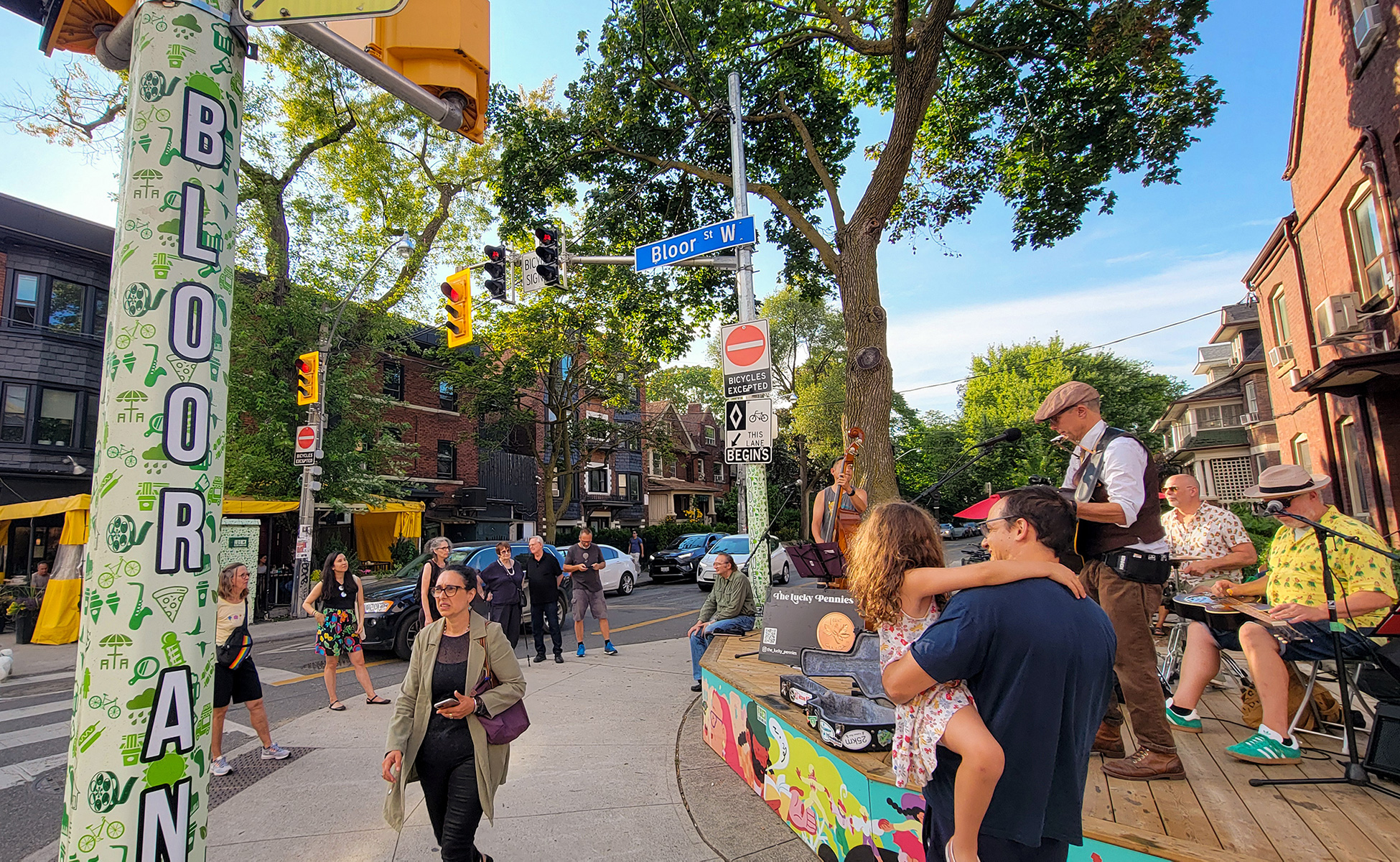
ON THE COVER (Summer 2024)
October 15th, 2024 · Comments Off on ON THE COVER (Summer 2024)
Comments Off on ON THE COVER (Summer 2024)Tags: Annex · News · On the cover
NEWS: A plan to build above heritage apartments (Summer 2024)
October 15th, 2024 · Comments Off on NEWS: A plan to build above heritage apartments (Summer 2024)
Density on Spadina Road to expand in coming years
By Meredith Poirier
The intersection of Spadina Road and Lowther Avenue is no stranger to construction. Currently the corner hosts a work site to add elevators to the Spadina TTC station. In the coming years, residents of the Annex (in particular those who live near the intersection of Bloor Street West and Spadina Road) will continue to see construction of major developments which will lead to greater residential density in the neighbourhood. Many businesses will be forced out, although some of the developers are planning to incorporate the businesses on the main floors or lower levels of the new developments. Much of the construction happening is in conjunction with the Spadina subway station.
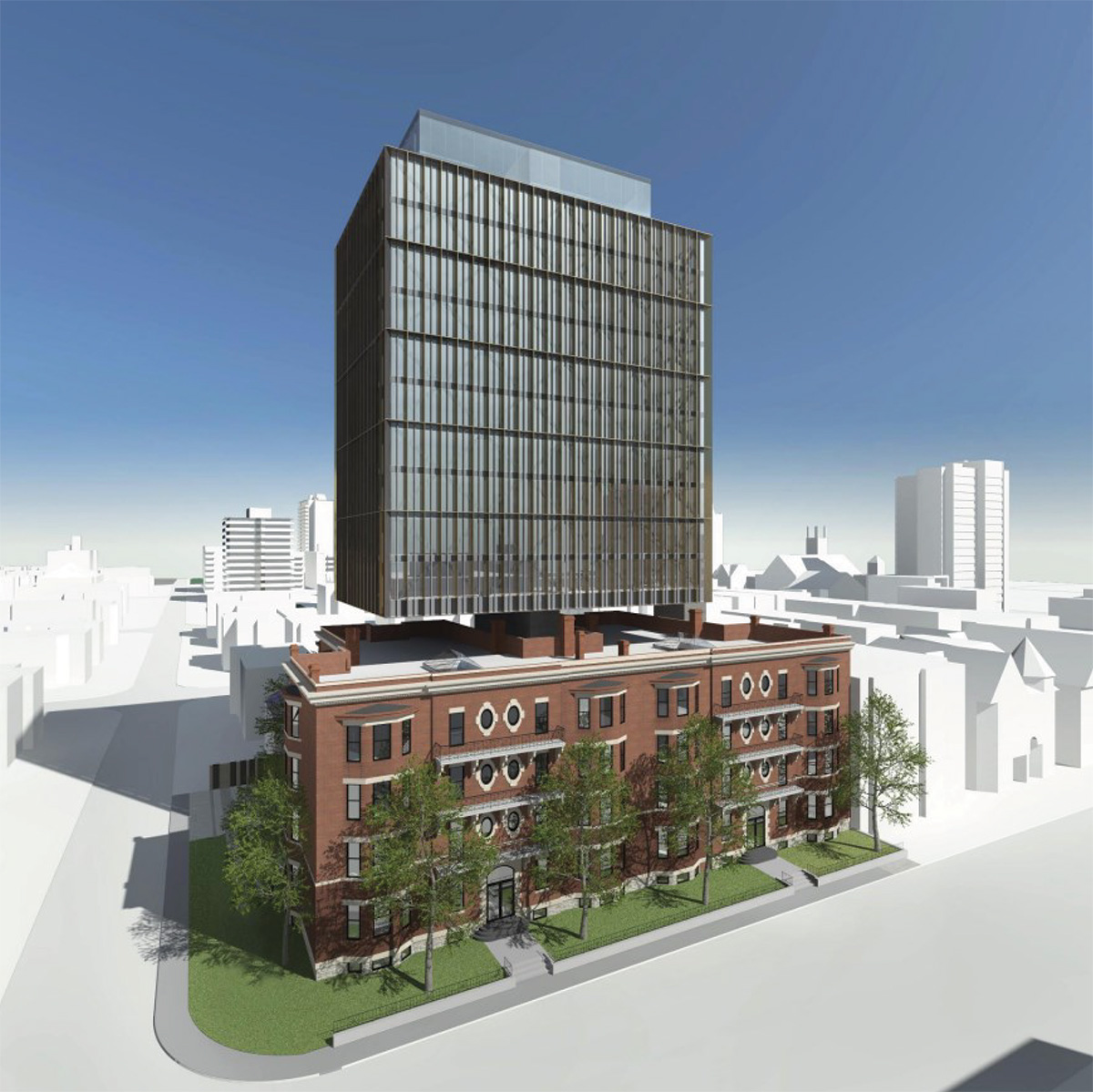
On the southeast corner of Spadina and Lowther is 41-45 Spadina Road, a modest four-storey apartment building known as Spadina Gardens. It is a heritage-designated building. The low rise was constructed in 1905-1906 and was built in response to the city’s growing population at the time. It was designed by the inventive Toronto architect, Arthur Richard Denison and was built in the Edwardian Classical style. Today, its exterior still meshes beautifully with other buildings in the Annex neighbourhood with buidlings of a similar vintage Spadina Gardens has great significance and was recognized on the City of Toronto’s Heritage Inventory in 1979.
A proposal for the redevelopment of Spadina Gardens has been submitted by ProWinko, a real estate development firm that builds high-end real estate in prime urban locations across the world. The proposal is a 10-storey residential building, containing 70 units, that will float overthe current apartment building at 41-45 Spadina Road.
The project was discussed with the Annex Residents’ Association (ARA) in October 2023. Following the meeting, a review of the proposal was done by the ARA, and a summary of the project and concerns were compiled in a Project Position Statement. According to Henry Wiercinski, of the ARA, one of the concerns is the safety of tenants, as tenants will remain living in their current dwellings as construction takes place, which could span two to three years. There is also concern over how the heritage building and its attributes will be meaningfully retained. According to the Planning Rationale Report, created by WND Associates, a consultant to the developer, there are plans to “maintain the prominence of the existing heritage building…while appropriately locating new construction above it with a sensitive and innovative massing, material, and design strategy.” However there does not appear to be more information available to the public on how this will be achieved and how the interior of the building will be maintained. Garbage collection, parking spots, and stormwater allocation are listed as significant concerns as well.
From the perspective of the developers and the city planners, this new building will be an important one. The Planning Rationale Report also states that the proposed development “is consistent with the Provincial Policy Statement, 2020, as it provides for a mix of new market based housing, within a compact built form in an existing settlement area that is well served by transit, municipal infrastructure and public services.”
According to Dianne Saxe, councillor, University-Rosedale, there are still “many questions to be answered before a decision can be made.” Saxe explained that Heritage Planning is content with the proposal (which states that the entire heritage building will be kept in place). Local residents reached out to Saxe to request a meeting prior to the public meeting on July 31. As specified by Saxe, this developer has not built in the University-Rosedale ward before, and there are concerns around the construction of the 10-storey building on top of the pre-existing apartment building and how tenants’ lives will be disrupted and how the heritage building will be fully maintained.
READ MORE:
- DEVELOPINGS: Bloor and Spadina tower update (Feb. 2024)
- NEWS: Retail suffers as developments loom (May/June 2023)
- FOCUS: Developments on your doorstep (Mar. 2023)
- DEVELOPINGS: Developments on your doorstep (Aug. 2022)
- NEWS: Developer, community come together (Aug. 2022)
- DEVELOPINGS: Developments on your doorstep (Spring 2022)
- NEWS: New highrise planned for Bloor and Spadina (May 2022)
- CHATTER: Groundbreaking at Sussex (Winter 2022)
- NEWS: Community input changes Bloor/Spadina build (Mar. 2021)
- NEWS: New tower for Bloor and Spadina (Jan. 2020)
- DEVELOPINGS: Annex area developments loom (Jan. 2020)
- NEWS: Plans for a “slender” building (August 2019)
- NEWS: Funding for Indigenous housing (October 2018)
Comments Off on NEWS: A plan to build above heritage apartments (Summer 2024)Tags: Annex · News
NEWS: New Tactile Map in the Annex (Summer 2024)
October 15th, 2024 · Comments Off on NEWS: New Tactile Map in the Annex (Summer 2024)
Bloor Annex BIA and STEPS Public Art make the Annex more accessible
COURTESY AYESHA KHAN/STEPS PUBLIC ART
By Merideth Poirier
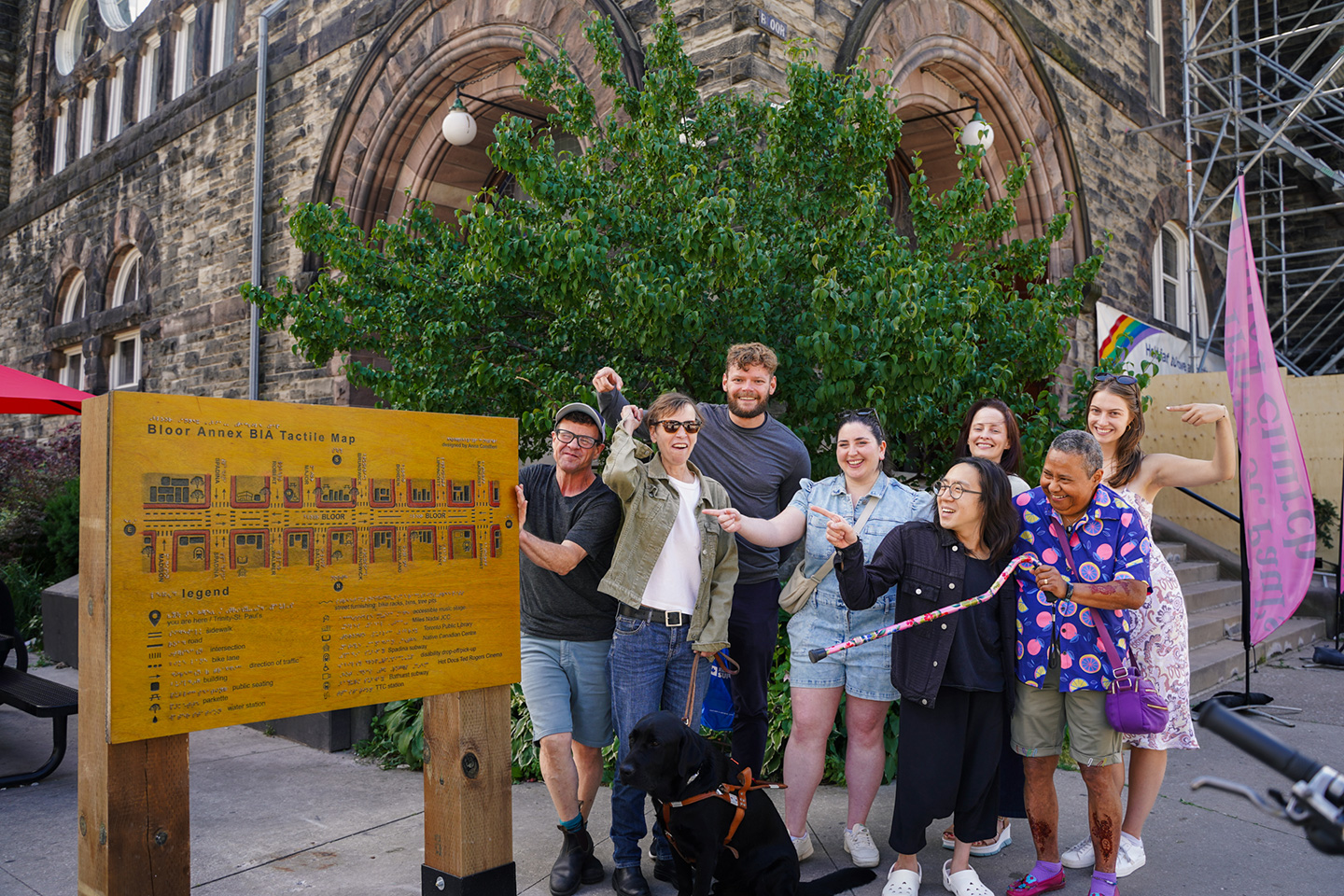
On Thursday, June 27, the Annex became a little more inclusive as it unveiled its new Tactile Map. The map sits on the corner of Bloor Street West and Robert Street, right next to Trinity-St. Paul’s Church at 427 Bloor St. W. The installation features braille writing and tactile symbols that allow for blind or low-vision individuals to read the map and navigate the neighbourhood more safely. Representatives from the Bloor-Annex Business Improvement Area (BIA) and STEPS Public Art, as well as local community members, were all present to reveal this novel guide. It is the first of its kind in North America and is a testament to the BIA’s focus on inclusivity and safety. Other accessible art spaces in the neighbourhood include the Bloor- Annex BIA stage (on the corner of Bloor Street and Brunswick Avenue) and Interconnections (an Indigenous mural) at Paul Martel Park. The bike lanes on Bloor were also a way to make the street more inclusive and safer, and the Bloor-Annex BIA was a major sponsor of them.
The Tactile Map project was years in the making. STEPS is a Canadian charity that connects artists to communities with an aim to make public spaces more welcoming and safer. In 2022, they approached the BIA to ask them to participate in an inclusive art project, as they had received funding to do so. “We’d worked with them [before] on a few other projects, so they thought of us and so we took on this accessibility [art project],” explained Melanie Ramsay, project coordinator for the BIA.
According to Madison Kennedy, project organizer for the Tactile Map initiative, they started by reaching out to Alex Bulmer (a blind Canadian artist) and ReDefine Arts about the process of creating a map with braille writing. This kind of map, to be installed outdoors, was a completely new concept for the organizers so they wanted to make sure that the proper approach was taken. After speaking with Bulmer and ReDefine Arts, Kennedy and Ramsay reached out to organizations that work with individuals with disabilities, as well as community members from various backgrounds. “We wanted to have a variety of different disabilities heard, but also a variety of different backgrounds. So, we had artists, we had urban planners, we had people from different disciplines come together to chat with Alex specifically,” explained Kennedy. Once these connections were made, Bulmer took individual walks with people, and they chatted on their walks and discussed challenges they encountered (as well as the positive aspects of the walk as well). These walks with Bulmer were recorded, and from them, audio tours of the walks were created. The audio tours can be accessed on the BIA’s website, and the hope is that they provide members of the neighbourhood with new ways to engage with the streets of the Annex. The audio tours are a part of Bulmer’s portfolio and are entitled May I Take Your Arm. The Tactile Map was a natural next step from the audio tours.
The creation of the map takes inspiration from Bulmer’s work and was created by artist Anna Camilleri. The map is a 48 by 32-inch exterior tactile map, mounted vertically on robust posts installed by the BIA. Featuring braille writing and tangible symbols for those who are blind or living with sight loss, the map assists individuals with navigating their neighbourhood safely.
Ramsay notes that the map is not perfect, and the BIA will continue to learn and improve it, as well as other accessible art features in the community. “Our Tactile Map is a pioneering prototype, the first of its kind for any business improvement area in North America. As a groundbreaking initiative, it represents an important step towards creating more accessible awareness in public spaces,” said Ramsay.
The BIA will continue to have conversations with community members, artists, and individuals with disabilities in order to make the guide more useful and as safe as it can be.
Comments Off on NEWS: New Tactile Map in the Annex (Summer 2024)Tags: Annex · News
GRADING OUR GREENSPACE: A report card on our parks (Summer 2024)
October 15th, 2024 · Comments Off on GRADING OUR GREENSPACE: A report card on our parks (Summer 2024)
A plethora of Annex-area parks under scrutiny
Each year the Annex Gleaner reviews the many parks and parkettes in our coverage area using a variety of criteria. While there is no decisive “winner” of the grading, letter grades are assigned to convey the quality of the parks, considering aspects such as upkeep, design, and amenities. The reviews accompanying the grades also let the reader know what makes each space unique. This is the first instalment of reviews for 2024.
By Mia Keskinen
MIA KESKINEN/GLEANER NEWS
Robert St. Park
50 Sussex Ave.
Grade: A (last year’s grade A)
Time of visit: 2:30 p.m.
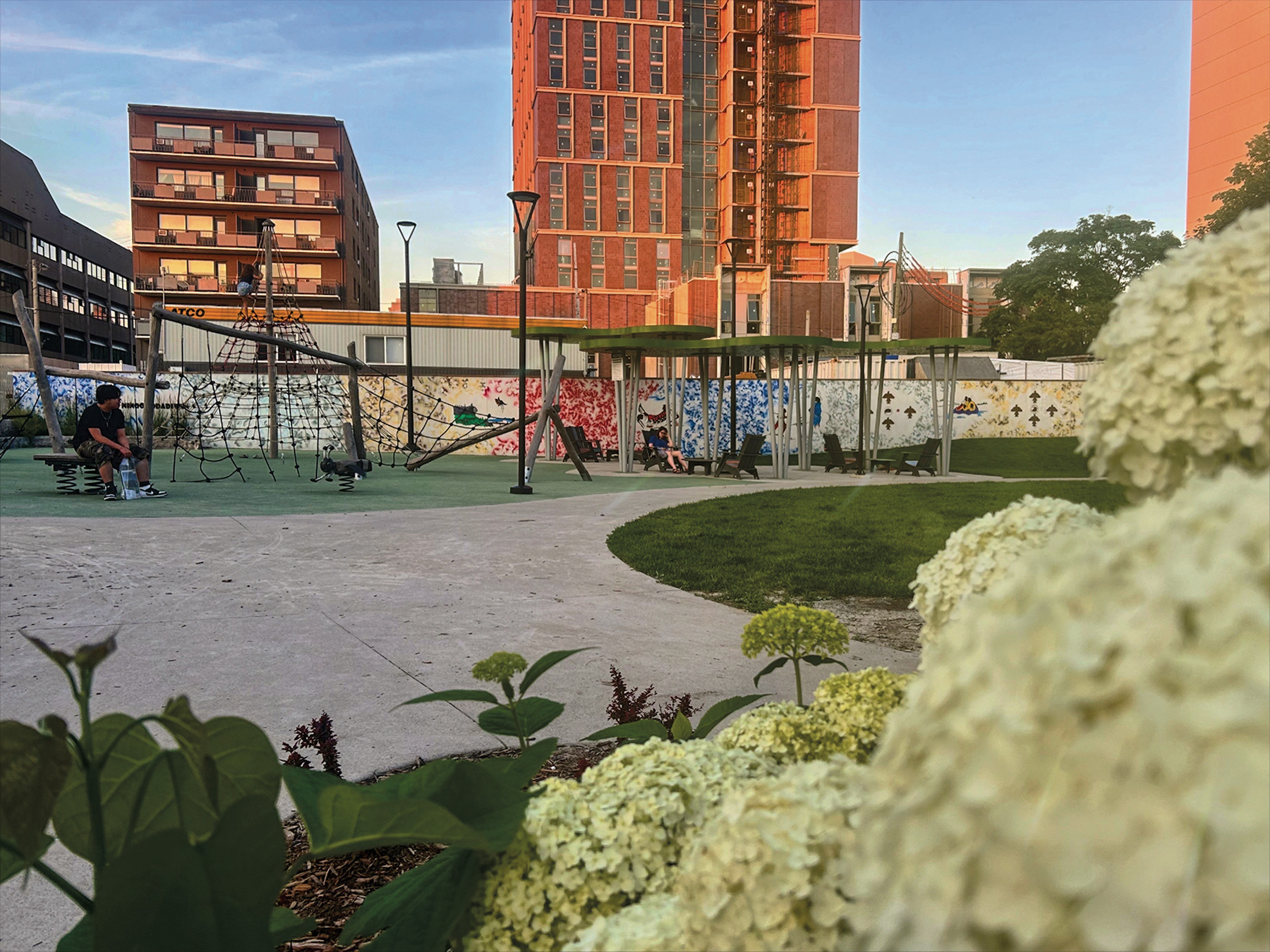
Reason to go: Located by Spadina Avenue and Bloor Street, Robert Street Park is a well-maintained park abundant with amenities. This park was originally called the Robert Street Field Project and was created by the University of Toronto as a multi-use greenspace for all ages to enjoy. The park features cottage-style chairs epitomizing summer comfort, mini pavilions built in the shape of trees, benches surrounded by hydrangeas, unique rope structures for little ones, as well as a butterfly garden. Like Paul Martel, this park features an Indigenous art piece on one of the walls. Robert Street Park is next to a large field that often hosts soccer games for teams of all ages. Overall, Robert Street Park is a wonderful place to relax during summer in the city.
Overheard: Three men playing Caribbean music, dancing together, dimples carved into their cheeks from the smiles with which they sing.
Did you know: In the Robert Street playing field to the north, the University of Toronto drilled 153 boreholes, each 850 feet deep, in order to extract geothermal energy to heat and cool the new Spadina-Sussex Student Residence as well as connect to the university on the other side of Spadina. In 2020, when it was built, it is the largest geothermal installation in the country, and it will ultimately lead to a 90 per cent reduction in carbon emissions from heating and cooling the university’s buildings. (See gleanernews.ca, March 2020, keywords: Robert Street geothermal).
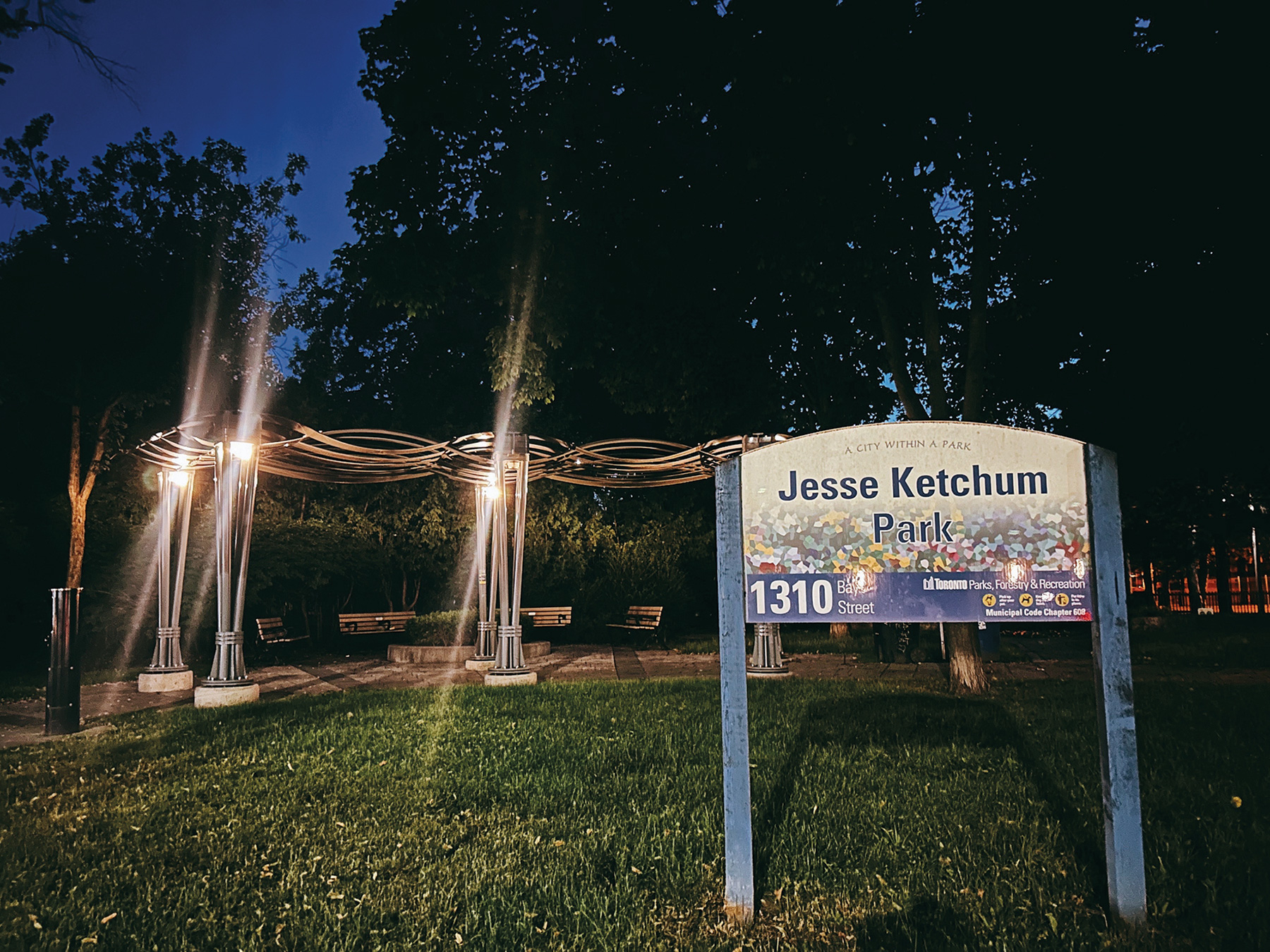
Jesse Ketchum Park
1310 Bay St.
Grade: A+ (last year’s grade: A+)
Time of visit: 10:00 a.m.
Reason to go: Jesse Ketchum Park reminds city-goers of the innate charm of simplicity. The essentials are covered: pathways lined with benches, water fountains, and trees swaying in the summer breeze. Despite the greenspace’s location at the corner of Avenue Road and Davenport Road, the sound does not distract too much from the park’s ambiance, as the trees and expanse of the park absorb much of the oncoming traffic. Located near Jesse Ketchum School, the park is also close to a soccer field where children can often be seen playing sports in the sun. This park is a delightful stop for those who are looking to appreciate nature amongst an urban landscape.
Overheard: Two dog owners laughing as their pups roughhouse.
Did you know: This park was named after Jesse Ketchum, who was well-known for his philanthropic efforts towards education. One of his most notable contributions was his support for public education. He donated land for the first public school in Toronto which was named Jesse Ketchum School in his honor.
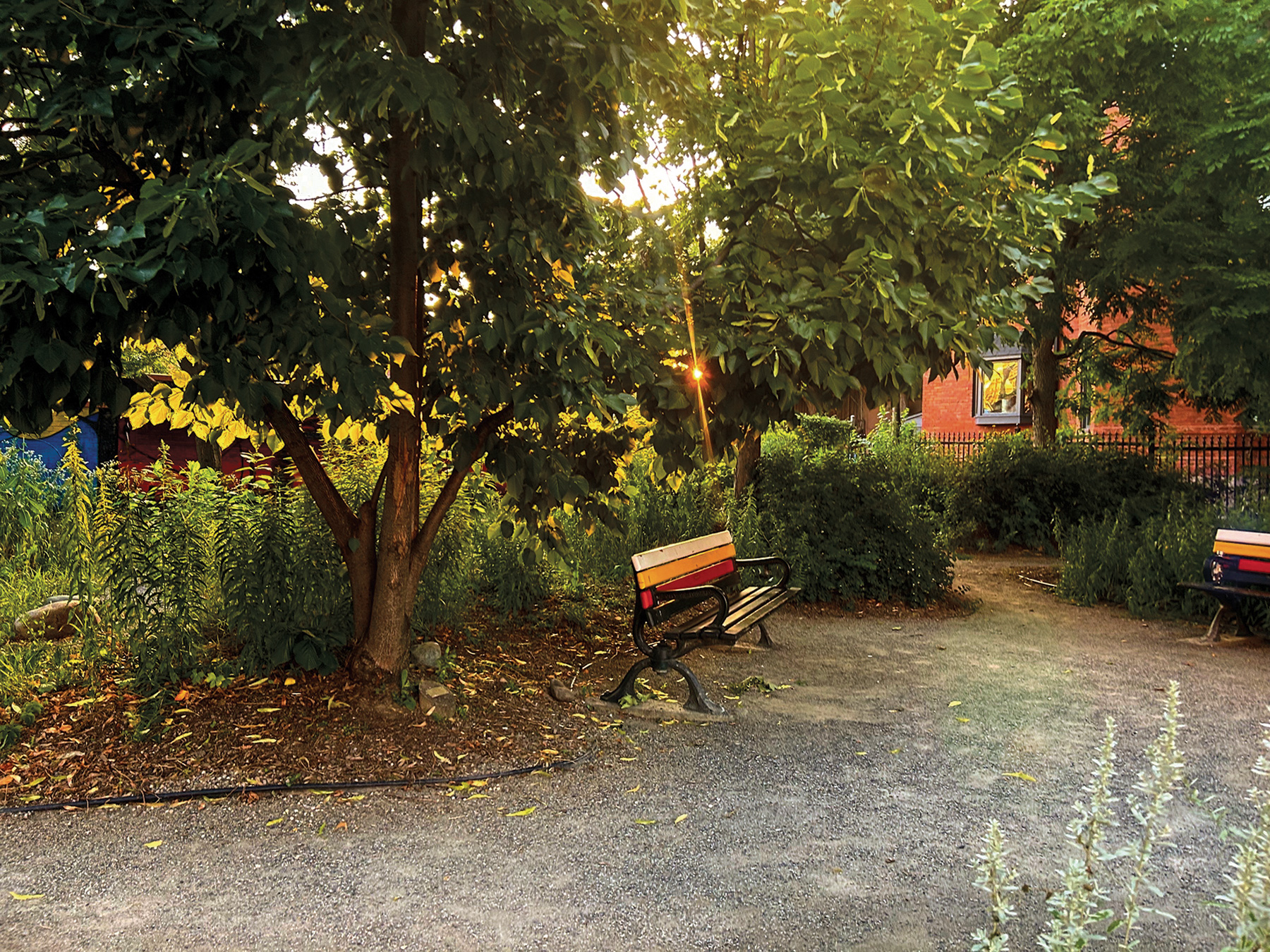
Paul Martel Park
10 Madison Ave.
Grade: A (last year’s grade: A)
Time of visit: 1:55 p.m.
Reason to go: In 2022, Paul Martel Park was rated by the Gleaner as the most improved park going from a D- to an A within a year due to a transformative restoration. This greenspace, located near the intersection of Spadina Avenue and Bloor Street, continues to uphold its charming allure with several painted park benches, cottage-style chairs lining the paths, and abundant wildflowers. This park is pleasing to the eye. Along the back wall, which provides a level of privacy given that the park is right behind Spadina station, is a beautiful Indigenous mural of vibrant orange and blue hues which pays tribute to our innate connection with nature. There is a sign explaining Indigenous peoples’ profound worldviews and beliefs. This greenspace is perfect for those who wish to rest in the shade as the summer sun elucidates the cityscape.
Overheard: Birdsong from robins hop through the bushes, taking mud baths to cleanse themselves.
Did you know: The park is named after Paul Martel, a well-known local resident who was dedicated to the preservation and enhancement of urban greenspaces.
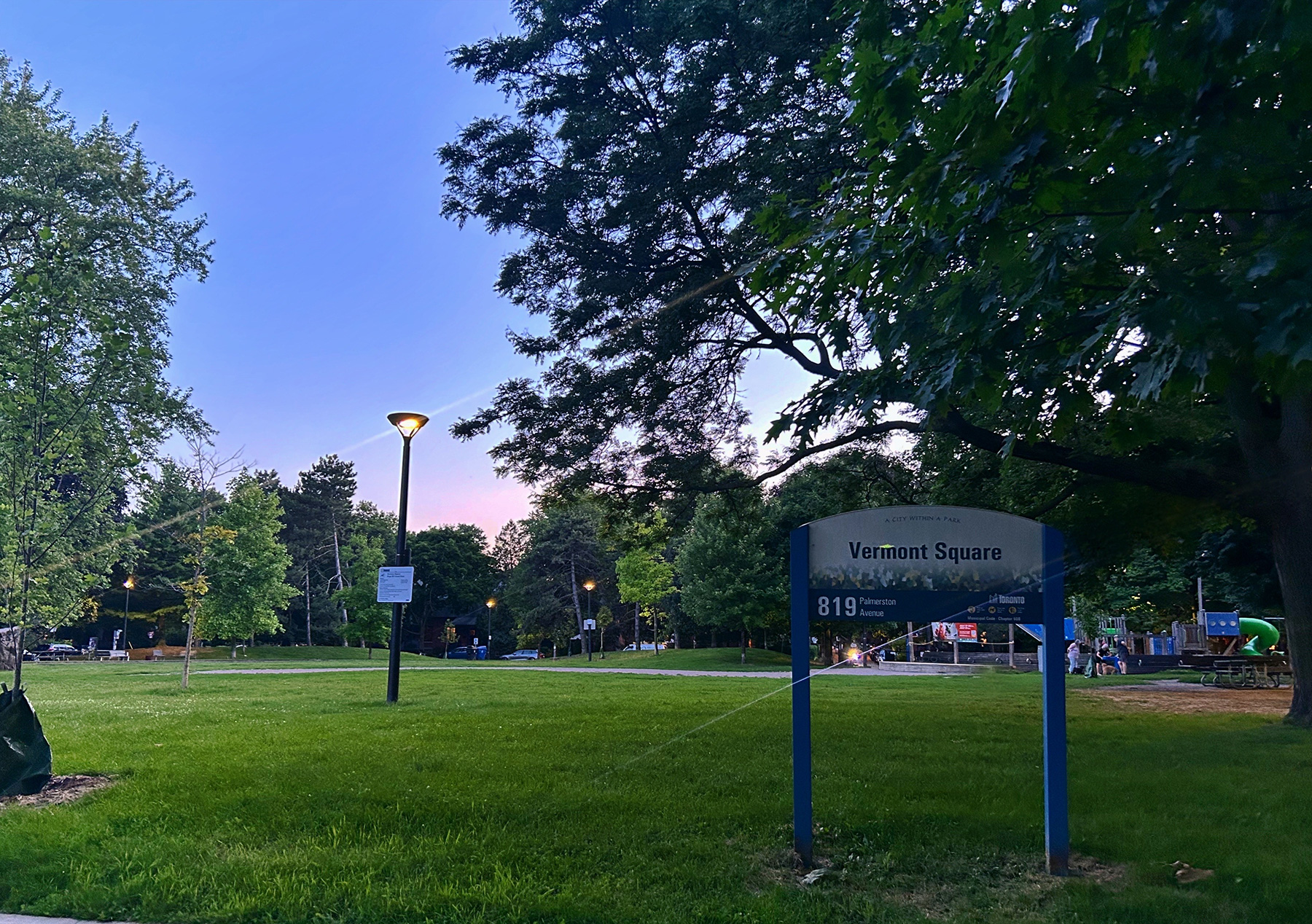
Vermont Square Park
819 Palmerston Ave.
Grade: A (reviewed last in 2022, grade then A+)
Time of visit: 1:45 p.m.
Reason to go: This park is a gem within Seaton Village. Despite being located close to Bathurst Street and Dupont Avenue, there is a pervasive calm and quiet that exists within this greenspace. As sunset rolls over the hills of Vermont Square Park, children can be seen chasing liquid gold until the sun falls asleep, playing into the hours of the night. Within its expansive grounds, lie various amenities: paths that linger through the park, various benches, as well as a playground built like a pirate ship. This park is often bustling from sunrise to sunset and draws in folks of all ages, be it the little ones who walk the plank, or the parents who gather to watch their little pirates. Given its expansive grounds and several amenities, this greenspace is the perfect place for all park-goers.
Did you know: Vermont Square Park has a rich history, dating back to its establishment in the late 19th century. It has evolved over the years to become a beloved community gathering place.
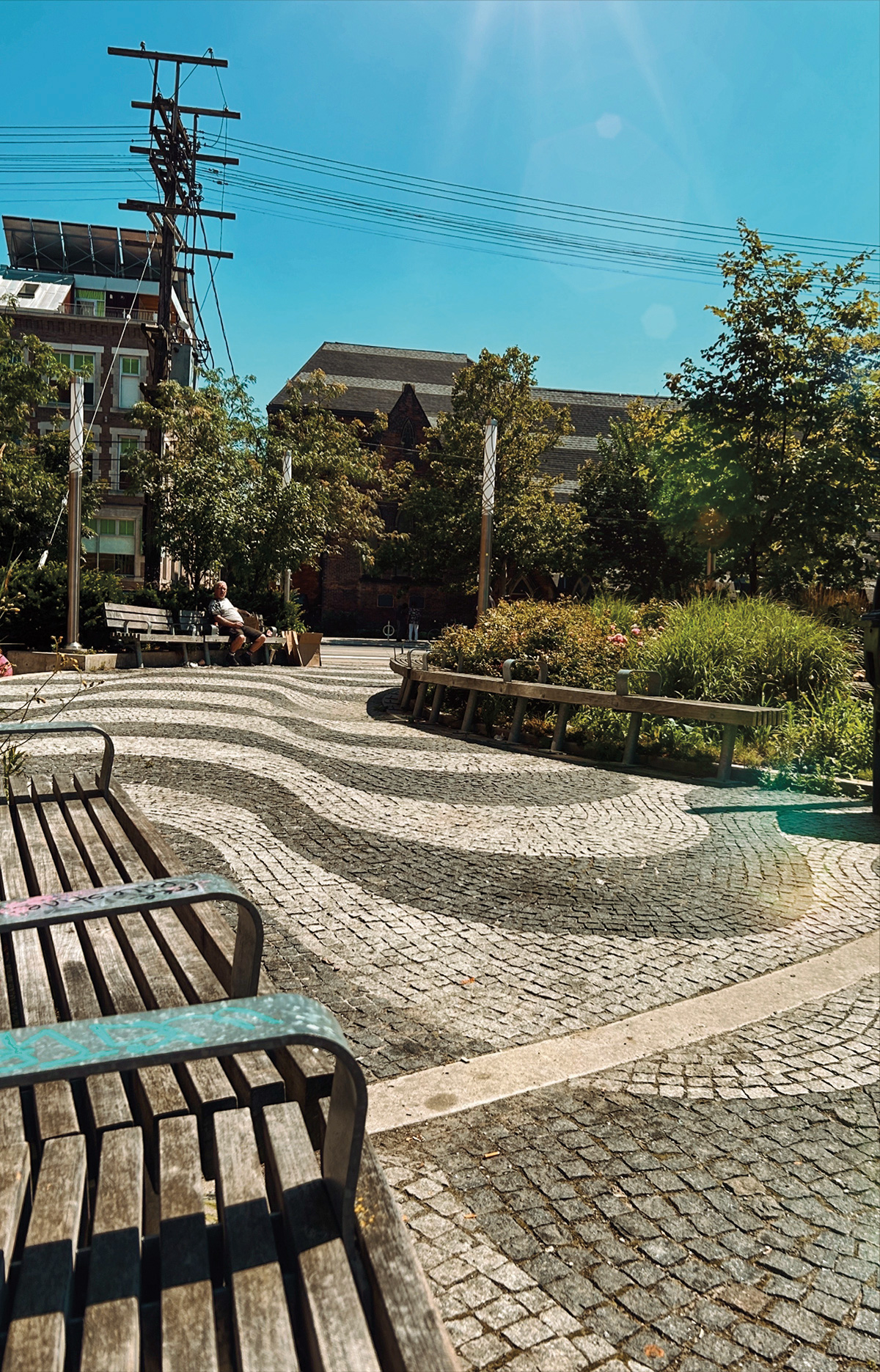
Doctors’ Parkette
15 Brunswick Ave.
Grade: C- (last year c-)
Time of visit: 3:05 p.m.
Reason to go: It is easy to bypass Doctors’ Parkette on one’s commute. While other greenspaces on the list have plenty of trees to provide ample shade, Doctors’ Parkette, located at College Street and Brunswick Avenue, is sorely lacking shade. Additionally, this park is almost entirely paved, making it feel very urbanized, much like the rest of one’s experience of living downtown. Its benches are uncomfortable due to the direct sun, and surfaces are hot to the touch. While the extensive hardscaping is not desirable, the pavers do exhibit an attractive pattern Overall though, this park still has room for improvement.
Overheard: “Apparently pigeons are entirely domesticated and reliant on people for survival because we used to use them as messenger pigeons,” a friend said to another friend, while feeding the pigeons.
Did you know: The parkette’s name pays homage to the medical professionals who have historically been part of the community or contributed to the city’s development and to Doctor’s Hospital which was located just north of the space on Brunswick Ave until 1998.
Christie Pits Park
750 Bloor St. W.
Grade: A+ (Last year A+)
Time of visit: 2:09 p.m.
Reason to go: Among one of the largest and most well-known parks in the city, Christie Pits is a favourite for those who need to escape to nature amid the fast-paced city life. Its convenient location next to Christie subway station, and its many amenities create a unique pull. Aside from the rolling hills and standard park amenities such as picnic benches and a clean washroom, Christie Pits offers various attractions including an outdoor swimming pool, basketball courts, baseball diamonds, and a skateboard park. The park truly comes alive during the summer, as there is always something to keep oneself entertained within the breadth of this greenspace, be it a weekly movie-night under the summer stars, pop-up vendors, or a picnic in celebration of pride month. This park teeming with life is worth visiting this summer.
Overheard: A young woman lying on the grassy knoll humming to herself happily with a book in hand.
Did you know: The park was originally known as Willowvale Park, but it was renamed Christie Pits in recognition of the Christie Sand Pits which were used for sand extraction in the early 1900s. The park is also named after the Christie Sand Company which owned the quarry.
MIA KESKINEN/GLEANER NEWS
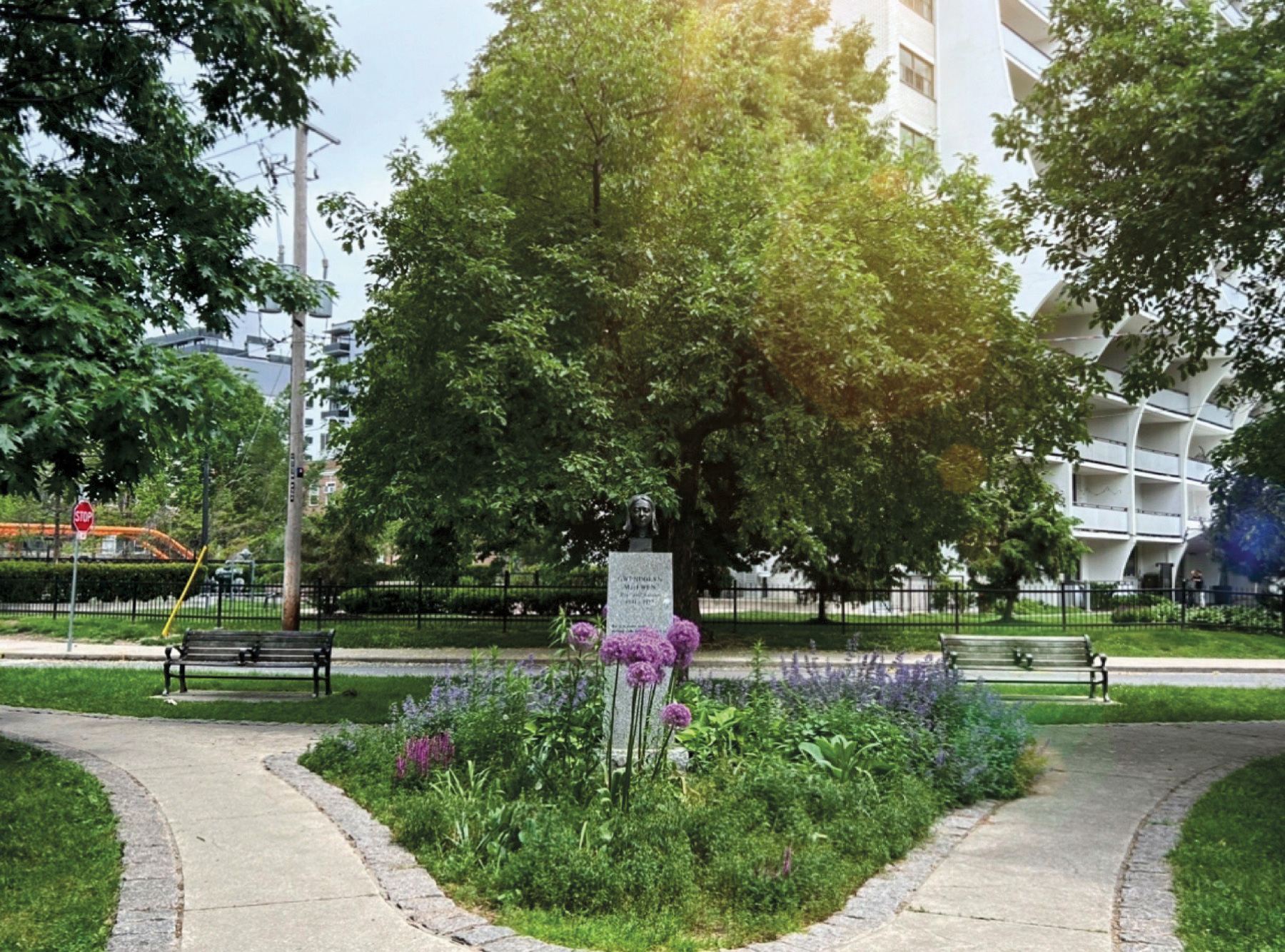
Gwendolyn MacEwen Park
33 Walmer Rd.
Time of visit: 12:01 p.m.
Grade: B- (Last year’s grade: B-)
Reason to go: Located at Walmer Road and Lowther Avenue, Gwendolyn MacEwen Park is a quaint, small greenspace featuring flower beds laden with lush purple hues. The park lies in front of Walmer Road Baptist Church where there is a beautiful Indigenous mural. Amenities include several park benches where park goers can relax. The park is in the middle of a roundabout, providing scenery for passersby on their commute. The only drawback of this park is the noise, given its location in the heart of a roundabout.
Overheard: Dogs panting happily as they sniff the flowerbeds on their afternoon walk.
Did you know: The park celebrates the life and work of Gwendolyn MacEwen who made significant contributions to Canadian literature. It serves as a reminder of her impact on the literary community and her connection to the Annex neighborhood.
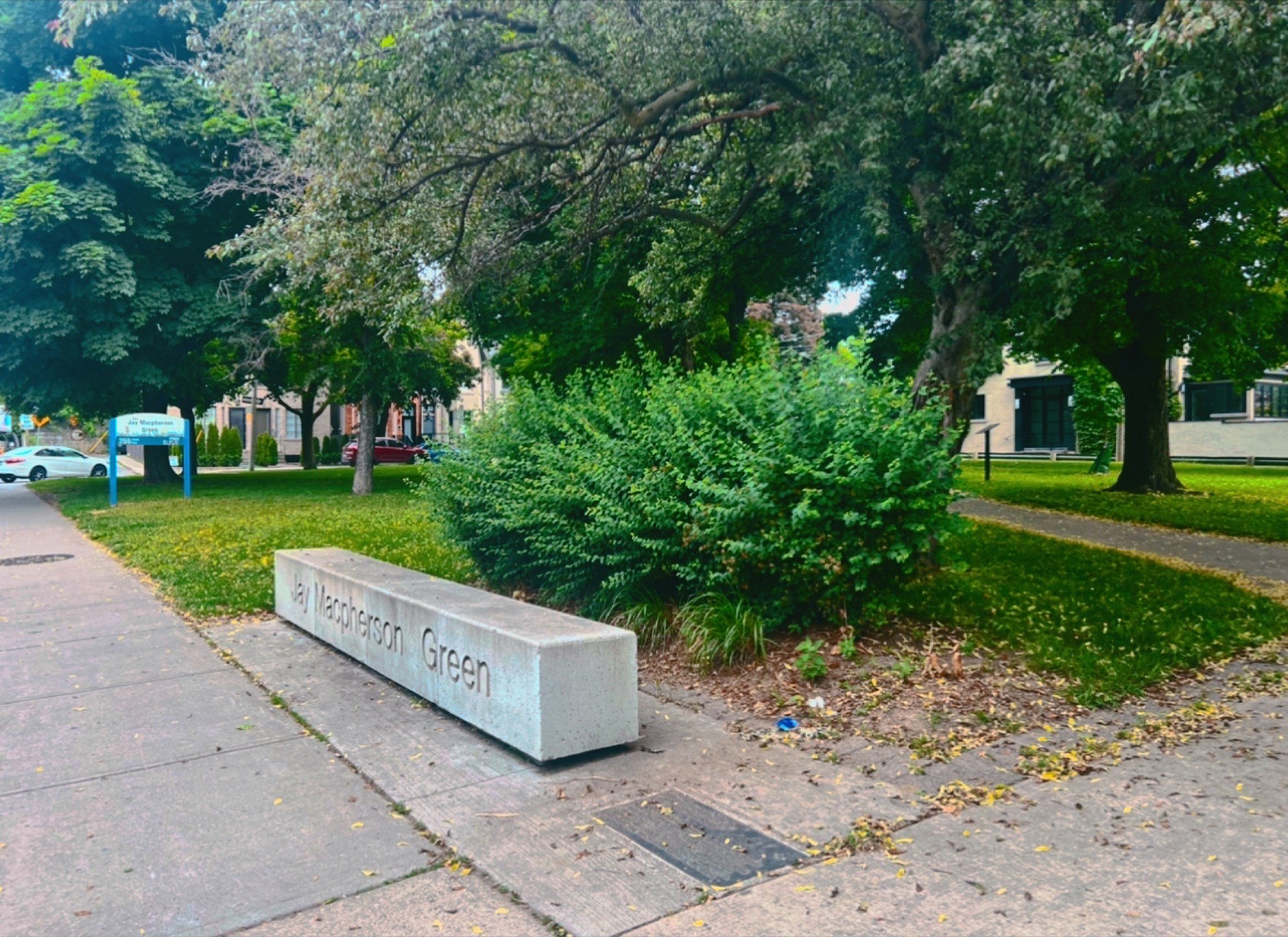
Jay MacPherson Green
255 Avenue Rd.
Time of visit: 1:20 p.m.
Grade: A- (Last year’s grade: A-)
Reason to go: Jay Macpherson Green is a small park located at the bustling intersection of Avenue Road and Dupont Street and encircled by Victorian homes. Its amenities consist of several benches, amongst the tall sway of the trees under the warm summer sun. Unfortunately, due to its location on a main road, noise pollution makes this park harder to enjoy than others on the list; however, the park serves its purpose, given that it is well kept. The park is across from Sergeant Ryan Russell Parkette.
Overheard: “C’mon boys!” says a dog walker walking with ten dogs in tow, relishing the warm summer sun.
Did you know: The park is named after Jay Macpherson, a celebrated Canadian poet and academic known for her contributions to Canadian literature. She won the Governor General’s Award for Poetry in 1957 for her book The Boatman.
Sergeant Ryan Russell Parkette
Time of visit: 1:45 p.m.
Rating: A (last year B+)
Reason to go: Sergeant Ryan Russell Parkette, near Jay Macpherson Green, is also located at Avenue Road and Dupont Street. The park provides more of an escape from the din of traffic than Jay Macpherson Green because the trees block the view of the roadway, creating a better sense of privacy. This park is great for those with little ones as the parkette features a large enclosed playground for children to safely enjoy, as well as benches for parents to sit and chat.
Overheard: “You’ll never catch me!” a little one yells to one of his friends, childlike wonder painted across his face as he runs from his friends during a game of tag.
Did you know: This park was named after Sergeant Ryan Russell who died in the line of duty on Jan. 12, 2011 in the arms of his fellow officer, Sergeant Sarah Andrews. The tragedy took place nearby on Avenue Road.
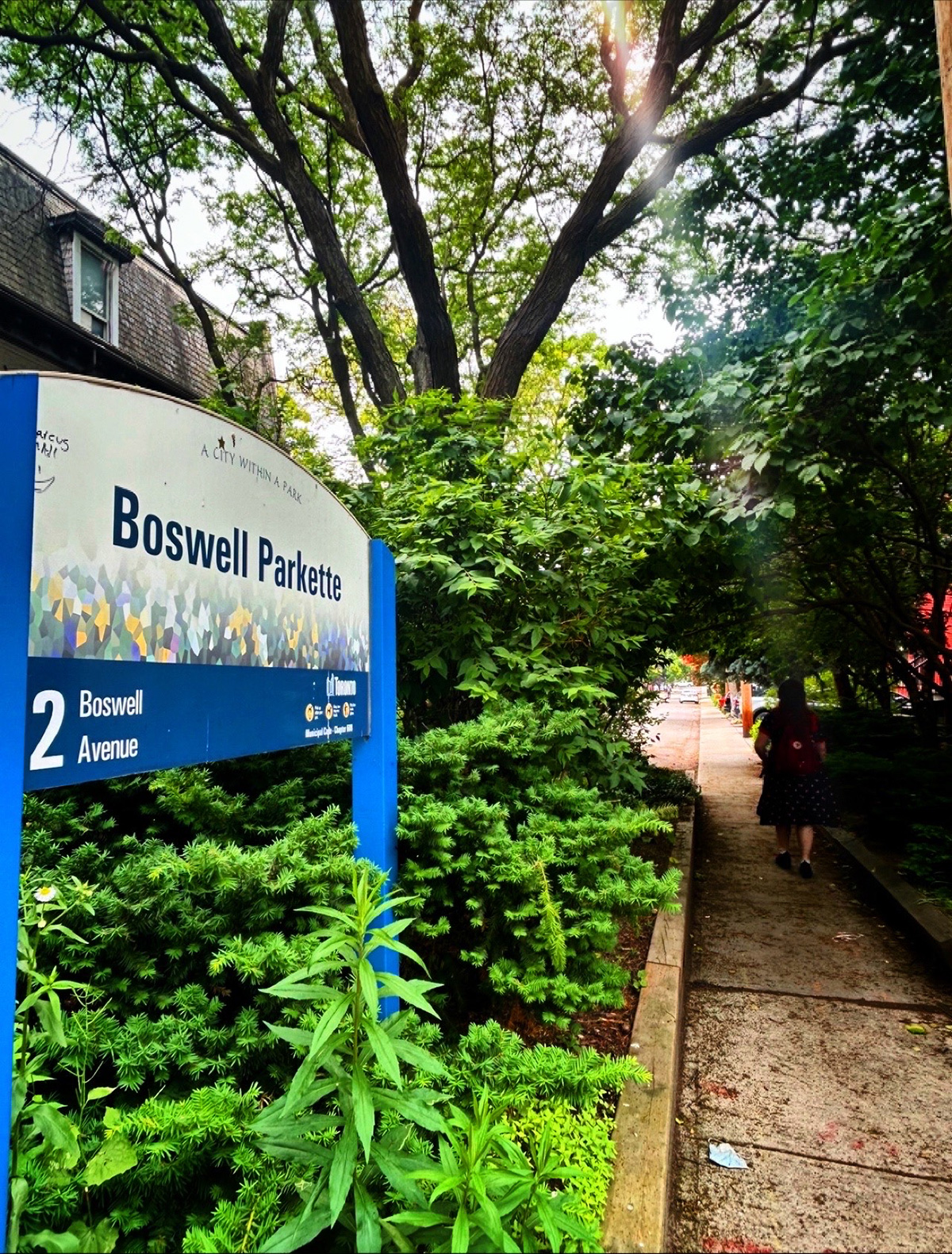
Boswell Parkette
4 Boswell Ave.
Time of visit: 1:25 p.m.
Grade: B (last year’s grade: B)
Reason to go: Boswell Parkette is a small pocket that can be easily missed while walking through the city. It provides a beautiful canopy of trees which form a passageway to a residential area along Boswell Avenue to Avenue Road. This greenery adds an additional level of privacy and serenity to a quaint neighbourhood, and it absorbs noise for those who live within the historical homes, located close to a main road. Finding this spot is a pleasant surprise for passersby amidst the hustle and bustle of the metropolis. The noises of the streets are unfortunately audible making this parkette less ambient than others on the list, but it can still be an enjoyable quick stop, nature amongst the urban landscape. Though its amenities are few, a single bench by a bus stop, Boswell Parkette is nonetheless an enjoyable place to pass through while waiting for the bus.
Overheard: A group of girls giggling and laughing with each other, carrying a bouquet of flowers; a glimpse of girlhood within a fast-paced urban jungle.
Did you know: Boswell Parkette was named after Toronto’s 24th mayor, Arthur Radcliffe Boswell, who is most remembered for hosting a renowned party in commemoration of Toronto’s 50th anniversary in 1884.
READ MORE:
- FOCUS: Grading our greenspace (Feb. 2024)
- FOCUS: Grading our Greenspace (Dec. 2023)
- FOCUS: Grading our greenspace (Fall 2023)
- GRADING OUR GREENSPACE: Third and final instalment (Oct. 2022)
- GRADING OUR GREENSPACE: Appraising Annex parks (Sept. 2022)
- GRADING OUR GREENSPACE (Aug. 2022)
- NEWS: New mural celebrates Indigenous storytelling (July 2022)
- GRADING OUR GREENSPACE (Fall 2021)
- GRADING OUR GREENSPACE (July 2021)
- LIFE: Bickford Park embraces yoga (June 2021)
- FOCUS: New park imbued with nostalgia (Apr. 2021)
- ON THE COVER: Renewing Martel’s vision (Nov. 2020)
- FOCUS: Park set for eco-restoration (Nov. 2020)
- GRADING OUR GREENSPACE: Grading the green (Aug. 2020)
- FORUM: Making it green (Aug. 2020)
- OBITUARY: Architect leaves indelibe marks (July 2020)
- CHATTER: Sally’s Fright finds a home in Yorkville (July 2020)
- FOCUS: Robert Street Field site of geothermal energy (Mar. 2020)
- CHATTER: Park gets a haircut (Nov. 2019)
- CHATTER: Park still ignored by city (Oct. 2019)
- NEWS: City fails to maintain park (Sept. 2019)
- GRADING OUR GREENSPACE: Park it here (August 2019)
- GRADING OUR GREENSPACE: Open spaces in the heart of the Annex (Summer 2019)
- NEWS: Huron-Washingon Parkette relocates while UTS expands (Spring 2019)
- NEWS: First meeting on new Mirvish Village park (Summer 2018)
- GRADING OUR GREENSPACE: The best and worst of local parks(Summer 2018)
- GRADING OUR GREENSPACE: More attention to green spaces means parks are improving (July 2018)
- GRADING OUR GREENSPACE: Parks on the fringe (AUGUST 2017)
- GRADING OUR GREENSPACE: Open spaces in the heart of the Annex (July 2017)
- GRADING OUR GREENSPACE: Survey reveals significant upgrades (June 2017)
- GRADING OUR GREENSPACE: Meet our parks supervisor (August 2016)
- Part two of our 2016 parks review (July 2016)
- NEWS: Renewing Margaret Fairley Park (JULY 2016)
- PART ONE: Green sanctuaries in the heart of the city (June 2016)
- Grading our Greenspace (2015)
- NEWS: Sibelius Park officially opens (June 2012)
Comments Off on GRADING OUR GREENSPACE: A report card on our parks (Summer 2024)Tags: Annex · Life
CHATTER (Summer 2024)
October 15th, 2024 · Comments Off on CHATTER (Summer 2024)
Cornfest returns; Koreatown’s inaugural street festival; street closure at Bloor and St. George streets
Cornfest returns to Jean Sibelius Park on Sept 15 (3-5pm)

The Annex Residents’ Association is again hosting its annual Cornfest. All are welcome to this rain or shine event to enjoy the sweet seasonal treat together with baked goods, games, and live entertainment!
Koreatown Street Festival
The Korea Town BIA hosted its inaugural street festival on August 10 featuring food vendors, drumming performances, and a brass band. A portion of Euclid Avenue from Bloor St. W was closed for the Saturday evening event which drew a large gathering.
Bloor and St. George full closure
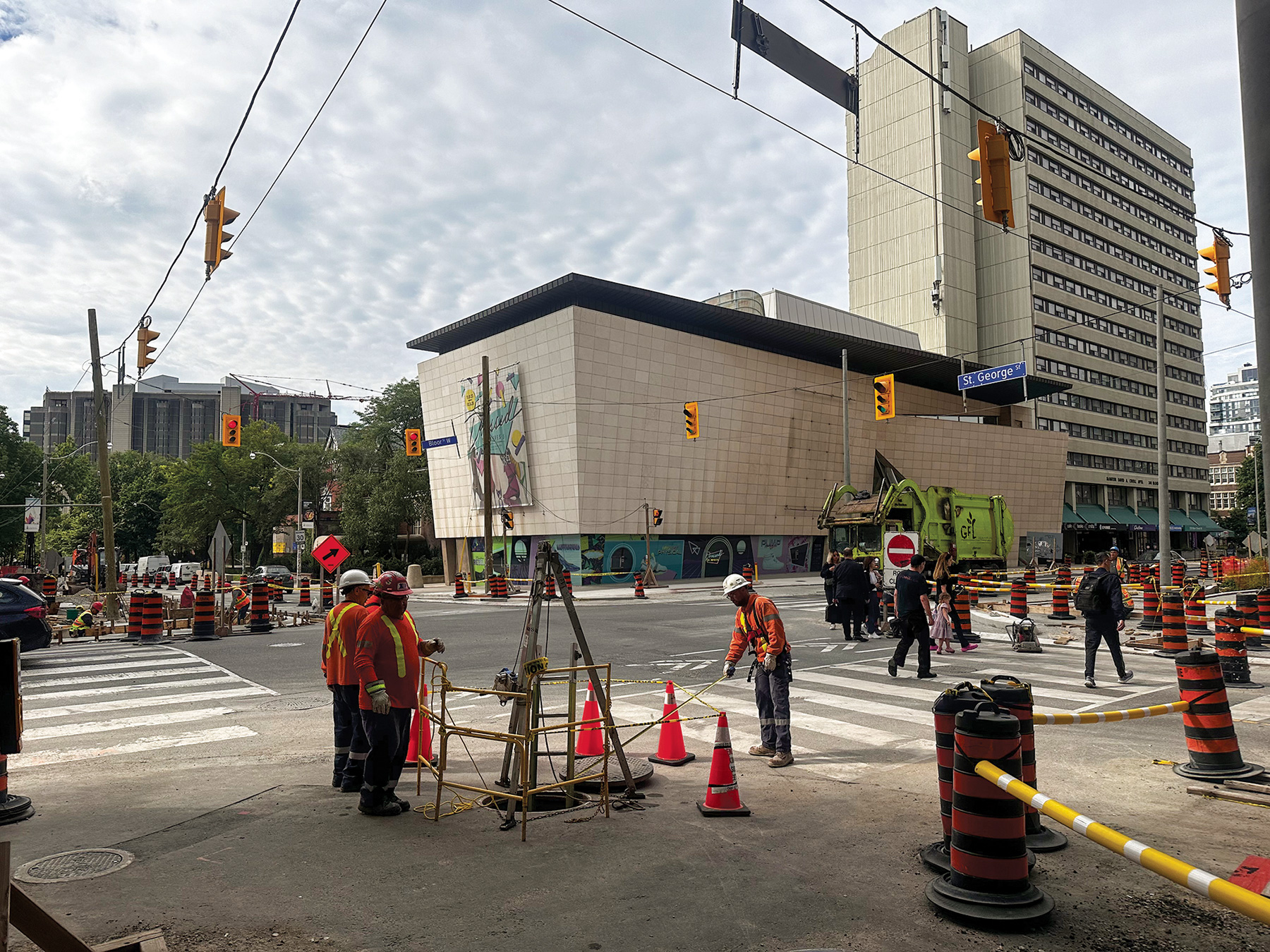
The city has announced that construction on Bloor Street West will require the full closure of the intersection at St. George for the week of August 19 to 26. No vehicle traffic, including cyclists, will be permitted passage. Cyclists will be expected to dismount. Pedestrian access will be maintained.
The city’s contractor anticipates substantial project completion by August 30 and to be off the street by the end of September after two years of roadwork.
—Brian Burchell/Gleaner News
Comments Off on CHATTER (Summer 2024)Tags: Annex · News
EDITORIAL CARTOON: Staggering Progress! (Summer 2024)
October 15th, 2024 · Comments Off on EDITORIAL CARTOON: Staggering Progress! (Summer 2024)

SEE MORE EDITORIAL CARTOONS:
- EDITORIAL CARTOON: How Nice (June 2024)
- EDITORIAL CARTOON: How Nice (May 2024)
- EDITORIAL CARTOON: How Nice: NIMBYism 101 (Apr. 2024)
- EDITORIAL CARTOON: Why can’t they get along??? (Mar. 2024)
- EDITORIAL CARTOON: How to drive in Toronto (Feb. 2024)
- EDITORIAL CARTON: “Someone’s getting rich!” (Dec. 2023)
- EDITORIAL CARTOON: How Nice (Fall 2023)
- EDITORIAL CARTOON: How Nice (Summer 2023)
- EDITORIAL CARTOON: How Nice (May/June 2023)
- EDITORIAL CARTOON: How nice (April 2023)
- EDITORIAL CARTOON: Scale of badness (Mar. 2023)
- EDITORIAL CARTOON: Winter’s not as cold as these deals! (Feb. 2023)
- EDITORIAL CARTOON: How Nice — Can dreams come true? (For John Tory) (Dec. 2022)
- EDITORIAL CARTOON: How Nice (Nov. 2022)
- EDITORIAL CARTOON: How Nice (Oct. 2022)
- EDITORIAL CARTOON: How Nice (Sept. 2022)
- EDITORIAL CARTOON: How Nice (Aug. 2022)
- EDITORIAL CARTOON: A chacun son principles (July 2022)
- EDITORIAL CARTOON: How Nice (Provincial Election 2022)
- EDITORIAL CARTOON: How Nice (May 2022)
- EDITORIAL CARTOON: How Nice (Spring 2022)
- EDITORIAL CARTOON: How Nice (Winter 2022)
- EDITORIAL CARTOON: How Nice (Jan. 2022)
- EDITORIAL CARTOON: How Nice (Dec. 2021)
- EDITORIAL CARTOON: How Nice (Fall 2021)
- EDITORIAL CARTOON: Fourth wave funnies! (Aug. 2021)
- EDITORIAL CARTOON: How Nice (Jul. 2021)
- EDITORIAL CARTOON: How Nice (Apr. 2021)
- EDITORIAL CARTOON: Pandemic Response (Mar. 2021)
- EDITORIAL CARTOON: How Nice (Feb. 2021)
- EDITORIAL CARTOON: How Nice (Jan. 2021)
- EDITORIAL CARTOON: How Nice! (Dec. 2020)
- EDITORIAL CARTOON: How Nice (Nov. 2020)
- EDITORIAL CARTOON: How Nice (Oct. 2020)
- EDITORIAL CARTOON: How Nice (Aug. 2020)
- EDITORIAL CARTOON: How Nice (July 2020)
- EDITORIAL CARTOON: How Nice (Apr. 2020)
- EDITORIAL CARTOON: How Nice (Mar. 2020)
- EDITORIAL CARTOON: How Nice (Feb. 2020)
- EDITORIAL CARTOON: How Nice (Election Special 2018)
- FORUM: Celebrating 20 years of cartoonist Brett Lamb (April 2017)
Comments Off on EDITORIAL CARTOON: Staggering Progress! (Summer 2024)Tags: Annex · Editorial · Opinion
EDITORIAL: Road safety for some, sometimes (Summer 2024)
October 15th, 2024 · Comments Off on EDITORIAL: Road safety for some, sometimes (Summer 2024)
When Ontario Premier Bill Davis stopped the Spadina Expressway, the decision could have been a defining moment for Toronto. But over a half century later, it’s still not clear that we are “building a transportation system to serve people” instead of automobiles. Construction projects and heavy trucks that endanger vulnerable road users, along with politicians devoted to protecting the status quo, continue to block a more people-friendly way forward. The death of a young female cyclist on Bloor Street on July 25 offers additional, tragic evidence that we still live in a car-first reality.
It’s easy to find construction projects where the safety of people looks like an afterthought, beginning with the year-long road work on Bloor Street between Spadina and Avenue Roads.
When the Bloor work started in August 2023, the first casualty was the bike lane, obliging people on bikes to travel single file with cars and trucks in narrow lanes where some motorists were quick to assert their power advantage, especially at dangerous merge points. Among the over 5,000 daily Bloor cyclists, about 10 per cent predictably took refuge on sidewalks, potentially undermining the safety of pedestrians.
Meanwhile, where detour routes are indicated to get around a road construction site—instead of providing safe passage through it—some efforts verge on the absurd. On Queen’s Park Road, just south of Bloor, where an elevator is being installed for the TTC’s Museum station, a detour for southbound cyclists was so long (1.7 kilometres) and so challenging (including two left turns) that very few people could be expected to use it, given that the obstruction itself was a mere 50 metres long.
Heavy trucks are another well-known peril because of driver blind spots and the risk of a person being pulled under the rear wheels in a collision. Anguished community pleas for remedial action after these deaths are as predictable as they are futile. Since 2018, cement, dump, and flatbed trucks have been involved in four deaths at or near the Bloor and Avenue Road intersection alone. The government and industry response has been consistent, but only in trying to pass the buck or to fight improvements, including truck side guards twice recommended by Ontario coroners in comprehensive death reviews.
Illegal placement of construction materials in bike lanes is a variation of long-standing problems of illegal, poorly enforced rules against parking in bike lanes by motorists who often wave off their delict with: “l’ll just be a minute.” While we don’t yet know definitively why the young woman exited the bike lane on July 25 before she was struck and killed, we do know that a construction bin was illegally parked in her path.
Fortunately, solutions to the existing dangers are not hard to find.
First, we need clearly articulated, consistent rules for all construction sites, based on the paramount importance of human life in our Vision Zero Road Safety Plan.
Second, the city must follow a clear hierarchy—with pedestrians and cyclists at the top—in deciding how to use available road space to provide safe passage through construction sites. The parking of personal vehicles by construction workers will fall low on this scale. Maintaining bike lanes and sidewalks, even if it means closing a road to motor traffic, must come first.
Third, we need effective and routine monitoring of construction projects that intrude on public rights of way—and routine enforcement for noncompliance. In the aftermath of the July 25 tragedy, Mayor Olivia Chow spoke of instituting an urban “mobility squad,” similar to one in Montreal, to monitor streets for dangers. Whatever the name, such patrols can’t come soon enough, especially to deal with cavalier attitudes to obstructing bikeways and sidewalks. Would any company illegally obstruct a bikeway if it reasonably feared being caught and penalized?
It’s time to build a city for people as if our lives depended on it…because they do.
Albert Koehl is an environmental lawyer, coordinator of Community Bikeways, and author of Wheeling through Toronto: A History of the Bicycle and Its Riders.
READ MORE EDITORIALS:
- EDITORIAL: Ford’s boozy billion-dollar blunder (June 2024)
- EDITORIAL: Ford needs to step up and lead for once (May 2024)
- EDITORIAL: The Vacant Home Tax: A multi-mayor failure (Apr. 2024)
- EDITORIAL: Ford‘s actions “reflect a juvenile understanding of the role of the judiciary” (Mar. 2024)
- EDITORIAL: The “Get it Done Act” should get Ford out (Feb. 2024)
- EDITORIAL: AG confirms Ford rigged Science Centre analysis (Dec. 2023)
- EDITORIAL: An insincere mea culpa (Fall 2023)
- EDITORIAL: Ford exploits housing crisis (Summer 2023)
- EDITORIAL: Ford’s poor planning will hurt us all (May/June 2023)
- EDITORIAL: Bleed it and then blame it for dying (April 2023)
- EDITORIAL: Ford’s budget is a fail (Mar. 2023)
- EDITORIAL: Freedom Ford-style (Feb. 2023)
- EDITORIAL: We care Mr. Tory (Jan. 2023)
- EDITORIAL: Bill 23: A housing plan built on corruption (Dec. 2022)
- EDITORIAL: Leaders show up (Nov. 2022)
- EDITORIAL: A small business tax break in name only (Oct. 2022)
- EDITORIAL: Taking control of the narrative (Sept. 2022)
- EDITORIAL: Farewell Mike (Aug. 2022)
- EDITORIAL: Highway’s environmental impact worsens with every report(July 2022)
- EDITORIAL: Buck-a-fare just another sound bite (Provincial Election 2022)
- EDITORIAL: Ford’s climate fiction (May 2022)
- EDITORIAL: A conservative in name only (Spring 2022)
- EDITORIAL: Ford should be first (Winter 2022)
- EDITORIAL: Ford stalls, families suffer (Jan. 2022)
Comments Off on EDITORIAL: Road safety for some, sometimes (Summer 2024)Tags: Annex · Editorial · Opinion
FORUM: Saxe and the City (Summer 2024)
October 15th, 2024 · Comments Off on FORUM: Saxe and the City (Summer 2024)
Councillor debuts podcast; Avenue Road safety improvements are on the way
By Dianne Saxe
Summer’s heat doesn’t slow things down in beautiful University-Rosedale! Celebrations raise spirits across the city, and our ward plays host to some of the best. I proudly celebrated love and diversity by dancing in this year’s Pride Parade (Thank you for all the cheers!). I was also glad to see so many of you enjoying this year’s Taste of Little Italy, the Toronto Jazz Festival, and Yorkville’s Exotic Car Show. A special thank you to everyone who came out to our June Environment Day. During summer in the Annex, I always look forward to being inspired and surprised at the Toronto Fringe Festival. Don’t miss my conversation with the new heads of the festival on my new podcast, Saxe and the City!
At June city council, we were able to address unsafe conditions for pedestrians and cyclists on the most dangerous road in our ward: Avenue Road between Bloor and Dupont. After months of intensive work in conjunction with the Avenue Road Safety Coalition, community members, my colleagues and staff, I am delighted to deliver the largest number of pedestrian and cyclist safety improvements that can be achieved without reconstructing the road (which could take decades). These measures strike a careful balance between the needs of pedestrians, cyclists, motorists, businesses, residents, visitors, the TTC and emergency services, transforming this section of Avenue Road into a more pedestrian-friendly corridor while maintaining traffic flow and a reasonable amount of parking. Installation south of Davenport began in July; Dupont to Davenport should begin this fall.
Unfortunately, council did not approve a staff-recommended median to physically bar dangerous maneuvers from Roxborough to Avenue to Dupont, which leads to a crash about every 12 days. The median would have made this particular intersection safer, but at the cost of more neighborhood traffic infiltration, and longer travel times for those who use Roxborough as a shortcut to the west.
Meanwhile, I continue to support measures to improve housing affordability and stability for Toronto’s renters. This includes turning a parking lot in the heart of Kensington Market into over 60 affordable, sustainable, supportive units; a proposed renovation control bylaw; and a new Rental Housing Supply program to construct purpose-built, rent-controlled homes. If the province does its part, we could build 65,000 more homes by 2030, including 6,500 much-needed rent-geared-to-income (RGI) homes in mixed-income developments.
We are also working to improve TTC fare enforcement which should reduce the numerous delays caused by “disorderly patrons,” many of whom did not pay for their ride.
As climate damage visibly worsens around the world, I am relieved that Toronto is still making slow but steady progress. I continue to work hard on climate action and to take the initiative whenever possible, and I am proud to report several landmark results from last month.
The biggest win was a landmark equity investment in Toronto Hydro. This long overdue investment will keep Toronto Hydro’s debt-to-equity ratio and borrowing costs within reasonable bounds while keeping pace with population growth and electrification. I am also looking forward to working with our new CEO and four new board members to lead Toronto Hydro through this exciting time. Two of them, Joyce MacLean and Ersilia Serafini, are respected climate leaders, and I expect that we will be able to do much more together than I could do alone.
Toronto city council also adopted my motion calling on the Independent Electricity System Operator to dramatically reduce gas generation by 2035 and allow Toronto Hydro to lead the transition. Now I’m working with the Clean Air Partnership and Environmental Defence to encourage other municipalities to do the same.
We can dramatically reduce our climate pollution by tackling two significant sources of it here in Toronto: car pollution and gas emissions from existing buildings. To these ends, we are pushing for buildings to eliminate their emissions by 2040, in line with the aims of TransformTO. I am also continuing to work on making it safer and more convenient to get around Toronto on foot, by bike, or by transit, and I am thrilled council also approved the 2025 to 2027 cycling network plan, plus more 2024 sidewalk and bike lane projects.
Dianne Saxe is city councillor for Ward 11, University-Rosedale.
READ MORE BY DIANNE SAXE:
- FORUM: Tackling road congestion, noise, and safety (June 2024)
- FORUM: Undoing vacant home tax debacle (May 2024)
- FORUM: A busy agenda at city council (Apr. 2024)
- FORUM: University-Rosedale update from the councillor’s chair (Mar. 2024)
- FORUM: Eventful new year at city council (Feb. 2024)
- FORUM: A hectic first year in University-Rosedale (Dec. 2023)
- FORUM: Keeping it green and safe in University-Rosedale (Fall 2023)
- FORUM: Fighting on five fronts (Summer 2023)
- FORUM: Addressing a housing shortage (May/June 2023)
- FORUM: Leveraging a green agenda (April 2023)
- FORUM: Budget passes in a consensus vote (Mar. 2023)
- FORUM: Bike lanes made permanent, more warming centres open (Feb. 2023)
- FORUM: Turbulent time to take a seat (Jan. 2023)
Comments Off on FORUM: Saxe and the City (Summer 2024)Tags: Annex · Opinion
FORUM: The heat is on (Summer 2024)
October 15th, 2024 · Comments Off on FORUM: The heat is on (Summer 2024)
The Ontario government is AWOL on the existential threat that is climate change
By Jessica Bell
This year has been a defining moment in our global climate crisis because the devastating and life-threatening impacts of climate change have arrived in Canada. It’s no longer an inconvenience that affects someone else; it affects us.
This summer the extreme weather event is heat. Lengthy extreme heat waves are making life a misery for people without A/C, mostly renters. I worry about the low-income seniors and vulnerable people living alone. People are dying of heat stroke.
Workers are sweating it out in dangerous heat, from firefighters to farmers, to construction workers. Heat stroke can strike fast. Many workers are not able to refuse work because they can’t risk being fired.
Our public services, energy grid, and infrastructure are not ready to withstand our electricity needs during an extreme and lengthy heat wave. Demand on our electricity grid reached a record high this June during an unprecedented heat wave that occurred early in the summer. Our future will look like what’s happening in Houston, where 800,000 people are without power during the insufferable heat.
Because we have delayed taking serious action on climate, humanity now faces three huge challenges at once: we must get to net-zero emissions as soon as possible; we must take on the herculean task of preparing ourselves to survive in a world marred by extreme weather events and ecological disruption, from bolstering our healthcare system to making our farming and food sector more resilient; and we need to do all this while coping with frequent crises, like entire towns being razed by wildfires or epic rainfalls that endanger lives, bring our city to a standstill, and flood our roads, stations, and basements, just like we recently experienced.
Given the high stakes, it’s tough to watch the Ontario government’s clumsy, reluctant, and contradictory response to the climate crisis. To be fair, the Conservatives are investing in new transit lines and the electric vehicle manufacturing sector. They’re obsessed, however, with opposing any price on carbon to incentivize people and industry to go green. You can’t go through a question period without the Conservatives asking their MPP colleagues to “axe the tax.”
We need a response to the climate crisis that matches the enormity of the challenge. That will involve replacing the Conservatives’ car-centric sprawl approach to planning with a sustainable planning mandate, where we build more employment zones, homes and services in existing towns and cities.
We need to invest in electric vehicle, transit, cycling and walking infrastructure.
We need to protect our farmland, Greenbelt, and forests, and restore power to our conservation authorities to ensure we don’t build on floodplains.
It’s time to invest in a large building retrofit program and upgrade our building code so all existing and new buildings and homes are resilient, green, and well-made.
It means greening our electricity grid, investing in energy efficiency, wind, and solar, and moving away from gas-powered gas plants.
It means bringing in rules to protect people from extreme heat, such as a minimum temperature standard for rental homes in summer and protections for workers in extreme heat. We have solutions.
When I canvass, I occasionally meet residents who feel despair, grief, and a sense of defeat about the climate crisis and what we can do to usefully respond to the many crises we face.
These feelings are common, especially since so many of us are exhausted from the pandemic times.
I am inspired by the work of Joanna Macey, an Australian activist who helps people feel and channel their grief and despair about the world and recommit to useful social change. She writes books with titles like Active Hope: How to Face the Mess We’re in Without Going Crazy.
“The most remarkable feature of this historical moment on Earth,” says Joanna Macey, “is not that we are on the way to destroying the world—we’ve actually been on the way for quite a while. It is that we are beginning to wake up, as from a millennia-long sleep, to a whole new relationship to our world, to ourselves and each other.”
These are words for hope and for taking useful action.
Jessica Bell is the MPP for University-Rosedale and the Official Opposition’s Housing Critic. She can be reached at jbell@ndp.on.ca or 416-535-7206.
READ MORE BY JESSICA BELL:
- FORUM: A view from inside the pink palace (June 2024)
- FORUM: Queen’s Park roundup (May 2024)
- FORUM: Ford’s gross mismanagement of the land use files (Apr. 2024)
- FORUM: Privatization, sprawl, and highways, oh my (Mar. 2024)
- FORUM: Report confirms Ford government failures (Feb. 2024)
- FORUM: Where’s Ontario’s student housing plan? (Dec. 2023)
- FORUM: Engage in the political process and change can happen (Fall 2023)
- FORUM: Shelters overwhelmed by refugee seekers (Summer 2023)
- FORUM: New density is landing where there are few schools (May/June 2023)
- FORUM: Ford boosts sprawl, brings in meek renter protections (April 2023)
- FORUM: Conservative budget doesn’t deliver for Toronto (Mar. 2023)
- FORUM: Toronto’s budget built on a false premise (Feb. 2023)
- FORUM: Toronto has a homelessness crisis (Jan. 2023)
- FORUM: Ford takes aim at democracy and the Greenbelt (Dec. 2022)
- FORUM: Ford unleashes his sprawl agenda (Nov. 2022)
- FORUM: Living on welfare is not healthy (Oct. 2022)
- FORUM: Rare summer legislature sittings (Sept. 2022)
- FORUM: Celebrating our local leaders (Spring 2022)
- FORUM: Ford’s antics fill Pink Palace (Winter 2022)
- FORUM: Omicron demands leadership, not indecision (Jan. 2022)
- FORUM: Premier Ford gets an “F” (Dec. 2021)
- FORUM: A wasted election, now Mr. Trudeau please deliver (Fall 2021)
- FORUM: Five provincial issues to follow this fall (Aug. 2021)
- FORUM: Leaders must take real action on climate (July 2021)
- FORUM: Ford is no friend of affordable housing (June 2021)
- FORUM: Premier Ford’s land use planning agenda is a big worry (May 2021)
- FORUM: Mr. Ford cuts into the future of public services (Apr. 2021)
- FORUM: Vaccines, development, judicial reform dominate Queen’s Park(Mar. 2021)
- FORUM: To curb COVID-19, Ontario must protect workers (Feb. 2021)
- FORUM: St. George Community Living was a preventable tragedy (Jan. 2021)
- FORUM: Ford’s fall agenda deeply flawed (Dec. 2020)
- FORUM: How will Doug Ford’s 2020 budget impact us? (Nov. 2020)
- FORUM: Waiting on a second-wave plan from Mr. Ford (Oct. 2020)
- FORUM: What can we do to fight for safe public education? (Aug. 2020)
- FORUM: Ford failing to address homelessness, racism, schooling (July 2020)
- FORUM: COVID-19 has exposed issues in long-term care homes (May 2020)
- FORUM: Pandemic brings out the best in humanity (Apr. 2020)
- FORUM: We need to do our part (Mar. 2020)
- FORUM: Catastrophic climate change is here. How do we respond? (Feb. 2020)
- FORUM: University-Rosedale has a housing affordability crisis (Jan. 2020)
- FORUM: Ford plows ahead with cuts (Dec. 2019)
- FORUM: Ford’s backtracks show our resistance is working (Nov. 2019)
- FORUM: Our streets should be safer (Oct. 2019)
- FORUM: Top takeaways for our community from Ontario’s 2019 budget (Summer 2019)
- FORUM: Taking a stand against Ford’s cuts to education (May 2019)
- FORUM: With people-power there is hope (Winter 2019)
- FORUM: Take back Toronto on the 22nd (City Election 2018)
Comments Off on FORUM: The heat is on (Summer 2024)Tags: Annex · Opinion
GREENINGS: Paris can do it, why can’t we? (Summer 2024)
October 15th, 2024 · Comments Off on GREENINGS: Paris can do it, why can’t we? (Summer 2024)
Addressing climate change is a matter of will, not lack of means
By Terri Chu
Addressing climate change is a matter of will, not lack of means
Political leadership is rare these days. I want to give a shout out to the mayor of Paris for doing what those of us in Toronto can only daydream about.
In the 10 years since holding power, Mayor Anne Hidalgo has closed over 100 streets to motor vehicles. In a move sure to enrage car manufacturers, the parking fees for oversized murder machines such as SUVs have tripled. Torontonians can only salivate at the idea of removing 50,000 parking spots. The concessions we give to car drivers are unbelievable in this city.
Paris has also constructed more than 1300 kilometres of bike lanes since Mayor Hidalgo has held office. Meanwhile Toronto boasts less than 300 kilometres of on-street cycling paths as of the end of 2022. Those changes in Paris have contributed to a 40 per cent decline in air pollution—something Toronto desperately needs.
Toronto has its own challenges, starting with the car culture that sees residents whining loudly at the prospect of losing a single street parking spot. There’s the privilege of taking up public space with their vehicles for a song, meanwhile homeless encampments regularly get cleared by police. The use of public space has always been for the wealthy it seems…at least wealthy enough to own a car. Despite having extremely low capacity (rarely do cars have more than two people and usually only one), cars are rarely asked to give up space for public transit. Most of our major streetcar and bus routes see cars intermingled with public transit vehicles. A vehicle carrying dozens of people only has designated road usage on a small handful of lines.
Drivers were up in arms over parking ticket rates going up to $70, meanwhile skipping a $3.50 TTC fare can land you a fine of $400.
The concessions that we give to car and car drivers are part of a system of oppression that favours the rich. Now that we have enslaved the bulk of the population to cars, giving them no choice but to use them for mundane tasks to simply live, keeping those car concessions has turned into a rallying cry for advocates of the poor because public transit is so horrible in poor areas that they really have no choice. We are stuck in a horrible cycle that I do not see our political leadership having half the gall of Mayor Hidalgo to deal with. Both sides of our political spectrum favour continued car ownership. On the right, those who shill for the billionaire oil barons of course want us to keep driving. On the left, the unions have a huge number of auto and oil industry jobs they are keen to protect. This leaves people like you and me suffering the consequences of a system designed to take away our quality of life but too economically important to get out of.
The answer? We can’t just keep paying lip service to climate targets. We have no idea how many people in India have died in the latest heat wave. Just declaring a climate emergency while doing diddly squat does not cut it. Transition means some people will get hurt. The ones hurt most will be the poor oil barons who may need to scale down their mega yacht plans. The humanity!!
Next are the jobs dependent on the oil industry. We can have complicated schemes to ensure there is a just transition or we can do something simple like implement a universal basic income (UBI) scheme so that nobody is beholden to work that they hate or has no escape from a planet-frying job. Again, the ones hurt the most will be the billionaires. The injustice!
The city can’t implement these schemes alone, but if governments were serious about preventing mass death events from climate change, they would start with removing car-centric policies and a UBI plan. It’s simple policy, but hard politics.
READ MORE BY TERRI CHU:
- GREENINGS: Greater density along transit hubs is good for all of us (May 2024)
- GREENINGS: A lament for the tree inventory (Mar. 2024)
- GREENINGS: Our trees are in crisis (Feb. 2023)
- GREENINGS: It’s time for climate truth not trinkets (Dec. 2022)
- GREENINGS: Vote this election (Provincial Election 2022)
- GREENINGS: The disproportionate impact of inflation (Jan. 2022)
- GREENINGS: Avoid the stress of stuff at Xmas (Dec. 2021)
- GREENINGS: More greenspace, fewer cars (Apr. 2021)
- GREENINGS: Urban agriculture has many environmental dividends(Mar. 2021)
- GREENINGS: May you find your xingfu in 2021 (Jan. 2021)
- GREENINGS: What happens if we don’t want to go back to the “before” times? (July 2020)
- GREENINGS: Capitalist truths exposed (May 2020)
- GREENINGS: Reflecting on who actually matters (Mar. 2020)
- GREENINGS: Short-term gains lead to long-term losses (Feb. 2020)
- GREENINGS: Emergency climate calls to city met with busy signal (Jan. 2020)
- GREENINGS: Moral cowardice fuels our failures (Dec. 2019)
- GREENINGS: Unpacking the winning bling (Nov. 2019)
- GREENINGS: Another election, another round of disappointing platforms(Oct. 2019)
- GREENINGS: Addiction to capitalism will lead to overdose (Sept. 2019)
- GREENINGS: Sing the same tune, PLEASE (August 2019)
- GREENINGS: Not sure what’s worse, climate crisis or denying it? (Summer 2019)
- GREENINGS: Plastic ban born of necessity (May 2019)
- GREENINGS: Confronting consumption (Spring 2019)
- GREENINGS: Preventing chaos, mass starvation (Dec. 2018)
Comments Off on GREENINGS: Paris can do it, why can’t we? (Summer 2024)Tags: Annex · Life
SPORTS: Baseball feels the chill at Christie Pits (Summer 2024)
October 15th, 2024 · Comments Off on SPORTS: Baseball feels the chill at Christie Pits (Summer 2024)
Maple Leafs and their racing mascot both search for elusive wins
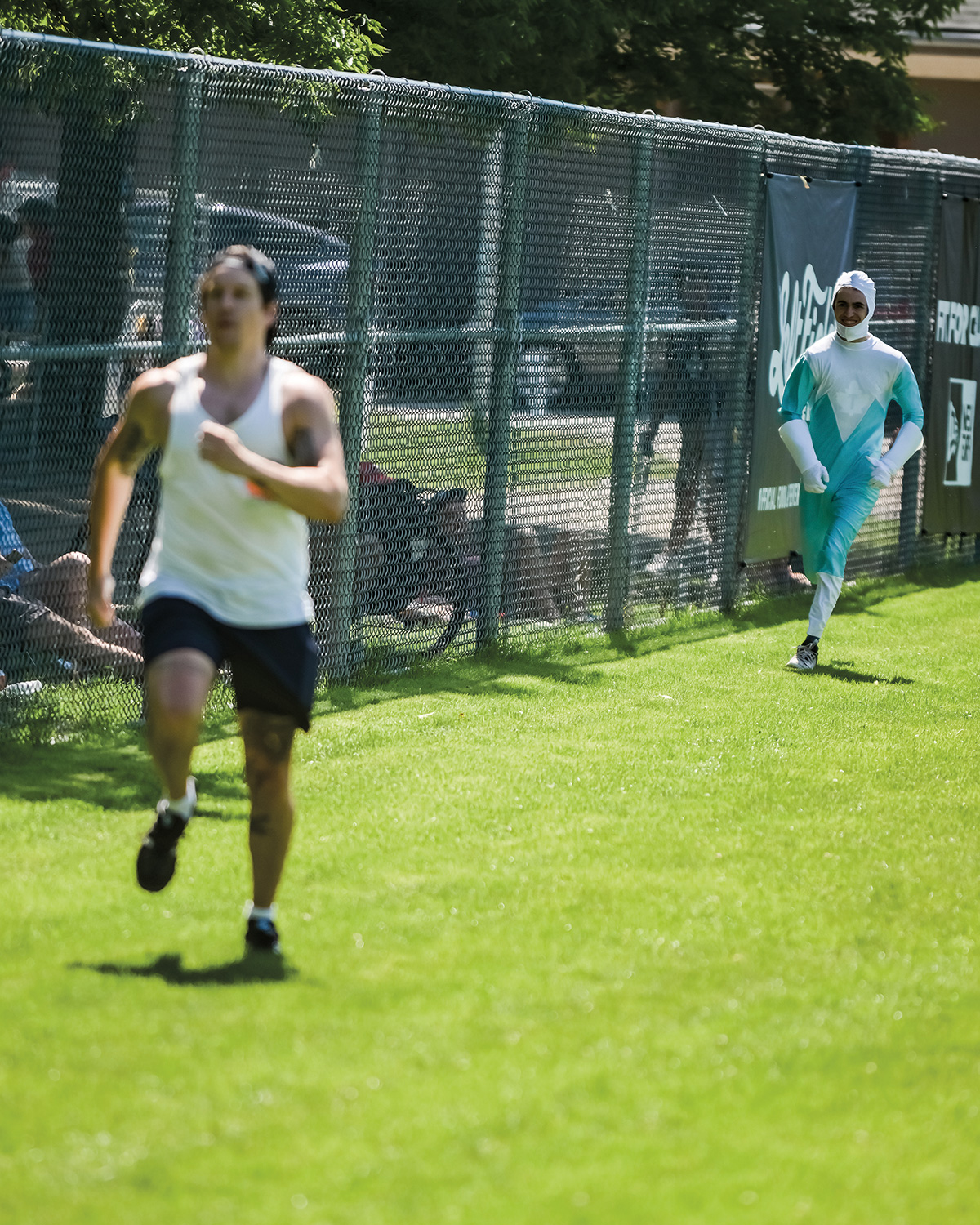
By R.S. Konjek
Gustavo Carvalho has a secret identity.
A native of São Paulo, Brazil, this soft-spoken 19-year-old now lives in Toronto and studies sports management at Brock University. He hopes his studies will provide a springboard to a career in the sports industry.
“My dream job is to be a general manager of a professional team,” he said. “I don’t really care what sport or what team it is.”
From an early age, sports has been in his blood. He played soccer as a youth, as well as basketball and baseball. His interest in the latter led him to an interesting gig at Christie Pits.
This spring, Carvalho found himself tagging along when his roommate was hired by the Toronto Maple Leafs baseball club to be part of their new fan experience team. Led by gameday host Michael Roudbari, the team is 10 to 15 members strong and puts in a seven-hour shift each day the Leafs play.
Among the fan experience team’s tasks are setting up of tents and banners before the game, selling merchandise and raffle tickets, and coordinating between-innings entertainment during Leafs games. This includes time-honoured activities like trivia contests, dance-offs, food-themed races, and leading kids for a run around the bases.
On certain days, another activity is added to the lineup. It’s called the Freeze Race.
While Roudbari introduces the contest and seeks out a volunteer to participate, Carvalho ducks into the Leafs’ clubhouse like Clark Kent into a phone booth. Moments later, the figure that emerges is no longer Carvalho, but the Freeze.
Some context: the Freeze is a character first introduced in 2017 by Atlanta’s Major League Baseball club. Dressed in a spandex skinsuit and cowl, the Freeze is a lightning-fast sprinter. The Freeze Race is a simple premise. A volunteer from the crowd tests their speed against the stadium’s champion in a race across the outfield. The fan is even given a generous head start. Several seconds after they are sent on their way, the Freeze takes off in pursuit. With uncanny precision, the Freeze always overtakes the fan right before the finish.
This summer, the Leafs decided to add their own version of the Freeze Race to the Sunday schedule. When Carvalho applied to be part of the fan experience team, the race caught his eye.
“When I played baseball the one thing I loved was running the bases and just doing a lot of running,” he said. “I made it very clear in my interview that [for] anything involved with running, call me in.”
That’s how a teenager from Brazil found himself spending the summer pelting across Christie Pits clad in a mint-green skinsuit.
There is an unexpected twist to the story: this Freeze has lost every race.
As of mid-July, the Freeze has a record of 0-5. The man behind the mask is taking it in stride.
“I always get close,” Carvalho said with a laugh. “I may not win but I always catch up. A couple more metres, and I would overtake them.”
Carvalho has endured some good-natured ribbing from his fan experience teammates. One of them suggested that perhaps the Freeze should be given the head start, but he’s not letting the losing streak or the teasing get him down.
“I’m determined to win one. I can’t go undefeated, [but] at the end of the day it’s all about the fun and good experiences for the fans.”
If the Freeze does finally win one?
“You will never hear the end of it,” Carvalho said with a smile.
As for the Leafs, their season so far has mirrored that of the Freeze. They have struggled through multiple losing streaks and at the midpoint of the 2024 Intercounty Baseball League season, they find themselves in last place.
The Maple Leafs’ complete 2024 season schedule can be found at www.mapleleafsbaseball.com.
READ MORE:
- SPORTS: Maple Leaf Mystique thrills Pits (June 2024)
- SPORTS: A whole new ball game (Apr. 2024)
- SPORTS: Baseball in full bloom at the Pits (Summer 2023)
- NEWS: Leafs fall in the Finals (Oct. 2022)
- SPORTS: Thrilling walkoff advances Leafs (Sept. 2022)
- ON THE COVER: Solazzo slams, salutes hillsides (Aug. 2022)
- SPORTS: Leafs prepare for postseason push (Aug. 2022)
- SPORTS: Baseball Leafs navigate a new era at Christie Pits (July 2022)
- NEWS: Dominico’s vision changed Toronto sports history (Winter 2022)
- SPORTS: IBL Maple Leafs fall one win short of championship (Fall 2021)
Comments Off on SPORTS: Baseball feels the chill at Christie Pits (Summer 2024)Tags: Annex · Sports
ON THE COVER (June 2024)
July 19th, 2024 · Comments Off on ON THE COVER (June 2024)
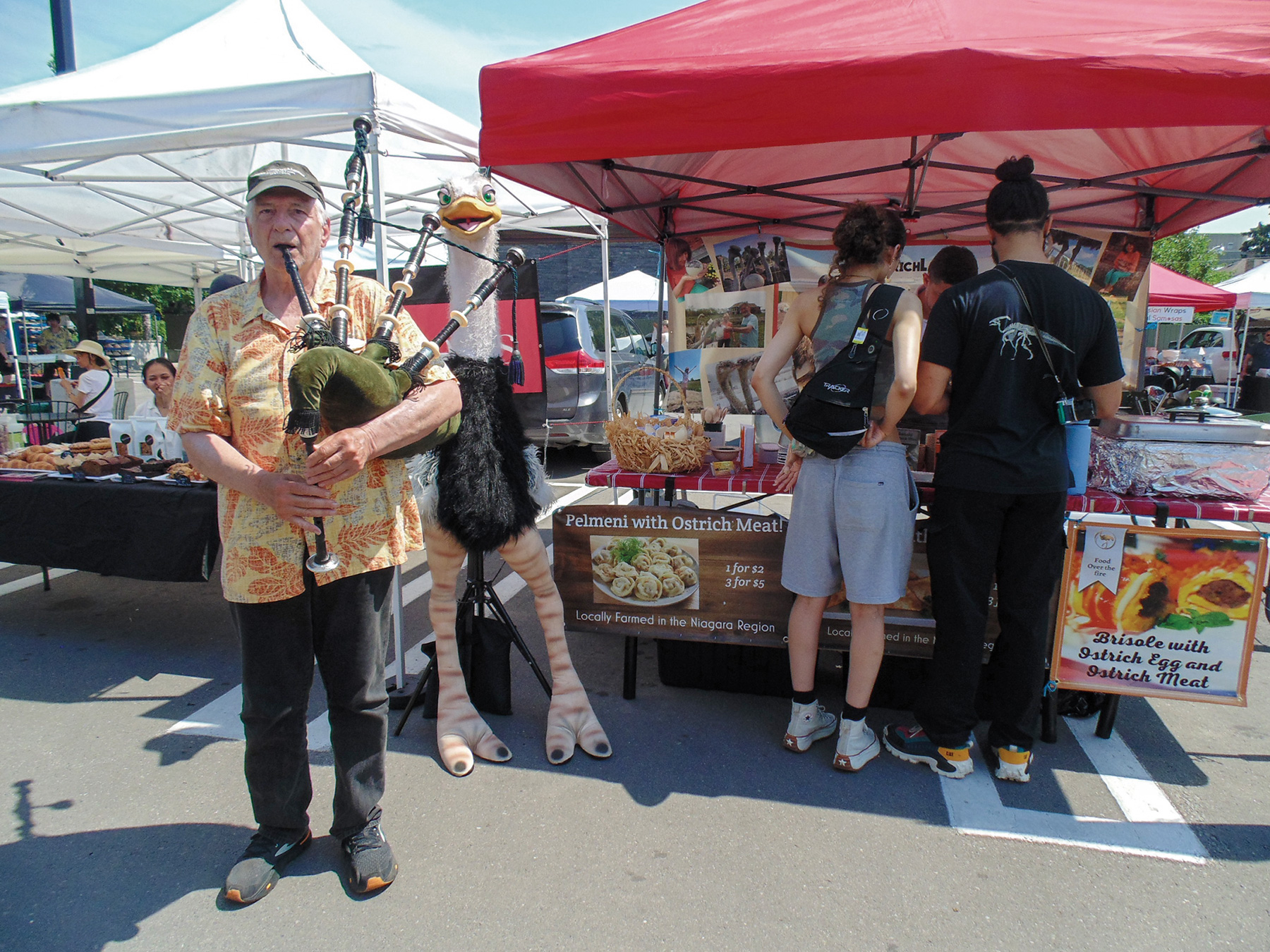
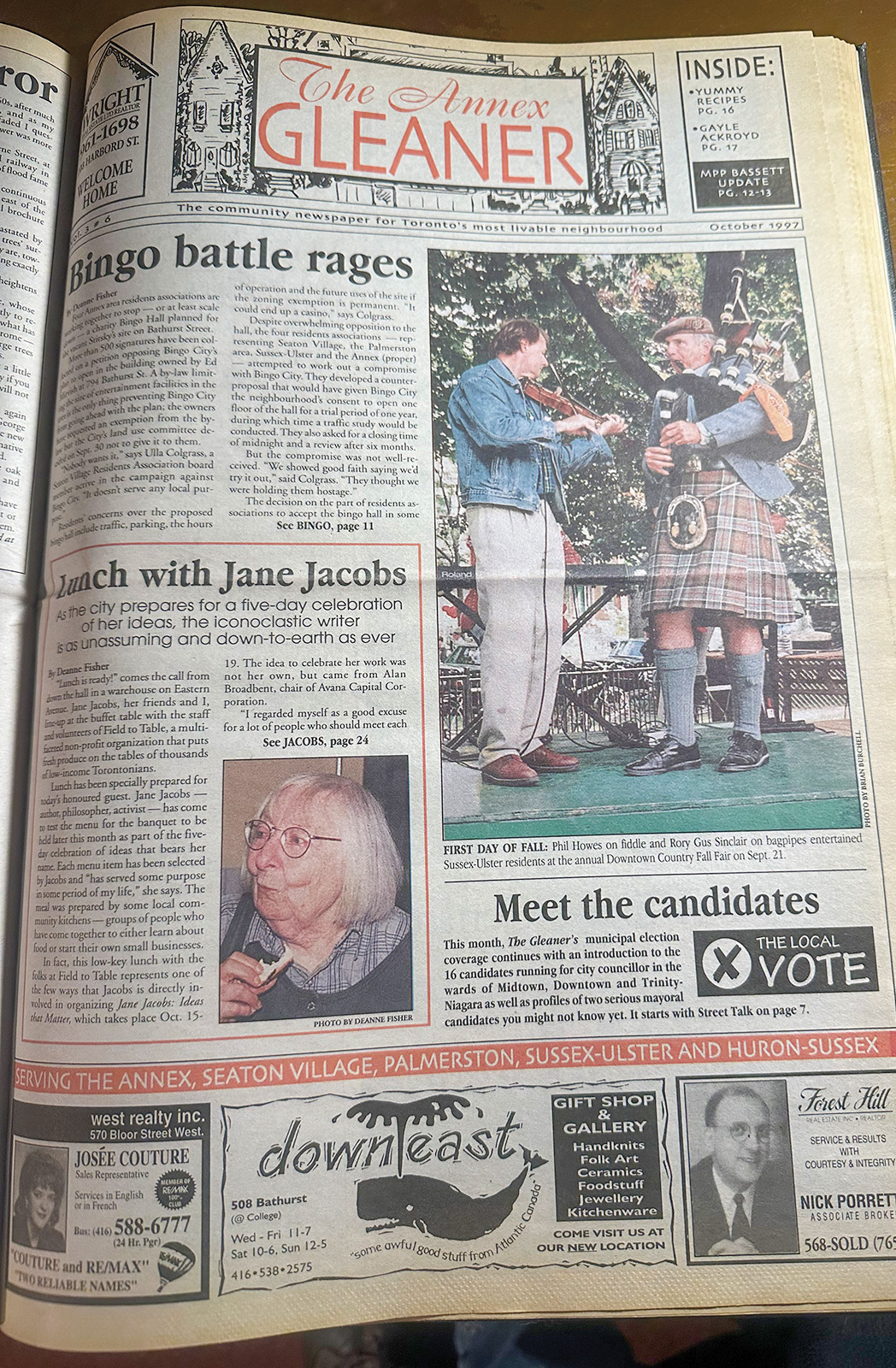
READ MORE:
- CHATTER: The Bloor-Borden farmers’ market is back! (June 2024)
- ON THE COVER: University community stops to remember (Nov. 2015)
- ARTS: Rubin Hurricane Carter’s new book missing Toronto chapter (Feb. 2011)
Comments Off on ON THE COVER (June 2024)Tags: Annex · On the cover