November 8th, 2024 · Comments Off on FORUM: Bike lanes are a solution to congestion, not the cause (Oct./Nov. 2024)
Ford adds fuel an to an ugly culture war of drivers versus cyclists
By Jessica Bell
Queen’s Park should be solving our biggest challenges, like climate change, homelessness, and fixing our public services, from health care to schools.
Doug Ford, however, is preparing for the next election, and making cynical and divisive political moves that won’t improve our lives, but will motivate his base.
That’s why the premier is attacking bike lanes.
The Conservatives are proposing new legislation that will require cities to get provincial approval to build a bike lane if it takes out a lane for vehicles. The government is also going to review every bike lane built in the past five years, including the Bloor Street and University Avenue bike lanes.
This is a terrible move. Removing bike lanes will make our roads more unsafe for cyclists, commute times won’t improve, and it will fuel an ugly culture war of drivers versus cyclists, suburbs versus downtown.
As I travel around our riding, I often reflect upon the people who have died cycling on our streets. I show my children the ghost bikes, marking those who have died, and urge them to bike as carefully as they can.
A 24-year old woman cycling on Bloor Street was killed earlier this summer when she veered out of a bike lane blocked by a dumpster for a construction project and was hit by a truck.
Local resident, beloved teacher and athlete, John Offut, was killed by a truck while cycling.
Alex Amaro, a 23-year-old journalism student was killed on Dufferin Street as she was taking a left hand turn in 2020. “All she was trying to do was come home,” said her friend at a council meeting.
These are preventable tragedies.
It is certainly true that getting around our rapidly growing region has never been more stressful and time consuming. Toronto is ranked the worst city in North America for traffic and commute times, beating out Mexico City, Los Angeles, and New York City. Commercial vehicles have difficulty delivering goods and services. Transit is often slow and unreliable.
It’s also true that the Conservatives have not taken our region’s serious transportation challenges seriously. The only positive move the Conservatives have made is to commit to building four new transit lines, including the Ontario Line and the Yonge Line Extension. This is an investment we support.
On the flip side, the Conservatives have flatly refused to help fund the maintenance and operation of the streetcar, bus, and subway lines to make the TTC faster, cheaper, and more reliable for 1.7 million angry, tired, and frustrated riders.
They’re doubling down on building highways, including this preposterous plan to build a tunnel under Highway 401 from Scarborough to Brampton.
They’re upending our planning laws to permit the construction of expensive low-density housing, which locks people into car use. This kind of outdated 1950s-style planning is terrible for congestion, terrible for the environment, and very expensive for municipalities to service.
If we’re serious about creating fast, reliable, and sustainable transportation patterns, then we need to pass rules that make it easier for people to walk, cycle, or take public transit more often.
To achieve this, the province needs to invest in transit so fares can be lowered and service levels can be rapidly increased, especially along bus routes.
Our planning rules need to encourage more density—not less—which means making it quicker and easier to build townhomes, fourplexes, apartments, and condos, in existing neighbourhoods so more people can afford to live near where they work, play, and study.
The province should adopt a Vision Zero strategy to reduce injuries and deaths on our roads to zero. This plan should include properly enforcing our road laws and protected bike lanes. Two major cities —Oslo, in Norway, and Helsinki, in Finland—had zero deaths of vulnerable road users by 2020 through implementing a Vision Zero approach. If they can do it, so can we.
Jessica Bell is the MPP for University-Rosedale and the Official Opposition’s Housing Critic. She can be reached at jbell@ndp.on.ca or 416-535-7206.
November 8th, 2024 · Comments Off on ON THE COVER: More fireworks for Dominico Field (Sept. 2024)
Toronto Maple Leafs Connor Lewis (L) and Jose Vinicio charge through smoke and fireworks during pregame player introductions at Christie Pits on August 24. The Leafs went down to defeat against the Barrie Baycats, bringing their 2024 season to an early end. CRAIG AIKIN/GLEANER NEWS
November 8th, 2024 · Comments Off on NEWS: City plans to convert Green P to housing (Sept. 2024)
Kensington Market parking lot set to become affordable housing
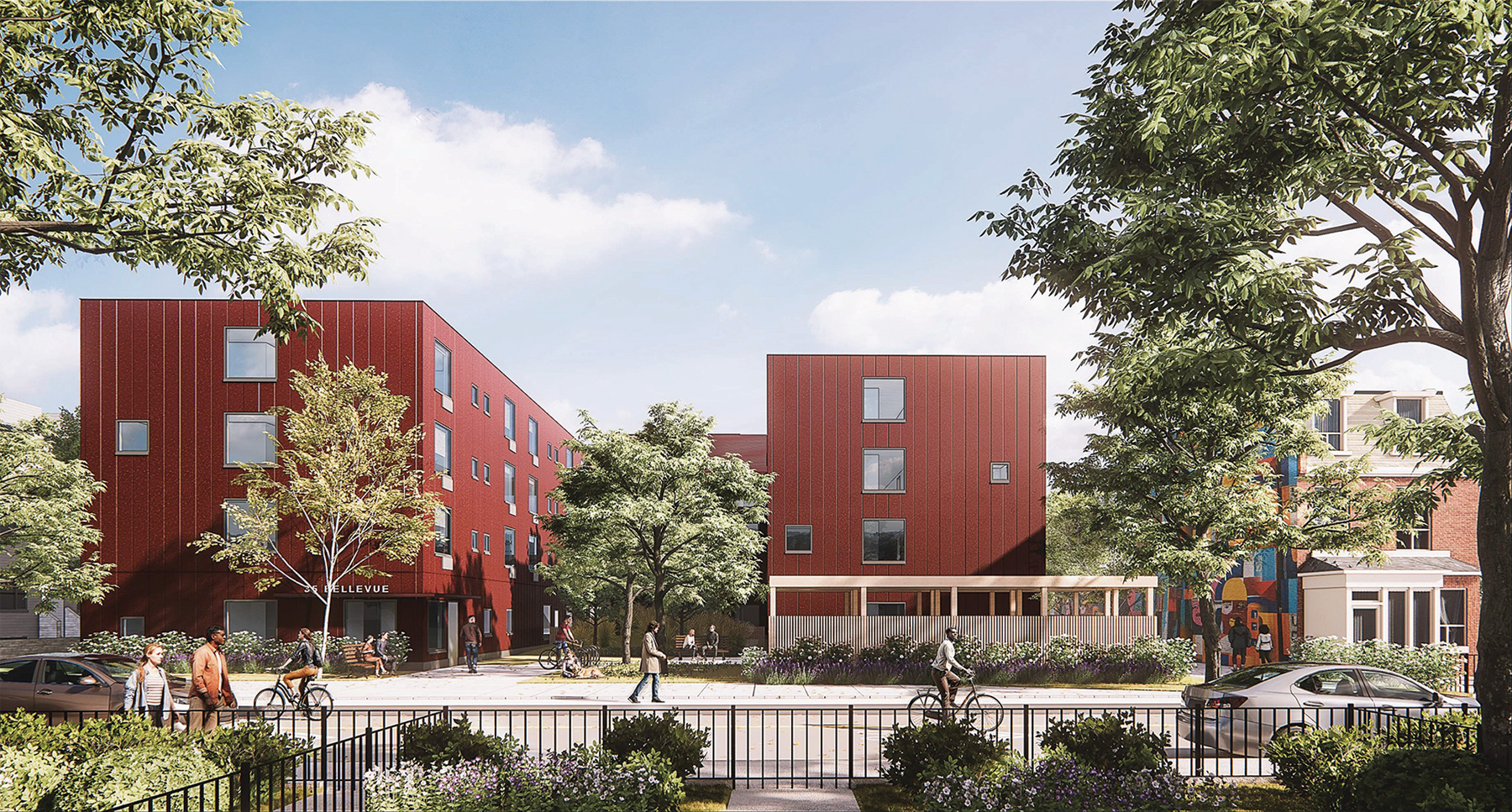
Artist rendering of the proposed new build at 35 Bellevue Ave. COURTESY MONTGOMERY SISAM ARCHITECTS
By Meredith Poirier
The parking lot at 35 Bellevue Ave. was filled with excitement and commotion on the morning of August 12 as an announcement was made by University-Rosedale councillor Dianne Saxe that the site would be the newest location of an affordable housing development. Mayor Olivia Chow as well as representatives from the Kensington Market Community Land Trust (KMCLT) and St. Clare’s Multifaith Housing Society (St. Clare’s) were all present during the press conference as they are all working in partnership on this exciting and ever necessary development.
The announcement comes at a dire time as just steps away from the parking lot is an encampment where unhoused individuals are residing. Many of these folks are likely on the list of the almost 90,000 active applicants for social housing in the city.
This development is a partnership between the City of Toronto, KMCLT and St. Clare’s. KMCLT is a non-profit corporation that works to “protect the social and economic diversity of the neighbourhood.” Currently they own and operate a mixed-use property in Kensington Market that has 12 affordable rental units. St. Clare’s is a non-profit that provides affordable housing in downtown Toronto.
Kevin Barrett, co-chair of the KMCLT board, explained that this project has been a long time coming. “Very early in the life of our organization, we identified that Green P parking lot on Bellevue as a really important piece of land of the neighborhood.” Early in 2018, they held a community visioning session to try to imagine what could happen at this site. Affordable housing was at the top of everyone’s minds.
KMCLT has been working tirelessly to get this project started. Since 2018, it has been advocating for the city to take the lead on this public housing project. Earlier this year the City of Toronto put out a call for proposals looking for community partners for the development of the parking lot at 35 Bellevue Ave., Barrett explained.
KMCLT and St. Clare’s were chosen and are now working very closely with the city on this important project. “I just want to emphasize how excited we are. I think this is a really, really great moment for the neighborhood of the city. We’re very appreciative of the leadership that Mayor Chow has offered,” said Barrett.
Construction is slated to start in the coming months with the hope of a completion date around the end of 2025.
The building itself will be a four-storey structure with at least 78 units. The units will be private apartments equipped with a bathroom and a kitchen, and the building itself will boast communal spaces such as a community kitchen and on-site laundry.
While this project’s main aim is to support the housing crisis in the city, it will also focus on the climate crisis and sustainability. Composite mass timber, a renewable resource, will be used in the construction, and the building will be designed to exceed Tier 2 of the Toronto Green Standard, which essentially means that voluntary efforts will be put in by the team to ensure the building has low emissions and is prepared for the future (and what the climate crisis may entail).
The City of Toronto’s communications advisor explained that the future residents of this building will be people experiencing homelessness or at risk of homelessness.
The city and St. Clare’s will select residents through the city’s coordinated access processes.
Once the building is complete, KMCLT will be the owner of the building. They will take on a long-term lease in partnership with the city to ensure that the land will not be sold. Day-to-day property management and support of residents will be managed by St. Clare’s.
November 8th, 2024 · Comments Off on FOCUS: Band of Storytellers tells a tale (Sept. 2024)
Brunswick House mural an Afrofuturistic tribute to Albert’s Hall
Pictured above (from left) are Neiland Brissenden from the Bloor Annex BIA, artist Komi Olafimihan, storyteller Norman Richmond, and filmmaker-interdisciplinary artist Saroja Ponnambalam. COURTESY AYESHA KHAN/STEPS PUBLIC ART
By Ammara Khan and Meredith Poirier
Recent pruning in the parkette on the southeast corner of Bloor and Brunswick has shed new light on the colourful Band of Storytellers mural. The art provides an immersive understanding of the musical history of Albert’s Hall.
The Band of Storytellers mural was installed in 2019 and is a perfect backdrop to the popular the Bloor Annex Business Improvement Area (BIA) parkette. It pays homage to Albert’s Hall in the Brunswick House which was popular in the 1970s and 80s and was active for decades.
Komi Olafimihan was the artist who designed and executed the piece, along with the assistance of his friend, Kalkidan Assefa.
“When the callout went out for a mural for the Brunswick House, I really felt drawn to the idea of the musical history because a lot of great blues and jazz musicians, and Canadian legends, played specifically in that location,” said Olafimihan.
The mural was dedicated to the venue which existed above the Brunswick House.
The fun and funky mural pays homage to the musicians who played for decades at Albert’s Hall. COURTESY AYESHA KHAN/STEPS PUBLIC ART
The upstairs room was known as Albert’s Hall after Albert Nightingale. It was a venue known for jazz and blues, and hosted many renowned artists like Blossom Dearie, Cab Calloway, Gordon Lightfoot, Oscar Peterson, Muddy Waters, Loretta Lynn, the Climax Jazz Band, Downchild, Blind John Davis, Dr. McJazz, Etta James, Stevie Ray Vaughan, Buddy Guy, Jeff Healey and k.d. lang.
While representing the rich history of an important local landmark, Olafimihan’s piece simultaneously includes many more aspects to unpack.
Themes of Afrofuturism can be observed in this piece of art. Olafimihan speaks of a “schism between different African cultures.”
The pianist in the mural can be seen with his lips being pulled apart by an invisible thread, pointing to the idea of “speaking out” on this schism.
“The Africans and African Americans in the diaspora, the Africans in the Caribbean, the Africans in Brazil. Our Africanness manifests in different ways, but there is a schism, you know, so when I say these guys are Afrofuturistic, in a way, it’s imagining that schism being healed.”
Additionally, hidden in the keys of the mural’s piano, Olafimihan planted little NFC chip stickers which android users can read using their phones.
Those chips were initially linked to “different kinds of songs or videos of people that have played in Albert’s Hall or people that contributed to the blues or something to tie in with the history.”
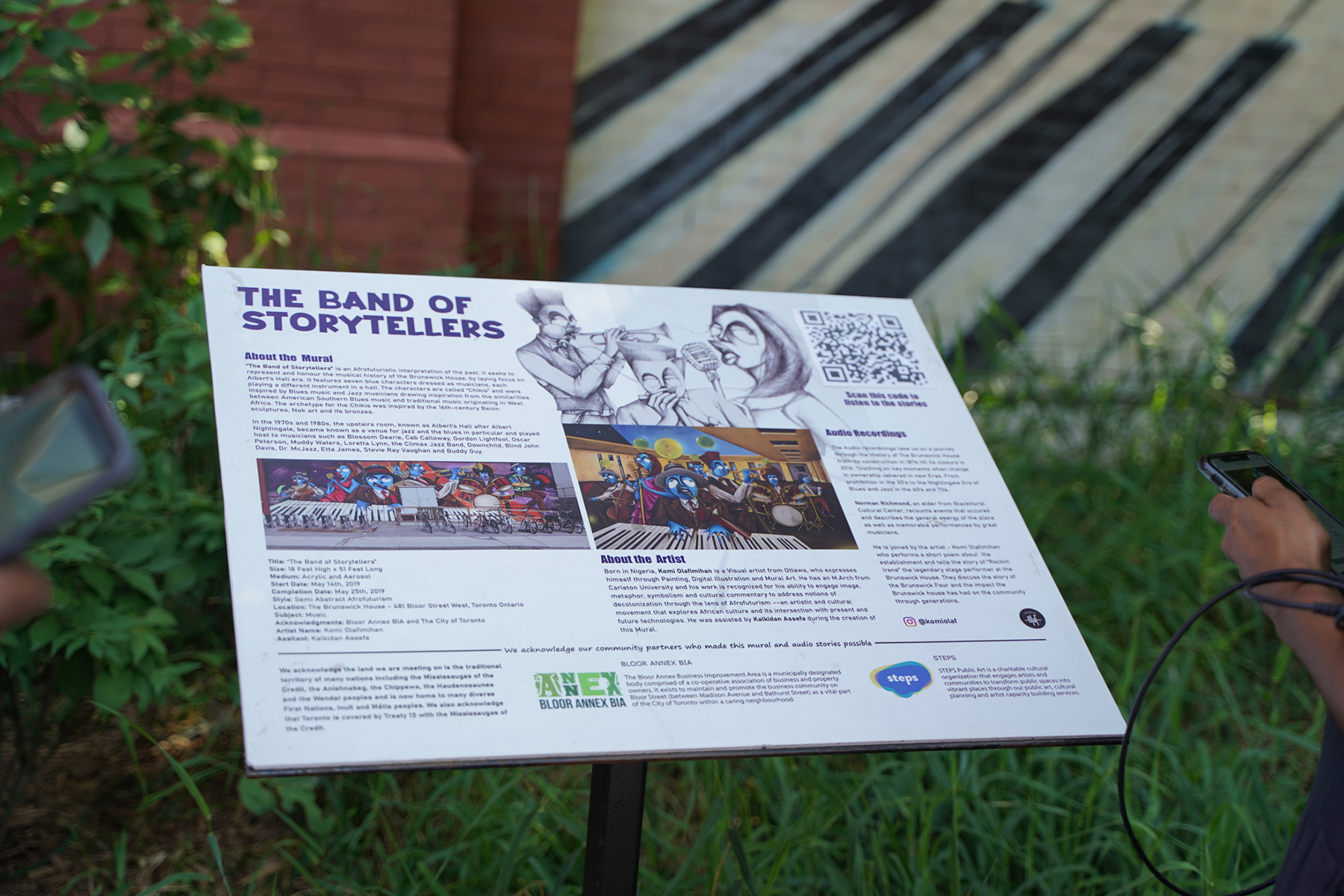
A plaque at the Brunswick Ave. parkette helps to interpret the mural along with an audio story accessible through a QR code. COURTESY AYESHA KHAN/STEPS PUBLIC ART
The sign which now accompanies the mural is a newer addition and makes the art more immersive, interactive, and accessible. The audio accompanies the visual images and helps to unravel the cartoonish style of the images.
“It’s kind of a separate project,” said Melanie Ramsey, project coordinator for the BIA about the sign. “So if you are visually impaired or can’t be there in person, you can actually hear Komi describe this mural in an accessible way, which is very cool.”
The Bloor Annex BIA was awarded a STEPS Public Art’s Innovative Award, for the audio project. Ramsey decided to work with Olafimihan again, but in a new way, which would bring his other artistic mediums to light, like poetry and writing.
The BIA also worked with Norman Richmond, who actually lived in the area and used to visit Albert’s Hall. Norman has a strong music background, so he was actually able to kind of relive some of the times he went to this source.
Richmond shares his personal experiences living in the Annex in the 1960s and the cross-cultural connections being made across immigrant groups at the time.
These audio stories are accessible through a QR code on the sign next to the mural. The recordings allow you to immerse yourself in the history of the space where you sit and around the mural. Not only are the engaging stories full of information but they are paired with background sounds and music allowing you to further breathe in and live the stories. The audio tours also give listeners an introduction to Afrofuturism as an art movement and Olaf’s cartoon art style.
The recordings also include Olafimihan reciting a poem that he wrote about Albert’s Hall. The audio stories are incredibly immersive, and with soft jazz playing in the background and Olaf’s keen storytelling, listeners can really picture themselves in the iconic Albert’s Hall.
The sign project also aligns with the Bloor Annex BIA’s new focus on accessibility.
“You’re not just painting a mural and walking away…these are really beautiful pieces. So just, you know, [we are] building on these very cool things which are promoting more engagement and obviously more accessibility,” said Ramsey.
The Annex has benefitted from these projects and the results are a decline in graffiti in the “improved and beautified places.”
The BIA appreciates feedback from the community on the developments of projects and how they can work on making the Annex more accessible for people with disabilities.
Listening to the audio stories while standing in front of the mural will provide the best experience and will give individuals insight into the artistic inspiration for the mural. Head over to 481 Bloor St. W. with your smart phone and take in the art and the history.
November 8th, 2024 · Comments Off on GRADING OUR GREENSPACE: A report card on our parks – part 2 (Sept. 2024)
Our annual review of Annex greenspaces continues
Each year the Annex Gleaner reviews the many parks and parkettes in our coverage area using a variety of criteria. While there is no decisive “winner” of the grading, letter grades are assigned to convey the quality of the parks, considering aspects such as upkeep, design, and amenities. The reviews accompanying the grades also let the reader know what makes each space unique. This is the second instalment of reviews for 2024.
By Mia Keskinen
Margaret Fairley Park
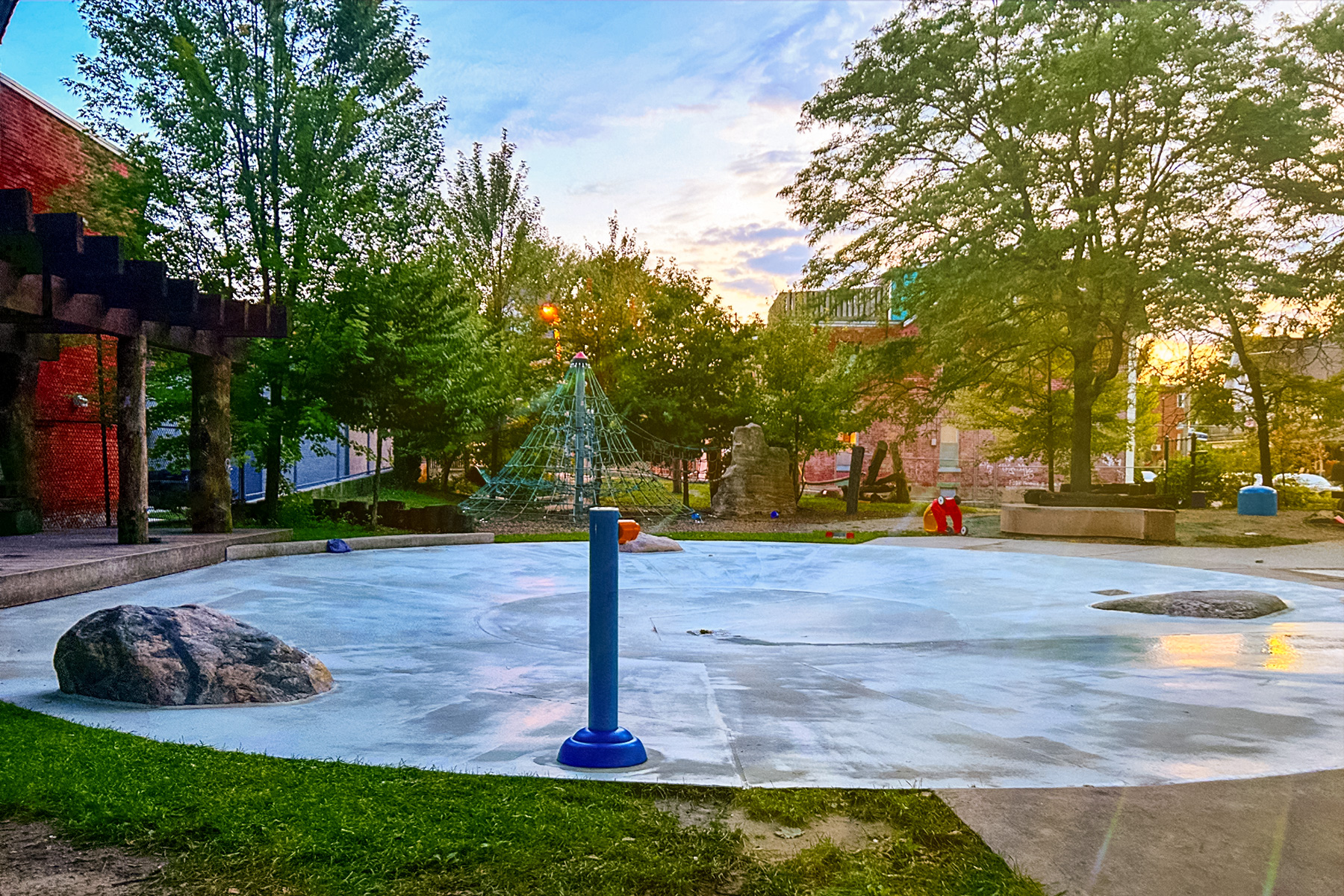
Margaret Fairley Park, image taken at sunset, boasts many amenities including this splash bed with an embedded boulder. MIA KESKINEN/GLEANER NEWS
100 Brunswick Ave. Grade: A (last year A-) Time: 8:27 p.m. Margaret Fairley Park, located at Brunswick Avenue and Ulster Street, is an Elysium of child-like wonder. The park features several standout play structures, such as a rope climbing structure, a sandpit full of toys, a treehouse, a splash pad, and several park benches. There are also several benches for parents to watch their little ones run around to their hearts’ content. This park is often visited by residents in the surrounding neighbourhood, as it is generally quiet and not frequented as much by the general public. Overheard: A couple discussing the importance of staying close to nature. Did you know: This park was named after Margaret Fairley who is best known for her work on the history of Canadian women and the history of Canada itself. Her research helped shed light on underrepresented aspects of Canadian history.
Jean Sibelius Square
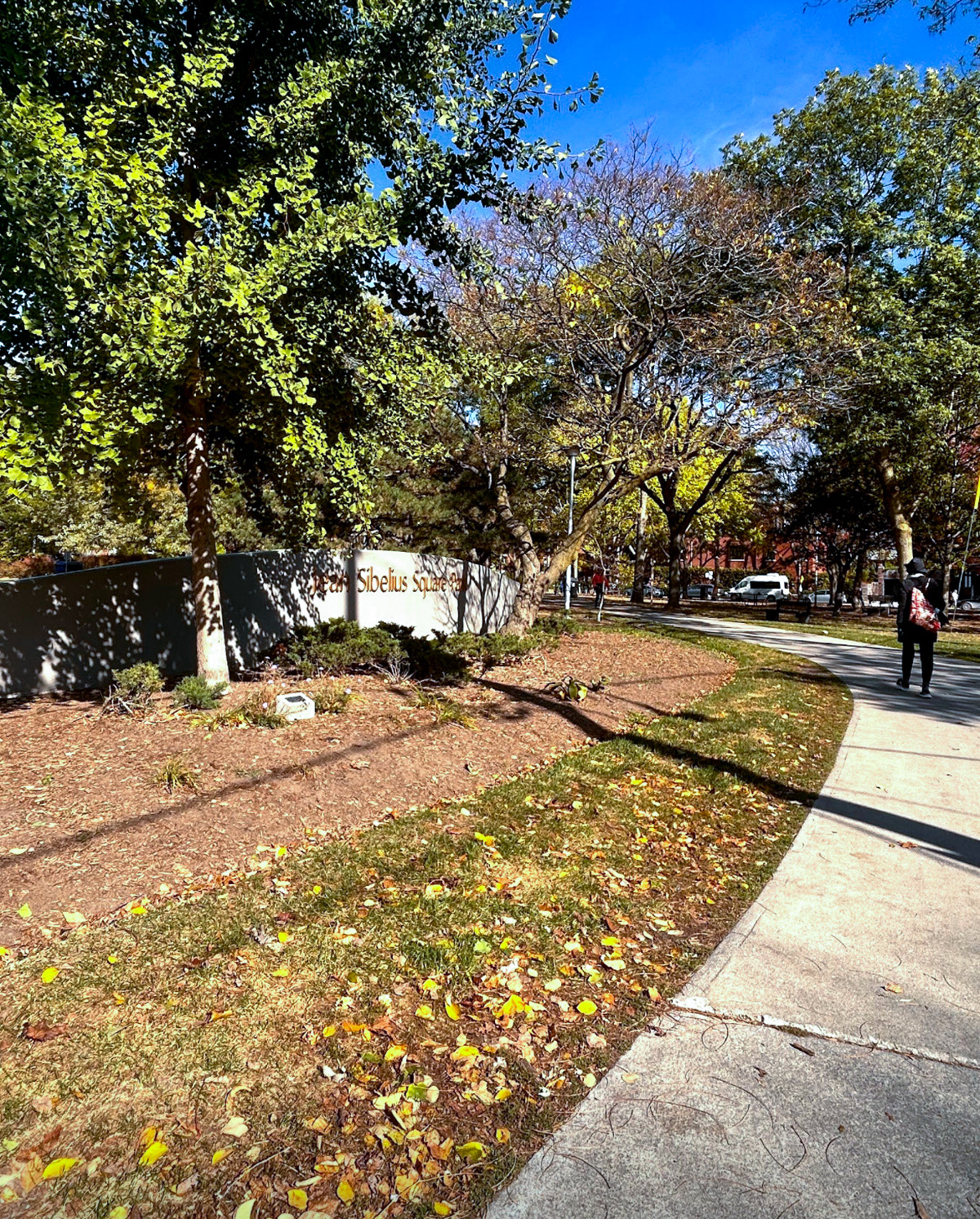
Jean Sibelius Park – a gem located in the heart of the Annex. MIA KESKINEN/GLEANER NEWS
50 Kendal Ave. Grade: A+ (last year A) Time: 7:00 p.m. Jean Sibelius Park, located near Bernard and Spadina provides a pleasant park-going experience. The cacophony of cars quickly dissolves into white noise when entering the historical neighbourhood surrounding the park. Given the variety of amenities, the park is suitable for all age groups. The park features a distinctive playground with a rock-climbing wall, a clean fountain, bike-sharing options, multiple park benches and picnic tables, and a large grassy area for pets and parents with little ones to enjoy. The park also boasts a vibrant mural on one of its walls, encouraging visitors to appreciate the beauty in life. Overheard: “You’ll never catch me!!” A little girl yells, running from her older brother. Did you know: It is named after Jean Sibelius, a renowned Finnish composer known for his symphonies and other classical music.The site is home to the Annex Residents’ Association’s annual Cornfest, this year scheduled for Sept 15.
BLOOR BEDFORD PARKETTE
Bloor Bedford Parkette is across the street from the Royal Conservatory of Music. MIA KESKINEN/GLEANER NEWS
245 Bloor Street W. Grade: B (last year B-) Time: 7:31 p.m. Located on Bloor, just west of Bedford, this greenspace is deeply entrenched within a cultural hub of Toronto, across the street from the Royal Conservatory of Music. This parkette is teeming with life; however, the park does lack the ability to lose yourself to nature, given its location near a busy intersection and its proximity to the University of Toronto. Construction is a constant within this area, so the view of the cityscape is often blocked by neon orange fences. Did you know: The area around Bloor Bedford Parkette is known for its historic homes and proximity to cultural landmarks, reflecting the diverse history and development of the Annex neighborhood. Overheard: U of T students talking about their classes as they sit down and take a break.
Matt Cohen Park
Matt Cohen Park – this space struggles given its proximity to Bloor and Spadina. Several benches and infor-
mational plaques though make it worth a try. MIA KESKINEN/GLEANER NEWS
393 Bloor St. West Grade: C- (Last year C-) Time: 7:41 p.m. Located at Bloor and Spadina, Matt Cohen Park is a cornerstone of green beside bustling city streets. Unfortunately, given its location, the noise is very disruptive. This park serves as a stop for commuters more so than a true park space as it lacks the quiet nature that creates a sense of respite. The greenspace is a part of the University of Toronto campus, named after Matt Cohen, a writer, who deemed his house in Spadina the “centre of the universe.” This park pays tribute to magic created by the fiction writer, with large black statues inscribed with leaves in amongst trees swaying in the summer breeze. Amenities include several park benches in both full sun and shade. This park offers the necessities but lacks a pull that creates a relaxing atmosphere. Overheard: Police sirens and passersby on their commute. Did you know: Matt Cohen Park boasts six memorial plaques featuring his life story and various excerpts from his literary works. Cohen earned the Governor General’s Award for his novel Elizabeth and After and was also recognized for his celebrated children’s books, short stories, and poetry.
Sally Bird Park
Sally Bird Parkette is a an oasis on Brunswick Ave., nestled between houses. A perfect place for a respite between Harbord Village/Little Italy and Bloor Street. MIA KESKINEN/GLEANER NEWS
194 Brunswick Ave. Grade: C+ (last year C) Time: 8:21 p.m. Sally Bird park is a hidden gem within the residential area of Brunswick Avenue and Powell Lane. Hidden between houses, this little alcove of nature is lined with trees and wildflowers. A mural of an astronaut gazing at space is illuminated by the setting sun in the middle of the park, enhancing the cozy feel of the greenspace. This park also features workout equipment for all to enjoy. Though this park is small in size and only features one bench for passersby to sit on, it is a perfect place to relax and enjoy nature. Overheard: Several men listening to music, chatting about life with smiles on their faces. Did you know: The concept of outdoor workouts originated during the Great Depression, a time when there was concern that economic hardship might lead to a decline in physical fitness. In response, the idea of creating walking trails and outdoor workout equipment emerged in Canada.
Euclid Avenue Parkette
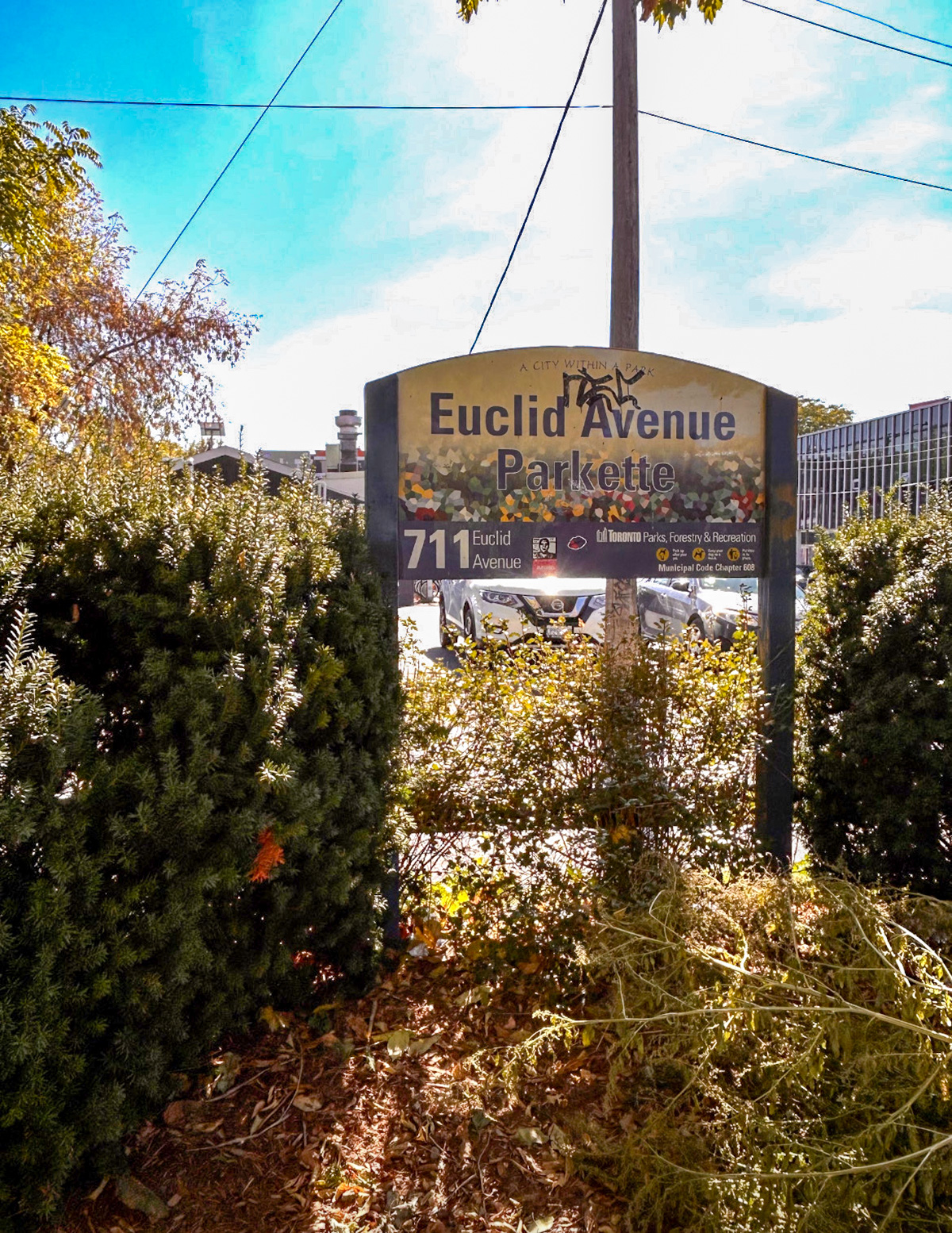
The City appears to have given up on Euclid Avenue Parkette. MIA KESKINEN/GLEANER NEWS
711 Euclid Ave. Grade: F (last year: D-) Time: 8:21 p.m. Some things never change. If you are looking for a park to escape your worries, it is recommended to steer clear of Euclid Avenue Parkette, located near Christie Street and Bloor Street. As mentioned in last year’s park reviews, Euclid Avenue Parkette still bares more resemblance to a glorified strip of dirt than a park. For various reasons, including the view, noise pollution from cars, and the litter-lined streets, park goers will find that other parks on the list are more worth their time than this greenspace. The view is nothing to call home about, as the two park benches face a wall defaced by graffiti and the street covered in trash. The park’s only appeal is that it is sandwiched in an alleyway behind a cultural hub for Korean food and other restaurants on Bloor Street. The city appears to have given up on this greenspace. Overheard: Two girls speaking in Korean, smiles lining their faces. Did you know: The Line 2 subway is directly underneath and the ground shakes as trains pass.
Healey Willan Park
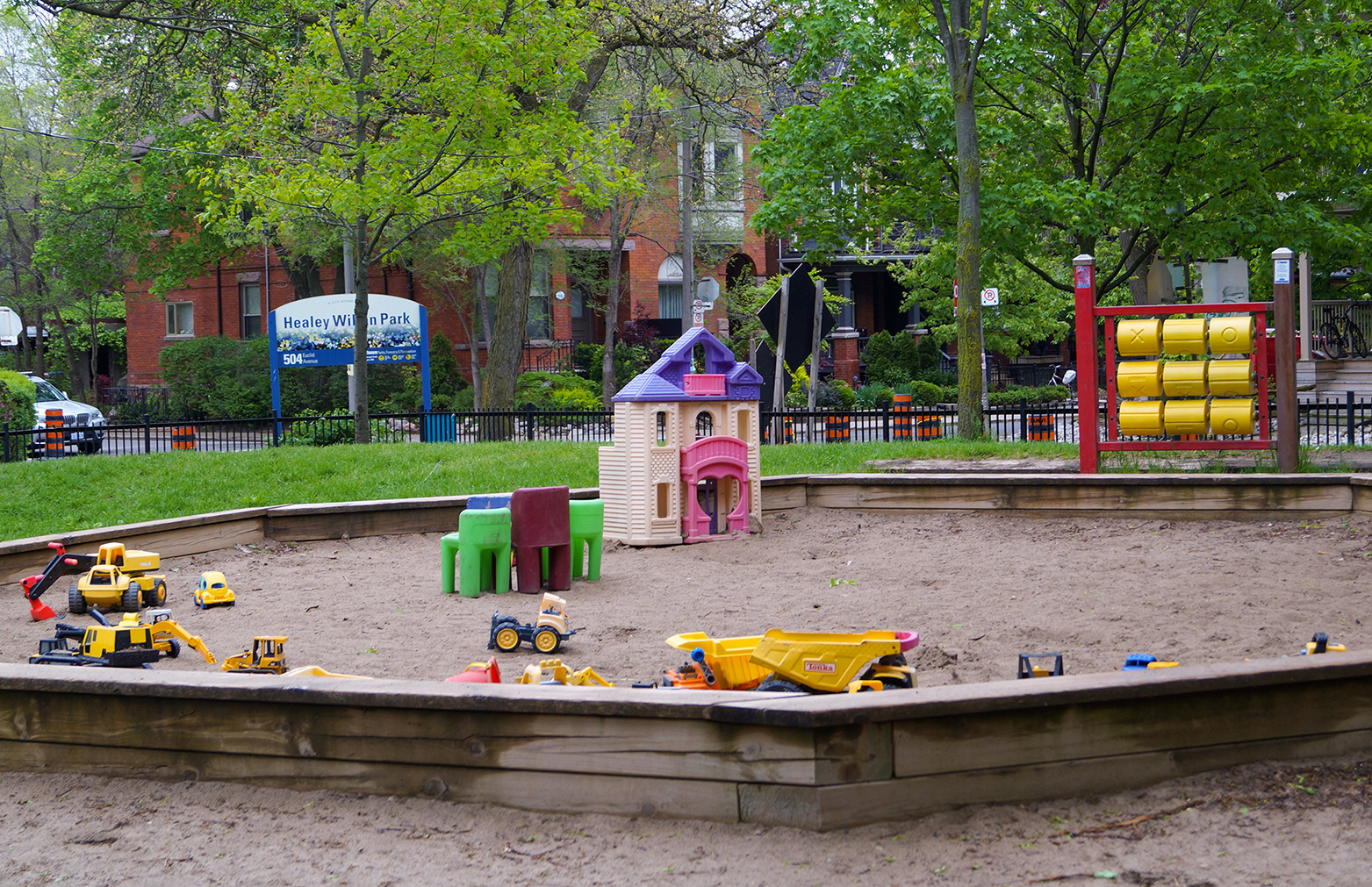
Healey Willan Park caters to local little ones. GLEANER NEWS FILE PHOTO
504 Euclid Ave. Grade: B+ (last review in 2020, grade: B) Healey Willan Park is a quiet, well-maintained greenspace tucked away within Ulster and Euclid avenues. This park caters to the little ones, with swings, a play structure, and a sandbox filled with toys. This park provides a sense of peace given its location within a residential neighbourhood. The only noise that can be heard is birdsong and the laughter of children running around. Overheard: A couple holding hands, chatting and enjoying the sunset, liquid gold dancing across their faces. Did you know: The park was named after Healey Willan, a notable figure in Canadian music, particularly known for his contributions to choral and organ music. The park is home to the Palmerston Area Residents’ Association annual Party in the Park.
November 8th, 2024 · Comments Off on CHATTER: Harbord Fair a success; Estonian future on Madison; Bloor Annex BIA stage (Sept. 2024)
Harbord Village Community Fair a success!
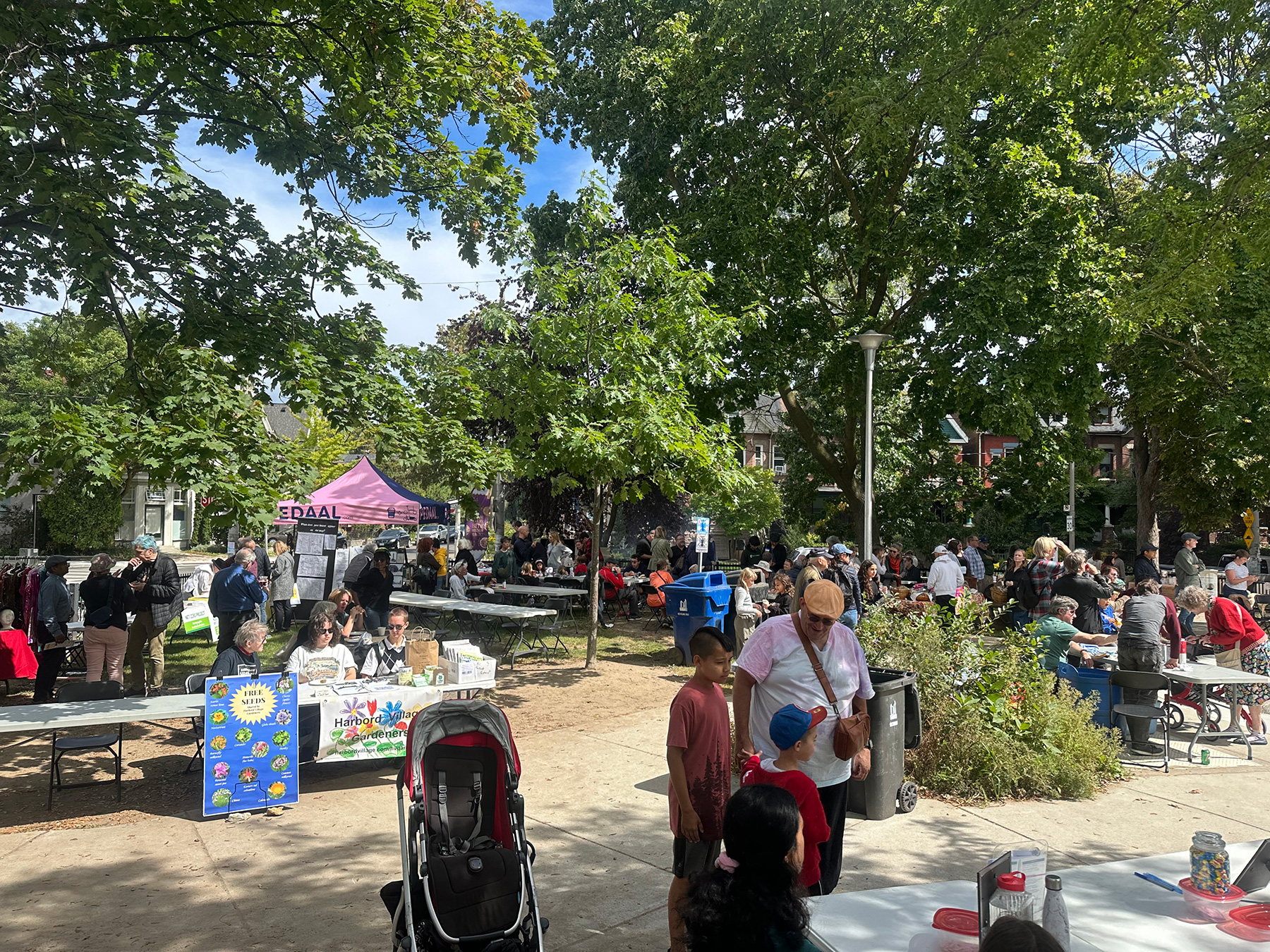
BRIAN BURCHELL/GLEANER NEWS
The Harbord Village Residents’ Association created another amazing gathering of neighbours on September 8 at Margaret Fairley Park.
Cementing Estonian future on Madison
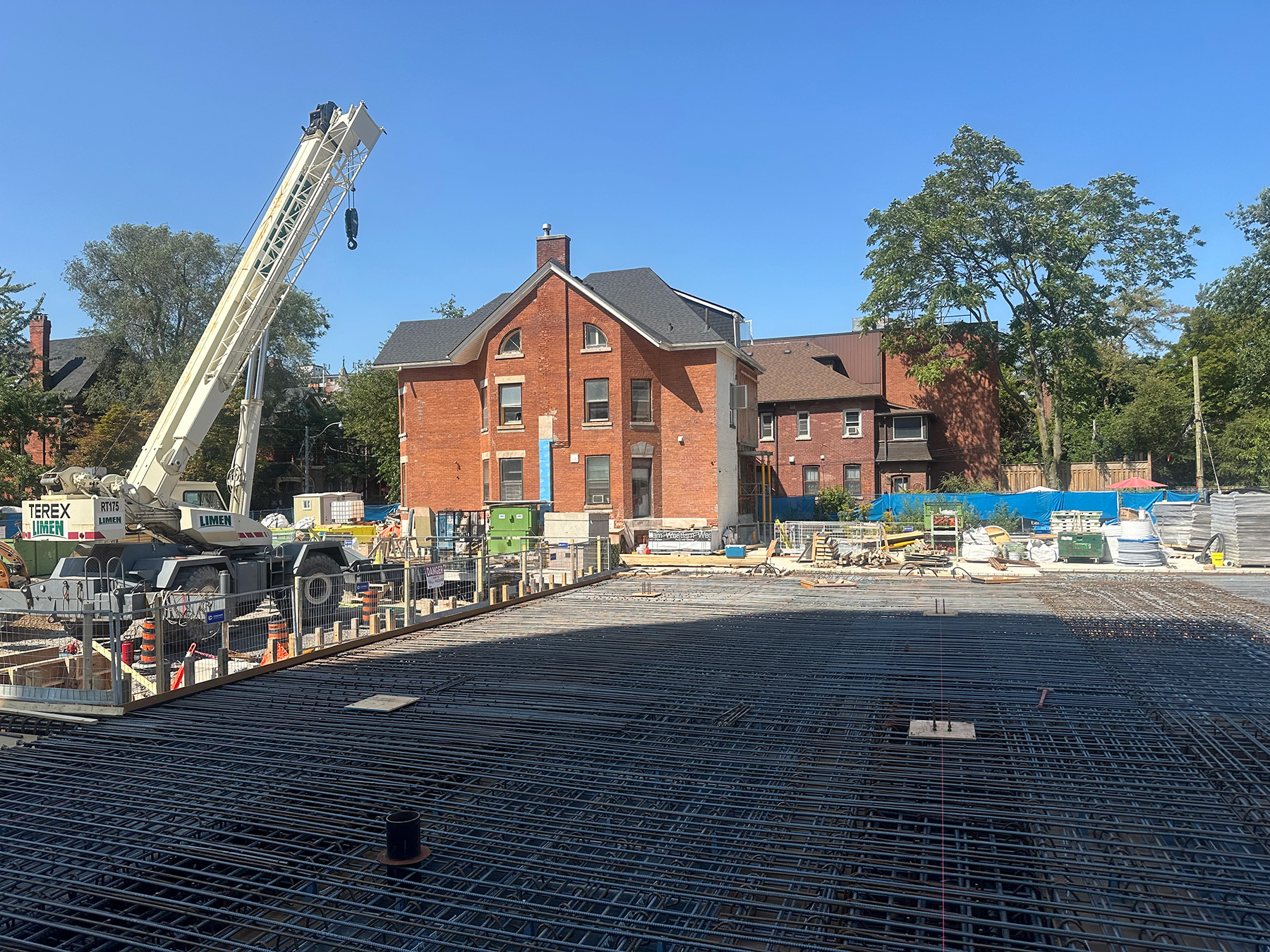
A sea of rebar at 11 Madison Ave. awaiting the major concrete pour for the much anticipated Estonian Cultural Centre. BRIAN BURCHELL/GLEANER NEWS
As the Keskus International Estonian Centre build moves along at 11 Madison Ave the site is preparing for a major construction step forward.
The extensive forming and maze of rebar installed over the summer is being prepared for a very large concrete pour in mid-September. Concrete pours must be continuous. The general contractor will start the pour at 7:00 am on the appointed day and keep pouring, rain or shine, well into the evening if necessary.
According to the Keskus website “This will be the largest pour of the KESKUS project; estimated at 38 trucks of concrete. It is all the more an exciting milestone as it includes the floor of the KESKUS anchor tenant’s space, Northern Birch Credit Union.”
In a video posted to the their website at: https://www.estoniancentre.ca, one can see the steel tensioning cables threaded through the beams. Once the concrete has cured (likely by mid-October), the cables can be tensioned.
In the video, the post-tensioning cables can be seen as they are threaded through the beams. These cables will be tensioned once the beam’s concrete has reached full strength, currently anticipated for mid-October. Once the concrete mass is loaded from above the cables get tensioned once more.
In all 390 cubic metres of concrete will be poured in one day. This is all happening above Line 2 of the TTC. Once the concrete is fully cured steel beams are installed to support the rest of the structure and a crane will be mounted on the engineered pad of the western half of the subway tunnel to complete the build.
—Brian Burchell/Gleaner News
Summer Music on Bloor
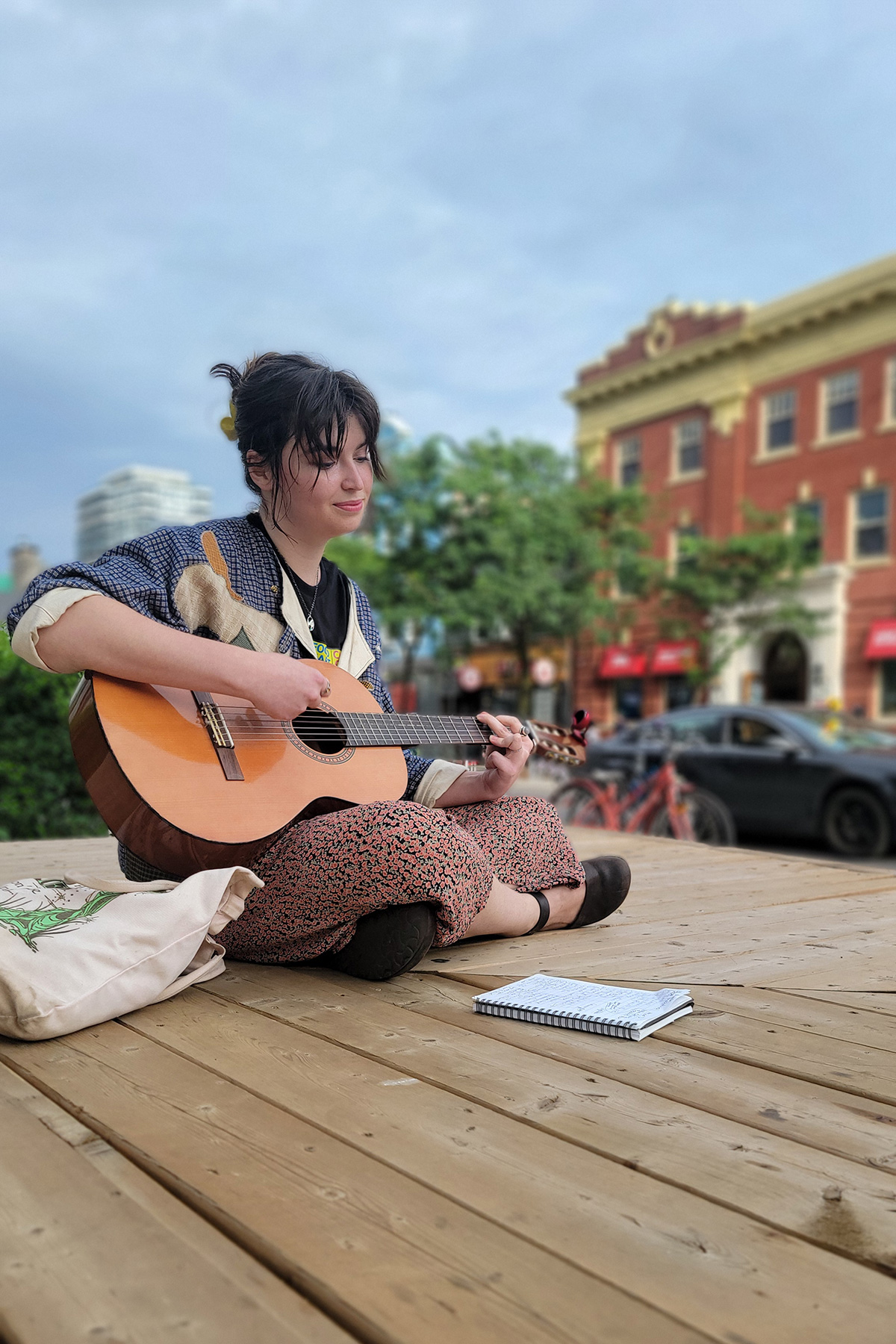
On Friday, August 16, Ruby Fleet, also known as A glimmering girl, performed on the Bloor Annex BIA’s public stage as part of their Summer Music Series. Over the course of the summer the BIA welcomed over 30 musicians, groups, and ensembles to perform on Fridays, Saturdays, and Sundays. NEILAND BRISSENDEN/GLEANER NEWS
Comments Off on CHATTER: Harbord Fair a success; Estonian future on Madison; Bloor Annex BIA stage (Sept. 2024)Tags:Annex · News
November 8th, 2024 · Comments Off on EDITORIAL: An injection of ignorance (Sept. 2024)
The provincial government led by Premier Doug Ford has elected to shutter ten of the of province’s 23 safe injection sites based on a “gut feeling” they are not working. This, despite the government’s own experts telling him they are not only working, but that their work needs to be bolstered. The war on drugs is now part of the culture wars in Doug Ford’s Ontario.
The pretext for the closures is a prohibition of the sites being located within 200 metres of schools. Concurrently though, the government has indicated that no application outside that perimeter will be welcomed; so apparently, it’s not really about schools at all.
In 2023, 523 people died in Toronto from opioid toxicity according to Toronto Public Health, up 74 per cent from 2019. The unregulated drug supply is increasingly toxic because it is contaminated with dangerous substances including fentanyl. Safe drug injection sites save countless lives as users can get immediate help should they overdose. They can get clean needles, have their drugs tested, and receive treatment. The number of people who overdose because they are alone, at home or on the street, will only go up when these sites close.
Advocates add that safe injection sites are a far better use of health care resources than someone shooting up in a park, overdosing, and then requiring emergency hospital care. Providing clean needles reduces the spread of infectious diseases which the health care system also bears the burden of treating.
In announcing the closure, the province promised to spend $378 million on 19 new Homelessness and Addiction Recovery Treatment (HART) hubs. There will be no injections permitted at these sites, and no clean needles will be made available. Zoe Dodd, a harm reduction worker told CBC’s Metro Morning that she was critical of the plan because “they should really start with a pilot to demonstrate its efficacy at saving lives.” While the Centre for Addiction and Mental Health (CAMH) welcomed the HART hub announcement they were very critical of the safe injection site closures, saying that “they [the safe injection sites] are a necessary part of a comprehensive response to the drug toxicity crises.” Ford responded with: “The sites are a failed policy, simple as that.” Ford does like to keep things simple.
This announcement comes as the province has allowed any convenience store, regardless of how close it is to a school, to sell beer, wine, and alcoholic cocktails from 7 a.m. to 11 p.m. daily. No risks for kids there apparently. Same for Vape shops that can be next door to high schools. Students are a high-risk group, but the province is not actually thinking about the welfare of students, that’s just smoke.
Sylvia Jones is currently the province’s health minister. Her constant insincerity makes her perhaps the most obnoxious of Ford’s cabinet of flying monkeys, assuring a press conference “that no one will die as a result of the closure of safe injection sites.” Jones is the one who served as solicitor general, Ontario’s top cop, during COVID-19. She ordered police to arrest anyone who left their home without provincial consent. The police ignored the order as it was unlawful. She should have resigned then and crawled away somewhere. Her foray into the opioid addiction crisis sounds eerily similar to the Reagan-era war on drugs when Nancy Reagan offered the remedy to addicted users: “Just say no.” Apparently, as it turns out, it’s not that simple.
And if you think the federal government will come to the rescue, think again. Ontario has taken a page out of Alberta’s playbook and prohibited municipalities from accepting federal support for safe injection sites: It’s Ford’s job not to do apparently, and he wants to make sure no one else fills in the void he has created.
Some have argued that Ford simply has a different ideology when it comes to safe injection sites. That gives his motivation too much credit. He has no world view other than holding onto power, no coherent set of beliefs or guiding principles that underlie denying care to those in need and at risk of dying. It’s just mean spiritedness. We can imagine in the future from Ford: “Look we threw them a lifeline. It sucks they can’t swim to it cause their dead. They should make better choices next time.”
November 8th, 2024 · Comments Off on FORUM: City building and bracing for more storms (Sept. 2024)
Housing and flood mitigation are at the top of the list
By Dianne Saxe
Summer is such a wonderful time in University-Rosedale, and as it draws to a close, I’ve found myself reflecting on all there has been to enjoy. Whether it was taking advantage of free access to the ROM’s first floor, exploring a local market, savouring a fresh dessert in the Annex, or exploring the sounds and foods of Kensington, Koreatown, or Chinatown, there’s always something new to discover in familiar places.
Amidst the bustle of council business, I’ve made sure to take some time to be in nature, as well as catch up with friends in University-Rosedale. Thanks again to the residents of 250 Davenport for having me at their annual barbeque. I equally enjoyed meeting with members of our Indigenous community for a discussion and to review the Indigenous Placemaking designs for a new park at 51 Sussex Ave. I’m very excited for these and other projects to come to fruition!
As many of you are aware, I am an avid bike rider and have been hard at work improving accessibility and safety for this mode of travel. This isn’t just because it’s healthy and climate-friendly, but because cycling throughout Toronto opens up a whole different version of the city. It should be available for everyone to take advantage of, particularly young people. To this end, I am also very excited to report that my motion broadening Bike Share usage passed city council. The age for Bike Share usage has now been lowered to 16 for classic (non-electric bikes), and to 14 for those accompanied by a parent or guardian.
We are also progressing on making upgrades throughout the Ward. We’re closer to refurbishing tennis courts at Moore Park Tennis Club and Tom Riley Park and creating an arts space for a new theatre and rehearsal space at St. Clare’s Multifaith Housing. We are also designing a streetscape vision for Elm Street between Yonge and Bay streets, one that accommodates new development while maintaining its historic character.
Yet for all there has been to celebrate and enjoy, events this summer have laid bare the important work at hand to adapt our city to the effects of climate change. Many parts of the city, including City Hall itself, were damaged by the massive rainstorm, in what may have been the third “100-year storm” since 2013. Evergreen Brickworks, an indispensable institution in the life of our city, is recovering from flooding.
These events have underscored how important it is to continue the work on upgrading our city for future generations. I am happy that substantial progress has been made during the last sitting of city council.
The City of Toronto is continuing to make record investments in housing. Uploading the Gardiner and DVP to the province has freed up nearly $2 billion which we are using to invest in priority areas and projects throughout the city. These include infrastructure development, housing maintenance and repairs, TTC, parks, and additional funds for the Broadview Eastern Flood Protection.
We have passed legislation taking a hard look at Toronto’s stormwater mitigation infrastructure and how we can best address future flooding. Of course, your humble servant made sure that the city takes all available steps to ensure that all newly constructed buildings reduce flood risks by adhering to the new version of the Toronto Green Standards. I also passed a motion whereby the city will look into accessing ways to reduce stormwater runoff from nonresidential properties that are built in a way that drives up flooding, stormwater costs, and water pollution.
I am also excited that as part of our infrastructure upgrades, the city is exploring the construction of two fully electric ferries. This is an important development which will not only reduce our carbon emissions and make our waterfront cleaner, but will provide better service for Torontonians than the current fleet. The capacity of the newly proposed vessels is far more impressive, holding up to 1000 people at a time and virtually eliminating long, time-consuming queues at Jack Layton Ferry terminal!
Finally, I am very excited at all the events happening this fall. Be sure to check out the city’s website for all the latest happenings in University-Rosedale. Be sure to follow me on social media for more updates, including on the next episode of my new podcast – Saxe and the City!
Dianne Saxe is city councillor for Ward 11, University-Rosedale.
November 8th, 2024 · Comments Off on FORUM: Government ignores own experts, closes injection sites (Sept. 2024)
Doug Ford chooses political gain over public health
By Jessica Bell
In a cynical move, the Conservatives have announced they will shutter ten consumption and treatment sites in Ontario, including the Kensington Overdose Prevention Site operated by The Neighbourhood Group. Any site 200 meters from schools or daycares will be banned from operating.
The government also plans to restrict needle exchanges, so used needles cannot be replaced with clean ones, and ban municipalities from asking the Federal government to permit the regulated and controlled distribution of safe drugs to people who are addicted.
Ontario says they’re banning consumption sites near schools and daycares to reduce crime and stop needles from being near children. This is not true. If it were true, consumption sites would be permitted to relocate, but the Conservatives have banned new sites from opening anywhere.
Minister of Health Sylvia Jones was asked by reporter Jack Hauen from The Trillium if research had been done about “how many people will die as a result of this decision.”
“Jack, people are not going to die,” the minister replied, “they’re going to get access to service.”
The minister’s comment is as dangerous as encouraging a drowning person to learn how to swim, instead of throwing them a life jacket.
This government has made a political decision to win votes by scapegoating vulnerable people. This has nothing to do with evidence.
Municipalities, hospitals, nurses, public health experts, and even two provincial government commissioned reports recommend keeping consumption sites open. To address crime and cleanliness, staff recommended hiring more staff, including security, not closing sites altogether.
Consumption sites are about reducing harm and saving lives. A CTV News review of federal government data shows that the sites, on average, help more than three people survive overdoses each day in Toronto.
Since opening in 2019, the Kensington site provides a room for people to use substances with trained staff on hand to respond to overdoses, provide education and supplies, like clean needles, and connect people to healthcare, counselling and other essential services.
Given the toxicity of the drugs available on the street, evidence also supports permitting the distribution of a regulated safe supply as a method to reduce overdose deaths.
Drug use doesn’t just magically disappear if needle exchanges are banned and consumption and treatment sites are shut down. If consumption sites close, people will use drugs alone at home, in restaurant washrooms, on the street, and yes, in nearby school yards. There will be more needles discarded on the street. Diseases like HIV and Hepatitis C will spread. More people will end up in very busy emergency rooms, like Toronto Western. And far more people will die.
No one is saying consumption sites should operate in a vacuum. These sites are one part of a comprehensive evidence-based plan to address the hideously complicated challenge of drug use and addiction by keeping people alive and helping people with recovery.
When Premier Ford was asked why he was closing sites his government originally approved, the premier said it’s just his “personal opinion” that they don’t work. He said critics should be happy that he’s pouring $378 million into new treatment hubs—there will be 19 of them—and 375 supportive housing units.
This plan is like a little two-legged stool trying to support an elephant. The chair can’t do its job because it is missing a key plank, and it’s too little to deal with the enormity of Ontario’s drug addiction crisis. The statistics are horrific. According to Public Health Ontario, in 2022, 2531 people died of an overdose, there were 2044 hospitalizations, and 12,144 emergency room visits.
Ontario needs to meet people where they are and save lives in the short term while also investing far more in housing, treatment, and health care to help people recover and rebuild their lives in the medium and long-term. This is what health care experts are recommending. We all benefit from this compassionate and evidence-based approach. This is not the time for cheap politics.
Jessica Bell is the MPP for University-Rosedale and the Official Opposition’s Housing Critic. She can be reached at jbell@ndp.on.ca or 416-535-7206.
November 8th, 2024 · Comments Off on GREENINGS: Flood impacts brought to you by low taxes (Sept. 2024)
Toronto lacks the leadership to address effects of climate change
Toronto had two “once in a century” storms this summer. If you are bothering to read my column, I can only assume you understand the cause—climate change. I know there are still corporate lap dogs licking oil men’s boots and denying its existence, but for the most part, the era of denial is over, except for the those whose money solidly depends on infinite oil and those suckers who believe them. Sadly, for us, the former group is highly influential, and the latter group is stubbornly numerous.
After two damaging storms in a summer, I’d like to think that the bulk of Torontonians have woken up to the fact that not only do we need to cut back on fossil fuel use, we need to think long and hard about our infrastructure and how we can reasonably survive the next “once in a century” storm next summer.
This will make me truly unpopular, but this is going to take money, and that money needs to come in the form of tax increases; nobody is coming to help us. We can’t have nice things if all we are worried about are imaginary gravy trains driven by drug-dealing political leaders. We will need higher taxes, more robust infrastructure, and free public transit. This will not fix our problems, but will make life far less miserable for a lot of people, including people who had to walk through sewage to get back to their flooded homes. I am sure they don’t want to do it again during the next “once in a century storm” next summer.
There’s a lot we can learn from our neighbours in Mississauga. While Toronto cowardly shelved their plans for a storm water charge, Mississauga went ahead with theirs. It funded projects to protect flood susceptible lands including projects that were key in mitigating the impact of all that flood water within the city.
Did anyone else notice how much worse residents in Etobicoke were compared to their neighbours in Mississauga? There was no magic involved. It was good planning and politicians with enough foresight to not cave to the few whiners about taxes. They actually did something.
While Mississauga has stormwater infrastructure worth an estimated $7.6 billion, we have constantly flooded streets and basements. In 2024, Mississauga allocated $33.7 million for stormwater improvements that include erosion control initiatives. Since 2016, they have invested over $231.5 million in stormwater infrastructure.
Their 10-year plan includes an additional $340 million for ongoing upgrades and maintenance to enhance their resilience against future storms. All of this is made possible because they had leadership that did the right thing and implemented a stormwater charge, something that Toronto still has not done nearly a decade later. We are an absolute embarrassment, and we will have no choice but to go crying to other levels of government because we insist on keeping taxes for those rich enough to own property. If this is starting to sound absurd, it’s because it is.
Next summer’s storms are coming whether we prepare for them or not. We can either do something, mitigate the risk and damage, or just whine about how terrible it was at the end of the summer. I would rather pay higher taxes than have us all get dysentery as our infrastructure fails bit by bit. Climate change is coming for us and we need real leadership that will do something about it.
Terri Chu is an engineer committed to practical environmentalism. This column is dedicated to helping the community reduce energy use, and help distinguish environmental truths from myths. Send questions, comments, and ideas for future columns to Terri at terri.chu@whyshouldicare.ca.
November 8th, 2024 · Comments Off on SPORTS: Christie Pits eyed as destination for baseball and more (Sept. 2024)
Maple Leafs owners seek bigger crowds in 2025 with food, music, and fun
By R.S. Konjek
It is the evening of Saturday, August 24, and smoke and flames engulf the outfield of Dominico Field at Christie Pits.
The scene is not the work of a brazen pyromaniac, but part of a pregame ceremony for the Toronto Maple Leafs baseball club.
The Leafs are hosting their first postseason game of the year, a quarterfinal matchup against the Barrie Baycats. Introduced as a group, the players charge through clouds of blue smoke to take their places on the diamond, with fireworks going off in their wake.
Keith Stein observes it through the outfield fence with a smile.
Stein is CEO of the group that took ownership of the Intercounty Baseball League franchise late last year. The purchase was announced with a pledge to keep the team in place at Christie Pits, the Leafs’ home since 1969.
“One of the reasons we bought the team is because of our commitment to the neighbourhood, the Annex, and surrounding area. It’s very important,” he said.
A corporate lawyer by trade, Stein’s footprint on the Toronto sports scene includes being one of the founders of the Toronto Phantoms indoor football team in 1997.
As CEO, he is one of the “guiding minds” of an ownership structure that resembles a corporate board.
“For this team to do as well as we want it to do, it’s got to be run like a successful business too,” he said.
Everyone likes to interact with the boss. During our conversation, Stein circulates the park, pausing to offer numerous hellos and introductions as acquaintances enter his orbit. There’s an energy throughout, not just because of the playoff atmosphere.
This year, one of the owners’ first objectives was to make Christie Pits a welcome place to play and to professionalize the whole operation. The ballpark was spruced up, a new sound system installed, and an eye-catching suite of new uniforms was unveiled.
The other priority was to create a new type of experience for fans. Stein gives a rapid-fire overview of the scene around the ballpark.
“If you look around tonight, there’s a DJ booth up next to the press box, there’s a merch tent, there’s a raffle tent, there’s a members’ tent. We have a full-time host who tries to animate things,” he said. “We’re also proud of what we’ve done on the food and beverage side. You never saw this….” (he gestures towards the customers at the concession stand, a lineup that snakes along the clubhouse).
Stein wants every Leafs game to be a party.
“We want this to be the type of experience that you can come and hang out even if you don’t like baseball,” he said. “We think this is a tremendous platform, every Sunday afternoon and Wednesday night, to provide an entertainment destination for people in Toronto.”
Another pledge the new owners made was to keep all games free of charge.
This promising new era has been hampered by one thing. The Leafs struggled mightily all season, finishing seventh in the standings. Every owner and fan knows that a winning team draws bigger crowds.
Improving the product on the diamond will be crucial.
“We’ve got a pretty good foundation here, but we’re always interested in building on that foundation,” Stein said.
Has there been any thought to reaching out to newly retired Major Leaguer Joey Votto’s agent?
“We have,” he said. “He lives around here. I’m sure everybody’s thinking about him, every baseball team in the country. We already have (former Toronto Blue Jay and current Leafs manager) Rob Butler. He’s done things no other Canadian has, so we’d like to have Joey Votto and Rob Butler.”
Whether that’s a hot scoop or a buzz-generating rumour, time will tell.
What can fans expect next year?
“Way more continuous improvement of the fan experience. This is just the beginning. I think you’re going to see something that is even night and day from what you’re seeing today.”
Fans will have to wait until May of 2025 to find out what the club has in the works.
The Leafs were defeated that Saturday night, and they were quickly eliminated from the postseason.
One sour note in the first movement of this promising new composition.
More information about the team can be found at www.mapleleafsbaseball.com.
The Maple Leafs’ complete 2024 season schedule can be found at www.mapleleafsbaseball.com.