July 3rd, 2015 · Comments Off on Christie Pits renewal set to begin
Popular park will benefit from development dollars

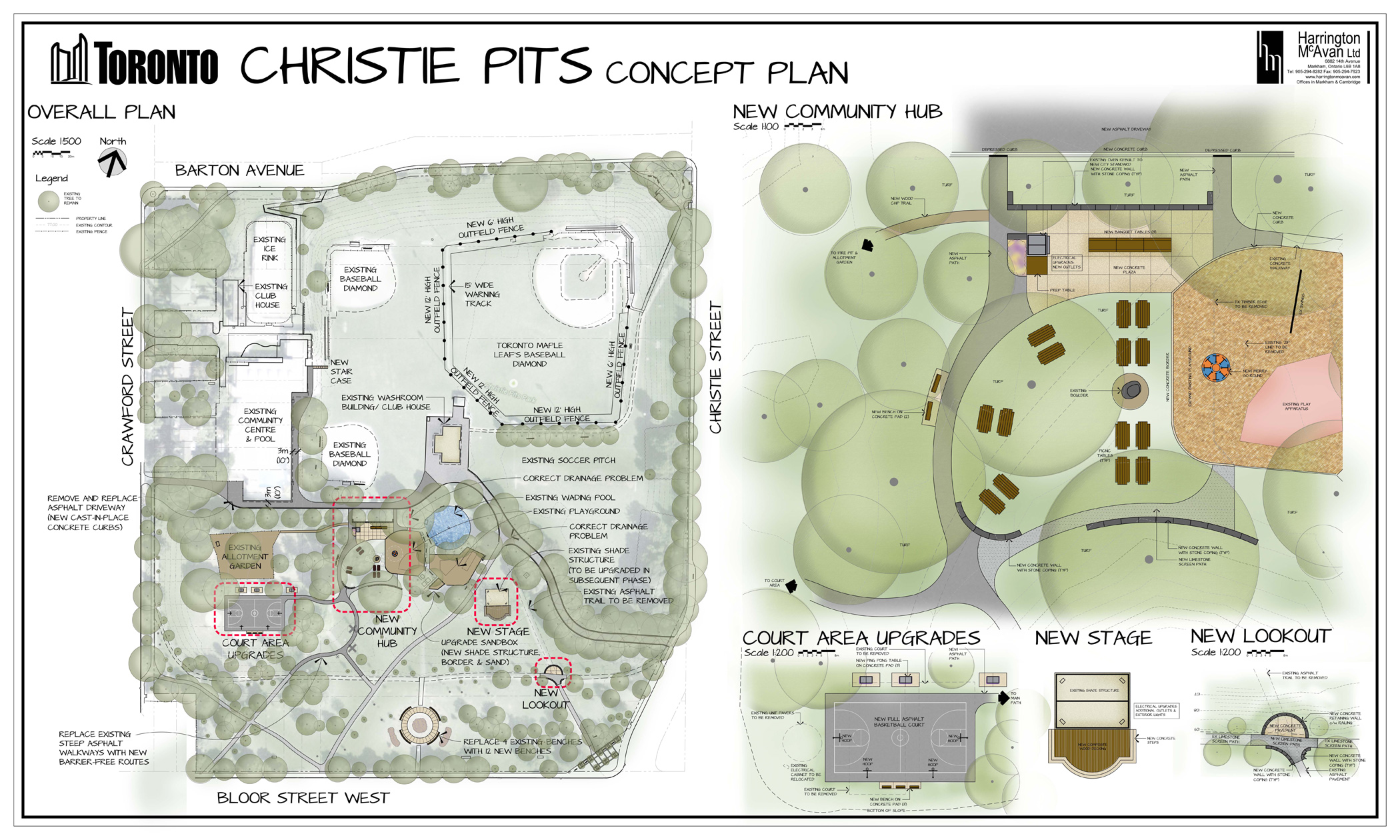
A rendering of the renewal plans for Christie Pits Park reveals improved pathways with new lookouts, a redesigned community hub and stage, and an expanded basketball court. By Harrington McAven Ltd., Courtesy of the City of Toronto
By Annemarie Brissenden and Brian Burchell
It will be a whole new ball game for Christie Pits Park when the bats start swinging next spring. A major revitalization of the park is slated to begin this summer; one that will see safety improvements, new courts, and community enhancements all installed by the time the Toronto Maple Leafs Baseball Club plays its 2016 home opener.
“Christie Pits is a large park that works well, very well, but it’s looking a little shabby and there is an opportunity for some improvements with some new amenities,” said Mike Layton (Ward 19, Trinity-Spadina), whose ward includes the park.
Known as Willowvale Park (a name that local residents never adopted) until 1983, when the City of Toronto officially renamed it Christie Pits Park, the area has a long and storied history. Despite common lore, it does not get its name from William Mellis Christie (“Mr. Christie”), who co-founded the Christie & Brown Cookie Company, but from a tanner who made his living in the area when it was still a sand and gravel quarry. It’s also been a shantytown inhabited by impoverished immigrants and those who escaped slavery along the Underground Railroad, and a waterhole for neighbourhood children, all before it became a park, and the site of the infamous Christie Pits Riots in 1933.
It is no wonder then that the park — at 8.9 hectares and filled with amenities — is due for a facelift.
A cultural hub for local residents, Christie Pits features the Alex Duff Memorial Pool, three baseball diamonds, basketball and volleyball courts, a community garden, a children’s playground and labyrinth, and an ice rink.
It is also, with its steep sloped sides, a favourite spot for tobogganing.
“Improving the pathways are a major priority,” said Layton. The paved pathways throughout the park are a safety hazard, broken in some parts and too steep in others. Their renewal also provides an opportunity to install some look-out points to the park’s bowl below.
Another safety improvement, raising better fencing for the baseball diamonds, will begin after the baseball season closes this fall.
An amalgamated basketball court is also planned, and will be installed in the area currently occupied by the volleyball court, which explained Layton, “has fallen into disuse and basketball has become very popular”.
The park’s renewal isn’t just limited to the sports amenities.
To date, event organizers for a planned performance needed to “bring their own stages”, which is inconvenient to say the least. The revitalization, however, will feature a new permanent stage that Layton said “will cement this important cultural component of the park’s use”.
A bit of retooling will update the park so that it suits contemporary tastes and uses. That, along with “the pizza oven and an enhanced community hub, are also key components of the facelift,” said Layton.
“The changes are welcome,” said Emily Reid, festival director and lead programmer of the Christie Pits Film Festival. “It shows the park is well used, and though many of the improvements are peripheral to our specific use, the lookouts will provide patrons of our event a new vantage point to view films we exhibit. We were happy with the level of consultation, and they made sure that the new stage plan would not interfere with our screen set-up.”
According to Layton, funding for the revitalization is largely provided by the city’s ten-year parks capital renewal budget, along with some Section 42 money, a provision of the The Ontario Planning Act that allows municipalities to ask developers to set aside money or land to create new parkland.
Tags: Annex · News
July 3rd, 2015 · Comments Off on Bring nuts to the party
Simple, tasty, and healthy
I try very hard to bring the right little seasonal gift to anyone I visit in their home for a BBQ, or summer gathering. Unless it is an assigned dish for a potluck or a BYOB, I am loath to arrive with yet another little package of shortbread cookies. No point competing with the hosts’ Aunt Martha.
So I splurge and bring nuts — the bigger and the more expensive, like pecans and walnuts and macadamias, the better. Surprisingly enough, the best roasted nuts I ever bought were from a little shop in Ramallah two years ago. I used to give my dog nuts casually until someone told me they were really bad for them. Who knew? Well, nuts are good for me, especially walnuts. A lot of information is coming out all the time about their health value.
Remember to toast any nuts as you use them in your recipes and freeze them in well-sealed baggies until you do.
Praline nuts
Ingredients
- 1 1/3 cup fine white sugar or castor sugar (castor sugar can be made by fine grinding white sugar in a food processor)
- 1 generous cup of any nuts: walnuts, pecans, hazelnuts, cashews, macadamias, brazil nuts
Directions:
Line a baking sheet with parchment paper. Put sugar into a saucepan and warm over a low heat. Shake the pan to dissolve evenly. Keep a close eye on the pan and cook until the sugar is a dark golden brown. Pour in nuts and stir once with a wooden spoon.
Dip the bottom of the pan quickly in and out of cold water to stop the sugar burning.
Pour the praline onto your baking parchment sheet and spread out evenly.
Wash the pan and spoon immediately in warm water or leave to soak.
Cool for 20 minutes and then break into pieces.
Seal tightly in a tin or jar.
Cherry, macadamia, and coconut granola
Ingredients
- 4 cups old-fashioned rolled oats
- 2 cups unsweetened coconut
- 6 tablespoons golden brown sugar
- 2 cups macadamia nuts lightly roasted
- 1/2 cup light vegetable oil
- 1/3 cup light liquid honey
- 2 teaspoons ground cinnamon
- 1 1/2 cups dried cherries, halved
Directions:
Preheat the oven to 350 degrees fahrenheit.
Toss the oats, coconut, sugar, and nuts together in a large bowl. Pour the vegetable oil and honey over this mixture. Add the cinnamon, and stir with a wooden spoon until all the oats and nuts are coated with the liquid. Pour onto a parchment papered sheet pan. Bake, stirring occasionally with a spatula, until the mixture turns a nice, even golden brown, about 20 to 25 minutes. Add the cherries and cook for 10 more minutes.
granola from the oven and allow to cool, stirring occasionally. Store the cooled granola in an airtight container. Makes approximately 10 cups.
Of course one can always add more salt or sugar to taste, especially before cooling the recipes down. There is something so yummy about the savoury embracing the sweet.
Seaton Village resident Susan Oppenheim is Java Mama, an independent coffee roaster, baker, avid traveller, and activist. She is the mother of three adult children and the grandmother of three. Susan can be reached by email: javamama.susan@gmail.com.
Tags: Annex · Liberty · Food
July 3rd, 2015 · Comments Off on Ditch the dryer
Line dry your clothes year round
Over the last few years I’ve noticed more and more of my Annex neighbours embracing the drying line over the electric dryer. It’s one of life’s simple pleasures to just admire clothes swaying in the wind on a warm summer day.
I hope that more and more of my neighbours are also embracing the indoor drying rack. It makes so little sense to create heat in an electric dryer only to vent that warm moist air outside.
Meanwhile, cold air heated up by our furnaces creates an uncomfortably dry environment that we have to find ways to humidify. While one appliance rejects heat and moisture, we employ another appliance to create both. This is what I call a waste of energy.
Instead, we could simply line dry our clothes indoors. We save energy in the form of heating and we get a bonus natural humidifier. Our clothes are happier because there’s less wear and tear on them from being heated and tumbled, and our electric bills are happier (perhaps not the electric utility, but you will be happier with the lower bill).
A bonus for anyone with cats is an instant kitty fort as your sheets get draped over an array of chairs.
Dryers also necessitate the use of dryer sheets or some other form of static control. These dryer sheets are the source of Volatile Organic Compounds (VOCs), some of which are known to cause cancer and other adverse health effects. That “fresh scent” is actually a mixture of chemicals containing about 25 VOCs (as measured by one study).
By ditching the dryer, we can eliminate one more cause of chemical pollution in our homes. (In truth most “fresh” smelling cleaners are chemical stews of not-so-healthy things, so I really don’t recommend chemical masks for odours of any sort.)
For big heavy items such as coats, pillows, and comforters where line drying isn’t practical, try replacing chemical-laced dryer sheets with a good old-fashioned tennis ball or two.
This will keep the clothes soft and fluffy without nearly the same amount of chemical release. Keep the heat moderate on the dryer too so that the fibres in the clothes aren’t abused as much and will tend to last longer. We often forget how much clothes are a burden to the environment. Everything from growing the fibres (cotton) to mining them out of wells, or in our case tar sands, imparts a large footprint.
Dying our garments with bright beautiful colours often leaves poor countries that make these products with contaminated drinking water. As attractive as a crimson red dress might be, imagine having to drink water that colour. This is the reality many people who don’t get to choose what colour dress they want to wear that evening face.
Taking care of our clothing and having it last longer means that we do less damage to the earth and to our fellow human beings.
Terri Chu is an engineer committed to practical environmentalism. This column is dedicated to helping the community reduce energy use, and help distinguish environmental truths from myths.
Send questions, comments, and ideas for future columns to Terri at terri.chu@whyshouldicare.ca.
Tags: General
July 3rd, 2015 · Comments Off on Artifacts uncovered at Pompeii at ROM
Casts of a family as they were found at the moment of their death, buried in volcanic ash. Almost two thousand years ago, Mt. Vesuvius erupted and buried the Italian city of Pompeii in hot ash and debris. Undiscovered for 1,600 years, important artifacts are revealed at the Royal Ontario Museum in an exhibition that has just opened. Photo by Brian Burchell, Gleaner News
Tags: Annex · News · General
Westbank Corp. has submitted its building application to the City of Toronto for the redevelopment of the Honest Ed’s site and the adjoining Mirvish Village. The store has been saying a long goodbye for some time now but it’s finally slated for closure Dec. 31, 2016. Though the building application is in, it is far from complete. It’s a complex site given the elaborate plans the Vancouver-based developer Westbank has very publicly mused about. Still Westbank is anxious to move forward before the mood of enthusiasm for the project wanes.
The proposed 1,000 residential units, half of which are two-bedroom or more, are going to be rental, not condos as was widely believed. This has caused a small tsunami in the minds of some residents. In terms of density, it’s an additional 3,500 residents in the Annex and their future impact on the area is unknown. The rental element has conjured up in the minds of some that the “wrong element” will take residence. There is an uncomfortable xenophobic sound to that sentiment.
Rental accommodation is what this city needs. According to Employment and Social Development Canada, Toronto’s rental vacancy rate stood at a scant 1.7 per cent in 2014. While no up-to-date figures are available on the subject, creating extra space at a major intersection and on a subway line could be argued as fulfilling an acute need.
We are at a crossroads. Pressure to accommodate a growing population will naturally find an outlet in tall buildings built near subway lines. This is sensible and consistent with the view that urban sprawl represents bad planning, because it is damaging to the environment, and is an inefficient use of all forms of infrastructure.
It’s a myth that all renters don’t care about community values and are not “house proud” because they have no stake in the game. This view fails to recognize that many condos out there contain tenants who are renting from owners who may not even live in the country. In contrast, Westbank plans to be an on-site landlord.
The idea of renting instead of buying so you can live where you want is a quality of life decision that has merit. Buying a house in the Annex these days is arguably a financially unattainable goal for the vast majority of people. Rental vacancies in Toronto are low, and these 1,000, many suitable for families, would be a very welcome addition to the urban inventory.
Architect Gregory Henriquez’s recent visit to the Palmerston Area Residents’ Association (PARA) Annual General Meeting fanned the flames of area residents’ increasing anxiety about the project when he mused about the high percentage of affordable housing in his other developments and the provisions he had previously made for clean injection sites and accommodating the homeless. God forbid we should provide shelter to those that lack it. The PARA executive and the architect agreed at the outset that they would not answer questions about the Honest Ed’s project, only general ones about his portfolio of work. This was an error in judgment that allowed a suspicious audience to “cut and paste” the architect’s socially progressive track record onto this pending development.
It has been argued that this is another St. James Town in the making. Built in the sixties and seventies, well off the beaten track, poorly constructed with no amenities, and overpopulated with 25,000 people, St. James Town is a massive planning failure. The Westbank development is no island like St. James Town. It is located at a core intersection of Bathurst and Bloor streets, right on the subway, filled with amenities, and envisaged to be built to a high standard where the builder plans to be the long-term owner-operator. This is what sets this development apart. This is not a build it and run proposition.
Lumping all developers into the same camp is a blunt instrument approach, which does not encourage developers to propose creative, civic-minded projects. It’s time to set cynicism aside and respond to this proposal with the same positive spirit it offers us.
Tags: Annex · News · Editorial
July 3rd, 2015 · Comments Off on BABIA endorses Westbank proposal
The Bloor-Annex Business Improvement Area (BABIA) has endorsed Westbank Corp.’s proposal for the redevelopment of the large area at the southwest corner of Bloor and Bathurst streets that includes Mirvish Village and Honest Ed’s.
“We have been deeply engaged with the developer and recognize its outreach to the community,” said Brian Burchell, chair of the BABIA, and publisher of this newspaper. “At the outset, we set some principles that we hoped the developer would meet.”
Those principles include: the preservation of Mirvish Village both in terms of its built form and the unique nature of its shopping, dining, and cultural experience; pursuing small owner-operator tenants for its retail spaces; broad consultation with the community; and developing a destination space that would draw people to the community thereby benefiting the BABIA membership.
According to Burchell, Westbank Corp. has met these conditions, and as such has earned the organization’s endorsement, even though Westbank hasn’t yet officially submitted an application to the City of Toronto.
“We have this one opportunity to comment,” explained Burchell. “We are prohibited under city bylaws governing BIAs from commenting once the application is in the hands of the city.”
Burchell’s big concern is that the area would become something like Yorkville, “which has no soul, whereas Mirvish Village has it in spades”.
With the Westbank development, Burchell added, the area will continue to be “a destination in itself. It will be the BABIA’s new western flank, and we welcome it on our doorstep.”
—Annemarie Brissenden/Gleaner News
Tags: Annex · News · General
July 3rd, 2015 · Comments Off on Settlement reached for 484 Spadina Ave.
A settlement has been reached regarding the future of 484 Spadina Ave., home to the Waverley Hotel and Silver Dollar Room.
The Wynn Group of Companies’ application to build a 22-storey private student residence on the site had been decried by local residents, who had raised concerns about the proposed height, the heritage value of the Silver Dollar Room, and the precedent such a development would set for the area.
Although the City of Toronto denied the developer’s application, it was under appeal at the Ontario Municipal Board.
Under the terms of the settlement, the building will be reduced from 22 to 15 storeys, or 69 to 52 metres, and will incorporate height step-downs and setbacks that will emphasize the architecture of the Silver Dollar Room, which will be restored and maintained in its existing location.
—Annemarie Brissenden/Gleaner News
Tags: Annex · Liberty · News
July 3rd, 2015 · Comments Off on Mirvish Village sidewalk sale is back!
Following on the success of the May event, the Mirvish Village Business Improvement Area is again hosting a sidewalk sale this time on Saturday, July 11 from 11 a.m. to 4 p.m.
Vintage wares, artists’ creations, and new merchandise will be featured, and local restaurants will offer up their tasty bites.
This event’s new roster of live music will include performances from the Backtrack Band (Motown and R&B), the Sean Stanley Quartet (early jazz, blues, and ragtime), and Mirian Katrib (singer songwriter, fusion).
—Brian Burchell, Gleaner News
Tags: Annex · News
July 3rd, 2015 · Comments Off on Esprit Orchestra goes to China
Trip marks 45th anniversary of diplomatic relations with Canada

The Esprit Orchestra performed The Falcon’s Trumpet by R. Murray Schafer with Robert Venables on trumpet on June 4 at the Guangxi Arts Institute Concert Hall. Courtesy Mimi Mok, Esprit Orchestra
By Beth McKay
Toronto’s Esprit Orchestra is fearless when it comes to musical innovation, and its brave musical style has recently landed them on the opposite side of the world. In late May, 30 Esprit musicians left Toronto for the orchestra’s debut tour of China.
Esprit’s founding musical director and conductor Alex Pauk has been nominated for the Margo Bindhardt and Rita Davies Award, a $10,000 prize given to an individual who demonstrates creative and cultural leadership in the development of Toronto’s arts and culture. The award acknowledges just the sort of initiative exemplified by this trip, and recognizes Pauk’s leadership role in bringing Esprit’s ever-evolving new musical sound to countries around the world.
Pauk hopes the trip to China will build a bridge to a future of musical exchange between the two countries, and encourage the sharing of new orchestral musical culture in the future.
“The idea is to present strongly characteristic pieces,” says Pauk about the Canadian pieces Esprit will play, noting the orchestra’s versatility and ability to perform unique music. “My work combines different aspects of what Esprit does. It combines the orchestra with digital playback sounds, like sounds of nature and electronic tones.”
The orchestra’s musical repertoire includes pieces written by R. Murray Schafer, Pauk, and his wife Alexina Louie, who will also give pre-concert talks and master classes to students throughout the tour.
Esprit is Canada’s only full-sized orchestra solely committed to performing and promoting new orchestral music. This trip to China has taken some considerable fundraising for the orchestra’s members which demonstrates their dedication to sharing new music beyond Canadian borders.
Esprit will play at multiple venues in Beijing and Nanning, returning to Canada on June 6. Pauk says that on May 29, they will be performing all Canadian music at the 2015 Beijing Modern Music Festival.
“In the future, we would really like to see some players come here [to Toronto],” says Pauk. With the foundation that has been made over the past two decades, this idea isn’t too far fetched.
The musicians do intend to do some sightseeing in China, but Pauk expects to be very busy. On June 2, Esprit will combine with the musicians of the Guangxi Symphony Orchestra to form an ensemble of over 90 players. This large orchestra will perform both a Canadian and an international program including works from Vietnamese composer ng Hu Phúc, Germany’s Jörg Widmann, and three phenomenal Chinese composers.
The trip coincides with the 45th anniversary of diplomatic relations between Canada and the People’s Republic of China, a relationship that has been growing continuously every year since 1970.
Canada is home to roughly 1.3 million Canadian residents of Chinese origin, and has a comprehensive relationship with China at many levels and in many areas, including trade, health, education, and culture, according to the Government of Canada’s website.
Tags: Annex · Liberty · Arts
Inclusionary zoning is used in 300 U.S. cities
By Joe Cressy
What makes a great city? Arts and culture, diversity, economic growth, and civic engagement. All these things matter a great deal. But, if you ask me, the test of a truly great city is whether we adequately care for the residents who live here. Sadly, on this front, we are letting residents of Toronto down.
Our city has an affordable housing crisis; and, the longer we delay in confronting it, the worse off we will all be.
The City of Toronto currently has more than 91,000 families on our centralized affordable housing waiting list. It’s a number that is almost hard to comprehend. This number exists at the very same time that Toronto has more condo towers under construction than any other city in North America.
As we grow as a city, we need to ensure that we are building neighbourhoods, rather than simply adding density. While we work hard to ensure we have the physical and social infrastructure to support our neighbourhoods, we also need to ensure that we are building equitable communities.
The affordable housing crisis is not new — it has been years in the making. In the 1990s, the provincial government downloaded the responsibility of affordable housing onto municipalities, and created a funding gap that continues to grow. Meanwhile, successive federal governments have been missing in action. In fact, Canada remains the only G7 country without a national housing strategy.
We need our provincial and federal governments to come back to the table as partners to address the housing crisis facing our city. Close the Housing Gap, a campaign led by the city’s Affordable Housing Office in partnership with Toronto Community Housing Corporation (TCHC) and countless other allies, seeks to build awareness of our city’s housing crisis and tell the other levels of government that the status quo is simply not an option.
With or without the partnership of our government counterparts, we must find ways to dramatically increase investments in affordable housing as our city sees more and more residential development. In Ward 20, we have more than 60 active development files and many more on the horizon. Our community is committed to building affordable housing, and our office requires an investment in affordability in every development in Ward 20. However, we need a legislative framework that mandates this investment in every development, city-wide.
Simply put, we can address the affordable housing crisis by simply mandating that every new residential development with over 20 units includes affordable units. It’s a practice known as inclusionary zoning and it is not new. In fact, inclusionary zoning is already used in more than 300 U.S. cities.
It’s a concept that seems almost too simple. Growth pays for equitable growth, and in the process we build mixed-income neighbourhoods. So, why haven’t we implemented this solution yet? The answer lies with the province. Inclusionary zoning requires provincial legislation, and the province of Ontario has not responded to the city’s repeated requests for this legislation.
With the addition of inclusionary zoning policies to our planning framework, our city could create a steady and growing supply of affordable rental and home ownership units across the city. We could ensure that our communities are built equitably, and that all residents have greater access to resources and services.
What makes a great city? I’d argue that inclusionary zoning and mandating equitable growth would be a good start.
Joe Cressy is the city councillor for Ward 20, Trinity-Spadina.
Tags: Annex · Liberty · News
July 3rd, 2015 · Comments Off on Preserving Mirvish Village
Collection of photographs captures spirit and character of the area
Gerald Pisarzowski, poses in front of Charlotte Hale & Associates Gallery on Markham St. Photo Courtesy of Charlotte Hale
By Annemarie Brissenden
Gerald Pisarzowski leafs through a series of platinum black and white prints bound into a beautiful book that is a work of art unto itself. His face quirks into the hint of an expression as he alights on a fresh image, each photo sparking a memory and a story.
“These people were so nice,” he remembers, hovering over a photograph of Ewe Dowlah and her co-workers at Caribbean Roti Place. “They were fun,” he comments about John Barthel and Maryse Claude of Vintage Video Collectables.
Mirvish Village People, produced in a limited run of 250 numbered copies, is the culmination of 80 days spent photographing the people who have built their businesses on the storied street. Many of the photos were exhibited during the Scotiabank CONTACT Photography Festival in May at the Charlotte Hale & Associates Gallery in Mirvish Village.
“Out of a conversation around the remarkable people in Mirvish Village sprang forth the concept to produce a series of portraits that would become a legacy to the unique magic that has existed on the little street for many years,” writes Charlotte Hale, herself a subject, in the book’s foreword.
The resulting portraits, in which the subjects stand in the centre of their place of business, staring directly at the camera, are arresting. When viewed together, they celebrate the quirky diversity of Mirvish Village, one of the city’s hidden gems, where you can buy yarn for a knitting project, pick up the latest comic book, visit an art gallery, get your clothing mended, and finish off with some New Orleans cuisine, all on the same street.
“I call it a little hub of wonder in Toronto,” says Hale in her gallery, surrounded by the photos.
With Westbank Corp. — a sponsor of the exhibit — set to redevelop the area in the coming years, it’s unclear what will come of the businesses that have thrived here for decades, but what is clear is that the subjects of the pictures are facing the future with pride and determination.
As Hale notes, “Someone commented that everyone looks proud; a strength of the exhibition is that it reflects the pride in the community.”
“This captures it just before the change,” explains Pisarzowski. “It had to be done now, not in two or three years’ time.”
“It’s a visual narrative of a community in the early stages of a major development,” adds Hale.
Traditionally Pisarzowski is a landscape artist noted for his hand-coated platinum prints, and so documenting the urban environment is a departure for the photographer, who admits to a bit of “vision block, like writer’s block”, before embarking on the project.
He expected to produce only 20 to 25 images, but in the end was hard pressed to keep the exhibit to 50, and plans to take additional pictures this summer. The collection of images has attracted much interest, particularly from Westbank, which will restage the exhibit in its community office, and the Toronto Archives. A copy of the book has also been put into the Mirvish Collection, as a tribute to the couple who — whether by design or happenstance — created the little neighbourhood.
“It was the vision of one individual, or really his wife,” says Pisarzowski of Anne and Ed Mirvish. “This was really an incubator. People, for not a lot of money, could start a business, and then as their mentor, you had Ed Mirvish. He seemed a pretty relaxed and easy-going sort who recognized that people came up through the system. He knew what it meant not to have hot water.”
Pisarzowski envisions returning to the project again in the coming years, suggesting that he’ll do the “next set of images in 2017, during the” — and here he struggles to find the right word, “destruction, tear down, evolution”, before settling on — “middle portion”.
It is a reflection of how, just as the conversation continues about the future of the area, this exhibition continues to expand and evolve, becoming a space for sharing and recording memories.
“The thing about the exhibition being here,” says Hale, “is that it opens the door for people to come in and tell their stories about the area.”
For a copy of Mirvish Village People by Gerald Pisarzowski, please contact Charlotte Hale and Associates at chaleandassociates.com. Proceeds from the sale of the book, which costs $425, will go to Covenant House.
Tags: Annex · News · Arts · People
May 29th, 2015 · Comments Off on how nice! Safety!
Tags: General