April 7th, 2016 · Comments Off on NEWS: Bloor Street goes green
Plan to transform underutilized space
[pullquote]“This is a major greening initiative for the neighbourhood”—Jonathan Da Silva, Bloor-Annex BIA[/pullquote]
By Annemarie Brissenden
Bloor Street West is about to get a whole lot greener, and it’s all thanks to the trees.
Currently confined to box planters, Bloor Street’s trees are suffering. The concrete boxes — sometimes known as tree coffins — prevent saplings from growing to maturity and obstruct pedestrians on an increasingly denser sidewalk.
Stuck in a constant cycle of replacing ailing trees, and recognizing that future development in the area will only make Bloor Street a whole lot busier, the Bloor-Annex BIA (whose chair also publishes this newspaper) has cultivated a plan that will grow a thriving urban canopy, provide the area with much-needed additional green space, make the sidewalk more pedestrian-friendly, and add bike parking.
“This is a progressive, wonderful initiative that highlights how BIAs in our part of the world have a vital role to play,” said Sue Dexter of the Harbord Village Residents’ Association (HVRA).
There are three components to the BIA’s plan: getting rid of Bloor Street’s 35 planter boxes and planting new trees in clusters on the north side of the street; increasing bike parking by adding corrals on side streets; and converting four disused rights-of-way into parkettes at Brunswick Avenue, Robert Street, Major Street, and Howland Avenue.
The work will be done in 2018, when the City of Toronto is scheduled to repave the street and do some sidewalk infrastructure work, which will minimize any disruption to the area. It is expected to cost between $1.5 and $2 million.
The BIA has been setting aside $100,000 per year and has approximately $350,000 already set aside for the project. It also expects to receive additional capital from the city’s public realm division, the forestry department, and matching funds from the city’s 50/50 cost share program. It may also seek Section 37 funding, and will borrow money should it prove necessary to make up any shortfall. Dtah, a firm known for its work on the Queen’s Quay revitalization, is developing the design of the project.
“In a period where a lot of exciting changes are happening, this is a major greening initiative for the neighbourhood,” said Jonathan Da Silva, the promotions committee chair of the Bloor-Annex BIA, who is also the communications director of the Hot Docs Festival. “We want to make the Annex more of a destination location.”
For Albert Koehl, vice chair of the Annex Residents’ Association, the proposal “underlines the fact that this is already a destination”.
“This initiative, the push for bike lanes, and [the push for] lower speed limits are all part of celebrating the neighbourhood for what it is,” said Koehl. “[The Annex] is not just a speck out of the corner of your eye when you pass by.”
Both Koehl and Dexter are particularly excited about the addition of the parkettes.
“Seniors need a place to rest, or parents with a baby stroller,” said Koehl.
“Someone walking along Bloor Street [will] have a sanctuary to sit and have a coffee under the shade of a tree,” added Dexter, who noted that the HVRA had coincidentally identified some of the sites for boulevard greening as part of the association’s greening plan.
Koehl said he is particularly impressed that the BIA plan uses underutilized and/or forgotten spaces.
“We have wasted a lot of space,” agreed Dexter. “It’s time to start reclaiming paved space.”
Da Silva explained that the BIA recognized that greening is a high priority for the residents’ associations, and that the plan will not only ensure a green canopy on Bloor Street, but add to the visual experience of the Annex.
The BIA’s plan includes green elements inside and out: permeable surfaces will retain storm water, seating will be carved from granite offcuts, all wood will be sustainably harvested, and indigenous flora and fauna will be used in the plantings. There will also be a water bottle refilling station at the Brunswick Avenue parkette.
“We are making a very Annex statement,” said Bloor-Annex BIA chair Brian Burchell of the proposal.
Da Silva said that the BIA is also looking for ways to recognize local history and emphasize the unique dynamism of the area.
Annex residents will get their first opportunity to review the Bloor-Annex BIA’s proposal at an April 18 open house from 4 to 8 p.m. at Markham House (610 Markham St.). The plan will be submitted to the city for review by January 2017, and if approved, work will begin in 2018.
READ MORE:
City seeking street greening opportunities: Harbord Village plan targets laneways, parkettes (February 2016) By Marielle Torrefranca
Tags: General
April 7th, 2016 · Comments Off on NEWS: Rexall replaces Brunswick House
Pharmacy drugstore chain says it will respect building’s heritage
[pullquote]“This will be a relief to the neighbourhood”—Sue Dexter, HVRA[/pullquote]
By Annemarie Brissenden
After one last weekend-long blowout, the doors of the Brunswick House closed for good, leaving the neighbourhood eagerly anticipating the site’s next, presumably quieter and more agreeable, incarnation.
“Identifying a new tenant is good news,” said Joe Cressy (Ward 20, Trinity-Spadina), after learning that Rexall, a pharmacy drugstore chain, will be taking over the first floor of the building at 481 Bloor St. W. The betting lounge on the upper floors will be moving out, and landlord Larry Sdao — who in mid March confirmed the agreement with Rexall — said the second and third floors will be available for lease.
“We are excited to be able to come into the Annex neighbourhood,” said Derek Tupling, director of communications and government relations for Rexall.
The Brunswick House has long been a flashpoint in the neighbourhood.
Local residents say the student dive bar — which was operated by Ottawa-based nightclub promoter Abbis Mahmoud through his Dreammind Entertainment Group since 2005 — was a blight on the area that was responsible for late night noise, drunken scuffles, and crime.
“This will be a relief to the neighbourhood, [and for those who] live in close proximity to Bloor Street,” said Sue Dexter of the Harbord Village Residents’ Association, who likened the site to Vesuvius, waiting to explode. “It was very hard for people on Brunswick Avenue to have a good experience in the summer.”
Cressy agreed.
“The Brunswick House was a problematic operator, not just for the local neighbourhood but for people coming into the neighbourhood.”
In November last year, Sdao announced that he would only renew Mahmoud’s lease on a month-to-month basis, and that he was actively seeking a new tenant. Boston Pizza explored opening a sports bar and restaurant in the space, but backed away after community members objected to the possibility of a patio and expressed concerns about whether the chain would mesh with the unique fabric of the street.
Dexter lauded Sdao for behaving responsibly with the options he had, and said the Rexall tenancy will guarantee the building for a very long time, as well as protect the neighbourhood.
“It wouldn’t be my first choice, a big corporate chain,” said Albert Koehl, vice chair of the Annex Residents’ Association, stressing he was speaking only for himself, and needed more time to process the announcement.
Although Cressy acknowledged that if the City of Toronto owned the building he could envision several different uses, he characterized “this [outcome as] a vast improvement on the other options”.
“Some people had that nostalgic connection to the Brunswick House,” conceded Dexter. “But it’s a big enough space; you have to have something reasonably big to afford it. It’s better to have a benign influence on the neighbourhood, and having the building restored is great.”
Tupling said Rexall is keenly aware of the community’s attachment to the building and that his company plans to reach out to local residents’ and business associations right from the outset.
“We are looking forward to becoming part of the community,” he said, noting that pharmacies are the face of healthcare in the community and provide quick access to high quality services.
Likening the Brunswick House location to the chain’s other urban outposts at Queen Street West and University Avenue; Church and Front streets; and College Street and Spadina Avenue, Tupling said Rexall was attracted to the site because it is in an urban community with high foot traffic.
He said Rexall wants to “create a flagship location that embraces the entire community”, and is doing something it has never done before: it is bringing in an expert to help build the site.
“Our intention is to respect and maintain as much of the building’s historical and architectural integrity as possible.”
Sdao said that is what sold him on Rexall.
“They have a genuine approach and want to respect the heritage, design, and what the building has been for a long time.”
Neither Sdao nor Tupling would speculate on when the store would be open for business; they both pointed out that renovations to the heritage building would take time.
“Rexall and I, we want to do it right,” explained Sdao. “These projects don’t happen overnight.”
“There’s some things in the building that have gotten long in the tooth, so to speak, and we want to look at opportunities to revitalize and incorporate those into the design of the store,” Tupling added.
“We want to make sure that when the doors open, everyone is as happy as much as possible with the result.”
A previous version of this article appeared on March 23, 2016.
READ MORE:
Brunswick on the block: Notorious bar on month-to-month lease (December 2015) by Annemarie Brissenden
Tags: Annex · News
April 7th, 2016 · Comments Off on NEWS: Huron Street Playground renewal
City to break ground later this year
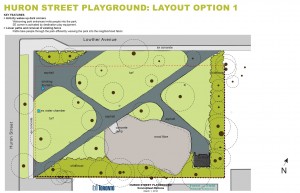
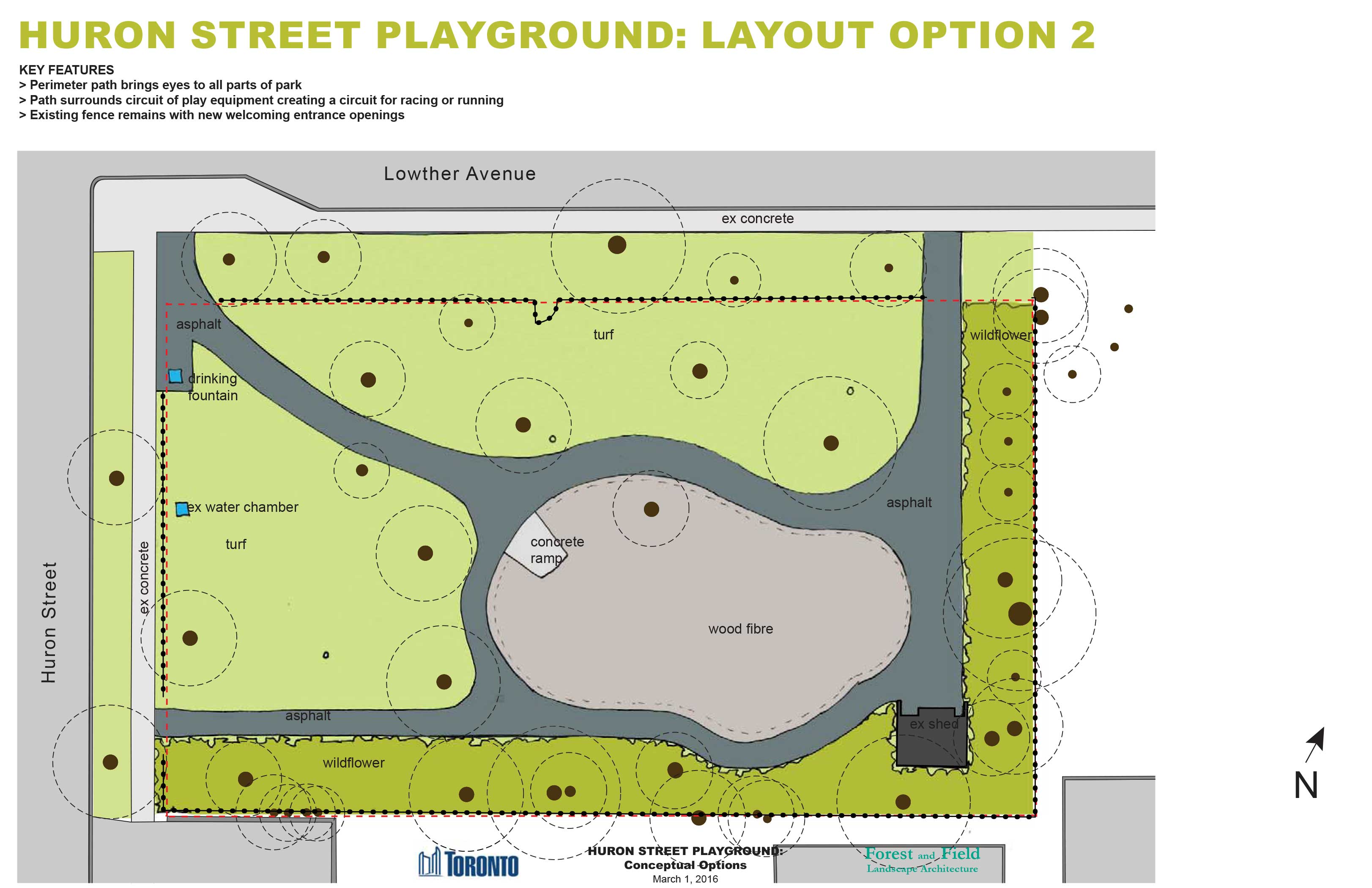
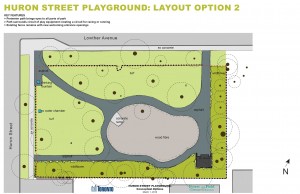
The City of Toronto’s Parks, Forestry and Recreation department is considering two layouts for the renewed Huron Street Playground. The first option (above) includes welcoming park entrances, a southest corner activated by destination play equipment, and the removal of the existing fence. In the second option (below), a perimeter path surrounding the play equipment will provide a circuit for racing or running. The existing fence will remain, complemented by the addition of new welcoming entrance options. Images courtesy of Forest and Field Landscape Architect and the City of Toronto.
By Annemarie Brissenden
Do you prefer a tetherball over a maypole? Would you scramble up a high ropy climber, or cling with glee to a lower rotating one? Would you rather sit on a log, dig through a sandbox, or watch the world go by from your perch on a bench?
These are the considerations at play as the City of Toronto’s Parks, Forestry and Recreation department refines the design plan for a revitalized Huron Street Playground at Huron Street and Lowther Avenue.
[pullquote]“It’s going to be a huge upgrade versus what we have now”—Brian Green, park supervisor, wards 19 and 20[/pullquote]
“It’s going to be a huge upgrade versus what we have now,” said Brian Green, the city’s parks supervisor for wards 19 and 20. “There’s going to be some challenge to this park, and by that I mean for the kids. There’s going to be some climbing equipment and stuff, not just let’s slide down the slide.”
At a community meeting on March 1, Katy Aminian of Parks, Forestry and Recreation presented two design options, which, for Joe Cressy (Ward 20, Trinity-Spadina), reflect different “visions of how we want people to move through the park”. In the first option, linear paths cross the park, the existing fence would be removed, and activity would enliven the park’s corners, particularly in the southeast, which would feature destination play equipment. In the second option, a perimeter path would surround the circuit of play equipment, and the existing fence would remain.
The park will be designed for children aged eight to 12 — nearby Taddle Creek is aimed at younger children — and accessible in accordance with provisions in the province’s Disabilities Act.
One of the challenges of designing a playground for this age group, explained Michelle Lazara, a principal at project designer Forest and Field Landscape Architecture, is that the children aren’t always on the structures. Her colleague Matthew Sweig added that “the shade [in the park] is amazing and we want to maintain it”.
The designers also have to consider what’s around the park, said Green.
“In this instance, there are two huge apartment buildings near the park. I don’t think the surrounding neighbours necessarily want to see a lot of [the] musical instruments that we would put in other parks.”
Cressy is particularly excited that approximately $250,000 from the city’s Playground Enhancement Program has been secured for the revitalization, which is expected to begin in the fall and could take anywhere from six to eight weeks to complete. He also noted that students in a number of classes at Huron Street Junior Public School are contributing to the community consultation process by doing projects exploring what they would like to see in the final design.
It’s the kind of thing that Josh Fullan, who is on the board of the Annex Residents’ Association, believes engages people in the overall health of a neighbourhood’s assets.
“Around seven or eight years ago, grade nine and ten students at University of Toronto Schools adopted the park for a volunteer project. They raked leaves and put away garbage,” explained Fullan. “They also conducted a survey with nearby residents…and heard two things: that maintenance was a real issue and that there were no benches.”
Consequently, the students raised money and installed a bench, as well as planted some flowerbeds.
According to the Gleaner’s annual parks survey, maintenance has been an ongoing issue at the park. Reviews regularly note graffiti, the need for more seating, and out-dated play equipment. Another recurring issue is whether or not to include an off-leash area for dogs.
“I’d like a third of the park to be an off-leash area,” said Pawel, a local resident who regularly walks his dog there. “There are a lot of people who let their dogs out here.”
According to Green, “dogs are the biggest issue in all of our parks. [People use] closed areas to let their dogs go [off-leash], and go into a playground for instance. We can’t monitor all that, and that’s a concern. If we have dogs in the park we…want to separate the children from the dogs.”
Cressy explained that while funds have been secured specifically for playground improvement, he does recognize the desire of some community members to have designated off-leash areas (DOLA), and that the park is being designed in such a way that a DOLA could be added in the future.
“There’s not anything on the western edge, where that could be accommodated,” he said.
Cressy expects that the park’s final design will be ready for the community to review in the next month or two.
—with files from Michael Chachura
READ MORE:
Grading our Greenspace (July 2015)
Tags: Annex · News
April 7th, 2016 · Comments Off on CHATTER (April 2016): Annex Residents’ Association app tracks developments
The Annex Residents’ Association (ARA) has unveiled a new web application to track all the building developments in the areas on and north of Bloor Street.
Residents can use the program to help keep up to date on how many new building projects are in place, as well as add information about them. The web portal was developed due to the unprecedented number of new building projects facing the Annex. David Harrison, chair of the ARA, cites an increased pressure on the area from developers and a need to keep residents informed as the key inspiration for the new app.
He said he hopes that other associations across the city will adapt the program in order to give a bigger picture of the developments coming to different areas of Toronto. Members of the community can access the map, as well as get an update on the trees of the Annex through the association’s TreesPlease project, at www.theara.org.
—Geremy Bordonaro/Gleaner News
MPPs promote benefits of post-secondary education at Central Tech
“I ended up going to Carlton and it changed my whole life”—Michael Coteau (MPP, Don Valley East)
Han Dong (MPP, Trinity-Spadina) and Michael Coteau (MPP, Don Valley East), the Minister of Tourism, Culture and Sport, recently spoke to senior students at Central Technical School about the proposed new Ontario Student Grant (OSG).
The MPPs emphasized the importance of attending university or college and how the new plan would help those from lower-income families access a post-secondary education.
Coteau told a story about how the smallest inspiration when he was growing up in Flemington Park changed the course of his life.
“There was this guy in my apartment building who kept bugging me and eventually he told me that he’d give me $50 if I applied to university,” he said ($50 was the cost of applying to university at the time). “I ended up going to Carlton and it changed my whole life…. It’s how I got into politics.”
Though times have changed since Coteau went to university, the provincial government has promoted the OSG as the “single largest modernization” of previous provincial education plans like the Ontario Student Assistance Program, because it gives a broader amount of coverage for low-income students.
If the 2016 budget is passed, the plan would do away with provincial debts for students from families with annual incomes under $50,000, and give grants of up to 50 per cent to students from families with incomes of $83,000 or less.
These grants will only cover what is considered the average tuition among students. The OSG will also provide help for full-time mature and married students no longer based on how long they’ve been out of high school. Students can expect to see the effects of the OSG starting in the 2017-18 school year.
—Geremy Bordonaro/Gleaner News
SIU clears officer of wrongdoing in police shooting
A Toronto police officer has been cleared of wrongdoing in last February’s shooting death of 49-year-old David Doucette on Spadina Road just south of Dupont Street. After a lengthy inquiry involving several investigators, two witness officers, and 17 civilian witnesses, the Special Investigations Unit (SIU) concluded that there are no reasonable grounds to charge the police officer with a criminal offence.
Police were called to the scene of a rooming house on 140 Spadina Rd. where residents had reported that a man had been stabbed. The stabbing victim was on the front steps bleeding profusely when police arrived and they immediately administered first aid. The officers noticed another man (Doucette) on the sidewalk, holding a knife and walking towards them. The subject officer pulled the injured man behind him, drew his firearm, and told Doucette to stop and drop the knife. The officer warned that he would shoot Doucette if he continued to advance. Doucette neared to within three to five metres, and the subject officer fired once, felling him. A second officer then approached Doucette, kicked the knife away, and handcuffed him.
A pathologist confirmed that a gunshot wound to the neck was the cause of Doucette’s death.
According to the SIU, the officer called for another officer with a conducted energy weapon (taser), but there was not enough time for that option to arrive; the officer had briefly retreated but Doucette continued his advance. Given the violence that Doucette had apparently already perpetrated, the SIU viewed the subject officer’s actions as reasonable to protect himself, his partner, and the injured civilian under their care.
“Pursuant to section 34 of the Criminal Code, a person who uses force that would constitute an offence is shielded from criminal liability if the force was intended to repel a reasonably apprehended assault on one’s person or a third party, and was itself reasonable in the circumstances,” said Acting SIU Director Joseph Martino about the incident.
—Brian Burchell, Gleaner News
Tags: Annex · News
April 7th, 2016 · Comments Off on EDITORIAL (April 2016): An injection of leadership
Supervised drug injection sites are on their way to Toronto if local councillor Joe Cressy (Ward 20, Trinity-Spadina) gets his way. The rookie member of city council finds himself on many civic bodies, but at the Toronto Board of Health, he is the elected chair. Cressy announced the initiative in late March after the board directed the Medical Officer of Health to conduct community consultations for several supervised injection sites. This could lead to the federal government’s endorsement of the proposal; that is, making it legal for injection drug users to come into a controlled site with their own privately procured drug, get some guidance and a clean needle, and under the watchful supervision of a nurse, inject themselves.
[pullquote]“Cressy’s announcement exhibits courage, compassion, and an understanding of the merits of good public health policy.”[/pullquote]
This plan has been brewing at the board of health for some time, but Cressy’s announcement, as well as the unequivocal manner in which he delivered it, exhibits courage, compassion, and an understanding of the merits of good public health policy.
In Toronto, there was a 41 per cent increase in deaths related to drug overdose from 2004 to 2013, with 206 in 2013 alone. The existing statistics identify a rise in opioid-related deaths caused by overdoses of heroin, morphine, oxycodone, and fentanyl.
A rash of lethal overdoses from China White (heroin laced with fentanyl — one hundred times more potent than morphine and fifty times more potent than heroin on its own) is occurring in British Columbia and Alberta, and it’s a trend that is slowly migrating eastward. This past Easter weekend saw four fentanyl overdose deaths alone. Naxalone is an antidote to a fentanyl overdose, but the victim must be treated immediately, which is why nurses at injection sites are so important.
Unlike in Vancouver, which built sites specifically for safe injection, the City of Toronto proposes to locate safe injection sites within pre-existing harm reduction health facilities. The first facility of this nature opened in Sweden approximately 30 years ago, and there are now 90 such places operating globally. If approved, three Toronto agencies would join their ranks: the Toronto Public Health facility known as The Works on Victoria Street, the South Riverdale Community Centre, and the Queen West-Central Community Health Centre, which is just south of Queen Street West on Bathurst Street.
Supervised injection sites can not only prevent overdose deaths, but they also reduce the spread of infectious diseases relating to using dirty needles, reduce the number of discarded needles littered in public spaces, and give public health workers an opportunity to connect users with much needed health and social services.
It’s a sea change from the approach of the former federal government.
Under the leadership of Stephen Harper and then health minister Tony Clement, the government had tried to shut down the supervised injection site in Vancouver, but was stymied by the Supreme Court of Canada ruling stating that the federal government was in breach of provisions of the Charter of Rights and Freedoms. Undeterred, the government responded with the Respect for Communities Act, which mandated that cities meet a high standard — including broad local community support — before approving any future safe injection sites.
It was a signature passive-aggressive workaround. It effectively prevented the establishment of any additional safe injection sites, and downloaded the burden of compliance onto the municipalities.
What they didn’t expect was for municipalities to pursue the matter anyway.
Toronto will have to apply for a federal exemption from the Controlled Drugs and Substances Act before seeking approval from the new federal Minister of Health, but in doing so, it has shown that leadership on pressing health issues is possible, even at the municipal level.
The Conservative scheme has backfired.
Tags: Annex · Editorial · Opinion
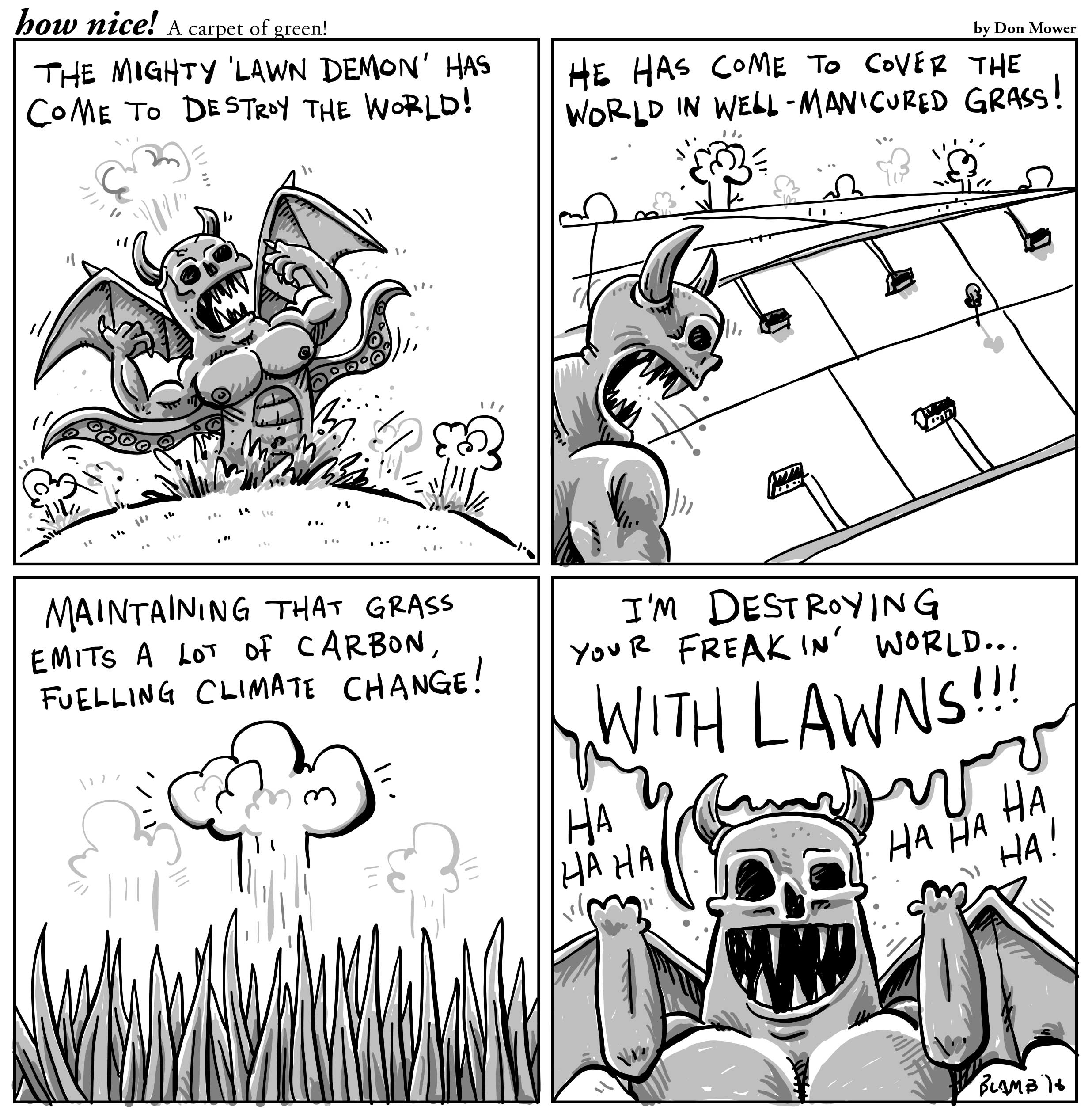
April 7th, 2016 · Comments Off on EDITORIAL CARTOON (April 2016): A carpet of green!
Tags: Annex · Editorial · General · Opinion
April 7th, 2016 · Comments Off on LETTERS (April 2016): Real story overlooked
Re “Crime down overall in 14 Division” (March 2016): Let me start off by saying I am a big fan of small newspapers catering to a local readership. I think it is the sign of a healthy democracy, whoever owns them, as long as they are fair. The Annex Gleaner is no exception.
It is with sorrow that I raise my keyboard to complain about your article.
The headline is wrong and the article missed the real story. Crime overall is up 4 per cent, at least if the percentage change figures are correct. I know about the quibble about significant crime, but it is just that, a quibble. Adding the plus figures and the minus figures together comes up with 4 per cent. Murder is flat, I agree, but theft of cars is significantly up, and of more interest to your readership than one druggie killing another.
The more significant story is in the bottom right hand corner of the table.
Shootings over the entire city are up 63 per cent!!! That is not a minor figure and is one that affects us all. Someone gets shot picking up their groceries with a stray bullet meant for some nearby rounder. It can happen, if it has not already. That is what your readers care about. Not being mislead into thinking crime overall in 14 Division is down.
That is the real story.
—Keith Lee-Whiting
Huron Street
READ MORE:
NEWS: Crime down overall in 14 Division (March 2016) by Brian Burchell
Tags: General
April 7th, 2016 · Comments Off on LETTERS (April 2016): Annex cyclists already well served
Re “Bike lane plan up for debate” (January 2016): As someone who has actively chased better Bloor Street biking for over a decade, I should be very happy that bike safety changes may finally occur, but I’m not fully pleased.
By only doing a part of Bloor Street in the already well-served Annex area (where Harbord Street, Barton Avenue, etc., can offer options), this implies that cyclists outside of wards 20 and 19 don’t matter.
But we have very significant shortfalls in the bike safety at the end of Harbord Street at Ossington Avenue, so the high needs for bike safety are west of Ossington Avenue to Dundas Street West.
Safe biking parallel to the subway is important for subway relief, as we won’t shed load to expand the subway capacity until it does become safer, and subway users far outnumber cyclists, pedestrians, or motorists, and transit needs should be paramount.
So we don’t need the concentration of bike facilities in the entitled Annex so much as continuity, as we still lack even one safe, continuous, long east-west cross-Toronto route, Bloor Street/Danforth Avenue being the obvious choice from 1992.
While the politics of the possible play out better in the Annex, it smells badly that we continue with the politicized and patchwork planning that provides safety for some and not others. Usually safety standards aren’t done on a ward-by-ward basis; neither are tax hikes.
Also, the City of Toronto‘s efforts almost preclude them doing anything else in Ward 20, and that’s a shame, as many tweaks are needed, and not just here. We could use some green paint on existing and substandard bike lanes. Road repairs are also necessary.
By elevating Bloor Street in the Annex to a high-status bike lane, we miss thinking of having pedestrian zones in a couple of blocks of the narrow Annex Bloor Street, e.g., Dalton Road to Lippincott Street.
If it’s logical to squeeze cars parallel to the subway, that should include pedestrians too, and we also lag in pedestrian zones, though walking safety is pretty good compared to cycling.
I’d have been far happier if we did Bloor Street bike lanes in Ward 18, and in this narrow Bloor Annex area had a wider curb lane with the feebler sharrows, which would still remove car parking from one side of Bloor Street West. A small central median would constrain lanes and assist informal crossings, and would recognize the upgrade of Harbord Street.
—Hamish Wilson
READ MORE:
Letters: Keep pushing bike safety (September 2015) by Hamish Wilson
Forum: Aims for bike safety (November 2012) by Hamish Wilson
Tags: Annex · Letters · Opinion
April 7th, 2016 · Comments Off on FORUM (April 2016): Home inspectors act receives unanimous consent
Bill 165 offers consumer protection, unifies industry
[pullquote]“If passed, Bill 165 will regulate the home inspection industry by licensing home inspectors.”[/pullquote]
By Han Dong
On March 3, 2016, Bill 165, Licensed Home Inspectors Act, 2016, my private member’s bill, received unanimous consent in the Ontario Legislature, and was referred to the committee on regulations and private bills.
If passed, Bill 165 will regulate the home inspection industry by licensing home inspectors, and will ensure confidence in homebuyers towards the services of a home inspector. All inspectors would be required to operate within the same set of prescribed requirements and under the same standards of practice.
In 2013, the Honourable Tracy MacCharles, then Minister of Consumer Services, hosted a panel of experts to review home inspector qualifications in Ontario. The panel included home inspectors, consumer advocates, educators, and other professionals in the real estate, legal, and insurance sectors. This panel delivered a report to the minister with a series of recommendations that support the regulation of home inspectors. The panel’s finding, which had been reaffirmed by the Honourable David Orazietti, the current Minister of Government and Consumer Services, correlates with the experience of many constituents that I have met with throughout Trinity-Spadina. It is through feedback from constituents and this panel’s report that I recognized the need for the regulation of the home inspection industry.
The report identified approximately 1,500 home inspectors working in Ontario, but no mandatory educational or technical standard for them. While the majority adopt high standards and are registered with one or more inspection associations, currently anyone in the province can call themselves a home inspector.
The primary objective of creating home inspector qualifications is to ensure consumer protection. A single standard of qualifications will allow the consumer to make an informed choice when hiring a home inspector. Standard qualifications would also limit issues — like unexpected repairs and maintenance costs — that can result in financial distress for those buying or selling a home. In addition, the condition of homes could be a safety risk to homeowners. These risks ultimately hurt consumer confidence and hurt the home inspection industry as a whole.
The secondary objective of Bill 165 is to unify the home inspection industry under one delegated administrative authority (DAA). This DAA would become the central agency of home inspectors by issuing, renewing, and revoking licences to all home inspectors in Ontario. Additionally, the DAA would act as the advocate for home inspectors across the province, thus assuring consumers of high quality standards and promoting this very important and often underutilized service.
Bill 165 proposes to adopt recommendations similar to the 2013 panel report and other public consultations.
The primary proposals are: the regulation of home inspectors using the title Licensed Home Inspectors; a self-governing body (with oversight by the Ministry of Government and Consumer Services) that will oversee the industry, including issuing, renewing, and revoking licences; licensing that will be based upon qualifications determined by the regulations and will include a definition and standard of practice for home inspections; financial protections including mandatory insurance; and a code of ethics that all home inspectors must adhere to, which will address the rapidly growing condo market and educate home inspectors on the standards of inspecting a condominium.
During the creation of Bill 165, I met with representatives of the home inspection industry, consumer protection advocates, real estate professionals, and insurance professionals from the riding of Trinity-Spadina and from outside the GTA. Bill 165 encompasses the discussions of these consultations and the expert panel’s recommendations.
Han Dong is the Member of Provincial Parliament for Trinity-Spadina. His website is http://www.handong.onmpp.ca.
Also by Han Dong:
Province tables sexual assault act (February 2016)
Tags: Annex · Opinion
April 7th, 2016 · Comments Off on ARTS: Bringing art to the people
Transforming neighbourhoods into open air galleries
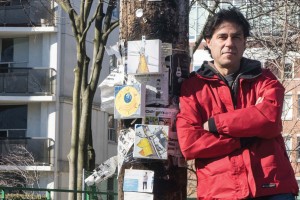
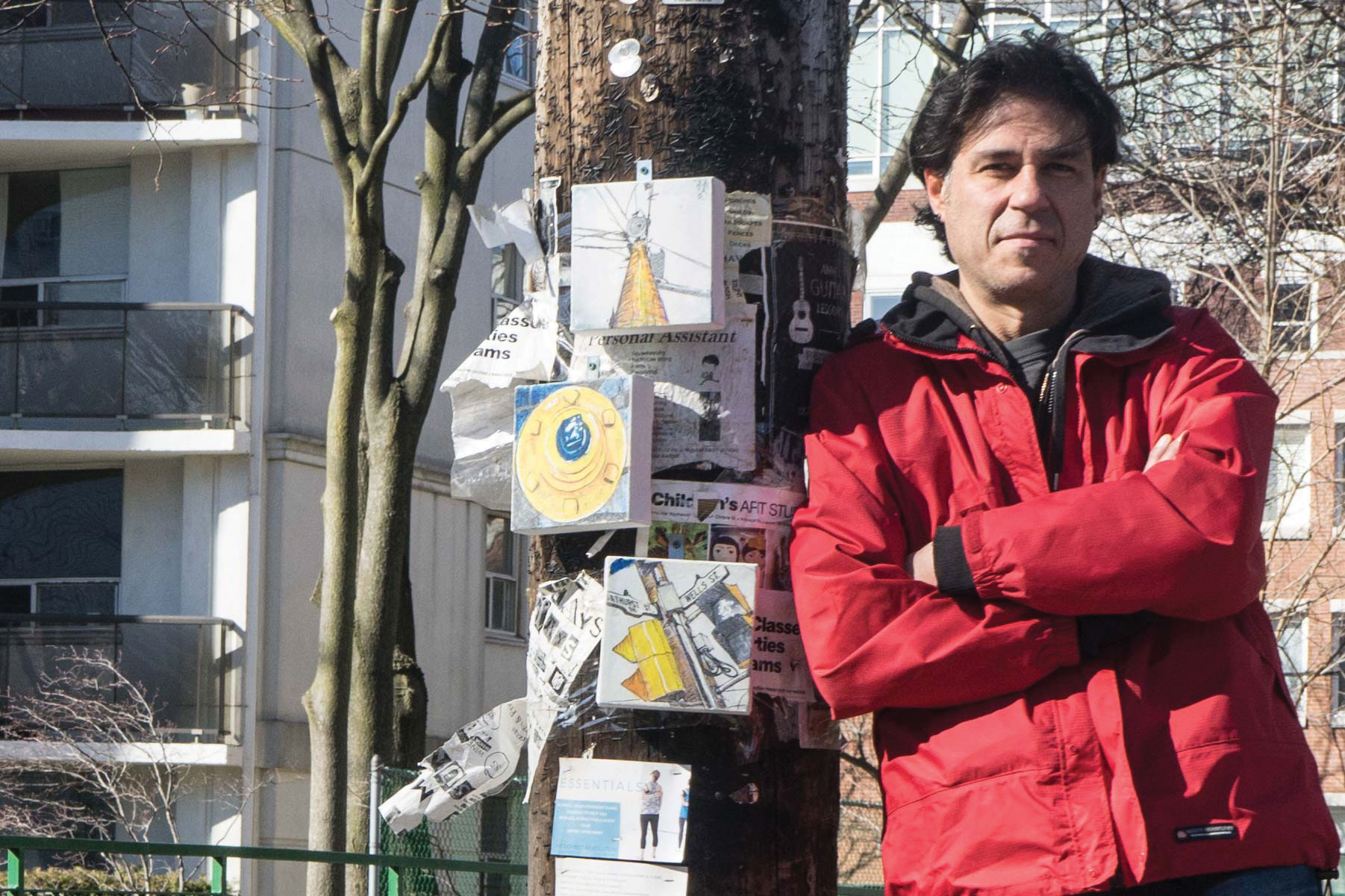
Artist Jorge Molina poses on Walmer Road with some of his work. He is installing 416 canvases on utility poles throughout the city as part of his 416 Project.
NEILAND BRISSENDEN/GLEANER NEWS
By Annemarie Brissenden
The 416 Project, an ambitious city-wide guerrilla art installation, is set to hit the Annex in the coming weeks.
Canadian artist Jorge Molina is installing 416 six inch by six inch canvases on wooden utility poles in 35 neighbourhoods across Toronto. Each canvas depicts what Molina terms the “mundane stuff” seen around the poles.
[pullquote]“We love to regulate cultural production, but not all artworks work that way”—Derek Liddington, OCAD University[/pullquote]
His works are proving so popular that he’s had to appeal to people to leave up the canvases for others to enjoy. The artist — also an actor who has appeared in Air Emergency, Rookie Blue, and Covert Affairs — had no idea his project would gain this much attention.
“I’m so blown away; it’s like people are craving this,” said Molina. “I just wanted to make people smile.”
His criteria for picking a neighbourhood is simple: it has to be in the 416 area code, and it needs to have wooden (not metal) poles, foot traffic, and a sidewalk. That’s all it takes to turn a neighbourhood into a gallery.
He is just the latest in series of guerrilla artists to take his work to the streets of Toronto.
[pullquote]“Street art is a growing recognized art form; we can’t grow the program fast enough”—Lilie Zendel, manager, START[/pullquote]
Like Molina, all Matthew Del Degan wanted to do was “make people smile” when he began installing his army of LoveBots — grey hand-cast concrete sculptures — throughout the city six years ago.
Del Degan came up with the idea while he was sitting on the streetcar, observing that everyone around him was acting like robots, stuck on cellphones.
“We are all faceless robots…except we’re not robots; we all have big hearts.”
An OCAD University student at the time, he also had to design a toy project for a class, and all his ideas coalesced into one. Since then the movement has taken on a life of its own, and giant LoveBot murals featuring bright red hearts can be found adorning the sides of buildings throughout Toronto, while square stickers surprise letter writers when they post mail in some of Canada Post’s bright red street letter boxes. Del Degan even sells LoveBot stickers, apparel, and toys via his online shop.
Lilie Zendel isn’t surprised that such installations resonate with so many people. It adds to pedestrian enjoyment, enhances a neighbourhood’s uniqueness, and combats Toronto’s brutalist architecture.
She manages StreetARToronto (START), a City of Toronto program that combats graffiti vandalism by commissioning artists to create works of art on traffic signal boxes and paint murals in public spaces.
“Street art is a growing recognized art form; we can’t grow the program fast enough,” said Zendel. “We live in a city with such talent. You shouldn’t have to go into a gallery or institution to know that; you should see it at street level.”
She cautioned, though, that permission is what distinguishes graffiti vandalism and graffiti art. In addition to raising concerns about maintaining the work, she noted that, “if we are going to put up public or street art, then neighbours should have a voice.”
But for Del Degan, that’s exactly the point.
“You didn’t get a say about whether you want to look at a billboard,” he said. “I can put some art up, and make a difference.”
While he wants to add a little wonder to people’s lives and get them to be curious, he also wants to reclaim public space. “We have destroyed our public space; you can walk exclusively on sidewalks…[our whole way of life] is a construct.”
There’s a big difference between legal walls and non-legal walls, explained Derek Liddington, a sessional faculty member of OCAD University.
“Not all works fit into established rubrics. We love to regulate cultural production, but not all artworks work that way.”
He points to a wall tagged with Black Lives Matter, or Banksy’s works, as examples of art that are designed to push people to look outside their comfort zone, to challenge how people see. In his view, graffiti art and graffiti vandalism are inextricably linked: “if one supports one, one has to support the existence of the other.”
So far, Molina hasn’t had any push back from anyone about his city-wide installation.
“The canvases are on the same poles that people [use] for flyers,” he said. “I’m putting a piece of art on it.”
START is accepting applications for its Outside the Box program, in which local artists create works of art on traffic signal boxes throughout the city, until April 29 at 4.30 p.m. For further information, please contact streetart@toronto.ca.
READ MORE:
Untapped potential: Animating our local laneways (February 2016) by Joe Cressy
Incubating micro-retail: Laneways untapped realm of urban design (December 2015) by Annemarie Brissenden
Graffiti artist Erica Balon creates mural on Bloor Street West (July 2015) by Justine Ricketts
A new side to graffiti: SPUD counters war on graffiti with gallery exhibit (April 2012) by Jelena Subotic
Tags: Annex · Arts
April 7th, 2016 · Comments Off on ARTS: Discover Mirvish Village’s artistic diversity
Galleries & Studios Hop returns to Markham Street April 23 and 24

Landscape artist Jill Boschulte, who works from small planes, creates monoprints, water-coloured pencil drawings, and collages. Her Furrows (above) will feature at Art Zone during the Hop.
COURTESY ART ZONE
By Annemarie Brissenden
A Lithuanian pioneer of avant-garde photography will be in the spotlight during the Mirvish Village Galleries & Studios Spring Gallery Hop later this month. Still relatively unknown in North America, Vitas Luckus (1943-87) was a Soviet-era photographer whose work challenged convention.
“He didn’t subscribe to the party line about what to photograph. He was one of the most compelling photographers at a time when [Lithuania] was still under Soviet rule,” said Charlotte Hale, whose eponymous gallery on Markham Street in Mirvish Village is mounting an exhibition of Luckus’s work. “His portraits are of the common man in common situations. You could tell he had a way of making people feel comfortable.”
She first discovered the “rebel” photographer when she was a young artist herself, and was drawn to his exquisite style of composition.
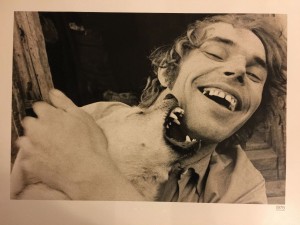
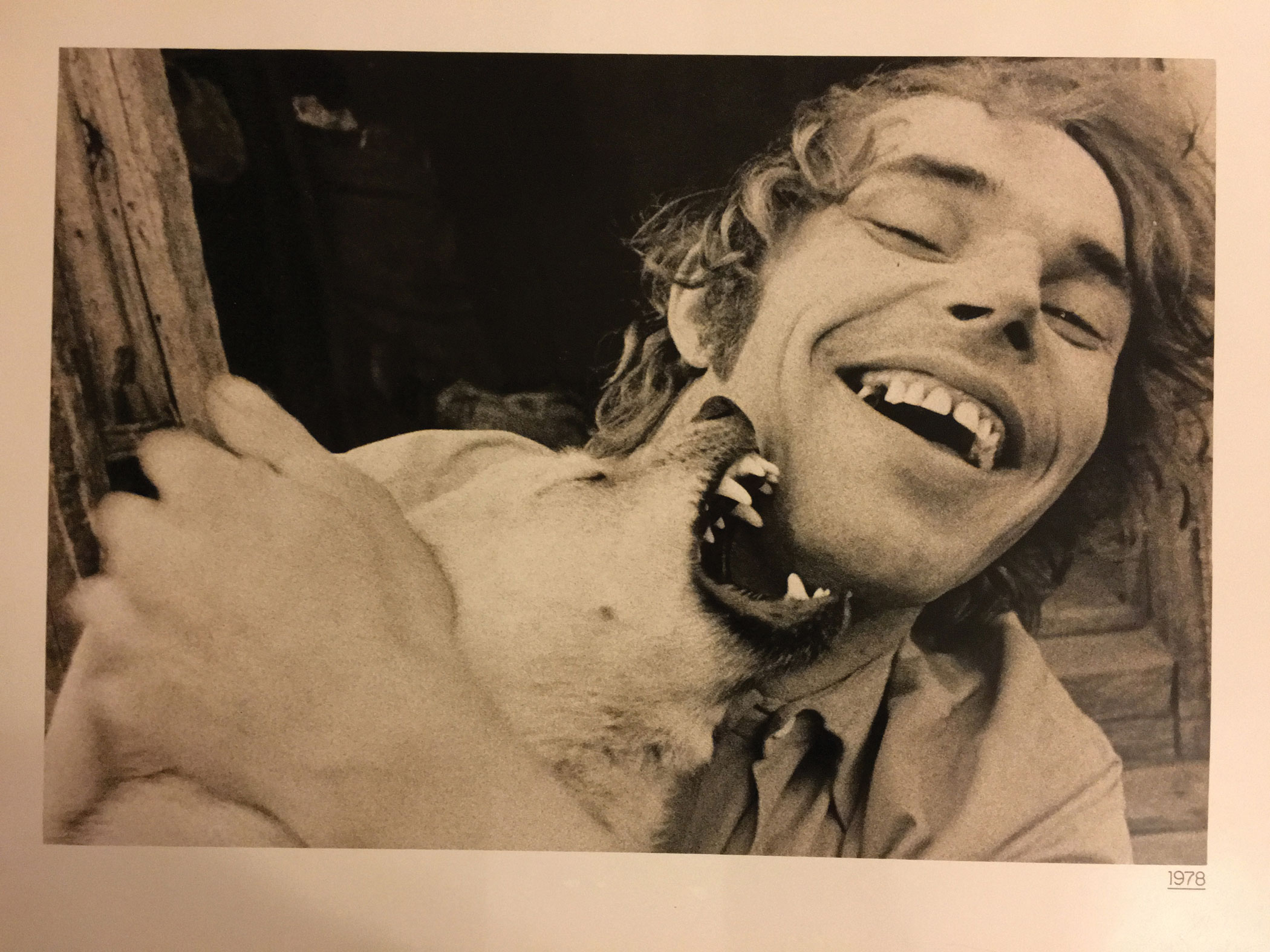
The work of Lithuanian photographer Vitas Luckus (shown in a photo taken by his widow Tanya Luckiene-Aldag) will be on display in Vitas Luckus: The Prince of Obscurity at Charlotte Hale & Associates April 9 to 30. It’s the first time limited editions of Luckus’s photographs will be available for sale in North America.
COURRTESY CHARLOTTE HALE
“It’s so exciting for me. This exhibition is a labour of love and the result of many, many years of work,” said Hale, who is working with Luckus’s widow, Tanya Luckiene-Aldag, on bringing more prominence to the photographer’s work. Luckiene-Aldag will be in Toronto for the Hop, which will also mark the first time that limited edition Luckus prints will be available for sale in North America.
Hale started the Hop two years ago with the intention of bringing visitors to the galleries, and to remind people of what she calls the wonderful dynamic of Markham Street. Mirvish Village is an interesting mix of artists’ studios, galleries, and small businesses, believes the gallery owner, who thinks it might be unique in Toronto.
“It’s still an event that we are trying to build,” she acknowledged, “and it might be the last year [because of the pending Westbank development], but we are going ahead anyway.
“We want to generate more interest in Mirvish Village, and get more people on the street this spring, summer, and fall.”
Jane Irwin, who along with her sister Kathryn Irwin, owns and operates Art Zone, a contemporary glass artworks studio on Markham Street, agreed.
[pullquote]“It’s good to let people know that we’re still here”—Jane Irwin, Art Zone[/pullquote]
“It’s good to let people know that we’re still here, and we would love to see them,” said Irwin, who has been on the street for 28 years.
Art Zone will have several pieces on display during the Hop, including some of the sculpture and stained glass work done in the studio. As well, the exhibition will feature pieces by landscape artist Jill Boschulte, also an Irwin sister.
Boschulte, who works on paper, creates monoprints, water-coloured pencil drawings, and collages.
“She works from small airplanes, looking down on the landscape,” said Irwin, “which gives her two points of perspective.”
Irwin said the Hop not only provides galleries and studios with the opportunity to reconnect with existing clients, but the opportunity to reach new ones as well.
“We have had people turn up at our space that know others better,” she explained. “It’s also a chance for people we’ve done business with before to come in and see new work.”
Irwin emphasized that the Hop will have a wide array of work on view.
Other participants include the Black Rock Studio, which features handmade tiles by Catherine Carroll, and the Spence Gallery, which is celebrating its 10th year on the street and specializes in Caribbean, Latin, and African art.
Joan Spence said that her gallery’s mandate is “to represent a diversity that we thought was missing from Toronto galleries”, and that three newer artists who have never been shown before at the gallery will be exhibited during the Hop: Peter Barelkowski, Laurie Skantzos, and Diana Rosa.
Rosa is originally from Cuba, added Spence, and “her work really reflects the vibrancy and energy of the country.” Similarly, there’s a “cultural perspective that’s quite present in Barelkowski’s work”.
Spence said she thinks that some people have the mistaken impression that Mirvish Village has already closed down, and so, like Irwin and Hale, she hopes this spring’s Hop will remind visitors that “we’re still here, alive, vibrant, engaging, and [that it will encourage them] to continue to support us no matter where in the city we go.”
Mostly, though, she’d like “people to see lots of work they love and want to take home with them”.
The Mirvish Village Galleries & Studios Spring Gallery Hop runs April 23 and 24 from noon to 6 p.m.
READ MORE:
Preserving Mirvish Village: Collection of photographs captures spirit and character of the area (July 2015) by Annemarie Brissenden
Tags: Annex · Arts
Several local galleries are participating in this year’s Scotiabank Contact Photography Festival, now in its 20th year. The largest photography event in the world, the festival features 1500 artists in 200 exhibitions across the Greater Toronto Area.

Exhibition: The Dark Room 5.0
Artist: Various
Gallery: 918 Bathurst
918 Bathurst St.
Date: May 17
Mark your ballot on May 17 at 918 Bathurst for The Dark Room 5.0, which will feature a one day only juried exhibition showcasing the many processes of analog and alternative photography.

Exhibition: The Language of Flowers
Artist: Carol Auld
Gallery: Café Pamenar
307 Augusta Ave.
Dates: May 1 – 31
At Cafe Pamenar, The Language of Flowers explores the spectacular beauty of daily life and multiple meanings that can be ascribed to flowers. All the images in Carol Auld’s exhibition of original giclée prints were taken from gardens in downtown Toronto.

Exhibition: Carbon Manifest
Artist: J. R. Bernstein
Gallery: Bezpala Brown Gallery
21 Yorkville Ave.
Dates: May 8 – June 1
Carbon Manifest by J. R. Bernstein at the Bezpala Brown Gallery in Yorkville consists of carbon-printed black and white landscape photos of the Svalbard archipelago in the Arctic. Taken during an international artist residency in 2014, the images in the exhibition investigate the theme of metamorphosis, evolution, and the inevitable change of our physical environment.

Exhibition: The InterLove Project
Artist: Colin Boyd Shafer
Gallery: Miles Nadal JCC
750 Spadina
Dates: April 30 – May 22
And Colin Boyd Shafer’s exhibition, The InterLove Project showing at The Miles Nadal JCC celebrates the love that can flourish between people of different religious beliefs.
—Annemarie Brissenden with files from Neiland Brissenden
Tags: Annex · Arts