April 10th, 2017 · Comments Off on ARTS (APRIL 2017): Challenging the audience
Brandon Hackett takes the stage in Second City revue

PHOTO COURTESY PAUL AIHOSHI/FLIP PUBLICITY: Hackett’s serious demeanour obscures a seriously silly side, say his colleagues. The Annex comedian, who got his start at Victoria College, has performed with The Sketchersons and on This Hour has 22 Minutes.
By Geremy Bordonaro
Brandon Hackett is a new breed of comedian. Fiercely funny and whip-smart, the Annex resident is one of the cast members bringing some diversity to Second City. He joined the Main Stage performers in June, and is currently appearing in Everything is Great Again.
“I’m pretty willing to go silly and just let myself play around in the moment,” Hackett said. “When I started, I was a bit more self-conscious about how I wanted to sound smart. But now I am so happy to be silly, goofy, and look stupid.”
[pullquote]“It’s pretty spectacular. It’s really funny. Super political but in all the right ways”—Jeremy Stephenson, audience member[/pullquote]
He began performing sketch comedy at Victoria College in 2006, and has since been part of the award-winning sketch troupe The Sketchersons, as well as a writer/performer on CBC’s This Hour Has 22 Minutes. Hackett says his willingness to let out his more outrageous side is one of his biggest strengths as a comedian, even as he balances it with sharp wit.
“One of the things that is so great is that he’s able to carry himself with a bit of gravity. It’s a little bit rare in comedy,” said Ann Pornel, fellow cast member and long-time friend and collaborator of Hackett. “The way Brandon carries himself is, on the surface, very serious. There’s a gravity to him. You think he’s very serious. And one of the most delightful things, especially in the current show right now, is because he looks a certain way people will have assumptions and he is able to flip that and bring out his sillier side.”
During the show, there’s a scene where Pornel pulls a random audience member to serve as a pilot for a plane flying above Russian airspace. This sketch has Hackett serving as a passenger, air flight controller, and Russian military announcer, within the span of minutes, even seconds. In one show, audience member “Captain Ham”, a self-proclaimed Urban Planner, flew from Toronto…to Toronto. Hackett, sharp as he is, comments that it is nice of Captain Ham to take the passengers “out for a spin around the block”.
The Main Stage room roared with laughter when Hackett and the cast erupted in fear over the world’s politics while trapped on the TTC, or when he went into the audience posing as a heckler, announcing himself as “George”, who wants to put his dog in a dress and make-up.
“It’s pretty spectacular. It’s really funny. Super political but in all the right ways,” said Jeremy Stephenson, an audience member, after the show. “I think that a lot of today’s society needs humour in politics because it’s all shitty anyway. It’s a really fun way of poking at that. It’s really enjoyable.”
Politics plays a large part in the content of the show. However, this year the focus is a bit different because of the diversity of the cast.
“Right now, rightfully so, there is a real importance placed upon diversity and different perspectives. I think Brandon brings all of that as well as talent,” Pornel said. “A lot of the time tokenism gets thrown around the idea that certain people are only there because they are a person of colour or offer a different take on life. Brandon does provide that by being both black and queer, but he’s got the talent to back it up in spades. As a co-worker and friend, you can’t ask for anything more than what you get from Brandon.”
One of the longest, and funniest, scenes in the show comes when Hackett, Pornel, and Paloma Nunez go to a spiritual retreat and drink tea that will help them purge their negativity. During this they vent about what Hackett terms their individual “versions of failing to live up to their own cultural background”.
“I think diversity is so important in every realm but certainly in Second City,” Hackett said. “You have got more stuff to talk about. [We talk] about ways to challenge the audience, to consider their own world view, and also experiences that are outside of themselves, in order to better live in this world.”
Tags: Annex · Arts
April 10th, 2017 · Comments Off on GREENINGS (APRIL 2017): Solving the food waste problem
We need to change ingrained cultural practices
Food waste is a $31-billion problem.
Every year, roughly 40 per cent of perfectly edible food that is grown and imported is thrown away. Of that, households account for half of the problem. Discarded food usually takes the form of unwanted leftovers, imperfect food deemed unsalable, oversupply, and, worst of all, supply management (throwing away food to keep prices high).
[pullquote]“Our attitudes surrounding food need to change.”[/pullquote]
Part of the culprit is cheap food. Outside of northern areas, food doesn’t really cost that much in Canada. We often buy much more than we can eat and throw away lots of perfectly edible food. Another part of the problem is our own demand for pretty-looking food. If an apple isn’t perfectly shaped or has a slight bruise, it will often end up rejected and discarded.
Whether food looks perfect or not, it takes a lot of energy, effort, and in some cases fertilizer and pesticide to produce. Ultimately, the more we waste, the higher our greenhouse gas emissions are for food that doesn’t even make it into our stomachs.
The world watches anxiously as some of the largest producers of staples rapidly deplete groundwater resources to grow food that ultimately doesn’t get eaten. The problem is a real one and it is big. A recent study suggests that the United States, Pakistan, and India are the biggest exporters of food grown using unsustainable groundwater. When we run out of irrigation water, Malthus will be proven correct.
This is not the path we want to head towards. While it might mean lower profits for multinationals, I think it’s imperative that we look at our eating habits and find ways to cut the waste.
Reducing waste can be as simple as finding creative ways to make leftovers more appealing or consciously cooking/ordering smaller quantities. As a woman who grew up with a quintessential Chinese grandmother, this can be a challenge. If people weren’t rolling away from your dinner table, you were viewed as having failed.
Our attitudes surrounding food need to change. The surge in wealth in China has created a middle class who view it as a status symbol to be able to afford to order large quantities of food and deliberately toss it. When my parents owned a restaurant, I observed this behaviour, and, despite it not being in our economic interests, I showed my disdain for it. My mother always made me do two things at the dinner table. I had to eat every grain of rice in my bowl since a farmer worked very hard to grow, harvest, and husk it, and I had to eat all the meat I was given since an animal died for it. If we treated food with even this basic level of respect, food waste could decrease substantially.
At the household level, this problem we can all have a small impact on by looking hard at our own habits. On a systemic level, we need stronger public policies that steer us in the right direction. The University of Toronto has a Food Systems Lab that looks at this exact problem on a high level. The research they produce will hopefully inform future public policy makers on how to reduce this $31-billion problem. I suspect what they come up with likely won’t be popular since industry tends to abhor change. It will be up to us to make sure we tell our lawmakers that reducing food waste, in any capacity, is something we are willing to vote for.
We can’t keep wasting our children’s future. The food we waste now is food they won’t have the opportunity to grow when the water has run out.
Why Should I Care? is hosting a free talk on Food Waste at the Madison Avenue Pub on April 24 at 7 p.m.
Terri Chu is an engineer committed to practical environmentalism. This column is dedicated to helping the community reduce energy, and help distinguish environmental truths from myths.
READ MORE GREENINGS BY TERRI CHU:
Kellie Leitch was right (March 2017)
Feeling the carbon tax crunch? (January 2017)
A green, meaningful Christmas (December 2016)
Force the focus (November 2016)
Tags: Annex · Life
March 22nd, 2017 · Comments Off on ON OUR COVER (MARCH 2017): A supportive vigil
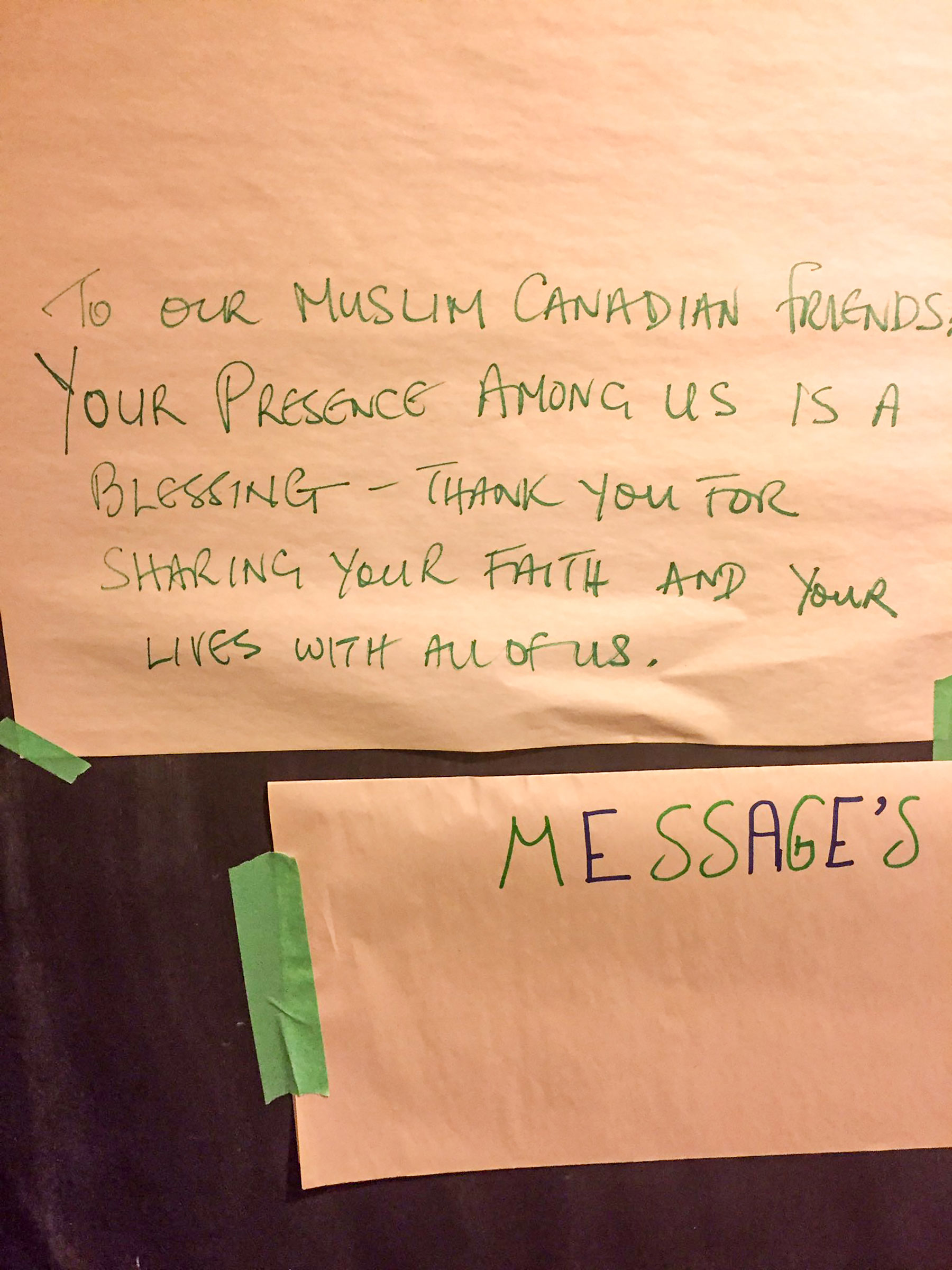
PHOTO BY MICHAEL CHACHURA/GLEANER NEWS: Fifty people gathered at the Centre for Social Innovation on Feb. 20 for a vigil in the wake of a shooting at a Quebec City mosque. Organized by Uniting Muslims and Allies for Humanity, the evening featured speakers, prayers for peace, and a message board on which participants left words of welcome and support (above). Arif Vriani (MP, Parkdale-High Park) was among the attendees. He spoke about Motion 103, which asks Parliament to denounce Islamophobia, and all other forms of religious discrimination.
Tags: Annex · News
March 22nd, 2017 · Comments Off on NEWS (MARCH 2017): Preserving culture and history
Process to designate Kensington Market underway
By Geremy Bordonaro
After a year of study and consultation, the city is going ahead with the process to designate Kensington Market a Heritage Conservation District (HCD). The decision was announced at a community consultation meeting last month.
“It’s a two-year process,” said Joe Cressy (Ward 20, Trinity-Spadina). “By this time next year, we’ll have a new Heritage Conservation District here in Kensington.”
[pullquote]“We’ve heard a whole range of passionate articulations on why this place has been so important in your lives”—Melanie Hare, partner, Urban Strategies[/pullquote]
Prior HCDs have been used primarily to maintain architectural heritage. This HCD will instead preserve the culture and history of the market. Protecting an area based on something that doesn’t have so much of a tangible presence may prove difficult, noted the councillor.
“The history and heritage of Kensington is unlike anywhere else. It’s not just physical and architectural. It’s not about a row of townhouses or unique Victorians. It’s as much about cultural and intangible heritage,” he said. “How do you seek to ensure that the intangible and the cultural continue to grow along with the architectural? That’s what the challenge is as we develop this.”
Tamara Anson-Cartwright, program manager for the city’s Heritage Preservation Services, said there is a key difference in how an HCD works that will help the community.
“With a Heritage District Plan it’s about conserving what is there as well as thinking about how change will occur in the future,” she said. “Other planning studies are all about “What will be the future?’”
Anson-Cartwright said the community was very productive.
“I thought it was excellent. It was very informing and engaging. What I appreciated was the understanding of the depth of analysis that has been done,” she said. “I’ve been with the city for two years and I think it was one of the best meetings that we have had.”
The planners involved in the designation not only actively welcome community participation; they have been counting on it ever since this process began.
“What has worked well since the first phase is that we set up a stakeholder advisory committee. They were very engaged and helped us a lot,” said Anson-Cartwright. “One of the keys for success in this second phase will be getting that type of community engagement.”
At the heart of the consultation process is a desire to protect the market, and discussions in part centered around the proposed boundaries of the market, currently Spadina Avenue, Dundas, Bathurst and College streets.
One audience member argued that those streets “provide a shield from downtown and should not be included”, while another felt that those streets “do not reflect the culture of the community”.
“We’ve heard [terms like] chaos, we’ve heard anarchy, we’ve heard evolving, we’ve heard welcoming,” said Melanie Hare, a partner with Urban Strategies, who chaired the community meeting. “We’ve heard a whole range of passionate articulations on why this place has been so important in your lives and in many different generations of families.”
The staff report formally endorsing all the HCD recommendations will be presented to the Toronto Preservation Board on April 20.
“Going forward council will formally endorse proceeding,” said Cressy. “Over the next years, we’ll develop the specific tools and regulatory provisions to forward the Heritage Conservation District. I have to tell you, now is when we’re going to roll up our sleeves and do the hard work.”
READ MORE:
FORUM: Our dynamic Kensington Market (November 2016)
CHATTER: Painted streets launch in Kensington (September 2016)
ARTS: Molly Johnson launches new jazz festival (September 2016)
CHATTER: Kensington Market consultation focuses on culture (July 2016)
NEWS: Kensington Market to become heritage district (May 2016)
Tags: Annex · News
March 22nd, 2017 · Comments Off on NEWS (MARCH 2017): City proposes steep patio fee hike
Business owners decry lack of consultation

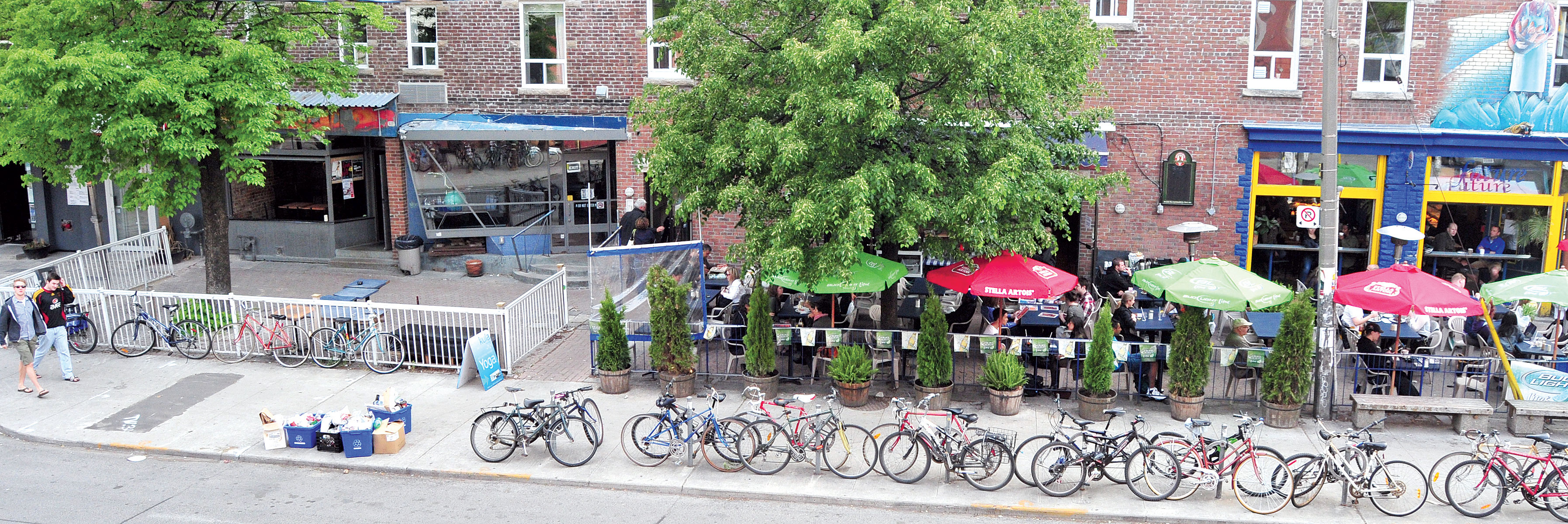
PHOTO BY MATT JAMES/GLEANER NEWS FILE PHOTO: Business owners said they weren’t consulted on the City of Toronto’s proposal to hike to patio fees. Many businesses on Bloor Street West — such as Future Bakery (above) — open a patio in the warmer months, but they are already expensive to operate and maintain.
By Sanjeev Wignarajah
The City of Toronto’s proposed one thousand per cent increase to patio fees has local bar and restaurant owners — who say they were never consulted about the increase — worried about the future of their businesses.
Most sidewalk patios are on land that is owned by the city, which charges the operators an annual per square foot rent. The city wants to standardize its rates, which are currently all over the map, a holdover from pre-amalgamation.
[pullquote]“They’re thinking they can come and take something that was $1,500 a year and turn it into $15,000 a year”—Andrew Kilgour, owner, Kilgour’s[/pullquote]
Joe Cressy (Ward 20, Trinity-Spadina) said city staff, council members, and the Municipal Licensing and Standards committee met January 30 to discuss harmonizing the patio fees.
“There was a number that was pretty quickly rejected by business owners but also by council members like myself and Mayor Tory,” he said, adding that patios bring energy and vibrancy to main streets.
“While there is and should be a rate paid for patio licences, that rate should be fair and it needs to be affordable,” Cressy said. “I expect that city staff will now go back to review what is a more appropriate and fair amount.”
Carmine Raviele and his son are the owners of Il Gatto Nero, a café bar in Little Italy at 720 College St. Raviele said he pays $1,400 per year for patio fees. He pointed out that business will suffer in the winter since patios are only operational for the spring, summer, and fall months.
“Naturally we have think what to do with it, whether to renew it or whatever,” Raviele said. “It’s hard to run a business.”
“It’s insane,” said Andrew Kilgour, who has owned Kilgour’s on Bloor Street since 1995. “I’m all in favour of user fees but they have got to be reasonable. They’re thinking they can come and take something that was $1,500 a year and turn it into $15,000 a year.”
Killian Thomson, general manager of Pauper’s Pub, also on Bloor Street, said that the city will make it very expensive for small businesses.
“Bars on the strip usually pay an exorbitant amount of rent,” Thomson said. “A typical patio fee can range from $1,400 up to $5,000 a year.”
Not only do restaurant owners pay a per-square-foot amount, they also pay for a liquor licence to serve alcohol on the patio. Antonietta Raviele, a board member of the Little Italy BIA, explained that owners pay a lot to maintain their patios, which adds to the cost of doing business.
“If I put out a wooden platform to make my patio even because the city sidewalk is so badly damaged that the tables wobble and people’s glasses fall, it would hurt them. So, I have to protect myself from that liability,” she said. “You want to put a platform in. You can’t put a platform in unless it’s pre-approved by the city and you have to pay extra for that for your yearly patio fee.”
Cressy said that the feedback he has received from restaurant owners is heartfelt.
“I think people appreciated and recognized that it’s a good thing that the consultation happened. There was never a fee that was brought to council for consideration,” he said. “In fact, they went out to the restaurant community and the patio community first.”
But local patio operators have said nobody on city staff consulted them about the increase.
The Mayor wrote in a letter statement that he, city staff, and council members will work together on the updated changes on fees and regulations:
“In my discussions with city staff, I have made it clear that I do not support excessive fees and that this review will need to balance the value of sidewalks as a city asset with many public benefits that patios bring to our communities.”
City council will vote on the proposed changes to the patio fees in the spring.
Tags: Annex · News
March 22nd, 2017 · Comments Off on CHATTER (MARCH 2017): Preliminary data on Bloor Street pilot bike lane released
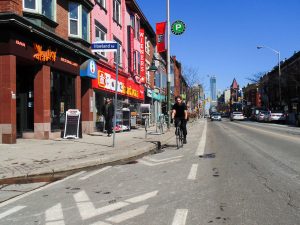
PHOTO BY BRIAN BURCHELL/GLEANER NEWS
Preliminary data on the Bloor Street Bike Lane Pilot was released in February. Separated bike lanes were installed along Bloor Street from Avenue Road to Shaw Street last August. The city has released preliminary transportation data, including a traffic volume count and a travel time study along with a public opinion poll. Data collection was done both before and after the pilot was put in. While cycling has increased by 36 per cent and 63 per cent of drivers said that they were safe around cyclists on Bloor Street, travel times for times for cars have also increased by four minutes during the morning rush-hour and eight-and-a-half minutes during the afternoon rush-hour. Most people asked about the project seem to support it, except for drivers, only a third of whom are in favour of the bike lanes. The city is studying how to improve traffic flow, and the report — which will also include information about the impact the lanes are having on local businesses — will be delivered to city council later this year.
The Bloor Annex and Korea Town BIAs and the Metcalf Foundation have sponsored a study on the economic impact of the lanes on local business and the community. The study will be completed in the fall.
—Geremy Bordonaro/Annex Gleaner
READ MORE:
CHATTER: Ground-breaking bike lanes launch on Bloor Street (August 2016)
NEWS: Bikes blessed for another season (June 2016)
FOCUS: An early advocate for bike lanes (June 2016)
NEWS: Bike lanes for Bloor Street (May 2016)
The faster we lower speeds, the more lives we save (October 2015)
Early brewer the basis for Bloor Street’s name (May 2015)
Tags: Annex · News
March 22nd, 2017 · Comments Off on CHATTER (MARCH 2017): Kensington Market workshop teaches how to respond to drug overdoses
Nearly one hundred bar and restaurant staff from Kensington Market participated in a free workshop on how to deal with drug overdoses on Feb. 27. Organized by the Kensington Market BIA and Joe Cressy (Ward 20, Trinity-Spadina), the workshop taught participants how to recognize and respond to an overdose. Queen West Central Toronto Community Health Centre led the technical aspects of the training and explained how Naloxone counter-acts the effects of opioids. Bar and restaurant owners also received overdose response kits.
—Geremy Bordonaro/Annex Gleaner
READ MORE:
EDITORIAL: Pot a remedy in opioid crises (January 2017)
CHATTER: Marijuana dispensary opens (December 2016)
NEWS: City approves safe injection sites, as council embraces a public health approach (August 2016)
Tags: Annex · News
March 22nd, 2017 · Comments Off on CHATTER (MARCH 2017): Decade rooms, formal gala, and talent shows to mark Harbord Collegiate’s 125th anniversary
Harbord Collegiate Institute is celebrating its 125th anniversary with a weekend of events for neighbours, students, and alumni April 28 to 30. On April 28, the school will host an open house featuring a museum and decade rooms. The creative-arts team will stage a variety of music and talent shows, while the Athletic Association will run a few games. The formal reunion gala will be held at the Parkview Manor on April 29, while individual class reunions will run on April 30. For further information, please visit www.harbordclub.com.
—Geremy Bordonaro/Annex Gleaner
READ MORE
News: Celebrating pink at Harbord Collegiate Institute (May 2016)
BLACK HISTORY MONTH: A long history of activism (February 2017)
Reflections on 32 years of service (August 2014)
Tags: Annex · News
March 22nd, 2017 · Comments Off on CHATTER (MARCH 2017): Nominate a community builder
The Annex Residents’ Association is launching a new award to recognize the efforts of a resident who contributed to making the community a better place. The Community Builder of the Year award will be given to a person living in the Annex who has made a significant contribution in improving heritage, education, development, or social justice in the area. Nominations are being accepted up until April 23. The prize recipient, along with all of the nominees, will be announced on April 27 during the association’s annual general meeting at Friends’ House. Nominate a candidate by emailing secretary@theara.org with the name and address of the person you are nominating, and your reason for nominating them. Please also include your own name and address.
—Geremy Bordonaro/Annex Gleaner
READ MORE:
HISTORY: Honouring those who honour history (October 2016)
LIFE: How I have made my community better (June 2016)
NEWS: HVRA recognized for historical achievements (May 2016)
Recognition for Harbord Street BIA (January 2016)
Tags: Annex · News
March 22nd, 2017 · Comments Off on NEWS (MARCH 2017): Westbank presents latest proposal
Community, city closer to approving Mirvish Village development
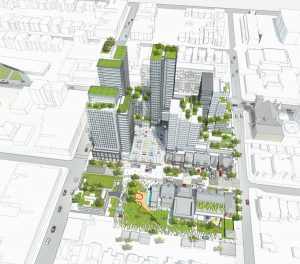
PHOTO COURTESY WESTBANK PROJECTS CORP.
By Geremy Bordonaro
It all came down to this: one final community meeting about Westbank Projects Corp.’s application to build a large mixed-use development on the former site of Honest Ed’s and Mirvish Village. After a long and unprecedented involvement from the community — including residents and local business owners — Joe Cressy (Ward 20, Trinity-Spadina) and Mike Layton (Ward 19, Trinity-Spadina) hosted a meeting on March 2 to present the latest (and perhaps last) iteration of the application.
It was standing-room-only in the Bickford Centre cafeteria.
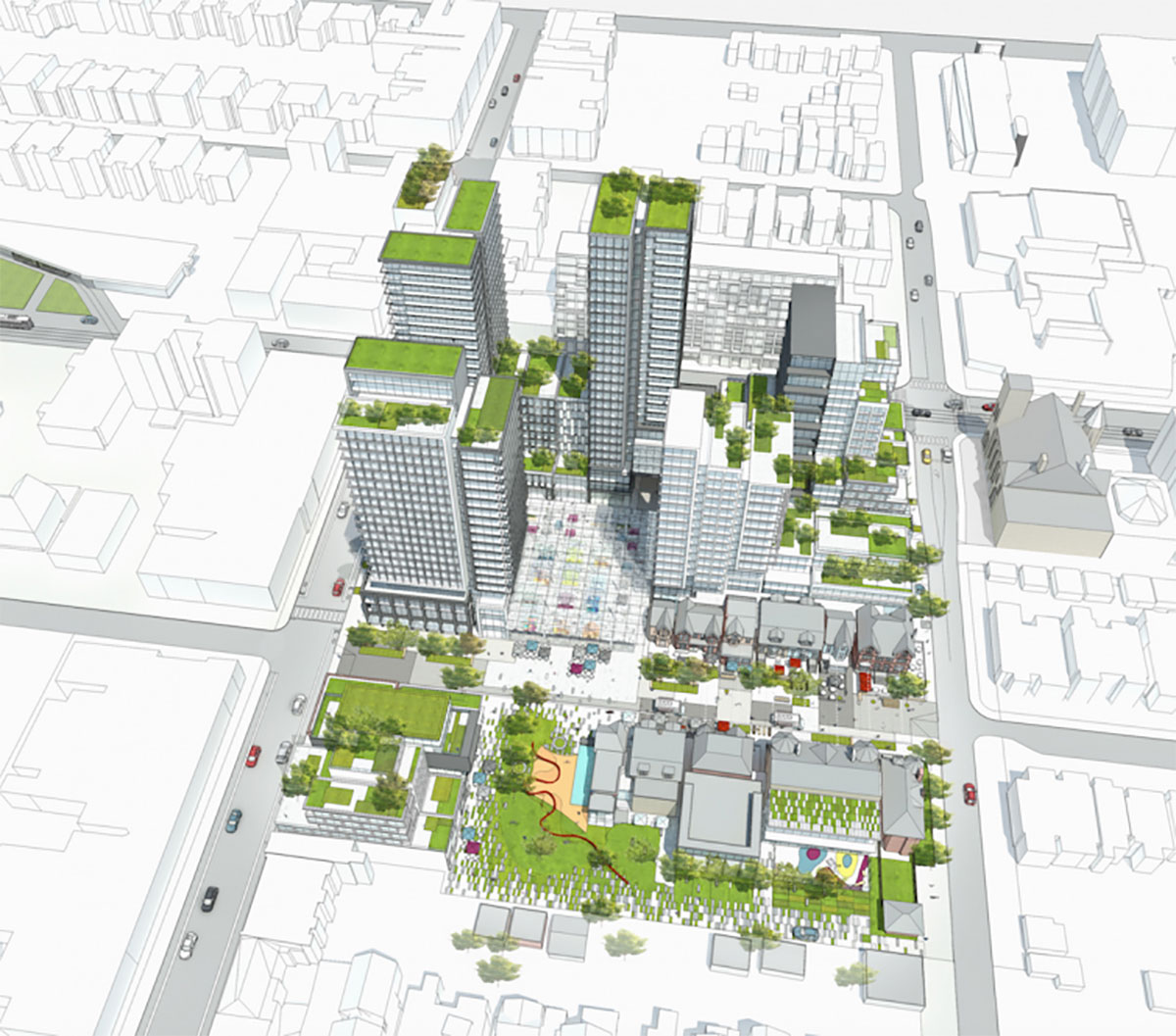
The proposed development has undergone many changes since it was first presented in 2015. The mixed-use plan includes a total of 804 rental residential spaces, a park spanning 1,150 square metres, a market alleyway, and 15,000 square metres of non-residential space. Twenty-three heritage buildings (up from 15) will be preserved out of a possible 27. All told, 47 unique buildings, including a 28-storey tower, will be raised.
“Thank you all so much for being here and welcome. This is the 750th meeting we’ve had for the Bloor and Bathurst street corner and section of town,” Layton joked. “I’m encouraged to see so many faces that are still so enthusiastic about what’s going on up the street.”
Cressy said he was to have a developer who did not shy away from confronting and keeping open communications with the public.
“Do we like absolutely everything that’s here? Is it perfect? Not yet,” said Cressy. “But, my goodness I can’t tell you in Ward 20 how many times we have a developer come in and a couple of months later they are at the Ontario Municipal Board.
“This is a model for how we want the development community to engage with us. When they work with the community and listen to the community we build better neighbourhoods.”
“The priorities for the community throughout this process have been limiting the height and density, and understanding the impact of these new buildings with regard to conserving as much heritage as possible of both the built and intangible heritage,” said Graig Uens, a community planner with the City of Toronto. “The site itself is special for a variety of reasons beyond the buildings that exist on it.”
These priorities dictated the flow of the meeting and feedback from those given the microphone to speak. While reassurances came from Cressy and Layton, there were still a number of those who called for the towers to be lowered and the density to be lessened.
There were also those who were concerned about recognizing and protecting the cultural history of the neighbourhood.
“I’m really concerned about the legacy of the local black community. There’s a long history that has expressed itself in the patty shops and the barber shops that continues to today. It’s a sacred site for a lot of communities,” said Kenneth Montague, who has run Word of Mouth Dentistry in the Annex for more than 20 years. “There needs to be a dedicated plan that says there will be community meeting places, art exhibitions, and so forth. I just want to make sure that in all this very beautiful planning there is something that maintains this history that we have.”
Gus Sinclair, chair of the Harbord Village Residents’ Association, said that while his organization supports the plan, his concerns are whether or not the promise for fully rental and affordable will be kept.
“We applaud the rental prioritizing of this project. Is there a way to guarantee that this will be all rental?” Sinclair asked. “That’s a critical question for us because we can imagine what would happen if it wasn’t and we’d rather the rentals would stay.”
Westbank, however, said they were committed to the rental model.
“[At this meeting] we’ll give you a sense of what’s happened over the past few years from our initial ideas, what we brought to the table at the beginning, how it has evolved and changed from your input and the input of city staff,” said Gregory Henriquez, lead architect. “We’re here to make it as good as it can be. We’re here to listen again.”
Henriquez valued the input on the project thus far and acknowledged that the development has “been strengthened” by residents and city staff.
Graig Uens said the city’s concerns with the proposal have been remedied, and that a recommendation to approve the application will be forthcoming.
“Our priorities [for] the site have largely been addressed by this development. This is a different approach from that brought to us by Westbank. We’ve reviewed the application and brought it into the community,” he said. “On April 4, we will bring forward recommendations to community council to approve the development as you see it today.”
READ MORE:
FORUM: Build a neighbourhood (March 2017)
NEWS: Height, density still top concerns (July 2016)
NEWS: Westbank submits revised application (June 2016)
DEVELOPINGS: Annual review reflects tension between community activism and OMB (March 2016)
Westbank towers over 4 Corners (January 2016)
City hosts first Mirvish Village community consultation (November 2015)
Residents’ associations share concerns for Mirvish Village (October 2015)
Westbank submits application (August 2015)
BABIA endorses Westbank proposal (July 2015)
How do you make it real? (April 2015)
Tags: Annex · News
March 22nd, 2017 · Comments Off on EDITORIAL (MARCH 2017): Foreign buyers tax a necessary cliff jump
Pursued to the edge of a cliff by relentless law enforcement, Butch Cassidy and the Sundance Kid were faced with an unenviable choice: jump, be captured, or — the most likely alternative — be killed while being captured. As they contemplate their fate, Butch and Sundance begin to argue over who should jump first, with Sundance finally admitting that he can’t swim.
“Are you crazy, the fall will probably kill you”, responds Butch, laughing, just before they finally jump — together. In this infamous scene from a 1969 Hollywood depiction of true-life events Butch and Sundance avoid drowning and escape the law, floating off to live another day.
[pullquote]This growth not only makes buying a house unaffordable for a huge swath of the population, it is also unsustainable and sucks real money out of the economy; money that could make a meaningful contribution to our gross domestic product.[/pullquote]
It’s a classic portrayal of being stuck between a rock and a hard place of having to make a decision when doing nothing is not an option.
According to the Toronto Real Estate Board, Greater Toronto Area (GTA) house prices in February were up 32.5 per cent over one year ago. Analysts have run out of adjectives to describe the extreme nature of this phenomenon. The average price for a detached home in the GTA is over $1.2 million, with the price of an Annex house much higher, as dedicated readers of our Focus on Homes section will know.
This growth not only makes buying a house unaffordable for a huge swath of the population, it is also unsustainable and sucks real money out of the economy; money that could make a meaningful contribution to our gross domestic product.
No one really believes the house they are purchasing is worth the millions in mortgage debt. It’s two or three bedrooms surrounded by plaster and brick on a 14-by-75-foot lot “close to TTC, U of T, schools, and lots of amenities”, as the listings tend to read. Most homes are sold without conditions, no survey, and no home inspection. Sometimes the buyers don’t even view the property. Sometimes they live in far-flung lands and the motive is to purchase a commodity, not to find a home in which to live.
Garth Turner, who was briefly the Minister of National Revenue under Kim Campbell, wrote in his 2005 book Greater Fool: The Troubled Future of Real Estate that such behaviour epitomizes the greater fool theory: when the price of an object is not determined by its intrinsic value, but the belief that another purchaser — the greater fool — will pay more for it down the road. It’s been a viable theory so far that has not only reaped untold millions of profit for speculators, but has also increased the theoretical value of every homeowner’s equity, be they speculators or not.
Faced with an equally out-of-control residential real estate market, British Columbia enacted legislation imposing a 15 per cent tax on purchases of property by foreigners in that province. Acting on incomplete facts, as leaders sometimes must do, B.C. took the legislative plunge, applied the tax and waited, hoping it would cool (not kill) the market. It appears to have had its desired effect: prices have fallen approximately 12 per cent in a year. It seems to have worked, even though we may never know why.
The province, like Ontario, was not tracking at the time who the buyers were, where they lived, and their source of income. It was a shot in the dark at real estate speculation from foreign lands.
Now, it may be that those prospective buyers, rebuffed in the west, have moved their focus to the GTA. But John Tory and Kathleen Wynn appear unwilling to follow B.C.’s lead, saying they say they need more facts to make an informed decision. Perhaps they figure the market will collapse under its own weight, and don’t want to appear to have caused it.
This is a defeatist and cowardly course to chart. They are really worried about curbing speculation and crashing the market, evaporating the $1.5-million in equity that grandma had in her Scarborough bungalow. Neither are likely to be re-elected after such a scenario.
Like Butch and Sundance facing inevitable capture and certain loss, this housing market bubble will burst left to its own devices. The mayor and the premier must summon the courage to enact measures to cool the market, even if it’s a jump fraught with political danger.
READ MORE:
EDITORIAL: Clement’s petulance diminishes parliament (February 2017)
EDITORIAL: Pot a remedy in opioid crises (January 2017)
EDITORIAL: Grappling with growth (December 2016)
EDITORIAL: Freeland got it done, with flair (November 2016)
Tags: Annex · Editorial
March 22nd, 2017 · Comments Off on FORUM (MARCH 2017): Build a neighbourhood
Not just buildings
By Joe Cressy
If you’ve ever made your way to a development meeting in Ward 20, you’ve heard me talk about the need to build community as we grow and change. With almost one quarter of all proposed development in the entire city occurring in our ward, we’d be leading ourselves astray without this focus. This has been my primary focus in the review of the Mirvish Village redevelopment proposal, which continues to evolve after three iterations.
[pullquote]How a building relates to our neighbourhoods is at the heart of how we can protect our communities and manage development[/pullquote]
Feedback from our neighbourhood stakeholders has identified the need for increased greenspace, the retention of heritage buildings, the preservation of the character and uniqueness of Markham Street, a diverse and locally focused retail strategy, and much more.
What happens on the Mirvish site will define our neighbourhood for the next 100 years, so it’s critical that we get it right. Let’s ask a few key questions: are we building a neighbourhood or just building buildings? Are we protecting the other corners, and Bloor Street as a whole, from negative precedents? Are we establishing a model for future development proposals in our city?
What makes a new development a neighbourhood? As we see growth in our neighbourhoods, ensuring that this growth contributes to the vibrancy and livability of our community is key — that means community spaces, community services, parks, and more. The first Mirvish Village proposal — despite plans for a new daycare and innovative green energy technology — fell much too short. Since then we’ve worked collectively and seen critical revisions: the plan now includes a new park on the west side of Markham Street, with a significantly enhanced tree canopy on it and adjacent streets. It will also include the development of an amenity space plan to ensure we’re planning for families.
Affordability is central to livability. For far too many the cost of housing has made our community impossible to live in. To that end, my colleague Mike Layton (Ward 19, Trinity-Spadina) and I are focused on achieving a significant measure of affordable housing in this project. We remain committed to this, and will bring city resources to the table to ensure we can build an affordable community.
Much of development is about precedent; with the Ontario Municipal Board looming large over our local planning decisions, we are acutely aware of the need to protect against negative precedent at the other corners of Bloor and Bathurst streets, and along the rest of Bloor Street. How a building relates to our neighbourhoods is at the heart of how we can protect our communities and manage development.
There have been changes to the height of many of the buildings in the third iteration, but at a peak height of 28 storeys, we still need to see more change — not just to sustain of our Bloor and Bathurst street neighbourhoods and infrastructure, but to protect the rest of Bloor Street as well.
Just as we seek to protect against bad precedent, building a model for future development — establishing positive precedents — is also critical. Significant heritage retention on the site, a focus on affordable housing, building in parks and green space, childcare and diverse uses, and a focus on sustainability overall — these are some of the ways we have worked together to set an example for those who might tell us they can’t. To those developers with large sites who say they can’t provide a park or the services our communities rely on, we say you can, and you must.
I believe that communities have a right to say no when things may harm our neighbourhoods. But, we also have a responsibility to say yes to things that will improve our neighbourhoods. Are we finished with the Mirvish Village proposal? No — we’re not there yet. More changes are needed. But, this multi-year development process should serve as an example to all.
We’ve seen our residents’ associations get engaged and lead this process through three years of work. We’ve had hundreds of our neighbours come to public meetings to voice support and concerns to help shape the project. We’ve seen a developer that’s engaged in this process, working with us and responding to concerns. And, we’ve seen the unparalleled commitment of our city staff to achieve one of the highest levels of engagement and attention in recent memory.
Listen, change is hard. When it comes to development in our own backyard, it’s also deeply personal. I get it. Bathurst and Bloor streets is my home too. So, after three years of work, let’s roll up our sleeves, push for a few more critical changes, and build a new neighbourhood for all.
Joe Cressy is the councillor for Ward 20, Trinity-Spadina.
READ MORE ABOUT WESTBANK DEVELOPMENT:
NEWS: Westbank presents latest proposal (March 2017)
NEWS: Height, density still top concerns (July 2016)
NEWS: Westbank submits revised application (June 2016)
DEVELOPINGS: Annual review reflects tension between community activism and OMB (March 2016)
Westbank towers over 4 Corners (January 2016)
City hosts first Mirvish Village community consultation (November 2015)
Residents’ associations share concerns for Mirvish Village (October 2015)
Westbank submits application (August 2015)
BABIA endorses Westbank proposal (July 2015)
How do you make it real? (April 2015)
READ MORE BY JOE CRESSY
FORUM: Conserving past to enrich future (January 2017)
FORUM: Our dynamic Kensington Market (November 2016)
FORUM: A new central park for Toronto (September 2016)
Tags: Annex · Columns