January 23rd, 2017 · Comments Off on EDITORIAL CARTOON (JANUARY 2017): Not really! It’s actually nice! by Stumpy the Subway

More how nice!
The stages of voting reform! by Joe Proportion (December 2016)
Previously rejected police car designs! by Designed Without Public Consultation (November 2016)
The sincerest form of flattery! by Dow Indepols (October 2016)
A warm carbon blanket! By Hock Estique (September 2016)
Tags: Annex · Editorial
January 23rd, 2017 · Comments Off on FORUM (JANUARY 2017): Conserving past to enrich future
Protecting heritage doesn’t mean freezing areas in time
By Joe Cressy
As is often said, Rome wasn’t built in a day. In comparison, Toronto may be a relatively young city, but that doesn’t mean we have no history to speak of — far from it. Preserving our city’s heritage is critical. It tells us something about who we are, who we were, and how we got here.
I’ve said before that our community is home to some of our city’s most vibrant neighbourhoods, neighbourhoods that have built and defined the character of our city for over a hundred years. It is this heritage — bricks and mortar, arts and culture, and so much more — that while it does, and should, continue to grow and change, is worthy of respect and protection.
[pullquote]Together we are finding new and creative ways to protect the buildings that contribute to the fabric of our city, and to conserve and enhance the very uses that make Toronto great.[/pullquote]
There is a reciprocal relationship between people and the places we inhabit. The first step in acknowledging the value of heritage buildings, districts, and landscapes is to recognize that the built environment moves, evolves, and reacts. The city itself is a testament to our collective legacy not just through buildings, beams, and floor boards, but in stories and memory, in habits and patterns of use. How we respond to the complex questions of preserving our shared legacy is as nuanced and layered as it is critical to the development of a livable and sustainable city.
Together we are finding new and creative ways to protect the buildings that contribute to the fabric of our city, and to conserve and enhance the very uses that make Toronto great. We’re working hard to identify buildings for heritage review. But our resources don’t allow us to do this fast enough. One technique is to review entire areas, and a critical tool for protecting and preserving the heritage of our communities is Heritage Conservation Districts (HCD). In King-Spadina, work on finalizing the HCD is almost complete. In Kensington Market, the HCD study, reviewing not only the physical structures but also the intangible cultural value that makes Kensington Kensington, is also underway. And, on Madison Avenue — a critical example of 19th-century architectural style that characterized so much of our city’s past — the HCD was approved in 2015.
Some circumstances require stronger tools to prevent the loss of critical pieces of our past.
One such circumstance is the unprecedented growth and change in King-Spadina over the last 10 years. In December 2016, after over two years of work to build a livable neighbourhood through securing new parkland, building community facilities at 505 Richmond St. W. and CityPlace, new childcare facilities and more, I introduced a motion to freeze all heritage demolitions in the neighbourhood for one year. It’s a significant step in our work to protect our community’s heritage, ensure appropriate development, and build a more livable downtown.
The now-approved Heritage Study Area Bylaw puts a one year freeze on demolition of 303 heritage buildings in King-Spadina. Since work on the HCD plan began, we have lost four contributing buildings in the neighbourhood and we were aware of at least 17 more buildings at risk. Implementing the one year freeze allows for appropriate development while stopping the wild-west demolition practices that we’ve seen recently across our communities.
At the same time, protecting our heritage doesn’t mean freezing an area in time, but must help guide and manage growth. Many heritage buildings are not cherished purely because of what they were, but because of what they have been allowed to become. A cherished example of this is 401 Richmond St. W., a vital part of Toronto, at the heart of the local community, and a hub for artists, creators, educators and entrepreneurs from across the city. Long after the industrial age that saw the growth of such buildings, originally factories, 401 Richmond St. W. has taken on new life as a pillar of the creative industry, home to producers in this age of creativity rather than the tapestries and products of the past. The building’s unique operating model and protection as a heritage resource have allowed a vibrant arts and culture centre to develop in a very building that may not have lasted this long if not for its protection. The recent MPAC re-assessment of the building is a serious and urgent new challenge. We’re working hard at the city to protect 401 Richmond St. W. to ensure we do not lose the vital resources now housed within it. The City of Toronto is advocating to the provincial government for a new way of assessing heritage buildings, to further protect these resources in the future.
Toronto is a young city at a pivotal moment. We can choose to build on our past, to learn and change in a way that respects and protects our city’s character. The golden age of our city’s heritage may be yet to come. As we work together to build livable neighbourhoods that cherish what has come before, this could, in fact, become part of our city’s identity that we continue to work to protect.
Joe Cressy is the councillor for Ward 20, Trinity-Spadina.
READ MORE ABOUT HCDs:
NEWS: Kensington Market to become heritage district (May 2016)
NEWS: Community council approves Madison Avenue HCD (October 2015)
NEWS: Preserving a historic street (May 2015)
READ MORE BY JOE CRESSY:
FORUM: Our dynamic Kensington Market (November 2016)
FORUM: A new central park for Toronto (September 2016)
FORUM: Building a livable city (July 2016)
FORUM: Bike lanes on Bloor Street (May 2016)
Tags: Annex · Opinion
January 23rd, 2017 · Comments Off on NEW IN BUSINESS (JANUARY 2017): Strictly local
Craft beer pint of choice
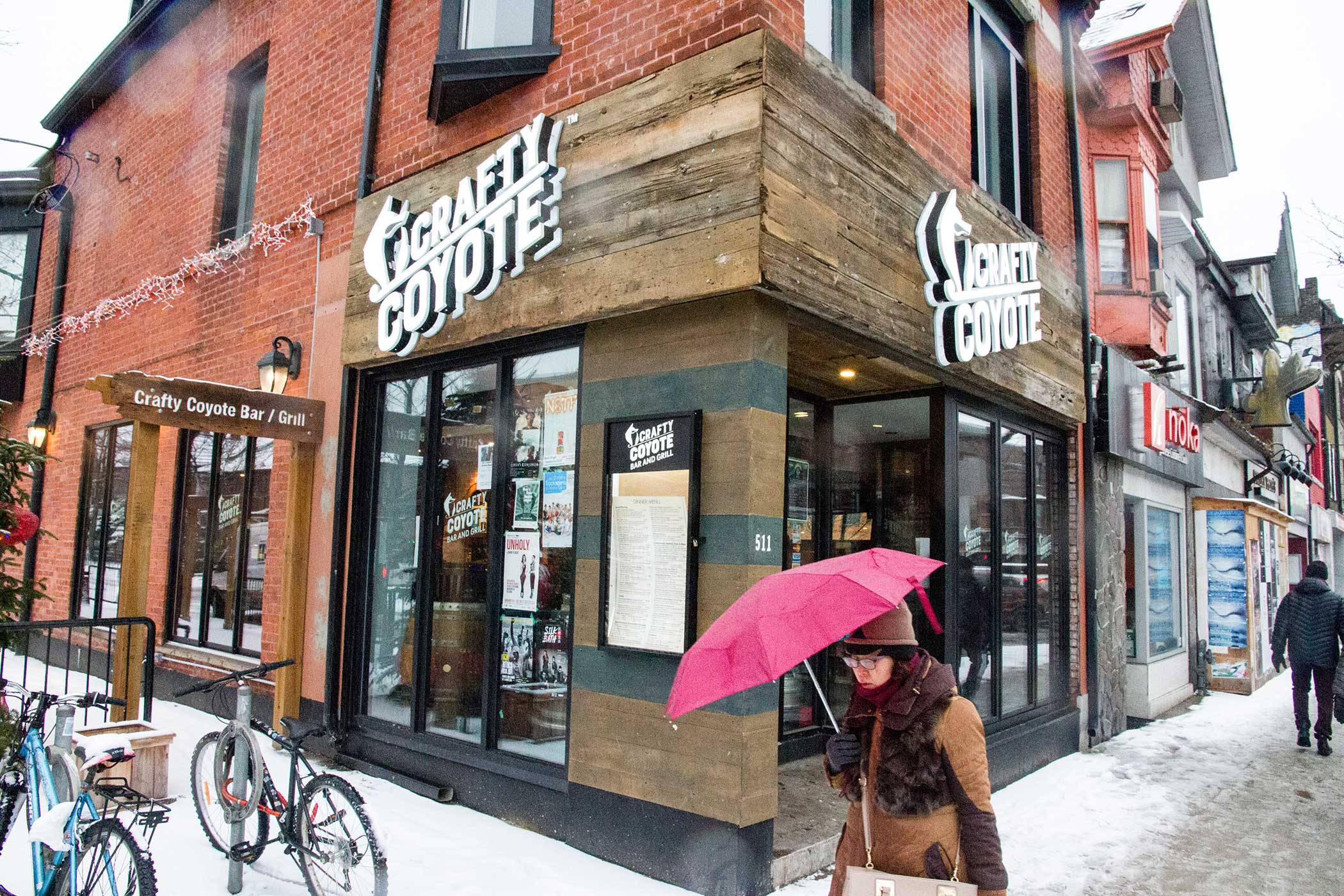
PHOTO BY GEREMY BORDONARO/GLEANER NEWS: Fans of the Victory Café, which will soon close to make way for the Mirvish Village development, need not despair. Owner Nick Ndreka has opened the Crafty Coyote on Bloor Street West. The bar boasts the same selection of craft beer and rustic atmosphere, and emphasizes its location with a sign emblazoned with the words The Annex.
By Geremy Bordonaro
Founded over 15 years ago, The Vic, as the Victory Café is known to its patrons, will soon close. Like all businesses on Markham Street from Lennox to Bloor streets, it is making way for the Mirvish Village redevelopment. But local lovers of craft beer need not despair: owner Nick Ndreka is opening Crafty Coyote, a new bar at 511 Bloor St. W.
The concept is simple. Present a large selection of craft beer and let them stand out.
“We are different from other bars in the area. We’ve got 33 rotating taps, four rotating ciders, and a large selection of Ontario wines,” Ndreka said. “That makes all the difference. We’re different from everybody else.”
[pullquote]“The Annex has a beautiful population. It’s a wealthy neighbourhood in that way. And there’s nothing like us”—Nick Ndreka, owner[/pullquote]
Most craft drinkers look for a different beer every time and a large rotating tap will easily satiate even the most tenured craft beer drinker.
“There’s been a demand. The Ontario craft beer industry has been growing for quite some time now,” he explained. “Every day a new brewery comes along. We don’t know when that’s going to end but so far it has been pretty good.”
As for the neighbourhood, the Annex provides a perfect demographic of patrons for a bar like the Crafty Coyote.
“The Annex has a beautiful population. It’s a wealthy neighbourhood in that way. And there’s nothing like us,” Ndreka said. “When summer comes by perhaps we’ll be getting the patio and operating fully. We add a lot of flavour to the neighbourhood.”
Unfortunately, operations have not been without their twists and turns as the aforementioned patio was previously rejected by the community when the city conducted a poll of neighbouring residents who were concerned that Crafty Coyote’s east face on Borden Street would lead to late night noise during the summer hours.
“Patios are always a thorny thicket. In fact, we have a patio protocol,” said Gus Sinclair, chair of the Harbord Village Residents’ Association. “We try to advise how best to go about it. Almost always it has to involve extra consideration, especially when a flanking patio is concerned.”
Though the patio request was initially denied by the community, Sinclair doesn’t believe that this means that the community will reject it again. He characterizes the community as being involved with the businesses and downtown hustle of the surrounding areas.
“We all live downtown where you can get your food by walking to it. We want to live near restaurants and bookstores. And that’s what makes downtown, downtown,” he said. “If we wanted nothing like that we’d move to the burbs. We value our businesses and want them to prosper. All that we ask is that proper consideration is put in place when you operate within our community.”
This sentiment is echoed by Joe Cressy (Ward 20, Trinity-Spadina), who believes striking the right compromise is key.
“In downtown Toronto we have a vision for mixed-use neighbourhoods. That means it is not only an entertainment zone but also a residential zone. What you need to do is work together to find a balance. So I would encourage the Crafty Coyote to work with the local community.”
Though this hiccup may slow down the Crafty Coyote slightly, Ndreka is still optimistic about the bar’s future.
“At some point we’d like to expand with two more locations within the city of Toronto,” he said. “The city is large enough for us to be there. Just for our name. We’re ‘craft’, we stand up to the big guys. We’re just local, strictly.”
READ MORE:
CHATTER: Dollar deals at Bathurst Station! (November 2016)
Tags: Annex · News
January 23rd, 2017 · Comments Off on FOCUS (JANUARY 2017): Should marijuana dispensaries be closed?
Bloor Street citizens have their say
By Geremy Bordonaro
The December 22 shutdown of Pacifico Life had us wondering: what do people think of having a marijuana dispensary in their neighbourhood? So, we hit Bloor Street on January 12, not too far from where Pacifico Life had been, to find out. We asked people what they thought of the shutdown, and of dispensaries in general. What follows is a round-up of what we learned.
Akwasi, professor: “It didn’t last very long. I’m not surprised. I’m not unhappy to be honest but I’m glad that they are popping up elsewhere. It was a little weird that it popped up on this stretch of Bloor Street…. I think it’s awesome [that marijuana dispensaries are popping up] but we need to wait around until regulations come around about where they are, what proximity they’re allowed to be around children, and things like that.”
Dave, video store clerk: “I don’t mind at all. There could be an issue with people thinking it’s a gateway drug but I don’t mind a place like that in the city.”
Michaela, waitress: “I don’t know about them at all. I haven’t been keeping up with news about the situation. I don’t really have an opinion.”
Baxter, student: “Yes, I’m aware of it closing. It is enforcement of the law while pot is still illegal and eventually when the federal Liberals get their shit together that will no longer be the case. But in the meantime marijuana is still illegal as a part of the criminal code…. It’s a rational response to an anticipated policy change that technically hasn’t materialized yet.”
Howard, manager of Wiener’s Home Hardware: “I kind of expected it to happen because any business that is operating in a grey area, at best, I don’t expect to see hang out too long…. I don’t really have a big opinion on it because people are going to try and make money however they feel they can make money. And then when legislation comes down either they’re all going to get to stay in business or they’re all going to get closed down.”
Paul, freelance cameraman: “I had no idea that it shut down. This place didn’t look so much like a head shop as it looked like a store that talked to people about the advantages of marijuana. I think there are certain positive things that come with marijuana such as [Cannabidiol] which is used to treat various ailments. I don’t know what it was but it would have been nice to have it here a little bit longer so that we could have figured out was it a head shop or was it an alternative healing place.”
Judy, journalist: “I’m not in favour. A lot of damage was done in my family by early pot use at a stage where a young person’s brain was developing. I’m convinced that a lot of mental health issues come from it. So anything that normalizes it I don’t think is the right way to go.”
David, professor: “Yes. Not happy. The dispensaries will be there until they legalize it.”
Roy, retired: “I really don’t like it. Places like that [points to nearby location] deal drugs on the street constantly and never ever get busted. These pot heads and pot shops never get busted. But these dispensaries get busted in an instant…. I don’t object to dispensaries because they’re trying to get something that is a constant product out to the public. Whereas places like that say ‘Oh well this week is garbage. Next week it will probably be better.’ These places are just rip-off joints and they never ever get touched. The head shops are always above the law. But a dispensary? That’s illegal.”
Naomi, administrator for a hospital: “Truthfully, not. I think they serve a purpose but they need to be regulated. It’s no different from a lot of things that [the federal Liberal government] are trying to put in regulation for. So it takes its time.”
READ MORE:
CHATTER: Marijuana dispensary opens (December 2016)
EDITORIAL: Mayo no, marijuana maybe (June 2016)
Tags: Annex · People · Opinion
January 23rd, 2017 · Comments Off on GREENINGS (JANUARY 2017): Feeling the carbon tax crunch?
Embrace the green and lower your footprint
Christmas came a little late for me this year. I woke up on New Year’s Day and looked out of the window at the gas station sign. The ever slightly higher gas price was a pleasant reminder of the new carbon tax that Ontarians are now paying and I couldn’t be happier. Natural gas will be increased by about 7 cents a cubic metre, and gasoline about 4 cents a litre. This is truly a great day for our children. It’s a small but important step in the right direction.
Until we see carbon tax around the $60 to $70 a ton mark, we likely won’t see a big uptake in alternative fuels, particularly in the corporate sector where the bottom line is king and polluting is still too cheap relatively. However, having a tax infrastructure in place is hugely important to getting there.
Price signals are one of the most important things we can do in a capitalist economy. Rather than complaining about the marginal increase in costs, here are a few things we can do to lower our carbon footprint and reduce those pesky taxes we have to pay.
Turn down the thermostat
Homes in the Annex are notoriously not airtight. If you are doing a renovation, make sure you get your home well insulated (spray foam is my preference). Short of that, anything you can do to stop drafts is a good stop-gap until you do decide to renovate. In the meantime, keep the thermostat down and throw on an extra sweater. Ambient room temperatures have steadily risen over the last century as heating became easier, cheaper, and more efficient. We really don’t need to keep it as warm as most of us do. A friend of mine keeps her electrically-heated home at a brisk 14° Celsius. At 7 cents of tax per metre cubed of natural gas, turning down the thermostat will save you in 2017.
Drive slower
If you have a lead foot like I do, you are burning gas unnecessarily. For most cars, fuel efficiency is around 80 kilometres per hour. Taking the 401 at 120 kilometres per hour burns a lot more gas than you really need to. You would do well by accelerating gently and keeping the tire pressure up too. If you can, though, ditching the car altogether is your best bet. We haven’t looked back since doing this nearly nine years ago.
Take shorter showers
Most of us have natural gas for heating domestic hot water. The shower will start to cost a few cents more, so this is the time to implement self-discipline when enjoying the beautiful warmth wash all over us. For anyone doing a major renovation that includes plumbing work, this is a good time to consider heat recovery systems for showering. Rather than going directly out to the sewer, your already warm shower water pre-warms the cold water going up to you so you need less hot water by the time it gets to the mixer.
I wish everyone a happy 2017 and I hope we can all embrace these price signals as opportunities to make greener habits for ourselves. May this be the year we start taking real action to slow down the extinction of the human race.
Terri Chu is an engineer committed to practical environmentalism. This column is dedicated to helping the community reduce energy, and help distinguish environmental truths from myths.
READ MORE GREENINGS BY TERRI CHU
A green, meaningful Christmas (December 2016)
Force the focus (November 2016)
The school of the future (July 2016)
Taking action on climate change (June 2016)
Tags: Annex · Columns
December 20th, 2016 · Comments Off on ABOUT OUR COVER (DECEMBER 2016): Arctic amusements

Captain Owen Stanley (1811-1850) painted this watercolour based on drawings he made while on Sir George Back’s Arctic expedition in 1836 and 1837. He served on the HMS Terror, which almost a decade later would be lost after returning to the Arctic for the Franklin Expedition. Stanley was not part of the ill-fated voyage, having moved on to command his own ships and sail to New Zealand and Australia. The HMS Terror was found in September by the Arctic Research Foundation. The drawings are part of the University of Toronto’s Thomas Fisher Rare Books Library.
The Gleaner wishes to thank Loryl MacDonald and Maureen Morin from the University of Toronto libraries for their help in creating this year’s cover photo.
—Annemarie Brissenden/Gleaner News
READ MORE:
ARTS: HMS Terror found on greeting cards (December 2016)
ABOUT OUR COVER: A red house in winter (December 2015)
Tags: Annex · News
December 20th, 2016 · Comments Off on NEWS (DECEMBER 2016): Infill versus open space at 666
Residents decry loss of green space and heritage impacts
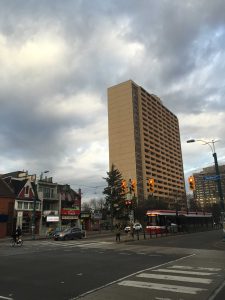
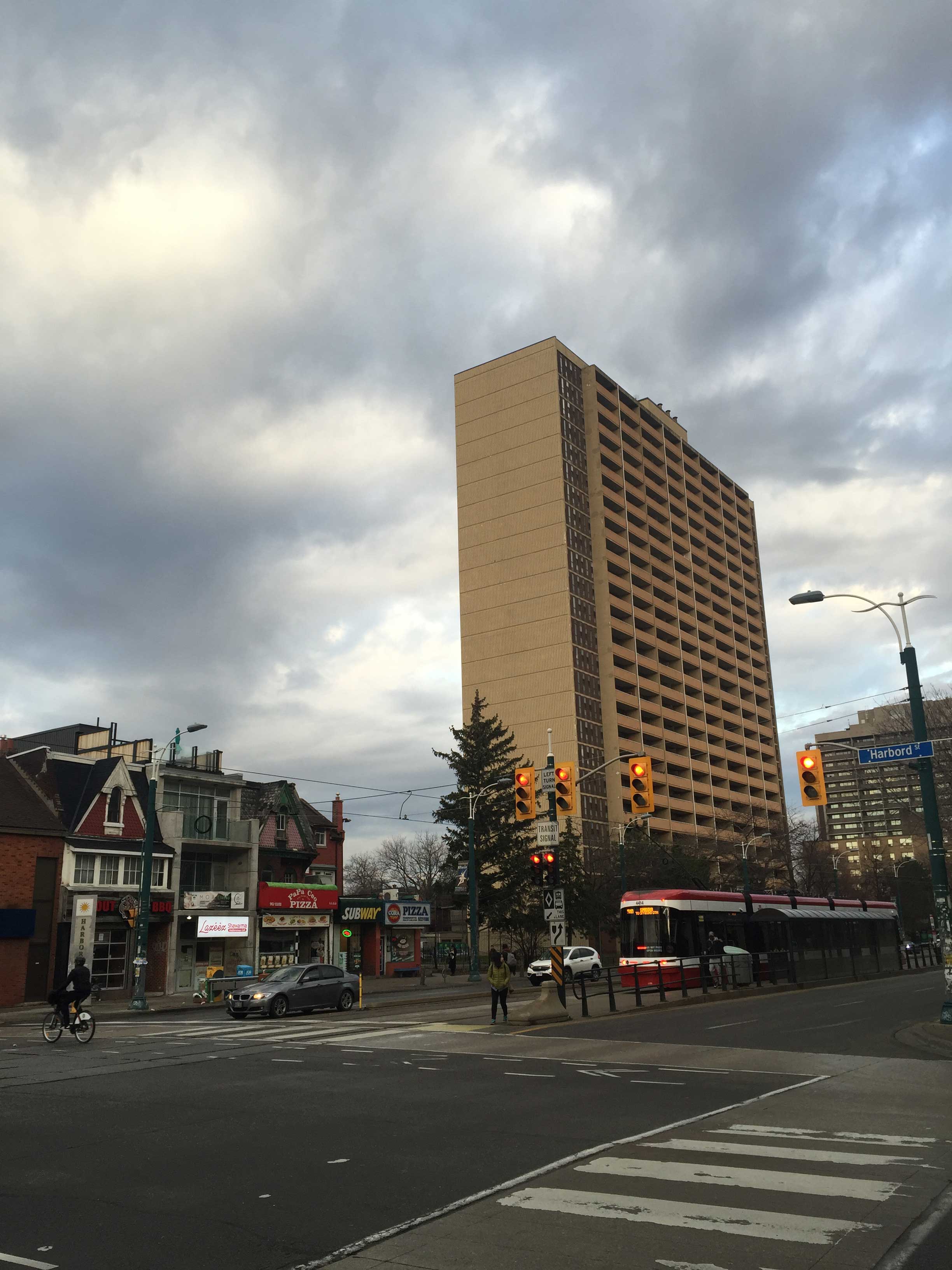
PHOTO BY BRIAN BURCHELL/GLEANE NEWS: Uno Prii designed 666 Spadina Ave., which is listed on the city’s inventory of Heritage Properties. The property owner wants to add an 11-storey building and eight stacked townhouses on the site.
By Brian Burchell
It was billed as a community consultation, but a Nov. 29 meeting on plans to add an 11-storey mixed-use building and eight stacked townhouses to the north and south of the existing 25-storey tower at 666 Spadina Ave. was more about airing grievances than anything else. Those in attendance refused to be appeased and were critical of the proposal’s potential impacts on the heritage site and local green space.
In fact, it was a rather fractious affair.
The site is in itself an anomaly.
[pullquote]“There was a vision here in 1969, and I think it deserves respect…50 years later”—Bob Bernett, Sussex Avenue resident[/pullquote]
As City of Toronto planner Liora Freedman explained, the site’s zoning is tailored to apartment building, and exceeds the residential height limit of 12 metres. It’s believed this was approved at the time the building was built because the original application included so much green space, a hallmark of Uno Prii, the architect responsible for this and many other residential high rises in the Annex, many of which are listed the city’s Inventory of Heritage Properties.
“The 1969 site-specific zoning allowed for the building to take up 30 per cent of the site and [leave] the remaining 70 per cent [as] open space,” said Freedman, adding that the property abuts a Harbord Village Conservation District on the west side, and as such, must transition in a manner that respects that low-rise residential neighbourhood.
Yet critics argued that just because the space exits for infill doesn’t mean it should be filled.
“There was a vision here in 1969, and I think it deserves respect…50 years later,” said Sussex Avenue resident Bob Bernett. “The developer got a gift when this was first developed; he got extra height and density because he left all this green space around it. The idea that we can get rid of all this parkland now does not wash with me.”
Robert Street resident Norman Track took issue with the adequacy of the existing public infrastructure to accommodate such heavy intensification, noting that “the sanitary sewers in Toronto are of 1908 vintage and they are leaking”, and that despite “all this influx of people [there are] no new hospitals”. He also expressed concern, after the power outages the Annex has experienced this year, about the ability of the hydro network to support more growth here given that “according to Toronto Hydro itself [in April 2016] 25 per cent of its infrastructure is outdated”.
Joe Cressy (Ward 20, Trinity-Spadina) acknowledged the power outages that occurred over the summer, but said they were not capacity related.
“[These were] caused by inclement weather and if you can believe it squirrels, and Hydro has prepared a report confirming this,” said Cressy. “The load capacity for downtown Toronto is not only stable but is planned for the future…. A new power station, [the Copeland Transformer Station], down at the Round House Park, is coming on line next year. It is a multi-billion-dollar facility that is designed to accommodate growth.”
The councillor reviewed the extensive “pre-application engagement” that the property owner has undertaken with respect to 666 Spadina Ave., and said the application incorporates significant changes since the last community consultation meeting.
“The plan that we ended up submitting, in response to the feedback we heard at the last consultation included increasing the set-back from [Sussex Mews] lane [from 6 to 10.5 metres], increasing the separation distance from the existing building and the new proposed building, and relocating the garbage enclosure away from the lane,” explained Mansoor Kazerouni of Page + Steele IBI Group Architects. Although the height of the mid-rise building to the south remains at 11 storeys, the application to the city exists entirely within the 45 degree solar angle required in the current planning rules.
The architect also described a provision for the privately-owned publicly accessible space on the west side of the property (the east side of Sussex Mews), which occupies 450 square metres (roughly 5,000 square feet). A glass vestibule has been added in this articulation of the proposal connecting the existing high-rise with the new 11 storey building which Kazerouni says will “be publicly accessible 24/7 and aid in wind mitigation”.
“The existing slab style building has an inherent problem with wind, since it is oriented against the prevailing wind which then must down wash around and flow around the adjacent streets or properties,” said Stephen Pollack of Theakston Environmental, which was retained by the developer to do wind studies on the property. “The proposed townhouses on the north side and stepped 11-storey building on the south side will deflect these winds.”
Several speakers were not swayed by the wind mitigation argument and decried the loss of open space that additional buildings would occupy. Or as Bernett put it, “I am sorry. If we want to deal with wind issues we can plant some coniferous trees there.”
READ MORE:
NEWS: Preventing a wall of towers (October 2016)
CHATTER: Two new rezoning applications submitted to city (September 2016)
NEWS: Tall tower before OMB, as city battles back with block study (August 2016)
NEWS: Planning for the future (May 2016)
DEVELOPINGS: Annual review reflects tension between community activism and OMB (March 2016)
Tags: General
December 20th, 2016 · Comments Off on FOCUS ON EDUCATION (DECEMBER 2016): Monsignor Fraser College needs help to go green
Phase one to include removal of fence
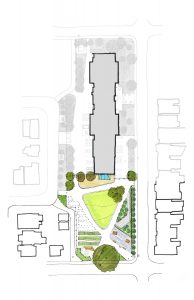
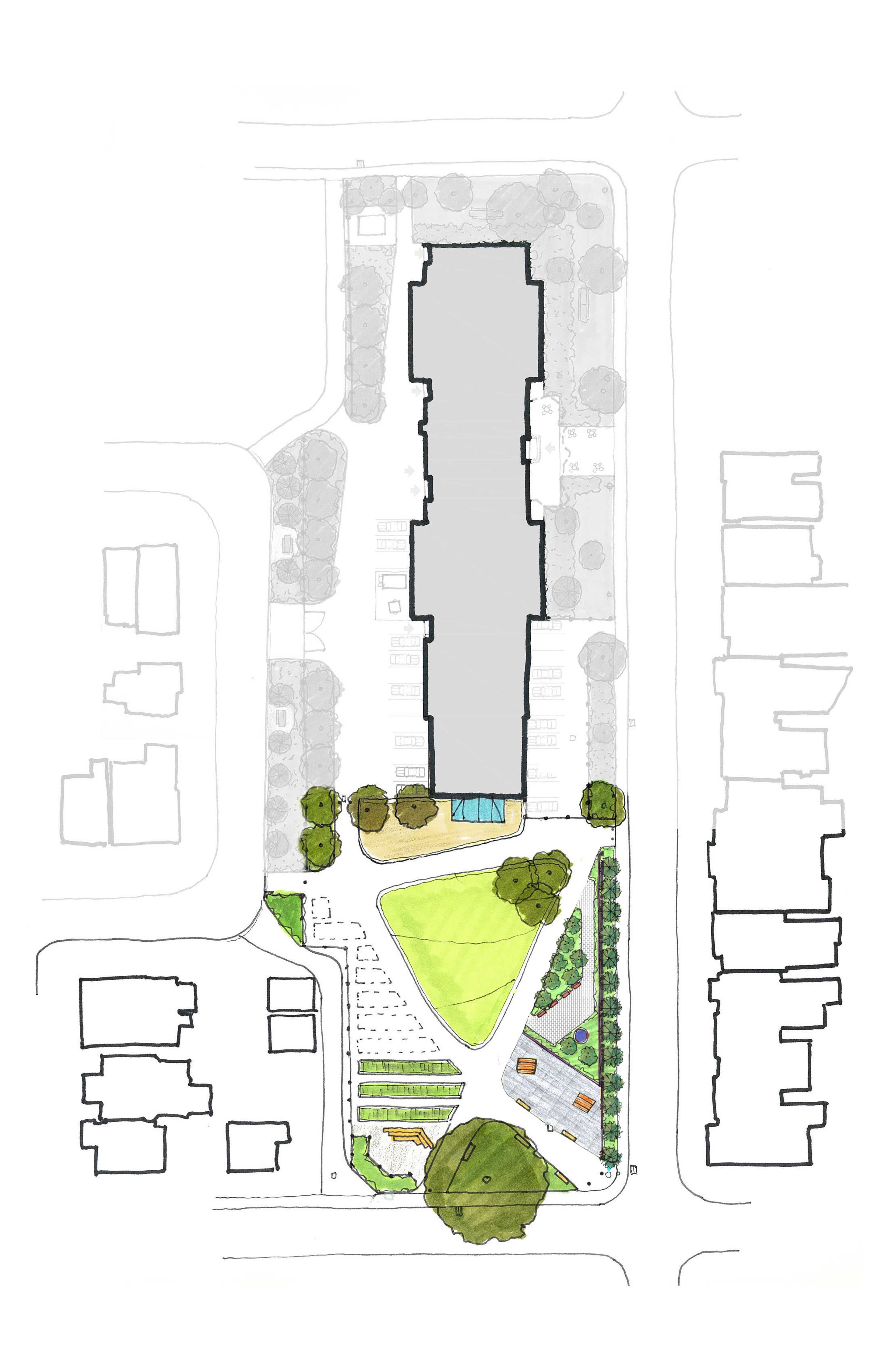
COURTESY MATTHEW SWEIG/FOREST AND FIELD LANDSCAPE ARCHITECTURE INC.: The proposed plan for converting the unused schoolyard into a green oasis includes planters, an amphitheatre, and a path for crossing the site.
By Annemarie Brissenden
Plans are afoot to green the Annex campus of Monsignor Fraser College, but help — lots of help — is needed to raise the $300,000 it will cost to make that happen. Toronto Catholic District School Board (TCDSB) trustee Jo-Ann Davis (Ward 9, St. Paul’s, Toronto-Centre, Trinity-Spadina) reviewed the plan to turn the Markham Street school’s former schoolyard — currently a paved unused space surrounded by a fence — into an oasis for both students and community members alike at a community meeting late last month.
The space is a legacy of the site’s previous tenant, an elementary school that was consolidated with St. Raymond Catholic School (which in turn is to be consolidated with St. Bruno Catholic School). These days Monsignor Fraser operates as an alternative learning site, drawing students from across the city.
[pullquote]“We pride ourselves on relationship building with students, and would like to extend that out into the community”—Marcello Mancuso, principal[/pullquote]
“We pride ourselves on relationship building with students, and would like to extend that out into the community,” said the school’s principal Marcello Mancuso at the meeting. “We are hoping to engage the students, and engage the students with the community in something worthwhile.”
Working with stakeholders from the community like the Evergreen and David Suzuki foundations, Foodshare, and the St. Peter’s Parish, the board has developed a working framework.
It includes a green lawn, a path through the space, raised planters for food production, spaces to display art, a sacred space for quiet reflection, seating, and an amphitheatre. And of course, the high fence would be removed.
Jacquanline Liu, project supervisor at the TCDSB, explained that the board anticipates it will have to rehabilitate the space in three phases. In the first, the fence would be ripped out, and the amphitheatre enhanced. In the second, raised planters would be installed, as well as seating for multiple users, while in the third and final stage, an art display area would be set up, as well as a potential greenhouse, and sacred space. Doing the project in three phases increases the cost by $100,000, but the board’s representatives are skeptical they can raise enough money to do everything in one go.
Joe Cressy (Ward 20, Trinity-Spadina) is an enthusiastic supporter of the plan, saying “if we get community agreement, I will work to find funding.”
“Our neighbourhood is deficient in greenspace, but if we’re going to make our neighbourhood more livable, we’re going to have to get creative,” added the councillor.
The school board has established a fundraising campaign, and has begun to apply for various grants, but it is looking for a person or organization to champion the project.
“We almost need an outside organization to take the lead because the board has a limited capacity for driving a project like this,” said Davis.
Those in attendance at the meeting were generally positive about the proposed greening, and were keen to see the fence removed, sooner rather than later.
Jennifer Hunter, president of the Seaton Village Residents’ Association, sees the potential for a community building opportunity, but acknowledged the challenges of engaging members for such an activity.
“Once the fences are gone” though, “that will generate interest.”
READ MORE:
NEWS: A $9.4-million school with a view (June 2016)
Tags: Annex · News
December 20th, 2016 · Comments Off on FOCUS ON EDUCATION (DECEMBER 2016): Decolonizing our schools
Putting the Indigenous land acknowledgement into practice
By Clarrie Feinstein
In September 2016, trustees at the Toronto District School Board (TDSB) unanimously passed a motion to include an Indigenous land acknowledgement every morning before the singing of the national anthem. Introducing the acknowledgement is part of the Aboriginal Education Committee’s (AEC) mandate to decolonize Canadian schools and recognize the colonialist construct under which the education system operates. The acknowledgement is the first step in reconciling the relationship between Indigenous and non-Indigenous groups within the education system, but simply saying the acknowledgement is not enough. Teachers and staff must provide historical and current context for the acknowledgement, which has proved to be a challenging feat in numerous ways.
“The transition has not been smooth sailing,” says Barbara Anne Felschow, central coordinating principal of the AEC. “It’s a slow process but people are on board.”
[pullquote]“We want to do it in a sensitive manner that honours the community”—Cheryl Howe, principal, Huron Street PS[/pullquote]
David Ast, the curriculum assistant leader at Harbord Collegiate Institute, agrees with Felschow. “It hasn’t been smooth. Everyone is in a different place on the continuum. Many teachers didn’t learn about much when it came to Indigenous issues. There are gaps in people’s awareness of the issues at hand.”
In order to prepare TDSB educators, the AEC offers resources for teachers, staff, and students at the TDSB. A 2010 report on the Urban Aboriginal Education Pilot Project (UAEPP) titled Decolonizing Our Schools: Aboriginal Education in TDSB emphasized that Indigenous issues must be incorporated in a meaningful way, which can be achieved through in-service professional development for teaching staff.
The UAEPP provided workshops and learning opportunities for teachers and staff to help facilitate Indigenous education for educators, resulting in a sizable shift in teachers’ understanding of Indigenous people, history, and culture. However, some teachers said they felt uncomfortable with the increased responsibility of decolonizing school space with other educational commitments.
“We still experience questions on how the acknowledgement came into being from staff,” Fleschow explained. “We have people asking what is and is not included in the statement, how it has evolved, et cetera.
“Our job in the AEC is to provide the resources for teachers and staff to be properly informed in order to have the context needed to understand the complicated history of the relationship between Indigenous and non-Indigenous people.”
The AEC provides accessible information on the Truth and Reconciliation Commission’s kindergarten to Grade 12 educational reform, which includes accurate residential school information and in-depth analysis of land and treaty acknowledgements. This gives teachers the fundamental knowledge to provide historical context and accurate information to their students. The committee also facilitates community members to speak at schools regularly in order to support a knowledge-building relationship with the schools and the Indigenous community.
At Harbord Collegiate this has been occurring for some time. Ast has coordinated workshops with various community members, artists, and elders for the past four years.
“On professional development day we had an Aboriginal speaker come in to facilitate a workshop with teachers to better understand treaties, the Indian Act, and the TRC commission,” Ast says. “The acknowledgement has put Indigenous issues on teachers’ radar. There has been interest from teachers to learn more.”
The land acknowledgement was introduced at Huron Street Public School in May 2016, and while Principal Cheryl Howe said the transition has not been difficult for teachers, the staff wants to do it right.
“We want to do it in a sensitive manner that honours the community. Teachers will take it slow because it is such a complex issue and none of my teaching staff is Indigenous. We need to reach out to the Indigenous community first.”
Huron is in the beginning stages for community outreach, which includes speaking with the AEC, inviting community members to facilitate educational workshops for staff, and updating its library with current and appropriate resources. “But there are over 500 schools in the TDSB all wanting this access,” Howe says. “It will take time.”
At Huron the acknowledgement is a stepping-stone for more teaching on Indigenous issues. Howe acknowledges the additional responsibility that is attached to teaching this material to young students. Many engage with questions ranging from “what is this?” to “what specific territory are we acknowledging?” indicating the students’ desire to be given more context on the acknowledgement.
For Grade 10 Harbord student Caleb Woolcott, the only difference in school has been the acknowledgement itself; there has been no cultural shift.
“There has been no curriculum change,” Woolcott said. “There has been no context provided on the treaties and what is actually being said when we acknowledge the land. Students don’t seem that interested, no one really pays attention to the announcements every morning.”
Woolcott attended a workshop, which discussed treaties to provide context for the land acknowledgement. So far, in his favourite subject, Grade 10 History, the curriculum has not yet covered Indigenous history. “We talked a little bit about Aboriginal involvement in the First World War. But it’s still the beginning of the year. Our teacher said there will be more taught after the winter break.”
While Woolcott has not witnessed increased student engagement regarding Indigenous issues, Felschow believes that non-Indigenous students are further ahead in their understanding of social justice and are independent learners, who self-inform. For Indigenous students, the acknowledgement provides them with a platform to be more visible and brings to the forefront their self-expression and student voice. The acknowledgement gives them a place of belonging. The goal for the TDSB is to create a space where self-identifying Aboriginal students can feel comfortable in expressing their identity.
According to Harbord’s principal, Vince Meade, there was a census conducted five years ago which indicated that Harbord had 30 to 40 students who self-identified as Aboriginal, but there is no updated information. Active engagement with the student body regarding Indigenous issues is still an ongoing process.
“There has not been a shift in the educational environment,” Meade said, “but parents adopt the acknowledgement before their meetings. We’ve had some workshops on the history of agreements and the board has implemented training sessions, which have been very informative. The work is ongoing.”
While the narrative between staff and student opinion regarding Indigenous education at Harbord does not align, Woolcott said, “The acknowledgement is more than what was done before and sheds light on the issue.”
READ MORE:
FOCUS ON EDUCATION: Building a respectful future (November 2016)
HISTORY: Honouring those who honour history (October 2016)
NEWS: U of T committee tasked with responding to Truth and Reconciliation Commission delivers interim report (August 2016)
ON THE COVER: Tracking history in the Annex (April 2016)
Tags: Annex · News
December 20th, 2016 · Comments Off on CHATTER (DECEMBER 2016): Serving the city’s neediest children

PHOTO BY NOELLE DEFOUR/GLEANER NEWS:
The Scott Mission at Spadina Avenue and College Street opened a free toy store for parents of the city’s neediest children. From Nov. 28 to Dec. 9, registered clients of the Mission were able to shop for a bagful of new children’s items including books, sports equipment, puzzles, and games. The Mission has also provided 2,600 grocery store gift cards, emergency groceries, children’s snowsuits, a hot Christmas meal, and a Christmas gift for every child in its camp and youth program this holiday.
—Annemarie Brissenden/Gleaner News
Tags: Annex · News
December 20th, 2016 · Comments Off on CHATTER (DECEMBER 2016): Bloor Annex BIA showcases street greening plans
On Nov. 25 the Bloor Annex Business Improvement Area (whose chair also publishes this newspaper) showcased its street revitalization plans at Markham House in Mirvish Village. The plans — expected to be implemented in 2018 — include converting public rights-of-way along Bloor Street into parkettes and a renewed tree inventory on the north side of the street.
—Noelle Defour/Gleaner News
READ MORE:
NEWS: Bloor Street goes green (April 2016)
Tags: Annex · News
December 20th, 2016 · Comments Off on CHATTER (DECEMBER 2016): Marijuana dispensary opens
Pacifico Life (444 Bloor St. W.), a marijuana dispensary, opened its Toronto doors late last month with a mission “to educate, empower, and alleviate”. The Hamilton-based business sells many different products derived from the plant, including bath bombs, lip salves, oils, and soaps. It also dispenses the flower itself, but only for medical use. The plant is sourced from 100 growers, some as far as away as British Columbia.
Owner Tamara Hirsh, herself a user for medical reasons, is dedicated to educating people about the difference between medical and recreational use, which she doesn’t necessarily support except to alleviate pain or stress. She also stresses the heavy security measures she has in place at the store, and explains that she will only sell to customers who produce a medical licence and are over 19 (customers younger than 30 years old must provide two pieces of identification).
She acknowledges that her store may be closed by police, but says her customers are supportive.
“We’re changing people’s lives,” says Hirsh. “We may get raided, but my god it’s worth it.”
—Annemarie Brissenden with files from Noelle Defour
READ MORE:
EDITORIAL: Mayo no, marijuana maybe (June 2016)
Tags: Annex