March 22nd, 2017 · Comments Off on NEWS (MARCH 2017): Westbank presents latest proposal
Community, city closer to approving Mirvish Village development
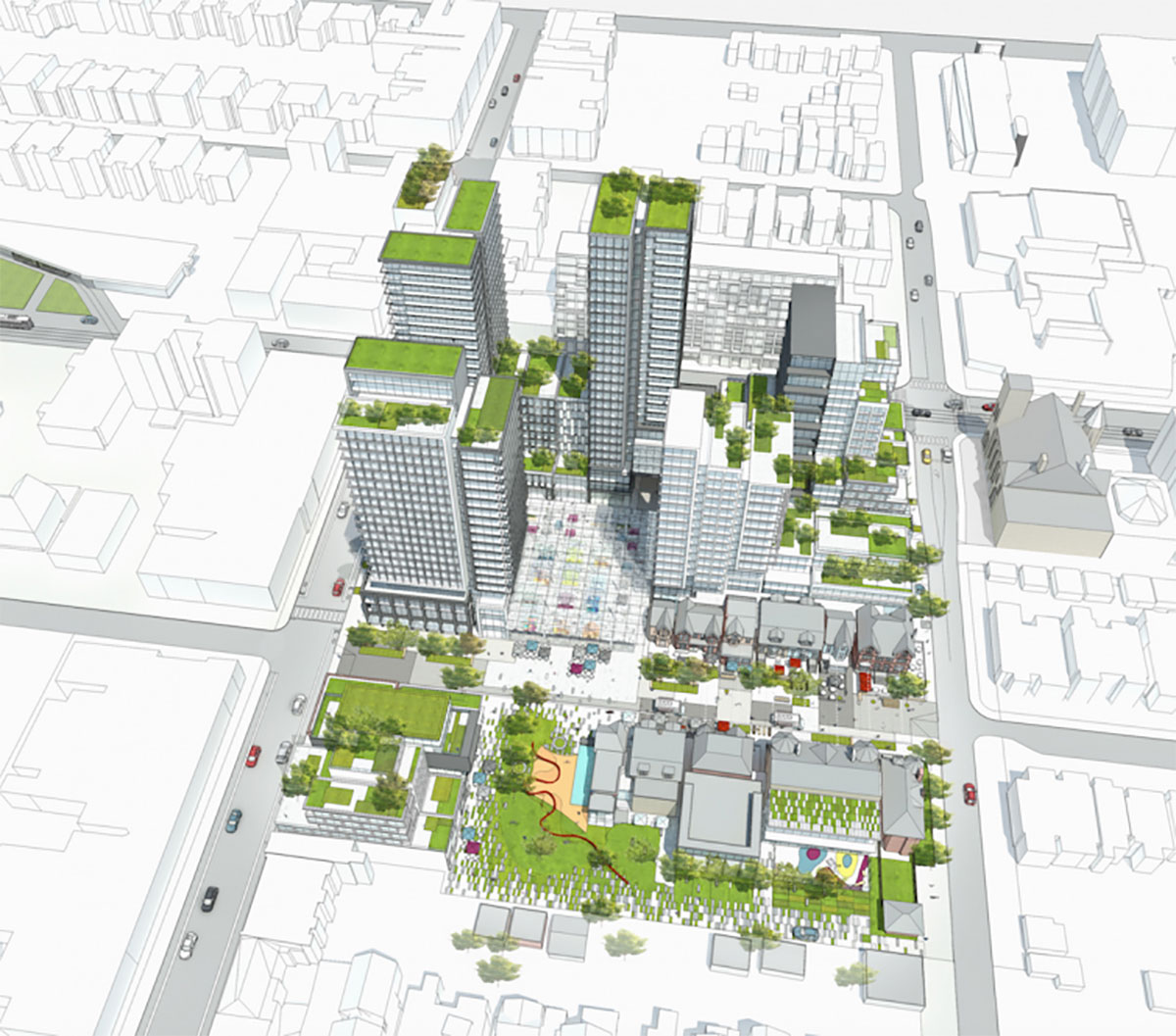
PHOTO COURTESY WESTBANK PROJECTS CORP.
By Geremy Bordonaro
It all came down to this: one final community meeting about Westbank Projects Corp.’s application to build a large mixed-use development on the former site of Honest Ed’s and Mirvish Village. After a long and unprecedented involvement from the community — including residents and local business owners — Joe Cressy (Ward 20, Trinity-Spadina) and Mike Layton (Ward 19, Trinity-Spadina) hosted a meeting on March 2 to present the latest (and perhaps last) iteration of the application.
It was standing-room-only in the Bickford Centre cafeteria.
The proposed development has undergone many changes since it was first presented in 2015. The mixed-use plan includes a total of 804 rental residential spaces, a park spanning 1,150 square metres, a market alleyway, and 15,000 square metres of non-residential space. Twenty-three heritage buildings (up from 15) will be preserved out of a possible 27. All told, 47 unique buildings, including a 28-storey tower, will be raised.
“Thank you all so much for being here and welcome. This is the 750th meeting we’ve had for the Bloor and Bathurst street corner and section of town,” Layton joked. “I’m encouraged to see so many faces that are still so enthusiastic about what’s going on up the street.”
Cressy said he was to have a developer who did not shy away from confronting and keeping open communications with the public.
“Do we like absolutely everything that’s here? Is it perfect? Not yet,” said Cressy. “But, my goodness I can’t tell you in Ward 20 how many times we have a developer come in and a couple of months later they are at the Ontario Municipal Board.
“This is a model for how we want the development community to engage with us. When they work with the community and listen to the community we build better neighbourhoods.”
“The priorities for the community throughout this process have been limiting the height and density, and understanding the impact of these new buildings with regard to conserving as much heritage as possible of both the built and intangible heritage,” said Graig Uens, a community planner with the City of Toronto. “The site itself is special for a variety of reasons beyond the buildings that exist on it.”
These priorities dictated the flow of the meeting and feedback from those given the microphone to speak. While reassurances came from Cressy and Layton, there were still a number of those who called for the towers to be lowered and the density to be lessened.
There were also those who were concerned about recognizing and protecting the cultural history of the neighbourhood.
“I’m really concerned about the legacy of the local black community. There’s a long history that has expressed itself in the patty shops and the barber shops that continues to today. It’s a sacred site for a lot of communities,” said Kenneth Montague, who has run Word of Mouth Dentistry in the Annex for more than 20 years. “There needs to be a dedicated plan that says there will be community meeting places, art exhibitions, and so forth. I just want to make sure that in all this very beautiful planning there is something that maintains this history that we have.”
Gus Sinclair, chair of the Harbord Village Residents’ Association, said that while his organization supports the plan, his concerns are whether or not the promise for fully rental and affordable will be kept.
“We applaud the rental prioritizing of this project. Is there a way to guarantee that this will be all rental?” Sinclair asked. “That’s a critical question for us because we can imagine what would happen if it wasn’t and we’d rather the rentals would stay.”
Westbank, however, said they were committed to the rental model.
“[At this meeting] we’ll give you a sense of what’s happened over the past few years from our initial ideas, what we brought to the table at the beginning, how it has evolved and changed from your input and the input of city staff,” said Gregory Henriquez, lead architect. “We’re here to make it as good as it can be. We’re here to listen again.”
Henriquez valued the input on the project thus far and acknowledged that the development has “been strengthened” by residents and city staff.
Graig Uens said the city’s concerns with the proposal have been remedied, and that a recommendation to approve the application will be forthcoming.
“Our priorities [for] the site have largely been addressed by this development. This is a different approach from that brought to us by Westbank. We’ve reviewed the application and brought it into the community,” he said. “On April 4, we will bring forward recommendations to community council to approve the development as you see it today.”
READ MORE:
FORUM: Build a neighbourhood (March 2017)
NEWS: Height, density still top concerns (July 2016)
NEWS: Westbank submits revised application (June 2016)
DEVELOPINGS: Annual review reflects tension between community activism and OMB (March 2016)
Westbank towers over 4 Corners (January 2016)
City hosts first Mirvish Village community consultation (November 2015)
Residents’ associations share concerns for Mirvish Village (October 2015)
Westbank submits application (August 2015)
BABIA endorses Westbank proposal (July 2015)
How do you make it real? (April 2015)
Tags: Annex · News
March 22nd, 2017 · Comments Off on EDITORIAL (MARCH 2017): Foreign buyers tax a necessary cliff jump
Pursued to the edge of a cliff by relentless law enforcement, Butch Cassidy and the Sundance Kid were faced with an unenviable choice: jump, be captured, or — the most likely alternative — be killed while being captured. As they contemplate their fate, Butch and Sundance begin to argue over who should jump first, with Sundance finally admitting that he can’t swim.
“Are you crazy, the fall will probably kill you”, responds Butch, laughing, just before they finally jump — together. In this infamous scene from a 1969 Hollywood depiction of true-life events Butch and Sundance avoid drowning and escape the law, floating off to live another day.
[pullquote]This growth not only makes buying a house unaffordable for a huge swath of the population, it is also unsustainable and sucks real money out of the economy; money that could make a meaningful contribution to our gross domestic product.[/pullquote]
It’s a classic portrayal of being stuck between a rock and a hard place of having to make a decision when doing nothing is not an option.
According to the Toronto Real Estate Board, Greater Toronto Area (GTA) house prices in February were up 32.5 per cent over one year ago. Analysts have run out of adjectives to describe the extreme nature of this phenomenon. The average price for a detached home in the GTA is over $1.2 million, with the price of an Annex house much higher, as dedicated readers of our Focus on Homes section will know.
This growth not only makes buying a house unaffordable for a huge swath of the population, it is also unsustainable and sucks real money out of the economy; money that could make a meaningful contribution to our gross domestic product.
No one really believes the house they are purchasing is worth the millions in mortgage debt. It’s two or three bedrooms surrounded by plaster and brick on a 14-by-75-foot lot “close to TTC, U of T, schools, and lots of amenities”, as the listings tend to read. Most homes are sold without conditions, no survey, and no home inspection. Sometimes the buyers don’t even view the property. Sometimes they live in far-flung lands and the motive is to purchase a commodity, not to find a home in which to live.
Garth Turner, who was briefly the Minister of National Revenue under Kim Campbell, wrote in his 2005 book Greater Fool: The Troubled Future of Real Estate that such behaviour epitomizes the greater fool theory: when the price of an object is not determined by its intrinsic value, but the belief that another purchaser — the greater fool — will pay more for it down the road. It’s been a viable theory so far that has not only reaped untold millions of profit for speculators, but has also increased the theoretical value of every homeowner’s equity, be they speculators or not.
Faced with an equally out-of-control residential real estate market, British Columbia enacted legislation imposing a 15 per cent tax on purchases of property by foreigners in that province. Acting on incomplete facts, as leaders sometimes must do, B.C. took the legislative plunge, applied the tax and waited, hoping it would cool (not kill) the market. It appears to have had its desired effect: prices have fallen approximately 12 per cent in a year. It seems to have worked, even though we may never know why.
The province, like Ontario, was not tracking at the time who the buyers were, where they lived, and their source of income. It was a shot in the dark at real estate speculation from foreign lands.
Now, it may be that those prospective buyers, rebuffed in the west, have moved their focus to the GTA. But John Tory and Kathleen Wynn appear unwilling to follow B.C.’s lead, saying they say they need more facts to make an informed decision. Perhaps they figure the market will collapse under its own weight, and don’t want to appear to have caused it.
This is a defeatist and cowardly course to chart. They are really worried about curbing speculation and crashing the market, evaporating the $1.5-million in equity that grandma had in her Scarborough bungalow. Neither are likely to be re-elected after such a scenario.
Like Butch and Sundance facing inevitable capture and certain loss, this housing market bubble will burst left to its own devices. The mayor and the premier must summon the courage to enact measures to cool the market, even if it’s a jump fraught with political danger.
READ MORE:
EDITORIAL: Clement’s petulance diminishes parliament (February 2017)
EDITORIAL: Pot a remedy in opioid crises (January 2017)
EDITORIAL: Grappling with growth (December 2016)
EDITORIAL: Freeland got it done, with flair (November 2016)
Tags: Annex · Editorial
March 22nd, 2017 · Comments Off on FORUM (MARCH 2017): Build a neighbourhood
Not just buildings
By Joe Cressy
If you’ve ever made your way to a development meeting in Ward 20, you’ve heard me talk about the need to build community as we grow and change. With almost one quarter of all proposed development in the entire city occurring in our ward, we’d be leading ourselves astray without this focus. This has been my primary focus in the review of the Mirvish Village redevelopment proposal, which continues to evolve after three iterations.
[pullquote]How a building relates to our neighbourhoods is at the heart of how we can protect our communities and manage development[/pullquote]
Feedback from our neighbourhood stakeholders has identified the need for increased greenspace, the retention of heritage buildings, the preservation of the character and uniqueness of Markham Street, a diverse and locally focused retail strategy, and much more.
What happens on the Mirvish site will define our neighbourhood for the next 100 years, so it’s critical that we get it right. Let’s ask a few key questions: are we building a neighbourhood or just building buildings? Are we protecting the other corners, and Bloor Street as a whole, from negative precedents? Are we establishing a model for future development proposals in our city?
What makes a new development a neighbourhood? As we see growth in our neighbourhoods, ensuring that this growth contributes to the vibrancy and livability of our community is key — that means community spaces, community services, parks, and more. The first Mirvish Village proposal — despite plans for a new daycare and innovative green energy technology — fell much too short. Since then we’ve worked collectively and seen critical revisions: the plan now includes a new park on the west side of Markham Street, with a significantly enhanced tree canopy on it and adjacent streets. It will also include the development of an amenity space plan to ensure we’re planning for families.
Affordability is central to livability. For far too many the cost of housing has made our community impossible to live in. To that end, my colleague Mike Layton (Ward 19, Trinity-Spadina) and I are focused on achieving a significant measure of affordable housing in this project. We remain committed to this, and will bring city resources to the table to ensure we can build an affordable community.
Much of development is about precedent; with the Ontario Municipal Board looming large over our local planning decisions, we are acutely aware of the need to protect against negative precedent at the other corners of Bloor and Bathurst streets, and along the rest of Bloor Street. How a building relates to our neighbourhoods is at the heart of how we can protect our communities and manage development.
There have been changes to the height of many of the buildings in the third iteration, but at a peak height of 28 storeys, we still need to see more change — not just to sustain of our Bloor and Bathurst street neighbourhoods and infrastructure, but to protect the rest of Bloor Street as well.
Just as we seek to protect against bad precedent, building a model for future development — establishing positive precedents — is also critical. Significant heritage retention on the site, a focus on affordable housing, building in parks and green space, childcare and diverse uses, and a focus on sustainability overall — these are some of the ways we have worked together to set an example for those who might tell us they can’t. To those developers with large sites who say they can’t provide a park or the services our communities rely on, we say you can, and you must.
I believe that communities have a right to say no when things may harm our neighbourhoods. But, we also have a responsibility to say yes to things that will improve our neighbourhoods. Are we finished with the Mirvish Village proposal? No — we’re not there yet. More changes are needed. But, this multi-year development process should serve as an example to all.
We’ve seen our residents’ associations get engaged and lead this process through three years of work. We’ve had hundreds of our neighbours come to public meetings to voice support and concerns to help shape the project. We’ve seen a developer that’s engaged in this process, working with us and responding to concerns. And, we’ve seen the unparalleled commitment of our city staff to achieve one of the highest levels of engagement and attention in recent memory.
Listen, change is hard. When it comes to development in our own backyard, it’s also deeply personal. I get it. Bathurst and Bloor streets is my home too. So, after three years of work, let’s roll up our sleeves, push for a few more critical changes, and build a new neighbourhood for all.
Joe Cressy is the councillor for Ward 20, Trinity-Spadina.
READ MORE ABOUT WESTBANK DEVELOPMENT:
NEWS: Westbank presents latest proposal (March 2017)
NEWS: Height, density still top concerns (July 2016)
NEWS: Westbank submits revised application (June 2016)
DEVELOPINGS: Annual review reflects tension between community activism and OMB (March 2016)
Westbank towers over 4 Corners (January 2016)
City hosts first Mirvish Village community consultation (November 2015)
Residents’ associations share concerns for Mirvish Village (October 2015)
Westbank submits application (August 2015)
BABIA endorses Westbank proposal (July 2015)
How do you make it real? (April 2015)
READ MORE BY JOE CRESSY
FORUM: Conserving past to enrich future (January 2017)
FORUM: Our dynamic Kensington Market (November 2016)
FORUM: A new central park for Toronto (September 2016)
Tags: Annex · Columns
March 22nd, 2017 · Comments Off on NEIGHBOURHOOD PROFILE (MARCH 2017): Invisible geography
Tracking the rivers under our feet
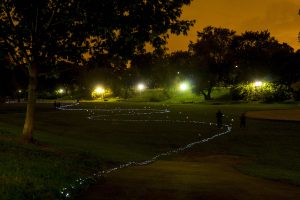
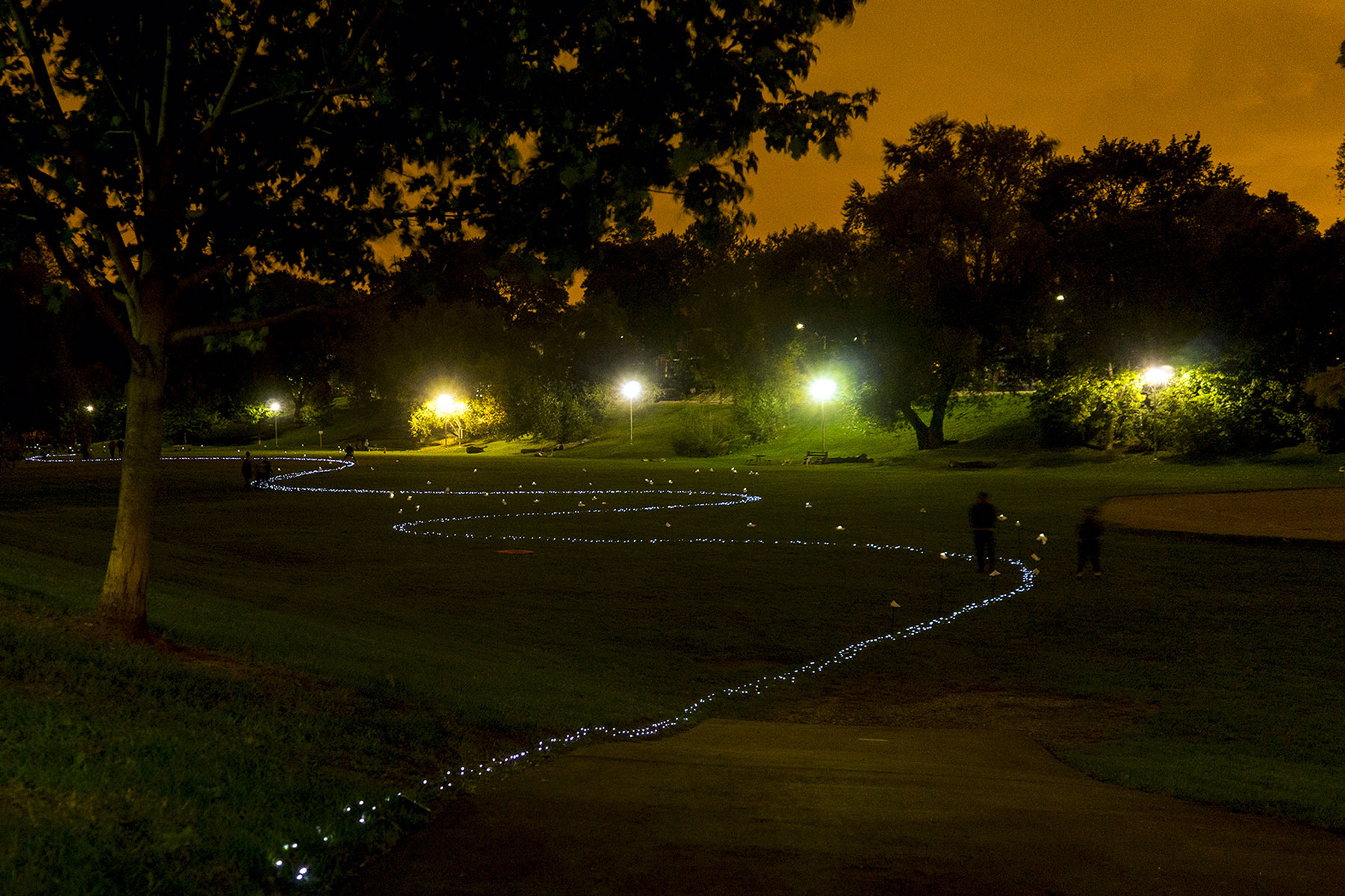
PHOTO BY NEILAND BRISSENDEN/GLEANER NEWS FILE: The area’s lost rivers have long been a source of fascination for artists and writers. In this 2015 Nuit Blanche installation, To Love You Deeply I Look to My Mind’s Eye, visual artist Christine Dewancker and landscape designer Katie Strang tracked Garrison Creek through Bickford Park to explore the impact of an invisible geography — such as a lost river — on a community.
By Geremy Bordonaro
It may be hard to fathom now, but the Annex was once home to three major creeks: Taddle, Garrison, and Russell. They are the area’s lost rivers, buried or incorporated into the city’s sewage system in the late 1800s.
“For people, it’s often like ‘Oh my god. Now I know why I have a wet basement or I get flooded.’ Or ‘Oh my god I used to play in this creek when I was a kid,’” said Helen Mills, coordinator of the Lost Rivers walks, which trace their trajectory.
[pullquote]Henry Scadding described Russell Creek as “meandering most recklessly through the fields”.[/pullquote]
She said that though Taddle and Garrison creeks are relatively well-known throughout the neighbourhood, Russell Creek is new to many people.
“Russell is lower and less famous but pretty cool actually. It starts northwest of Bathurst and Harbord [streets] and flows south right through Kensington Market and Chinatown,” said Mills, adding that mid-1800s clergyman and scholar Henry Scadding described it as “meandering most recklessly through the fields”.
Mills has studied the rivers and their place in Toronto’s ecological history for years. She believes it is important to learn about the rivers, because “there’s a whole layer of meaning that comes with that knowledge.
“For most of us our frame of awareness is probably the city grid or the transportation lines, work or home. This is a way to discover the fabric of the life support system of the city. It changes your sense of connection to this place where we live.”
You can follow the lost rivers by connecting the dots between canoe gardens that attract bees and butterflies installed by Community Canoe.
“[We are] using canoes as a vehicle to get the message out there about pollinators and lost rivers in the city,” explains organizer Aidan Nolan, who says the canoes also serve as a reminder of the Indigenous people who once lived by the rivers.
“We are marking the route of the rivers and building a habitat. In the Garrison Creek area, our canoes are on top of where the rivers went. In other places, we’ve been closer to the river but not exactly on top of it. It’s a physical and visual marker of where these rivers were.”
READ MORE:
ON THE COVER: Tracking history in the Annex (April 2016)
Canoe garden lands on the shore of Lake Iroquois (May 2015)
Tags: Annex · Life
March 22nd, 2017 · Comments Off on LIFE (MARCH 2017): Indigenous Games coming in July
Toronto to host First Nations youth from across the continent

By R.S. Konjek
A recent exhibition at the Royal Ontario Museum called Toronto Underfoot, presented a collection of Indigenous artifacts that have been unearthed from numerous locations around the city.
Tools, projectile points, carvings, and beads all provide evidence that for thousands of years Indigenous peoples have been coming to the Toronto area to live, thrive, and survive.

PHOTO COURTESY ROYAL ONTARIO MUSEUM: Birdstones were abstract stone carvings made by prehistoric North American Indians who lived around the Great Lakes and the Ohio River watershed. The one pictured above dates to the Late Archaic and Early Woodland period (2000 BCE to 100 CE) from a Royal Ontario Museum (ROM) collection was found sometime before 1896 just west of the Annex on the Quinn Farm near Dufferin Street. It’s featured in Underfoot, an exhibition showcasing the rich history of the ROM’s archeology collection that serves as a reminder of the deep roots of our local Indigenous communities.
This July, Toronto will acknowledge these links by hosting the 2017 North American Indigenous Games (NAIG 2017), and thousands of athletes and coaches from First Nations throughout Canada and the United States will come here to take part.
This is the first time in the 27-year history of the games that they will be held in Ontario, on the traditional lands of the Huron-Wendat Nation, Metis Nation of Ontario, Mississaugas of the New Credit First Nation, Mississaugas of Scugog Island First Nation, and Six Nations of the Grand River.
The games will take place at many of the sports venues that were used for the 2015 Pan Am/ParaPan Am Games.
Approximately 5,200 athletes aged 13 to 19 are expected to compete at NAIG 2017 on teams from each province and territory, as well as on regional teams from the United States. Over 6,100 athletes took part in the Pan Am/ParaPan Am Games. The athletes will compete in 14 different sports categories including archery, athletics, baseball, basketball, lacrosse, soccer, and swimming.
[pullquote]“You have Canada’s 150th, which is contentious for a lot of Indigenous communities and people, but it’s also a time of reconciliation”—Abidah Shirazi, Toronto NAIG 2017 Host Society[/pullquote]
Two week-long cultural festivals are also being organized to run concurrently with the games. The festivals will showcase Indigenous artists, performers, vendors, and food at two different locations.
The City of Toronto was integral to bringing the games here by supporting the bid process and providing funding.
“You have Canada’s 150th, which is contentious for a lot of Indigenous communities and people, but it’s also a time of reconciliation right now, and these games will set the stage for the next 150 years,” said Abidah Shirazi, director of Marketing and Communications for the Toronto NAIG 2017 Host Society.
One of the themes of the games is Past, Present, Future: All One. The athletic and cultural showcases will provide an opportunity to celebrate the rich history of Indigenous peoples while giving today’s youth a path to reconciliation through sport.
All the athletes will be participating under the banner (and hashtag) of #Team88, referring to the Truth and Reconciliation Commission (TRC)’s Call to Action #88, which calls on all levels of government to take action to ensure long-term Indigenous athlete development and growth, and promote the positive impacts of sport and wellness in Indigenous communities.
“Team 88 is about taking this sporting and cultural event and using it as a platform for greater social change,” Shirazi said. “We want to bring attention to the TRC, and to highlight some of the amazing Indigenous athletes out there right now that are not being talked about and reported on.”
Many of these athletes compete at the national level.
“We want to tell the story of Indigenous athletes and help create programs and policies that will reduce barriers and create pathways for [them] to have opportunities in mainstream Canadian high-performance sport,” Shirazi said. “We really see sport as a pathway to reconciliation. Sport is universal and positive and this provides people a way to get engaged with the conversation of reconciliation. Through sport we can begin some of that dialogue, so everyone is part of Team 88.”
The games will kick off with an opening ceremony in Toronto on July 16, and the sporting competitions will run for a week. The organizing committee is hoping to have about 2,000 volunteers for the games.
“Reconciliation is about every individual,” said Shirazi. “It’s not just up to the government or Indigenous communities, it’s up to everyone. These games will unite Indigenous communities and non-Indigenous communities across Canada, across North America, and we are all one.”
READ MORE:
NEWS: Building a stronger relationship (February 2017)
FOCUS ON EDUCATION: Decolonizing our schools (December 2016)
FOCUS ON EDUCATION: Building a respectful future (November 2016)
HISTORY: Honouring those who honour history (October 2016)
NEWS: U of T committee tasked with responding to Truth and Reconciliation Commission delivers interim report (August 2016)
ON THE COVER: Tracking history in the Annex (April 2016)
Tags: Annex · Sports
March 22nd, 2017 · Comments Off on ARTS (MARCH 2017): Blue whale exhibit opens at the Royal Ontario Museum
Bloor Street’s cultural organizations starting to celebrate Canada 150

PHOTO COURTESY THE GARDINER MUSEUM: Drawing from memory and using a unique visual language of hybrid animal creatures, Janet Macpherson presents her very personal view of the nation in Janet Macpherson: A Canadian Bestiary at the Gardiner Museum. Its features four immersive installations are connected by overlapping themes and questions tracing identity and history, nature and the consequences of human actions, and the idea of the North. Showing until May 22.
By Heather Kelly
The Annex neighbourhood is so full of art and culture organizations that, for March Break, we don’t have to go far to find fun and creative activities. The Bata Shoe Museum will host “shoetastic shenanigans” during March Break, where kids can make shoe crafts, walk the runway in fun footwear, play games, and go on a “heel hunt”. The Bata Shoe Museum also offers hands-on demonstrations at the All About Shoes exhibition on Saturday afternoons, and crafts and try-on shoes every weekend.
The Royal Ontario Museum (ROM) presents Big Blue March Break based on the new exhibition Out of the Depths: The Blue Whale Story. This exhibit, opening March 11, showcases one of the largest, most complete blue whale skeletons ever discovered. Blue whale themed family activities include Swimming with Giants, a virtual reality experience, and stories by ROM experts who tell the secrets of whales.
The Gardiner Museum will run its popular March Break Kids Clay Camps where people aged 7 to 16 can unplug and get their hands dirty. Every Sunday in March the Gardiner offers Family Sunday activities from 11 a.m. to 3 p.m. The Miles Nadal JCC also has a March Break camp for children aged 5 to 10 with drama, arts, cooking, and other activities. The Royal Conservatory School offers an Instrument Exploration Camp for ages 7 and 8, a camp called Songs of the Sea and Sky for ages 8 to 10, and Music Camp en Français for ages 5 to 7 presented in partnership with Alliance Française.
For those of us without little tykes to keep entertained, there are hundreds of options for adults to enjoy. Arts organizations across the Bloor St. Culture Corridor are starting to roll out events for Canada 150, Canada’s sesquicentenary.
The special exhibition Janet Macpherson: A Canadian Bestiary, on now at the Gardiner Museum, addresses Canadian identity and history, nature, and the North. The Talisker Players mark Canada’s sesquicentennial with Land of the Silver Birch, based on settlers’ folk songs, March 28 and 29 at Trinity St. Paul’s Centre. The Museum of Estonians Abroad hosts the exhibition Sharing Our Stories: The Baltic Diaspora at Home in Canada, opening March 4. Tafelmusik Baroque Orchestra presents The Baroque Diva, Karina Gauvin performing Handel, Vivaldi, and a world premiere by Canadian composer Colin Labadie, commissioned for Canada 150, at Koerner Hall from March 23 to 26.
We will see more Canada 150 events in the coming months.
Photography exhibitions are opening at local culture organizations. Alliance Française presents Photographic Memories of Lost Spaces by Marilyn Stafford, March 8 to April 1.
The Istituto Italiano di Cultura presents Ritual by documentary photographer Vincenzo Pietropaolo until March 16, and Palimpsests and Interfaces: Architecture by Renato Rizzi and Cino Zucchi opening March 28. The Miles Nadal JCC presents Among Israelis: Some Captured Moments, on view March 2-29. The Japan Foundation hosts the exhibition National Treasures at Todaiji Temple by Miro Ito, opening March 15.
For film lovers, Apples from the Desert will screen at the Miles Nadal JCC twice on March 26, and The Canadian Improv Games from March 28 to April 1. The Bata Shoe Museum’s Arctic Film Series continues with 7 SÁMI STORIES. The Museum of Estonians Abroad presents Tangerines at Alliance Française on March 10.
There’s no shortage of concerts, too. The Royal Conservatory of Music presents violinist Alina Ibragimova with pianist Cédric Tiberghien on March 31 at Koerner Hall. Alliance Française presents NAISA performing works by the Marocouleurs on March 18. The University of Toronto Faculty of Music presents The Gryphon Trio on March 27, and during ROM Winter Fridays visitors can enjoy live music in the galleries on Friday evenings until March 17.
Heather Kelly is the founder and director of the Bloor St. Culture Corridor, one of the city’s leading cultural districts. All of these arts and culture events are part of the Bloor St. Culture Corridor, a collaboration of 19 arts and culture organizations located on Bloor St. West.
READ MORE:
ARTS: Celebrate love and family (February 2017)
ARTS: Creating growth through the arts (January 2016)
Tags: Annex · Arts · Columns
March 22nd, 2017 · Comments Off on GREENINGS (MARCH 2017): Kellie Leitch was right
It’s hard to borrow a cup of sugar…but the problem isn’t Toronto
Kellie Leitch is reportedly getting packets upon packets of sugar in the mail as a response to her comments that in Toronto, you can’t walk next door and borrow a cup of sugar. She’s right, to an extent…just not in Toronto.
In my, extremely walkable neighbourhood of the Annex (with a walkability score of 97), I know all my immediate neighbours, know everyone within a dozen houses with kids, and know all the avid gardeners between my house and the subway station. Last weekend, when a friend came to teach me how to make borscht, I realized too late that I was out of bay leaves. A quick phone call later, and a neighbour four houses to the south rang the doorbell with three fragrant bay leaves in hand.
[pullquote]Though she just won’t admit it, what Kellie Leitch is really criticizing is the unsustainable lifestyle of “the American dream”.[/pullquote]
A very good friend of mine lives in Mississauga. He knows his immediate neighbours, but that’s about it. When a family with a child roughly the same age as his son walked by, he asked if they would like to play. The parents flatly said “no”.
The key difference? Mine is a walkable neighbourhood with few driveways and lots of destinations to walk to. His is a get-in-the-car-and-drive-away neighbourhood. While I’ve met, and received gardening advice from, every avid gardener on the street, my friend simply drives past, admiring gardeners planting in the sun.
To Kellie Leitch and her supporters, “Toronto” is everything from Milton to Pickering and right up to Barrie. Given the popularity of trashing Toronto, it isn’t surprising that she’ll accuse everyone in the Greater Toronto Area of being colder than mediocre beer.
The people she’s really talking about are the suburbanites; those who dwell in drive-through neighbourhoods and have a weakened sense of community. As Vox, the American news site, reported in 2015, “our housing choices make adult friendships more difficult”. How we live determines how strong our community bonds are. And for once, I actually agree with Leitch.
The dream of a big yard and a white picket fence is all about having a personal piece of paradise away from others. In that case, who needs to borrow sugar? We have everything we need. When we live in McMansions of four-garage homes and individual swimming pools, who really meets friends at the community swim? When we have a gigantic back yard with an individual swing set, who needs to head to the local park and meet other parents? Losing the ability to have spontaneous interactions is the number one inhibitor of making new friends.
Though she just won’t admit it, what Kellie Leitch is really criticizing is the unsustainable lifestyle of “the American dream”. Ironically, that is also the demographic where she likely draws her support. If we want to make sure we don’t have communities where we can’t borrow sugar, we need to break our addiction to big homes and SUVs. In those “Toronto” neighbourhoods of the suburbs, it really is hard to borrow a cup of sugar! What we need is good public policy that gives us tight walkable communities, communities which are also less energy-intensive. What we need is a leader who understands the implicit value of walkable neighbourhoods and the strength they bring to Canada. I’m afraid that leader isn’t Dr. Leitch.
Terri Chu is an engineer committed to practical environmentalism. This column is dedicated to helping the community reduce energy, and help distinguish environmental truths from myths.
READ MORE GREENINGS BY TERRI CHU
Feeling the carbon tax crunch? (January 2017)
A green, meaningful Christmas (December 2016)
Force the focus (November 2016)
Tags: Annex · Columns · Life
March 5th, 2017 · Comments Off on ON OUR COVER (FEBRUARY 2017): Fifty years of amateur opera
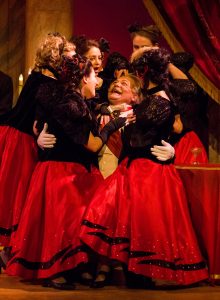
PHOTO COURTESY NICHOLAS WONG/TORONTO CITY OPERA: The Toronto City Opera, now in its 50th season, performs A Merry Widow by Franz Lehár at the Bickford Centre (777 Bloor St. W.). This season’s performances also include a staging of Carmen by Georges Bizet.
READ MORE:
ARTS: Drink L’Elixir d’Amore on Bloor (February 2016)
Tags: Annex · News
March 5th, 2017 · Comments Off on NEWS (FEBRUARY 2017): One last hurrah
Toronto for Everyone celebrates Honest Ed’s
By Geremy Bordonaro
For 68 years, Honest Ed’s welcomed all those who came to its doors. While the store made its last sale on the final day of 2016, it will play host to a grand wake before it closes its doors one last time. And organizers hope the celebration will be a tribute to the spirit of inclusivity that they say was a hallmark of the discount emporium.
Running for four days, An Honest Farewell will include a cocktail party, a community hub, an immersive art maze (clearly a reflection of just how easy it was to get lost in the labyrinthian store), a bargain bash, and, of course, shopping.
“The Honest Ed’s farewell, also the launch of Toronto for Everyone, is an event that is meant to bring together everyone to honour and respect the legacy of the building,” explained Stefan Hostetter, a community director with Toronto for Everyone.
An initiative of the Centre of Social Innovation, Toronto for Everyone is a collaborative team of city-builders, marketers, artistic directors, event planners, and community organizers who are working together to foster inclusivity and a sense of wonder.
“There are some aspirational goals to take Toronto, which is statistically the most diverse city in the world, to a place that is a handy and inclusive example for the world,” continued Hostetter, who saw Honest Ed’s as a bastion of inclusivity in the Annex. When researching how best to send off the store he found that there were many who shared his opinion.
“We found that there was a ton of people speaking of Honest Ed’s as [the] first place where they felt welcomed and accepted in the city,” he said. “With Honest Ed’s they felt like they were actually welcomed and brought into the space.”
It’s a sentiment that rang true for Timna Ben-Ari, a member of Toronto for Everyone’s inclusivity committee. When she arrived in Toronto eight years ago, she experienced first-hand how Honest Ed’s was “an example of what makes Toronto as amazing as it is”.
Ben-Ari believes the closing will bring changes, and that it’s important to mark the occasion with a large-scale event.
“It has had a huge impact. That’s a big part of why this event is not just a celebration, but a recognition of what Honest Ed’s was and what it means that it is closing,” Ben-Ari said. “A lot of this event is around ensuring that there is space for all of those feelings. There will be grieving and that’s understandable.”
While Honest Ed’s may be the key focus, Hostetter wants to honour the local shops and businesses that will also be taking their leave.
“It’s not just Ed’s. It is the entire Mirvish Village…. This is not just the local grocery/everything else store. It’s your local pub, favourite place to eat, art gallery, and dentist. It’s your entire neighbourhood of services that is leaving. To expect that to not be massively destructive would be foolish.”
Joe Cressy (Ward 20, Trinity-Spadina) has fond memories of what Honest Ed’s was like in the past.
“I grew up in the Annex. As a kid I used to go and play tag and hide and seek in there,” Cressy said. “This is part of the lure of Honest Ed’s. We all had a connection to it. Whether it was as a shopper, as a kid playing, or somebody in the neighbourhood who would take photos in front of it. It was a fixture.”
Such connections will make it hard for people to move on from the store but ultimately Cressy thinks that the city moving forward is good as long as events like An Honest Farewell keep us reminded of the past.
“The birth and rebirth of cities and neighbourhoods is part of what allows us to continue to grow and mature,” he said. “There is a loss with an end of an era but ultimately if we do our job right by honouring the history and reflecting on it then we will have done well by Honest Ed’s.”
READ MORE:
CHATTER: Bird was the word for giving (January 2017)
ARTS: Capturing the Ward (October 2015)
Tags: Annex · News
March 5th, 2017 · Comments Off on NEWS (FEBRUARY 2017): Building a stronger relationship
U of T receives final report recommending response to TRC
By Clarrie Feinstein
The Steering Committee for the University of Toronto Response to the Truth and Reconciliation Commission of Canada has answered a call to action. On Dec. 31, 2016, it released Wecheehetowin, a final report on how the university should respond to the dozens of educational reforms recommended by the Truth and Reconciliation Commission.
Taking its title from the Cree word for working together, the report’s recommendations aim to create a more welcoming environment for Indigenous students by having their presence more widely acknowledged in campus spaces. At the heart of the report is a recognition that the university must acknowledge its own role before any meaningful reconciliation can begin.
[pullquote]“When we were forcefully removed from Toronto, people celebrated. This has to be reminded”—Lee Maracle, Traditional Teacher[/pullquote]
“U of T has played a role in the oppression of Indigenous peoples as the university educated generations of political leaders, policy makers, teachers, and civil servants who were a part of the system that created residential schools,” reads the report, which emphasizes the vital importance of evaluating the relationship between the university and the Indigenous community in an honest way.
“The biggest problem the Indigenous community faces at U of T is representation at all levels,” says Jonathan Hamilton-Diabo, co-chair of the steering committee and director of Aboriginal Student Services at First Nations House and coordinator of the Council for Aboriginal Initiatives. “They need to find a place, community, and people on campus, and if these are not readily available then it makes it very difficult for them to feel a sense of belonging.”
The report strives for increased representation and awareness of Indigenous issues in regard to five specific areas: Indigenous spaces, Indigenous faculty, Indigenous curriculum, Indigenous research ethics and community relationships, and Indigenous co-curricular education. Five individual working groups created the recommendations for each of these categories. In total, the report outlines 34 Calls to Action, and recommends specific ways the university can implement certain initiatives in order to make this vision a reality.
“We wanted different approaches and to expand the number of people participating in the process,” says Hamilton-Diabo. The committee included staff, faculty, and students, as well as two Indigenous Elders, Traditional Teacher Lee Maracle and Elder in Residence Andrew Wesley.
There are 500 to 600 students who self-identify as Aboriginal on all three campuses, but Hamilton-Diabo says this is a conservative approximation.
And although First Nations House (the third floor of the North Borden Building on Spadina Avenue) and the Indigenous Studies program offer a space for Indigenous students, such spaces have limited resources and are not centres of focus at the university. The final report outlines ways to make Indigenous spaces more central on St. George campus, and provide opportunities for spiritual practice.
“It goes beyond the physical space,” explains Hamilton-Diabo, “it’s not just about dedicating a building. There has to be more enhanced Indigenous presence for people to see there is an Aboriginal community that is very vibrant here. This can be done with outdoor spaces holding events and ceremonies outside, like a sacred fire or cleansing ceremonies. It’s all about visibility and acknowledgement.”
But visibility is a systemic issue that extends to faculty and staff.
There is no available data on how many Indigenous faculty are hired at U of T, but historically they have been underrepresented. The need for greater representation amongst faculty is essential in enhancing the University’s Indigenous curricular offerings and academic support for Indigenous Students, reflected in the 11 Calls to Action focused on Indigenous faculty. These comprise the largest section of recommendations.
“Hiring practices are starting to change,” says Traditional Teacher Lee Maracle. “There’s no reason why other departments cannot hire Indigenous professors. But we need to make the Indigenous studies program a department, where we can have tenured professors in our own program and expand it.”
The university must develop strategies in close consultation with the Indigenous community on forming hiring targets, which could improve if the Indigenous community realizes that working at an institution like U of T is an attainable goal. “Not everyone who works in the academic world needs a Ph.D. You can work with the campus police, registrar, student services,” says Hamilton-Diabo. “These connections need to be made and if people cannot see the vibrant community that is here people will not want to apply for jobs or student positions.”
As the title of the report suggests, working in tandem with the Indigenous community is an integral step in moving forward and will build the right kind of relationships that historically have not been made.
“People need to see that non-Native students have been placed before Native students in every way,” says Maracle. “We were always dealt the leftovers and left out of the conversation. When we were forcefully removed from Toronto, people celebrated. This has to be reminded. And when people accepted this during the process of writing the report, we managed to have a positive attitude going forward.”
READ MORE:
FOCUS ON EDUCATION: Decolonizing our schools (December 2016)
FOCUS ON EDUCATION: Building a respectful future (November 2016)
HISTORY: Honouring those who honour history (October 2016)
NEWS: U of T committee tasked with responding to Truth and Reconciliation Commission delivers interim report (August 2016)
ON THE COVER: Tracking history in the Annex (April 2016)
Tags: Annex · News
March 5th, 2017 · Comments Off on NEWS (FEBRUARY 2017): New chapter for student residence?
Site recommended for heritage list—impact on development unclear
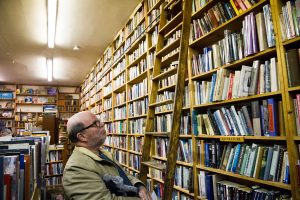
PHOTO BY GEREMY BORDONARO/GLEANER NEWS: Heritage Preservation Services has recommended that 698 Spadina Ave., home to Ten Editions Bookstore, be protected.
By Annemarie Brissenden
City Planning announced its intention to designate 698 Spadina Avenue under the Ontario Heritage Act and list the property on the City of Toronto’s Heritage Register last month. The announcement came four days before a community consultation meeting on the University of Toronto’s application to build a residence at the corner of Spadina and Sussex avenues, an area that includes the site.
It’s still not clear what, if any, impact the listing will have on the university’s plans. The report dated Jan. 12, 2017, still needs to be reviewed by Toronto and East York Community Council (TEYCC) on Feb. 22. If approved, the report will go to Toronto City Council on March 9.
[pullquote]“This is a residence, not a fraternity”—Matthew Thomas, U of T students’ union[/pullquote]
“If council adopts the designation,” said Tamara Anson-Cartwright, a program manager with Heritage Preservation Services (HPS), “then I would say there is another chapter in this project.”
The site has been home to the Ten Editions Bookstore, which since 1984 has been a much-loved fixture of the area.
The report dates to Aug. 12, 2014, when TEYCC directed HPS to assess the heritage value of 698, 700, and 704 Spadina Ave., as well as 54 Sussex Ave. Of the four properties, only 698 was deemed appropriate for a heritage designation.
Built in 1885, the three-storey Victorian block was originally a grocery store topped by residential units. The report highlights it as “an example of a late-Victorian-style, neighbourhood corner store with commercial use at grade and residential units above, featuring decorative brick and wood detailing and a diagonal corner entrance which are characteristic of the type”.
Characterizing the building as a 130-year-old neighbourhood landmark, HPS argues that it is associated with the late nineteenth-century origins of the South Annex and Harbord Village.
Wendy Duff, a member of the family that owns Ten Editions, spoke at the community meeting on Jan. 16.
“There has been a bookstore there for close to 40 years. We should continue to have a bookstore there; it might even be good for the undergraduates,” said Duff. Her mother, Christine, had taken over the store from Atticus Books in 1984, renaming it in honour of her ten children.
But city planner Michelle Knieri cautioned that while a heritage designation would support keeping the building’s nineteenth-century storefront intact, it has little to say about the use of the building itself.
While the university’s representatives admitted they were still digesting the intended heritage designation, they went to great lengths to demonstrate the changes they have made to the application resulting from community feedback.
Anne Macdonald, the university’s director of ancillary services, said the application now features a mix of undergraduate, post-graduate, and faculty housing, a lower student to adviser ratio, mixed room types, and areas that will be accessible to the community.
But what hasn’t changed is the density. “Five hundred and forty beds is the number that we need to make the residence affordable and viable in the first place,” said Scott Mabury, vice president of university operations.
Many in the audience were unconvinced.
Robert Street resident Edward Goudreau argued that profit — both for U of T and the Daniels Corporation — was the motivating factor.
“We’ve only heard what your needs are. How does [this proposal] fit in this place and balance the interests of the community,” asked another audience member, while a third said, “We were never asked if this was a good idea for our historic neighbourhood. It will destroy the eastern entrance to this neighbourhood.”
Matthew Thomas of the U of T students’ union spoke in favour of the proposed residence. Stressing the vibrancy and cultural enrichment he believes the university brings to the area, he acknowledged that “there will be gatherings”, but that “most of the time students will be working.
“This is a residence, not a fraternity.”
“I find it difficult to accept that this is a destruction of our neighbourhood,” said Catherine Bragg, a Harbord Village resident. “This is on a wide avenue on the fringe of our neighbourhood. We’re forgetting about why we are downtown in the first place, and all we can derive from it.”
Conceding that “some important changes have been made over the course of the years,” Joe Cressy (Ward 20, Trinity-Spadina) said the height was still not appropriate.
But, he pointed out, “we’re three years into this process, and we’re not at the Ontario Municipal Board. While what’s here doesn’t have our support, Daniels and the university are still here.”
READ MORE
NEWS: Preventing a wall of towers (October 2016)
CHATTER: Two new rezoning applications submitted to city (September 2016)
NEWS: Tall tower before OMB, as city battles back with block study (August 2016)
NEWS: Planning for the future (May 2016)
DEVELOPINGS: Annual review reflects tension between community activism and OMB (March 2016)
Tags: Annex · News
March 5th, 2017 · Comments Off on CHATTER (FEBRUARY 2017): Welcoming the rooster

PHOTO BY GEREMY BORDONARO/GLEANER NEWS: Dragon City Mall on Spadina Avenue was crowded wall-to-wall for the Chinatown BIA’s celebration of the Lunar New Year on Jan. 28. Representatives from the Toronto Police Service’s 14 Division joined councillors Joe Cressy (Ward 20, Trinity-Spadina), Mike Layton (Ward 19, Trinity-Spadina), Adam Vaughan (MP, Spadina Fort York), and Han Dong (MPP, Trinity-Spadina) for a day of jubilation featuring a traditional dragon dance and inking of the dragon’s eyes.
Tags: Annex · News