April 10th, 2017 · Comments Off on ON OUR COVER (APRIL 2017): Celebrating the city’s third oldest school
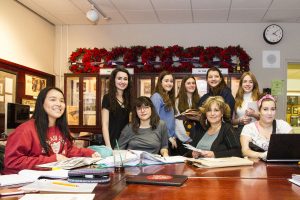
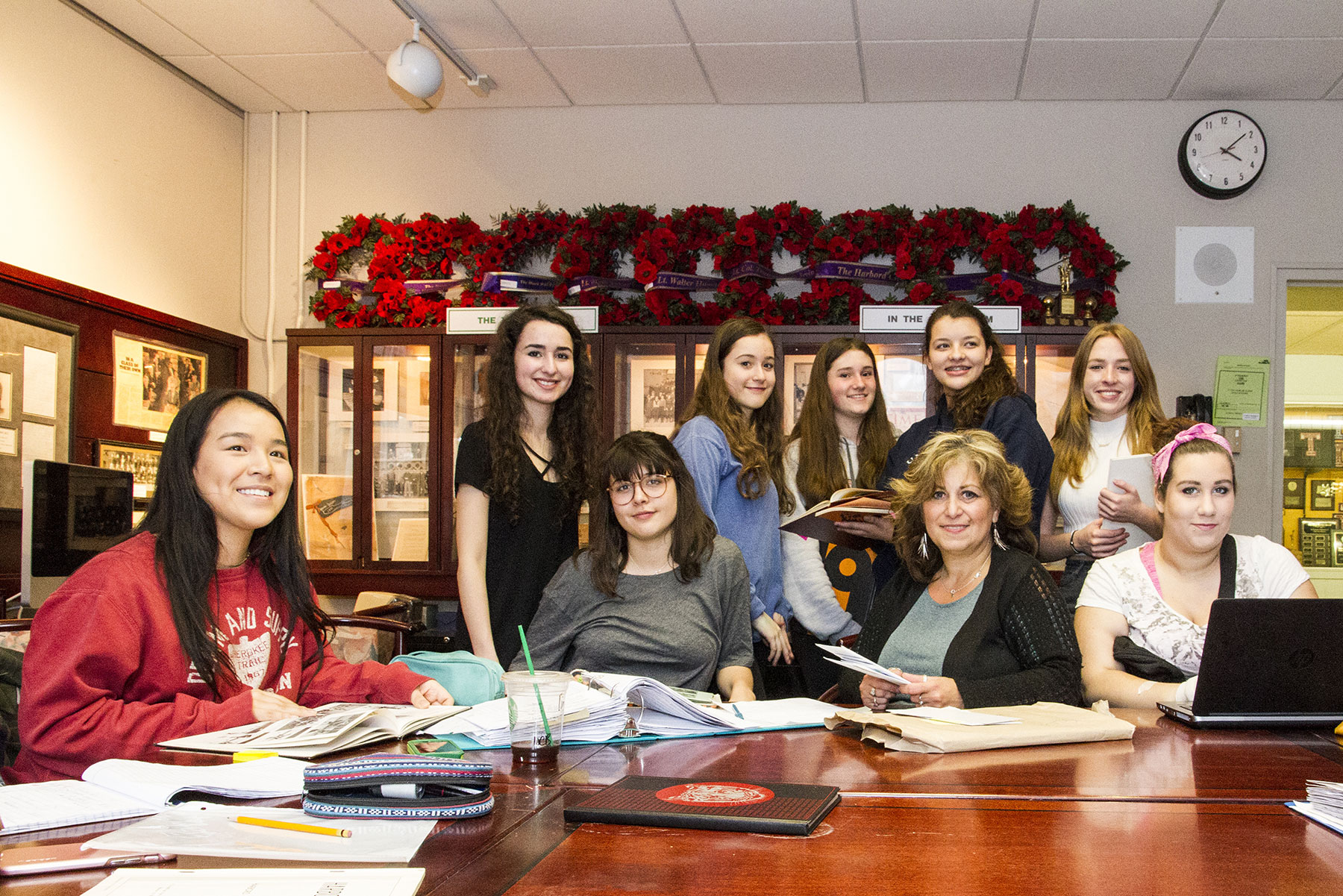
PHOTO BY GEREMY BORDONARO/GLEANER NEWS: Harbord Collegiate Institute teacher Belinda Medeiros-Felix and student volunteers prepare to celebrate the school’s 125th anniversary later this month. They are surrounded by the school’s memorabilia, which are housed in its museum, the first of its kind in Canada. The school is also home to two memorials to the First and Second World wars.
Tags: Annex · News
April 10th, 2017 · Comments Off on NEWS (APRIL 2017): U of T seeks to expand planning exemption
Proposal designates character areas

PHOTO BY BRIAN BURCHELL/GLEANER NEWS: Audience members at a community meeting fear that extending the University of Toronto’s Planning Act exemptions for its St. George campus would lead to additional new development in the area.
By Brian Burchell
The City of Toronto hosted a public meeting to consider expanding the University of Toronto’s exemptions from the Planning Act early last month. Billed as a “pre-application consultation” by the city, it drew community members who questioned the need to broaden the university’s powers.
Approved by the city in 1993 and 1997, the U of T Master and Secondary plans are essentially an area-specific bylaw enabling the university to bypass the Committee of Adjustment when development proposals for its St. George Campus exceed standard restrictions around minimal set-back, building heights, and density.
[pullquote]“We need to keep the institution in the institutional area and out of our nice community and houses”—Bob Barnett, local resident[/pullquote]
The Secondary Plan specified the location of these buildings, and limited the exemptions. The existing bylaw covers 29 potential sites, 16 of which have been or are currently being developed, including the new engineering tower at 47-55 St. George Street north of College Street. It exemplifies the type of infill, height, density, and set-back that the university wants to retain the right to develop under an amended secondary plan.
The proposal covers the same 108 hectares as the Secondary Plan, roughly bounded by College Street, Bloor Street West, Spadina Avenue, and Bay Street. It would apply to building owners in that area, like the Royal Ontario Museum, even though the university owns only 77 of the 108 hectares.
The university has requested carte blanche to build any structure that is consistent with what it has classified as “character areas”: the Historic Campus Character Area, the North Campus Character Area, and the Huron Sussex Character Area. According to the city’s planning department, the planning objectives of each character include conserving and protecting cultural heritage resources, enhancing and expanding the public realm, and identifying opportunities for new development.
City planner Paul Johnson said that while the city agrees with certain aspects of the plan, it still has significant concerns.
It supports basing the proposed policies on heritage and public realm, “looking at it as more of a cultural heritage landscape”, standardizing the building-by-building analysis, and encouraging more cycling and pedestrian activity.
However, said Johnson, the challenge is to find the right balance between flexibility and precision in the area.
“Right now we find the plan overly flexible. It does not provide enough certainty, does not provide enough protection for heritage elements, and does not prevent the significant intrusion of other uses such as private residential and commercial activity in the area.”
He also questioned whether the existing street boundaries still make sense, or whether they should be expanded.
Pino Di Mascio, a partner at Urban Strategies Inc. representing the university at the meeting, said the shift to character areas as a planning guide “is consistent with what is happening elsewhere in the city.
“So much heritage and low-rise existing institutions [need] to be maintained. [There’s also] a need to create an aesthetically pleasing public realm that meets the needs of the students, the staff, the faculty, and the people that meander through the university.”
But it was the identification of opportunities for new development that concerned most of the speakers at the meeting.
Local resident Ray Wolf said the university should be more transparent, and demanded to know whether it planned to put condominiums in the mixed-use areas.
“The university…has been busy acquiring parcels of land south of College Street and east of Spadina [Avenue] for years,” said Ceta Ramkhalawansingh, former councillor (Ward 20, Trinity-Spadina), who spoke on behalf of the Grange Residents’ Association. She also questioned the need for further development when the university’s own documents suggest it has no plans to add students to the St. George Campus, and in fact is planning to change the mix to a more graduate-based student body.
Bob Barnett, a local resident and graduate of the university’s school of architecture in the 1960s, characterized the university’s conduct “as the gorilla escaping, trying to get south of College [Street] and west of Spadina [Avenue]. We need to keep the institution in the institutional area and out of our nice community and houses.”
Barnett praised some the proposal’s language, like “new development will transition into the neighbouring city edges in a context appropriate manner”, but observed that this is not consistent with the U of T’s conduct.
“The university has come to beat up our neighbourhood at Sussex and Spadina and build a 23-storey building right beside two-and-half-storey houses…. There are all sorts of nice words around the room but it ain’t happening.”
The city said it plans to host additional community consultations in the future, each focusing on the plan’s key elements: heritage, open space, active transportation, and built-form. The university is expected to make its formal application in early 2018.
In 1993, Brian Burchell was a governor of the university, and participated in the creation of the original Master Plan. He publishes this newspaper.
READ MORE:
NEWS: New chapter for student residence? (February 2017)
NEWS: Preventing a wall of towers (October 2016)
CHATTER: Two new rezoning applications submitted to city (September 2016)
NEWS: Tall tower before OMB, as city battles back with block study (August 2016)
NEWS: Planning for the future (May 2016)
DEVELOPINGS: Annual review reflects tension between community activism and OMB (March 2016)
Tags: Annex · News
April 10th, 2017 · Comments Off on NEWS (APRIL 2017): Reclaiming the Anishinaabe past
Street-naming project highlights a 15,000-year history
By Clarrie Feinstein
How things are named can be loaded with historical, and often political, significance. Consider Toronto: in the Wendat language, Toronto refers to a fishing weir constructed of standing sticks in the water, implying this was an important gathering area for many Aboriginal peoples as the fish from the weirs would not have been for one specific Indigenous group but many. Toronto is often mistranslated as “gathering place”, which simplifies the complex meaning of the word and the cultural exchanges that took place in the region.
[pullquote]“[We] wanted to highlight the importance of the Anishinaabe language in an activist and creative context”—Susan Blight, Aboriginal Student Life Coordinator at First Nations House[/pullquote]
Within the city itself, our street names — many of which reflect early politicians and landowners — also obscure the deep roots that many Indigenous tribes have in the area. But Ogimaa Mikana, a project to rename and reclaim streets to their original Indigenous names in the Anishinaabe language that dates to 2013, is challenging that historical whitewashing.
“During the height of the Idle No More movement there was a lot of visibility and coverage on Indigenous activism,” said Susan Blight, the Aboriginal Student Life Coordinator at First Nations House, who cofounded the project with fellow artist and activist Hayden King. “[We] wanted to highlight the importance of the Anishinaabe language in an activist and creative context. We came up with the idea of replacing street signs in an interventionist way.”
Blight and King began by covering street signs with Anishinaabemowin street-place names, the first being Queen Street, which they renamed Ogimaa Mikana in tribute to the founding female leaders of the Idle No More movement and Chief Theresa Spence, who at the time was on a hunger strike to protest the treatment of Indigenous peoples in Canada.
“Chief Spence was receiving a lot of misogynistic and racist commentary during this time from the media. As Indigenous activists we felt that reaction towards her in a very visceral way — we wanted to honour these female leaders at the centre of these movements,” Blight explained.
The Queen Street sign was chosen for its prominent and iconic position in the city. By renaming the street in the Anishinaabe language to Ogimaa, meaning leader, and Mikana, meaning path or road, they were paying homage to their ancestral roots and the modern female activists who were taking action to fight injustice.
Bringing historical context to the forefront is a vital ingredient for integrating the strong Indigenous presence and community that is in the city, and this project is a symbolic representation of improving Indigenous visibility.
In 2015, the Dupont by the Castle BIA contacted the Ogimma Mikana project to turn this form of creative activism into a concrete part of Toronto street signage.
“We had put some signs at Davenport and Spadina [roads] because Spadina Road was an anglicised word for Ishpadinaa of which there is a whole history for Indigenous peoples in this area,” Blight said. “Davenport is a vital route as it was the longest road that was used for thousands of years by Indigenous peoples. There is great historical significance in this part of Toronto.”
The renaming of the intersection was brought to the attention of the BIA chair, Stuart Grant, at a BIA meeting by a member of the team.
“We brought this project to the attention of the city,” said Grant, “to see if we could incorporate the Indigenous language on the street signs. Apparently above the street name on the sign there is space for the BIA to use their logo or whatever you want, so we put forth the original Anishinaabe names and the city approved.”
Blight and King acted as language consultants throughout the process and after a year the permanent signs were placed on major streets in the Dupont area. “We wanted to highlight the fact that this area is the site of these ancient trails,” explained Grant. “It has generated interest and conversation.”
The Ogimaa Mikana project is creating visibility and presence on the land that was and is home to many Indigenous peoples. As Canada celebrates its 150th birthday, Blight reminds us that we should also celebrate the 15,000 years of history that colonial and settler history has obscured and eradicated for hundreds of decades.
“We want people to look further into the history and to relearn and speak our languages that hold a central place in our society. And for municipal governments to recognize there are these histories and peoples that deserve a place and visible presence in our city. But this project is ongoing. More will be coming out this summer, so look out for our work.”
Read more
LIFE: Indigenous Games coming in July (March 2017)
NEWS: Building a stronger relationship (February 2017)
FOCUS ON EDUCATION: Decolonizing our schools (December 2016)
FOCUS ON EDUCATION: Building a respectful future (November 2016)
HISTORY: Honouring those who honour history (October 2016)
NEWS: U of T committee tasked with responding to Truth and Reconciliation Commission delivers interim report (August 2016)
ON THE COVER: Tracking history in the Annex (April 2016)
Tags: Annex · News
April 10th, 2017 · Comments Off on CHATTER (APRIL 2017) Miles Nadal JCC receives bomb threat on March 7

PHOTO BY GEREMY BORDONARO/GLEANER NEWS: The Miles Nadal Jewish Community Centre was evacuated for two hours on the morning of March 7 after it received a bomb threat via a robo-call. A Jewish community centre in London, Ontario also received a similar threat around the same time. Over 120 bomb threats have been made against North American Jewish community centres since the start of the year, according to the Centre for Israel and Jewish Affairs.
Tags: Annex · News
April 10th, 2017 · Comments Off on NEWS (APRIL 2017): Students solve mystery
Thomas Fisher Library renovation aims to prevent condensation
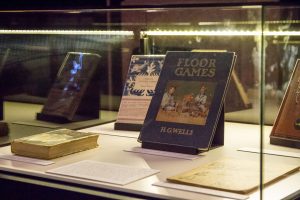
GEREMY BORDONARO/GLEANER NEWS: Thomas Fisher’s rare books are now safe from condensation thanks to student ingenuity.
By Geremy Bordonaro
It’s home to a diverse array of rare manuscripts, and the archives of some our nation’s most prominent scribes. Even as the HMS Terror lies under the Arctic sea, its log books are safely stored within its walls.
Opened in 1973 and a fixture of the University of Toronto’s St. George campus, the Thomas Fisher Rare Book Library has long had a fatal flaw. Condensation has occurred on the inner walls of the library’s mezzanine levels, threatening the integrity of the library’s collection. But an eye-catching exterior renovation, now underway, is addressing the problem.
[pullquote]“We realized some years ago that this was obviously a serious problem for a rare book library”—P. J. Carefoote, librarian[/pullquote]
“The building [is] 40 to 45 years old and in between the inner and the outer wall there was a vapour barrier. Over the years that barrier disintegrated,” said librarian P. J. Carefoote. “That meant that condensation was building up on the inside and it wasn’t being absorbed. We realized some years ago that this was obviously a serious problem for a rare book library.”
He explained the devastating effects of heavy moisture on the rare books if the condensation continued to build up.
“The things that books dislike most of all is fluctuations in humidity and temperature. When you have moisture build-up on the inside there’s a danger that humidity levels are going to go up. When humidity levels go up there’s a danger of mould,” said Carefoote. “Once a book gets mould the treatment is very, very costly, if possible at all.”
Dealing with the problem has proved to be difficult.
All architectural firms suggested the library move all of the books out and close for interior renovations, something out of the question for the library’s manager, John Toyonaga, manager of the library.
“To move that many books, rare books, is a task in itself. Where do you move them to? They can’t just go anywhere,” said Toyonaga. “[They’ve] got to go to a controlled environment. And then if people want to use them they need to be accessible. That is the whole issue why we wouldn’t want to [take] that route. And we didn’t have to.”
It was a group of University of Toronto students who came up with a solution.
“You can give [the university] a problem and [it] groups first year students to come up with options for you. No charge,” he said. “I saw this ad and I went up to my supervisor and said, ‘You know we’ve got nothing to lose. Let’s see what they can come up with.’”
Although the solution has changed considerably from what the students proposed, the group did spark an idea that led to the current work.
“We looked at ways to increase the temperature of the exterior walls. That can be done in a few different ways,” said Jack Albert of RJC Engineers: Structural Engineering, Building Science & Restoration. “The way that it’s being done now avoids the necessity of moving the books. That was one of the big owner concerns.”
RJC has installed purple and yellow layered insulation, and it already appears to be working.
It has also drawn some new eyes to the building.
“The best thing about this is that people at large have noticed that we’re here, which is great. After 40 years, people are starting to realize that there’s a rare book library in Toronto,” said Carefoote. “Oddly enough, having our building turn purple and then turn yellow has really brought it to people’s attention. People have been coming in. It’s a nice side benefit to all this.”
READ MORE:
ABOUT OUR COVER: Arctic amusements (December 2016)
ARTS: HMS Terror found on greeting cards (December 2016)
ABOUT OUR COVER: A red house in winter (December 2015)
Tags: Annex · News
April 10th, 2017 · Comments Off on CHATTER (APRIL 2017) Central Tech Blues take home the bronze
The Central Tech Blues came off an outstanding basketball season with a third-place finish in the National Preparatory Association championships. Led by the association’s 2017 Coach of the Year Kevin Jeffers, the Blues beat out the Toronto Basketball Academy 103 to 93 in a tightly-fought game. Point guard Raheim Sullivan scored 23 points for the Blues, and was awarded player of the game. Fellow team member shooting guard Steven Rahwire was named the league’s most valuable player.
—Justin Vieira/Gleaner News
Tags: Annex · News
April 10th, 2017 · Comments Off on CHATTER (APRIL 2017): Bateman’s Bikes opens new express shop on Dupont Street
Bateman’s Bicycle Company has opened a third store at Dupont Street and Davenport Road. Express Shoppe (149 Dupont St.) offers a variety of bikes, accessories, and quick tune-ups. The company emphasizes bike safety, ensuring that bikes are road-ready quickly and affordably.
“The Annex is one of the main corridors downtown for bicycle commuters. We knew this was a busy traffic area, so that’s one of the main reasons why we wanted to come over here and service it,” said Robert Bateman, the eponymous owner of the company. He said that many customers have stopped in since the store opened its doors.
“We’re very fortunate that the neighbourhood here has responded quite well to our new shop,” Bateman said. “It’s been pretty exciting to be a welcoming addition here and we can’t wait to see how the business will grow.”
—Justin Vieira/Gleaner News
Tags: Annex · News
April 10th, 2017 · Comments Off on CHATTER (APRIL 2017): Pink Day at UTS renews call for tolerance
Community members are invited to don pink and join students from the University of Toronto Schools (UTS) in celebrating International Day of Pink on April 12 for the fourth year in a row. They will also be fundraising for LGBT Youthline, an organization that offers confidential and non-judgmental peer support by telephone, text, and online chat services.
“This year our focus is on educating people about queer intersectionality and how different aspects of being an oppressed group play into how people are treated,” said Esperanza Krementsova, a student and member of the Pink Day crew.
The keynote speaker, Dr. Carys Massarella of St. Joseph’s Health Centre, will share her personal experiences of being transgender.
“Pink day is a very meaningful day for us,” said guidance counsellor Catherine Wachter. “It teaches acceptance and helps to create a safer atmosphere.”
—Justin Vieira/Gleaner News
READ MORE:
NEWS: Celebrating pink at Harbord Collegiate Institute (May 2016)
NEWS: Break out the pink on April 13 (April 2016)
UTS goes pink, students unite (April 2015)
Tags: Annex · News
April 10th, 2017 · Comments Off on FOCUS ON EDUCATION (APRIL 2017): A little Oola, a lot of Boola
Harbord Collegiate celebrates 125 years
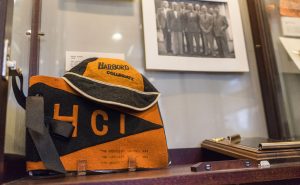
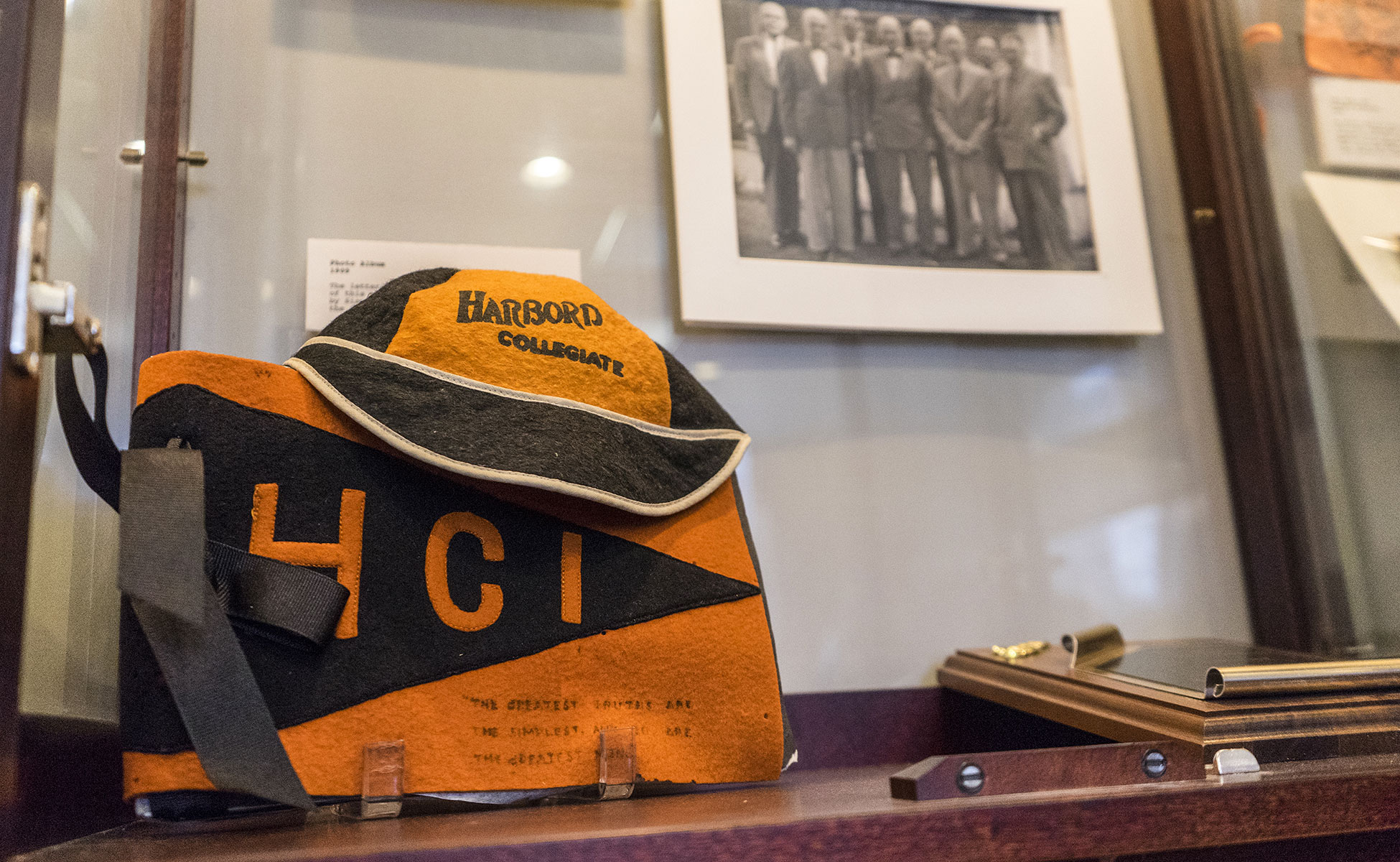
PHOTO BY NEILAND BRISSENDEN: A handmade, felt-covered photo album from 1909 sits in the Harbord Collegiate Institute museum, the first of its kind in Canada. Titled The Brownies at Harbord by Simple Simon, it features a caption reading “The Greatest Truths are the Simplest/And so are the Greatest Men”.
By Annemarie Brissenden
There will be a little bit of Oola and a whole lot of Boola when Harbordites gather later this month to celebrate the 125th anniversary of Harbord Collegiate Institute. Opened in 1892, it’s the third oldest school in the Toronto District School Board, something alumni are quick to tell you should you ask about its history.
They’ll also tell you about three things: it was a haven of diversity long before multiculturalism was even a word, it faithfully honours its alumni who served in the First and Second World Wars, and Wayne and Shuster got their start there in the legendary Oola Boola Club.
[pullquote]“The school for me was an opportunity for the child of an immigrant to be educated in Canada. It’s a symbol of what Canada became. It started at Harbord Collegiate, with immigrant children from all over the world”—Murray Rubin (class of 1950)[/pullquote]
The pair were part of the club, founded in 1932 by teacher Charles Girdler, who recruited students to perform sketch comedy and raise money to pay for stage curtains for the school’s new auditorium.
“To this day, the Oola Boola Club remains a legend among alumni,” writes India Anamanthadoo in the June 2013 issue of The Harbordite, a newsletter for those connected to the school. “Its hysterical, skillful, and even irrational antics left an imprint on the minds of students and staff alike.”
Frank Shuster had met Johnny Wayne two years earlier in a Grade 10 history class, when Wayne sat right behind Shuster. Syd Moscoe, in the December 2012 Harbordite, said, “I flinch when I think what life must have been like for the teacher.”
Such memories have been kept alive thanks to its dedicated alumni. The Harbord Club welcomes all staff, students, and former students connected to the school. It helps with the school museum — the first of its kind in Canada — and is organizing the anniversary celebration.
“The amazing thing about Harbord is its long-standing connection with alumni in the community,” says Vincent Meade, the school’s principal. “Long after graduating, they keep committing their time and resources to the school.”
“I have spent more years at Harbord than not,” laughs teacher Belinda Medeiros-Felix, who is also a Harbord Club director and a member of the class of 1981. The school was renovated during her time as a student, so she “entered a very old, old, building, and graduated out of a new building, which is now old.”
She says her teachers had a great impact on her life, so much so that some attended her wedding.
Recent graduate Nicolas Zuniga (class of 2011) agrees.
“I had a number of great teachers when I was there, and that made it a great experience.”
He’s less connected to the school’s history, but does recognize the importance of Remembrance Day at Harbord, noting “people did their sacrifices for what they believe in”.
“There were an enormous amount of men and at least two nurses that we know of who gave their lives,” says Daniel Leblanc, who volunteers in the museum and teaches a class on archives and local history.
Meade adds that alumni come in to speak about their experience on Remembrance Day, and the history department brings Grade 10 classes down to the archive room.
“After four years, students have a sense of the legacy and why that’s important.”
There are also the two monuments honouring Harbord students who perished in the First and Second World wars standing sentry outside the school. Alumni, led by Murray Rubin (class of 1950), paid to restore the first and install the second.
“It’s the only Second World War monument in Toronto at a school,” says Rubin. “We raised a lot of money from alumni, and now provide scholarships and bursaries for the students. It happens in private schools all the time, not as much in public schools.”
He says he loved his time at Harbord.
“The school for me was an opportunity for the child of an immigrant to be educated in Canada. It’s a symbol of what Canada became. It started at Harbord Collegiate, with immigrant children from all over the world.”
Rubin attended Harbord in what Leblanc says was the school’s heyday: the late 1940s.
“It was the Jewish push right after the Holocaust,” explains Leblanc. “So many students had lost extended family overseas. This became their family, and it shows in the love for their school.”
“You had a lot of first generation immigrants, a lot of Jewish students,” adds John Fulford, whose son goes to Harbord. “They came from similar backgrounds, lived in small homes. Their parents wanted to make sure they had better than they had.”
Rubin says his classmates did very well in school, and because he looked up to them, he knew he had to do so as well.
“The spirit in the school was pervasive. The teachers liked the school because kids did well and they worked hard.”
And now those kids have had kids who are enrolling in Harbord.
“We have generations of Harbordites,” says Meade, including the next Rubin generation.
“My daughter moved into the area, and my grandson is going to Harbord this year,” says Rubin. “That makes me feel so good.”
Harbord Collegiate Institute celebrates its 125th anniversary from April 28 to 30. .
Some notable Harbordites
- Charles Best
- Frank Gehry
- Stanley Grizzle
- Royson James
- Stephen Lewis
- Rosario Marchese
- Joe Pantalone
- Harry Rosen
- Morley Safer
- Sam Shopsowitz
- Sam Sniderman
- Garfield Weston
READ MORE
FROM THE ARCHIVES: Harbord C.I. connects with history (April 2017)
CHATTER: Decade rooms, formal gala, and talent shows to mark Harbord Collegiate’s 125th anniversary (March 2017)
BLACK HISTORY MONTH: A long history of activism (February 2017)
NEWS: Celebrating pink at Harbord Collegiate Institute (May 2016)
Reflections on 32 years of service (August 2014)
Tags: Annex · News
April 10th, 2017 · Comments Off on FROM THE ARCHIVES: Harbord C.I. connects with history
Fully restored statue returns to school
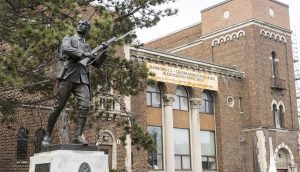
PHOTO BY NEILAND BRISSENDEN/GLEANER NEWS: Our Soldier has watched over Harbord students since 1922.
By Linda Nguyen
A bronze soldier has stood proudly in front of Harbord Collegiate Institute for 83 years. He’s watched students saunter in and out of class each day, watched as they skateboard and chatter at his feet, but most importantly, he’s watched over them.
Nicknamed “Our Soldier” by the school community, he stands as a reminder to each passing generation of the 75 former staff and students who lost their lives in the First World War, and encourages them to remember the 500 from their high school who served for this country.
[pullquote]“There was so much eroding. Our Soldier looked worse for the weather and it was no way to treat the monument, the only monument dedicated to [the First World War] at any high school in Canada”—Sid Moscoe, Harbord Club[/pullquote]
But for the first time, the soldier is not standing in his usual spot and students, although unsure exactly of what he represents, definitely miss his presence.
Chantal Goncalves, 15, says though she doesn’t know what happened to the soldier, Harbord isn’t the same without him. “I think [the soldier is] getting fixed or something. I don’t really know what it represents, probably soldiers going to war. No one told us really, but it’s weird that it’s not there.”
But the truth is, his disappearance has been calculated and planned for the past four years.
Sid Moscoe, 79, a member of the Harbord Club, says the statue was suffering from so much wear and tear that something needed to be done, and fast. “There was so much eroding. Our Soldier looked worse for the weather and it was no way to treat the monument, the only monument dedicated to [the First World War] at any high school in Canada.”
So for four years, the Harbord Club has been raising money to pay for the soldier’s full restoration. And now, with over 300 contributions from private donors, including a large donation from the Garfield Weston Foundation (Weston is also a Harbord graduate), $43,000 has been raised.
On Remembrance Day, Our Soldier will return to his rightful spot in front of the school in a lavish ceremony that will include appearances from political dignitaries, alumni, and a performance from the school choir. All students in the school will pose to recreate a photo taken in 1922 during the original unveiling of the statue. In addition, two students will read their winning essays from a Grade 10 history contest.
Murray Rubin, who attended the high school in 1945, says the essay contest, which will award the two winners with $100, is a way to make the students aware of the history around them in their school.
“The kids today don’t have that feeling in Canada that the war was important and should be remembered. We have to instill it and this [restoration] will do the job. To them it may just be a statue, but the fact that the monument is being looked after has made an impact on students.”
Tim Dingwall, a Harbord history teacher, says that to him, the events surrounding Remembrance Day were something very exciting that he’s never experienced before. “I’m really impressed by it. It’s a very dynamic relationship between Harbord and its history and I know the students appreciate the opportunity to reconnect with history.”
One of Dingwall’s students, Alexandra D’addetta, 15, says she’s eager to start her essay and hopes she will win the contest.
“My grandfather was in World War Two supplying food to soldiers so I definitely care about Remembrance Day, but more people should care too. Anyone can win this contest, why not? I might win. Have some faith in yourself.”
But it’s this faith that is dwindling as the years pass and few First World War veterans are left to tell the tale. Currently there are fewer than five living veterans in Canada from that war.
For Tom Medland, 79, the tale is still too real. His father, a Harbord graduate, was one of the students who fought in the First World War. Medland says that ceremonies like the one planned at Harbord are very important to the community and to the country.
“It’s important for any young person growing up to know the history of the country and how it all began and what it involved. My children were always conscious of what the soldiers did because they grew up knowing their grandfather and seeing pictures of the war. It’s important that everyone gets the opportunity.”
Rubin says when Our Soldier is returned, he hopes students will get the opportunity to understand the battles and struggles that it represents at Harbord.
“The First World War is nothing but history to them but this [soldier] will bring it a lot closer to the school.”
The Harbord Club hopes to raise another $90,000 to install a monument to Second World War veterans on Remembrance Day 2006.
Reprinted from the October 2005 edition of The Annex Gleaner.
The original version contained some typographical errors that have been corrected.
READ MORE
FOCUS ON EDUCATION: A little Oola, a lot of Boola (April 2017)
CHATTER: Decade rooms, formal gala, and talent shows to mark Harbord Collegiate’s 125th anniversary (March 2017)
BLACK HISTORY MONTH: A long history of activism (February 2017)
NEWS: Celebrating pink at Harbord Collegiate Institute (May 2016)
Reflections on 32 years of service (August 2014)
Tags: Annex · History

More how nice!:
FORUM: Celebrating 20 years of cartoonist Brett Lamb (April 2017)
EDITORIAL CARTOON: A second chance! by Brett Lamb 2037 (February 2017)
EDITORIAL CARTOON: Not really! It’s actually nice! by Stumpy the Subway (January 2017)
The stages of voting reform! by Joe Proportion (December 2016)
Previously rejected police car designs! by Designed Without Public Consultation (November 2016)
The sincerest form of flattery! by Dow Indepols (October 2016)
A warm carbon blanket! By Hock Estique (September 2016)
Tags: Annex · Editorial
April 10th, 2017 · 1 Comment
The Toronto and East York Community Council unanimously endorsed a planning staff recommendation to approve Westbank Projects Corp.’s application to redevelop the southwest corner of Bloor and Bathurst streets on April 4. It’s a significant milestone that comes after three years of community consultations and collaborative work between the Vancouver-based developer, planning staff, and community representatives.
Called Mirvish Village, the plan will retain 24 of 27 heritage buildings, and add 804 residential units (over 40 per cent of which will have two or more bedrooms), 200,000 square feet of commercial space, and a new park. Taken together these elements not only create a neighbourhood unto itself, but complement the surrounding community. It’s an innovative and welcome re-imagining of the corner.
[pullquote]“The Westbank precedent has taught us much about municipal planning.”[/pullquote]
The question is no longer so much whether or not this represents intelligent growth. It’s rather two questions: how did we get to such a happy result? And, can the city replicate this approach for other new developments while successfully avoiding the many development atrocities that the Ontario Municipal Board (OMB) permits on our collective landscape?
The Westbank precedent has taught us much about municipal planning. To recreate the magic, one needs a developer with a certain progressive mind-set, a receptive and highly competent planning department (led in this case by Graig Uens), and a community that responds with a constructive tone.
Three years ago, Westbank’s project director Ian Duke told a skeptical audience gathered at the Randolph Academy that, despite having spent reportedly over $70 million for the 3.47-acre site, the company had not yet hired an architect and the closest thing it had to a plan were some guiding principles. He explained the principles clustered around nine points that included residential and commercial components, shared economies (co-op daycare, car share, farmers’ market), heritage, community space, and urban mobility. It would reflect a mix of commercial and residential uses, and all the units would be rental. Moreover, Duke urged the small audience to see Westbank “not as developers but as city builders”.
At the time, few were prepared to accept all this lofty goodness, and many saw Westbank’s pitch as a bunch of “Vancouver hooey”. Privately, some community representatives even admitted they were biased against renters over owners, doubting that renters “could be house-proud”. The extremely low vacancy rate for apartments across the city coupled with certain pressing needs — accommodating a burgeoning population, combatting urban sprawl — are not problems residents’ associations are prepared to solve in their backyards.
To win over the community, and avoid the pitfalls so prevalent in the OMB process, the dynamic duo of councillors Mike Layton (Ward 19, Trinity-Spadina) and Joe Cressy (Ward 20, Trinity-Spadina) decided at the outset to take the developer’s stated position at face value. A comprehensive series of community consultations, private and public, were begun. And the city established a working group (of which the publisher of this newspaper was a member by virtue of his position as chair of the Bloor-Annex BIA) to evaluate the first, second, and third iteration of the development application through four distinct prisms: transportation, heritage, built-form, and public realm. At one of the sessions the group even directly cross-examined the applicant. There were many public engagement opportunities hosted first by Westbank, then by the city’s planning department, and then finally in March of this year by Layton and Cressy.
It was not consultation just for the sake of consultation. The net effect was transformative to the project: significant park space was added, tall structures were relocated from the corners, heritage buildings were meaningfully preserved, and the guidelines in the Bathurst-Bloor Four Corners Study were respected.
As Cressy told The Gleaner: “This is a model for how we want the development community to engage with us. When they work with the community and listen to the community we build better neighbourhoods.”
READ MORE:
EDITORIAL: Foreign buyers tax a necessary cliff jump (March 2017)
EDITORIAL: Clement’s petulance diminishes parliament (February 2017)
EDITORIAL: Pot a remedy in opioid crises (January 2017)
Tags: Annex · Editorial